

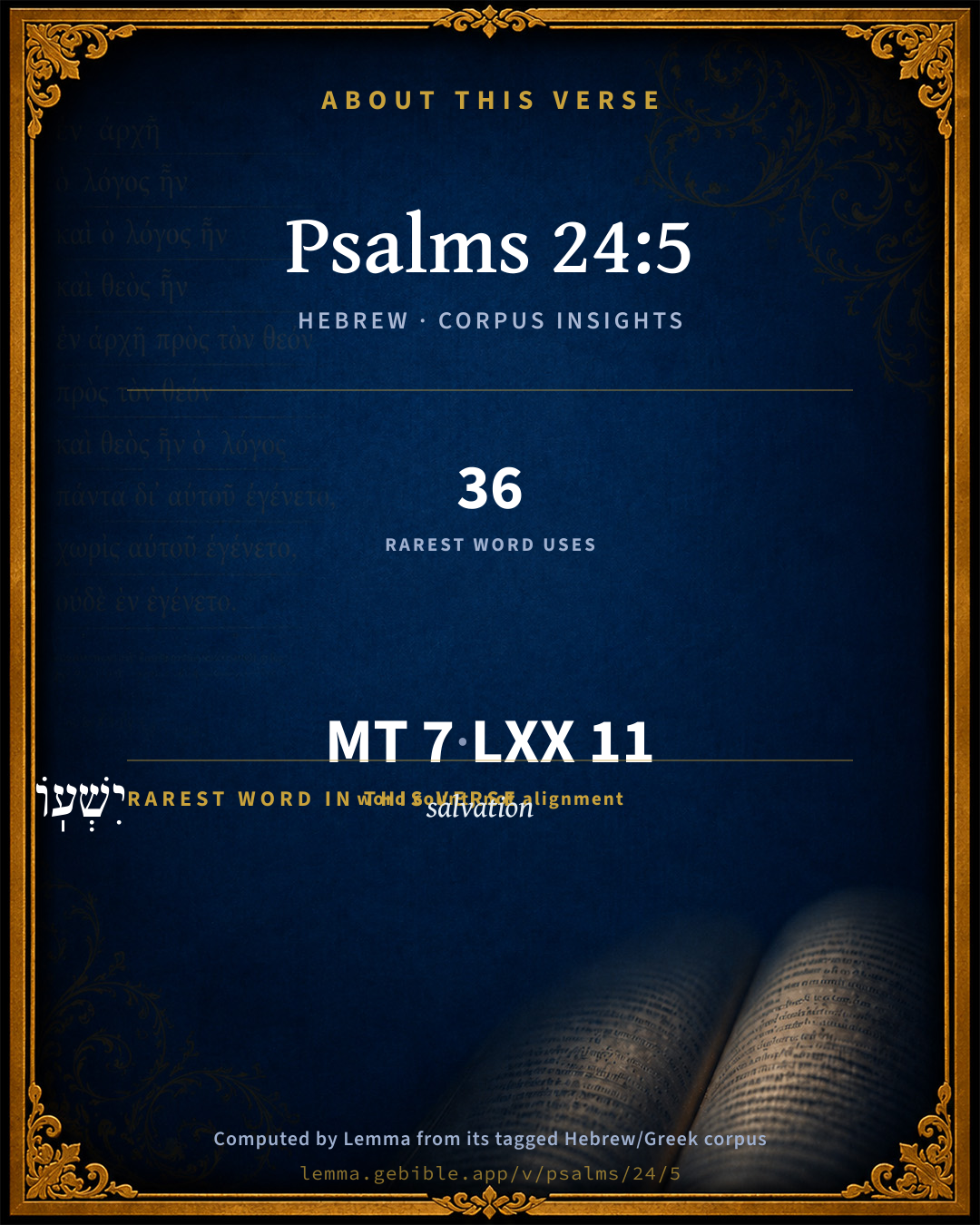
Psalms 24:5

Hebrew (Westminster Leningrad Codex) Psalms 24:5 appears in the Hebrew Old Testament. The text above is from the Westminster Leningrad Codex. Each word links to its Strong’s number, a concise gloss, and parsing drawn from the Open Scriptures Hebrew Bible morphology. Click any word for its full Brown-Driver-Briggs (BDB) entry.
Download image
Cite this verse

Psalms 24:5 (World English Bible). Public Domain. Lemma interlinear Bible study tool, https://lemma.gebible.app/v/psalms/24/5.

Show BibTeX & RIS
BibTeX
RIS
English Translation
He shall receive a blessing from Yahweh, Righteousness from the God of his salvation.
World English Bible · Public Domain
Download a study sheet

One document with this verse’s original text, its word-by-word gloss line, the meaning frame, cross-references with their text, attributed commentary, and full source and license credits — printable, and it pastes into notes with its structure intact.

This verse Autodidact and up

Study sheet (.html) Plain text (.txt)

A passage Seminary Student

Up to 50 verses in one chapter. A passage sheet keeps up to 6 commentary sources and 12 cross-references per verse, in the order this page ranks them, and says so on the sheet whenever that leaves anything out. Ask for a single verse and you get the Autodidact verse sheet above.

Everything on this page stays free to read, with no account — the sheet is a download of what is already on screen, not access to it.

Want to remove ads? Support Godless Engineer
Compare translations 3

The same verse in 3 English versions, stacked beneath the original-language interlinear above. Click any original word for its lexicon entry.

Each is an independent rendering of the whole verse — the interlinear is not word-aligned to these translations.

Highlighted words mark where these versions differ — a whole-verse word diff, not a word-by-word alignment.

  • World English Bible Public Domain
    He shall receive a blessing from Yahweh, Righteousness from the God of his salvation.
  • King James Version Public Domain
    He shall receive the blessing from the LORD, and righteousness from the God of his salvation.
  • unfoldingWord Literal Text CC BY-SA 4.0
    He will take up a blessing from Yahweh and righteousness from the God of his salvation.

unfoldingWord Literal Text — © unfoldingWord, licensed CC BY-SA 4.0. Word-aligned USFM3 via Door43 (git.door43.org/unfoldingWord/en_ult).

Versions to compare (up to 4)

3 of 4 selected

Show all 18 translations

Every available English version of this verse, each an independent rendering of the whole verse.

  • World English Bible Public Domain
    He shall receive a blessing from Yahweh, Righteousness from the God of his salvation.
  • Berean Standard Bible Public Domain
    He will receive blessing from the LORD and vindication from the God of his salvation.
  • Majority Standard Bible Public Domain
    He will receive blessing from the LORD and vindication from the God of his salvation.
  • King James Version Public Domain
    He shall receive the blessing from the LORD, and righteousness from the God of his salvation.
  • American Standard Version (1901) Public Domain
    He shall receive a blessing from Jehovah, And righteousness from the God of his salvation.
  • Revised Version (1885) Public Domain
    He shall receive a blessing from the LORD, and righteousness from the God of his salvation.
  • Geneva Bible (1599) Public Domain
    He shall receiue a blessing from the Lord, and righteousnesse from the God of his saluation.
  • Douay-Rheims (1899) Public Domain
    He shall receive a blessing from the Lord, and mercy from God his Saviour.
  • Young's Literal Translation Public Domain
    He beareth away a blessing from Jehovah, Righteousness from the God of his salvation.
  • Literal Standard Version CC BY-SA 4.0
    He carries away a blessing from YHWH, || Righteousness from the God of his salvation.
  • Unlocked Literal Bible CC BY-SA 4.0
    He will receive a blessing from Yahweh and righteousness from the God of his salvation.
  • unfoldingWord Literal Text CC BY-SA 4.0
    He will take up a blessing from Yahweh and righteousness from the God of his salvation.
  • Darby Bible Public Domain
    He shall receive blessing from Jehovah, and righteousness from the God of his salvation.
  • World Messianic Bible Public Domain
    He shall receive a blessing from the LORD, righteousness from the God of his salvation.
  • Webster's Bible Public Domain
    He shall receive the blessing from the LORD, and righteousness from the God of his salvation.
  • Free Bible Version CC BY-SA 4.0
    They will take with them the blessing of the Lord, vindicated by the God who saves them.
  • Bible in Basic English Public Domain
    He will have blessing from the Lord, and righteousness from the God of his salvation.
  • JPS Tanakh (1917) Public Domain
    He shall receive a blessing from the LORD, and righteousness from the God of his salvation.

Literal Standard Version (2020), Covenant Press — licensed CC BY-SA 4.0. Text via the HelloAO Bible API (eBible.org). Unlocked Literal Bible (unfoldingWord) — licensed CC BY-SA 4.0. Text via the HelloAO Bible API (eBible.org). unfoldingWord Literal Text — © unfoldingWord, licensed CC BY-SA 4.0. Word-aligned USFM3 via Door43 (git.door43.org/unfoldingWord/en_ult). Free Bible Version, Dr. Jonathan Gallagher — licensed CC BY-SA 4.0. Text via the HelloAO Bible API (eBible.org).

Word by word

More ways to search: Search by grammar → Find every occurrence → Compare this word →

Practice this passage: Drill this verse → Learn its vocabulary →

About this verse

These counts appear in no published source. They are computed here, from the morphology-tagged text and Lemma’s own curated glosses. What Lemma adds →

7
words
7
distinct lemmas
Wisdom
section

Shared distinctive vocabulary

יִשְׁעֽוֹ salvation H3468 occurs in 35 verses of the Hebrew Bible. Also found in:

Grammatical profile

  • 1 verb
  • 5 nouns
  • 1 preposition

Verb forms

  • יִשָּׂ֣א Qal · Imperfect

Hebrew & Septuagint length

In English translation the verse runs 14 words from the Hebrew and 14 from the Septuagint (LXX English) — the same length.

A rough comparison of the two English renderings, which tokenize alike — not a word-level alignment.

Word counts can differ between the Hebrew and the Greek without any difference in meaning — e.g. the Hebrew direct-object marker אֵת has no separate Greek word, and Greek often adds the article ὁ.

In the original languages it is 7 Hebrew tokens and 11 Greek tokens — but the two are counted differently (Hebrew bundles its prefixes and suffixes into one token; the Greek is in lemma form), so that isn’t a like-for-like length.

Cross-references

31

Topical passages linked to Psalms 24:5 in the Treasury of Scripture Knowledge — connected by theme and wording, ordered by reader-vote popularity; previews shown in the World English Bible.

  • Philippians 3:9 and be found in him, not having a righteousness of my own, that which is of the law, but that which is through faith in Christ, the righteousness which is from God by faith;
  • Ephesians 1:3 Blessed be the God and Father of our Lord Jesus Christ, who has blessed us with every spiritual blessing in the heavenly places in Christ;
  • Titus 3:4–6 But when the kindness of God our Savior and his love toward mankind appeared,
  • 1 Peter 3:9 not rendering evil for evil, or reviling for reviling; but instead blessing; knowing that to this were you called, that you may inherit a blessing.
  • Isaiah 12:2 Behold, God is my salvation. I will trust, and will not be afraid; for Yah, Yahweh, is my strength and song; and he has become my salvation."
  • Isaiah 46:13 I bring near my righteousness, it shall not be far off, and my salvation shall not wait; and I will place salvation in Zion for Israel my glory.
  • Numbers 6:24–27 'Yahweh bless you, and keep you.
  • Psalms 50:23 Whoever offers the sacrifice of thanksgiving glorifies me, And prepares his way so that I will show God's salvation to him."
  • Psalms 67:6–7 The earth has yielded its increase. God, even our own God, will bless us.
  • Psalms 115:12–13 Yahweh remembers us. He will bless us. He will bless the house of Israel. He will bless the house of Aaron.
  • Romans 4:6–9 Even as David also pronounces blessing on the man to whom God counts righteousness apart from works,
  • Galatians 3:14 that the blessing of Abraham might come on the Gentiles through Christ Jesus; that we might receive the promise of the Spirit through faith.
  • Psalms 68:19 Blessed be the Lord, who daily bears our burdens, Even the God who is our salvation. Selah.
  • Psalms 72:17 His name endures forever. His name continues as long as the sun. Men shall be blessed by him. All nations will call him blessed.
  • Psalms 88:1 Yahweh, the God of my salvation, I have cried day and night before you.
  • Psalms 128:1–5 Blessed is everyone who fears Yahweh, Who walks in his ways.
  • Isaiah 33:15–17 He who walks righteously, and speaks blamelessly; he who despises the gain of oppressions, who shakes his hands from taking a bribe, who stops his ears from hearing of blood, and shuts his eyes from looking on evil:
  • Isaiah 45:17 [But] Israel shall be saved by Yahweh with an everlasting salvation: you shall not be disappointed nor confounded world without end.
  • Isaiah 51:5–6 My righteousness is near, my salvation is gone forth, and my arms shall judge the peoples; the isles shall wait for me, and on my arm shall they trust.
  • Isaiah 51:8 For the moth shall eat them up like a garment, and the worm shall eat them like wool; but my righteousness shall be forever, and my salvation to all generations.
  • Isaiah 54:17 No weapon that is formed against you shall prosper; and every tongue that shall rise against you in judgment you shall condemn. This is the heritage of the servants of Yahweh, and their righteousness which is of me, says Yahweh.
  • Isaiah 61:10 I will greatly rejoice in Yahweh, my soul shall be joyful in my God; for he has clothed me with the garments of salvation, he has covered me with the robe of righteousness, as a bridegroom decks himself with a garland, and as a bride adorns herself with her jewels.
  • Matthew 5:3–12 "Blessed are the poor in spirit, For theirs is the Kingdom of Heaven.
  • John 7:17 If anyone desires to do his will, he will know about the teaching, whether it is from God, or if I am speaking from myself.
  • Romans 3:22 even the righteousness of God through faith in Jesus Christ to all and on all those who believe. For there is no distinction,
  • Romans 5:17–18 For if by the trespass of the one, death reigned through the one; so much more will those who receive the abundance of grace and of the gift of righteousness reign in life through the one, Jesus Christ.
  • 1 Corinthians 1:30 But of him, you are in Christ Jesus, who was made to us wisdom from God, and righteousness and sanctification, and redemption:
  • 2 Corinthians 5:21 For him who knew no sin he made to be sin on our behalf; so that in him we might become the righteousness of God.
  • Galatians 3:9 So then, those who are of faith are blessed with the faithful Abraham.
  • Galatians 5:5 For we, through the Spirit, by faith wait for the hope of righteousness.
  • Titus 2:10–14 not stealing, but showing all good fidelity; that they may adorn the doctrine of God, our Savior, in all things.

Cross-references courtesy of OpenBible.info (CC BY 4.0).

Hebrew and Greek witnesses Masoretic Hebrew ↔ Greek Septuagint

The same verse in the two great witnesses to the Old Testament, shown verse-for-verse.

You’re reading Greek Psalm 23 (Hebrew Psalm 24). The Septuagint counts the superscription, so verse numbers can differ from the Hebrew — chapter-level alignment, not verse-by-verse. Numbering follows Rahlfs.

These are two independent witnesses, not word-aligned to each other, and the Septuagint is shown in lemma (dictionary) form.

Hebrew Psalms 24:5 Masoretic · Westminster Leningrad Codex

יִשָּׂ֣א בְ֭רָכָה מֵאֵ֣ת יְהוָ֑ה וּ֝צְדָקָ֗ה מֵאֱלֹהֵ֥י יִשְׁעֽוֹ

He shall receive a blessing from Yahweh, Righteousness from the God of his salvation.

World English Bible · Public Domain

Greek LXX Greek Psalm 23:5 Septuagint · lemma form

οὗτος λαμβάνω εὐλογία παρά κύριος καί ἐλεημοσύνη παρά θεός σωτήρ αὐτός

He shall receive a blessing from the Lord, and mercy from God his Saviour.

LXX2012 (modern English Septuagint) · Public Domain

Hebrew: Westminster Leningrad Codex (CC BY 4.0). Greek: Septuagint (public domain); English from LXX2012 (modern English Septuagint) (Public Domain). How the Septuagint differs from the Hebrew →

Commentary

Notes on Psalms 24:5 from classic Christian and Jewish commentators (each source and its license shown beneath its notes). The classic Christian expositions comment on the surrounding passage and are grouped to its opening verse, so a note may address several verses; the Jewish commentaries on the Tanakh (Rashi and others) are per-verse, so they appear only where the commentator wrote on this verse.

Lemma curates 59 commentaries, every one of them public domain or Creative Commons licensed, each selected and text-cleaned for this edition rather than reprinted as found. About our sources →

Trapp's Complete Commentary

John Trapp

Psa 24:5 He shall receive the blessing from the LORD, and righteousness from the God of his salvation.

Ver. 5. He shall receive the blessing of the Lord] i.e. Omnimodam felieitatem, all manner of mercies, saith Vatablus; he shall be as happy as heart can wish; for great is the gain of godliness. See my Righteous Man’s Recompense.

And righteousness, &c.] i.e. The fruit and reward of righteousness, which the righteous God will not fail to bestow upon all his; even the crown of righteousness, 2Ti 4:8. A grave interpreter hath here observed, that there is such a reciprocation between the description of this reward and the persons described, that the blessedness assured to the persons exciteth them to the care of piety; and this care of piety bringeth unto them a sure and firm expectation of blessedness (Ames).

John Trapp, A Commentary or Exposition upon All the Books of the Old and New Testament (1647–1656) — public domain. Text from a community e-Sword module.

The Biblical Illustrator

Joseph S. Exell

Psa_24:5

And righteousness from the God of his salvation.

Gods blessing of righteousness

The first glance at these words might suggest that they told us one of the rewards which the man who had fulfilled the preceding requirements received from God. But that would he but a poor thing to say; there would neither be gospel nor logic, as it seems to me, in it. For, according to that, all that was said here would simply be that, if a man would make himself righteous, God would then make him righteous; that if a man cleansed his heart, and got his hands pure and his soul fixed upon God and his lips truthful, then, after that, God would give him righteousness, which, by the hypothesis, he has already got. I do not think that is the meaning of the words, both because such a meaning would destroy the sequence of thought, and because a man cannot so make himself righteous at all. It is more natural to take these words as carrying on the description of the man who is fit to stand in the holy place, than as introducing the new thought of certain other blessings which the righteous man of the previous verse receives. So regarded, we have a deep thought here in answer to the unspoken doubt which must needs arise on hearing such conditions. One can well fancy the hearer replying, your statement of qualifications is only a round-about way of saying No one: how can I or anybody attain these requirements? If these be necessary, we may as well loiter in the flowery vales below as toil up only to see Alps on Alps arise, and the temple shining far above us, inaccessible after all. But if we rightly grasp the sequence of thought here, we have here the blessed truth that Gods impossible requirements are Gods great gifts. We may put that as the second great principle in these verses: the men who are pure receive purity as a gift from God. God will give righteousness. That means here outward and inner purity, or, in effect, the sum of the qualifications already insisted on. That is a grand thought, though it sounds strange to some men, that moral condition--a certain state of heart and mind--can be given to a man. Many people dismiss such a hope as an illusion, and smile at such a gospel as an impossibility. So it is for us. We can but try to bring motives and influences to bear on one another which may tend to shape character. But God can work on the springs of thought and will, and can put into our hearts purity and righteousness, however alien and remote they may be from our natural dispositions and from our past lives. Another great truth here is, that God can put into a mans heart someone germinal principle which shall develop and flower out into all graces and purities and beauties of character: all these things that make up the qualifications, they can all be given to a man in germ from Gods own hand. Still further, these words imply that righteousness, in the sense of purity and holiness, is salvation. He shall receive righteousness from the God of his salvation. David did not merely think of salvation as merely temporal deliverance, and we are not to think of mere deliverance from external punishment or some material hell as exhausting its meaning, but to understand that the main part of salvation is that God shall impart to us Himself, and fill our souls with His righteousness. But we have to remember that all this is made a great deal more plain to us in Jesus Christ. He comes and brings to us a righteousness by which we shall be made pure if we will only love Him and trust Him, and in our hearts there will bloom and grow the exotics of holy and virtuous character, and our lives will be fragrant with the precious fruits of holy and virtuous conduct. By the implanting within us of His own Spirit, by the new life kindred with His own, which we thence derive, of which righteousness is the very life breath--for, as Paul says, The renewed spirit is life because of righteousness--as well as by the mere ordinary means of bringing new and powerful motives to holiness, by the attraction of His own example, and by love which moulds to likeness, Christ gives us righteousness, and implants at least the germ of all purity. The last thought here is--the men who receive righteousness are the men who seek it from God. This is the generation of them that seek Him, that seek Thy face, and, as the last words ought to be rendered, this is Jacob, the true Israel. So then there is an answer to another unspoken question that might arise. The question might still remain--How am I to get this great gift? The Psalmist believed in a heart of love so deep and so Divine that there Was nothing more needed in order to get all the fulness of His righteousness and purity into our stained spirits, but simply to ask for it. To desire is to have, to seek is to possess, to wish is to be enriched with all this purity. And we know how, beyond the Psalmists anticipations and the prophets hopes, that great giving love of God has drawn near to man, in the unspeakable gift of His dear Son, in whom the most sinful amongst us has righteousness, and the weakest amongst us has strength. And we know how the one condition which is needed in order that there should pour down into our foul hearts the cleansing flood of His granted righteousness, is simply that we should be willing to accept, that we should desire to possess, and that we should turn to Christ and get from Him that which He gives. In this world things of little worth have to be toiled for. Nothing for nothing is the inexorable law in the worlds markets, but God sells without money and without price. Life and the air which sustains it are gifts. We have to work for smaller things. In the sweat of our brow we have to win the bread that perishes, but the bread of life the Son of Man will give unto us, and of it we have but to take and eat. Tis only heaven can be had for the asking, Tis only God that is given away. Let us hear the conclusion of the whole matter. Men have been asking all through the ages, Who shall ascend into the hill of the Lord? They have built for themselves Babels that their tops might reach heaven, but it has been all in vain. You have tried to climb. Your progress has been slow, like that of some crawling insect upon some smooth surface--an inch in advance with immense pains, and then a great slide backwards. But heaven bends down to us, and Christ puts down the palm of His hand, if I may say so, and bids us step on to it, and so bears us up on His hands. We shall not rise without our own efforts and many a hard struggle, but He will give us the power to struggle, and the certainty that we shall not set a stout heart to a steep hill in vain. So put away your hopelessness, and cease your painful toils. Say not in thine heart who shall ascend into heaven--the word is nigh thee,--even the word of promise that trusting to Christ, and filled with His strength, we shall mount up with wings as eagles. The conditions may seem hard and even impossible, amounting to a perpetual sentence of exclusion from the presence of God, and therefore from light and well-being. But be of good cheer. If you hunger and thirst after righteousness you shall be filled. Seek God in Christ, and then, though nothing that has not wings can reach the steep summit, you will have the wings of faith and love budding on your shoulders with which you may reach it, and be invested by your righteous Saviour with that fine linen, clean and white, which is the righteousness of saints, arrayed in which you will be fit to pass into the secret place of the Most High, and to dwell for evermore in the blaze of that pure Light. (A. Maclaren, D. D.)

The gift of righteousness

Among the Mexican Catholics there used to be great anxiety to provide themselves with a priests cast-off robe to be buried in. These were begged or bought as the greatest of treasures; kept in sight or always at hand to remind them of approaching death. When their last hour drew near this robe was flung over their breasts and they died happy, their stiffening fingers grasping its folds. The robe of Christs righteousness is not provided for the dying hour merely, for the hasty investiture of the spirit when about to be ushered into the presence of the King.

The Biblical Illustrator, edited by Joseph S. Exell (c. 1880s–1900s) — public domain. Text from a community e-Sword module.

Joseph Benson's Commentary

Psa 24:5. He shall receive the blessing from the Lord — That is, the blessings which God hath promised to his people, namely, grace and glory, and all other good things, Psa 84:11. He, and only he, shall be truly blessed. And righteousness — The fruit or reward of his righteousness, the work being often put for the reward of it: or kindness, or mercy, and those benefits which flow therefrom.

Joseph Benson's Commentary on the Old and New Testaments (1811–1818) — public domain. Text from a community e-Sword module.

J. A. Alexander on Psalms

Joseph Addison Alexander

5. (Psa 24:5) He shall carry away a blessing from Jehovah, and righteousness from the God of his salvation. The first verb seems to have been chosen with some reference to its use in the foregoing verse, but not so as to require us to take it in precisely the same sense. A blessing from Jehovah, not merely from man, with allusion, as some think, to David's blessing the people, 2Sa 6:18.—Righteousness may either mean a practical justification, an attestation of his innocence afforded by his experience of God's favour; or the gift of righteousness itself, the highest and most precious of all gifts, and one which always follows upon justification.—The God of his salvation, i.e. God his Saviour, or his God, who is a Saviour. See above, on Psa 18:47 (46).

Joseph Addison Alexander, The Psalms Translated and Explained (1850) — public domain. Text from a community e-Sword module.

Jamieson, Fausset & Brown

Robert Jamieson, A. R. Fausset & David Brown

righteousness--the rewards which God bestows on His people, or the grace to secure those rewards as well as the result.

Jamieson, Fausset & Brown — Commentary Critical and Explanatory on the Whole Bible (1871) — public domain (CC PDM 1.0). Text via the HelloAO Bible API.

Adam Clarke's Commentary

Verse 5. He shall receive the blessing] Perhaps alluding to Obed-edom, at whose house the ark had been lodged, and on whom God had poured out especial blessings.

And righteousness] Mercy: every kind of necessary good. It is the mercy of God that crowns the obedience and fidelity of good men. For what made them good and faithful? God's mercy. What crowns their fidelity? God's mercy.

Adam Clarke's Commentary on the Bible (1810–1826) — public domain. Text from a community e-Sword/MySword module.

John Calvin's Commentaries

5. He shall receive blessing. The more effectually to move the minds of the Israelites, David declares that nothing is more desirable than to be numbered among the flock of God, and to be members of the church. We must here consider that there is an implied contrast between true Israelites and those of them who were degenerate and bastards. The more license the wicked give themselves, the more presumptuous are they in pretending to the name of God, as if he were under obligation to them, because they are adorned with the same outward symbols or badges as true believers. Accordingly, the demonstrative pronoun this, in the following verse, is of great weight, for it expressly excludes all that bastard generation which gloried only in the mask of external ceremonies. And in this verse, when he speaks of blessing, he intimates that it is not those who boast of being the servants of God, while they have only the name, who shall be partakers of the promised blessing, but those only who answer to their calling with their whole heart, and without hypocrisy. It is, as we have already observed, a very powerful inducement to godliness and an upright life, when the faithful are assured that they do not lose their labor in following righteousness, since God has in reserve for them a blessing which cannot fail them. The word righteousness may be explained two ways. It either means all the benefits of God, by which he proves himself to be righteous and faithful towards his people in keeping his promises to them, or it denotes the fruit or reward of the believer’s righteousness. Indeed, David’s meaning is abundantly manifest. He intends to show on the one hand, that it is not to be expected that the fruit or reward of righteousness will be bestowed on those who unrighteously profane God’s sacred worship; and on the other hand, that it is impossible for God to disappoint his true worshippers; for it is his peculiar office to give evidence of his righteousness by doing them good.

John Calvin's Commentaries (1540-1563) — public domain. Text from the Calvin Translation Society English edition (1840s-50s) via the Christian Classics Ethereal Library (ccel.org). Calvin's coverage is partial (roughly two-thirds of the Bible); uncommented books and verses are honest gaps, never fabricated. The 19th-century editor's footnotes and remarks are omitted so the notes are faithfully Calvin's own voice.

Ellicott's Commentary for English Readers

(5) Righteousness.—This is the real blessing that comes from God. That virtue is her own reward, is the moral statement of the truth. The highest religious statement must be looked for in Christ’s “Beatitudes.”

A Bible Commentary for English Readers, edited by Charles John Ellicott (1878–1897) — public domain. Text from a community e-Sword module.

The Cambridge Bible for Schools and Colleges

gen. ed. J. J. S. Perowne

5. the blessing] R.V. rightly, a blessing.

righteousness] ‘Righteousness’ is blessing in another aspect. Jehovah manifests Himself to the godly man, as ‘the God of his salvation’ (Psa_25:5; Psa_27:9); and this ‘salvation’ is the witness to and reward for his upright conduct. See 1Sa_26:23; Psa_18:20; Psa_18:24; Psa_58:11. In the light of N.T. revelation the words receive a deeper meaning. See Mat_5:6.

The Cambridge Bible for Schools and Colleges (gen. ed. J. J. S. Perowne; Cambridge University Press, 1878–1918) — public domain. Text from a community e-Sword module.

John Gill's Exposition

He shall receive the blessing from the Lord,.... Or "who receives" (l); the future for the present; and so is a continuation of the description of a person proper to enter and abide in the church of God, as Psa 24:6 seems to require; even one who has received every spiritual blessing in Christ in general, special grace out of his fulness; particularly the blessing of pardon, as also adoption, and a right to eternal life; though it may be that the following clause is explanative of this;

and righteousness from the God of his salvation; from Christ, who is God his Saviour, the author of salvation; and who has brought in an everlasting righteousness, which is in him, and is a gift of his grace, and is received from him by faith, and is a great blessing indeed; it secures from condemnation and death, and entitles to eternal life.

(l) "qui accipit", Cocceius.

John Gill's Exposition of the Whole Bible (1746–1763) — public domain (CC PDM 1.0). Text via the HelloAO Bible API.

Albert Barnes' Notes on the Bible

He shall receive the blessing from the Lord - literally, “He shall bear away a blessing from Yahweh.” The blessing here referred to means His favor and friendship. He shall be recognized and treated as His. In other words, God bestows His favor on those who possess the character here referred to.

And righteousness from the God of his salvation - He shall be regarded and treated as righteous. Or, he shall obtain the divine approval as a righteous person. The idea of the psalmist would seem to be, not that he would obtain this as if it were a gift, but that he would obtain the divine “approval” of his character as righteous; he would be recognized and dealt with as a righteous man. He would come to God with “clean hands and a pure heart” Psa 24:4, and would be welcomed and treated as a friend of God. The wicked and the impure could not hope to obtain this; but he who was thus righteous would be treated according to his real character, and would meet with the assurances of the divine favor. It is as true now as it was in the days of the psalmist, that it is only the man who is in fact upright and holy that can obtain the evidences of the divine approval. God will not regard one who is living in wickedness as a righteous man, nor will he admit such a man to His favor here, or to His dwelling-place hereafter.

Albert Barnes' Notes on the Bible (1834–1885) — public domain. Text from a community e-Sword/MySword module.

Matthew Poole's English Annotations

The blessing, i.e. the blessings which God hath promised to his church and people, to wit, grace and glory, and all other good things, as they are summed up, Psa 84:11. He and he only shall be truly blessed. From the Lord; which is added significantly, by way of opposition to the blessings which men received, either from the priests or from other men, which were oftentimes given unto unworthy persons, and in that case were without any effect or benefit; whereas God’s blessings are given only to good men, and are always effectual for their good.

Righteousness, i.e. the blessed fruit or reward of his righteousness, as the work is oft put for the reward of it, as Lev 19:13; Job 7:2; Psa 109:20. Or, kindness or mercy, and those benefits which flow from it, which are oft called by the name of righteousness, as Jdg 5:11; 1Sa 12:7; Psa 48:10; 112:9.

Matthew Poole's English Annotations on the Holy Bible (1683–1685) — public domain. Text from a community e-Sword/MySword module.

The Treasury of David

Charles H. Spurgeon

Ver. 5. It must not be supposed that the persons who are thus described by their inward and outward holiness are saved by the merits of their works; but their works are the evidences by which they are known. The present verse shows that in the saints grace reigns and grace alone. Such men wear the holy livery of the Great King because he has of his own free love clothed them therewith. The true saint wears the wedding garment, but he owns that the Lord of the feast provided it for him, without money and without price.

He shall receive the blessing from the Lord, and righteousness from the God of his salvation. So that the saints need salvation; they receive righteousness, and

the blessing is a boon from God their Saviour. They do not ascend the hill of the Lord as givers but as receivers, and they do not wear their own merits, but a righteousness which they have received. Holy living ensures a blessing as its reward from the thrice Holy God, but it is itself a blessing of the New Covenant and a delightful fruit of the Spirit. God first gives us good works, and then rewards us for them. Grace is not obscured by God's demand for holiness, but is highly exalted as we see it decking the saint with jewels, and clothing him in fair white linen; all this sumptuous array being a free gift of mercy.

Ver. 5. He shall receive the blessing; as before, "Thou shalt set him to be a blessing." Ps 21:6. His name is never without blessing. In him shall all the nations of the earth be blessed. On the mount of his beatitudes, on the heavenly Mount Sion, crowned as "the Son of the Blessed." From the Lord; even "the God and father of our Lord Jesus Christ." Eph 1:3. Isaac Williams.

Ver. 5. He shall receive...righteousness. As for our own righteousness which we have without him, Esay telleth us, "it is a defiled cloth; "and St. Paul, that it is but "dung." Two very homely comparisons, but they be the Holy Ghost's own; yet nothing so homely as in the original, where they be so odious, as what manner of defiled cloth, or what kind of dung, we have not dared to translate. Our own then being no better, we are driven to seek for it elsewhere. "He shall receive his righteousness, "saith the prophet; and "the gift of righteousness, "saith the apostle. Php 3:8-9 Ro 5:17. It is then another, to be given us, and to be received by us, which we must seek for. And whither shall we go for it? Job alone dispatches this point Job 15:15 4:18 25:5. Not to the heavens or stars, they are unclean in his sight. Not to the saints, for in them he found folly. Not to the angels, for neither in them found he steadfastness. Now, if none of these will serve, we see a necessary reason why Jehovah must be a part of this name, "the LORD our righteousness." Jer 23:6. Lancelot Andrewes.

Ver. 5. (second clause). The good man receiving righteousness and needing salvation, or the evangelical meaning of apparently legal passages.

Psalms 24:6*

Charles H. Spurgeon's The Treasury of David (1869–1885) — public domain. Psalms only. Text from a community e-Sword/MySword module.

Whedon's Commentary on the Bible

Daniel D. Whedon

5. Blessing—Refers especially to 2Sa_6:11-12.

Righteousness— “That moral perfection which is the restored and realized image of God.”—Delitzsch. Mat_5:6

Daniel D. Whedon (gen. ed.), Commentary on the Old and New Testaments (1874–1909) — public domain. Text from a community e-Sword module.

The Pulpit Commentary

He shall receive the blessing from the Lord; rather, blessing, without the article. On the pure in thought, word, and act, God"s blessing is sure to rest. (see Mat_5:8) And righteousness from the God of his salvation. To the man who comes to God with an honest and true heart, God will give additional graces, such as justification, assurance, perseverance, unwavering hope, perfect charity.

The Pulpit Commentary (1880–1919), ed. H.D.M. Spence-Jones & Joseph S. Exell — public domain. Text from a community e-Sword module.

John Wesley's Explanatory Notes

The blessing - Grace and glory, and all other good things.

John Wesley, Explanatory Notes Upon the Whole Bible (1754–1765) — public domain. Text via the GEBible commentary corpus.

unfoldingWord translationNotes

Door43 World Missions Community

He will receive a blessing from Yahweh

The word "he" does not refer to a specific person. It refers to the ones with pure hearts mentioned in previous verse. The abstract noun "blessing" can be stated as a verb. AT: "Yahweh will bless them" (See: Generic Noun Phrases and Abstract Nouns)

righteousness from the God of his salvation

The abstract noun "righteousness" can be stated as "righteously." And, "salvation" can be stated as "save." AT: "God will deal righteously with him and save him" (See: Abstract Nouns)

Such is the generation of those who seek him

Here "generation" represents people in general. AT: "The people who seek him are like this" (See: Metonymy)

those who seek him, those who seek the face of the God of Jacob

Both statements mean the same thing. They both refer to those who go to the temple to worship God. AT: "the ones who approach God, they are the ones who may worship God, the one we Israelites worship" (See: Parallelism)

those who seek him

Going to the temple to worship Yahweh is spoken of as if the person is literally seeking to find him. (See: Metaphor)

the face of the God of Jacob

Here "face" stands for the whole person. AT: "the God of Jacob" (See: Synecdoche)

translationWords

receive

bless

righteous

God

save

generation

face

Jacob

selah

unfoldingWord translationNotes — © Distant Shores Media and the Door43 World Missions Community, licensed CC BY-SA 4.0. Source: git.door43.org/Door43/en_tn.

Radak

Rabbi David Kimhi (Radak)

Such an one shall receive a blessing from the Lord, And righteousness from the God of his salvation: – Shall receive (ישׂא), i.e. shall take (יקח), as (Ruth 1:4), “And they took (וישׂאו) them wives.” A blessing on the analogy of (2 Kings 5:15), “Take now a blessing (present) from thy servant.” Or (the) interpretation may be, One shall take to him (a blessing), as (Gen. 43:34), “Messes from before him were taken to them” They who go up into the House of the Lord shall receive a blessing from the Lord, because He will give them His blessing and righteousness, and save them from all trouble, and this is from the God of his salvation.

Radak on the Tanakh — English translations: “Sefaria Community Translation” (CC0 1.0 (public-domain dedication)); “Eliyahu Munk, HaChut Hameshulash” (CC BY 4.0); “Rabbi Mike Feuer, Jerusalem Anthology” (CC BY 4.0); and “R. David Kimhi on the first book of Psalms, Translated by R.G. Finch, London, 1919” (public domain). Text via Sefaria.

Lesson kit

Teaching starters — assembled from the data on this page, not authored interpretation. Every prompt links to the verse data it draws on. Edit before teaching.

Psalms, in the Wisdom, opens this verse with 7 words (7 distinct Hebrew lemmas). Its most distinctive word is yeshaʻ (“salvation”). A historical commentator’s framing appears above. Read the whole chapter for the surrounding context.

Discussion questions

  1. How does “salvation” (yeshaʻ) shape what this verse is saying?
  2. How does 2 Samuel 22:3, which shares the word «salvation», read alongside this verse?
  3. The translations on this page render this verse differently — a whole-verse word diff, not a word-by-word alignment. What might account for the different wordings?
  4. «יִשָּׂ֣א» is a Qal Imperfect verb. How does that grammatical form shape the action described?
  5. Compare how Trapp's Complete Commentary and The Biblical Illustrator read this verse. Where do they agree or differ?

Things to notice

Reading settings

Reading text

Shown beneath each verse's original-language words.

Old Testament
Old Testament edition

Read the OT as the Masoretic Hebrew (MT) or the Greek Septuagint (LXX).

English shown for the Greek Septuagint (in the Hebrew ↔ Greek comparison).

Comparing translations? Open the Compare panel on any verse page to stack up to four side by side.