
Isaiah 63:9

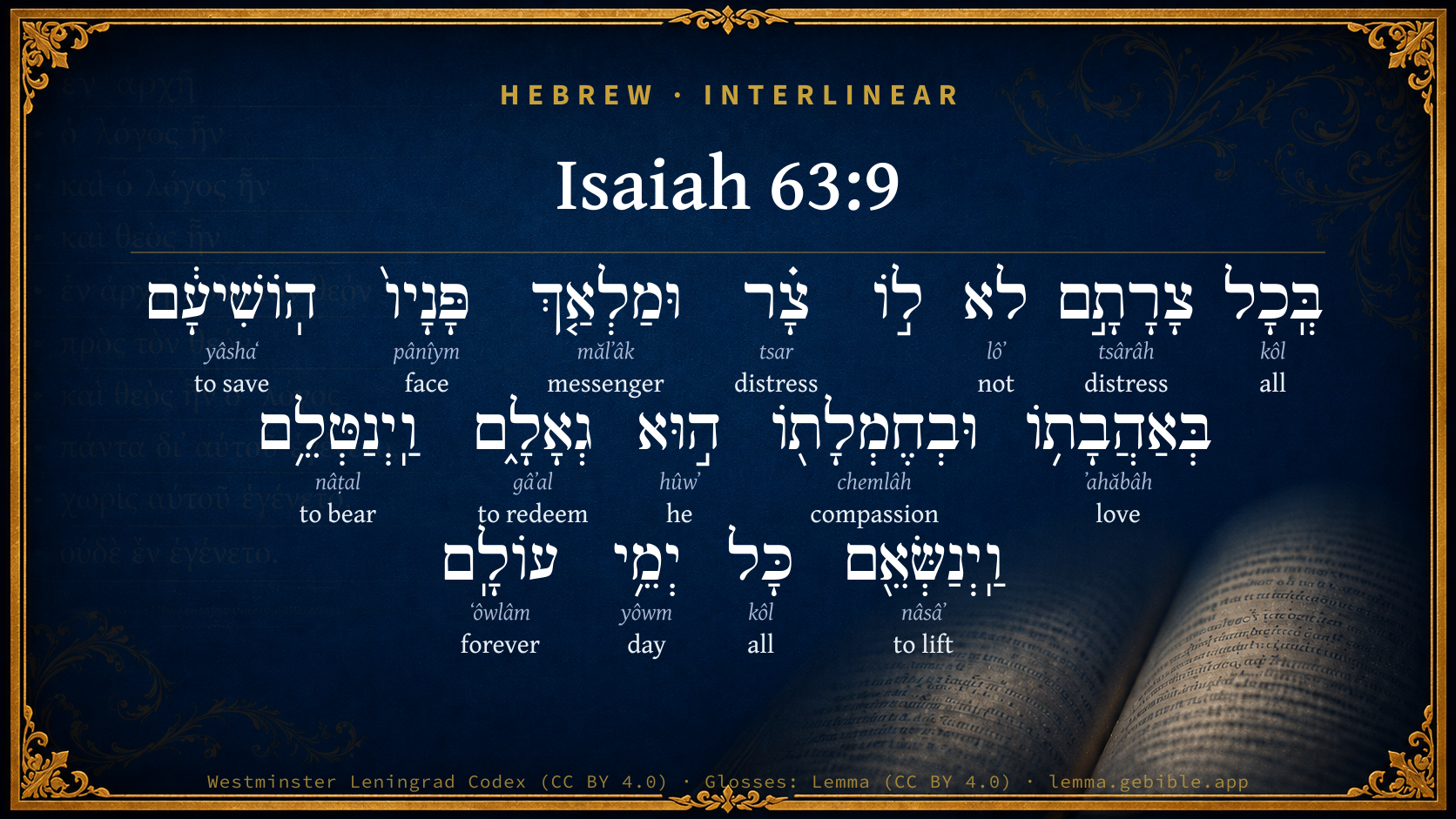
Hebrew (Westminster Leningrad Codex) Isaiah 63:9 appears in the Hebrew Old Testament. The text above is from the Westminster Leningrad Codex. Each word links to its Strong’s number, a concise gloss, and parsing drawn from the Open Scriptures Hebrew Bible morphology. Click any word for its full Brown-Driver-Briggs (BDB) entry.
Download image
Cite this verse

Isaiah 63:9 (World English Bible). Public Domain. Lemma interlinear Bible study tool, https://lemma.gebible.app/v/isaiah/63/9.

Show BibTeX & RIS
BibTeX
RIS
English Translation
In all their affliction he was afflicted, and the angel of his presence saved them: in his love and in his pity he redeemed them; and he bore them, and carried them all the days of old.
World English Bible · Public Domain
Download a study sheet

One document with this verse’s original text, its word-by-word gloss line, the meaning frame, cross-references with their text, attributed commentary, and full source and license credits — printable, and it pastes into notes with its structure intact.

This verse Autodidact and up

Study sheet (.html) Plain text (.txt)

A passage Seminary Student

Up to 50 verses in one chapter. A passage sheet keeps up to 6 commentary sources and 12 cross-references per verse, in the order this page ranks them, and says so on the sheet whenever that leaves anything out. Ask for a single verse and you get the Autodidact verse sheet above.

Everything on this page stays free to read, with no account — the sheet is a download of what is already on screen, not access to it.

Want to remove ads? Support Godless Engineer
Compare translations 3

The same verse in 3 English versions, stacked beneath the original-language interlinear above. Click any original word for its lexicon entry.

Each is an independent rendering of the whole verse — the interlinear is not word-aligned to these translations.

Highlighted words mark where these versions differ — a whole-verse word diff, not a word-by-word alignment.

  • World English Bible Public Domain
    In all their affliction he was afflicted, and the angel of his presence saved them: in his love and in his pity he redeemed them; and he bore them, and carried them all the days of old.
  • King James Version Public Domain
    In all their affliction he was afflicted, and the angel of his presence saved them: in his love and in his pity he redeemed them; and he bare them, and carried them all the days of old.
  • unfoldingWord Literal Text CC BY-SA 4.0
    In all of their affliction, he was not afflicted, and the angel of his face saved them. In his love and in his mercy he, he redeemed them, and he lifted them up and carried them all of the days of eternity.

unfoldingWord Literal Text — © unfoldingWord, licensed CC BY-SA 4.0. Word-aligned USFM3 via Door43 (git.door43.org/unfoldingWord/en_ult).

Versions to compare (up to 4)

3 of 4 selected

Show all 18 translations

Every available English version of this verse, each an independent rendering of the whole verse.

  • World English Bible Public Domain
    In all their affliction he was afflicted, and the angel of his presence saved them: in his love and in his pity he redeemed them; and he bore them, and carried them all the days of old.
  • Berean Standard Bible Public Domain
    In all their distress, He too was afflicted, and the Angel of His Presence saved them. In His love and compassion He redeemed them; He lifted them up and carried them all the days of old.
  • Majority Standard Bible Public Domain
    In all their distress, He too was afflicted, and the Angel of His Presence saved them. In His love and compassion He redeemed them; He lifted them up and carried them all the days of old.
  • King James Version Public Domain
    In all their affliction he was afflicted, and the angel of his presence saved them: in his love and in his pity he redeemed them; and he bare them, and carried them all the days of old.
  • American Standard Version (1901) Public Domain
    In all their affliction he was afflicted, and the angel of his presence saved them: in his love and in his pity he redeemed them; and he bare them, and carried them all the days of old.
  • Revised Version (1885) Public Domain
    In all their affliction he was afflicted, and the angel of his presence saved them: in his love and in his pity he redeemed them; and he bare them, and carried them all the days of old.
  • Geneva Bible (1599) Public Domain
    In all their troubles he was troubled, and the Angel of his presence saued them: in his loue and in his mercie he redeemed them, and he bare them and caried them alwayes continually.
  • Douay-Rheims (1899) Public Domain
    In all their affliction he was not troubled, and the angel of his presence saved them: in his love, and in his mercy he redeemed them, and he carried them and lifted them up all the days of old.
  • Young's Literal Translation Public Domain
    In all their distress `He is' no adversary, And the messenger of His presence saved them, In His love and in His pity He redeemed them, And He doth lift them up, And beareth them all the days of old.
  • Literal Standard Version CC BY-SA 4.0
    In all their distress [He is] no adversary, || And the Messenger of His Presence saved them, || In His love and in His pity He redeemed them, || And He lifts them up, || And carries them all the days of old.
  • Unlocked Literal Bible CC BY-SA 4.0
    Through all their suffering, he suffered too, and the angel from his presence saved them. In his love and mercy he saved them, and he lifted them up and carried them through all the ancient times.
  • unfoldingWord Literal Text CC BY-SA 4.0
    In all of their affliction, he was not afflicted, and the angel of his face saved them. In his love and in his mercy he, he redeemed them, and he lifted them up and carried them all of the days of eternity.
  • Darby Bible Public Domain
    In all their affliction he was afflicted, and the Angel of his presence saved them: in his love and in his pity he redeemed them; and he bore them and carried them all the days of old.
  • World Messianic Bible Public Domain
    In all their affliction he was afflicted, and the angel of his presence saved them. In his love and in his pity he redeemed them. He bore them, and carried them all the days of old.
  • Webster's Bible Public Domain
    In all their affliction he was afflicted, and the angel of his presence saved them: in his love and in his pity he redeemed them; and he bore them, and carried them all the days of old.
  • Free Bible Version CC BY-SA 4.0
    He suffered with them in all their suffering, and the angel of his presence saved them. In his love and kindness he redeemed them. He picked them up and carried them all throughout those years long ago.
  • Bible in Basic English Public Domain
    It was no sent one or angel, but he himself who was their saviour: in his love and in his pity he took up their cause, and he took them in his arms, caring for them all through the years.
  • JPS Tanakh (1917) Public Domain
    In all their affliction He was afflicted, and the angel of His presence saved them; in His love and in His pity He redeemed them; and He bore them, and carried them all the days of old.

Literal Standard Version (2020), Covenant Press — licensed CC BY-SA 4.0. Text via the HelloAO Bible API (eBible.org). Unlocked Literal Bible (unfoldingWord) — licensed CC BY-SA 4.0. Text via the HelloAO Bible API (eBible.org). unfoldingWord Literal Text — © unfoldingWord, licensed CC BY-SA 4.0. Word-aligned USFM3 via Door43 (git.door43.org/unfoldingWord/en_ult). Free Bible Version, Dr. Jonathan Gallagher — licensed CC BY-SA 4.0. Text via the HelloAO Bible API (eBible.org).

Word by word

More ways to search: Search by grammar → Find every occurrence → Compare this word →

Practice this passage: Drill this verse → Learn its vocabulary →

וּבְחֶמְלָת֖וֹ
chemlâh
H2551
“and · in/at · compassion · his”
Conjunction + Preposition + Noun, Common, Feminine, Singular, Construct + Suffix, Personal, 3rd Person, Masculine, Singular
Part of Speech
Conjunction + Preposition + Noun
Type
Common
Gender
Feminine
Number
Singular
State
Construct
Full BDB Definition

Origin: from H2550

TWOT: TWOT- 676a

mercy, pity, compassion
  1. בְּֽכָל kôl H3605 “in/at · all of” Preposition + Noun, Common, Masculine, Singular, Construct
  2. צָרָתָ֣ם tsârâh H6869 “distress · their” Noun, Common, Feminine, Singular, Construct + Suffix, Personal, 3rd Person, Masculine, Plural
  3. לא lôʼ H3808 “not” Particle, Negative
  4. צָ֗ר tsar H6862 “distress” Adjective, Adjective, Masculine, Singular, Absolute
  5. וּמַלְאַ֤ךְ mălʼâk H4397 “and · messenger of” Conjunction + Noun, Common, Masculine, Singular, Construct
  6. פָּנָיו֙ pânîym H6440 “face(s) · his” Noun, Common, Both, Plural, Construct + Suffix, Personal, 3rd Person, Masculine, Singular
  7. הֽוֹשִׁיעָ֔ם yâshaʻ H3467 “to save · them” Verb, Hiphil, Perfect, 3rd Person, Masculine, Singular + Suffix, Personal, 3rd Person, Masculine, Plural
  8. בְּאַהֲבָת֥וֹ ʼahăbâh H160 “in/at · love · his” Preposition + Noun, Common, Feminine, Singular, Construct + Suffix, Personal, 3rd Person, Masculine, Singular
  9. ה֣וּא hûwʼ H1931 “he” Pronoun, Personal, 3rd Person, Masculine, Singular
  10. גְאָלָ֑ם gâʼal H1350 “to redeem · them” Verb, Qal, Perfect, 3rd Person, Masculine, Singular + Suffix, Personal, 3rd Person, Masculine, Plural
  11. וַֽיְנַטְּלֵ֥ם nâṭal H5190 “and · to bear · them” Conjunction + Verb, Piel, Sequential Imperfect, 3rd Person, Masculine, Singular + Suffix, Personal, 3rd Person, Masculine, Plural
  12. וַֽיְנַשְּׂאֵ֖ם nâsâʼ H5375 “and · to lift · them” Conjunction + Verb, Piel, Sequential Imperfect, 3rd Person, Masculine, Singular + Suffix, Personal, 3rd Person, Masculine, Plural
  13. כָּל kôl H3605 “all of” Noun, Common, Masculine, Singular, Construct
  14. יְמֵ֥י yôwm H3117 “days of” Noun, Common, Masculine, Plural, Construct
  15. עוֹלָֽם ʻôwlâm H5769 “forever” Noun, Common, Masculine, Singular, Absolute

About this verse

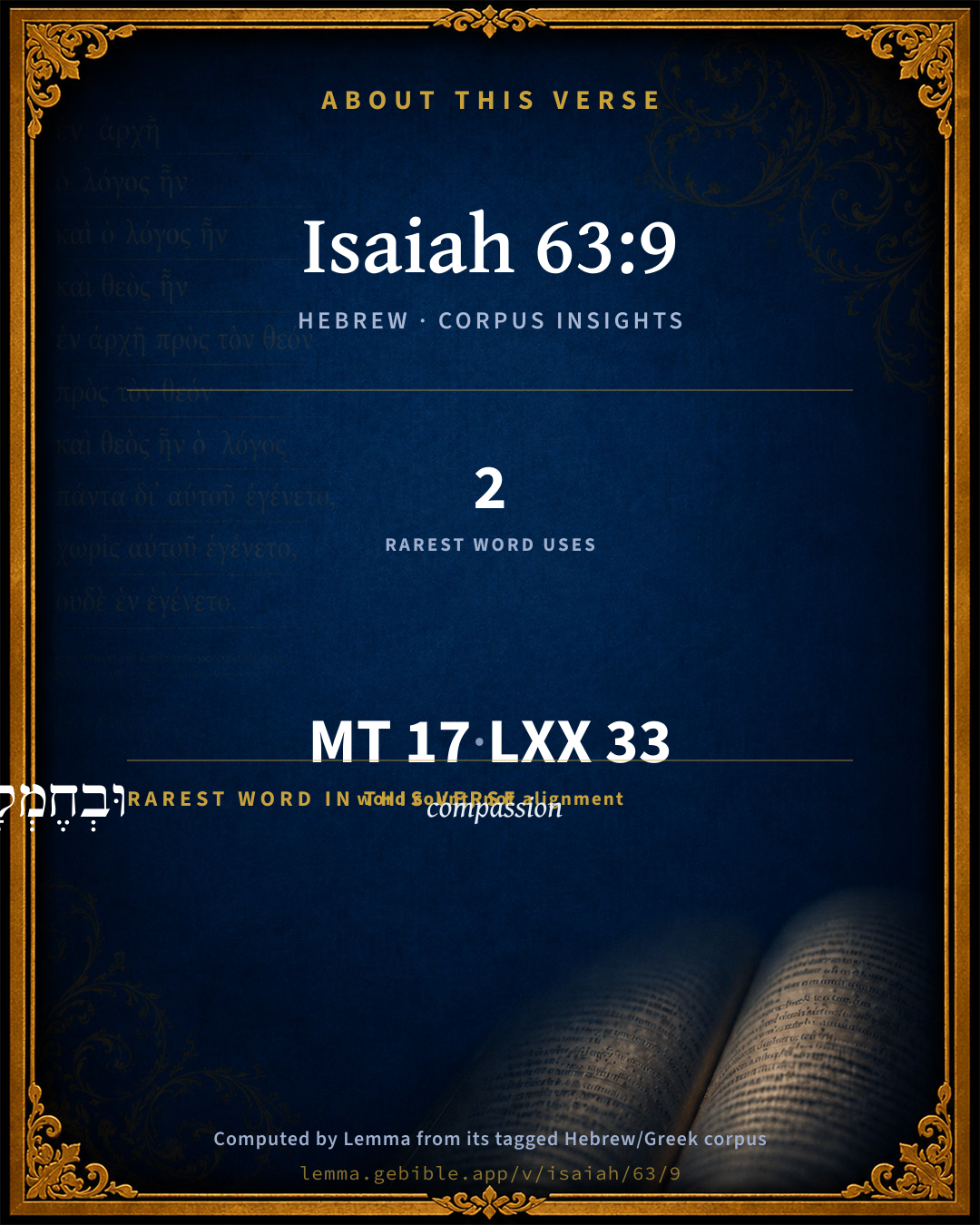
These counts appear in no published source. They are computed here, from the morphology-tagged text and Lemma’s own curated glosses. What Lemma adds →

17
words
15
distinct lemmas
Prophets
section

Notable vocabulary

The rarest word here is וּבְחֶמְלָת֖וֹ compassion H2551 — appearing just 2 times in the whole Hebrew Bible.

Shared distinctive vocabulary

וּבְחֶמְלָת֖וֹ compassion H2551 occurs in 2 verses of the Hebrew Bible. Also found in:

Grammatical profile

  • 4 verbs
  • 9 nouns
  • 1 adjective
  • 1 pronoun
  • 1 preposition
  • 1 particle

Verb forms

  • הֽוֹשִׁיעָ֔ם Hiphil · Perfect
  • גְאָלָ֑ם Qal · Perfect
  • וַֽיְנַטְּלֵ֥ם Piel · Sequential Imperfect
  • וַֽיְנַשְּׂאֵ֖ם Piel · Sequential Imperfect

Repetition

A word recurs within this verse — often emphatic in Hebrew:

  • בְּֽכָל all H3605 ×2

Hebrew & Septuagint length

In English translation the verse runs 37 words from the Hebrew and 39 from the Septuagint (LXX English) — closely comparable.

A rough comparison of the two English renderings, which tokenize alike — not a word-level alignment.

Word counts can differ between the Hebrew and the Greek without any difference in meaning — e.g. the Hebrew direct-object marker אֵת has no separate Greek word, and Greek often adds the article ὁ.

In the original languages it is 17 Hebrew tokens and 33 Greek tokens — but the two are counted differently (Hebrew bundles its prefixes and suffixes into one token; the Greek is in lemma form), so that isn’t a like-for-like length.

Cross-references

33

Topical passages linked to Isaiah 63:9 in the Treasury of Scripture Knowledge — connected by theme and wording, ordered by reader-vote popularity; previews shown in the World English Bible.

  • Exodus 33:14 He said, "My presence will go with you, and I will give you rest."
  • Exodus 23:20–21 "Behold, I send an angel before you, to keep you by the way, and to bring you into the place which I have prepared.
  • Malachi 3:1 "Behold, I send my messenger, and he will prepare the way before me; and the Lord, whom you seek, will suddenly come to his temple; and the messenger of the covenant, whom you desire, behold, he comes!" says Yahweh of hosts.
  • Acts 7:34–35 I have surely seen the affliction of my people that is in Egypt, and have heard their groaning. I have come down to deliver them. Now come, I will send you into Egypt.'
  • Acts 12:11 When Peter had come to himself, he said, "Now I truly know that the Lord has sent out his angel and delivered me out of the hand of Herod, and from everything the Jewish people were expecting."
  • Exodus 14:19 The angel of God, who went before the camp of Israel, moved and went behind them; and the pillar of cloud moved from before them, and stood behind them.
  • Exodus 19:4 'You have seen what I did to the Egyptians, and how I bore you on eagles' wings, and brought you to myself.
  • Deuteronomy 1:31 and in the wilderness, where you have seen how that Yahweh your God bore you, as a man does bear his son, in all the way that you went, until you came to this place.
  • Deuteronomy 7:7–8 Yahweh didn't set his love on you, nor choose you, because you were more in number than any people; for you were the fewest of all peoples:
  • Psalms 106:7–10 Our fathers didn't understand your wonders in Egypt. They didn't remember the multitude of your loving kindnesses, But were rebellious at the sea, even at the Red Sea.
  • Judges 10:16 They put away the foreign gods from among them, and served Yahweh; and his soul was grieved for the misery of Israel.
  • Psalms 78:38 But he, being merciful, forgave iniquity, and didn't destroy them. Yes, many times he turned his anger away, And didn't stir up all his wrath.
  • Genesis 48:16 the angel who has redeemed me from all evil, bless the lads, and let my name be named on them, and the name of my fathers Abraham and Isaac. Let them grow into a multitude in the midst of the earth."
  • Exodus 3:7–9 Yahweh said, "I have surely seen the affliction of my people who are in Egypt, and have heard their cry because of their taskmasters, for I know their sorrows.
  • Deuteronomy 32:10–12 He found him in a desert land, In the waste howling wilderness; He compassed him about, he cared for him, He kept him as the apple of his eye.
  • Hebrews 4:15 For we don't have a high priest who can't be touched with the feeling of our infirmities, but one who has been in all points tempted like we are, yet without sin.
  • 1 John 4:9–10 By this was God's love revealed in us, that God has sent his one and only Son into the world that we might live through him.
  • Revelation 1:5 and from Jesus Christ, the faithful witness, the firstborn of the dead, and the ruler of the kings of the earth. To him who loves us, and washed us from our sins by his blood;
  • Isaiah 46:3–4 Listen to me, house of Jacob, and all the remnant of the house of Israel, that have been borne [by me] from their birth, that have been carried from the womb;
  • Hosea 12:3–5 In the womb he took his brother by the heel; And in his manhood he had power with God.
  • Zechariah 2:8 For thus says Yahweh of hosts: 'For honor he has sent me to the nations which plundered you; for he who touches you touches the apple of his eye.
  • Titus 2:14 who gave himself for us, that he might redeem us from all iniquity, and purify for himself a people for his own possession, zealous for good works.
  • Revelation 5:9 They sang a new song, saying, "You are worthy to take the book, And to open its seals: For you were killed, And bought us for God with your blood, Out of every tribe, language, people, and nation,
  • Genesis 22:11–17 The angel of Yahweh called to him out of the sky, and said, "Abraham, Abraham!" He said, "Here I am."
  • Hebrews 2:18 For in that he himself has suffered being tempted, he is able to help those who are tempted.
  • Acts 7:30–32 "When forty years were fulfilled, an angel of the Lord appeared to him in the wilderness of Mount Sinai, in a flame of fire in a bush.
  • Acts 7:38 This is he who was in the assembly in the wilderness with the angel that spoke to him on Mount Sinai, and with our fathers, who received living oracles to give to us,
  • Hosea 1:7 But I will have mercy on the house of Judah, and will save them by Yahweh their God, and will not save them by bow, nor by sword, nor by battle, by horses, nor by horsemen."
  • Matthew 25:40 "The King will answer them, 'Most assuredly I tell you, inasmuch as you did it to one of the least of these my brothers, you did it to me.'
  • Matthew 25:45 "Then he will answer them, saying, 'Most assuredly I tell you, inasmuch as you didn't do it to one of the least of these, you didn't do it to me.'
  • Luke 15:5 When he has found it, he carries it on his shoulders, rejoicing.
  • Acts 9:4 He fell on the earth, and heard a voice saying to him, "Saul, Saul, why do you persecute me?"
  • 1 Corinthians 10:9 Neither let us test the Lord, as some of them tested, and perished by the serpents.

Cross-references courtesy of OpenBible.info (CC BY 4.0).

Hebrew and Greek witnesses Masoretic Hebrew ↔ Greek Septuagint

The same verse in the two great witnesses to the Old Testament, shown verse-for-verse.

These are two independent witnesses, not word-aligned to each other, and the Septuagint is shown in lemma (dictionary) form.

Hebrew Isaiah 63:9 Masoretic · Westminster Leningrad Codex

בְּֽכָל צָרָתָ֣ם לא ל֣וֹ צָ֗ר וּמַלְאַ֤ךְ פָּנָיו֙ הֽוֹשִׁיעָ֔ם בְּאַהֲבָת֥וֹ וּבְחֶמְלָת֖וֹ ה֣וּא גְאָלָ֑ם וַֽיְנַטְּלֵ֥ם וַֽיְנַשְּׂאֵ֖ם כָּל יְמֵ֥י עוֹלָֽם

In all their affliction he was afflicted, and the angel of his presence saved them: in his love and in his pity he redeemed them; and he bore them, and carried them all the days of old.

World English Bible · Public Domain

Greek LXX Isaiah 63:9 Septuagint · lemma form

ἐκ πᾶς θλῖψις οὐ πρέσβυς οὐδέ ἄγγελος ἀλλά αὐτός κύριος σώζω αὐτός διά ὁ ἀγαπάω αὐτός καί φείδομαι αὐτός αὐτός λυτρόω αὐτός καί ἀναλαμβάνω αὐτός καί ὑψόω αὐτός πᾶς ὁ ἡμέρα ὁ αἰών

out of all their affliction: not an ambassador, nor a messenger, but himself saved them, because he loved them and spared them: he himself redeemed them, and took them up, and lifted them up all the days of old.

LXX2012 (modern English Septuagint) · Public Domain

On this verse, The Biblical Illustrator discusses the Septuagint’s reading. Read the note in Commentary ↓

Hebrew: Westminster Leningrad Codex (CC BY 4.0). Greek: Septuagint (public domain); English from LXX2012 (modern English Septuagint) (Public Domain). How the Septuagint differs from the Hebrew →

Targum (Aramaic paraphrase)

1

The Targum is the ancient Jewish Aramaic paraphrase of the Hebrew Scriptures — an interpretive translation, not the Hebrew text itself. Onkelos (literal) and Pseudo-Jonathan (expansive) render the Torah, and Jonathan the Prophets. Coverage is partial: where no permissively-licensed English translation exists for a verse, only the Aramaic is shown. This is verse-level text, not a word-by-word alignment to the Hebrew.

  1. Targum Jonathan Prophets (Joshua–Malachi)
    בְּכָל עִדַן דְחָבוּ קֳדָמוֹהִי לְאַיְתָאָה עֲלֵיהוֹן עָקָא לָא אָעִיק לְהוֹן וּמַלְאַךְ שְׁלִיחַ מִן קֳדָמוֹהִי פְרֵיקִינוּן בְּרַחֲמָתֵהּ וּבִמְחָסֵהּ עֲלֵיהוֹן הָא שֵׁיזְבִינוּן וְנַטְלִינוּן וְסוֹבְרִינוּן כָּל יוֹמֵי עַלְמָא:

    Whenever they sinned against Him, that He might have brought upon them distress, He did not distress them; but an angel was sent from Him, who in His mercy redeemed them; and in His compassion, behold, He delivered them; and He bare them, and carried them all the days of old.

    Targum Jonathan — Aramaic: “Mikraot Gedolot” (public domain). English: “Sefaria Community Translation” (CC0 1.0 (public-domain dedication)); “London "Chaldee Paraphrase," 1871” (public domain). Text via Sefaria.

Commentary

Notes on Isaiah 63:9 from classic Christian and Jewish commentators (each source and its license shown beneath its notes). The classic Christian expositions comment on the surrounding passage and are grouped to its opening verse, so a note may address several verses; the Jewish commentaries on the Tanakh (Rashi and others) are per-verse, so they appear only where the commentator wrote on this verse.

Lemma curates 59 commentaries, every one of them public domain or Creative Commons licensed, each selected and text-cleaned for this edition rather than reprinted as found. About our sources →

Trapp's Complete Commentary

John Trapp

Isa 63:9 In all their affliction he was afflicted, and the angel of his presence saved them: in his love and in his pity he redeemed them; and he bare them, and carried them all the days of old.

Ver. 9. In all their afflictions he was afflicted.] See Exo 3:7; Exo 3:9 Jdg 10:16 Zec 2:8 Act 9:4 Jer 31:20. O God, we may better say, than the poet did of Augustus -

“ Est placidus, facilisque parens, veniaeque paratus:

Et qui fulmineo saepe sine igne tonat.

Qui rum triste aliquid statuit, fit tristis et ipse:

Cuique fere poenam sumere poena sua est. ”{ a}

And the angel of his presence saved them,] i.e., Jesus Christ, who is called the "face of God"; {Exo 33:14-15} "the image of the invisible God"; {Col 1:15} whom whoso "hath seen, hath seen the Father also"; {Joh 14:9} he "who is in the bosom of the Father"; {Joh 1:18} and as an everlasting priest mediateth and ministereth in the presence of his Father, making request for us; {Heb 9:24 Rev 8:3} that "angel of the covenant." {Mal 3:1}

And he bare them.] As parents do their young children.

And carried them.] As eagles do their young. See Exo 19:4 Deu 32:11. {See Trapp on "Deu 32:11"}

{a} De Ponto, ii., Eleg. 2.

John Trapp, A Commentary or Exposition upon All the Books of the Old and New Testament (1647–1656) — public domain. Text from a community e-Sword module.

The Biblical Illustrator

Joseph S. Exell

Isa_63:9

In all their affliction He was afflicted

God not impassive

Just as a man may feel pain, whilst in his own person he is raised above it, so God feels pain without His blessedness suffering hurt; and so He felt His peoples suffering; it did not remain unreflected in His own life; it moved Him inwardly.

(F. Delitzsch, D. D.)

The Angel of His presence

1. The Presence (lit. Face) of Jehovah is used elsewhere of His self-manifestation. The fundamental passage is Exo_33:14-15. But compare also Deu_4:37; Lam_4:16.

2. An angel of the Presence, on the other hand, is a figure elsewhere unknown to the Old Testament: the phrase would seem to be a confusion of two forms of expression, incident to a midway stage of revelation (Cheyne).

3. The Face of Jehovah, however, is not (as the LXX inferred) just the same as Jehovah Himself in person. It is rather a name for His highest sensible manifestation, and hardly differs from what is in other places called the Malak Yahveh (Angel of Jehovah). This is shown by the comparison Exo_33:14 f with Exo_23:20-23. The verse, therefore, means that it was no ordinary angelic messenger, but the supreme embodiment of Jehovahs presence that accompanied Israel in the early days. (Prof. J. Skinner, D. D.)

The Angel in whom Jehovah was seen; who was Jehovah Himself in manifestation. (A. B. Davidson, D. D.)

Not some one of the ministering spirits, nor some one of the angel-princes standing in Gods immediate presence (archangels), but the one whom God makes the medium of His presence in the world for affecting the revelation of Himself in sacred history. (F. Delitzsch, D. D.)

The Angel of His presence

The great majority of men dread affliction more than they dread sin. And yet the two things are related--sometimes as cause and effect and sometimes by more distant connections.

I. AFFLICTIONS MAY BE DIVIDED INTO THREE CLASSES--the physical, the mental, and the emotional. Not that we can ever totally separate these three, but for purposes of consideration it may be practicable to do so.

1. It is very hard to resist a plea from physical disability. It is well that it should be so, for callous indifference to the causes of sorrow and pain found in the lives of others is surely a most unpromising state. Anything which will draw us out of ourselves, and keep us from being self-contained, must surely be, in some sort, a servant of God. Our Lord recognized the physical afflictions of men and entered sympathetically into them.

2. But physical afflictions, though more impressive, are oftentimes more endurable than mental afflictions. Indeed, when we come to the last analysis of the case, we find that the mental region is the region where pain reports itself. If we could totally separate the physical and mental, and keep the mind clear and calm while the body suffered its pains and penalties, affliction would be a very different matter from what it now is. Only that then physical affliction would lose its meaning and purpose, for everything physical is for the sake of the mental. But there are mental sufferings which do not report themselves in physical manifestations. The mind is often so tried with doubt and debate--so cast down by its own inability and decrepitude--that it is in a constant state of unrest, and no report thereof is made in the physical frame--no report anyway of such a nature that all can read it.

3. But back of the intellectual department of the mind is that other profounder realm covered by the word emotional. This emotional region is the strangest and strongest of all. It is the realm of love, of joy, of peace--or of hatred, joylessness, discord. Without our emotions we should be not men and women, but stones, or at best animals. Our emotions gather around persons, places, objects, and these become to us of such transcendent worth that all the world seems poor in comparison with them.

II. When we think of these things, HOW WONDROUS, HOW TERRIBLE DOES THIS NATURE OF OURS SEEM! We become afraid of ourselves. To be owners of ourselves seems too great a responsibility. Does it not seem to us that the Creator, in giving us this nature, has taken upon Himself a responsibility so great and so fearful that none but Himself could bear it? We ask ourselves, in amazement, what must His own nature be?

III. Is not this the revelation made by the prophet, that WE ARE NOT ALONE IN OUR AFFLICTIONS.

IV.

As it was with the Israelites, so is it with all the Spiritual Israel; for they and we are not unlike.

In all their affliction He was afflicted.

He! Who? The Deliverer.

The One who identified Himself with them.

And His nature has not changed.

We assume that Deity cannot suffer, but we do not know it.

We suppose that Deity means perfection--impassive perfection. But is impassivity perfection? May there not be suffering which has in it more of perfection than imperfection, suffering which does not arise from sin, or from weakness, or from anything outside perfection

V. Anyway, Jesus Christ has come between us and naked, unknowable Deity; He has united in some way the human and the Divine. And He is, in some mysterious manner, identified with us; and in all our afflictions He is afflicted, and inside all the affliction is the Angel of His presence to save us. I cant tell you what this Angel of the presence means. But cherish faith in these unseen forces and powers--ay, in unseen personal ministries. (R. Thomas, D. D.)

The spheres of compassion

I. GODS COMPASSION IN THE SPHERE OF HUMAN SORROW. We must not make too much of human sorrow. There is much else in the life of man. There is the joy of youth and the sober delights of age. Does any man really think that God looks down on all this welter and does not care--and, because He does not care, does not prevent it? God would not prevent it if He could, and He could not if He would. A world such as ours, and without suffering, is not possible to God. It is His sovereign will which has made every law under which we suffer, and His holiness which enforces every penalty. This compassion in the sphere of sorrow has been from the days of old long before men had eyes to see it. But it reaches its highest manifestation in the life of Jesus our Lord. Gods compassion is still working in the sphere of human sorrow, in the heart of the ascended Christ. Even now in all your affliction He is afflicted, and the angel of His presence is saving you, not from suffering, but from fall and shame.

II. GODS COMPASSION IN THE SPHERE OF SIN. The compassion of God has a greater work to do than to transform suffering, by grace, into nobility and strength. It has to go down into the depths of sin. Though the sin of the world lies behind all our suffering, there is much sorrow that is wholly pure. But when we come to sin, to the bondage of evil habit, the riot of wicked passion, to the indulgence of sloth and vanity and pride, ending in defiance of the Almighty and rebellion against His law, then compassion might well be exhausted. And then, indeed, holiness cannot but condemn, and sovereignty cannot but execute the decree; but compassion finds a way even in the sphere of,, sin, and so the prophet continues, m His love and in His pity He redeemed them. But the compassion needs no words to make itself known. In the thorns on His brow, in the nails in His hands, in the prayer for human forgiveness, compassion proclaims its victory. This cross of Christ, just because it is so unlike man and is so like God, is the greatest mystery in the world. Whatever be your sin, whatever be your shame, whatever may have been your past lack of faith, come to-day again to the Cross, to find that sovereignty, holiness, and compassion have redeemed you.

III. GODS COMPASSION IN THE SPHERE OF HUMAN WEAKNESS. Our human needs are not all supplied when our sufferings are borne with us, and our sins are pardoned. Though we cross our Red Sea, we have still the years of pilgrimage: though we lose our burdens at the Cross, we have still our cross to carry. Though we surrender ourselves to Christ, we have our warfare to accomplish. And who is there among us who knows the frailty of his past, the slips and falls of poor human nature, who does not feel the inspiration of the Word when it completes the revelation: He bare them and He carried them all the days of old. There is no one so helpless as a disciple of Christ. Before we came to Christ, we could gird ourselves, and walk whither we would. Now we cannot take a step alone. Only by continually casting ourselves upon Him in our prayers, being led, guided, instructed, strengthened by HIS Spirit; only by clinging to Him in faith does our safety lie. (W. M. Clow, B. D.)

Christ with His people in trouble

We remember an old tale of our boyhood, how poor Robinson Crusoe, wrecked on a foreign strand, rejoiced when he saw the print of a mans foot. So is it with the Christian in his trouble; he shall not despair in a desolate land, because there is the foot-print of Christ Jesus on all our temptations and troubles. Go on rejoicing, Christian; thou art in an inhabited country; thy Jesus is with thee in all thy afflictions and in all thy woes. (C. H. Spurgeon.)

In His love and in His pity He redeemed them

Discipline by chastisement

In His love and His pity He redeemed them, says Isaiah. These sharp and tragic punishments where with God visited His people were part of His redemptive work. God punished in order to redeem. He used the sword in order to deliver His people from the curse and doom of sin. It was love and pity that prompted even His terrible judgments. God still sometimes inflicts upon His people great and sore troubles, so that we are tempted to think He has forgotten to be gracious. But in reality it is love that sends the trouble; it is pity that prompts the punishment. Gods wrath, somebody has said, is but His love on fire. A God who never punished sin would not be a loving God. (J. D. Jones, B. D.)

Divine discipline

There can be no government, there can be no Church, save there be discipline. In the natural world we find this law. In the animal kingdom there is ruling and serving. In the vegetable kingdom superior vitality makes the weaker plants give room. Among men we witness this not alone where brute force is displayed and secures mastery. We see it in the intellectual and moral world. Each man has his sphere, his proper position. He must be held in that position, else there is chaos and utter waste--worse than utter waste, of all his power. The work of discipline is to restore and hold man to his proper sphere. We now behold man as fallen. See him in his pristine glory. See him as he falls. Even in his prostration he is not wholly without compensation, for he has gained a knowledge of good and evil. But now the tendency in man, which before was toward God, is downward. We see in fallen man attempts to recover himself a recognition of the necessity of Divine help. In Scripture, more especially, do we find it set forth that God is the Source of that help which can restore man. Here is sovereignty manifested in mercy. Observe the characteristics of this discipline.

I. IT IS JUST.

II. IT IS EQUITABLE (Psa_85:10).

III. IT IS REMEDIAL--designed, like a righteous, law, for good, not for punishment. -It is paternal, for it brings the wanderer home.

IV. IT IS SPECIAL. It is adapted to each case.

V. IT IS EXHAUSTIVE OF DIVINE HELP. You cannot think of any one thing which God has neglected to do that man might be saved.

VI. IT EXHAUSTS THE GREATEST EFFORTS OF THE HUMAN SOUL. Take away the beneficial effect of this Divine discipline, and the human soul sinks in anarchy and woe for evermore. Rightly improved, it lifts man to more than his pristine glory. (N. H. Schenck, D. D.)

The Biblical Illustrator, edited by Joseph S. Exell (c. 1880s–1900s) — public domain. Text from a community e-Sword module.

The Preacher's Complete Homiletical Commentary

Joseph S. Exell (gen. ed.)

THE SYMPATHY OF CHRIST

Isa_63:9. In all their affliction He was afflicted, &c.

There is no man so great as not to need at some season or other the sympathy of his friend, &c. If human sympathy be so valuable how much more Divine, &c. Christ once suffered for us, He always suffers with us, &c. We have here—

I. HUMAN CALAMITY SUPPOSED. The text supposes that affliction may be great,—sorrow upon sorrow, that we are unable to endure the pressure of grief alone, and that adequate occasions for God’s special interference may frequently occur. This was the case with the Church in captivity, &c. Human calamity is the same thing still, &c. There is an awful reality in grief, which, like an overwhelming burden, crushes the spirit and overpowers the resources, &c. Or the human mind may be burdened with the sense of guilt, personal afflictions, bereavements, &c. Who can hush the grief and afford adequate relief under all the sorrows and calamities of life. There is but One in the universe can do it, and to Him the text points.

II. DIVINE COMPASSION EXPRESSED.

1. His compassion is most real and perfect. He is afflicted with the afflictions of His people. His sympathy is no imaginary consolation. He ascended in the nature in which He suffered. He knows by experience the nature of human trial, and can meet the exigency alike of real and groundless alarm, &c.

2. His aid is exerted in the most seasonable time. In His interpositions there is never any unnecessary or fatal delay.

3. There is an ineffable kindness in His dispensations which cannot be mistaken.

4. Constant and unchangeable.

CONCLUSION.—

1. Ascertain your title to His peculiar sympathy.

2. Carry your griefs to Him. He is engaged to relieve all the trouble, and forgive all the guilt that is brought to Him.

3. Acknowledge your past obligations.

4. Be a saviour to others (2Co_1:3).—Samuel Thodey.

I. Divine sympathy. II. Interposition. III. Love. IV. Care.—Dr. Lyth.

The Preacher's Complete Homiletical Commentary (gen. ed. Joseph S. Exell; Funk & Wagnalls, c. 1892) — public domain (pre-1929). A full-Bible homiletical/sermon-outline anthology covering 65 of 66 books (2 John is absent from the source module). Text from a community e-Sword module.

MacLaren's Expositions of Holy Scripture

Alexander MacLaren

Isaiah

THE SYMPATHY OF GOD

Isa 63:9.

I. The wonderful glimpse opened here into the heart of God.

It is not necessary to touch upon the difference between the text and margin of the Revised Version, or to enter on the reason for preferring the former. And what a deep and wonderful thought that is, of divine sympathy with human sorrow! We feel that this transcends the prevalent tone of the Old Testament. It is made the more striking by reason of the other sides of the divine nature which the Old Testament gives so strongly; as, for instance, the unapproachable elevation and absolute sovereignty of God, and the retributive righteousness of God.

Affliction is His chastisement, and is ever righteously inflicted. But here is something more, tender and strange. Sympathy is a necessary part of love. There is no true affection which does not put itself in the place and share the sorrows of its objects. And His sympathy is none the less because He inflicts the sorrow. These afflictions wherein He too was afflicted, were sent by Him. Like an earthly father who suffers more than the child whom he chastises, the Heavenly Father feels the strokes that He inflicts.

That sympathy is consistent with the blessedness of God. Even in the pain of our human sympathy there is a kind of joy, and we may be sure that in His nature there is nothing else.

Contrast with other thoughts about God.

The vague agnosticism of the present day, which knows only a dim Something of which we can predicate nothing.

The God of the philosophers-whom we are bidden to think of as passionless and unemotional. No wave of feeling ever ripples that tideless sea. The attribute of infinitude or sovereign completeness is dwelt on with such emphasis as to obscure all the rest.

The gods of men’s own creation are careless in their happiness, and cruel in their vengeance. But here is a God for all the weary and the sorrowful. What a thought for us in our own burdened days!

II. The mystery of the divine salvation.

Of course the salvation here spoken of is the deliverance from Egyptian bondage. This is a summary of the Exodus. But we must mark well that significant expression, ‘the angel of His face’ or ‘presence.’ We can only attempt a partial and bald enumeration of some of the very remarkable references to that mysterious person, ‘the angel of the Lord ‘or ‘of the presence.’ The dying Jacob ascribed his being ‘redeemed from all evil’ to ‘the Angel,’ and invoked his blessing on ‘the lads.’ ‘The angel of the Lord’ appeared to Moses out of the midst of the burning bush. On Sinai, Jehovah promised to send an ‘angel’ in whom was His own name, before the people. The promise was renewed after Israel’s sin and repentance, and was then given in the form, ‘My presence shall go with thee.’ Joshua saw a man with a drawn sword in his hand, who declared himself to be the Captain of the Lord’s host. ‘The angel of the Lord’ appeared to Manoah and his wife, withheld his name from them because it was ‘wonderful’ or ‘secret,’ accepted their sacrifice, and went up to heaven in its flame. Wherefore Manoah said, ‘We have seen God.’ Long after these early visions, a psalmist knows himself safe because ‘the angel of the Lord encampeth round about them that fear Him.’ Hosea, looking back on the story of Jacob’s wrestling at Peniel, says, first, that ‘he had power with God, yea, he had power over the angel,’ and then goes on to say that ‘there He spake with us, even Jehovah.’ And Malachi, on the last verge of Old Testament prophecy, goes furthest of all in seeming to run together the conceptions of Jehovah and the Angel of Jehovah, for he says, ‘The Lord whom ye seek shall suddenly come to His temple; and the angel of the covenant . . . behold, he cometh.’ From this imperfect resume, we see that there appears in the earliest as in the latest books of the Old Testament, a person distinguished from the hosts of angels, identified in a very remarkable manner with Jehovah, by alternation of names, in attributes and offices, and in receiving worship, and being the organ of His revelation. That special relation to the divine revelation is expressed by both the representation that ‘Jehovah’s name is in him,’ and by the designation in our text, ‘the angel of His presence,’ or literally, ‘of His face.’ For ‘name’ and ‘face’ are in so far synonymous that they mean the side of the divine nature which is turned to the world.

For the present I go no further than this. It is clear, then, that our text is at all events remarkable, in that it ascribes to this ‘angel of His presence’ the praise of Jehovah’s saving work. The loving heart, afflicted in all their afflictions, sends forth the messenger of His face, and by Him is salvation wrought. The whole sum of the deliverance of Israel in the past is attributed to Him. Surely this must have been felt by a devout Jew to conceal some great mystery.

III. The crowning revelation both of the heart of God and of His saving power.

{a} Jesus Christ is the true ‘angel of the face.’

I do not need to enter on the question of whether in the Old Testament the angel of the Covenant was indeed a pre-manifestation of the eternal Son. I am disposed to answer it in the affirmative. But be that as it may, all that was spoken of the angel is true of Him. God’s name is in Him, and that not in fragments or half-syllables but complete. The face of God looks lovingly on men in Him, so that Jesus could declare, ‘He that hath seen Me hath seen the Father.’ His presence brings God’s presence, and He can venture to say, ‘We will come and make our abode with Him.’ He is the agent of the divine salvation.

The identity and the difference are here in their highest form.

{b} The mystery of God’s sharing our sorrows is explained in Him.

We may find a difficulty in the thought of a suffering and sympathising God. But if we believe that ‘My name is in Him,’ then the sympathy and gentleness of Jesus is the compassion of God. This is a true revelation. So tears at the grave sighs in healing, and all the sorrows which He bore are an unveiling of the heart of God.

That sharing our sorrows is the very heart of His work. We might almost say that He became man in order to increase His power of sympathy, as a prince might temporarily become a pauper. But certainly He became man that He might bear our burdens. ‘Himself took our infirmities.’ ‘Forasmuch as the children are partakers of flesh and blood, He himself also likewise took part of the same.’

The atoning death is the climax of Christ’s being afflicted with our afflictions. His priestly sympathy flows out now and for ever to us all.

So complete is His unity with God, that He works the salvation which is God’s, and that God’s name is in Him. So complete is His union with us, that our sorrows touch Him and His life becomes ours. ‘Ye have done it unto Me.’ ‘Saul, Saul, why persecutest thou Me?’

For us in all our troubles there are no darker rooms than Christ has been in before us. We are like prisoners put in the same cell as some great martyr. He drank the cup, and we can put the rim to our lips at the place that His lips have touched. But not only may we have our sufferings lightened by the thought that He has borne the same, and that we know the ‘fellowship of Christ’s sufferings,’ but we have the further alleviation of being sure that He makes our afflictions His by perfect sympathy, and, still more wonderful and blessed, that there is such unity of life and sensation between the Head and the members that our afflictions are His, and are not merely made so.

‘Think not thou canst sigh a sigh,

And thy Saviour is not by;

Think not thou canst shed a tear

And thy Saviour is not near.’

Do not front the world alone. In all our afflictions He is with us; out of them all He saves.

Alexander MacLaren, Expositions of Holy Scripture (1904–1910) — public domain. Text from a community e-Sword module.

Tyndale Open Study Notes

Tyndale Open Resources

63:9 he also suffered: God identified with his suffering people, and their suffering brought him grief. Later, Jesus suffered on behalf of all humanity. • and he personally rescued them: e.g., see Exod 12:25-33; 14:10-31; 23:20-23.

Tyndale Open Study Notes — © Tyndale Open Resources, licensed CC BY-SA 4.0. Text via the HelloAO Bible API.

Geneva Bible (1599)

Geneva Bible translators

Which was a witness of God’s presence, and this may be referred to Christ, to whom belongeth the office of Salvation.

He bare their afflictions and griefs as though they had been his own.

Geneva Bible (1599) marginal notes — public domain. Text via Bolls.life.

Jamieson, Fausset & Brown

Robert Jamieson, A. R. Fausset & David Brown

he was afflicted--English Version reads the Hebrew as the Keri (Margin), does, "There was affliction to Him." But the Chetib (text) reads, "There was no affliction" (the change in Hebrew being only of one letter); that is, "In all their affliction there was no (utterly overwhelming) affliction" [GESENIUS]; or, for "Hardly had an affliction befallen them, when the angel of His presence saved them" [MAURER]; or, as best suits the parallelism, "In all their straits there was no straitness in His goodness to them" [HOUBIGANT], (Jdg 10:16; Mic 2:7; Co2 6:12).

angel of his presence--literally, "of His face," that is, who stands before Him continually; Messiah (Exo 14:19; Exo 23:20-21; Pro 8:30), language applicable to no creature (Exo 32:34; Exo 33:2, Exo 33:14; Num 20:16; Mal 3:1).

bare them-- (Isa 46:3-4; Isa 40:11; Exo 19:4; Deu 32:11-12).

Jamieson, Fausset & Brown — Commentary Critical and Explanatory on the Whole Bible (1871) — public domain (CC PDM 1.0). Text via the HelloAO Bible API.

Adam Clarke's Commentary

Verse 9. See Clarke on Isa 63:8.

Adam Clarke's Commentary on the Bible (1810–1826) — public domain. Text from a community e-Sword/MySword module.

Ellicott's Commentary for English Readers

(9) In all their affliction . . .—Literally, there was affliction to Him. So taken, the words speak of a compassion like that of Jdg_10:16. The Hebrew text gives, In all their affliction there was no affliction: i.e., it was as nothing compared with the salvation which came from Jehovah. The Authorised Version follows the Kĕri, or marginal reading of the Hebrew. It may be inferred, from the strange rendering of both clauses in the LXX. (“neither a messenger, nor an angel, but He himself saved them “), that the variation in the text existed at an early date, and was a source of perplexity, and therefore of conjectural emendation.

The angel of his presence . . .—Literally, the angel of His face. As in Exo_23:20-23; Exo_32:34; Exo_33:2, so here, Jehovah is thought of as working out His purpose of deliverance for Israel through the mediation of an angel, who is thus described either as revealing the highest attributes of God, of which the “face” is the anthropomorphic symbol, or as standing ever in the immediate presence of the King of kings, ready for any mission.

He bare them . . .—The same image of fatherly care meets us in Isa_46:3, Exo_19:4, Deu_1:31; Deu_32:11.

A Bible Commentary for English Readers, edited by Charles John Ellicott (1878–1897) — public domain. Text from a community e-Sword module.

The Cambridge Bible for Schools and Colleges

gen. ed. J. J. S. Perowne

9. In all their affliction he was afflicted] (lit. “there was affliction to Him”). This is the sense of the Qĕrê, which substitutes lô (to him) for the lô’ (not) of the Kĕthîb (see on ch. Isa_9:3). It is impossible to obtain a good sense from the consonantal text; and it is accordingly rejected in favour of the Qĕrê by nearly all commentators. There is, however, no equally strong expression of Jehovah’s sympathy with His people in the O.T.; both Jdg_10:16, and Psa_106:44 fall far short of it. The LXX. (joining “in all their affliction” to the previous verse) continues: οὐ πρέσβυς οὐδὲ ἄγγελος, ἀλλʼ αὐτὸς ἔσωσεν αὐτούς; i.e. Not a messenger or an angel (but) His Presence saved them. The only textual difference here is that צִיר (“messenger” or “ambassador”) is read instead of צָר (“affliction”). It is true that צִיר is not elsewhere used of an angelic representative of Jehovah; but the metaphor is a natural one, and otherwise the translation has much to recommend it. (a) The “Presence” (lit. “Face”) of Jehovah is used elsewhere of His self-manifestation. The fundamental passage is Exo_33:14-15 : “My presence shall go … If thy presence go not, &c.” But comp. also Deu_4:37; Lam_4:16, and see on ch. Isa_59:2. (b) An “angel of the Presence” on the other hand is a figure elsewhere unknown to the O.T.; the phrase would seem to be “a confusion of two forms of expression, incident to a midway stage of revelation” (Cheyne). (c) The “Face” of Jehovah, however, is not (as the LXX. inferred) just the same as Jehovah Himself in person. It is rather a name for His highest sensible manifestation, and hardly differs from what is in other places called the Mal’ak Yahveh (Angel of Jehovah). This is shewn by a comparison of Exo_33:14 f., with Exo_23:20-23. The verse therefore means that it was no ordinary angelic messenger, but the supreme embodiment of Jehovah’s presence that accompanied Israel in the early days. The idea has its analogies in Semitic heathenism, as when at Carthage the goddess Tanit was worshipped as the “Face of Baal,” although this has been otherwise explained (Euting, Punische Steine, p. 8).

and he bare them] Better, took them up, as in ch. Isa_40:15. Cf. Deu_32:11.

The Cambridge Bible for Schools and Colleges (gen. ed. J. J. S. Perowne; Cambridge University Press, 1878–1918) — public domain. Text from a community e-Sword module.

John Gill's Exposition

In all their affliction he was afflicted,.... That is, God, who said the above words; not properly speaking; for to be afflicted is not consistent with his nature and perfections, being a spirit, and impassible; nor with his infinite and complete happiness; but this is said after the manner of men, and is expressive of the sympathy of God with his afflicted people, and his tender care of them, and concern for them under affliction, as one friend may have for another: afflictions belong to the people of God; they come to them, not by chance, but according to the will of God; and are not in wrath, but in love; they are many and various; there is an "all" of them, yet not one too many, and in everyone of them God is afflicted, or sympathizes with them: as he looked upon the affliction of the people of Israel, in Egypt, at the Red sea, and in the wilderness, and had compassion upon them, and saved them, so he visits all his people when afflicted, and pities them, and speaks comfortably to them; knows and owns their souls in adversity; makes known himself to them; grants them his gracious presence; puts underneath them his everlasting arms; makes their bed in their affliction, and supplies their wants; and this sympathy arises from their union to him, from his relation to them as a Father, and from his great love to them. There is a double reading of these words; the marginal reading is, "in all their affliction there is affliction to him" (t); or, "he was afflicted"; which our version follows: the textual reading is, "there is no affliction"; or, "he was not afflicted" (u); he seemed to take no notice of their affliction, or be concerned at it, that he might the sooner bring them to a sense of themselves and their sins, Hos 5:15. The Targum follows this reading, and renders it actively, "and he afflicted them not" (w): they were indeed in affliction, but they, and not he, brought it upon them, and by their sins. Some render it, "he was no enemy" (x); though he afflicted them, yet not in wrath, but love; or, "in all their straits there was no strait" (y); the Israelites were in straits when Pharaoh's army pursued them behind, the rocks were on both sides them, and the sea before them, and yet there was no strait as it were, they were so soon delivered out of it; and so it may be read, "in all their afflictions there was no affliction"; there is so much love in the afflictions of God's people, and they work so much for their good, and they are so soon delivered out of them, that they scarce deserve the name of afflictions; and so both readings may be taken in, "in all their afflictions there was no affliction to him"; or to them, to Israel, to the people of God:

and the Angel of his presence saved them; not Michael, as Jarchi; but the Messiah is here meant; the Angel of the covenant, the Angel which went before the Israelites in the wilderness, Exo 23:20 not a created angel, or an angel by nature, but by office; being sent of God, as the word signifies, on the errand and business of salvation; called "the Angel of God's presence", or "face", because his face was seen in him; his name, and nature, and perfections were in him; he is the brightness of his Father's glory, and the express image of his person besides, the presence of God was always with him; he is the "Ithiel", the Word that was with God, and with whom God always was; who lay in the bosom of his Father, and was ever with him; and who also, as Mediator, introduces his people into the presence of God, and always appears in it for them as their advocate and intercessor: now to him salvation is ascribed; he saved Israel out of Egypt, and out of the hands of all their enemies in the wilderness; and which salvation was typical of the spiritual, eternal, and complete salvation, which is only by Christ, and issues in eternal glory:

in his love and in his pity he redeemed them; Israel out of Egyptian bondage, and from all their enemies, which was owing to his great love to them, which operated in a way of mercy, pity, and compassion, Hos 11:1, and it is he who has redeemed the spiritual Israel of God, not by power only, but by price, from sin, Satan, and the law, death, and hell, with a spiritual and eternal redemption, and which flows from his love to those persons; hence he undertook to be their Redeemer; came in their nature to redeem them; and gave himself for them for that purpose; which love is wonderful and matchless, and showed itself in pity and compassion; he became a merciful as well as a faithful high priest; he saw them in their low estate, pitied them, and delivered them out of it:

and he bare them, and carried them all the days of old; he bore them in his bosom, and in his arms, as a nursing father his child; he carried them, as on eagles' wings, from the time of their coming out of Egypt, to their settlement in Canaan's land, Num 11:12 he bore with their manners for forty years, and carried them through all their trials and difficulties, and supported them under them, and brought them out of them all, Act 13:18 and so he bears all his people on his heart, and in his hands, and bears them up under all their temptations and afflictions; and, from the time of their conversion, carries on his work in them, and carries them safe to heaven, as the great Captain of their salvation, and never leaves them, nor forsakes them; see Isa 46:3.

(t) "angustia ipsi fuit", Calvin, Grotius; "ipse fuit contribulatus", Munster; "ipsi fuit angustum", Vitringa. (u) "non angustia, Montanus; non afflictus est", Tigurine version. (w) "Non affecit eos angustia", Junius & Tremellius, Piscator; "non coarctavit eos, sub. Deus, vel angustia", Forerius, (x) "Non fuit hostis", Gataker; so Gussetius, Ebr. Comment. p. 423. (y) "In omni angustia eorum non augustia", Montanus.

John Gill's Exposition of the Whole Bible (1746–1763) — public domain (CC PDM 1.0). Text via the HelloAO Bible API.

Albert Barnes' Notes on the Bible

In all their affliction he was afflicted - This is a most beautiful sentiment, meaning that God sympathized with them in all their trials, and that he was ever ready to aid them. This sentiment accords well with the connection; but there has been some doubt whether this is the meaning of the Hebrew. Lowth renders it, as has been already remarked, ‘It was not an envoy, nor an angel of his presence that saved him.’ Noyes, ‘In all their straits they had no distress.’ TheSeptuagint renders it, ‘It was not an ambassador (ου ̓ πρέσβυς ou presbus), nor an angel (οὐδὲ ἄγγελος oude angelos), but he himself saved them.’ Instead of the present Hebrew word (צר tsâr, ‘affliction’), they evidently read it, ציר tsiyr, ‘a messenger.’ The Chaldee renders it, ‘Every time when they sinned against him, so that he might have brought upon them tribulation, he did not afflict them.’ The Syriac, ‘In all their calamities he did not afflict them.’ This variety of translation has arisen from an uncertainty or ambiguity in the Hebrew text.

Instead of the present reading (לא lo', ‘not’) about an equal number of manuscripts read לו lô, ‘to him,’ by the change of a single letter. According to the former reading, the sense would be, ‘in all their affliction, there was no distress,’ that is, they were so comforted and supported by God, that they did not feel the force of the burden. According to the other mode of reading it, the sense would be, ‘in all their affliction, there was affliction to him;’ that is, he sympathized with them, and upheld them. Either reading makes good sense, and it is impossible now to ascertain which is correct. Gesenius supposes it to mean, ‘In all their afflictions there would be actually no trouble to them. God sustained them, and the angel of of his presence supported and delivered them.’ For a fuller view of the passage, see Rosenmuller. In the uncertainty and doubt in regard to the true reading of the Hebrew, the proper way is not to attempt to change the translation in our common version. It expresses an exceedingly interesting truth, and one that is suited to comfort the people of God; - that he is never unmindful of their sufferings; that he feels deeply when they are afflicted; and that he hastens to their relief. It is an idea which occurs everywhere in the Bible, that God is not a cold, distant, abstract being; but that he takes the deepest interest in human affairs, and especially that he has a tender solicitude in all the trials of his people.

And the angel of his presence saved them - This angel, called ‘the angel of the presence of God,’ is frequently mentioned as having conducted the children of Israel through the wilderness, and as having interposed to save them Exo 23:20, Exo 23:31; Exo 32:34; Exo 33:2; Num 20:16. The phrase, ‘the angel of his presence,’ (Hebrew, פניו מלאך פ male'âk pânâyv, ‘angel of his face,’ or ‘countenance’), means an angel that stands in his presence, and that enjoys his favor, as a man does who stands before a prince, or who is admitted constantly to his presence (compare Pro 22:29). Evidently there is reference here to an angel of superior order or rank, but to whom has been a matter of doubt with interpreters. Jarchi supposes that it was Michael, mentioned in Dan 10:13-21. The Chaldee renders it, ‘The angel sent (שׁליח shelı̂yach) from his presence.’ Most Christian interpreters have supposed that the reference is to the Messiah, as the manifested guide and defender of the children of Israel during their long journey in the desert. This is not the place to go into a theological examination of that question. The sense of the Hebrew here is, that it was a messenger sent from the immediate presence of God, and therefore of elevated rank. The opinion that it was the Son of God is one that can be sustained by arguments that are not easily refuted. On the subject of angels, according to the Scripture doctrine, the reader may consult with advantage an article by Dr. Lewis Mayer, in the Bib. Rep., Oct. 1388.

He redeemed them - (See the notes at Isa 43:1).

And he bare them - As a shepherd carries the lambs of the flock, or as a nurse carries her children; or still more probably, as an eagle bears her young on her wings Deu 32:11-12. The idea is, that he conducted them through all their trials in the wilderness, and led them in safety to the promised land (compare the notes at Isa 40:11).

All the days of old - In all their former history. He has been with them and protected them in all their trials.

Albert Barnes' Notes on the Bible (1834–1885) — public domain. Text from a community e-Sword/MySword module.

Haydock's Catholic Bible Commentary

Presence, in high authority, Exodus xxxiii. 20. (Calmet) --- The angel guardian of the Church. Particular guardians also see God’s face, Matthew xviii. (Worthington)

George Leo Haydock (1774–1849), Haydock's Catholic Family Bible and Commentary, 1859 edition — public domain. Excludes Psalms (Douay-Rheims chapter numbering differs from Protestant) and Deuterocanonical books (Catholic canon only).

Matthew Poole's English Annotations

In all their affliction he was afflicted; because of all the afflictions they endured in Egypt: this notes the sympathy that is in Christ, he having the same Spirit in him that the church hath, and her Head and Father. Or, In all their afflictions no affliction; so the words may be read; their afflictions were rather favors than afflictions; all that befell them from the Red Sea through the wilderness; and then tzar is taken actively, he afflicted not: this may note his clemency, their sting was taken out; either way it may be read according to the different spelling of lo, whether by aleph or vau. The first seems the more genuine; they that list to drive this notion further may consult the Latin Synopsis, and the English Annotations. The angel of his presence; the same that conducted them through the wilderness, called an angel, Exo 33:2, and his presence, Isa 63:14, and Jehovah, Exo 13:21; so that it must be the Lord Jesus Christ, who appeared to Moses in the bush, as Stephen doth interpret it, Act 7:35, &c. Other angels are in his presence, but they were not always; he was ever so, therefore so called by way of eminency; hence the LXX. express it not a legate, or angel, but himself. Saved them from the house of bondage; brought them through the Red Sea, the wilderness, &c. Their Rock was Christ, 1Co 10:4.

In his love and in his pity: this shows the ground of his kindness; they were a stubborn, superstitious, idolatrous people, yet Christ’s love and pity saved them for all that; it was because he loved them.

He bare them, and carried them; he left them not to shift for themselves, but bare them as a father his child, or an eagle her young ones; he carried them in the arms of his power; see Isa 46:4; and on the wings of his providence: see Deu 32:10-12; and See Poole "Deu 1:31". And he is said to do it

of old, to remember his ancient kindness for many generations past; elam signifies an eternity, or a long time past, as well as to come; from the clays of Abraham or Moses, from their bondage in Egypt, to the time of Isaiah; and it is used as an argument to move him to do so still; he will carry her till he bring her unto his Father.

Matthew Poole's English Annotations on the Holy Bible (1683–1685) — public domain. Text from a community e-Sword/MySword module.

Whedon's Commentary on the Bible

Daniel D. Whedon

9. In all their affliction he was afflicted — Was a sharer in “their affliction,” and consequently not the inflicter, or, he was not one who afflicted. The original well bears either meaning. The difference arises by לא, not, in the Hebrew text, and לו, for him, in the margin. Original copies vary on these two forms. To general readers the difference is not essential, and scarcely important.

Angel of his presence — (See Exo_23:20-21; Num_20:16.) This means the “angel” standing in his presence. In Old Testament theophanies, the Servant, or Messenger — in other words, the Messiah, often appeared in bodily form to his people or their representatives. The remaining words tenderly express the divine interferences for God’s ancient saints.

Daniel D. Whedon (gen. ed.), Commentary on the Old and New Testaments (1874–1909) — public domain. Text from a community e-Sword module.

The Pulpit Commentary

In all their affliction he was afflicted. The "affliction" of Israel began in Egypt, (Gen_15:13) probably not long after the death of Joseph. It became an intense oppression, when the king "arose who knew not Joseph". (Exo_1:8) God"s sympathy with Israel"s sufferings at this time is strongly marked in the narrative of Exodus. (Exo_2:23, 24 3:7, 17) An alternative reading of the Hebrew text gives the sense, "In all their affliction he was not an adversary;" i.e. he did not afflict them for their hurt, but for their benefit. But the reading followed by our translators, and most moderns, is to be preferred. The angel of his presence saved them. "The angel of his presence" occurs nowhere but in this place. It is probably equivalent to "the angel of God", (Exo_14:19 Jud_1:15:6 Act_27:23) or "the angel of the Lord", (Gen_16:7 Num_22:23 Jud_1:13:3, etc.) and designates either the Second Person of the Trinity, or the highest of the angelic company, who seems to be the archangel Michael (see Pussy"s "Daniel," pp. 525, 526). (For the angelic interpositions which "saved" Israel, see Exo_14:19 Jud 6:11-23 13:3-21 2Ki_19:35, etc.) In his love and in his pity he redeemed them. The "redemption" of this passage is probably that from the bondage of Egypt, (Exo_6:6 Exo_15:13 Deu_7:8, etc.) which belonged to "the days of old not the spiritual redemption from the bondage of sin, which was reserved for the time of the Messiah. Having "redeemed" them, i.e. delivered them out of the hand of the Egyptians, and thereby, as it were, purchased them to be his own, he hare them them on eagles" wings", (Exo_19:4) and brought them safely through the wilderness to Palestine. (comp. Deu_32:10-12)

God afflicted in the afflictions of his people.

It is questioned by some whether God can really feel pain. Doubtless, the inner essence of the Divine nature is so far removed from us, and so inscrutable by us, that answers must be given with extreme hesitation to any questions which touch that inner essence. And in using words of God, which derive their whole meaning from our consciousness of feelings which we experience in ourselves, we must beware of supposing that the terms which we employ are used univocally of God and of men. They are, at best, used analogously. Still, as Delitzsch says, "the question whether God can feel pain seems to be answered by the Scriptures in the affirmative." Pity, and compassion, and indignation, and anger are ascribed to God in Scripture, and all of them are pains. God"s "soul" is said to have been "grieved for the misery of Israel". (Jud_1:10:16) There is nothing derogatory to the Divine greatness in the mere fact of God feeling pain; and certainly the fact is of a nature to raise our conception of the Divine goodness. God seems to be afflicted in the afflictions of his people

I WHEN THEY SUFFER AT THE HANDS OF WICKED MEN. It was the cruel oppression of the Israelites in Egypt which first called forth the compassion and sympathy of God for his people, and caused him to draw near to them, and to enter into a closer relationship. "The children of Israel sighed by reason of the bondage, and they cried, and their cry came up unto God by reason of the bondage; and God heard their groaning". (Exo_2:23, Exo_2:24) "And the Lord said, I have surely seen the affliction of my people... and have heard their cry by reason of their taskmasters; for I know their sorrows". (Exo_3:7) It was, again, the "sore distress" which Israel suffered at the hands of the children of Ammon that caused "the Lord"s soul to be grieved" in the days of the Judges, and induced him to raise up Jephthah as a deliverer. (Jud_1:10:9, 16 11:1) The oppression of Babylon wrought similarly, and by stirring God"s indignation and compassion induced him to save his people and execute judgment upon Babylon by means of Cyrus. (Isa_42:22-25, etc.)

II WHEN THEY SUFFER AT THE HANDS OF GOD HIMSELF. God "has no pleasure in the death of him that dieth." When he is forced to punish, it is with reluctance and regret that he punishes. Witness his long pleadings with his people before he consents to let judgment go forth against them, his long forbearance, his long endurance of their perversity. "All the chief of the priests, and the people, transgressed very much after all the abominations of the heathen; and polluted the house of the Lord which he had hallowed at Jerusalem. And the Lord God of their fathers sent to them by his messengers, rising up betimes, and sending; because he had compassion on his people, and on his dwelling-place; but they mocked the messengers of God, and despised his words, and misused his prophets, until the wrath of the Lord arose against his people, until there was no remedy". (2Ch_36:14-16) As the "fathers of our flesh, which correct us", (Heb_12:9) grieve to do so, suffering often more than those they chasten suffer, so the heavenly Father is himself afflicted as he afflicts; his "heart is turned within him, his repentings are kindled together". (Hos_11:8)

God"s suffering sympathy.

There is a verbal difficulty connected with the first clause of this verse. A little Hebrew word that is employed, if pronounced in one way, means "to him;" but, if pronounced in another way, it means "not." According to the one mode the clause wilt read, "In all their affliction there was affliction to him;" or, as in our English version, "He was afflicted." According to the other mode the clause will read, "In all their affliction there was no affliction;" that is, nothing worth calling affliction, because his presence and help were so near to them in their time of need. Both give good meanings, but the spirit of the passage leads us, with Luther and other expositors, to prefer the former one.

I GOD CAN FEEL. It may be said that this needs no proof. But the God sometimes presented in theological systems, preached from our pulpits, and addressed in our prayers, does not really feel as we do. It is said that "he is complete in himself, infinitely full, infinitely happy, infinitely satisfied. Nothing can add one jot to his happiness, nothing can diminish his bliss. He, as a King, recognizes and punishes sin and rebellion, but he does not feel hurt by it himself. No waves heave and toss on the quiet ocean of God." But is the impression left on our minds by all this concerning God quite true? And is that the God we are asked to love that immovable statue? We want a God whose bosom heaves with feeling, whose face beams with smiles, who can pity us as a father pities. Too often the impression left on us is, that it is only Christ who can suffer, since he was a man. God cannot feel; Christ feels. Christ is in self-sacrifice, not God. But we must be far from the truth when we divide our vision, and with one eye see Christ, and with the other see God. Look with both eyes, and we shall see Christ in God, and God in Christ. This is true God cannot be physically affected. We must not think of him as a body, capable of feeling bodily pain. He cannot be struck. He cannot be subject to disease. God is a Spirit. But he is a real Being. tie is what we understand by a moral being a moral being who can sustain relations to other beings, and can be affected by the conditions and doings of other beings. Our deepest feelings joys or sorrows do not come from our bodies, but from our minds. And when we say that God can feel, we mean that his moral being can be affected, and that his precise glory lies in this he does feel rightly, suitably, adequately, divinely, in every case.

1. God must feel if he can be said to have a perfect character. We should take no impressions from the wrongs or the goodnesses around us if we bad no power of feeling, and so there could be no culture of character. If God cannot feel it is no longer intelligible to us to say that he is "good." that he is "love." That God can feel is taught by the imagery of Old Testament Scriptures. Constantly he is represented as though he were a man. We read of his feet, his breath, his hand, his arm, etc. "He is represented as blessed according to the merit and beauty of whatever is done that is right. He smelled a sweet savour in Noah"s sacrifice. He has pleasure in them that hope in his mercy. He is affected with joy over his people, as a prophet represents, even to singing in the day of their restored peace. He is tender in his feeling to the obedient, pitying them that fear him as a father pitieth his children. His very love is partly passive; that is, it is a Being affected with compassion by the bitter and hard lot of those under sin. On the other hand, by how many unpleasant varieties or pains of feeling does he profess to suffer in his relation to scenes of human wrong and ingratitude! The sighing of the prisoner comes before him to command his sympathy. He calls after his people as a woman forsaken and grieved in spirit. He testifies, "I am pressed under you as a cart is pressed that is full of sheaves." His repentings are kindled together in view of the sins of his people. He is said to be exercised by all manner of disagreeable and unpleasant sentiments in relation to all manner of evil doings: displeased; sore displeased; wroth; angry; loathing; abhorring; despising; hating; weary; filled with abomination; wounded; hurt; grieved; and he even protests, like one sorrowing, that he could do nothing more to his vineyard than he had done for it" (Dr. H. Bushnell). There must be deep moral meanings in these anthropomorphic expressions.

2. Rightly regarding the life of the Lord Jesus Christ, it becomes a proof that God can feel. It is said that Christ felt because he was human; the feeling was part of the humanity. But if there had been no human nature, would not he have felt and borne our sorrows and our sins just the same? "The great thing about Christ is that he manifests God to us in these our human spheres, and under these our human conditions. And in him we see not only the glory of God"s holiness and claims, but the glory also of his pitying feeling. When God makes himself most evident to us as he does in the person of his Son then we behold a loving, pitying, suffering God.

II GOD DOES FEEL IN THE PARTICULAR WAY OF SYMPATHY WITH THE SUFFERING. "In all their affliction he is afflicted." The prophet is reviewing the Divine dealings with his forefathers; recalling more especially that deliverance from Egypt, and guidance to the promised land, which was the dearest of memories to every Jew. God"s interest, he declares, had been bound up with that of his people. He suffered in their suffering. Sorrows came upon that people from outward circumstances; and worse sorrows came through their wilfulness and sin. We are to understand that God sympathized with them under both kinds of sorrow. The text is as true for us as for Israel of old. Our human troubles are so overwhelming because we persist in. bearing them alone; we will not let God bear them with us, much less will we let him bear them for us. We even try to persuade ourselves that he does not feel for us under certain of our sorrows, because the sin whence they come is so abhorrent to him. Yes, the sin is, but the sinner is not especially the stricken, suffering sinner is not.

III WE ARE GOD-LIKE ONLY AS WE ARE AFFLICTED IN OTHERS" AFFLICTIONS. Pity for the suffering is a natural emotion. Some of us cannot bear to see even the meanest creature suffering pain. There is much of this "milk of human kindness" left in the sinful, sorrowful world, where man is "horn to trouble as the sparks fly upward." But we can only be rightly "afflicted with others" afflictions" when:

Like God, we can see sin at the root of the affliction, and yet feel drawn to the afflicted. Mere human feeling is not strong enough to draw us to the sinner.

1. When we can discern God working out through them his purposes of grace. As mere sufferings they must be borne alone. We cannot share the feeling of pain; but as chastisements, as discipline, we may bear troubles with others; and it is in these religious aspects of human suffering that a God-like sympathy becomes possible.

2. As we ourselves are led through experiences of trouble, as life passes on, it ought to make the brotherhood of souls perfect. Nothing brings hearts together like a common trouble. Send a woman who has a child in heaven to comfort the mother who looks into a newly emptied cradle. God touches us all touches us to the quick sometimes and helps us thus to feel for others" infirmities. God"s power on us is his fellow-feeling of our infirmities. Our power on each other must be just this in closeness of sympathy we bear one another"s burdens. R.T.

The Pulpit Commentary (1880–1919), ed. H.D.M. Spence-Jones & Joseph S. Exell — public domain. Text from a community e-Sword module.

John Wesley's Explanatory Notes

The angel - The same that conducted them through the wilderness; the Lord Jesus Christ, who appeared to Moses in the bush. Saved them - From the house of bondage. Carried - He carried them in the arms of his power, and on the wings of his providence. And he is said to do it of old, To remember his ancient kindness for many generations past.

John Wesley, Explanatory Notes Upon the Whole Bible (1754–1765) — public domain. Text via the GEBible commentary corpus.

Keil & Delitzsch

C. F. Keil & F. Delitzsch

The next v. commemorates the way in which He proved Himself a Saviour in heart and action. "In all their affliction He was afflicted, and the Angel of His face brought them salvation. In His love and in His pity He redeemed them, and lifted them up, and bare them all the days of the olden time." This is one of the fifteen passages in which the chethib has לא, the keri לו. It is only with difficulty that we can obtain any meaning from the chethib: "in all the affliction which He brought upon them He did not afflict, viz., according to their desert" (Targ., Jer., Rashi); or better still, as tsâr must in this case be derived from tsūr, and tsăr is only met with in an intransitive sense, "In all their distress there was no distress" (Saad.), with which J. D. Michaelis compares Co2 4:8, "troubled on every side, yet not distressed." The oxymoron is perceptible enough, but the להם (צר לא), which is indispensable to this expression, is wanting. Even with the explanation, "In all their affliction He was not an enemy, viz., Jehovah, to them" (Dderlein), or "No man persecuted them without the angel immediately," etc. (Cocceius and Rosenmller), we miss להם or אתם. There are other still more twisted and jejune attempts to explain the passage with לא, which are not worth the space they occupy. Even in the older translators did not know how to deal with the לא in the text. The Sept. takes tsăr as equivalent to tsı̄r, a messenger, and renders the passage according to its own peculiar interpunctuation: οὐ πρέσβυς οὐδὲ ἄγγελος ἀλλ ̓ αὐτὸς ἔσωσεν αὐτούς (neither a messenger nor an angel, but His face, i.e., He Himself helped them: Exo 33:14-15; Sa2 17:11). Everything forces to the conclusion that the keri לו is to be preferred. The Masora actually does reckon this as one of the fifteen passages in which לו is to be read for לא.

(Note: There are fifteen passages in which the keri substitutes לו for לא. See Masora magna on Lev 11:21 (Psalter, ii. 60). If we add Isa 49:5; Ch1 11:20; Sa1 2:16, there are eighteen (Comm. on Job, at Job 13:15). But the first two of these are not reckoned, because they are doubtful; and in the third, instead of לּו being substituted for לא, לא is substituted for לו (Ges. Thes. 735, b). Sa2 19:7 also is not a case in point, for there the keri is לוּ for לא.)

Jerome was also acquainted with this explanation. He says: "Where we have rendered it, 'In all their affliction He was not afflicted,' which is expressed in Hebrew by lo, the adverb of negation, we might read ipse; so that the sense would be, 'In all their affliction He, i.e., God, was afflicted.' " If we take the sentence in this way, "In all oppression there was oppression to Him," it yields a forcible thought in perfect accordance with the Scripture (compare e.g., Jdg 10:16), an expression in harmony with the usage of the language (compare tsar-lı̄, Sa2 1:26), and a construction suited to the contents (לו = ipsi). There is nothing to surprise us in the fact that God should be said to feel the sufferings of His people as His own sufferings; for the question whether God can feel pain is answered by the Scriptures in the affirmative. He can as surely as everything originates in Him, with the exception of sin, which is a free act and only originates in Him so far as the possibility is concerned, but not in its actuality. Just as a man can feel pain, and yet in his personality keep himself superior to it, so God feels pain without His own happiness being thereby destroyed. And so did He suffer with His people; their affliction was reflected in His own life in Himself, and shared Him inwardly. But because He, the all-knowing, all-feeling One, is also the almighty will, He sent the angel of His face, and brought them salvation. "The angel of His face," says Knobel, "is the pillar of cloud and fire, in which Jehovah was present with His people in the march through the desert, with His protection, instruction, and guidance, the helpful presence of God in the pillar of cloud and fire." But where do we ever read of this, that it brought Israel salvation in the pressure of great dangers? Only on one occasion (Exo 14:19-20) does it cover the Israelites from their pursuers; but in that very instance a distinction is expressly made between the angel of God and the pillar of cloud.

Consequently the cloud and the angel were two distinct media of the manifestation of the presence of God. They differed in two respects. The cloud was a material medium - the evil, the sign, and the site of the revealed presence of God. The angel, on the other hand, was a personal medium, a ministering spirit (λειτουργικὸν πνεῦμα), in which the name of Jehovah was indwelling for the purpose of His own self-attestation in connection with the historical preparation for the coming of salvation (Exo 23:21). He was the mediator of the preparatory work of God in both word and deed under the Old Testament, and the manifestation of that redeeming might and grace which realized in Israel the covenant promises given to Abraham (Gen 15). A second distinction consisted in the fact that the cloud was a mode of divine manifestation which was always visible; whereas, although the angel of God did sometimes appear in human shape both in the time of the patriarchs and also in that of Joshua (Jos 5:13.), it never appeared in such a form during the history of the exodus, and therefore is only to be regarded as a mode of divine revelation which was chiefly discernible in its effects, and belonged to the sphere of invisibility: so that in any case, if we search in the history of the people that was brought out of Egypt for the fulfilment of such promises as Exo 23:20-23, we are forced to the conclusion that the cloud was the medium of the settled presence of God in His angel in the midst of Israel, although it is never so expressed in the thorah. This mediatorial angel is called "the angel of His face," as being the representative of God, for "the face of God" is His self-revealing presence (even though only revealed to the mental eye); and consequently the presence of God, which led Israel to Canaan, is called directly "His face" in Deu 4:37, apart from the angelic mediation to be understood; and "my face" in Exo 33:14-15, by the side of "my angel" in Exo 32:34, and the angel in Exo 33:2, appears as something incomparably higher than the presence of God through the mediation of that one angel, whose personality is completely hidden by his mediatorial instrumentality. The genitive פניו, therefore, is not to be taken objectively in the sense of "the angel who sees His face," but as explanatory, "the angel who is His face, or in whom His face is manifested." The הוּא which follows does not point back to the angel, but to Jehovah, who reveals Himself thus. But although the angel is regarded as a distinct being from Jehovah, it is also regarded as one that is completely hidden before Him, whose name is in him. He redeemed them by virtue of His love and of His chemlâh, i.e., of His forgiving gentleness (Arabic, with the letters transposed, chilm; compare, however, chamūl, gentle-hearted), and lifted them up, and carried them (נשּׂא the consequence of נטּל, which is similar in sense, and more Aramaean; cf., tollere root tal, and ferre root bhar, perf. tuli) all the days of the olden time.

The prayer passes now quite into the tone of Ps 78 and 106, and begins to describe how, in spite of Jehovah's grace, Israel fell again and again away from Jehovah, and yet was always rescued again by virtue of His grace. For it is impossible that it should leap at once in והמּה to the people who caused the captivity, and ויּזכּר have for its subject the penitential church of the exiles which was longing for redemption (Ewald). The train of thought is rather this: From the proofs of grace which the Israel of the olden time had experienced, the prophet passes to that disobedience to Jehovah into which it fell, to that punishment of Jehovah which it thereby brought upon itself, and to that longing for the renewal of the old Mosaic period of redemption, which seized it in the midst of its state of punishment. But instead of saying that Jehovah did not leave this longing unsatisfied, and responded to the penitence of Israel with ever fresh help, the prophet passes at once from the desire of the old Israel for redemption, to the prayer of the existing Israel for redemption, suppressing the intermediate thought, that Israel was even now in such a state of punishment and longing.

Keil & Delitzsch — Biblical Commentary on the Old Testament (1861–1891) — public domain (CC PDM 1.0). Text via the HelloAO Bible API. (Old Testament only.)

J. A. Alexander on Isaiah

Joseph Addison Alexander

“In all their enmity He was not an enemy, and the angel of His face (or presence) saved them, in His love and in His sparing mercy He redeemed them, and He took them up and carried them all the days of old.” The first clause is famous as the subject of discordant and even contradictory interpretations. These have been multiplied by the existence of a doubt as to the text. The Masora notes this as one of fifteen places in which lo’ (not) is written by mistake for lo (to him or it). Another instance of the same alleged error in the text of Isaiah occurs in Isa 9:3. The English Version renders it, “in all their affliction he was afflicted”. This explanation, with the text on which it is founded, and which is exhibited by a number of manuscripts and editions, is favored, not only by the strong and affecting sense which it yields, but by the analogy of Jdg 10:16; Jdg 11:7, in one of which places the same phrase is used to denote human suffering, and in the other God is represented as sympathizing with it. The objections to it are, that it gratuitously renders necessary another anthropopathic explanation; that the natural collocation of the words, if this were the meaning, would be different; that the negative is expressed by all the ancient versions; and that the critical presumption is in favor of the textual reading, as the more ancient, and it ought not to be now abandoned, if a coherent sense can be put upon it, as it can in this case. A much more natural construction is, ‘in all their affliction He did not afflict (them);’ which, however, is scarcely reconcilable with history. This difficulty is avoided by a modification of the same construction, ‘in all their afflictions He was not an adversary’ (i.e., although He afflicted them, He did not hate them). This agrees well with what immediately follows, but is still liable to the objection that it takes the same word in two entirely different senses, which can only be admissible in case of necessity. An interpretation which gives the words essentially the same sense, yet so far modified as to explain the difference of form, is that which takes the words as correlative derivatives from one sense of the same root, but distinguished from each other as an abstract and a concrete, enemy and enmity. A real difficulty in the way of this interpretation is the want of any usage to sustain the latter definition, which, however, is so easily deducible from the primary meaning, and so clearly indicated by the parallel expression, that it may perhaps be properly assumed in a case where the only choice is one of difficulties. Thus understood, the clause simply throws the blame of all their conflicts with Jehovah on themselves: ‘in all their enmity (to him) He was not an enemy (to them)’. The proof of this assertion is that He saved them, not from Egypt merely, but from all their early troubles, with particular reference perhaps to the period of the Judges, in the history of which this verb very frequently occurs. (See Jdg 2:16; Jdg 2:18; Jdg 3:15; Jdg 6:14; etc.). This salvation is ascribed, however, not directly to Jehovah, but to the angel of His face or presence, Whom Jehovah promised to send with Israel (Exo 23:20-23) and Whom He did send, and Who is identified with the presence of Jehovah, and with Jehovah Himself. The combination of these passages determines the sense of the angel of His presence, as denoting the angel whose presence was the presence of Jehovah, or in Whom Jehovah was personally present, and precludes the explanation given by many writers, who suppose it to mean merely an angel who habitually stands in the presence of Jehovah (1Ki 22:19), just as human courtiers or officers of state are said to see the king’s face (Jer 52:25). The old Christian doctrine is that the Angel of God’s presence, Who is mentioned in the passages already cited, and from time to time in other books of the Old Testament (Gen 28:13; Gen 31:11; Gen 48:16; Exo 3:2; Jos 5:14; Jdg 13:6; Hos 12:5; Zec 3:1; Mal 3:1; Psa 34:8) was that Divine being who is represented in the New as the brightness of the Father’s glory and the express image of His person (Heb 1:3), the image of God (2Co 4:4; Col 1:15) in Whose face the glory of God shines (2Co 4:6) and in Whom dwelleth all the fullness of the Godhead bodily (Col 2:9). For the true sense of what follows, as to taking up and carrying them, see above, on Isa 46:3. The verb redeem is not only one of frequent occurrence in these (Isa 43:1; Isa 44:22-23; Isa 48:20; Isa 49:7; etc.) but is expressly applied elsewhere to the redemption of Israel from Egypt (Exo 6:5; Psa 74:2; Psa 77:16) and is therefore applicable to all other analogous deliverances.

Joseph Addison Alexander, The Prophecies of Isaiah (1846–1847; New York: Scribner, 1870–1878) — public domain. Text from a community e-Sword module.

Scofield Reference Notes

C. I. Scofield

angel (See Scofield "Heb 1:4")

redeemed Heb. "goel," Redemp. (Kinsman type). (See Scofield "Isa 59:20").

The Scofield Reference Bible (1917 edition), notes by C. I. Scofield — public domain. Text from a community e-Sword module.

unfoldingWord translationNotes

Door43 World Missions Community

Through all their suffering

"Through all our suffering." Here "their" refers to the people of Israel. Isaiah included himself as a member of the people.

he suffered too

Here "he" refers to Yahweh.

the angel from his presence

This is a representative who is sent from God's presence.

he lifted them up and carried them

This refers to when God protected and saved the people of Israel from the Egyptians many years earlier. The full meaning of this statement can be made clear. (See: Metaphor and Assumed Knowledge and Implicit Information)

translationWords

suffer

messenger

save

love

mercy

unfoldingWord translationNotes — © Distant Shores Media and the Door43 World Missions Community, licensed CC BY-SA 4.0. Source: git.door43.org/Door43/en_tn.

Rashi

Rabbi Shlomo Yitzchaki (Rashi)

In all their trouble that He would bring upon them.

He did not trouble [them] He did not trouble them according to their deeds, that they deserved to suffer, for the angel of His presencei.e., Michael the prince of the Presence, of those who minister before Him saved them always as an agent of the Omnipresent.

Rashi on the Tanakh — English translations: “The Judaica Press complete Tanach with Rashi, translated by A. J. Rosenberg” (CC BY 4.0); “Pentateuch with Rashi's commentary by M. Rosenbaum and A.M. Silbermann, 1929-1934” (public domain); “The Metsudah Tanach series, Lakewood, N.J” (CC BY 4.0); and “The Book of Joshua, Metsudah Publications, 1997” (CC BY 4.0). Text via Sefaria.

Ibn Ezra

Rabbi Abraham ibn Ezra

לא The true meaning of the word is to Him; and לא צר (lit., Unto Him was trouble), he was afflicted, has the same meaning as And His soul was grieved (Jud. 10:16). It is a figurative expression. He was, as it were, in distress, therefore He hastened to deliver them.

And the angel of His presence. Comp. And sent an angel, and hath brought us forth out of Egypt (Num. 20:16); this does by no means refer to Moses.

וינטלם And he bare them. Comp. ונטל and the weight (Prov. 27:3). It refers to the deliverance of Israel from Egypt. And he carried them in their land. כל ימי עולם All the days of the long period of their stay in their own land.

Ibn Ezra on the Tanakh — English translations: “Sefaria Community Translation” (CC0 1.0 (public-domain dedication)); “Yalkut, Sifsei Chachomim Chumash, Metsudah Publications, 2009” (CC BY 4.0); and “Commentary of Ibn Ezra on Isaiah - trans. by M. Friedlander, 1873” (public domain). Text via Sefaria.

Lesson kit

Teaching starters — assembled from the data on this page, not authored interpretation. Every prompt links to the verse data it draws on. Edit before teaching.

Isaiah, in the Prophets, opens this verse with 17 words (15 distinct Hebrew lemmas). Its most distinctive word is chemlâh (“compassion”). A historical commentator’s framing appears above. Read the whole chapter for the surrounding context.

Discussion questions

  1. The word chemlâh carries the sense “compassion.” How does it shape the verse?
  2. How does Genesis 19:16, which shares the word «compassion», read alongside this verse?
  3. What does the repetition of “all” (2× in this one verse) do in this verse?
  4. The translations on this page render this verse differently — a whole-verse word diff, not a word-by-word alignment. What might account for the different wordings?
  5. «הֽוֹשִׁיעָ֔ם» is a Hiphil Perfect verb. How does that grammatical form shape the action described?
  6. Compare how Trapp's Complete Commentary and The Biblical Illustrator read this verse. Where do they agree or differ?

Things to notice

Reading settings

Reading text

Shown beneath each verse's original-language words.

Old Testament
Old Testament edition

Read the OT as the Masoretic Hebrew (MT) or the Greek Septuagint (LXX).

English shown for the Greek Septuagint (in the Hebrew ↔ Greek comparison).

Comparing translations? Open the Compare panel on any verse page to stack up to four side by side.