
Ezra 9:12

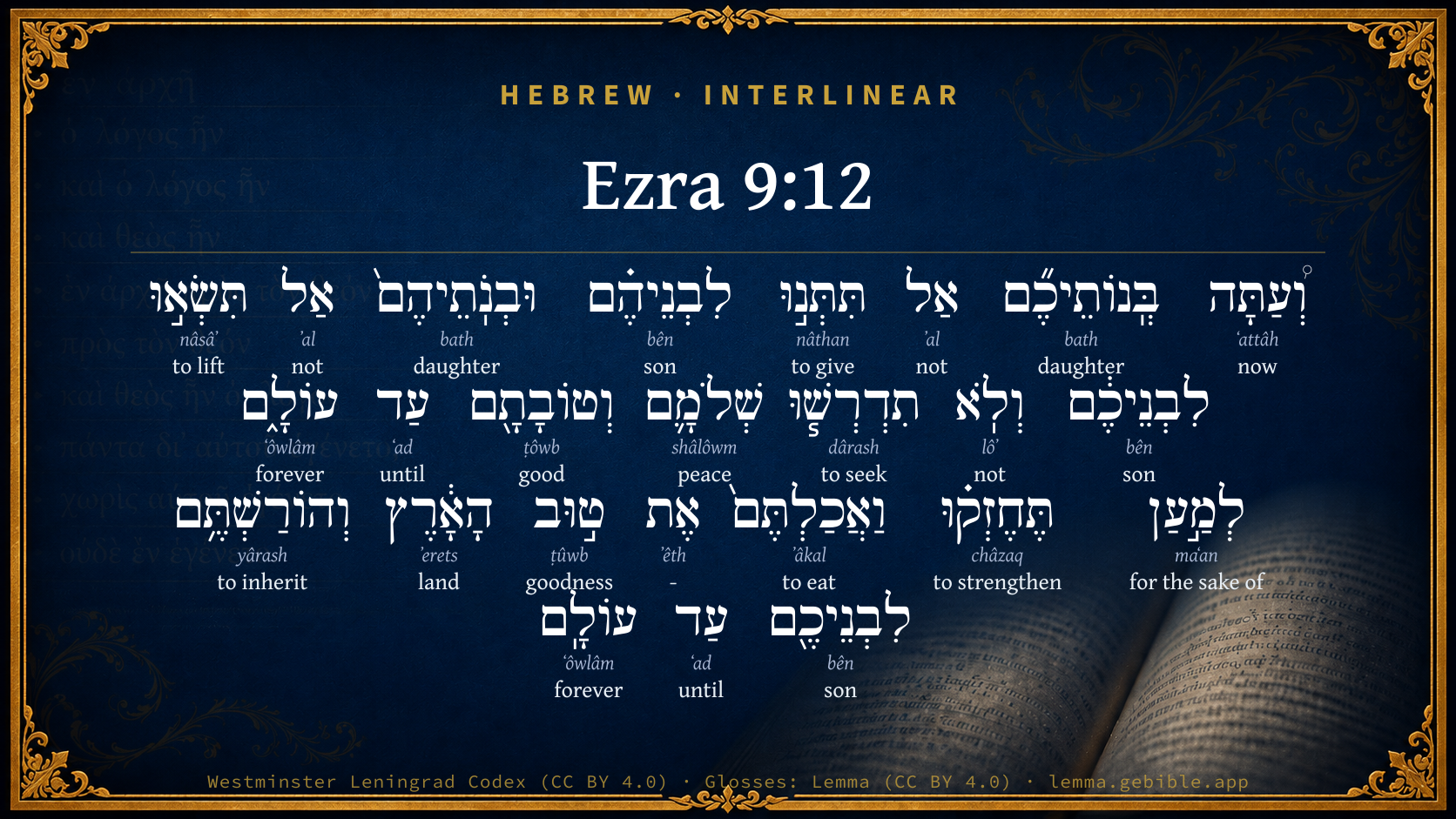
Hebrew (Westminster Leningrad Codex) Ezra 9:12 appears in the Hebrew Old Testament. The text above is from the Westminster Leningrad Codex. Each word links to its Strong’s number, a concise gloss, and parsing drawn from the Open Scriptures Hebrew Bible morphology. Click any word for its full Brown-Driver-Briggs (BDB) entry.
Download image
Cite this verse

Ezra 9:12 (World English Bible). Public Domain. Lemma interlinear Bible study tool, https://lemma.gebible.app/v/ezra/9/12.

Show BibTeX & RIS
BibTeX
RIS
English Translation
now therefore don't give your daughters to their sons, neither take their daughters to your sons, nor seek their peace or their prosperity forever; that you may be strong, and eat the good of the land, and leave it for an inheritance to your children forever.
World English Bible · Public Domain
Download a study sheet

One document with this verse’s original text, its word-by-word gloss line, the meaning frame, cross-references with their text, attributed commentary, and full source and license credits — printable, and it pastes into notes with its structure intact.

This verse Autodidact and up

Study sheet (.html) Plain text (.txt)

A passage Seminary Student

Up to 50 verses in one chapter. A passage sheet keeps up to 6 commentary sources and 12 cross-references per verse, in the order this page ranks them, and says so on the sheet whenever that leaves anything out. Ask for a single verse and you get the Autodidact verse sheet above.

Everything on this page stays free to read, with no account — the sheet is a download of what is already on screen, not access to it.

Want to remove ads? Support Godless Engineer
Compare translations 3

The same verse in 3 English versions, stacked beneath the original-language interlinear above. Click any original word for its lexicon entry.

Each is an independent rendering of the whole verse — the interlinear is not word-aligned to these translations.

Highlighted words mark where these versions differ — a whole-verse word diff, not a word-by-word alignment.

  • World English Bible Public Domain
    now therefore don't give your daughters to their sons, neither take their daughters to your sons, nor seek their peace or their prosperity forever; that you may be strong, and eat the good of the land, and leave it for an inheritance to your children forever.
  • King James Version Public Domain
    Now therefore give not your daughters unto their sons, neither take their daughters unto your sons, nor seek their peace or their wealth for ever: that ye may be strong, and eat the good of the land, and leave it for an inheritance to your children for ever.
  • unfoldingWord Literal Text CC BY-SA 4.0
    So now, neither give your daughters to their sons nor lift their daughters for your sons, nor shall you seek their peace or their good until eternity, so that you may be strong and eat the good things of the land and cause your sons to inherit it until eternity.’

unfoldingWord Literal Text — © unfoldingWord, licensed CC BY-SA 4.0. Word-aligned USFM3 via Door43 (git.door43.org/unfoldingWord/en_ult).

Versions to compare (up to 4)

3 of 4 selected

Show all 18 translations

Every available English version of this verse, each an independent rendering of the whole verse.

  • World English Bible Public Domain
    now therefore don't give your daughters to their sons, neither take their daughters to your sons, nor seek their peace or their prosperity forever; that you may be strong, and eat the good of the land, and leave it for an inheritance to your children forever.
  • Berean Standard Bible Public Domain
    Now, therefore, do not give your daughters in marriage to their sons or take their daughters for your sons. Never seek their peace or prosperity, so that you may be strong and may eat the good things of the land, leaving it as an inheritance to your sons forever.’
  • Majority Standard Bible Public Domain
    Now, therefore, do not give your daughters in marriage to their sons or take their daughters for your sons. Never seek their peace or prosperity, so that you may be strong and may eat the good things of the land, leaving it as an inheritance to your sons forever.’
  • King James Version Public Domain
    Now therefore give not your daughters unto their sons, neither take their daughters unto your sons, nor seek their peace or their wealth for ever: that ye may be strong, and eat the good of the land, and leave it for an inheritance to your children for ever.
  • American Standard Version (1901) Public Domain
    now therefore give not your daughters unto their sons, neither take their daughters unto your sons, nor seek their peace or their prosperity for ever; that ye may be strong, and eat the good of the land, and leave it for an inheritance to your children for ever.
  • Revised Version (1885) Public Domain
    now therefore give not your daughters unto their sons, neither take their daughters unto your sons, nor seek their peace or their prosperity t for ever: that ye may be strong, and eat the good of the land, and leave it for an inheritance to your children for ever.
  • Geneva Bible (1599) Public Domain
    Now therfore shall ye not giue your daughters vnto their sonnes, neither shall ye take their daughters vnto your sonnes, nor seeke their peace nor wealth for euer, that yee may be strong and eate the goodnes of the lande, and leaue it for an inheritance to your sonnes for euer.
  • Douay-Rheims (1899) Public Domain
    Now therefore give not your daughters to their sons, and take not their daughters for your sons, and seek not their peace, nor their prosperity forever: that you may be strengthened, and may eat the good things of the land, and may have your children your heirs for ever.
  • Young's Literal Translation Public Domain
    and now, your daughters ye do not give to their sons, and their daughters ye do not take to your sons, and ye do not seek their peace, and their good -- unto the age, so that ye are strong, and have eaten the good of the land, and given possession to your sons unto the age.
  • Literal Standard Version CC BY-SA 4.0
    and now, your daughters you do not give to their sons, and their daughters you do not take to your sons, and you do not seek their peace, and their good—for all time, so that you are strong, and have eaten the good of the land, and given possession to your sons for all time.
  • Unlocked Literal Bible CC BY-SA 4.0
    So now, do not give your daughters to their sons; do not take their daughters for your sons, and do not seek their ongoing peace and welfare, so that you will be strong and eat the good of the land, so you will cause your children to possess it for all time.”
  • unfoldingWord Literal Text CC BY-SA 4.0
    So now, neither give your daughters to their sons nor lift their daughters for your sons, nor shall you seek their peace or their good until eternity, so that you may be strong and eat the good things of the land and cause your sons to inherit it until eternity.’
  • Darby Bible Public Domain
    Now therefore give not your daughters to their sons, neither take their daughters to your sons, nor seek their peace or their prosperity for ever; that ye may be strong, and eat the good of the land, and leave it for an inheritance to your children for ever.
  • World Messianic Bible Public Domain
    Now therefore don’t give your daughters to their sons. Don’t take their daughters to your sons, nor seek their peace or their prosperity forever, that you may be strong and eat the good of the land, and leave it for an inheritance to your children forever.’
  • Webster's Bible Public Domain
    Now therefore give not your daughters to their sons, neither take their daughters to your sons, nor seek their peace or their wealth for ever: that ye may be strong, and eat the good of the land, and leave it for an inheritance to your children for ever.
  • Free Bible Version CC BY-SA 4.0
    So do not let your daughters marry their sons, or allow their daughters marry your sons. Never make a peace or friendship treaty with them, so that you may live well and eat the good food the land produces, and give the land as an inheritance to your children forever.’
  • Bible in Basic English Public Domain
    So now do not give your daughters to their sons or take their daughters for your sons or do anything for their peace or well-being for ever; so that you may be strong, living on the good of the land, and handing it on to your children for a heritage for ever.
  • JPS Tanakh (1917) Public Domain
    Now therefore give not your daughters unto their sons, neither take their daughters unto your sons, nor seek their peace or their prosperity for ever; that ye may be strong, and eat the good of the land, and leave it for an inheritance to your children for ever.

Literal Standard Version (2020), Covenant Press — licensed CC BY-SA 4.0. Text via the HelloAO Bible API (eBible.org). Unlocked Literal Bible (unfoldingWord) — licensed CC BY-SA 4.0. Text via the HelloAO Bible API (eBible.org). unfoldingWord Literal Text — © unfoldingWord, licensed CC BY-SA 4.0. Word-aligned USFM3 via Door43 (git.door43.org/unfoldingWord/en_ult). Free Bible Version, Dr. Jonathan Gallagher — licensed CC BY-SA 4.0. Text via the HelloAO Bible API (eBible.org).

Word by word

More ways to search: Search by grammar → Find every occurrence → Compare this word →

Practice this passage: Drill this verse → Learn its vocabulary →

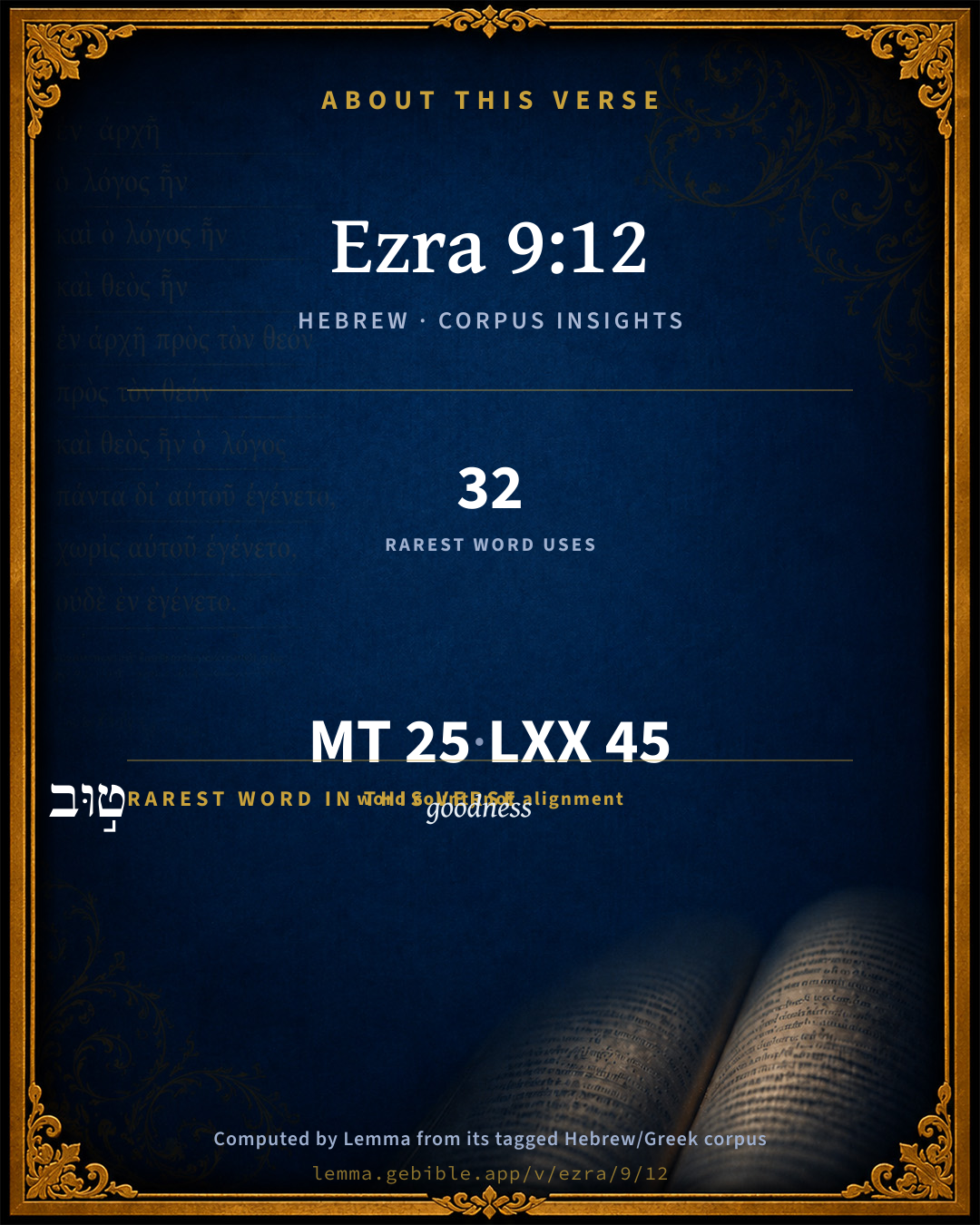
ט֣וּב
ṭûwb
H2898
“goodness of”
Noun, Common, Masculine, Singular, Construct
Part of Speech
Noun
Type
Common
Gender
Masculine
Number
Singular
State
Construct
Full BDB Definition

Origin: from H2895

TWOT: 793b

goods, good things, goodness - good things - goods, property - fairness, beauty, joy, prosperity, goodness (abstract) - goodness (of taste, discernment) - goodness (of God) (abstract)
  1. וְ֠עַתָּה ʻattâh H6258 “and · now” Conjunction + Adverb
  2. בְּֽנוֹתֵיכֶ֞ם bath H1323 “daughters · your” Noun, Common, Feminine, Plural, Construct + Suffix, Personal, 2nd Person, Masculine, Plural
  3. אַל ʼal H408 “not” Particle, Negative
  4. תִּתְּנ֣וּ nâthan H5414 “to give” Verb, Qal, Jussive, 2nd Person, Masculine, Plural
  5. לִבְנֵיהֶ֗ם bên H1121 “to/for · sons · their” Preposition + Noun, Common, Masculine, Plural, Construct + Suffix, Personal, 3rd Person, Masculine, Plural
  6. וּבְנֹֽתֵיהֶם֙ bath H1323 “and · daughters · their” Conjunction + Noun, Common, Feminine, Plural, Construct + Suffix, Personal, 3rd Person, Masculine, Plural
  7. אַל ʼal H408 “not” Particle, Negative
  8. תִּשְׂא֣וּ nâsâʼ H5375 “to lift” Verb, Qal, Jussive, 2nd Person, Masculine, Plural
  9. לִבְנֵיכֶ֔ם bên H1121 “to/for · sons · your” Preposition + Noun, Common, Masculine, Plural, Construct + Suffix, Personal, 2nd Person, Masculine, Plural
  10. וְלֹֽא lôʼ H3808 “and · not” Conjunction + Particle, Negative
  11. תִדְרְשׁ֧וּ dârash H1875 “to seek” Verb, Qal, Imperfect, 2nd Person, Masculine, Plural
  12. שְׁלֹמָ֛ם shâlôwm H7965 “peace · their” Noun, Common, Masculine, Singular, Construct + Suffix, Personal, 3rd Person, Masculine, Plural
  13. וְטוֹבָתָ֖ם ṭôwb H2896 “and · good · their” Conjunction + Adjective, Adjective, Feminine, Singular, Construct + Suffix, Personal, 3rd Person, Masculine, Plural
  14. עַד ʻad H5704 “until” Preposition
  15. עוֹלָ֑ם ʻôwlâm H5769 “forever” Noun, Common, Masculine, Singular, Absolute
  16. לְמַ֣עַן maʻan H4616 “for the sake of” Preposition
  17. תֶּחֶזְק֗וּ châzaq H2388 “to strengthen” Verb, Qal, Imperfect, 2nd Person, Masculine, Plural
  18. וַאֲכַלְתֶּם֙ ʼâkal H398 “and · to eat” Conjunction + Verb, Qal, Sequential Perfect, 2nd Person, Masculine, Plural
  19. אֶת ʼêth H853 “-” Particle, Direct Object
  20. הָאָ֔רֶץ ʼerets H776 “the · land” Particle, Definite Article + Noun, Common, Both, Singular, Absolute
  21. וְהוֹרַשְׁתֶּ֥ם yârash H3423 “and · to inherit” Conjunction + Verb, Hiphil, Sequential Perfect, 2nd Person, Masculine, Plural
  22. לִבְנֵיכֶ֖ם bên H1121 “to/for · sons · your” Preposition + Noun, Common, Masculine, Plural, Construct + Suffix, Personal, 2nd Person, Masculine, Plural
  23. עַד ʻad H5704 “until” Preposition
  24. עוֹלָֽם ʻôwlâm H5769 “forever” Noun, Common, Masculine, Singular, Absolute

About this verse

These counts appear in no published source. They are computed here, from the morphology-tagged text and Lemma’s own curated glosses. What Lemma adds →

25
words
19
distinct lemmas
Historical
section

Shared distinctive vocabulary

ט֣וּב goodness H2898 occurs in 31 verses of the Hebrew Bible. Also found in:

Grammatical profile

  • 6 verbs
  • 10 nouns
  • 1 adjective
  • 3 prepositions
  • 1 adverb
  • 4 particles

Verb forms

  • תִּתְּנ֣וּ Qal · Jussive
  • תִּשְׂא֣וּ Qal · Jussive
  • תִדְרְשׁ֧וּ Qal · Imperfect
  • תֶּחֶזְק֗וּ Qal · Imperfect
  • וַאֲכַלְתֶּם֙ Qal · Sequential Perfect
  • וְהוֹרַשְׁתֶּ֥ם Hiphil · Sequential Perfect

Repetition

Words recur within this verse — often emphatic in Hebrew:

  • לִבְנֵיהֶ֗ם son H1121 ×3
  • בְּֽנוֹתֵיכֶ֞ם daughter H1323 ×2
  • עַד until H5704 ×2
  • עוֹלָ֑ם forever H5769 ×2
  • אַל not H408 ×2

Hebrew & Septuagint length

In English translation the verse runs 46 words from the Hebrew and 52 from the Septuagint (LXX English) — closely comparable.

A rough comparison of the two English renderings, which tokenize alike — not a word-level alignment.

Word counts can differ between the Hebrew and the Greek without any difference in meaning — e.g. the Hebrew direct-object marker אֵת has no separate Greek word, and Greek often adds the article ὁ.

In the original languages it is 25 Hebrew tokens and 45 Greek tokens — but the two are counted differently (Hebrew bundles its prefixes and suffixes into one token; the Greek is in lemma form), so that isn’t a like-for-like length.

Cross-references

15

Topical passages linked to Ezra 9:12 in the Treasury of Scripture Knowledge — connected by theme and wording, ordered by reader-vote popularity; previews shown in the World English Bible.

  • Deuteronomy 7:3 neither shall you make marriages with them; your daughter you shall not give to his son, nor his daughter shall you take to your son.
  • Deuteronomy 23:6 You shall not seek their peace nor their prosperity all your days forever.
  • Joshua 23:12–13 Else if you do at all go back, and cleave to the remnant of these nations, even these who remain among you, and make marriages with them, and go in to them, and they to you;
  • Proverbs 13:22 A good man leaves an inheritance to his children's children, But the wealth of the sinner is stored for the righteous.
  • Exodus 34:15–16 Don't make a covenant with the inhabitants of the land, lest they play the prostitute after their gods, and sacrifice to their gods, and one call you and you eat of his sacrifice;
  • Proverbs 20:7 A righteous man walks in integrity. Blessed are his children after him.
  • 2 John 1:10–11 If anyone comes to you, and doesn't bring this teaching, don't receive him into your house, and don't welcome him,
  • Genesis 18:18–19 seeing that Abraham has surely become a great and mighty nation, and all the nations of the earth will be blessed in him?
  • Exodus 23:32 You shall make no covenant with them, nor with their gods.
  • Ezra 9:2 For they have taken of their daughters for themselves and for their sons, so that the holy seed have mixed themselves with the peoples of the lands: yes, the hand of the princes and rulers has been chief in this trespass.
  • Psalms 112:1–2 Praise Yah! Blessed is the man who fears Yahweh, Who delights greatly in his commandments.
  • Isaiah 1:19 If you are willing and obedient, You shall eat the good of the land;
  • Deuteronomy 6:1–2 Now this is the commandment, the statutes, and the ordinances, which Yahweh your God commanded to teach you, that you might do them in the land where you go over to possess it;
  • Joshua 1:6–9 Be strong and of good courage; for you shall cause this people to inherit the land which I swore to their fathers to give them.
  • 2 Chronicles 19:2 Jehu the son of Hanani the seer went out to meet him, and said to king Jehoshaphat, Should you help the wicked, and love those who hate Yahweh? for this thing wrath is on you from before Yahweh.

Cross-references courtesy of OpenBible.info (CC BY 4.0).

Hebrew and Greek witnesses Masoretic Hebrew ↔ Greek Septuagint

The same verse in the two great witnesses to the Old Testament, shown verse-for-verse.

These are two independent witnesses, not word-aligned to each other, and the Septuagint is shown in lemma (dictionary) form.

Hebrew Ezra 9:12 Masoretic · Westminster Leningrad Codex

וְ֠עַתָּה בְּֽנוֹתֵיכֶ֞ם אַל תִּתְּנ֣וּ לִבְנֵיהֶ֗ם וּבְנֹֽתֵיהֶם֙ אַל תִּשְׂא֣וּ לִבְנֵיכֶ֔ם וְלֹֽא תִדְרְשׁ֧וּ שְׁלֹמָ֛ם וְטוֹבָתָ֖ם עַד עוֹלָ֑ם לְמַ֣עַן תֶּחֶזְק֗וּ וַאֲכַלְתֶּם֙ אֶת ט֣וּב הָאָ֔רֶץ וְהוֹרַשְׁתֶּ֥ם לִבְנֵיכֶ֖ם עַד עוֹלָֽם

now therefore don't give your daughters to their sons, neither take their daughters to your sons, nor seek their peace or their prosperity forever; that you may be strong, and eat the good of the land, and leave it for an inheritance to your children forever.

World English Bible · Public Domain

Greek LXX Ezra 9:12 Septuagint · lemma form

καί νῦν ὁ θυγάτηρ σύ μή δίδωμι ὁ υἱός αὐτός καί ἀπό ὁ θυγάτηρ αὐτός μή λαμβάνω ὁ υἱός σύ καί οὐ ἐκζητέω εἰρήνη αὐτός καί ἀγαθός αὐτός ἕως αἰών ὅπως ἐνἰσχύω καί ἐσθίω ὁ ἀγαθός ὁ γῆ καί κληροδοτέω ὁ υἱός σύ ἕως αἰών

And now give not your daughters to their sons, and take not of their daughters for your sons, neither shall you⌃ seek their peace or their good for ever: that you⌃ may be strong, and eat the good of the land, and transmit it as an inheritance to your children for ever.

LXX2012 (modern English Septuagint) · Public Domain

In the Septuagint this is one book — Esdras B (2 Esdras): Ezra is chapters 1–10, Nehemiah 11–23.

Hebrew: Westminster Leningrad Codex (CC BY 4.0). Greek: Septuagint (public domain); English from LXX2012 (modern English Septuagint) (Public Domain). How the Septuagint differs from the Hebrew →

Commentary

Notes on Ezra 9:12 from classic Christian and Jewish commentators (each source and its license shown beneath its notes). The classic Christian expositions comment on the surrounding passage and are grouped to its opening verse, so a note may address several verses; the Jewish commentaries on the Tanakh (Rashi and others) are per-verse, so they appear only where the commentator wrote on this verse.

Lemma curates 59 commentaries, every one of them public domain or Creative Commons licensed, each selected and text-cleaned for this edition rather than reprinted as found. About our sources →

Trapp's Complete Commentary

John Trapp

Ezr 9:12 Now therefore give not your daughters unto their sons, neither take their daughters unto your sons, nor seek their peace or their wealth for ever: that ye may be strong, and eat the good of the land, and leave [it] for an inheritance to your children for ever.

Ver. 12. Now therefore give not your daughters] Unless ye have a mind to pitch them into the mouth of hell. See Ezr 9:2. {See Trapp on "Ezr 9:2"}

Nor seek their peace or their wealth for ever] For they were devoted by God to utter destruction; and therefore Israel might have no intercourse with them. The Jews at this day count and call us Canaanites, Edomites, &c., and hold it an almsdeed to knock us on the head. The best among the Gentiles, say they, is worthy cui caput conteratur tanquam serpenti, to be killed up as a serpent. Tacitus long since observed of them, that as they were very kind to their own, so to all others they bare a deadly hatred. Thrice a day in their prayers they curse us Christians, and in Polony (where they have a toleration) they print base and blasphemous things against Christ and religion (Buxtorf. Synag. Jud. cap. 5).

That ye may be strong] viz. By my presence amongst you and providence over you; for cui adhaereo, praeest, as Queen Elizabeth could write; how much more may God Almighty, he whom I favour is sure to prevail.

And eat the good of the land] The best of the best, the finest wheat, the choicest fruit, and those a pledge and foretaste of the happiness of heaven, where there is nec fames, nec fastidium (as one saith), neither lack nor loathing, neither measure nor mixture, but sweetest varieties, felicities, eternities.

And leave it for an inheritance] Personal goodness is profitable to posterity: the righteous shall leave inheritance to his children’s children, Pro 13:22. God never casteth out his good tenants, nor leaveth his servants unprovided for. See Psa 103:17; Psa 112:1-2.

John Trapp, A Commentary or Exposition upon All the Books of the Old and New Testament (1647–1656) — public domain. Text from a community e-Sword module.

The Cambridge Bible for Schools and Colleges

gen. ed. J. J. S. Perowne

12. Now therefore give not, &c.] This sentence reproduces the substance of Deu_7:3 ‘Neither shalt thou make marriages with them; thy daughter thou shalt not give unto his son, nor his daughter shalt thou take unto thy son’.

nor seek their peace or their wealth for ever] R.V. … or their prosperity.… This phrase is found in Deu_23:6 ‘Thou shalt not seek their peace nor their prosperity all thy days for ever’, where the Ammonites and Moabites are especially referred to. The words had probably become almost proverbial. Here its application is destitute of any reference to the context in Deuteronomy 23. The thought reproduces the prohibition of Exo_23:32 ‘Thou shalt make no covenant with them (i.e. the inhabitants of the land) nor with their gods’. Compare Jer_29:7 ‘And seek the peace of the city, whither I have caused you to be carried away captive’.

that ye may be strong] The same blessing is promised Deu_11:8 ‘Therefore shall ye keep all the commandment … that ye may be strong’. The power to maintain God’s gift was the measure of their true prosperity.

and eat the good of the land] Isa_1:19 ‘If ye be willing and obedient, ye shall eat the good of the land’. The present enjoyment of the gift. The clause, in spite of the reference to ‘the land’, has no verbal parallel in the Pentateuch.

and leave it for an inheritance] The blessing perpetuated. Practically equivalent to ‘That thy days may be long in the land which the Lord thy God giveth thee’. Cf. Deu_11:9. The allusion to Pro_13:22; Eze_37:25 can only be of the most shadowy kind.

The Cambridge Bible for Schools and Colleges (gen. ed. J. J. S. Perowne; Cambridge University Press, 1878–1918) — public domain. Text from a community e-Sword module.

John Gill's Exposition

Now therefore give not your daughters unto their sons, nor take their daughters unto your sons,.... That is, in marriage, see Deu 7:3, where the prohibition is expressed in the same language:

nor seek their peace or their wealth for ever; that is, as long as they continue in their idolatries and impurities, see Deu 23:6,

that ye may be strong, and eat the good of the land, and leave it for an inheritance to your children for ever; that they might be strengthened and established in the land into which they were brought, and enjoy all the good things it produced, and leave their children in the possession of it, to hold at least until the Messiah came, see Isa 1:19.

John Gill's Exposition of the Whole Bible (1746–1763) — public domain (CC PDM 1.0). Text via the HelloAO Bible API.

Haydock's Catholic Bible Commentary

Peace. Alliance, (Menochius) or advantage. See Psalm cxxi. 8. Moses had thus proscribed the Moabites, &c., as he had done the people of Chanaan still more severely. The Israelites were to execute God’s decrees, Deuteronomy xxiii. 6. (Calmet) --- The obstinate idolaters were to be exterminated.

George Leo Haydock (1774–1849), Haydock's Catholic Family Bible and Commentary, 1859 edition — public domain. Excludes Psalms (Douay-Rheims chapter numbering differs from Protestant) and Deuterocanonical books (Catholic canon only).

Matthew Poole's English Annotations

Nor seek their peace; but root them out, as I have commanded you to do; which also they have abundantly deserved, both of mine and of your hands. See Deu 7:2.

That ye may be strong: although you may fancy that this way of making leagues and marriages with them is the only way to establish and settle you, yet I assure you it will weaken and ruin you, and the contrary course will make you stronger.

Matthew Poole's English Annotations on the Holy Bible (1683–1685) — public domain. Text from a community e-Sword/MySword module.

Whedon's Commentary on the Bible

Daniel D. Whedon

12. Nor seek their peace or their wealth — Quoted from Deuteronomy xxiii, 6. The sense is, thou shalt not make it an object of care to promote the welfare or prosperity of the heathen.

Daniel D. Whedon (gen. ed.), Commentary on the Old and New Testaments (1874–1909) — public domain. Text from a community e-Sword module.

The Pulpit Commentary

Give not your daughters, etc. Here Deu_7:3 is plainly referred to, though not verbally quoted. This is the sole place in the Law where the double injunction is given, Exo_34:16 referring to the taking of wives only. Nor seek their peace or their wealth for ever. So Moses had enjoined with special reference to the Moabites and Ammonites. (Deu_23:6) With regard to the other idolatrous nations, the exact command was "to make no covenant with them", (Exo_23:32 Exo_34:12) i.e. no terms of peace. Much the same was probably meant by both injunctions. That ye may be strong. See Deu_11:8. And eat the good of the land. These words are taken from Isa_1:19. And leave it for an inheritance, etc. No single passage seems to be referred to here, but the clause embodies the idea found in Deu_11:9; Pro_10:27; Eze_37:25, and elsewhere.

The Pulpit Commentary (1880–1919), ed. H.D.M. Spence-Jones & Joseph S. Exell — public domain. Text from a community e-Sword module.

John Wesley's Explanatory Notes

Strong - Although you may fancy making leagues and marriages with them, as the only way to establish you, yet I assure you, it will weaken and ruin you, and the contrary course will make you strong.

John Wesley, Explanatory Notes Upon the Whole Bible (1754–1765) — public domain. Text via the GEBible commentary corpus.

Rashi

Rabbi Shlomo Yitzchaki (Rashi)

and you shall cause...to inherit You shall give the land to your children as an inheritance to eternity.

Rashi on the Tanakh — English translations: “The Judaica Press complete Tanach with Rashi, translated by A. J. Rosenberg” (CC BY 4.0); “Pentateuch with Rashi's commentary by M. Rosenbaum and A.M. Silbermann, 1929-1934” (public domain); “The Metsudah Tanach series, Lakewood, N.J” (CC BY 4.0); and “The Book of Joshua, Metsudah Publications, 1997” (CC BY 4.0). Text via Sefaria.

Lesson kit

Teaching starters — assembled from the data on this page, not authored interpretation. Every prompt links to the verse data it draws on. Edit before teaching.

Ezra, in the Historical, opens this verse with 25 words (19 distinct Hebrew lemmas). Its most distinctive word is ṭûwb (“goodness”). A historical commentator’s framing appears above. Read the whole chapter for the surrounding context.

Discussion questions

  1. What does “goodness” (ṭûwb) contribute to the verse as a whole?
  2. Genesis 24:10 shares the word «goodness» with this verse. How do the two illuminate each other?
  3. “son” occurs 3× in this one verse. What is the effect of the repetition?
  4. The translations on this page render this verse differently — a whole-verse word diff, not a word-by-word alignment. What might account for the different wordings?
  5. The verb «תִּתְּנ֣וּ» is Qal Jussive. How does its form color the action?
  6. Reading how Trapp's Complete Commentary and The Cambridge Bible for Schools and Colleges read this verse, where do the two commentators agree and where do they part?

Things to notice

Reading settings

Reading text

Shown beneath each verse's original-language words.

Old Testament
Old Testament edition

Read the OT as the Masoretic Hebrew (MT) or the Greek Septuagint (LXX).

English shown for the Greek Septuagint (in the Hebrew ↔ Greek comparison).

Comparing translations? Open the Compare panel on any verse page to stack up to four side by side.