
1 Kings 18:12

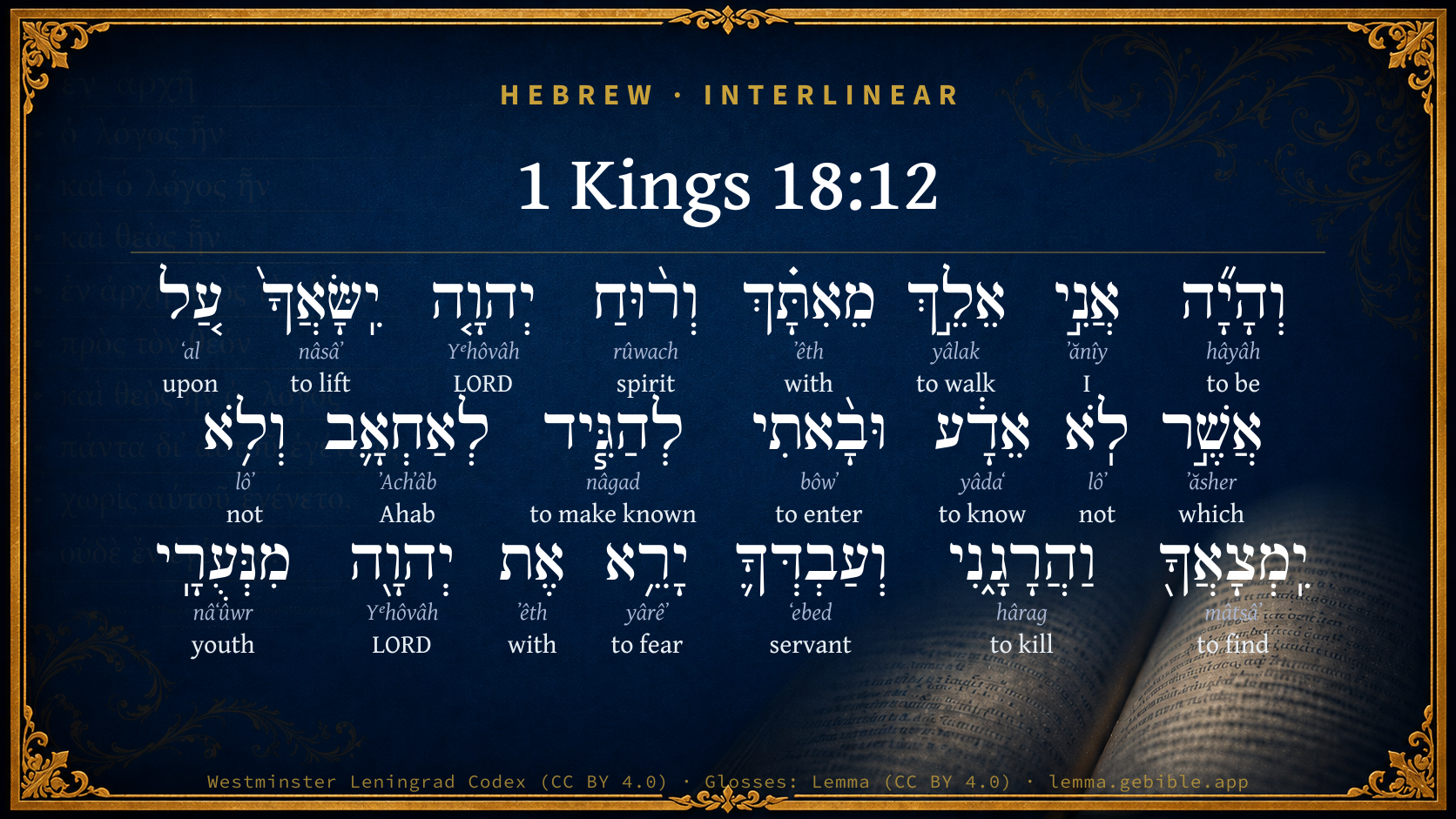
Hebrew (Westminster Leningrad Codex) 1 Kings 18:12 appears in the Hebrew Old Testament. The text above is from the Westminster Leningrad Codex. Each word links to its Strong’s number, a concise gloss, and parsing drawn from the Open Scriptures Hebrew Bible morphology. Click any word for its full Brown-Driver-Briggs (BDB) entry.
Download image
Cite this verse

1 Kings 18:12 (World English Bible). Public Domain. Lemma interlinear Bible study tool, https://lemma.gebible.app/v/1-kings/18/12.

Show BibTeX & RIS
BibTeX
RIS
English Translation
It will happen, as soon as I am gone from you, that the Spirit of Yahweh will carry you I don't know where; and so when I come and tell Ahab, and he can't find you, he will kill me: but I your servant fear Yahweh from my youth.
World English Bible · Public Domain
Download a study sheet

One document with this verse’s original text, its word-by-word gloss line, the meaning frame, cross-references with their text, attributed commentary, and full source and license credits — printable, and it pastes into notes with its structure intact.

This verse Autodidact and up

Study sheet (.html) Plain text (.txt)

A passage Seminary Student

Up to 50 verses in one chapter. A passage sheet keeps up to 6 commentary sources and 12 cross-references per verse, in the order this page ranks them, and says so on the sheet whenever that leaves anything out. Ask for a single verse and you get the Autodidact verse sheet above.

Everything on this page stays free to read, with no account — the sheet is a download of what is already on screen, not access to it.

Want to remove ads? Support Godless Engineer
Compare translations 3

The same verse in 3 English versions, stacked beneath the original-language interlinear above. Click any original word for its lexicon entry.

Each is an independent rendering of the whole verse — the interlinear is not word-aligned to these translations.

Highlighted words mark where these versions differ — a whole-verse word diff, not a word-by-word alignment.

  • World English Bible Public Domain
    It will happen, as soon as I am gone from you, that the Spirit of Yahweh will carry you I don't know where; and so when I come and tell Ahab, and he can't find you, he will kill me: but I your servant fear Yahweh from my youth.
  • King James Version Public Domain
    And it shall come to pass, as soon as I am gone from thee, that the Spirit of the LORD shall carry thee whither I know not; and so when I come and tell Ahab, and he cannot find thee, he shall slay me: but I thy servant fear the LORD from my youth.
  • unfoldingWord Literal Text CC BY-SA 4.0
    And it will happen that I, I will go from with you, and the Spirit of Yahweh will carry you to where I do not know. And I will come to declare to Ahab, but he will not find you, and he will kill me. But your servant fearing Yahweh from my youth.

unfoldingWord Literal Text — © unfoldingWord, licensed CC BY-SA 4.0. Word-aligned USFM3 via Door43 (git.door43.org/unfoldingWord/en_ult).

Versions to compare (up to 4)

3 of 4 selected

Show all 18 translations

Every available English version of this verse, each an independent rendering of the whole verse.

  • World English Bible Public Domain
    It will happen, as soon as I am gone from you, that the Spirit of Yahweh will carry you I don't know where; and so when I come and tell Ahab, and he can't find you, he will kill me: but I your servant fear Yahweh from my youth.
  • Berean Standard Bible Public Domain
    I do not know where the Spirit of the LORD may carry you off when I leave you. Then when I go and tell Ahab and he does not find you, he will kill me. But I, your servant, have feared the LORD from my youth.
  • Majority Standard Bible Public Domain
    I do not know where the Spirit of the LORD may carry you off when I leave you. Then when I go and tell Ahab and he does not find you, he will kill me. But I, your servant, have feared the LORD from my youth.
  • King James Version Public Domain
    And it shall come to pass, as soon as I am gone from thee, that the Spirit of the LORD shall carry thee whither I know not; and so when I come and tell Ahab, and he cannot find thee, he shall slay me: but I thy servant fear the LORD from my youth.
  • American Standard Version (1901) Public Domain
    And it will come to pass, as soon as I am gone from thee, that the Spirit of Jehovah will carry thee whither I know not; and so when I come and tell Ahab, and he cannot find thee, he will slay me: but I thy servant fear Jehovah from my youth.
  • Revised Version (1885) Public Domain
    And it shall come to pass, as soon as I am gone from thee, that the spirit of the LORD shall carry thee whither I know not; and so when I come and tell Ahab, and he cannot find thee, he shall slay me: but I thy servant fear the LORD from my youth.
  • Geneva Bible (1599) Public Domain
    And when I am gone from thee, the Spirit of the Lord shall cary thee into some place that I doe not know: so when I come and tell Ahab, if he cannot finde thee, then wil he kill me: But I thy seruant feare the Lord from my youth.
  • Douay-Rheims (1899) Public Domain
    And when I am gone from thee, the spirit of the Lord will carry thee into a place that I know not: and I shall go in and tell Achab, and he not finding thee, will kill me: but thy servant feareth the Lord from his infancy.
  • Young's Literal Translation Public Domain
    and it hath been, I go from thee, and the Spirit of Jehovah doth lift thee up, whither I know not, and I have come to declare to Ahab, and he doth not find thee, and he hath slain me; and thy servant is fearing Jehovah from my youth.
  • Literal Standard Version CC BY-SA 4.0
    and it has been, I go from you, and the Spirit of YHWH lifts you up to where I do not know, and I have come to declare to Ahab, and he does not find you, and he has slain me; and your servant is fearing YHWH from my youth.
  • Unlocked Literal Bible CC BY-SA 4.0
    As soon as I am gone from you, the Spirit of Yahweh will carry you some place I do not know. Then when I go and tell Ahab, and when he cannot find you, he will kill me. Yet I, your servant, have worshiped Yahweh from my youth.
  • unfoldingWord Literal Text CC BY-SA 4.0
    And it will happen that I, I will go from with you, and the Spirit of Yahweh will carry you to where I do not know. And I will come to declare to Ahab, but he will not find you, and he will kill me. But your servant fearing Yahweh from my youth.
  • Darby Bible Public Domain
    And it shall come to pass when I am gone from thee, that the Spirit of Jehovah shall carry thee whither I know not; and when I come and tell Ahab, and he cannot find thee, he will kill me; and I thy servant fear Jehovah from my youth.
  • World Messianic Bible Public Domain
    It will happen, as soon as I leave you, that the LORD’s Spirit will carry you I don’t know where; and so when I come and tell Ahab, and he can’t find you, he will kill me. But I, your servant, have feared the LORD from my youth.
  • Webster's Bible Public Domain
    And it will come to pass, as soon as I have gone from thee, that the Spirit of the LORD will carry thee whither I know not; and so when I come and tell Ahab, and he cannot find thee, he will slay me: but I thy servant fear the LORD from my youth.
  • Free Bible Version CC BY-SA 4.0
    I have no idea where the Spirit of the Lord will take you after I leave you. If I go and tell Ahab and then he can't find you, he's going to kill me, even though I, your servant, have worshiped the Lord since I was young.
  • Bible in Basic English Public Domain
    And straight away, when I have gone from you, the spirit of the Lord will take you away, I have no idea where, so that when I come and give word to Ahab, and he sees you not, he will put me to death: though I, your servant, have been a worshipper of the Lord from my earliest years.
  • JPS Tanakh (1917) Public Domain
    And it will come to pass, as soon as I am gone from thee, that the spirit of the LORD will carry thee whither I know not; and so when I come and tell Ahab, and he cannot find thee, he will slay me; but I thy servant fear the LORD from my youth.

Literal Standard Version (2020), Covenant Press — licensed CC BY-SA 4.0. Text via the HelloAO Bible API (eBible.org). Unlocked Literal Bible (unfoldingWord) — licensed CC BY-SA 4.0. Text via the HelloAO Bible API (eBible.org). unfoldingWord Literal Text — © unfoldingWord, licensed CC BY-SA 4.0. Word-aligned USFM3 via Door43 (git.door43.org/unfoldingWord/en_ult). Free Bible Version, Dr. Jonathan Gallagher — licensed CC BY-SA 4.0. Text via the HelloAO Bible API (eBible.org).

Word by word

More ways to search: Search by grammar → Find every occurrence → Compare this word →

Practice this passage: Drill this verse → Learn its vocabulary →

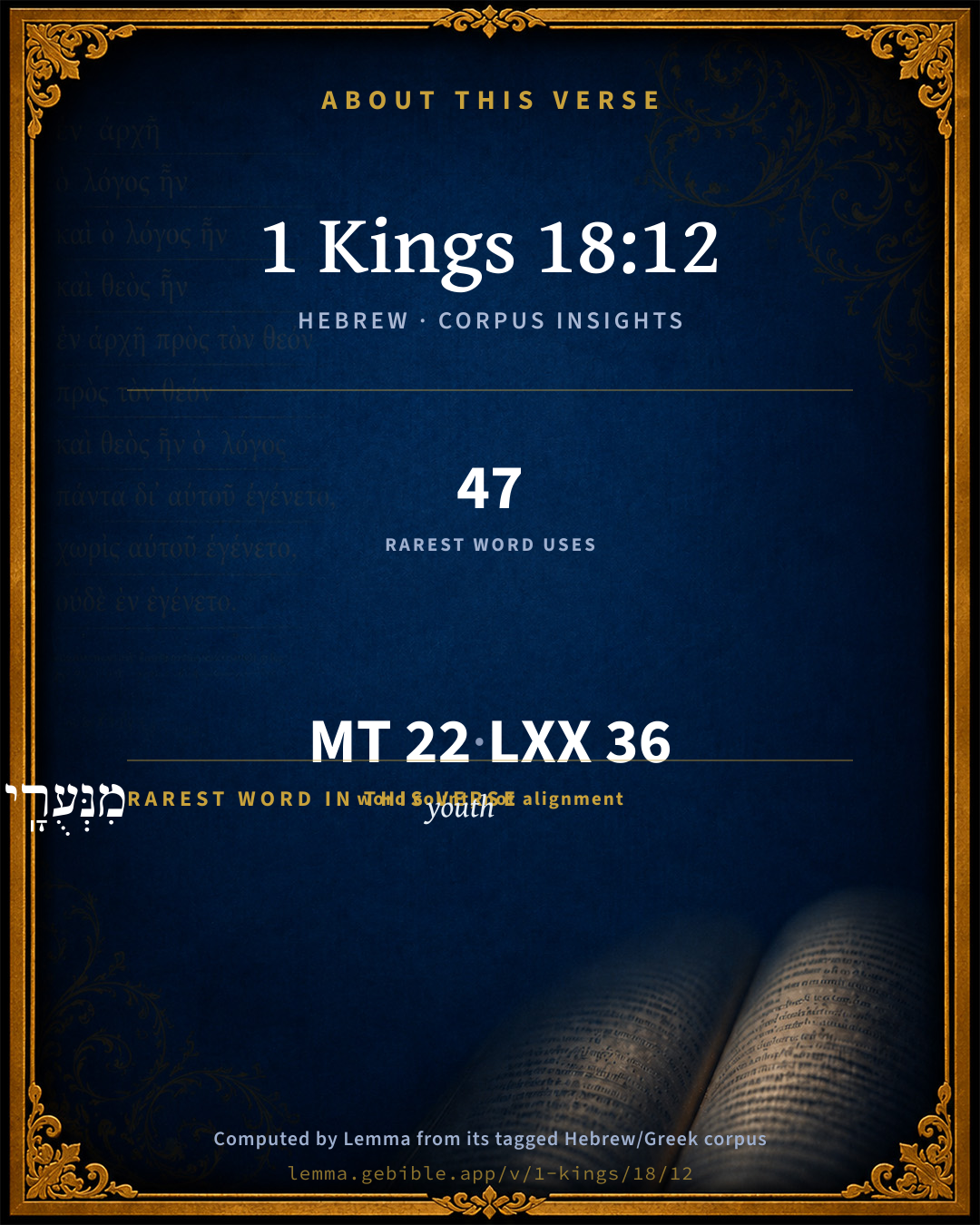
מִנְּעֻרָֽי
nâʻûwr
H5271
“from · youth · my”
Preposition + Noun, Common, Both, Plural, Construct + Suffix, Personal, 1st Person, Common, Singular
Part of Speech
Preposition + Noun
Type
Common
Gender
Both
Number
Plural
State
Construct
Full BDB Definition

Origin: properly, pass. participle from H5288 as denominative

TWOT: 1389d , 1389e

youth, early life
  1. וְהָיָ֞ה hâyâh H1961 “and · to be” Conjunction + Verb, Qal, Perfect, 3rd Person, Masculine, Singular
  2. אֲנִ֣י ʼănîy H589 “I” Pronoun, Personal, 1st Person, Common, Singular
  3. אֵלֵ֣ךְ yâlak H3212 “to walk” Verb, Qal, Imperfect, 1st Person, Common, Singular
  4. מֵאִתָּ֗ךְ ʼêth H854 “from · with · you” Preposition + Preposition + Suffix, Personal, 2nd Person, Feminine, Singular
  5. וְר֨וּחַ rûwach H7307 “and · spirit of” Conjunction + Noun, Common, Both, Singular, Construct
  6. יְהוָ֤ה Yᵉhôvâh H3068 “LORD” Noun, Proper
  7. יִֽשָּׂאֲךָ֙ nâsâʼ H5375 “to lift · you” Verb, Qal, Imperfect, 3rd Person, Masculine, Singular + Suffix, Personal, 2nd Person, Masculine, Singular
  8. עַ֚ל ʻal H5921 “upon” Preposition
  9. אֲשֶׁ֣ר ʼăsher H834 “which” Particle, Relative
  10. לֹֽא lôʼ H3808 “not” Particle, Negative
  11. אֵדָ֔ע yâdaʻ H3045 “to know” Verb, Qal, Imperfect, 1st Person, Common, Singular
  12. וּבָ֨אתִי bôwʼ H935 “and · to enter” Conjunction + Verb, Qal, Perfect, 1st Person, Common, Singular
  13. לְהַגִּ֧יד nâgad H5046 “to make known” Preposition + Verb, Hiphil, Infinitive Construct
  14. לְאַחְאָ֛ב ʼAchʼâb H256 “to/for · Ahab” Preposition + Noun, Proper
  15. וְלֹ֥א lôʼ H3808 “and · not” Conjunction + Particle, Negative
  16. יִֽמְצָאֲךָ֖ mâtsâʼ H4672 “to find · you” Verb, Qal, Imperfect, 3rd Person, Masculine, Singular + Suffix, Personal, 2nd Person, Masculine, Singular
  17. וַהֲרָגָ֑נִי hârag H2026 “and · to kill · me” Conjunction + Verb, Qal, Sequential Perfect, 3rd Person, Masculine, Singular + Suffix, Personal, 1st Person, Common, Singular
  18. וְעַבְדְּךָ֛ ʻebed H5650 “and · servant · your” Conjunction + Noun, Common, Masculine, Singular, Construct + Suffix, Personal, 2nd Person, Masculine, Singular
  19. יָרֵ֥א yârêʼ H3372 “fearing” Adjective, Adjective, Masculine, Singular, Absolute
  20. אֶת ʼêth H854 “with” Preposition
  21. יְהוָ֖ה Yᵉhôvâh H3068 “LORD” Noun, Proper

About this verse

These counts appear in no published source. They are computed here, from the morphology-tagged text and Lemma’s own curated glosses. What Lemma adds →

22
words
19
distinct lemmas
Historical
section

Shared distinctive vocabulary

מִנְּעֻרָֽי youth H5271 occurs in 46 verses of the Hebrew Bible. Also found in:

Grammatical profile

  • 8 verbs
  • 6 nouns
  • 1 adjective
  • 1 pronoun
  • 3 prepositions
  • 3 particles

Verb forms

  • וְהָיָ֞ה Qal · Perfect
  • אֵלֵ֣ךְ Qal · Imperfect
  • יִֽשָּׂאֲךָ֙ Qal · Imperfect
  • אֵדָ֔ע Qal · Imperfect
  • וּבָ֨אתִי Qal · Perfect
  • לְהַגִּ֧יד Hiphil · Infinitive Construct
  • יִֽמְצָאֲךָ֖ Qal · Imperfect
  • וַהֲרָגָ֑נִי Qal · Sequential Perfect

Repetition

Words recur within this verse — often emphatic in Hebrew:

  • יְהוָ֤ה LORD H3068 ×2
  • מֵאִתָּ֗ךְ with H854 ×2
  • לֹֽא not H3808 ×2

Hebrew & Septuagint length

In English translation the verse runs 49 words from the Hebrew and 59 from the Septuagint (LXX English) — closely comparable.

A rough comparison of the two English renderings, which tokenize alike — not a word-level alignment.

Word counts can differ between the Hebrew and the Greek without any difference in meaning — e.g. the Hebrew direct-object marker אֵת has no separate Greek word, and Greek often adds the article ὁ.

In the original languages it is 22 Hebrew tokens and 36 Greek tokens — but the two are counted differently (Hebrew bundles its prefixes and suffixes into one token; the Greek is in lemma form), so that isn’t a like-for-like length.

Cross-references

24

Topical passages linked to 1 Kings 18:12 in the Treasury of Scripture Knowledge — connected by theme and wording, ordered by reader-vote popularity; previews shown in the World English Bible.

  • 2 Kings 2:16 They said to him, See now, there are with your servants fifty strong men; let them go, we pray you, and seek your master, lest the Spirit of Yahweh has taken him up, and cast him on some mountain, or into some valley. He said, You shall not send.
  • Acts 8:39 When they came up out of the water, the Spirit of the Lord caught Philip away, and the eunuch didn't see him any more, for he went on his way rejoicing.
  • Ezekiel 8:3 He put forth the form of a hand, and took me by a lock of my head; and the Spirit lifted me up between earth and the sky, and brought me in the visions of God to Jerusalem, to the door of the gate of the inner [court] that looks toward the north; where was the seat of the image of jealousy, which provokes to jealousy.
  • 2 Kings 2:11 It happened, as they still went on, and talked, that behold, [there appeared] a chariot of fire, and horses of fire, which parted them both apart; and Elijah went up by a whirlwind into heaven.
  • Ezekiel 3:12–14 Then the Spirit lifted me up, and I heard behind me the voice of a great rushing, [saying], Blessed be the glory of Yahweh from his place.
  • Ezekiel 11:24 The Spirit lifted me up, and brought me in the vision by the Spirit of God into Chaldea, to them of the captivity. So the vision that I had seen went up from me.
  • Ezekiel 37:1 The hand of Yahweh was on me, and he brought me out in the Spirit of Yahweh, and set me down in the midst of the valley; and it was full of bones.
  • Ezekiel 40:1–2 In the five and twentieth year of our captivity, in the beginning of the year, in the tenth [day] of the month, in the fourteenth year after that the city was struck, in the same day, the hand of Yahweh was on me, and he brought me there.
  • 2 Corinthians 12:2–3 I know a man in Christ, fourteen years ago (whether in the body, I don't know, or whether out of the body, I don't know; God knows), such a one caught up into the third heaven.
  • 1 Samuel 2:18 But Samuel ministered before Yahweh, being a child, girded with a linen ephod.
  • 1 Samuel 2:26 The child Samuel grew on, and increased in favor both with Yahweh, and also with men.
  • 1 Samuel 3:19–20 Samuel grew, and Yahweh was with him, and did let none of his words fall to the ground.
  • 1 Samuel 22:11–19 Then the king sent to call Ahimelech the priest, the son of Ahitub, and all his father's house, the priests who were in Nob: and they came all of them to the king.
  • 2 Chronicles 34:3 For in the eighth year of his reign, while he was yet young, he began to seek after the God of David his father; and in the twelfth year he began to purge Judah and Jerusalem from the high places, and the Asherim, and the engraved images, and the molten images.
  • Psalms 71:17–18 God, you have taught me from my youth. Until now, I have declared your wondrous works.
  • Proverbs 8:13 The fear of Yahweh is to hate evil. I hate pride, arrogance, the evil way, and the perverse mouth.
  • Ecclesiastes 7:18 It is good that you should take hold of this. Yes, also from that don't withdraw your hand; for he who fears God will come forth from them all.
  • Daniel 2:5–13 The king answered the Chaldeans, The thing is gone from me: if you don't make known to me the dream and the interpretation of it, you shall be cut in pieces, and your houses shall be made a dunghill.
  • Matthew 4:1 Then Jesus was led up by the Spirit into the wilderness to be tempted by the devil.
  • Luke 1:15 For he will be great in the sight of the Lord, and he will drink no wine nor strong drink. He will be filled with the Holy Spirit, even from his mother's womb.
  • Acts 12:19 When Herod had sought for him, and didn't find him, he examined the guards, and commanded that they should be put to death. He went down from Judea to Caesarea, and stayed there.
  • Isaiah 50:10 Who is among you who fears Yahweh, who obeys the voice of his servant? He who walks in darkness, and has no light, let him trust in the name of Yahweh, and rely on his God.
  • Matthew 2:16 Then Herod, when he saw that he was mocked by the wise men, was exceedingly angry, and sent out, and killed all the male children who were in Bethlehem and in all the surrounding countryside, from two years old and under, according to the exact time which he had learned from the wise men.
  • 2 Timothy 3:15 From infancy, you have known the sacred writings which are able to make you wise for salvation through faith, which is in Christ Jesus.

Cross-references courtesy of OpenBible.info (CC BY 4.0).

Hebrew and Greek witnesses Masoretic Hebrew ↔ Greek Septuagint

The same verse in the two great witnesses to the Old Testament, shown verse-for-verse.

These are two independent witnesses, not word-aligned to each other, and the Septuagint is shown in lemma (dictionary) form.

Hebrew 1 Kings 18:12 Masoretic · Westminster Leningrad Codex

וְהָיָ֞ה אֲנִ֣י אֵלֵ֣ךְ מֵאִתָּ֗ךְ וְר֨וּחַ יְהוָ֤ה יִֽשָּׂאֲךָ֙ עַ֚ל אֲשֶׁ֣ר לֹֽא אֵדָ֔ע וּבָ֨אתִי לְהַגִּ֧יד לְאַחְאָ֛ב וְלֹ֥א יִֽמְצָאֲךָ֖ וַהֲרָגָ֑נִי וְעַבְדְּךָ֛ יָרֵ֥א אֶת יְהוָ֖ה מִנְּעֻרָֽי

It will happen, as soon as I am gone from you, that the Spirit of Yahweh will carry you I don't know where; and so when I come and tell Ahab, and he can't find you, he will kill me: but I your servant fear Yahweh from my youth.

World English Bible · Public Domain

Greek LXX 1 Kings 18:12 Septuagint · lemma form

καί εἰμί ἐάν ἐγώ ἀποἔρχομαι ἀπό σύ καί πνεῦμα κύριος αἴρω σύ εἰς γῆ ὅς οὐ οἶδα καί εἰςἔρχομαι ἀποἀγγέλλω ὁ αχααβ καί ἀποκτείνω ἐγώ καί ὁ δοῦλος σύ εἰμί φοβέω ὁ κύριος ἐκ νεότης αὐτός

And it shall come to pass when I shall have departed from you, that the Spirit of the Lord shall carry you to a land which I know not, and I shall go in to tell the matter to Achaab, and he will not find you and will kill me: yet your servant fears the Lord from his youth.

LXX2012 (modern English Septuagint) · Public Domain

Hebrew: Westminster Leningrad Codex (CC BY 4.0). Greek: Septuagint (public domain); English from LXX2012 (modern English Septuagint) (Public Domain). How the Septuagint differs from the Hebrew →

Targum (Aramaic paraphrase)

1

The Targum is the ancient Jewish Aramaic paraphrase of the Hebrew Scriptures — an interpretive translation, not the Hebrew text itself. Onkelos (literal) and Pseudo-Jonathan (expansive) render the Torah, and Jonathan the Prophets. Coverage is partial: where no permissively-licensed English translation exists for a verse, only the Aramaic is shown. This is verse-level text, not a word-by-word alignment to the Hebrew.

  1. Targum Jonathan Prophets (Joshua–Malachi)
    וִיהֵי עוֹד דַאֲנָא אָזֵיל מִלְוָתָךְ וְרוּחָא מִן קֳדָם יְיָ יִטְלִינָךְ לַאֲתַר דְלָא אִידַע וֶאֱהַךְ לְחַוָאָה לְאַחְאָב וְלָא יִשְׁכְּחִינָךְ וְיִקְטְלִינַנִי וְעַבְדָךְ דָחֵיל מִן קֳדָם יְיָ מִזְעוּרִי:

    (no public-domain English translation for this verse)

    Targum Jonathan — Aramaic: “Mikraot Gedolot” (public domain). English: “Sefaria Community Translation” (CC0 1.0 (public-domain dedication)); “London "Chaldee Paraphrase," 1871” (public domain). Text via Sefaria.

Commentary

Notes on 1 Kings 18:12 from classic Christian and Jewish commentators (each source and its license shown beneath its notes). The classic Christian expositions comment on the surrounding passage and are grouped to its opening verse, so a note may address several verses; the Jewish commentaries on the Tanakh (Rashi and others) are per-verse, so they appear only where the commentator wrote on this verse.

Lemma curates 59 commentaries, every one of them public domain or Creative Commons licensed, each selected and text-cleaned for this edition rather than reprinted as found. About our sources →

Trapp's Complete Commentary

John Trapp

1Ki 18:12 And it shall come to pass, [as soon as] I am gone from thee, that the Spirit of the LORD shall carry thee whither I know not; and [so] when I come and tell Ahab, and he cannot find thee, he shall slay me: but I thy servant fear the LORD from my youth.

Ver. 12. But I thy servant fear the Lord from my youth.] This he saith not of vain glory; but upon necessity for his own safety, and that the prophet might not be mistaken in him, thus making excuse.

John Trapp, A Commentary or Exposition upon All the Books of the Old and New Testament (1647–1656) — public domain. Text from a community e-Sword module.

The Biblical Illustrator

Joseph S. Exell

1Ki_18:12

I thy servant real the Lord from my youth.

Fearing the Lord from ones youth

There are two valuable lessons we are to carry away from these words of Obadiah.

I. The importance of early decision for God. It was a favourite idea, a hobby in short, of that singular and austere sage Thomas Carlyle, that a select few of our race are to be set up for the admiration and imitation of the rest: and though, no doubt, the Chelsea philosopher pushed it too far (as he was in the habit of doing with most ideas that possessed him), the notion is a sound and scriptural one. The Bible teaches as much by example as by precept, and it seems to me that the grand lesson of Obadiahs life--and it is hub a very brief biography we have--is the unspeakable value to a man, all through his career, of starting with fixed religious principles, and sticking to them at all hazards. I quite believe, if you will allow me to say so, that some of you, who would hardly venture to call yourselves real Christians, are most favourably inclined towards religion, only you will not come up to the point of a full and absolute decision. But this is just where your danger lies: for these half-religious feelings are apt to satisfy you, whilst, until you have actually given your hand to Christ, you are as absolutely unsaved as if you were a railing infidel.

II. The importance of courage in openly avowing our religious decision. The first thing is to have sound principles; and the second thing is not to be ashamed of them. It was a remarkable saying of the Duke of Wellington, that in war the moral is to the physical as ten to one. That is to say, that, if the soldiers know and feel in their conscience that right is on their side, they are ten times as brave as when they are not very sure about it. Well, when you know you are standing on sure ground, you can afford to despise the shots that are fired at you by godless men. Nay, more, the fact is, it is a great help to you, if your faith is genuine, to meet with a little opposition at times. A man is none the worse a Christian for having occasionally to stand up for his principles. It makes your religion more real, and gives you greater confidence in its power. You want a new principle within you, and that is faith in Christ as your Saviour. (J. T. Davidson, D. D.)

The fear of the Lord, as illustrated in the character of Obadiah

I. The great principle of action in the life of Obadiah, viz., the fear of the Lord.

II. The necessity for an early inculcation of this fear in the mind--I thy servant fear the Lord from my youth. (H. C. Cherry, M. A.)

The Biblical Illustrator, edited by Joseph S. Exell (c. 1880s–1900s) — public domain. Text from a community e-Sword module.

Joseph Benson's Commentary

1Ki 18:12. The Spirit of the Lord shall carry thee whither I know not — Shall snatch thee away from hence, so that thou shalt not be found; instances of such sudden transportations of the prophets, by an invisible power, to places far distant from those where they were, having undoubtedly occurred before this time, as we know they did after. See the margin. He shall slay me — Either as an impostor that has deluded him with vain hopes, or rather, because I did not seize upon thee forthwith, and bring thee to him. But I thy servant fear the Lord from my youth — He speaks not these or the following words in a way of boasting; but only for his own necessary vindication and preservation, that he might move the prophet to spare him, and not put him upon that hazardous action; which yet, it appears, he was resolved to perform, if Elijah peremptorily required it.

Joseph Benson's Commentary on the Old and New Testaments (1811–1818) — public domain. Text from a community e-Sword module.

MacLaren's Expositions of Holy Scripture

Alexander MacLaren

1 Kings

OBADIAH

To the Young

1Ki 18:12.

This Obadiah is one of the obscurer figures in the Old Testament. We never hear of him again, for there is no reason to accept the Jewish tradition which alleges that he was Obadiah the prophet. And yet how distinctly he stands out from the canvas, though he is only sketched with a few bold outlines! He is the ‘governor over Ahab’s house,’ a kind of mayor of the palace, and probably the second man in the kingdom. But though thus high in that idolatrous and self-willed court, he has bravely kept true to the ancient faith. Neither Jezebel’s flatteries nor her frowns have moved him. But there, amid apostasy and idolatry he stands, probably all alone in the court, a worshipper of Jehovah. His name is his character, for it means ‘servant of Jehovah.’ It was not a light thing to be a worshipper of the God of Israel in Ahab’s court. The feminine rage of the fierce Sidonian woman, whom Ahab obeyed in most things, burned hot against the enemies of her father’s gods, and hotter, perhaps, against any one who thwarted her imperious will. Obadiah did both, in that audacious piece of benevolence when he sheltered the Lord’s prophets-one hundred of them-and saved them from her cruel search. The writer of the book very rightly marks this brave antagonism to the outburst of the queen’s wrath as a signal proof of a more than ordinary devotion to the worship and fear of Jehovah. His firmness and his religion did not prevent his retaining his place of honour and dignity. That says something for Ahab, and more perhaps for Obadiah.

Most of you believe that you ought to ‘fear the Lord’: but you are apt to put off, and so I wish to urge on you that you should give your hearts to Jesus Christ at once.

I. The blessedness of youthful religion.

{a} It guards from many temptations, and keeps a character innocent of much transgression.

Think of the dangers that lie thick in the streets of every great city, and of a lad coming up from a country home of godliness, where he was surrounded by a mother’s love and an atmosphere of purity, and launched into some lonely lodging, or some factory or warehouse with many tempters. Nothing will be such a help to resistance and victory as to be able to say, ‘So did not I because of the fear of the Lord.’

{b} It will save from remorse. Even if a man ‘sobers down’ after ‘sowing his wild oats,’ which is a very problematical ‘if,’ what bitter memories of wasted days, what polluting memories of filthy ones, will haunt him! And if he does not sober down, what then?

It is folly to begin life on a wrong tack, in regard to which the best that you can say is that you do not mean to continue it. If you do not, then the wise thing is to get at once on to the road on which you do mean to continue, and to save the weary work of retracing steps and the painful consciousness of having made a false start. Are you so sure that you will wish, or that it will be possible, to face right about and get on to a new line? Fishermen catch lobsters and the like by means of baskets with one opening, the withes of which are so set that the entrance is easy, but that a ring of sharp points oppose all attempts at turning back and getting out. The world lays ‘pots’ of that sort, and many a young man and woman glides smoothly in, and finds it impossible to get out.

{c} It usually leads to a deeper and more peaceful and harmonious religion than is attained by those who have given the world the better part of their days, and have only the last fragment of them to give to God. Obadiah had feared God from his youth, and that had a good deal to do with his brave stand against Jezebel. It is a grand thing to enlist habit on the side of godliness.

II. The foes of youthful religion.

There are foes within . . .. the strong self-reliance and bounding life proper to youth, without which at the opening of the flower, the bloom would be poor and the fruit little, . . . the power of appeals to the unjaded and physically strong senses, . . . the difficulty at such a stage of life of looking forward and soberly regarding the end.

There are foes without . . ..the crowds of tempters of both sexes, men and women who take a devilish pleasure in polluting innocent minds, . . . the companions whose jeers are worse to face than a battery, . . . the inconsistencies of so-called Christians, the anti-Christian literature which is peculiarly fascinating to the young, with its brave show of breaking with mouldy tradition and enthroning reason and emancipating from rusty fetters.

III. The too probable alternative to youthful religion.

It is but too likely that, if a man does not ‘fear the Lord’ from ‘his youth,’ he will never fear Him. Thank God, there is no time nor condition of life in which the wicked man cannot ‘forsake his way,’ or ‘the unrighteous man his thoughts,’ and ‘turn to the Lord’ with the assurance that ‘He will abundantly pardon.’ But it is sadly too plain to observation, and to the experience of some of us, that obstacles grow with years, that habits and associations grip with increasing power, that in all things our natures become less flexible, the supple sapling becoming gnarled and tough, that a middle-aged or old man is more inextricably ‘tied and bound by the cords of his sins,’ than a young one is.

Sin lies to us by first saying, ‘It is too soon to be religious,’ and then it lies to us by saying, ‘It is too late.’

The inclination diminishes.

The Gospel long heard and long put aside, loses power.

Contrast the beauty of a course of life, begun on the same lines as those on which it ends, and being like ‘the shining light, that shineth more and more unto the meridian of the day,’ with one which gave the greater part of its years to ‘the world, the flesh, and the devil,’ or at least to one’s godless self, and the dregs of it only to God.

Alexander MacLaren, Expositions of Holy Scripture (1904–1910) — public domain. Text from a community e-Sword module.

Tyndale Open Study Notes

Tyndale Open Resources

18:12-15 As a true believer, Obadiah recognized that the Spirit of the Lord operated within God’s prophets (Judg 6:34; Ezek 3:12, 14; 11:1). Obadiah feared that the Lord’s Spirit would carry Elijah away while he was reporting Elijah’s whereabouts to Ahab. The king would then interpret his inability to produce Elijah as a sign that he was hiding Elijah, and he would kill him.

Tyndale Open Study Notes — © Tyndale Open Resources, licensed CC BY-SA 4.0. Text via the HelloAO Bible API.

Geneva Bible (1599)

Geneva Bible translators

I am none of the wicked persecutors that thou shouldest procure unto me such displeasure, but serve God, and favor his children.

Geneva Bible (1599) marginal notes — public domain. Text via Bolls.life.

Adam Clarke's Commentary

Verse 12. The Spirit of the Lord shall carry thee] Obadiah supposed that the Spirit of the Lord had carried him to some strange country during the three years and a half of the drought; and as he had reason to think that Ahab would slay Elijah if he found him, and that the God of the prophet would not suffer his servant to fall into such murderous hands, he took for granted that as soon as he should come into danger, so soon would the Spirit of the Lord carry him away, or direct him to some hiding place.

Adam Clarke's Commentary on the Bible (1810–1826) — public domain. Text from a community e-Sword/MySword module.

Ellicott's Commentary for English Readers

(12) The Spirit of the Lord shall carry thee.—In this phrase there is perhaps a survival of the original physical sense of the word “Spirit”—the whirlwind which is “the breath of the Lord.” (Comp. 2Ki_2:16; Act_8:39.) To Obadiah it seemed that only by such miraculous agency could Elijah have been removed from the persecution for so long a time, and that, having emerged for a moment, he will be swept away into his hidden refuge again.

A Bible Commentary for English Readers, edited by Charles John Ellicott (1878–1897) — public domain. Text from a community e-Sword module.

The Cambridge Bible for Schools and Colleges

gen. ed. J. J. S. Perowne

12. And it shall come to pass] Clearly Obadiah regards Elijah’s concealment as only possible, amid such a thorough inquiry, by reason of divine aid. This may be exercised again, and he be taken away and concealed, before Ahab can be brought to him.

the spirit of the Lord shall carry thee] So Act_8:39, of the supernatural removal of Philip. Cf. likewise 2Ki_2:16.

fear the Lord from my youth] The true worshippers of Jehovah had not all perished out of Israel through Jeroboam’s sin. Not only in special bodies, as the sons of the prophets, but also in positions of secular employment, we find some who still hold to the pure religion of Jehovah, and teach their children the same. The Hebrew, literally is ‘but thy servant feareth the Lord from my youth,’ which accounts for the italic ‘I’ of A.V.

The Cambridge Bible for Schools and Colleges (gen. ed. J. J. S. Perowne; Cambridge University Press, 1878–1918) — public domain. Text from a community e-Sword module.

John Gill's Exposition

Was it not told my lord what I did when Jezebel slew the prophets of the Lord? how I hid one hundred men of the Lord's prophets by fifty in a cave, and fed them with bread and water? See Gill on Kg1 18:4, this he said not in a way of ostentation, but to show that it would be very ungenerous and ungrateful, as well as impolitic, to sacrifice such a friend at court to the Lord's prophets as he had been, and might still continue to be.

, this he said not in a way of ostentation, but to show that it would be very ungenerous and ungrateful, as well as impolitic, to sacrifice such a friend at court to the Lord's prophets as he had been, and might still continue to be.

1 Kings 18:14

kg1 18:14

kg1 18:14

kg1 18:14And now thou sayest, go tell my lord, behold, Elijah is here: and he shall slay me. That is, should he carry such a message to him, and Elijah should be removed elsewhere, and not to be found.

John Gill's Exposition of the Whole Bible (1746–1763) — public domain (CC PDM 1.0). Text via the HelloAO Bible API.

Haydock's Catholic Bible Commentary

Spirit. Abdias supposed that the prophet had been transported to some unknown country, (Calmet) as he was afterwards to paradise. His disciples imagined, by a violent wind, 4 Kings ii. 16. (Haydock) --- Thus the spirit of the Lord took away Philip, (Acts viii. 39,) and conducted Jesus into the desert, Matthew iv. 1., and Mark i. 12. (Calmet) --- Infancy. This he mentions, that the prophet might take pity on him. (Menochius)

George Leo Haydock (1774–1849), Haydock's Catholic Family Bible and Commentary, 1859 edition — public domain. Excludes Psalms (Douay-Rheims chapter numbering differs from Protestant) and Deuterocanonical books (Catholic canon only).

Matthew Poole's English Annotations

The Spirit of the Lord; the Holy Ghost, to whom the inspiration and conduct of the prophets is commonly ascribed in Holy Scripture, as Isa 48:16; 61:1; Mat 4:1; Act 16:6,7, who might do this either immediately by his own power, or by an angel, or by a strong wind.

Shall carry thee whither I know not; such transportations of the prophets having doubtless been usual before this time, as they were after it. See 2Ki 2:16; Eze 3:12,14; Mt 4:1; Act 8:39.

He will slay me; either as a cursed impostor that hath deluded him with vain hopes; or rather, because I did not forthwith seize upon thee, and bring thee to him to receive punishment.

I thy servant fear the Lord from my youth: he speaks not these nor the following words in way of vain boasting, but only for his own necessary vindication and preservation, that he might move the prophet to pity and spare him, and not put him upon that hazardous action; which yet he was resolved to do, if the prophet peremptorily required it.

Matthew Poole's English Annotations on the Holy Bible (1683–1685) — public domain. Text from a community e-Sword/MySword module.

Whedon's Commentary on the Bible

Daniel D. Whedon

12. The Spirit… carry thee whither I know not — An allusion, perhaps, to the sudden disappearance of Elijah after his announcement of the drought to Ahab. 1Ki_17:1. There seems to have been so much of the weird and solemn about Elijah as even to inspire the pious Obadiah with a fear of him.

Daniel D. Whedon (gen. ed.), Commentary on the Old and New Testaments (1874–1909) — public domain. Text from a community e-Sword module.

The Pulpit Commentary

And it shall come to pass, as soon as I am gone from thee, that Heb. I shall go from thee, and the Spirit of the Lord shall carry thee whither I know not These words, which literally translated are shall lift thee up upon where," etc., are to be explained by 2Ki_2:16, "lest the Spirit of the Lord hath taken him up" (same word) "and cast him upon some mountain," etc. Seb. Schmidt, Wordsworth, al. think that such a transportation must have already occurred in the history of Elijah, but the sudden, mysterious disappearance and the long concealment of the prophet is quite sufficient to account for Obadiah"s fear. Compare Act_8:39. The words do suggest, however, that it had been believed by somethat the Lord had hid Elijah, and it is not improbable that during his long absence rumours had often gained credence that he had been seen and had suddenly disappeared, just as later Jews have held that he "has appeared again and again as an Arabian merchant to wise and good Rabbis at their prayers or in their journeys" (Stanley); and so when I come and tell Heb. and I come to tell Ahab, and he cannot find thee, he shall slay me This is just what a prince like Ahab, or any prince who was under the guidance of a Jezebel, would do, out of sheer vexation at losing his prey when so nearly in his grasp: but Heb. and I thy servant fear the Lord from my youth. Obadiah"s meaning clearly is not that he, "as a God-fearing man and a protector of the prophets, cannot have any special favour to expect from Ahab" (Keil; similarly Ewald), but that it was hard that one who was a steadfast worshipper of Elijah"s God should be slain for his sake. It is extremely unlikely that Ahab knew of Obadiah"s having protected the prophets. He could hardly have maintained him in his post had he known that the steward of the palace had thwarted the designs of his queen.

The Pulpit Commentary (1880–1919), ed. H.D.M. Spence-Jones & Joseph S. Exell — public domain. Text from a community e-Sword module.

John Wesley's Explanatory Notes

Carry thee - Such transportations of the prophets having doubtless been usual before this time, as they were after it. Slay me - Either as one that hath deluded him with vain hopes: or, because I did not seize upon thee, and bring thee to him. But I, &c. - He speaks not these words, in a way of boasting; but that he might move the prophet to spare him, and not put him upon that hazardous action.

John Wesley, Explanatory Notes Upon the Whole Bible (1754–1765) — public domain. Text via the GEBible commentary corpus.

unfoldingWord translationNotes

Door43 World Missions Community

Has it not been told to you ... with bread and water?

This can be stated in active form. AT: "Surely you have been told about what I did ... with bread and water!" (See: Active or Passive)

my master

Here the word "master" is a term of respect used to refer to Elijah.

one hundred of Yahweh's prophets by fifties

"100 of Yahweh's prophets in groups of 50" (See: Numbers)

translationWords

Holy Spirit

worship

Yahweh

Jezebel

prophet

bread

unfoldingWord translationNotes — © Distant Shores Media and the Door43 World Missions Community, licensed CC BY-SA 4.0. Source: git.door43.org/Door43/en_tn.

Lesson kit

Teaching starters — assembled from the data on this page, not authored interpretation. Every prompt links to the verse data it draws on. Edit before teaching.

1 Kings, in the Historical, opens this verse with 22 words (19 distinct Hebrew lemmas). Its most distinctive word is nâʻûwr (“youth”). A historical commentator’s framing appears above. Read the whole chapter for the surrounding context.

Discussion questions

  1. The word nâʻûwr carries the sense “youth.” How does it shape the verse?
  2. How does Genesis 8:21, which shares the word «youth», read alongside this verse?
  3. What does the repetition of “LORD” (2× in this one verse) do in this verse?
  4. These translations render this verse differently. What is at stake in choosing one wording over another?
  5. «וְהָיָ֞ה» is a Qal Perfect verb. How does that grammatical form shape the action described?
  6. Compare how Trapp's Complete Commentary and The Biblical Illustrator read this verse. Where do they agree or differ?

Things to notice

Reading settings

Reading text

Shown beneath each verse's original-language words.

Old Testament
Old Testament edition

Read the OT as the Masoretic Hebrew (MT) or the Greek Septuagint (LXX).

English shown for the Greek Septuagint (in the Hebrew ↔ Greek comparison).

Comparing translations? Open the Compare panel on any verse page to stack up to four side by side.