
Jeremiah 10:5

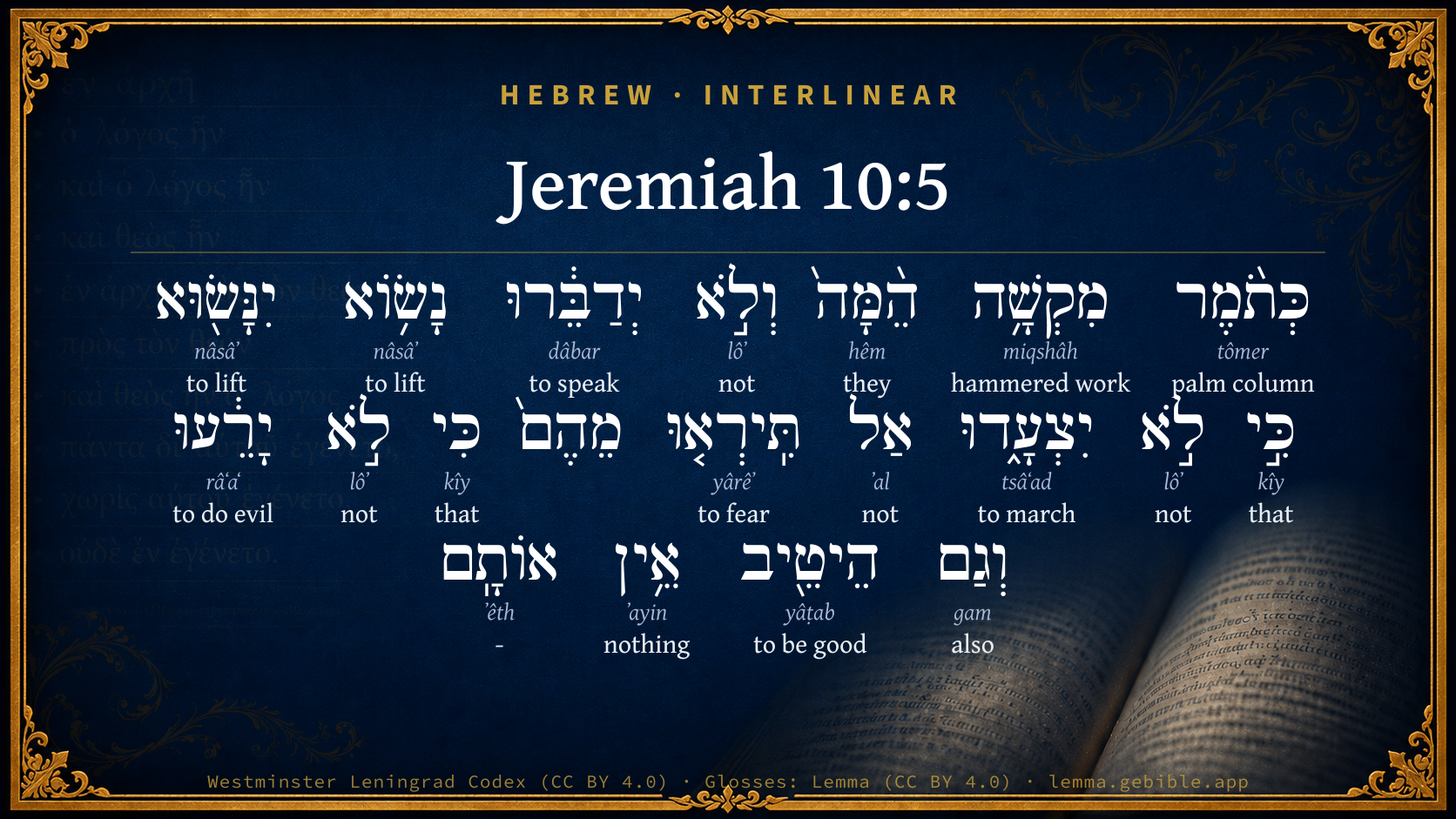
Hebrew (Westminster Leningrad Codex) Jeremiah 10:5 appears in the Hebrew Old Testament. The text above is from the Westminster Leningrad Codex. Each word links to its Strong’s number, a concise gloss, and parsing drawn from the Open Scriptures Hebrew Bible morphology. Click any word for its full Brown-Driver-Briggs (BDB) entry.
Download image
Cite this verse

Jeremiah 10:5 (World English Bible). Public Domain. Lemma interlinear Bible study tool, https://lemma.gebible.app/v/jeremiah/10/5.

Show BibTeX & RIS
BibTeX
RIS
English Translation
They are like a palm tree, of turned work, and don't speak: they must be carried, because they can't go. Don't be afraid of them; for they can't do evil, neither is it in them to do good."
World English Bible · Public Domain
Download a study sheet

One document with this verse’s original text, its word-by-word gloss line, the meaning frame, cross-references with their text, attributed commentary, and full source and license credits — printable, and it pastes into notes with its structure intact.

This verse Autodidact and up

Study sheet (.html) Plain text (.txt)

A passage Seminary Student

Up to 50 verses in one chapter. A passage sheet keeps up to 6 commentary sources and 12 cross-references per verse, in the order this page ranks them, and says so on the sheet whenever that leaves anything out. Ask for a single verse and you get the Autodidact verse sheet above.

Everything on this page stays free to read, with no account — the sheet is a download of what is already on screen, not access to it.

Want to remove ads? Support Godless Engineer
Compare translations 3

The same verse in 3 English versions, stacked beneath the original-language interlinear above. Click any original word for its lexicon entry.

Each is an independent rendering of the whole verse — the interlinear is not word-aligned to these translations.

Highlighted words mark where these versions differ — a whole-verse word diff, not a word-by-word alignment.

  • World English Bible Public Domain
    They are like a palm tree, of turned work, and don't speak: they must be carried, because they can't go. Don't be afraid of them; for they can't do evil, neither is it in them to do good."
  • King James Version Public Domain
    They are upright as the palm tree, but speak not: they must needs be borne, because they cannot go. Be not afraid of them; for they cannot do evil, neither also is it in them to do good.
  • unfoldingWord Literal Text CC BY-SA 4.0
    They like scarecrows of a cucumber field, and they do not speak, carrying, they are carried because they do not walk. Do not be afraid of them, for they will not do harm, and also there is not good with them.”

unfoldingWord Literal Text — © unfoldingWord, licensed CC BY-SA 4.0. Word-aligned USFM3 via Door43 (git.door43.org/unfoldingWord/en_ult).

Versions to compare (up to 4)

3 of 4 selected

Show all 18 translations

Every available English version of this verse, each an independent rendering of the whole verse.

  • World English Bible Public Domain
    They are like a palm tree, of turned work, and don't speak: they must be carried, because they can't go. Don't be afraid of them; for they can't do evil, neither is it in them to do good."
  • Berean Standard Bible Public Domain
    Like scarecrows in a cucumber patch, their idols cannot speak. They must be carried because they cannot walk. Do not fear them, for they can do no harm, and neither can they do any good.”
  • Majority Standard Bible Public Domain
    Like scarecrows in a cucumber patch, their idols cannot speak. They must be carried because they cannot walk. Do not fear them, for they can do no harm, and neither can they do any good.”
  • King James Version Public Domain
    They are upright as the palm tree, but speak not: they must needs be borne, because they cannot go. Be not afraid of them; for they cannot do evil, neither also is it in them to do good.
  • American Standard Version (1901) Public Domain
    They are like a palm-tree, of turned work, and speak not: they must needs be borne, because they cannot go. Be not afraid of them; for they cannot do evil, neither is it in them to do good.
  • Revised Version (1885) Public Domain
    They are like a palm tree, of turned work, and speak not: they must needs be borne, because they cannot go. Be not afraid of them; for they cannot do evil, neither is it in them to do good.
  • Geneva Bible (1599) Public Domain
    The idoles stande vp as the palme tree, but speake not: they are borne because they cannot go feare them not, for they cannot do euill, neither can they do good.
  • Douay-Rheims (1899) Public Domain
    They are framed after the likeness of a palm tree, and shall not speak: they must be carried to be removed, because they cannot go. Therefore, fear them not, for they can neither do evil nor good.
  • Young's Literal Translation Public Domain
    As a palm they `are' stiff, and they speak not, They are surely borne, for they step not, Be not afraid of them, for they do no evil, Yea, also to do good is not in them.
  • Literal Standard Version CC BY-SA 4.0
    They [are] stiff as a palm, and they do not speak, || They are surely carried, for they do not step, || Do not be afraid of them, for they do no evil, || Indeed, to do good is also not in them.”
  • Unlocked Literal Bible CC BY-SA 4.0
    What they make with their hands is like scarecrows in a cucumber field, because they, too, can say nothing, and they have to be carried because they cannot walk. Do not fear them, for they cannot bring about evil, nor are they able to do anything good.'”
  • unfoldingWord Literal Text CC BY-SA 4.0
    They like scarecrows of a cucumber field, and they do not speak, carrying, they are carried because they do not walk. Do not be afraid of them, for they will not do harm, and also there is not good with them.”
  • Darby Bible Public Domain
    They are as a palm-column of turned work, and they speak not; they are carried, for they cannot go. Be not afraid of them; for they cannot do evil, neither also is it in them to do good.
  • World Messianic Bible Public Domain
    They are like a palm tree, of turned work, and don’t speak. They must be carried, because they can’t move. Don’t be afraid of them; for they can’t do evil, neither is it in them to do good.”
  • Webster's Bible Public Domain
    They are upright as the palm tree, but speak not: they must needs be borne, because they cannot go. Be not afraid of them; for they cannot do evil, neither also is it in them to do good.
  • Free Bible Version CC BY-SA 4.0
    Just like a scarecrow in a field of cucumbers, their idols can't speak. They have to be carried around because they can't walk. You don't have to be afraid of them because they can't hurt you—and they can't do you any good either.
  • Bible in Basic English Public Domain
    It is like a pillar in a garden of plants, and has no voice: it has to be lifted, for it has no power of walking. Have no fear of it; for it has no power of doing evil and it is not able to do any good.
  • JPS Tanakh (1917) Public Domain
    They are like a pillar in a garden of cucumbers, and speak not; they must needs be borne, because they cannot go. Be not afraid of them, for they cannot do evil, neither is it in them to do good.

Literal Standard Version (2020), Covenant Press — licensed CC BY-SA 4.0. Text via the HelloAO Bible API (eBible.org). Unlocked Literal Bible (unfoldingWord) — licensed CC BY-SA 4.0. Text via the HelloAO Bible API (eBible.org). unfoldingWord Literal Text — © unfoldingWord, licensed CC BY-SA 4.0. Word-aligned USFM3 via Door43 (git.door43.org/unfoldingWord/en_ult). Free Bible Version, Dr. Jonathan Gallagher — licensed CC BY-SA 4.0. Text via the HelloAO Bible API (eBible.org).

Word by word

More ways to search: Search by grammar → Find every occurrence → Compare this word →

Practice this passage: Drill this verse → Learn its vocabulary →

כְּתֹ֨מֶר
tômer
H8560
“like/as · palm column of”
Preposition + Noun, Common, Masculine, Singular, Construct
Part of Speech
Preposition + Noun
Type
Common
Gender
Masculine
Number
Singular
State
Construct
Full BDB Definition

Origin: from the same root as H8558

TWOT: 2523a

palm tree, post, column
  1. מִקְשָׁ֥ה miqshâh H4749 “hammered work” Noun, Common, Feminine, Singular, Absolute
  2. הֵ֨מָּה֙ hêm H1992 “they” Pronoun, Personal, 3rd Person, Masculine, Plural
  3. וְלֹ֣א lôʼ H3808 “and · not” Conjunction + Particle, Negative
  4. יְדַבֵּ֔רוּ dâbar H1696 “to speak” Verb, Piel, Imperfect, 3rd Person, Masculine, Plural
  5. נָשׂ֥וֹא nâsâʼ H5375 “to lift” Verb, Qal, Infinitive Absolute
  6. יִנָּשׂ֖וּא nâsâʼ H5375 “to lift” Verb, Niphal, Imperfect, 3rd Person, Masculine, Plural
  7. כִּ֣י kîy H3588 “that” Conjunction
  8. לֹ֣א lôʼ H3808 “not” Particle, Negative
  9. יִצְעָ֑דוּ tsâʻad H6805 “to march” Verb, Qal, Imperfect, 3rd Person, Masculine, Plural
  10. אַל ʼal H408 “not” Particle, Negative
  11. תִּֽירְא֤וּ yârêʼ H3372 “to fear” Verb, Qal, Jussive, 2nd Person, Masculine, Plural
  12. כִּי kîy H3588 “that” Conjunction
  13. לֹ֣א lôʼ H3808 “not” Particle, Negative
  14. יָרֵ֔עוּ râʻaʻ H7489 “to do evil” Verb, Hiphil, Imperfect, 3rd Person, Masculine, Plural
  15. וְגַם gam H1571 “and · also” Conjunction + Particle, Accusative
  16. הֵיטֵ֖יב yâṭab H3190 “to be good” Verb, Hiphil, Infinitive Absolute
  17. אֵ֥ין ʼayin H369 “nothing” Particle, Negative
  18. אוֹתָֽם ʼêth H853 “- · them” Particle, Direct Object + Suffix, Personal, 3rd Person, Masculine, Plural

About this verse

These counts appear in no published source. They are computed here, from the morphology-tagged text and Lemma’s own curated glosses. What Lemma adds →

20
words
15
distinct lemmas
Prophets
section

Notable vocabulary

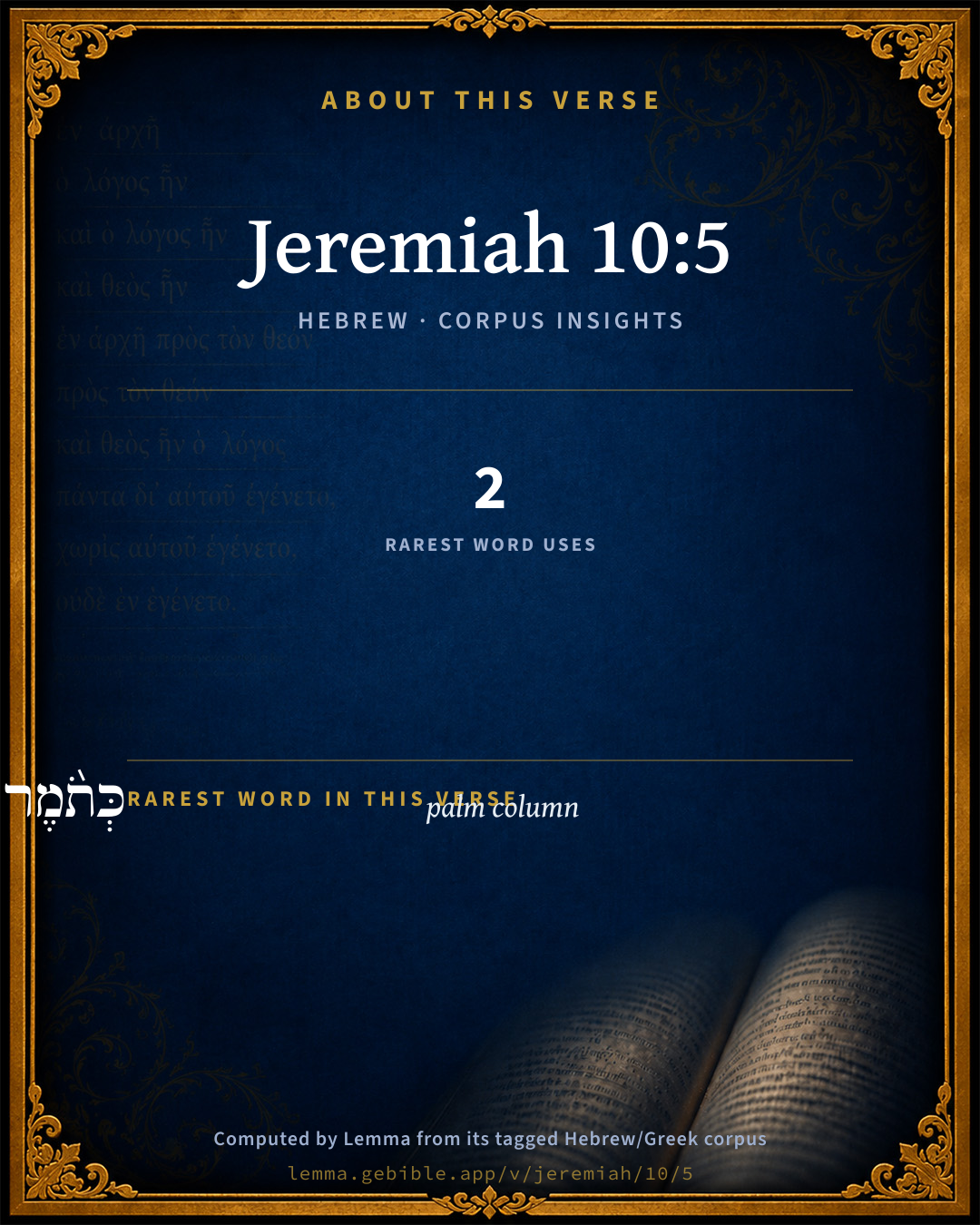
The rarest word here is כְּתֹ֨מֶר palm column H8560 — appearing just 2 times in the whole Hebrew Bible.

Shared distinctive vocabulary

כְּתֹ֨מֶר palm column H8560 occurs in 2 verses of the Hebrew Bible. Also found in:

Grammatical profile

  • 7 verbs
  • 2 nouns
  • 1 pronoun
  • 1 preposition
  • 2 conjunctions
  • 7 particles

Verb forms

  • יְדַבֵּ֔רוּ Piel · Imperfect
  • נָשׂ֥וֹא Qal · Infinitive Absolute
  • יִנָּשׂ֖וּא Niphal · Imperfect
  • יִצְעָ֑דוּ Qal · Imperfect
  • תִּֽירְא֤וּ Qal · Jussive
  • יָרֵ֔עוּ Hiphil · Imperfect
  • הֵיטֵ֖יב Hiphil · Infinitive Absolute

Repetition

Words recur within this verse — often emphatic in Hebrew:

  • נָשׂ֥וֹא to lift H5375 ×2
  • וְלֹ֣א not H3808 ×3
  • כִּ֣י that H3588 ×2

Cross-references

11

Topical passages linked to Jeremiah 10:5 in the Treasury of Scripture Knowledge — connected by theme and wording, ordered by reader-vote popularity; previews shown in the World English Bible.

  • Isaiah 46:7 They bear it on the shoulder, they carry it, and set it in its place, and it stands, from its place it shall not move: yes, one may cry to it, yet it can not answer, nor save him out of his trouble.
  • 1 Corinthians 12:2 You know that when you were heathen, you were led away to those mute idols, however you might be led.
  • Psalms 115:5–8 They have mouths, but they don't speak; They have eyes, but they don't see;
  • Isaiah 41:23–24 Declare the things that are to come hereafter, that we may know that you are gods: yes, do good, or do evil, that we may be dismayed, and see it together.
  • Psalms 135:16–18 They have mouths, but they can't speak; They have eyes, but they can't see;
  • Isaiah 46:1 Bel bows down, Nebo stoops; their idols are on the animals, and on the cattle: the things that you carried about are made a load, a burden to the weary [animal].
  • Habakkuk 2:19 Woe to him who says to the wood, 'Awake!' or to the mute stone, 'Arise!' Shall this teach? Behold, it is overlaid with gold and silver, and there is no breath at all in the midst of it.
  • 1 Corinthians 8:4 Therefore concerning the eating of things sacrificed to idols, we know that no idol is anything in the world, and that there is no other God but one.
  • Revelation 13:14–15 He deceives my own people who dwell on the earth because of the signs he was granted to do in front of the beast; saying to those who dwell on the earth, that they should make an image to the beast who had the sword wound and lived.
  • Isaiah 44:9–10 Those who fashion an engraved image are all of them vanity; and the things that they delight in shall not profit; and their own witnesses don't see, nor know: that they may be disappointed.
  • Isaiah 45:20 Assemble yourselves and come; draw near together, you who have escaped from the nations: they have no knowledge who carry the wood of their engraved image, and pray to a god that can't save.

Cross-references courtesy of OpenBible.info (CC BY 4.0).

Hebrew and Greek witnesses Masoretic Hebrew ↔ Greek Septuagint

The same verse in the two great witnesses to the Old Testament, shown verse-for-verse.

These are two independent witnesses, not word-aligned to each other, and the Septuagint is shown in lemma (dictionary) form.

Hebrew Jeremiah 10:5 Masoretic · Westminster Leningrad Codex

כְּתֹ֨מֶר מִקְשָׁ֥ה הֵ֨מָּה֙ וְלֹ֣א יְדַבֵּ֔רוּ נָשׂ֥וֹא יִנָּשׂ֖וּא כִּ֣י לֹ֣א יִצְעָ֑דוּ אַל תִּֽירְא֤וּ מֵהֶם֙ כִּי לֹ֣א יָרֵ֔עוּ וְגַם הֵיטֵ֖יב אֵ֥ין אוֹתָֽם

They are like a palm tree, of turned work, and don't speak: they must be carried, because they can't go. Don't be afraid of them; for they can't do evil, neither is it in them to do good."

World English Bible · Public Domain

Greek LXX Structure differs

In the Septuagint, Jeremiah is about an eighth shorter than the Hebrew and arranges its material differently — the Oracles Against the Nations (Hebrew chapters 46–51) appear in the middle of the Greek book, after 25:13. Because the chapter and verse boundaries do not line up, a verse-for-verse comparison with the Hebrew is not shown.

A verse-for-verse comparison isn’t shown here because the chapters and verses don’t line up. Switch to the LXX edition with the MT / LXX toggle above to read the Greek directly.

On this verse, The Cambridge Bible for Schools and Colleges discusses the Septuagint’s reading. Read the note in Commentary ↓

Hebrew: Westminster Leningrad Codex (CC BY 4.0). Greek: Septuagint (public domain); English from a public-domain English Septuagint. How the Septuagint differs from the Hebrew →

Targum (Aramaic paraphrase)

1

The Targum is the ancient Jewish Aramaic paraphrase of the Hebrew Scriptures — an interpretive translation, not the Hebrew text itself. Onkelos (literal) and Pseudo-Jonathan (expansive) render the Torah, and Jonathan the Prophets. Coverage is partial: where no permissively-licensed English translation exists for a verse, only the Aramaic is shown. This is verse-level text, not a word-by-word alignment to the Hebrew.

  1. Targum Jonathan Prophets (Joshua–Malachi)
    עוֹבַד נְגִיד זְקִיפִין אִינוּן וְלָא מְמַלְלִין אִתְנַטָלָא יִתְנַטְלוּן אֲרֵי לֵית בְּהוֹן רוּחָא לַהֲלָכָא לָא תִדַחֲלוּן מִנְהוֹן אֲרֵי לָא מַבְאֲשִׁין וְאַף לְאֵיטָבָא לֵית אִינוּן יָדְעִין:

    (no public-domain English translation for this verse)

    Targum Jonathan — Aramaic: “Mikraot Gedolot” (public domain). English: “Sefaria Community Translation” (CC0 1.0 (public-domain dedication)); “London "Chaldee Paraphrase," 1871” (public domain). Text via Sefaria.

Commentary

Notes on Jeremiah 10:5 from classic Christian and Jewish commentators (each source and its license shown beneath its notes). The classic Christian expositions comment on the surrounding passage and are grouped to its opening verse, so a note may address several verses; the Jewish commentaries on the Tanakh (Rashi and others) are per-verse, so they appear only where the commentator wrote on this verse.

Lemma curates 59 commentaries, every one of them public domain or Creative Commons licensed, each selected and text-cleaned for this edition rather than reprinted as found. About our sources →

Trapp's Complete Commentary

John Trapp

Jer 10:5 They [are] upright as the palm tree, but speak not: they must needs be borne, because they cannot go. Be not afraid of them; for they cannot do evil, neither also [is it] in them to do good.

Ver. 5. They are upright as the palm tree.] Which is straight, tall, smooth, and in summo profert fructus, and beareth fruits at the very top of it.

John Trapp, A Commentary or Exposition upon All the Books of the Old and New Testament (1647–1656) — public domain. Text from a community e-Sword module.

Tyndale Open Study Notes

Tyndale Open Resources

10:5 Just as scarecrows in a garden can do nothing more than scare ignorant birds, idols are feared only by ignorant people.

Tyndale Open Study Notes — © Tyndale Open Resources, licensed CC BY-SA 4.0. Text via the HelloAO Bible API.

Jamieson, Fausset & Brown

Robert Jamieson, A. R. Fausset & David Brown

upright--or, "They are of turned work, resembling a palm tree" [MAURER]. The point of comparison between the idol and the palm is in the pillar-like uprightness of the latter, it having no branches except at the top.

speak not-- (Psa 115:5).

cannot go--that is, walk (Psa 115:7; Isa 46:1, Isa 46:7).

neither . . . do good-- (Isa 41:23).

Jamieson, Fausset & Brown — Commentary Critical and Explanatory on the Whole Bible (1871) — public domain (CC PDM 1.0). Text via the HelloAO Bible API.

Adam Clarke's Commentary

Verse 5. They are upright as the palm tree] As straight and as stiff as the trees out of which they are hewn.

Adam Clarke's Commentary on the Bible (1810–1826) — public domain. Text from a community e-Sword/MySword module.

John Calvin's Commentaries

He goes on with the same subject, and borrows his words from the forty — fourth chapter of Isaiah (Isaiah 44); for the passage is wholly similar. Jeremiah, being later, was induced to take the words from his predecessor, that his own nation might be more impressed, on finding that the same thing was said by two Prophets, and that thus they had two witnesses.

He then says that these wise men, who filled the Jews with wonder and astonishment, adorned their images, or statues, with silver and gold, and afterward fixed them with nails and with hammers, that they might not move Some refer the last word to the metal, “that the pieces might not come off,” as the verb sometimes means to depart. But the simpler meaning is, that the statues were fixed by nails and hammers, that they might not be moved. Then the Prophet adds by way of concession, They are indeed erect as the palm-trees; and thus there appears in them something remarkable: but they speak not; and then, being raised they are raised, that is, they cannot move themselves; for they cannot walk Then he says, Be not afraid of them; for they do no evil, nor is it in their power to do good

We now see what the Prophet meant to teach us, — that the wisdom of the Chaldeans, and also of the Egyptians, was celebrated throughout the world, and also so blinded the Jews, or so enraptured, them, that they thought that nothing proceeded from them but what deserved to be known and esteemed. In order therefore to remove and demolish this false notion, he shews that they were beyond measure foolish; for what could have been more sottish than to think that the nature of a tree is changed as soon as it receives a new form? How? By the hand of the artificer. Can it be in the power of man to make a god at his will? This is a folly which heathen authors have derided. Horace has this sentence: —

“When the workman was uncertain whether to make a bench or Priapus, He chose rather to make a god.”

That poet, as he dared not generally to condemn the madness which then prevailed, indirectly shewed how shameful it was to make a log of wood a god, because the workman had given it a form. The very richest worshipped a wooden god, while he despised the artificer! He who would not have condescended to give the workman a cup of water, yet prostrated himself befbre the god which the workman had made! This then is what our Prophet now says, “Behold, with silver and gold do they adorn trunks of trees; they indeed stood up, for they are erect statues;” and he compares them to palm-trees, because they stood high: and he says, “but they speak not; they are raised up, for they have no life; hence fear them not:” and then he adds, “They cannot do evil, and it is not in their power to do good.”

The Prophet seems to speak improperly when he says that they were not gods, because they could do no evil; for it is wholly contrary to the nature of the only true God to do evil: but the Prophet, according to what is common, uses the word for the infliction of punishment. God, then, is said to do evil, not because he does harm to any one, not because he does wrong to any mortals, but because he chastises them for their sins. And it is a way of speaking derived from the common judgment of man, for we call those things evils which are afflictions to us; for famine, diseases, poverty, cold, heat, disgrace, and things of this kind, are called afflictions or adversities. Now, the Prophet says, that the idols of the Gentiles, or their fictitious gods, do no evil, that is, they have no power to inflict punishment on men. And this is taken from Isaiah. God uses there a twofold argument, while claiming divinity to himself alone: he says,

“I alone am he who foresees and predicts future things;”

and hence I am God alone; and then he says,

“I alone am he who do good and evil;”

hence I alone am God. (Isaiah 45:22; Isaiah 48:3, 5.) He says, that he doeth evil, because he is the Judge of the world. We hence see that this expression is not to be taken in a bad sense, but, as I have said, it is to be taken in a sense used by men; for we consider and call those punishments, with which God visits us, evils. It follows —

John Calvin's Commentaries (1540-1563) — public domain. Text from the Calvin Translation Society English edition (1840s-50s) via the Christian Classics Ethereal Library (ccel.org). Calvin's coverage is partial (roughly two-thirds of the Bible); uncommented books and verses are honest gaps, never fabricated. The 19th-century editor's footnotes and remarks are omitted so the notes are faithfully Calvin's own voice.

Ellicott's Commentary for English Readers

(5) Upright as the palm tree.—Better, perhaps, A pillar in a garden of gourds are they. The Hebrew word translated “upright” has two very different, though not entirely unconnected, meanings—(1) “twisted, rounded, carved,” and in this sense it is translated commonly as “beaten work” (Exo_25:18; Exo_25:31; Exo_25:36), and is here applied (if we accept this meaning) to the twisted palm-like columns of a temple, to which the stiff, formal figure of the idol, with arms pressed close to the side, and none of the action which we find in Greek statues, is compared; (2) the other meaning adopted by many commentators is that of “a garden of gourds or cucumbers,” and the word is so rendered in Isa_1:8. The comparison, in the so-called “Epistle of Jeremy” in the apocryphal book of Baruch (10:70), of an idol to “a scarecrow in a garden of cucumbers” shows that the latter meaning was the accepted one when that Epistle was written. The thought, on this view, is that the idol which the men of Judah were worshipping was like one of the “pillars” (so the word for “palm tree” is translated in Son_3:6; Joe_2:30), the Hermes, or Priapus-figures which were placed by Greeks and Romans in gardens and orchards as scarecrows. Like figures appear to have been used by the Phœnicians for the same purpose, and the practice, like the kindred worship of the Asherah, would seem to have been gaining ground even in Judah.

A Bible Commentary for English Readers, edited by Charles John Ellicott (1878–1897) — public domain. Text from a community e-Sword module.

The Cambridge Bible for Schools and Colleges

gen. ed. J. J. S. Perowne

5. palm tree, of turned work] Substitute mg., comparing, as above, Bar_6:70 (“scarecrow”). See introd. note for this attitude towards idols.

From “they must needs” to “do good” is placed after Jer_10:9 in LXX. This suggests that these clauses have their origin in marginal glosses, to the insertion of which at different places in the text by copyists the Hebrew and the Greek bear testimony.

The Cambridge Bible for Schools and Colleges (gen. ed. J. J. S. Perowne; Cambridge University Press, 1878–1918) — public domain. Text from a community e-Sword module.

John Gill's Exposition

They are upright as the palm tree,.... Being nailed to a post, or fastened to a pillar, or set upon a pedestal, and so stand erect without bending any way; and are like a palm tree, which is noted for its uprightness; hence the church's stature is compared to it, Sol 7:7, here it is a sarcasm, and a bitter one:

but speak not; man, that is of an erect stature, in which he differs from other creatures, has the faculty of speech, which they that go upon four feet have not; but the idols of the Gentiles, though erect, have not the power of speaking a word; and therefore can give no answer to their worshippers; see Psa 115:5,

they must needs be borne: or, "in carrying be carried" (q); when being made they are fixed in the designed place, or are moved from place to place; they are then carried in men's arms, or on their shoulders:

because they cannot go; they have no life, and so are incapable of motion of themselves; they have feet, but walk not; and cannot arise and bestir themselves for the help of those that pray unto them, Psa 115:7,

be not afraid of them, for they cannot do evil; that is, inflict judgment, cause drought, famine, or pestilence, or any other evil or calamity:

neither is it also in them to do good; to give rains and fruitful seasons, or bestow any favour, temporal or spiritual; see Jer 14:21.

(q) "portando portantur", Schmidt; "portabitur" Pagninus; "portabuntur", Montanus; "omnino portanda sunt", Junius & Tremellius, Piscator.

John Gill's Exposition of the Whole Bible (1746–1763) — public domain (CC PDM 1.0). Text via the HelloAO Bible API.

Albert Barnes' Notes on the Bible

They are upright ... - Rather, “They are like a palm tree of turned work, i. e.” like one of those stiff inelegant pillars, something like a palm tree, which may be seen in oriental architecture. Some translate thus: “They are like pillar’s in a garden of cucumbers, i. e.” like the blocks set up to frighten away the birds; but none of the ancient versions support this rendering.

Albert Barnes' Notes on the Bible (1834–1885) — public domain. Text from a community e-Sword/MySword module.

Haydock's Catholic Bible Commentary

Tree. The ancient statues were ill-formed, (Diodorus 4.) before Dedalus brought the art to greater perfection, and gave them a living attitude.

George Leo Haydock (1774–1849), Haydock's Catholic Family Bible and Commentary, 1859 edition — public domain. Excludes Psalms (Douay-Rheims chapter numbering differs from Protestant) and Deuterocanonical books (Catholic canon only).

Matthew Poole's English Annotations

They are upright as the palm tree; the nature of which is to grow upright and tall, without any branchings, till it comes to the top, thereby possibly representing majesty.

But speak not; looking as if they were about to speak, standing in a speaking posture; but have not a word to utter, being only dumb stocks, wooden gods.

They must needs be borne, because they cannot go; they move no further or faster than you lift them, either when you go to set them up, or upon any occasion of removal, as stiff as stakes, being indeed but sticks.

Be not afraid of them; they can do you no more harm than the signs of heaven could do; they are but dead stocks. The heathens worshipped some idols that they might do them good, and others that they might do them no harm; but God tells them here, they can do neither good nor harm, as in the next words; they can neither punish nor reward; they can neither hurt their enemies, nor help their friends: by this the true God will be distinguished from idols, that he alone can foretell things to come, and he alone can reward or punish, Isa 48:5, and therefore the prophet endeavours to turn them off from their idols to the true God.

Matthew Poole's English Annotations on the Holy Bible (1683–1685) — public domain. Text from a community e-Sword/MySword module.

Whedon's Commentary on the Bible

Daniel D. Whedon

5. Upright as the palm tree — Rather, as a palm tree of turned work, etc. The word rendered “palm tree,” occurs besides only in Jdg_4:5, where it clearly has this meaning. But as in later Hebrew, (for example, Son_3:6; Joe_2:30, and in the Talmud,) the root yields the sense of pillar. Keil would give it that sense in this place, and so translates, as a lathe-turned pillar, etc., that is, lifeless and motionless.

This verse is peculiar to Jeremiah. There is nothing answering to it in either of the kindred passages in Isaiah. The whole passage is grotesquely faithful, and the conclusion commends itself, They cannot do evil, neither also is it in them to do good.

Daniel D. Whedon (gen. ed.), Commentary on the Old and New Testaments (1874–1909) — public domain. Text from a community e-Sword module.

The Pulpit Commentary

They are upright as the palm tree; rather, they are like a pillar (i.e. a scarecrow) in a field of cucumbers. This is the interpretation given to our passage in Ver. 70 of the apocryphal Epistle of Jeremiah (written in the Maccabean period, evidently with reference to our prophecy), and is much more striking than the rival translation, "like a palm tree of turned work," i.e. stiff, immovable (comp. Virgil, "Georg.," 4:110, 111; Horace, "Sat.," 1. 8, 1-4). They must needs be borne... they cannot do evil; a reminiscence, apparently, of Isa_46:7 Isa_41:23.

The Pulpit Commentary (1880–1919), ed. H.D.M. Spence-Jones & Joseph S. Exell — public domain. Text from a community e-Sword module.

Rashi

Rabbi Shlomo Yitzchaki (Rashi)

Like a palm tree they are beaten He hammers them with a hammer until it has an upright stature like a palm tree.

fear them not if you separate from them for they will not harm you.

neither is it in them to do good If you worship them. היטיב is like להיטיב to do good.

Rashi on the Tanakh — English translations: “The Judaica Press complete Tanach with Rashi, translated by A. J. Rosenberg” (CC BY 4.0); “Pentateuch with Rashi's commentary by M. Rosenbaum and A.M. Silbermann, 1929-1934” (public domain); “The Metsudah Tanach series, Lakewood, N.J” (CC BY 4.0); and “The Book of Joshua, Metsudah Publications, 1997” (CC BY 4.0). Text via Sefaria.

Lesson kit

Teaching starters — assembled from the data on this page, not authored interpretation. Every prompt links to the verse data it draws on. Edit before teaching.

Jeremiah, in the Prophets, opens this verse with 20 words (15 distinct Hebrew lemmas). Its most distinctive word is tômer (“palm column”). A historical commentator’s framing appears above. Read the whole chapter for the surrounding context.

Discussion questions

  1. The word tômer carries the sense “palm column.” How does it shape the verse?
  2. How does Judges 4:5, which shares the word «palm column», read alongside this verse?
  3. What does the repetition of “to lift” (2× in this one verse) do in this verse?
  4. The translations on this page render this verse differently — a whole-verse word diff, not a word-by-word alignment. What might account for the different wordings?
  5. «יְדַבֵּ֔רוּ» is a Piel Imperfect verb. How does that grammatical form shape the action described?
  6. Compare how Trapp's Complete Commentary and Tyndale Open Study Notes read this verse. Where do they agree or differ?

Things to notice

Reading settings

Reading text

Shown beneath each verse's original-language words.

Old Testament
Old Testament edition

Read the OT as the Masoretic Hebrew (MT) or the Greek Septuagint (LXX).

English shown for the Greek Septuagint (in the Hebrew ↔ Greek comparison).

Comparing translations? Open the Compare panel on any verse page to stack up to four side by side.