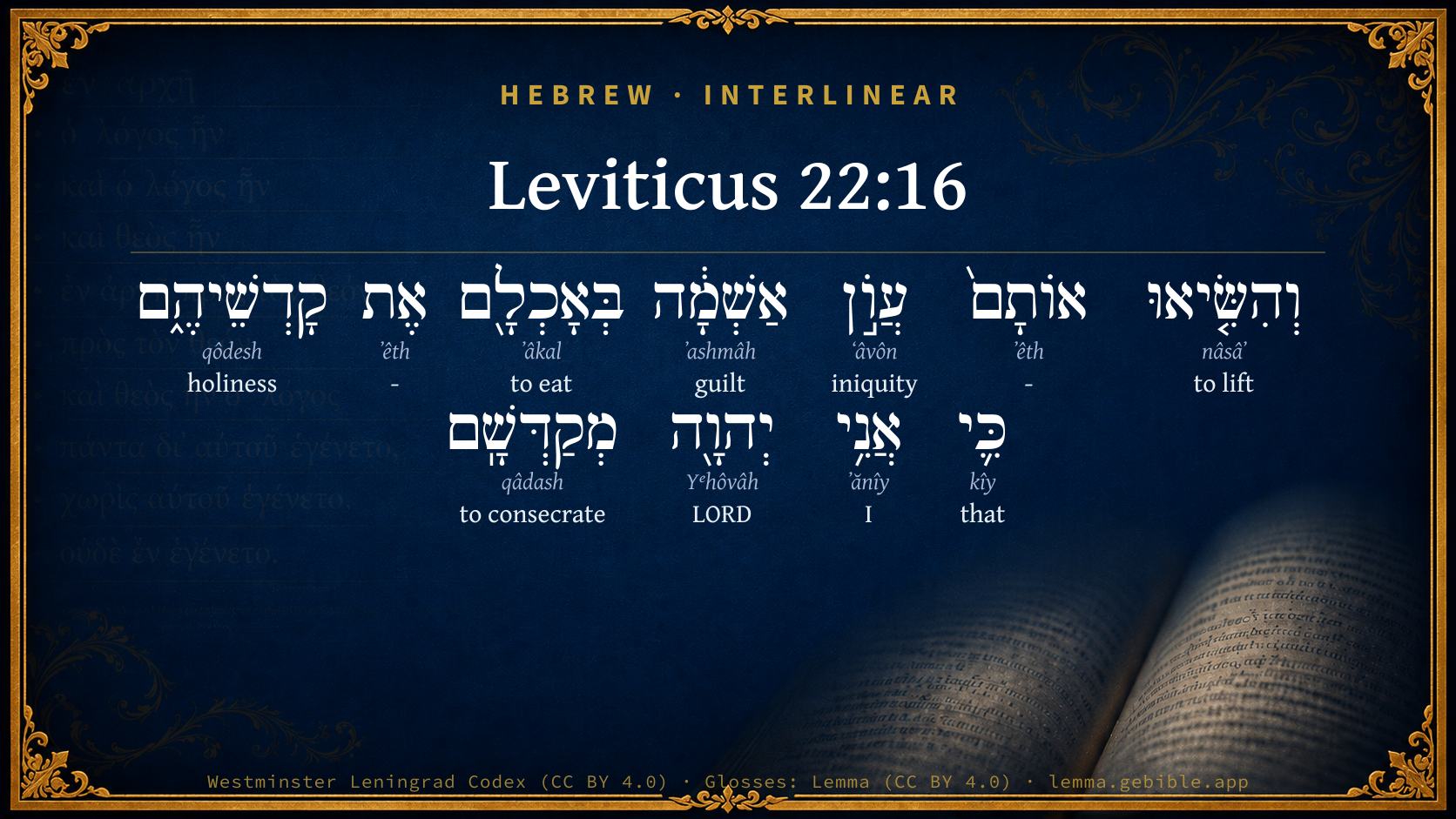
Leviticus 22:16

Hebrew (Westminster Leningrad Codex) Leviticus 22:16 appears in the Hebrew Old Testament. The text above is from the Westminster Leningrad Codex. Each word links to its Strong’s number, a concise gloss, and parsing drawn from the Open Scriptures Hebrew Bible morphology. Click any word for its full Brown-Driver-Briggs (BDB) entry.
Download image
Cite this verse

Leviticus 22:16 (World English Bible). Public Domain. Lemma interlinear Bible study tool, https://lemma.gebible.app/v/leviticus/22/16.

Show BibTeX & RIS
BibTeX
RIS
English Translation
and so cause them to bear the iniquity that brings guilt, when they eat their holy things: for I am Yahweh who sanctifies them.'"
World English Bible · Public Domain
Download a study sheet

One document with this verse’s original text, its word-by-word gloss line, the meaning frame, cross-references with their text, attributed commentary, and full source and license credits — printable, and it pastes into notes with its structure intact.

This verse Autodidact and up

Study sheet (.html) Plain text (.txt)

A passage Seminary Student

Up to 50 verses in one chapter. A passage sheet keeps up to 6 commentary sources and 12 cross-references per verse, in the order this page ranks them, and says so on the sheet whenever that leaves anything out. Ask for a single verse and you get the Autodidact verse sheet above.

Everything on this page stays free to read, with no account — the sheet is a download of what is already on screen, not access to it.

Want to remove ads? Support Godless Engineer
Compare translations 3

The same verse in 3 English versions, stacked beneath the original-language interlinear above. Click any original word for its lexicon entry.

Each is an independent rendering of the whole verse — the interlinear is not word-aligned to these translations.

Highlighted words mark where these versions differ — a whole-verse word diff, not a word-by-word alignment.

  • World English Bible Public Domain
    and so cause them to bear the iniquity that brings guilt, when they eat their holy things: for I am Yahweh who sanctifies them.'"
  • King James Version Public Domain
    Or suffer them to bear the iniquity of trespass, when they eat their holy things: for I the LORD do sanctify them.
  • unfoldingWord Literal Text CC BY-SA 4.0
    or they shall cause themselves to bear the iniquity of guilt by their eating their holy things. For I Yahweh, the one making them holy.’”

unfoldingWord Literal Text — © unfoldingWord, licensed CC BY-SA 4.0. Word-aligned USFM3 via Door43 (git.door43.org/unfoldingWord/en_ult).

Versions to compare (up to 4)

3 of 4 selected

Show all 18 translations

Every available English version of this verse, each an independent rendering of the whole verse.

  • World English Bible Public Domain
    and so cause them to bear the iniquity that brings guilt, when they eat their holy things: for I am Yahweh who sanctifies them.'"
  • Berean Standard Bible Public Domain
    by allowing the people to eat the sacred offerings and thus to bear the punishment for guilt. For I am the LORD who sanctifies them.”
  • Majority Standard Bible Public Domain
    by allowing the people to eat the sacred offerings and thus to bear the punishment for guilt. For I am the LORD who sanctifies them.”
  • King James Version Public Domain
    Or suffer them to bear the iniquity of trespass, when they eat their holy things: for I the LORD do sanctify them.
  • American Standard Version (1901) Public Domain
    and `so' cause them to bear the iniquity that bringeth guilt, when they eat their holy things: for I am Jehovah who sanctifieth them.
  • Revised Version (1885) Public Domain
    and so cause them to bear the iniquity that bringeth guilt, when they eat their holy things: for I am the LORD which sanctify them.
  • Geneva Bible (1599) Public Domain
    Neither cause the people to beare the iniquitie of their trespas, while they eate their holy thing: for I the Lord do halowe them.
  • Douay-Rheims (1899) Public Domain
    Lest perhaps they bear the iniquity of their trespass, when they shall have eaten the sanctified things. I am the Lord who sanctify them.
  • Young's Literal Translation Public Domain
    nor have caused them to bear the iniquity of the guilt-offering in their eating their holy things; for I `am' Jehovah, sanctifying them.'
  • Literal Standard Version CC BY-SA 4.0
    or have caused them to bear the iniquity of the guilt-offering in their eating their holy things; for I [am] YHWH, sanctifying them.”
  • Unlocked Literal Bible CC BY-SA 4.0
    and cause themselves to carry the sin that would make them guilty of eating the holy food, for I am Yahweh who makes them holy.'”
  • unfoldingWord Literal Text CC BY-SA 4.0
    or they shall cause themselves to bear the iniquity of guilt by their eating their holy things. For I Yahweh, the one making them holy.’”
  • Darby Bible Public Domain
    and cause them to bear the iniquity of trespass when they eat their holy things; for I am Jehovah who do hallow them.
  • World Messianic Bible Public Domain
    and so cause them to bear the iniquity that brings guilt when they eat their holy things; for I am the LORD who sanctifies them.’”
  • Webster's Bible Public Domain
    Or suffer them to bear the iniquity of trespass, when they eat their holy things: for I the LORD do sanctify them.
  • Free Bible Version CC BY-SA 4.0
    by allowing the people to eat them and in so doing take upon themselves the punishment for guilt. For I am the Lord who makes them holy.”
  • Bible in Basic English Public Domain
    So causing sin to come on them when they take their holy things for food: I am the Lord who make them holy.
  • JPS Tanakh (1917) Public Domain
    and so cause them to bear the iniquity that bringeth guilt, when they eat their holy things; for I am the LORD who sanctify them.

Literal Standard Version (2020), Covenant Press — licensed CC BY-SA 4.0. Text via the HelloAO Bible API (eBible.org). Unlocked Literal Bible (unfoldingWord) — licensed CC BY-SA 4.0. Text via the HelloAO Bible API (eBible.org). unfoldingWord Literal Text — © unfoldingWord, licensed CC BY-SA 4.0. Word-aligned USFM3 via Door43 (git.door43.org/unfoldingWord/en_ult). Free Bible Version, Dr. Jonathan Gallagher — licensed CC BY-SA 4.0. Text via the HelloAO Bible API (eBible.org).

Word by word

More ways to search: Search by grammar → Find every occurrence → Compare this word →

Practice this passage: Drill this verse → Learn its vocabulary →

אַשְׁמָ֔ה
ʼashmâh
H819
“guilt”
Noun, Common, Feminine, Singular, Absolute
Part of Speech
Noun
Type
Common
Gender
Feminine
Number
Singular
State
Absolute
Full BDB Definition

Origin: from H817

TWOT: 180c

guiltiness, guilt, offense, sin, wrong-doing - doing wrong, committing a trespass or offense - becoming guilty, guilt - bringing a guilt-offering
  1. וְהִשִּׂ֤יאוּ nâsâʼ H5375 “and · to lift” Conjunction + Verb, Hiphil, Sequential Perfect, 3rd Person, Common, Plural
  2. אוֹתָם֙ ʼêth H853 “- · them” Particle, Direct Object + Suffix, Personal, 3rd Person, Masculine, Plural
  3. עֲוֺ֣ן ʻâvôn H5771 “iniquity of” Noun, Common, Both, Singular, Construct
  4. בְּאָכְלָ֖ם ʼâkal H398 “in/at · to eat · them” Preposition + Verb, Qal, Infinitive Construct + Suffix, Personal, 3rd Person, Masculine, Plural
  5. אֶת ʼêth H853 “-” Particle, Direct Object
  6. קָדְשֵׁיהֶ֑ם qôdesh H6944 “holy things · their” Noun, Common, Masculine, Plural, Construct + Suffix, Personal, 3rd Person, Masculine, Plural
  7. כִּ֛י kîy H3588 “that” Conjunction
  8. אֲנִ֥י ʼănîy H589 “I” Pronoun, Personal, 1st Person, Common, Singular
  9. יְהוָ֖ה Yᵉhôvâh H3068 “LORD” Noun, Proper
  10. מְקַדְּשָֽׁם qâdash H6942 “consecrating · them” Verb, Piel, Participle Active, Masculine, Singular, Construct + Suffix, Personal, 3rd Person, Masculine, Plural

About this verse

These counts appear in no published source. They are computed here, from the morphology-tagged text and Lemma’s own curated glosses. What Lemma adds →

11
words
10
distinct lemmas
Pentateuch
section

Notable vocabulary

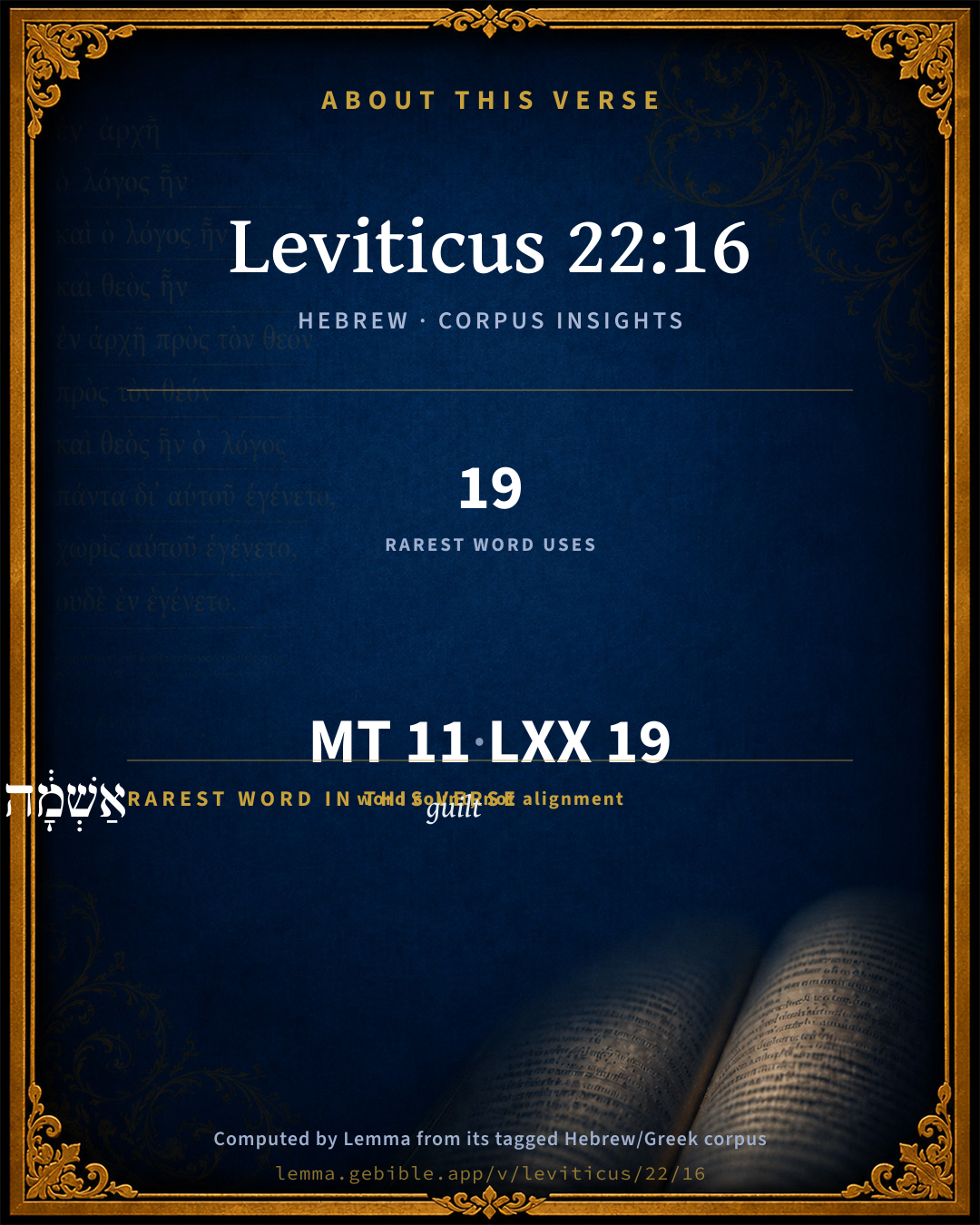
The rarest word here is אַשְׁמָ֔ה guilt H819 — appearing just 19 times in the whole Hebrew Bible.

Shared distinctive vocabulary

אַשְׁמָ֔ה guilt H819 occurs in 17 verses of the Hebrew Bible. Also found in:

Grammatical profile

  • 3 verbs
  • 4 nouns
  • 1 pronoun
  • 1 conjunction
  • 2 particles

Verb forms

  • וְהִשִּׂ֤יאוּ Hiphil · Sequential Perfect
  • בְּאָכְלָ֖ם Qal · Infinitive Construct
  • מְקַדְּשָֽׁם Piel · Participle Active

Hebrew & Septuagint length

In English translation the verse runs 24 words from the Hebrew and 24 from the Septuagint (LXX English) — the same length.

A rough comparison of the two English renderings, which tokenize alike — not a word-level alignment.

Word counts can differ between the Hebrew and the Greek without any difference in meaning — e.g. the Hebrew direct-object marker אֵת has no separate Greek word, and Greek often adds the article ὁ.

In the original languages it is 11 Hebrew tokens and 19 Greek tokens — but the two are counted differently (Hebrew bundles its prefixes and suffixes into one token; the Greek is in lemma form), so that isn’t a like-for-like length.

Cross-references

6

Topical passages linked to Leviticus 22:16 in the Treasury of Scripture Knowledge — connected by theme and wording, ordered by reader-vote popularity; previews shown in the World English Bible.

  • Leviticus 22:9 "'They shall therefore keep my charge, lest they bear sin for it, and die therein, if they profane it. I am Yahweh who sanctifies them.
  • 1 Peter 2:24 who his own self bore our sins in his body on the tree, that we, having died to sins, might live to righteousness; by whose stripes you were healed.
  • Leviticus 7:18 If any of the flesh of the sacrifice of his peace offerings is eaten on the third day, it will not be accepted, neither shall it be imputed to him who offers it. It will be an abomination, and the soul who eats any of it will bear his iniquity.
  • Leviticus 20:8 You shall keep my statutes, and do them. I am Yahweh who sanctifies you.
  • Psalms 38:4 For my iniquities have gone over my head. As a heavy burden, they are too heavy for me.
  • Isaiah 53:11–12 He shall see of the travail of his soul, [and] shall be satisfied: by the knowledge of himself shall my righteous servant justify many; and he shall bear their iniquities.

Cross-references courtesy of OpenBible.info (CC BY 4.0).

Hebrew and Greek witnesses Masoretic Hebrew ↔ Greek Septuagint

The same verse in the two great witnesses to the Old Testament, shown verse-for-verse.

These are two independent witnesses, not word-aligned to each other, and the Septuagint is shown in lemma (dictionary) form.

Hebrew Leviticus 22:16 Masoretic · Westminster Leningrad Codex

וְהִשִּׂ֤יאוּ אוֹתָם֙ עֲוֺ֣ן אַשְׁמָ֔ה בְּאָכְלָ֖ם אֶת קָדְשֵׁיהֶ֑ם כִּ֛י אֲנִ֥י יְהוָ֖ה מְקַדְּשָֽׁם

and so cause them to bear the iniquity that brings guilt, when they eat their holy things: for I am Yahweh who sanctifies them.'"

World English Bible · Public Domain

Greek LXX Leviticus 22:16 Septuagint · lemma form

καί ἐπιἄγω ἐπί ἑαυτοῦ ἀνομία πλημμέλεια ἐν ὁ ἐσθίω αὐτός ὁ ἅγιος αὐτός ὅτι ἐγώ κύριος ὁ ἁγιάζω αὐτός

So should they bring upon themselves the iniquity of trespass in their eating their holy things: for I am the Lord that sanctifies them.

LXX2012 (modern English Septuagint) · Public Domain

Hebrew: Westminster Leningrad Codex (CC BY 4.0). Greek: Septuagint (public domain); English from LXX2012 (modern English Septuagint) (Public Domain). How the Septuagint differs from the Hebrew →

Targum (Aramaic paraphrase)

2

The Targum is the ancient Jewish Aramaic paraphrase of the Hebrew Scriptures — an interpretive translation, not the Hebrew text itself. Onkelos (literal) and Pseudo-Jonathan (expansive) render the Torah, and Jonathan the Prophets. Coverage is partial: where no permissively-licensed English translation exists for a verse, only the Aramaic is shown. This is verse-level text, not a word-by-word alignment to the Hebrew.

  1. Targum Onkelos Torah (Genesis–Deuteronomy)
    וִיקַבְּלוּן עֲלֵיהוֹן עֲוָיָן וְחוֹבִין בְּמֵיכָלְהוֹן בְּסוֹאֲבָא יָת קוּדְשֵׁיהוֹן אֲרֵי אֲנָא יְיָ מְקַדִשְׁהוֹן

    (no public-domain English translation for this verse)

    Targum Onkelos — Aramaic: “Onkelos Genesis” (public domain); “Onkelos Exodus” (public domain); “Onkelos Leviticus” (public domain); “Onkelos Numbers” (public domain); “Onkelos Deuteronomy” (public domain). English: “Sefaria Community Translation” (CC0 1.0 (public-domain dedication)); “J.W. Etheridge. The Targums of Onkelos and Jonathan Ben Uzziel on the Pentateuch. London: Longmans, Green, 1862” (public domain). Text via Sefaria.

  2. Targum Pseudo-Jonathan Torah (Genesis–Deuteronomy)
    וִיאַרְעוּן יַתְהוֹן חוֹבֵי אַשְׁמַתְהוֹן בְּמֵיכַלְהוֹן בְּסוֹאֲבָא יַת קוּדְשֵׁיהוֹן אֲרוּם אֲנָא יְיָ מְקַדִישְׁהוֹן

    nor let the sin of their trespass be found upon them, by eating in uncleanness their consecrated things; for I am the Lord who do sanctify them.

    Targum Pseudo-Jonathan — Aramaic: “Targum Jonathan on Genesis” (public domain); “Targum Jonathan on Exodus” (public domain); “Targum Jonathan on Leviticus” (public domain); “Targum Jonathan on Numbers” (public domain); “Targum Jonathan on Deuteronomy” (public domain). English: “The Targum of Jonathan ben Uzziel, trans. J. W. Etheridge, London, 1862” (public domain). Text via Sefaria.

Commentary

Notes on Leviticus 22:16 from classic Christian and Jewish commentators (each source and its license shown beneath its notes). The classic Christian expositions comment on the surrounding passage and are grouped to its opening verse, so a note may address several verses; the Jewish commentaries on the Tanakh (Rashi and others) are per-verse, so they appear only where the commentator wrote on this verse.

Lemma curates 59 commentaries, every one of them public domain or Creative Commons licensed, each selected and text-cleaned for this edition rather than reprinted as found. About our sources →

Trapp's Complete Commentary

John Trapp

Lev 22:16 Or suffer them to bear the iniquity of trespass, when they eat their holy things: for I the LORD do sanctify them.

Ver. 16. Or suffer them.] From my "other men’s sins," good Lord deliver me, said one: have we not enough of our own to answer for? See 1Ti 5:22, {See Trapp on "1Ti 5:22"} That cannot be wholesome meat that is sauced with the blood of souls, and spiced with the wrath of God.

John Trapp, A Commentary or Exposition upon All the Books of the Old and New Testament (1647–1656) — public domain. Text from a community e-Sword module.

Joseph Benson's Commentary

Lev 22:16. They — That is, the priests; shall not (the negative particle being understood out of the foregoing clause) suffer them — That is, the people; to bear the iniquity of trespass — That is, the punishment of their sin, which they might expect from God, and for the prevention whereof the priest was to see restitution made.

Joseph Benson's Commentary on the Old and New Testaments (1811–1818) — public domain. Text from a community e-Sword module.

Geneva Bible (1599)

Geneva Bible translators

For if they did not offer for their error, the people by their example might commit the like offense.

Geneva Bible (1599) marginal notes — public domain. Text via Bolls.life.

Ellicott's Commentary for English Readers

(16) Or suffer them to bear the iniquity of trespass.—Better, Moreover, they shall not cause them to bear the iniquity. That is, not only are the priests themselves prohibited to treat with profanity the sacred gifts, but they are to realise that it is incumbent upon them to guard these sacrifices so carefully as not to cause the Israelites to contract sin by transgressing the laws by eating holy things which are put in their way through culpable negligence.

A Bible Commentary for English Readers, edited by Charles John Ellicott (1878–1897) — public domain. Text from a community e-Sword module.

The Cambridge Bible for Schools and Colleges

gen. ed. J. J. S. Perowne

16. to bear the iniquity that bringeth guilt] The expression is unique.

The Cambridge Bible for Schools and Colleges (gen. ed. J. J. S. Perowne; Cambridge University Press, 1878–1918) — public domain. Text from a community e-Sword module.

John Gill's Exposition

And the Lord spake unto Moses,.... At the same time; for having said many things concerning the holiness of priests, whose business it was to offer sacrifices, he adds various things concerning the nature, condition, and circumstances of the sacrifices they were to offer:

saying, as follows.

John Gill's Exposition of the Whole Bible (1746–1763) — public domain (CC PDM 1.0). Text via the HelloAO Bible API.

Matthew Poole's English Annotations

i.e. They, i.e. the priests shall not (the negative particle being understood out of the foregoing clause, as Psa 1:5; 9:18 suffer them, i.e. the people, to bear the iniquity of trespass, i.e. the punishment of their sin, which they might expect from God, and for the prevention whereof the priest was to see restitution made, &c. The words may be rendered thus, But (so the Hebrew vau is oft translated) they, i.e. the priests, shall make them, i.e. the people, to bear the iniquity, or punishment, of their trespass or sin, i.e. they shall require from them reparations in manner here expressed.

Matthew Poole's English Annotations on the Holy Bible (1683–1685) — public domain. Text from a community e-Sword/MySword module.

John Wesley's Explanatory Notes

They - That is, the priests, shall not (the negative particle being understood out of the foregoing clause) suffer them - That is, the people, to bear the iniquity of trespass - That is, the punishment of their sin, which they might expect from God, and for the prevention whereof the priest was to see restitution made.

John Wesley, Explanatory Notes Upon the Whole Bible (1754–1765) — public domain. Text via the GEBible commentary corpus.

Rashi

Rabbi Shlomo Yitzchaki (Rashi)

והשיאו אותם means, and they (the priests) would burden themselves with sin, באכלם את קדשיהם WHEN THEY (the non-priests) EAT THEIR HOLY THINGS which have been set apart for the purpose of heave-offering and have thereby become holy and forbidden to them. [Onkelos who translated באכלם את קדשיהם by “when they (the priests) eat them in their uncleanness” has translated it thus quite unnecessarily] (But cf. Rashi on Sanhedrin 90b).

והשיאו אותם — This (the word אותם) is one of the three cases of את with a pronominal suffix occurring in the Torah which R. Ishmael explained as speaking of (referring to) the person himself who is the subject of the sentence (i. e. as being reflexive and not accusative pronouns). In the same sense did he explain (Numbers 4:13) “[And this is the law of the Nazarite] when the days of his Nazaritehood are fulfilled, יביא אותו [to the entrance of the appointed tent]” as meaning: he shall bring himself (i. e. present himself) to the entrance etc. Similarly he explained (Deuteronomy 34:6) “ויקבור אותו in the glen” as meaning: he (Moses) buried himself (i. e. he went into a cave and died there cf. Avot 5:9 and יד משה on Shemot Rabbah 10). Thus is it explained in the Sifrei Bamidbar 32 (on Numbers 6:3).

Rashi on the Tanakh — English translations: “The Judaica Press complete Tanach with Rashi, translated by A. J. Rosenberg” (CC BY 4.0); “Pentateuch with Rashi's commentary by M. Rosenbaum and A.M. Silbermann, 1929-1934” (public domain); “The Metsudah Tanach series, Lakewood, N.J” (CC BY 4.0); and “The Book of Joshua, Metsudah Publications, 1997” (CC BY 4.0). Text via Sefaria.

Lesson kit

Teaching starters — assembled from the data on this page, not authored interpretation. Every prompt links to the verse data it draws on. Edit before teaching.

Leviticus, in the Pentateuch, opens this verse with 11 words (10 distinct Hebrew lemmas). Its most distinctive word is ʼashmâh (“guilt”). A historical commentator’s framing appears above. Read the whole chapter for the surrounding context.

Discussion questions

  1. How does “guilt” (ʼashmâh) shape what this verse is saying?
  2. How does Leviticus 4:3, which shares the word «guilt», read alongside this verse?
  3. These translations render this verse differently. What is at stake in choosing one wording over another?
  4. «וְהִשִּׂ֤יאוּ» is a Hiphil Sequential Perfect verb. How does that grammatical form shape the action described?
  5. Compare how Trapp's Complete Commentary and Joseph Benson's Commentary read this verse. Where do they agree or differ?

Things to notice

Reading settings

Reading text

Shown beneath each verse's original-language words.

Old Testament
Old Testament edition

Read the OT as the Masoretic Hebrew (MT) or the Greek Septuagint (LXX).

English shown for the Greek Septuagint (in the Hebrew ↔ Greek comparison).

Comparing translations? Open the Compare panel on any verse page to stack up to four side by side.