Genesis 40:19

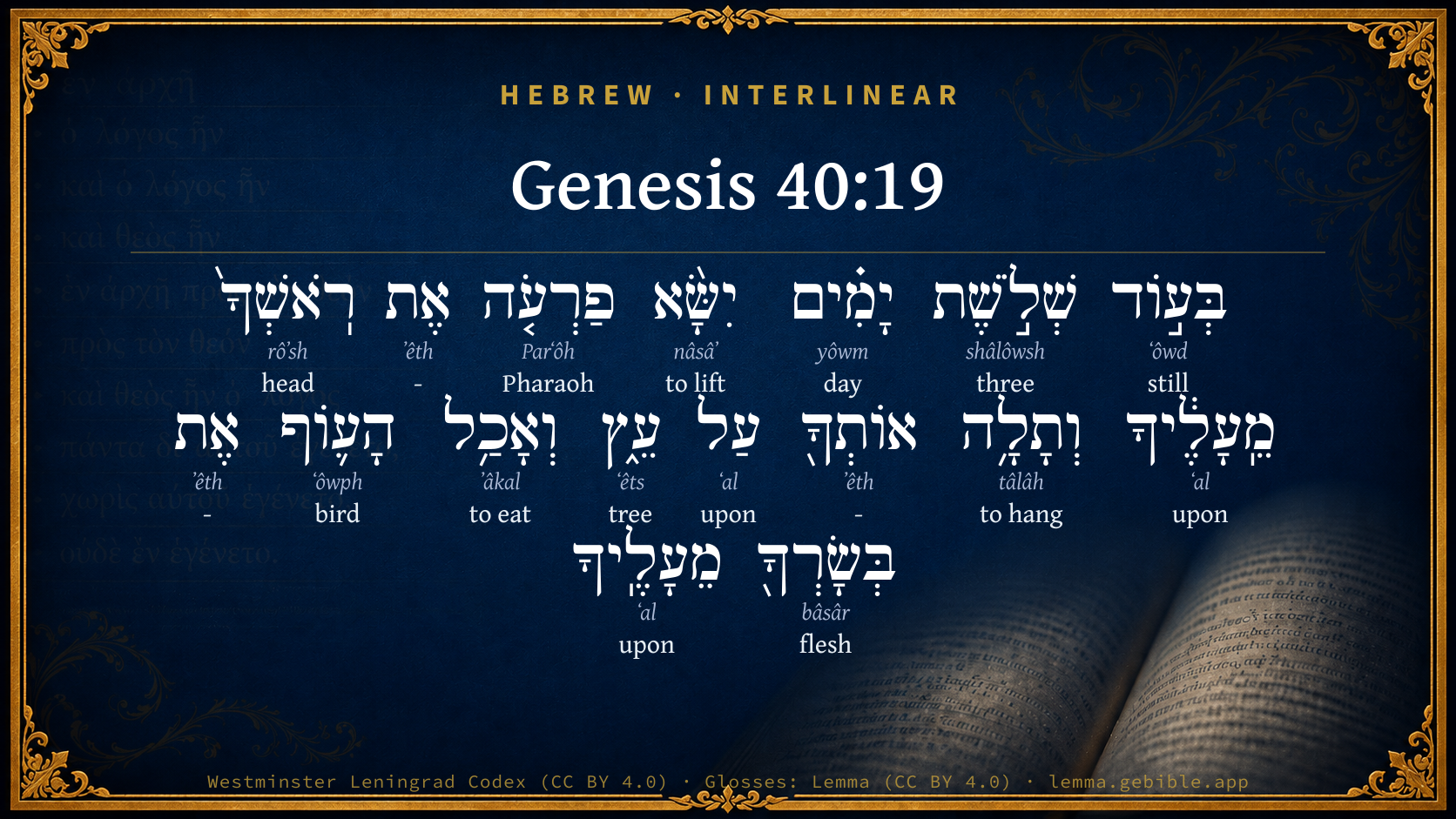
Hebrew (Westminster Leningrad Codex) Genesis 40:19 appears in the Hebrew Old Testament. The text above is from the Westminster Leningrad Codex. Each word links to its Strong’s number, a concise gloss, and parsing drawn from the Open Scriptures Hebrew Bible morphology. Click any word for its full Brown-Driver-Briggs (BDB) entry.
Download image
Cite this verse

Genesis 40:19 (World English Bible). Public Domain. Lemma interlinear Bible study tool, https://lemma.gebible.app/v/genesis/40/19.

Show BibTeX & RIS
BibTeX
RIS
English Translation
Within three more days, Pharaoh will lift up your head from off you, and will hang you on a tree; and the birds will eat your flesh from off you."
World English Bible · Public Domain
Highlights
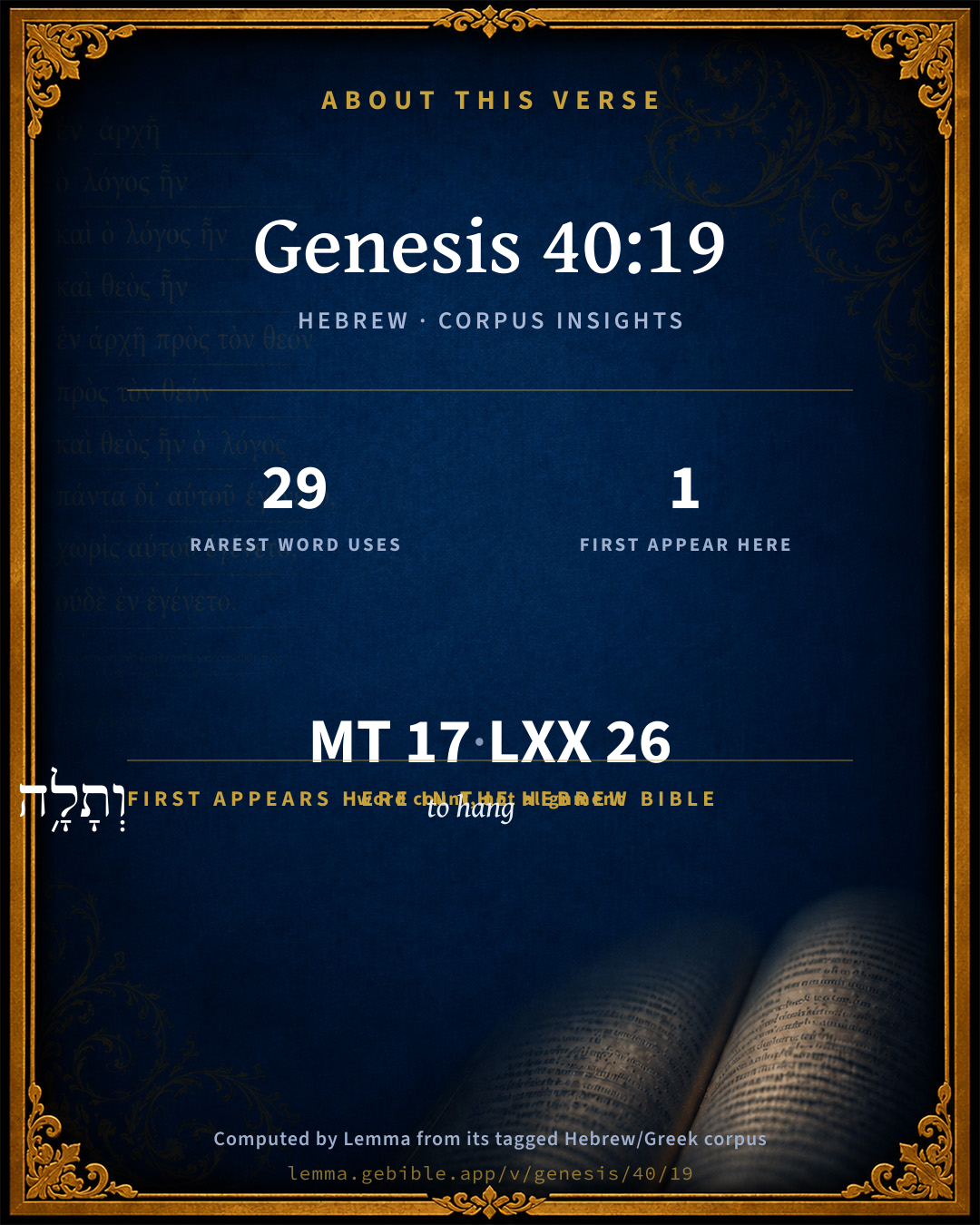
  • 1 first appearance in the Hebrew Bible
Full analysis ↓
Download a study sheet

One document with this verse’s original text, its word-by-word gloss line, the meaning frame, cross-references with their text, attributed commentary, and full source and license credits — printable, and it pastes into notes with its structure intact.

This verse Autodidact and up

Study sheet (.html) Plain text (.txt)

A passage Seminary Student

Up to 50 verses in one chapter. A passage sheet keeps up to 6 commentary sources and 12 cross-references per verse, in the order this page ranks them, and says so on the sheet whenever that leaves anything out. Ask for a single verse and you get the Autodidact verse sheet above.

Everything on this page stays free to read, with no account — the sheet is a download of what is already on screen, not access to it.

Want to remove ads? Support Godless Engineer
Compare translations 3

The same verse in 3 English versions, stacked beneath the original-language interlinear above. Click any original word for its lexicon entry.

Each is an independent rendering of the whole verse — the interlinear is not word-aligned to these translations.

Highlighted words mark where these versions differ — a whole-verse word diff, not a word-by-word alignment.

  • World English Bible Public Domain
    Within three more days, Pharaoh will lift up your head from off you, and will hang you on a tree; and the birds will eat your flesh from off you."
  • King James Version Public Domain
    Yet within three days shall Pharaoh lift up thy head from off thee, and shall hang thee on a tree; and the birds shall eat thy flesh from off thee.
  • unfoldingWord Literal Text CC BY-SA 4.0
    Within three days Pharaoh will lift up your head from you and hang you on a tree, and the birds will eat your flesh from you.”

unfoldingWord Literal Text — © unfoldingWord, licensed CC BY-SA 4.0. Word-aligned USFM3 via Door43 (git.door43.org/unfoldingWord/en_ult).

Versions to compare (up to 4)

3 of 4 selected

Show all 18 translations

Every available English version of this verse, each an independent rendering of the whole verse.

  • World English Bible Public Domain
    Within three more days, Pharaoh will lift up your head from off you, and will hang you on a tree; and the birds will eat your flesh from off you."
  • Berean Standard Bible Public Domain
    Within three days Pharaoh will lift off your head and hang you on a tree. Then the birds will eat the flesh of your body.”
  • Majority Standard Bible Public Domain
    Within three days Pharaoh will lift off your head and hang you on a tree. Then the birds will eat the flesh of your body.”
  • King James Version Public Domain
    Yet within three days shall Pharaoh lift up thy head from off thee, and shall hang thee on a tree; and the birds shall eat thy flesh from off thee.
  • American Standard Version (1901) Public Domain
    within yet three days shall Pharaoh lift up thy head from off thee, and shall hang thee on a tree; and the birds shall eat thy flesh from off thee.
  • Revised Version (1885) Public Domain
    within yet three days shall Pharaoh lift up thy head from off thee, and shall hang thee on a tree; and the birds shall eat thy flesh from off thee.
  • Geneva Bible (1599) Public Domain
    Within three dayes shall Pharaoh take thine head from thee, and shall hang thee on a tree, and the birdes shall eate thy flesh from off thee.
  • Douay-Rheims (1899) Public Domain
    And that in one basket which was uppermost, I carried all meats that are made by the art of baking, and that the birds ate out of it.
  • Young's Literal Translation Public Domain
    yet, within three days doth Pharaoh lift up thy head from off thee, and hath hanged thee on a tree, and the birds have eaten thy flesh from off thee.'
  • Literal Standard Version CC BY-SA 4.0
    yet, within three days Pharaoh lifts up your head from off you, and has hanged you on a tree, and the birds have eaten your flesh from off you.”
  • Unlocked Literal Bible CC BY-SA 4.0
    Within three days Pharaoh will lift up your head from you and will hang you on a tree. The birds will eat your flesh off you.”
  • unfoldingWord Literal Text CC BY-SA 4.0
    Within three days Pharaoh will lift up your head from you and hang you on a tree, and the birds will eat your flesh from you.”
  • Darby Bible Public Domain
    In yet three days will Pharaoh lift up thy head from off thee, and hang thee on a tree; and the birds will eat thy flesh from off thee.
  • World Messianic Bible Public Domain
    Within three more days, Pharaoh will lift up your head from off you, and will hang you on a tree; and the birds will eat your flesh from off you.”
  • Webster's Bible Public Domain
    Yet within three days shall Pharaoh lift up thy head from off thee, and shall hang thee on a tree; and the birds shall eat thy flesh from off thee.
  • Free Bible Version CC BY-SA 4.0
    In three days' time Pharaoh will take you out of prison and hang you on a pole, and birds will eat your flesh.”
  • Bible in Basic English Public Domain
    After three days Pharaoh will take you out of prison, hanging you on a tree, so that your flesh will be food for birds.
  • JPS Tanakh (1917) Public Domain
    within yet three days shall Pharaoh lift up thy head from off thee, and shall hang thee on a tree; and the birds shall eat thy flesh from off thee.'

Literal Standard Version (2020), Covenant Press — licensed CC BY-SA 4.0. Text via the HelloAO Bible API (eBible.org). Unlocked Literal Bible (unfoldingWord) — licensed CC BY-SA 4.0. Text via the HelloAO Bible API (eBible.org). unfoldingWord Literal Text — © unfoldingWord, licensed CC BY-SA 4.0. Word-aligned USFM3 via Door43 (git.door43.org/unfoldingWord/en_ult). Free Bible Version, Dr. Jonathan Gallagher — licensed CC BY-SA 4.0. Text via the HelloAO Bible API (eBible.org).

Word by word

More ways to search: Search by grammar → Find every occurrence → Compare this word →

Practice this passage: Drill this verse → Learn its vocabulary →

וְתָלָ֥ה
tâlâh
H8518
“and · to hang”
Conjunction + Verb, Qal, Sequential Perfect, 3rd Person, Masculine, Singular
Part of Speech
Conjunction + Verb
Stem
Qal
Form
Sequential Perfect
Person
3rd Person
Gender
Masculine
Number
Singular
Full BDB Definition

Origin: a primitive root

TWOT: 2512

to hang - (Qal) - to hang - to hang up (any object) - to put to death by hanging - (Niphal) to be hanged - (Piel) to hang, hang up (for display)
  1. בְּע֣וֹד ʻôwd H5750 “in/at · still” Preposition + Adverb
  2. שְׁלֹ֣שֶׁת shâlôwsh H7969 “three” Adjective, Cardinal number, Masculine, Singular, Construct
  3. יָמִ֗ים yôwm H3117 “days” Noun, Common, Masculine, Plural, Absolute
  4. יִשָּׂ֨א nâsâʼ H5375 “to lift” Verb, Qal, Imperfect, 3rd Person, Masculine, Singular
  5. פַרְעֹ֤ה Parʻôh H6547 “Pharaoh” Noun, Proper
  6. אֶת ʼêth H853 “-” Particle, Direct Object
  7. רֹֽאשְׁךָ֙ rôʼsh H7218 “head · your” Noun, Common, Masculine, Singular, Construct + Suffix, Personal, 2nd Person, Masculine, Singular
  8. מֵֽעָלֶ֔יךָ ʻal H5921 “from · upon · you” Preposition + Preposition + Suffix, Personal, 2nd Person, Masculine, Singular
  9. אוֹתְךָ֖ ʼêth H853 “- · you” Particle, Direct Object + Suffix, Personal, 2nd Person, Masculine, Singular
  10. עַל ʻal H5921 “upon” Preposition
  11. עֵ֑ץ ʻêts H6086 “tree” Noun, Common, Masculine, Singular, Absolute
  12. וְאָכַ֥ל ʼâkal H398 “and · to eat” Conjunction + Verb, Qal, Sequential Perfect, 3rd Person, Masculine, Singular
  13. הָע֛וֹף ʻôwph H5775 “the · bird” Particle, Definite Article + Noun, Common, Masculine, Singular, Absolute
  14. אֶת ʼêth H853 “-” Particle, Direct Object
  15. בְּשָׂרְךָ֖ bâsâr H1320 “flesh · your” Noun, Common, Masculine, Singular, Construct + Suffix, Personal, 2nd Person, Masculine, Singular
  16. מֵעָלֶֽיךָ ʻal H5921 “from · upon · you” Preposition + Preposition + Suffix, Personal, 2nd Person, Masculine, Singular

About this verse

These counts appear in no published source. They are computed here, from the morphology-tagged text and Lemma’s own curated glosses. What Lemma adds →

17
words
13
distinct lemmas
Pentateuch
section

First appearance in Scripture

This word makes its first canonical appearance in the Hebrew Bible here:

  • וְתָלָ֥ה to hang H8518

Shared distinctive vocabulary

וְתָלָ֥ה to hang H8518 occurs in 27 verses of the Hebrew Bible. Also found in:

Grammatical profile

  • 3 verbs
  • 6 nouns
  • 1 adjective
  • 3 prepositions
  • 1 adverb
  • 3 particles

Verb forms

  • יִשָּׂ֨א Qal · Imperfect
  • וְתָלָ֥ה Qal · Sequential Perfect
  • וְאָכַ֥ל Qal · Sequential Perfect

Repetition

A word recurs within this verse — often emphatic in Hebrew:

  • מֵֽעָלֶ֔יךָ upon H5921 ×3

Hebrew & Septuagint length

In English translation the verse runs 30 words from the Hebrew and 33 from the Septuagint (LXX English) — closely comparable.

A rough comparison of the two English renderings, which tokenize alike — not a word-level alignment.

Word counts can differ between the Hebrew and the Greek without any difference in meaning — e.g. the Hebrew direct-object marker אֵת has no separate Greek word, and Greek often adds the article ὁ.

In the original languages it is 17 Hebrew tokens and 26 Greek tokens — but the two are counted differently (Hebrew bundles its prefixes and suffixes into one token; the Greek is in lemma form), so that isn’t a like-for-like length.

Cross-references

15

Topical passages linked to Genesis 40:19 in the Treasury of Scripture Knowledge — connected by theme and wording, ordered by reader-vote popularity; previews shown in the World English Bible.

  • Genesis 40:13 Within three more days, Pharaoh will lift up your head, and restore you to your office. You will give Pharaoh's cup into his hand, the way you did when you were his cupbearer.
  • Genesis 40:22 but he hanged the chief baker, as Joseph had interpreted to them.
  • Genesis 40:17 In the uppermost basket there was all kinds of baked food for Pharaoh, and the birds ate them out of the basket on my head."
  • Genesis 41:13 It happened, as he interpreted to us, so it was: he restored me to my office, and he hanged him."
  • Deuteronomy 21:22–23 If a man have committed a sin worthy of death, and he be put to death, and you hang him on a tree;
  • Joshua 8:29 The king of Ai he hanged on a tree until the evening: and at the going down of the sun Joshua commanded, and they took his body down from the tree, and cast it at the entrance of the gate of the city, and raised thereon a great heap of stones, to this day.
  • Joshua 10:26 Afterward Joshua struck them, and put them to death, and hanged them on five trees: and they were hanging on the trees until the evening.
  • 1 Samuel 17:44 The Philistine said to David, Come to me, and I will give your flesh to the birds of the sky, and to the animals of the field.
  • 1 Samuel 17:46 This day will Yahweh deliver you into my hand; and I will strike you, and take your head from off you; and I will give the dead bodies of the host of the Philistines this day to the birds of the sky, and to the wild animals of the earth; that all the earth may know that there is a God in Israel,
  • 2 Samuel 21:6 let seven men of his sons be delivered to us, and we will hang them up to Yahweh in Gibeah of Saul, the chosen of Yahweh. The king said, I will give them.
  • 2 Samuel 21:10 Rizpah the daughter of Aiah took sackcloth, and spread it for her on the rock, from the beginning of harvest until water was poured on them from the sky; and she allowed neither the birds of the sky to rest on them by day, nor the animals of the field by night.
  • Proverbs 30:17 The eye that mocks at his father, And scorns obedience to his mother: The ravens of the valley shall pick it out, The young eagles shall eat it.
  • Ezekiel 39:4 You shall fall on the mountains of Israel, you, and all your hordes, and the peoples who are with you: I will give you to the ravenous birds of every sort, and to the animals of the field to be devoured.
  • Acts 20:27 for I didn't shrink from declaring to you the whole counsel of God.
  • Galatians 3:13 Christ redeemed us from the curse of the law, having become a curse for us. For it is written, "Cursed is everyone who hangs on a tree,"

Cross-references courtesy of OpenBible.info (CC BY 4.0).

Hebrew and Greek witnesses Masoretic Hebrew ↔ Greek Septuagint

The same verse in the two great witnesses to the Old Testament, shown verse-for-verse.

These are two independent witnesses, not word-aligned to each other, and the Septuagint is shown in lemma (dictionary) form.

Hebrew Genesis 40:19 Masoretic · Westminster Leningrad Codex

בְּע֣וֹד שְׁלֹ֣שֶׁת יָמִ֗ים יִשָּׂ֨א פַרְעֹ֤ה אֶת רֹֽאשְׁךָ֙ מֵֽעָלֶ֔יךָ וְתָלָ֥ה אוֹתְךָ֖ עַל עֵ֑ץ וְאָכַ֥ל הָע֛וֹף אֶת בְּשָׂרְךָ֖ מֵעָלֶֽיךָ

Within three more days, Pharaoh will lift up your head from off you, and will hang you on a tree; and the birds will eat your flesh from off you."

World English Bible · Public Domain

Greek LXX Genesis 40:19 Septuagint · lemma form

ἔτι τρεῖς ἡμέρα ἀποαἱρέω φαραώ ὁ κεφαλή σύ ἀπό σύ καί κρεμάζω σύ ἐπί ξύλον καί ἐσθίω ὁ ὄρνεον ὁ οὐρανός ὁ σάρξ σύ ἀπό σύ

Yet three days, and Pharao shall take away your head from off you, and shall hang you on a tree, and the birds of the sky shall eat your flesh from off you.

LXX2012 (modern English Septuagint) · Public Domain

Hebrew: Westminster Leningrad Codex (CC BY 4.0). Greek: Septuagint (public domain); English from LXX2012 (modern English Septuagint) (Public Domain). How the Septuagint differs from the Hebrew →

Targum (Aramaic paraphrase)

2

The Targum is the ancient Jewish Aramaic paraphrase of the Hebrew Scriptures — an interpretive translation, not the Hebrew text itself. Onkelos (literal) and Pseudo-Jonathan (expansive) render the Torah, and Jonathan the Prophets. Coverage is partial: where no permissively-licensed English translation exists for a verse, only the Aramaic is shown. This is verse-level text, not a word-by-word alignment to the Hebrew.

  1. Targum Onkelos Torah (Genesis–Deuteronomy)
    בְּסוֹף תְּלָתָא יוֹמִין יַעְדִּי פַרְעֹה יָת רֵישָׁךְ מִנָּךְ וְיִצְלוֹב יָתָךְ עַל צְלִיבָא וְיֵכוּל עוֹפָא יָת בִּשְׂרָךְ מִנָּךְ

    (no public-domain English translation for this verse)

    Targum Onkelos — Aramaic: “Onkelos Genesis” (public domain); “Onkelos Exodus” (public domain); “Onkelos Leviticus” (public domain); “Onkelos Numbers” (public domain); “Onkelos Deuteronomy” (public domain). English: “Sefaria Community Translation” (CC0 1.0 (public-domain dedication)); “J.W. Etheridge. The Targums of Onkelos and Jonathan Ben Uzziel on the Pentateuch. London: Longmans, Green, 1862” (public domain). Text via Sefaria.

  2. Targum Pseudo-Jonathan Torah (Genesis–Deuteronomy)
    בְּסוֹף תְּלָתָא יוֹמִין יַעֲדִי פַּרְעה בְּסַיְיפָא יַת רֵישָׁךְ מֵעִילוֹי גוּפָךְ וְיִצְלוֹב יָתָךְ עַל קֵיסָא וְיֵיכוּל עוֹפָא יַת בִּישְרָךְ מִינָךְ

    At the end of three days, Pharoh with the sword will take away thy head from thy body, and will hang thee upon a gibbet, and the birds will cut thy flesh from thee.

    Targum Pseudo-Jonathan — Aramaic: “Targum Jonathan on Genesis” (public domain); “Targum Jonathan on Exodus” (public domain); “Targum Jonathan on Leviticus” (public domain); “Targum Jonathan on Numbers” (public domain); “Targum Jonathan on Deuteronomy” (public domain). English: “The Targum of Jonathan ben Uzziel, trans. J. W. Etheridge, London, 1862” (public domain). Text via Sefaria.

Commentary

Notes on Genesis 40:19 from classic Christian and Jewish commentators (each source and its license shown beneath its notes). The classic Christian expositions comment on the surrounding passage and are grouped to its opening verse, so a note may address several verses; the Jewish commentaries on the Tanakh (Rashi and others) are per-verse, so they appear only where the commentator wrote on this verse.

Lemma curates 59 commentaries, every one of them public domain or Creative Commons licensed, each selected and text-cleaned for this edition rather than reprinted as found. About our sources →

Trapp's Complete Commentary

John Trapp

Gen 40:19 Yet within three days shall Pharaoh lift up thy head from off thee, and shall hang thee on a tree; and the birds shall eat thy flesh from off thee.

Ver. 19. And shall hang thee on a tree, &c.] This was cold comfort to the baker: so shall the last judgment be to the ungodly; when the saints, as the butler, shall lift up their heads with joy. But what a sweet providence of God was this, that the butler should first relate his dream, and receive his interpretation, as good as he could wish! Had the baker begun, the butler would have been disheartened, and hindered, perhaps, from declaring his dream. And then, where had Joseph’s hopes been of deliverance by the butler? How could he have had that opportunity of setting forth his innocency, and requesting the butler’s favour, and good word to Pharaoh for his freedom? {a} See how all things work together for good to them that love God.

The birds shall eat thy flesh.] Those that were hanged among the Jews were taken down. {Deu 21:23} Not so among the Gentiles. A sore judgment of God threatened, in a special manner, against those that despise parents {b} {Pro 30:17} and fulfilled in Absalom. Abslon Marte furens, pensilis arbore obit. Gretser, the Jesuit, to show his wit, calls that tree, a cross; and makes it a manifest figure of the cross of Christ. Sed o mirum et delirum figurativae crueis fabrum! Our Lord indeed died upon the cross, and that with a curse. But that Absalom should, in that behalf, be a type of him, is a new Jesuitical invention. Some say, that in honour of Christ crucified, Constantine the Great abolished that kind of death throughout the empire.

{a} Piscator.

{b} Effossos oculos voret atro gutture corvus. - Catull., De Cruce., lib. i. cap. 6.

John Trapp, A Commentary or Exposition upon All the Books of the Old and New Testament (1647–1656) — public domain. Text from a community e-Sword module.

Adam Clarke's Commentary

Verse 19. Lift up thy head from off thee] Thus we find that beheading, hanging, and gibbeting, were modes of punishment among the ancient Egyptians; but the criminal was beheaded before he was hanged, and then either hanged on hooks, or by the hands. See La 5:12.

Adam Clarke's Commentary on the Bible (1810–1826) — public domain. Text from a community e-Sword/MySword module.

John Calvin's Commentaries

19. Pharaoh shall lift up thy head from off thee. This phrase (in the original) is ambiguous without some addition; and may be taken in a good or a bad sense; just as we say, “With regard to any one,” or “With respect to him;” here the expression is added “from thee.” Yet there seems to be an allusion of this kind, as if Joseph had said, “Pharaoh will lift up thy head, that he may take it off.” Now, when Moses relates, that what Joseph had predicted happened to both of them, he proves by this sign that Joseph was a true prophet of God, as it is written in Jeremiah. (Jeremiah 28:9.) For that the prophets sometimes threatened punishments, which God abstained from inflicting, was done for this reason, because to such prophecies a condition was annexed. But when the Lord speaks positively by his servants, it is necessary that whatever he predicts should be confirmed by the result. Therefore, Moses expressly commends in Joseph, his confidence in the heavenly oracle. With regard to what Moses records, that Pharaoh celebrated his birthday by a great feast, we know that this custom has always been in use, not only among kings, but also among plebeian men. Nor is the custom to be condemned, if only men would keep the right end in view; namely, that of giving thanks unto God by whom they were created and brought up, and whom they have found, in innumerable ways, to be a beneficent Father. But such is the depravity of the world, that it greatly distorts those things which formerly were honestly instituted by their fathers, into contrary corruptions. Thus, by a vicious practice, it has become common for nearly all to abandon themselves to luxury and wantonness on their birthday. In short, they keep up the memory of God, as the Author of their life, in such a manner as if it were their set purpose to forget Him.

John Calvin's Commentaries (1540-1563) — public domain. Text from the Calvin Translation Society English edition (1840s-50s) via the Christian Classics Ethereal Library (ccel.org). Calvin's coverage is partial (roughly two-thirds of the Bible); uncommented books and verses are honest gaps, never fabricated. The 19th-century editor's footnotes and remarks are omitted so the notes are faithfully Calvin's own voice.

Ellicott's Commentary for English Readers

(19) Shall Pharaoh lift up thy head from off thee.—In Gen_40:13 the lifting up of the butler’s head meant his elevation to his former rank. Here there is the significant addition “from off thee,” implying that he would be beheaded, and his body publicly exposed to ignominy.

A Bible Commentary for English Readers, edited by Charles John Ellicott (1878–1897) — public domain. Text from a community e-Sword module.

The Cambridge Bible for Schools and Colleges

gen. ed. J. J. S. Perowne

19. lift up thy head from off thee] Joseph, by a use of the same phrase as in Gen_40:13, introduces the sudden unfavourable interpretation: “from off thee” shews that it means here “decapitation,” not (see note on Gen_40:13) “he will release thee from imprisonment, in order to be executed.” For the word-play, which uses the same word in two senses, cf. Gen_27:39.

hang thee on a tree] The decapitated corpse of the malefactor would be impaled, and allowed to hang exposed to public view, and to become the prey of wild animals and obscene birds. This picture was terrible to the Egyptian mind, which attached great value to preservation of the body as the ultimate medium of the soul’s (= ḳa) existence. For “hanging,” see Jos_10:26; 2Sa_4:12; 2Sa_21:9-10.

The Cambridge Bible for Schools and Colleges (gen. ed. J. J. S. Perowne; Cambridge University Press, 1878–1918) — public domain. Text from a community e-Sword module.

John Gill's Exposition

Yet within three days shall Pharaoh lift up thine head from off thee,.... Order thee to be beheaded; so the Targum of Jonathan and Ben Melech interpret it,"Pharaoh shall remove thy head from thy body with a sword:"

and shall hang thee on a tree; his body after his head was severed from it, this should be hung upon a gallows or gibbet, and there continue:

and the birds shall eat the flesh from off thee; as they usually do when bodies are thus hung up, see Sa2 21:9; this was signified by the birds eating the bakemeats out of the uppermost basket when upon his head, as it seemed to him in his dream.

John Gill's Exposition of the Whole Bible (1746–1763) — public domain (CC PDM 1.0). Text via the HelloAO Bible API.

Haydock's Catholic Bible Commentary

From thee, by decapitation. This was customary, when a person’s body was to be hung on the cross or gibbet. (Deuteronomy xxi. 22; Josue x. 26; Lamentations v. 12; 1 Kings xxxi. 10.) --- Birds. So Horace says, pasces in cruce corvos.

George Leo Haydock (1774–1849), Haydock's Catholic Family Bible and Commentary, 1859 edition — public domain. Excludes Psalms (Douay-Rheims chapter numbering differs from Protestant) and Deuterocanonical books (Catholic canon only).

Matthew Poole's English Annotations

From off thee. This clause is industriously added here to the former phrase, to show that it was now meant in another sense. He shall indeed lift up thy head, as well as the chief butler’s, but in another manner, not for time, but

from thee, or so as to take away thy head or thy life (which eminently consists and appears in the head) from thee.

Matthew Poole's English Annotations on the Holy Bible (1683–1685) — public domain. Text from a community e-Sword/MySword module.

Whedon's Commentary on the Bible

Daniel D. Whedon

19. Lift up thy head from off thee — A peculiar play on words; but the addition, from off thee, gives the sense as distinguished from that in Gen_40:13. The victim was first beheaded, and afterwards hung, or impaled.

Daniel D. Whedon (gen. ed.), Commentary on the Old and New Testaments (1874–1909) — public domain. Text from a community e-Sword module.

Lesson kit

Teaching starters — assembled from the data on this page, not authored interpretation. Every prompt links to the verse data it draws on. Edit before teaching.

Genesis, in the Pentateuch, opens this verse with 17 words (13 distinct Hebrew lemmas). Its most distinctive word is tâlâh (“to hang”). A historical commentator’s framing appears above. Read the whole chapter for the surrounding context.

Discussion questions

  1. How does “to hang” (tâlâh) shape what this verse is saying?
  2. The word “to hang” first appears here in Scripture. What is being introduced at this debut?
  3. Genesis 40:22 shares the word «to hang» with this verse. How do the two illuminate each other?
  4. “upon” occurs 3× in this one verse. What is the effect of the repetition?
  5. These translations render this verse differently; the difference is in the English rendering, not the original. What questions does that raise?
  6. The verb «יִשָּׂ֨א» is Qal Imperfect. How does its form color the action?
  7. Reading how Trapp's Complete Commentary and Adam Clarke's Commentary read this verse, where do the two commentators agree and where do they part?

Things to notice

Reading settings

Reading text

Shown beneath each verse's original-language words.

Old Testament
Old Testament edition

Read the OT as the Masoretic Hebrew (MT) or the Greek Septuagint (LXX).

English shown for the Greek Septuagint (in the Hebrew ↔ Greek comparison).

Comparing translations? Open the Compare panel on any verse page to stack up to four side by side.