
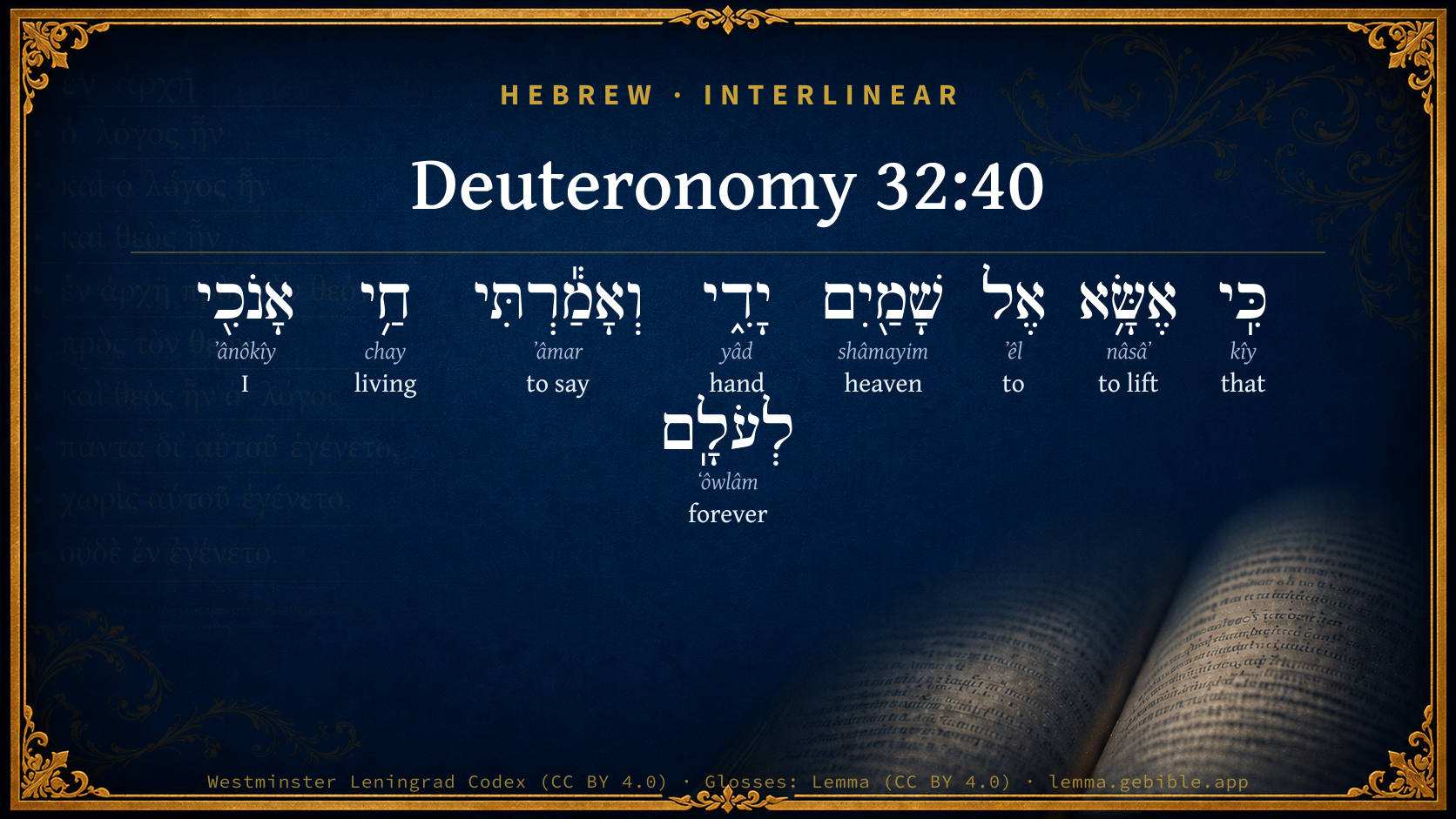
Deuteronomy 32:40

Hebrew (Westminster Leningrad Codex) Deuteronomy 32:40 appears in the Hebrew Old Testament. The text above is from the Westminster Leningrad Codex. Each word links to its Strong’s number, a concise gloss, and parsing drawn from the Open Scriptures Hebrew Bible morphology. Click any word for its full Brown-Driver-Briggs (BDB) entry.
Download image
Cite this verse

Deuteronomy 32:40 (World English Bible). Public Domain. Lemma interlinear Bible study tool, https://lemma.gebible.app/v/deuteronomy/32/40.

Show BibTeX & RIS
BibTeX
RIS
English Translation
For I lift up my hand to heaven, And say, As I live forever,
World English Bible · Public Domain
Download a study sheet

One document with this verse’s original text, its word-by-word gloss line, the meaning frame, cross-references with their text, attributed commentary, and full source and license credits — printable, and it pastes into notes with its structure intact.

This verse Autodidact and up

Study sheet (.html) Plain text (.txt)

A passage Seminary Student

Up to 50 verses in one chapter. A passage sheet keeps up to 6 commentary sources and 12 cross-references per verse, in the order this page ranks them, and says so on the sheet whenever that leaves anything out. Ask for a single verse and you get the Autodidact verse sheet above.

Everything on this page stays free to read, with no account — the sheet is a download of what is already on screen, not access to it.

Want to remove ads? Support Godless Engineer
Compare translations 3

The same verse in 3 English versions, stacked beneath the original-language interlinear above. Click any original word for its lexicon entry.

Each is an independent rendering of the whole verse — the interlinear is not word-aligned to these translations.

Highlighted words mark where these versions differ — a whole-verse word diff, not a word-by-word alignment.

  • World English Bible Public Domain
    For I lift up my hand to heaven, And say, As I live forever,
  • King James Version Public Domain
    For I lift up my hand to heaven, and say, I live for ever.
  • unfoldingWord Literal Text CC BY-SA 4.0
    for I lift up my hand to heaven and say, “ I live forever,

unfoldingWord Literal Text — © unfoldingWord, licensed CC BY-SA 4.0. Word-aligned USFM3 via Door43 (git.door43.org/unfoldingWord/en_ult).

Versions to compare (up to 4)

3 of 4 selected

Show all 18 translations

Every available English version of this verse, each an independent rendering of the whole verse.

  • World English Bible Public Domain
    For I lift up my hand to heaven, And say, As I live forever,
  • Berean Standard Bible Public Domain
    For I lift up My hand to heaven and declare: As surely as I live forever,
  • Majority Standard Bible Public Domain
    For I lift up My hand to heaven and declare: As surely as I live forever,
  • King James Version Public Domain
    For I lift up my hand to heaven, and say, I live for ever.
  • American Standard Version (1901) Public Domain
    For I lift up my hand to heaven, And say, As I live for ever,
  • Revised Version (1885) Public Domain
    For I lift up my hand to heaven, And say, As I live for ever,
  • Geneva Bible (1599) Public Domain
    For I lift vp mine hand to heauen, and say, I liue for euer.
  • Douay-Rheims (1899) Public Domain
    I will lift up my hand to heaven, and I will say: I live for ever.
  • Young's Literal Translation Public Domain
    For I lift up unto the heavens My hand, And have said, I live -- to the age!
  • Literal Standard Version CC BY-SA 4.0
    For I lift up My hand to the heavens, || And have said, I live for all time!
  • Unlocked Literal Bible CC BY-SA 4.0
    For I lift up my hand to heaven and say, 'As I live forever, I will act.
  • unfoldingWord Literal Text CC BY-SA 4.0
    for I lift up my hand to heaven and say, “ I live forever,
  • Darby Bible Public Domain
    For I lift up my hand to the heavens, and say, I live for ever!
  • World Messianic Bible Public Domain
    For I lift up my hand to heaven and declare, as I live forever,
  • Webster's Bible Public Domain
    For I lift up my hand to heaven, and say, I live for ever.
  • Free Bible Version CC BY-SA 4.0
    I hold up my hand to heaven and solemnly declare on my eternal life,
  • Bible in Basic English Public Domain
    For lifting up my hand to heaven I say, By my unending life,
  • JPS Tanakh (1917) Public Domain
    For I lift up My hand to heaven, and say: As I live for ever,

Literal Standard Version (2020), Covenant Press — licensed CC BY-SA 4.0. Text via the HelloAO Bible API (eBible.org). Unlocked Literal Bible (unfoldingWord) — licensed CC BY-SA 4.0. Text via the HelloAO Bible API (eBible.org). unfoldingWord Literal Text — © unfoldingWord, licensed CC BY-SA 4.0. Word-aligned USFM3 via Door43 (git.door43.org/unfoldingWord/en_ult). Free Bible Version, Dr. Jonathan Gallagher — licensed CC BY-SA 4.0. Text via the HelloAO Bible API (eBible.org).

Word by word

More ways to search: Search by grammar → Find every occurrence → Compare this word →

Practice this passage: Drill this verse → Learn its vocabulary →

About this verse

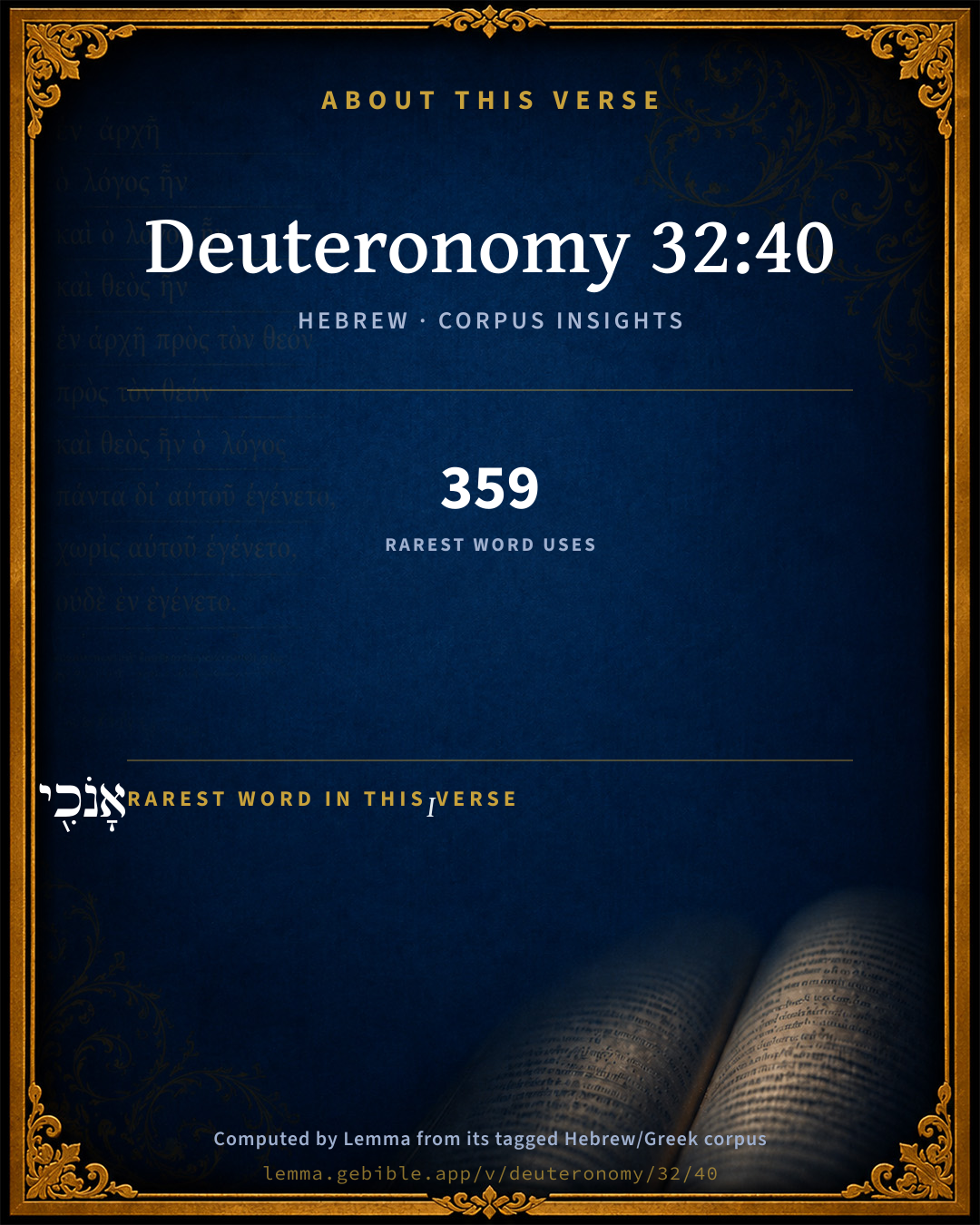
These counts appear in no published source. They are computed here, from the morphology-tagged text and Lemma’s own curated glosses. What Lemma adds →

9
words
9
distinct lemmas
Pentateuch
section

Grammatical profile

  • 2 verbs
  • 3 nouns
  • 1 adjective
  • 1 pronoun
  • 1 preposition
  • 1 conjunction

Verb forms

  • אֶשָּׂ֥א Qal · Imperfect
  • וְאָמַ֕רְתִּי Qal · Sequential Perfect

Hebrew & Septuagint length

In English translation the verse runs 14 words from the Hebrew and 23 from the Septuagint (LXX English) — the Septuagint runs noticeably longer here. See the side-by-side →

A rough comparison of the two English renderings, which tokenize alike — not a word-level alignment.

Word counts can differ between the Hebrew and the Greek without any difference in meaning — e.g. the Hebrew direct-object marker אֵת has no separate Greek word, and Greek often adds the article ὁ.

Cross-references

6

Topical passages linked to Deuteronomy 32:40 in the Treasury of Scripture Knowledge — connected by theme and wording, ordered by reader-vote popularity; previews shown in the World English Bible.

  • Genesis 14:22 Abram said to the king of Sodom, "I have lifted up my hand to Yahweh, God Most High, possessor of heaven and earth,
  • Jeremiah 4:2 and you shall swear, As Yahweh lives, in truth, in justice, and in righteousness; and the nations shall bless themselves in him, and in him shall they glory.
  • Hebrews 6:17–18 In this way God, being determined to show more abundantly to the heirs of the promise the immutability of his counsel, interposed with an oath;
  • Revelation 10:5–6 The angel who I saw standing on the sea and on the land lifted up his right hand to the sky,
  • Numbers 14:28–30 Tell them, As I live, says Yahweh, surely as you have spoken in my ears, so will I do to you:
  • Exodus 6:8 I will bring you into the land which I swore to give to Abraham, to Isaac, and to Jacob; and I will give it to you for a heritage: I am Yahweh.'"

Cross-references courtesy of OpenBible.info (CC BY 4.0).

Hebrew and Greek witnesses Masoretic Hebrew ↔ Greek Septuagint

The same verse in the two great witnesses to the Old Testament, shown verse-for-verse.

Here the Septuagint runs noticeably longer than the Hebrew — LXX2012 (modern English Septuagint) 23 words vs World English Bible 14. A rough length comparison of the two English translations, not a word-level alignment — read both below.

These are two independent witnesses, not word-aligned to each other, and the Septuagint is shown in lemma (dictionary) form.

Hebrew Deuteronomy 32:40 Masoretic · Westminster Leningrad Codex

כִּֽי אֶשָּׂ֥א אֶל שָׁמַ֖יִם יָדִ֑י וְאָמַ֕רְתִּי חַ֥י אָנֹכִ֖י לְעֹלָֽם

For I lift up my hand to heaven, And say, As I live forever,

World English Bible · Public Domain

Greek LXX Deuteronomy 32:40 Septuagint · lemma form

ὅτι αἴρω εἰς ὁ οὐρανός ὁ χείρ ἐγώ καί ὄμνυμι ὁ δεξιός ἐγώ καί εἶπον ζάω ἐγώ εἰς ὁ αἰών

For I will lift up my hand to heaven, and swear by my right hand, and I will say, I live for ever.

LXX2012 (modern English Septuagint) · Public Domain

Hebrew: Westminster Leningrad Codex (CC BY 4.0). Greek: Septuagint (public domain); English from LXX2012 (modern English Septuagint) (Public Domain). How the Septuagint differs from the Hebrew →

Targum (Aramaic paraphrase)

2

The Targum is the ancient Jewish Aramaic paraphrase of the Hebrew Scriptures — an interpretive translation, not the Hebrew text itself. Onkelos (literal) and Pseudo-Jonathan (expansive) render the Torah, and Jonathan the Prophets. Coverage is partial: where no permissively-licensed English translation exists for a verse, only the Aramaic is shown. This is verse-level text, not a word-by-word alignment to the Hebrew.

  1. Targum Onkelos Torah (Genesis–Deuteronomy)
    אֲרֵי אַתְקֵנִית בִּשְׁמַיָא בֵּית שְׁכִנְתִּי וַאֲמָרִית קַיָם אֲנָא לְעָלְמִין

    (no public-domain English translation for this verse)

    Targum Onkelos — Aramaic: “Onkelos Genesis” (public domain); “Onkelos Exodus” (public domain); “Onkelos Leviticus” (public domain); “Onkelos Numbers” (public domain); “Onkelos Deuteronomy” (public domain). English: “Sefaria Community Translation” (CC0 1.0 (public-domain dedication)); “J.W. Etheridge. The Targums of Onkelos and Jonathan Ben Uzziel on the Pentateuch. London: Longmans, Green, 1862” (public domain). Text via Sefaria.

  2. Targum Pseudo-Jonathan Torah (Genesis–Deuteronomy)
    אֲרוּם זְקָפִית בִּשְׁבוּעָה יַת יְדַי בִּשְׁמַיָא וַאֲמָרִית הֵיכְמָא דַאֲנָא קַיָים הֵיכְדֵין לָא אַבְטִיל שְׁבוּעָתִי לְעַלְמִין

    I have lifted My hand with an oath to heaven, and have said, As I exist, I will not abolish My oath forever.

    Targum Pseudo-Jonathan — Aramaic: “Targum Jonathan on Genesis” (public domain); “Targum Jonathan on Exodus” (public domain); “Targum Jonathan on Leviticus” (public domain); “Targum Jonathan on Numbers” (public domain); “Targum Jonathan on Deuteronomy” (public domain). English: “The Targum of Jonathan ben Uzziel, trans. J. W. Etheridge, London, 1862” (public domain). Text via Sefaria.

Commentary

Notes on Deuteronomy 32:40 from classic Christian and Jewish commentators (each source and its license shown beneath its notes). The classic Christian expositions comment on the surrounding passage and are grouped to its opening verse, so a note may address several verses; the Jewish commentaries on the Tanakh (Rashi and others) are per-verse, so they appear only where the commentator wrote on this verse.

Lemma curates 59 commentaries, every one of them public domain or Creative Commons licensed, each selected and text-cleaned for this edition rather than reprinted as found. About our sources →

Trapp's Complete Commentary

John Trapp

Deu 32:40 For I lift up my hand to heaven, and say, I live for ever.

Ver. 40. And say, I live forever.] God can swear by no greater than himself. {Heb 6:13}

John Trapp, A Commentary or Exposition upon All the Books of the Old and New Testament (1647–1656) — public domain. Text from a community e-Sword module.

Joseph Benson's Commentary

Deu 32:40-42. I lift up my hand to heaven — I solemnly swear I will do what here follows. It was the custom to stretch out the hand in swearing, Gen 14:22. And say, I live for ever — As surely as I live for ever, I will whet my sword, &c. If I whet — If once I begin to prepare for war, and for the execution of my sentence. Mine hand take hold on judgment — The instruments of judgments, the weapons of war. A metaphor from warriors that take their weapons into their hands when they intend to fight. Glittering sword — Hebrew, the lightning of my sword. A similitude which shows God’s judgments to be swift, powerful, and terrible, Eze 21:10; Zec 9:14. I will render vengeance to mine enemies — No power shall be able to stop or hinder my proceedings. I will make mine arrows drunk with blood — I will execute vengeance upon them to the full. A strong poetical figure, implying the abundance of blood that should be shed. The blood — of the captives — Whom my sword hath sorely wounded, though not utterly killed. The beginning of revenges — When once I begin to revenge myself and people upon mine and their enemies, and will go on and make a full end.

Joseph Benson's Commentary on the Old and New Testaments (1811–1818) — public domain. Text from a community e-Sword module.

Tyndale Open Study Notes

Tyndale Open Resources

32:40 I raise my hand to heaven: This anthropomorphism (see study notes on 4:34 and 8:2) asserts God’s solemn intention to keep his covenant promises to deliver his people from their enemies. When God makes an oath, he is not bound to some course of action in the event that he proves undependable. Rather, the statement emphasizes the reliability of God’s promises above and beyond his character alone (see Num 14:21, 28; Isa 49:18; Ezek 20:5-6).

Tyndale Open Study Notes — © Tyndale Open Resources, licensed CC BY-SA 4.0. Text via the HelloAO Bible API.

Geneva Bible (1599)

Geneva Bible translators

That is, I swear, read Gen. 14:12.

Geneva Bible (1599) marginal notes — public domain. Text via Bolls.life.

Adam Clarke's Commentary

Verse 40. For I lift up my hand to heaven] See concerning oaths and appeals to God in Clarke's note on "De 6:13".

Adam Clarke's Commentary on the Bible (1810–1826) — public domain. Text from a community e-Sword/MySword module.

Ellicott's Commentary for English Readers

(40, 41) For I lift up my hand.—This is the form in taking an oath. (Comp. Rev_10:5.) The two verses may be connected thus: “For I lift up my hand to heaven, and say, As I live for ever, if I whet my lightning sword, and my hand take hold on judgment, I will render vengeance to mine enemies, and repay them that hate me.”

A Bible Commentary for English Readers, edited by Charles John Ellicott (1878–1897) — public domain. Text from a community e-Sword module.

The Cambridge Bible for Schools and Colleges

gen. ed. J. J. S. Perowne

40. lift up, etc.] Cp. Gen_14:22, Exo_6:8, Num_14:30 and many instances in Ezekiel.

The Cambridge Bible for Schools and Colleges (gen. ed. J. J. S. Perowne; Cambridge University Press, 1878–1918) — public domain. Text from a community e-Sword module.

John Gill's Exposition

If I whet my glittering sword,.... That is, I will do it as sure as I live, if I do not, be it so and so; what that is is not said, but left to be concluded. A glittering sword is a sword drawn, the blade of it drawn out of the scabbard, cleaned and polished, whetted and made sharp, that it may more easily penetrate and pierce; and this, being brandished, glitters like lightning, as the word used signifies. Whetting the sword is a preparation for doing execution with it; and is a warning, a giving notice of it, as girding: the sword on the thigh also is ascribed to Christ, Psa 45:3. This sword intends a sword of justice, the sharp sword said to proceed out of the mouth of Christ, the judiciary sentence which he will pronounce and execute on antichrist, and all his followers, Rev 19:15,

and my hand take hold on judgment: in order to execute it; the allusion is to the laying hold on the instruments of justice and death, as the glittering sword before mentioned, and arrows afterwards; and may have respect to the four sore judgments, or at least to some of them, which the Lord will execute on mystical Babylon, Eze 14:21; and particularly to the seven vials of God's wrath, which will be poured out on the antichristian states, Rev 16:1,

I will render vengeance to mine enemies, and I will reward them that hate me; his enemies that hate him, and will not have him to rule over them, are the followers of antichrist, who has his name from his opposition to Christ, his hatred of him, and enmity against him; opposing him in his kingly office, taking upon him to exercise dominion and tyranny over the consciences of men, making new laws, and imposing them on them, and dispensing with the laws of Christ; and setting aside his priestly office by the sacrifice of the Mass, granting pardons and indulgences, and advancing the works and merits of men, in opposition to the righteousness of Christ, and pretending even to works of supererogation; making of none effect, as much as in him lies, his prophetic office, by setting up unwritten traditions before the word of God, and making them the rule of faith and practice, and assuming to himself an infallible interpretation of the sense of Scripture. The vengeance Christ will render, as a righteous reward to those his enemies, is expressed by destroying antichrist with the breath of his mouth; by the beast going into perdition; by leading them captive who have led others; by killing them with the sword who have killed others with it; by pouring out the vials of his wrath on them; by giving them the cup of the wine of the fierceness of his wrath; by smiting them with the sword that comes out of his mouth, and by bringing upon them death, mourning, and famine, and burning them with fire; all which he will most surely render unto them, Th2 2:8 Rev 19:15.

John Gill's Exposition of the Whole Bible (1746–1763) — public domain (CC PDM 1.0). Text via the HelloAO Bible API.

Haydock's Catholic Bible Commentary

For ever. God can swear by no one greater than himself, Hebrews vi. 13.

George Leo Haydock (1774–1849), Haydock's Catholic Family Bible and Commentary, 1859 edition — public domain. Excludes Psalms (Douay-Rheims chapter numbering differs from Protestant) and Deuterocanonical books (Catholic canon only).

Matthew Poole's English Annotations

I lift up my hand to heaven, i.e. I solemnly swear that I will do what here follows, that as I will deliver my people, so I will fully avenge myself upon all mine enemies, whom I have used as rods to scourge my people.

I live for ever, i.e. As sure as I live. Compare Jer 4:2; Heb 6:13; Rev 10:5,6.

Matthew Poole's English Annotations on the Holy Bible (1683–1685) — public domain. Text from a community e-Sword/MySword module.

Whedon's Commentary on the Bible

Daniel D. Whedon

40. I live forever — The formula of an oath was, “The Lord liveth.” Comp. Num_14:21; 1Sa_14:39; Jer_5:2.

Daniel D. Whedon (gen. ed.), Commentary on the Old and New Testaments (1874–1909) — public domain. Text from a community e-Sword module.

The Pulpit Commentary

Vers. 40, 41. These verses should be read continuously: For I lift up my hand to heaven, and say, As I live forever, if I whet my glittering sword, and if my hand take hold on judgment; I will render vengeance to mine enemies, etc. Lifting up the hand to heaven was a gesture intended to express that the person taking an oath appealed to God as a witness of his oath, and who would perish for falsehood; (cf. Gen_14:22) and "as the Lord liveth" was a common formula in taking an oath (cf. Num_14:21; 1Sa_14:39, 1Sa_14:45; Jer_5:2) As God could swear by none greater, he swore by himself (cf. Exo_6:8; Num_14:30; Isa_45:23; Jer_22:5; Heb_6:17) that if he did come forth to avenge himself of his enemies, he would not spare, but would do thoroughly what he had come forth to do. Glittering sword; literally, lightning of sword. (Eze_21:10)

The Pulpit Commentary (1880–1919), ed. H.D.M. Spence-Jones & Joseph S. Exell — public domain. Text from a community e-Sword module.

John Wesley's Explanatory Notes

I lift up my hand - I solemnly swear, that I will do what here follows. I live - As sure as I live.

John Wesley, Explanatory Notes Upon the Whole Bible (1754–1765) — public domain. Text via the GEBible commentary corpus.

Rashi

Rabbi Shlomo Yitzchaki (Rashi)

כי אשא אל שמים ידי FOR I SHALL LIFT UP MY HAND TO HEAVEN — This means; for in My wrath I shall lift up My hand to Myself in an oath.

ואמרתי חי אנכי — This is the expression of an oath: I SWEAR AS TRUE AS I LIVE [FOR EVER].

Rashi on the Tanakh — English translations: “The Judaica Press complete Tanach with Rashi, translated by A. J. Rosenberg” (CC BY 4.0); “Pentateuch with Rashi's commentary by M. Rosenbaum and A.M. Silbermann, 1929-1934” (public domain); “The Metsudah Tanach series, Lakewood, N.J” (CC BY 4.0); and “The Book of Joshua, Metsudah Publications, 1997” (CC BY 4.0). Text via Sefaria.

Ramban (Nachmanides)

Rabbi Moshe ben Nachman (Ramban / Nachmanides)

FOR I LIFT UP MY HAND TO HEAVEN. By way of the plain meaning of Scripture this is an oath by His throne. He states I lift up, for whoever takes an oath raises his hand and touches the object by which he swears. And by way of the Truth, [the mystic teachings of the Cabala], during the time of the exile He hath cast down from heaven unto the earth the beauty of Israel. He, therefore states that now in an acceptable time He will lift His hand to the highest heavens, the reference being to the great hand that fights on behalf of Israel. And this is the sense of the expression, And I say: As I live forever, for I make My strong hand active when I whet the lightning of My sword and support it [My hand] to prevail for the justice of Israel [which, until then, had been cast down to the earth] and to recompense them that hate Me, for then will G-d’s Name be full and the throne perfect. The student learned in the mysteries of the Cabala will understand.Now this Song, which is our true and faithful testimony, tells us clearly all that will happen to us. It mentions first the mercy that the Holy One, blessed be He, bestowed upon us from the time He took us to be His portion. It mentions the favors that He did for us in the wilderness, and that He caused us to possess the lands of great and mighty nations, and the abundant good, wealth, and honor that He made us inherit there. Yet despite the abundance of all good, they rebelled against G-d to worship the idols, and it mentions how He was provoked by them until He visited upon them in their country pestilence, famine, the evil beast, and the sword, and then He dispersed them in every direction and corner. It is known that all this has been fulfilled, and it was so. And the Song states that ultimately He will render vengeance to His adversaries and will recompense them that hate Him. The reason [for their punishment] is that they inflicted all these evils upon us out of their hatred of the Holy One, blessed be He: because they do not hate Israel for having made idols like theirs, but only because they do not imitate their deeds. Instead they serve the Holy One, blessed be He, and observe His commandments, neither intermarrying with them nor eating of their slaughterings, and they [Israel] hold their idol in contempt and remove it from their places, similar to what [the psalmist] said, but for Thy sake are we killed all the day. If so, it is because of their hatred of the Holy One, blessed be He, that they inflict all these evils upon us; they are thus His adversaries and His enemies, and it is for Him to wreak vengeance upon them. And it is clear, that He assures [Israel] concerning the future redemption, for, during the construction of the Second Temple, the nations did not rejoice with His people, but mocked them: What are these feeble Jews doing? And their leaders were servants in the palace of the king of Babylon and all the Jews were subject to him. In those days He did not render vengeance to His adversaries and He did not make expiation for the land of His people. Now, in this Song there is no condition of repentance or service [of G-d as a prerequisite for the coming redemption], but it is a testamentary document that the evils will come and that we will endure them, and that He, blessed be He, will do with us in furious rebukes — but He will not destroy our memory. Rather, He will return and be comforted and will punish the enemies with His sore and great and strong sword, and forgive our sins, for His Name’s sake. If so, this Song is a clear-promise of the future redemption — the infidels notwithstanding. And so the Rabbis mentioned in the Sifre: 333. “Great is this Song, for there is in it the present, the past, the future, and there is in it this world and the World to Come.” It is to this that Scripture alludes in saying, And Moses came and spoke all the words of this Song in the ears of the people. It mentions all [‘all’ the words] in order to indicate that the Song contains everything that is to come upon them although it is brief in words, for Moses explained its many subjects to them.Now, if this Song had been written by one of the astrologers declaring the end from the beginning it would have earned belief therein because all its words have been fulfilled by now, not one thing hath failed. Certainly we shall continue to believe and look forward with all our heart for the word of G-d by the mouth of His prophet, the most trusted in all His house, [and like unto him] was there no one before him, neither after him — peace be upon him!V’zoth Habrachah

Ramban (Nachmanides) on the Tanakh — English translation: “Commentary on the Torah by Ramban (Nachmanides). Translated and annotated by Charles B. Chavel. New York, Shilo Pub. House, 1971-1976” (CC BY 4.0). Text via Sefaria.

Lesson kit

Teaching starters — assembled from the data on this page, not authored interpretation. Every prompt links to the verse data it draws on. Edit before teaching.

Deuteronomy, in the Pentateuch, opens this verse with 9 words (9 distinct Hebrew lemmas). Its most distinctive word is ʼânôkîy (“I”). The Greek Septuagint runs longer here. A historical commentator’s framing appears above. Read the whole chapter for the surrounding context.

Discussion questions

  1. How does “I” (ʼânôkîy) shape what this verse is saying?
  2. Genesis 14:22 shares this passage’s theme. How do the two illuminate each other?
  3. Compared with the Hebrew, the Septuagint runs longer here. What questions does that raise?
  4. These translations render this verse differently; the difference is in the English rendering, not the original. What questions does that raise?
  5. The verb «אֶשָּׂ֥א» is Qal Imperfect. How does its form color the action?
  6. Reading how Trapp's Complete Commentary and Joseph Benson's Commentary read this verse, where do the two commentators agree and where do they part?

Things to notice

Reading settings

Reading text

Shown beneath each verse's original-language words.

Old Testament
Old Testament edition

Read the OT as the Masoretic Hebrew (MT) or the Greek Septuagint (LXX).

English shown for the Greek Septuagint (in the Hebrew ↔ Greek comparison).

Comparing translations? Open the Compare panel on any verse page to stack up to four side by side.