
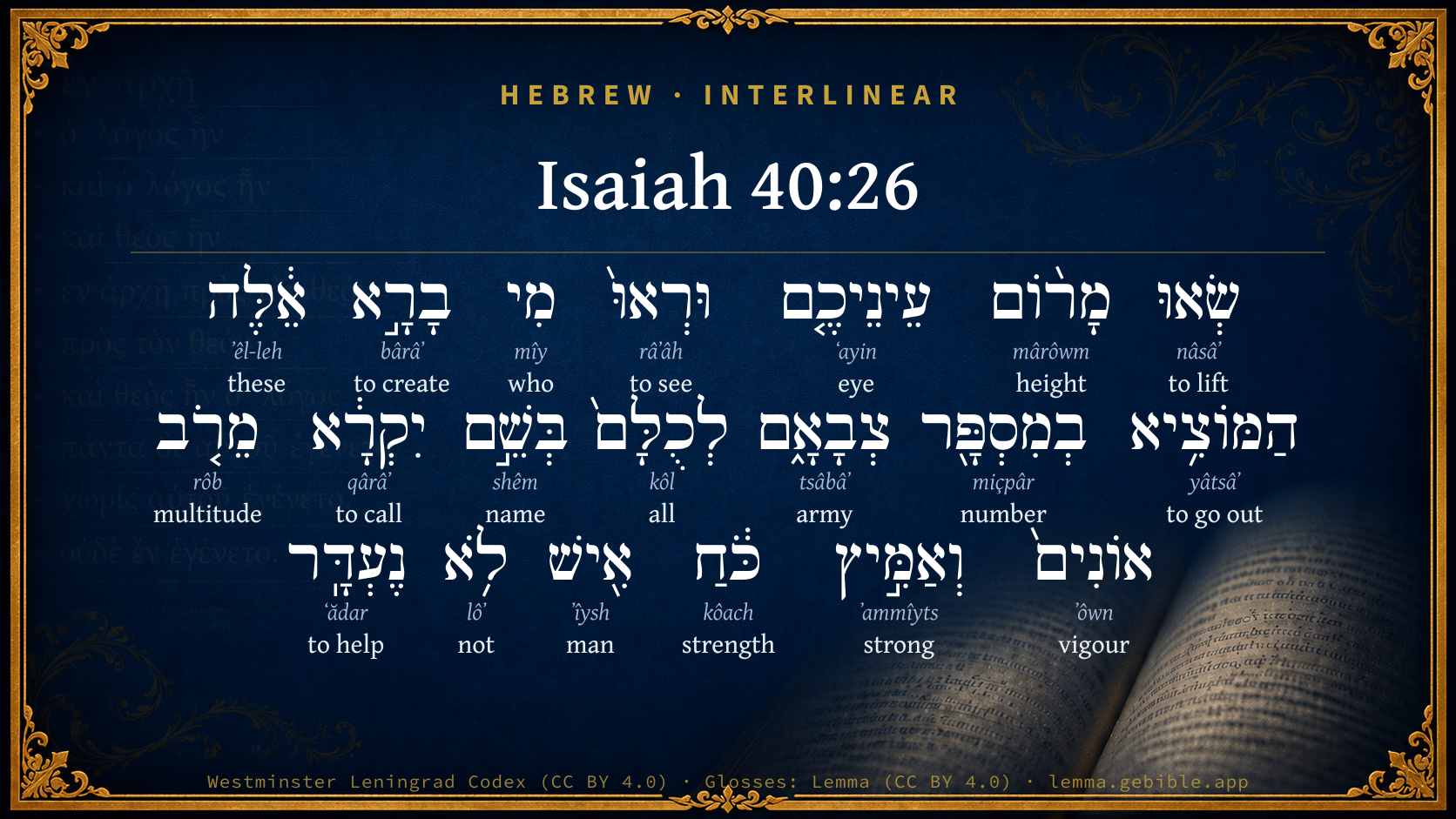
Isaiah 40:26

Hebrew (Westminster Leningrad Codex) Isaiah 40:26 appears in the Hebrew Old Testament. The text above is from the Westminster Leningrad Codex. Each word links to its Strong’s number, a concise gloss, and parsing drawn from the Open Scriptures Hebrew Bible morphology. Click any word for its full Brown-Driver-Briggs (BDB) entry.
Download image
Cite this verse

Isaiah 40:26 (World English Bible). Public Domain. Lemma interlinear Bible study tool, https://lemma.gebible.app/v/isaiah/40/26.

Show BibTeX & RIS
BibTeX
RIS
English Translation
Lift up your eyes on high, and see who has created these, who brings out their host by number; he calls them all by name; by the greatness of his might, and because he is strong in power, not one is lacking.
World English Bible · Public Domain
Download a study sheet

One document with this verse’s original text, its word-by-word gloss line, the meaning frame, cross-references with their text, attributed commentary, and full source and license credits — printable, and it pastes into notes with its structure intact.

This verse Autodidact and up

Study sheet (.html) Plain text (.txt)

A passage Seminary Student

Up to 50 verses in one chapter. A passage sheet keeps up to 6 commentary sources and 12 cross-references per verse, in the order this page ranks them, and says so on the sheet whenever that leaves anything out. Ask for a single verse and you get the Autodidact verse sheet above.

Everything on this page stays free to read, with no account — the sheet is a download of what is already on screen, not access to it.

Want to remove ads? Support Godless Engineer
Compare translations 3

The same verse in 3 English versions, stacked beneath the original-language interlinear above. Click any original word for its lexicon entry.

Each is an independent rendering of the whole verse — the interlinear is not word-aligned to these translations.

Highlighted words mark where these versions differ — a whole-verse word diff, not a word-by-word alignment.

  • World English Bible Public Domain
    Lift up your eyes on high, and see who has created these, who brings out their host by number; he calls them all by name; by the greatness of his might, and because he is strong in power, not one is lacking.
  • King James Version Public Domain
    Lift up your eyes on high, and behold who hath created these things, that bringeth out their host by number: he calleth them all by names by the greatness of his might, for that he is strong in power; not one faileth.
  • unfoldingWord Literal Text CC BY-SA 4.0
    Lift up your eyes the height and see! Who created these? The one bringing out their army by number; he calls to all of them by name. From greatness of might and strength of power, a man is not missing. q1

unfoldingWord Literal Text — © unfoldingWord, licensed CC BY-SA 4.0. Word-aligned USFM3 via Door43 (git.door43.org/unfoldingWord/en_ult).

Versions to compare (up to 4)

3 of 4 selected

Show all 18 translations

Every available English version of this verse, each an independent rendering of the whole verse.

  • World English Bible Public Domain
    Lift up your eyes on high, and see who has created these, who brings out their host by number; he calls them all by name; by the greatness of his might, and because he is strong in power, not one is lacking.
  • Berean Standard Bible Public Domain
    Lift up your eyes on high: Who created all these? He leads forth the starry host by number; He calls each one by name. Because of His great power and mighty strength, not one of them is missing.
  • Majority Standard Bible Public Domain
    Lift up your eyes on high: Who created all these? He leads forth the starry host by number; He calls each one by name. Because of His great power and mighty strength, not one of them is missing.
  • King James Version Public Domain
    Lift up your eyes on high, and behold who hath created these things, that bringeth out their host by number: he calleth them all by names by the greatness of his might, for that he is strong in power; not one faileth.
  • American Standard Version (1901) Public Domain
    Lift up your eyes on high, and see who hath created these, that bringeth out their host by number; he calleth them all by name; by the greatness of his might, and for that he is strong in power, not one is lacking.
  • Revised Version (1885) Public Domain
    Lift up your eyes on high, and see who hath created these, that bringeth out their host by number: he calleth them all by name; by the greatness of his might, and for that he is strong in power, not one is lacking.
  • Geneva Bible (1599) Public Domain
    Lift vp your eyes on hie, and beholde who hath created these things, and bringeth out their armies by nomber, and calleth them all by names? by the greatnesse of his power and mightie strength nothing faileth.
  • Douay-Rheims (1899) Public Domain
    Lift up your eyes on high, and see who hath created these things: who bringeth out their host by number, and calleth them all by their names: by the greatness of his might, and strength, and power, not one of them was missing.
  • Young's Literal Translation Public Domain
    Lift up on high your eyes, And see -- who hath prepared these? He who is bringing out by number their host, To all of them by name He calleth, By abundance of strength (And `he is' strong in power) not one is lacking.
  • Literal Standard Version CC BY-SA 4.0
    Lift up your eyes on high, || And see—who has created these? He who is bringing out their host by number, || He calls to all of them by name, || By the abundance of His strength || And mighty power, || Not one is lacking.
  • Unlocked Literal Bible CC BY-SA 4.0
    Look up at the sky! Who has created all these stars? He leads out their formations and calls them all by name. By the greatness of his might and by the strength of his power, not one is missing.
  • unfoldingWord Literal Text CC BY-SA 4.0
    Lift up your eyes the height and see! Who created these? The one bringing out their army by number; he calls to all of them by name. From greatness of might and strength of power, a man is not missing. q1
  • Darby Bible Public Domain
    Lift up your eyes on high, and see! Who hath created these things, bringing out their host by number? He calleth them all by name; through the greatness of his might and strength of power, not one faileth.
  • World Messianic Bible Public Domain
    Lift up your eyes on high, and see who has created these, who brings out their army by number. He calls them all by name. By the greatness of his might, and because he is strong in power, not one is lacking.
  • Webster's Bible Public Domain
    Lift up your eyes on high, and behold who hath created these things, that bringeth out their host by number: he calleth them all by names, by the greatness of his might, for that he is strong in power; not one faileth.
  • Free Bible Version CC BY-SA 4.0
    Look at the heavens. Who created all this? He leads the stars like an army, and calls each one by name. Because he has great power and incredible strength, not a single one of them is missing.
  • Bible in Basic English Public Domain
    Let your eyes be lifted up on high, and see: who has made these? He who sends out their numbered army: who has knowledge of all their names: by whose great strength, because he is strong in power, all of them are in their places.
  • JPS Tanakh (1917) Public Domain
    Lift up your eyes on high, and see: who hath created these? He that bringeth out their host by number, He calleth them all by name; by the greatness of His might, and for that He is strong in power, not one faileth.

Literal Standard Version (2020), Covenant Press — licensed CC BY-SA 4.0. Text via the HelloAO Bible API (eBible.org). Unlocked Literal Bible (unfoldingWord) — licensed CC BY-SA 4.0. Text via the HelloAO Bible API (eBible.org). unfoldingWord Literal Text — © unfoldingWord, licensed CC BY-SA 4.0. Word-aligned USFM3 via Door43 (git.door43.org/unfoldingWord/en_ult). Free Bible Version, Dr. Jonathan Gallagher — licensed CC BY-SA 4.0. Text via the HelloAO Bible API (eBible.org).

Word by word

More ways to search: Search by grammar → Find every occurrence → Compare this word →

Practice this passage: Drill this verse → Learn its vocabulary →

וְאַמִּ֣יץ
ʼammîyts
H533
“and · strong of”
Conjunction + Adjective, Adjective, Masculine, Singular, Construct
Part of Speech
Conjunction + Adjective
Type
Adjective
Gender
Masculine
Number
Singular
State
Construct
Full BDB Definition

Origin: from H553

TWOT: 117d

strong, mighty
  1. שְׂאוּ nâsâʼ H5375 “lift” Verb, Qal, Imperative, 2nd Person, Masculine, Plural
  2. מָר֨וֹם mârôwm H4791 “height” Noun, Common, Masculine, Singular, Absolute
  3. עֵינֵיכֶ֤ם ʻayin H5869 “eyes · your” Noun, Common, Both, Dual, Construct + Suffix, Personal, 2nd Person, Masculine, Plural
  4. וּרְאוּ֙ râʼâh H7200 “and · see” Conjunction + Verb, Qal, Imperative, 2nd Person, Masculine, Plural
  5. מִי mîy H4310 “who” Particle, Interrogative
  6. בָרָ֣א bârâʼ H1254 “to create” Verb, Qal, Perfect, 3rd Person, Masculine, Singular
  7. אֵ֔לֶּה ʼêl-leh H428 “these” Pronoun, Demonstrative, Common, Plural
  8. הַמּוֹצִ֥יא yâtsâʼ H3318 “the · going out” Particle, Definite Article + Verb, Hiphil, Participle Active, Masculine, Singular, Absolute
  9. בְמִסְפָּ֖ר miçpâr H4557 “in/at · number” Preposition + Noun, Common, Masculine, Singular, Absolute
  10. צְבָאָ֑ם tsâbâʼ H6635 “army · their” Noun, Common, Both, Singular, Construct + Suffix, Personal, 3rd Person, Masculine, Plural
  11. לְכֻלָּם֙ kôl H3605 “to/for · all · their” Preposition + Noun, Common, Masculine, Singular, Construct + Suffix, Personal, 3rd Person, Masculine, Plural
  12. בְּשֵׁ֣ם shêm H8034 “in/at · name” Preposition + Noun, Common, Masculine, Singular, Absolute
  13. יִקְרָ֔א qârâʼ H7121 “to call” Verb, Qal, Imperfect, 3rd Person, Masculine, Singular
  14. מֵרֹ֤ב rôb H7230 “from · multitude of” Preposition + Noun, Common, Both, Singular, Construct
  15. אוֹנִים֙ ʼôwn H202 “vigour” Noun, Common, Masculine, Plural, Absolute
  16. כֹּ֔חַ kôach H3581 “strength” Noun, Common, Masculine, Singular, Absolute
  17. אִ֖ישׁ ʼîysh H376 “man” Noun, Common, Masculine, Singular, Absolute
  18. לֹ֥א lôʼ H3808 “not” Particle, Negative
  19. נֶעְדָּֽר ʻădar H5737 “to help” Verb, Niphal, Perfect, 3rd Person, Masculine, Singular

About this verse

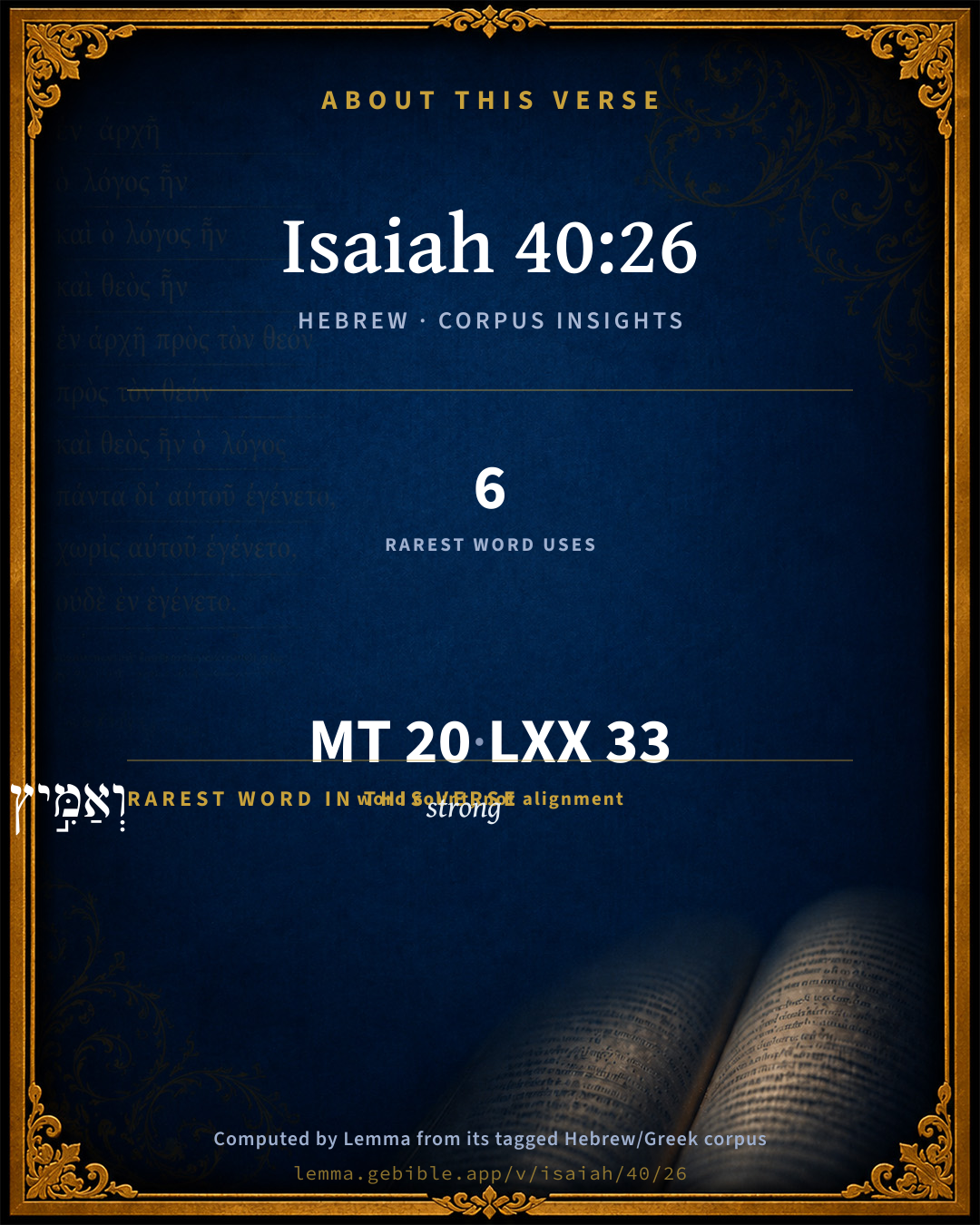
These counts appear in no published source. They are computed here, from the morphology-tagged text and Lemma’s own curated glosses. What Lemma adds →

20
words
20
distinct lemmas
Prophets
section

Notable vocabulary

The rarest word here is וְאַמִּ֣יץ strong H533 — appearing just 6 times in the whole Hebrew Bible.

Shared distinctive vocabulary

וְאַמִּ֣יץ strong H533 occurs in 6 verses of the Hebrew Bible. Also found in:

Grammatical profile

  • 6 verbs
  • 10 nouns
  • 1 adjective
  • 1 pronoun
  • 2 particles

Verb forms

  • שְׂאוּ Qal · Imperative
  • וּרְאוּ֙ Qal · Imperative
  • בָרָ֣א Qal · Perfect
  • הַמּוֹצִ֥יא Hiphil · Participle Active
  • יִקְרָ֔א Qal · Imperfect
  • נֶעְדָּֽר Niphal · Perfect

Hebrew & Septuagint length

In English translation the verse runs 42 words from the Hebrew and 47 from the Septuagint (LXX English) — closely comparable.

A rough comparison of the two English renderings, which tokenize alike — not a word-level alignment.

Word counts can differ between the Hebrew and the Greek without any difference in meaning — e.g. the Hebrew direct-object marker אֵת has no separate Greek word, and Greek often adds the article ὁ.

In the original languages it is 20 Hebrew tokens and 33 Greek tokens — but the two are counted differently (Hebrew bundles its prefixes and suffixes into one token; the Greek is in lemma form), so that isn’t a like-for-like length.

Cross-references

18

Topical passages linked to Isaiah 40:26 in the Treasury of Scripture Knowledge — connected by theme and wording, ordered by reader-vote popularity; previews shown in the World English Bible.

  • Colossians 1:16–17 For by him were all things created, in the heavens and on the earth, things visible and things invisible, whether thrones or dominions or principalities or powers; all things have been created through him, and for him.
  • Jeremiah 32:17–19 Ah Lord Yahweh! behold, you have made the heavens and the earth by your great power and by your outstretched arm; there is nothing too hard for you,
  • Isaiah 48:13 Yes, my hand has laid the foundation of the earth, and my right hand has spread out the heavens: when I call to them, they stand up together.
  • Isaiah 51:6 Lift up your eyes to the heavens, and look on the earth beneath; for the heavens shall vanish away like smoke, and the earth shall wax old like a garment; and those who dwell therein shall die in like manner: but my salvation shall be forever, and my righteousness shall not be abolished.
  • Psalms 89:11–13 The heavens are yours. The earth also is yours; The world and its fullness. You have founded them.
  • Psalms 147:4–5 He counts the number of the stars. He calls them all by their names.
  • Isaiah 44:24 Thus says Yahweh, your Redeemer, and he who formed you from the womb: I am Yahweh, who makes all things; who stretches forth the heavens alone; who spreads abroad the earth (who is with me?);
  • Genesis 2:1–2 The heavens and the earth were finished, and all the host of them.
  • Deuteronomy 4:19 and lest you lift up your eyes to the sky, and when you see the sun and the moon and the stars, even all the host of the sky, you are drawn away and worship them, and serve them, which Yahweh your God has allotted to all the peoples under the whole sky.
  • Job 31:26–28 If I have seen the sun when it shined, Or the moon moving in splendor,
  • Psalms 19:1 The heavens declare the glory of God. The expanse shows his handiwork.
  • Psalms 148:3–6 Praise him, sun and moon! Praise him, all you shining stars!
  • Isaiah 42:5 Thus says God Yahweh, he who created the heavens, and stretched them forth; he who spread abroad the earth and that which comes out of it; he who gives breath to the people on it, and spirit to those who walk therein:
  • Isaiah 45:7 I form the light, and create darkness; I make peace, and create evil. I am Yahweh, who does all these things.
  • Psalms 8:3–4 When I consider your heavens, the work of your fingers, The moon and the stars, which you have ordained;
  • Psalms 102:25 Of old, you laid the foundation of the earth. The heavens are the work of your hands.
  • Isaiah 34:16 Seek you out of the book of Yahweh, and read: no one of these shall be missing, none shall want her mate; for my mouth, it has commanded, and his Spirit, it has gathered them.
  • Jeremiah 10:11–12 Thus shall you say to them, The gods that have not made the heavens and the earth, these shall perish from the earth, and from under the heavens.

Cross-references courtesy of OpenBible.info (CC BY 4.0).

Hebrew and Greek witnesses Masoretic Hebrew ↔ Greek Septuagint

The same verse in the two great witnesses to the Old Testament, shown verse-for-verse.

These are two independent witnesses, not word-aligned to each other, and the Septuagint is shown in lemma (dictionary) form.

Hebrew Isaiah 40:26 Masoretic · Westminster Leningrad Codex

שְׂאוּ מָר֨וֹם עֵינֵיכֶ֤ם וּרְאוּ֙ מִי בָרָ֣א אֵ֔לֶּה הַמּוֹצִ֥יא בְמִסְפָּ֖ר צְבָאָ֑ם לְכֻלָּם֙ בְּשֵׁ֣ם יִקְרָ֔א מֵרֹ֤ב אוֹנִים֙ וְאַמִּ֣יץ כֹּ֔חַ אִ֖ישׁ לֹ֥א נֶעְדָּֽר

Lift up your eyes on high, and see who has created these, who brings out their host by number; he calls them all by name; by the greatness of his might, and because he is strong in power, not one is lacking.

World English Bible · Public Domain

Greek LXX Isaiah 40:26 Septuagint · lemma form

ἀναβλέπω εἰς ὕψος ὁ ὀφθαλμός σύ καί ὁράω τίς καταδεικνύω πᾶς οὗτος ὁ ἐκφέρω κατά ἀριθμός ὁ κόσμος αὐτός πᾶς ἐπί ὄνομα καλέω ἀπό πολύς δόξα καί ἐν κράτος ἰσχύς οὐδείς σύ λανθάνω

Lift up your eyes on high, and see, who has displayed all these things? even he that brings forth his host by number: he shall call them all by name by means of his great glory, and by the power of his might: nothing has escaped you.

LXX2012 (modern English Septuagint) · Public Domain

Hebrew: Westminster Leningrad Codex (CC BY 4.0). Greek: Septuagint (public domain); English from LXX2012 (modern English Septuagint) (Public Domain). How the Septuagint differs from the Hebrew →

Targum (Aramaic paraphrase)

1

The Targum is the ancient Jewish Aramaic paraphrase of the Hebrew Scriptures — an interpretive translation, not the Hebrew text itself. Onkelos (literal) and Pseudo-Jonathan (expansive) render the Torah, and Jonathan the Prophets. Coverage is partial: where no permissively-licensed English translation exists for a verse, only the Aramaic is shown. This is verse-level text, not a word-by-word alignment to the Hebrew.

  1. Targum Jonathan Prophets (Joshua–Malachi)
    זְקוּפוּ לְרוּמָא עֵינֵיכוֹן וַחֲזוּ לְמִדְחַל קֳדָם מַן דִבְרָא אִלֵין דְאַפֵּיק בְּמִנְיָן חֵילֵי שְׁמַיָא לְכוּלְהוֹן בְּשִׁמְהָן קָרֵי מַסְגֵי גְבוּרָן וּתְקוֹף חֵיל חַד מִסִדְרֵהּ לָא מִתְעַכָּב:

    Lift up your eyes on high, and behold, that ye may fear Him, who hath created these things, who bringeth forth the host of the heavens by number: He calleth them all by their name: on account of the combination of forces and might of power, not one is hindered in its orb.

    Targum Jonathan — Aramaic: “Mikraot Gedolot” (public domain). English: “Sefaria Community Translation” (CC0 1.0 (public-domain dedication)); “London "Chaldee Paraphrase," 1871” (public domain). Text via Sefaria.

Commentary

Notes on Isaiah 40:26 from classic Christian and Jewish commentators (each source and its license shown beneath its notes). The classic Christian expositions comment on the surrounding passage and are grouped to its opening verse, so a note may address several verses; the Jewish commentaries on the Tanakh (Rashi and others) are per-verse, so they appear only where the commentator wrote on this verse.

Lemma curates 59 commentaries, every one of them public domain or Creative Commons licensed, each selected and text-cleaned for this edition rather than reprinted as found. About our sources →

Trapp's Complete Commentary

John Trapp

Isa 40:26 Lift up your eyes on high, and behold who hath created these [things], that bringeth out their host by number: he calleth them all by names by the greatness of his might, for that [he is] strong in power; not one faileth.

Ver. 26. Lift up your eyes on high.] Who is there, saith a heathen, {a} that looketh up toward heaven, and presently perceiveth not that there is a God? we may well add, and an Almighty God? Why then should the vanities of the heathen come in competition with him? or why should Jacob say, "My way is hid from the Lord," &c., {as Isa 40:27} as if God neglected them, or were weary of helping them. {Isa 40:28}

And behold who hath created these things.] Without tool or toil. {Isa 40:28} And shall the creature be worshipped rather than the Creator, "God blessed for ever."

That bringeth out their host by number.] As if he had them set down in his muster rolls. Astronomers take upon them to number and name the chiefest of the stars; reliquas nomenclationi Dei permittere coguntur. Abraham could not number them, {Gen 15:5} and yet Aratus and Eudoxus vainly vaunted that they had done it.

{a} Cicero.

John Trapp, A Commentary or Exposition upon All the Books of the Old and New Testament (1647–1656) — public domain. Text from a community e-Sword module.

The Biblical Illustrator

Joseph S. Exell

Isa_40:26

Lift up your eyes on high

Looking up and pressing on

A mans vision broadens as it lengthens.

Look straight down at your feet; what do you see? A few inches will measure the diameter of the circle within which your sight has play. Look up at the blue which spans the heavens, and what see you then? Your circle of vision takes a sweep which demands astronomic computation. The circumference widens with the distance. But that is not all. Within the near and narrow circle there is room only for small details and severed parts--mere fractions and fragments, whose drift is not clear. The distant and wide outlook shows great and harmonious aggregates, shows their movement and drift, shows their obedience to the time-beat of a sovereign purpose. Herein lies the explanation of our text. It was a call to men to look at the stars, and to get therefrom a larger and more inspiriting conception of Gods providence. The downward look throws an exaggerated emphasis on local details and passing experiences. It shows a complexity of events and movements whose design is not clear. The outlook is too confined to reveal the great issues which give meaning and value to details. Life sinks to a series of disjointed commonplaces. Man is robbed of the vision which inspires creative thought and heroic endeavour. Hope, faith, courage are the fruit of a loftier and far-reaching vision. The present finds its interpretation in the eternal, the local in the infinite. The soul of the seer expands with his vision. Narrow thought and hasty judgment become impossible to him. Essentially, then, our text calls us to a broader outlook, bids us to form our judgments and to feed our impulses on larger views of life and providence. This is far enough from bidding us to become visionaries and star-gazers in the sense usually associated with those terms. It is vision in order to labour, not vision in place of labour, to which we are called. By rising in vision above the present, we shall more adequately fill the present with wise thought and toil.

I. THIS THOUGHT GUIDES US TO THE PROPER UNDERSTANDING OF PROVIDENCE. God works on a large scale. His purposes, like Himself, inhabit eternity. In His government there is nothing small, arbitrary, merely local. Every passing movement is part of a big design. And the man who would read even the plainer words of that purpose must get his light from a wide study of Gods ways. Providence cannot be interpreted by details. We get a glimpse of this truth when we engage in retrospect. Looking back over a long stretch of years, we are enabled to perceive merciful meanings in crises which at the time perplexed and burdened us. The same truth impresses us when we take a panoramic view of nations and movements in history. To the man of downward look and narrow view, few things are more perplexing than the oftentimes apparent breach between moral worth and material progress. He sometimes becomes cynical over it. He has been heard to say that righteousness has nothing to do with prosperity. He looks down at the few facts lying near his feet, and this is what he makes of them. Think you that the resources of civilisation have banished for ever the dispensations of righteous, all-controlling providence? Read history. You will find that virtue, truth, honour, are more than mere sentiments--are vital elements of victorious power. God works on a grand scale. We must look far if we would adequately see. To this grandeur of purpose, which is the glory of providence, must be traced our many perplexities. Higher intelligence and larger aims must ever work in a manner ill understood and misunderstood by lower capacity. There will ever be need for trust and patience, but there may be moments of insight and realisation. But these can only come to the man who attains the broad outlook. In this matter we multiply our inevitable perplexities by the persistence of our downward look. Our thoughts and interests are so centred in the passing day and the current event as to narrow both our views and our sympathies. The things of to-day are what we are eager for; and on Gods relation to us through them do we often misjudge His character and purpose. Give scope to your eyes. The tree will then sink to small proportions. It will become a pleasing detail on the broad expanse which stretches away to the horizon. The men to whom the text was first spoken needed this exhortation. They had been trying to see the landscape while placing their eyes upon the tree.

II. THIS THOUGHT GUIDES US TO THE PROPER STANDPOINT FROM WHICH TO LOOK AT MAN. The downward look tends to the denial of God. It tends equally, and as a consequence, to the degradation of our thought of man. It is by enlarging our vision, by taking in a wider view of facts, that we shall rightly see God, and through Him, ourselves. In a word, as we must look at lifes facts in the light of Gods great purposes, so must we look at man, not as he merely is, but as he is ideally in the redeeming thought and design of the Father. Man, looked at only from below, does not inspire great expectations or reverential regard. Before us looms a being of measurable height, of weight and bulk definable, acting under the impulse of appetites and desires which he holds in common with the brutes, showing now and again the possession of genius and virtues clearly not brutish, but for the most part failing to rise above sheer commonplace alike of power or sympathy. The natural man of ordinary proportions is not impressive. And the observer who looks downwards at him will soon lose all heroic conceptions of life, all sense of mans high origin and destiny. We become the victims of a delusion. The eye tricks us into the belief that we see, and under that belief we begin to cherish low views of mans worth. Man, like providence, to be seen aright must be looked at on high. Here we come under the tyranny of his too obtrusive parts. It is in Christ that we must look at our life, judge its possibilities and its worth, its character and destiny. Looking at man in Him, we behold a being God-like in the proportions of power and quality. If God, looking upon the very imperfect disciples of His Son, calls them saints, while yet they are a long way from sanctity, I will be guided by the example.

III. THIS THOUGHT GUIDES US TO THE PROPER INSPIRATION OF WORK. Never yet was great work done by the man of mere downward look. The eye, to be sure, must look steadily at the object and instrument of its toil, must look down and around at the place and conditions of the work to be done; but nothing much will come of it till the eye kindles the soul, and the soul rekindles the eye to wider vision. The artist who painted for eternity had mastered the secret of most patient and potent work for time and man. In the same spirit of lofty consecration did the men work who planned and reared our great cathedrals. Not for pay, not for fame, not by regulating rule of trade society did the chisels chip, and the hammers ring, and the trowelsiply their busy task. The workmen consciously worked for God. And nothing less than a renewal of this vision can redeem the work of to-day from insignificance or degradation, or lift men into the confidence and joy of patient well-doing. The busy housewife, engaged in an endless round of detailed tasks, would surely fail through very weariness, did not the large vision and love of home and family give great value to small activities and lifelong significance to patient fidelity. It is when the preacher or the Sunday-school teacher looks at his work from on high, and sees before him not so many recognisable people about whom he knows everything, but a company of immortal spirits whose life passes measurement or comprehension, that he is strengthened for the drudgery attaching to his vocation, and rises to the height of passionate enthusiasm. The commerce and industry of the day are to some extent smitten with debility through the narrowing of their outlook, consequent upon hot competition and vigorous clashing of rights and claims. The downward look has resulted in the blight of worldliness. Only the broader vision can raise the tone and quality of life. It is the business of the poet, the preacher, the leader, to bring and keep these loftier inspirations within the practical spheres of life. The tendency of work is always towards absorption in its own immediate occupation.

IV. THE PROPER EFFECT OF THIS UPWARD LOOK IS THE RENEWAL OF OUR FAITH AND RESOLVE. It is to grace we must look for the secret of all that is beneficent in providence and bright in the prospects of man. And as we recall these blessings, we do but emphasise the work of Jesus, through whom man is crowned with favour and immortality. We lift up our eyes on high, and there we behold Jesus crowned with glory and honour, all dominion granted to Him, holding the reins of power while bearing the marks of conflict. In Him we see the Father. (C. A. Berry, D. D.)

The universe and man

These words remind us of an incident in the life of the first Napoleon. On board the ship which carried him across the Mediterranean to him campaign in Egypt, there were French savants who had convinced themselves, and thought they could convince others, that there is no God. The great commander found them discoursing boastfully on their favourite theme, and, calling them upon deck, while the heavens above were bright with innumerable stars, he said to them, Tell me who made these. Napoleon was no philosopher, no metaphysician, no theologian. But he was a man of great common sense. We are not content to be told conjecturally of any processes through which things have passed into their present forms of existence. Nebular hypotheses and atomic theories explain nothing. If assumed as true, we demand to know whence the nebulae and whence the atoms came. Nor are we content to be cheated out of an answer to the question, Who made these? by a metaphysics which ends by leaving us in doubt as to whether these stars have any existence except in our own thoughts and thought-processes. There was a time when the children of men, lifting up their eyes on high, saw in the hosts of heaven not creatures of God, but gods. And we scarcely wonder. The living God once forsaken and forgotten, who or what so worthy of adoration as sun, moon, and stars?

I. IT IS THIS OLDER FAITH WE FIND IN OUR TEXT--not obscurely, but with the positiveness of knowledge. And it is not in this text alone, but horn the beginning to the end of our Bible. Its writers, in succession to one another, explicitly maintain the faith of a living God, Maker and Ruler of all And in doing so, they stood alone in the world. The wisdom of Egypt and the wisdom of Assyria gave them no countenance. The teaching of these Hebrew writers, through all the ages, from Moses to Christ, is like a pure crystal stream flowing through a vast desert, unabsorbed by sand or sun, and undefiled by the ten thousand impurities on its banks. The old Hebrew faith stands as firmly in the light of modern science as it did when science in its modern sense was a thing almost unknown. Sir Isaac Newton, in closing his exposition of the system of the universe, worshipped and declared that its cause could not be mechanical; it must be intelligent, it must be found in a voluntary agent infinitely wise and mighty. But while these men of the old Hebrew race knew less of the vastness of the universe than we do now, they did not feel it less. The man of science, with his telescope and mathematical reckonings, must feel himself utterly bewildered when he attempts to imagine the distances which his demonstrations reveal But it does not follow that his impression of that vastness, or his awe in the contemplation of it, is in proportion to his knowledge. A child, with a true childs heart, may be more deeply impressed with the glory of the over-hanging heavens, than a full-grown man who exercises all his intellectual power in endeavouring to understand them. The Hebrews knew enough and saw enough to produce the profoundest feeling. Perhaps the chief explanation of the feeling with which the Hebrews contemplated nature is that they saw God in everything.

II. THIS IS THE SECOND POINT TO WHICH OUR TEXT INTRODUCES US. He calleth them all by names by the greatness of His might; for that He is strong in power not one faileth. But what of the laws of nature? The Hebrew Scriptures, instead of denying the constancy of nature, seem to affirm it more consistently than some modern scientists. Take, e.g., these primitive statements: God said, Let the earth bring forth grass, the herb yielding seed, and the fruit tree yielding fruit after its kind, whose seed is in itself, upon the earth; and it was so. And God saw that it was good. But the Bible, While explicit in regard to the constancy of nature, asserts with equal explicitness a continued Divine agency in nature (Psa_104:14; Joh_5:17).

III. ALL THIS IS MADE THE FOUNDATION OF AN ARGUMENT OF COMFORT PRIMARILY TO THE ANCIENT ISRAEL OF GOD, AND EQUALLY TO ALL THE SPIRITUAL ISRAEL. Why sayest thou, O Jacob, and speakest, O Israel? etc. Galileo approached this idea, whether he got it from Isaiah or not, in a very significant form. I would not that we should so shorten the arm of God in the government of human affairs, but that we should rest in this, that we are certain that God and nature are so occupied in the government of human affairs, they could not more attend to us if they were charged with the care of the human race alone. The prophet goes a step beyond this, and draws an argument from Gods care over the universe to assure us of His care over us. Christ said, Behold the fowls of the air; for they sow not, neither do they reap nor gather into barns; yet your Heavenly Father feedeth them. Are ye not much better than they? But the prophet seems to argue from Gods care over the greater to His care over the less. As if he said, He watches over suns and stars, therefore He will watch over you. More than this, the Bible story of creation gives us the keynote of the Bible idea of man. Man is not merely one of innumerable living creatures made to people the earth; the earth was made for him. He was the end for which and towards which progressive changes, spread over vast ages, were effected. Glorious as that star may be, and wonderingly as I contemplate its brightness, I am more to God than it is; I am nearer of kin to God than it is; and if God cares for it, much more will He care for me, His own child. (J. Kennedy, D. D.)

The heavens testily of God

Cicero could ask, with unfailing constancy, Can we doubt that some present and efficient ruler is over them? And Seneca says, They all continue, not because they are eternal, but because the watchfulness of their Governor protects them: imperishable things need no guardian; but these are preserved by their Maker, who, by His power, controls their natural tendency, to decay. And Hume, though his philosophy was irreligious in comparison with that of either Roman, could raise his hands to the starry sky and show that he too had a human heart, by exclaiming to Fergusson, Oh, Adam, how can a man look at that and not believe in a God! (Sir E. Strachey, Bart.)

The Biblical Illustrator, edited by Joseph S. Exell (c. 1880s–1900s) — public domain. Text from a community e-Sword module.

The Preacher's Complete Homiletical Commentary

Joseph S. Exell (gen. ed.)

THE UNIVERSE AND MAN

Isa_40:26. Lift up your eyes on high, &c.

We find in the text—not obscurely, not ambiguously, but with the clearness and positiveness of knowledge—

I. That God should not be confounded with His works, but apprehended as the personal and living Author of all. This faith is conspicuous throughout the whole Bible. The first verse of the Book is an explicit declaration of it. On this foundation the Book rests, and from it it is never moved. In this the Bible writers stood alone in the world. The wisdom of Egypt and Assyria gave them no countenance; they lacked the sympathy, to a large extent, of their own nation. This old Hebrew faith stands as firmly in the light of modern science. Sir Isaac Newton declared that the cause of the universe could not be mechanical; Galileo saw God as clearly as Newton in the heavens, whose scientific prophet he was.

That we moderns know more of the material universe scientifically than did the ancients is not to be questioned; but while the Hebrew writers used popular language, they were preserved from mixing the false or inaccurate science of their times with their religious teachings. But while they knew less of the vastness of the universe than we do now, they did not feel it less. The modern scientist’s awe in the contemplation of it may not be in proportion to his knowledge; the Hebrews knew enough and saw enough to produce the profoundest feeling, and more scientific knowledge would scarcely have added to the depth or intensity of their feeling.

II. That which God created He sustains. “For that He is strong in power, not one faileth.” But are not the laws of Nature self-working and constant? Constant, certainly; self-working, in the sense of being independent of their Author, as a well-made clock is of its maker, is not, to say the least, so evident. The Hebrew Scriptures affirm the constancy of Nature more consistently than some modern scientists. God said, “Let the earth bring forth grass,” &c., and the fruittree yielding fruit “after its kind.” “God created every living creature that moveth, which the waters brought forth abundantly, after their kind, and every winged fowl after its kind. And God saw that it was good.” “And God made the beast of the earth after its kind, and cattle after their kind, and everything that creepeth upon the earth after its kind.” And man, we may add, has produced “after his kind.” Nature has been constant; all history proves it. The Bible traces it to its source in an ordinance of the Creator. God saw that it was good. Good it was,—a most beneficent decree (H. E. I. 3157). Anything else would have turned human forethought and activity into folly, and would have furnished a new illustration of the old Greek notion of a fortuitous concourse of atoms. It is not by the Bible, nor by believers in it, that the constancy of Nature is now doubted; it is by a very bold and boastful section of scientific men, who do not believe that things have always produced after their kind. But the Bible asserts with equal explicitness a continued Divine agency in Nature. It tells us that God still causeth the grass to grow for the cattle, &c. (Psa_104:14). “My Father worketh hitherto,” said Christ. The Sabbath-rest was not a cessation from Divine activity. The best of our living astronomers, as well as the greatest of the past, believe that “the heavens declare the glory of God,” that they are sustained in their immensely complicated but most orderly structure and relations by the power of their Maker; they accept the words of the prophet as containing the conclusion to which science shuts us up. Nor are they offended by the metaphoric or poetic form in which the sublime conception is here expressed; poetic in form, it is true in fact. How consoling is this thought! When we think of the physical possibilities of the universe or of our own globe, we may tremble. Our fear is allayed, not so much by the idea of the regularity and stability of Nature, as by the assurance that God reigneth (2Pe_3:7)

III. These truths are made the foundation of comfort, primarily to the ancient Israel of God, and equally to all the spiritual Israel (Isa_40:27-29). The vastness of the universe in nowise detracts from nor diminishes God’s care over the human race. The prophet’s argument seems almost an inversion of our Lord’s (Mat_6:26). Suns and stars are glorious things; we are as atoms and worms in comparison (Psa_8:3-4). But if this feeling is turned into an argument to place us at a distance from God, there is a reply to it from His own mouth (Isa_66:1-2). More than this, the Bible story of creation gives us the keynote of the Bible idea of man. The earth was made for him, and he was made in the image of God. The material universe, which “was made glorious, has no glory in this respect, by reason of the glory that excelleth.” This idea lies at the foundation of the whole Christian scheme, which assumes both the “majesty and the misery of man.” If man is not a glorious being, he is not worth the expenditure by which he has been redeemed; if he is not fallen, he does not need the redemption of Christ. If we be “human atoms,” as a modern Pantheist calls us, without personal relations to God, “dots of animated jelly,” to be absorbed by and by into the mass from which we have been taken, assuredly the Christian redemption is uncalled for and incredible. The African traveller was cheered, when almost dying, by discovering a tuft of living moss. But if we understand things as the prophet did, not only every blade of grass that grows, but every star that shines, justifies faith in the providential love and care of our Heavenly Father. Happy if, in addition to this, we can enter into full sympathy with the apostolic argument! (Rom_8:32).—John Kennedy, D.D.: Christian World Pulpit, vol. vi. pp. 225–227.

CHEER FOR THE DESPONDING

Isa_40:26-31. Lift up your eyes on high, &c.

These encouraging assurances must have been of the highest value to the captive and disconsolate Jews in Babylon. Banished for so long a period from the land of their fathers, they were ready to fear that they were outcasts from God. And they are of the utmost value now, for even now the people of God are in times of trouble often tempted to take a dark and depressing view of God’s dealings and dispensation. Then let them consider the facts here brought before us.

I. In His providential government, God exerts on behalf of His children the same almighty power which at first created and still sustains all worlds (Isa_40:26-27). When by the aid of astronomy we attempt to conceive of the vastness of the universe, we are not only astonished, but confounded. Two thousand stars are said to be visible to the naked eye; but astronomers declare that there are 250,000,000 of them. What an evidence of the affluence of God’s creative energy! The same power that at first called them into being must be perpetually put forth in regulating their movements, sustaining their harmony, and controlling their mutual influences (H. E. I. 362–365). Surely, He whose eye can discern, whose arm upholds millions of worlds, can distinctly survey and effectually preserve and bless every individual of His redeemed family, without overlooking or disregarding the minutest of their concerns (cf. Isa_40:10-11; Luk_12:6-7; Php_4:6-7; Rom_8:28. H. E. I. 4015–4022).

II. In ordering the concerns of His people, God exercises the same wisdom which He displays in regulating the constitution and course of Nature (Isa_40:27-28). His wisdom is equal to His power. To Him causes and effects, tendencies and results, are alike known. The events both of the past and the future lie distinctly before Him (H. E. I. 2264, 2268). How great, then, is the encouragement to refer all our interests to Him with whom an error in judgment is a thing unknown, and a mistake impossible! (H. E. I. 4049–4057.)

III. God is pleased to impart ample and diversified communications of grace to those who wait upon Him. Of those who receive from Him renewal of strength it is said, “They shall mount up with wings as eagles; they shall run, and not be weary; and they shall walk, and not faint.” These words seem to imply that there are those of whom all this elevation of spirit, buoyancy of heart, and untiring alertness in their prescribed course may be asserted. But there are many more to whom some one of these capabilities is imparted without the others.

1. The first part of the description presents to us a favoured class of devout worshippers, distinguished by fervour of spirit in their approaches to the throne of grace, so that they are enabled to soar far above this lower region of cares, fears, and turmoils into a higher and serener atmosphere, where they attain to more realising views of God in Christ, and more intimate, joy-inspiring, and transforming communion with Him. Such were Baxter, John Howe, Leighton, Watts, Doddridge, and other poets of the sanctuary who have aided the upward flight of redeemed spirits. There are such men still among those who here wait upon God.

2. There are other Christians, whose minds are less buoyant, whose affections are less fervid, and whose imagination is less vivid; but, by the grace of God, they run with persevering energy the race set before them, and are not weary.

3. There are others of whom it can only be said—yet, blessed be God, it can be said—“They walk and do not faint.” Their movement is less rapid than that of the former classes, but still they are making constant progress in the path of duty and safety. Some of them are aged, infirm, afflicted, or tried, harassed, and tempted; but still they look unto Jesus, and “He giveth power to the faint, and to them that have no power He increaseth strength” (Psa_69:33; H. E. I. 952–961, P. D. 474).

IV. Divine aid is necessary to support even the strongest. Without it, “even the youths shall faint and be weary, and the young men shall utterly fall.” There may be an allusion here to young men selected for military service, singled out as the most vigorous, active, and athletic. As even these cannot secure for themselves the continuance of their health and strength for a single day, so for vigour of faith, fervour in love, energy in obedience, we depend on the grace which renders us “strong in the Lord and in the power of His might” (H. E I. 2351–2358).

V. Divine aid is sufficient to strengthen even the weakest. From God comes the strength of the strongest, and in Him they trusted. David (Psa_68:17; Psa_71:16). Paul (2Co_12:5-10). In all times of need and depression, let us look to the same Helper; we shall not look in vain (H. E. I. 4789–4981).—H. F. Burder, D.D.: Sermons, pp. 262–278.

The Christian’s life is a continual warfare. Nor has he any strength but in God. He is prone to reflect more on his own weakness than on God’s power.

I. THE DISCOURAGEMENTS OF GOD’S PEOPLE.

1. Temporal afflictions.

(1.) Pain and sickness.

(2.) Losses and poverty,—sometimes rendered heavier by the unkindness of friends and calumny. Job sank for a time under their weight (Job_3:1; Job_27:2).

2. Spiritual troubles.

(1.) Corruptions of the heart

(2.) Unsuccessful conflicts.

(3.) Temptations of Satan.

(4.) Desolations of Zion (H. E. I. 1059–1062, 2457, 3398, 3949–3951).

II. THE SUPPORTS WHICH GOD WILL BESTOW.

God is never at a loss for means to succour His people (Isa_40:28).

1. He is not lacking in tenderness and compassion.

(1.) He has given them a sympathising High Priest (Heb_4:15).

(2.) Accepts their weak endeavours (Isa_40:31).

(3.) Infirmities are no bar to His favours (Mat_12:20; H. E. I. 2313–2315).

2. He expects, however, that they “wait upon” Him.

(1.) Prayer is necessary (Eze_36:37).

(2.) Effectual aid obtained by waiting (Deu_33:25). The drooping shall “mount up,” &c.; they that had utterly fallen shall “run;” they shall march onward in spite of all opposition; they shall never faint through want of strength or courage.

(3.) None shall be disappointed in his hope (Psa_40:1-2).

III. PRACTICAL APPLICATION.

1. To those who bless themselves that they have never felt such discouragements. Such ignorance argues an utter ignorance of true religion (Gal_5:17).

2. To those who are now discouraged. Though the sources are many from whence difficulties arise, God is an all-sufficient Helper to those who trust in Him (2Co_12:10; Php_4:13). They shall soon be able to attest the truth of the prophet’s assertion (Isa_30:18).—Charles Simeon, M.A.: Skeletons, pp. 202–204.

This is the language of Isaiah’s despondency and consolation.

Sorrow may be said to be the heritage of us all. God never intended man’s life to be a perpetual song. He made the roses and the thorns, the sunlight and the shadows. But to all who either feel or utter the prophet’s lament God sends the prophet’s consolation.

I. GOD’S POWER IS THE COMFORT OF HIS PEOPLE.

The problems of our life have no solution if we turn away from God. Life, when we turn to God, is never cruel and hard, however full of trial it may be. God has surrounded us on every side with reminders of what He is.

1. His power is painted on the sky.

2. His power is seen on earth.

II. GOD’S TENDERNESS IS, &c.

This is seen rightly only in conjunction with His greatness. We see the tender in contrast with the mighty. “The everlasting God, the Lord, the Creator of the ends of the earth,” stoops to give power to the faint. Tenderness is strength in gentle action. Gentleness is not weakness, but calm, quiet, loving strength. The Great Father has also a mother’s tenderness (P. D. 1499). He giveth power to the faint. Not He gave; not He shall give; but He giveth (H. E. I. 2304). HE GIVETH!—that is God’s name. He who fainteth not is drawn to those who do faint; and to the faint He giveth power. There is nothing so mighty as the faintness and weakness which takes hold of the Divine strength. It has omnipotence behind it (2Co_12:9).

In Christ how is this character given Him by the prophet confirmed? Strong to exorcise devils, yet how tender with His disciples’ faults; strong to still the storm, yet so touched by His disciples’ trouble; strong to raise the dead, yet so tender to weep tears of natural sorrow (H. E. I. 951–961).

III. GOD’S WISDOM IS, &c.

“There is no searching of His understanding.” This is not to say much if it only means that we cannot search it; but there is no searching of it. God’s infinite wisdom is to us the needful complement of His infinite power.

CONCLUSION.—We cannot understand, but God knows all. Some plan there is in our changeful life. We can only rest in the thought of His wisdom, His tenderness, His power.

And Christ! He is the wisdom of God, the love, the tenderness of God. Away from Christ, there is no certainty, no rest; and hope is quenched in darkness.—Henry Wonnacott: Christian World Pulpit, vol. xvi. pp. 180–182.

SPIRITUAL DESPONDENCY

Isa_40:27-31. Why sayest thou, O Jacob? &c.

Here is no mere utterance of the complaints of the people; for although the more earnest Jews of the day doubtless did feel that God had forsaken them, the prophet had felt it with the keenest agony. Consider the circumstances in which Isaiah was placed when the text was written.

1. He had been prophesying for fifty years with but few glimpses into the splendour of the future, and without any indications in the people of the beneficial results of his mission.

2. Imagine now his position. Summoned to prophesy with the strange warning that his words would harden the people (chap. Isa_6:9-10), he had found for half a century the truth of that mysterious commission. He had seen words both of the most awful woe and of the tenderest love alike fail to rouse the people from their dreams. Invasion after invasion swept over the land; he had just seen the people panic-stricken at the approach of the dread Assyrian army; had beheld their hosts wither in a night before the breath of the Destroyer. Another and darker invasion, which would carry them captive to Babylon, had shaped itself before his prophetic eye. Must not the grey old man have been more than human if he had not been tempted, in some moments, to cry in utter gloom, “The Lord has forgotten me?”

3. In the midst of that deep depression, the new revelation, which begins with a shout of joy in this chapter, opened before him in its glory. The old question came back, with its grand reply, “Why sayest thou?” &c. We have three points before us—

I. ISAIAH’S DESPONDENCY.

It arose from a twofold source.

1. The sense of a Divine desertion: “My way is hidden from the Lord.” Just because the most earnest of the people felt the absence of God from the nation, he felt it far more intensely. Many men have had the same experience. If we are Christians, we shall know it sooner or later.

2. The absence of Divine recompense: “My judgment is passed over from my God.” A cry from the prophet himself. Remember how little result of his long labour the man of eighty years had seen.

The people were buried in God-forgetting repose; the priests were dead in formalism; the spiritual life of the land was decaying, and thunders of woe were muttering in the nation’s future. All great men think that they die in failure. The same terrible absence of Divine recompense has been felt by lesser minds, if only earnest.

II. THE TRUTH THAT REMOVED IT.

In Isa_40:30-31, we perceive that the double manifestation of God’s greatness in Nature and the tenderness of His revealed will dispelled the gloom.

1. The greatness of God in Nature (Isa_40:28; Isa_40:26).

(1.) Would not He who guided unweariedly the stars guide the life of immortal man unforgettingly and righteously? And thus the eternal chorus swept down on the prophet’s soul from the heaven of heavens (Isa_40:27). Before the majestic care of the Creator in God’s visible Bible of creation man’s doubting heart should grow calm.

(2.) He speaks not only of the unsearchable Creator, but of the Everlasting God. The Everlasting implies the thought of One to whom past, present, and future are one now (Isa_40:6-8).

2. The tenderness of the revealed will (Isa_40:11; Isa_40:29). The revelation of God’s tenderness fuller for the Christian man. We know how the Great Shepherd gave His life for the sheep.

III. THE RESULTS OF ITS REMOVAL.

They are twofold.

1. Strength in weakness (Isa_40:31). Feebleness is transformed into power when God has taught His great lesson of glorying in infirmity.

2. Immortal youth. “They shall mount up with wings as eagles.” There is an old Jewish fable that the eagle in dying recovered its youthful power. This is what Isaiah meant. The trustful heart never grows old. The dying Christian starts into new vigour at the name of Christ. “The oldest angels are the youngest.”—E. L. Hull: Sermons, First Series, pp. 81–90.

The Preacher's Complete Homiletical Commentary (gen. ed. Joseph S. Exell; Funk & Wagnalls, c. 1892) — public domain (pre-1929). A full-Bible homiletical/sermon-outline anthology covering 65 of 66 books (2 John is absent from the source module). Text from a community e-Sword module.

Tyndale Open Study Notes

Tyndale Open Resources

40:26 Look up into the heavens: Just as God directed Abraham to look into the sky (Gen 15:5), he also directed Israel to look to the stars for encouragement (see also Isa 51:2-3). The cosmos bears witness to God’s great power and incomparable strength. The Strong One is able to strengthen the weak (40:27-31; see Ps 147:5).

Tyndale Open Study Notes — © Tyndale Open Resources, licensed CC BY-SA 4.0. Text via the HelloAO Bible API.

Geneva Bible (1599)

Geneva Bible translators

Who hath set in order the infinite number of the stars.

Geneva Bible (1599) marginal notes — public domain. Text via Bolls.life.

Jamieson, Fausset & Brown

Robert Jamieson, A. R. Fausset & David Brown

bringeth out . . . host--image from a general reviewing his army: He is Lord of Sabaoth, the heavenly hosts (Job 38:32).

calleth . . . by names--numerous as the stars are. God knows each in all its distinguishing characteristics--a sense which "name" often bears in Scripture; so in Gen 2:19-20, Adam, as God's vicegerent, called the beasts by name, that is, characterized them by their several qualities, which, indeed, He has imparted.

by the greatness . . . faileth--rather, "by reason of abundance of (their inner essential) force and firmness of strength, not one of them is driven astray"; referring to the sufficiency of the physical forces with which He has endowed the heavenly bodies, to prevent all disorder in their motions [HORSLEY]. In English Version the sense is, "He has endowed them with their peculiar attributes ('names') by the greatness of His might," and the power of His strength (the better rendering, instead of, "for that He is strong").

Jamieson, Fausset & Brown — Commentary Critical and Explanatory on the Whole Bible (1871) — public domain (CC PDM 1.0). Text via the HelloAO Bible API.

Adam Clarke's Commentary

Verse 26. Left up your eyes on high] The rabbins say, He who is capable of meditating on the revolutions of the heavenly bodies, and does not meditate on them, is not worthy to have his name mentioned among men.

Adam Clarke's Commentary on the Bible (1810–1826) — public domain. Text from a community e-Sword/MySword module.

Ellicott's Commentary for English Readers

(26) Who hath created . . .—The verb may be noted as a characteristic of 2 Isaiah, in which it occurs twenty times.

That bringeth out their host . . .—The words expand the idea implied in Jehovah-Sabaoth (comp. Psa_147:4). He marshals all that innumerable host of stars, as a supreme general who knows by sight and name every soldier in a vast army, or as a shepherd who knows his flock (Joh_10:3).

A Bible Commentary for English Readers, edited by Charles John Ellicott (1878–1897) — public domain. Text from a community e-Sword module.

The Cambridge Bible for Schools and Colleges

gen. ed. J. J. S. Perowne

26. and behold who hath created] Better as R.V. marg.: and see: who hath created these? The word “create” occurs fifteen times in ch. 40–55 and five times in the chapters which follow; perhaps not more than nine times in the whole of the earlier literature. No other language possesses a word so exclusively appropriated to the Divine activity. Although it may not express the metaphysical idea of creation ex nihilo, it certainly denotes the effortless production, by a bare volition, which is the manner of God’s working. Its frequent use in these chapters is significant not only of the writer’s theology, but of the great movement of religious thought in Israel about the time of the Captivity. See Introd. pp. 44, 48.

For these things render simply these, i.e. “these (stars) yonder” which you see when you lift your eyes on high. The stars are likened to a great army, a host of living, intelligent beings, which every night Jehovah marshals and leads across the sky.

that bringeth out] a participial clause like those of Isa_40:22 f.

he calleth … names] Better: calling them all by name, i.e. not “bestowing names on them,” but calling each forth by his name. Cf. Psa_147:4-5.

by the greatness … faileth] Render as a single sentence: On account of Him who is great in might and strong in power not one is missing; none dares to leave its post vacant when it hears the summons of the Almighty. A slight change of pointing (mçrab for mçrôb) seems necessary to make the epithet “great in might” correspond with “strong in power.” For the latter cf. Job_9:4.

The Cambridge Bible for Schools and Colleges (gen. ed. J. J. S. Perowne; Cambridge University Press, 1878–1918) — public domain. Text from a community e-Sword module.

John Gill's Exposition

Why sayest thou, O Jacob, and speakest, O Israel,.... The Jews, supposed to be in captivity, are here meant, according to Jarchi and Kimchi; whom the prophet reproves, for murmuring at the calamities and afflictions there endured by them; but it may be the church and people of God, in Gospel times, are here intended, being under suffering circumstances, either under Rome Pagan, or Rome Papal; not only inwardly repining, but openly complaining and uttering, as follows:

my way is hid from the Lord; meaning not their course of life, or their religious actions, their profession of the Gospel, their attendance on public worship, their prayers and other duties of religion; but their sufferings for his name's sake, the tribulations they endured, the afflicted way they walked in, which they imagined God took no notice of, since no way was opened in Providence for their deliverance out of them:

and my judgment is passed over from my God; my cause and case are neglected by him; he does not undertake my cause, nor plead it against my enemies, or right my wrongs, and avenge the injuries done me, or deliver me out of the hands of those that contend with me. The answer to which complaint follows, and which clearly shows there was no just foundation for it.

John Gill's Exposition of the Whole Bible (1746–1763) — public domain (CC PDM 1.0). Text via the HelloAO Bible API.

Albert Barnes' Notes on the Bible

Lift up your eyes on high - Direct your eyes toward heaven, and in the contemplation of the wonders of the starry world, and of God’s power there, learn the evidence of his ability to destroy his foes and to save his friends. Lowth connects this verse with the former, and renders it:

‘Saith the Holy One,

Lift up your eyes on high.’

The words ‘on high’ here are evidently synonymous with heaven, and refer to the starry worlds. The design of the passage is to convince them of the folly of idolatry, and of the power and majesty, of the true God. It is proof of man’s elevated nature that he can thus look upward, and trace the evidences of the power and wisdom of God in the heavens; that he can raise his eyes and thoughts above the earth, and fix his attention on the works of God in distant worlds; and in the number, the order, the greatness, and the harmony of the heavenly bodies, trace the proofs of the infinite greatness and the wisdom of God. This thought was most beautifully expressed by one of the ancient poets.

Pronaque cum spectent animalia caetera terram;

Os homini sublime dedit: ccelumque tueri,

Jussit et erectos ad sidera tollere vultus.

Ovid, Met. i. 84-86.

In the Scriptures, God not unfrequently appeals to the starry heavens in proof of his existence and perfections, and as the most sublime exhibition of his greatness and power (see Psa 19:1-6). And it may be remarked, that this argument is one that increases in strength, in the view of people, from age to age, just in proportion to the advances which are made in the science of astronomy. It is now far more striking than it was in the times of Isaiah; and, indeed, the discoveries in astronomical science in modern times have given a beauty and power to this argument which could have been but imperfectly understood in the times of the prophets. The argument is one that accumulates with every new discovery in astronomy; but is one - such is the vastness and beauty of the system of the universe - which can be contemplated in its fall power only amidst the more sublime contemplations of eternity. Those who are disposed to contemplate this argument more fully, may find it presented with great eloquence and beauty in Dr. Chalmers’ Astronomical Discourses, and in Dick’s Christian Philosopher.

Who hath created these things - These heavens. This is the first evidence of the power of God in the contemplation of the heavens, that God is their Creator. The other demonstrations referred to are the fact, that he brings out their armies as if they were a marshalled host, and understands and calls all their names.

That bringeth out their hosts - Their armies, for so the word ‘hosts’ means (see the note at Isa 1:9). The word here alludes to the fact that the heavenly bodies seem to be marshalled, or regularly arrayed as an array; that they keep their place, preserve their order, and are apparently led on from the east to the west, like a vast army under a mighty leader:

Canst thou bring forth Mazzaroth in his season?

Or canst thou guide Arcturus with his sons?

Job 38:32

By number - As if he had numbered, or named them; as a military commander would call forth his armies in their proper order, and have them so numbered and enrolled in the various divisions, that he can command them with ease.

He calleth them all by names - This idea is also taken from a military leader, who would know the names of the individuals that composed his army. In smaller divisions of an army, this could of course be done; but the idea is, that God is intimately acquainted with all the hosts of stars; that though their numbers appear to us so great, yet he is acquainted with each one individually, and has that knowledge of it which we have of a person or object which we recognize by a name. It is said of Cyrus, that he was acquainted by name with every individual that composed his vast army. The practice of giving names to the stars of heaven was early, and is known to have been originated by the Chaldeans. Intimations of this custom we have not unfrequently in the Scriptures, as far back as the time of Job:

Which maketh Arcturus, and Orion, and Pleiades,

And the chambers of the south.

Job 9:9

Canst thou bind the sweet influences of Pleiades?

Or loose the bands of Orion?

Canst thou bring forth Mazzaroth in his season?

Or canst thou guide Arcturus with his sons?

Job 38:31-32

This power of giving names to all the stars, is beautifully ascribed to God in Psa 147:4 :

He telleth the number of the stars,

He calleth them all by their names.

This view of the greatness of God is more striking now than it was in the times of David or Isaiah. Little then, comparatively, was known of the number of the stars. But since the invention of the telescope the view of the heavenly world has been enlarged almost to immensity; arid though the expression ‘he calleth them all by their names,’ had great sublimity as used in the time of Isaiah, yet it raises in us far higher conceptions of the power and greatness of God when applied to what we know now of the heavens. Yet doubtless our view of the heavens is much further beneath the sublime reality than were the prevalent views in the time of the prophet beneath those which we now have. As an illustration of this we may remark, that the milky way which stretches across the heavens, is now ascertained to receive its white appearance from the mingling together of the light of an innumerable number of stars, too remote to be seen by the naked eye. Dr. Herschell examined a portion of the milky way about fifteen degrees long, and two broad, and found that it contained no fewer than fifty thousand stars, large enough to be distinctly counted, and he suspected that that portion contained twice as manymore, which, for the want of sufficient light in his telescope, he saw only now and then. It is to be remembered, also, that the galaxy, or milky way, which we see with the naked eye, is only one of a large number of nebulae of similar construction which are arranged apparently in strata, and which extend to great length in the heavens. According to this, and on every correct supposition in regard to the heavens, the number of the stars surpasses all our powers of computation. Yet God is said to lead them all forth as marshalled armies - how beautiful a description when applied to the nebuloe! - and to call all their names.

By the greatness of his might - It is his single and unassisted arm that conducts them; his own hand alone that sustains them.

Not one faileth - Not one is missing; not one of the immense host is out of its place, or unnoticed. All are arranged in infinite wisdom; all observe the proper order, and the proper times. How strikingly true is this, on the slightest inspection of the heavens. How im pressive and grand is it in the higher developments of the discoveries of astronomy!

Albert Barnes' Notes on the Bible (1834–1885) — public domain. Text from a community e-Sword/MySword module.

Haydock's Catholic Bible Commentary

Host of heaven, the stars, &c., Genesis ii. 1., and Psalm cxlvi. 4.

George Leo Haydock (1774–1849), Haydock's Catholic Family Bible and Commentary, 1859 edition — public domain. Excludes Psalms (Douay-Rheims chapter numbering differs from Protestant) and Deuterocanonical books (Catholic canon only).

Matthew Poole's English Annotations

Lift up your eyes on high; to the high and starry heaven as appears from the following words.

These things which you see on high, the host of heaven, as it follows.

That bringeth out; that at first brought them out of nothing, and from day to day brings them forth, making them to rise and set in their appointed and fixed times.

Their host by number, as a general brings forth his army into the field, and there musters them.

He calleth them all by names, as a master calleth all the members of his family.

For that he is strong in power; which work is a certain and evident proof of God’s infinite power.

Not one faileth, either to appear when he calleth them, or to do the work to which he sends them.

Matthew Poole's English Annotations on the Holy Bible (1683–1685) — public domain. Text from a community e-Sword/MySword module.

The Pulpit Commentary

Lift up your eyes, etc. Once more an appeal is made to creation, as proving God"s greatness. "Lift up your eyes on high, and see who hath created these (heavens), bringing out their host (i.e. the stars) by number, or in their full number (Cheyne), and calling them all by names" Psa_147:4, Psa_147:5, "He telleth the number of the stars, and calleth them all by their names," which, however, is probably later than Isaiah). Omnipotence alone could have created the starry host. Omniscience is required to know their number and their names. The Israelites are supposed to have "learned that the constellations had names, in Babylon" (Cheyne, ad loc. ); but a special name for each star, which the Babylonians did not give, seems to be here intended. Not one faileth; i.e. "not one star neglects to attend the muster when God marshals the host." The stars are viewed as his army.

The Pulpit Commentary (1880–1919), ed. H.D.M. Spence-Jones & Joseph S. Exell — public domain. Text from a community e-Sword module.

John Wesley's Explanatory Notes

Bringeth - That at first brought them out of nothing, and from day to day brings them forth, making them to rise and set in their appointed times. Faileth - Either to appear when he calls them; or to do the work to which he sends them.

John Wesley, Explanatory Notes Upon the Whole Bible (1754–1765) — public domain. Text via the GEBible commentary corpus.

Keil & Delitzsch

C. F. Keil & F. Delitzsch

After the questions in Isa 40:18 and Isa 40:25, which close syllogistically, a third start is made, to demonstrate the incomparable nature of Jehovah. "Lift up your eyes on high, and see: who hath created these things? It is He who bringeth out their host by number, calleth them all by names, because of the greatness of (His) might, and as being strong in power: there is not one that is missing." Jehovah spoke in Isa 40:25; now the prophet speaks again. We have here the same interchange which occurs in every prophetic book from Deuteronomy downwards, and in which the divine fulness of the prophets is displayed. The answer does not begin with המּוציא, in the sense of "He who brings them out has created them;" but the participle is the predicate to the subject of which the prophet's soul is full: Jehovah, it is He who brings out the army of stars upon the plane of heaven, as a general leads out his army upon the field of battle, and that bemispâr, by number, counting the innumerable stars, those children of light in armour of light, which meet the eye as it looks up by night. The finite verb יקרא denotes that which takes place every night. He calls them all by name (comp. the derivative passage, Psa 147:4): this He does on account of the greatness and fulness of His might ('ōnı̄m, vires, virtus), and as strong in power, i.e., because He is so. This explanation is simpler than Ewald's (293, c), viz., "because of the power (τὸ κρατερὸν) of the Strong One." The call addressed to the stars that are to rise is the call of the Almighty, and therefore not one of all the innumerable host remains behind. אישׁ individualizes; נעדּר (participle), as in Isa 34:16, suggests the idea of a sheep that is missed from the flock through staying behind. The second part of the address closes here, having demonstrated the folly of idolatry from the infinite superiority of God; and from this the third part deduces consolation for Israel in the midst of its despair.

Keil & Delitzsch — Biblical Commentary on the Old Testament (1861–1891) — public domain (CC PDM 1.0). Text via the HelloAO Bible API. (Old Testament only.)

J. A. Alexander on Isaiah

Joseph Addison Alexander

“Lift up on high your eyes and see, who hath created all these? (and who is) the (one) bringing out by number their host? To all of them by name will He call, from abundance of might and (because) strong in power, not one faileth (literally, a man is not missed or found wanting).” The same exhortation to lift up the eyes occurs elsewhere in Isaiah. (See Isa 37:23; Isa 49:18; Isa 60:4). The construction is not, ‘see (Him) Who created these,’ or, ‘see who created these, ‘but, as the accents indicate, ‘see, behold, the heavens and the heavenly bodies,’ and then a distinct interrogation, ‘who created these?’ To ‘bring out’ is a military term, as appears from Isa 43:17 and 2Sa 5:2. It is applied as here to the host of heaven in Job 38:32. The sense is that the stars are like an army which its leader brings out and enumerates, the particular points of the resemblance being left to the imagination.

Joseph Addison Alexander, The Prophecies of Isaiah (1846–1847; New York: Scribner, 1870–1878) — public domain. Text from a community e-Sword module.

Rashi

Rabbi Shlomo Yitzchaki (Rashi)

who created these All the host that you will see on high.

because of His great might that He has, and that He is strong in power, no one of His host is missing, that He does not call by name.

Rashi on the Tanakh — English translations: “The Judaica Press complete Tanach with Rashi, translated by A. J. Rosenberg” (CC BY 4.0); “Pentateuch with Rashi's commentary by M. Rosenbaum and A.M. Silbermann, 1929-1934” (public domain); “The Metsudah Tanach series, Lakewood, N.J” (CC BY 4.0); and “The Book of Joshua, Metsudah Publications, 1997” (CC BY 4.0). Text via Sefaria.

Ibn Ezra

Rabbi Abraham ibn Ezra

Who hath created these, these creatures that are here; and who is it, that bringeth out their host with number every day. This phrase refers to the daily apparent coming and going of the stars. It may also refer to the planets, each of which has its circuit defined by a number, which is known to the Almighty, but unknown hitherto to the wise men of the East and to all astronomers. It is, however, possible, that the prophet refers to the number of stars in the highest sphere, which no man, however wise, is able to tell.

By the greatness of might, which He possesses; and for that He is strong in power,

not one faileth to be numbered, or to preserve its substance; for no star is ever annihilated. איש signifies here an individual; comp. והאיש גבריאל (Dan. 9:21).

Ibn Ezra on the Tanakh — English translations: “Sefaria Community Translation” (CC0 1.0 (public-domain dedication)); “Yalkut, Sifsei Chachomim Chumash, Metsudah Publications, 2009” (CC BY 4.0); and “Commentary of Ibn Ezra on Isaiah - trans. by M. Friedlander, 1873” (public domain). Text via Sefaria.

Lesson kit

Teaching starters — assembled from the data on this page, not authored interpretation. Every prompt links to the verse data it draws on. Edit before teaching.

Isaiah, in the Prophets, opens this verse with 20 words (20 distinct Hebrew lemmas). Its most distinctive word is ʼammîyts (“strong”). A historical commentator’s framing appears above. Read the whole chapter for the surrounding context.

Discussion questions

  1. What does “strong” (ʼammîyts) contribute to the verse as a whole?
  2. How does 2 Samuel 15:12, which shares the word «strong», read alongside this verse?
  3. These translations render this verse differently; the difference is in the English rendering, not the original. What questions does that raise?
  4. «שְׂאוּ» is a Qal Imperative verb. How does that grammatical form shape the action described?
  5. Compare how Trapp's Complete Commentary and The Biblical Illustrator read this verse. Where do they agree or differ?

Things to notice

Reading settings

Reading text

Shown beneath each verse's original-language words.

Old Testament
Old Testament edition

Read the OT as the Masoretic Hebrew (MT) or the Greek Septuagint (LXX).

English shown for the Greek Septuagint (in the Hebrew ↔ Greek comparison).

Comparing translations? Open the Compare panel on any verse page to stack up to four side by side.