
Deuteronomy 1:31

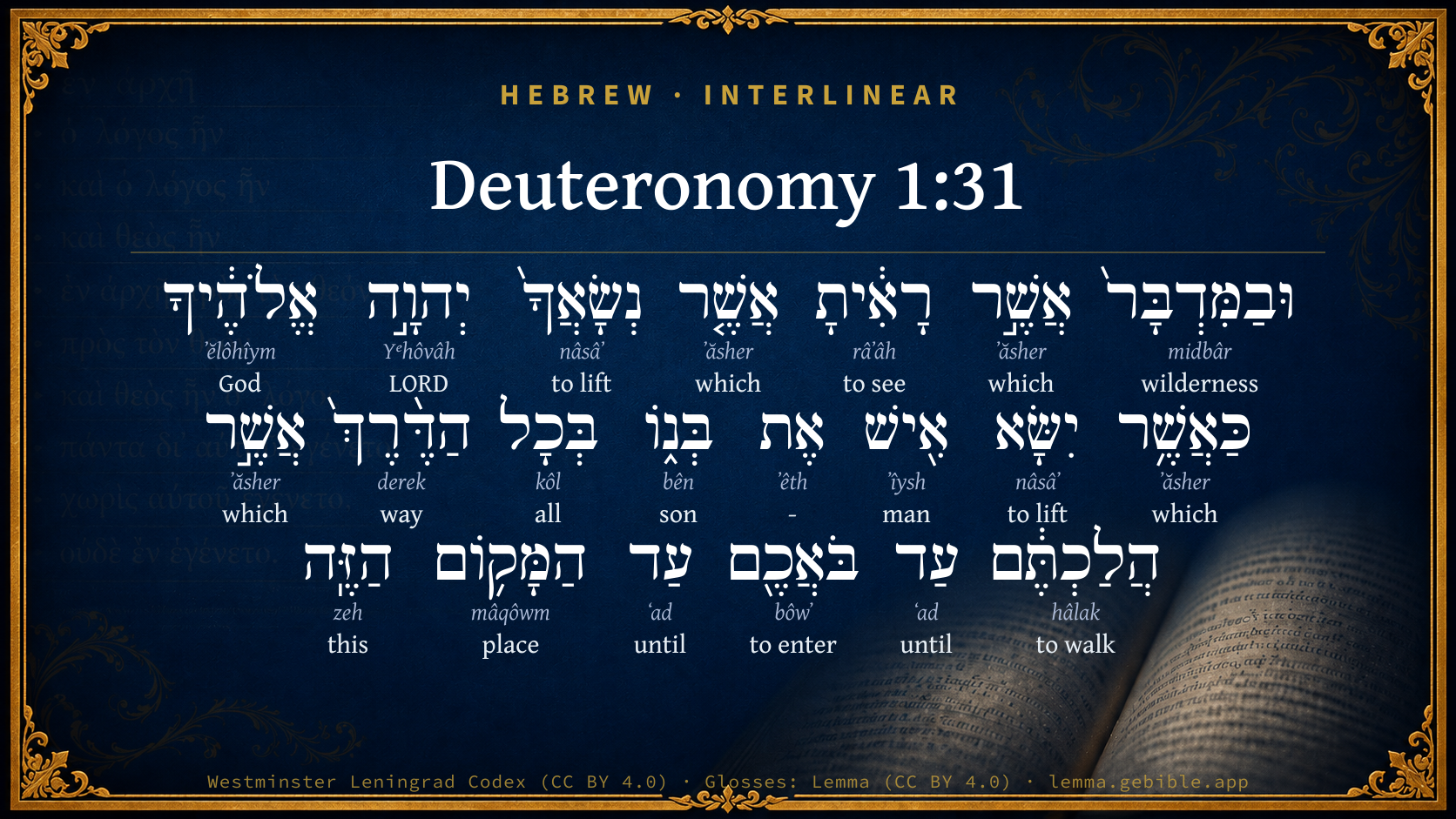
Hebrew (Westminster Leningrad Codex) Deuteronomy 1:31 appears in the Hebrew Old Testament. The text above is from the Westminster Leningrad Codex. Each word links to its Strong’s number, a concise gloss, and parsing drawn from the Open Scriptures Hebrew Bible morphology. Click any word for its full Brown-Driver-Briggs (BDB) entry.
Download image
Cite this verse

Deuteronomy 1:31 (World English Bible). Public Domain. Lemma interlinear Bible study tool, https://lemma.gebible.app/v/deuteronomy/1/31.

Show BibTeX & RIS
BibTeX
RIS
English Translation
and in the wilderness, where you have seen how that Yahweh your God bore you, as a man does bear his son, in all the way that you went, until you came to this place.
World English Bible · Public Domain
Download a study sheet

One document with this verse’s original text, its word-by-word gloss line, the meaning frame, cross-references with their text, attributed commentary, and full source and license credits — printable, and it pastes into notes with its structure intact.

This verse Autodidact and up

Study sheet (.html) Plain text (.txt)

A passage Seminary Student

Up to 50 verses in one chapter. A passage sheet keeps up to 6 commentary sources and 12 cross-references per verse, in the order this page ranks them, and says so on the sheet whenever that leaves anything out. Ask for a single verse and you get the Autodidact verse sheet above.

Everything on this page stays free to read, with no account — the sheet is a download of what is already on screen, not access to it.

Want to remove ads? Support Godless Engineer
Compare translations 3

The same verse in 3 English versions, stacked beneath the original-language interlinear above. Click any original word for its lexicon entry.

Each is an independent rendering of the whole verse — the interlinear is not word-aligned to these translations.

Highlighted words mark where these versions differ — a whole-verse word diff, not a word-by-word alignment.

  • World English Bible Public Domain
    and in the wilderness, where you have seen how that Yahweh your God bore you, as a man does bear his son, in all the way that you went, until you came to this place.
  • King James Version Public Domain
    And in the wilderness, where thou hast seen how that the LORD thy God bare thee, as a man doth bear his son, in all the way that ye went, until ye came into this place.
  • unfoldingWord Literal Text CC BY-SA 4.0
    and in the wilderness, where you have seen how Yahweh your God carried you, as a man carries his son, in all the way that you went until you came to this place.’

unfoldingWord Literal Text — © unfoldingWord, licensed CC BY-SA 4.0. Word-aligned USFM3 via Door43 (git.door43.org/unfoldingWord/en_ult).

Versions to compare (up to 4)

3 of 4 selected

Show all 18 translations

Every available English version of this verse, each an independent rendering of the whole verse.

  • World English Bible Public Domain
    and in the wilderness, where you have seen how that Yahweh your God bore you, as a man does bear his son, in all the way that you went, until you came to this place.
  • Berean Standard Bible Public Domain
    and in the wilderness, where the LORD your God carried you, as a man carries his son, all the way by which you traveled until you reached this place.”
  • Majority Standard Bible Public Domain
    and in the wilderness, where the LORD your God carried you, as a man carries his son, all the way by which you traveled until you reached this place.”
  • King James Version Public Domain
    And in the wilderness, where thou hast seen how that the LORD thy God bare thee, as a man doth bear his son, in all the way that ye went, until ye came into this place.
  • American Standard Version (1901) Public Domain
    and in the wilderness, where thou hast seen how that Jehovah thy God bare thee, as a man doth bear his son, in all the way that ye went, until ye came unto this place.
  • Revised Version (1885) Public Domain
    and in the wilderness, where thou hast seen how that the LORD thy God bare thee, as a man doth bear his son, in all the way that ye went, until ye came unto this place.
  • Geneva Bible (1599) Public Domain
    And in the wildernesse, where thou hast seene how the Lord thy God bare thee, as a man doeth beare his sonne, in all the way which ye haue gone, vntill ye came vnto this place.
  • Douay-Rheims (1899) Public Domain
    And I said to you: Fear not, neither be ye afraid of them:
  • Young's Literal Translation Public Domain
    and in the wilderness, where thou hast seen that Jehovah thy God hath borne thee as a man beareth his son, in all the way which ye have gone, till your coming in unto this place.
  • Literal Standard Version CC BY-SA 4.0
    and in the wilderness where you have seen that your God YHWH has carried you, as a man carries his son, in all the way which you have gone until your coming to this place.
  • Unlocked Literal Bible CC BY-SA 4.0
    and also in the wilderness, where you have seen how Yahweh your God carried you, as a man carries his son, everywhere you went until you came to this place.'
  • unfoldingWord Literal Text CC BY-SA 4.0
    and in the wilderness, where you have seen how Yahweh your God carried you, as a man carries his son, in all the way that you went until you came to this place.’
  • Darby Bible Public Domain
    and in the wilderness where thou hast seen that Jehovah thy God bore thee, as a man doth bear his son, in all the way that ye went, until ye came to this place.
  • World Messianic Bible Public Domain
    and in the wilderness where you have seen how that the LORD your God carried you, as a man carries his son, in all the way that you went, until you came to this place.”
  • Webster's Bible Public Domain
    And in the wilderness, where thou hast seen how the LORD thy God bore thee, as a man doth bear his son, in all the way that ye went, until ye came into this place.
  • Free Bible Version CC BY-SA 4.0
    He did the same in the desert—you saw how the Lord your God carried you like a father carries his son during your whole journey until you arrived here.”
  • Bible in Basic English Public Domain
    And in the waste land, where you have seen how the Lord was supporting you, as a man does his son, in all your journeying till you came to this place.
  • JPS Tanakh (1917) Public Domain
    and in the wilderness, where thou hast seen how that the LORD thy God bore thee, as a man doth bear his son, in all the way that ye went, until ye came unto this place.

Literal Standard Version (2020), Covenant Press — licensed CC BY-SA 4.0. Text via the HelloAO Bible API (eBible.org). Unlocked Literal Bible (unfoldingWord) — licensed CC BY-SA 4.0. Text via the HelloAO Bible API (eBible.org). unfoldingWord Literal Text — © unfoldingWord, licensed CC BY-SA 4.0. Word-aligned USFM3 via Door43 (git.door43.org/unfoldingWord/en_ult). Free Bible Version, Dr. Jonathan Gallagher — licensed CC BY-SA 4.0. Text via the HelloAO Bible API (eBible.org).

Word by word

More ways to search: Search by grammar → Find every occurrence → Compare this word →

Practice this passage: Drill this verse → Learn its vocabulary →

וּבַמִּדְבָּר֙
midbâr
H4057
“and · in/at the · wilderness”
Conjunction + Preposition, Determined + Noun, Common, Masculine, Singular, Absolute
Part of Speech
Conjunction + Preposition + Noun
Type
Common
Gender
Masculine
Number
Singular
State
Absolute
Full BDB Definition

Origin: from H1696 in the sense of driving

TWOT: 399k , 399 L

wilderness - pasture - uninhabited land, wilderness - large tracts of wilderness (around cities) - wilderness (figuratively) - mouth - mouth (as organ of speech)
  1. אֲשֶׁ֣ר ʼăsher H834 “which” Particle, Relative
  2. רָאִ֔יתָ râʼâh H7200 “to see” Verb, Qal, Perfect, 2nd Person, Masculine, Singular
  3. אֲשֶׁ֤ר ʼăsher H834 “which” Particle, Relative
  4. נְשָׂאֲךָ֙ nâsâʼ H5375 “to lift · you” Verb, Qal, Perfect, 3rd Person, Masculine, Singular + Suffix, Personal, 2nd Person, Masculine, Singular
  5. יְהוָ֣ה Yᵉhôvâh H3068 “LORD” Noun, Proper
  6. אֱלֹהֶ֔יךָ ʼĕlôhîym H430 “God(s) · your” Noun, Common, Masculine, Plural, Construct + Suffix, Personal, 2nd Person, Masculine, Singular
  7. כַּאֲשֶׁ֥ר ʼăsher H834 “like/as · which” Preposition + Particle, Relative
  8. יִשָּׂא nâsâʼ H5375 “to lift” Verb, Qal, Imperfect, 3rd Person, Masculine, Singular
  9. אִ֖ישׁ ʼîysh H376 “man” Noun, Common, Masculine, Singular, Absolute
  10. אֶת ʼêth H853 “-” Particle, Direct Object
  11. בְּנ֑וֹ bên H1121 “son · his” Noun, Common, Masculine, Singular, Construct + Suffix, Personal, 3rd Person, Masculine, Singular
  12. בְּכָל kôl H3605 “in/at · all of” Preposition + Noun, Common, Masculine, Singular, Construct
  13. הַדֶּ֨רֶךְ֙ derek H1870 “the · way” Particle, Definite Article + Noun, Common, Both, Singular, Absolute
  14. אֲשֶׁ֣ר ʼăsher H834 “which” Particle, Relative
  15. הֲלַכְתֶּ֔ם hâlak H1980 “to walk” Verb, Qal, Perfect, 2nd Person, Masculine, Plural
  16. עַד ʻad H5704 “until” Preposition
  17. בֹּאֲכֶ֖ם bôwʼ H935 “to enter · you” Verb, Qal, Infinitive Construct + Suffix, Personal, 2nd Person, Masculine, Plural
  18. עַד ʻad H5704 “until” Preposition
  19. הַמָּק֥וֹם mâqôwm H4725 “the · place” Particle, Definite Article + Noun, Common, Masculine, Singular, Absolute
  20. הַזֶּֽה zeh H2088 “the · this” Particle, Definite Article + Pronoun, Demonstrative, Masculine, Singular

About this verse

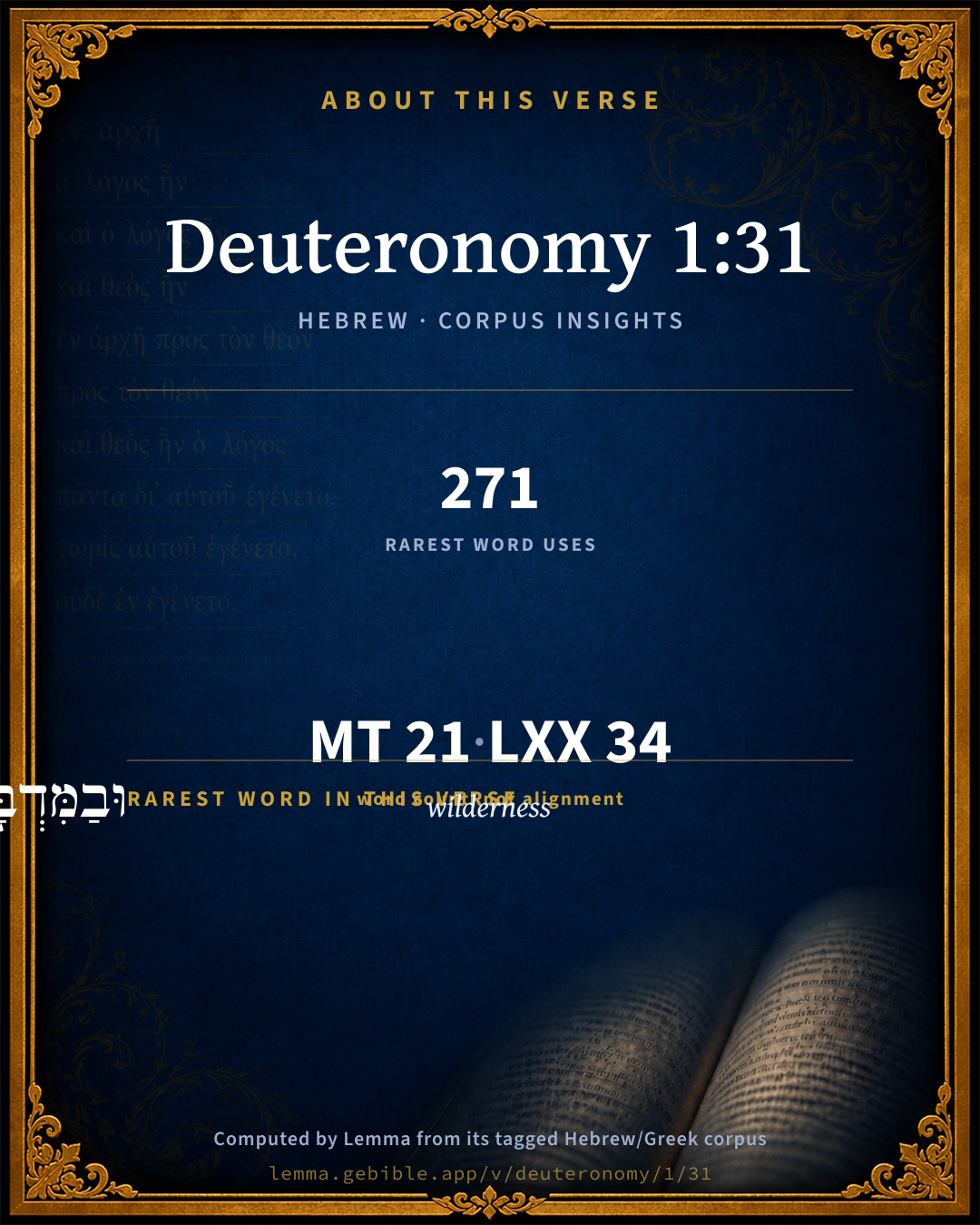
These counts appear in no published source. They are computed here, from the morphology-tagged text and Lemma’s own curated glosses. What Lemma adds →

21
words
16
distinct lemmas
Pentateuch
section

Grammatical profile

  • 5 verbs
  • 8 nouns
  • 1 pronoun
  • 2 prepositions
  • 5 particles

Verb forms

  • רָאִ֔יתָ Qal · Perfect
  • נְשָׂאֲךָ֙ Qal · Perfect
  • יִשָּׂא Qal · Imperfect
  • הֲלַכְתֶּ֔ם Qal · Perfect
  • בֹּאֲכֶ֖ם Qal · Infinitive Construct

Repetition

Words recur within this verse — often emphatic in Hebrew:

  • נְשָׂאֲךָ֙ to lift H5375 ×2
  • עַד until H5704 ×2
  • אֲשֶׁ֣ר which H834 ×4

Hebrew & Septuagint length

In English translation the verse runs 35 words from the Hebrew and 49 from the Septuagint (LXX English) — the Septuagint runs noticeably longer here. See the side-by-side →

A rough comparison of the two English renderings, which tokenize alike — not a word-level alignment.

Word counts can differ between the Hebrew and the Greek without any difference in meaning — e.g. the Hebrew direct-object marker אֵת has no separate Greek word, and Greek often adds the article ὁ.

In the original languages it is 21 Hebrew tokens and 34 Greek tokens — but the two are counted differently (Hebrew bundles its prefixes and suffixes into one token; the Greek is in lemma form), so that isn’t a like-for-like length.

Cross-references

13

Topical passages linked to Deuteronomy 1:31 in the Treasury of Scripture Knowledge — connected by theme and wording, ordered by reader-vote popularity; previews shown in the World English Bible.

  • Isaiah 46:3–4 Listen to me, house of Jacob, and all the remnant of the house of Israel, that have been borne [by me] from their birth, that have been carried from the womb;
  • Acts 13:18 For a period of about forty years he put up with them in the wilderness.
  • Deuteronomy 32:10–12 He found him in a desert land, In the waste howling wilderness; He compassed him about, he cared for him, He kept him as the apple of his eye.
  • Isaiah 63:9 In all their affliction he was afflicted, and the angel of his presence saved them: in his love and in his pity he redeemed them; and he bore them, and carried them all the days of old.
  • Hosea 11:3–4 Yet I taught Ephraim to walk. I took them by his arms; But they didn't know that I healed them.
  • Exodus 19:4 'You have seen what I did to the Egyptians, and how I bore you on eagles' wings, and brought you to myself.
  • Isaiah 40:11 He will feed his flock like a shepherd, he will gather the lambs in his arm, and carry them in his bosom, [and] will gently lead those who have their young.
  • Numbers 11:14 I am not able to bear all this people alone, because it is too heavy for me.
  • Exodus 16:1–17 They took their journey from Elim, and all the congregation of the children of Israel came to the wilderness of Sin, which is between Elim and Sinai, on the fifteenth day of the second month after their departing out of the land of Egypt.
  • Psalms 105:39–41 He spread a cloud for a covering, Fire to give light in the night.
  • Numbers 11:11–12 Moses said to Yahweh, Why have you dealt ill with your servant? and why haven't I found favor in your sight, that you lay the burden of all this people on me?
  • Nehemiah 9:12–23 Moreover in a pillar of cloud you led them by day; and in a pillar of fire by night, to give them light in the way in which they should go.
  • Psalms 78:14–28 In the daytime he also led them with a cloud, And all night with a light of fire.

Cross-references courtesy of OpenBible.info (CC BY 4.0).

Hebrew and Greek witnesses Masoretic Hebrew ↔ Greek Septuagint

The same verse in the two great witnesses to the Old Testament, shown verse-for-verse.

Here the Septuagint runs noticeably longer than the Hebrew — LXX2012 (modern English Septuagint) 49 words vs World English Bible 35. A rough length comparison of the two English translations, not a word-level alignment — read both below.

These are two independent witnesses, not word-aligned to each other, and the Septuagint is shown in lemma (dictionary) form.

Hebrew Deuteronomy 1:31 Masoretic · Westminster Leningrad Codex

וּבַמִּדְבָּר֙ אֲשֶׁ֣ר רָאִ֔יתָ אֲשֶׁ֤ר נְשָׂאֲךָ֙ יְהוָ֣ה אֱלֹהֶ֔יךָ כַּאֲשֶׁ֥ר יִשָּׂא אִ֖ישׁ אֶת בְּנ֑וֹ בְּכָל הַדֶּ֨רֶךְ֙ אֲשֶׁ֣ר הֲלַכְתֶּ֔ם עַד בֹּאֲכֶ֖ם עַד הַמָּק֥וֹם הַזֶּֽה

and in the wilderness, where you have seen how that Yahweh your God bore you, as a man does bear his son, in all the way that you went, until you came to this place.

World English Bible · Public Domain

Greek LXX Deuteronomy 1:31 Septuagint · lemma form

καί ἐν ὁ ἔρημος οὗτος ὅς ὁράω ὡς τροφοφόρέω σύ κύριος ὁ θεός σύ ὡς εἰ τις τροφοφορέω ἄνθρωπος ὁ υἱός αὐτός κατά πᾶς ὁ ὁδός ὅς πορεύομαι ἕως ἔρχομαι εἰς ὁ τόπος οὗτος

and in this wilderness which you⌃ saw, by the way of the mountain of the Amorite; how the Lord your God will bear you as a nursling, as if any man should nurse his child, through all the way which you⌃ have gone until you⌃ came to this place.

LXX2012 (modern English Septuagint) · Public Domain

Hebrew: Westminster Leningrad Codex (CC BY 4.0). Greek: Septuagint (public domain); English from LXX2012 (modern English Septuagint) (Public Domain). How the Septuagint differs from the Hebrew →

Targum (Aramaic paraphrase)

2

The Targum is the ancient Jewish Aramaic paraphrase of the Hebrew Scriptures — an interpretive translation, not the Hebrew text itself. Onkelos (literal) and Pseudo-Jonathan (expansive) render the Torah, and Jonathan the Prophets. Coverage is partial: where no permissively-licensed English translation exists for a verse, only the Aramaic is shown. This is verse-level text, not a word-by-word alignment to the Hebrew.

  1. Targum Onkelos Torah (Genesis–Deuteronomy)
    וּבְמַדְבְּרָא דִי חֲזֵיתָא דִי סוֹבְרָךְ יְיָ אֱלָהָךְ כְּמָא דִי מִסוֹבַר גַבְרָא יָת בְּרֵהּ בְּכָל אָרְחָא דִי הַלֶכְתּוּן עַד מֵיתֵיכוֹן עַד אַתְרָא הָדֵין

    (no public-domain English translation for this verse)

    Targum Onkelos — Aramaic: “Onkelos Genesis” (public domain); “Onkelos Exodus” (public domain); “Onkelos Leviticus” (public domain); “Onkelos Numbers” (public domain); “Onkelos Deuteronomy” (public domain). English: “Sefaria Community Translation” (CC0 1.0 (public-domain dedication)); “J.W. Etheridge. The Targums of Onkelos and Jonathan Ben Uzziel on the Pentateuch. London: Longmans, Green, 1862” (public domain). Text via Sefaria.

  2. Targum Pseudo-Jonathan Torah (Genesis–Deuteronomy)
    וּבְמַדְבְּרָא דַחֲמֵיתָא חִוְויָא קָלָן מַלְיָין אֶרֶס דִּקְטוֹל וְסוֹבְרָךְ יְיָ אֱלָהָךְ בַּעֲנָנֵי אִיקַר שְׁכִינְתֵּיהּ הֵיכְמָא דִמְסוֹבַר גְּבַר יַת בְּרֵיהּ בְּכָל אָרְחָא דְהַלֵיכְתּוּן עַד זְמַן מֵיתֵיכוֹן עַד אַתְרָא הָדֵין

    And in the desert, where thou sawest burning serpents full of deadly venom, the Lord thy God bare thee with the glorious clouds of His Shekinah, as a man carrieth his child, all the way that you went, until you have come to this place.

    Targum Pseudo-Jonathan — Aramaic: “Targum Jonathan on Genesis” (public domain); “Targum Jonathan on Exodus” (public domain); “Targum Jonathan on Leviticus” (public domain); “Targum Jonathan on Numbers” (public domain); “Targum Jonathan on Deuteronomy” (public domain). English: “The Targum of Jonathan ben Uzziel, trans. J. W. Etheridge, London, 1862” (public domain). Text via Sefaria.

Commentary

Notes on Deuteronomy 1:31 from classic Christian and Jewish commentators (each source and its license shown beneath its notes). The classic Christian expositions comment on the surrounding passage and are grouped to its opening verse, so a note may address several verses; the Jewish commentaries on the Tanakh (Rashi and others) are per-verse, so they appear only where the commentator wrote on this verse.

Lemma curates 59 commentaries, every one of them public domain or Creative Commons licensed, each selected and text-cleaned for this edition rather than reprinted as found. About our sources →

Trapp's Complete Commentary

John Trapp

Deu 1:31 And in the wilderness, where thou hast seen how that the LORD thy God bare thee, as a man doth bear his son, in all the way that ye went, until ye came into this place.

Ver. 31. As a man doth bear his son.] Charily and tenderly, as his own heart; not hating them, as they desperately belied the Lord. {Deu 1:27} "For if a man find his enemy, will he let him go well away?" {1Sa 24:19} Will he accommodate him as God did these murmurers? Never was any prince served in such state as they were.

John Trapp, A Commentary or Exposition upon All the Books of the Old and New Testament (1647–1656) — public domain. Text from a community e-Sword module.

The Biblical Illustrator

Joseph S. Exell

Deu_1:31

The Lord thy God bare thee as a man doth bear his son.

The paternal upholding of God

These words are part of a discourse delivered by Moses to all Israel, in the plain over against the Red Sea. Some of the most tender Divine utterances are to be found in the books of Moses. The subject of the text is the paternal upholding of God.

I. Glance first at what we may call our history. There is a history appertaining to each of us, a story of our life. It has been written, though not with a pen, and it is inscribed on the mind of God. We study the biographies of others, and neglect the story of our own lives.

II. The next thing is, God in our history. The chief agents in our history are God and ourselves. God is in a good mother, God is in a wise father, God is in a competent tutor, God is in useful companions, God is in holy social influences, and God is in the ministry of angels; while bad parents, and bad teachers, and evil companions, and devils, have acted upon us by Gods permission. God is, on these grounds, in all our history. Those passages which seem to present prominently the mother contain God, and they contain more of God than they do even of the mother. From no portion of the story of life can we exclude God. His purpose and thought and will are in each part and in the whole. Every step we take works out some part of the plan of life which He has laid down for us, so that God is in our history, in a certain sense, far more than we ourselves are in it.

III. Now, seeing that God is in our history, what does that history express with reference to God? It shows Gods upholding of us. God bare thee when thou seemedst to thyself to walk alone. There are seasons in which you appear to design and arrange, but you have only been rough-hewing, as the mason sometimes rough hews for the sculptor, and even this rough-hewing has been under Divine direction. God bare thee when thou wast carried by others, and the Lord thy God bare thee when thou wast thyself inactive, and no fellow creature seemed to be ministering to thee. Then He held thy soul in life, and kept thy feet from falling. He has also borne with thee. A most important part of bearing thee is this.

IV. The great point, however, of this passage is, the paternal character of the Divine sustenance. We each have a history, and God is in it, and the upholding of God is expressed by it. But that upholding is paternal. The Lord thy God bare thee as a man doth bear his son. Now let us break this up a little. We may say that a man bears his son by taking charge of him, and by being responsible for him. We may say that a man bears his son by working for him, and by being a sort of subordinate providence over him. We may say that a man hears his son by teaching him, in due time, to act and to work for himself. We may say that a man bears his son when he shows patience towards his ignorance and folly, pity towards his sorrows, forbearance towards his faults, and love for his person. And thus does God sustain those who trust and fear Him.

V. There are obligations and duties that spring from these truths.

1. In the first place, if God bears us as a man bears his son, we ought to be quiet from the fear of evil. Real evil, while God is bearing us as a man his son--evil in the sense of real calamity--cannot happen to us.

2. If God bear us as a man his son, we ought to be careful for nothing. God cares for us. What have we to do with care? What have we to do, in many circumstances, with responsibility? We are responsible for finding out Gods will, and for doing that will with all our might, but beyond where is our responsibility? Are we responsible for consequences? Is the husbandman, for example, responsible for the harvest? He is responsible for breaking the clods of the field, and for ploughing, and for tilling the ground; he is responsible for the choice of the seed, for the way in which it is sown, for the treatment of the field after seed is sown; but is lie responsible for the clouds? Is he responsible for the rain? Is he responsible for frost? Is be responsible for light or for darkness? Is he responsible for the calm or for sunshine? The man may plough to perfection and sow most carefully and treat his ground most scientifically, but there is something more than that which man can do required for the increase of the earth; and that something more is Gods care, not mans.

3. If God bear us as a man his son, we ought lovingly to trust Him. Obey Him and honour Him, and when God tries your confidence in Him take care that this confidence conies forth from the trial like gold purified seven times. Eventually you shall be free from such trials, but now God often exposes you to them. The results of Gods guidance and the results of Gods upholding are now, in some respects, or at least in some of their results, very much like unripe fruit--green, sour, bitter, but as months roll on these results will become like ripened fruit, beautiful, sweet, and mellow, a picture to the eye, and as honey to the taste. (S. Martin, D. D.)

Gods fatherly care

There is nothing of which men know less than of themselves. They do not understand how their own characters are formed; they stand in great doubt as to their own moral states before God. They cannot judge or take account of themselves, much less of their fellows. It is a great comfort to know that there is One who perfectly knows all that is in us, and all that concerns us, and who will take us for just our real worth. It is a comfort to trust in God. Oh, when a little child is weary, marching through a desert towards his home, when he feels that he has no longer strength to travel, nor wisdom to direct his way, how glad is he to have his father take him in his arms to rest him! And when the child, just before falling asleep, raises his eyes for one more glance at the face above him, and sees it firm and calm and set for home, how sweetly he resigns himself to slumber, confident that all is well! And thus do we, in the weary march through life, sometimes love to recline upon the bosom of the Eternal Traveller, and take our hour of rest confiding in our God. (H. W. Beecher.)

Deu_1:31

Joshua . . . Encourage him.

Encourage your minister

Joshua was a young man in comparison with Moses. He was about to undertake the onerous task of commanding a great people. He had, moreover, the difficult enterprise of leading them into the promised laud, and chasing out the nations which possessed it. The Lord commanded Moses therefore to encourage him, that in the prospect of great labour he might not be dismayed.

I. God, even our God, is graciously considerate of His servants, and would have them well fitted for high enterprise with good courage. He does not send them as a tyrant would send a soldier upon an errand for which he is not capable, nor does He afterwards withhold His succour, forgetful of the straits to which they may be reduced; but tie is very careful of His servants, and will not let one of them perish. The Lord our God hath strong reasons for being thus considerate of His servants.

1. Are they not His children? Is He not their Father? Does tie not love them? Now, none of us would send a child of ours upon a difficult enterprise without being anxious for his welfare. We would not put him upon a trial beyond his strength, without at the same time guaranteeing to stand at his side and make his strength equal to his day.

2. Moreover, the Father Himself is concerned as to His honour in all that they do. If any servant of God shall fall, then Gods name is despised. The daughters of Philistia rejoice, and the inhabitants of Ekron triumph. His honour is too much concerned ever to permit this. Ye feeble ones, to whom God hath given to do or to suffer for His names sake, rest assured that He hath His eye upon you now. He cannot leave you, unless He can cease to be God over all, blessed for ever.

3. Observe well how far the tender consideration of God for His servants extends! He not only considers their outward state, and the absolute interests of their condition, but He remembers their spirits, and loves to see them of good courage.

II. God uses His own people to encourage one another. He did not say to the angel, Gabriel, there is My servant Joshua, about to take the people into Canaan--fly down and encourage him. God never works needless miracles. Gabriel would not have been half so well fitted for the work as Moses. A brothers sympathy is more precious than an angels embassy. To whom, then, should this work of encouraging the people be committed?

1. Surely the elders should do it; those of riper years than their fellows. I know of nothing more inspiriting than to hear the experience of a grey-headed saint. I have found much spiritual comfort in sitting at the feet of my venerable grandfather, more than eighty years of age.

2. Not the aged only, but the wise in the family should be comforters. All believers are not equal in knowledge. Oh, ye that have searched the Scriptures through and know its promises, be sure to quote the promises of God to trembling hearts, and especially to those engaged in arduous labour for the Master. Comfort them. Repeat the doctrine of Gods faithfulness; say to them, He will be with thee, He will not fail thee, neither forsake thee: fear not, neither be dismayed. Oh, that the wise-hearted in the Lords family would be thus employed at all times.

3. Nor can I doubt that the happier sort of Christians ought always to be engaged in comforting the mournful and sorrowing. You know whom I mean; their eyes always sparkle; wherever they go they carry lamps bright with animation, sunshine gleams in their faces, they live in the light of Gods countenance.

4. Let the brother of low degree be likewise encouraged by those who are rich among you. You may frequently breathe comfort into a desponding spirit by seasonable help.

III. I advance to the object that is uppermost in my mind. I believe there is a special occasion for the exercise of this duty of encouraging one another in the case of the minister and Church in this place. It is a fresh enterprise surrounded with peculiar difficulties, and demanding special labour. It is a work so solemn that if you do not encourage your minister your minister will probably sink down in despair. Remember that the man himself needs encouragement because he is weak. Who is sufficient for these things? To serve in any part of the spiritual army is dangerous, but to be a captain is to be doubly exposed. The most of the shots are aimed at the officers. There are all sorts of discouragements to be met with. Professing Christians will backslide. Those who do remain will often be inconsistent, and he will be sighing in his closet, while you, perhaps, are thanking God that your souls have been fed under him. Encourage your minister, I pray yon, wherever you attend--encourage him for your own sake. A discouraged minister is a serious burden upon the congregation. When the fountain gets out of order you cannot expect water at any of the taps; and if the minister be not right it is something like a steam engine in a great manufactory--everybodys loom is idle when the motive power is out of order. See that he is resting upon God and receiving His Divine power, and you will all know, each Sabbath day, the benefit of it. This is the least thing you can do. There are many other things which may cause you expense, effort, time, but to encourage the minister is so easy, so simple a matter, that I may well press upon you to do it. Perhaps you will say, Well, if it is so simple and easy, tell us, who are expecting to settle down in this place, how we can encourage the minister here. Well, you can do it in several ways.

1. You can encourage him by very constant attendance. Those who are going from place to place are of no use to anybody; but those are the truly useful men who, when the servants of God are in their places, keep to theirs, and let everybody see that whoever discourages the minister, they will not, for they appreciate his ministry.

2. Again, let me say, by often being present at the prayer meeting you can encourage the minister.

3. Again, you can all encourage the minister by the consistency of your lives. I do not know when I ever felt more gratified than on one occasion when, sitting at a church meeting, having to report the death of a young brother who was in the service of an eminent employer, a little note came from him to say, My servant, Edward--, is dead. I send you word at once that you may send me another young man; for if your members are such as he was, I never wish to have better servants around me. I read the letter at the church meeting, and another was soon found. It is a cheering thing for the Christian minister to know that his converts are held in repute. (C. H. Spurgeon.)

Encouragement

I. The text supposes that difficulties will be encountered. In the Christian life there are many obstacles.

1. Difficulties made by ourselves.

2. Difficulties arising from the conduct of others.

3. Difficulties expressly sent by God to test His servants.

II. The text gives a command to surmount these difficulties. We should encourage our fellow Christians.

1. To meet their trials with patience.

2. Steadily to fight till they conquer them.

3. To profit by them.

III. The text contains a lesson for every Christian preacher and teacher. Encourage--

1. The penitent sinner.

2. The young believer.

3. The well-tried saint. (J. W. Macdonald.)

The Christian pastor encouraged by his flock

You need not be told that those clergymen who enter into the spirit of their office are oppressed with discouragements of various kinds. These it is incumbent on you to anticipate, and as far as lies in your power to prevent; a measure far more easy to effect than a removal of them after they have actually taken place.

I. He is liable to discouragement arising from fear as to the inefficacy of his public and private labours.

1. Encourage him by your regular attendance on the public, worship of God. Let it ever be remembered that attendance on the House of God IS not a matter of choice, but a sacred duty.

2. Encourage him by endeavouring to derive personal benefit from his ministry.

3. Encourage him by endeavouring to counteract his fears in manifesting your readiness to cooperate with him in all his efforts to do good. It is heartless work to labour alone.

4. Encourage him by praying for him.

5. Encourage him by informing him of the success of his labours, whether on yourselves or on others.

II. A second source of ministerial discouragement regards the unfavourable impressions likely to be made on some minds by the faithful discharge of his professional duties. Let it be your delight to encourage your minister by following him with patience and docility in all his researches into the inexhaustible treasures of inspiration.

III. Another species of ministerial discouragement sometimes arises from fear respecting the failure of the affection of our people and the diminution of our own usefulness should we continue long to labour amongst them. There are some who will show less forbearance to a minister than to others; and who, not satisfied with exciting the hostility of their families, labour by partial statements of their own case to create a general prejudice against him. Contentions in parishes and in churches have often caused clergymen to sigh for a place in the desert, that they might leave their flocks and go from them; indeed, they have made them long for that place where the wicked cease from troubling and where the weary are at rest. Encourage your minister, therefore, by endeavouring to be all of one mind. As Christians, you must walk in love. (T. Gibson, M. A.)

Salutary encouragement

A gentleman travelling in the northern part of Ireland heard the voices of children, and stopped to listen. Finding the sound came from a small building used as a school house he drew near; as the door was open he went in and listened to the words the boys were spelling. One little fellow stood apart, looking very sad. Why does that boy stand there? asked the gentleman. Oh, he is good for nothing, replied the teacher. There is nothing in him. I can make nothing of him. He is the most stupid boy in the school. The gentleman was surprised at his answer. He saw the teacher was so stern and rough that the younger and more timid were nearly crushed. After a few words to them, placing his hand on the head of the little fellow who stood apart, he said, One of these days you may be a fine scholar. Dont give up; try, my boy--try. The boys soul was aroused. A new purpose was formed. From that hour he became anxious to excel, and he did become a fine scholar. It was Dr. Adam Clarke.

A ministers encouragement

I remember to have preached, years ago, at a watering place in the Virginia mountains, at the dedication of a new church. The people were all strangers to each other; and as he went away my friend said (who had a right to speak so familiarly), I wonder, my dear fellow, that you could be animated at all today; for we are all strangers, and things were pretty cold I thought. Ah, but, the preacher replied, you did not see old brother Gwathmey, of Hanover, who sat there by the post. The first sentence of the sermon caught hold of him, and it kept shining out of his eyes and his face, and he and the preacher had a good time together, and we didnt care at all about the rest of you.

Timely encouragement

As Luther was passing to the assembly room of the Diet a noted commander, George Von Frundesberg, touched him on the shoulder, and said, My dear monk, thou art now about taking a step the like of which neither I nor many a commander on the hardest fought battlefield has ever taken. If thou art right and sure of thy cause, proceed in Gods name, and be of good cheer; God will not forsake thee. (Littles Historical Lights.)

Encouragement needed

Lord Lytton, in his essay on the efficacy of praise, tells a story of Mr. Keen, who, when performing in some city of the United States, came to the manager when the play was half over, and said, I cant go on again, sir, if the pit keeps its hands in its pockets. Such an audience would extinguish AEtna. Upon this the manager told the audience that Mr. Keen, not being accustomed to the severe intelligence of American citizens, mistook their silent attention for courteous disappointment, and that if they did not applaud Mr. Keen as he was accustomed to be applauded, they could not see Mr. Keen act as he was accustomed to act. Of course, the audience took the hint, and as their fervour rose, so rose the genius of the actor, and their applause contributed to the triumphs it rewarded.

The Biblical Illustrator, edited by Joseph S. Exell (c. 1880s–1900s) — public domain. Text from a community e-Sword module.

Joseph Benson's Commentary

Deu 1:31-34. Bare thee — Or carried thee, as a father carries his weak and tender child in his arms, through difficulties and dangers, gently leading you according as you were able to go, and sustaining you by his power and goodness. Ye did not believe the Lord — So they could not enter in, because of unbelief. It was not any other sin that shut them out of Canaan, but their disbelief of that promise which was typical of gospel grace; to signify that no sin will ruin us but unbelief, which is a sin against the remedy, and therefore without remedy. Your words — That is to say, your murmurings, your unthankful, impatient, distrustful, and rebellious speeches.

Joseph Benson's Commentary on the Old and New Testaments (1811–1818) — public domain. Text from a community e-Sword module.

Tyndale Open Study Notes

Tyndale Open Resources

1:31 God’s tender care as a father reflected his covenant relationship with Israel (Exod 4:22; Hos 11:1-4; cp. Matt 6:26-33; John 14:21; Acts 13:18; Rom 8:15-17; 1 Pet 1:2-3; 1 Jn 3:1). Israel was God’s child by descent from Abraham and because God had chosen and adopted Israel from among all the nations (Deut 14:2; Exod 19:4-6). The imagery is similar to that found in secular covenant texts in which a great king regarded a vassal with whom he had made a treaty as his son.

Tyndale Open Study Notes — © Tyndale Open Resources, licensed CC BY-SA 4.0. Text via the HelloAO Bible API.

Ellicott's Commentary for English Readers

(31) The Lord . . . bare thee, as a man doth bear his son.—From this comes the expression in Act_13:18, “He bare them as a nursing father in the wilderness.”—Rev. N. T., margin.

A Bible Commentary for English Readers, edited by Charles John Ellicott (1878–1897) — public domain. Text from a community e-Sword module.

The Cambridge Bible for Schools and Colleges

gen. ed. J. J. S. Perowne

31. the wilderness, where thou hast seen how that … thy God bare thee] The second of the Sg. passages in this discourse. If we omit it the rest of the verse in the Pl. address follows suitably on the initial conjunction: and in all the way ye went until ye came to this place. Possibly, therefore, the Sg. clause is a later insertion (so Stärk, Steuern., Berth.). Yet it may be argued that the author has himself naturally changed from Pl. to Sg. under the influence of the metaphor he uses; the nation being personified by the metaphor and therefore conceived in the Sg.

bare thee] Rather, hath borne thee. This figure for the Divine Providence is frequent in the O.T.; whether with the accompanying simile, as a man his son, Deu_1:44; Deu_8:5; cp. Hos_11:1 f.; or with another, on eagles’ wings, Deu_32:11; Exo_19:4 (both JE); or with no addition, Hos_11:4; Isa_46:4; Isa_63:9; or as implied in other words Deu_32:13, he made him to ride; Deu_33:27, underneath are the everlasting arms. Isaiah 46 contrasts the dead idols that need to be carried with the living God who carries His people. The same idea, that religion is not what we have to carry but what carries us, is enforced nowhere more finely than in D in which faith in God means buoyancy and progress, the experience of being lifted and forwarded.

unto this place] Deu_3:29, the valley over against Beth-Pe‘or. Cp. Deu_9:7, Deu_11:5, and with a different prepos. Deu_26:9, Deu_29:6.

The Cambridge Bible for Schools and Colleges (gen. ed. J. J. S. Perowne; Cambridge University Press, 1878–1918) — public domain. Text from a community e-Sword module.

John Gill's Exposition

And in the wilderness,.... Where he had fed them with manna, brought water out of rocks for them, protected them from every hurtful creature, had fought their battles for them, and given them victory over Amalek, Sihon, and Og:

where thou hast seen how the Lord thy God bare thee as a man doth bear his son; in his arms, in his bosom, with great care and tenderness:

in all the way that ye went, until ye came into this place; supplying their wants, supporting their persons, subduing their enemies, and preserving them from everything hurtful to them; and therefore having God on their side, as appeared by so many instances, of his favour to them, they had nothing to dread or fear from the Canaanites, though ever so mighty.

John Gill's Exposition of the Whole Bible (1746–1763) — public domain (CC PDM 1.0). Text via the HelloAO Bible API.

Matthew Poole's English Annotations

God bare thee, or, carried thee, as a father carries his weak and tender child in his arms, as Isa 49:22; or as upon eagles’ wings, as it is Exo 19:4, through difficulties and dangers, gently leading you according as you were able to go, and sustaining you by his power and goodness. See of this or the like phrase Num 11:12; Deu 32:10,11; Psa 91:12; Isa 46:3,4.

Matthew Poole's English Annotations on the Holy Bible (1683–1685) — public domain. Text from a community e-Sword/MySword module.

The Pulpit Commentary

Not only at the Red Sea did God appear for the defense of his people and the discomfiture of their enemies, but also in the wilderness, which they had seen (as in ver. 19), where (rca) elliptically for wOb rca Jehovah their God bore them as a man beareth his son, sustaining, tending, supporting, and carrying them over difficulties. (comp. Num_11:12, where a similar figure occurs; see also Isa_46:3, 4 63:9, etc.; Ps 23)

Vers. 31-33. Love in the wilderness.

A beautiful passage, laden with God"s compassions. We have in it

I TENDER LOVE. The love is likened to that of the best of fathers to a son (cf. Psa_103:13) The New Testament goes further. It not only likens God to a father, but tells us he is one. He is "our Father in heaven," "the God and Father of Jesus Christ our Lord." This full revelation of Fatherhood only a Son could have given; and as given in the gospel it is the believer"s daily comfort. (Mat_6:25-34)

II CONSTANT CARE. This arises out of the relation and the love. It is a care:

1. Unceasing. "All the way.

2. Provident. "Who went in the way before you, to search you out a place to pitch your tents in.

3. Comprehensive; embracing every want of our lives. God "bare" Israel, i.e. took the entire charge of the nation upon himself; the wholeresponsibility of seeing them fed, led, clothed, kept, and brought safely to their final destination. So does he provide for his children in Christ.

4. Tenderly sympathetic. "As a man doth bear his son." And God has to bear with, as well as bear us.

III SPECIAL GUIDANCE. This is included in the care, but is more prominent as a peculiar manifestation of it (ver. 33). Guidance is never wanting to those who need it. It is from day to day just sufficient to show us present duty. It is given in the Bible, in the indications of providence, and in that inward illumination which enables us to discern the Lord"s will in both, It was furnished to the Israelites through the pillar of cloud and fire the symbol:

1. Of fiery guardianship with grateful shade.

2. Of guiding light with attendant mystery.

3. Of light shining to us in the midst of dark providences.

4. Of the adaptation of God"s guidance to our needs by day the cloud, by night the fire. J.O.

The Pulpit Commentary (1880–1919), ed. H.D.M. Spence-Jones & Joseph S. Exell — public domain. Text from a community e-Sword module.

John Wesley's Explanatory Notes

Bare thee - Or, carried thee, as a father carries his weak and tender child in his arms, through difficulties and dangers, gently leading you according as you are able to go, and sustaining you by his power and goodness.

John Wesley, Explanatory Notes Upon the Whole Bible (1754–1765) — public domain. Text via the GEBible commentary corpus.

Rashi

Rabbi Shlomo Yitzchaki (Rashi)

ובמדבר אשר ראית — This is to be connected with the verse preceding: "according to all that He did for you in Egypt" "and" which He also did "in the wilderness, where thou hast seen how that [the Lord thy God] bore thee, etc.

כאשר ישא איש את בנו AS A MAN DOTH BEAR HIS SON — The meaning is just as I have explained in connection with the verse (Exodus 14:19—20), "And the angel of the Lord that went before the camp of the Israelites moved, etc.". A parable! It may be compared to one who is proceeding on a journey, his son walking in front of him. If bandits come to kidnap him (the son), he takes him away from in front of him and places him behind himself, etc.

Rashi on the Tanakh — English translations: “The Judaica Press complete Tanach with Rashi, translated by A. J. Rosenberg” (CC BY 4.0); “Pentateuch with Rashi's commentary by M. Rosenbaum and A.M. Silbermann, 1929-1934” (public domain); “The Metsudah Tanach series, Lakewood, N.J” (CC BY 4.0); and “The Book of Joshua, Metsudah Publications, 1997” (CC BY 4.0). Text via Sefaria.

Lesson kit

Teaching starters — assembled from the data on this page, not authored interpretation. Every prompt links to the verse data it draws on. Edit before teaching.

Deuteronomy, in the Pentateuch, opens this verse with 21 words (16 distinct Hebrew lemmas). Its most distinctive word is midbâr (“wilderness”). The Greek Septuagint runs longer here. A historical commentator’s framing appears above. Read the whole chapter for the surrounding context.

Discussion questions

  1. How does “wilderness” (midbâr) shape what this verse is saying?
  2. Isaiah 46:3–4 shares this passage’s theme. How do the two illuminate each other?
  3. “to lift” occurs 2× in this one verse. What is the effect of the repetition?
  4. Compared with the Hebrew, the Septuagint runs longer here. What questions does that raise?
  5. These translations render this verse differently. What is at stake in choosing one wording over another?
  6. The verb «רָאִ֔יתָ» is Qal Perfect. How does its form color the action?
  7. Reading how Trapp's Complete Commentary and The Biblical Illustrator read this verse, where do the two commentators agree and where do they part?

Things to notice

Reading settings

Reading text

Shown beneath each verse's original-language words.

Old Testament
Old Testament edition

Read the OT as the Masoretic Hebrew (MT) or the Greek Septuagint (LXX).

English shown for the Greek Septuagint (in the Hebrew ↔ Greek comparison).

Comparing translations? Open the Compare panel on any verse page to stack up to four side by side.