
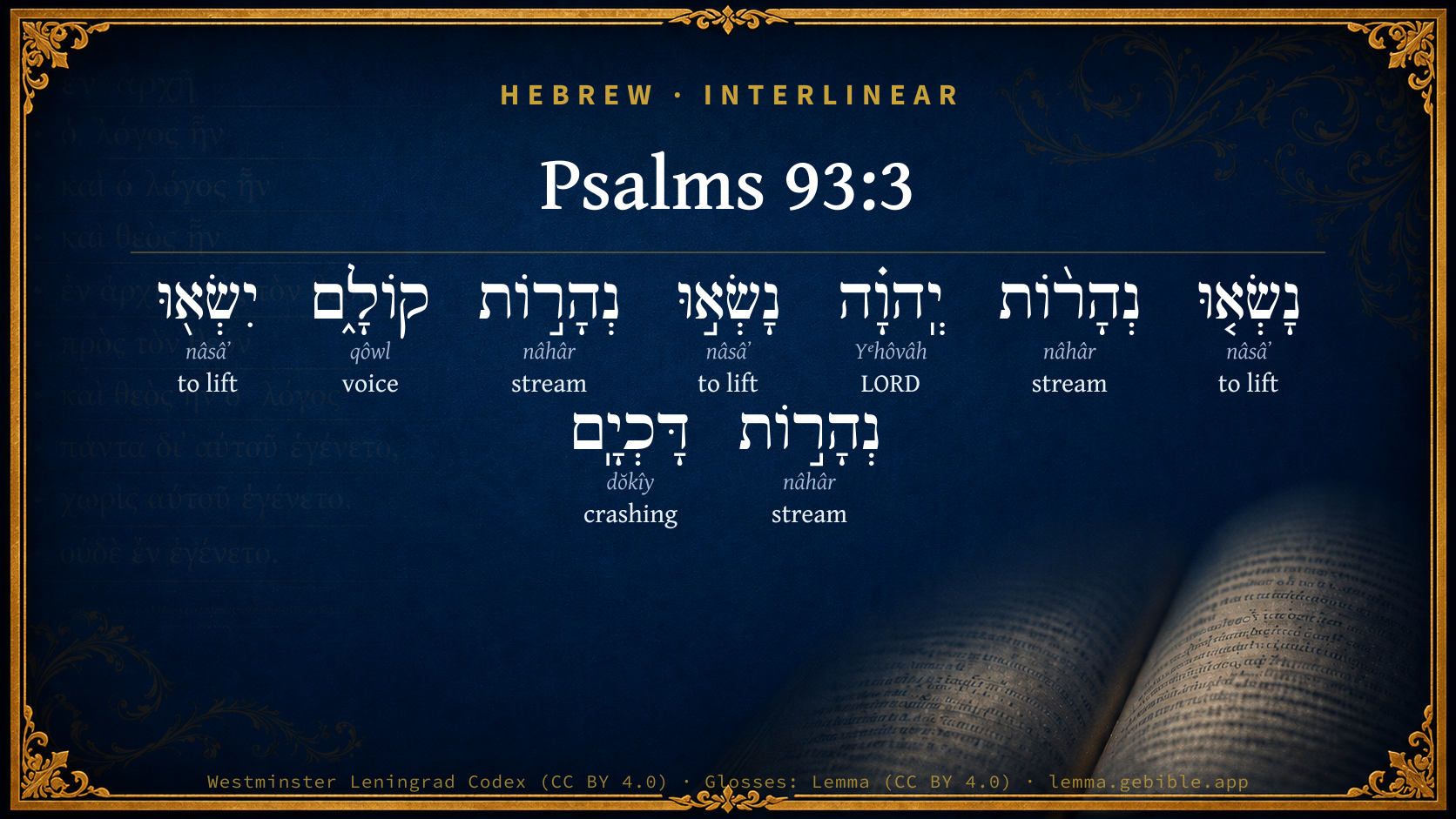
Psalms 93:3

Hebrew (Westminster Leningrad Codex) Psalms 93:3 appears in the Hebrew Old Testament. The text above is from the Westminster Leningrad Codex. Each word links to its Strong’s number, a concise gloss, and parsing drawn from the Open Scriptures Hebrew Bible morphology. Click any word for its full Brown-Driver-Briggs (BDB) entry.
Download image
Cite this verse

Psalms 93:3 (World English Bible). Public Domain. Lemma interlinear Bible study tool, https://lemma.gebible.app/v/psalms/93/3.

Show BibTeX & RIS
BibTeX
RIS
English Translation
The floods have lifted up, Yahweh, The floods have lifted up their voice. The floods lift up their waves.
World English Bible · Public Domain
Highlights
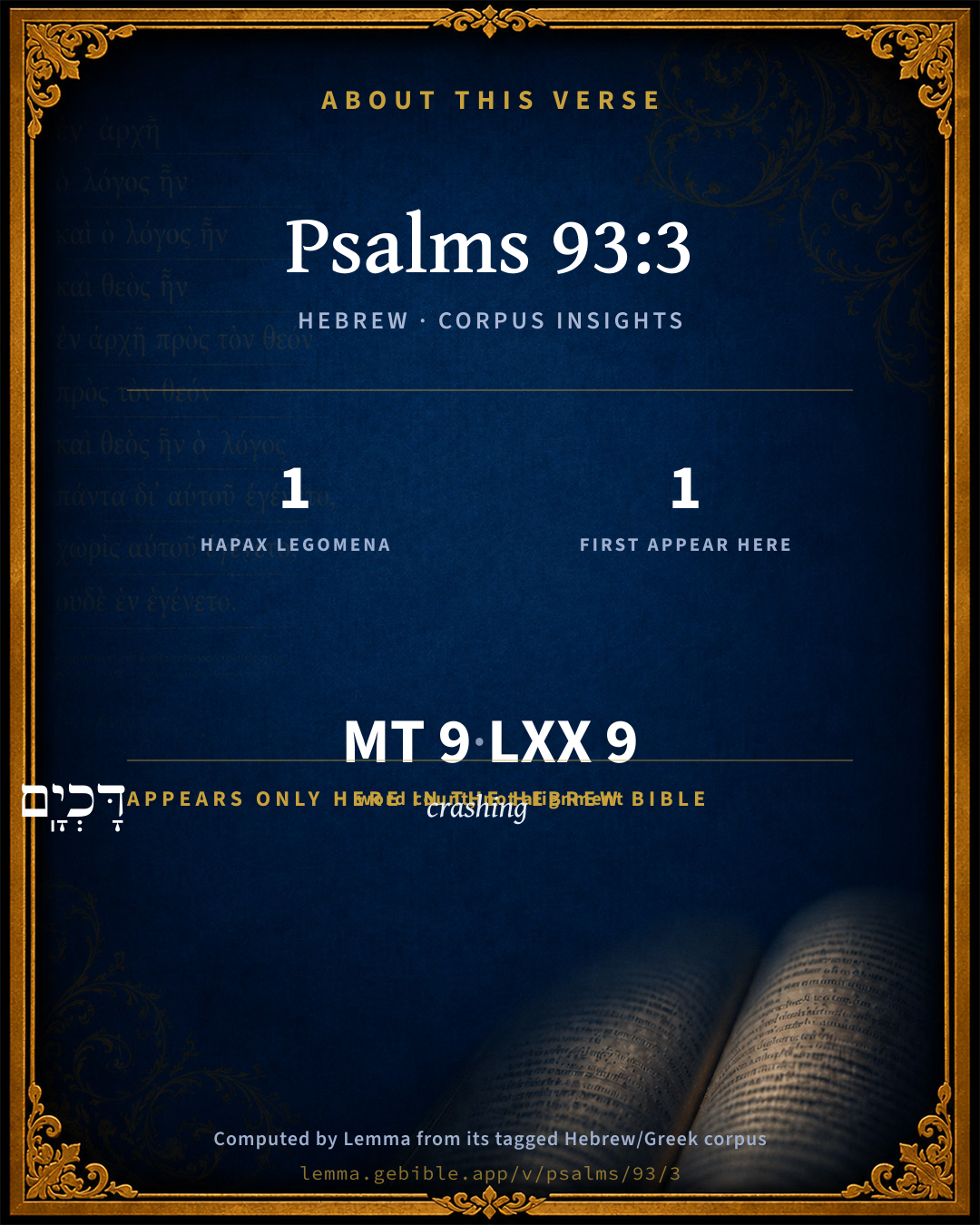
  • 1 hapax legomenon — only here in the Hebrew Bible
  • 1 first appearance in the Hebrew Bible
Full analysis ↓
Download a study sheet

One document with this verse’s original text, its word-by-word gloss line, the meaning frame, cross-references with their text, attributed commentary, and full source and license credits — printable, and it pastes into notes with its structure intact.

This verse Autodidact and up

Study sheet (.html) Plain text (.txt)

A passage Seminary Student

Up to 50 verses in one chapter. A passage sheet keeps up to 6 commentary sources and 12 cross-references per verse, in the order this page ranks them, and says so on the sheet whenever that leaves anything out. Ask for a single verse and you get the Autodidact verse sheet above.

Everything on this page stays free to read, with no account — the sheet is a download of what is already on screen, not access to it.

Want to remove ads? Support Godless Engineer
Compare translations 3

The same verse in 3 English versions, stacked beneath the original-language interlinear above. Click any original word for its lexicon entry.

Each is an independent rendering of the whole verse — the interlinear is not word-aligned to these translations.

Highlighted words mark where these versions differ — a whole-verse word diff, not a word-by-word alignment.

  • World English Bible Public Domain
    The floods have lifted up, Yahweh, The floods have lifted up their voice. The floods lift up their waves.
  • King James Version Public Domain
    The floods have lifted up, O LORD, the floods have lifted up their voice; the floods lift up their waves.
  • unfoldingWord Literal Text CC BY-SA 4.0
    The seas rise, Yahweh; the seas have lifted up their voice; the seas lift up their pounding.

unfoldingWord Literal Text — © unfoldingWord, licensed CC BY-SA 4.0. Word-aligned USFM3 via Door43 (git.door43.org/unfoldingWord/en_ult).

Versions to compare (up to 4)

3 of 4 selected

Show all 18 translations

Every available English version of this verse, each an independent rendering of the whole verse.

  • World English Bible Public Domain
    The floods have lifted up, Yahweh, The floods have lifted up their voice. The floods lift up their waves.
  • Berean Standard Bible Public Domain
    The floodwaters have risen, O LORD; the rivers have raised their voice; the seas lift up their pounding waves.
  • Majority Standard Bible Public Domain
    The floodwaters have risen, O LORD; the rivers have raised their voice; the seas lift up their pounding waves.
  • King James Version Public Domain
    The floods have lifted up, O LORD, the floods have lifted up their voice; the floods lift up their waves.
  • American Standard Version (1901) Public Domain
    The floods have lifted up, O Jehovah, The floods have lifted up their voice; The floods lift up their waves.
  • Revised Version (1885) Public Domain
    The floods have lifted up, O LORD, the floods have lifted up their voice; the floods lift up their waves.
  • Geneva Bible (1599) Public Domain
    The floodes haue lifted vp, O Lord: the floodes haue lifted vp their voyce: the floods lift vp their waues.
  • Douay-Rheims (1899) Public Domain
    The floods have lifted up, O Lord: the floods have lifted up their voice. The floods have lifted up their waves,
  • Young's Literal Translation Public Domain
    Floods have lifted up, O Jehovah, Floods have lifted up their voice, Floods lift up their breakers.
  • Literal Standard Version CC BY-SA 4.0
    Floods have lifted up, O YHWH, || Floods have lifted up their voice, || Floods lift up their breakers.
  • Unlocked Literal Bible CC BY-SA 4.0
    The oceans rise, Yahweh; they have lifted up their voice; the oceans' waves crash and roar.
  • unfoldingWord Literal Text CC BY-SA 4.0
    The seas rise, Yahweh; the seas have lifted up their voice; the seas lift up their pounding.
  • Darby Bible Public Domain
    The floods lifted up, O Jehovah, the floods lifted up their voice; the floods lifted up their roaring waves.
  • World Messianic Bible Public Domain
    The floods have lifted up, LORD, the floods have lifted up their voice. The floods lift up their waves.
  • Webster's Bible Public Domain
    The floods have lifted up, O LORD, the floods have lifted up their voice; the floods lift their waves.
  • Free Bible Version CC BY-SA 4.0
    The floods have raised up, Lord; the floods have raised their voices; the floods have raised up their crashing waves.
  • Bible in Basic English Public Domain
    The rivers send up, O Lord, the rivers send up their voices; they send them up with a loud cry.
  • JPS Tanakh (1917) Public Domain
    The floods have lifted up, O LORD, the floods have lifted up their voice; the floods lift up their roaring.

Literal Standard Version (2020), Covenant Press — licensed CC BY-SA 4.0. Text via the HelloAO Bible API (eBible.org). Unlocked Literal Bible (unfoldingWord) — licensed CC BY-SA 4.0. Text via the HelloAO Bible API (eBible.org). unfoldingWord Literal Text — © unfoldingWord, licensed CC BY-SA 4.0. Word-aligned USFM3 via Door43 (git.door43.org/unfoldingWord/en_ult). Free Bible Version, Dr. Jonathan Gallagher — licensed CC BY-SA 4.0. Text via the HelloAO Bible API (eBible.org).

Word by word

More ways to search: Search by grammar → Find every occurrence → Compare this word →

Practice this passage: Drill this verse → Learn its vocabulary →

About this verse

These counts appear in no published source. They are computed here, from the morphology-tagged text and Lemma’s own curated glosses. What Lemma adds →

9
words
5
distinct lemmas
Wisdom
section

Notable vocabulary

1 hapax legomenon — a word that appears only here in the entire Hebrew Bible:

  • דָּכְיָֽם crashing H1796

First appearance in Scripture

This word makes its first canonical appearance in the Hebrew Bible here:

  • דָּכְיָֽם crashing H1796

Grammatical profile

  • 3 verbs
  • 6 nouns

Verb forms

  • נָשְׂא֤וּ Qal · Perfect
  • נָשְׂא֣וּ Qal · Perfect
  • יִשְׂא֖וּ Qal · Imperfect

Repetition

Words recur within this verse — often emphatic in Hebrew:

  • נָשְׂא֤וּ to lift H5375 ×3
  • נְהָר֨וֹת stream H5104 ×3

Hebrew & Septuagint length

In English translation the verse runs 19 words from the Hebrew and 14 from the Septuagint (LXX English) — closely comparable.

A rough comparison of the two English renderings, which tokenize alike — not a word-level alignment.

Word counts can differ between the Hebrew and the Greek without any difference in meaning — e.g. the Hebrew direct-object marker אֵת has no separate Greek word, and Greek often adds the article ὁ.

In the original languages it is 9 Hebrew tokens and 9 Greek tokens — but the two are counted differently (Hebrew bundles its prefixes and suffixes into one token; the Greek is in lemma form), so that isn’t a like-for-like length.

Cross-references

15

Topical passages linked to Psalms 93:3 in the Treasury of Scripture Knowledge — connected by theme and wording, ordered by reader-vote popularity; previews shown in the World English Bible.

  • Psalms 96:11 Let the heavens be glad, and let the earth rejoice. Let the sea roar, and it's fullness!
  • Psalms 69:1–2 Save me, God, For the waters have come up to my neck!
  • Psalms 18:4 The cords of death surrounded me. The floods of ungodliness made me afraid.
  • Psalms 98:7–8 Let the sea roar with its fullness; The world, and those who dwell therein.
  • Psalms 124:3–5 Then they would have swallowed us up alive, When their wrath was kindled against us;
  • Isaiah 17:12–13 Ah, the uproar of many peoples, who roar like the roaring of the seas; and the rushing of nations, that rush like the rushing of mighty waters!
  • Isaiah 55:12 For you shall go out with joy, and be led forth with peace: the mountains and the hills shall break forth before you into singing; and all the trees of the fields shall clap their hands.
  • Jeremiah 46:7–8 Who is this who rises up like the Nile, whose waters toss themselves like the rivers?
  • Revelation 17:15 He said to me, "The waters which you saw, where the prostitute sits, are peoples, multitudes, nations, and languages.
  • Psalms 2:1–3 Why do the nations rage, And the peoples plot a vain thing?
  • Psalms 69:14–16 Deliver me out of the mire, and don't let me sink. Let me be delivered from those who hate me, and out of the deep waters.
  • Psalms 107:25–26 For he commands, and raises the stormy wind, Which lifts up its waves.
  • Jonah 2:3 For you threw me into the depths, In the heart of the seas. The flood was all around me. All your waves and your billows passed over me.
  • Revelation 12:15 The serpent spewed water out of his mouth after the woman like a river, that he might cause her to be carried away by the stream.
  • Acts 4:25–27 who by the mouth of your servant, David, said, 'Why do the nations rage, And the peoples plot a vain thing?

Cross-references courtesy of OpenBible.info (CC BY 4.0).

Hebrew and Greek witnesses Masoretic Hebrew ↔ Greek Septuagint

The same verse in the two great witnesses to the Old Testament, shown verse-for-verse.

You’re reading Greek Psalm 92 (Hebrew Psalm 93). The Septuagint counts the superscription, so verse numbers can differ from the Hebrew — chapter-level alignment, not verse-by-verse. Numbering follows Rahlfs.

These are two independent witnesses, not word-aligned to each other, and the Septuagint is shown in lemma (dictionary) form.

Hebrew Psalms 93:3 Masoretic · Westminster Leningrad Codex

נָשְׂא֤וּ נְהָר֨וֹת יְֽהוָ֗ה נָשְׂא֣וּ נְהָר֣וֹת קוֹלָ֑ם יִשְׂא֖וּ נְהָר֣וֹת דָּכְיָֽם

The floods have lifted up, Yahweh, The floods have lifted up their voice. The floods lift up their waves.

World English Bible · Public Domain

Greek LXX Greek Psalm 92:3 Septuagint · lemma form

ἐπιαἴρω ὁ ποταμός κύριος ἐπιαἴρω ὁ ποταμός φωνή αὐτός

The rivers have lifted up, O Lord, the rivers have lifted up their voices,

LXX2012 (modern English Septuagint) · Public Domain

On this verse, Ellicott's Commentary for English Readers discusses the Septuagint’s reading. Read the note in Commentary ↓

Hebrew: Westminster Leningrad Codex (CC BY 4.0). Greek: Septuagint (public domain); English from LXX2012 (modern English Septuagint) (Public Domain). How the Septuagint differs from the Hebrew →

Commentary

Notes on Psalms 93:3 from classic Christian and Jewish commentators (each source and its license shown beneath its notes). The classic Christian expositions comment on the surrounding passage and are grouped to its opening verse, so a note may address several verses; the Jewish commentaries on the Tanakh (Rashi and others) are per-verse, so they appear only where the commentator wrote on this verse.

Lemma curates 59 commentaries, every one of them public domain or Creative Commons licensed, each selected and text-cleaned for this edition rather than reprinted as found. About our sources →

Trapp's Complete Commentary

John Trapp

Psa 93:3 The floods have lifted up, O LORD, the floods have lifted up their voice; the floods lift up their waves.

Ver. 3. The floods have lifted up, O Lord] Armies of enemies have attempted great matters, but thou hast soon quelled and quashed them. Immota manet may well be the Church’s motto.

Aura tonet, sonet unda marls, fremat orbis et orcus;

Tu tamen insertos nos tibi, Christe, tegis.

The floods lift up their waves] The word for waves hath its name from dashing or breaking (Anaphora); the enemies do but beat themselves into foam and froth against Christ the rock, qui instar rupis quae in mari vadoso, horridi Iovis, et irati, ut ita dicam, Neptuni fervidis assultibus undique verberata, non cedit aut minuitur, sed obtendit assuetum fluctibus latus; et firma duritie tumentis undae impetum sustinet ac frangit (Woverius).

John Trapp, A Commentary or Exposition upon All the Books of the Old and New Testament (1647–1656) — public domain. Text from a community e-Sword module.

The Biblical Illustrator

Joseph S. Exell

Psa_93:3

The floods . . . lift up their waves.

Thoughts for the seaside

I. What are the waves saying to us of human life? Even in its greatest tranquillity there is its deep throb and moan; the sea is really never at rest. Life is like the sea, in constant motion. However exempt some may seem to be from anxiety and care, every heart knows its own bitterness, every spirit its own sob and sigh. Especially to the Christian this is not a place of rest. Toil and care, temptation and sorrow, mingle in the woof and warp of life. The waves therefore speak to us of the restlessness of human life. They also speak to us of the changefulness of life. How ever-changing the ocean is! At one time its waves are lashed into frantic fury, and its huge billows leap mountain high; anon, it is hushed and reeked to a cradled calm; at one time it is all aglow, and flaming with phosphorescent fire; at another time it is dull and leaden, and looks like liquid blue. How changing, too, is human life! Seasons of sorrow succeed seasons of gladness. Life is made up of losses and crosses, as well as of prizes and crowns. Especially is the life of the Christian chequered with storm and calm, shadows and sunshine, smiles and tears. The waves speak to us also of the separations of life. How the sea separates continent from continent and shore from shore! How many farewells are uttered on its shores! Life is full of adieus, from the cradle to the grave. The waves also speak to us of the depravity of life. By sin, death came into our world; and the ocean is like a mighty grave.

II. What are the waves saying to us of Divine Providence.?

1. The history of Gods Providence has been as the ebb and flow of the tide. The rising tide has ever gained back what it seemed to lose, and it rises higher and higher; and the issue shall be that the knowledge of the Lord shall one day cover the earth as the waters cover the face of the mighty sea.

2. The sea cannot be controlled, but it can be made subservient to man, and a minister to his good. So we cannot command or control Divine Providence; but we can work with it, obey its laws, and make it subservient to our present and permanent good, and with its friendly aid we may sail to a better and a brighter shore.

3. The sea has an under-current. Although the waves may leap and roar, or the surface of the deep may be calm and still as a sheet of glass, yet the great deep, undisturbed, moves on! So, in the course and conduct of Divine Providence, around the shores of time, in the bays and creeks of human affairs, the waters may twist and twirl; but the great purposes of God move on, and His undisturbed affairs perpetually progress.

III. What are the waves saying to us of Almighty God? They speak to us of His power, wisdom, goodness, immensity. The sea is the symbol of infinity and eternity. (F. W. Brown.)

The Biblical Illustrator, edited by Joseph S. Exell (c. 1880s–1900s) — public domain. Text from a community e-Sword module.

J. A. Alexander on Psalms

Joseph Addison Alexander

3. (Psa 93:3) The floods have raised, Jehovah, the floods have raised their voice; the floods will raise their crash, or crashing noise. The last Hebrew word occurs only here, but its etymology is obvious and perfectly analogous to that of waves or breakers in the next verse. The idea here conveyed is that of the noise made by the dashing of waves against each other or upon the shore. The preterite and future forms include the present, but suggest the additional idea of what has been heretofore and may be expected to continue hereafter. The emphatic repetition of the verb is like that in ver. 1, and reappears in this whole series (Psalms 91—100.) as a characteristic feature.

Joseph Addison Alexander, The Psalms Translated and Explained (1850) — public domain. Text from a community e-Sword module.

Tyndale Open Study Notes

Tyndale Open Resources

93:3-4 God’s victory over natural chaos gives the psalmist confidence that the Lord will also defeat his present enemies (cp. Jer 46:8; 47:2).

Tyndale Open Study Notes — © Tyndale Open Resources, licensed CC BY-SA 4.0. Text via the HelloAO Bible API.

Geneva Bible (1599)

Geneva Bible translators

God’s power appeareth in ruling the furious waters.

Geneva Bible (1599) marginal notes — public domain. Text via Bolls.life.

Adam Clarke's Commentary

Verse 3. The floods have lifted up] Multitudes of people have confederated against thy people; and troop succeeds troop as the waves of the sea succeed each other.

Adam Clarke's Commentary on the Bible (1810–1826) — public domain. Text from a community e-Sword/MySword module.

John Calvin's Commentaries

3 The floods have lifted up, O Jehovah! Various meanings have been attached to this verse. Some think there is an allusion to the violent assaults made upon the Church by her enemies, and the goodness of God seen in restraining them. Others are of opinion that the words should be taken literally, and not figuratively, in this sense — Though the noise of many waters be terrible, and the waves of the sea more fearful still, God is more terrible than all. I would not be inclined to insist too nicely upon any comparison that may have been intended. I have no doubt the Psalmist sets forth the power of God by adducing one brief illustration out of many which might have been given, Intimating that we need not go farther for a striking instance of Divine power — one that may impress us with an idea of his tremendous majesty — than to the floods of waters, and agitations of the ocean; as in Psalm 29:4, the mighty voice of God is said to be in the thunder. God manifests his power in the sound of the floods, and in the tempestuous waves of the sea, in a way calculated to excite our reverential awe. Should it be thought that there is a comparison intended, then the latter clause of the verse must be understood as added, with this meaning, That all the terror of the objects mentioned is as nothing when we come to consider the majesty of God himself, such as he is in heaven. There is still another sense which may be extracted from the words, That though the world may to appearance be shaken with violent commotions, this argues no defect in the government of God, since he can control them at once by his dreadful power.

John Calvin's Commentaries (1540-1563) — public domain. Text from the Calvin Translation Society English edition (1840s-50s) via the Christian Classics Ethereal Library (ccel.org). Calvin's coverage is partial (roughly two-thirds of the Bible); uncommented books and verses are honest gaps, never fabricated. The 19th-century editor's footnotes and remarks are omitted so the notes are faithfully Calvin's own voice.

Ellicott's Commentary for English Readers

(3) Waves.—Better, for the parallelism, roaring: but literally, breaking of the waves on the shore.

Floods, here poetically for the sea, as in Psa_24:2.

Lift up.—The repetition of the verb the third time in a different tense adds to the force. In LXX. and Vulgate this clause is “from the voices of many waters.”

A Bible Commentary for English Readers, edited by Charles John Ellicott (1878–1897) — public domain. Text from a community e-Sword module.

The Cambridge Bible for Schools and Colleges

gen. ed. J. J. S. Perowne

3. The floods] Lit. the rivers, rising up and threatening to inundate the land and sweep everything before them, are emblems of the great world-powers threatening to overspread the world. Thus Assyria is compared by Isaiah to the Euphrates, ‘the River’ par excellence (Isa_8:7-8); Egypt by Jeremiah to the Nile (Jer_46:7-8). Similarly the sea with its mighty breakers thundering against the shore as though it would engulf the solid land is an emblem of the heathen world menacing the kingdom of God, but all in vain. For the sea as an emblem of hostile powers cp. Psa_46:3; Psa_89:9; Isa_17:12-13.

their waves] A word occurring here only, probably meaning collision, clash, din.

3, 4. The powers of earth menace Jehovah’s sovereignty in vain.

The Cambridge Bible for Schools and Colleges (gen. ed. J. J. S. Perowne; Cambridge University Press, 1878–1918) — public domain. Text from a community e-Sword module.

John Gill's Exposition

The floods have lifted up, O Lord, the floods have lifted up their voice,.... The Targum adds,

"in a song,''

taking the words in a good sense; and so some of the ancients, as Jerome particularly, understood them of the apostles and their ministrations; who lifted up their voice like a trumpet, which went into all the world, and unto the ends of the earth; and who came with the fulness of the gifts and graces of the Spirit; and were attended with a force and power which bore down all before them: but rather by "the floods" are meant the enemies of Christ, his kingdom, and interest; and by their "lifting up their voice", the opposition made by them thereunto; see Isa 8:7, this was fulfilled in the Jews and Gentiles, who raged, like foaming waves of the sea, against Christ, and lifted up their voices to have him crucified; in the Roman emperors, and in the ten persecutions under them; in those floods of errors and heresies, which the dragon has cast out of his mouth to devour the church of Christ, against which the Spirit of the Lord has lifted up a standard in all ages; in the antichristian kingdoms, compared to many waters, on which the whore of Rome is said to sit, Rev 17:1 and especially in antichrist himself, who has opened his mouth in blasphemy against God, his tabernacle, and they that dwell therein; and will be further fulfilled in the last persecution and slaying of the witnesses, and in the Gog and Magog army, which shall encompass the beloved city and camp of the saints. Kimchi interprets it of Gog and Magog, and of the kings that shall be gathered together to fight against Jerusalem:

the floods lift up their waves; with great strength, making a great noise, and threatening with ruin and destruction, as before.

John Gill's Exposition of the Whole Bible (1746–1763) — public domain (CC PDM 1.0). Text via the HelloAO Bible API.

Albert Barnes' Notes on the Bible

The floods have lifted up, O Lord, the floods have lifted up their voice - The word here rendered “floods,” means properly rivers, and then it may be applied to any waters. The word voice here refers to the noise of raging waters when they are agitated by the winds, or when they dash on the shore. See the notes at Psa 42:7.

The floods lift up their waves - As if they would sweep everything away. The allusion here is to some calamity or danger which might, in its strength and violence, be compared with the wild and raging waves of the ocean. Or if it refers literally to the ocean in a storm, then the psalm may have been the reflections of the author as he stood on the shore of the sea, and saw the waves beat and dash against the shore. To one thus looking upon the billows as they roll in toward the shore, it seems as if they were angry; as if they intended to sweep everything away; as if the rocks of the shore could not resist them. Yet they have their bounds. They spend their strength; they break, and retire as if to recover their force, and then they renew their attack with the same result. But their power is limited. The rocky shore is unmoved. The earth abides. God is over all. His throne is unshaken. No violence of the elements can affect that; and, under his dominion, all is secure.

Albert Barnes' Notes on the Bible (1834–1885) — public domain. Text from a community e-Sword/MySword module.

Matthew Poole's English Annotations

The floods; the enemies of thy kingdom, who are oft compared to floods for their numbers, force, rage, &c. See Isa 8:7,8; 17:12,13; Jer 46:7,8. They have both by their words and actions made opposition against it.

Matthew Poole's English Annotations on the Holy Bible (1683–1685) — public domain. Text from a community e-Sword/MySword module.

The Treasury of David

Charles H. Spurgeon

Ver. 3. The floods have lifted up, 0 LORD. Men have raged like angry waves of the sea, but vain has been their tumult. Observe that the psalmist turns to the Lord when he sees the billows foam, and hears the breakers roar; he does not waste his breath by talking to the waves, or to violent men; but like Hezekiah he spreads the blasphemies of the wicked before the Lord.

The floods have lifted up their voice; the floods lift up their waves. These repetitions are needed for the sake both of the poetry and the music, but they also suggest the frequency and the violence of wicked assaults upon the government of God, and the repeated defeats which they sustain. Sometimes men are furious in wordsthey lift up their voice, and at other times they rise to acts of violencethey lift up their waves; but the Lord has control over them in either case. The ungodly are all foam and fury, noise and bluster, during their little hour, and then the tide turns or the storm is hushed, and we hear no more of them; while the kingdom of the Eternal abides in the grandeur of its power.

Ver. 3. The floods have lifted up, etc. Advisedly in this place does he make mention of floods, in order better to depict the effects of war. For when rivers are raised and swollen with inundations, they burst the restraining banks, and sweep far and wide over the neighbouring plains, carrying everything in their course. Such is the manner of war; when armies are despatched into countries, they lay waste and fill all places with slaughter. Whence Virgil employs this simile (Aeneid 2) in describing the violence of the Grecian army breaking into the citadel of Priam, rendered by Dryden thus

"In rush the Greeks, and all the apartments fill;

Those few defendants whom they find, they kill.

Not with so fierce a rage the foaming flood

Roars, when he finds his rapid course withstood;

Bears down the dittos with unresisted sway,

And sweeps the cattle and the cots away." Mollerus.

Ver. 3. Their waves. The word k signifies a wave; because the water being dashed against a rock, or the shore, or another wave, is broken into spray. For the central idea of the word is breaking. And this aptly serves to picture the issue of those commotions and wars which are undertaken for the overthrow of empires and the church. For as mighty waves fill the beholders with horror, so great and powerful armies fill all things with fear and terror. But as the waves striking, in a moment are broken, and disappear, so the mighty power of kings and princes is often dissolved at one glance of God. The Church dwells in this life, as a rock in the waves, beaten by the waves of every tempest; but yet remains immutable, because the Son of God confirms and sustains her. Mollerus.

Ver. 3. The voice of the floods.

1. The voice of Nature is the voice of God.

2. It is a voice from God.

3. It is a voice for God.

"God hath a voice that ever is heard,

In the peal of the thunder, the chirp of the bird:

It comes in the torrent, all rapid and strong,

In the streamlet's soft gush, as it ripples along;

In the waves of the ocean, the furrows of land,

In the mountain of granite, the atom of sand;

Turn where ye may, from the sky to the sod,

Where can ye gaze that ye see not a God?" G. R. Poetry by Eliza Cook.

Psalms 93:4*

Charles H. Spurgeon's The Treasury of David (1869–1885) — public domain. Psalms only. Text from a community e-Sword/MySword module.

Whedon's Commentary on the Bible

Daniel D. Whedon

3. Floods—נהרות, (neharoth,) rivers.

Lifted up their voice—This could be done by rivers only in the rushing and roaring of cataracts. The cataracts of the Jordan were used as a figure of the civil commotions which drove David for a season from his capital. See on Psa_42:7. Probably the word rivers, here, refers to the Euphrates and the Tigris, as representing the mad power of Assyria.

Waves—The word signifies “waves” that are broken by being dashed against the shore, or otherwise broken with violence—breakers. The radical idea is, to dash in pieces—to break. The common word for wave is different, and comes from the idea to heap together, to cast up a mound. In symbolic language, the sea, or any great body of water, represents a great collection of people; and a troubled, or tumultuous, sea signifies a nation or nations at war. See Psa_65:7; Dan_7:2; Jer_51:42. The figure here clearly points to such war and commotion as threatened the destruction of the nation, and is a strong indication of the date we have assigned to the psalm.

Daniel D. Whedon (gen. ed.), Commentary on the Old and New Testaments (1874–1909) — public domain. Text from a community e-Sword module.

The Pulpit Commentary

The floods have lifted up, O Lord, the floods have lifted up their voice. By "the floods" seem to be meant the world powers, God"s enemies; perhaps especially Egypt, Assyria, and Babylon. Invading hosts are constantly compared to "floods" or "rivers" in Scripture. (see Isa_8:7, 8 28:2 17:12, 13 59:19 Jer_46:8, etc.) The floods lift up their waves; or, "their din," "their roaring". (comp. Psa_65:7, "Which stilleth the noise of the seas, the noise of their waves, and the tumult of the people

The irresistible power of floods.

Though we have experience of disastrous floods, the full force of the figure can only be felt in Eastern and in mountainous lands. The "spate" in Scotland, the wady floods of Palestine, and the gigantic overflow of such rivers as the Tigris and the Euphrates, or the awful desolations of Chinese rivers when the embankments give way, alone provide adequate illustration of such texts as this now before us. If we take Mosaic associations for this psalm, then desert wady floods will be in the poet"s mind. If we take the associations of the returned captives, then the awful floods of the Babylon rivers will be in his mind. In a previous homily the Jewish dread of the sea has been recalled. The Mosaic associations may include reference to God"s control of the waters of the Red Sea, and using them as agents of his judgment on Pharaoh. One forcible illustration of a wady flood will indicate the force of this poetic figure, and help us to realize what he must be who can mate and master even such floods. A traveller was at Nazareth when a sudden but violent storm arose. The rain fell in torrents; and in the course of an hour a river flowed past the convent door, along what lately was a dry and quiet street. In the darkness of the night were heard loud shrieks for help. The flood carried away baskets, logs of wood, tables, and fruit stands. At length, a general alarm was given. Two houses, built on the sand, were undermined by the water, and both fell together, while the people in them escaped with difficulty. Loosened waters have been for man, in every age, the type of the masterful, the uncontrolled. Man never feels his helplessness so much as in presence of loosened waters. He can fight with fire; he can do nothing with water, when it once gets free.

I THE POWER OF GOD IS SEEN IN HIS MASTERY OF WATERS. See especially the impression produced by the crossing of the Red Sea, and the destruction of the Egyptians. See same impression from crossing of Jordan. Great nations are likened to floods. And they too are fully within Divine control.

II THE POWER OF GOD MANIFEST IS SEEN IN HIS MASTERY OF WATERS. Two striking scenes: Walking on the waters. Quelling the storm on Galilee with a word of command. R.T.

The Pulpit Commentary (1880–1919), ed. H.D.M. Spence-Jones & Joseph S. Exell — public domain. Text from a community e-Sword module.

John Wesley's Explanatory Notes

Floods - The enemies of thy kingdom.

John Wesley, Explanatory Notes Upon the Whole Bible (1754–1765) — public domain. Text via the GEBible commentary corpus.

Keil & Delitzsch

C. F. Keil & F. Delitzsch

The sense of מלך (with ā beside Zinnor or Sarka as in Psa 97:1; Psa 99:1 beside Dech)

Keil & Delitzsch — Biblical Commentary on the Old Testament (1861–1891) — public domain (CC PDM 1.0). Text via the HelloAO Bible API. (Old Testament only.)

unfoldingWord translationNotes

Door43 World Missions Community

oceans ... oceans'

Some versions read "floods ... floods'." The word often refers to a river (See: "the River" in Psalms 72:8), but "oceans ... oceans'" has been chosen here because oceans, not rivers, have "waves" that "crash and roar."

have lifted up their voice; the oceans' waves crash and roar

The psalmist speaks of the ocean as if it were a person who could speak. AT: "have made a mighty noise because their waves crash and roar" (See: Personification)

roar

make a long, loud sound.

Above the crashing of many waves, the mighty breakers of the sea

The phrase "the mighty breakers of the sea" means basically the same thing as "many waves" and emphasizes how great these waves are. AT: "Above the crashing of all of the very great waves of the sea" (See: Doublet)

breakers

large waves coming to land

on high

The psalmist speaks of where God lives as if it were high above the earth. AT: "in heaven" (See: Metaphor)

translationWords

raise

voice

might

unfoldingWord translationNotes — © Distant Shores Media and the Door43 World Missions Community, licensed CC BY-SA 4.0. Source: git.door43.org/Door43/en_tn.

Rashi

Rabbi Shlomo Yitzchaki (Rashi)

The rivers have raised, O Lord This is an expression of a cry and a plaint: Woe, O Lord, behold! Your enemies, who flood like rivers, have raised their voice and roar, and the lowness of the depths of their locks they will raise and lift on high constantly to be haughty against You. Every expression of דכא is an expression of depth and lowness.

Rashi on the Tanakh — English translations: “The Judaica Press complete Tanach with Rashi, translated by A. J. Rosenberg” (CC BY 4.0); “Pentateuch with Rashi's commentary by M. Rosenbaum and A.M. Silbermann, 1929-1934” (public domain); “The Metsudah Tanach series, Lakewood, N.J” (CC BY 4.0); and “The Book of Joshua, Metsudah Publications, 1997” (CC BY 4.0). Text via Sefaria.

Lesson kit

Teaching starters — assembled from the data on this page, not authored interpretation. Every prompt links to the verse data it draws on. Edit before teaching.

Psalms, in the Wisdom, opens this verse with 9 words (5 distinct Hebrew lemmas). Its most distinctive word is dŏkîy (“crashing”). A historical commentator’s framing appears above. Read the whole chapter for the surrounding context.

Discussion questions

  1. What does “crashing” (dŏkîy) contribute to the verse as a whole?
  2. 1 word here appears nowhere else in the Hebrew Bible. Why might the author reach for such rare wording?
  3. This is the first place “crashing” appears in Scripture (first appears here). What does its debut here establish?
  4. How does Psalms 96:11, which shares this passage’s theme, read alongside this verse?
  5. What does the repetition of “to lift” (3× in this one verse) do in this verse?
  6. These translations render this verse differently. What is at stake in choosing one wording over another?
  7. «נָשְׂא֤וּ» is a Qal Perfect verb. How does that grammatical form shape the action described?
  8. Compare how Trapp's Complete Commentary and The Biblical Illustrator read this verse. Where do they agree or differ?

Things to notice

  • 1 word in this verse appears nowhere else in the Hebrew Bible.
  • 1 word makes its first canonical appearance in Scripture here.
  • This verse counts 9 Hebrew ↔ 9 Greek words.
  • These translations choose different wording for 8 words in this verse.
  • “to lift” occurs 3× in this single verse.

Reading settings

Reading text

Shown beneath each verse's original-language words.

Old Testament
Old Testament edition

Read the OT as the Masoretic Hebrew (MT) or the Greek Septuagint (LXX).

English shown for the Greek Septuagint (in the Hebrew ↔ Greek comparison).

Comparing translations? Open the Compare panel on any verse page to stack up to four side by side.