
2 Kings 9:26

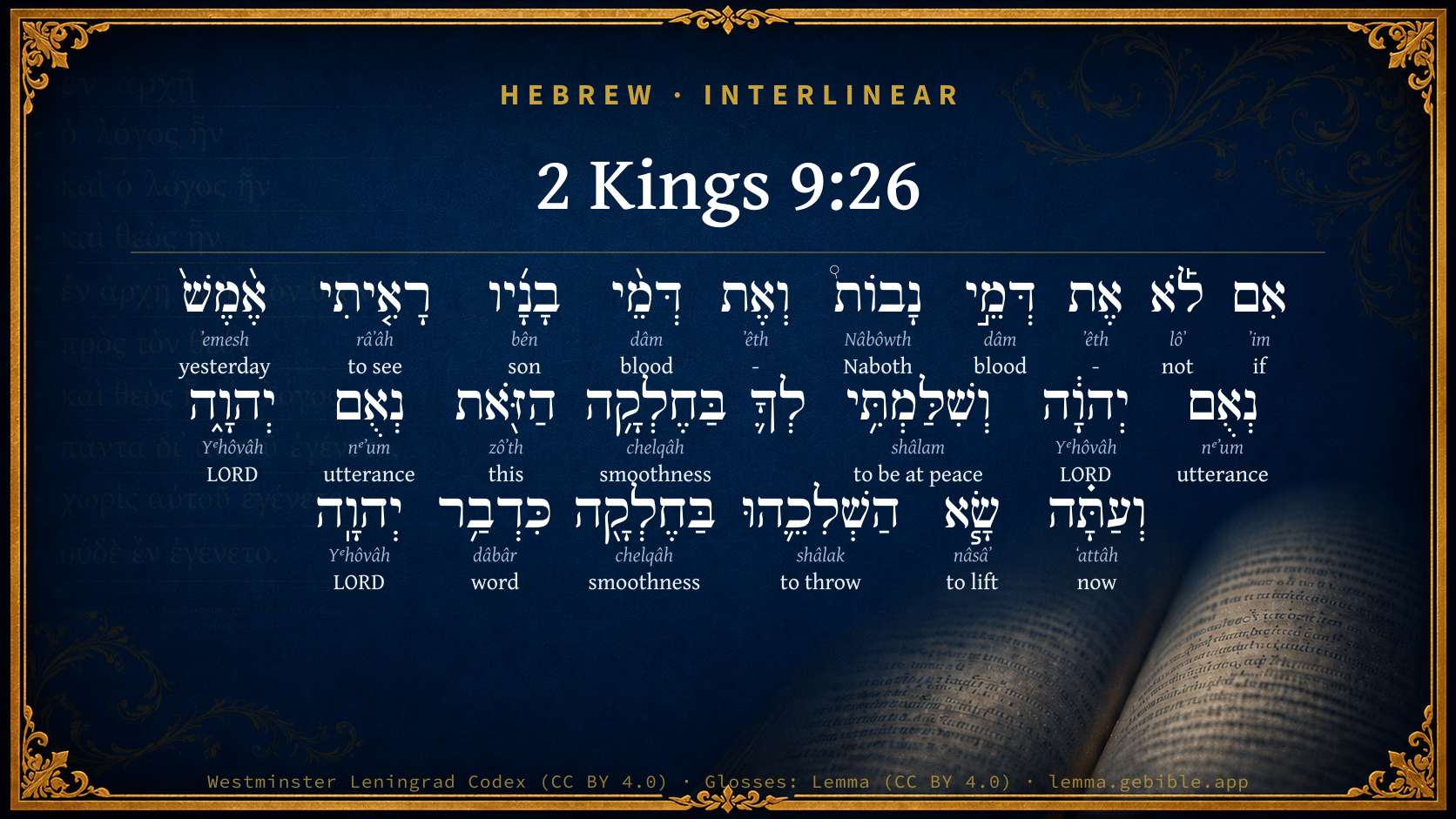
Hebrew (Westminster Leningrad Codex) 2 Kings 9:26 appears in the Hebrew Old Testament. The text above is from the Westminster Leningrad Codex. Each word links to its Strong’s number, a concise gloss, and parsing drawn from the Open Scriptures Hebrew Bible morphology. Click any word for its full Brown-Driver-Briggs (BDB) entry.
Download image
Cite this verse

2 Kings 9:26 (World English Bible). Public Domain. Lemma interlinear Bible study tool, https://lemma.gebible.app/v/2-kings/9/26.

Show BibTeX & RIS
BibTeX
RIS
English Translation
Surely I have seen yesterday the blood of Naboth, and the blood of his sons, says Yahweh; and I will requite you in this plat, says Yahweh. Now therefore take and cast him into the plat [of ground], according to the word of Yahweh.
World English Bible · Public Domain
Download a study sheet

One document with this verse’s original text, its word-by-word gloss line, the meaning frame, cross-references with their text, attributed commentary, and full source and license credits — printable, and it pastes into notes with its structure intact.

This verse Autodidact and up

Study sheet (.html) Plain text (.txt)

A passage Seminary Student

Up to 50 verses in one chapter. A passage sheet keeps up to 6 commentary sources and 12 cross-references per verse, in the order this page ranks them, and says so on the sheet whenever that leaves anything out. Ask for a single verse and you get the Autodidact verse sheet above.

Everything on this page stays free to read, with no account — the sheet is a download of what is already on screen, not access to it.

Want to remove ads? Support Godless Engineer
Compare translations 3

The same verse in 3 English versions, stacked beneath the original-language interlinear above. Click any original word for its lexicon entry.

Each is an independent rendering of the whole verse — the interlinear is not word-aligned to these translations.

Highlighted words mark where these versions differ — a whole-verse word diff, not a word-by-word alignment.

  • World English Bible Public Domain
    Surely I have seen yesterday the blood of Naboth, and the blood of his sons, says Yahweh; and I will requite you in this plat, says Yahweh. Now therefore take and cast him into the plat [of ground], according to the word of Yahweh.
  • King James Version Public Domain
    Surely I have seen yesterday the blood of Naboth, and the blood of his sons, saith the LORD; and I will requite thee in this plat, saith the LORD. Now therefore take and cast him into the plat of ground, according to the word of the LORD.
  • unfoldingWord Literal Text CC BY-SA 4.0
    ‘“If I have not seen the blood of Naboth and the blood of his sons yesterday,” the declaration of Yahweh, “and I will repay you on this portion,” the declaration of Yahweh.’ And now, pick up, throw him onto the portion, according to the word of Yahweh.”

unfoldingWord Literal Text — © unfoldingWord, licensed CC BY-SA 4.0. Word-aligned USFM3 via Door43 (git.door43.org/unfoldingWord/en_ult).

Versions to compare (up to 4)

3 of 4 selected

Show all 18 translations

Every available English version of this verse, each an independent rendering of the whole verse.

  • World English Bible Public Domain
    Surely I have seen yesterday the blood of Naboth, and the blood of his sons, says Yahweh; and I will requite you in this plat, says Yahweh. Now therefore take and cast him into the plat [of ground], according to the word of Yahweh.
  • Berean Standard Bible Public Domain
    ‘As surely as I saw the blood of Naboth and the blood of his sons yesterday, declares the LORD, so will I repay you on this plot of ground, declares the LORD.’ Now then, according to the word of the LORD, pick him up and throw him on the plot of ground.”
  • Majority Standard Bible Public Domain
    ‘As surely as I saw the blood of Naboth and the blood of his sons yesterday, declares the LORD, so will I repay you on this plot of ground, declares the LORD.’ Now then, according to the word of the LORD, pick him up and throw him on the plot of ground.”
  • King James Version Public Domain
    Surely I have seen yesterday the blood of Naboth, and the blood of his sons, saith the LORD; and I will requite thee in this plat, saith the LORD. Now therefore take and cast him into the plat of ground, according to the word of the LORD.
  • American Standard Version (1901) Public Domain
    Surely I have seen yesterday the blood of Naboth, and the blood of his sons, saith Jehovah; and I will requite thee in this plat, saith Jehovah. Now therefore take and cast him into the plat `of ground', according to the word of Jehovah.
  • Revised Version (1885) Public Domain
    Surely I have seen yesterday the blood of Naboth, and the blood of his sons, saith the LORD; and I will requite thee in this plat, saith the LORD. Now therefore take and cast him into the plat of ground, according to the word of the LORD.
  • Geneva Bible (1599) Public Domain
    Surely I haue seene yesterday the blood of Naboth, and the blood of his sonnes, saide the Lord, and I will render it thee in this fielde, saith the Lord: nowe therefore take and cast him in the fielde, according to the word of the Lord.
  • Douay-Rheims (1899) Public Domain
    If I do not requite thee in this field, saith the Lord, for the blood of Naboth, and for the blood of his children, which I saw yesterday, saith the Lord. So now take him, and cast him into the field, according to the word of the Lord.
  • Young's Literal Translation Public Domain
    Have I not the blood of Naboth and the blood of his sons seen yesternight -- the affirmation of Jehovah -- yea, I have recompensed to thee in this portion -- the affirmation of Jehovah; -- and now, lift up, cast him into the portion, according to the word of Jehovah.'
  • Literal Standard Version CC BY-SA 4.0
    Have I not seen the blood of Naboth and the blood of his sons last night—a declaration of YHWH—indeed, I have repaid to you in this portion—a declaration of YHWH—and now, lift up, cast him into the portion, according to the word of YHWH.”
  • Unlocked Literal Bible CC BY-SA 4.0
    'Yesterday I saw the blood of Naboth and the blood of his sons—declares Yahweh—and I will surely make you pay for it on this field—declares Yahweh. Now then, pick him up and throw him on this field, according to the word of Yahweh.”
  • unfoldingWord Literal Text CC BY-SA 4.0
    ‘“If I have not seen the blood of Naboth and the blood of his sons yesterday,” the declaration of Yahweh, “and I will repay you on this portion,” the declaration of Yahweh.’ And now, pick up, throw him onto the portion, according to the word of Yahweh.”
  • Darby Bible Public Domain
    Certainly I have seen yesterday the blood of Naboth, and the blood of his sons, saith Jehovah; and I will requite thee in this plot, saith Jehovah. And now, take [and] cast him into the plot, according to the word of Jehovah.
  • World Messianic Bible Public Domain
    ‘Surely I have seen yesterday the blood of Naboth, and the blood of his sons,’ says the LORD; ‘and I will repay you in this plot of ground,’ says the LORD. Now therefore take and cast him onto the plot of ground, according to the LORD’s word.”
  • Webster's Bible Public Domain
    Surely I saw yesterday the blood of Naboth, and the blood of his sons, saith the LORD; and I will requite thee in this plat, saith the LORD. Now therefore take and cast him into the plat of ground, according to the word of the LORD.
  • Free Bible Version CC BY-SA 4.0
    ‘In the same way as I saw the blood of Naboth and the blood of his sons yesterday, says the Lord, so I will certainly repay you on this same plot of ground, says the Lord.’ Now then, following what the Lord has said, pick him up and throw him on the plot of ground.”
  • Bible in Basic English Public Domain
    I saw the blood of Naboth and of his sons yesterday; and I will give you full payment in this field, says the Lord? So now, take him and put him in this field, as the Lord said.
  • JPS Tanakh (1917) Public Domain
    Surely I have seen yesterday the blood of Naboth, and the blood of his sons, saith the LORD; and I will requite thee in this plot, saith the LORD. Now therefore take and cast him into the plot of ground, according to the word of the LORD.'

Literal Standard Version (2020), Covenant Press — licensed CC BY-SA 4.0. Text via the HelloAO Bible API (eBible.org). Unlocked Literal Bible (unfoldingWord) — licensed CC BY-SA 4.0. Text via the HelloAO Bible API (eBible.org). unfoldingWord Literal Text — © unfoldingWord, licensed CC BY-SA 4.0. Word-aligned USFM3 via Door43 (git.door43.org/unfoldingWord/en_ult). Free Bible Version, Dr. Jonathan Gallagher — licensed CC BY-SA 4.0. Text via the HelloAO Bible API (eBible.org).

Word by word

More ways to search: Search by grammar → Find every occurrence → Compare this word →

Practice this passage: Drill this verse → Learn its vocabulary →

אֶ֨מֶשׁ֙
ʼemesh
H570
“yesterday”
Adverb
Part of Speech
Adverb
Full BDB Definition

Origin: unknown derivation

TWOT: 120

yesterday, last night - recently (figuratively)
  1. אִם ʼim H518 “if” Conjunction
  2. לֹ֡א lôʼ H3808 “not” Particle, Negative
  3. אֶת ʼêth H853 “-” Particle, Direct Object
  4. דְּמֵ֣י dâm H1818 “blood of” Noun, Common, Masculine, Plural, Construct
  5. נָבוֹת֩ Nâbôwth H5022 “Naboth” Noun, Proper
  6. וְאֶת ʼêth H853 “and · -” Conjunction + Particle, Direct Object
  7. דְּמֵ֨י dâm H1818 “blood of” Noun, Common, Masculine, Plural, Construct
  8. בָנָ֜יו bên H1121 “sons · his” Noun, Common, Masculine, Plural, Construct + Suffix, Personal, 3rd Person, Masculine, Singular
  9. רָאִ֤יתִי râʼâh H7200 “to see” Verb, Qal, Perfect, 1st Person, Common, Singular
  10. נְאֻם nᵉʼum H5002 “utterance of” Noun, Common, Masculine, Singular, Construct
  11. יְהוָ֔ה Yᵉhôvâh H3068 “LORD” Noun, Proper
  12. וְשִׁלַּמְתִּ֥י shâlam H7999 “and · to be at peace” Conjunction + Verb, Piel, Sequential Perfect, 1st Person, Common, Singular
  13. בַּחֶלְקָ֥ה chelqâh H2513 “in/at the · smoothness” Preposition, Determined + Noun, Common, Feminine, Singular, Absolute
  14. הַזֹּ֖את zôʼth H2063 “the · this” Particle, Definite Article + Pronoun, Demonstrative, Feminine, Singular
  15. נְאֻם nᵉʼum H5002 “utterance of” Noun, Common, Masculine, Singular, Construct
  16. יְהוָ֑ה Yᵉhôvâh H3068 “LORD” Noun, Proper
  17. וְעַתָּ֗ה ʻattâh H6258 “and · now” Conjunction + Adverb
  18. שָׂ֧א nâsâʼ H5375 “lift” Verb, Qal, Imperative, 2nd Person, Masculine, Singular
  19. הַשְׁלִכֵ֛הוּ shâlak H7993 “throw · him” Verb, Hiphil, Imperative, 2nd Person, Masculine, Singular + Suffix, Personal, 3rd Person, Masculine, Singular
  20. בַּחֶלְקָ֖ה chelqâh H2513 “in/at the · smoothness” Preposition, Determined + Noun, Common, Feminine, Singular, Absolute
  21. כִּדְבַ֥ר dâbâr H1697 “like/as · word of” Preposition + Noun, Common, Masculine, Singular, Construct
  22. יְהוָֽה Yᵉhôvâh H3068 “LORD” Noun, Proper

About this verse

These counts appear in no published source. They are computed here, from the morphology-tagged text and Lemma’s own curated glosses. What Lemma adds →

24
words
17
distinct lemmas
Historical
section

Notable vocabulary

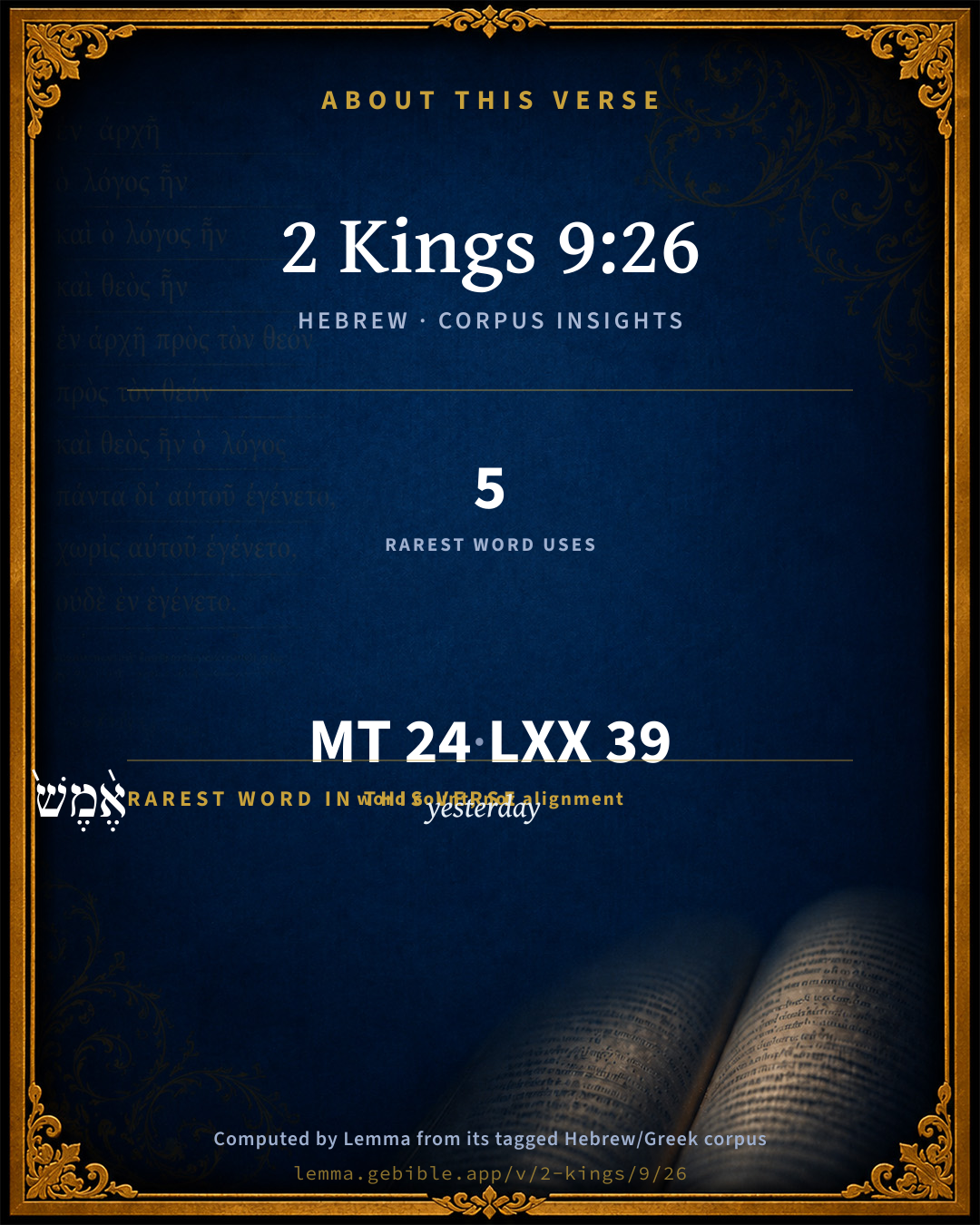
The rarest word here is אֶ֨מֶשׁ֙ yesterday H570 — appearing just 5 times in the whole Hebrew Bible.

Shared distinctive vocabulary

אֶ֨מֶשׁ֙ yesterday H570 occurs in 5 verses of the Hebrew Bible. Also found in:

Grammatical profile

  • 4 verbs
  • 12 nouns
  • 1 pronoun
  • 1 preposition
  • 1 conjunction
  • 2 adverbs
  • 3 particles

Verb forms

  • רָאִ֤יתִי Qal · Perfect
  • וְשִׁלַּמְתִּ֥י Piel · Sequential Perfect
  • שָׂ֧א Qal · Imperative
  • הַשְׁלִכֵ֛הוּ Hiphil · Imperative

Repetition

Words recur within this verse — often emphatic in Hebrew:

  • יְהוָ֔ה LORD H3068 ×3
  • דְּמֵ֣י blood H1818 ×2
  • נְאֻם utterance H5002 ×2
  • בַּחֶלְקָ֥ה smoothness H2513 ×2

Hebrew & Septuagint length

In English translation the verse runs 44 words from the Hebrew and 50 from the Septuagint (LXX English) — closely comparable.

A rough comparison of the two English renderings, which tokenize alike — not a word-level alignment.

Word counts can differ between the Hebrew and the Greek without any difference in meaning — e.g. the Hebrew direct-object marker אֵת has no separate Greek word, and Greek often adds the article ὁ.

In the original languages it is 24 Hebrew tokens and 39 Greek tokens — but the two are counted differently (Hebrew bundles its prefixes and suffixes into one token; the Greek is in lemma form), so that isn’t a like-for-like length.

Cross-references

7

Topical passages linked to 2 Kings 9:26 in the Treasury of Scripture Knowledge — connected by theme and wording, ordered by reader-vote popularity; previews shown in the World English Bible.

  • 1 Kings 21:19 You shall speak to him, saying, Thus says Yahweh, Have you killed and also taken possession? You shall speak to him, saying, Thus says Yahweh, In the place where dogs licked the blood of Naboth shall dogs lick your blood, even yours.
  • Exodus 20:5 you shall not bow yourself down to them, nor serve them, for I, Yahweh your God, am a jealous God, visiting the iniquity of the fathers on the children, on the third and on the fourth generation of those who hate me,
  • Deuteronomy 5:9 you shall not bow down yourself to them, nor serve them; for I, Yahweh, your God, am a jealous God, visiting the iniquity of the fathers on the children, and on the third and on the fourth generation of those who hate me;
  • Deuteronomy 24:16 The fathers shall not be put to death for the children, neither shall the children be put to death for the fathers: every man shall be put to death for his own sin.
  • 2 Chronicles 24:25 When they were departed for him (for they left him very sick), his own servants conspired against him for the blood of the sons of Jehoiada the priest, and killed him on his bed, and he died; and they buried him in the city of David, but they didn't bury him in the tombs of the kings.
  • 2 Chronicles 25:4 But he didn't put their children to death, but did according to that which is written in the law in the book of Moses, as Yahweh commanded, saying, The fathers shall not die for the children, neither shall the children die for the fathers; but every man shall die for his own sin.
  • Ezekiel 18:19 Yet say you, Why does not the son bear the iniquity of the father? when the son has done that which is lawful and right, and has kept all my statutes, and has done them, he shall surely live.

Cross-references courtesy of OpenBible.info (CC BY 4.0).

Hebrew and Greek witnesses Masoretic Hebrew ↔ Greek Septuagint

The same verse in the two great witnesses to the Old Testament, shown verse-for-verse.

These are two independent witnesses, not word-aligned to each other, and the Septuagint is shown in lemma (dictionary) form.

Hebrew 2 Kings 9:26 Masoretic · Westminster Leningrad Codex

אִם לֹ֡א אֶת דְּמֵ֣י נָבוֹת֩ וְאֶת דְּמֵ֨י בָנָ֜יו רָאִ֤יתִי אֶ֨מֶשׁ֙ נְאֻם יְהוָ֔ה וְשִׁלַּמְתִּ֥י לְךָ֛ בַּחֶלְקָ֥ה הַזֹּ֖את נְאֻם יְהוָ֑ה וְעַתָּ֗ה שָׂ֧א הַשְׁלִכֵ֛הוּ בַּחֶלְקָ֖ה כִּדְבַ֥ר יְהוָֽה

Surely I have seen yesterday the blood of Naboth, and the blood of his sons, says Yahweh; and I will requite you in this plat, says Yahweh. Now therefore take and cast him into the plat [of ground], according to the word of Yahweh.

World English Bible · Public Domain

Greek LXX 2 Kings 9:26 Septuagint · lemma form

εἰ μή μετά ὁ αἷμα ναβουθαι καί ὁ αἷμα ὁ υἱός αὐτός ὁράω ἐχθές φημί κύριος καί ἀντι ἀποδίδωμι αὐτός ἐν ὁ μερίς οὗτος φημί κύριος καί νῦν αἴρω δή ῥίπτω αὐτός ἐν ὁ μερίς κατά ὁ ῥῆμα κύριος

Surely, I have seen yesterday the blood of Nabuthai, and the blood of his sons, says the Lord; and I will recompense him in this portion, says the Lord. Now then, I pray you, take him up and cast him into the portion, according to the word of the Lord.

LXX2012 (modern English Septuagint) · Public Domain

Hebrew: Westminster Leningrad Codex (CC BY 4.0). Greek: Septuagint (public domain); English from LXX2012 (modern English Septuagint) (Public Domain). How the Septuagint differs from the Hebrew →

Targum (Aramaic paraphrase)

1

The Targum is the ancient Jewish Aramaic paraphrase of the Hebrew Scriptures — an interpretive translation, not the Hebrew text itself. Onkelos (literal) and Pseudo-Jonathan (expansive) render the Torah, and Jonathan the Prophets. Coverage is partial: where no permissively-licensed English translation exists for a verse, only the Aramaic is shown. This is verse-level text, not a word-by-word alignment to the Hebrew.

  1. Targum Jonathan Prophets (Joshua–Malachi)
    אִם לָא יַת דְמֵי נָבוֹת וְיַת דְמֵי בְנוֹהִי גְלַן קֳדָמַי בְקָרִיב אֲמַר יְיָ וַאֲשַׁלֵם לָךְ בְּאַחֲסַנְתָּא הָדָא אֲמַר יְיָ וּכְעַן סַב רְמִיהִי בְּאַחֲסַנְתָּא כְּפִתְגָמָא דַיָי:

    (no public-domain English translation for this verse)

    Targum Jonathan — Aramaic: “Mikraot Gedolot” (public domain). English: “Sefaria Community Translation” (CC0 1.0 (public-domain dedication)); “London "Chaldee Paraphrase," 1871” (public domain). Text via Sefaria.

Commentary

Notes on 2 Kings 9:26 from classic Christian and Jewish commentators (each source and its license shown beneath its notes). The classic Christian expositions comment on the surrounding passage and are grouped to its opening verse, so a note may address several verses; the Jewish commentaries on the Tanakh (Rashi and others) are per-verse, so they appear only where the commentator wrote on this verse.

Lemma curates 59 commentaries, every one of them public domain or Creative Commons licensed, each selected and text-cleaned for this edition rather than reprinted as found. About our sources →

Trapp's Complete Commentary

John Trapp

2Ki 9:26 Surely I have seen yesterday the blood of Naboth, and the blood of his sons, saith the LORD; and I will requite thee in this plat, saith the LORD. Now therefore take [and] cast him into the plat [of ground], according to the word of the LORD.

Ver. 26. Surely I have seen yesterday.] It was but yesterday. Murder ever bleedeth fresh in the eye of God. To him many years, yea, that eternity that is past, is but yesterday.

And the blood of his sons.] Put to death, it seemeth by this text, together with their father, that Ahab might come clear to the vineyard; unless, by the loss of their blood, we shall understand the loss of their means; for a poor man’s livelihood is his life; he is in his stock like a snail in his shell. Crush that, and you kill him quite.

And I will requite thee in this plat.] See on 1Ki 21:19.

Now therefore take and cast him.] Jehoram’s blood manureth that plot that was wrung from Naboth, and Jezebel shall add to this compost. Oh, garden of herbs dearly bought, royally dunged!

John Trapp, A Commentary or Exposition upon All the Books of the Old and New Testament (1647–1656) — public domain. Text from a community e-Sword module.

Joseph Benson's Commentary

2Ki 9:26. And the blood of his sons — Who, many commentators have thought, were killed by their father, by Jezebel’s advice, to make the possession of the vineyard more sure to Ahab. Some however, are of opinion, as we have no account in the history of Naboth, (1 Kings 21.,) that his sons were killed with him, that Jehu does not here repeat the exact words of God by Elijah, but exaggerates the matter, and represents the sons as slain with their father, because, by their being deprived of him and of his estate, they were, in a manner, in as bad a condition as though they had been destroyed. I will requite thee in this plat — That very piece of ground, which Ahab, with so much pride and pleasure, had made himself master of, at the expense of the guilt of innocent blood, now became the theatre on which his son’s dead body lay unburied and exposed, a spectacle to the world, and a prey to the dogs or fowls, according to the prediction, 1Ki 21:19. Thus the Lord is known by the judgments which he executeth. The son justly deserved the punishment due to the father, because he gave his approbation to the deed of his father, by continuing to keep possession of Naboth’s vineyard, and taking no care to repair the injury done to Naboth and his family by the false accusation which had been preferred against him.

Joseph Benson's Commentary on the Old and New Testaments (1811–1818) — public domain. Text from a community e-Sword module.

Geneva Bible (1599)

Geneva Bible translators

By this place it is evident, that Jezebel caused both Naboth and his sons to be put to death, that Ahab might enjoy his vineyard more quietly: for else his children might have claimed possession.

Geneva Bible (1599) marginal notes — public domain. Text via Bolls.life.

Jamieson, Fausset & Brown

Robert Jamieson, A. R. Fausset & David Brown

the blood of Naboth, and the blood of his sons, saith the Lord--Although their death is not expressly mentioned, it is plainly implied in the confiscation of his property (see Kg1 21:16).

Jamieson, Fausset & Brown — Commentary Critical and Explanatory on the Whole Bible (1871) — public domain (CC PDM 1.0). Text via the HelloAO Bible API.

Adam Clarke's Commentary

Verse 26. The blood of Naboth, and the blood of his sons] We are not informed in 1 Kings 21 that any of Naboth's family was slain but himself: but as the object both of Ahab and Jezebel was to have Naboth's vineyard entirely, and for ever, it is not likely that they would leave any of his posterity, who might at a future time reclaim it as their inheritance. Again, to secure this point, Jezebel had Naboth convicted of treason and atheism; in order that his whole family might be involved in his ruin.

Adam Clarke's Commentary on the Bible (1810–1826) — public domain. Text from a community e-Sword/MySword module.

Ellicott's Commentary for English Readers

(26) Surely.—Literally, if not; a formula of emphatic asseveration, which originally must have run somewhat as follows: “If I have not seen, may I perish.” The inappropriateness of such an expression in the mouth of the Deity is obvious; but that only shows how completely the original meaning of the formula was forgotten in everyday usage.

Yesterday.—So that Ahab seized the vineyard the day after the murder of Naboth, a detail not exactly specified in 1Ki_21:16.

The blood.—The plural (margin) implies death by violence (Gen_4:10).

And the blood of his sons.—The murder of the sons of Naboth is neither stated nor implied in 1 Kings 21, an omission which has needlessly troubled the minds of commentators. As to the fact, it would be quite in accordance with ancient practice to slay the sons of one accused of blasphemy along with their father (comp. Jos_7:24-25); and the crafty Jezebel would not be likely to spare persons whose wrongs might one day prove dangerous. The difference in the two narratives is accounted for by the circumstance that the present is the exact version of an eye-witness, viz., Jehu himself, while the former was probably derived from a less direct source.

Saith the Lord.—Literally, is the thing uttered of Jehovah. This phrase, which is uncommon except in the writings of the prophets, and the word rendered “burden” in the last verse, which also belongs to prophetic terminology, together establish the historical authenticity of the short oracle of Elijah, recorded in this verse. Its brevity and the solemnity with which it was pronounced would, we may be sure, stamp it ineffaceably upon the memory of those who heard it. (Comp. 1Sa_2:30; and 2Ki_19:33, infra.)

I will requite thee in this plat.—Another important detail not given in the former account.

Plat.—Portion, as in 2Ki_9:25 (twice).

A Bible Commentary for English Readers, edited by Charles John Ellicott (1878–1897) — public domain. Text from a community e-Sword module.

The Cambridge Bible for Schools and Colleges

gen. ed. J. J. S. Perowne

26. the blood of Naboth, and the blood of his sons] It appears from this that Jezebel in order that she might put all claimants out of the way, had caused the family of Naboth to be killed as well as himself. So Ahab’s son pays the penalty of his father’s wrongdoing, and both father and son are brought at death into the field which they had gained with so much crime, and as Elijah had foretold, dogs lick the blood of both.

saith the Lord] The phrase is not the usual Hebrew, but a more solemn form of expression, used in the prophets and especially in Jeremiah. Cf. Jer_1:8; Jer_1:15; Jer_1:19, &c.

I will requite thee in this plat] Jehu gives the sense but not the words of 1Ki_21:19.

take and cast him] i.e. Lift his dead body out of the chariot and carry it and throw it forth into the ground which was taken from Naboth.

The Cambridge Bible for Schools and Colleges (gen. ed. J. J. S. Perowne; Cambridge University Press, 1878–1918) — public domain. Text from a community e-Sword module.

John Gill's Exposition

And in the eleventh year of Joram the son of Ahab began Ahaziah to reign over Judah. In Kg2 8:25, it is said to be in the twelfth year of his reign; it was at the close of the eleventh, and the beginning of the twelfth; or he began to reign with his father in the eleventh as here, and in the twelfth as there, when his father was dead.

, it is said to be in the twelfth year of his reign; it was at the close of the eleventh, and the beginning of the twelfth; or he began to reign with his father in the eleventh as here, and in the twelfth as there, when his father was dead.

2 Kings 9:30

kg2 9:30

kg2 9:30

kg2 9:30And when Jehu was come to Jezreel, Jezebel heard of it,.... And of what he had done to Joram:

and she painted her face; or put "stibium" on her eyes; a sort of paint, to make them look beautiful perhaps the same with powder of lead ore, the Moors now use to tinge their eyebrows with, and make them look black, which they reckon graceful; see Gill on Eze 23:40, this custom now obtains among the white Indians, who, to heighten the lustre of their complexion, and render their eyes more languishing, put a little black about them (n):

and tired her head; dressed her head in the most elegant manner; not with a view to tempt Jehu, which she could not expect, being an aged woman; but for grandeur and majesty, and in the pride and haughtiness of her spirit, which she retained to the last, and resolved to keep up and show in her extremity and calamity:

and looked out at a window; in a bravado, as fearless of Jehu, and to dash him out of countenance if she could; or she might hope, by such a graceful and majestic appearance she made, that he would be moved to spare her life; though this does not so well agree with what follows as the former.

(n) Agreement of Customs between East Indians and Jews, art. 15. p. 65.

John Gill's Exposition of the Whole Bible (1746–1763) — public domain (CC PDM 1.0). Text via the HelloAO Bible API.

Albert Barnes' Notes on the Bible

The passage from “Surely I have seen” to “Saith the Lord,” is exegetical of 2Ki 9:25, containing the “burden” there spoken of.

And the blood of his sons - The murder of Naboth’s sons is here for the first time mentioned; but as the removal of the sons was necessary, if the vineyard was to pass to Ahab, we can well understand that Jezebel would take care to clear them out of the way.

Albert Barnes' Notes on the Bible (1834–1885) — public domain. Text from a community e-Sword/MySword module.

Haydock's Catholic Bible Commentary

Children. We do not read these words before, or that the children of Naboth were slain; but it is very usual to supply in one place what has been omitted in another, and Achab was not required to make restitution, (Calmet) as there were no heirs probably left. (Menochius) (Worthington)

George Leo Haydock (1774–1849), Haydock's Catholic Family Bible and Commentary, 1859 edition — public domain. Excludes Psalms (Douay-Rheims chapter numbering differs from Protestant) and Deuterocanonical books (Catholic canon only).

Matthew Poole's English Annotations

The blood of his sons; who, as it seems, were killed with their father by Jezebel’s advice, to make the possession of the vineyard more sure to Ahab, though it be not mentioned in its proper place, 1Ki 21:13; for it is not unusual to bring in such fragments of history in succeeding writings which were neglected in the history of those matters. Thus we read of the earthquake in the days of Uzziah, Amo 1:1, which was not recorded in his history, in the Books of the Kings or Chronicles. Although he might well be charged with taking away the lives of his sons, because he took away the necessary supports of their lives. I will requite thee in this plat; of which See Poole "1Ki 21:19".

Cast him into the plat of ground; where he shall lie unburied, and be a prey to the dogs or fowls, according to the prediction, 1Ki 21:24.

Matthew Poole's English Annotations on the Holy Bible (1683–1685) — public domain. Text from a community e-Sword/MySword module.

Lesson kit

Teaching starters — assembled from the data on this page, not authored interpretation. Every prompt links to the verse data it draws on. Edit before teaching.

2 Kings, in the Historical, opens this verse with 24 words (17 distinct Hebrew lemmas). Its most distinctive word is ʼemesh (“yesterday”). A historical commentator’s framing appears above. Read the whole chapter for the surrounding context.

Discussion questions

  1. The word ʼemesh carries the sense “yesterday.” How does it shape the verse?
  2. How does Genesis 19:34, which shares the word «yesterday», read alongside this verse?
  3. What does the repetition of “LORD” (3× in this one verse) do in this verse?
  4. The translations on this page render this verse differently — a whole-verse word diff, not a word-by-word alignment. What might account for the different wordings?
  5. «רָאִ֤יתִי» is a Qal Perfect verb. How does that grammatical form shape the action described?
  6. Compare how Trapp's Complete Commentary and Joseph Benson's Commentary read this verse. Where do they agree or differ?

Things to notice

Reading settings

Reading text

Shown beneath each verse's original-language words.

Old Testament
Old Testament edition

Read the OT as the Masoretic Hebrew (MT) or the Greek Septuagint (LXX).

English shown for the Greek Septuagint (in the Hebrew ↔ Greek comparison).

Comparing translations? Open the Compare panel on any verse page to stack up to four side by side.