
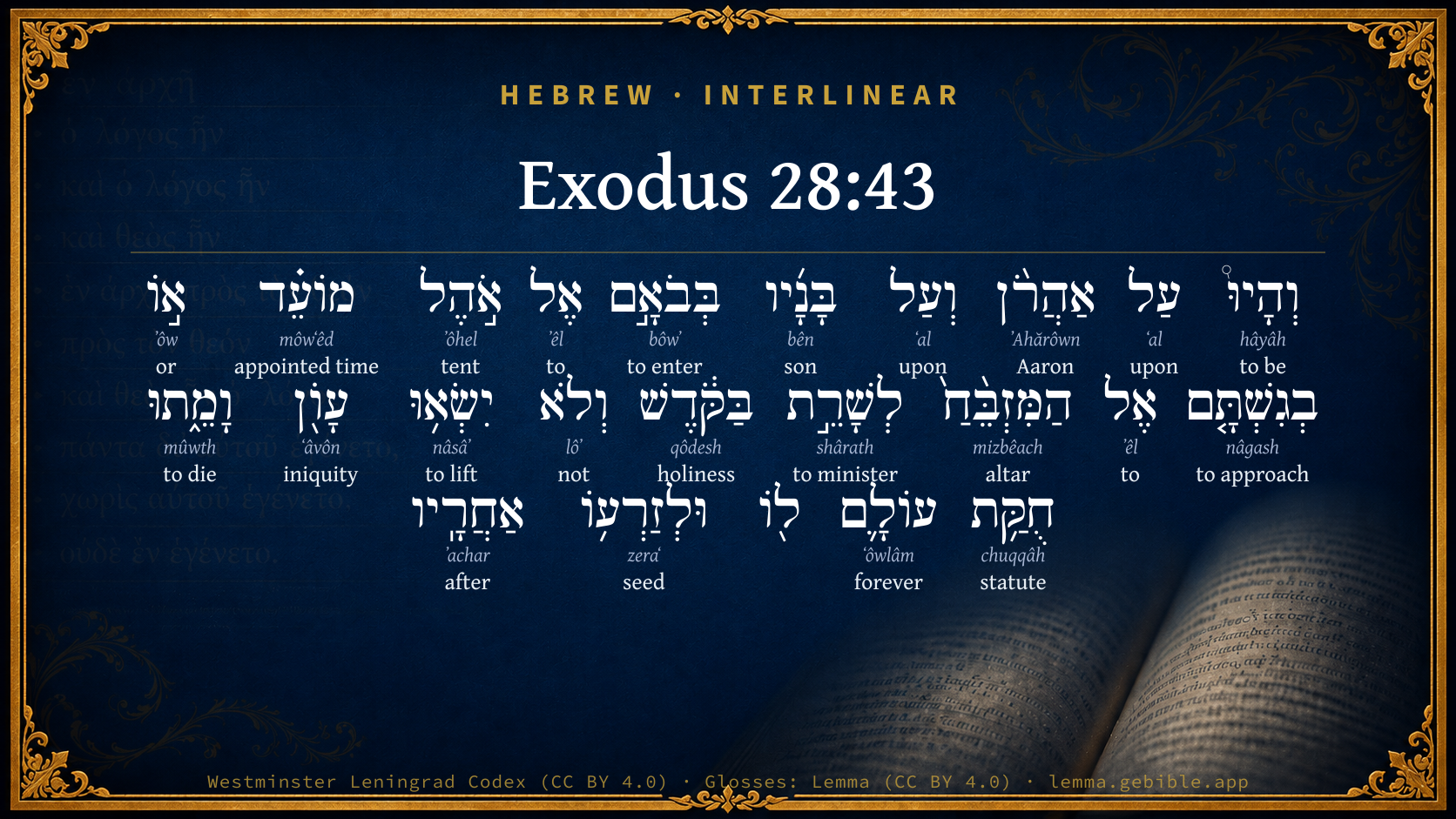
Exodus 28:43

Hebrew (Westminster Leningrad Codex) Exodus 28:43 appears in the Hebrew Old Testament. The text above is from the Westminster Leningrad Codex. Each word links to its Strong’s number, a concise gloss, and parsing drawn from the Open Scriptures Hebrew Bible morphology. Click any word for its full Brown-Driver-Briggs (BDB) entry.
Download image
Cite this verse

Exodus 28:43 (World English Bible). Public Domain. Lemma interlinear Bible study tool, https://lemma.gebible.app/v/exodus/28/43.

Show BibTeX & RIS
BibTeX
RIS
English Translation
They shall be on Aaron, and on his sons, when they go in to the tent of meeting, or when they come near to the altar to minister in the holy place; that they don't bear iniquity, and die: it shall be a statute forever to him and to his descendants after him.
World English Bible · Public Domain
Download a study sheet

One document with this verse’s original text, its word-by-word gloss line, the meaning frame, cross-references with their text, attributed commentary, and full source and license credits — printable, and it pastes into notes with its structure intact.

This verse Autodidact and up

Study sheet (.html) Plain text (.txt)

A passage Seminary Student

Up to 50 verses in one chapter. A passage sheet keeps up to 6 commentary sources and 12 cross-references per verse, in the order this page ranks them, and says so on the sheet whenever that leaves anything out. Ask for a single verse and you get the Autodidact verse sheet above.

Everything on this page stays free to read, with no account — the sheet is a download of what is already on screen, not access to it.

Want to remove ads? Support Godless Engineer
Compare translations 3

The same verse in 3 English versions, stacked beneath the original-language interlinear above. Click any original word for its lexicon entry.

Each is an independent rendering of the whole verse — the interlinear is not word-aligned to these translations.

Highlighted words mark where these versions differ — a whole-verse word diff, not a word-by-word alignment.

  • World English Bible Public Domain
    They shall be on Aaron, and on his sons, when they go in to the tent of meeting, or when they come near to the altar to minister in the holy place; that they don't bear iniquity, and die: it shall be a statute forever to him and to his descendants after him.
  • King James Version Public Domain
    And they shall be upon Aaron, and upon his sons, when they come in unto the tabernacle of the congregation, or when they come near unto the altar to minister in the holy place; that they bear not iniquity, and die: it shall be a statute for ever unto him and his seed after him.
  • unfoldingWord Literal Text CC BY-SA 4.0
    And they shall be on Aaron and on his sons at their entering into the tent of meeting or at their drawing near to the altar to serve in the Holy Place. And they shall not bear iniquity and die. This is a statute forever for him and for his offspring after him.

unfoldingWord Literal Text — © unfoldingWord, licensed CC BY-SA 4.0. Word-aligned USFM3 via Door43 (git.door43.org/unfoldingWord/en_ult).

Versions to compare (up to 4)

3 of 4 selected

Show all 17 translations

Every available English version of this verse, each an independent rendering of the whole verse.

  • World English Bible Public Domain
    They shall be on Aaron, and on his sons, when they go in to the tent of meeting, or when they come near to the altar to minister in the holy place; that they don't bear iniquity, and die: it shall be a statute forever to him and to his descendants after him.
  • Berean Standard Bible Public Domain
    Aaron and his sons must wear them whenever they enter the Tent of Meeting or approach the altar to minister in the Holy Place, so that they will not incur guilt and die. This is to be a permanent statute for Aaron and his descendants.
  • Majority Standard Bible Public Domain
    Aaron and his sons must wear them whenever they enter the Tent of Meeting or approach the altar to minister in the Holy Place, so that they will not incur guilt and die. This is to be a permanent statute for Aaron and his descendants.
  • King James Version Public Domain
    And they shall be upon Aaron, and upon his sons, when they come in unto the tabernacle of the congregation, or when they come near unto the altar to minister in the holy place; that they bear not iniquity, and die: it shall be a statute for ever unto him and his seed after him.
  • American Standard Version (1901) Public Domain
    And they shall be upon Aaron, and upon his sons, when they go in unto the tent of meeting, or when they come near unto the altar to minister in the holy place; that they bear not iniquity, and die: it shall be a statute for ever unto him and unto his seed after him.
  • Revised Version (1885) Public Domain
    and they shall be upon Aaron, and upon his sons, when they go in unto the tent of meeting, or when they come near unto the altar to minister in the holy place; that they bear not iniquity, and die: it shall be a statute for ever unto him and unto his seed after him.
  • Geneva Bible (1599) Public Domain
    And they shalbe for Aaron and his sonnes when they come into the Tabernacle of the Congregation, or whe they come vnto the altar to minister in the holy place, that they commit not iniquitie, and so die. This shalbe a lawe for euer vnto him and to his seede after him.
  • Young's Literal Translation Public Domain
    and they have been on Aaron and on his sons, in their going in unto the tent of meeting, or in their drawing nigh unto the altar to minister in the sanctuary, and they do not bear iniquity nor have they died; a statute age-during to him, and to his seed after him.
  • Literal Standard Version CC BY-SA 4.0
    and they have been on Aaron and on his sons in their going into the Tent of Meeting, or in their drawing near to the altar to minister in the holy place, and they do not bear iniquity nor have they died; [it is] a continuous statute to him and to his seed after him.”
  • Unlocked Literal Bible CC BY-SA 4.0
    Aaron and his sons must wear these garments when they enter the tent of meeting or when they approach the altar to serve in the holy place. They must do this so they would not be guilty or else they would die. This is a permanent law for Aaron and his descendants after him.
  • unfoldingWord Literal Text CC BY-SA 4.0
    And they shall be on Aaron and on his sons at their entering into the tent of meeting or at their drawing near to the altar to serve in the Holy Place. And they shall not bear iniquity and die. This is a statute forever for him and for his offspring after him.
  • Darby Bible Public Domain
    And they shall be upon Aaron and his sons when they enter into the tent of meeting, or when they come near to the altar to serve in the sanctuary; that they may not bear iniquity and die -- an everlasting statute for him and his seed after him.
  • World Messianic Bible Public Domain
    They shall be on Aaron and on his sons, when they go in to the Tent of Meeting, or when they come near to the altar to minister in the holy place, that they don’t bear iniquity, and die. This shall be a statute forever to him and to his offspring after him.
  • Webster's Bible Public Domain
    And they shall be upon Aaron, and upon his sons, when they enter in to the tabernacle of the congregation, or when they come near to the altar to minister in the holy place; that they bear not iniquity, and die. It shall be a statute for ever to him, and to his seed after him.
  • Free Bible Version CC BY-SA 4.0
    Aaron and his sons are to wear them when they enter the Tent of Meeting or when they approach the altar to serve in the Holy Place, so that they will not bring guilt on themselves and die. This is a law for Aaron and his descendants forever.
  • Bible in Basic English Public Domain
    Aaron and his sons are to put these on whenever they go into the Tent of meeting or come near the altar, when they are doing the work of the holy place, so that they may be free from any sin causing death: this is to be an order for him and his seed after him for ever.
  • JPS Tanakh (1917) Public Domain
    And they shall be upon Aaron, and upon his sons, when they go in unto the tent of meeting, or when they come near unto the altar to minister in the holy place; that they bear not iniquity, and die; it shall be a statute for ever unto him and unto his seed after him.

Literal Standard Version (2020), Covenant Press — licensed CC BY-SA 4.0. Text via the HelloAO Bible API (eBible.org). Unlocked Literal Bible (unfoldingWord) — licensed CC BY-SA 4.0. Text via the HelloAO Bible API (eBible.org). unfoldingWord Literal Text — © unfoldingWord, licensed CC BY-SA 4.0. Word-aligned USFM3 via Door43 (git.door43.org/unfoldingWord/en_ult). Free Bible Version, Dr. Jonathan Gallagher — licensed CC BY-SA 4.0. Text via the HelloAO Bible API (eBible.org).

Word by word

More ways to search: Search by grammar → Find every occurrence → Compare this word →

Practice this passage: Drill this verse → Learn its vocabulary →

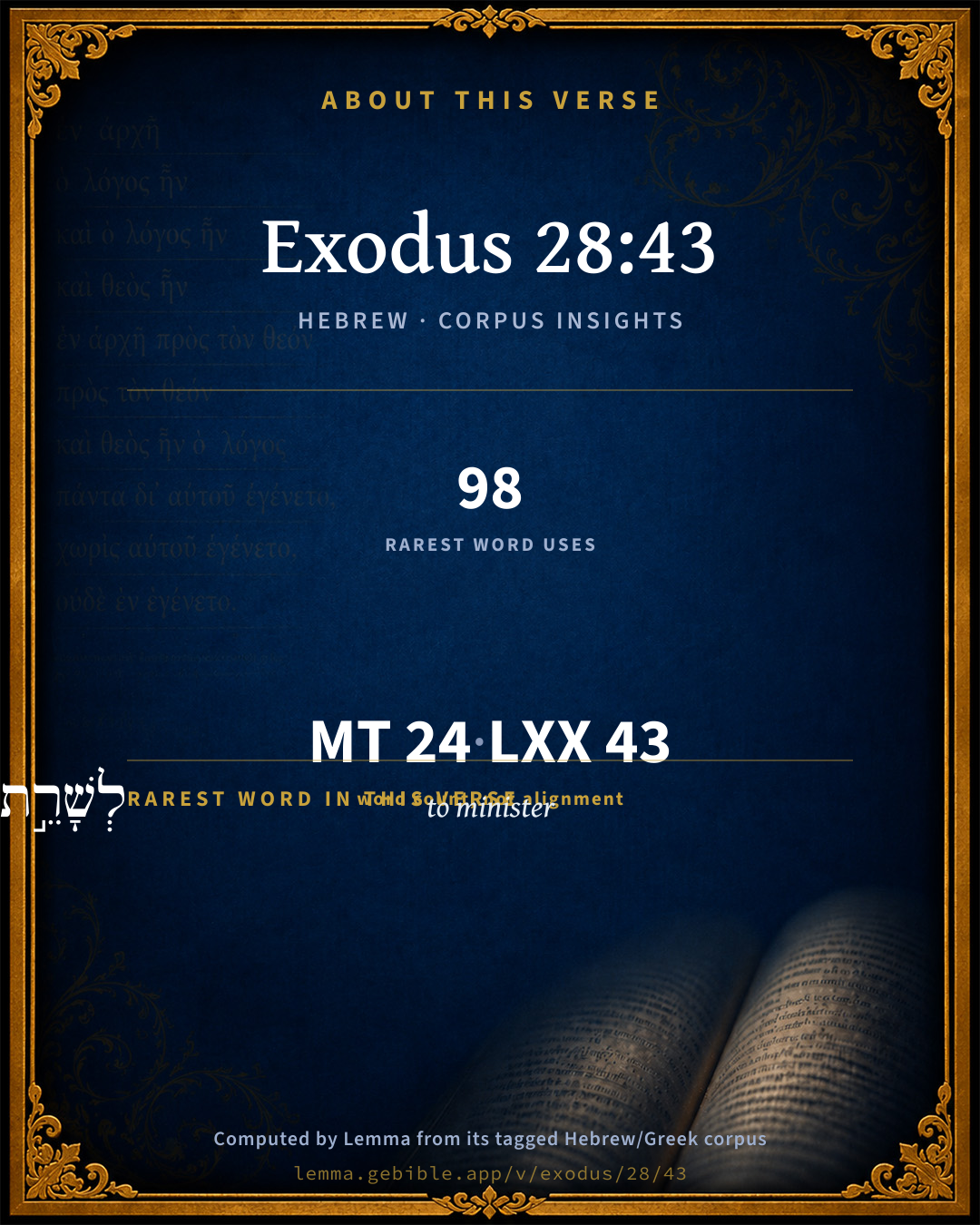
לְשָׁרֵ֣ת
shârath
H8334
“to minister”
Preposition + Verb, Piel, Infinitive Construct
Part of Speech
Preposition + Verb
Stem
Piel
Form
Infinitive Construct
Full BDB Definition

Origin: a primitive root

TWOT: 2472

(Piel) to minister, serve, minister to
  1. וְהָיוּ֩ hâyâh H1961 “and · to be” Conjunction + Verb, Qal, Sequential Perfect, 3rd Person, Common, Plural
  2. עַל ʻal H5921 “upon” Preposition
  3. אַהֲרֹ֨ן ʼAhărôwn H175 “Aaron” Noun, Proper
  4. וְעַל ʻal H5921 “and · upon” Conjunction + Preposition
  5. בָּנָ֜יו bên H1121 “sons · his” Noun, Common, Masculine, Plural, Construct + Suffix, Personal, 3rd Person, Masculine, Singular
  6. בְּבֹאָ֣ם bôwʼ H935 “in/at · to enter · them” Preposition + Verb, Qal, Infinitive Construct + Suffix, Personal, 3rd Person, Masculine, Plural
  7. אֶל ʼêl H413 “to” Preposition
  8. אֹ֣הֶל ʼôhel H168 “tent of” Noun, Common, Masculine, Singular, Construct
  9. מוֹעֵ֗ד môwʻêd H4150 “appointed time” Noun, Common, Masculine, Singular, Absolute
  10. א֣וֹ ʼôw H176 “or” Conjunction
  11. בְגִשְׁתָּ֤ם nâgash H5066 “in/at · to approach · them” Preposition + Verb, Qal, Infinitive Construct + Suffix, Personal, 3rd Person, Masculine, Plural
  12. אֶל ʼêl H413 “to” Preposition
  13. הַמִּזְבֵּ֨חַ֙ mizbêach H4196 “the · altar” Particle, Definite Article + Noun, Common, Masculine, Singular, Absolute
  14. בַּקֹּ֔דֶשׁ qôdesh H6944 “in/at the · holiness” Preposition, Determined + Noun, Common, Masculine, Singular, Absolute
  15. וְלֹא lôʼ H3808 “and · not” Conjunction + Particle, Negative
  16. יִשְׂא֥וּ nâsâʼ H5375 “to lift” Verb, Qal, Imperfect, 3rd Person, Masculine, Plural
  17. עָוֺ֖ן ʻâvôn H5771 “iniquity” Noun, Common, Both, Singular, Absolute
  18. וָמֵ֑תוּ mûwth H4191 “and · to die” Conjunction + Verb, Qal, Sequential Perfect, 3rd Person, Common, Plural
  19. חֻקַּ֥ת chuqqâh H2708 “statute of” Noun, Common, Both, Singular, Construct
  20. עוֹלָ֛ם ʻôwlâm H5769 “forever” Noun, Common, Masculine, Singular, Absolute
  21. וּלְזַרְע֥וֹ zeraʻ H2233 “and · to/for · seed · his” Conjunction + Preposition + Noun, Common, Masculine, Singular, Construct + Suffix, Personal, 3rd Person, Masculine, Singular
  22. אַחֲרָֽיו ʼachar H310 “after · him” Preposition + Suffix, Personal, 3rd Person, Masculine, Singular

About this verse

These counts appear in no published source. They are computed here, from the morphology-tagged text and Lemma’s own curated glosses. What Lemma adds →

24
words
21
distinct lemmas
Pentateuch
section

Grammatical profile

  • 6 verbs
  • 10 nouns
  • 6 prepositions
  • 1 conjunction
  • 1 particle

Verb forms

  • וְהָיוּ֩ Qal · Sequential Perfect
  • בְּבֹאָ֣ם Qal · Infinitive Construct
  • בְגִשְׁתָּ֤ם Qal · Infinitive Construct
  • לְשָׁרֵ֣ת Piel · Infinitive Construct
  • יִשְׂא֥וּ Qal · Imperfect
  • וָמֵ֑תוּ Qal · Sequential Perfect

Repetition

Words recur within this verse — often emphatic in Hebrew:

Hebrew & Septuagint length

In the original languages it is 24 Hebrew tokens and 43 Greek tokens — but the two are counted differently (Hebrew bundles its prefixes and suffixes into one token; the Greek is in lemma form), so that isn’t a like-for-like length.

Cross-references

10

Topical passages linked to Exodus 28:43 in the Treasury of Scripture Knowledge — connected by theme and wording, ordered by reader-vote popularity; previews shown in the World English Bible.

  • Exodus 27:21 In the tent of meeting, outside the veil which is before the testimony, Aaron and his sons shall keep it in order from evening to morning before Yahweh: it shall be a statute forever throughout their generations on the behalf of the children of Israel.
  • Exodus 20:26 Neither shall you go up by steps to my altar, that your nakedness may not be exposed to it.'
  • Leviticus 5:17 "If anyone sins, and does any of the things which Yahweh has commanded not to be done; though he didn't know it, yet he is guilty, and shall bear his iniquity.
  • Leviticus 5:1 "'If anyone sins, in that he hears the voice of adjuration, he being a witness, whether he has seen or known, if he doesn't report it, then he shall bear his iniquity.
  • Leviticus 17:7 They shall no more sacrifice their sacrifices to the goat idols, after which they play the prostitute. This shall be a statute forever to them throughout their generations.'
  • Leviticus 22:9 "'They shall therefore keep my charge, lest they bear sin for it, and die therein, if they profane it. I am Yahweh who sanctifies them.
  • Numbers 18:22 Henceforth the children of Israel shall not come near the tent of meeting, lest they bear sin, and die.
  • Leviticus 20:19–20 "'You shall not uncover the nakedness of your mother's sister, nor of your father's sister; for he has made naked his close relative: they shall bear their iniquity.
  • Numbers 9:13 But the man who is clean, and is not on a journey, and fails to keep the Passover, that soul shall be cut off from his people. Because he didn't offer the offering of Yahweh in its appointed season, that man shall bear his sin.
  • Matthew 22:12–13 and he said to him, 'Friend, how did you come in here not wearing wedding clothing?' He was speechless.

Cross-references courtesy of OpenBible.info (CC BY 4.0).

Hebrew and Greek witnesses Masoretic Hebrew ↔ Greek Septuagint

The same verse in the two great witnesses to the Old Testament, shown verse-for-verse.

These are two independent witnesses, not word-aligned to each other, and the Septuagint is shown in lemma (dictionary) form.

Hebrew Exodus 28:43 Masoretic · Westminster Leningrad Codex

וְהָיוּ֩ עַל אַהֲרֹ֨ן וְעַל בָּנָ֜יו בְּבֹאָ֣ם אֶל אֹ֣הֶל מוֹעֵ֗ד א֣וֹ בְגִשְׁתָּ֤ם אֶל הַמִּזְבֵּ֨חַ֙ לְשָׁרֵ֣ת בַּקֹּ֔דֶשׁ וְלֹא יִשְׂא֥וּ עָוֺ֖ן וָמֵ֑תוּ חֻקַּ֥ת עוֹלָ֛ם ל֖וֹ וּלְזַרְע֥וֹ אַחֲרָֽיו

They shall be on Aaron, and on his sons, when they go in to the tent of meeting, or when they come near to the altar to minister in the holy place; that they don't bear iniquity, and die: it shall be a statute forever to him and to his descendants after him.

World English Bible · Public Domain

Greek LXX Exodus 28:43 Septuagint · lemma form

καί ἔχω ααρων αὐτός καί ὁ υἱός αὐτός ὡς ἄν εἰςπορεύομαι εἰς ὁ σκηνή ὁ μαρτύριον ἤ ὅταν προςπορεύομαι λειτουργέω πρός ὁ θυσιαστήριον ὁ ἅγιος καί οὐ ἐπιἄγω πρός ἑαυτοῦ ἁμαρτία ἵνα μή ἀποθνήσκω νόμιμος αἰώνιος αὐτός καί ὁ σπέρμα αὐτός μετά αὐτός

No English rendering of this Greek verse — the small residue in the structurally divergent books.

Hebrew: Westminster Leningrad Codex (CC BY 4.0). Greek: Septuagint (public domain); English from a public-domain English Septuagint. How the Septuagint differs from the Hebrew →

Targum (Aramaic paraphrase)

2

The Targum is the ancient Jewish Aramaic paraphrase of the Hebrew Scriptures — an interpretive translation, not the Hebrew text itself. Onkelos (literal) and Pseudo-Jonathan (expansive) render the Torah, and Jonathan the Prophets. Coverage is partial: where no permissively-licensed English translation exists for a verse, only the Aramaic is shown. This is verse-level text, not a word-by-word alignment to the Hebrew.

  1. Targum Onkelos Torah (Genesis–Deuteronomy)
    וִיהוֹן עַל אַהֲרֹן וְעַל בְּנוֹהִי בְּמֵעַלְהוֹן לְּמַשְׁכַּן זִמְנָא אוֹ בְמִקְרָבְהוֹן לְמַדְבְּחָא לְשַׁמָשָׁא בְקוּדְשָׁא וְלָא יְקַבְּלוּן חוֹבָא וִימוּתוּן קְיָם עָלָם לֵהּ וְלִבְנוֹהִי בַתְרוֹהִי:

    (no public-domain English translation for this verse)

    Targum Onkelos — Aramaic: “Onkelos Genesis” (public domain); “Onkelos Exodus” (public domain); “Onkelos Leviticus” (public domain); “Onkelos Numbers” (public domain); “Onkelos Deuteronomy” (public domain). English: “Sefaria Community Translation” (CC0 1.0 (public-domain dedication)); “J.W. Etheridge. The Targums of Onkelos and Jonathan Ben Uzziel on the Pentateuch. London: Longmans, Green, 1862” (public domain). Text via Sefaria.

  2. Targum Pseudo-Jonathan Torah (Genesis–Deuteronomy)
    וִיהוֹן עַל אַהֲרן וְעַל בְּנוֹי בִּזְמַן מֵעַלְהוֹן לְמַשְׁכַּן זִימְנָא אוֹ בְּמִקְרָבֵיהוֹן לְמַדְבְּחָא לְשַׁמָשָׁא בְּקוּדְשָׁא וְלָא יְקַבְּלוּן חוֹבָא וְלָא יְמוּתוּן בְּאֵשָׁא מִצַלְהֲבָא קְיַים עֲלַם לֵיהּ וְלִבְנוֹי בַּתְרוֹי

    And they shall be upon Aharon and upon his sons at the time when they enter the tabernacle of testimony, or when they approach the altar to minister in the sanctuary, that they may not receive the punishment of flaming fire. This is an everlasting statute for him and for his sons after him.

    Targum Pseudo-Jonathan — Aramaic: “Targum Jonathan on Genesis” (public domain); “Targum Jonathan on Exodus” (public domain); “Targum Jonathan on Leviticus” (public domain); “Targum Jonathan on Numbers” (public domain); “Targum Jonathan on Deuteronomy” (public domain). English: “The Targum of Jonathan ben Uzziel, trans. J. W. Etheridge, London, 1862” (public domain). Text via Sefaria.

Commentary

Notes on Exodus 28:43 from classic Christian and Jewish commentators (each source and its license shown beneath its notes). The classic Christian expositions comment on the surrounding passage and are grouped to its opening verse, so a note may address several verses; the Jewish commentaries on the Tanakh (Rashi and others) are per-verse, so they appear only where the commentator wrote on this verse.

Lemma curates 59 commentaries, every one of them public domain or Creative Commons licensed, each selected and text-cleaned for this edition rather than reprinted as found. About our sources →

Trapp's Complete Commentary

John Trapp

Exo 28:43 And they shall be upon Aaron, and upon his sons, when they come in unto the tabernacle of the congregation, or when they come near unto the altar to minister in the holy [place]; that they bear not iniquity, and die: [it shall be] a statute for ever unto him and his seed after him.

Ver. 43. That they bear not the iniquity, and die,] sc., For not hiding their nakedness. See on Exo 20:26.

John Trapp, A Commentary or Exposition upon All the Books of the Old and New Testament (1647–1656) — public domain. Text from a community e-Sword module.

Joseph Benson's Commentary

Exo 28:43. It shall be a statute for ever — That is, it is to continue as long as the priesthood continues. And it is to have its perpetuity in the substance of which these things were the shadow.

Joseph Benson's Commentary on the Old and New Testaments (1811–1818) — public domain. Text from a community e-Sword module.

Geneva Bible (1599)

Geneva Bible translators

In not hiding their nakedness.

Or, of witness.

Geneva Bible (1599) marginal notes — public domain. Text via Bolls.life.

Ellicott's Commentary for English Readers

(43) The tabernacle of the congregation.—Heb., the tent of meeting.

The holy place seems to be here the court of the tabernacle, within which the altar was to be set up (Exo_40:6; Exo_40:29).

That they bear not iniquity, and die.—The death penalty is threatened against the sin of ministering without the garments needed for decency, as against the sin of neglecting to wear the robe of the ephod (Exo_28:35). In both cases a Divine vengeance, rather than a legal punishment, is probably intended.

A Bible Commentary for English Readers, edited by Charles John Ellicott (1878–1897) — public domain. Text from a community e-Sword module.

The Cambridge Bible for Schools and Colleges

gen. ed. J. J. S. Perowne

43. the altar] i.e. the altar of burnt-offering: cf. on Exo_27:1.

the holy place] i.e. the sanctuary in general (including the court), as Exo_36:1; Exo_36:3-4; Exo_36:6; not in the special sense of Exo_26:33; for the altar of burnt-offering did not stand in the Dwelling, but in the court (Exo_40:6). With to minister, as Exo_29:30, Exo_35:19 al. (P); Eze_44:27.

bear iniquity and die, cf. Lev_22:16 (H); and on v. 35 above.

a statute for ever] as Exo_30:21, Lev_6:18; Lev_6:22; Lev_7:34; Lev_10:15; Lev_24:9, Num_18:8; Num_18:11; Num_18:19 (all P): cf. on Exo_12:14 (where the Heb. is ḥuḳḳâh, the fem. of ḥôḳ, the word used here).

and … his seed after him] one of P’s standing expressions: Gen_9:9; Gen_17:7-10; Gen_17:19; Gen_35:12; Gen_48:4, Num_25:13.

The Cambridge Bible for Schools and Colleges (gen. ed. J. J. S. Perowne; Cambridge University Press, 1878–1918) — public domain. Text from a community e-Sword module.

The Pulpit Commentary

When they go into the tabernacle of the congregation. Literally," when they go into the tent of meetingi.e. , the place where God and the high priest were to meet. The holy place. The "holy place" seems in this passage to include the court of the tabernacle, wherein the altar was situated. That they bear not iniquity. To "bear iniquity" is to incur guilt, or have sin imputed to one. If even through forgetfulness a priest entered the sanctuary without this necessary article of clothing, and so risked an unseemly, exposure of his person, he was to be accounted guilty, and punished by death. This was to be a "statute for ever," and to apply both to the high priest and the ordinary priests. Compare Exo_20:26.

The Pulpit Commentary (1880–1919), ed. H.D.M. Spence-Jones & Joseph S. Exell — public domain. Text from a community e-Sword module.

John Wesley's Explanatory Notes

It shall be a statute forever - That is, It is to continue as long as the priesthood continues. And it is to have its perpetuity in the substance, of which these things were the shadows.

John Wesley, Explanatory Notes Upon the Whole Bible (1754–1765) — public domain. Text via the GEBible commentary corpus.

Rashi

Rabbi Shlomo Yitzchaki (Rashi)

והיו על אהרן AND THEY SHALL BE UPON AARON — “they” means all these garments (not only the breeches which are the last-mentioned garments); upon Aaron shall be those which are proper to him,

ועל בניו AND UPON HIS SONS, those prescribed for them.

בבאם אל אהל מועד WHEN THEY COME INTO THE APPOINTED TENT — into the Temple, and similarly when they come into the Tabernacle.

ומתו AND THEY DIE — thus you may learn that he who officiates lacking any of these garments is liable to death (Midrash Tanchuma, Achrei Mot 6).

חקת עולם לו AN ORDINANCE TO HIM FOR EVER — Wherever it is said “an ordinance forever” it is an enactment for the immediate present time and for future generations, and the phrase is used to make invalid thereby (through the fact that this phrase is used) any rite where the details prescribed are not fully carried out (cf. Menachot 19a).

Rashi on the Tanakh — English translations: “The Judaica Press complete Tanach with Rashi, translated by A. J. Rosenberg” (CC BY 4.0); “Pentateuch with Rashi's commentary by M. Rosenbaum and A.M. Silbermann, 1929-1934” (public domain); “The Metsudah Tanach series, Lakewood, N.J” (CC BY 4.0); and “The Book of Joshua, Metsudah Publications, 1997” (CC BY 4.0). Text via Sefaria.

Lesson kit

Teaching starters — assembled from the data on this page, not authored interpretation. Every prompt links to the verse data it draws on. Edit before teaching.

Exodus, in the Pentateuch, opens this verse with 24 words (21 distinct Hebrew lemmas). Its most distinctive word is shârath (“to minister”). A historical commentator’s framing appears above. Read the whole chapter for the surrounding context.

Discussion questions

  1. The word shârath carries the sense “to minister.” How does it shape the verse?
  2. How does Exodus 27:21, which shares this passage’s theme, read alongside this verse?
  3. What does the repetition of “upon” (2× in this one verse) do in this verse?
  4. These translations render this verse differently. What is at stake in choosing one wording over another?
  5. «וְהָיוּ֩» is a Qal Sequential Perfect verb. How does that grammatical form shape the action described?
  6. Compare how Trapp's Complete Commentary and Joseph Benson's Commentary read this verse. Where do they agree or differ?

Things to notice

Reading settings

Reading text

Shown beneath each verse's original-language words.

Old Testament
Old Testament edition

Read the OT as the Masoretic Hebrew (MT) or the Greek Septuagint (LXX).

English shown for the Greek Septuagint (in the Hebrew ↔ Greek comparison).

Comparing translations? Open the Compare panel on any verse page to stack up to four side by side.