
Exodus 18:22

Hebrew (Westminster Leningrad Codex) Exodus 18:22 appears in the Hebrew Old Testament. The text above is from the Westminster Leningrad Codex. Each word links to its Strong’s number, a concise gloss, and parsing drawn from the Open Scriptures Hebrew Bible morphology. Click any word for its full Brown-Driver-Briggs (BDB) entry.
Download image
Cite this verse

Exodus 18:22 (World English Bible). Public Domain. Lemma interlinear Bible study tool, https://lemma.gebible.app/v/exodus/18/22.

Show BibTeX & RIS
BibTeX
RIS
English Translation
Let them judge the people at all times. It shall be that every great matter they shall bring to you, but every small matter they shall judge themselves. So shall it be easier for you, and they shall share the load with you.
World English Bible · Public Domain
Download a study sheet

One document with this verse’s original text, its word-by-word gloss line, the meaning frame, cross-references with their text, attributed commentary, and full source and license credits — printable, and it pastes into notes with its structure intact.

This verse Autodidact and up

Study sheet (.html) Plain text (.txt)

A passage Seminary Student

Up to 50 verses in one chapter. A passage sheet keeps up to 6 commentary sources and 12 cross-references per verse, in the order this page ranks them, and says so on the sheet whenever that leaves anything out. Ask for a single verse and you get the Autodidact verse sheet above.

Everything on this page stays free to read, with no account — the sheet is a download of what is already on screen, not access to it.

Want to remove ads? Support Godless Engineer
Compare translations 3

The same verse in 3 English versions, stacked beneath the original-language interlinear above. Click any original word for its lexicon entry.

Each is an independent rendering of the whole verse — the interlinear is not word-aligned to these translations.

Highlighted words mark where these versions differ — a whole-verse word diff, not a word-by-word alignment.

  • World English Bible Public Domain
    Let them judge the people at all times. It shall be that every great matter they shall bring to you, but every small matter they shall judge themselves. So shall it be easier for you, and they shall share the load with you.
  • King James Version Public Domain
    And let them judge the people at all seasons: and it shall be, that every great matter they shall bring unto thee, but every small matter they shall judge: so shall it be easier for thyself, and they shall bear the burden with thee.
  • unfoldingWord Literal Text CC BY-SA 4.0
    And they will judge the people at all times. And so it will be, every great situation they will bring to you, and every small situation they will judge themselves. And you must lighten from on you! And they will carry alongside you.

unfoldingWord Literal Text — © unfoldingWord, licensed CC BY-SA 4.0. Word-aligned USFM3 via Door43 (git.door43.org/unfoldingWord/en_ult).

Versions to compare (up to 4)

3 of 4 selected

Show all 18 translations

Every available English version of this verse, each an independent rendering of the whole verse.

  • World English Bible Public Domain
    Let them judge the people at all times. It shall be that every great matter they shall bring to you, but every small matter they shall judge themselves. So shall it be easier for you, and they shall share the load with you.
  • Berean Standard Bible Public Domain
    Have these men judge the people at all times. Then they can bring you any major issue, but all minor cases they can judge on their own, so that your load may be lightened as they share it with you.
  • Majority Standard Bible Public Domain
    Have these men judge the people at all times. Then they can bring you any major issue, but all minor cases they can judge on their own, so that your load may be lightened as they share it with you.
  • King James Version Public Domain
    And let them judge the people at all seasons: and it shall be, that every great matter they shall bring unto thee, but every small matter they shall judge: so shall it be easier for thyself, and they shall bear the burden with thee.
  • American Standard Version (1901) Public Domain
    and let them judge the people at all seasons: and it shall be, that every great matter they shall bring unto thee, but every small matter they shall judge themselves: so shall it be easier for thyself, and they shall bear `the burden' with thee.
  • Revised Version (1885) Public Domain
    and let them judge the people at all seasons: and it shall be, that every great matter they shall bring unto thee, but every small matter they shall judge themselves: so shall it be easier for thyself, and they shall bear the burden with thee.
  • Geneva Bible (1599) Public Domain
    And let them iudge the people at all seasons: but euery great matter let them bring vnto thee, and let them iudge all small causes: so shall it be easier for thee, when they shall beare the burden with thee.
  • Douay-Rheims (1899) Public Domain
    Who may judge the people at all times: and when any great matter soever shall fall out, let them refer it to thee, and let them judge the lesser matters only: that so it may be lighter for thee, the burden being shared out unto others.
  • Young's Literal Translation Public Domain
    and they have judged the people at all times; and it hath come to pass, every great matter they bring in unto thee, and every small matter they judge themselves; and lighten it from off thyself, and they have borne with thee.
  • Literal Standard Version CC BY-SA 4.0
    and they have judged the people at all times; and it has come to pass, they bring every great matter to you, and they judge every small matter themselves; and lighten it from off yourself, and they have borne with you.
  • Unlocked Literal Bible CC BY-SA 4.0
    They will judge the people in all routine cases, but the difficult cases they will bring to you. As for all the small cases, they can judge those themselves. In that way it will be easier for you, and they will carry the burden with you.
  • unfoldingWord Literal Text CC BY-SA 4.0
    And they will judge the people at all times. And so it will be, every great situation they will bring to you, and every small situation they will judge themselves. And you must lighten from on you! And they will carry alongside you.
  • Darby Bible Public Domain
    that they may judge the people at all times; and it shall be [that] they shall bring to thee every great matter, and that they shall judge every small matter, and they shall lighten [the task] on thee, and they shall bear [it] with thee.
  • World Messianic Bible Public Domain
    Let them judge the people at all times. It shall be that every great matter they shall bring to you, but every small matter they shall judge themselves. So shall it be easier for you, and they shall share the load with you.
  • Webster's Bible Public Domain
    And let them judge the people at all seasons: and it shall be, that every great matter they shall bring to thee, but every small matter they shall judge: So shall it be easier for thyself, and they shall bear the burden with thee.
  • Free Bible Version CC BY-SA 4.0
    These men are to judge the people on a continuing basis. Major issues they can bring to you, but they can decide all the small matters themselves. In this way your burden will be made lighter as they share it with you.
  • Bible in Basic English Public Domain
    And let them be judges in the causes of the people at all times: and let them put before you all important questions, but in small things let them give decisions themselves: in this way, it will be less hard for you, and they will take the weight off you.
  • JPS Tanakh (1917) Public Domain
    And let them judge the people at all seasons; and it shall be, that every great matter they shall bring unto thee, but every small matter they shall judge themselves; so shall they make it easier for thee and bear the burden with thee.

Literal Standard Version (2020), Covenant Press — licensed CC BY-SA 4.0. Text via the HelloAO Bible API (eBible.org). Unlocked Literal Bible (unfoldingWord) — licensed CC BY-SA 4.0. Text via the HelloAO Bible API (eBible.org). unfoldingWord Literal Text — © unfoldingWord, licensed CC BY-SA 4.0. Word-aligned USFM3 via Door43 (git.door43.org/unfoldingWord/en_ult). Free Bible Version, Dr. Jonathan Gallagher — licensed CC BY-SA 4.0. Text via the HelloAO Bible API (eBible.org).

Word by word

More ways to search: Search by grammar → Find every occurrence → Compare this word →

Practice this passage: Drill this verse → Learn its vocabulary →

וְהָקֵל֙
qâlal
H7043
“and · be light”
Conjunction + Verb, Hiphil, Imperative, 2nd Person, Masculine, Singular
Part of Speech
Conjunction + Verb
Stem
Hiphil
Form
Imperative
Person
2nd Person
Gender
Masculine
Number
Singular
Full BDB Definition

Origin: a primitive root

TWOT: 2028

to be slight, be swift, be trifling, be of little account, be light - (Qal) - to be slight, be abated (of water) - to be swift - to be trifling, be of little account - (Niphal) - to be swift, show oneself swift - to appear trifling, be too trifling, be insignificant - to be lightly esteemed - (Piel) - to make despicable - to curse - (Pual) to be cursed - (Hiphil) - to make light, lighten - to treat with contempt, bring contempt or dishonour - (Pilpel) - to shake - to whet - (Hithpalpel) to shake oneself, be moved to and fro
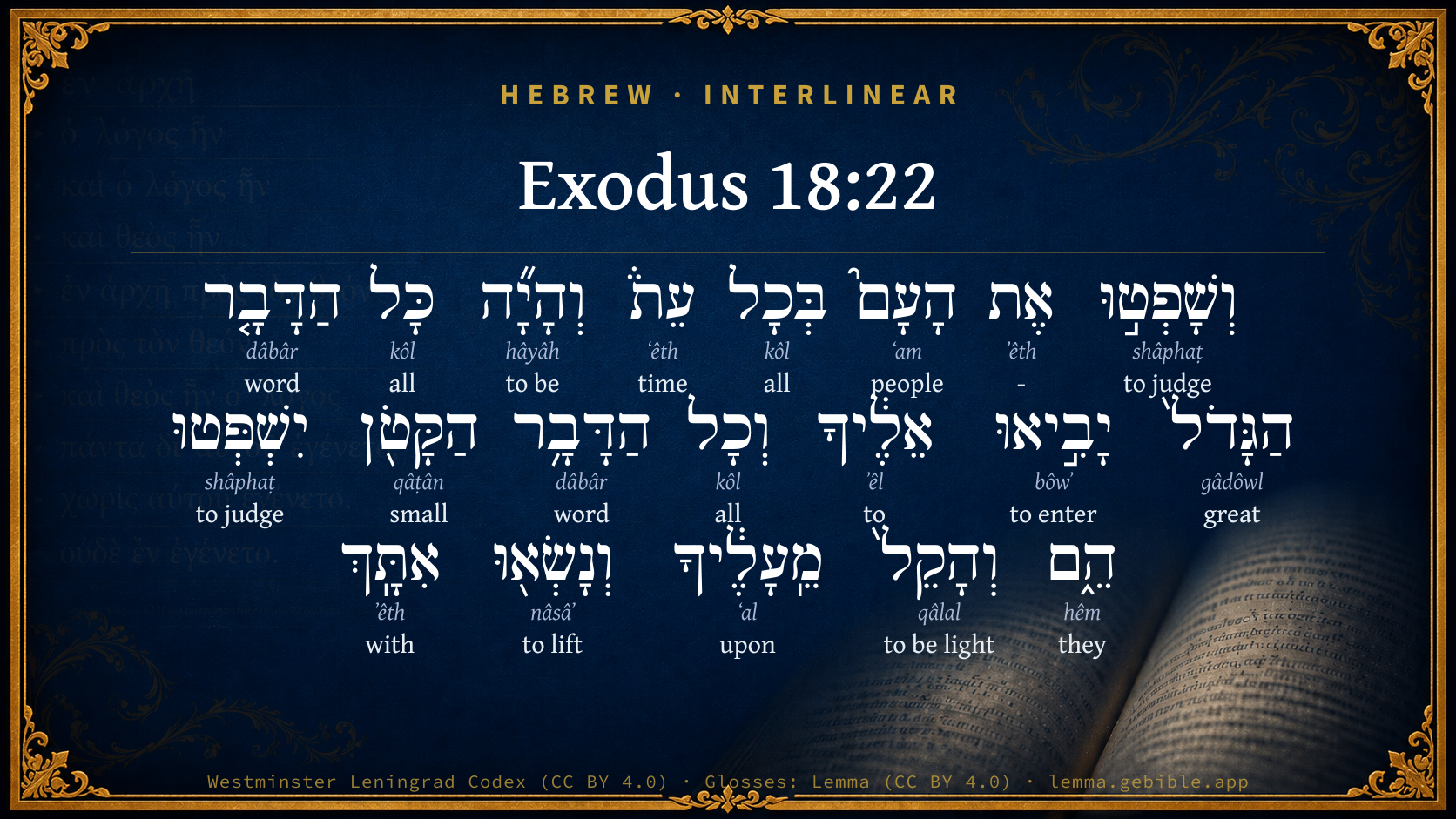
  1. וְשָׁפְט֣וּ shâphaṭ H8199 “and · to judge” Conjunction + Verb, Qal, Sequential Perfect, 3rd Person, Common, Plural
  2. אֶת ʼêth H853 “-” Particle, Direct Object
  3. הָעָם֮ ʻam H5971 “the · people” Particle, Definite Article + Noun, Common, Masculine, Singular, Absolute
  4. בְּכָל kôl H3605 “in/at · all of” Preposition + Noun, Common, Masculine, Singular, Construct
  5. עֵת֒ ʻêth H6256 “time” Noun, Common, Both, Singular, Absolute
  6. וְהָיָ֞ה hâyâh H1961 “and · to be” Conjunction + Verb, Qal, Sequential Perfect, 3rd Person, Masculine, Singular
  7. כָּל kôl H3605 “all of” Noun, Common, Masculine, Singular, Construct
  8. הַדָּבָ֤ר dâbâr H1697 “the · word” Particle, Definite Article + Noun, Common, Masculine, Singular, Absolute
  9. הַגָּדֹל֙ gâdôwl H1419 “the · great” Particle, Definite Article + Adjective, Adjective, Masculine, Singular, Absolute
  10. יָבִ֣יאוּ bôwʼ H935 “to enter” Verb, Hiphil, Imperfect, 3rd Person, Masculine, Plural
  11. אֵלֶ֔יךָ ʼêl H413 “to · you” Preposition + Suffix, Personal, 2nd Person, Masculine, Singular
  12. וְכָל kôl H3605 “and · all of” Conjunction + Noun, Common, Masculine, Singular, Construct
  13. הַדָּבָ֥ר dâbâr H1697 “the · word” Particle, Definite Article + Noun, Common, Masculine, Singular, Absolute
  14. הַקָּטֹ֖ן qâṭân H6996 “the · small” Particle, Definite Article + Adjective, Adjective, Masculine, Singular, Absolute
  15. יִשְׁפְּטוּ shâphaṭ H8199 “to judge” Verb, Qal, Imperfect, 3rd Person, Masculine, Plural
  16. הֵ֑ם hêm H1992 “they” Pronoun, Personal, 3rd Person, Masculine, Plural
  17. מֵֽעָלֶ֔יךָ ʻal H5921 “from · upon · you” Preposition + Preposition + Suffix, Personal, 2nd Person, Masculine, Singular
  18. וְנָשְׂא֖וּ nâsâʼ H5375 “and · to lift” Conjunction + Verb, Qal, Sequential Perfect, 3rd Person, Common, Plural
  19. אִתָּֽךְ ʼêth H854 “with · you” Preposition + Suffix, Personal, 2nd Person, Feminine, Singular

About this verse

These counts appear in no published source. They are computed here, from the morphology-tagged text and Lemma’s own curated glosses. What Lemma adds →

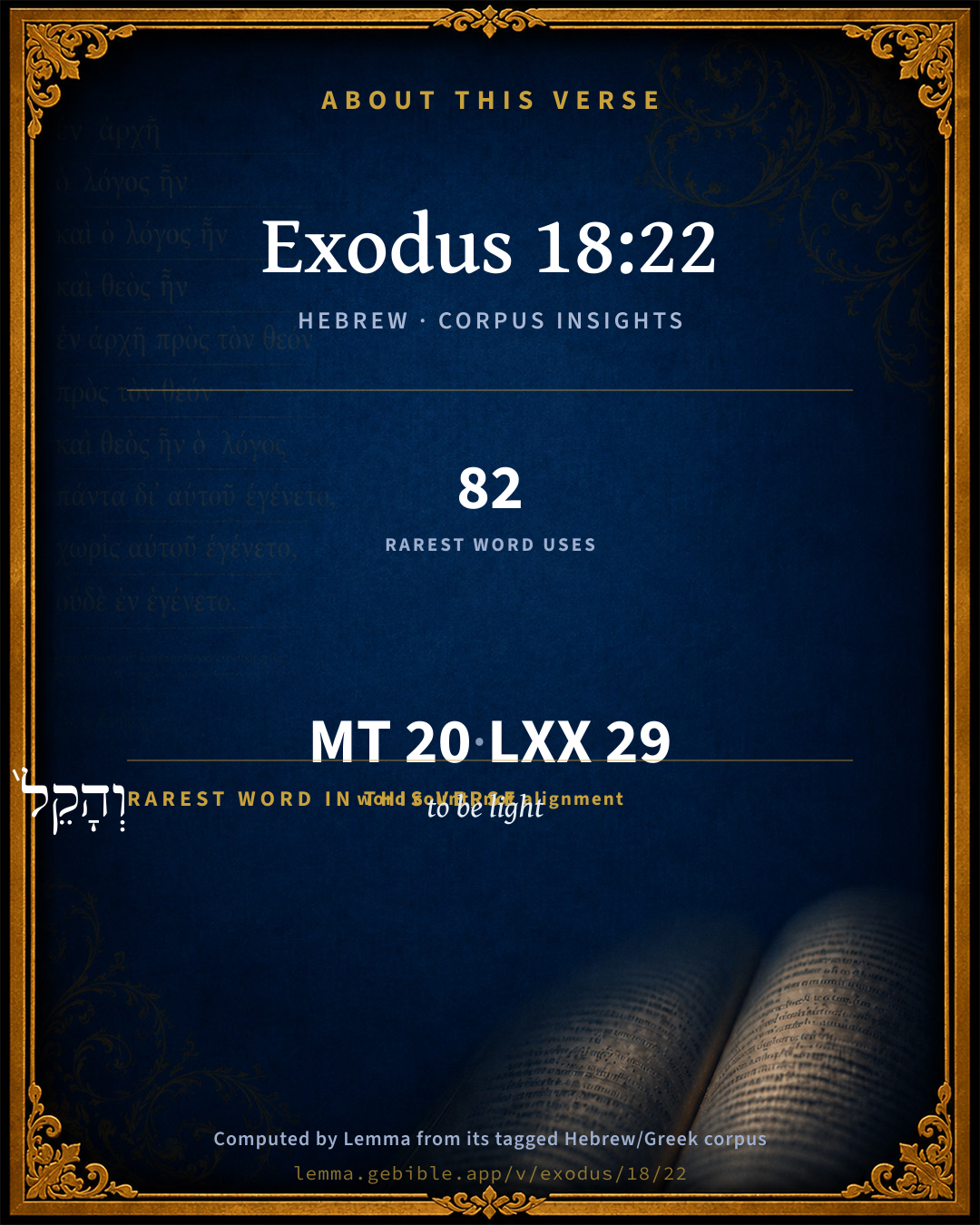
20
words
16
distinct lemmas
Pentateuch
section

Grammatical profile

  • 6 verbs
  • 7 nouns
  • 2 adjectives
  • 1 pronoun
  • 3 prepositions
  • 1 particle

Verb forms

  • וְשָׁפְט֣וּ Qal · Sequential Perfect
  • וְהָיָ֞ה Qal · Sequential Perfect
  • יָבִ֣יאוּ Hiphil · Imperfect
  • יִשְׁפְּטוּ Qal · Imperfect
  • וְהָקֵל֙ Hiphil · Imperative
  • וְנָשְׂא֖וּ Qal · Sequential Perfect

Repetition

Words recur within this verse — often emphatic in Hebrew:

  • בְּכָל all H3605 ×3
  • וְשָׁפְט֣וּ to judge H8199 ×2
  • הַדָּבָ֤ר word H1697 ×2

Hebrew & Septuagint length

In English translation the verse runs 43 words from the Hebrew and 34 from the Septuagint (LXX English) — closely comparable.

A rough comparison of the two English renderings, which tokenize alike — not a word-level alignment.

Word counts can differ between the Hebrew and the Greek without any difference in meaning — e.g. the Hebrew direct-object marker אֵת has no separate Greek word, and Greek often adds the article ὁ.

In the original languages it is 20 Hebrew tokens and 29 Greek tokens — but the two are counted differently (Hebrew bundles its prefixes and suffixes into one token; the Greek is in lemma form), so that isn’t a like-for-like length.

Cross-references

10

Topical passages linked to Exodus 18:22 in the Treasury of Scripture Knowledge — connected by theme and wording, ordered by reader-vote popularity; previews shown in the World English Bible.

  • Numbers 11:17 I will come down and talk with you there: and I will take of the Spirit which is on you, and will put it on them; and they shall bear the burden of the people with you, that you not bear it yourself alone.
  • Exodus 18:26 They judged the people at all times. They brought the hard causes to Moses, but every small matter they judged themselves.
  • Leviticus 24:11 The son of the Israelite woman blasphemed the Name, and cursed; and they brought him to Moses. His mother's name was Shelomith, the daughter of Dibri, of the tribe of Dan.
  • Numbers 15:33 Those who found him gathering sticks brought him to Moses and Aaron, and to all the congregation.
  • Numbers 27:2 They stood before Moses, and before Eleazar the priest, and before the princes and all the congregation, at the door of the tent of meeting, saying,
  • Numbers 36:1 The heads of the fathers' [houses] of the family of the children of Gilead, the son of Machir, the son of Manasseh, of the families of the sons of Joseph, came near, and spoke before Moses, and before the princes, the heads of the fathers' [houses] of the children of Israel:
  • Deuteronomy 1:17–18 You shall not show partiality in judgment; you shall hear the small and the great alike; you shall not be afraid of the face of man; for the judgment is God's: and the cause that is too hard for you, you shall bring to me, and I will hear it.
  • Exodus 18:18 You will surely wear away, both you, and this people that is with you; for the thing is too heavy for you. You are not able to perform it yourself alone.
  • Deuteronomy 17:8–9 If there arise a matter too hard for you in judgment, between blood and blood, between plea and plea, and between stroke and stroke, being matters of controversy within your gates; then shall you arise, and go up to the place which Yahweh your God shall choose;
  • Romans 13:6 For this reason you also pay taxes, for they are ministers of God's service, attending continually on this very thing.

Cross-references courtesy of OpenBible.info (CC BY 4.0).

Hebrew and Greek witnesses Masoretic Hebrew ↔ Greek Septuagint

The same verse in the two great witnesses to the Old Testament, shown verse-for-verse.

These are two independent witnesses, not word-aligned to each other, and the Septuagint is shown in lemma (dictionary) form.

Hebrew Exodus 18:22 Masoretic · Westminster Leningrad Codex

וְשָׁפְט֣וּ אֶת הָעָם֮ בְּכָל עֵת֒ וְהָיָ֞ה כָּל הַדָּבָ֤ר הַגָּדֹל֙ יָבִ֣יאוּ אֵלֶ֔יךָ וְכָל הַדָּבָ֥ר הַקָּטֹ֖ן יִשְׁפְּטוּ הֵ֑ם וְהָקֵל֙ מֵֽעָלֶ֔יךָ וְנָשְׂא֖וּ אִתָּֽךְ

Let them judge the people at all times. It shall be that every great matter they shall bring to you, but every small matter they shall judge themselves. So shall it be easier for you, and they shall share the load with you.

World English Bible · Public Domain

Greek LXX Exodus 18:22 Septuagint · lemma form

καί κρίνω ὁ λαός πᾶς ὥρα ὁ δέ ῥῆμα ὁ ὑπέρογκος ἀναφέρω ἐπί σύ ὁ δέ βραχύς ὁ κρίμα κρίνω αὐτός καί κουφίζω ἀπό σύ καί συν ἀντιλαμβάνω σύ

And they shall judge the people at all times, and the too burdensome matter they shall bring to you, but they shall judge the smaller cases; so they shall relieve you and help you.

LXX2012 (modern English Septuagint) · Public Domain

Hebrew: Westminster Leningrad Codex (CC BY 4.0). Greek: Septuagint (public domain); English from LXX2012 (modern English Septuagint) (Public Domain). How the Septuagint differs from the Hebrew →

Targum (Aramaic paraphrase)

2

The Targum is the ancient Jewish Aramaic paraphrase of the Hebrew Scriptures — an interpretive translation, not the Hebrew text itself. Onkelos (literal) and Pseudo-Jonathan (expansive) render the Torah, and Jonathan the Prophets. Coverage is partial: where no permissively-licensed English translation exists for a verse, only the Aramaic is shown. This is verse-level text, not a word-by-word alignment to the Hebrew.

  1. Targum Onkelos Torah (Genesis–Deuteronomy)
    וִידוּנוּן יָת עַמָא בְּכָל עִדַן וִיהֵי כָּל פִּתְגַם רַב יַיְתוּן לְוָתָךְ וְכָל פִּתְגַם זְעֵיר יְדוּנוּן אִנוּן וְיִקְלוּן מִנָךְ וִיסוֹבְרוּן עִמָךְ:

    (no public-domain English translation for this verse)

    Targum Onkelos — Aramaic: “Onkelos Genesis” (public domain); “Onkelos Exodus” (public domain); “Onkelos Leviticus” (public domain); “Onkelos Numbers” (public domain); “Onkelos Deuteronomy” (public domain). English: “Sefaria Community Translation” (CC0 1.0 (public-domain dedication)); “J.W. Etheridge. The Targums of Onkelos and Jonathan Ben Uzziel on the Pentateuch. London: Longmans, Green, 1862” (public domain). Text via Sefaria.

  2. Targum Pseudo-Jonathan Torah (Genesis–Deuteronomy)
    וִידִינוּן יַת עַמָּא בְּכָל עִידַן וִיהֵי כָּל פִּתְגַּם רַב יֵיתוּן לְוָותָךְ וְכָל פִּתְגַּם קָלִיל יִדוֹנוּן הִינוּן וִיקִילוּן מִן מְטוֹל דְּעָלָךְ וִיסוֹבְרוּן עִמָךְ

    And let them judge the people at all times, and every great matter bring to thee, but every little thing let them judge themselves, that they may lighten the burden that is upon thee, and bear it with thee.

    Targum Pseudo-Jonathan — Aramaic: “Targum Jonathan on Genesis” (public domain); “Targum Jonathan on Exodus” (public domain); “Targum Jonathan on Leviticus” (public domain); “Targum Jonathan on Numbers” (public domain); “Targum Jonathan on Deuteronomy” (public domain). English: “The Targum of Jonathan ben Uzziel, trans. J. W. Etheridge, London, 1862” (public domain). Text via Sefaria.

Commentary

Notes on Exodus 18:22 from classic Christian and Jewish commentators (each source and its license shown beneath its notes). The classic Christian expositions comment on the surrounding passage and are grouped to its opening verse, so a note may address several verses; the Jewish commentaries on the Tanakh (Rashi and others) are per-verse, so they appear only where the commentator wrote on this verse.

Lemma curates 59 commentaries, every one of them public domain or Creative Commons licensed, each selected and text-cleaned for this edition rather than reprinted as found. About our sources →

Trapp's Complete Commentary

John Trapp

Exo 18:22 And let them judge the people at all seasons: and it shall be, [that] every great matter they shall bring unto thee, but every small matter they shall judge: so shall it be easier for thyself, and they shall bear [the burden] with thee.

Ver. 22. So shall it be easier, &c.] How thankless is their labour that do wilfully overspend themselves in their ordinary vocations!

John Trapp, A Commentary or Exposition upon All the Books of the Old and New Testament (1647–1656) — public domain. Text from a community e-Sword module.

Ellicott's Commentary for English Readers

(22) At all seasons.—Not on occasional court days, as had been the custom of Moses, but day by day continually.

Every great matter they shall bring unto thee.—It must have been left to the judges themselves to decide what were “great” and what were “small matters.” Under ordinary circumstances, courts would be inclined to extend their jurisdiction, and take enlarged views of their competency; but the difficulties of desert life were such as to counteract this inclination, and induce men to contract, rather than widen, their responsibilities. When the wilderness life was ended, the judicial system of Jethro came to an end also, and a system at once simpler and more elastic was adopted.

A Bible Commentary for English Readers, edited by Charles John Ellicott (1878–1897) — public domain. Text from a community e-Sword module.

The Cambridge Bible for Schools and Colleges

gen. ed. J. J. S. Perowne

22. at all seasons] i.e. in all ordinary cases.

so &c.] Heb. and make it light off thyself, i.e. relieve thyself.

The Cambridge Bible for Schools and Colleges (gen. ed. J. J. S. Perowne; Cambridge University Press, 1878–1918) — public domain. Text from a community e-Sword module.

John Gill's Exposition

If thou shall do this thing,.... Hearken to the advice given, and put it in execution, by choosing out of the people, and placing over them, judges qualified, as directed: and God command thee so; for he did not desire him to follow his advice any further than it appeared to be according to the will of God, which he doubted not he would inquire about; and if he found it was agreeable to it, and should pursue it:

then thou shall be able to endure; to continue in his office and post, and hold on for years to come, God granting him life and health; whereas otherwise, in all human probability, he must waste and wear away apace:

and all this people shall also go to their place in peace; having had their cases heard and tried, and their differences adjusted to satisfaction; and quick dispatch being made, they would return to their tents or places of abode in much peace of mind, and sit down contented with the determination made, and pleased that the lawsuit was not protracted to any unreasonable length of time. Jarchi interprets all this people, of Aaron, Nadab, and Abihu, and the seventy elders that came with him, as if they by this means would be eased, and so pleased with it.

John Gill's Exposition of the Whole Bible (1746–1763) — public domain (CC PDM 1.0). Text via the HelloAO Bible API.

Whedon's Commentary on the Bible

Daniel D. Whedon

22. Great matter… small matter — See note on Exo_18:19.

Daniel D. Whedon (gen. ed.), Commentary on the Old and New Testaments (1874–1909) — public domain. Text from a community e-Sword module.

The Pulpit Commentary

Let them judge the people at all seasons. Instead of occasional court-days, on which Moses sat from morning to evening hearing causes, judgments were to be given continually by the rulers of tens, fifties, etc., the accumulation of untried causes being thus avoided, and punishment following promptly on the committal of an offence. The elaborately minute organisation was only suited for the period of the wanderings, and was of a semi-military character, such as might have suited an army on the march When the Israelites became settled dwellers in Palestine, such a multiplicity of judges was unnecessary, and was discontinued. So shall it be easier. Literally, "So make it easier." Compare ver. 18.

The Pulpit Commentary (1880–1919), ed. H.D.M. Spence-Jones & Joseph S. Exell — public domain. Text from a community e-Sword module.

Rashi

Rabbi Shlomo Yitzchaki (Rashi)

ושפטו — Onkelos translates this by וידונון AND LET THEM JUDGE (not “and they judged”, as in v. 26) — the word expresses a command.

והקל מעליך lit., AND TO LIGHTEN the burden FROM OFF YOU — this thing will serve to lighten it from off you. והקל — the grammatical form is similar to (Exodus 8:11) ”and to harden (והכבד) his heart”; (2 Kings 3:24) “and to smite (והכות) Moab” — both of which words are infinitives expressing present time.

Rashi on the Tanakh — English translations: “The Judaica Press complete Tanach with Rashi, translated by A. J. Rosenberg” (CC BY 4.0); “Pentateuch with Rashi's commentary by M. Rosenbaum and A.M. Silbermann, 1929-1934” (public domain); “The Metsudah Tanach series, Lakewood, N.J” (CC BY 4.0); and “The Book of Joshua, Metsudah Publications, 1997” (CC BY 4.0). Text via Sefaria.

Ramban (Nachmanides)

Rabbi Moshe ben Nachman (Ramban / Nachmanides)

AND LET THEM JUDGE THE PEOPLE AT ALL TIMES. The meaning thereof is that “when there will be many judges available, the oppressed one will go to the judge at any time he desires and he will find him ready [to listen to his grievance]. He cannot come near you [i.e., Moses] at any time because of the great multitude of people before you and on account of your many preoccupations. The result of this is that many of them will rather tolerate the violence committed against them because they have no opportunity to tell it to you. They do not want to abandon their work and affairs to wait for a free moment when they will be able to approach you.” This is the sense of the expression, each one shall go to his place in peace. At present, because they cannot come near for judgment at all times, they will not rest in peace, since this opens a door for unjust people to commit violence and for oppressors to cause contention. And the meaning of the expression to his place is that to whatever place they will come, [they will live in peace] as long as they are in the camp in the wilderness.From the language, And let them judge the people ‘at all times,’ our Rabbis have derived the principle that in civil cases, the verdict may be reached even during the night, 32 a). The trial itself, in both capital and non-capital cases, must be held during the daytime (ibid.) since it does not say here, “[and let them judge the people] the whole day.”

Ramban (Nachmanides) on the Tanakh — English translation: “Commentary on the Torah by Ramban (Nachmanides). Translated and annotated by Charles B. Chavel. New York, Shilo Pub. House, 1971-1976” (CC BY 4.0). Text via Sefaria.

Lesson kit

Teaching starters — assembled from the data on this page, not authored interpretation. Every prompt links to the verse data it draws on. Edit before teaching.

Exodus, in the Pentateuch, opens this verse with 20 words (16 distinct Hebrew lemmas). Its most distinctive word is qâlal (“to be light”). A historical commentator’s framing appears above. Read the whole chapter for the surrounding context.

Discussion questions

  1. How does “to be light” (qâlal) shape what this verse is saying?
  2. How does Numbers 11:17, which shares this passage’s theme, read alongside this verse?
  3. What does the repetition of “all” (3× in this one verse) do in this verse?
  4. These translations render this verse differently. What is at stake in choosing one wording over another?
  5. «וְשָׁפְט֣וּ» is a Qal Sequential Perfect verb. How does that grammatical form shape the action described?
  6. Compare how Trapp's Complete Commentary and Ellicott's Commentary for English Readers read this verse. Where do they agree or differ?

Things to notice

Reading settings

Reading text

Shown beneath each verse's original-language words.

Old Testament
Old Testament edition

Read the OT as the Masoretic Hebrew (MT) or the Greek Septuagint (LXX).

English shown for the Greek Septuagint (in the Hebrew ↔ Greek comparison).

Comparing translations? Open the Compare panel on any verse page to stack up to four side by side.