Ruth 1:4

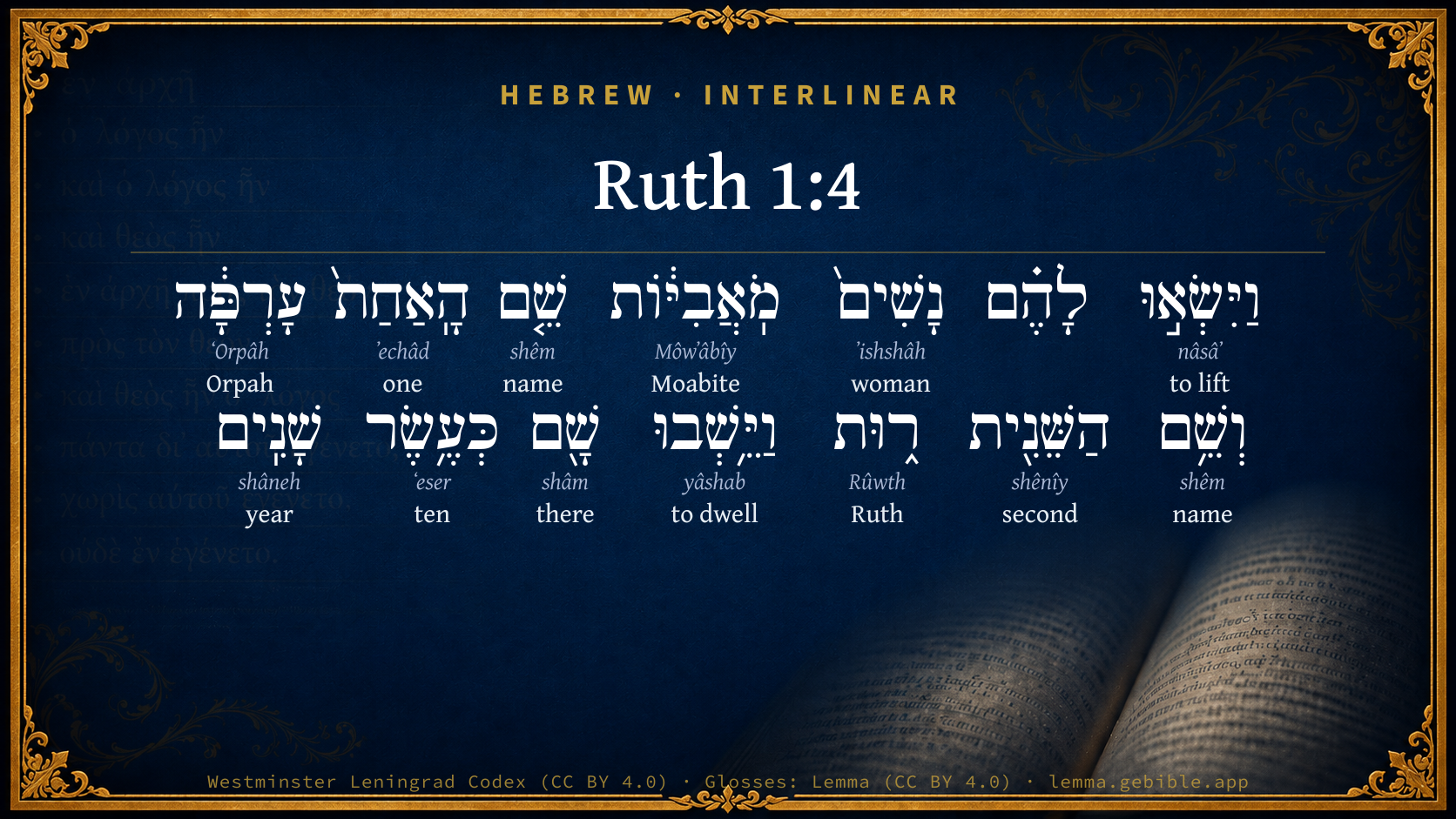
Hebrew (Westminster Leningrad Codex) Ruth 1:4 appears in the Hebrew Old Testament. The text above is from the Westminster Leningrad Codex. Each word links to its Strong’s number, a concise gloss, and parsing drawn from the Open Scriptures Hebrew Bible morphology. Click any word for its full Brown-Driver-Briggs (BDB) entry.
Download image
Cite this verse

Ruth 1:4 (World English Bible). Public Domain. Lemma interlinear Bible study tool, https://lemma.gebible.app/v/ruth/1/4.

Show BibTeX & RIS
BibTeX
RIS
English Translation
They took them wives of the women of Moab; the name of the one was Orpah, and the name of the other Ruth: and they lived there about ten years.
World English Bible · Public Domain
Highlights
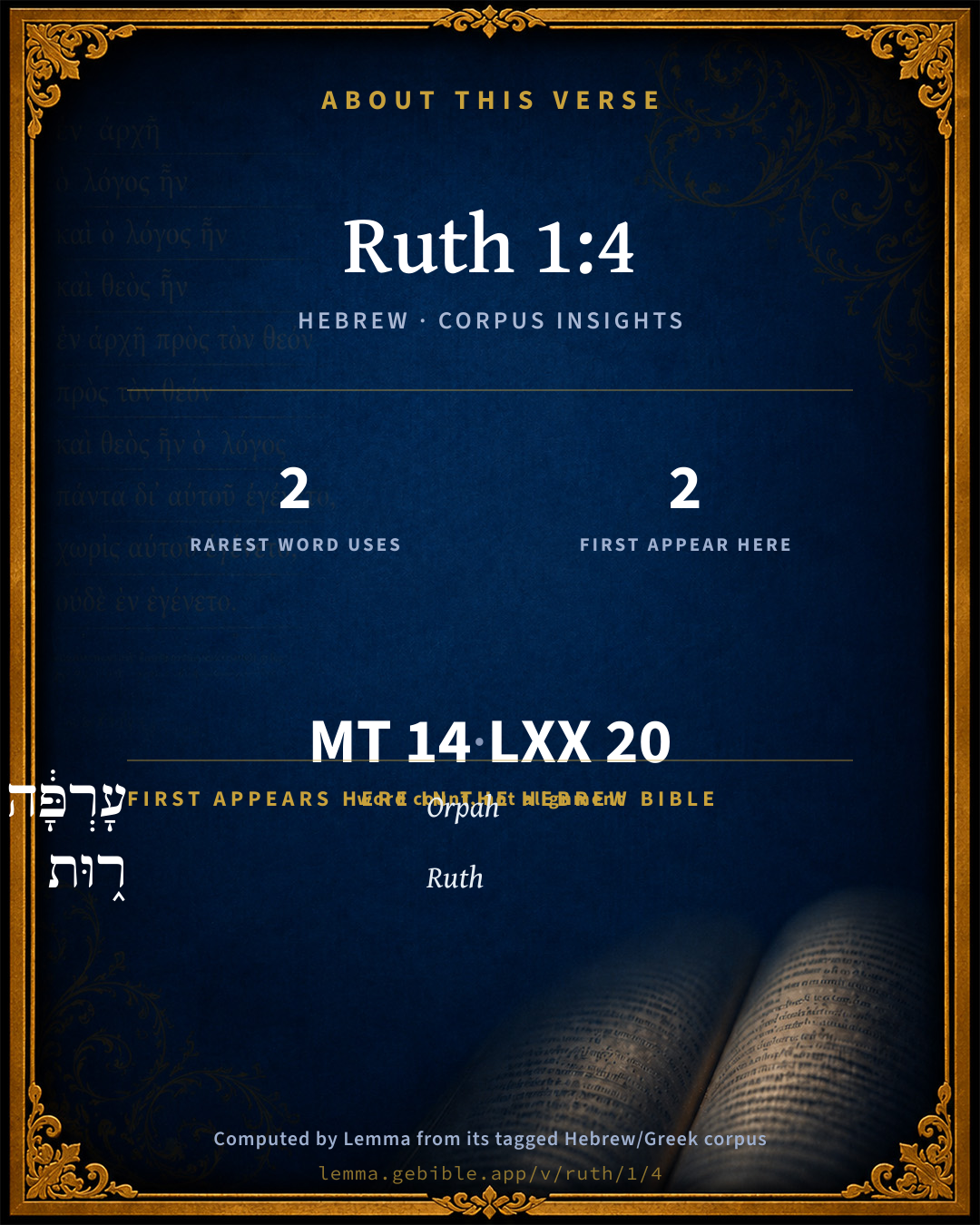
  • 2 first appearances in the Hebrew Bible
Full analysis ↓
Download a study sheet

One document with this verse’s original text, its word-by-word gloss line, the meaning frame, cross-references with their text, attributed commentary, and full source and license credits — printable, and it pastes into notes with its structure intact.

This verse Autodidact and up

Study sheet (.html) Plain text (.txt)

A passage Seminary Student

Up to 50 verses in one chapter. A passage sheet keeps up to 6 commentary sources and 12 cross-references per verse, in the order this page ranks them, and says so on the sheet whenever that leaves anything out. Ask for a single verse and you get the Autodidact verse sheet above.

Everything on this page stays free to read, with no account — the sheet is a download of what is already on screen, not access to it.

Want to remove ads? Support Godless Engineer
Compare translations 3

The same verse in 3 English versions, stacked beneath the original-language interlinear above. Click any original word for its lexicon entry.

Each is an independent rendering of the whole verse — the interlinear is not word-aligned to these translations.

Highlighted words mark where these versions differ — a whole-verse word diff, not a word-by-word alignment.

  • World English Bible Public Domain
    They took them wives of the women of Moab; the name of the one was Orpah, and the name of the other Ruth: and they lived there about ten years.
  • King James Version Public Domain
    And they took them wives of the women of Moab; the name of the one was Orpah, and the name of the other Ruth: and they dwelled there about ten years.
  • unfoldingWord Literal Text CC BY-SA 4.0
    And they took wives for themselves from the women of Moab; the name of the first woman was Orpah, and the name of the second woman was Ruth. And they lived there for about ten years.

unfoldingWord Literal Text — © unfoldingWord, licensed CC BY-SA 4.0. Word-aligned USFM3 via Door43 (git.door43.org/unfoldingWord/en_ult).

Versions to compare (up to 4)

3 of 4 selected

Show all 18 translations

Every available English version of this verse, each an independent rendering of the whole verse.

  • World English Bible Public Domain
    They took them wives of the women of Moab; the name of the one was Orpah, and the name of the other Ruth: and they lived there about ten years.
  • Berean Standard Bible Public Domain
    who took Moabite women as their wives, one named Orpah and the other named Ruth. And after they had lived in Moab about ten years,
  • Majority Standard Bible Public Domain
    who took Moabite women as their wives, one named Orpah and the other named Ruth. And after they had lived in Moab about ten years,
  • King James Version Public Domain
    And they took them wives of the women of Moab; the name of the one was Orpah, and the name of the other Ruth: and they dwelled there about ten years.
  • American Standard Version (1901) Public Domain
    And they took them wives of the women of Moab; the name of the one was Orpah, and the name of the other Ruth: and they dwelt there about ten years.
  • Revised Version (1885) Public Domain
    And they took them wives of the women of Moab; the name of the one was Orpah, and the name of the other Ruth: and they dwelled there about ten years.
  • Geneva Bible (1599) Public Domain
    Which tooke them wiues of the Moabites: the ones name was Orpah, and the name of ye other Ruth: and they dwelled there about ten yeeres.
  • Douay-Rheims (1899) Public Domain
    And they took wives of the women of Moab, of which one was called Orpha, and the other Ruth. And they dwelt there ten years.
  • Young's Literal Translation Public Domain
    and they take to them wives, Moabitesses: the name of the one `is' Orpah, and the name of the second Ruth; and they dwell there about ten years.
  • Literal Standard Version CC BY-SA 4.0
    and they take to them wives, Moabitesses: the name of the first [is] Orpah, and the name of the second Ruth; and they dwell there about ten years.
  • Unlocked Literal Bible CC BY-SA 4.0
    These sons took wives from the women of Moab; the name of one was Orpah, and the name of the other was Ruth. They lived there for about ten years.
  • unfoldingWord Literal Text CC BY-SA 4.0
    And they took wives for themselves from the women of Moab; the name of the first woman was Orpah, and the name of the second woman was Ruth. And they lived there for about ten years.
  • Darby Bible Public Domain
    And they took them Moabitish wives; the name of the one was Orpah, and the name of the second Ruth: and they abode there about ten years.
  • World Messianic Bible Public Domain
    They took for themselves wives of the women of Moab. The name of the one was Orpah, and the name of the other was Ruth. They lived there about ten years.
  • Webster's Bible Public Domain
    And they took to themselves wives of the women of Moab; the name of the one was Orpah, and the name of the other Ruth: and they dwelt there about ten years.
  • Free Bible Version CC BY-SA 4.0
    The sons married Moabite women. One was called Orpah, the other was called Ruth. After about ten years,
  • Bible in Basic English Public Domain
    And they took two women of Moab as their wives: the name of the one was Orpah, and the name of the other Ruth; and they went on living there for about ten years.
  • JPS Tanakh (1917) Public Domain
    And they took them wives of the women of Moab: the name of the one was Orpah, and the name of the other Ruth; and they dwelt there about ten years.

Literal Standard Version (2020), Covenant Press — licensed CC BY-SA 4.0. Text via the HelloAO Bible API (eBible.org). Unlocked Literal Bible (unfoldingWord) — licensed CC BY-SA 4.0. Text via the HelloAO Bible API (eBible.org). unfoldingWord Literal Text — © unfoldingWord, licensed CC BY-SA 4.0. Word-aligned USFM3 via Door43 (git.door43.org/unfoldingWord/en_ult). Free Bible Version, Dr. Jonathan Gallagher — licensed CC BY-SA 4.0. Text via the HelloAO Bible API (eBible.org).

Word by word

More ways to search: Search by grammar → Find every occurrence → Compare this word →

Practice this passage: Drill this verse → Learn its vocabulary →

עָרְפָּ֔ה
ʻOrpâh
H6204
“Orpah”
Noun, Proper
Part of Speech
Noun
Type
Proper
Full BDB Definition

Origin: from H6203

TWOT: None

Orpah = "gazelle" - a Moabite woman, wife of Chilion, the son of Naomi, and sister-in- law of Ruth
  1. וַיִּשְׂא֣וּ nâsâʼ H5375 “and · to lift” Conjunction + Verb, Qal, Sequential Imperfect, 3rd Person, Masculine, Plural
  2. נָשִׁים֙ ʼishshâh H802 “women” Noun, Common, Feminine, Plural, Absolute
  3. מֹֽאֲבִיּ֔וֹת Môwʼâbîy H4125 “Moabites” Noun, Gentilic, Feminine, Plural, Absolute
  4. שֵׁ֤ם shêm H8034 “name of” Noun, Common, Masculine, Singular, Construct
  5. הָֽאַחַת֙ ʼechâd H259 “the · one” Particle, Definite Article + Adjective, Cardinal number, Feminine, Singular, Absolute
  6. וְשֵׁ֥ם shêm H8034 “and · name of” Conjunction + Noun, Common, Masculine, Singular, Construct
  7. הַשֵּׁנִ֖ית shênîy H8145 “the · second” Particle, Definite Article + Adjective, Ordinal number, Feminine, Singular, Absolute
  8. ר֑וּת Rûwth H7327 “Ruth” Noun, Proper
  9. וַיֵּ֥שְׁבוּ yâshab H3427 “and · to dwell” Conjunction + Verb, Qal, Sequential Imperfect, 3rd Person, Masculine, Plural
  10. שָׁ֖ם shâm H8033 “there” Adverb
  11. כְּעֶ֥שֶׂר ʻeser H6235 “like/as · ten” Preposition + Adjective, Cardinal number, Feminine, Singular, Absolute
  12. שָׁנִֽים shâneh H8141 “years” Noun, Common, Feminine, Plural, Absolute

About this verse

These counts appear in no published source. They are computed here, from the morphology-tagged text and Lemma’s own curated glosses. What Lemma adds →

14
words
12
distinct lemmas
Historical
section

Notable vocabulary

The rarest word here is עָרְפָּ֔ה Orpah H6204 — appearing just 2 times in the whole Hebrew Bible.

First appearance in Scripture

These words make their first canonical appearance in the Hebrew Bible here:

  • עָרְפָּ֔ה Orpah H6204
  • ר֑וּת Ruth H7327

Shared distinctive vocabulary

עָרְפָּ֔ה Orpah H6204 occurs in 2 verses of the Hebrew Bible. Also found in:

Grammatical profile

  • 2 verbs
  • 7 nouns
  • 3 adjectives
  • 1 preposition
  • 1 adverb

Verb forms

  • וַיִּשְׂא֣וּ Qal · Sequential Imperfect
  • וַיֵּ֥שְׁבוּ Qal · Sequential Imperfect

Repetition

A word recurs within this verse — often emphatic in Hebrew:

  • שֵׁ֤ם name H8034 ×2

Hebrew & Septuagint length

In English translation the verse runs 30 words from the Hebrew and 30 from the Septuagint (LXX English) — the same length.

A rough comparison of the two English renderings, which tokenize alike — not a word-level alignment.

Word counts can differ between the Hebrew and the Greek without any difference in meaning — e.g. the Hebrew direct-object marker אֵת has no separate Greek word, and Greek often adds the article ὁ.

In the original languages it is 14 Hebrew tokens and 20 Greek tokens — but the two are counted differently (Hebrew bundles its prefixes and suffixes into one token; the Greek is in lemma form), so that isn’t a like-for-like length.

Cross-references

4

Topical passages linked to Ruth 1:4 in the Treasury of Scripture Knowledge — connected by theme and wording, ordered by reader-vote popularity; previews shown in the World English Bible.

  • Matthew 1:5 Salmon became the father of Boaz by Rahab. Boaz became the father of Obed by Ruth. Obed became the father of Jesse.
  • Deuteronomy 7:3 neither shall you make marriages with them; your daughter you shall not give to his son, nor his daughter shall you take to your son.
  • Deuteronomy 23:3 An Ammonite or a Moabite shall not enter into the assembly of Yahweh; even to the tenth generation shall none belonging to them enter into the assembly of Yahweh forever:
  • 1 Kings 11:1–2 Now king Solomon loved many foreign women, together with the daughter of Pharaoh, women of the Moabites, Ammonites, Edomites, Sidonians, and Hittites;

Cross-references courtesy of OpenBible.info (CC BY 4.0).

Hebrew and Greek witnesses Masoretic Hebrew ↔ Greek Septuagint

The same verse in the two great witnesses to the Old Testament, shown verse-for-verse.

These are two independent witnesses, not word-aligned to each other, and the Septuagint is shown in lemma (dictionary) form.

Hebrew Ruth 1:4 Masoretic · Westminster Leningrad Codex

וַיִּשְׂא֣וּ לָהֶ֗ם נָשִׁים֙ מֹֽאֲבִיּ֔וֹת שֵׁ֤ם הָֽאַחַת֙ עָרְפָּ֔ה וְשֵׁ֥ם הַשֵּׁנִ֖ית ר֑וּת וַיֵּ֥שְׁבוּ שָׁ֖ם כְּעֶ֥שֶׂר שָׁנִֽים

They took them wives of the women of Moab; the name of the one was Orpah, and the name of the other Ruth: and they lived there about ten years.

World English Bible · Public Domain

Greek LXX Ruth 1:4 Septuagint · lemma form

καί λαμβάνω ἑαυτοῦ γυνή μωαβῖτις ὄνομα ὁ εἷς ορφα καί ὄνομα ὁ δεύτερος ρουθ καί καταοἰκέω ἐκεῖ ὡς δέκα ἔτος

And they took to themselves wives, women of Moab; the name of the one was Orpha, and the name of the second Ruth; and they lived there about ten years.

LXX2012 (modern English Septuagint) · Public Domain

Hebrew: Westminster Leningrad Codex (CC BY 4.0). Greek: Septuagint (public domain); English from LXX2012 (modern English Septuagint) (Public Domain). How the Septuagint differs from the Hebrew →

Commentary

Notes on Ruth 1:4 from classic Christian and Jewish commentators (each source and its license shown beneath its notes). The classic Christian expositions comment on the surrounding passage and are grouped to its opening verse, so a note may address several verses; the Jewish commentaries on the Tanakh (Rashi and others) are per-verse, so they appear only where the commentator wrote on this verse.

Lemma curates 59 commentaries, every one of them public domain or Creative Commons licensed, each selected and text-cleaned for this edition rather than reprinted as found. About our sources →

Trapp's Complete Commentary

John Trapp

Rth 1:4 And they took them wives of the women of Moab; the name of the one [was] Orpah, and the name of the other Ruth: and they dwelled there about ten years.

Ver. 4. And they took them wives of the women of Moab.] Which haply they had not been suffered to do if their father had lived: their mother, it may be, could as little hinder it, as Rebekah Esau’s marrying those daughters of Heth. But God had a holy hand in it: he ordereth the disorders of men to his own glory.

The name of the one was Orpah.] She was Chilion’s wife, as Ruth was Mahlon’s; {Rth 4:10} whether they were sisters is uncertain, but sure enough they were not King Eglon’s daughters, as the Chaldee Paraphrast thinketh.

And they dwelt there about ten years.] A sore affliction to Naomi no doubt. See Psa 120:5. Lord - said a certain good woman on her deathbed, and in trouble of mind, - send me not to hell among the wicked; for thou knowest I could never in all my life like their company.

John Trapp, A Commentary or Exposition upon All the Books of the Old and New Testament (1647–1656) — public domain. Text from a community e-Sword module.

The Biblical Illustrator

Joseph S. Exell

Rth_1:4

They took them wives of the women of Moab.

Sinful marriages

The sin of these young men in marrying strange women is not expressly denounced as a sin in the story, although it is denounced in the Targum, which commences Rth_1:4 thus: They transgressed the commandment of the Lord, and took foreign wives from among the daughters of Moab. But no one can read the Old Testament without feeling that they sinned against the law, for to the Hebrews marriage was a religious covenant; and St. Paul does but utter an admitted and familiar truth when he asks, What fellowship has light with darkness, or Belial with God? The reason of the law is given in the passage just cited from Deuteronomy--they will turn away thy children from Me, and they will serve false gods. The daughters of Moab were specially obnoxious to the faithful Israelites. They appear to have been among the most fascinating, and the most wanton and profligate, women of antiquity. Their gods--Chemosh, Moloch, Baal-peor--were incarnations of lust and cruelty. They demanded human sacrifices. Children were cast into their burning arms. In their ritual sensuality was accounted piety. True, Mahlon and Chilion were exceptionally fortunate in their wives. They were not turned to the service of false gods, though there was grave reason to fear that they might be; but, on the other hand, neither did they turn their wives to the service of the only true God. It was not till after her husbands death that Ruth learned to take shelter under the wings of the Lord God of Israel (Rth_2:12); and Orpah, as we are expressly told (Rth_1:15), went back to her people and her gods.(S. Cox, D. D.)

In the country of Moab

It is wonderful how soon and how easily one gets used to a change of circumstances when the change itself is brought about gradually. The country of Moab, into which Elimelech and his family had journeyed, had of course its own language, its own fashions, and its own religion too, and these were as dissimilar as possible from those of the country which they had just now left. Yet the new-comers were in no serious sense shocked by what they saw and heard--had they so been they would have retraced their steps without delay; but each day brought its own novelty, and they managed to accustom themselves to the new things of to-day before it became necessary to face those of the morrow. Looking calmly at our fashion of living and way of acting now, some of us are compelled to admit how much we have changed in recent years; we never guessed that the alteration was so great or so complete; we never meant to have come so far. Worst of all, we never thought we should have felt the change so little. We remember well the qualms of conscience by which we were troubled when first we commenced to wander: we recollect now how the protests of our heart became fainter and fainter day by day until they ceased to be anything more than a hardly audible whisper. We went to sojourn in the country of Moab: we came into the country of Moab, and continued there. To begin with, our intentions were purely selfish, as selfish as were those of Lot when he elected to pitch his tent toward Sodom. We were going to get what we could out of Moab; they who lived there had something that we coveted, and we determined to make them share it with us. And, moreover, we had no serious intention of giving Moab anything in return. It is, indeed, just possible that at one time we may have possessed the Quixotic idea of remodelling life in Moab to suit our own ideas, but if so we soon abandoned the idea; for on the one hand we found that Moab was not willing to be remodelled--indeed, when we faintly suggested something of the kind, they said to us, as Sodom had said to Lot, and with not a little point, Stand back; this one came in to sojourn, and he will needs be a judge; and on the other hand, our own opinions were neither sufficiently clear in our own minds nor dear to our own hearts to enable us to graft them upon others. We were somewhat surprised, it may be, and a little pained, at the way in which our new neighbours received our well-meant attempts, in the early days of our life in Moab, to bring before them the advantages of a life of obedience and surrender to God. If Bethlehem was such a charming place, and the life there so delightful, why did you exchange it for our country? they not unnaturally inquired; if Bethlehem did not satisfy you, how can you suppose that it will satisfy us? Nor may we forget that in leaving the land of promise the wanderer never intends to be absent for other than a short period. If, on parting from our true home, any one had suggested that we should have been found in Moab to-day, we should have denied the imputation with indignation. Yet here we are still; and here in His great mercy the Good Shepherd has found us, and hence He desires to carry us home again--to our home and His. So they came into the country of Moab, and appear to have been received there with courtesy and hospitality. The world is always glad when those who have been making a somewhat definite profession of devotion to God show signs of a desire to relax the strictness of their behaviour; it is always willing to meet such persons more than half-way, and to do its best to enable them to quiet the still struggling conscience with as little delay as possible. If the world would only persecute us when it finds us on its own ground, there would be some hope that our stay in Moab would prove short indeed. Not that the world is any more prompted by unselfishness in its reception of us than were we ourselves in our journey to Moab; our new friends rejoice that, by our change of front, another protest against their way of life has died a natural death, and they are only too glad to be present and assist at its obsequies; they are, moreover, clear-sighted enough to see without being told that our surrender is a tacit victory for the world and indifferentism, and pro tanto a defeat for the gospel and a discredit to the life of faith in Christ. (H. A. Hall, B. D.)

Alternation of shadow and sunshine in life

And thus the world moves on--deaths and marriages, marriages and deaths. The household which to-day mourns as though all joy had taken flight for ever to-morrow resounds with the laughter of many voices at a newborn happiness. The faces all tear-stained yesterday are bright with smiles to-day. The bell which slowly tolled the funeral knell an hour ago now rings out the joyous wedding chime. So it must be, so it ought to be. Probably life would lose half its beauty but for this alternation of shadow and sunshine; at least, this we know, that human hearts need both the darkness and the light, or they will not grow to that perfection of truth and purity which God has designed they shall attain. Elimelech died, the sons married. It is a simple statement, yet a whole world of change is involved in it for that small household. (W. Braden.)

The Biblical Illustrator, edited by Joseph S. Exell (c. 1880s–1900s) — public domain. Text from a community e-Sword module.

Joseph Benson's Commentary

Rth 1:4. They took them wives of the daughters of Moab — Either these women were proselytes when they married them, which what is afterward recorded of Ruth (Rth 1:16) renders very probable, or they sinned in marrying them, and therefore might be punished with short lives and want of issue. The Chaldee paraphrast declares for the latter opinion. “Their days were cut short,” says he, “because they married strange women.”

Joseph Benson's Commentary on the Old and New Testaments (1811–1818) — public domain. Text from a community e-Sword module.

Tyndale Open Study Notes

Tyndale Open Resources

1:4 Kilion married . . . Orpah; Mahlon married Ruth (see 4:10).

Tyndale Open Study Notes — © Tyndale Open Resources, licensed CC BY-SA 4.0. Text via the HelloAO Bible API.

Geneva Bible (1599)

Geneva Bible translators

By this wonderful providence of God Ruth became one of God’s household, of whom Christ came.

Geneva Bible (1599) marginal notes — public domain. Text via Bolls.life.

Adam Clarke's Commentary

Verse 4. And they took them wives] The Targum very properly observes, that they transgressed the decree of the word of the Lord, and took to themselves strange women.

Adam Clarke's Commentary on the Bible (1810–1826) — public domain. Text from a community e-Sword/MySword module.

Ellicott's Commentary for English Readers

(4) They took them wives.—This seems to have been after the father’s death. The fault of settling on a heathen soil begun by the father is carried on by the sons in marrying heathen women, for such we cannot doubt they must have been in the first instance. The Targum (or ancient Chaldee paraphrase) says: “They transgressed against the decree of the Word of the Lord, and took to themselves strange wives.” This act was to incur a further risk of being involved in idolatry, as King Solomon found.

Ruth.—This name will mean either “comeliness” or “companion.” according to the spelling of which we suppose the present name to be a contraction. The Syriac spelling supports the latter view. Ruth was the wife of Mahlon (Rth_4:10), apparently the elder sou. The Targum calls Ruth the daughter of Eglon, king of Moab, obviously from the wish to exalt the dignity of Ruth.

A Bible Commentary for English Readers, edited by Charles John Ellicott (1878–1897) — public domain. Text from a community e-Sword module.

The Cambridge Bible for Schools and Colleges

gen. ed. J. J. S. Perowne

4. took them wives] The idiom is a late one, 2Ch_11:21, Ezr_9:2; Ezr_9:12, Neh_13:25 etc.; see Introd. p. xv. It is uncertain whether the names of the two wives have any bearing upon the parts which they play in the story. The Midrash Rabbah on this Book explains that Orpah was so called ‘because she turned her neck (‘oreph) on her mother in law’; possibly the name may=‘obstinacy’ (cf. stiffnecked, Exo_32:9 etc.). Equally doubtful is the significance of Ruth; if the name is shortened from re‘uth, as it is written in Syriac, it will be the fem. of Re’u (Gen_11:18 ff.), and may mean ‘friendship.’ We cannot, therefore, feel sure that the writer invented the names; he may have derived them from tradition.

The Cambridge Bible for Schools and Colleges (gen. ed. J. J. S. Perowne; Cambridge University Press, 1878–1918) — public domain. Text from a community e-Sword module.

John Gill's Exposition

And they took them wives of the women of Moab,.... Not before they were proselyted to the Jewish religion, as Aben Ezra thinks, and which seems plainly to be the case of Ruth; at least she was so afterwards, if not before; and also of Orpah, as the same writer concludes from Rut 1:15 though others are of a different opinion, and some excuse their marriage, and others condemn it as unlawful, among whom is the Targumist, who paraphrases the words,"and they transgressed the decree of the Word of the Lord, and took to them strange wives of the daughters of Moab;''however it was so permitted by the Lord, and ordered in Providence, that from one of them the Messiah might spring:

and the name of the one was Orpah; she was married to Chilion; and Alshech gathers from hence that the youngest was married first before his brother:

and the name of the other Ruth the Targum adds,"the daughter of Eglon, king of Moab;''and that she was his daughter, or the daughter of his son, is a notion commonly received with the Jews (y) though without any just foundation; she was married to Mahlon, Rut 4:10, one Philo (z) asserts these two women to be own sisters, for what reason does not appear; and a Jewish writer (a) says they were both daughters of Eglon, king of Moab: and they dwelt there about ten years; that is, Mahlon and Chilion, who married these women; which is to be reckoned either from the time they came into the land, or from the time of their marriage; the latter seems to be the case from the connection of the words.

(y) T. Bab. Nazir, fol. 23. 2. Sotah, fol. 47. 1. Sanhedrin, fol. 105. 2. Horayot, fol. 10. 2. Zohar in Deut. fol. 109. 2. (z) Apud Drusium in loc. (a) Shalshalet Hakabala, fol. 8. 1.

John Gill's Exposition of the Whole Bible (1746–1763) — public domain (CC PDM 1.0). Text via the HelloAO Bible API.

Albert Barnes' Notes on the Bible

Marriages of Israelites with women of Ammon or Moab are nowhere in the Law expressly forbidden, as were marriages with the women of Canaan Deu 7:1-3. In the days of Nehemiah the special law Deu 23:3-6 was interpreted as forbidding them, and as excluding the children of such marriages from the congregation of Israel Neh 13:1-3. Probably the marriages of Mahlon and Chilion would be justified by necessity, living as they were in a foreign land. Ruth was the wife of the older brother, Mahlon Rth 4:10.

Albert Barnes' Notes on the Bible (1834–1885) — public domain. Text from a community e-Sword/MySword module.

Haydock's Catholic Bible Commentary

Ruth was the wife of Mahalon; (chap. iv. 10,) and signifies one "well watered, (Menochius) or inebriated," &c. (Haydock) --- The sons of Noemi were excused by necessity in marrying idolaters, though they ought to have done their best to convert them. The Chaldean greatly condemns their marriage, and thinks that their death was in punishment of their prevarication, Deuteronomy vii. 3., and xx. 11. (Calmet) --- Salien is of the same opinion. So various have always been the sentiments of people on this head! (Haydock) See Serarius, q. 11.

George Leo Haydock (1774–1849), Haydock's Catholic Family Bible and Commentary, 1859 edition — public domain. Excludes Psalms (Douay-Rheims chapter numbering differs from Protestant) and Deuterocanonical books (Catholic canon only).

Matthew Poole's English Annotations

Of the women of Moab; either these were proselytes when they married them, which may well be doubted, from Rth 1:15, or they sinned in marrying them, as appears from Deu 7:3; 23:3; Ezr 9:1,2; Ne 13:23, and therefore were punished with short life and want of issue, Rth 1:5,19,21.

About ten years; as long as the famine lasted.

Matthew Poole's English Annotations on the Holy Bible (1683–1685) — public domain. Text from a community e-Sword/MySword module.

Whedon's Commentary on the Bible

Daniel D. Whedon

4. They took them wives — “A kind of phrase,” says Kitto, “which usually occurs in a bad sense, as done without the concurrence of their parents, or not left so entirely to them as custom required.”

Of the women of Moab — The law condemned intermarriages with the Canaanitish tribes, but, inasmuch as Israel and Moab were descended from kindred ancestors, Abraham and Lot, not with the daughters of the Moabites, (Deu_7:3;) it commanded, however, that no Moabite, even to the tenth generation, should enter the congregation of the Lord. Deu_23:3. In the days of Ezra and Nehemiah the law was so construed as to prohibit all intermarriage with foreigners. Exodus 9, and Nehemiah 13.

But it was a distinguishing feature of the age of the Judges that every man did that which was right in his own eyes, (Jdg_17:6;) the law was not enforced, and men forgot the commandments of the Lord and indulged in such looseness as even to intermarry with the idolatrous Canaanites. See Jdg_3:5-6.

In this marriage of Ruth, the Moabitess, and Mahlon, the Beth-lehemite, we may now see the overruling hand of Providence, by which a Gentile woman is adopted into the family from which Christ had his human lineage, thus typifying the reception of the Gentiles into the kingdom of the Messiah, and the elevation, by the Gospel, of different nations above narrow sectional prejudices and partition-walls into feelings of a common brotherhood. “The story of Ruth has shed a peaceful light over what else would be the accursed race of Moab. We strain our gaze to know something of the long line of the purple hills of Moab, which form the background at once of the history and of the geography of Palestine. It is a satisfaction to feel that there is one tender association which unites them with the familiar history and scenery of Judea — that from their recesses, across the deep gulf which separates the two regions, came the Gentile ancestress of David and the Messiah.” — Stanley.

Daniel D. Whedon (gen. ed.), Commentary on the Old and New Testaments (1874–1909) — public domain. Text from a community e-Sword module.

The Pulpit Commentary

And they took to themselves wives of the women of Moab. It was their own act. Josephus, reproducing the narrative from memory, represents the event as occurring in the father"s lifetime, and as brought about by his arrangement. He says of Elimelech, "Coming into the territory of Moab, he sojourns there, and, things pros-paring according to his mind, he gives in marriage to his sons (agetai toiv uioiv ) Moabitish wives." Theological critics have here again raised the question, Was it sinful in these emigrant Hebrews to take in marriage daughters of the land? The Chaldee Targumist did not hesitate in his decision. He begins his paraphrase of the verse, thus they transgressed the edict of the word of the Lord, and took to themselves alien wives of the daughters of Mesh." Dr. Thomas Fuller represents Naomi as passionately remonstrating with her sons. He says of himself, My mouth denieth to be the orator of an unjust action." "Nothing can be brought," he adds, "for the defense of these matches. Something may be said for the excuse of them, but that fetched not from piety, but from policy." It is note worthy, however, that in the text itself, and throughout the entire Book, there is nothing of the nature of condemnation, not the least hint of blame. There was a law, indeed, which laid an interdict upon marriages with Canaanites. (see Deu_7:3) But these Canaanites occupied a peculiar relation to the Hebrews. They were within the line of that Canaan which had become the land of Israel. Israelites and Canaanites were thus living within the same borders as rival claimants of the same territory. It was no wonder that the Canaanites" claim was not to be recognized by the Hebrews. The Moabites, however, living within the lines or "coasts" of their own distinct territory, stood in quite a different relation. And while, for purity"s sake, great restrictions were to be laid upon all overtures for naturalization, (Deu_23:3-6) yet the law could never he intended to apply to the families of Hebrews who were settlers in Moab, or to Moabitish females living in their own land, and rather awarding than seeking the prerogatives" of natives. The name of the one was Orpah, and the name of the other Ruth. No doubt native Moabitish names. Much ingenuity has been expended on that of the more interesting person. Some have unwarrantably assumed that Ruth is a contraction of the Hebrew word tWr meaning a female companion or friend. Still more unwarrantable, though more captivating to the aesthetic imagination, is the signification which is given to the word by Weruer and Eadie, namely, beauty. It is founded on an impossible derivation from the Hebrew har. Still more aesthetically captivating is the conjecture of Cassel, that the name is the ancient Semitic form of the Indo-European word rodon or rose. "At all events," says he, "the thought of Ruth as the Rose of Moab is in itself too attractive not to be proposed as a conjecture." It is certainly, most attractive and most admirable as a jeu d"esprit, but too imaginative to be vindicated on grounds of comparative philology. And they dwelt there. Or, "settled themselves there; literally, "sat them." We still call a gentleman"s mansion his seat. About ten years, which, however, are treated by the writer as a mere blank in his story. He hastens on.

Marriage.

The notes of time found in this narrative are meager. It is not easy to decide to what the "ten years "here mentioned refer. After the death of Elimelech, the two sons were spared to be the occupation and the solace of the widow"s life. Naomi saw them grow up to manhood. Then the young men "took them wives of the women of Moab.

I MARRIAGE IS LAWFUL BETWEEN PERSONS OF DIFFERENT NATIONS. There was nothing in the law of Moses to prevent these young men from acting as they did, although the children of Israel were not allowed to intermarry with the Canaanites. Later in Jewish history Nehemiah interpreted the law as forbidding marriage with the children of Moab, But he seems to have acted with unjust severity. These Moabitish women were virtuous, kind, devoted; conformed to the religion of their husbands, and one of them found a solid satisfaction in the worship of Jehovah. The conduct of the young men seems to have been natural and blameless.

II MARRIAGE SHOULD ONLY BE-ENTERED UPON AFTER SERIOUS AND PRAYERFUL DELIBERATION, AND WITH A CONVICTION OF ITS ACCEPTABLENESS TO GOD. Sensible and Christian people should discountenance the practice of treating marriage with levity. Consideration should be given to time, to circumstances, and, above all, to character. Confidence and esteem must be, with affection, the basis of wedded happiness; and these cannot exist in their completeness where there is dissimilarity of conviction and aim where one party is living to the world, and the other would live unto the Lord. Error here involves misery, and perhaps disaster and ruin.

Lessons:

1. Let elders inculcate just views of the marriage relationship upon the young.

2. Let the young avoid committing themselves to a contract of marriage until a fair experience of life has been acquired.

3. Let Christians marry "only in the Lord. T.

Vers. 4, 5. A foreign land.

"And they dwelled there about ten years." Memorable years! Marriages and births had given place to separation and bereavement. Elimelech the father died; so also did the two sons Mahlon and Chillon. Thus we have the sad picture of three widows.

I WE CAN FLY FROM FAMINE, BUT NOT FROM DEATH. We need not enter upon the argument of some expositors, as to whether Elimelech did right to leave Bethlehem; whether by famine is not meant insufficiency of plenty rather than actual want. We must be content with the fact that he thought it prudent and wise to go. And now with fullness of bread came the saddest experience of all. How often it happens that when circumstances improve, those we hoped to enjoy them with are taken away. We climb the hill together, and then with new and fair prospect comes the desolation of death amid the beauties and blessings of earth and sky. These are darker clouds than covered them in Bethlehem. We never know how dear are the living till they are gone; then we see it was their presence that gave life and peace to so many scenes, that gave inspiration to labor and sweetness to success.

II TROUBLES OFTEN COME WAVE UPON WAVE. Ten years! and lo, three out of the four pilgrims are at rest. No more fatigue, no more distress for them. True; but those that are left! What of them? It is often easier to go than to remain. It is all summed up in the consciousness, I have but to live, and to live without them. Nor is this a morbid feeling. It is a most sacred emotion. True, time will alleviate; but there will always be graves in the heart, and men and women who have lost their beloved ones can never be the same again. Character will be softened, purified, elevated. Heaven will be nearer and dearer to the heart. Ten years! How fleetly they fly, and yet what a long volume of experience may be bound up in them.

III EVERY HOME IS BUT AS A TENT LIFE. They dwelled there. Got used to the new people, the new skies, the new ways. After a time, to a family removed to another shore, there are always some tendrils gathering round the place, and in time they feel in leaving that a sense of loss. Strange as it all seemed at first, in time touches of experience make it homelike to them. Still the old first home, the dear village of childhood and youth, nestles in the heart. How many in life"s evening like to go back and live near the abode of the morning. We dwell! So it seems; and we look at the picture of the world"s life-pilgrimage as though, like some panorama, it was all outside us. But we pass onward too, and ere long grey hairs are here and there upon us, though we know it not. At times we look back. Ten years! And their experience is within us, as well as behind us. W.M.S.

The Pulpit Commentary (1880–1919), ed. H.D.M. Spence-Jones & Joseph S. Exell — public domain. Text from a community e-Sword module.

John Wesley's Explanatory Notes

Took wives - Either these were Proselytes when they married them, or they sinned in marrying them, and therefore were punished with short life, and want of issue.

John Wesley, Explanatory Notes Upon the Whole Bible (1754–1765) — public domain. Text via the GEBible commentary corpus.

Lesson kit

Teaching starters — assembled from the data on this page, not authored interpretation. Every prompt links to the verse data it draws on. Edit before teaching.

Ruth, in the Historical, opens this verse with 14 words (12 distinct Hebrew lemmas). Its most distinctive word is ʻOrpâh (“Orpah”). A historical commentator’s framing appears above. Read the whole chapter for the surrounding context.

Discussion questions

  1. The word ʻOrpâh carries the sense “Orpah.” How does it shape the verse?
  2. 2 words here appear for the first time in Scripture. What is being introduced at this debut?
  3. Ruth 1:14 shares the word «Orpah» with this verse. How do the two illuminate each other?
  4. “name” occurs 2× in this one verse. What is the effect of the repetition?
  5. These translations render this verse differently. What is at stake in choosing one wording over another?
  6. The verb «וַיִּשְׂא֣וּ» is Qal Sequential Imperfect. How does its form color the action?
  7. Reading how Trapp's Complete Commentary and The Biblical Illustrator read this verse, where do the two commentators agree and where do they part?

Things to notice

Reading settings

Reading text

Shown beneath each verse's original-language words.

Old Testament
Old Testament edition

Read the OT as the Masoretic Hebrew (MT) or the Greek Septuagint (LXX).

English shown for the Greek Septuagint (in the Hebrew ↔ Greek comparison).

Comparing translations? Open the Compare panel on any verse page to stack up to four side by side.