Genesis 7:17

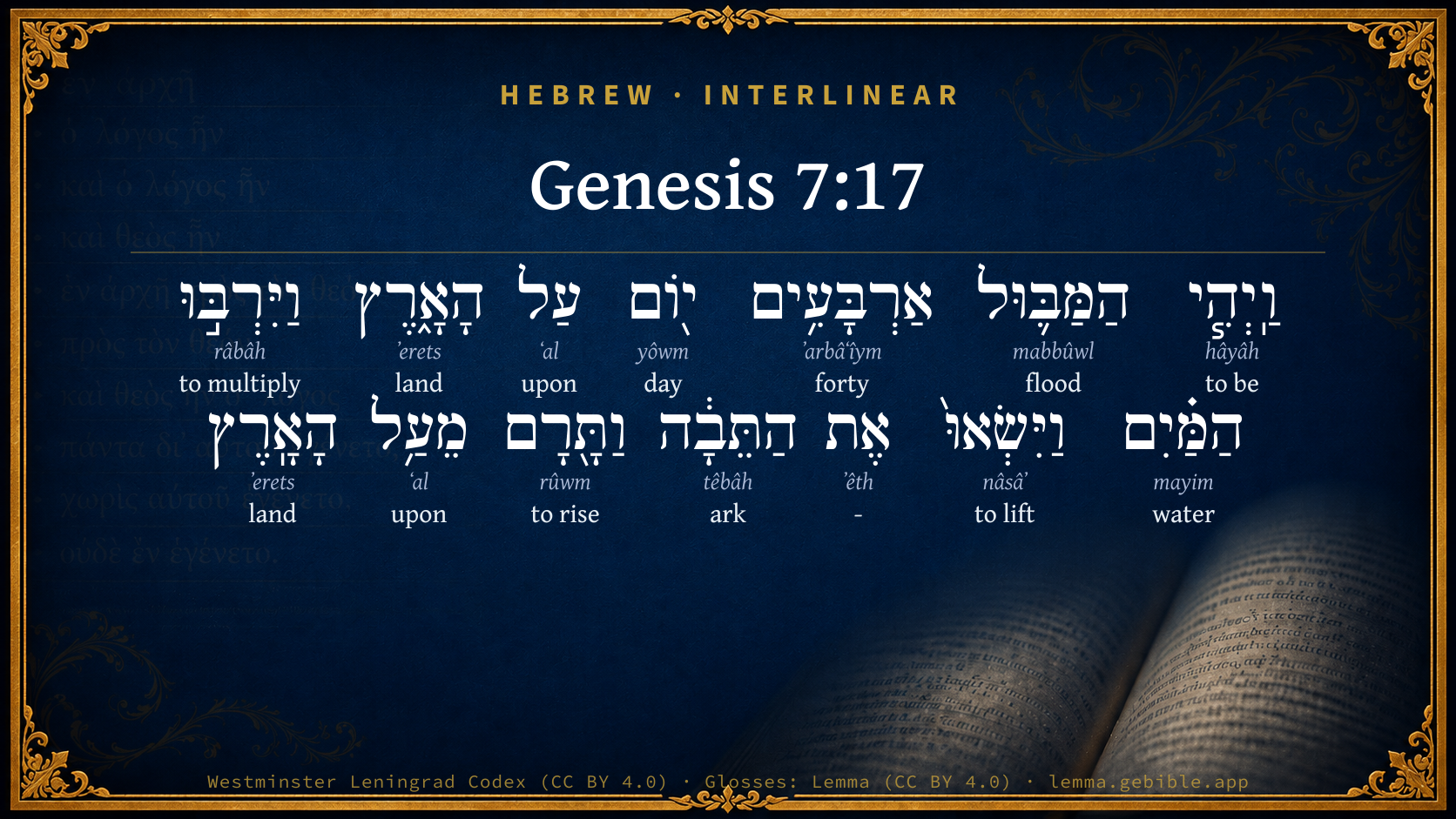
Hebrew (Westminster Leningrad Codex) Genesis 7:17 appears in the Hebrew Old Testament. The text above is from the Westminster Leningrad Codex. Each word links to its Strong’s number, a concise gloss, and parsing drawn from the Open Scriptures Hebrew Bible morphology. Click any word for its full Brown-Driver-Briggs (BDB) entry.
Download image
Cite this verse

Genesis 7:17 (World English Bible). Public Domain. Lemma interlinear Bible study tool, https://lemma.gebible.app/v/genesis/7/17.

Show BibTeX & RIS
BibTeX
RIS
English Translation
The flood was forty days on the earth. The waters increased, and lifted up the ark, and it was lifted up above the earth.
World English Bible · Public Domain
Highlights
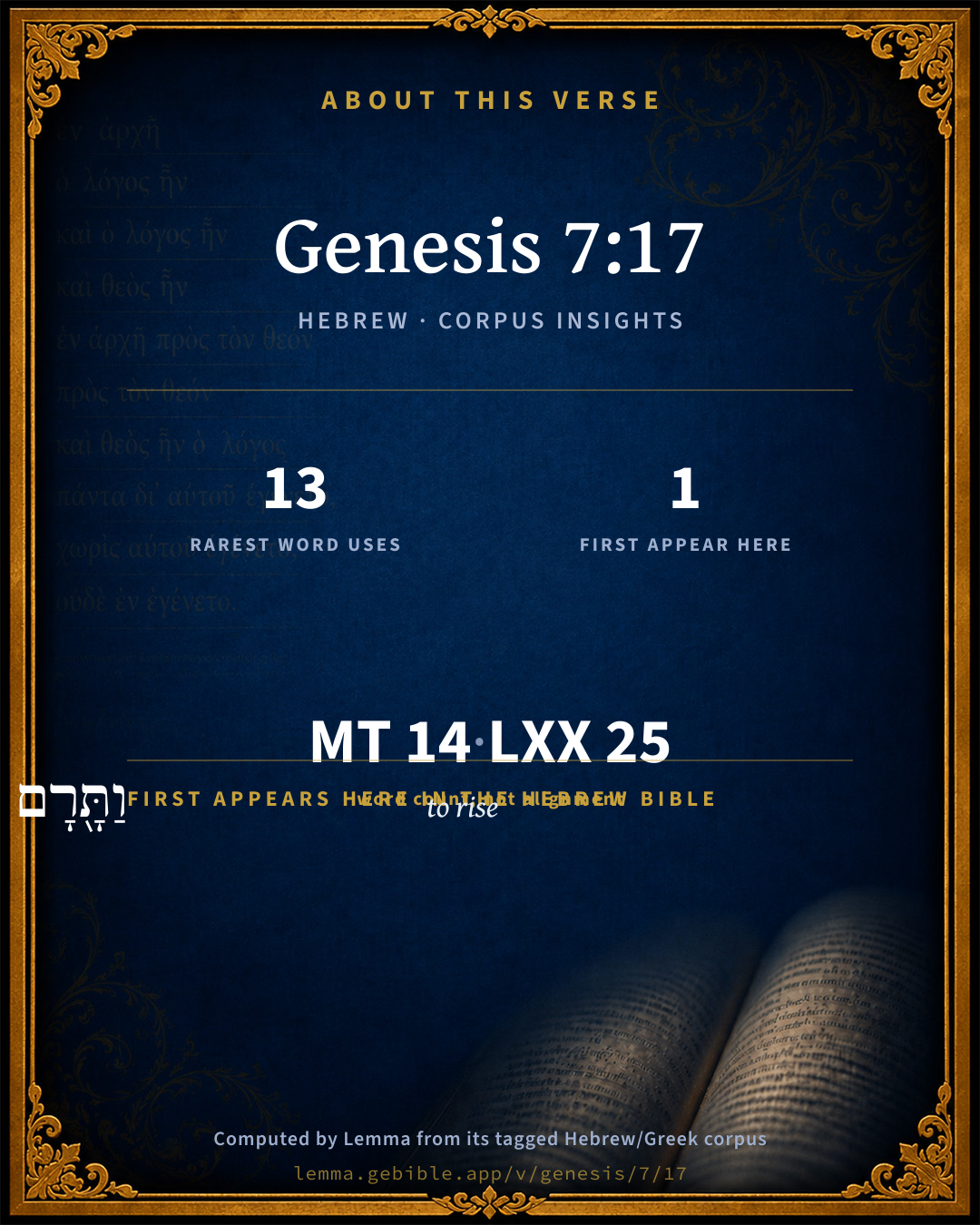
  • 1 first appearance in the Hebrew Bible
Full analysis ↓
Download a study sheet

One document with this verse’s original text, its word-by-word gloss line, the meaning frame, cross-references with their text, attributed commentary, and full source and license credits — printable, and it pastes into notes with its structure intact.

This verse Autodidact and up

Study sheet (.html) Plain text (.txt)

A passage Seminary Student

Up to 50 verses in one chapter. A passage sheet keeps up to 6 commentary sources and 12 cross-references per verse, in the order this page ranks them, and says so on the sheet whenever that leaves anything out. Ask for a single verse and you get the Autodidact verse sheet above.

Everything on this page stays free to read, with no account — the sheet is a download of what is already on screen, not access to it.

Want to remove ads? Support Godless Engineer
Compare translations 3

The same verse in 3 English versions, stacked beneath the original-language interlinear above. Click any original word for its lexicon entry.

Each is an independent rendering of the whole verse — the interlinear is not word-aligned to these translations.

Highlighted words mark where these versions differ — a whole-verse word diff, not a word-by-word alignment.

  • World English Bible Public Domain
    The flood was forty days on the earth. The waters increased, and lifted up the ark, and it was lifted up above the earth.
  • King James Version Public Domain
    And the flood was forty days upon the earth; and the waters increased, and bare up the ark, and it was lift up above the earth.
  • unfoldingWord Literal Text CC BY-SA 4.0
    Then the flood came on the earth forty days, and the waters increased and lifted the ark so that it rose up off the earth.

unfoldingWord Literal Text — © unfoldingWord, licensed CC BY-SA 4.0. Word-aligned USFM3 via Door43 (git.door43.org/unfoldingWord/en_ult).

Versions to compare (up to 4)

3 of 4 selected

Show all 18 translations

Every available English version of this verse, each an independent rendering of the whole verse.

  • World English Bible Public Domain
    The flood was forty days on the earth. The waters increased, and lifted up the ark, and it was lifted up above the earth.
  • Berean Standard Bible Public Domain
    For forty days the flood kept coming on the earth, and the waters rose and lifted the ark high above the earth.
  • Majority Standard Bible Public Domain
    For forty days the flood kept coming on the earth, and the waters rose and lifted the ark high above the earth.
  • King James Version Public Domain
    And the flood was forty days upon the earth; and the waters increased, and bare up the ark, and it was lift up above the earth.
  • American Standard Version (1901) Public Domain
    And the flood was forty days upon the earth; and the waters increased, and bare up the ark, and it was lifted up above the earth.
  • Revised Version (1885) Public Domain
    And the flood was forty days upon the earth; and the waters increased, and bare up the ark, and it was lift up above the earth.
  • Geneva Bible (1599) Public Domain
    Then ye flood was fourtie dayes vpon the earth, and the waters were increased, and bare vp the Arke, which was lift vp aboue the earth.
  • Douay-Rheims (1899) Public Domain
    And the flood was forty days upon the earth, and the waters increased, and lifted up the ark on high from earth.
  • Young's Literal Translation Public Domain
    And the deluge is forty days on the earth, and the waters multiply, and lift up the ark, and it is raised up from off the earth;
  • Literal Standard Version CC BY-SA 4.0
    And the flood is on the earth [for] forty days, and the waters multiply and lift up the Ark, and it is raised up from off the earth;
  • Unlocked Literal Bible CC BY-SA 4.0
    Then the flood came upon the earth for forty days, and the water increased and lifted the ark and raised it above the earth.
  • unfoldingWord Literal Text CC BY-SA 4.0
    Then the flood came on the earth forty days, and the waters increased and lifted the ark so that it rose up off the earth.
  • Darby Bible Public Domain
    And the flood was forty days on the earth. And the waters increased, and bore up the ark; and it was lifted up above the earth.
  • World Messianic Bible Public Domain
    The flood was forty days on the earth. The waters increased, and lifted up the ship, and it was lifted up above the earth.
  • Webster's Bible Public Domain
    And the flood was forty days upon the earth: and the waters increased, and bore up the ark, and it was lifted above the earth.
  • Free Bible Version CC BY-SA 4.0
    The flood increased for forty days, lifting the ark so that it floated up from the earth.
  • Bible in Basic English Public Domain
    And for forty days the waters were over all the earth; and the waters were increased so that the ark was lifted up high over the earth.
  • JPS Tanakh (1917) Public Domain
    And the flood was forty days upon the earth; and the waters increased, and bore up the ark, and it was lifted up above the earth.

Literal Standard Version (2020), Covenant Press — licensed CC BY-SA 4.0. Text via the HelloAO Bible API (eBible.org). Unlocked Literal Bible (unfoldingWord) — licensed CC BY-SA 4.0. Text via the HelloAO Bible API (eBible.org). unfoldingWord Literal Text — © unfoldingWord, licensed CC BY-SA 4.0. Word-aligned USFM3 via Door43 (git.door43.org/unfoldingWord/en_ult). Free Bible Version, Dr. Jonathan Gallagher — licensed CC BY-SA 4.0. Text via the HelloAO Bible API (eBible.org).

Word by word

More ways to search: Search by grammar → Find every occurrence → Compare this word →

Practice this passage: Drill this verse → Learn its vocabulary →

הַמַּבּ֛וּל
mabbûwl
H3999
“the · flood”
Particle, Definite Article + Noun, Common, Masculine, Singular, Absolute
Part of Speech
Particle + Noun
Type
Common
Gender
Masculine
Number
Singular
State
Absolute
Full BDB Definition

Origin: from H2986 in the sense of flowing

TWOT: 1142

flood, deluge. - Noah's flood that submerged the entire planet earth under water for about a year
  1. וַֽיְהִ֧י hâyâh H1961 “and · to be” Conjunction + Verb, Qal, Sequential Imperfect, 3rd Person, Masculine, Singular
  2. אַרְבָּעִ֥ים ʼarbâʻîym H705 “forty” Adjective, Cardinal number, Both, Plural, Absolute
  3. י֖וֹם yôwm H3117 “day” Noun, Common, Masculine, Singular, Absolute
  4. עַל ʻal H5921 “upon” Preposition
  5. הָאָ֑רֶץ ʼerets H776 “the · land” Particle, Definite Article + Noun, Common, Both, Singular, Absolute
  6. וַיִּרְבּ֣וּ râbâh H7235 “and · to multiply” Conjunction + Verb, Qal, Sequential Imperfect, 3rd Person, Masculine, Plural
  7. הַמַּ֗יִם mayim H4325 “the · water(s)” Particle, Definite Article + Noun, Common, Masculine, Plural, Absolute
  8. וַיִּשְׂאוּ֙ nâsâʼ H5375 “and · to lift” Conjunction + Verb, Qal, Sequential Imperfect, 3rd Person, Masculine, Plural
  9. אֶת ʼêth H853 “-” Particle, Direct Object
  10. הַתֵּבָ֔ה têbâh H8392 “the · ark” Particle, Definite Article + Noun, Common, Feminine, Singular, Absolute
  11. וַתָּ֖רָם rûwm H7311 “and · to rise” Conjunction + Verb, Qal, Sequential Imperfect, 3rd Person, Feminine, Singular
  12. מֵעַ֥ל ʻal H5921 “from · upon” Preposition + Preposition
  13. הָאָֽרֶץ ʼerets H776 “the · land” Particle, Definite Article + Noun, Common, Both, Singular, Absolute

About this verse

These counts appear in no published source. They are computed here, from the morphology-tagged text and Lemma’s own curated glosses. What Lemma adds →

14
words
12
distinct lemmas
Pentateuch
section

Notable vocabulary

The rarest word here is הַמַּבּ֛וּל flood H3999 — appearing just 13 times in the whole Hebrew Bible.

First appearance in Scripture

This word makes its first canonical appearance in the Hebrew Bible here:

  • וַתָּ֖רָם to rise H7311

Shared distinctive vocabulary

הַמַּבּ֛וּל flood H3999 occurs in 12 verses of the Hebrew Bible. Also found in:

Grammatical profile

  • 4 verbs
  • 6 nouns
  • 1 adjective
  • 2 prepositions
  • 1 particle

Verb forms

  • וַֽיְהִ֧י Qal · Sequential Imperfect
  • וַיִּרְבּ֣וּ Qal · Sequential Imperfect
  • וַיִּשְׂאוּ֙ Qal · Sequential Imperfect
  • וַתָּ֖רָם Qal · Sequential Imperfect

Repetition

Words recur within this verse — often emphatic in Hebrew:

  • עַל upon H5921 ×2
  • הָאָ֑רֶץ land H776 ×2

Hebrew & Septuagint length

In English translation the verse runs 24 words from the Hebrew and 32 from the Septuagint (LXX English) — closely comparable.

A rough comparison of the two English renderings, which tokenize alike — not a word-level alignment.

Word counts can differ between the Hebrew and the Greek without any difference in meaning — e.g. the Hebrew direct-object marker אֵת has no separate Greek word, and Greek often adds the article ὁ.

In the original languages it is 14 Hebrew tokens and 25 Greek tokens — but the two are counted differently (Hebrew bundles its prefixes and suffixes into one token; the Greek is in lemma form), so that isn’t a like-for-like length.

Cross-references

2

Topical passages linked to Genesis 7:17 in the Treasury of Scripture Knowledge — connected by theme and wording, ordered by reader-vote popularity; previews shown in the World English Bible.

  • Genesis 7:4 In seven days, I will cause it to rain on the earth for forty days and forty nights. Every living thing that I have made, I will destroy from the surface of the ground."
  • Genesis 7:12 The rain was on the earth forty days and forty nights.

Cross-references courtesy of OpenBible.info (CC BY 4.0).

Hebrew and Greek witnesses Masoretic Hebrew ↔ Greek Septuagint

The same verse in the two great witnesses to the Old Testament, shown verse-for-verse.

These are two independent witnesses, not word-aligned to each other, and the Septuagint is shown in lemma (dictionary) form.

Hebrew Genesis 7:17 Masoretic · Westminster Leningrad Codex

וַֽיְהִ֧י הַמַּבּ֛וּל אַרְבָּעִ֥ים י֖וֹם עַל הָאָ֑רֶץ וַיִּרְבּ֣וּ הַמַּ֗יִם וַיִּשְׂאוּ֙ אֶת הַתֵּבָ֔ה וַתָּ֖רָם מֵעַ֥ל הָאָֽרֶץ

The flood was forty days on the earth. The waters increased, and lifted up the ark, and it was lifted up above the earth.

World English Bible · Public Domain

Greek LXX Genesis 7:17 Septuagint · lemma form

καί γίγνομαι ὁ κατακλυσμός τεσσαράκοντα ἡμέρα καί τεσσαράκοντα νύξ ἐπί ὁ γῆ καί πληθύνω ὁ ὕδωρ καί ἐπιαἴρω ὁ κιβωτός καί ὑψόω ἀπό ὁ γῆ

And the flood was upon the earth forty days and forty nights, and the water abounded greatly and bore up the ark, and it was lifted on high from off the earth.

LXX2012 (modern English Septuagint) · Public Domain

On this verse, The Pulpit Commentary discusses the Septuagint’s reading. Read the note in Commentary ↓

Hebrew: Westminster Leningrad Codex (CC BY 4.0). Greek: Septuagint (public domain); English from LXX2012 (modern English Septuagint) (Public Domain). How the Septuagint differs from the Hebrew →

Targum (Aramaic paraphrase)

2

The Targum is the ancient Jewish Aramaic paraphrase of the Hebrew Scriptures — an interpretive translation, not the Hebrew text itself. Onkelos (literal) and Pseudo-Jonathan (expansive) render the Torah, and Jonathan the Prophets. Coverage is partial: where no permissively-licensed English translation exists for a verse, only the Aramaic is shown. This is verse-level text, not a word-by-word alignment to the Hebrew.

  1. Targum Onkelos Torah (Genesis–Deuteronomy)
    וַהֲוָה טוֹפָנָא אַרְבְּעִין יְמָמִין עַל אַרְעָא וּסְגִיאוּ מַיָּא וּנְטָלוּ יָת תֵּבוֹתָא וְאִתָּרָמַת מֵעַל אַרְעָא

    And there was a deluge forty days upon the earth, and the waters increased, and took up the ark, and it was lifted up above the earth.

    Targum Onkelos — Aramaic: “Onkelos Genesis” (public domain); “Onkelos Exodus” (public domain); “Onkelos Leviticus” (public domain); “Onkelos Numbers” (public domain); “Onkelos Deuteronomy” (public domain). English: “Sefaria Community Translation” (CC0 1.0 (public-domain dedication)); “J.W. Etheridge. The Targums of Onkelos and Jonathan Ben Uzziel on the Pentateuch. London: Longmans, Green, 1862” (public domain). Text via Sefaria.

  2. Targum Pseudo-Jonathan Torah (Genesis–Deuteronomy)
    וַהֲוָה טוּבְעָנָא אַרְבְּעִין יְמָמִין עַל אַרְעָא וּסְגִיאוּ מַיָא וּנְטָלוּ יַת תֵּיבוּתָא וְאִיתְרָמַת מֵעַל אַרְעָא

    And there was a flood forty days upon the earth, and the waters were multiplied and bare up the ark, and it was lifted from the earth.

    Targum Pseudo-Jonathan — Aramaic: “Targum Jonathan on Genesis” (public domain); “Targum Jonathan on Exodus” (public domain); “Targum Jonathan on Leviticus” (public domain); “Targum Jonathan on Numbers” (public domain); “Targum Jonathan on Deuteronomy” (public domain). English: “The Targum of Jonathan ben Uzziel, trans. J. W. Etheridge, London, 1862” (public domain). Text via Sefaria.

Commentary

Notes on Genesis 7:17 from classic Christian and Jewish commentators (each source and its license shown beneath its notes). The classic Christian expositions comment on the surrounding passage and are grouped to its opening verse, so a note may address several verses; the Jewish commentaries on the Tanakh (Rashi and others) are per-verse, so they appear only where the commentator wrote on this verse.

Lemma curates 59 commentaries, every one of them public domain or Creative Commons licensed, each selected and text-cleaned for this edition rather than reprinted as found. About our sources →

Matthew Henry's Commentary

We are here told,

I. How long the flood was increasing - forty days, Gen 7:17. The profane world, who believed not that it would come, probably when it came flattered themselves with hopes that it would soon abate and never come to extremity; but still it increased, it prevailed. Note, 1. When God judges he will overcome. If he begin, he will make an end; his way is perfect, both in judgment and mercy. 2. The gradual approaches and advances of God's judgments, which are designed to bring sinners to repentance, are often abused to the hardening of them in their presumption.

II. To what degree they increased: they rose so high that not only the low flat countries were deluged, but to make sure work, and that none might escape, the tops of the highest mountains were overflowed - fifteen cubits, that is, seven yards and a half; so that in vain was salvation hoped for from hills or mountains, Jer 3:23. None of God's creatures are so high but his power can overtop them; and he will make them know that wherein they deal proudly he is above them. Perhaps the tops of the mountains were washed down by the strength of the waters, which helped much towards the prevailing of the waters above them; for it is said (Job 12:15), He sends out the waters, and they not only overflow, but overturn, the earth. Thus the refuge of lies was swept away, and the waters overflowed the hiding-place of those sinners (Isa 28:17), and in vain they fly to them for safety, Rev 6:16. Now the mountains departed, and the hills were removed, and nothing stood a man in stead but the covenant of peace, Isa 54:10. There is no place on earth so high as to set men out of the reach of God's judgments, Jer 49:16; Oba 1:3, Oba 1:4. God's hand will find out all his enemies, Psa 21:8. Observe how exactly they are fathomed (fifteen cubits), not by Noah's plummet, but by his knowledge who weighs the waters by measure, Job 28:25.

III. What became of Noah's ark when the waters thus increased: It was lifted up above the earth (Gen 7:17), and went upon the face of the waters, Gen 7:18. When all other buildings were demolished by the waters, and buried under them, the ark alone subsisted. Observe, 1. The waters which broke down every thing else bore up the ark. That which to unbelievers is a savour of death unto death is to the faithful a savour of life unto life. 2. The more the waters increased the higher the ark was lifted up towards heaven. Thus sanctified afflictions are spiritual promotions; and as troubles abound consolations much more abound.

Matthew Henry's Commentary on the Whole Bible (1708–1710) — public domain (CC PDM 1.0). Text via the HelloAO Bible API.

Trapp's Complete Commentary

John Trapp

Gen 7:17 And the flood was forty days upon the earth; and the waters increased, and bare up the ark, and it was lift up above the earth.

Ver. 17. It was lift up above the waters.] Afterwards it went upon the face of the waters, till, at last, the highest hills were covered with waters; the ark floating upon the surface of them, and not swallowed up by them. In reference whereunto David prays, "Let not the waterflood overflow me, neither let the deep swallow me up". {Psa 69:15} The true Christian may be tossed on the waters of affliction, yea, douced over head and ears; and, as a drowning man, sink twice to the bottom; yet shall up again, if out of the deep he call upon God, as Jonah did: "Then I said, I am cast out of thy sight" (there you may take him up for dead), "yet I will look again toward thy holy temple" (there he revives and recovers comfort), {Jon 2:4} Yea, though hell had swallowed up a servant of God into her bowels, yet it must, in despite of it, render him up, as the whale did Jonah: which, if he had lighted upon the mariners, would have devoured and digested twenty of them in less space.

John Trapp, A Commentary or Exposition upon All the Books of the Old and New Testament (1647–1656) — public domain. Text from a community e-Sword module.

The Biblical Illustrator

Joseph S. Exell

Gen_7:17

And the waters increased

Increased affliction

I.

THAT AFFLICTION IS PROGRESSIVE IN ITS DEVELOPMENT AND SEVERITY.

II. THAT INCREASED AFFLICTION IS THE CONTINUED AND EFFECTIVE DISCIPLINE AND PUNISHMENT OF GOD. (J. S. Exell, M. A.)

The judgment on an ungodly world

I. JUDGMENT THREATENED.

II. JUDGMENT DELAYED. Gods forbearance and long suffering. Every day brings judgment nearer.

III. JUDGMENT EXECUTED. God did as He said. This judgment was--

1. Terrible.

2. Unavoidable.

3. Universal.

LESSONS:--

1. Listen to Gods warnings.

2. Abuse not Gods long suffering.

3. Flee from the wrath to come. (W. S. Smith, B. D.)

The destruction of the wicked.

1. Numbers, learning, wealth, combination, could not save. Though wickedness join hand in hand, it shall not go unpunished.

2. Their destruction complete and universal. None escaped.

3. They were not without an offer of mercy. In 120 years longer, after the warning was given, they were striven with. This was their day of grace. By word and life, Noah preached to them.

4. At length the flood came and took them all away. Consternation, when they saw the ark drifting away, and the water still rising. Despair. A too late repentance. (J. C. Gray.)

The Biblical Illustrator, edited by Joseph S. Exell (c. 1880s–1900s) — public domain. Text from a community e-Sword module.

Whedon's Commentary on the Bible

Daniel D. Whedon

17, 18. Forty days — That is, as we understand it, for forty days the rain burst from the “lattices of heaven,” and the waters rushed from the great deep upon the subsiding land. At last they lifted up the ark from off the earth, so that it went upon the face of the waters. Repetitions like those in Gen_7:17-19 (comp. also Gen_7:12, and Gen_7:20-23) favour the theory that the narrative is a compilation from different documents; but the compiler may as well have been Moses or one of his contemporaries as any writer living a thousand years later.

Daniel D. Whedon (gen. ed.), Commentary on the Old and New Testaments (1874–1909) — public domain. Text from a community e-Sword module.

Keil & Delitzsch

C. F. Keil & F. Delitzsch

Gen 7:17-24 contain a description of the flood: how the water increased more and more, till it was 15 cubits above all the lofty mountains of the earth, and how, on the one hand, it raised the ark above the earth and above the mountains, and, on the other, destroyed every living being upon the dry land, from man to cattle, creeping things, and birds. "The description is simple and majestic; the almighty judgment of God, and the love manifest in the midst of the wrath, hold the historian fast. The tautologies depict the fearful monotony of the immeasurable expanse of water: omnia pontus erant et deerant litera ponto." The words of Gen 7:17, "and the flood was (came) upon the earth for forty days," relate to the 40 days' rain combined with the bursting forth of the foundations beneath the earth. By these the water was eventually raised to the height given, at which it remained 150 days (Gen 7:24). But if the water covered "all the high hills under the whole heaven," this clearly indicates the universality of the flood. The statement, indeed, that it rose 15 cubits above the mountains, is probably founded upon the fact, that the ark drew 15 feet of water, and that when the waters subsided, it rested upon the top of Ararat, from which the conclusion would very naturally be drawn as to the greatest height attained. Now as Ararat, according to the measurement of Perrot, is only 16,254 feet high, whereas the loftiest peaks of the Himalaya and Cordilleras are as much as 26,843, the submersion of these mountains has been thought impossible, and the statement in Gen 7:19 has been regarded as a rhetorical expression, like Deu 2:25 and Deu 4:19, which is not of universal application. But even if those peaks, which are higher than Ararat, were not covered by water, we cannot therefore pronounce the flood merely partial in its extent, but must regard it as universal, as extending over every part of the world, since the few peaks uncovered would not only sink into vanishing points in comparison with the surface covered, but would form an exception not worth mentioning, for the simple reason that no living beings could exist upon these mountains, covered with perpetual snow and ice; so that everything that lived upon the dry land, in whose nostrils there was a breath of life, would inevitably die, and, with the exception of those shut up in the ark, neither man nor beast would be able to rescue itself, and escape destruction. A flood which rose 15 cubits above the top of Ararat could not remain partial, if it only continued a few days, to say nothing of the fact that the water was rising for 40 days, and remained at the highest elevation for 150 days. To speak of such a flood as partial is absurd, even if it broke out at only one spot, it would spread over the earth from one end to the other, and reach everywhere to the same elevation. However impossible, therefore, scientific men may declare it to be for them to conceive of a universal flood of such a height and duration in accordance with the known laws of nature, this inability on their part does not justify any one in questioning the possibility of such an event being produced by the omnipotence of God. It has been justly remarked, too, that the proportion of such a quantity of water to the entire mass of the earth, in relation to which the mountains are but like the scratches of a needle on a globe, is no greater than that of a profuse perspiration to the body of a man. And to this must be added, that, apart from the legend of a flood, which is found in nearly every nation, the earth presents unquestionable traces of submersion in the fossil remains of animals and plants, which are found upon the Cordilleras and Himalaya even beyond the limit of perpetual snow.

(Note: The geological facts which testify to the submersion of the entire globe are collected in Buckland's reliquiae diluv., Schubert's Gesch. der Natur, and C. v. Raumer's Geography, and are of such importance that even Cuvier acknowledged "Je pense donc, avec MM. Deluc et Dolomieu, que s'il y a quelque chose de constat en gologie; c'est que la surface de notre globe a t victime d'une grande et subite rvolution, dont la date ne peut remonter beaucoup au del de cinq ou six mille ans" (Discours sur les rvol. de la surface du globe, p. 190, ed. 6). The latest phase of geology, however, denies that these facts furnish any testimony to the historical character of the flood, and substitutes the hypothesis of a submersion of the entire globe before the creation of man: 1. because the animals found are very different from those at present in existence; and 2. because no certain traces have hitherto been found of fossil human bones. We have already shown that there is no force in these arguments. Vid., Keerl, pp. 489ff.)

In Gen 7:23, instead of ויּמּח (imperf. Niphal) read ויּמח (imperf. Kal): "and He (Jehovah) destroyed every existing thing," as He had said in Gen 7:4.

Keil & Delitzsch — Biblical Commentary on the Old Testament (1861–1891) — public domain (CC PDM 1.0). Text via the HelloAO Bible API. (Old Testament only.)

Tyndale Open Study Notes

Tyndale Open Resources

7:17 floodwaters grew deeper (literally waters multiplied): The same word used for the proliferation of humans and animals during creation (see 1:22, 28) is now used ironically of the water that would annihilate them. • covering the ground: The Hebrew word translated “ground” or “earth” is mentioned eight times in eight verses (7:17-24). The earth is the domain that humankind had polluted and that was now the object of a cleansing deluge.

Tyndale Open Study Notes — © Tyndale Open Resources, licensed CC BY-SA 4.0. Text via the HelloAO Bible API.

Jamieson, Fausset & Brown

Robert Jamieson, A. R. Fausset & David Brown

the waters increased, and bare up the ark--It seems to have been raised so gradually as to be scarcely perceptible to its occupants.

Jamieson, Fausset & Brown — Commentary Critical and Explanatory on the Whole Bible (1871) — public domain (CC PDM 1.0). Text via the HelloAO Bible API.

John Calvin's Commentaries

17. And the flood was forty days, etc. Moses copiously insists upon this fact, in order to show that the whole world was immersed in the waters. Moreover, it is to be regarded as the special design of this narrations that we should not ascribe to fortune, the flood by which the world perished; how ever customary it may be for men to cast some veil over the works of God, which may obscure either his goodness or his judgments manifested in them. But seeing it is plainly declared, that whatever was flourishing on the earth was destroyed, we hence infer, that it was an indisputable and signal judgment of God; especially since Noah alone remained secure, because he had embraced, by faith, the word in which salvation was contained. He then recalls to memory what we before have said; namely how desperate had been the impiety, and how enormous the crimes of men, by which God was induced to destroy the whole world; whereas, on account of his great clemency, he would have spared his own workmanship, had he seen that any milder remedy could have been effectually applied. These two things, directly opposed to each other, he connects together; that the whole human race was destroyed, but that Noah and his family safely escaped. Hence we learn how profitable it was for Noah, disregarding the world, to obey God alone: which Moses states not so much for the sake of praising the man, as for that of inviting us to imitate his example. Moreover, lest the multitude of sinners should draw us away from God; we must patiently bear that the ungodly should hold us up to ridicule, and should triumph over us, until the Lord shall show by the final issue, that our obedience has been approved by him. In this sense, Peter teaches that Noah’s deliverance from the universal deluge was a figure of baptism, (1 Peter 3:21;) as if he had said, the method of the salvation, which we receive through baptism, degrees with this deliverance of Noah. Since at this time also the world is full of unbelievers as it was then; therefore it is necessary for us to separate ourselves from the greater multitude, that the Lord may snatch us from destruction. In the same manner, the Church is fitly, and justly, compared to the ark. But we must keep in mind the similitude by which they mutually correspond with each other; for that is derived from the word of God alone; because as Noah believing the promise of God, gathered himself his wife and his children together, in order that under a certain appearance of death, he might emerge out of death; so it is fitting that we should renounce the world and die, in order that the Lord may quicken us by his word. For nowhere else is there any security of salvation. The Papists, however, act ridiculously who fabricate for us an ark without the word.

John Calvin's Commentaries (1540-1563) — public domain. Text from the Calvin Translation Society English edition (1840s-50s) via the Christian Classics Ethereal Library (ccel.org). Calvin's coverage is partial (roughly two-thirds of the Bible); uncommented books and verses are honest gaps, never fabricated. The 19th-century editor's footnotes and remarks are omitted so the notes are faithfully Calvin's own voice.

Ellicott's Commentary for English Readers

(17-19) The waters increased . . . —The swelling of the flood is told with great power in these verses but every stage and detail has reference to the ark, as if the author of the narrative was one of those on board. First, the “waters increased,” and raised up the ark till it floated. Next, “they became strong and increased exceedingly”—the word rendered “prevailed” really signifying the setting in of mighty currents (see on Gen_8:1), as the waters sought the lower ground—and at this stage the ark began to move. Finally, they “became strong exceedingly, exceedingly,” rushing along with ever-increasing force, and carrying the ark high above every hill in its course. Of these it is said—

All the high hills, that were under the whole heaven, were covered.—Interpreting this by the English Version, many regard it as a proof of the deluge having been universal. But omitting the well-known fact that in the Bible the word “all” means much less than with us, we must also remember that the Hebrew language has a very small vocabulary, and “the whole heaven” means simply the whole shy. We with our composite language borrow a word for it from the Greek, and say “the whole horizon,” that is, the whole heaven, bounded by the line of the spectators vision. So then here. Far and wide, in every direction, to the utmost reach of the beholder’s gaze, no mountain was in sight. All was a surging waste of flood. But there is no idea here of the mountains of Auvergne, with the ashes of old-world volcanoes still reposing upon their craters, extinct from a time probably long anterior to the creation even of man. The mountains were those of the Noachian world, as limited as the Roman world of Luk_2:1, or even more so.

A Bible Commentary for English Readers, edited by Charles John Ellicott (1878–1897) — public domain. Text from a community e-Sword module.

John Gill's Exposition

And the waters prevailed exceedingly on the earth,.... Yet more and more, so that the people without the ark were obliged to remove, not only from the lower to the higher rooms in their houses, and to the tops of them, but to the highest trees; and when these were bore down, to the highest hills and mountains; and to those it was in vain to fly, by what follows:

and all the high hills that were under the whole heaven were covered: whence it appears there were hills before the flood, and that these were not caused by it, and that the deluge was universal, since there was not a hill under the whole heaven but what was covered with it. In Deucalion's flood all men are said to perish, except a few who fled to the high mountains (n); which story seems to be hammered out of this account.

(n) Apollodorus, de Deor. Origin. l. 1. p. 19.

John Gill's Exposition of the Whole Bible (1746–1763) — public domain (CC PDM 1.0). Text via the HelloAO Bible API.

Albert Barnes' Notes on the Bible

The prevalence of the waters. The forty days are now completed. And at the end of this period the ark had been afloat for a long time. It was drifted on the waters in the direction in which they were flowing, and toward what was formerly the higher ground.

Gen 7:19

Upon the land. - The land is to be understood of the portion of the earth’s surface known to man. This, with an unknown margin beyond it, was covered with the waters. But this is all that Scripture warrants us to assert. Concerning the distant parts of Europe, the continents of Africa, America, or Australia, we can say nothing. “All the high hills were covered.” Not a hill was above water within the horizon of the spectator or of man. There were ten generations from Adam to Noah inclusive. We cannot tell what the rate of increase was. But, supposing each couple to have ten children, and therefore the common ratio to be five, the whole number of births would be about five million, and the population in the time of Noah less than four million. It is probable that they did not scatter further than the necessities and conveniences of life demanded. In a fertile region, an area equal to that of the British Isles would be amply sufficient for four million men, women, and children.

Let us suppose, then, a circle of five hundred miles in diameter inhabited by man. Let this occupy the central region of a concentric circle of eight hundred miles in diameter. With a center a little southwest of Mosul, this larger circle would reach fifty miles into the Mediterranean, the Euxine, and the Caspian, and would probably have touched the Persian Gulf at the time of the deluge. If this region were covered with water, it is obvious that no land or mountain would be visible to a spectator within the inner circle of five hundred miles in diameter. “Fifteen cubits upward.” This was half the depth of the ark. It may have taken this draught of water to float it. If so, its grounding on a hill under water would indicate the depth of water on its summit. The gradual rise of the waters was accomplished by the depression of the land, aided, possibly, by a simultaneous elevation of the bed of the ocean. The water, by the mere necessity of finding its level, overflowed the former dry land. The extent of this oscillation of the solid crust of the earth is paralleled by the changes of level which geology indicates, the last of which took place at the time of the six days’ creation. It is possible that most of the land that was then raised was now again temporarily submerged in the returning waters; while distant continents may have all along existed, which never came within the ken of antediluvian man. The sobriety and historical veracity of the narrative are strikingly exhibited in the moderate height to which the waters are said to have risen above the ancient hills.

Gen 7:21-23

There expired all flesh. - The resulting death of all by drowning is here recounted. “All in whose nostrils was the breath of the spirit of live died.” This statement refers solely to man, whose higher life is exclusively expressed by the phrase חיים נשׁמת nı̂shmat chayı̂ym, “breath of life” Gen 2:7. It affirms the death of the whole of mankind. The sum total of animal and vegetable life, with the exception of those in the ark, is here declared to be extinguished.

Gen 7:24

Fifty and a hundred days. - These, and the forty days of rain, make one hundred and ninety days: about six lunar months and thirteen days. If to this we add the month and seventeen days before the commencement of the rain, we have eight months completed, and are therefore brought to the first day of the ninth month. The waters may be said to prevail as long as the ark had its full draught of water. It is probable they were still rising during the first half of the hundred and fifty days, and then gradually sinking during the other half.

Albert Barnes' Notes on the Bible (1834–1885) — public domain. Text from a community e-Sword/MySword module.

Matthew Poole's English Annotations

The flood; or, that flood of waters which was poured down in that shower mentioned Gen 7:12; otherwise the flood was one hundred and fifty days upon the earth, Gen 7:24.

The waters increased, by the accession of more waters from above and beneath.

Matthew Poole's English Annotations on the Holy Bible (1683–1685) — public domain. Text from a community e-Sword/MySword module.

The Pulpit Commentary

Vers. 17-19. And the flood was forty days upon the earth. Referring to the forty days" and nights" rain of ver. 4 (tessarakonta hJmerav kaikonta nuktav, LXX), during which the augmentation of the waters is described in a threefold degree. And the waters increased. Literally, grew great. The first degree of increase, marked by the floating of the ark. And bare up the ark, and it was lift up above the earth. Literally, it was high from upon the earth, i.e. it rose above it. And the waters prevailed. Literally, were strong; from rbG; to be strong; whence the Gibborim of Gen_6:4. And were increased greatly on the earth. Literally, became great, greatly. The second degree of increase, marked by the going of the ark. And the ark wenti.e. floated along; kaireto, LXX (Psa_104:26) upon the face of the waters. And the waters prevailed exceedingly. Literally, and the waters became strong, exceedingly. The third degree of increase, marked by the submergence of the mountains. And all the high hills, that were under the whole heaven, were covered. A clear assertion of the universality of the Flood (Keil, Kalisch, Alford, Bush, Wordsworth); but the language does not necessarily imply more than that all the high hills beneath the spectator s heaven were submerged (cf. Gen_41:57; Exo_9:25 Exo_10:15; Deu_2:25; 1Ki_10:24; Act_2:5; Col_1:25, for instances in which the universal terms all and every must be taken with a limited signification) while it is almost certain that, had the narrator even designed to record only the fact that all the heights within the visible horizon had disappeared beneath the rising waters, he would have done so by saying that "all the high hills under the whole heaven were covered." While, then, it is admitted that the words may depict a complete submergence of the globe, it is maintained by many competent scholars that the necessities of exegesis only demand a partial inundation (Peele, Murphy, Taylor Lewis, "Speaker"s Commentary," Inglis).

The Pulpit Commentary (1880–1919), ed. H.D.M. Spence-Jones & Joseph S. Exell — public domain. Text from a community e-Sword module.

Kretzmann's Popular Commentary

Paul E. Kretzmann

The Destruction Caused by the Flood

v. 17. And the flood was forty days upon the earth; and the waters increased, and bare up the ark, and it was lifted up above the earth. It took forty days for the Flood to reach its crest, to come to full development. During this time the ark was lifted up from the dry land where it had been built; high above the earth the vessel of deliverance rode majestically forward.

v. 18. And the waters prevailed and were increased greatly upon the earth; and the ark went upon the face of the waters. Greater, farther, and wider the expanse of the waters grew, a limitless ocean where formerly only the dry land had been seen.

v. 19. And the waters prevailed exceedingly upon the earth; and all the high hills that were under the whole heaven were covered. The very repetition of similar expressions serves to impress upon the reader the immensity of that waste of waters which stretched out over the whole earth. Finally even the summits of the highest mountains sank beneath the flood of waters, and men and animals that may have sought safety in the mountains perished like the rest.

v. 20. Fifteen cubits upward did the waters prevail; and the mountains were covered. To think of a partial flood, of a local deluge, with this plain account before us were madness; for if the Deluge, after reaching its crest, stood on the earth for more than one hundred days and the ark did not settle on Mount Ararat until the waters subsided, then it stands to reason that it must have been a great deal higher than 16,000 feet, the height of Mount Ararat, and the fact that water seeks its own level would alone demand our belief in the universality of the Flood. Besides, the expression is very general: The mountains were covered; wherever they were on the entire surface of the earth, they were hidden by this mass of waters sent as a punishment by God.

v. 21. And all flesh died that moved upon the earth, both of fowl and of cattle and of beast and of every creeping thing that creepeth upon the earth, and every man;

v. 22. all in whose nostrils was the breath of life, of all that was in the dry land, died. All animate beings on earth which breathe with lungs and have the ability to move about on the dry land: reptiles, birds, mammals, men, they all had to perish in the great Flood.

v. 23. And every living substance was destroyed which was upon the face of the ground, both man and cattle and the creeping things and the fowl of the heaven; and they were destroyed from the earth. As Jehovah had announced,

v. 4. so He carried His threat into execution: every being that has an independent existence and maintains its life by breathing with lungs was destroyed. And Noah only remained alive, and they that were with him in the ark.

v. 24. And the waters prevailed upon the earth an hundred and fifty days. In the midst of that fearful waste of waters, in which all living, animate beings of the earth found their grave, and which covered the earth for a full hundred and fifty days after reaching its highest level, only Noah and his family were saved, the water in their case serving as the means of lifting up their vessel and thus preserving their lives. The water of the Deluge, according to Scriptures, is a type of Baptism, 1Pe 3:20-21. The water of Baptism delivers us and saves us; it washes away the filth of our sins and presents us to God as His children through the merits of Jesus Christ, our Savior. Thus there is comfort for us even in this story of death and destruction.

Paul E. Kretzmann, Popular Commentary of the Bible (1921–1924) — public domain. Text from a community e-Sword module.

unfoldingWord translationNotes

Door43 World Missions Community

General Information:

Verses 13-18 repeat for a third time and give more detail about how Noah went into the ark with his family and the animals in Genesis 7:1-5. This is not a new event.

the water increased

"the water became very deep." This happened during the forty days while the water kept coming.

lifted the ark

"it caused the ark to float"

raised it above the earth

"causes the ark to rise up high over the ground" or "he ark floated on top of the deep water"

translationWords

flood

ark

unfoldingWord translationNotes — © Distant Shores Media and the Door43 World Missions Community, licensed CC BY-SA 4.0. Source: git.door43.org/Door43/en_tn.

Rashi

Rabbi Shlomo Yitzchaki (Rashi)

ותרם מעל הארץ AND IT WAS LIFTED UP ABOVE THE EARTH — It was eleven cubits deep in the water like a laden ship that has part of it sunk in the waters (Genesis Rabbah 32:9); the following verses prove that this is the meaning.

Rashi on the Tanakh — English translations: “The Judaica Press complete Tanach with Rashi, translated by A. J. Rosenberg” (CC BY 4.0); “Pentateuch with Rashi's commentary by M. Rosenbaum and A.M. Silbermann, 1929-1934” (public domain); “The Metsudah Tanach series, Lakewood, N.J” (CC BY 4.0); and “The Book of Joshua, Metsudah Publications, 1997” (CC BY 4.0). Text via Sefaria.

Radak

Rabbi David Kimhi (Radak)

ויהי המבול ארבעים יום, day and night, as has been mentioned in verse 12. The night is usually included when the Torah speaks of יום, day. We have learned this already in Genesis 1,8 ויהי ערב ויהי בוקר יום אחד, “it was evening, it became morning, one day.”

וירבו המים, when the waters had increased for forty days, and the waters of the underground wells were added to the rainwater, the latter were powerful enough to lift the ark and all the creatures inside. Due to its weight it had not risen from the ground until the force of the subterranean geysers lifted it, and the ark now floated on the waters.

Radak on the Tanakh — English translations: “Sefaria Community Translation” (CC0 1.0 (public-domain dedication)); “Eliyahu Munk, HaChut Hameshulash” (CC BY 4.0); “Rabbi Mike Feuer, Jerusalem Anthology” (CC BY 4.0); and “R. David Kimhi on the first book of Psalms, Translated by R.G. Finch, London, 1919” (public domain). Text via Sefaria.

Lesson kit

Teaching starters — assembled from the data on this page, not authored interpretation. Every prompt links to the verse data it draws on. Edit before teaching.

Genesis, in the Pentateuch, opens this verse with 14 words (12 distinct Hebrew lemmas). Its most distinctive word is mabbûwl (“flood”). A historical commentator’s framing appears above. Read the whole chapter for the surrounding context.

Discussion questions

  1. How does “flood” (mabbûwl) shape what this verse is saying?
  2. This is the first place “to rise” appears in Scripture (first appears here). What does its debut here establish?
  3. How does Genesis 6:17, which shares the word «flood», read alongside this verse?
  4. What does the repetition of “upon” (2× in this one verse) do in this verse?
  5. These translations render this verse differently. What is at stake in choosing one wording over another?
  6. «וַֽיְהִ֧י» is a Qal Sequential Imperfect verb. How does that grammatical form shape the action described?
  7. Compare how Matthew Henry's Commentary and Trapp's Complete Commentary read this verse. Where do they agree or differ?

Things to notice

Reading settings

Reading text

Shown beneath each verse's original-language words.

Old Testament
Old Testament edition

Read the OT as the Masoretic Hebrew (MT) or the Greek Septuagint (LXX).

English shown for the Greek Septuagint (in the Hebrew ↔ Greek comparison).

Comparing translations? Open the Compare panel on any verse page to stack up to four side by side.