
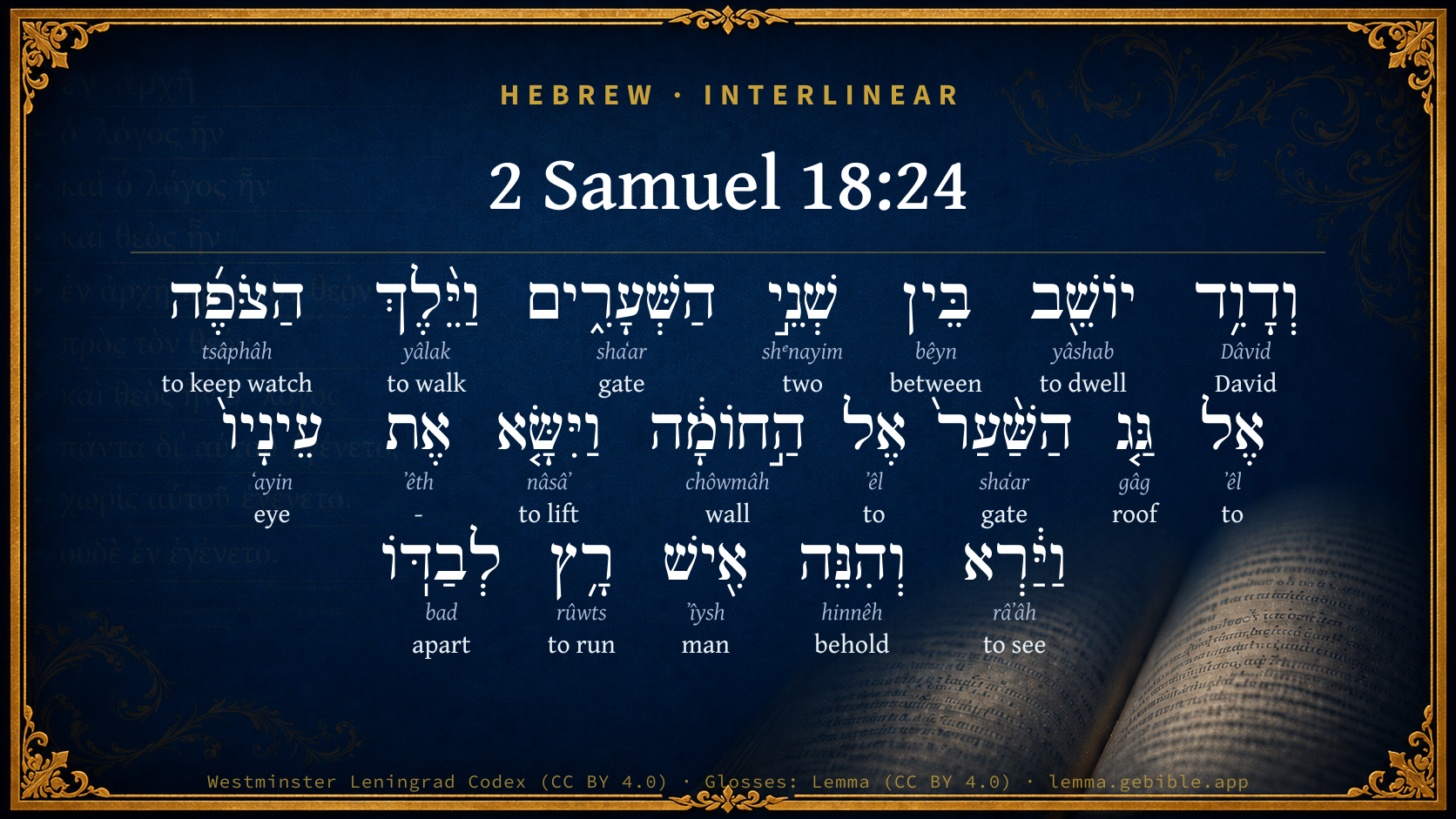
2 Samuel 18:24

Hebrew (Westminster Leningrad Codex) 2 Samuel 18:24 appears in the Hebrew Old Testament. The text above is from the Westminster Leningrad Codex. Each word links to its Strong’s number, a concise gloss, and parsing drawn from the Open Scriptures Hebrew Bible morphology. Click any word for its full Brown-Driver-Briggs (BDB) entry.
Download image
Cite this verse

2 Samuel 18:24 (World English Bible). Public Domain. Lemma interlinear Bible study tool, https://lemma.gebible.app/v/2-samuel/18/24.

Show BibTeX & RIS
BibTeX
RIS
English Translation
Now David was sitting between the two gates: and the watchman went up to the roof of the gate to the wall, and lifted up his eyes, and looked, and, behold, a man running alone.
World English Bible · Public Domain
Download a study sheet

One document with this verse’s original text, its word-by-word gloss line, the meaning frame, cross-references with their text, attributed commentary, and full source and license credits — printable, and it pastes into notes with its structure intact.

This verse Autodidact and up

Study sheet (.html) Plain text (.txt)

A passage Seminary Student

Up to 50 verses in one chapter. A passage sheet keeps up to 6 commentary sources and 12 cross-references per verse, in the order this page ranks them, and says so on the sheet whenever that leaves anything out. Ask for a single verse and you get the Autodidact verse sheet above.

Everything on this page stays free to read, with no account — the sheet is a download of what is already on screen, not access to it.

Want to remove ads? Support Godless Engineer
Compare translations 3

The same verse in 3 English versions, stacked beneath the original-language interlinear above. Click any original word for its lexicon entry.

Each is an independent rendering of the whole verse — the interlinear is not word-aligned to these translations.

Highlighted words mark where these versions differ — a whole-verse word diff, not a word-by-word alignment.

  • World English Bible Public Domain
    Now David was sitting between the two gates: and the watchman went up to the roof of the gate to the wall, and lifted up his eyes, and looked, and, behold, a man running alone.
  • King James Version Public Domain
    And David sat between the two gates: and the watchman went up to the roof over the gate unto the wall, and lifted up his eyes, and looked, and behold a man running alone.
  • unfoldingWord Literal Text CC BY-SA 4.0
    Now David was sitting between the two gates, and the watcher went to the roof of the gate, on the wall, and he lifted his eyes, and he saw, and behold, a man running by himself.

unfoldingWord Literal Text — © unfoldingWord, licensed CC BY-SA 4.0. Word-aligned USFM3 via Door43 (git.door43.org/unfoldingWord/en_ult).

Versions to compare (up to 4)

3 of 4 selected

Show all 18 translations

Every available English version of this verse, each an independent rendering of the whole verse.

  • World English Bible Public Domain
    Now David was sitting between the two gates: and the watchman went up to the roof of the gate to the wall, and lifted up his eyes, and looked, and, behold, a man running alone.
  • Berean Standard Bible Public Domain
    Now David was sitting between the two gates when the watchman went up to the roof of the gateway by the wall, looked out, and saw a man running alone.
  • Majority Standard Bible Public Domain
    Now David was sitting between the two gates when the watchman went up to the roof of the gateway by the wall, looked out, and saw a man running alone.
  • King James Version Public Domain
    And David sat between the two gates: and the watchman went up to the roof over the gate unto the wall, and lifted up his eyes, and looked, and behold a man running alone.
  • American Standard Version (1901) Public Domain
    Now David was sitting between the two gates: and the watchman went up to the roof of the gate unto the wall, and lifted up his eyes, and looked, and, behold, a man running alone.
  • Revised Version (1885) Public Domain
    Now David sat between the two gates: and the watchman went up to the roof of the gate unto the wall, and lifted up his eyes, and looked, and, behold, a man running alone.
  • Geneva Bible (1599) Public Domain
    Now Dauid sate betweene the two gates. And the watchman went to the top of the gate vpon the wall, and lift vp his eyes, and sawe, and beholde, a man came running alone.
  • Douay-Rheims (1899) Public Domain
    And David sat between the two gates: and the watchman that was on the top of the gate upon the wall, lifting up his eyes, saw a man running alone.
  • Young's Literal Translation Public Domain
    And David is sitting between the two gates, and the watchman goeth unto the roof of the gate, unto the wall, and lifteth up his eyes, and looketh, and lo, a man running by himself.
  • Literal Standard Version CC BY-SA 4.0
    And David is sitting between the two gates, and the watchman goes to the roof of the gate, to the wall, and lifts up his eyes, and looks, and behold, a man running by himself.
  • Unlocked Literal Bible CC BY-SA 4.0
    Now David was sitting between the inner and outer gates. The watchman had gone up to the roof of the gate to the wall and raised his eyes. As he looked, he saw a man approaching, running alone.
  • unfoldingWord Literal Text CC BY-SA 4.0
    Now David was sitting between the two gates, and the watcher went to the roof of the gate, on the wall, and he lifted his eyes, and he saw, and behold, a man running by himself.
  • Darby Bible Public Domain
    And David sat between the two gates; and the watchman went up to the roof of the gate, on to the wall, and lifted up his eyes and looked, and behold, a man running alone.
  • World Messianic Bible Public Domain
    Now David was sitting between the two gates; and the watchman went up to the roof of the gate to the wall, and lifted up his eyes and looked, and, behold, a man running alone.
  • Webster's Bible Public Domain
    And David sat between the two gates: and the watchman went up to the roof over the gate to the wall, and lifted up his eyes, and looked, and behold a man running alone.
  • Free Bible Version CC BY-SA 4.0
    David was sitting between the inside and outside gates. The watchman climbed up to the roof of the gateway by the wall. He looked out, and saw a man running by himself.
  • Bible in Basic English Public Domain
    Now David was seated between the two town doors; and the watchman went up to the roof of the doorways, on the wall, and, lifting up his eyes, saw a man running by himself.
  • JPS Tanakh (1917) Public Domain
    Now David sat between the two gates; and the watchman went up to the roof of the gate unto the wall, and lifted up his eyes, and looked, and behold a man running alone.

Literal Standard Version (2020), Covenant Press — licensed CC BY-SA 4.0. Text via the HelloAO Bible API (eBible.org). Unlocked Literal Bible (unfoldingWord) — licensed CC BY-SA 4.0. Text via the HelloAO Bible API (eBible.org). unfoldingWord Literal Text — © unfoldingWord, licensed CC BY-SA 4.0. Word-aligned USFM3 via Door43 (git.door43.org/unfoldingWord/en_ult). Free Bible Version, Dr. Jonathan Gallagher — licensed CC BY-SA 4.0. Text via the HelloAO Bible API (eBible.org).

Word by word

More ways to search: Search by grammar → Find every occurrence → Compare this word →

Practice this passage: Drill this verse → Learn its vocabulary →

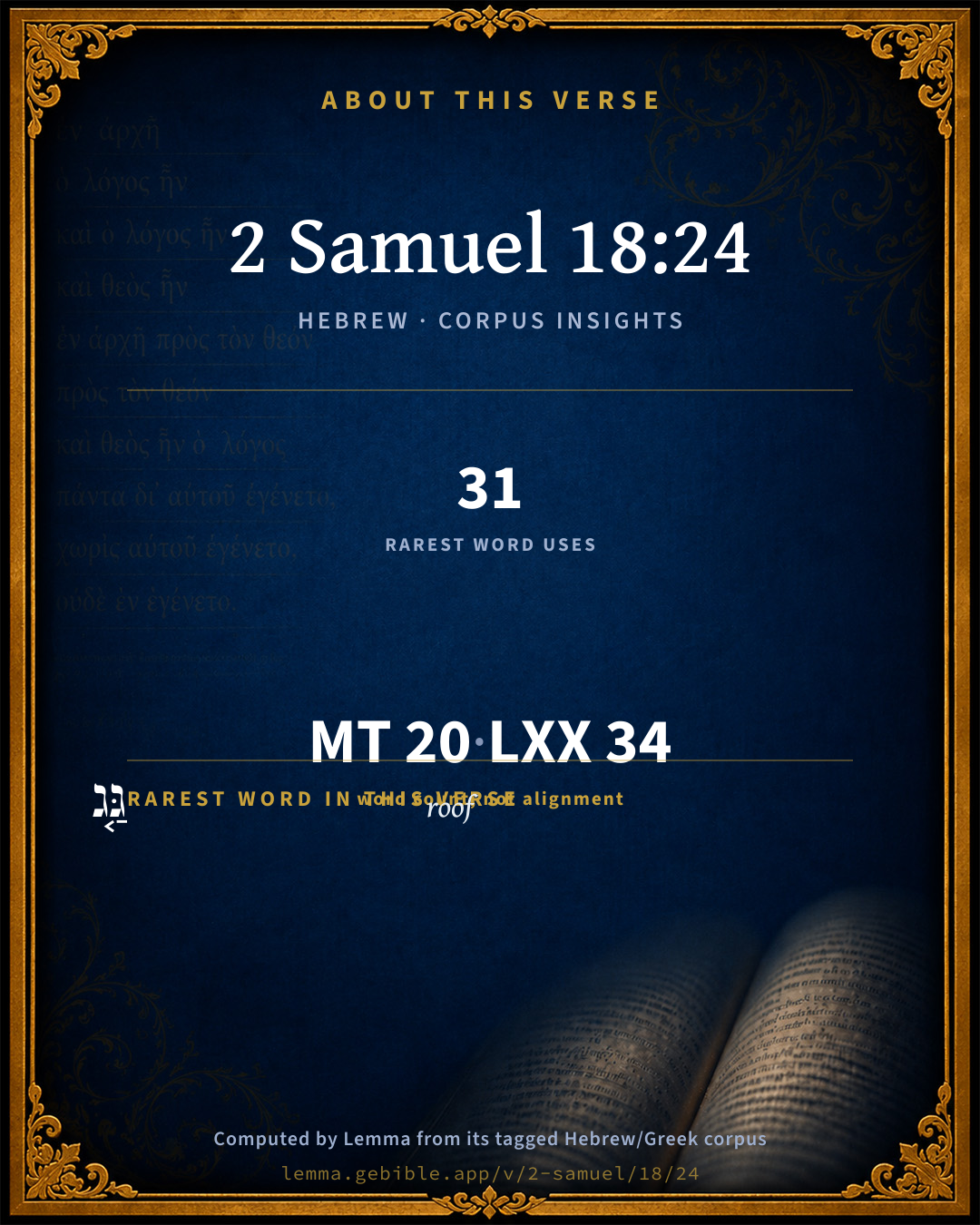
גַּ֤ג
gâg
H1406
“roof of”
Noun, Common, Masculine, Singular, Construct
Part of Speech
Noun
Type
Common
Gender
Masculine
Number
Singular
State
Construct
Full BDB Definition

Origin: probably by reduplication from H1342

TWOT: 312

roof, top, housetop - roof (of house) - top (of altar of incense)
  1. וְדָוִ֥ד Dâvid H1732 “and · David” Conjunction + Noun, Proper
  2. יוֹשֵׁ֖ב yâshab H3427 “dwelling” Verb, Qal, Participle Active, Masculine, Singular, Absolute
  3. בֵּין bêyn H996 “between” Preposition
  4. שְׁנֵ֣י shᵉnayim H8147 “two” Adjective, Cardinal number, Masculine, Dual, Construct
  5. הַשְּׁעָרִ֑ים shaʻar H8179 “the · gates” Particle, Definite Article + Noun, Common, Masculine, Plural, Absolute
  6. וַיֵּ֨לֶךְ yâlak H3212 “and · to walk” Conjunction + Verb, Qal, Sequential Imperfect, 3rd Person, Masculine, Singular
  7. הַצֹּפֶ֜ה tsâphâh H6822 “the · keeping watch” Particle, Definite Article + Verb, Qal, Participle Active, Masculine, Singular, Absolute
  8. אֶל ʼêl H413 “to” Preposition
  9. הַשַּׁ֨עַר֙ shaʻar H8179 “the · gate” Particle, Definite Article + Noun, Common, Masculine, Singular, Absolute
  10. אֶל ʼêl H413 “to” Preposition
  11. הַ֣חוֹמָ֔ה chôwmâh H2346 “the · wall” Particle, Definite Article + Noun, Common, Feminine, Singular, Absolute
  12. וַיִּשָּׂ֤א nâsâʼ H5375 “and · to lift” Conjunction + Verb, Qal, Sequential Imperfect, 3rd Person, Masculine, Singular
  13. אֶת ʼêth H853 “-” Particle, Direct Object
  14. עֵינָיו֙ ʻayin H5869 “eyes · his” Noun, Common, Both, Dual, Construct + Suffix, Personal, 3rd Person, Masculine, Singular
  15. וַיַּ֔רְא râʼâh H7200 “and · to see” Conjunction + Verb, Qal, Sequential Imperfect, 3rd Person, Masculine, Singular
  16. וְהִנֵּה hinnêh H2009 “and · behold” Conjunction + Particle, Demonstrative
  17. אִ֖ישׁ ʼîysh H376 “man” Noun, Common, Masculine, Singular, Absolute
  18. רָ֥ץ rûwts H7323 “running” Verb, Qal, Participle Active, Masculine, Singular, Absolute
  19. לְבַדּֽוֹ bad H905 “to/for · apart · his” Preposition + Noun, Common, Masculine, Singular, Construct + Suffix, Personal, 3rd Person, Masculine, Singular

About this verse

These counts appear in no published source. They are computed here, from the morphology-tagged text and Lemma’s own curated glosses. What Lemma adds →

20
words
18
distinct lemmas
Historical
section

Shared distinctive vocabulary

גַּ֤ג roof H1406 occurs in 27 verses of the Hebrew Bible. Also found in:

Grammatical profile

  • 6 verbs
  • 8 nouns
  • 1 adjective
  • 3 prepositions
  • 2 particles

Verb forms

  • יוֹשֵׁ֖ב Qal · Participle Active
  • וַיֵּ֨לֶךְ Qal · Sequential Imperfect
  • הַצֹּפֶ֜ה Qal · Participle Active
  • וַיִּשָּׂ֤א Qal · Sequential Imperfect
  • וַיַּ֔רְא Qal · Sequential Imperfect
  • רָ֥ץ Qal · Participle Active

Repetition

Words recur within this verse — often emphatic in Hebrew:

  • הַשְּׁעָרִ֑ים gate H8179 ×2
  • אֶל to H413 ×2

Hebrew & Septuagint length

In English translation the verse runs 35 words from the Hebrew and 37 from the Septuagint (LXX English) — closely comparable.

A rough comparison of the two English renderings, which tokenize alike — not a word-level alignment.

Word counts can differ between the Hebrew and the Greek without any difference in meaning — e.g. the Hebrew direct-object marker אֵת has no separate Greek word, and Greek often adds the article ὁ.

In the original languages it is 20 Hebrew tokens and 34 Greek tokens — but the two are counted differently (Hebrew bundles its prefixes and suffixes into one token; the Greek is in lemma form), so that isn’t a like-for-like length.

Cross-references

8

Topical passages linked to 2 Samuel 18:24 in the Treasury of Scripture Knowledge — connected by theme and wording, ordered by reader-vote popularity; previews shown in the World English Bible.

  • 2 Samuel 19:8 Then the king arose, and sat in the gate. They told to all the people, saying, Behold, the king is sitting in the gate: and all the people came before the king. Now Israel had fled every man to his tent.
  • 1 Samuel 4:13 When he came, behold, Eli was sitting on his seat by the road watching; for his heart trembled for the ark of God. When the man came into the city, and told it, all the city cried out.
  • 2 Samuel 13:34 But Absalom fled. The young man who kept the watch lifted up his eyes, and looked, and, behold, there came much people by the way of the hill-side behind him.
  • 2 Samuel 18:4 The king said to them, What seems you best I will do. The king stood by the gate-side, and all the people went out by hundreds and by thousands.
  • Isaiah 21:6–9 For thus has the Lord said to me, Go, set a watchman: let him declare what he sees:
  • Isaiah 21:11–12 The burden of Dumah. One calls to me out of Seir, Watchman, what of the night? Watchman, what of the night?
  • Ezekiel 33:2–7 Son of man, speak to the children of your people, and tell them, When I bring the sword on a land, and the people of the land take a man from among them, and set him for their watchman;
  • 2 Kings 9:17–20 Now the watchman was standing on the tower in Jezreel, and he spied the company of Jehu as he came, and said, I see a company. Joram said, Take a horseman, and send to meet them, and let him say, Is it peace?

Cross-references courtesy of OpenBible.info (CC BY 4.0).

Hebrew and Greek witnesses Masoretic Hebrew ↔ Greek Septuagint

The same verse in the two great witnesses to the Old Testament, shown verse-for-verse.

These are two independent witnesses, not word-aligned to each other, and the Septuagint is shown in lemma (dictionary) form.

Hebrew 2 Samuel 18:24 Masoretic · Westminster Leningrad Codex

וְדָוִ֥ד יוֹשֵׁ֖ב בֵּין שְׁנֵ֣י הַשְּׁעָרִ֑ים וַיֵּ֨לֶךְ הַצֹּפֶ֜ה אֶל גַּ֤ג הַשַּׁ֨עַר֙ אֶל הַ֣חוֹמָ֔ה וַיִּשָּׂ֤א אֶת עֵינָיו֙ וַיַּ֔רְא וְהִנֵּה אִ֖ישׁ רָ֥ץ לְבַדּֽוֹ

Now David was sitting between the two gates: and the watchman went up to the roof of the gate to the wall, and lifted up his eyes, and looked, and, behold, a man running alone.

World English Bible · Public Domain

Greek LXX 2 Samuel 18:24 Septuagint · lemma form

καί δαυίδ κάθημαι ἀνά μέσος ὁ δύο πύλη καί πορεύομαι ὁ σκοπός εἰς ὁ δῶμα ὁ πύλη πρός ὁ τεῖχος καί ἐπιαἴρω ὁ ὀφθαλμός αὐτός καί ὁράω καί ἰδού ἀνήρ τρέχω μόνος ἐνώπιον αὐτός

And David was sitting between the two gates: and the watchman went up on the top of the gate of the wall, and lifted up his eyes, and looked, and behold a man running alone before him.

LXX2012 (modern English Septuagint) · Public Domain

Hebrew: Westminster Leningrad Codex (CC BY 4.0). Greek: Septuagint (public domain); English from LXX2012 (modern English Septuagint) (Public Domain). How the Septuagint differs from the Hebrew →

Targum (Aramaic paraphrase)

1

The Targum is the ancient Jewish Aramaic paraphrase of the Hebrew Scriptures — an interpretive translation, not the Hebrew text itself. Onkelos (literal) and Pseudo-Jonathan (expansive) render the Torah, and Jonathan the Prophets. Coverage is partial: where no permissively-licensed English translation exists for a verse, only the Aramaic is shown. This is verse-level text, not a word-by-word alignment to the Hebrew.

  1. Targum Jonathan Prophets (Joshua–Malachi)
    וְדָוִד יָתֵיב בֵּין תְּרֵין תַּרְעַיָא וְהַלִיךְ סַכְוָאָה עַל אִגַר תַּרְעָא עַל שׁוּרָא וּזְקֵף יַת עֵינוֹהִי וַחֲזָא וְהָא גַבְרָא רָהִיט בִּלְחוֹדוֹהִי:

    (no public-domain English translation for this verse)

    Targum Jonathan — Aramaic: “Mikraot Gedolot” (public domain). English: “Sefaria Community Translation” (CC0 1.0 (public-domain dedication)); “London "Chaldee Paraphrase," 1871” (public domain). Text via Sefaria.

Commentary

Notes on 2 Samuel 18:24 from classic Christian and Jewish commentators (each source and its license shown beneath its notes). The classic Christian expositions comment on the surrounding passage and are grouped to its opening verse, so a note may address several verses; the Jewish commentaries on the Tanakh (Rashi and others) are per-verse, so they appear only where the commentator wrote on this verse.

Lemma curates 59 commentaries, every one of them public domain or Creative Commons licensed, each selected and text-cleaned for this edition rather than reprinted as found. About our sources →

Trapp's Complete Commentary

John Trapp

2Sa 18:24 And David sat between the two gates: and the watchman went up to the roof over the gate unto the wall, and lifted up his eyes, and looked, and behold a man running alone.

Ver. 24. And David sat between the two gates.] Where he hung in suspense, and waited for the next news.

John Trapp, A Commentary or Exposition upon All the Books of the Old and New Testament (1647–1656) — public domain. Text from a community e-Sword module.

Joseph Benson's Commentary

2Sa 18:24. David sat between the two gates — It is probable the gates of cities then were, as they now generally are, large and thick, and that, for greater security, they had two gates, one more outward, and the other inward. Here the king sat, that he might hear tidings as soon as they came to the city.

Joseph Benson's Commentary on the Old and New Testaments (1811–1818) — public domain. Text from a community e-Sword module.

Whedon's Commentary on the Bible

Daniel D. Whedon

ABSALOM’S PURSUIT OF DAVID, 2Sa_18:24-26.

24. David came to Mahanaim — Where Ishbosheth had once had the seat of his government. See 2Sa_2:8.

Absalom passed over Jordan — This was probably several weeks or months after David crossed, during which time Absalom had been anointed as king, (2Sa_19:10,) and, in accordance with Hushai’s counsel, had gathered warriors from all the tribes.

24. Sat between the two gates — The city of Mahanaim seems to have been enclosed by a double wall, and its main entrance guarded by two gates, an outer and an inner one, between which was a sort of court.

The roof over the gate unto the wall — The top of one of the towers of the outer gate. The outer gate of fortified cities was usually surmounted by a tower, in which chambers were often built. The top was a suitable station for a watchman. Such towers were also built into the city walls at various places.

Daniel D. Whedon (gen. ed.), Commentary on the Old and New Testaments (1874–1909) — public domain. Text from a community e-Sword module.

Geneva Bible (1599)

Geneva Bible translators

He sat in the gate of the city of Mahanaim.

Geneva Bible (1599) marginal notes — public domain. Text via Bolls.life.

Jamieson, Fausset & Brown

Robert Jamieson, A. R. Fausset & David Brown

David sat between the two gates--that is, in the tower-house on the wall that overhung the gate of Mahanaim. Near it was a watchtower, on which a sentinel was posted, as in times of war, to notify every occurrence. The delicacy of Ahimaaz' communication was made up by the unmistakable plainness of Cushi's. The death of Absalom was a heavy trial, and it is impossible not to sympathize with the outburst of feeling by which David showed that all thoughts of the victory he had won as a king were completely sunk in the painful loss he had sustained as a father. The extraordinary ardor and strength of his affection for this worthless son break out in the redundancy and vehemence of his mournful ejaculations.

Next: 2 Samuel Chapter 19

Jamieson, Fausset & Brown — Commentary Critical and Explanatory on the Whole Bible (1871) — public domain (CC PDM 1.0). Text via the HelloAO Bible API.

Adam Clarke's Commentary

Verse 24. David sat between the two gates] He was probably in the seat of justice. Before the gate of the city it is supposed there was an enclosure, which had its gate also; David sat in the space between these two doors. Over the larger gate there appears to have been a turret, on which a sentinel or watchman stood continually, and gave information of what he saw in the country.

Adam Clarke's Commentary on the Bible (1810–1826) — public domain. Text from a community e-Sword/MySword module.

The Cambridge Bible for Schools and Colleges

gen. ed. J. J. S. Perowne

24. between the two gates] In the space between the inner and outer gates of the city gateway.

to the roof over the gate unto the wall] To that side of the flat roof of the gateway which was in the outer wall of the city.

The Cambridge Bible for Schools and Colleges (gen. ed. J. J. S. Perowne; Cambridge University Press, 1878–1918) — public domain. Text from a community e-Sword module.

John Gill's Exposition

And David sat between the two gates,.... Of the city of Mahanaim; which being a fortified place had two walls, one within another, and in each wall a gate; and between these David sat, waiting for news of the battle:

and the watchman went up to the roof over the gate unto the wall; the gate to the outward wall, over which was a tower, and on that a flat roof; to which the watchman went to observe if he could see an express coming; no doubt by David's orders:

and lifted up his eyes and looked; that is, very diligently and wistfully:

and, behold, a man running alone: which made him the more observable, and was the more likely to be a messenger.

John Gill's Exposition of the Whole Bible (1746–1763) — public domain (CC PDM 1.0). Text via the HelloAO Bible API.

Haydock's Catholic Bible Commentary

Two gates, one leading into the town, the other into the country. In the middle was a chamber for public meetings, and another above, Job xxix. 7. On the roof a guard was stationed on this occasion.

George Leo Haydock (1774–1849), Haydock's Catholic Family Bible and Commentary, 1859 edition — public domain. Excludes Psalms (Douay-Rheims chapter numbering differs from Protestant) and Deuterocanonical books (Catholic canon only).

Matthew Poole's English Annotations

Between the two gates; for the gates of the cities then were, as now they are, large and thick; and, for the greater security, had two gates, one more outward, the other inward. Here he sat, that he might hear tidings when any came into the city.

Unto the wall; unto the top of the wall or tower upon the gate, where watchmen used to watch. Compare 2Ki 9:17; Eze 33:2.

Matthew Poole's English Annotations on the Holy Bible (1683–1685) — public domain. Text from a community e-Sword/MySword module.

The Pulpit Commentary

David sat between the two gates. The gateway was in a tower in the city walls, and David was sitting in the space between the inner and outer gates. Over this space was a chamber, mentioned in ver. 33, while the sentinel was posted upon the front wall over the outer gate.

The Pulpit Commentary (1880–1919), ed. H.D.M. Spence-Jones & Joseph S. Exell — public domain. Text from a community e-Sword module.

John Wesley's Explanatory Notes

Gates - For the gates of the cities then were, as now they are, large and thick; and for the greater security, had two gates, one more outward, the other inward. Here he sat, that he might hear tidings when any came into the city.

John Wesley, Explanatory Notes Upon the Whole Bible (1754–1765) — public domain. Text via the GEBible commentary corpus.

Keil & Delitzsch

C. F. Keil & F. Delitzsch

David was sitting between the two gates of Mahanaim waiting for tidings of the result of the battle. The two gates are the outer and inner gate of the fortified city wall, between which there was a small court, where David was sitting. The watchman then went up to the roof of the gate by the wall, probably the outer gate in the city wall, and as he looked he saw a man running alone.

Keil & Delitzsch — Biblical Commentary on the Old Testament (1861–1891) — public domain (CC PDM 1.0). Text via the HelloAO Bible API. (Old Testament only.)

unfoldingWord translationNotes

Door43 World Missions Community

Now

This word is used here to mark a break in the main story line and the beginning of a new part of the story.

raised his eyes

Here the watchman looking to see something is spoken of as if he lifted up his eyes. AT: "looked out beyond the city" (See: Metaphor)

there is news in his mouth

Here the king speaks of the man having a message as if the news were an object sitting in his mouth. AT: "he has news to tell us" (See: Metaphor)

translationWords

watch

gate

raise

unfoldingWord translationNotes — © Distant Shores Media and the Door43 World Missions Community, licensed CC BY-SA 4.0. Source: git.door43.org/Door43/en_tn.

Lesson kit

Teaching starters — assembled from the data on this page, not authored interpretation. Every prompt links to the verse data it draws on. Edit before teaching.

2 Samuel, in the Historical, opens this verse with 20 words (18 distinct Hebrew lemmas). Its most distinctive word is gâg (“roof”). A historical commentator’s framing appears above. Read the whole chapter for the surrounding context.

Discussion questions

  1. How does “roof” (gâg) shape what this verse is saying?
  2. Exodus 30:3 shares the word «roof» with this verse. How do the two illuminate each other?
  3. “gate” occurs 2× in this one verse. What is the effect of the repetition?
  4. These translations render this verse differently; the difference is in the English rendering, not the original. What questions does that raise?
  5. The verb «יוֹשֵׁ֖ב» is Qal Participle Active. How does its form color the action?
  6. Reading how Trapp's Complete Commentary and Joseph Benson's Commentary read this verse, where do the two commentators agree and where do they part?

Things to notice

Reading settings

Reading text

Shown beneath each verse's original-language words.

Old Testament
Old Testament edition

Read the OT as the Masoretic Hebrew (MT) or the Greek Septuagint (LXX).

English shown for the Greek Septuagint (in the Hebrew ↔ Greek comparison).

Comparing translations? Open the Compare panel on any verse page to stack up to four side by side.