
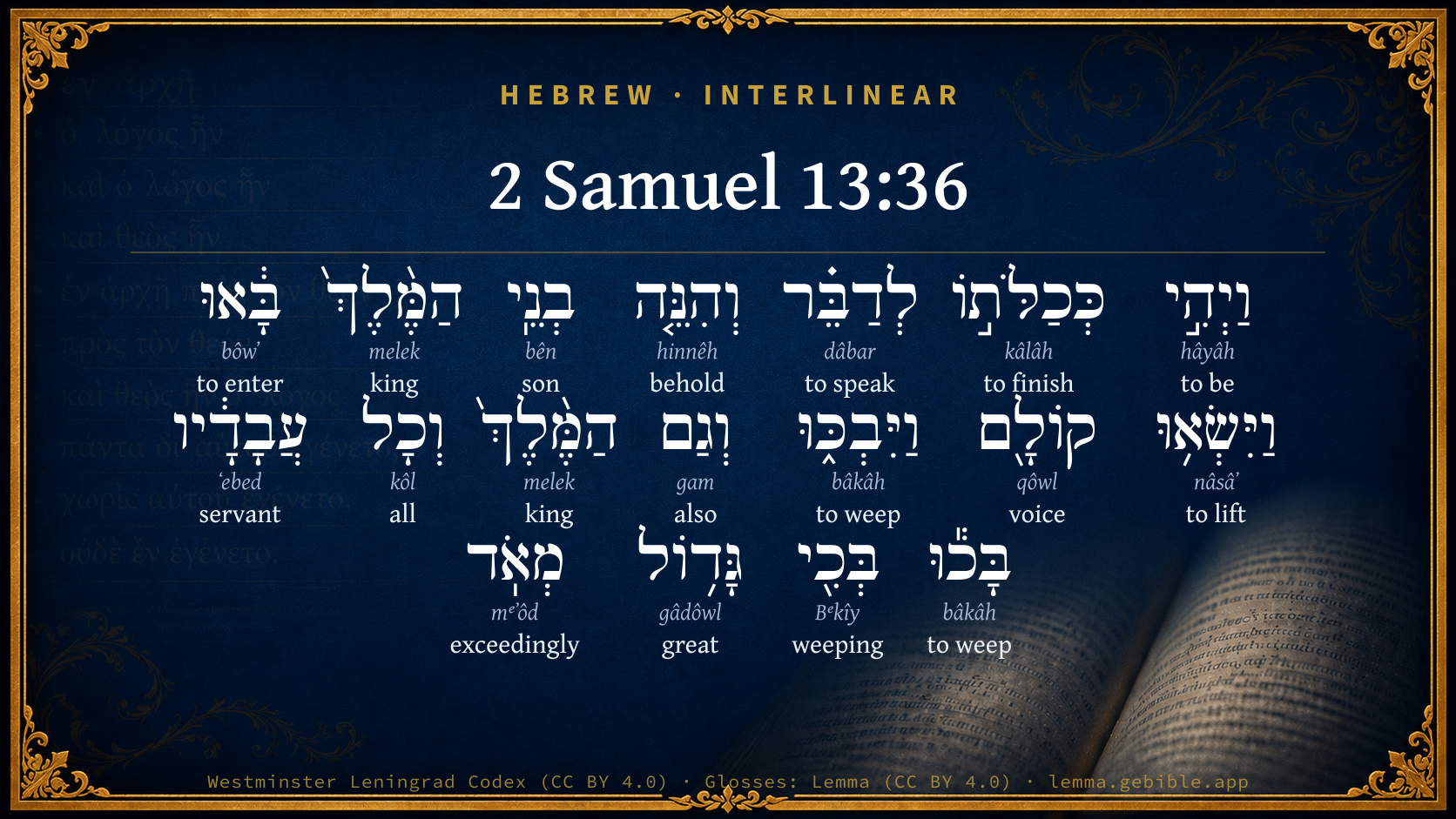
2 Samuel 13:36

Hebrew (Westminster Leningrad Codex) 2 Samuel 13:36 appears in the Hebrew Old Testament. The text above is from the Westminster Leningrad Codex. Each word links to its Strong’s number, a concise gloss, and parsing drawn from the Open Scriptures Hebrew Bible morphology. Click any word for its full Brown-Driver-Briggs (BDB) entry.
Download image
Cite this verse

2 Samuel 13:36 (World English Bible). Public Domain. Lemma interlinear Bible study tool, https://lemma.gebible.app/v/2-samuel/13/36.

Show BibTeX & RIS
BibTeX
RIS
English Translation
It happened, as soon as he had made an end of speaking, that behold, the king's sons came, and lifted up their voice, and wept: and the king also and all his servants wept very sore.
World English Bible · Public Domain
Download a study sheet

One document with this verse’s original text, its word-by-word gloss line, the meaning frame, cross-references with their text, attributed commentary, and full source and license credits — printable, and it pastes into notes with its structure intact.

This verse Autodidact and up

Study sheet (.html) Plain text (.txt)

A passage Seminary Student

Up to 50 verses in one chapter. A passage sheet keeps up to 6 commentary sources and 12 cross-references per verse, in the order this page ranks them, and says so on the sheet whenever that leaves anything out. Ask for a single verse and you get the Autodidact verse sheet above.

Everything on this page stays free to read, with no account — the sheet is a download of what is already on screen, not access to it.

Want to remove ads? Support Godless Engineer
Compare translations 3

The same verse in 3 English versions, stacked beneath the original-language interlinear above. Click any original word for its lexicon entry.

Each is an independent rendering of the whole verse — the interlinear is not word-aligned to these translations.

Highlighted words mark where these versions differ — a whole-verse word diff, not a word-by-word alignment.

  • World English Bible Public Domain
    It happened, as soon as he had made an end of speaking, that behold, the king's sons came, and lifted up their voice, and wept: and the king also and all his servants wept very sore.
  • King James Version Public Domain
    And it came to pass, as soon as he had made an end of speaking, that, behold, the king's sons came, and lifted up their voice and wept: and the king also and all his servants wept very sore.
  • unfoldingWord Literal Text CC BY-SA 4.0
    And it happened, as he finished speaking, that behold, the sons of the king came, and they lifted up their voice and wept. And the king and all of his servants also wept a very great weeping.

unfoldingWord Literal Text — © unfoldingWord, licensed CC BY-SA 4.0. Word-aligned USFM3 via Door43 (git.door43.org/unfoldingWord/en_ult).

Versions to compare (up to 4)

3 of 4 selected

Show all 18 translations

Every available English version of this verse, each an independent rendering of the whole verse.

  • World English Bible Public Domain
    It happened, as soon as he had made an end of speaking, that behold, the king's sons came, and lifted up their voice, and wept: and the king also and all his servants wept very sore.
  • Berean Standard Bible Public Domain
    And as he finished speaking, the sons of the king came in, wailing loudly. Then the king and all his servants also wept very bitterly.
  • Majority Standard Bible Public Domain
    And as he finished speaking, the sons of the king came in, wailing loudly. Then the king and all his servants also wept very bitterly.
  • King James Version Public Domain
    And it came to pass, as soon as he had made an end of speaking, that, behold, the king's sons came, and lifted up their voice and wept: and the king also and all his servants wept very sore.
  • American Standard Version (1901) Public Domain
    And it came to pass, as soon as he had made an end of speaking, that, behold, the king's sons came, and lifted up their voice, and wept: and the king also and all his servants wept very sore.
  • Revised Version (1885) Public Domain
    And it came to pass, as soon as he had made an end of speaking, that, behold, the king’s sons came, and lifted up their voice, and wept: and the king also and all his servants wept very sore.
  • Geneva Bible (1599) Public Domain
    And assoone as hee had left speaking, behold, the Kings sonnes came, and lift vp their voyces, and wept: and the King also and all his seruants wept exceedingly sore.
  • Douay-Rheims (1899) Public Domain
    And when he made an end of speaking, the king's sons also appeared: and coming in they lifted up their voice, and wept: and the king also and all his servants wept very much.
  • Young's Literal Translation Public Domain
    And it cometh to pass at his finishing to speak, that lo, the sons of the king have come, and they lift up their voice, and weep, and also the king and all his servants have wept -- a very great weeping.
  • Literal Standard Version CC BY-SA 4.0
    And it comes to pass at his finishing to speak, that behold, the sons of the king have come, and they lift up their voice, and weep, and also the king and all his servants have wept—a very great weeping.
  • Unlocked Literal Bible CC BY-SA 4.0
    So it came about when he finished speaking, the king's sons arrived and raised their voices and wept. The king and all his servants also wept bitterly.
  • unfoldingWord Literal Text CC BY-SA 4.0
    And it happened, as he finished speaking, that behold, the sons of the king came, and they lifted up their voice and wept. And the king and all of his servants also wept a very great weeping.
  • Darby Bible Public Domain
    And as soon as he had ended speaking, behold, the king's sons came, and lifted up their voice and wept; and the king also and all his servants wept very bitterly.
  • World Messianic Bible Public Domain
    As soon as he had finished speaking, behold, the king’s sons came, and lifted up their voices and wept. The king also and all his servants wept bitterly.
  • Webster's Bible Public Domain
    And it came to pass, as soon as he had made an end of speaking, that behold, the king's sons came, and lifted up their voice and wept: and the king also and all his servants wept exceedingly.
  • Free Bible Version CC BY-SA 4.0
    As he finished speaking, the king's sons came in, crying and wailing. Then the king and all his officials also cried loudly.
  • Bible in Basic English Public Domain
    And while he was talking, the king's sons came, with weeping and loud cries: and the king and all his servants were weeping bitterly.
  • JPS Tanakh (1917) Public Domain
    And it came to pass, as soon as he had made an end of speaking, that, behold, the king's sons came, and lifted up their voice, and wept; and the king also and all his servants wept very sore.

Literal Standard Version (2020), Covenant Press — licensed CC BY-SA 4.0. Text via the HelloAO Bible API (eBible.org). Unlocked Literal Bible (unfoldingWord) — licensed CC BY-SA 4.0. Text via the HelloAO Bible API (eBible.org). unfoldingWord Literal Text — © unfoldingWord, licensed CC BY-SA 4.0. Word-aligned USFM3 via Door43 (git.door43.org/unfoldingWord/en_ult). Free Bible Version, Dr. Jonathan Gallagher — licensed CC BY-SA 4.0. Text via the HelloAO Bible API (eBible.org).

Word by word

More ways to search: Search by grammar → Find every occurrence → Compare this word →

Practice this passage: Drill this verse → Learn its vocabulary →

בְּכִ֖י
Bᵉkîy
H1065
“weeping”
Noun, Common, Masculine, Singular, Absolute
Part of Speech
Noun
Type
Common
Gender
Masculine
Number
Singular
State
Absolute
Full BDB Definition

Origin: from H1058

TWOT: 243b

a weeping, weeping
  1. וַיְהִ֣י hâyâh H1961 “and · to be” Conjunction + Verb, Qal, Sequential Imperfect, 3rd Person, Masculine, Singular
  2. כְּכַלֹּת֣וֹ kâlâh H3615 “like/as · to finish · him” Preposition + Verb, Piel, Infinitive Construct + Suffix, Personal, 3rd Person, Masculine, Singular
  3. לְדַבֵּ֗ר dâbar H1696 “to speak” Preposition + Verb, Piel, Infinitive Construct
  4. וְהִנֵּ֤ה hinnêh H2009 “and · behold” Conjunction + Particle, Demonstrative
  5. בְנֵֽי bên H1121 “sons of” Noun, Common, Masculine, Plural, Construct
  6. הַמֶּ֨לֶךְ֙ melek H4428 “the · king” Particle, Definite Article + Noun, Common, Masculine, Singular, Absolute
  7. בָּ֔אוּ bôwʼ H935 “to enter” Verb, Qal, Perfect, 3rd Person, Common, Plural
  8. וַיִּשְׂא֥וּ nâsâʼ H5375 “and · to lift” Conjunction + Verb, Qal, Sequential Imperfect, 3rd Person, Masculine, Plural
  9. קוֹלָ֖ם qôwl H6963 “voice · their” Noun, Common, Masculine, Singular, Construct + Suffix, Personal, 3rd Person, Masculine, Plural
  10. וַיִּבְכּ֑וּ bâkâh H1058 “and · to weep” Conjunction + Verb, Qal, Sequential Imperfect, 3rd Person, Masculine, Plural
  11. וְגַם gam H1571 “and · also” Conjunction + Particle, Accusative
  12. הַמֶּ֨לֶךְ֙ melek H4428 “the · king” Particle, Definite Article + Noun, Common, Masculine, Singular, Absolute
  13. וְכָל kôl H3605 “and · all of” Conjunction + Noun, Common, Masculine, Singular, Construct
  14. עֲבָדָ֔יו ʻebed H5650 “servants · his” Noun, Common, Masculine, Plural, Construct + Suffix, Personal, 3rd Person, Masculine, Singular
  15. בָּכ֕וּ bâkâh H1058 “to weep” Verb, Qal, Perfect, 3rd Person, Common, Plural
  16. גָּד֥וֹל gâdôwl H1419 “great” Adjective, Adjective, Masculine, Singular, Absolute
  17. מְאֹֽד mᵉʼôd H3966 “exceedingly” Adverb

About this verse

These counts appear in no published source. They are computed here, from the morphology-tagged text and Lemma’s own curated glosses. What Lemma adds →

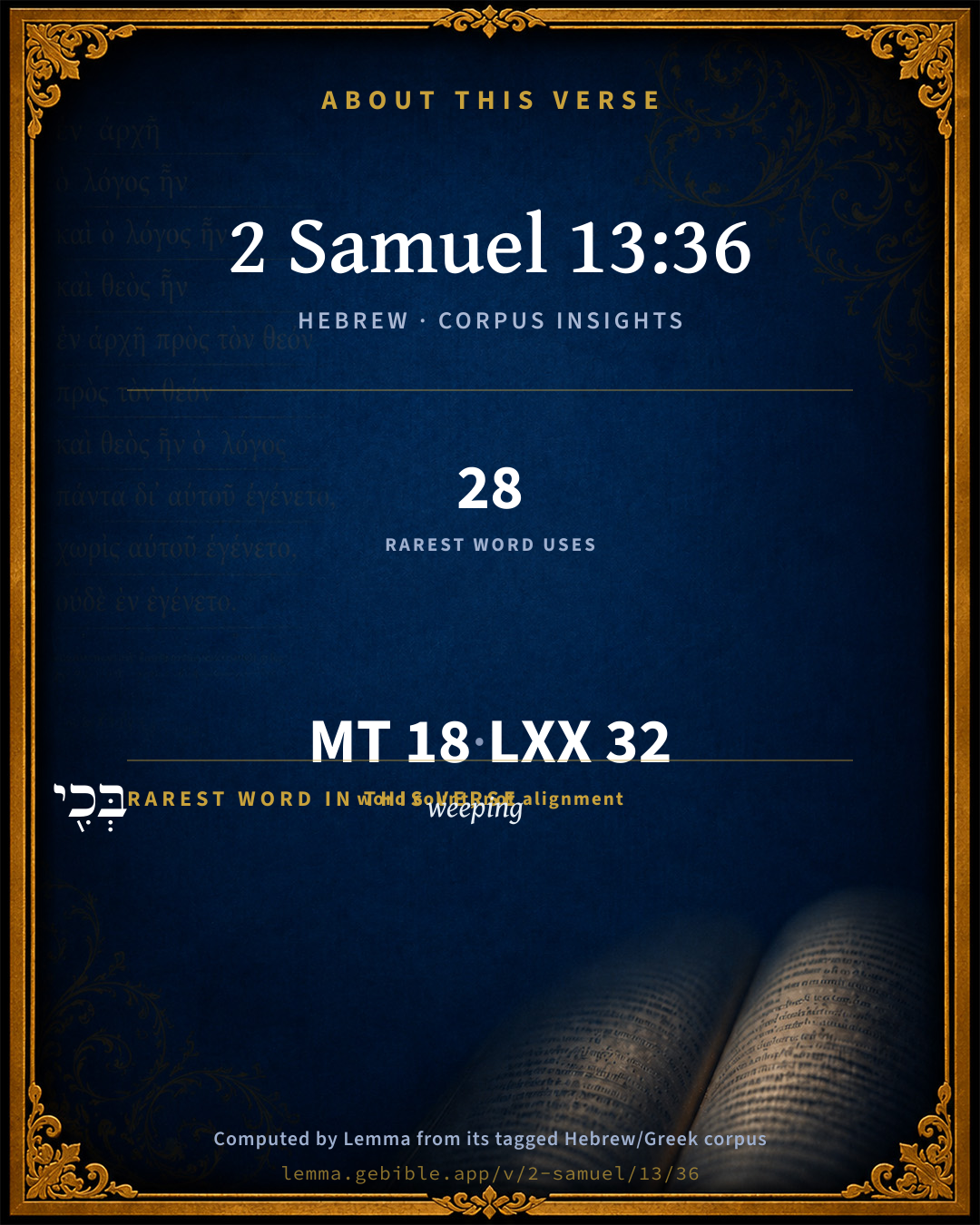
18
words
16
distinct lemmas
Historical
section

Shared distinctive vocabulary

בְּכִ֖י weeping H1065 occurs in 27 verses of the Hebrew Bible. Also found in:

Grammatical profile

  • 7 verbs
  • 7 nouns
  • 1 adjective
  • 1 adverb
  • 2 particles

Verb forms

  • וַיְהִ֣י Qal · Sequential Imperfect
  • כְּכַלֹּת֣וֹ Piel · Infinitive Construct
  • לְדַבֵּ֗ר Piel · Infinitive Construct
  • בָּ֔אוּ Qal · Perfect
  • וַיִּשְׂא֥וּ Qal · Sequential Imperfect
  • וַיִּבְכּ֑וּ Qal · Sequential Imperfect
  • בָּכ֕וּ Qal · Perfect

Repetition

Words recur within this verse — often emphatic in Hebrew:

  • הַמֶּ֨לֶךְ֙ king H4428 ×2
  • וַיִּבְכּ֑וּ to weep H1058 ×2

Hebrew & Septuagint length

In English translation the verse runs 36 words from the Hebrew and 37 from the Septuagint (LXX English) — closely comparable.

A rough comparison of the two English renderings, which tokenize alike — not a word-level alignment.

Word counts can differ between the Hebrew and the Greek without any difference in meaning — e.g. the Hebrew direct-object marker אֵת has no separate Greek word, and Greek often adds the article ὁ.

In the original languages it is 18 Hebrew tokens and 32 Greek tokens — but the two are counted differently (Hebrew bundles its prefixes and suffixes into one token; the Greek is in lemma form), so that isn’t a like-for-like length.

Cross-references

3

Topical passages linked to 2 Samuel 13:36 in the Treasury of Scripture Knowledge — connected by theme and wording, ordered by reader-vote popularity; previews shown in the World English Bible.

  • 2 Samuel 12:21 Then said his servants to him, What thing is this that you have done? you did fast and weep for the child, while it was alive; but when the child was dead, you did rise and eat bread.
  • 2 Samuel 13:15 Then Amnon hated her with exceeding great hatred; for the hatred with which he hated her was greater than the love with which he had loved her. Amnon said to her, Arise, be gone.
  • 2 Samuel 18:33 The king was much moved, and went up to the chamber over the gate, and wept: and as he went, thus he said, my son Absalom, my son, my son Absalom! would I had died for you, Absalom, my son, my son!

Cross-references courtesy of OpenBible.info (CC BY 4.0).

Hebrew and Greek witnesses Masoretic Hebrew ↔ Greek Septuagint

The same verse in the two great witnesses to the Old Testament, shown verse-for-verse.

These are two independent witnesses, not word-aligned to each other, and the Septuagint is shown in lemma (dictionary) form.

Hebrew 2 Samuel 13:36 Masoretic · Westminster Leningrad Codex

וַיְהִ֣י כְּכַלֹּת֣וֹ לְדַבֵּ֗ר וְהִנֵּ֤ה בְנֵֽי הַמֶּ֨לֶךְ֙ בָּ֔אוּ וַיִּשְׂא֥וּ קוֹלָ֖ם וַיִּבְכּ֑וּ וְגַם הַמֶּ֨לֶךְ֙ וְכָל עֲבָדָ֔יו בָּכ֕וּ בְּכִ֖י גָּד֥וֹל מְאֹֽד

It happened, as soon as he had made an end of speaking, that behold, the king's sons came, and lifted up their voice, and wept: and the king also and all his servants wept very sore.

World English Bible · Public Domain

Greek LXX 2 Samuel 13:36 Septuagint · lemma form

καί γίγνομαι ἡνίκα συντελέω λαλέω καί ὁράω ὁ υἱός ὁ βασιλεύς ἔρχομαι καί ἐπιαἴρω ὁ φωνή αὐτός καί κλαίω καί γέ ὁ βασιλεύς καί πᾶς ὁ παῖς αὐτός κλαίω κλαυθμός μέγας σφόδρα

And it came to pass when he had finished speaking, that, behold, the king's sons came, and lifted up their voices and wept: and the king also and all his servants wept with a very great weeping.

LXX2012 (modern English Septuagint) · Public Domain

Hebrew: Westminster Leningrad Codex (CC BY 4.0). Greek: Septuagint (public domain); English from LXX2012 (modern English Septuagint) (Public Domain). How the Septuagint differs from the Hebrew →

Targum (Aramaic paraphrase)

1

The Targum is the ancient Jewish Aramaic paraphrase of the Hebrew Scriptures — an interpretive translation, not the Hebrew text itself. Onkelos (literal) and Pseudo-Jonathan (expansive) render the Torah, and Jonathan the Prophets. Coverage is partial: where no permissively-licensed English translation exists for a verse, only the Aramaic is shown. This is verse-level text, not a word-by-word alignment to the Hebrew.

  1. Targum Jonathan Prophets (Joshua–Malachi)
    וַהֲוָה כְּשֵׁיצָיוּתֵיהּ לְמַלָלָא וְהָא בְנֵי מַלְכָּא אֲתוֹ וַאֲרִימוּ קַלְהוֹן וּבְכוֹ וְאַף מַלְכָּא וְכָל עַבְדוֹהִי בְּכוֹ בְּכִי סַגִיאָה לַחֲדָא:

    (no public-domain English translation for this verse)

    Targum Jonathan — Aramaic: “Mikraot Gedolot” (public domain). English: “Sefaria Community Translation” (CC0 1.0 (public-domain dedication)); “London "Chaldee Paraphrase," 1871” (public domain). Text via Sefaria.

Commentary

Notes on 2 Samuel 13:36 from classic Christian and Jewish commentators (each source and its license shown beneath its notes). The classic Christian expositions comment on the surrounding passage and are grouped to its opening verse, so a note may address several verses; the Jewish commentaries on the Tanakh (Rashi and others) are per-verse, so they appear only where the commentator wrote on this verse.

Lemma curates 59 commentaries, every one of them public domain or Creative Commons licensed, each selected and text-cleaned for this edition rather than reprinted as found. About our sources →

Trapp's Complete Commentary

John Trapp

2Sa 13:36 And it came to pass, as soon as he had made an end of speaking, that, behold, the king’s sons came, and lifted up their voice and wept: and the king also and all his servants wept very sore.

Ver. 36. And the king also … wept very sore.] Heb., With a great weeping greatly: this was the product of his sweet sin with Bathsheba. Macrobius telleth us that the Romans placed the image of Angeronia upon the altar of Volupia. And the poets feign that pleasure and pain once accused one another before Jupiter: and that whenas he could not decide the controversies between them, be tied them together with a chain of adamant, and so made them inseparable companions.

John Trapp, A Commentary or Exposition upon All the Books of the Old and New Testament (1647–1656) — public domain. Text from a community e-Sword module.

John Gill's Exposition

And it came to pass, as soon as he had made an end of speaking,.... As soon as the above words were out of his mouth:

that, behold, the king's sons came: into the palace, and into the apartment where the king was:

and lifted up their voice and wept; not being able to tell the sorrowful news with their mouths, but declared it by gestures:

and the king also and all his servants wept very sore; they joined the king's sons in weeping, and were the more moved to it by their weeping, and the rather, since hereby the news of Amnon's murder was confirmed.

John Gill's Exposition of the Whole Bible (1746–1763) — public domain (CC PDM 1.0). Text via the HelloAO Bible API.

The Pulpit Commentary

The king also and all his servants wept very sore. The narrative sets very clearly before us the great terror of the king, who at first supposes that all his sons are murdered; there is then suspense while Jonadab suggests that one only has been sacrificed to private vengeance; then quickly comes the watchman"s report of the appearance of much people rapidly descending the hillside, and this is followed by the hasty rush of the fugitives into his presence, and the terrible certainty that one son has, with long premeditated malice, murdered his brother. And as he wept, David, we may feel sure, thought of Uriah, murdered because of his own base passions, whereas Amnon had brought death upon himself by following, alas! the example of his own father. He would think, too, of the words of his sentence, that "the sword should never depart from his house." It had claimed one victim, and who could now stop the outburst of angry passions in a family which previously had dwelt in kindly friendship? Probably, too, he reproached himself for not punishing Amnon. Had he done so with sufficient severity to have satisfied Absalom, he would have saved the life of his firstborn, and not have driven his second son into terrible crime. He had not done so because his own sins had tied his hands. Yes; David had good reason for weeping sore.

The Pulpit Commentary (1880–1919), ed. H.D.M. Spence-Jones & Joseph S. Exell — public domain. Text from a community e-Sword module.

Keil & Delitzsch

C. F. Keil & F. Delitzsch

Jonadab had hardly said this when the king's sons arrived and wept aloud, sc., as they related what had occurred; whereupon the king and all his retainers broke out in loud weeping.

Keil & Delitzsch — Biblical Commentary on the Old Testament (1861–1891) — public domain (CC PDM 1.0). Text via the HelloAO Bible API. (Old Testament only.)

Lesson kit

Teaching starters — assembled from the data on this page, not authored interpretation. Every prompt links to the verse data it draws on. Edit before teaching.

2 Samuel, in the Historical, opens this verse with 18 words (16 distinct Hebrew lemmas). Its most distinctive word is Bᵉkîy (“weeping”). A historical commentator’s framing appears above. Read the whole chapter for the surrounding context.

Discussion questions

  1. What does “weeping” (Bᵉkîy) contribute to the verse as a whole?
  2. Genesis 45:2 shares the word «weeping» with this verse. How do the two illuminate each other?
  3. “king” occurs 2× in this one verse. What is the effect of the repetition?
  4. The translations on this page render this verse differently — a whole-verse word diff, not a word-by-word alignment. What might account for the different wordings?
  5. The verb «וַיְהִ֣י» is Qal Sequential Imperfect. How does its form color the action?
  6. Reading how Trapp's Complete Commentary and John Gill's Exposition read this verse, where do the two commentators agree and where do they part?

Things to notice

Reading settings

Reading text

Shown beneath each verse's original-language words.

Old Testament
Old Testament edition

Read the OT as the Masoretic Hebrew (MT) or the Greek Septuagint (LXX).

English shown for the Greek Septuagint (in the Hebrew ↔ Greek comparison).

Comparing translations? Open the Compare panel on any verse page to stack up to four side by side.