
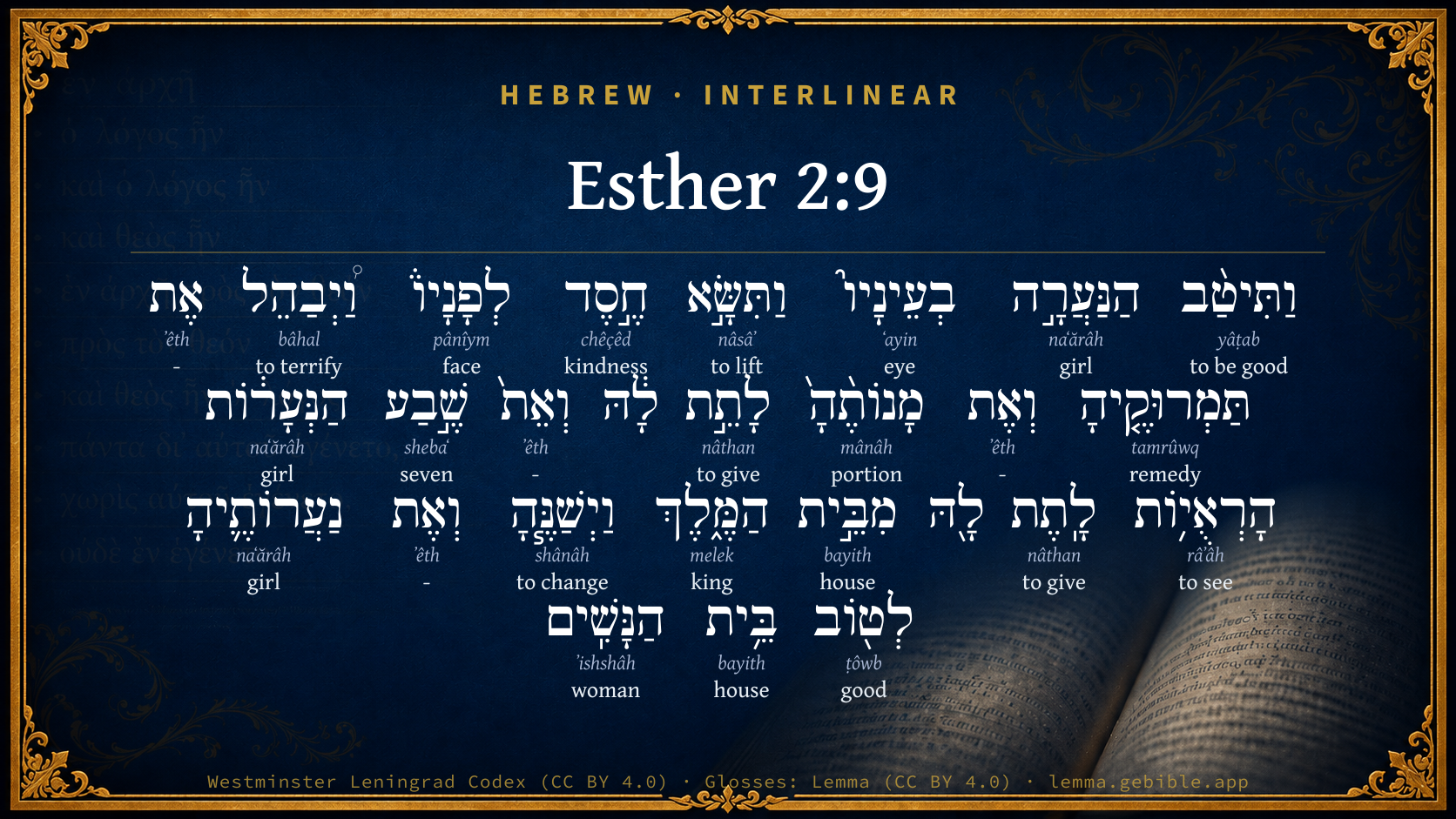
Esther 2:9

Hebrew (Westminster Leningrad Codex) Esther 2:9 appears in the Hebrew Old Testament. The text above is from the Westminster Leningrad Codex. Each word links to its Strong’s number, a concise gloss, and parsing drawn from the Open Scriptures Hebrew Bible morphology. Click any word for its full Brown-Driver-Briggs (BDB) entry.
Download image
Cite this verse

Esther 2:9 (World English Bible). Public Domain. Lemma interlinear Bible study tool, https://lemma.gebible.app/v/esther/2/9.

Show BibTeX & RIS
BibTeX
RIS
English Translation
The maiden pleased him, and she obtained kindness of him; and he speedily gave her things for her purification, with her portions, and the seven maidens who were meet to be given her out of the king's house: and he removed her and her maidens to the best place of the house of the women.
World English Bible · Public Domain
Download a study sheet

One document with this verse’s original text, its word-by-word gloss line, the meaning frame, cross-references with their text, attributed commentary, and full source and license credits — printable, and it pastes into notes with its structure intact.

This verse Autodidact and up

Study sheet (.html) Plain text (.txt)

A passage Seminary Student

Up to 50 verses in one chapter. A passage sheet keeps up to 6 commentary sources and 12 cross-references per verse, in the order this page ranks them, and says so on the sheet whenever that leaves anything out. Ask for a single verse and you get the Autodidact verse sheet above.

Everything on this page stays free to read, with no account — the sheet is a download of what is already on screen, not access to it.

Want to remove ads? Support Godless Engineer
Compare translations 3

The same verse in 3 English versions, stacked beneath the original-language interlinear above. Click any original word for its lexicon entry.

Each is an independent rendering of the whole verse — the interlinear is not word-aligned to these translations.

Highlighted words mark where these versions differ — a whole-verse word diff, not a word-by-word alignment.

  • World English Bible Public Domain
    The maiden pleased him, and she obtained kindness of him; and he speedily gave her things for her purification, with her portions, and the seven maidens who were meet to be given her out of the king's house: and he removed her and her maidens to the best place of the house of the women.
  • King James Version Public Domain
    And the maiden pleased him, and she obtained kindness of him; and he speedily gave her her things for purification, with such things as belonged to her, and seven maidens, which were meet to be given her, out of the king's house: and he preferred her and her maids unto the best place of the house of the women.
  • unfoldingWord Literal Text CC BY-SA 4.0
    And the young woman was pleasing in his eyes, and she lifted kindness before his face. And he quickly gave her ointments, gave her portions of food, and gave her seven young women chosen from the house of the king. And he transferred her and her young women to the best of the house of women.

unfoldingWord Literal Text — © unfoldingWord, licensed CC BY-SA 4.0. Word-aligned USFM3 via Door43 (git.door43.org/unfoldingWord/en_ult).

Versions to compare (up to 4)

3 of 4 selected

Show all 18 translations

Every available English version of this verse, each an independent rendering of the whole verse.

  • World English Bible Public Domain
    The maiden pleased him, and she obtained kindness of him; and he speedily gave her things for her purification, with her portions, and the seven maidens who were meet to be given her out of the king's house: and he removed her and her maidens to the best place of the house of the women.
  • Berean Standard Bible Public Domain
    And the young woman pleased him and obtained his favor, so he quickly provided her with beauty treatments and the special diet. He assigned to her seven select maidservants from the palace and transferred her with them to the best place in the harem.
  • Majority Standard Bible Public Domain
    And the young woman pleased him and obtained his favor, so he quickly provided her with beauty treatments and the special diet. He assigned to her seven select maidservants from the palace and transferred her with them to the best place in the harem.
  • King James Version Public Domain
    And the maiden pleased him, and she obtained kindness of him; and he speedily gave her her things for purification, with such things as belonged to her, and seven maidens, which were meet to be given her, out of the king's house: and he preferred her and her maids unto the best place of the house of the women.
  • American Standard Version (1901) Public Domain
    And the maiden pleased him, and she obtained kindness of him; and he speedily gave her her things for purification, with her portions, and the seven maidens who were meet to be given her out of the king's house: and he removed her and her maidens to the best place of the house of the women.
  • Revised Version (1885) Public Domain
    And the maiden pleased him, and she obtained kindness of him; and he speedily gave her her things for purification, with her portions, and the seven maidens, which were meet to be given her, out of the king’s house: and he removed her and her maidens to the best place of the house of the women.
  • Geneva Bible (1599) Public Domain
    And the mayde pleased him, and she founde fauour in his sight: therefore he caused her things for purification to be giuen her speedily, and her state, and seuen comely maides to be giuer her out of the Kings house, and he gaue change to her and to her maydes of the best in the house of the women.
  • Douay-Rheims (1899) Public Domain
    And she pleased him, and found favour in his sight. And he commanded the eunuch to hasten the women's ornaments, and to deliver to her her part, and seven of the most beautiful maidens of the king's house, and to adorn and deck out both her and her waiting maids.
  • Young's Literal Translation Public Domain
    and the young woman is good in his eyes, and she receiveth kindness before him, and he hasteneth her purifications and her portions -- to give to her, and the seven young women who are provided -- to give to her, from the house of the king, and he changeth her and her young women to a good `place in' the house of the women.
  • Literal Standard Version CC BY-SA 4.0
    and the young woman is good in his eyes, and she receives kindness before him, and he hurries her purifications and her portions—to give to her, and the seven young women who are provided—to give to her, from the house of the king, and he changes her and her young women to a good [place in] the house of the women.
  • Unlocked Literal Bible CC BY-SA 4.0
    The young girl pleased him, and she found favor with him. Immediately he provided her with cosmetics and her portion of food. He assigned to her seven servant girls from the king's palace, and he moved her and the servant girls to the best place in the house of the women.
  • unfoldingWord Literal Text CC BY-SA 4.0
    And the young woman was pleasing in his eyes, and she lifted kindness before his face. And he quickly gave her ointments, gave her portions of food, and gave her seven young women chosen from the house of the king. And he transferred her and her young women to the best of the house of women.
  • Darby Bible Public Domain
    And the maiden pleased him, and obtained favour before him; and he speedily gave her her things for purification, and her portions, and the seven maidens selected to be given her, out of the king's house; and he removed her and her maids to the best [place] of the house of the women.
  • World Messianic Bible Public Domain
    The maiden pleased him, and she obtained kindness from him. He quickly gave her cosmetics and her portions of food, and the seven choice maidens who were to be given her out of the king’s house. He moved her and her maidens to the best place in the women’s house.
  • Webster's Bible Public Domain
    And the maiden pleased him, and she obtained kindness from him; and he speedily gave her her things for purification, with such things as belonged to her, and seven maidens who were meet to be given her, out of the king's house: and he preferred her and her maids to the best place of the house of the women.
  • Free Bible Version CC BY-SA 4.0
    Esther caught his eye and he treated her favorably. He quickly arranged beauty treatments and special food for her. He also provided her with seven specially-chosen maids from the king's palace, and moved her and her maids to the best location in the harem.
  • Bible in Basic English Public Domain
    And he was pleased with the girl and was kind to her; and he quickly gave her what was needed for making her clean, and the things which were hers by right, and seven servant-girls who were to be hers from the king's house: and he had her and her servant-girls moved to the best place in the women's part of the house.
  • JPS Tanakh (1917) Public Domain
    And the maiden pleased him, and she obtained kindness of him; and he speedily gave her her ointments, with her portions, and the seven maidens, who were meet to be given her out of the king's house; and he advanced her and her maidens to the best place in the house of the women.

Literal Standard Version (2020), Covenant Press — licensed CC BY-SA 4.0. Text via the HelloAO Bible API (eBible.org). Unlocked Literal Bible (unfoldingWord) — licensed CC BY-SA 4.0. Text via the HelloAO Bible API (eBible.org). unfoldingWord Literal Text — © unfoldingWord, licensed CC BY-SA 4.0. Word-aligned USFM3 via Door43 (git.door43.org/unfoldingWord/en_ult). Free Bible Version, Dr. Jonathan Gallagher — licensed CC BY-SA 4.0. Text via the HelloAO Bible API (eBible.org).

Word by word

More ways to search: Search by grammar → Find every occurrence → Compare this word →

Practice this passage: Drill this verse → Learn its vocabulary →

תַּמְרוּקֶ֤יהָ
tamrûwq
H8562
“remedies · her”
Noun, Common, Masculine, Plural, Construct + Suffix, Personal, 3rd Person, Feminine, Singular
Part of Speech
Noun
Type
Common
Gender
Masculine
Number
Plural
State
Construct
Full BDB Definition

Origin: from H4838

TWOT: 1246b

a scraping, rubbing - (CLBL) remedy (for an injury)
  1. וַתִּיטַ֨ב yâṭab H3190 “and · to be good” Conjunction + Verb, Qal, Sequential Imperfect, 3rd Person, Feminine, Singular
  2. הַנַּעֲרָ֣ה naʻărâh H5291 “the · girl” Particle, Definite Article + Noun, Common, Feminine, Singular, Absolute
  3. בְעֵינָיו֮ ʻayin H5869 “in/at · eyes · his” Preposition + Noun, Common, Both, Dual, Construct + Suffix, Personal, 3rd Person, Masculine, Singular
  4. וַתִּשָּׂ֣א nâsâʼ H5375 “and · to lift” Conjunction + Verb, Qal, Sequential Imperfect, 3rd Person, Feminine, Singular
  5. חֶ֣סֶד chêçêd H2617 “kindness” Noun, Common, Masculine, Singular, Absolute
  6. לְפָנָיו֒ pânîym H6440 “to/for · face(s) · his” Preposition + Noun, Common, Both, Plural, Construct + Suffix, Personal, 3rd Person, Masculine, Singular
  7. וַ֠יְבַהֵל bâhal H926 “and · to terrify” Conjunction + Verb, Piel, Sequential Imperfect, 3rd Person, Masculine, Singular
  8. אֶת ʼêth H853 “-” Particle, Direct Object
  9. וְאֶת ʼêth H853 “and · -” Conjunction + Particle, Direct Object
  10. מָנוֹתֶ֨הָ֙ mânâh H4490 “portions · her” Noun, Common, Feminine, Plural, Construct + Suffix, Personal, 3rd Person, Feminine, Singular
  11. לָתֵ֣ת nâthan H5414 “to give” Preposition + Verb, Qal, Infinitive Construct
  12. וְאֵת֙ ʼêth H853 “and · -” Conjunction + Particle, Direct Object
  13. שֶׁ֣בַע shebaʻ H7651 “seven” Adjective, Cardinal number, Feminine, Singular, Absolute
  14. הַנְּעָר֔וֹת naʻărâh H5291 “the · girls” Particle, Definite Article + Noun, Common, Feminine, Plural, Absolute
  15. הָרְאֻי֥וֹת râʼâh H7200 “the · seen” Particle, Definite Article + Verb, Qal, Participle Passive, Feminine, Plural, Absolute
  16. לָֽתֶת nâthan H5414 “to give” Preposition + Verb, Qal, Infinitive Construct
  17. מִבֵּ֣ית bayith H1004 “from · house of” Preposition + Noun, Common, Masculine, Singular, Construct
  18. הַמֶּ֑לֶךְ melek H4428 “the · king” Particle, Definite Article + Noun, Common, Masculine, Singular, Absolute
  19. וַיְשַׁנֶּ֧הָ shânâh H8138 “and · to change · her” Conjunction + Verb, Piel, Sequential Imperfect, 3rd Person, Masculine, Singular + Suffix, Personal, 3rd Person, Feminine, Singular
  20. וְאֶת ʼêth H853 “and · -” Conjunction + Particle, Direct Object
  21. נַעֲרוֹתֶ֛יהָ naʻărâh H5291 “girls · her” Noun, Common, Feminine, Plural, Construct + Suffix, Personal, 3rd Person, Feminine, Singular
  22. לְט֖וֹב ṭôwb H2896 “to/for · good of” Preposition + Adjective, Adjective, Masculine, Singular, Construct
  23. בֵּ֥ית bayith H1004 “house of” Noun, Common, Masculine, Singular, Construct
  24. הַנָּשִֽׁים ʼishshâh H802 “the · women” Particle, Definite Article + Noun, Common, Feminine, Plural, Absolute

About this verse

These counts appear in no published source. They are computed here, from the morphology-tagged text and Lemma’s own curated glosses. What Lemma adds →

27
words
18
distinct lemmas
Historical
section

Notable vocabulary

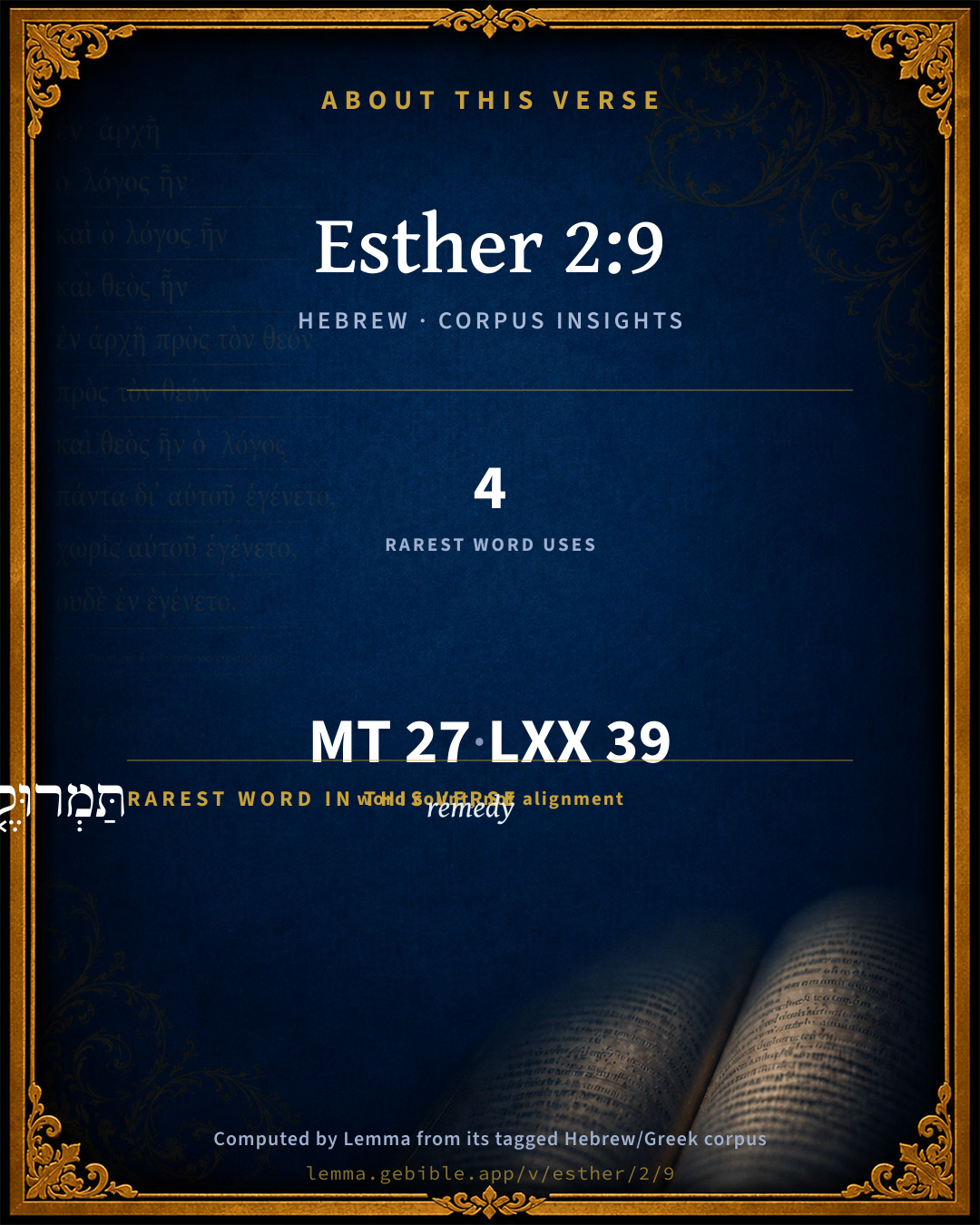
The rarest word here is תַּמְרוּקֶ֤יהָ remedy H8562 — appearing just 4 times in the whole Hebrew Bible.

Shared distinctive vocabulary

תַּמְרוּקֶ֤יהָ remedy H8562 occurs in 4 verses of the Hebrew Bible. Also found in:

Grammatical profile

  • 7 verbs
  • 12 nouns
  • 2 adjectives
  • 2 prepositions
  • 4 particles

Verb forms

  • וַתִּיטַ֨ב Qal · Sequential Imperfect
  • וַתִּשָּׂ֣א Qal · Sequential Imperfect
  • וַ֠יְבַהֵל Piel · Sequential Imperfect
  • לָתֵ֣ת Qal · Infinitive Construct
  • הָרְאֻי֥וֹת Qal · Participle Passive
  • לָֽתֶת Qal · Infinitive Construct
  • וַיְשַׁנֶּ֧הָ Piel · Sequential Imperfect

Repetition

Words recur within this verse — often emphatic in Hebrew:

  • הַנַּעֲרָ֣ה girl H5291 ×3
  • לָתֵ֣ת to give H5414 ×2
  • מִבֵּ֣ית house H1004 ×2

Hebrew & Septuagint length

In English translation the verse runs 55 words from the Hebrew and 47 from the Septuagint (LXX English) — closely comparable.

A rough comparison of the two English renderings, which tokenize alike — not a word-level alignment.

Word counts can differ between the Hebrew and the Greek without any difference in meaning — e.g. the Hebrew direct-object marker אֵת has no separate Greek word, and Greek often adds the article ὁ.

In the original languages it is 27 Hebrew tokens and 39 Greek tokens — but the two are counted differently (Hebrew bundles its prefixes and suffixes into one token; the Greek is in lemma form), so that isn’t a like-for-like length.

Cross-references

9

Topical passages linked to Esther 2:9 in the Treasury of Scripture Knowledge — connected by theme and wording, ordered by reader-vote popularity; previews shown in the World English Bible.

  • Genesis 39:21 But Yahweh was with Joseph, and showed kindness to him, and gave him favor in the sight of the keeper of the prison.
  • Proverbs 16:7 When a man's ways please Yahweh, He makes even his enemies to be at peace with him.
  • Esther 2:3 and let the king appoint officers in all the provinces of his kingdom, that they may gather together all the beautiful young virgins to Shushan the palace, to the house of the women, to the custody of Hegai the king's chamberlain, keeper of the women; and let their things for purification be given them;
  • Esther 2:12 Now when the turn of every maiden was come to go in to king Ahasuerus, after it had been done to her as prescribed for the women twelve months (for so were the days of their purification accomplished, [to wit], six months with oil of myrrh, and six months with sweet odors and with the things for the purifying of the women),
  • Daniel 1:9 Now God made Daniel to find kindness and compassion in the sight of the prince of the eunuchs.
  • Ezra 7:6 this Ezra went up from Babylon: and he was a ready scribe in the law of Moses, which Yahweh, the God of Israel, had given; and the king granted him all his request, according to the hand of Yahweh his God on him.
  • Psalms 106:46 He made them also to be pitied By all those who carried them captive.
  • Acts 7:10 and delivered him out of all his afflictions, and gave him favor and wisdom before Pharaoh, king of Egypt. He made him governor over Egypt and all his house.
  • 1 Kings 8:50 and forgive your people who have sinned against you, and all their transgressions in which they have transgressed against you; and give them compassion before those who carried them captive, that they may have compassion on them

Cross-references courtesy of OpenBible.info (CC BY 4.0).

Hebrew and Greek witnesses Masoretic Hebrew ↔ Greek Septuagint

The same verse in the two great witnesses to the Old Testament, shown verse-for-verse.

These are two independent witnesses, not word-aligned to each other, and the Septuagint is shown in lemma (dictionary) form.

Hebrew Esther 2:9 Masoretic · Westminster Leningrad Codex

וַתִּיטַ֨ב הַנַּעֲרָ֣ה בְעֵינָיו֮ וַתִּשָּׂ֣א חֶ֣סֶד לְפָנָיו֒ וַ֠יְבַהֵל אֶת תַּמְרוּקֶ֤יהָ וְאֶת מָנוֹתֶ֨הָ֙ לָתֵ֣ת לָ֔הּ וְאֵת֙ שֶׁ֣בַע הַנְּעָר֔וֹת הָרְאֻי֥וֹת לָֽתֶת לָ֖הּ מִבֵּ֣ית הַמֶּ֑לֶךְ וַיְשַׁנֶּ֧הָ וְאֶת נַעֲרוֹתֶ֛יהָ לְט֖וֹב בֵּ֥ית הַנָּשִֽׁים

The maiden pleased him, and she obtained kindness of him; and he speedily gave her things for her purification, with her portions, and the seven maidens who were meet to be given her out of the king's house: and he removed her and her maidens to the best place of the house of the women.

World English Bible · Public Domain

Greek LXX Esther 2:9 Septuagint · lemma form

καί ἀρέσκω αὐτός ὁ κοράσιον καί εὑρίσκω χάρις ἐνώπιον αὐτός καί σπεύδω αὐτός δίδωμι ὁ σμῆγμα καί ὁ μερίς καί ὁ ἑπτά κοράσιον ὁ ἀποδεικνύω αὐτός ἐκ βασιλικός καί χράω αὐτός καλῶς καί ὁ ἅβρα αὐτός ἐν ὁ γυναικών

And the damsel pleased him, and she found favor in his sight; and he hasted to give her the things for purification, and her portion, and the seven maidens appointed her out of the palace: and he treated her and her maidens well in the women's apartment.

LXX2012 (modern English Septuagint) · Public Domain

On this verse, The Cambridge Bible for Schools and Colleges discusses the Septuagint’s reading. Read the note in Commentary ↓

Hebrew: Westminster Leningrad Codex (CC BY 4.0). Greek: Septuagint (public domain); English from LXX2012 (modern English Septuagint) (Public Domain). How the Septuagint differs from the Hebrew →

Commentary

Notes on Esther 2:9 from classic Christian and Jewish commentators (each source and its license shown beneath its notes). The classic Christian expositions comment on the surrounding passage and are grouped to its opening verse, so a note may address several verses; the Jewish commentaries on the Tanakh (Rashi and others) are per-verse, so they appear only where the commentator wrote on this verse.

Lemma curates 59 commentaries, every one of them public domain or Creative Commons licensed, each selected and text-cleaned for this edition rather than reprinted as found. About our sources →

Trapp's Complete Commentary

John Trapp

Est 2:9 And the maiden pleased him, and she obtained kindness of him; and he speedily gave her her things for purification, with such things as belonged to her, and seven maidens, [which were] meet to be given her, out of the king’s house: and he preferred her and her maids unto the best [place] of the house of the women.

Ver. 9. And the maiden pleased him] Hegai cast his favour upon her; not because she was the fairest, noblest, most industrious, most courtly, &c., but because God wrought his heart to it; as he did Potiphar’s and Pharaoh’s to Joseph, Jonathan’s to David, Darius’s to Daniel, &c. It is the Lord that gives favour, and fashioneth men’s opinions of us. He gave Solomon honour; and Paul prays to him that his service may be accepted of the saints, Rom 15:31.

And she obtained kindness of him] His favour was not empty favour, professional only, as that of courtiers.

And he speedily gave her, &c.] As resolving shortly to recommend her to the king, who, he knew, would be much ruled by him in his choice. Here were shadows of many excellent virtues in a blind ethnic; who may in some sort teach true kindness, and doth condemn those that boast of false liberality. He dealt not basely, but bountifully, with Esther.

Her things for purification] See Est 2:3; Est 2:12.

With such things as belonged to her] Heb. Her portions or allowances of food, raiment, &c., which this faithful officer interverted not for his own private gain, but rather enlarged himself in the true bestowing thereof.

And seven maidens] When he might have put her off with one; he enlargeth himself, and even stretcheth his authority, that he might, by these maids of honour attending her, set her forth as a queen beforehand.

Which were meet to be given her] Or, which were very comely, speciosae, vel spectatae.

And he preferred] Heb. He changed her, sc. for the better, as God doth his people, when he taketh them to heaven, where they change place, but not company (as that good man, Dr Preston, saith upon his death bed), and are brought from the jaws of death to the joys of eternal life; from shadows to substances, from misery to majesty, &c., a greater change than that of Queen Elizabeth, from a prisoner to a princess; or that of our Henry IV, who was crowned the very same day that the year before he had been banished the realm. The Latins call prosperous things Res secundas, secondary things, because they are to be had hereafter; they are not the first things.

Unto the best place of the house of the women] Or, Unto the best condition. God’s best children shall have the best of the best, fat things full of marrow, wines on the lees well refined, Isa 25:6. Jacob and his family had the best of the land of Egypt, that granary of the world, as one calleth it. His posterity had a land that flowed with milk and honey. What countries comparable to those that profess the gospel? "Godliness is profitable to all things," having the promises of both lives, &c.

John Trapp, A Commentary or Exposition upon All the Books of the Old and New Testament (1647–1656) — public domain. Text from a community e-Sword module.

Joseph Benson's Commentary

Est 2:9. The maiden pleased him — Because she was very beautiful, therefore he supposed she would be acceptable to the king; and by the divine power, which moveth the hearts of men which way he pleaseth.

Joseph Benson's Commentary on the Old and New Testaments (1811–1818) — public domain. Text from a community e-Sword module.

Tyndale Open Study Notes

Tyndale Open Resources

2:9 ordered a special menu . . . beauty treatments: Hegai knew the king’s taste and singled out the best prospects for special attention. • Hegai assigned seven of the best assistants to Esther, indicating that he thought she was one of the very best candidates for becoming the queen.

Tyndale Open Study Notes — © Tyndale Open Resources, licensed CC BY-SA 4.0. Text via the HelloAO Bible API.

Geneva Bible (1599)

Geneva Bible translators

Hebrew, portions.

Geneva Bible (1599) marginal notes — public domain. Text via Bolls.life.

Adam Clarke's Commentary

Verse 9. The maiden pleased him] He conceived a partiality for her above the rest, probably because of the propriety of her deportment, and her engaging though unassuming manners.

Seven maidens] These were to attend her to the bath, to anoint and adorn her, and be her servants in general.

Adam Clarke's Commentary on the Bible (1810–1826) — public domain. Text from a community e-Sword/MySword module.

Ellicott's Commentary for English Readers

(9) Obtained kindness of him.—This is the same phrase as that which is rendered “obtained favour in his sight” in Est_2:17.

A Bible Commentary for English Readers, edited by Charles John Ellicott (1878–1897) — public domain. Text from a community e-Sword module.

The Cambridge Bible for Schools and Colleges

gen. ed. J. J. S. Perowne

9. she obtained kindness of him] This or a synonymous expression is a favourite one with the author (Est_2:15; Est_2:17, Est_5:2).

speedily] In order that the prescribed period of twelve months’ preparation (see Est_2:12) might be accomplished as soon as possible in Esther’s case, Hegai gave her precedence over others in its commencement.

her things for purification] See on Est_2:3.

with her portions] A.V. has more vaguely, with such things as belonged to her. The reference is not to unguents of any kind, but to special food given as part of the preparation of those who were to be admitted to the king. So Nebuchadnezzar appointed for the youths who were to ‘stand before the king’ (Dan_1:5) a daily portion of the king’s dainties and of the wine which he drank.

and the seven maidens] The article (wrongly omitted in the A.V.) indicates that it was the custom to assign seven attendants or maids of honour to persons in Esther’s position as candidates for the king’s favour.

which were meet to be given her] suitable to her exceptional claims on the ground of her beauty.

and he removed etc.] A.V. has and he preferred etc. In this sense, viz. to advance, promote, the verb (occurring also in A.V. of Dan_6:3; Joh_1:15; Joh_1:27) is now but little used, although the substantive preferment has held its ground in common parlance. The Heb. verb simply denotes change, and it is the remainder of the clause which expresses the fact that the change was for the better.

and her maidens] The word in the LXX. (ἅβρα) is employed to denote female attendants of the choicer kind, like the French fille d’honneur. If it be an actual Greek word, it properly means graceful, delicate, but in the sense in which it is here used, it may be of foreign origin. Elsewhere it is used of the attendants upon Pharaoh’s daughter (Exo_2:5), also of Judith’s maid (Jdg_8:33), and again in this Book (Est_4:4; Est_4:16) and so in the apocryphal Additions (Esther 15:2, 7).

The Cambridge Bible for Schools and Colleges (gen. ed. J. J. S. Perowne; Cambridge University Press, 1878–1918) — public domain. Text from a community e-Sword module.

John Gill's Exposition

And the maiden pleased him,.... Not the king, into whose presence she was not yet introduced, but the chamberlain; her beauty and her behaviour recommended her to him, and he concluded within himself that she was the person that of all would be acceptable to the king:

and she obtained kindness of him: had favours shown others had not:

and he speedily gave her things for purification; as oil, spices, &c. that she might be the sooner fitted to be had into the king's presence:

with such things as belonged to her; food and drink from the king's table; the Targum interprets it gifts, as chains and royal apparel:

and seven maidens, which were given her, out of the king's house; to wait upon her the seven days of the week, as the same Targum:

and he preferred her and her maids unto the best place of the house of the women; removed her and them to it, which was the most splendid, had large, airy, and pleasant rooms.

John Gill's Exposition of the Whole Bible (1746–1763) — public domain (CC PDM 1.0). Text via the HelloAO Bible API.

Haydock's Catholic Bible Commentary

And he, Egeus, commanded the under eunuch. (Tirinus) --- Hebrew, "he quickly gave her her things for purifications, (ver. 3.) and her portions, with seven maids, suitable for her, out of the king’s house; and he charged her and her maids to dwell in the best of the women’s house," (Haydock) where things were the most commodious. (Calmet)

George Leo Haydock (1774–1849), Haydock's Catholic Family Bible and Commentary, 1859 edition — public domain. Excludes Psalms (Douay-Rheims chapter numbering differs from Protestant) and Deuterocanonical books (Catholic canon only).

Matthew Poole's English Annotations

The maiden pleased him; partly because she was very beautiful, and therefore he supposed she would be very acceptable to the king, which would be his advantage; and partly by the Divine Power, which moveth the hearts of men which way he pleaseth.

Matthew Poole's English Annotations on the Holy Bible (1683–1685) — public domain. Text from a community e-Sword/MySword module.

Whedon's Commentary on the Bible

Daniel D. Whedon

9. Such things as belonged to her — Hebrew, her portions, that is, proper allowances of food.

Seven maidens… meet to be given her — Each of the virgins probably had seven maids appointed to attend her, but Esther’s seven were selected with special care, (meet, ראיות, looked up, searched out, from ראה, to see, to look after,) and Hegai’s further partiality for her was shown in his preferring, or changing, her and her maids to the choice apartments of the harem.

Daniel D. Whedon (gen. ed.), Commentary on the Old and New Testaments (1874–1909) — public domain. Text from a community e-Sword module.

The Pulpit Commentary

The maiden pleased him. Literally, "was good in his eyes," the same expression as that which occurs in Est_1:21. And she obtained kindness of him. This is a phrase peculiar to the Book of Esther, and a favourite one with the author. (see vers. 15, 17; and Est_5:2) It is better translated "she obtained favour" (as in all the other places where it occurs) than "she obtained kindness," though the latter translation is more literal. Her things for purification. See ver. 12. With such things as belonged to her. Literally, as in the margin, "with her portions by which is probably meant her daily allowance of food. And seven maidens. Rather, "and her seven maidens." It is implied that each virgin had seven female attendants assigned to her. Meet to be given her. It was in this point that the "favour" or "kindness of Hegel was shown. He selected for her use the most suitable of the attendants.

The Pulpit Commentary (1880–1919), ed. H.D.M. Spence-Jones & Joseph S. Exell — public domain. Text from a community e-Sword module.

John Wesley's Explanatory Notes

Pleased - Because she was very beautiful, therefore he supposed she would be acceptable to the king; and by the Divine power, which moveth the hearts of men which way he pleaseth.

John Wesley, Explanatory Notes Upon the Whole Bible (1754–1765) — public domain. Text via the GEBible commentary corpus.

Rashi

Rabbi Shlomo Yitzchaki (Rashi)

and he hastened her ointments He was more diligent and quicker with bringing her [ointments] than those of all of them.

fitting to give to her to serve her, and so they would do for all of them; and our Sages explained what they explained.

Rashi on the Tanakh — English translations: “The Judaica Press complete Tanach with Rashi, translated by A. J. Rosenberg” (CC BY 4.0); “Pentateuch with Rashi's commentary by M. Rosenbaum and A.M. Silbermann, 1929-1934” (public domain); “The Metsudah Tanach series, Lakewood, N.J” (CC BY 4.0); and “The Book of Joshua, Metsudah Publications, 1997” (CC BY 4.0). Text via Sefaria.

Ibn Ezra

Rabbi Abraham ibn Ezra

and he changed: He changed the portions, to do good to her. And the explanation of "the house of the women" is that it is connected to, "and he changed her portions and [those of her maidens" - and that was in the house of the women with her colleagues. Some say that Mordekhai did not act correctly when he commanded Esther not to mention her nation, since he was afraid that the king would not take her as a wife if he knew that she was from the exile. And others say that it was by way of prophecy or a dream that he knew that the salvation would come through her to the Jewish people. But what seems correct to me is that Mordekhai did this in order that she could observe the Torah of God secretly, such that she would not eat carcasses and could observe the Shabbat, and the guards would not be aware. For if the matter would be known, perhaps the king would force her [to do otherwise] or kill her, since she was taken by force. And we know that Mordekhai was from the greats of the Jewish people. As behold, he was the third of the ministers that came up [to Israel] with Zerubavel. But when he saw that the Temple was not built, he came to Eilam and was situated at the gate of the king in the palace, which is a great honor. Behold, Daniel had appointed his colleagues over the Babylonian kingdom, and he was at the gate of the king. But had Mordekhai not been among the servants of the king before the story with Esther, the servants would not have let him walk around in the courtyard of the house of the women.

Ibn Ezra on the Tanakh — English translations: “Sefaria Community Translation” (CC0 1.0 (public-domain dedication)); “Yalkut, Sifsei Chachomim Chumash, Metsudah Publications, 2009” (CC BY 4.0); and “Commentary of Ibn Ezra on Isaiah - trans. by M. Friedlander, 1873” (public domain). Text via Sefaria.

Lesson kit

Teaching starters — assembled from the data on this page, not authored interpretation. Every prompt links to the verse data it draws on. Edit before teaching.

Esther, in the Historical, opens this verse with 27 words (18 distinct Hebrew lemmas). Its most distinctive word is tamrûwq (“remedy”). A historical commentator’s framing appears above. Read the whole chapter for the surrounding context.

Discussion questions

  1. What does “remedy” (tamrûwq) contribute to the verse as a whole?
  2. Esther 2:3 shares the word «remedy» with this verse. How do the two illuminate each other?
  3. “girl” occurs 3× in this one verse. What is the effect of the repetition?
  4. The translations on this page render this verse differently — a whole-verse word diff, not a word-by-word alignment. What might account for the different wordings?
  5. The verb «וַתִּיטַ֨ב» is Qal Sequential Imperfect. How does its form color the action?
  6. Reading how Trapp's Complete Commentary and Joseph Benson's Commentary read this verse, where do the two commentators agree and where do they part?

Things to notice

Reading settings

Reading text

Shown beneath each verse's original-language words.

Old Testament
Old Testament edition

Read the OT as the Masoretic Hebrew (MT) or the Greek Septuagint (LXX).

English shown for the Greek Septuagint (in the Hebrew ↔ Greek comparison).

Comparing translations? Open the Compare panel on any verse page to stack up to four side by side.