
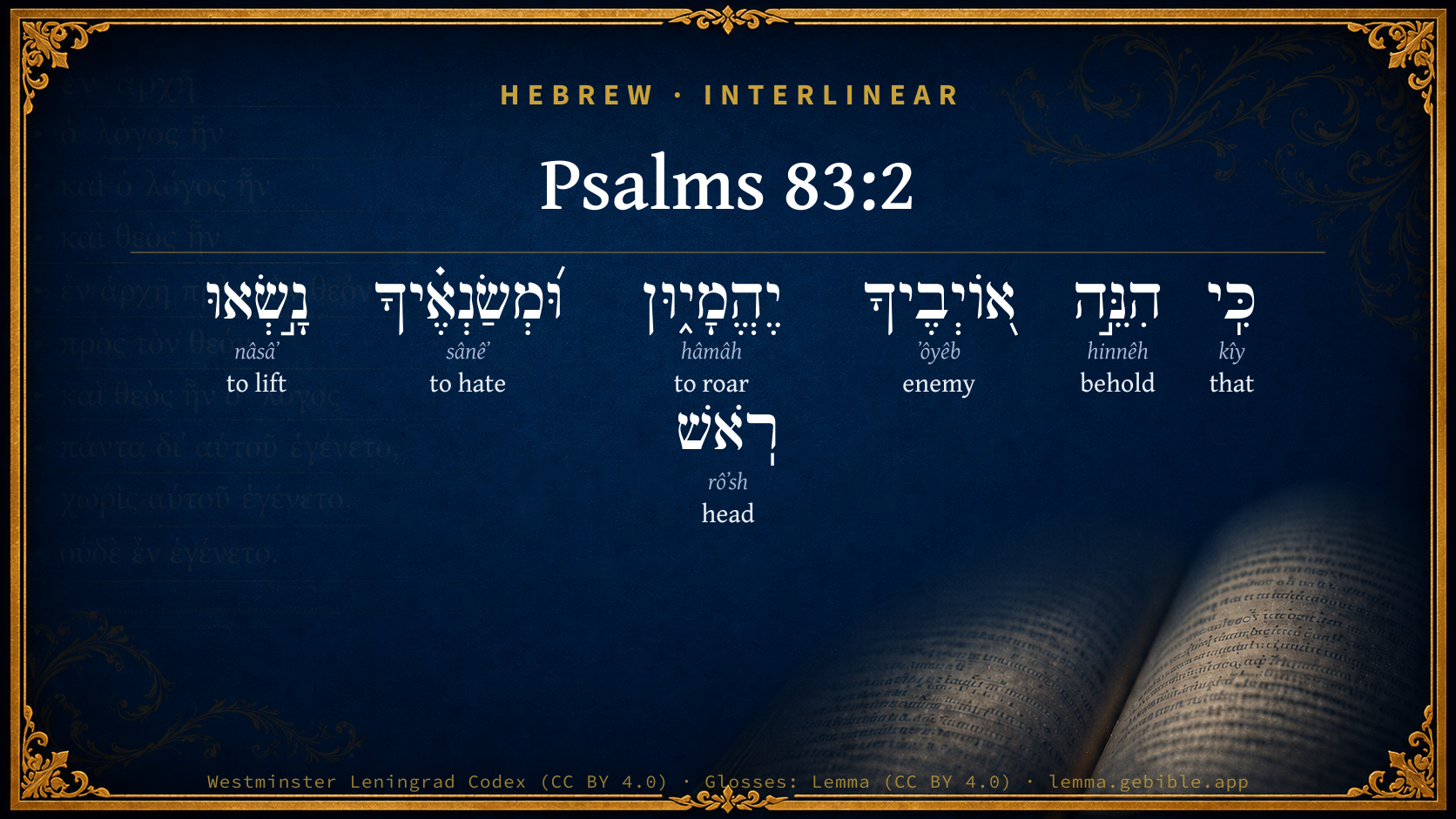
Psalms 83:2

Hebrew (Westminster Leningrad Codex) Psalms 83:2 appears in the Hebrew Old Testament. The text above is from the Westminster Leningrad Codex. Each word links to its Strong’s number, a concise gloss, and parsing drawn from the Open Scriptures Hebrew Bible morphology. Click any word for its full Brown-Driver-Briggs (BDB) entry.
Download image
Cite this verse

Psalms 83:2 (World English Bible). Public Domain. Lemma interlinear Bible study tool, https://lemma.gebible.app/v/psalms/83/2.

Show BibTeX & RIS
BibTeX
RIS
English Translation
For, behold, your enemies are stirred up. Those who hate you have lifted up their heads.
World English Bible · Public Domain
Download a study sheet

One document with this verse’s original text, its word-by-word gloss line, the meaning frame, cross-references with their text, attributed commentary, and full source and license credits — printable, and it pastes into notes with its structure intact.

This verse Autodidact and up

Study sheet (.html) Plain text (.txt)

A passage Seminary Student

Up to 50 verses in one chapter. A passage sheet keeps up to 6 commentary sources and 12 cross-references per verse, in the order this page ranks them, and says so on the sheet whenever that leaves anything out. Ask for a single verse and you get the Autodidact verse sheet above.

Everything on this page stays free to read, with no account — the sheet is a download of what is already on screen, not access to it.

Want to remove ads? Support Godless Engineer
Compare translations 3

The same verse in 3 English versions, stacked beneath the original-language interlinear above. Click any original word for its lexicon entry.

Each is an independent rendering of the whole verse — the interlinear is not word-aligned to these translations.

Highlighted words mark where these versions differ — a whole-verse word diff, not a word-by-word alignment.

  • World English Bible Public Domain
    For, behold, your enemies are stirred up. Those who hate you have lifted up their heads.
  • King James Version Public Domain
    For, lo, thine enemies make a tumult: and they that hate thee have lifted up the head.
  • unfoldingWord Literal Text CC BY-SA 4.0
    For behold, your enemies roar, and the ones hating you lift up head.

unfoldingWord Literal Text — © unfoldingWord, licensed CC BY-SA 4.0. Word-aligned USFM3 via Door43 (git.door43.org/unfoldingWord/en_ult).

Versions to compare (up to 4)

3 of 4 selected

Show all 18 translations

Every available English version of this verse, each an independent rendering of the whole verse.

  • World English Bible Public Domain
    For, behold, your enemies are stirred up. Those who hate you have lifted up their heads.
  • Berean Standard Bible Public Domain
    See how Your enemies rage, how Your foes have reared their heads.
  • Majority Standard Bible Public Domain
    See how Your enemies rage, how Your foes have reared their heads.
  • King James Version Public Domain
    For, lo, thine enemies make a tumult: and they that hate thee have lifted up the head.
  • American Standard Version (1901) Public Domain
    For, lo, thine enemies make a tumult; And they that hate thee have lifted up the head.
  • Revised Version (1885) Public Domain
    For, lo, thine enemies make a tumult: and they that hate thee have lifted up the head.
  • Geneva Bible (1599) Public Domain
    For lo, thine enemies make a tumult: and they that hate thee, haue lifted vp the head.
  • Douay-Rheims (1899) Public Domain
    O God, who shall be like to thee? hold not thy peace, neither be thou still, O God.
  • Young's Literal Translation Public Domain
    For, lo, Thine enemies do roar, And those hating Thee have lifted up the head,
  • Literal Standard Version CC BY-SA 4.0
    For behold, Your enemies roar, || And those hating You have lifted up the head,
  • Unlocked Literal Bible CC BY-SA 4.0
    Look, your enemies are making a commotion, and those who hate you have raised their heads.
  • unfoldingWord Literal Text CC BY-SA 4.0
    For behold, your enemies roar, and the ones hating you lift up head.
  • Darby Bible Public Domain
    For behold, thine enemies make a tumult; and they that hate thee lift up the head.
  • World Messianic Bible Public Domain
    For, behold, your enemies are stirred up. Those who hate you have lifted up their heads.
  • Webster's Bible Public Domain
    \\83:1\\A song, or Psalm of Asaph. Keep not thou silence, O God: hold not thy peace, and be not still, O God.
  • Free Bible Version CC BY-SA 4.0
    Can't you hear the roars of your enemies? Can't you see how those who hate you are defiantly lifting up their heads?
  • Bible in Basic English Public Domain
    For see! those who make war on you are out of control; your haters are lifting up their heads.
  • JPS Tanakh (1917) Public Domain
    (83-3) For, lo, Thine enemies are in an uproar; and they that hate Thee have lifted up the head.

Literal Standard Version (2020), Covenant Press — licensed CC BY-SA 4.0. Text via the HelloAO Bible API (eBible.org). Unlocked Literal Bible (unfoldingWord) — licensed CC BY-SA 4.0. Text via the HelloAO Bible API (eBible.org). unfoldingWord Literal Text — © unfoldingWord, licensed CC BY-SA 4.0. Word-aligned USFM3 via Door43 (git.door43.org/unfoldingWord/en_ult). Free Bible Version, Dr. Jonathan Gallagher — licensed CC BY-SA 4.0. Text via the HelloAO Bible API (eBible.org).

Word by word

More ways to search: Search by grammar → Find every occurrence → Compare this word →

Practice this passage: Drill this verse → Learn its vocabulary →

יֶהֱמָי֑וּן
hâmâh
H1993
“to roar”
Verb, Qal, Imperfect, 3rd Person, Masculine, Plural + Suffix, n
Part of Speech
Verb
Stem
Qal
Form
Imperfect
Person
3rd Person
Gender
Masculine
Number
Plural
Full BDB Definition

Origin: a primitive root [compare H1949 ]

TWOT: 505

to murmur, growl, roar, cry aloud, mourn, rage, sound, make noise, tumult, be clamorous, be disquieted, be loud, be moved, be troubled, be in an uproar - (Qal) - to growl - to murmur (figuratively of a soul in prayer) - to roar - to be in a stir, be in a commotion - to be boisterous, be turbulent
  1. כִּֽי kîy H3588 “that” Conjunction
  2. הִנֵּ֣ה hinnêh H2009 “behold” Particle, Demonstrative
  3. א֭וֹיְבֶיךָ ʼôyêb H341 “enemy · you” Verb, Qal, Participle Active, Masculine, Plural, Construct + Suffix, Personal, 2nd Person, Masculine, Singular
  4. וּ֝מְשַׂנְאֶ֗יךָ sânêʼ H8130 “and · hating · you” Conjunction + Verb, Piel, Participle Active, Masculine, Plural, Construct + Suffix, Personal, 2nd Person, Masculine, Singular
  5. נָ֣שְׂאוּ nâsâʼ H5375 “to lift” Verb, Qal, Perfect, 3rd Person, Common, Plural
  6. רֹֽאשׁ rôʼsh H7218 “head” Noun, Common, Masculine, Singular, Absolute

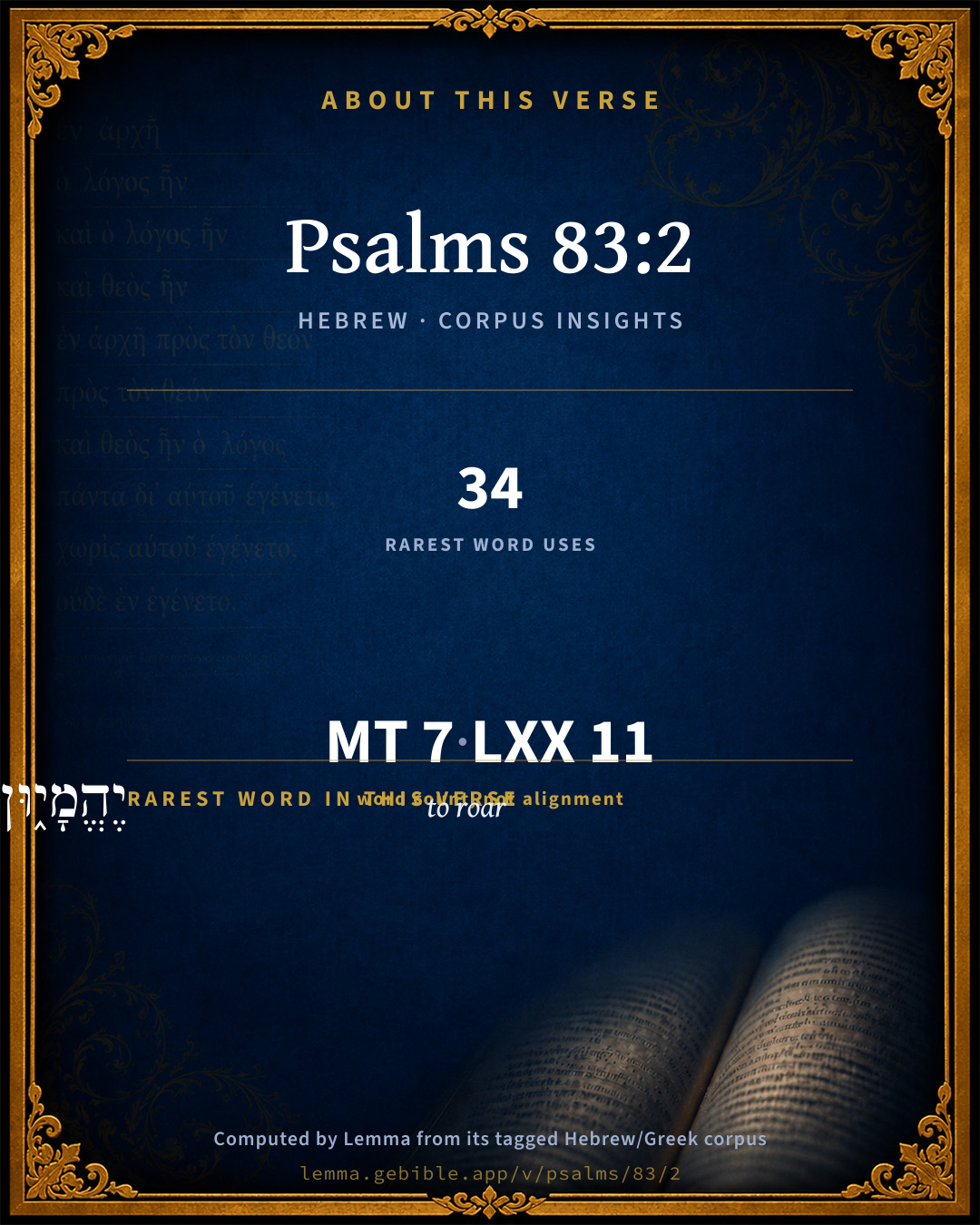
About this verse

These counts appear in no published source. They are computed here, from the morphology-tagged text and Lemma’s own curated glosses. What Lemma adds →

7
words
7
distinct lemmas
Wisdom
section

Shared distinctive vocabulary

יֶהֱמָי֑וּן to roar H1993 occurs in 32 verses of the Hebrew Bible. Also found in:

Grammatical profile

  • 4 verbs
  • 1 noun
  • 1 conjunction
  • 1 particle

Verb forms

  • א֭וֹיְבֶיךָ Qal · Participle Active
  • יֶהֱמָי֑וּן Qal · Imperfect
  • וּ֝מְשַׂנְאֶ֗יךָ Piel · Participle Active
  • נָ֣שְׂאוּ Qal · Perfect

Hebrew & Septuagint length

In English translation the verse runs 16 words from the Hebrew and 18 from the Septuagint (LXX English) — closely comparable.

A rough comparison of the two English renderings, which tokenize alike — not a word-level alignment.

Word counts can differ between the Hebrew and the Greek without any difference in meaning — e.g. the Hebrew direct-object marker אֵת has no separate Greek word, and Greek often adds the article ὁ.

In the original languages it is 7 Hebrew tokens and 11 Greek tokens — but the two are counted differently (Hebrew bundles its prefixes and suffixes into one token; the Greek is in lemma form), so that isn’t a like-for-like length.

Cross-references

21

Topical passages linked to Psalms 83:2 in the Treasury of Scripture Knowledge — connected by theme and wording, ordered by reader-vote popularity; previews shown in the World English Bible.

  • Psalms 81:15 The haters of Yahweh would cringe before him, And their punishment would last forever.
  • Matthew 27:24 So when Pilate saw that nothing was being gained, but rather that a disturbance was starting, he took water, and washed his hands before the multitude, saying, "I am innocent of the blood of this righteous person. You see to it."
  • Judges 8:28 So Midian was subdued before the children of Israel, and they lifted up their heads no more. The land had rest forty years in the days of Gideon.
  • Isaiah 17:12 Ah, the uproar of many peoples, who roar like the roaring of the seas; and the rushing of nations, that rush like the rushing of mighty waters!
  • Jeremiah 1:19 They shall fight against you; but they shall not prevail against you: for I am with you, says Yahweh, to deliver you.
  • 2 Kings 19:28 Because of your raging against me, and because your arrogance is come up into my ears, therefore will I put my hook in your nose, and my bridle in your lips, and I will turn you back by the way by which you came.
  • Psalms 2:1–2 Why do the nations rage, And the peoples plot a vain thing?
  • Psalms 74:4 Your adversaries have roared in the midst of your assembly. They have set up their standards as signs.
  • Psalms 74:23 Don't forget the voice of your adversaries. The tumult of those who rise up against you ascends continually.
  • Psalms 75:4–5 I said to the arrogant, "Don't boast;" To the wicked, "Don't lift up the horn.
  • Psalms 93:3 The floods have lifted up, Yahweh, The floods have lifted up their voice. The floods lift up their waves.
  • Isaiah 37:23 Whom have you defied and blasphemed? and against whom have you exalted your voice and lifted up your eyes on high? [even] against the Holy One of Israel.
  • Isaiah 37:29 Because of your raging against me, and because your arrogance is come up into my ears, therefore will I put my hook in your nose, and my bridle in your lips, and I will turn you back by the way by which you came.
  • Daniel 5:20–23 But when his heart was lifted up, and his spirit was hardened so that he dealt proudly, he was deposed from his kingly throne, and they took his glory from him:
  • Acts 4:25–27 who by the mouth of your servant, David, said, 'Why do the nations rage, And the peoples plot a vain thing?
  • Acts 16:22 The multitude rose up together against them, and the magistrates tore their clothes off of them, and commanded them to be beaten with rods.
  • Acts 17:5 But the unpersuaded Jews took along some wicked men from the marketplace, and gathering a crowd, set the city in an uproar. Assaulting the house of Jason, they sought to bring them out to the people.
  • Acts 19:28–41 When they heard this they were filled with anger, and cried out, saying, "Great is Artemis of the Ephesians!"
  • Acts 21:30 All the city was moved, and the people ran together. They seized Paul and dragged him out of the temple. Immediately the doors were shut.
  • Acts 22:22 They listened to him until he said that; then they lifted up their voice, and said, "Rid the earth of this fellow, for he isn't fit to live!"
  • Acts 23:10 When a great argument arose, the commanding officer, fearing that Paul would be torn in pieces by them, commanded the soldiers to go down and take him by force from among them, and bring him into the barracks.

Cross-references courtesy of OpenBible.info (CC BY 4.0).

Hebrew and Greek witnesses Masoretic Hebrew ↔ Greek Septuagint

The same verse in the two great witnesses to the Old Testament, shown verse-for-verse.

You’re reading Greek Psalm 82 (Hebrew Psalm 83). The Septuagint counts the superscription, so verse numbers can differ from the Hebrew — chapter-level alignment, not verse-by-verse. Numbering follows Rahlfs.

These are two independent witnesses, not word-aligned to each other, and the Septuagint is shown in lemma (dictionary) form.

Hebrew Psalms 83:2 Masoretic · Westminster Leningrad Codex

כִּֽי הִנֵּ֣ה א֭וֹיְבֶיךָ יֶהֱמָי֑וּן וּ֝מְשַׂנְאֶ֗יךָ נָ֣שְׂאוּ רֹֽאשׁ

For, behold, your enemies are stirred up. Those who hate you have lifted up their heads.

World English Bible · Public Domain

Greek LXX Greek Psalm 82:2 Septuagint · lemma form

ὁ θεός τίς ὁμοιόω σύ μή σιγάω μηδέ καταπραΰνω ὁ θεός

For behold, your enemies have made a noise; and they that hate you have lifted up the head.

LXX2012 (modern English Septuagint) · Public Domain

On this verse, Ellicott's Commentary for English Readers discusses the Septuagint’s reading. Read the note in Commentary ↓

Hebrew: Westminster Leningrad Codex (CC BY 4.0). Greek: Septuagint (public domain); English from LXX2012 (modern English Septuagint) (Public Domain). How the Septuagint differs from the Hebrew →

Commentary

Notes on Psalms 83:2 from classic Christian and Jewish commentators (each source and its license shown beneath its notes). The classic Christian expositions comment on the surrounding passage and are grouped to its opening verse, so a note may address several verses; the Jewish commentaries on the Tanakh (Rashi and others) are per-verse, so they appear only where the commentator wrote on this verse.

Lemma curates 59 commentaries, every one of them public domain or Creative Commons licensed, each selected and text-cleaned for this edition rather than reprinted as found. About our sources →

Trapp's Complete Commentary

John Trapp

Psa 83:2 For, lo, thine enemies make a tumult: and they that hate thee have lifted up the head.

Ver. 2. For, lo, thine enemies make a tumult] Concurrunt magno impetu, conatu, et ardore, Thine, because ours; for there is a league offensive and defensive between God and his people; the Church must, therefore, needs be invincible, because God is so.

Have lifted up the head] Being insolent and confident, they bear their noses high in the air, uttering loud and lofty language; as did Rabshakeh, sent by Sennacherib, 2Ki 18:17, to which times some refer this psalm, as others to those of Jehoshaphat, 2Ch 20:1-2 (Kimchi).

John Trapp, A Commentary or Exposition upon All the Books of the Old and New Testament (1647–1656) — public domain. Text from a community e-Sword module.

J. A. Alexander on Psalms

Joseph Addison Alexander

3. (Psa 83:2). For lo, thine enemies roar, and thy haters raise the head. The general prayer in the preceding verse is now enforced by a description of the danger, beginning with the violence and confidence of the assailants. The lo is equivalent to see there, and converts the passage into a description of a present scene. The enemies of Israel are, as usual, identified with those of God, as a reason why he should appear for their destruction. The first verb means to make a noise, and is applied to the roar of the sea in Psa 46:3, as it is to the howl of dogs in Psa 59:6, and to internal commotions in Psa 39:6; Psa 42:5; Psa 42:11. Lift up the head, as a natural indication of confidence and triumph. Compare the description of a conquered people, Jdg 8:28.

Joseph Addison Alexander, The Psalms Translated and Explained (1850) — public domain. Text from a community e-Sword module.

Geneva Bible (1599)

Geneva Bible translators

He calleth them God’s enemies, which are enemies to his Church.

Geneva Bible (1599) marginal notes — public domain. Text via Bolls.life.

Adam Clarke's Commentary

Verse 2. Thine enemies make a tumult] They are not merely the enemies of thy people, but they are the enemies of thyself, thy worship, ordinances, and laws: "They make a tumult," they throng together.

They - have lifted up the head.] They have made an irruption into the land of Judea, and encamped at En-gedi, by the Dead Sea, 2Ch 20:1-2.

Adam Clarke's Commentary on the Bible (1810–1826) — public domain. Text from a community e-Sword/MySword module.

John Calvin's Commentaries

2 For, behold! thy enemies are tumultuous. As an argument for enforcing the prayer of the preceding verse, it is affirmed that the faithful are oppressed both by the impetuous violence and the crafty policy of their enemies, which, to all human appearance, rendered their escape from death utterly hopeless. When it is said that they are tumultuous and lift up the head, the meaning is, that relying upon their own power, they behave themselves insolently and proudly. By this conduct on the part of their enemies, the minds of the people of God are greatly depressed, and the only way in which they can obtain relief, is by making their moan to Him whose continual work it is to repress the proud. When, therefore, the saints implore his aid, it is their ordinary course to lay before him the perverseness of their enemies. It is worthy of notice, that those who molest the Church are called the enemies of God.

It affords us no small ground of confidence that those who are our enemies are also God’s enemies. This is one of the fruits of his free and gracious covenant, in which he has promised to be an enemy to all our enemies, — a promise for which there is good cause, when it is considered that the welfare of his people, whom he has taken under his protection, cannot be assailed without an injury being, at the same the done to his own majesty. Meanwhile, let us live at peace with all men, as much as in us lies, and let us endeavor to practice uprightness in our whole deportment, that we may be able confidently to appeal to God, that when we suffer at the hands of men, we suffer wrongfully. The pride and violent assaults of our enemies may be combined with craftiness. But when such is the case, it becomes us to yield to God the honor which belongs to him, by resting satisfied that He can succor us; for to break the proud who foam out their rage, and to take the crafty in their own craftiness, is work which He has been accustomed to perform in all ages. To keep us from thinking that we are abandoned to the snares and traps of our enemies, the prophet here seasonably sets before us a consideration calculated to administer the highest consolation and hope, when he calls us God’s hidden ones This expression is understood by some as meaning that the aid and protection which God extends to us, is not apparent to the eye of sense and reason; just as it is said elsewhere of the life of the people of God, that it is hid, (Colossians 3:3.) But this interpretation is too forced, and altogether inconsistent both with the scope of the passage and the natural construction of the words. The design of them is simply to teach that we are hidden under the shadow of God’s wings; for although to outward appearance we lie open, and are exposed to the will of the wicked and the proud, we are preserved by the hidden power of God. Accordingly, it is said in another Psalm, (27:5,)

“In the time of trouble he shall hide me in his pavilion: in the secret of his tabernacle shall he hide me.” (Psalm 27:5)

It is, however, at the same time to be observed, that none are hid under the keeping and protection of God but those who, renouncing all dependence on their own strength, betake themselves with fear and trembling to Him. Such as under the influence of a flattering belief in the sufficiency of their own strength to resist, boldly enter the conflict, and, as if devoid of all fear, wax wanton, will ultimately suffer the consequences which result from inadequate resources. We will then best consult our own safety by taking shelter under the shadow of the Almighty, and, conscious of our own weakness, committing our salvation to him, casting it, so to speak, into his bosom.

John Calvin's Commentaries (1540-1563) — public domain. Text from the Calvin Translation Society English edition (1840s-50s) via the Christian Classics Ethereal Library (ccel.org). Calvin's coverage is partial (roughly two-thirds of the Bible); uncommented books and verses are honest gaps, never fabricated. The 19th-century editor's footnotes and remarks are omitted so the notes are faithfully Calvin's own voice.

Ellicott's Commentary for English Readers

(2) Make a tumult.—Literally, roar like the sea. So (correctly) LXX. and Vulg. (See Psa_46:3.)

A Bible Commentary for English Readers, edited by Charles John Ellicott (1878–1897) — public domain. Text from a community e-Sword module.

The Cambridge Bible for Schools and Colleges

gen. ed. J. J. S. Perowne

2. make a tumult] A word denoting the uproar and tumult of a throng of people: the substantive for multitude, frequently used of a great army, is derived from it: cp. Psa_46:3; Psa_46:6; Isa_17:12; Isa_29:5; Isa_29:7-8; 2Ch_20:2; 2Ch_20:12; 2Ch_20:15; 2Ch_20:24.

thine enemies … they that hate thee] For Israel’s enemies are Jehovah’s enemies: their plot to destroy His people is a plot to frustrate the purposes and put an end to the worship of Jehovah. Cp. against thee, Psa_83:5; and Jdg_5:31.

The Cambridge Bible for Schools and Colleges (gen. ed. J. J. S. Perowne; Cambridge University Press, 1878–1918) — public domain. Text from a community e-Sword module.

John Gill's Exposition

For, lo, thine enemies make a tumult,.... Or "a noise" (d): wicked men are commonly noisy, roaring out their blasphemies against God, belching out oaths and curses, and breathing threatenings and slaughter against the saints; especially a numerous army of them, consisting of many people and nations, as this did; who are called the Lord's "enemies", being the enemies of his people, and their cause and his are one and the same; and besides, all wicked men are enemies to God, and all that is good, in their minds, and which appears by their actions; yea, they are enmity itself unto him:

and they that hate thee have lift up the head; are haughty, proud, and arrogant; speak loftily, and with a stiff neck; set their mouth against heaven, and God in it; and their tongue walks through the earth, and spares none; they exult and rejoice, as sure of victory, before the battle is fought; such then were, and such there are, who are haters of God, hate his being, perfections, purposes, and providences; hate his Son without a cause, and even do despite unto the Spirit of grace; hate the law and its precepts, the Gospel and its doctrines and ordinances, and the ways, worship, and people of God, as appears by what follows.

(d) "sonuerunt", V. L. "perstrepunt", Junius & Tremellius, Piscator, Cocceius; "strepunt", Gejerus.

John Gill's Exposition of the Whole Bible (1746–1763) — public domain (CC PDM 1.0). Text via the HelloAO Bible API.

Albert Barnes' Notes on the Bible

For, lo, thine enemies make a tumult - Are excited; are aroused; are moving in a wild, furious, tumultuous manner, rushing on to the accomplishment of their designs. They come like rolling waves of the sea. See the word used here explained in the notes at Psa 2:1, where it is rendered, in the text, “rage;” in the margin, “tumultuously assemble.”

And they that hate thee - Thine enemies; the enemies of thy cause, and of thy people. Who they were is specified in Psa 83:6-8.

Have lifted up the head - Have become proud; bold; confident of success, all of which is indicated by the phrase “lifted up the head.” The head is bowed down in penitence and trouble; pride lifts it up; boldness, confidence, and wickedness, are indicated by its being thus lifted up.

Albert Barnes' Notes on the Bible (1834–1885) — public domain. Text from a community e-Sword/MySword module.

Matthew Poole's English Annotations

Thine enemies; they are not only enemies to us thy people, but also to thy will, and name, and glory.

Make a tumult; or, make a tumultuous noise, both with their tongues reproaching thee and threatening us, and with their arms.

Have lift up the head; are grown potent, and insolent, and scornful.

Matthew Poole's English Annotations on the Holy Bible (1683–1685) — public domain. Text from a community e-Sword/MySword module.

The Treasury of David

Charles H. Spurgeon

Ver. 2. For, lo, thine enemies make a tumult. They are by no means sparing of their words, they are like a hungry pack of dogs, all giving tongue at once. So sure are they of devouring thy people that they already shout over the feast.

And they that hate thee have lifted up the head. Confident of conquest, they carry themselves proudly and exalt themselves as if their anticipated victories were already obtained. These enemies of Israel were also God's enemies, and are here described as such by way of adding intensity to the argument of the intercession. The adversaries of the church are usually a noisy and a boastful crew. Their pride is a brass which always sounds, a cymbal which is ever tinkling.

Ver. 2. For, lo. The prayer begins with the particle lo, which has not only the force of arousing God, but also give the idea of something present, with the view of pointing out the opportune moment for God to gird himself for the work. Hermann Venema.

Ver. 2. Thine enemies make a tumult. The whole world is but like an army, a brigade of men (as it were) under a general; and God is the Lord of Hosts, that is the Lord of his armies: now when there is a tumult in an army, they complain to the officers, to the general especially; and he must come and suppress it. Therefore, saith he, Thou Lord of hosts, thou art general of the world; lo, there is a tumult in the world, a mutiny. Walter Cradock.

None.

Psalms 83:3*

Charles H. Spurgeon's The Treasury of David (1869–1885) — public domain. Psalms only. Text from a community e-Sword/MySword module.

Whedon's Commentary on the Bible

Daniel D. Whedon

2. Tumult—Uproar, a disorderly noise. In contrast to the silence of God, deprecated in Psa_83:1.

Lifted up the head—An expression of haughtiness and confidence of victory, in opposition to the “hanging down the head” of captives. Lam_2:10; Jdg_8:28

Daniel D. Whedon (gen. ed.), Commentary on the Old and New Testaments (1874–1909) — public domain. Text from a community e-Sword module.

The Pulpit Commentary

For, lo, thine enemies; i.e. Israel"s enemies, who are also "thine enemies". (see the comment on Psa_81:15) make a tumult; literally, make a roaring, like the roaring of the sea. (comp. Psa_46:3 Isa_17:12) And they that hate thee. (compare "the haters of the Lord," in Psa_81:15) Have lifted up the head; i.e. raised themselves up against thee taken a menacing attitude. (comp. Jud_1:8:28)

The foes of the Church are the foes of God.

The psalmist calls the enemies of his nation Gods enemies. "Thine enemies make a tumult." But it would not be a matter interesting to us, or one about which we could pray, if they were God"s enemies only. The point of importance is that they are God"s enemies just because they are ours. We find the best relief from the fear of what they may do, in thinking that God counts them to be his enemies; and if we cannot defend ourselves from them, God can defend us. So this realization that our enemies are God"s enemies becomes

(1) a ground of appeal;

(2) a restful consolation; and

(3) a source of strength.

Work this out in relation to the Jewish nation. In a special and representative sense the Jewish nation was Jehovah"s nation. So the Church, as a spiritual body the kingdom of God is Christ"s Church. And as everything related to the Jewish nation was of direct concern to Jehovah, and had his active interference as required, so everything related to the Church is of direct concern to the living Christ; and he, by his presiding Spirit, ever actively interferes, as may be required. Passing within the Church, the truth may be applied to each believer. His foes cannot be exclusively his. Being bound up with Christ, Christ is bound up with all his interests. The believer"s friends are Christ"s friends; the believer"s foes are Christ"s foes.

I THIS RELATION CONNECTS GOD WITH THE NATION"S PROGRESS. This is illustrated in the history. A tribe of slaves came to be an ordered nation, through an experience of good and evil. God was sympathetically and actively present in all the various steps of the national progress Apply to the development of the Christian Church through a variety of hard and anxious experiences. Foes of heresy, persecution, etc.

II THIS RELATION CONNECTS GOD WITH THE NATION"S DISASTERS. Compare the expression, "In all their affliction he was afflicted." There had been disasters in the Jewish history, but God was in them for recovery and for sanctifying. Apply to the "dark ages" of the Christian history. Since our foes are God"s foes, they cannot overwhelm us. R.T.

The Pulpit Commentary (1880–1919), ed. H.D.M. Spence-Jones & Joseph S. Exell — public domain. Text from a community e-Sword module.

Rashi

Rabbi Shlomo Yitzchaki (Rashi)

have no silence Do not give silence to our wrongs, with which our enemies harm us.

Rashi on the Tanakh — English translations: “The Judaica Press complete Tanach with Rashi, translated by A. J. Rosenberg” (CC BY 4.0); “Pentateuch with Rashi's commentary by M. Rosenbaum and A.M. Silbermann, 1929-1934” (public domain); “The Metsudah Tanach series, Lakewood, N.J” (CC BY 4.0); and “The Book of Joshua, Metsudah Publications, 1997” (CC BY 4.0). Text via Sefaria.

Lesson kit

Teaching starters — assembled from the data on this page, not authored interpretation. Every prompt links to the verse data it draws on. Edit before teaching.

Psalms, in the Wisdom, opens this verse with 7 words (7 distinct Hebrew lemmas). Its most distinctive word is hâmâh (“to roar”). A historical commentator’s framing appears above. Read the whole chapter for the surrounding context.

Discussion questions

  1. How does “to roar” (hâmâh) shape what this verse is saying?
  2. How does 1 Kings 1:41, which shares the word «to roar», read alongside this verse?
  3. These translations render this verse differently. What is at stake in choosing one wording over another?
  4. «א֭וֹיְבֶיךָ» is a Qal Participle Active verb. How does that grammatical form shape the action described?
  5. Compare how Trapp's Complete Commentary and J. A. Alexander on Psalms read this verse. Where do they agree or differ?

Things to notice

Reading settings

Reading text

Shown beneath each verse's original-language words.

Old Testament
Old Testament edition

Read the OT as the Masoretic Hebrew (MT) or the Greek Septuagint (LXX).

English shown for the Greek Septuagint (in the Hebrew ↔ Greek comparison).

Comparing translations? Open the Compare panel on any verse page to stack up to four side by side.