
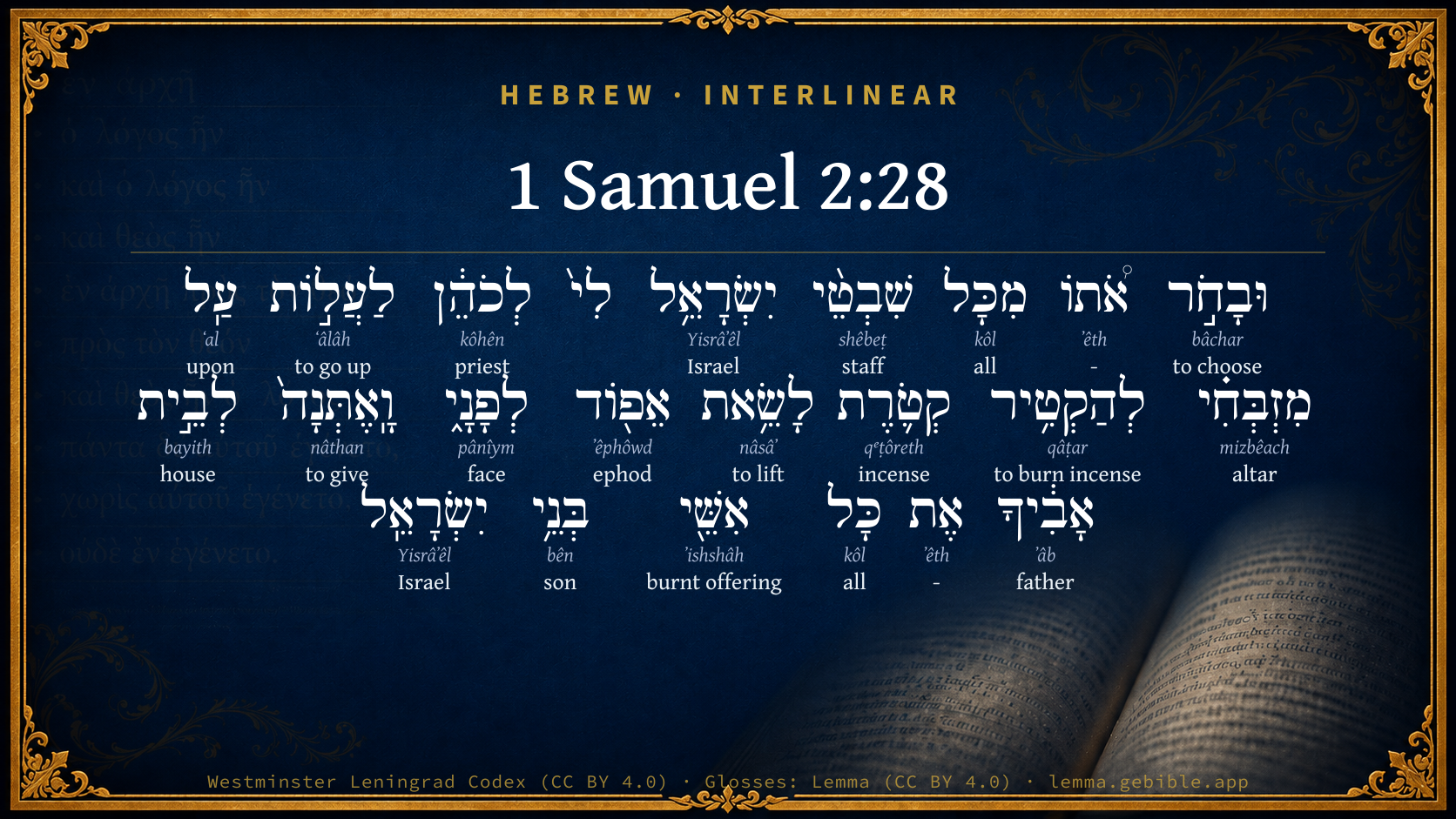
1 Samuel 2:28

Hebrew (Westminster Leningrad Codex) 1 Samuel 2:28 appears in the Hebrew Old Testament. The text above is from the Westminster Leningrad Codex. Each word links to its Strong’s number, a concise gloss, and parsing drawn from the Open Scriptures Hebrew Bible morphology. Click any word for its full Brown-Driver-Briggs (BDB) entry.
Download image
Cite this verse

1 Samuel 2:28 (World English Bible). Public Domain. Lemma interlinear Bible study tool, https://lemma.gebible.app/v/1-samuel/2/28.

Show BibTeX & RIS
BibTeX
RIS
English Translation
and did I choose him out of all the tribes of Israel to be my priest, to go up to my altar, to burn incense, to wear an ephod before me? and did I give to the house of your father all the offerings of the children of Israel made by fire?
World English Bible · Public Domain
Download a study sheet

One document with this verse’s original text, its word-by-word gloss line, the meaning frame, cross-references with their text, attributed commentary, and full source and license credits — printable, and it pastes into notes with its structure intact.

This verse Autodidact and up

Study sheet (.html) Plain text (.txt)

A passage Seminary Student

Up to 50 verses in one chapter. A passage sheet keeps up to 6 commentary sources and 12 cross-references per verse, in the order this page ranks them, and says so on the sheet whenever that leaves anything out. Ask for a single verse and you get the Autodidact verse sheet above.

Everything on this page stays free to read, with no account — the sheet is a download of what is already on screen, not access to it.

Want to remove ads? Support Godless Engineer
Compare translations 3

The same verse in 3 English versions, stacked beneath the original-language interlinear above. Click any original word for its lexicon entry.

Each is an independent rendering of the whole verse — the interlinear is not word-aligned to these translations.

Highlighted words mark where these versions differ — a whole-verse word diff, not a word-by-word alignment.

  • World English Bible Public Domain
    and did I choose him out of all the tribes of Israel to be my priest, to go up to my altar, to burn incense, to wear an ephod before me? and did I give to the house of your father all the offerings of the children of Israel made by fire?
  • King James Version Public Domain
    And did I choose him out of all the tribes of Israel to be my priest, to offer upon mine altar, to burn incense, to wear an ephod before me? and did I give unto the house of thy father all the offerings made by fire of the children of Israel?
  • unfoldingWord Literal Text CC BY-SA 4.0
    And I chose him from all of the tribes of Israel for myself for a priest, to go up on my altar, to burn incense, to wear an ephod to my face. And I gave to the house of your father all of the gifts of the sons of Israel.

unfoldingWord Literal Text — © unfoldingWord, licensed CC BY-SA 4.0. Word-aligned USFM3 via Door43 (git.door43.org/unfoldingWord/en_ult).

Versions to compare (up to 4)

3 of 4 selected

Show all 18 translations

Every available English version of this verse, each an independent rendering of the whole verse.

  • World English Bible Public Domain
    and did I choose him out of all the tribes of Israel to be my priest, to go up to my altar, to burn incense, to wear an ephod before me? and did I give to the house of your father all the offerings of the children of Israel made by fire?
  • Berean Standard Bible Public Domain
    And out of all the tribes of Israel I selected your father to be My priest, to offer sacrifices on My altar, to burn incense, and to wear an ephod in My presence. I also gave to the house of your father all the offerings of the Israelites made by fire.
  • Majority Standard Bible Public Domain
    And out of all the tribes of Israel I selected your father to be My priest, to offer sacrifices on My altar, to burn incense, and to wear an ephod in My presence. I also gave to the house of your father all the food offerings of the Israelites.
  • King James Version Public Domain
    And did I choose him out of all the tribes of Israel to be my priest, to offer upon mine altar, to burn incense, to wear an ephod before me? and did I give unto the house of thy father all the offerings made by fire of the children of Israel?
  • American Standard Version (1901) Public Domain
    and did I choose him out of all the tribes of Israel to be my priest, to go up unto mine altar, to burn incense, to wear an ephod before me? and did I give unto the house of thy father all the offerings of the children of Israel made by fire?
  • Revised Version (1885) Public Domain
    and did I choose him out of all the tribes of Israel to be my priest, to go up unto mine altar to burn incense, to wear an ephod before me? and did I give unto the house of thy father all the offerings of the children of Israel made by fire?
  • Geneva Bible (1599) Public Domain
    And I chose him out of all the tribes of Israel to be my Priest, to offer vpon mine altar, and to burne incense, and to weare an Ephod before me, and I gaue vnto the house of thy father all the offrings made by fire of the children of Israel.
  • Douay-Rheims (1899) Public Domain
    And I chose him out of all the tribes of Israel to be my priest, to go up to my sitar, and burn incense to me, and to wear the ephod before me: and I gave to thy father's house of all the sacrifices of the children of Israel.
  • Young's Literal Translation Public Domain
    even to choose him out of all the tribes of Israel to Me for a priest, to go up on Mine altar, to make a perfume, to bear an ephod before Me, and I give to the house of thy father all the fire-offerings of the sons of Israel?
  • Literal Standard Version CC BY-SA 4.0
    even to choose him out of all the tribes of Israel for a priest for Myself, to go up on My altar, to make incense, to bear an ephod before Me, and I give to the house of your father all the fire-offerings of the sons of Israel?
  • Unlocked Literal Bible CC BY-SA 4.0
    I chose him out of all the tribes of Israel to be my priest, to go up to my altar, and to burn incense, to wear an ephod before me. I gave to the house of your ancestor all the offerings of the people of Israel made with fire.
  • unfoldingWord Literal Text CC BY-SA 4.0
    And I chose him from all of the tribes of Israel for myself for a priest, to go up on my altar, to burn incense, to wear an ephod to my face. And I gave to the house of your father all of the gifts of the sons of Israel.
  • Darby Bible Public Domain
    and choose him out of all the tribes of Israel, to be my priest, to offer upon mine altar, to burn incense, to wear the ephod before me? and I gave unto the house of thy father all the offerings by fire of the children of Israel.
  • World Messianic Bible Public Domain
    Didn’t I choose him out of all the tribes of Israel to be my priest, to go up to my altar, to burn incense, to wear an ephod before me? Didn’t I give to the house of your father all the offerings of the children of Israel made by fire?
  • Webster's Bible Public Domain
    And did I choose him out of all the tribes of Israel to be my priest, to offer upon my altar, to burn incense, to wear an ephod before me? and did I give to the house of thy father all the offerings made by fire of the children of Israel?
  • Free Bible Version CC BY-SA 4.0
    I chose him out of all the tribes of Israel as my priest, to offer sacrifices on my altar, to burn incense, and to wear an ephod in my presence. I also gave to your forefather's family all the Israelites' offerings made with fire.
  • Bible in Basic English Public Domain
    Did I take him out of all the tribes of Israel to be my priest and to go up to my altar to make the smoke of the offerings go up and to take up the ephod? Did I give to your father's family all the offerings made by fire by the children of Israel?
  • JPS Tanakh (1917) Public Domain
    And did I choose him out of all the tribes of Israel to be My priest, to go up unto Mine altar, to burn incense, to wear an ephod before Me? and did I give unto the house of thy father all the offerings of the children of Israel made by fire?

Literal Standard Version (2020), Covenant Press — licensed CC BY-SA 4.0. Text via the HelloAO Bible API (eBible.org). Unlocked Literal Bible (unfoldingWord) — licensed CC BY-SA 4.0. Text via the HelloAO Bible API (eBible.org). unfoldingWord Literal Text — © unfoldingWord, licensed CC BY-SA 4.0. Word-aligned USFM3 via Door43 (git.door43.org/unfoldingWord/en_ult). Free Bible Version, Dr. Jonathan Gallagher — licensed CC BY-SA 4.0. Text via the HelloAO Bible API (eBible.org).

Word by word

More ways to search: Search by grammar → Find every occurrence → Compare this word →

Practice this passage: Drill this verse → Learn its vocabulary →

אֵפ֖וֹד
ʼêphôwd
H646
“ephod”
Noun, Common, Masculine, Singular, Absolute
Part of Speech
Noun
Type
Common
Gender
Masculine
Number
Singular
State
Absolute
Full BDB Definition

Origin: probably of foreign derivation

TWOT: 142 . 1a

ephod - priestly garment, shoulder-cape or mantle, outer garment - worn by an ordinary priest and made of white stuff - worn by the high priest - more costly, woven of gold, blue, purple, scarlet, and linen threads provided with shoulder-pieces and a breast piece of like material, ornamented with gems and gold
  1. וּבָחֹ֣ר bâchar H977 “and · to choose” Conjunction + Verb, Qal, Infinitive Absolute
  2. אֹ֠תוֹ ʼêth H853 “- · him” Particle, Direct Object + Suffix, Personal, 3rd Person, Masculine, Singular
  3. מִכָּל kôl H3605 “from · all of” Preposition + Noun, Common, Masculine, Singular, Construct
  4. שִׁבְטֵ֨י shêbeṭ H7626 “staffs of” Noun, Common, Masculine, Plural, Construct
  5. יִשְׂרָאֵ֥ל Yisrâʼêl H3478 “Israel” Noun, Proper
  6. לְכֹהֵ֔ן kôhên H3548 “to/for · priest” Preposition + Noun, Common, Masculine, Singular, Absolute
  7. לַעֲל֣וֹת ʻâlâh H5927 “to go up” Preposition + Verb, Qal, Infinitive Construct
  8. עַֽל ʻal H5921 “upon” Preposition
  9. מִזְבְּחִ֗י mizbêach H4196 “altar · my” Noun, Common, Masculine, Singular, Construct + Suffix, Personal, 1st Person, Common, Singular
  10. לְהַקְטִ֥יר qâṭar H6999 “to burn incense” Preposition + Verb, Hiphil, Infinitive Construct
  11. קְטֹ֛רֶת qᵉṭôreth H7004 “incense” Noun, Common, Feminine, Singular, Absolute
  12. לָשֵׂ֥את nâsâʼ H5375 “to lift” Preposition + Verb, Qal, Infinitive Construct
  13. לְפָנָ֑י pânîym H6440 “to/for · face(s) · my” Preposition + Noun, Common, Both, Plural, Construct + Suffix, Personal, 1st Person, Common, Singular
  14. וָֽאֶתְּנָה֙ nâthan H5414 “and · to give” Conjunction + Verb, Qal, Sequential Imperfect, 1st Person, Common, Singular + Suffix, h
  15. לְבֵ֣ית bayith H1004 “to/for · house of” Preposition + Noun, Common, Masculine, Singular, Construct
  16. אָבִ֔יךָ ʼâb H1 “father · your” Noun, Common, Masculine, Singular, Construct + Suffix, Personal, 2nd Person, Masculine, Singular
  17. אֶת ʼêth H853 “-” Particle, Direct Object
  18. כָּל kôl H3605 “all of” Noun, Common, Masculine, Singular, Construct
  19. אִשֵּׁ֖י ʼishshâh H801 “burnt offerings of” Noun, Common, Masculine, Plural, Construct
  20. בְּנֵ֥י bên H1121 “sons of” Noun, Common, Masculine, Plural, Construct
  21. יִשְׂרָאֵֽל Yisrâʼêl H3478 “Israel” Noun, Proper

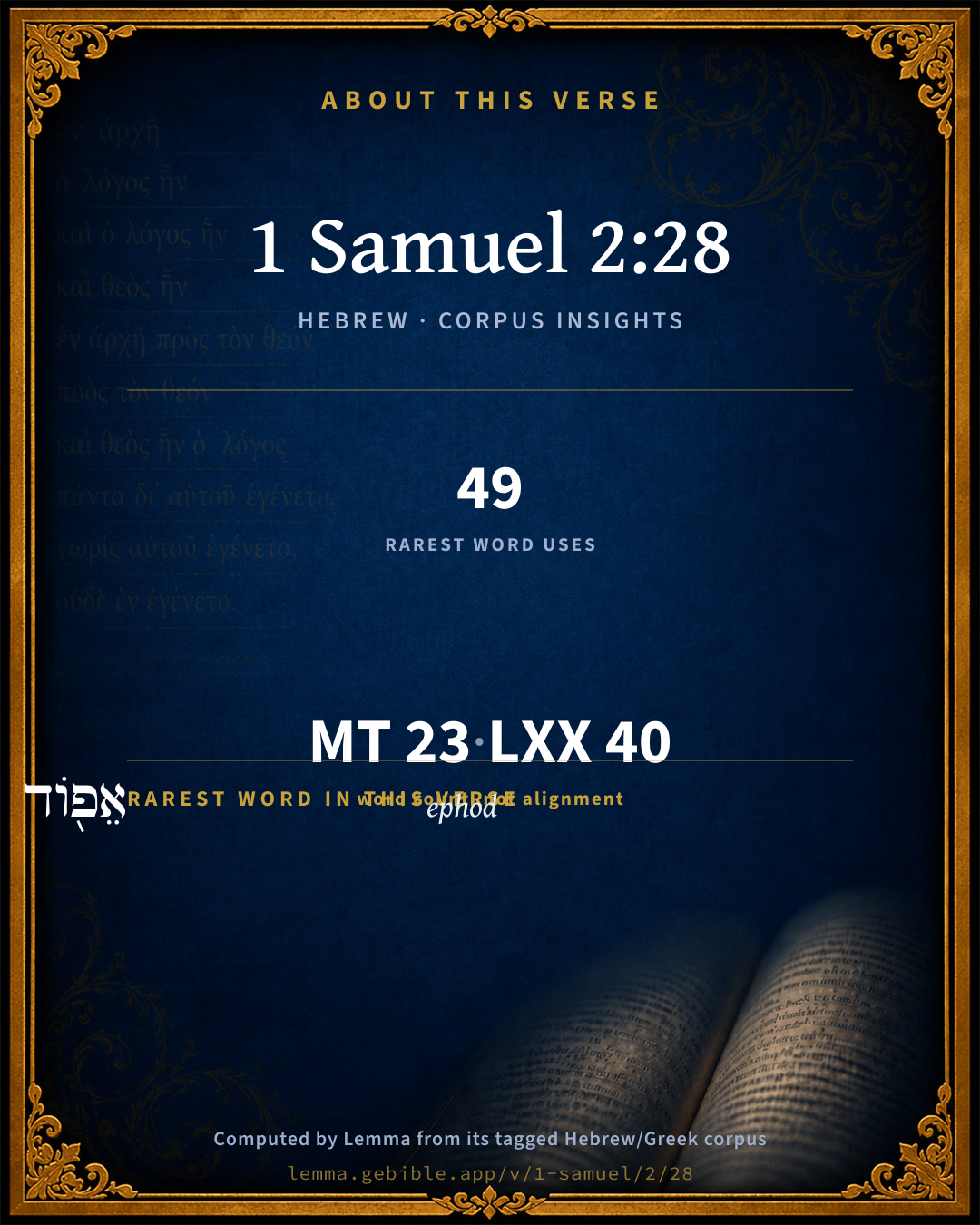
About this verse

These counts appear in no published source. They are computed here, from the morphology-tagged text and Lemma’s own curated glosses. What Lemma adds →

23
words
19
distinct lemmas
Historical
section

Shared distinctive vocabulary

אֵפ֖וֹד ephod H646 occurs in 39 verses of the Hebrew Bible. Also found in:

Grammatical profile

  • 5 verbs
  • 14 nouns
  • 2 prepositions
  • 2 particles

Verb forms

  • וּבָחֹ֣ר Qal · Infinitive Absolute
  • לַעֲל֣וֹת Qal · Infinitive Construct
  • לְהַקְטִ֥יר Hiphil · Infinitive Construct
  • לָשֵׂ֥את Qal · Infinitive Construct
  • וָֽאֶתְּנָה֙ Qal · Sequential Imperfect

Repetition

Words recur within this verse — often emphatic in Hebrew:

  • מִכָּל all H3605 ×2
  • יִשְׂרָאֵ֥ל Israel H3478 ×2

Hebrew & Septuagint length

In English translation the verse runs 52 words from the Hebrew and 59 from the Septuagint (LXX English) — closely comparable.

A rough comparison of the two English renderings, which tokenize alike — not a word-level alignment.

Word counts can differ between the Hebrew and the Greek without any difference in meaning — e.g. the Hebrew direct-object marker אֵת has no separate Greek word, and Greek often adds the article ὁ.

In the original languages it is 23 Hebrew tokens and 40 Greek tokens — but the two are counted differently (Hebrew bundles its prefixes and suffixes into one token; the Greek is in lemma form), so that isn’t a like-for-like length.

Cross-references

20

Topical passages linked to 1 Samuel 2:28 in the Treasury of Scripture Knowledge — connected by theme and wording, ordered by reader-vote popularity; previews shown in the World English Bible.

  • Exodus 28:1 "Bring Aaron your brother, and his sons with him, near to you from among the children of Israel, that he may minister to me in the priest's office, even Aaron, Nadab and Abihu, Eleazar and Ithamar, Aaron's sons.
  • Leviticus 8:7–8 He put the coat on him, tied the sash on him, clothed him with the robe, put the ephod on him, and he tied the skillfully woven band of the ephod on him, and fastened it to him with it.
  • Numbers 18:19 All the heave-offerings of the holy things, which the children of Israel offer to Yahweh, have I given you, and your sons and your daughters with you, as a portion forever: it is a covenant of salt forever before Yahweh to you and to your seed with you.
  • Exodus 28:4 These are the garments which they shall make: a breastplate, and an ephod, and a robe, and a coat of checker work, a turban, and a sash: and they shall make holy garments for Aaron your brother, and his sons, that he may minister to me in the priest's office.
  • Leviticus 2:3 That which is left of the meal offering shall be Aaron's and his sons'. It is a most holy thing of the offerings of Yahweh made by fire.
  • Leviticus 2:10 That which is left of the meal offering shall be Aaron's and his sons'. It is a thing most holy of the offerings of Yahweh made by fire.
  • Leviticus 6:16 That which is left of it Aaron and his sons shall eat. It shall be eaten without yeast in a holy place. They shall eat it in the court of the Tent of Meeting
  • Leviticus 7:7–8 "'As is the sin offering, so is the trespass offering; there is one law for them. The priest who makes atonement with them shall have it.
  • Leviticus 7:32 The right thigh you shall give to the priest for a heave offering out of the sacrifices of your peace offerings.
  • Leviticus 7:34–35 For the waved breast and the heaved thigh I have taken from the children of Israel out of the sacrifices of their peace offerings, and have given them to Aaron the priest and to his sons as their portion forever from the children of Israel.'"
  • Leviticus 10:14–15 The waved breast and the heaved thigh you shall eat in a clean place, you, and your sons, and your daughters with you: for they are given as your portion, and your sons' portion, out of the sacrifices of the peace offerings of the children of Israel.
  • Numbers 5:9–10 Every heave offering of all the holy things of the children of Israel, which they present to the priest, shall be his.
  • Numbers 16:5 and he spoke to Korah and to all his company, saying, In the morning Yahweh will show who are his, and who is holy, and will cause him to come near to him: even him whom he shall choose will he cause to come near to him.
  • Numbers 17:5–8 It shall happen, that the rod of the man whom I shall choose shall bud: and I will make to cease from me the murmurings of the children of Israel, which they murmur against you.
  • Exodus 28:6–30 "They shall make the ephod of gold, of blue, and purple, scarlet, and fine twined linen, the work of the skillful workman.
  • Exodus 29:4–37 You shall bring Aaron and his sons to the door of the tent of meeting, and shall wash them with water.
  • Exodus 39:1–7 Of the blue, purple, and scarlet, they made finely worked garments, for ministering in the holy place, and made the holy garments for Aaron; as Yahweh commanded Moses.
  • Numbers 18:1–8 Yahweh said to Aaron, You and your sons and your fathers' house with you shall bear the iniquity of the sanctuary; and you and your sons with you shall bear the iniquity of your priesthood.
  • Deuteronomy 18:1–8 The priests the Levites, [even] all the tribe of Levi, shall have no portion nor inheritance with Israel: they shall eat the offerings of Yahweh made by fire, and his inheritance.
  • 2 Samuel 12:7 Nathan said to David, "You are the man. This is what Yahweh, the God of Israel, says: 'I anointed you king over Israel, and I delivered you out of the hand of Saul.

Cross-references courtesy of OpenBible.info (CC BY 4.0).

Hebrew and Greek witnesses Masoretic Hebrew ↔ Greek Septuagint

The same verse in the two great witnesses to the Old Testament, shown verse-for-verse.

These are two independent witnesses, not word-aligned to each other, and the Septuagint is shown in lemma (dictionary) form.

Hebrew 1 Samuel 2:28 Masoretic · Westminster Leningrad Codex

וּבָחֹ֣ר אֹ֠תוֹ מִכָּל שִׁבְטֵ֨י יִשְׂרָאֵ֥ל לִי֙ לְכֹהֵ֔ן לַעֲל֣וֹת עַֽל מִזְבְּחִ֗י לְהַקְטִ֥יר קְטֹ֛רֶת לָשֵׂ֥את אֵפ֖וֹד לְפָנָ֑י וָֽאֶתְּנָה֙ לְבֵ֣ית אָבִ֔יךָ אֶת כָּל אִשֵּׁ֖י בְּנֵ֥י יִשְׂרָאֵֽל

and did I choose him out of all the tribes of Israel to be my priest, to go up to my altar, to burn incense, to wear an ephod before me? and did I give to the house of your father all the offerings of the children of Israel made by fire?

World English Bible · Public Domain

Greek LXX 1 Samuel 2:28 Septuagint · lemma form

καί ἐκλέγω ὁ οἶκος ὁ πατήρ σύ ἐκ πᾶς ὁ σκῆπτρον ἰσραήλ ἐγώ ἱερατεύω καί ἀναβαίνω ἐπί θυσιαστήριον ἐγώ καί θυμιάζω θυμίαμα καί αἴρω εφουδ καί δίδωμι ὁ οἶκος ὁ πατήρ σύ ὁ πᾶς ὁ πῦρ υἱός ἰσραήλ εἰς βρῶσις

And I chose the house of your father out of all the tribes of Israel to minister to me in the priest's office, to go up to my altar, and to burn incense, and to wear an ephod. And I gave to the house of your father all the offerings by fire of the children of Israel for food.

LXX2012 (modern English Septuagint) · Public Domain

Hebrew: Westminster Leningrad Codex (CC BY 4.0). Greek: Septuagint (public domain); English from LXX2012 (modern English Septuagint) (Public Domain). How the Septuagint differs from the Hebrew →

Targum (Aramaic paraphrase)

1

The Targum is the ancient Jewish Aramaic paraphrase of the Hebrew Scriptures — an interpretive translation, not the Hebrew text itself. Onkelos (literal) and Pseudo-Jonathan (expansive) render the Torah, and Jonathan the Prophets. Coverage is partial: where no permissively-licensed English translation exists for a verse, only the Aramaic is shown. This is verse-level text, not a word-by-word alignment to the Hebrew.

  1. Targum Jonathan Prophets (Joshua–Malachi)
    וְאִתְרְעֵיתִי בֵיהּ מִכָּל שִׁבְטַיָא דְיִשְׂרָאֵל קֳדָמַי לְמֶהֱוֵי כָהֵין לְאַסָקָא קוּרְבַּנָא עַל מַדְבְּחִי לְאַקְטָרָא קְטוֹרֶת בּוּסְמִין לְמִלְבַּשׁ אֵפוֹד לְשַׁמָשָׁא קֳדָמַי וִיהָבִית לְבֵית אָבוּךְ יַת כָּל קוּרְבָּנַיָא דִבְנֵי יִשְׂרָאֵל:

    (no public-domain English translation for this verse)

    Targum Jonathan — Aramaic: “Mikraot Gedolot” (public domain). English: “Sefaria Community Translation” (CC0 1.0 (public-domain dedication)); “London "Chaldee Paraphrase," 1871” (public domain). Text via Sefaria.

Commentary

Notes on 1 Samuel 2:28 from classic Christian and Jewish commentators (each source and its license shown beneath its notes). The classic Christian expositions comment on the surrounding passage and are grouped to its opening verse, so a note may address several verses; the Jewish commentaries on the Tanakh (Rashi and others) are per-verse, so they appear only where the commentator wrote on this verse.

Lemma curates 59 commentaries, every one of them public domain or Creative Commons licensed, each selected and text-cleaned for this edition rather than reprinted as found. About our sources →

Trapp's Complete Commentary

John Trapp

1Sa 2:28 And did I choose him out of all the tribes of Israel [to be] my priest, to offer upon mine altar, to burn incense, to wear an ephod before me? and did I give unto the house of thy father all the offerings made by fire of the children of Israel?

Ver. 28. And did I choose him? &c., ] q.d., Do ye thus requite the Lord, O ye foolish folk and unwise Qui exprobrat reposcit: God doth not upbraid any, but only in case of abuse of his benefits, which he accounts a very great indignity. Beneficium postulat officium.

All the offerings made by fire.] A very liberal and an honourable maintenance. {Lev 6:17 Deu 18:1}

John Trapp, A Commentary or Exposition upon All the Books of the Old and New Testament (1647–1656) — public domain. Text from a community e-Sword module.

Adam Clarke's Commentary

Verse 28. And did I choose him] The high priesthood was a place of the greatest honour that could be conferred on man, and a place of considerable emolument; for from their part of the sacrifices they derived a most comfortable livelihood.

Adam Clarke's Commentary on the Bible (1810–1826) — public domain. Text from a community e-Sword/MySword module.

Ellicott's Commentary for English Readers

(28) Did I choose him out of all the tribes of Israel? . . .—After such glorious privileges had been conferred on this favoured house, and such ample provision for all its wants had been made for it, it was indeed a crime of the blackest ingratitude that its leading members should pour dishonour on their invisible King and Benefactor.

To wear an ephod before me.—This included the privilege, which belonged to the head of the house of Aaron, the reigning high priest, of entering the Holy of Holies—that lightless inner sanctuary where the visible presence of the Eternal was ever and anon pleased to dwell—and also the possession of the mysterious Urim and Thummim, by which enquiry could be made of the will of the invisible King of Israel.

A Bible Commentary for English Readers, edited by Charles John Ellicott (1878–1897) — public domain. Text from a community e-Sword module.

The Cambridge Bible for Schools and Colleges

gen. ed. J. J. S. Perowne

28. him] Perhaps we should read, it (the house of Aaron) to be my priests (Exo_28:1-4). The priestly functions are mentioned in an ascending scale: (a) the common sacrificial duties, (b) offering incense in the Holy Place (Exo_30:7-8), (c) wearing an ephod, i.e. serving as High-priest, for probably the High-priest’s ephod (the only one mentioned in the Pentateuch) is meant here, and not the ordinary linen ephod worn at this time by all priests. See note on 1Sa_2:18.

to offer upon mine altar] or perhaps, “to go up to mine altar,” to minister at it. But the E. V. seems best.

all the offerings made by fire] See Lev_10:12-15.

The Cambridge Bible for Schools and Colleges (gen. ed. J. J. S. Perowne; Cambridge University Press, 1878–1918) — public domain. Text from a community e-Sword module.

John Gill's Exposition

Wherefore kick ye at my sacrifice, and at mine offering, which I have commanded in my habitation,.... To be offered in the tabernacle, where the Lord had his dwelling; which they might be said to kick and spurn at, despising them, as if there were not enough of them, nor the best of them given to them for their maintenance; a metaphor taken from cattle well fed and fat, which kick and spurn with their feet at even the owners and feeders of them. The Targum is,"why do ye use force with the holy offerings?''that is, take them away by force, when there was such a sufficient quantity allowed them for their support. Some understand this of their driving away such, that before used to bring their sacrifices to be offered, but being so ill treated, refrained from bringing them:

and honourest thy sons above me; by suffering them to take their part of the sacrifices, and even what did not belong to them, before God had his part, or before the fat was burnt; and by continuing them in their office, to the dishonour of God, his name and worship, when they ought to have been turned out by him and punished; but by this he preferred the honour of his sons before the honour of God, and chose rather that he should be dishonoured, than that they should be censured:

to make yourselves fat with the chiefest of all the offerings of Israel my people? they took the best pieces of the peace offerings from them by force, having no right unto them; and this they did to indulge their luxury and sensuality, which Eli connived at; and it is highly probable took part of the roasted meat his sons provided for themselves, out of the choicest pieces of the offerings of the people; since he himself is included in this clause, "to make yourselves fat", as his sons might be, and it is certain he himself was, Sa1 4:18.

John Gill's Exposition of the Whole Bible (1746–1763) — public domain (CC PDM 1.0). Text via the HelloAO Bible API.

Albert Barnes' Notes on the Bible

An ephod - The High Priest’s ephod, in which was Urim and Thummim.

Did I give ... - The bountiful provision made by God for His priests is mentioned as the great aggravation of the covetousness of Eli’s sons (compare 2Sa 12:7-9).

Albert Barnes' Notes on the Bible (1834–1885) — public domain. Text from a community e-Sword/MySword module.

Haydock's Catholic Bible Commentary

CHAPTER II.

Ephod, and all the pontifical attire. (Haydock) --- The high priest wore a different sort of ephod from that of other people. (Calmet) --- All the, &c. Even of the holocausts, the priests received the skin. (Menochius)

George Leo Haydock (1774–1849), Haydock's Catholic Family Bible and Commentary, 1859 edition — public domain. Excludes Psalms (Douay-Rheims chapter numbering differs from Protestant) and Deuterocanonical books (Catholic canon only).

Matthew Poole's English Annotations

Did I choose him, to wit, Aaron thy father? whereby he shows what he meant by his father’s house. An ephod; that golden ephod which was peculiar to the high priest.

All the offerings made by fire, i.e. all the priest’s part of the offerings. He only had the office, and he had the whole benefit.

Matthew Poole's English Annotations on the Holy Bible (1683–1685) — public domain. Text from a community e-Sword/MySword module.

Whedon's Commentary on the Bible

Daniel D. Whedon

28. Did I choose him… my priest — Compare Exodus 28.

All the offerings made by fire — Aaron and his sons had oversight of all the offerings of the altar. Num_18:7.

Daniel D. Whedon (gen. ed.), Commentary on the Old and New Testaments (1874–1909) — public domain. Text from a community e-Sword module.

Lesson kit

Teaching starters — assembled from the data on this page, not authored interpretation. Every prompt links to the verse data it draws on. Edit before teaching.

1 Samuel, in the Historical, opens this verse with 23 words (19 distinct Hebrew lemmas). Its most distinctive word is ʼêphôwd (“ephod”). A historical commentator’s framing appears above. Read the whole chapter for the surrounding context.

Discussion questions

  1. How does “ephod” (ʼêphôwd) shape what this verse is saying?
  2. Exodus 25:7 shares the word «ephod» with this verse. How do the two illuminate each other?
  3. “all” occurs 2× in this one verse. What is the effect of the repetition?
  4. These translations render this verse differently; the difference is in the English rendering, not the original. What questions does that raise?
  5. The verb «וּבָחֹ֣ר» is Qal Infinitive Absolute. How does its form color the action?
  6. Reading how Trapp's Complete Commentary and Adam Clarke's Commentary read this verse, where do the two commentators agree and where do they part?

Things to notice

Reading settings

Reading text

Shown beneath each verse's original-language words.

Old Testament
Old Testament edition

Read the OT as the Masoretic Hebrew (MT) or the Greek Septuagint (LXX).

English shown for the Greek Septuagint (in the Hebrew ↔ Greek comparison).

Comparing translations? Open the Compare panel on any verse page to stack up to four side by side.