Genesis 18:24

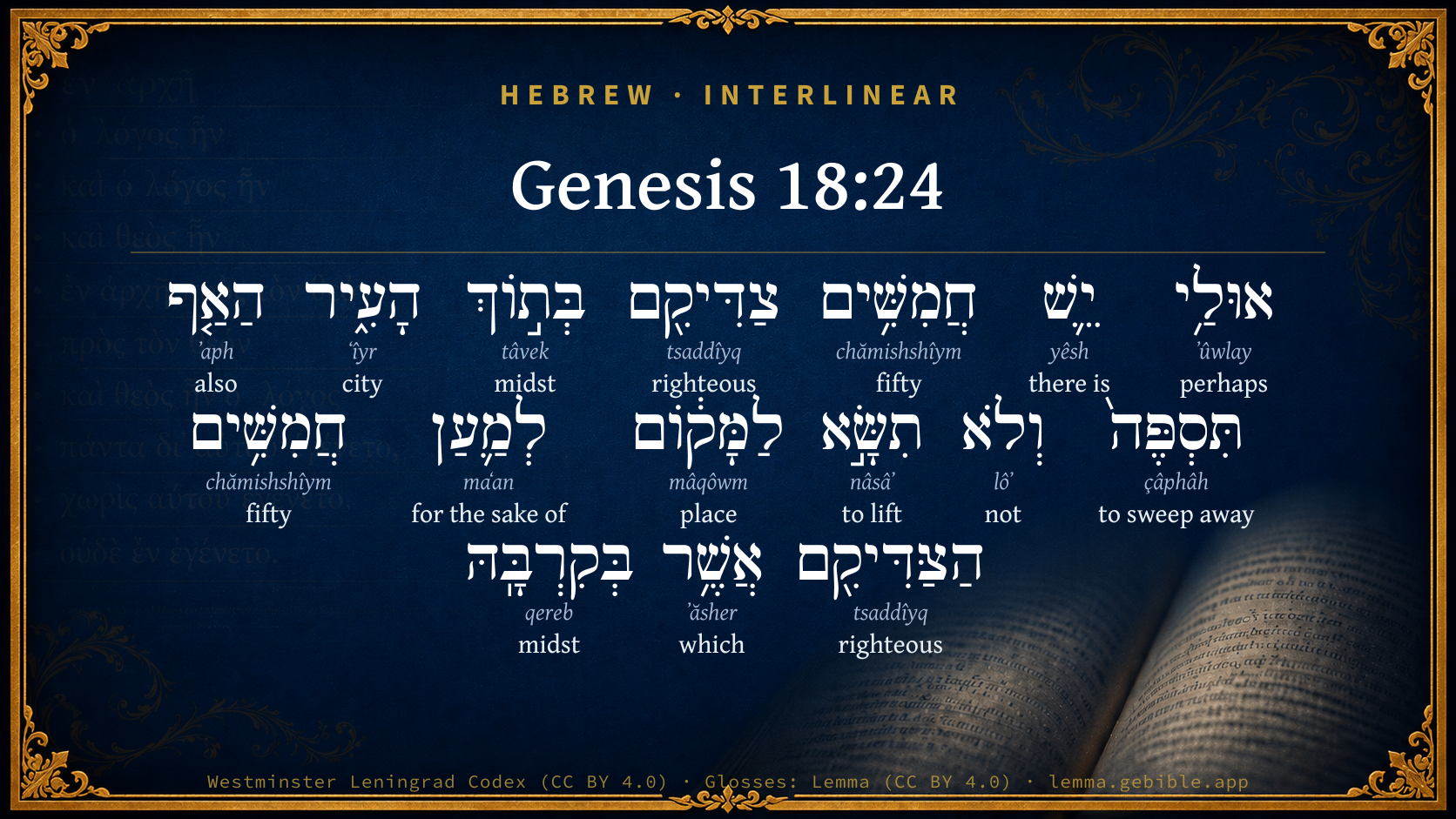
Hebrew (Westminster Leningrad Codex) Genesis 18:24 appears in the Hebrew Old Testament. The text above is from the Westminster Leningrad Codex. Each word links to its Strong’s number, a concise gloss, and parsing drawn from the Open Scriptures Hebrew Bible morphology. Click any word for its full Brown-Driver-Briggs (BDB) entry.
Download image
Cite this verse

Genesis 18:24 (World English Bible). Public Domain. Lemma interlinear Bible study tool, https://lemma.gebible.app/v/genesis/18/24.

Show BibTeX & RIS
BibTeX
RIS
English Translation
What if there are fifty righteous within the city? Will you consume and not spare the place for the fifty righteous who are therein?
World English Bible · Public Domain
Highlights
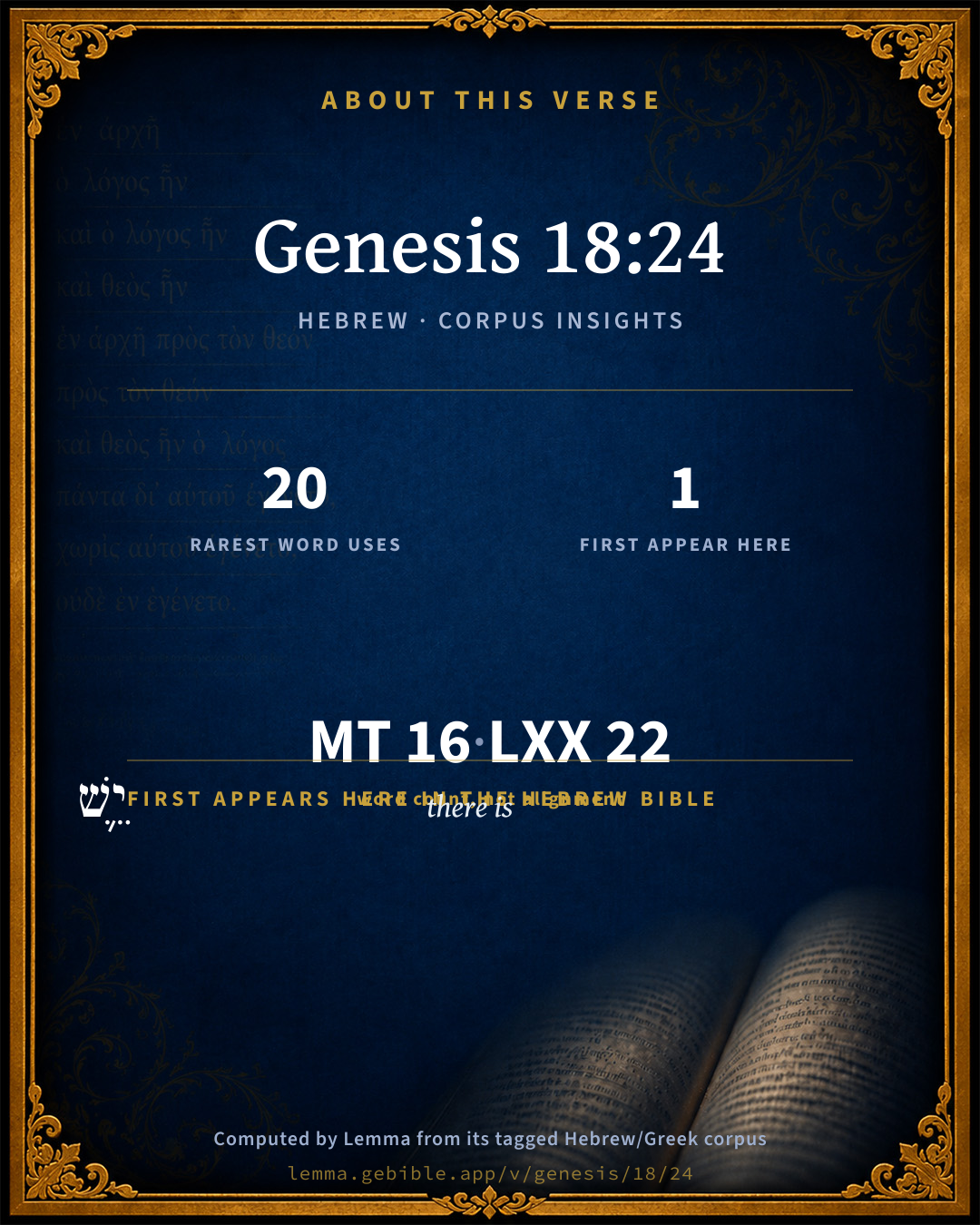
  • 1 first appearance in the Hebrew Bible
Full analysis ↓
Download a study sheet

One document with this verse’s original text, its word-by-word gloss line, the meaning frame, cross-references with their text, attributed commentary, and full source and license credits — printable, and it pastes into notes with its structure intact.

This verse Autodidact and up

Study sheet (.html) Plain text (.txt)

A passage Seminary Student

Up to 50 verses in one chapter. A passage sheet keeps up to 6 commentary sources and 12 cross-references per verse, in the order this page ranks them, and says so on the sheet whenever that leaves anything out. Ask for a single verse and you get the Autodidact verse sheet above.

Everything on this page stays free to read, with no account — the sheet is a download of what is already on screen, not access to it.

Want to remove ads? Support Godless Engineer
Compare translations 3

The same verse in 3 English versions, stacked beneath the original-language interlinear above. Click any original word for its lexicon entry.

Each is an independent rendering of the whole verse — the interlinear is not word-aligned to these translations.

Highlighted words mark where these versions differ — a whole-verse word diff, not a word-by-word alignment.

  • World English Bible Public Domain
    What if there are fifty righteous within the city? Will you consume and not spare the place for the fifty righteous who are therein?
  • King James Version Public Domain
    Peradventure there be fifty righteous within the city: wilt thou also destroy and not spare the place for the fifty righteous that are therein?
  • unfoldingWord Literal Text CC BY-SA 4.0
    Suppose there are fifty righteous in the city. Will you really sweep away and not spare the place for the sake of the fifty righteous who in it?

unfoldingWord Literal Text — © unfoldingWord, licensed CC BY-SA 4.0. Word-aligned USFM3 via Door43 (git.door43.org/unfoldingWord/en_ult).

Versions to compare (up to 4)

3 of 4 selected

Show all 18 translations

Every available English version of this verse, each an independent rendering of the whole verse.

  • World English Bible Public Domain
    What if there are fifty righteous within the city? Will you consume and not spare the place for the fifty righteous who are therein?
  • Berean Standard Bible Public Domain
    What if there are fifty righteous ones in the city? Will You really sweep it away and not spare the place for the sake of the fifty righteous ones who are there?
  • Majority Standard Bible Public Domain
    What if there are fifty righteous ones in the city? Will You really sweep it away and not spare the place for the sake of the fifty righteous ones who are there?
  • King James Version Public Domain
    Peradventure there be fifty righteous within the city: wilt thou also destroy and not spare the place for the fifty righteous that are therein?
  • American Standard Version (1901) Public Domain
    Peradventure there are fifty righteous within the city: wilt thou consume and not spare the place for the fifty righteous that are therein?
  • Revised Version (1885) Public Domain
    Peradventure there be fifty righteous within the city: wilt thou consume and not spare the place for the fifty righteous that are therein?
  • Geneva Bible (1599) Public Domain
    If there be fiftie righteous within the citie, wilt thou destroy and not spare the place for the fiftie righteous that are therein?
  • Douay-Rheims (1899) Public Domain
    And drawing nigh he said: Wilt thou destroy the just with the wicked?
  • Young's Literal Translation Public Domain
    peradventure there are fifty righteous in the midst of the city; dost Thou also consume, and not bear with the place for the sake of the fifty -- the righteous who `are' in its midst?
  • Literal Standard Version CC BY-SA 4.0
    Perhaps there are fifty righteous in the midst of the city; do You also consume, and not bear with the place for the sake of the fifty righteous who [are] in its midst?
  • Unlocked Literal Bible CC BY-SA 4.0
    Perhaps there are fifty righteous within the city. Will you sweep it away and not spare the place for the sake of the fifty righteous that are there?
  • unfoldingWord Literal Text CC BY-SA 4.0
    Suppose there are fifty righteous in the city. Will you really sweep away and not spare the place for the sake of the fifty righteous who in it?
  • Darby Bible Public Domain
    There are perhaps fifty righteous within the city: wilt thou also destroy and not forgive the place for the sake of the fifty righteous that are therein?
  • World Messianic Bible Public Domain
    What if there are fifty righteous within the city? Will you consume and not spare the place for the fifty righteous who are in it?
  • Webster's Bible Public Domain
    Peradventure there are fifty righteous within the city: wilt thou also destroy and not spare the place for the fifty righteous that are in it?
  • Free Bible Version CC BY-SA 4.0
    What if there are fifty good people in the town? Are you still going to wipe it out despite the fifty good people there?
  • Bible in Basic English Public Domain
    If by chance there are fifty upright men in the town, will you give the place to destruction and not have mercy on it because of the fifty upright men?
  • JPS Tanakh (1917) Public Domain
    Peradventure there are fifty righteous within the city; wilt Thou indeed sweep away and not forgive the place for the fifty righteous that are therein?

Literal Standard Version (2020), Covenant Press — licensed CC BY-SA 4.0. Text via the HelloAO Bible API (eBible.org). Unlocked Literal Bible (unfoldingWord) — licensed CC BY-SA 4.0. Text via the HelloAO Bible API (eBible.org). unfoldingWord Literal Text — © unfoldingWord, licensed CC BY-SA 4.0. Word-aligned USFM3 via Door43 (git.door43.org/unfoldingWord/en_ult). Free Bible Version, Dr. Jonathan Gallagher — licensed CC BY-SA 4.0. Text via the HelloAO Bible API (eBible.org).

Word by word

More ways to search: Search by grammar → Find every occurrence → Compare this word →

Practice this passage: Drill this verse → Learn its vocabulary →

תִּסְפֶּה֙
çâphâh
H5595
“to sweep away”
Verb, Qal, Imperfect, 2nd Person, Masculine, Singular
Part of Speech
Verb
Stem
Qal
Form
Imperfect
Person
2nd Person
Gender
Masculine
Number
Singular
Full BDB Definition

Origin: a primitive root

TWOT: 1531

to sweep or snatch away, catch up, destroy, consume - (Qal) - to be snatched away - to sweep or snatch away - (Niphal) - to be swept away, be destroyed - to be caught up, be captured - (Hiphil) to catch up, gather
  1. אוּלַ֥י ʼûwlay H194 “perhaps” Adverb
  2. יֵ֛שׁ yêsh H3426 “there is” Particle, Demonstrative
  3. חֲמִשִּׁ֥ים chămishshîym H2572 “fifty” Adjective, Cardinal number, Both, Plural, Absolute
  4. צַדִּיקִ֖ם tsaddîyq H6662 “righteous” Adjective, Adjective, Masculine, Plural, Absolute
  5. בְּת֣וֹךְ tâvek H8432 “in/at · midst of” Preposition + Noun, Common, Masculine, Singular, Construct
  6. הָעִ֑יר ʻîyr H5892 “the · city” Particle, Definite Article + Noun, Common, Feminine, Singular, Absolute
  7. הַאַ֤ף ʼaph H637 “also” Particle, Interrogative + Adverb
  8. וְלֹא lôʼ H3808 “and · not” Conjunction + Particle, Negative
  9. תִשָּׂ֣א nâsâʼ H5375 “to lift” Verb, Qal, Imperfect, 2nd Person, Masculine, Singular
  10. לַמָּק֔וֹם mâqôwm H4725 “to/for the · place” Preposition, Determined + Noun, Common, Masculine, Singular, Absolute
  11. לְמַ֛עַן maʻan H4616 “for the sake of” Preposition
  12. חֲמִשִּׁ֥ים chămishshîym H2572 “fifty” Adjective, Cardinal number, Both, Plural, Absolute
  13. הַצַּדִּיקִ֖ם tsaddîyq H6662 “the · righteous” Particle, Definite Article + Adjective, Adjective, Masculine, Plural, Absolute
  14. אֲשֶׁ֥ר ʼăsher H834 “which” Particle, Relative
  15. בְּקִרְבָּֽהּ qereb H7130 “in/at · midst · her” Preposition + Noun, Common, Masculine, Singular, Construct + Suffix, Personal, 3rd Person, Feminine, Singular

About this verse

These counts appear in no published source. They are computed here, from the morphology-tagged text and Lemma’s own curated glosses. What Lemma adds →

16
words
14
distinct lemmas
Pentateuch
section

Notable vocabulary

The rarest word here is תִּסְפֶּה֙ to sweep away H5595 — appearing just 20 times in the whole Hebrew Bible.

First appearance in Scripture

This word makes its first canonical appearance in the Hebrew Bible here:

  • יֵ֛שׁ there is H3426

Shared distinctive vocabulary

תִּסְפֶּה֙ to sweep away H5595 occurs in 20 verses of the Hebrew Bible. Also found in:

Grammatical profile

  • 2 verbs
  • 4 nouns
  • 4 adjectives
  • 1 preposition
  • 2 adverbs
  • 3 particles

Verb forms

  • תִּסְפֶּה֙ Qal · Imperfect
  • תִשָּׂ֣א Qal · Imperfect

Repetition

Words recur within this verse — often emphatic in Hebrew:

  • חֲמִשִּׁ֥ים fifty H2572 ×2
  • צַדִּיקִ֖ם righteous H6662 ×2

Hebrew & Septuagint length

In English translation the verse runs 24 words from the Hebrew and 31 from the Septuagint (LXX English) — closely comparable.

A rough comparison of the two English renderings, which tokenize alike — not a word-level alignment.

Word counts can differ between the Hebrew and the Greek without any difference in meaning — e.g. the Hebrew direct-object marker אֵת has no separate Greek word, and Greek often adds the article ὁ.

In the original languages it is 16 Hebrew tokens and 22 Greek tokens — but the two are counted differently (Hebrew bundles its prefixes and suffixes into one token; the Greek is in lemma form), so that isn’t a like-for-like length.

Cross-references

5

Topical passages linked to Genesis 18:24 in the Treasury of Scripture Knowledge — connected by theme and wording, ordered by reader-vote popularity; previews shown in the World English Bible.

  • Isaiah 1:9 Unless Yahweh of hosts had left to us a very small remnant, We would have been as Sodom; We would have been like Gomorrah.
  • Jeremiah 5:1 Run you back and forth through the streets of Jerusalem, and see now, and know, and seek in the broad places of it, if you can find a man, if there are any who does justly, who seeks truth; and I will pardon her.
  • Genesis 18:32 He said, "Oh don't let the Lord be angry, and I will speak yet but this once. What if ten are found there?" He said, "I will not destroy it for the ten's sake."
  • Matthew 7:13–14 "Enter in by the narrow gate; for wide is the gate and broad is the way that leads to destruction, and many are those who enter in by it.
  • Acts 27:24 saying, 'Don't be afraid, Paul. You must stand before Caesar. Behold, God has granted you all those who sail with you.'

Cross-references courtesy of OpenBible.info (CC BY 4.0).

Hebrew and Greek witnesses Masoretic Hebrew ↔ Greek Septuagint

The same verse in the two great witnesses to the Old Testament, shown verse-for-verse.

These are two independent witnesses, not word-aligned to each other, and the Septuagint is shown in lemma (dictionary) form.

Hebrew Genesis 18:24 Masoretic · Westminster Leningrad Codex

אוּלַ֥י יֵ֛שׁ חֲמִשִּׁ֥ים צַדִּיקִ֖ם בְּת֣וֹךְ הָעִ֑יר הַאַ֤ף תִּסְפֶּה֙ וְלֹא תִשָּׂ֣א לַמָּק֔וֹם לְמַ֛עַן חֲמִשִּׁ֥ים הַצַּדִּיקִ֖ם אֲשֶׁ֥ר בְּקִרְבָּֽהּ

What if there are fifty righteous within the city? Will you consume and not spare the place for the fifty righteous who are therein?

World English Bible · Public Domain

Greek LXX Genesis 18:24 Septuagint · lemma form

ἐάν εἰμί πεντήκοντα δίκαιος ἐν ὁ πόλις ἀποὀλλύω αὐτός οὐ ἀναἵημι πᾶς ὁ τόπος ἕνεκεν ὁ πεντήκοντα δίκαιος ἐάν εἰμί ἐν αὐτός

Should there be fifty righteous in the city, will you destroy them? will you not spare the whole place for the sake of the fifty righteous, if they be in it?

LXX2012 (modern English Septuagint) · Public Domain

Hebrew: Westminster Leningrad Codex (CC BY 4.0). Greek: Septuagint (public domain); English from LXX2012 (modern English Septuagint) (Public Domain). How the Septuagint differs from the Hebrew →

Targum (Aramaic paraphrase)

2

The Targum is the ancient Jewish Aramaic paraphrase of the Hebrew Scriptures — an interpretive translation, not the Hebrew text itself. Onkelos (literal) and Pseudo-Jonathan (expansive) render the Torah, and Jonathan the Prophets. Coverage is partial: where no permissively-licensed English translation exists for a verse, only the Aramaic is shown. This is verse-level text, not a word-by-word alignment to the Hebrew.

  1. Targum Onkelos Torah (Genesis–Deuteronomy)
    מָאִים אִית חַמְּשִׁין זַכָּאִין בְּגוֹ קַרְתָּא הֲבִרְגַז תְּשֵׁיצֵי וְלָא תִשְׁבּוֹק לְאַתְרָא בְּדִיל חַמְשִׁין זַכָּאִין דִּי בְגַוָּהּ

    (no public-domain English translation for this verse)

    Targum Onkelos — Aramaic: “Onkelos Genesis” (public domain); “Onkelos Exodus” (public domain); “Onkelos Leviticus” (public domain); “Onkelos Numbers” (public domain); “Onkelos Deuteronomy” (public domain). English: “Sefaria Community Translation” (CC0 1.0 (public-domain dedication)); “J.W. Etheridge. The Targums of Onkelos and Jonathan Ben Uzziel on the Pentateuch. London: Longmans, Green, 1862” (public domain). Text via Sefaria.

  2. Targum Pseudo-Jonathan Torah (Genesis–Deuteronomy)
    מָאִים אִית חַמְשִׁין זַכָּאִין בְּגוֹ קַרְתָּא דְיֵיצְלוּן קֳדָמָךְ עֲשָרָה לְכָל קִרְוָוא כָּל קְבֵיל חַמְשָׁא קוּרְיַין סְדוֹם וַעֲמוֹרָה אַדְמָה וּצְבוֹיִם וְזוֹעַר הֲרוּגְזָךְ שֵׁצְיָא וְלָא תִשְׁבּוֹק לְאַתְרָא בְּגִין זַכְוַות חַמְשִׁין זַכָּאִין דִבְגַוָוהּ

    Perhaps there are fifty innocent persons within the city, who pray before Thee,--ten for every city, of all the five cities of Sedom, Amorah, Admah, Zeboim, and Zoar. Wilt Thou in Thy displeasure destroy and not forgive the country, on account of the fifty innocent ones who are in it? Unholy would it be before Thee to do according to this word, to slay the innocent with the guilty, and to make the innocent to be as the guilty!

    Targum Pseudo-Jonathan — Aramaic: “Targum Jonathan on Genesis” (public domain); “Targum Jonathan on Exodus” (public domain); “Targum Jonathan on Leviticus” (public domain); “Targum Jonathan on Numbers” (public domain); “Targum Jonathan on Deuteronomy” (public domain). English: “The Targum of Jonathan ben Uzziel, trans. J. W. Etheridge, London, 1862” (public domain). Text via Sefaria.

Commentary

Notes on Genesis 18:24 from classic Christian and Jewish commentators (each source and its license shown beneath its notes). The classic Christian expositions comment on the surrounding passage and are grouped to its opening verse, so a note may address several verses; the Jewish commentaries on the Tanakh (Rashi and others) are per-verse, so they appear only where the commentator wrote on this verse.

Lemma curates 59 commentaries, every one of them public domain or Creative Commons licensed, each selected and text-cleaned for this edition rather than reprinted as found. About our sources →

Trapp's Complete Commentary

John Trapp

Gen 18:24 Peradventure there be fifty righteous within the city: wilt thou also destroy and not spare the place for the fifty righteous that [are] therein?

Ver. 24. Peradventure there be fifty righteous.] Charity presumes the best, hopes the best. The disciples could not imagine that Judas was so very a traitor: each one suspects himself sooner than him. And when our Saviour said, "What thou doest do quickly"; they thought he had meant of making provision, or giving something to the poor. {Joh 13:27-29}

John Trapp, A Commentary or Exposition upon All the Books of the Old and New Testament (1647–1656) — public domain. Text from a community e-Sword module.

The Cambridge Bible for Schools and Colleges

gen. ed. J. J. S. Perowne

24. spare the place] The word in the Heb. means literally “and take away for the place,” i.e. its guilt, and so “forgive,” as in Num_14:19.

The Cambridge Bible for Schools and Colleges (gen. ed. J. J. S. Perowne; Cambridge University Press, 1878–1918) — public domain. Text from a community e-Sword module.

John Gill's Exposition

Peradventure there be fifty righteous within the city,.... Within the Pentapolis, which consisted of five cities; and so ten righteous persons are supposed to be in each, as Jarchi observes, agreeably to the Targum of Jonathan;"perhaps there may be fifty righteous persons in the city who pray before thee, ten for every city, answerable to the five cities of Sodom and Gomorrah, Admah, Zeboiim, and Zoar:"

wilt thou also destroy, and not spare the place for the fifty righteous that are therein? here Abraham becomes an advocate and intercessor for all the inhabitants of the place, even the wicked, that they might not be destroyed, but spared and be delivered from impending ruin, for the sake of the fifty righteous among them; before he seemed only concerned for the righteous, lest they should perish with the rest, and that some method might be found out and taken to distinguish them from them; but here he expresses himself in favour of the wicked also, that they might be spared, provided such a number of righteous ones was found among them.

John Gill's Exposition of the Whole Bible (1746–1763) — public domain (CC PDM 1.0). Text via the HelloAO Bible API.

Matthew Poole's English Annotations

Within the city, i.e. in the cities concerned, as appears by Gen 18:20, and Gen 19:25; the singular number for the plural, as is frequent, as Gen 3:22; 1Ch 10:1, compared with 1Sa 31:1, and oft elsewhere. Or the city Sodom alone is mentioned, but the rest are comprehended under it, either because of its eminency, or because they were subject or subordinate to it, as may seem probable from the history, Gen 14:1-24.

Matthew Poole's English Annotations on the Holy Bible (1683–1685) — public domain. Text from a community e-Sword/MySword module.

Whedon's Commentary on the Bible

Daniel D. Whedon

24. Peradventure there be fifty — He begins his intercession with this moderate number. Surely if half a hundred righteous people are living in the city, for their sake it should be spared.

Daniel D. Whedon (gen. ed.), Commentary on the Old and New Testaments (1874–1909) — public domain. Text from a community e-Sword module.

The Pulpit Commentary

Peradventure there be fifty righteous within the city. A charitable supposition, as the event showed, though at first sight it might not appear so to Abraham; and the bare Possibility of Sodom"s not Sodom alone (Kalisch), but the Pentapolis containing so many good men was enough to afford a basis for the argument which followed. Wilt thou also destroy and not spare literally, take away (sc. the iniquity) i.e. remove the punishment from the place (not the godly portion of the city merely, but the entire population; a complete discovery of Abraham s design) for the fifty righteous that are therein?

The Pulpit Commentary (1880–1919), ed. H.D.M. Spence-Jones & Joseph S. Exell — public domain. Text from a community e-Sword module.

unfoldingWord translationNotes

Door43 World Missions Community

General Information:

Abraham continues talking to Yahweh.

Perhaps there are

"Suppose there are"

Will you sweep it away and not spare the place for the sake of the fifty righteous that are there?

Abraham was hoping that Yahweh would say, "I will not sweep it away." AT: "I think you would not sweep it away. Instead, you would spare the place for the sake of the fifty righteous that are there" (See: Rhetorical Question)

sweep it away

"destroy it." Abraham speaks of destroying people as if it were sweeping dirt with a broom. AT: "destroy the people who live there" (See: Metaphor)

not spare the place for the sake of the fifty righteous that are there?

Abraham was hoping that God would say "I will spare the place for the sake of the fifty righteous people there."

spare the place

"let the people live"

for the sake of

"because of"

Far be it from you to do such a thing

Here "Far be it from you" is an idiom that means the person should never do something like that. AT: "I would never want you to do something like that" or "You should not want to do something like that" (See: Idiom)

such a thing, killing

"such a thing as killing" or "such a thing, that is, killing"

the righteous should be treated the same as the wicked

This can be stated in active from. AT: "you should treat the righteous the same way you treat the wicked" (See: Active or Passive)

Will not the Judge of all the earth do what is just?

Abraham used this rhetorical question to say what he expected God to do. AT: "The Judge of all the earth will certainly do what is just!" or "Since you are the Judge of all the earth, you will surely do what is right!" (See: Rhetorical Question)

Judge

God is often referred to as a judge because he is the one perfect judge who makes the final decisions about what is right or wrong.

translationWords

righteous

sweep

judge, judges

evil

Yahweh

unfoldingWord translationNotes — © Distant Shores Media and the Door43 World Missions Community, licensed CC BY-SA 4.0. Source: git.door43.org/Door43/en_tn.

Rashi

Rabbi Shlomo Yitzchaki (Rashi)

אולי יש חמשים צדיקים PERADVENTURE THERE BE FIFTY RIGHTEOUS — ten righteous men for each city for there were five localities concerned. Should You, however, say that the righteous cannot save the wicked—but why should You kill the righteous at all?

Rashi on the Tanakh — English translations: “The Judaica Press complete Tanach with Rashi, translated by A. J. Rosenberg” (CC BY 4.0); “Pentateuch with Rashi's commentary by M. Rosenbaum and A.M. Silbermann, 1929-1934” (public domain); “The Metsudah Tanach series, Lakewood, N.J” (CC BY 4.0); and “The Book of Joshua, Metsudah Publications, 1997” (CC BY 4.0). Text via Sefaria.

Ramban (Nachmanides)

Rabbi Moshe ben Nachman (Ramban / Nachmanides)

FIFTY RIGHTEOUS. Rashi wrote: “Ten righteous men for each city. Wilt thou destroy on account of the five. Nine for each city, and You, the All-Righteous One of the Universe, will be counted with them [to make up the original number of ten]. Perhaps there shall be found there forty. Then let four cities be saved. So, too, thirty will save three of them, twenty will save two of them, and ten will save one of them. And he did not plead for less than ten since in the generation of the flood there were eight righteous people, and they could not save their generation. For nine, in association with G-d, he had already pleaded but found no acceptance.” All these are the words of the Rabbi, of blessed memory.But I wonder: If so, what is this prayer and supplication which he pleads each and every time, saying, oh let not the Lord be angry; Behold, now, I have taken upon me to speak? It is proper that forty should save four cities, and thirty and twenty should save in proportion, just as fifty would save five! Similarly, concerning that which Rashi said, “for nine in association with G-d he had already pleaded but found no acceptance,” it may be asked: When he pleaded about forty-five, [i.e., to save all five cities by having nine righteous men for each city] in association [with G-d to make up ten], and he did not find forty-five, but perhaps he might have found there nine! Now it would seem that the intention of the Rabbi is that many righteous people can effect a proportionately greater salvation than a few righteous people can, just as the Sages have said: ) “A few who fulfill the commandments of the Torah cannot compare with the many who fulfill the commandments of the Torah.” And thus, the Holy One, blessed be He, having conceded that forty-five righteous men in association with the All-Righteous One of the Universe would save all the five cities just as if there were the entire fifty, it follows that if forty could save four cities — in association with the Righteous One, praised be He — they would also save with even thirty and twenty, since He already conceded this association. [Thus, thirty-six would save four, twenty-seven three, eighteen two, and nine one]. And in case you say that He conceded only the case of forty-five because they are many, and perhaps He might not concede the principle of association with the few, as we have said, the refutation is that it is proper for the righteousness of G-d to associate even with the few and save [as many of the cities as possible] since He had conceded the principle of association, for He would not distinguish between the many and the few. This is the opinion of the Rabbi. But the way of the simple meaning of the verses is smooth. First Abraham said fifty in order to give a perfect number of ten for each city, and then he decreased the number as much as possible, and each time he thought to save all five cities. And I do not know who brought the Rabbi to that which he said.

Ramban (Nachmanides) on the Tanakh — English translation: “Commentary on the Torah by Ramban (Nachmanides). Translated and annotated by Charles B. Chavel. New York, Shilo Pub. House, 1971-1976” (CC BY 4.0). Text via Sefaria.

Radak

Rabbi David Kimhi (Radak)

?אולי יש חמשים צדיקים בתוך העיר, the words בתוך העיר must be understood as referring exclusively to the city of Sodom, not including its satellites. We know this from G’d’s reply in which He spelled out: in verse 24 “if I find in Sodom 50 righteous men inside the city, etc.” Avraham’s argument could have been that if there would be 50 righteous men in the city of Sodom, it was most likely that also the satellite towns would harbour among their populations some righteous people. Alternately, Avraham may have asked that if there would be a total of 50 good men scattered in the various towns, this should be enough to allow all the cities to escape destruction at this time. G’d might then have mentioned Sodom as an example of all of the cities in the valley, saying that 50 people would suffice for G’d’s forgiveness at this time. He singled out Sodom because Lot, Avraham’s kin, lived in that particular city. Avraham tested the number of righteous men that would be the rock bottom minimum for G’d to suspend all or part of the destruction He had planned.

האף תספה ולא תשא למקום, he did not mention the people in the place but referred to the place itself. Avraham could not reasonably expect G’d to forgive the sinners, but he felt that the place could be saved. If the guilty would be wiped out the righteous would at least be able to continue living in that town, and would not have to migrate to a new location. Avraham concentrated on the word כלה, “total destruction,” of which G’d had spoken. The prophet Ezekiel in Ezekiel 22,30 and already in chapter 21, elaborates further on how the impending destruction which overtook Jerusalem in his time could have been stopped. Not only would there have to have been interlocutors such as Avraham, but the sins of the city would have had to be in the main minor sins, i.e. not violence, the sin which provokes G’d’s wrath the most, as we know from the generation of the deluge already. Not only that, but in order for the righteous to be able to save their townsfolk from disaster they must be absolutely righteous, not only barely have more merits than debits in G’d’s ledger of their conduct. In Jeremiah’s time there were righteous people. These were withdrawn, did not mix with the wicked, and did not dare go out into the streets to admonish their countrymen, as they were afraid for their own lives and were not prepared to risk their lives in order to urge their fellow Jews to do penitence. Our author quotes Jeremiah 5,1, Psalms 94,15, 69,12, as well as Ezekiel 14,14 and 14,16 to support his case.

Radak on the Tanakh — English translations: “Sefaria Community Translation” (CC0 1.0 (public-domain dedication)); “Eliyahu Munk, HaChut Hameshulash” (CC BY 4.0); “Rabbi Mike Feuer, Jerusalem Anthology” (CC BY 4.0); and “R. David Kimhi on the first book of Psalms, Translated by R.G. Finch, London, 1919” (public domain). Text via Sefaria.

Lesson kit

Teaching starters — assembled from the data on this page, not authored interpretation. Every prompt links to the verse data it draws on. Edit before teaching.

Genesis, in the Pentateuch, opens this verse with 16 words (14 distinct Hebrew lemmas). Its most distinctive word is çâphâh (“to sweep away”). A historical commentator’s framing appears above. Read the whole chapter for the surrounding context.

Discussion questions

  1. How does “to sweep away” (çâphâh) shape what this verse is saying?
  2. This is the first place “there is” appears in Scripture (first appears here). What does its debut here establish?
  3. How does Genesis 18:23, which shares the word «to sweep away», read alongside this verse?
  4. What does the repetition of “fifty” (2× in this one verse) do in this verse?
  5. These translations render this verse differently. What is at stake in choosing one wording over another?
  6. «תִּסְפֶּה֙» is a Qal Imperfect verb. How does that grammatical form shape the action described?
  7. Compare how Trapp's Complete Commentary and The Cambridge Bible for Schools and Colleges read this verse. Where do they agree or differ?

Things to notice

Reading settings

Reading text

Shown beneath each verse's original-language words.

Old Testament
Old Testament edition

Read the OT as the Masoretic Hebrew (MT) or the Greek Septuagint (LXX).

English shown for the Greek Septuagint (in the Hebrew ↔ Greek comparison).

Comparing translations? Open the Compare panel on any verse page to stack up to four side by side.