1 Samuel 30:4

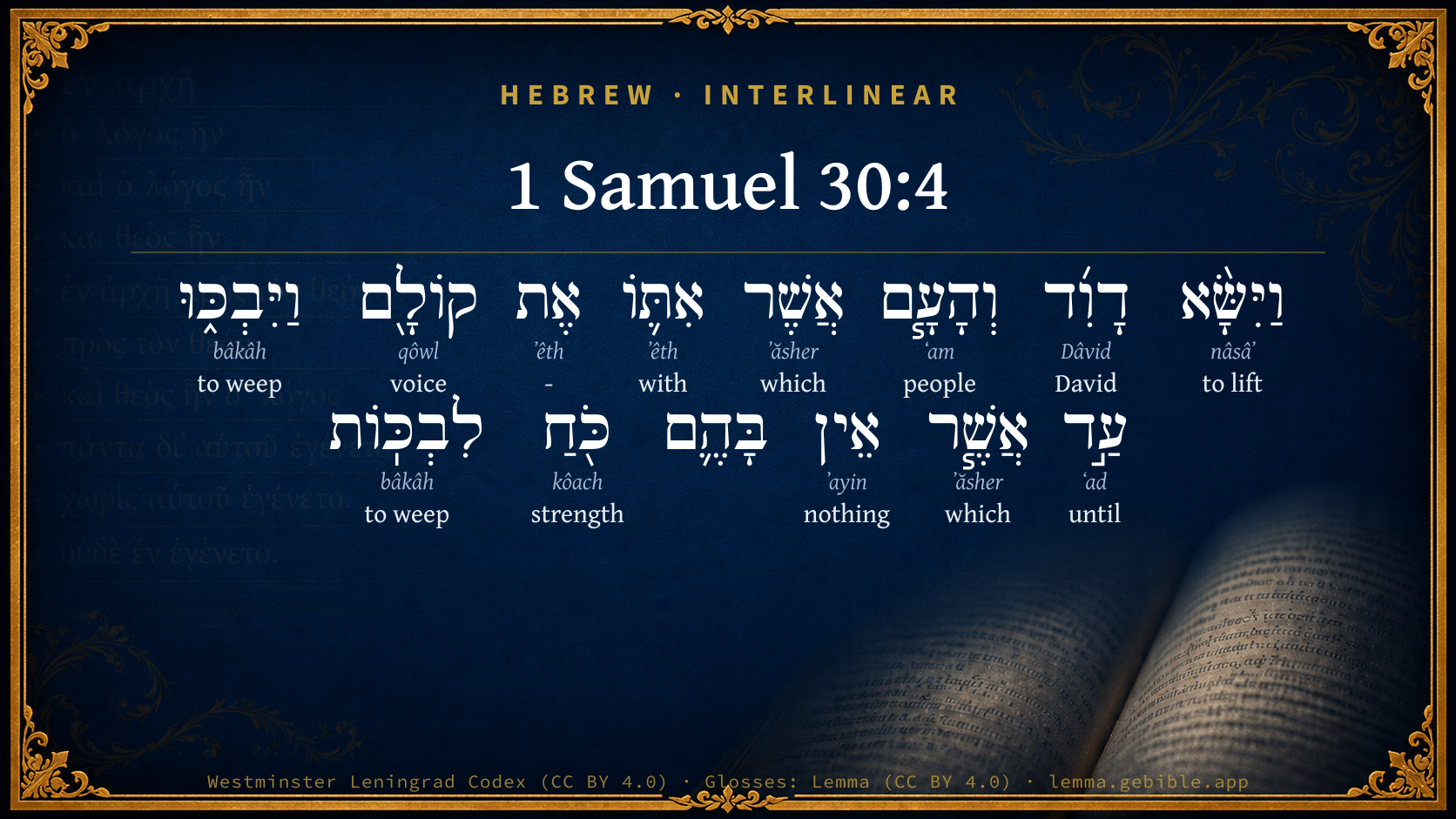
Hebrew (Westminster Leningrad Codex) 1 Samuel 30:4 appears in the Hebrew Old Testament. The text above is from the Westminster Leningrad Codex. Each word links to its Strong’s number, a concise gloss, and parsing drawn from the Open Scriptures Hebrew Bible morphology. Click any word for its full Brown-Driver-Briggs (BDB) entry.
Download image
Cite this verse

1 Samuel 30:4 (World English Bible). Public Domain. Lemma interlinear Bible study tool, https://lemma.gebible.app/v/1-samuel/30/4.

Show BibTeX & RIS
BibTeX
RIS
English Translation
Then David and the people who were with him lifted up their voice and wept, until they had no more power to weep.
World English Bible · Public Domain
Download a study sheet

One document with this verse’s original text, its word-by-word gloss line, the meaning frame, cross-references with their text, attributed commentary, and full source and license credits — printable, and it pastes into notes with its structure intact.

This verse Autodidact and up

Study sheet (.html) Plain text (.txt)

A passage Seminary Student

Up to 50 verses in one chapter. A passage sheet keeps up to 6 commentary sources and 12 cross-references per verse, in the order this page ranks them, and says so on the sheet whenever that leaves anything out. Ask for a single verse and you get the Autodidact verse sheet above.

Everything on this page stays free to read, with no account — the sheet is a download of what is already on screen, not access to it.

Want to remove ads? Support Godless Engineer
Compare translations 3

The same verse in 3 English versions, stacked beneath the original-language interlinear above. Click any original word for its lexicon entry.

Each is an independent rendering of the whole verse — the interlinear is not word-aligned to these translations.

Highlighted words mark where these versions differ — a whole-verse word diff, not a word-by-word alignment.

  • World English Bible Public Domain
    Then David and the people who were with him lifted up their voice and wept, until they had no more power to weep.
  • King James Version Public Domain
    Then David and the people that were with him lifted up their voice and wept, until they had no more power to weep.
  • unfoldingWord Literal Text CC BY-SA 4.0
    And David and the people who with him lifted up their voices and wept until that no strength in them to weep.

unfoldingWord Literal Text — © unfoldingWord, licensed CC BY-SA 4.0. Word-aligned USFM3 via Door43 (git.door43.org/unfoldingWord/en_ult).

Versions to compare (up to 4)

3 of 4 selected

Show all 18 translations

Every available English version of this verse, each an independent rendering of the whole verse.

  • World English Bible Public Domain
    Then David and the people who were with him lifted up their voice and wept, until they had no more power to weep.
  • Berean Standard Bible Public Domain
    So David and the troops with him lifted up their voices and wept until they had no strength left to weep.
  • Majority Standard Bible Public Domain
    So David and the troops with him lifted up their voices and wept until they had no strength left to weep.
  • King James Version Public Domain
    Then David and the people that were with him lifted up their voice and wept, until they had no more power to weep.
  • American Standard Version (1901) Public Domain
    Then David and the people that were with him lifted up their voice and wept, until they had no more power to weep.
  • Revised Version (1885) Public Domain
    Then David and the people that were with him lifted up their voice and wept, until they had no more power to weep.
  • Geneva Bible (1599) Public Domain
    Then Dauid and the people that was with him, lift vp their voyces and wept, vntill they could weepe no more.
  • Douay-Rheims (1899) Public Domain
    David and the people that were with him, lifted up their voices, and wept till they had no more tears.
  • Young's Literal Translation Public Domain
    And David lifteth up -- and the people who `are' with him -- their voice and weep, till that they have no power to weep.
  • Literal Standard Version CC BY-SA 4.0
    And David lifts up—and the people who [are] with him—their voice and weep, until they have no power to weep.
  • Unlocked Literal Bible CC BY-SA 4.0
    Then David and the people that were with him raised their voices and wept until they had no more power to weep.
  • unfoldingWord Literal Text CC BY-SA 4.0
    And David and the people who with him lifted up their voices and wept until that no strength in them to weep.
  • Darby Bible Public Domain
    Then David and the people that were with him lifted up their voice and wept, until they had no more power to weep.
  • World Messianic Bible Public Domain
    Then David and the people who were with him lifted up their voice and wept until they had no more power to weep.
  • Webster's Bible Public Domain
    Then David and the people that were with him, lifted up their voice and wept, until they had no more power to weep.
  • Free Bible Version CC BY-SA 4.0
    David and his men cried loudly until they couldn't cry any more.
  • Bible in Basic English Public Domain
    Then David and the people who were with him gave themselves up to weeping till they were able to go on weeping no longer.
  • JPS Tanakh (1917) Public Domain
    Then David and the people that were with him lifted up their voice and wept, until they had no more power to weep.

Literal Standard Version (2020), Covenant Press — licensed CC BY-SA 4.0. Text via the HelloAO Bible API (eBible.org). Unlocked Literal Bible (unfoldingWord) — licensed CC BY-SA 4.0. Text via the HelloAO Bible API (eBible.org). unfoldingWord Literal Text — © unfoldingWord, licensed CC BY-SA 4.0. Word-aligned USFM3 via Door43 (git.door43.org/unfoldingWord/en_ult). Free Bible Version, Dr. Jonathan Gallagher — licensed CC BY-SA 4.0. Text via the HelloAO Bible API (eBible.org).

Word by word

More ways to search: Search by grammar → Find every occurrence → Compare this word →

Practice this passage: Drill this verse → Learn its vocabulary →

וַיִּבְכּ֑וּ
bâkâh
H1058
“and · to weep”
Conjunction + Verb, Qal, Sequential Imperfect, 3rd Person, Masculine, Plural
Part of Speech
Conjunction + Verb
Stem
Qal
Form
Sequential Imperfect
Person
3rd Person
Gender
Masculine
Number
Plural
Full BDB Definition

Origin: a primitive root

TWOT: 243

to weep, bewail, cry, shed tears - (Qal) - to weep (in grief, humiliation, or joy) - to weep bitterly (with cognate acc.) - to weep upon (embrace and weep) - to bewail - (Piel) participle - lamenting - bewailing
  1. וַיִּשָּׂ֨א nâsâʼ H5375 “and · to lift” Conjunction + Verb, Qal, Sequential Imperfect, 3rd Person, Masculine, Singular
  2. דָוִ֜ד Dâvid H1732 “David” Noun, Proper
  3. וְהָעָ֧ם ʻam H5971 “and · the · people” Conjunction + Particle, Definite Article + Noun, Common, Masculine, Singular, Absolute
  4. אֲשֶׁר ʼăsher H834 “which” Particle, Relative
  5. אִתּ֛וֹ ʼêth H854 “with · him” Preposition + Suffix, Personal, 3rd Person, Masculine, Singular
  6. אֶת ʼêth H853 “-” Particle, Direct Object
  7. קוֹלָ֖ם qôwl H6963 “voice · their” Noun, Common, Masculine, Singular, Construct + Suffix, Personal, 3rd Person, Masculine, Plural
  8. עַ֣ד ʻad H5704 “until” Preposition
  9. אֲשֶׁ֧ר ʼăsher H834 “which” Particle, Relative
  10. אֵין ʼayin H369 “nothing” Particle, Negative
  11. כֹּ֖חַ kôach H3581 “strength” Noun, Common, Masculine, Singular, Absolute
  12. לִבְכּֽוֹת bâkâh H1058 “to weep” Preposition + Verb, Qal, Infinitive Construct

About this verse

These counts appear in no published source. They are computed here, from the morphology-tagged text and Lemma’s own curated glosses. What Lemma adds →

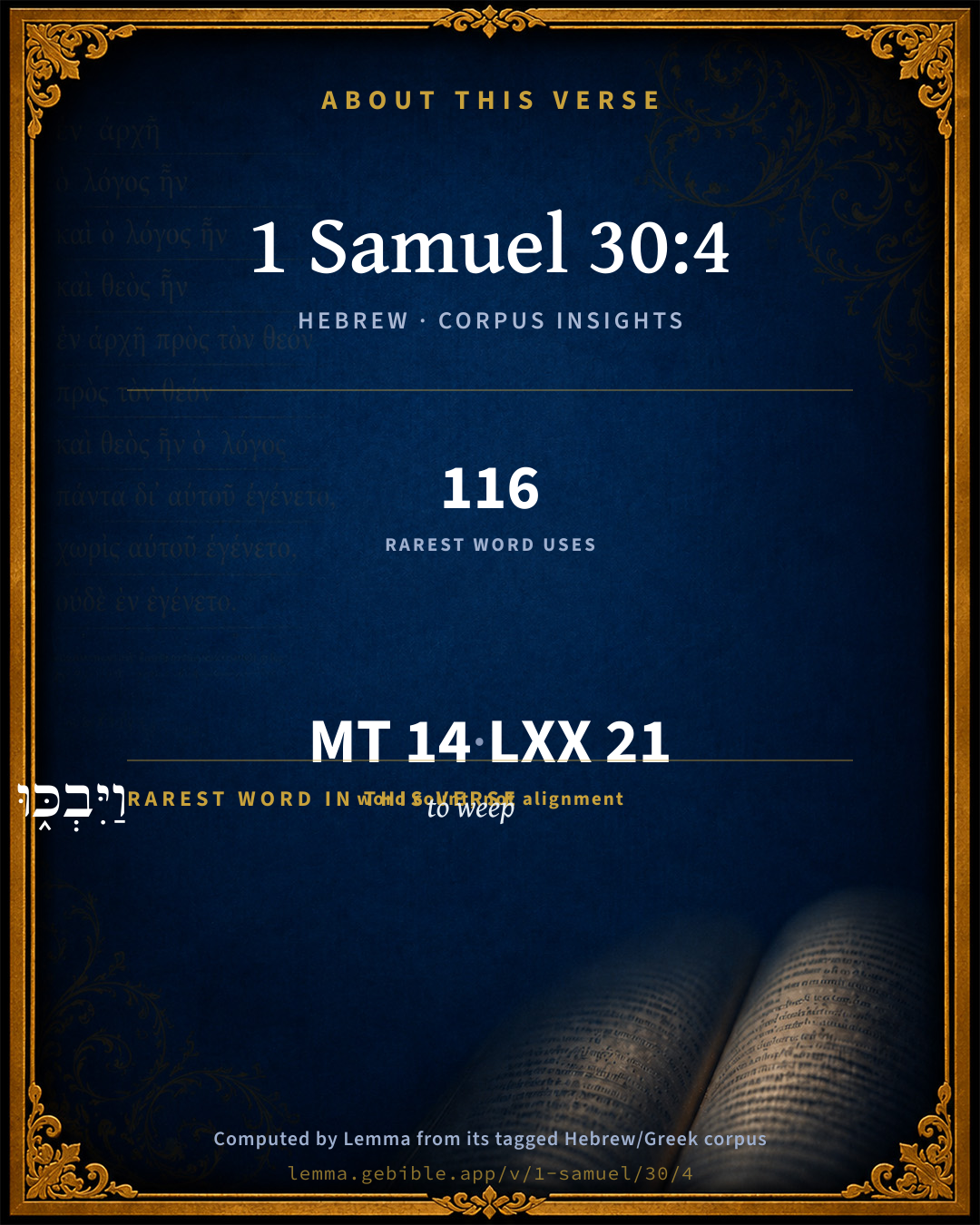
14
words
11
distinct lemmas
Historical
section

Grammatical profile

  • 3 verbs
  • 4 nouns
  • 3 prepositions
  • 4 particles

Verb forms

  • וַיִּשָּׂ֨א Qal · Sequential Imperfect
  • וַיִּבְכּ֑וּ Qal · Sequential Imperfect
  • לִבְכּֽוֹת Qal · Infinitive Construct

Repetition

Words recur within this verse — often emphatic in Hebrew:

  • וַיִּבְכּ֑וּ to weep H1058 ×2
  • אֲשֶׁר which H834 ×2

Hebrew & Septuagint length

In English translation the verse runs 23 words from the Hebrew and 22 from the Septuagint (LXX English) — closely comparable.

A rough comparison of the two English renderings, which tokenize alike — not a word-level alignment.

Word counts can differ between the Hebrew and the Greek without any difference in meaning — e.g. the Hebrew direct-object marker אֵת has no separate Greek word, and Greek often adds the article ὁ.

In the original languages it is 14 Hebrew tokens and 21 Greek tokens — but the two are counted differently (Hebrew bundles its prefixes and suffixes into one token; the Greek is in lemma form), so that isn’t a like-for-like length.

Cross-references

8

Topical passages linked to 1 Samuel 30:4 in the Treasury of Scripture Knowledge — connected by theme and wording, ordered by reader-vote popularity; previews shown in the World English Bible.

  • 1 Samuel 11:4 Then came the messengers to Gibeah of Saul, and spoke these words in the ears of the people: and all the people lifted up their voice, and wept.
  • Genesis 37:33–35 He recognized it, and said, "It is my son's coat. An evil animal has devoured him. Joseph is without doubt torn in pieces."
  • Numbers 14:1 All the congregation lifted up their voice, and cried; and the people wept that night.
  • Numbers 14:39 Moses told these words to all the children of Israel: and the people mourned greatly.
  • Judges 2:4 It happened, when the angel of Yahweh spoke these words to all the children of Israel, that the people lifted up their voice, and wept.
  • Judges 21:2 The people came to Bethel, and sat there until evening before God, and lifted up their voices, and wept sore.
  • 1 Samuel 4:13 When he came, behold, Eli was sitting on his seat by the road watching; for his heart trembled for the ark of God. When the man came into the city, and told it, all the city cried out.
  • Ezra 10:1 Now while Ezra prayed and made confession, weeping and casting himself down before the house of God, there was gathered together to him out of Israel a very great assembly of men and women and children; for the people wept very sore.

Cross-references courtesy of OpenBible.info (CC BY 4.0).

Hebrew and Greek witnesses Masoretic Hebrew ↔ Greek Septuagint

The same verse in the two great witnesses to the Old Testament, shown verse-for-verse.

These are two independent witnesses, not word-aligned to each other, and the Septuagint is shown in lemma (dictionary) form.

Hebrew 1 Samuel 30:4 Masoretic · Westminster Leningrad Codex

וַיִּשָּׂ֨א דָוִ֜ד וְהָעָ֧ם אֲשֶׁר אִתּ֛וֹ אֶת קוֹלָ֖ם וַיִּבְכּ֑וּ עַ֣ד אֲשֶׁ֧ר אֵין בָּהֶ֛ם כֹּ֖חַ לִבְכּֽוֹת

Then David and the people who were with him lifted up their voice and wept, until they had no more power to weep.

World English Bible · Public Domain

Greek LXX 1 Samuel 30:4 Septuagint · lemma form

καί αἴρω δαυίδ καί ὁ ἀνήρ αὐτός ὁ φωνή αὐτός καί κλαίω ἕως ὅστις οὐ εἰμί ἐν αὐτός ἰσχύς ἔτι κλαίω

And David and his men lifted up their voice, and wept till there was no longer any power within them to weep.

LXX2012 (modern English Septuagint) · Public Domain

Hebrew: Westminster Leningrad Codex (CC BY 4.0). Greek: Septuagint (public domain); English from LXX2012 (modern English Septuagint) (Public Domain). How the Septuagint differs from the Hebrew →

Targum (Aramaic paraphrase)

1

The Targum is the ancient Jewish Aramaic paraphrase of the Hebrew Scriptures — an interpretive translation, not the Hebrew text itself. Onkelos (literal) and Pseudo-Jonathan (expansive) render the Torah, and Jonathan the Prophets. Coverage is partial: where no permissively-licensed English translation exists for a verse, only the Aramaic is shown. This is verse-level text, not a word-by-word alignment to the Hebrew.

  1. Targum Jonathan Prophets (Joshua–Malachi)
    וַאֲרֵים דָוִד וְעַמָא דִי עִמֵיהּ יַת קַלְהוֹן וּבְכוֹ עַד דְלָא הֲוָה בְהוֹן חֵילָא לְמִבְכֵּי:

    (no public-domain English translation for this verse)

    Targum Jonathan — Aramaic: “Mikraot Gedolot” (public domain). English: “Sefaria Community Translation” (CC0 1.0 (public-domain dedication)); “London "Chaldee Paraphrase," 1871” (public domain). Text via Sefaria.

Commentary

Notes on 1 Samuel 30:4 from classic Christian and Jewish commentators (each source and its license shown beneath its notes). The classic Christian expositions comment on the surrounding passage and are grouped to its opening verse, so a note may address several verses; the Jewish commentaries on the Tanakh (Rashi and others) are per-verse, so they appear only where the commentator wrote on this verse.

Lemma curates 59 commentaries, every one of them public domain or Creative Commons licensed, each selected and text-cleaned for this edition rather than reprinted as found. About our sources →

Ellicott's Commentary for English Readers

(4) Then David and the people.—1Sa_30:1-4 form one period, which is expanded by the introduction of several circumstantial clauses. The apodosis to “it came to pass when,” &c., 1Sa_30:1, does not follow till 1Sa_30:4, “Then David and the people,” &c.; but this is formally attached to 1Sa_30:3. The statement, “So David and his men came,” with which the protasis commenced in 1Sa_30:1, is resumed in an altered form: “It came to pass, when David and his men were come to Ziklag . . . the Amalekites had invaded . . . and had taken away the women captive . . . and had gone their way . . . and David and his men came into the city, and behold, it was burned. . . . Then David and the people with him lifted up their voice.”—Keil.

A Bible Commentary for English Readers, edited by Charles John Ellicott (1878–1897) — public domain. Text from a community e-Sword module.

Trapp's Complete Commentary

John Trapp

1Sa 30:4 Then David and the people that [were] with him lifted up their voice and wept, until they had no more power to weep.

Ver. 4. Lifted up their voice, and wept.] Wept their utmost. They held not that stoical apathy, but testified their great grief for their sins and their sufferings by a flood of tears, which are called the blood of the soul.

“ Expletur lachrymis egeriturque dolor. ”

John Trapp, A Commentary or Exposition upon All the Books of the Old and New Testament (1647–1656) — public domain. Text from a community e-Sword module.

Joseph Benson's Commentary

1Sa 30:4. David and his people lift up their voice and wept — As was natural, they thus gave way to the first transports of their grief on this sad sight. “It is no disparagement,” says Henry, “to the boldest, bravest spirits to lament the calamities of friends or relations.”

Joseph Benson's Commentary on the Old and New Testaments (1811–1818) — public domain. Text from a community e-Sword module.

Adam Clarke's Commentary

Verse 4. Wept, until they had no more power to weep.] This marks great distress; they wept, as says the Vulgate, till their tears failed them.

Adam Clarke's Commentary on the Bible (1810–1826) — public domain. Text from a community e-Sword/MySword module.

The Cambridge Bible for Schools and Colleges

gen. ed. J. J. S. Perowne

4. wept] See on 1Sa_11:4.

The Cambridge Bible for Schools and Colleges (gen. ed. J. J. S. Perowne; Cambridge University Press, 1878–1918) — public domain. Text from a community e-Sword module.

John Gill's Exposition

Then David and the people that were with him lifted up their voice,.... In doleful shrieks, and loud lamentations:

and wept, until they had no more power to weep; till nature was quite exhausted, and no moisture left; so the Vulgate Latin version, "till tears failed in them"; they could shed no more.

John Gill's Exposition of the Whole Bible (1746–1763) — public domain (CC PDM 1.0). Text via the HelloAO Bible API.

Haydock's Catholic Bible Commentary

Tears. Hebrew, "till they had no more power to weep." (Menochius) --- See Lamentations ii. 11. Cicero exclaims, Hei mihi! consumptis enim lachrymis, infixus tamen hæret in corde dolor. (Phil. ii.)

George Leo Haydock (1774–1849), Haydock's Catholic Family Bible and Commentary, 1859 edition — public domain. Excludes Psalms (Douay-Rheims chapter numbering differs from Protestant) and Deuterocanonical books (Catholic canon only).

Matthew Poole's English Annotations

Till either the humour was wholly spent, or the consideration of their calamity had made them stupid.

Matthew Poole's English Annotations on the Holy Bible (1683–1685) — public domain. Text from a community e-Sword/MySword module.

John Wesley's Explanatory Notes

Wept - It is no disparagement to the boldest, bravest spirits, to lament the calamities of friends or relations.

John Wesley, Explanatory Notes Upon the Whole Bible (1754–1765) — public domain. Text via the GEBible commentary corpus.

Lesson kit

Teaching starters — assembled from the data on this page, not authored interpretation. Every prompt links to the verse data it draws on. Edit before teaching.

1 Samuel, in the Historical, opens this verse with 14 words (11 distinct Hebrew lemmas). Its most distinctive word is bâkâh (“to weep”). A historical commentator’s framing appears above. Read the whole chapter for the surrounding context.

Discussion questions

  1. How does “to weep” (bâkâh) shape what this verse is saying?
  2. How does 1 Samuel 11:4, which shares this passage’s theme, read alongside this verse?
  3. What does the repetition of “to weep” (2× in this one verse) do in this verse?
  4. These translations render this verse differently; the difference is in the English rendering, not the original. What questions does that raise?
  5. «וַיִּשָּׂ֨א» is a Qal Sequential Imperfect verb. How does that grammatical form shape the action described?
  6. Compare how Ellicott's Commentary for English Readers and Trapp's Complete Commentary read this verse. Where do they agree or differ?

Things to notice

Reading settings

Reading text

Shown beneath each verse's original-language words.

Old Testament
Old Testament edition

Read the OT as the Masoretic Hebrew (MT) or the Greek Septuagint (LXX).

English shown for the Greek Septuagint (in the Hebrew ↔ Greek comparison).

Comparing translations? Open the Compare panel on any verse page to stack up to four side by side.