
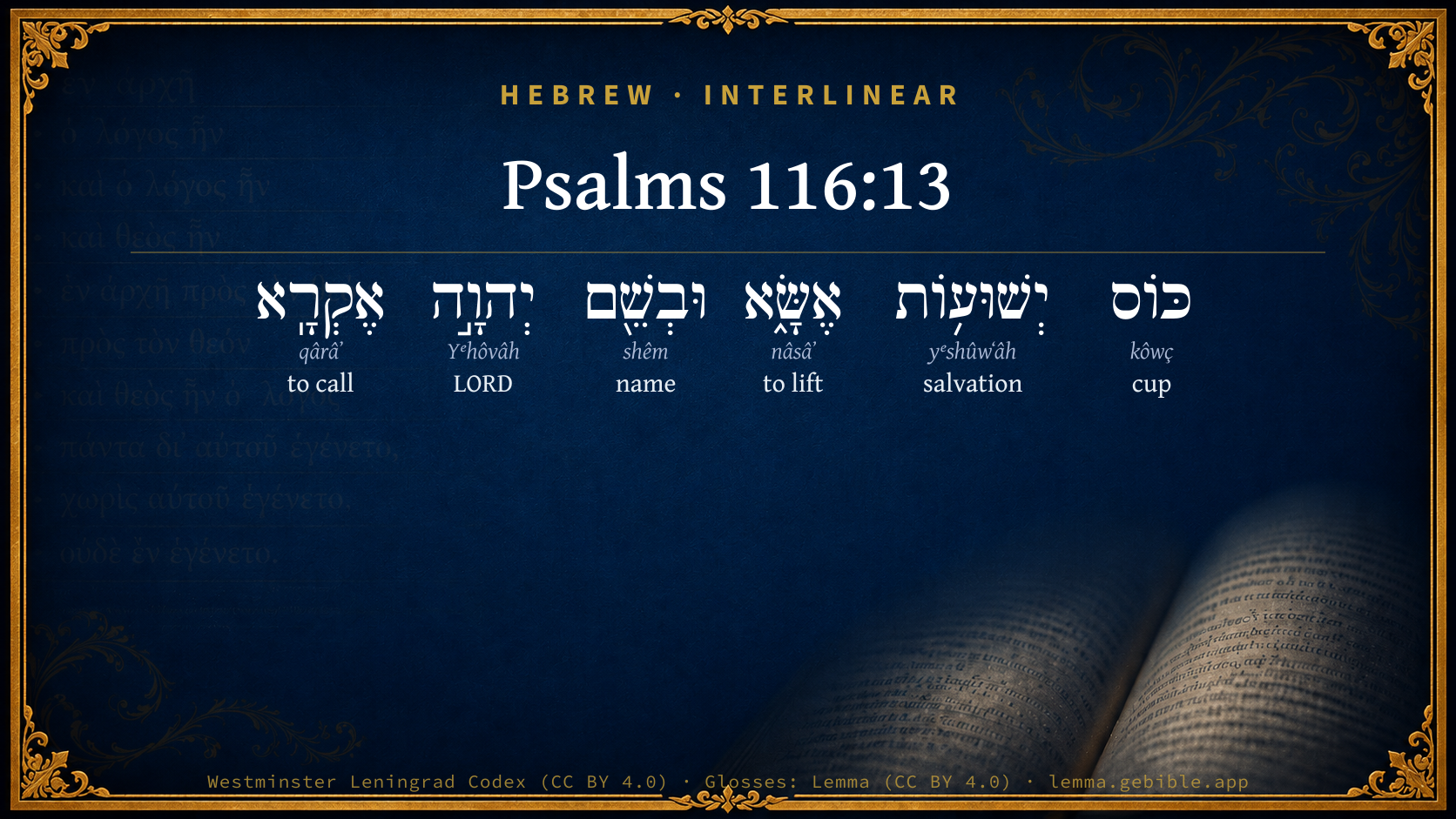
Psalms 116:13

Hebrew (Westminster Leningrad Codex) Psalms 116:13 appears in the Hebrew Old Testament. The text above is from the Westminster Leningrad Codex. Each word links to its Strong’s number, a concise gloss, and parsing drawn from the Open Scriptures Hebrew Bible morphology. Click any word for its full Brown-Driver-Briggs (BDB) entry.
Download image
Cite this verse

Psalms 116:13 (World English Bible). Public Domain. Lemma interlinear Bible study tool, https://lemma.gebible.app/v/psalms/116/13.

Show BibTeX & RIS
BibTeX
RIS
English Translation
I will take the cup of salvation, and call on the name of Yahweh.
World English Bible · Public Domain
Download a study sheet

One document with this verse’s original text, its word-by-word gloss line, the meaning frame, cross-references with their text, attributed commentary, and full source and license credits — printable, and it pastes into notes with its structure intact.

This verse Autodidact and up

Study sheet (.html) Plain text (.txt)

A passage Seminary Student

Up to 50 verses in one chapter. A passage sheet keeps up to 6 commentary sources and 12 cross-references per verse, in the order this page ranks them, and says so on the sheet whenever that leaves anything out. Ask for a single verse and you get the Autodidact verse sheet above.

Everything on this page stays free to read, with no account — the sheet is a download of what is already on screen, not access to it.

Want to remove ads? Support Godless Engineer
Compare translations 3

The same verse in 3 English versions, stacked beneath the original-language interlinear above. Click any original word for its lexicon entry.

Each is an independent rendering of the whole verse — the interlinear is not word-aligned to these translations.

Highlighted words mark where these versions differ — a whole-verse word diff, not a word-by-word alignment.

  • World English Bible Public Domain
    I will take the cup of salvation, and call on the name of Yahweh.
  • King James Version Public Domain
    I will take the cup of salvation, and call upon the name of the LORD.
  • unfoldingWord Literal Text CC BY-SA 4.0
    I will raise the cup of salvation, and call on the name of Yahweh.

unfoldingWord Literal Text — © unfoldingWord, licensed CC BY-SA 4.0. Word-aligned USFM3 via Door43 (git.door43.org/unfoldingWord/en_ult).

Versions to compare (up to 4)

3 of 4 selected

Show all 18 translations

Every available English version of this verse, each an independent rendering of the whole verse.

  • World English Bible Public Domain
    I will take the cup of salvation, and call on the name of Yahweh.
  • Berean Standard Bible Public Domain
    I will lift the cup of salvation and call on the name of the LORD.
  • Majority Standard Bible Public Domain
    I will lift the cup of salvation and call on the name of the LORD.
  • King James Version Public Domain
    I will take the cup of salvation, and call upon the name of the LORD.
  • American Standard Version (1901) Public Domain
    I will take the cup of salvation, And call upon the name of Jehovah.
  • Revised Version (1885) Public Domain
    I will take the cup of salvation, and call upon the name of the LORD.
  • Geneva Bible (1599) Public Domain
    I will take the cup of saluation, and call vpon the Name of the Lord.
  • Douay-Rheims (1899) Public Domain
    I will take the chalice of salvation; and I will call upon the name of the Lord.
  • Young's Literal Translation Public Domain
    The cup of salvation I lift up, And in the name of Jehovah I call.
  • Literal Standard Version CC BY-SA 4.0
    I lift up the cup of salvation, || And in the Name of YHWH I call.
  • Unlocked Literal Bible CC BY-SA 4.0
    I will raise the cup of salvation, and call on the name of Yahweh.
  • unfoldingWord Literal Text CC BY-SA 4.0
    I will raise the cup of salvation, and call on the name of Yahweh.
  • Darby Bible Public Domain
    I will take the cup of salvation, and call upon the name of Jehovah.
  • World Messianic Bible Public Domain
    I will take the cup of salvation, and call on the LORD’s name.
  • Webster's Bible Public Domain
    I will take the cup of salvation, and call upon the name of the LORD.
  • Free Bible Version CC BY-SA 4.0
    I will lift up the cup of salvation and worship the Lord.
  • Bible in Basic English Public Domain
    I will take the cup of salvation, and give praise to the name of the Lord.
  • JPS Tanakh (1917) Public Domain
    I will lift up the cup of salvation, and call upon the name of the LORD.

Literal Standard Version (2020), Covenant Press — licensed CC BY-SA 4.0. Text via the HelloAO Bible API (eBible.org). Unlocked Literal Bible (unfoldingWord) — licensed CC BY-SA 4.0. Text via the HelloAO Bible API (eBible.org). unfoldingWord Literal Text — © unfoldingWord, licensed CC BY-SA 4.0. Word-aligned USFM3 via Door43 (git.door43.org/unfoldingWord/en_ult). Free Bible Version, Dr. Jonathan Gallagher — licensed CC BY-SA 4.0. Text via the HelloAO Bible API (eBible.org).

Word by word

More ways to search: Search by grammar → Find every occurrence → Compare this word →

Practice this passage: Drill this verse → Learn its vocabulary →

About this verse

These counts appear in no published source. They are computed here, from the morphology-tagged text and Lemma’s own curated glosses. What Lemma adds →

6
words
6
distinct lemmas
Wisdom
section

Shared distinctive vocabulary

כּוֹס cup H3563 occurs in 29 verses of the Hebrew Bible. Also found in:

Grammatical profile

  • 2 verbs
  • 4 nouns

Verb forms

  • אֶשָּׂ֑א Qal · Imperfect
  • אֶקְרָֽא Qal · Imperfect

Hebrew & Septuagint length

In English translation the verse runs 14 words from the Hebrew and 12 from the Septuagint (LXX English) — closely comparable.

A rough comparison of the two English renderings, which tokenize alike — not a word-level alignment.

Word counts can differ between the Hebrew and the Greek without any difference in meaning — e.g. the Hebrew direct-object marker אֵת has no separate Greek word, and Greek often adds the article ὁ.

Cross-references

11

Topical passages linked to Psalms 116:13 in the Treasury of Scripture Knowledge — connected by theme and wording, ordered by reader-vote popularity; previews shown in the World English Bible.

  • Psalms 16:5 Yahweh assigned my portion and my cup. You made my lot secure.
  • Psalms 105:1 Give thanks to Yahweh! Call on his name! Make his doings known among the peoples.
  • Psalms 116:2 Because he has turned his ear to me, Therefore I will call on him as long as I live.
  • Psalms 80:18 So we will not turn away from you. Revive us, and we will call on your name.
  • 1 Corinthians 10:21 You can't both drink the cup of the Lord and the cup of demons. You can't both partake of the table of the Lord, and of the table of demons.
  • Psalms 116:17 I will offer to you the sacrifice of thanksgiving, And will call on the name of Yahweh.
  • Isaiah 12:4 In that day you will say, "Give thanks to Yahweh! Call on his name. Declare his doings among the peoples. Proclaim that his name is exalted!
  • Luke 22:20 Likewise, he took the cup after supper, saying, "This cup is the new covenant in my blood, which is poured out for you.
  • 1 Corinthians 10:16 The cup of blessing which we bless, isn't it a communion of the blood of Christ? The bread which we break, isn't it a communion of the body of Christ?
  • 1 Corinthians 11:25–27 In the same way he also took the cup, after supper, saying, "This cup is the new covenant in my blood. Do this, as often as you drink, in memory of me."
  • Luke 22:17–18 He received a cup, and when he had given thanks, he said, "Take this, and share it among yourselves,

Cross-references courtesy of OpenBible.info (CC BY 4.0).

Hebrew and Greek witnesses Masoretic Hebrew ↔ Greek Septuagint

The same verse in the two great witnesses to the Old Testament, shown verse-for-verse.

You’re reading Greek Psalm 114 (Hebrew Psalm 116). The Septuagint counts the superscription, so verse numbers can differ from the Hebrew — chapter-level alignment, not verse-by-verse. Numbering follows Rahlfs.

These are two independent witnesses, not word-aligned to each other, and the Septuagint is shown in lemma (dictionary) form.

Hebrew Psalms 116:13 Masoretic · Westminster Leningrad Codex

כּוֹס יְשׁוּע֥וֹת אֶשָּׂ֑א וּבְשֵׁ֖ם יְהוָ֣ה אֶקְרָֽא

I will take the cup of salvation, and call on the name of Yahweh.

World English Bible · Public Domain

Greek LXX Greek Psalm 114:13 Septuagint · lemma form
He has blessed them that fear the Lord, both small and great.

LXX2012 (modern English Septuagint) · Public Domain

Hebrew: Westminster Leningrad Codex (CC BY 4.0). Greek: Septuagint (public domain); English from LXX2012 (modern English Septuagint) (Public Domain). How the Septuagint differs from the Hebrew →

Commentary

Notes on Psalms 116:13 from classic Christian and Jewish commentators (each source and its license shown beneath its notes). The classic Christian expositions comment on the surrounding passage and are grouped to its opening verse, so a note may address several verses; the Jewish commentaries on the Tanakh (Rashi and others) are per-verse, so they appear only where the commentator wrote on this verse.

Lemma curates 59 commentaries, every one of them public domain or Creative Commons licensed, each selected and text-cleaned for this edition rather than reprinted as found. About our sources →

Trapp's Complete Commentary

John Trapp

Psa 116:13 I will take the cup of salvation, and call upon the name of the LORD.

Ver. 13. I will take the cup of salvation] Calicem salutum, vel omnis salutis (Vatab. Trem.). As in the drink offerings, or as at the feast after the peace offerings. See 1Ch 16:3. Wherein the feast maker was wont to take a festival great cup; and in lifting it up to declare the occasion of that feast; and then, in testimony of thankfulness, to drink thereof to the guests, that they in order might pledge him. This was called a cup of salvation, or a health cup, but not in the drunkard’s sense. To this the apostle seemeth to allude, 1Co 10:17, when he calleth the sacramental cup the cup of blessing. Jerome rendereth it, Calicem Iesu accipiam.

And call upon the name of the Lord] Pray unto him, and so praise him. Or, I will proclaim and preach his praises, as 1Pe 2:9.

John Trapp, A Commentary or Exposition upon All the Books of the Old and New Testament (1647–1656) — public domain. Text from a community e-Sword module.

J. A. Alexander on Psalms

Joseph Addison Alexander

13. (Psa 116:13) The cup of salvations I will take up, and on the name of Jehovah will call. This is commonly explained by a reference to the Jewish tradition of a cup of thanksgiving which accompanied or followed the thank- offerings. But we read of no such cup in Scripture, and its origin may probably be traced to the rabbinical interpretation of this very passage. Interpreted by Scriptural analogies, it simply means, I will accept the portion God allots me. For this figurative use of cup, see above, on Psa 11:6; Psa 16:5. The plural form, salvations, denotes fulness or completeness. Take up, as if from the table where the hand of God has placed it; or lift up, towards heaven as a gesture of acknowledgment.

Joseph Addison Alexander, The Psalms Translated and Explained (1850) — public domain. Text from a community e-Sword module.

Geneva Bible (1599)

Geneva Bible translators

In the Law they used to make a banquet when they gave solemn thanks to God, and to take the cup and drink in sign of thanksgiving.

Geneva Bible (1599) marginal notes — public domain. Text via Bolls.life.

Adam Clarke's Commentary

Verse 13. I will take the cup of salvation] Literally, The cup of salvation, or deliverance, will I lift up. Alluding to the action in taking the cup of blessing among the Jews, which, when the person or master of the family lifted up, he said these words, "Blessed be the Lord, the Maker of the world, who has created the fruit of the vine!"

But it may probably allude to the libation-offering, Nu 28:7; for the three last verses seem to intimate that the psalmist was now at the temple, offering the meat-offering, drink-offering, and sacrifices to the Lord. Cup is often used by the Hebrews to denote plenty or abundance. So, the cup of trembling, an abundance of misery; the cup of salvation, an abundance of happiness.

And call upon the name of the Lord.] I will invoke his name, that I may get more of the same blessings; for the only return that God requires is, that we ask for more. Who is like GOD? One reason why we should never more come to a fellow-mortal for a favour is, we have received so many already. A strong reason why we should claim the utmost salvation of God is, because we are already so much in debt to his mercy. Now this is the only way we have of discharging our debts to God; and yet, strange to tell, every such attempt to discharge the debt only serves to increase it! Yet, notwithstanding, the debtor and creditor are represented as both pleased, both profited, and both happy in each other! Reader, pray to him, invoke his name; receive the cup-accept the abundance of salvation which he has provided thee, that thou mayest love and serve him with a perfect heart.

Adam Clarke's Commentary on the Bible (1810–1826) — public domain. Text from a community e-Sword/MySword module.

John Calvin's Commentaries

13. The cup of salvation He refers to a custom which was prevalent under the Law. For when they rendered solemn thanks to God, a feast was also appointed, at which, in token of their gladness, there was an holy libation. This being a symbol of their deliverance from Egyptian thraldom, is for that reason here called the cup of salvation The term to call upon, signifies to celebrate the name of God; and this he expresses more plainly, subsequently, by saying that he would pay his vows in the assembly of the faithful, the sanctuary alone being the place where sacrifices could be offered. The amount is, that the faithful need not be greatly perplexed about the way of performing their duties, God not demanding from them a return which he knows they are unable to give, but being satisfied with a bare and simple acknowledgment. The proper return is to own our obligation to him for every thing. If God deal so kindly and mercifully with us, and we fail in giving to him the tribute of praise for our deliverance which he claims, then our supineness becomes the more base. And certainly they are unworthy of the enjoyment, I say not of the riches of the world, but of the light of the sun and the air by which we breathe and live, who would rob the Author of them of the small return which so legitimately belongs to him. The Mosaic ritual has indeed been abrogated, and along with it the external libation referred to by David, yet the spiritual service, as we found in Psalm 50:23, “The sacrifice of praise shall glorify me,” is still in force. Let us, however, bear in mind, that God is lawfully praised by us, when we offer in sacrifice not only our tongues, but also ourselves, and all that we possess. And this not because God derives any profit from it, but because it is reasonable that our gratitude should manifest itself in this way.

John Calvin's Commentaries (1540-1563) — public domain. Text from the Calvin Translation Society English edition (1840s-50s) via the Christian Classics Ethereal Library (ccel.org). Calvin's coverage is partial (roughly two-thirds of the Bible); uncommented books and verses are honest gaps, never fabricated. The 19th-century editor's footnotes and remarks are omitted so the notes are faithfully Calvin's own voice.

Ellicott's Commentary for English Readers

(13) I will take.—Or, lift up.

Cup of salvation.—The drink offering or oblation which accompanied festival celebrations (Num_29:19, &c). Others think of the Passover cup mentioned Mat_26:27, when this psalm as part of the Hallel was sung. Others, again, take the figurative sense of cup—i.e., portion, lot, as in Psa_16:5.

A Bible Commentary for English Readers, edited by Charles John Ellicott (1878–1897) — public domain. Text from a community e-Sword module.

The Cambridge Bible for Schools and Colleges

gen. ed. J. J. S. Perowne

13. the cup of salvation] Lit. salvations; the cup to be drunk as a part of the sacrifice of thanksgiving (Psa_116:14) for great and manifold deliverance. Cp. ‘the cup of blessing’ in the service of the Passover (Mat_26:27).

call upon] Rather, proclaim the name of Jehovah, acknowledging that to Him alone is my gratitude due.

The Cambridge Bible for Schools and Colleges (gen. ed. J. J. S. Perowne; Cambridge University Press, 1878–1918) — public domain. Text from a community e-Sword module.

John Gill's Exposition

I will pay my vows unto the Lord now, in the presence of all his people. Make good the resolutions and determinations he made in the strength of divine grace, in the time of his troubles; that should the Lord deliver him out of them, he would give him all the glory, and offer thanksgiving and praise to him; and now being delivered, this he declares he would do, in a public way, before all the people of God, assembled in the house of the Lord, as witnesses of it; see Psa 66:13.

.

Psalms 116:15

psa 116:15

psa 116:15

psa 116:15Precious in the sight of the Lord is the death of his saints. The Lord has his saints or sanctified ones, who are sanctified or set apart by God the Father from all eternity; who are sanctified in Christ, their head and representative; who are sanctified by his blood, shed for the expiation of their sins; who are sanctified by his Spirit and grace, are called with an holy calling, and have principles of holiness wrought in them, and live holy lives and conversations. The word (o) used also signifies one that has received kindness and favour, and shows it: saints are such, who have received spiritual blessings from the Lord; to whom he has been kind and bountiful; and these are merciful and beneficent to others. Now these die as well as others, though holy and righteous, and though Christ has died for them; he has indeed delivered them from death as a punishment, he has abolished it in this sense; and has freed them from the curse and sting of it, but not from that itself; because it is for their good, and it is precious in the sight of the Lord. Saints are precious to him, living and dying; there is something in their death, or that attends it, that is delightful to him, and of high esteem with him; as when they are in the full exercise of grace at such a season; when they die in faith, and have hope in their death; and their love is drawn out unto him, and they long to be with him: besides, they die in the Lord, and sleep in Jesus, in union with him; with whom he is well pleased, and all in him; and they die unto him, according to his will, and are resigned unto it; and so glorify him in death, as well as in life. It is the time of their ingathering to him; at death he comes into his garden, and gathers his flowers, and smells a sweet savour in them; their very dust is precious to him, which he takes care of and raises up at the last day. The commonly received sense of the words is, that the saints are so dear to the Lord, their lives are so much set by with him, and their blood so precious to him, that he will not easily suffer their lives to be taken away, or their blood to be spilled; and whenever it is, he will, sooner or later, severely revenge it; see Sa1 26:21. And to this sense is the Targum,

"precious before the Lord is death sent to (or inflicted on) his saints;''

that is, by men. The words will bear to be rendered, "precious in the sight of the Lord is that death", or "death itself, for his saints"; that very remarkable and observable death, even the death of his Son, which was not only for the good of his saints, for their redemption, salvation, justification, pardon, and eternal life; but in their room and stead; and which was very acceptable unto God, of high esteem with him, of a sweet smelling savour to him: not that he took pleasure in it, simply considered; for he that hath no pleasure in the death of him that dieth, even of a sinner, could have none in the death of his Son; but as hereby his justice was satisfied, his law fulfilled, the salvation of his people procured, and his covenant, counsels, purposes, and decrees, accomplished. has a double in it; one at the beginning, and the other at the end of the word; which is very emphatic, and so may point at something very remarkable; and what more so than the death of Christ? and is sometimes used for substitution, and signifies "for", "instead", or "in the room of", another; see Exo 4:16.

(o) "quos ipse benignitate prosequitur", Junius & Tremellius; so Musculus.

John Gill's Exposition of the Whole Bible (1746–1763) — public domain (CC PDM 1.0). Text via the HelloAO Bible API.

Albert Barnes' Notes on the Bible

I will take the cup of salvation - Compare the notes at Psa 11:6. The “cup of salvation” means the cup by which his sense of the greatness of the salvation might be expressed - the cup of thanksgiving. Compare the notes at 1Co 10:16. The reference seems to be to a custom in festivals of drinking a cup of wine as a special expression of thanks or of obligation. The act would be more solemn, and the truth more deeply impressed on the mind, when accompanied by some religious rite - some ceremonial, as in the Lord’s Supper, expressly designed to call the mercy of God to remembrance.

And call upon the name of the Lord - Engage in a solemn act of devotion; make it a matter of special ceremony or observance to call the mercy of God to remembrance. This was one way of rendering to the Lord a return for the benefits received at his hands; as it is now. Christians do this at the table of the Lord - in the observance of the Lord’s Supper.

Albert Barnes' Notes on the Bible (1834–1885) — public domain. Text from a community e-Sword/MySword module.

Matthew Poole's English Annotations

I will take the cup of salvation; I will offer the sacrifice of thanksgiving to God, as this phrase seems to be explained below, Psa 116:17, where the latter clause of the verse is the same with that which here follows. The phrase is taken from the common practice of the Jews in their thank-offerings, in which a feast was made of the remainders of the sacrifices, and the offerers, together with the priests, did eat and drink before the Lord, and, amongst other rites, the master of the feast took a cup of wine into his hand, and solemnly blessed God for it, and for the mercy which was then acknowledged, and then gave it to all the guests, who drunk successively of it; see 1Ch 16:2,3; to which custom it is supposed that our blessed Saviour alludes in the institution of the cup, which also is called the cup of blessing, 1Co 10:16, which is in effect the same with the cup of salvation. This metaphor of a cup is used both of afflictions, as Psa 11:6; 75:8, and of comforts, as Psa 23:5; Jer 16:7.

Call upon the name of the Lord; or, publish or preach in or of the name of the Lord, i.e. his gracious nature, and the great things which he hath done for me. For he speaks of praise rather than of prayer, as appears both from the former clause, and by comparing Psa 116:17.

Matthew Poole's English Annotations on the Holy Bible (1683–1685) — public domain. Text from a community e-Sword/MySword module.

The Treasury of David

Charles H. Spurgeon

Ver. 13. I will take the cup of salvation. "I will take" is a strange answer to the question, "What shall I render?" and yet it is the wisest reply that could possibly be given.

"The best return for one like me,

So wretched and so poor,

Is from his gifts to draw a plea

And ask him still for more."

To take the cup of salvation was in itself an act of worship, and it was accompanied with other forms of adoration, hence the Psalmist says,

and call upon the name of the LORD. He means that he will utter blessings and thanksgivings and prayers, and then drink of the cup which the Lord had filled with his saving grace. What a cup this is! Upon the table of infinite love stands the cup full of blessing; it is ours by faith to take it in our hand, make it our own, and partake of it, and then with joyful hearts to laud and magnify the gracious One who has filled it for our sakes that we may drink and be refreshed. We can do this figuratively at the sacramental table, we can do it spiritually every time we grasp the golden chalice of the covenant, realizing the fulness of blessing which it contains, and by faith receiving its divine contents into our inmost soul. Beloved reader, let us pause here and take a long and deep draught from the cup which Jesus filled, and then with devout hearts let us worship God.

Ver. 13. I will take the cup of salvation. It may probably allude to the libation offering, Nu 28:7; for the three last verses seem to intimate that the Psalmist was now at the temple, offering the meat offering, drink offering, and sacrifices to the Lord. "Cup" is often used by the Hebrews to denote plenty or abundance. So, "the cup of trembling, "an abundance of misery; "the cup of salvation, "an abundance of happiness. Adam Clarke.

Ver. 13. Cup of salvation. In holy Scripture there is mention made of drink offerings, Ge 25:14 Le 23:13 Nu 15:5; which were a certain quantity of wine that used to be poured out before the Lord; as the very notation of the word imports, coming from a root dmg, effudit, that signifieth to pour out. As the meat offerings, so the drink offerings, were brought to the Lord in way of gratulation and thanksgiving. Some therefore in allusion hereunto so expound the text, as a promise and vow of the Psalmist, to testify his public gratitude by such an external and solemn rite as in the law was prescribed. This he terms a cup, because that drink offering was contained in a cup and poured out thereof; and he adds this epithet, "salvation, "because that rite was an acknowledgment of salvation, preservation and deliverance from the Lord.

After their solemn gratulatory sacrifices they were wont to have a feast. When David had brought the ark of God into the tabernacle, they offered burnt offerings and peace offerings, which being finished, "he dealt to every one of Israel, both man and woman, to every one a loaf of bread, and a good piece of flesh, and a flagon of wine." 1Ch 16:8. Hereby is implied that he made so beautiful a feast, as he had to give thereof to all the people there assembled. In this feast the master thereof was wont to take a great cup, and in lifting it up to declare the occasion of that feast, and then in testimony of thankfulness to drink thereof to the guests, that they in order might pledge him. This was called a cup of salvation, or deliverance, because they acknowledged by the use thereof that God had saved and delivered them. Almost in a like sense the apostle styles the sacramental cup, the cup of blessing. Here the prophet useth the plural number, thus, "cup of salvations, "whereby, after the Hebrew elegancy, he meaneth many deliverances, one after another; or some great and extraordinary deliverance which was instead of many, or which comprised many under it. The word translated take (ava a avg) properly signifieth to lift up, and in that respect may the more fitly be applied to the aforementioned taking of the festival cup and lifting it up before the guests. Most of our later expositors of this Psalm apply this phrase, "I will take the cup of salvation, "to the forenamed gratulatory drink offering, or to the taking and lifting up of the cup of blessing in the feast, after the solemn sacrifice. Both of these import one and the same thing, which is, that saints of old were wont to testify their gratefulness for great deliverances with some outward solemn rite. William Gouge.

Ver. 13. Cup of salvation. Yeshuoth: Ps 18:50 28:8 53:6. The cup of salvation, symbolized by the eucharistic cup of the Passover Supper. Zion that had drunk of the "cup of trembling" (Isa 51:17, 22) might now rise and drink of the cup of salvation.

To the church these words have had a yet deeper significance added to them by Mt 26:27. Jesus, on that Passover night, drank of the bitter wine of God's wrath, that he might refill the cup with joy and health for his people. William Kay.

Ver. 13-14, 17-19. A fit mode of expressing our thanks to God is by solemn acts of worship, secret, social, and public. "The closet will be the first place where the heart will delight in pouring forth its lively joys; thence the feeling will extend to the family altar: and thence again it will proceed to the sanctuary of the Most High." (J. Morison). To every man God has sent a large supply of benefits, and nothing but perverseness can deny to him the praise of our lips. William, S. Plumer.

Ver. 13. Sermon on the Lord's supper. We take the cup of the Lord

1. In memory of him who is our salvation.

2. In token of our trust in him.

3. In evidence of our obedience to him.

4. In type of communion with him.

5. In hope of drinking it new with him ere long.

Ver. 13. The various cups mentioned in Scripture would make an interesting subject.

Psalms 116:14*

Charles H. Spurgeon's The Treasury of David (1869–1885) — public domain. Psalms only. Text from a community e-Sword/MySword module.

Whedon's Commentary on the Bible

Daniel D. Whedon

13. Cup of salvation—The special dispensations, or allotments, of God to men, whether of joy or sorrow, mercy or judgment, are represented often under the figure of a cup, the contents of which they are to drink. Thus, of good, Psa_16:5; Psa_23:5; Jer_16:7 : of wrath, Psa_11:6; Psa_75:8; Jer_25:15; Jer_25:17; Jer_25:28; Eze_23:31-33. But the allusion here would seem to be to the cup of libation, or drink-offering, which was ordinarily wine, and used in the daily sacrifice and in burnt offerings to indicate devotion to God in form of a covenant. Thus blood, the emblem of life, and wine, representing richness and acceptableness—the former for expiation and the latter for thanksgiving—made the offering complete.

Daniel D. Whedon (gen. ed.), Commentary on the Old and New Testaments (1874–1909) — public domain. Text from a community e-Sword module.

The Pulpit Commentary

I will take the cup of salvation. It has been usual to explain this of actual participation in the contents of a cup offered at a sacrificial meal, and then passed round to the worshippers. But there is no clear evidence of any such usage, except in connection with the Passover, which cannot here be in question. Hengstenberg there fore proposes to regard the phrase as a mere metaphor, like the "cup of trembling", (Isa_51:17, Isa_51:22) and understands the psalmist to mean that he will gladly and thankfully receive God"s mercy vouchsafed to him, and thus show his gratitude for it. And call upon the Name of the Lord (comp. vers. 4 and 17).

Vers. 13, 14. The answer of the grateful heart.

That answer is threefold.

I HE WILL ACCEPT GOD"S SALVATION. This the meaning of the words, "I will take the cup of salvation." God has designed salvation for each one of us; he puts it before us as the master of a feast was wont to hand the cup to each guest. And the grateful heart here says, "I will take thy salvation, O Lord, the pardon which is in Christ, the sanctification of the Holy Spirit, and eternal life." No worship or service is pleasing to God until this is done.

II HE WILL CALL UPON THE NAME OF THE LORD. Thus, by fervent prayer, will he keep in communion with God, and look to him day by day for all needed grace.

III HE WILL OPENLY ACKNOWLEDGE GOD. "I will pay my vows," etc. What has gone before has been transacted between God and the soul; this should be before all men. If there be these three things, all holy obedience will follow; there will be the consecrated life. S.C.

The only return God looks for.

"I will take the cup of salvation." Visiting Muller"s Orphan House at Ashley Down, Bristol, some years ago, we were shown into a room where, ranged on a gallery, were some seventy or eighty infant orphans of from three to five years of age, fatherless, if not motherless too. They sang to us a little hymn, and the pathetic refrain of it, as sung by those infant voices, we hear still in our souls"What shall we render, O heavenly Friend, to thee, For care so tender, for love so free?

It is the feeling of all pious souls, the ever-growing feeling of the deepening experience, that no fitting return can be made to God, and that the only possible return we can make is to let him do all his work of grace in us to take his "cup of salvation." We know how, sometimes, in the ordinary associations of life, the gifts of our friends altogether overwhelm us. We cannot keep pace with them in returning their gifts. At last we give up attempting to do so, and just let them spend their love on us as they will. This may help us to understand the psalmist"s feeling concerning God. Possibly there is a reference to the "cup of blessing" in the observance of the Pass over, which may have been introduced after the Exile; but it is better to regard it simply as a poetical figure, and as meaning, "I will accept thankfully and with devout acknowledgment the blessings which God gives me as my portion." The Christian can flu the term "salvation" with higher and holier meanings.

I THE HOPELESSNESS OF FINDING ANY WAY OF RETURNING GOD"S GOODNESS. Because he wants nothing of us. When we would return a gift, how anxiously we try to find out what our friend wants I But it is hopeless to think of finding out any thing that God wants. Illust. by the reproachful plea through the psalmist (Psalm 1), "Every beast of the forest is mine, and the cattle upon a thousand hills. If I were hungry, I would not tell thee: for the world is mine, and the fullness thereof." And because we could find nothing that he wanted, if he did want. Things are not in our possession or control. How can we give when we have nothing? And all the things we seem to have are his.

II THE HOPEFULNESS OF RESPONDING TO GOD"S WAY FOR OUR RECOGNIZING HIS GOODNESS. What he asks of us is to let him bless us to be willing recipients of his benedictions, to take his cup of salvation; he wants not things, but thanks; not gifts but love; not offerings, but praise. "Offer unto God the sacrifice of thanksgiving." That we can do. R.T.

The Pulpit Commentary (1880–1919), ed. H.D.M. Spence-Jones & Joseph S. Exell — public domain. Text from a community e-Sword module.

Rashi

Rabbi Shlomo Yitzchaki (Rashi)

I shall lift up a cup of salvations I shall bring the libations for the thanksgiving offerings that I vowed, as he says, “To You I shall slaughter a thanksgiving offering,” and on that cup I shall call out about this salvation, for the Levite does not recite a song unless over the wine [libations].

Rashi on the Tanakh — English translations: “The Judaica Press complete Tanach with Rashi, translated by A. J. Rosenberg” (CC BY 4.0); “Pentateuch with Rashi's commentary by M. Rosenbaum and A.M. Silbermann, 1929-1934” (public domain); “The Metsudah Tanach series, Lakewood, N.J” (CC BY 4.0); and “The Book of Joshua, Metsudah Publications, 1997” (CC BY 4.0). Text via Sefaria.

Lesson kit

Teaching starters — assembled from the data on this page, not authored interpretation. Every prompt links to the verse data it draws on. Edit before teaching.

Psalms, in the Wisdom, opens this verse with 6 words (6 distinct Hebrew lemmas). Its most distinctive word is kôwç (“cup”). A historical commentator’s framing appears above. Read the whole chapter for the surrounding context.

Discussion questions

  1. How does “cup” (kôwç) shape what this verse is saying?
  2. Genesis 40:11 shares the word «cup» with this verse. How do the two illuminate each other?
  3. These translations render this verse differently; the difference is in the English rendering, not the original. What questions does that raise?
  4. The verb «אֶשָּׂ֑א» is Qal Imperfect. How does its form color the action?
  5. Reading how Trapp's Complete Commentary and J. A. Alexander on Psalms read this verse, where do the two commentators agree and where do they part?

Things to notice

Reading settings

Reading text

Shown beneath each verse's original-language words.

Old Testament
Old Testament edition

Read the OT as the Masoretic Hebrew (MT) or the Greek Septuagint (LXX).

English shown for the Greek Septuagint (in the Hebrew ↔ Greek comparison).

Comparing translations? Open the Compare panel on any verse page to stack up to four side by side.