Psalms 16:4

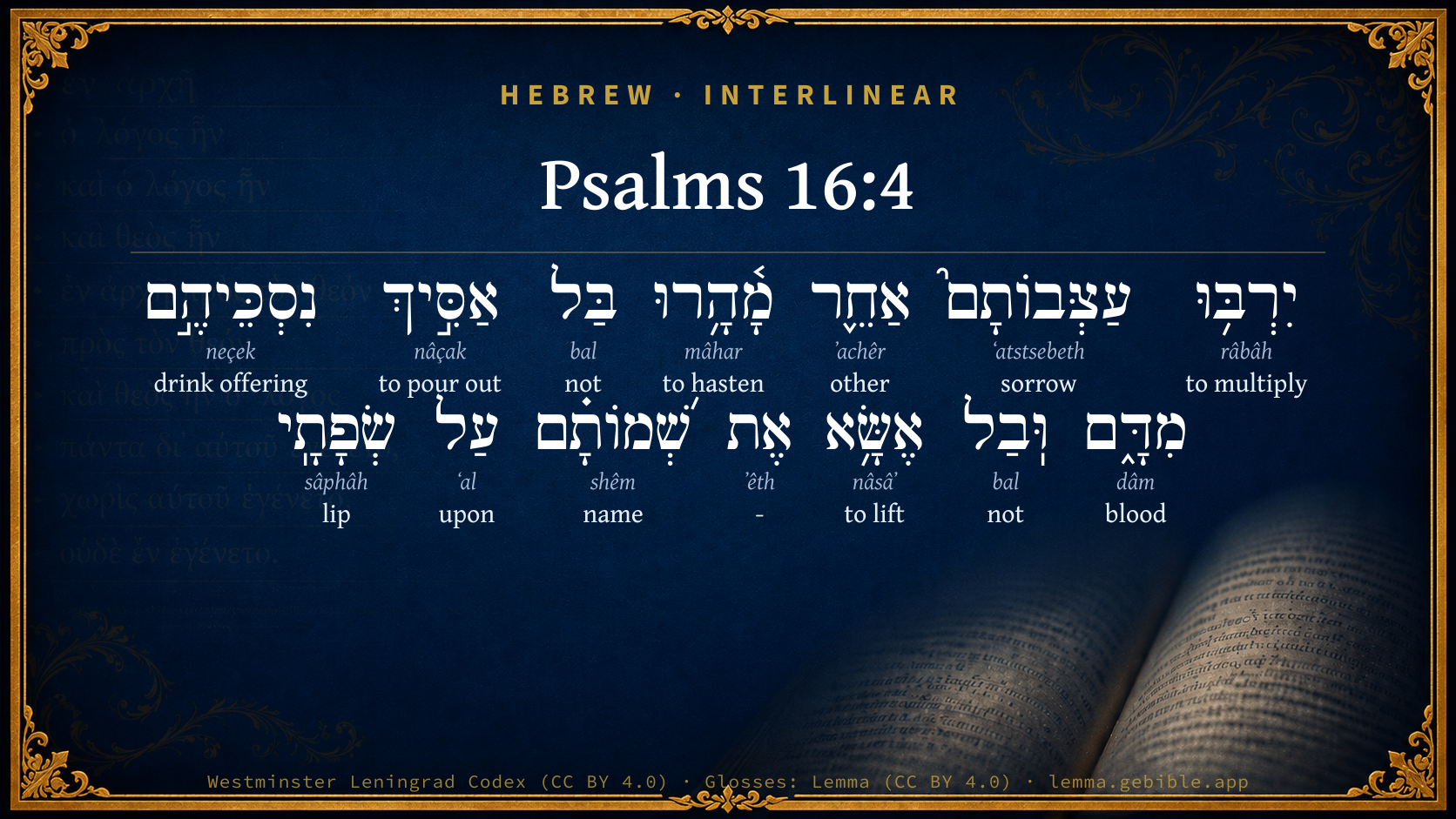
Hebrew (Westminster Leningrad Codex) Psalms 16:4 appears in the Hebrew Old Testament. The text above is from the Westminster Leningrad Codex. Each word links to its Strong’s number, a concise gloss, and parsing drawn from the Open Scriptures Hebrew Bible morphology. Click any word for its full Brown-Driver-Briggs (BDB) entry.
Download image
Cite this verse

Psalms 16:4 (World English Bible). Public Domain. Lemma interlinear Bible study tool, https://lemma.gebible.app/v/psalms/16/4.

Show BibTeX & RIS
BibTeX
RIS
English Translation
Their sorrows shall be multiplied who give gifts to another god. Their drink-offerings of blood I will not offer, Nor take their names on my lips.
World English Bible · Public Domain
Download a study sheet

One document with this verse’s original text, its word-by-word gloss line, the meaning frame, cross-references with their text, attributed commentary, and full source and license credits — printable, and it pastes into notes with its structure intact.

This verse Autodidact and up

Study sheet (.html) Plain text (.txt)

A passage Seminary Student

Up to 50 verses in one chapter. A passage sheet keeps up to 6 commentary sources and 12 cross-references per verse, in the order this page ranks them, and says so on the sheet whenever that leaves anything out. Ask for a single verse and you get the Autodidact verse sheet above.

Everything on this page stays free to read, with no account — the sheet is a download of what is already on screen, not access to it.

Want to remove ads? Support Godless Engineer
Compare translations 3

The same verse in 3 English versions, stacked beneath the original-language interlinear above. Click any original word for its lexicon entry.

Each is an independent rendering of the whole verse — the interlinear is not word-aligned to these translations.

Highlighted words mark where these versions differ — a whole-verse word diff, not a word-by-word alignment.

  • World English Bible Public Domain
    Their sorrows shall be multiplied who give gifts to another god. Their drink-offerings of blood I will not offer, Nor take their names on my lips.
  • King James Version Public Domain
    Their sorrows shall be multiplied that hasten after another god: their drink offerings of blood will I not offer, nor take up their names into my lips.
  • unfoldingWord Literal Text CC BY-SA 4.0
    Their sorrows will be multiplied, they hasten another. I will not pour out their drink offerings from blood, and I will not take up their names on my lips.

unfoldingWord Literal Text — © unfoldingWord, licensed CC BY-SA 4.0. Word-aligned USFM3 via Door43 (git.door43.org/unfoldingWord/en_ult).

Versions to compare (up to 4)

3 of 4 selected

Show all 18 translations

Every available English version of this verse, each an independent rendering of the whole verse.

  • World English Bible Public Domain
    Their sorrows shall be multiplied who give gifts to another god. Their drink-offerings of blood I will not offer, Nor take their names on my lips.
  • Berean Standard Bible Public Domain
    Sorrows will multiply to those who chase other gods. I will not pour out their libations of blood, or speak their names with my lips.
  • Majority Standard Bible Public Domain
    Sorrows will multiply to those who chase other gods. I will not pour out their libations of blood, or speak their names with my lips.
  • King James Version Public Domain
    Their sorrows shall be multiplied that hasten after another god: their drink offerings of blood will I not offer, nor take up their names into my lips.
  • American Standard Version (1901) Public Domain
    Their sorrows shall be multiplied that give gifts for another `god': Their drink-offerings of blood will I not offer, Nor take their names upon my lips.
  • Revised Version (1885) Public Domain
    Their sorrows shall be multiplied that exchange the LORD for another god: their drink offerings of blood will I not offer, nor take their names upon my lips.
  • Geneva Bible (1599) Public Domain
    The sorowes of them, that offer to an other god, shall be multiplied: their offerings of blood will I not offer, neither make mention of their names with my lips.
  • Douay-Rheims (1899) Public Domain
    Their infirmities were multiplied: afterwards they made haste. I will not gather together their meetings for blood offerings: nor will I be mindful of their names by my lips.
  • Young's Literal Translation Public Domain
    Multiplied are their griefs, `Who' have hastened backward; I pour not out their libations of blood, Nor do I take up their names on my lips.
  • Literal Standard Version CC BY-SA 4.0
    Their griefs are multiplied, [who] have hurried backward; I do not pour out their drink-offerings of blood, || Nor do I take up their names on my lips.
  • Unlocked Literal Bible CC BY-SA 4.0
    Their troubles will be increased, those who seek out other gods. I will not pour out drink offerings of blood to their gods or lift up their names with my lips.
  • unfoldingWord Literal Text CC BY-SA 4.0
    Their sorrows will be multiplied, they hasten another. I will not pour out their drink offerings from blood, and I will not take up their names on my lips.
  • Darby Bible Public Domain
    Their sorrows shall be multiplied that hasten after another: their drink-offerings of blood will I not offer, and I will not take up their names into my lips.
  • World Messianic Bible Public Domain
    Their sorrows shall be multiplied who give gifts to another god. Their drink offerings of blood I will not offer, nor take their names on my lips.
  • Webster's Bible Public Domain
    Their sorrows shall be multiplied that hasten after another god: their drink-offerings of blood will I not offer, nor take their names into my lips.
  • Free Bible Version CC BY-SA 4.0
    Those who run after other gods will face a lot of trouble. I will not participate in their offerings of blood, I will not even speak the names of their gods.
  • Bible in Basic English Public Domain
    Their sorrows will be increased who go after another god: I will not take drink offerings from their hands, or take their names on my lips.
  • JPS Tanakh (1917) Public Domain
    Let the idols of them be multiplied that make suit unto another; their drink-offerings of blood will I not offer, nor take their names upon my lips.

Literal Standard Version (2020), Covenant Press — licensed CC BY-SA 4.0. Text via the HelloAO Bible API (eBible.org). Unlocked Literal Bible (unfoldingWord) — licensed CC BY-SA 4.0. Text via the HelloAO Bible API (eBible.org). unfoldingWord Literal Text — © unfoldingWord, licensed CC BY-SA 4.0. Word-aligned USFM3 via Door43 (git.door43.org/unfoldingWord/en_ult). Free Bible Version, Dr. Jonathan Gallagher — licensed CC BY-SA 4.0. Text via the HelloAO Bible API (eBible.org).

Word by word

More ways to search: Search by grammar → Find every occurrence → Compare this word →

Practice this passage: Drill this verse → Learn its vocabulary →

עַצְּבוֹתָם֮
ʻatstsebeth
H6094
“sorrows · their”
Noun, Common, Feminine, Plural, Construct + Suffix, Personal, 3rd Person, Masculine, Plural
Part of Speech
Noun
Type
Common
Gender
Feminine
Number
Plural
State
Construct
Full BDB Definition

Origin: from H6087

TWOT: 1666d

pain, hurt, injury, sorrow, wound
  1. יִרְבּ֥וּ râbâh H7235 “to multiply” Verb, Qal, Imperfect, 3rd Person, Masculine, Plural
  2. אַחֵ֪ר ʼachêr H312 “other” Adjective, Adjective, Masculine, Singular, Absolute
  3. מָ֫הָ֥רוּ mâhar H4116 “to hasten” Verb, Qal, Perfect, 3rd Person, Common, Plural
  4. בַּל bal H1077 “not” Particle, Negative
  5. אַסִּ֣יךְ nâçak H5258 “to pour out” Verb, Hiphil, Imperfect, 1st Person, Common, Singular
  6. נִסְכֵּיהֶ֣ם neçek H5262 “drink offerings · their” Noun, Common, Masculine, Plural, Construct + Suffix, Personal, 3rd Person, Masculine, Plural
  7. מִדָּ֑ם dâm H1818 “from · blood” Preposition + Noun, Common, Masculine, Singular, Absolute
  8. וּֽבַל bal H1077 “and · not” Conjunction + Particle, Negative
  9. אֶשָּׂ֥א nâsâʼ H5375 “to lift” Verb, Qal, Imperfect, 1st Person, Common, Singular
  10. אֶת ʼêth H853 “-” Particle, Direct Object
  11. שְׁ֝מוֹתָ֗ם shêm H8034 “names · their” Noun, Common, Masculine, Plural, Construct + Suffix, Personal, 3rd Person, Masculine, Plural
  12. עַל ʻal H5921 “upon” Preposition
  13. שְׂפָתָֽי sâphâh H8193 “lips · my” Noun, Common, Feminine, Dual, Construct + Suffix, Personal, 1st Person, Common, Singular

About this verse

These counts appear in no published source. They are computed here, from the morphology-tagged text and Lemma’s own curated glosses. What Lemma adds →

14
words
13
distinct lemmas
Wisdom
section

Notable vocabulary

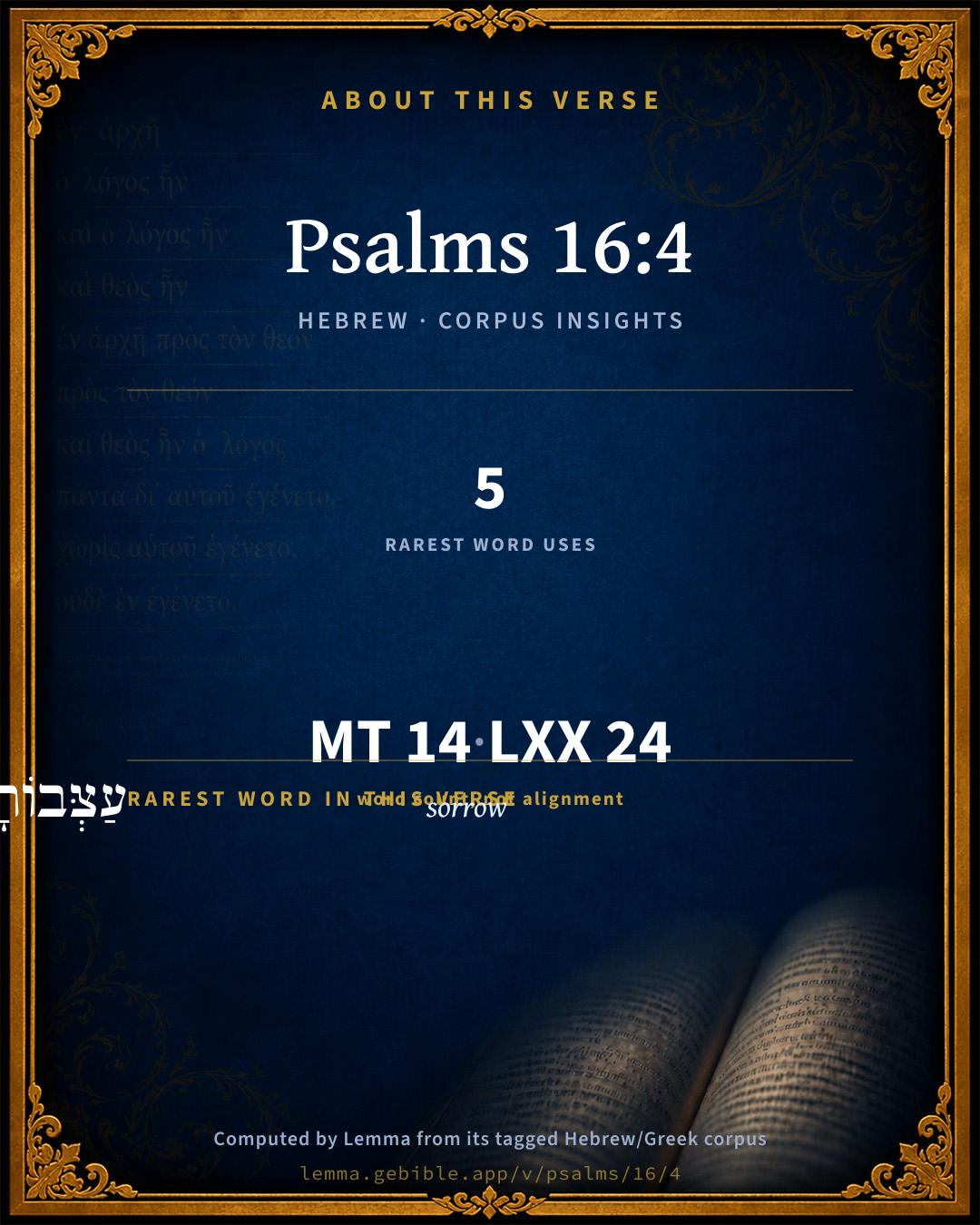
The rarest word here is עַצְּבוֹתָם֮ sorrow H6094 — appearing just 5 times in the whole Hebrew Bible.

Shared distinctive vocabulary

עַצְּבוֹתָם֮ sorrow H6094 occurs in 5 verses of the Hebrew Bible. Also found in:

Grammatical profile

  • 4 verbs
  • 5 nouns
  • 1 adjective
  • 1 preposition
  • 3 particles

Verb forms

  • יִרְבּ֥וּ Qal · Imperfect
  • מָ֫הָ֥רוּ Qal · Perfect
  • אַסִּ֣יךְ Hiphil · Imperfect
  • אֶשָּׂ֥א Qal · Imperfect

Repetition

A word recurs within this verse — often emphatic in Hebrew:

Hebrew & Septuagint length

In English translation the verse runs 26 words from the Hebrew and 28 from the Septuagint (LXX English) — closely comparable.

A rough comparison of the two English renderings, which tokenize alike — not a word-level alignment.

Word counts can differ between the Hebrew and the Greek without any difference in meaning — e.g. the Hebrew direct-object marker אֵת has no separate Greek word, and Greek often adds the article ὁ.

In the original languages it is 14 Hebrew tokens and 24 Greek tokens — but the two are counted differently (Hebrew bundles its prefixes and suffixes into one token; the Greek is in lemma form), so that isn’t a like-for-like length.

Cross-references

15

Topical passages linked to Psalms 16:4 in the Treasury of Scripture Knowledge — connected by theme and wording, ordered by reader-vote popularity; previews shown in the World English Bible.

  • Exodus 23:13 "Be careful to do all things that I have said to you; and don't invoke the name of other gods, neither let them be heard out of your mouth.
  • Joshua 23:7 that you not come among these nations, these that remain among you; neither make mention of the name of their gods, nor cause to swear [by them], neither serve them, nor bow down yourselves to them;
  • Psalms 32:10 Many sorrows shall be to the wicked, But he who trusts in Yahweh, loving kindness shall surround him.
  • Psalms 97:7 Let all them be shamed who serve engraved images, Who boast in their idols. Worship him, all you gods!
  • Jonah 2:8 Those who regard lying vanities forsake their own mercy.
  • Isaiah 57:6 Among the smooth [stones] of the valley is your portion; they, they are your lot; even to them have you poured a drink-offering, you have offered an offering. Shall I be appeased for these things?
  • Psalms 106:37–38 Yes, they sacrificed their sons and their daughters to demons.
  • Genesis 35:14 Jacob set up a pillar in the place where he spoke with him, a pillar of stone. He poured out a drink-offering on it, and poured oil on it.
  • Leviticus 23:13 The meal offering with it shall be two tenth parts of an ephah of fine flour mingled with oil, an offering made by fire to Yahweh for a sweet savor; and the drink offering with it shall be of wine, the fourth part of a hin.
  • Isaiah 65:11 But you who forsake Yahweh, who forget my holy mountain, who prepare a table for Fortune, and who fill up mixed wine to Destiny;
  • Isaiah 66:3 He who kills an ox is as he who kills a man; he who sacrifices a lamb, as he who breaks a dog's neck; he who offers an offering, [as he who offers] pig's blood; he who burns frankincense, as he who blesses an idol. Yes, they have chosen their own ways, and their soul delights in their abominations:
  • Jeremiah 7:18 The children gather wood, and the fathers kindle the fire, and the women knead the dough, to make cakes to the queen of the sky, and to pour out drink-offerings to other gods, that they may provoke me to anger.
  • Hosea 2:16–17 It will be in that day," says Yahweh, "That you will call me 'my husband,' And no longer call me 'my master.'
  • Revelation 18:4–5 I heard another voice from heaven, saying, "Come out of her, my people, that you have no participation in her sins, and that you don't receive of her plagues,
  • Revelation 14:9–11 Another angel, a third, followed them, saying with a great voice, "If anyone worships the beast and his image, and receives a mark on his forehead, or on his hand,

Cross-references courtesy of OpenBible.info (CC BY 4.0).

Hebrew and Greek witnesses Masoretic Hebrew ↔ Greek Septuagint

The same verse in the two great witnesses to the Old Testament, shown verse-for-verse.

You’re reading Greek Psalm 15 (Hebrew Psalm 16). The Septuagint counts the superscription, so verse numbers can differ from the Hebrew — chapter-level alignment, not verse-by-verse. Numbering follows Rahlfs.

These are two independent witnesses, not word-aligned to each other, and the Septuagint is shown in lemma (dictionary) form.

Hebrew Psalms 16:4 Masoretic · Westminster Leningrad Codex

יִרְבּ֥וּ עַצְּבוֹתָם֮ אַחֵ֪ר מָ֫הָ֥רוּ בַּל אַסִּ֣יךְ נִסְכֵּיהֶ֣ם מִדָּ֑ם וּֽבַל אֶשָּׂ֥א אֶת שְׁ֝מוֹתָ֗ם עַל שְׂפָתָֽי

Their sorrows shall be multiplied who give gifts to another god. Their drink-offerings of blood I will not offer, Nor take their names on my lips.

World English Bible · Public Domain

Greek LXX Greek Psalm 15:4 Septuagint · lemma form

πληθύνω ὁ ἀσθένεια αὐτός μετά οὗτος ταχύνω οὐ μή συνἄγω ὁ συναγωγή αὐτός ἐκ αἷμα οὐδέ μή μιμνήσκω ὁ ὄνομα αὐτός διά χεῖλος ἐγώ

Their weaknesses have been multiplied; afterward they hasted. I will by no means assemble their bloody meetings, neither will I make mention of their names with my lips.

LXX2012 (modern English Septuagint) · Public Domain

On this verse, Keil & Delitzsch discusses the Septuagint’s reading. Read the note in Commentary ↓

Hebrew: Westminster Leningrad Codex (CC BY 4.0). Greek: Septuagint (public domain); English from LXX2012 (modern English Septuagint) (Public Domain). How the Septuagint differs from the Hebrew →

Commentary

Notes on Psalms 16:4 from classic Christian and Jewish commentators (each source and its license shown beneath its notes). The classic Christian expositions comment on the surrounding passage and are grouped to its opening verse, so a note may address several verses; the Jewish commentaries on the Tanakh (Rashi and others) are per-verse, so they appear only where the commentator wrote on this verse.

Lemma curates 59 commentaries, every one of them public domain or Creative Commons licensed, each selected and text-cleaned for this edition rather than reprinted as found. About our sources →

Trapp's Complete Commentary

John Trapp

Psa 16:4 Their sorrows shall be multiplied [that] hasten [after] another [god]: their drink offerings of blood will I not offer, nor take up their names into my lips.

Ver. 4. Their sorrows shall be multiplied] Many sorrows shall be to those wicked idolaters, Psa 32:10, some of their own creating by their superstitions and will worships (vide Plutarch, περι δεισιδαιμονιας); others from a jealous and just God; others from the devil, who acteth and agitateth them, beateth and whippeth them (as at this day he doth the poor Indians, who worship devils in most terrible figure; believing that they are permitted of God to punish or spare them at their pleasure); and some they shall be sure of from me whenever I come to the kingdom. Some, after the Chaldee, read it, their idols are multiplied. The old heathens had thirty thousand in Hesiod’s days. In China there are said to be at this day no fewer than a hundred thousand idols, which they use to whip if they come not at a call to help them. Before a sick man they put the devil’s picture, that he may learn to know him in another world, and take him for his friend.

That hasten after another god] Or, that endow another god. Superstition is not only painful but chargeable. The story is told of one king of England, that he bestowed as much upon a cross as the revenues of his kingdom came to in a year. Idolaters lavish out of the bag, and spare for no cost; witness the Papists’ vowed presents and memories, as they call them, hung up in honour to their male and female saints, the Lady of Loretto especially. But it was the serpent’s grammar that first taught men to decline God in the plural number, Eritis sicut Dii, you will be as gods, as Damianus observeth from Gen 3:5, and hence that innumerable rabble. The Jesuits boast of their Ignatii Apotheosis; and Cardinal Bembus is not ashamed to say of his St Francis, quod in deorum numerum ab Ecclesia Romana sit relatus (Hist. Venet.). Is not this abominable idolatry? 1Pe 4:3.

Their drink offerings of blood] Many heathens sacrificed to their idols (that is, to devils) with man’s blood, against all laws of humanity and piety. Thus they sacrificed to Bellona, the sister of Mars; as also with blood let out of their own arms (Euseb. de Praep. Evangel.). The priests of Baal (who perhaps was Mars) cut and lanced themselves, 1Ki 18:28 So do the Mahometan priests of today; as the Papists whip themselves, &c. The old idolaters offered their children in sacrifice to Moloch, or Saturn. David abhorreth the thought of such inhumanities, Neque deos illegitimos, nec illegitime colam, saith he, I will have no such doings.

Nor take up their names into my lips] But spit them out of my mouth with utmost detestation, according to the law, Exo 23:13. It repented Austin that ever he had used the word Fortune, that heathen goddess (Epist. ad Damas.). And Absit ut de ore Christiano sonet Iupiter omnipotens, &c., saith Jerome, Let no Christian mouth say, Jupiter omnipotent, or swear Mehercule, Mecastor. The primitive Christians would not call their days of the week dies Martis, Mercurii, &c., as Trismegist had named them; but the first, second, third, &c., day of the week. All occasions or semblances of idolatry should be shunned; it is not safe being at Satan’s mess though our spoon be never so long, saith one. See Hos 2:16-17 Zec 13:2 Deu 12:2.

John Trapp, A Commentary or Exposition upon All the Books of the Old and New Testament (1647–1656) — public domain. Text from a community e-Sword module.

The Biblical Illustrator

Joseph S. Exell

Psa_16:4

Their sorrows shall be multiplied that hasten after another God.

The sorrows of idolaters

There is no other fact more incontrovertibly established than the fact that idolatry of every sort is a system of sorrows. Forsaking the one living and true God to serve other gods has written the scroll of human history, within and without, with mourning and lamentation and woe. The command, Thou shalt have no other gods, but Me, is a command grounded in the nature of things, and the necessities of the human soul. The human soul cannot have any other god without piercing itself through with many sorrows. The moment it adopts, as the object of its supreme love and adoration, any other being than the Lord God it begins to degenerate. The result is the same degeneracy where the attempt is made even to blend with the worship of the true God the worship of other beings. Saint worship has proved as disastrous to human progress as the worship of pagan gods and heroes. Italy has been as sadly degraded by papal as it ever was by pagan Rome. Jupiter, and Venus, and Bacchus, and Mars have only been displaced by saints as little entitled to our respect. It is only as the soul chooses for its worship an object of supreme excellence that it rises in the scale of moral and intellectual dignity. Such an object Davids soul had chosen as the God of its worship: Their drink offerings of blood will I not offer, nor take up their names into my lips. Drink offerings of wine were offered by the Israelites; but all such offerings of blood were forbidden them (Lev_17:9-14). The heathen, however, in their worship, both drank and offered blood. It will be recollected by the reader of history that Catiline pledged his accomplices in a goblet of blood, binding them by fearful oaths to the performance of fearful deeds, previous to explaining to them his plan for the massacre of the Roman senate and people. Hannibal, too, is said to have made a blood-drinking vow. We have read also of a tyrant who, piercing his enemies with hot irons, and gathering the blood in a cup as it flowed, drank one half of it, and offered up the other half to his god. These illustrations go to prove that worshipping other gods than the true God degrades men more and more, until the words brute and fiend are the only words that accurately describe him. (David Caldwell, A. M.)

The misery of idolatry

The Psalmist here introduces the subject of idolatry, and forms respecting it a worthy and decided resolution. He speaks of the misery of such as attach themselves to the worship and service of false gods. Not only shall they be subjected to calamity, but their calamities shall be manifold. This arises from two causes. The gods in whom they have placed their confidence are mere imaginary beings. And by forsaking the true God they have forfeited all the advantages which trust in Him and obedience to Him would have certainly produced. On account of the sinfulness and misery of such conduct the Psalmist determined that he should not be chargeable with it. True, we are not in danger of becoming idolaters in the literal and original sense of the word. But the substance of the crime is contained in your feeling and showing a stronger attachment to some other being than to the Supreme Being. It is of no consequence what it is to which you thus pay the homage and give the glory which are due to God alone. Idolatry is to serve the creature more than the Creator. Beware of the guilt of idolatry, and of the vengeance which impends over those who indulge in it. The Psalmist goes on to say, The Lord is the portion of mine inheritance. This refers both to the future life and to the present, the life that now is. In all that happens to us we will recognise the operation of His combined mercy and wisdom and faithfulness. Then our lines will have fallen in pleasant places. But our principal concern is with our spiritual circumstances. (A. Thomson, D. D.)

The Biblical Illustrator, edited by Joseph S. Exell (c. 1880s–1900s) — public domain. Text from a community e-Sword module.

Joseph Benson's Commentary

Psa 16:4. Their sorrows, &c. — Having showed his great respect and affection to the saints and servants of the true God, he now declares what an abhorrence he had for those that worshipped idols, the increase of whose sorrows he foretels, that a consideration thereof might be a means of awakening and converting them to the Lord. That hasten after another God — Or, that present to, or endow, (as the verb מהר, mahar, signifies, Exo 22:16,) another God, namely, with oblations, as it follows. The sense is, Idolaters, notwithstanding all their zeal or cost about their idols, gain nothing to themselves but abundance of sorrow and misery. This he mentions as a reason why he would have no fellowship with them in their idolatrous worship; and also, that by this comparison he might illustrate and commend his own happiness, in having the Lord for his portion, of which he speaks, Psa 16:5-6. Their drink-offerings of blood — Under which he comprehends all their offerings, none of which would he be concerned in offering; but he mentions these particularly, because of the peculiar wickedness implied in these sacrifices, more than in others. For in these, as divers learned men have observed, the heathen used not only to offer, but even to drink part of the blood of their sacrifices, whether of beasts or men, according as either of them were sacrificed. Which must needs have been very hateful to God, because he had so severely forbidden his people to drink or eat blood, either at their sacrifices or at their common meals. By this the psalmist probably meant to convince those Israelites of the greatness of their sin who hankered after idolatry, and made no conscience of maintaining communion with idolaters, (which was the case with many of them in Saul’s time,) as well as to justify himself for his detestation of them and of all fellowship with them. Nor take up their names into my lips — The names of those other gods mentioned before. I abhor the very name and memory of them. Not that he thought it absolutely unlawful to mention the names of these idols, which is frequently done by holy prophets, but he means thus to express the odiousness of idolatry, by showing his hatred to the very names of idols. Compare Exo 23:13; Deu 12:3; Hos 2:16-17; Eph 5:3.

Joseph Benson's Commentary on the Old and New Testaments (1811–1818) — public domain. Text from a community e-Sword module.

Keil & Delitzsch

C. F. Keil & F. Delitzsch

As he loves the saints so, on the other hand, he abhors the apostates and their idols. אהר מהרוּ is to be construed as an appositional relative clause to the preceding: multi sunt cruciatus (cf. Psa 32:10) eorum, eorum scil. qui alium permutant. The expression would flow on more smoothly if it were ירבּוּ: they multiply, or increase their pains, who..., so that אחר מהרו would be the subject, for instance like אהבו ה (he whom Jahve loves), Isa 48:14. This Psa 16:4 forms a perfect antithesis to Psa 16:3. In David's eyes the saints are already the glorified, in whom his delight centres; while, as he knows, a future full of anguish is in store for the idolatrous, and their worship, yea, their very names are an abomination to him. The suffixes of נסכּיהם and שׁמותם might be referred to the idols according to Exo 23:13; Hos 2:19, if אהר be taken collectively as equivalent to אחר ם, as in Job 8:19. But it is more natural to assign the same reference to them as to the suffix of עצּבותם, which does not signify "their idols" (for idols are עצבּים), but their torments, pains (from עצּבת derived from עצּב), Psa 147:3; Job 9:28. The thought is similar to Ti1 6:10, ἑαυτοὺς περιέπειραν ὀδύναις ποικίλαις. אהר is a general designation of the broadest kind for everything that is not God, but which man makes his idol beside God and in opposition to God (cf. Isa 42:8; Isa 48:11). מהרוּ cannot mean festinant, for in this signification it is only found in Piel מהר, and that once with a local, but not a personal, accusative of the direction, Nah 2:6. It is therefore to be rendered (and the perf. is also better adapted to this meaning): they have taken in exchange that which is not God (מהר like המיר, Psa 106:20; Jer 2:11). Perhaps (cf. the phrase זנה אהרי) the secondary meaning of wooing and fondling is connected with it; for מהר is the proper word for acquiring a wife by paying down the price asked by her father, Exo 22:15. With such persons, who may seem to be אדּירים in the eyes of the world, but for whom a future full of anguish is in store, David has nothing whatever to do: he will not pour out drink-offerings as they pour them out. נסכּיהם has the Dag. lene, as it always has. They are not called מדּם as actually consisting of blood, or of wine actually mingled with blood; but consisting as it were of blood, because they are offered with blood-stained hands and blood-guilty consciences. מן is the min of derivation; in this instance (as in Amo 4:5, cf. Hos 6:8) of the material, and is used in other instances also for similar virtually adjectival expressions. Psa 10:18; Psa 17:14; Psa 80:14.

In Psa 16:4 the expression of his abhorrence attains its climax: even their names, i.e., the names of their false gods, which they call out, he shuns taking upon his lips, just as is actually forbidden in the Tra, Exo 23:13 (cf. Const. Apost. V. 10 εἴδωλον μνημονεύειν ὀνόματα δαιμονικά).; He takes the side of Jahve. Whatever he may wish for, he possesses in Him; and whatever he has in Him, is always secured to him by Him. חלקי does not here mean food (Bttch.), for in this sense חלק (Lev 6:10) and מגה (Sa1 1:4) are identical; and parallel passages like Psa 142:6 show what חלקי means when applied to Jahve. According to Psa 11:6, כוסי is also a genitive just like חלקי; מנת חלק is the share of landed property assigned to any one; מנת כּוס the share of the cup according to paternal apportionment. The tribe of Levi received no territory in the distribution of the country, from which they might have maintained themselves; Jahve was to be their חלק, Num 18:20, and the gifts consecrated to Jahve were to be their food, Deu 10:9; Deu 18:1. But nevertheless all Israel is βασίλειον ἱεράτευμα, Exo 19:6, towards which even קדושׁים and אדרים in Psa 16:3 pointed; so that, therefore, the very thing represented by the tribe of Levi in outward relation to the nation, holds good, in all its deep spiritual significance, of every believer. It is not anything earthly, visible, created, and material, that is allotted to him as his possession and his sustenance, but Jahve and Him only; but in Him is perfect contentment. In Psa 16:5, תּומיך, as it stands, looks at first sight as though it were the Hiph. of a verb ימך (ומך). But such a verb is not to be found anywhere else, we must therefore seek some other explanation of the word. It cannot be a substantive in the signification of possession (Maurer, Ewald), for such a substantival form does not exist. It might more readily be explained as a participle = תּומך, somewhat like יוסיף, Isa 29:4; Isa 38:5; Ecc 1:18, = יוסף, - a comparison which has been made by Aben-Ezra (Sefath Jether No. 421) and Kimchi (Michlol 11a), - a form of the participle to which, in writing at least, סוכיב, Kg2 8:21, forms a transition; but there is good reason to doubt the existence of such a form. Had the poet intended to use the part. of תמך, it is more probable he would have written אתה תּומכי גורלי, just as the lxx translators might have had it before them, taking the Chirek compaginis as a suffix: σὺ εἶ ὁ ἀποκαθιστῶν τὴν κληρονομίαν μου ἐμοί (Bttcher). For the conjecture of Olshausen and Thenius, תּוסיף in the sense: "thou art continually my portion" halts both in thought and expression. Hitzig's conjecture תּוּמּיך "thou, thy Tummm are my lot," is more successful and tempting. But the fact that the תּמּים are never found (not even in Deu 33:8) without the אוּרים, is against it. Nevertheless, we should prefer this conjecture to the other explanations, if the word would not admit of being explained as Hiph. from ימך (ומך), which is the most natural explanation. Schultens has compared the Arabic wamika, to be broad, from which there is a Hiphil form Arab. awmaka, to make broad, in Syro-Arabic, that is in use even in the present day among the common people.

(Note: The Arabic Lexicographers are only acquainted with a noun wamka, breadth (amplitudo), but not with the verb. And even the noun does not belong to the universal and classical language. But at the present day Arab. 'l-wamk (pronounced wumk), breadth, and wamik are in common use in Damascus; and it is only the verb that is shunned in the better conversational style. - Wetzstein.)

And since we must at any rate come down to the supposition of something unusual about this תומיך, it is surely not too bold to regard it as a ἅπαξ γεγραμμ.: Thou makest broad my lot, i.e., ensurest for me a spacious habitation, a broad place, as the possession that falleth to me,

(Note: It is scarcely possible for two words to be more nearly identical than גּורל and κλῆρος. The latter, usually derived from κλάω (a piece broken off), is derived from κέλεσθαι (a determining of the divine will) in Dderlein's Homer. Glossar, iii. 124. But perhaps it is one word with גורל. Moreover κλῆρος signifies 1) the sign by which anything whatever falls to one among a number of persons in conformity with the decision of chance or of the divine will, a pebble, potsherd, or the like. So in Homer, Il. iii. 316, vii. 175, xxiii. 351, Od. x. 206, where casting lots is described with the expression κλῆρος. 2) The object that falls to any one by lot, patrimonium, e.g., Od. xiv. 64, Il. xv. 498, οἶκος καὶ κλῆρος, especially of lands. 3) an inheritance without the notion of the lot, and even without any thought of inheriting, absolutely: a settled, landed property. It is the regular expression for the allotments of land assigned to colonists (κληροῦχοι).)

- a thought, that is expanded in Psa 16:6.

Keil & Delitzsch — Biblical Commentary on the Old Testament (1861–1891) — public domain (CC PDM 1.0). Text via the HelloAO Bible API. (Old Testament only.)

J. A. Alexander on Psalms

Joseph Addison Alexander

4. (Psa 16:4) Many (or multiplied) shall be their sorrows—another they have purchased—I will not pour their drink-offering of blood, and will not take their names upon my lips. With the happiness of those who like himself trust the Lord, he contrasts the wretchedness of those who have chosen any other object of supreme affection. The relative construction in the English version, "their sorrows shall be multiplied that hasten," etc., gives the sense correctly, but with more variation from the Hebrew idiom, which conveys the same idea by means of short independent propositions. In the word translated their sorrows, there seems to be an allusion to a very similar form, which would mean their idols, as if to suggest that false gods are mere troubles and vexations. Another means another god, in opposition to the one true God, Jehovah, as in Isa 42:8; Isa 48:11. The contrast which is there expressed is here to be supplied from Psa 16:2 and Psa 16:5, and from the general antithesis, running through the context, between God and gods, not idols merely, but any created object of supreme affection. The verb used here in its derived form means to hasten, and is so translated here by the English and some other versions. But in the only other place where the primitive verb occurs (Exo 22:15), it means to endow a wife, or secure her by the payment of a dowry, according to the ancient oriental custom. The same usage of the verb exists in several of the cognate dialects. It seems here to have the general sense of purchasing, by costly sacrifice or self-denial, but with particular allusion to the conjugal relation which is constantly described in Scripture as existing between worshippers and their gods; see Hos 3:2, and Hos 8:9, Eze 16:33-34. In the last clause he abjures all communion with such idolaters. He will not join in their impious services, nor even name the names of their divinities. Drink-offerings of blood, libations no less loathsome than if composed of human blood, perhaps with an allusion to the frequent poetical description of wine as the blood of the grape; see Gen 49:11, Deu 32:14, Isa 63:3. To take the name upon the lips is to stain or pollute them by pronouncing it. Both here and in Hos 2:19, there is an obvious allusion to the solemn prohibition of the law (Exo 23:13): "Make no mention of the name of other gods, neither let it be heard out of thy mouth." The pronoun their, in this whole clause, refers not to the worshippers but to their divinities, as comprehended under the collective term another.

Joseph Addison Alexander, The Psalms Translated and Explained (1850) — public domain. Text from a community e-Sword module.

Tyndale Open Study Notes

Tyndale Open Resources

16:4 The psalmist dissociates himself from ungodly worship, rituals, and words (see 15:3-5).

Tyndale Open Study Notes — © Tyndale Open Resources, licensed CC BY-SA 4.0. Text via the HelloAO Bible API.

Geneva Bible (1599)

Geneva Bible translators

As grief of conscience and miserable destruction.

He would neither by outward profession nor in heart, nor in mouth consent to their idolatries.

Geneva Bible (1599) marginal notes — public domain. Text via Bolls.life.

Jamieson, Fausset & Brown

Robert Jamieson, A. R. Fausset & David Brown

He expresses his abhorrence of those who seek other sources of happiness or objects of worship, and, by characterizing their rites by drink offerings of blood, clearly denotes idolaters. The word for "sorrows" is by some rendered "idols"; but, though a similar word to that for idols, it is not the same. In selecting such a term, there may be an allusion, by the author, to the sorrows produced by idolatrous practices.

Jamieson, Fausset & Brown — Commentary Critical and Explanatory on the Whole Bible (1871) — public domain (CC PDM 1.0). Text via the HelloAO Bible API.

Adam Clarke's Commentary

Verse 4. Their sorrows shall be multiplied that hasten after another god] The Chaldee has: "They multiply their idols, and afterwards hasten that they may offer their gifts." In the Hebrew text there is no word for God, and therefore Messiah or Saviour might be as well substituted; and then the whole will refer to the unbelieving Jews. They would not have the true Christ; they have sought, and are seeking, another Messiah; and how amply fulfilled has the prophetic declaration been in them! Their sorrows have been multiplied for more than 1800 years.

The Vulgate and Septuagint, and after them the AEthiopic and Arabic, have given this clause a widely different turn: "their afflictions have been multiplied, and afterwards they have run swiftly;" referring to the suffering saints: the more they were afflicted and persecuted, the more fervent and prosperous they became.

Their drink-offerings of blood will I not offer] נסך nesech is a libation, whether of wine or water, poured out on the sacrifice. A drink-offering of blood is not a correct form of expression; it is rather the libation on the blood of the sacrifice already made. Coverdale translates the same; but Mathewes, who reformed his text in a few places, has Their brente offeringes of bloude, without much mending the text; though by this the exceptionable idea of a drink-offering of blood is avoided. As applicable to our Lord, here is an intimation that their libations and sacrifices should cease. None of these should exist under the Christian dispensation; Jesus Christ's offering upon the cross being the accomplishment and termination of all such sacrifices.

Nor take up their names into my lips.] None of those sacrifices shall be mentioned with any kind of respect after the end of their institution shall have been accomplished; for sacrifice, offering, burnt-offering, and sacrifice for sin, such as are offered according to the law, God would no longer receive; therefore Jesus said; "Lo, I come to do thy will; a body hast thou prepared me." Since that time all these sacrifices have ceased. The old Psalter is curious: -

Ver. 4. Multiplicate sunt infirmitates eorum; postea acceleraverunt.

Trans. Manyfalded er thair sekenes: and sythen thai hasted thaim.

Par. - That es at say; thai knew that thai war ful seke in body and saule, and sythen thai hasted tham til the Leche; for he that feles him seke, he sekes remedy. Il men wenes that thai er noght seke for thi that dye in thair syn.

Non congregabo conventicula eroum de sanguinibus, c.

Trans. I sal noght gadyr the coventes of tha of blodes ne I sal be menand of their names thurgh my lippis.

Par. That est at say, by the coventes of haly men, my servaundes sal nout fleschely, but gastly: for blode bytakyns syn and unclenes that that er in, that folous thair flesche, and the vanites of thair blode; that er comen of grete kyn. Ne I sal by menand of thair names; for thai er chaunged fra syn till ryghtwisnes on domesday, qwen I sal speke thrugh my lippes til thaim that haldes the name of wykednes: sa ye weryed til fyer with outen end.

Adam Clarke's Commentary on the Bible (1810–1826) — public domain. Text from a community e-Sword/MySword module.

John Calvin's Commentaries

The Psalmist now describes the true way of maintaining brotherly concord with the saints, by declaring that he will have nothing to do with unbelievers and the superstitious. We cannot be united into the one body of the Church under God, if we do not break off all the bonds of impiety, separate ourselves from idolaters, and keep ourselves pure and at a distance from all the pollutions which corrupt and vitiate the holy service of God. This is certainly the general drift of David’s discourse. But as to the words there is a diversity of opinion among expositors. Some translate the first word of the verse עצבות, atsboth, by idols, The Chaldee version reads, “their idols.” The Septuagint reads, ἀσθενειαι αὐτων, “their weaknesses,” or” afflictions;” and the Syriac and Arabic use a word of similar import. Bishop Patrick paraphrases the verse as follows: — “They multiply idols, (here in this place whither I am driven, 1 Samuel 26:19,) and are zealous in the service of another God. But I will never forsake thee by partaking with them in their abominable sacrifices, (in which the blood of men is offered,) nor by swearing by the name of any of their false gods.” “Dathe observes, that עצבות, never signifies idols, the proper word being עצבים. See Gesenius and 1 Samuel 31:9; 2 Samuel 5:21; Hosea 4:17. The other versions of the Polyglott support the common interpretation, which is also approved by Dathe, Horsley, Berlin, and De Rossi.” — Roger’s Book of Psalms, in Hebrew, Metrically Arranged; vol. 2, p. 172.

“They have forsaken me the fountain of living waters, and hewed them out cisterns, broken cisterns, that can hold no water.”

In the next clause there is also some ambiguity. The Hebrew word מהר, mahar, which we have translated to offer, in the conjugation kal signifies to endow, or to give. But as, in the conjugation hiphil, it is more frequently taken for to run, or to make haste, Walford translates the verse thus:—

“They multiply their sorrows who hastily turn backward; Their libations of blood will I not offer; Nor will I take their names upon my lips.”

And the sense which he attaches to the passage is, that David having in the preceding verse declared his delight in the righteous, here states that those who turn away from God and his truth augment their own sufferings; and affirms it to be his resolution to have no fellowship with them in their religious services, which were polluted and detestable, or in the intercourse of friendship by making mention of their names.

“Et de faict, nous voyons de quelle impetuosite ils se jettent on leurs idolatries sans regarder, lien, tellement qu’il semble que ce soyent gens forcenez, qui courent a travers champs.” — Fr.

Horsley reads, “They shall multiply their sorrows [who] betroth themselves to another. That is, who go a whoring after other gods.”

I will not taste their libations of blood. By libations of blood some understand that there is a reference to sacrifices made of things acquired by murder or rapine. As, however, the prophet is not here inveighing against cruel and bloodthirsty men, but condemns, in general, all false and corrupt religious worship; and again, as he does not directly name sacrifices, but expressly speaks of the ceremony of taking the cup, and tasting a little of it, which was observed in offering sacrifices, “Mais touche nommement la ceremonie qu’on observoit en sacrifices asgavoir de prendre la coupe et en gouster un peu.” — Fr. On the margin of the French version there is a reference to the Commentaries of Calvin upon Matthew 26:26, and Genesis 9:4.

“Qui se nomment ainsi, tort.” — Fr.

“Quoy que la terre soit pleine d’un grand areas d’infinite de superstitions.” — Fr.

John Calvin's Commentaries (1540-1563) — public domain. Text from the Calvin Translation Society English edition (1840s-50s) via the Christian Classics Ethereal Library (ccel.org). Calvin's coverage is partial (roughly two-thirds of the Bible); uncommented books and verses are honest gaps, never fabricated. The 19th-century editor's footnotes and remarks are omitted so the notes are faithfully Calvin's own voice.

Ellicott's Commentary for English Readers

(4) Their sorrows.—This verse offers also great variation in the ancient versions. The literal text runs Their sorrows [or, idols] (fem.) are multiplied (masc); another they hasten [or, change]. I will not pour out their libations from blood, and will not take their names upon my lips, which, with one or two slight changes in the punctuation, becomes—

“They shall multiply their sorrows

Who change to another god:

I will not pour out their bloody libations,

Nor take their names on my lips.”

At the same time, from the evident allusion to the curse on Eve in Gen_3:16, and the fact that the verb rendered “hasten” (comp. margin) means to buy a wife, it seems that the psalmist had the common prophetical figure for idolatry, viz., adultery, in his mind; but as he is not speaking of the Church as a whole, he does not work it out as the prophets do, by representing the idolaters as adulteresses.

The “libations of blood” seem to refer to the ghastly rites of Moloch and Chemosh. For the last clause comp. Exo_23:13. To the Hebrews the very name of a god included a predication of his power. Hence the avoidance of even mentioning baal, but substituting bosheth, i.e., shameful thing, for it, even in proper names.

A Bible Commentary for English Readers, edited by Charles John Ellicott (1878–1897) — public domain. Text from a community e-Sword module.

The Cambridge Bible for Schools and Colleges

gen. ed. J. J. S. Perowne

4. Their sorrows] This, and not their idols (Targ. Symm. Jer.), is the right rendering. Cp. Psa_32:10; 1Ti_6:10.

that hasten after another god] The Heb. cannot be so rendered. Rightly R.V., that exchange the Lord for another god. Cp. Psa_106:20; and the exact parallel in Jer_2:11. Less probable is R.V. marg., give gifts for; for though the verb is used of giving a dowry for a wife (Exo_22:16), and marriage is a common figure for the relationship between God and His people, the wife in this figure always represents the people.

Their drink offerings of blood] Variously explained of libations accompanying human sacrifices, or libations of blood offered in idolatrous rituals instead of oil and wine, or libations offered with blood-stained hands and therefore abominable (Isa_1:15; Isa_59:3); but probably meaning that their libations are as detestable as though they were composed of blood. Cp. Isa_66:3.

nor take up &c.] R.V., nor take their names upon my lips. Not the idolaters’ names, but the names of their gods, which are the expression of their religion. “In Semitic antiquity the very name of a god included a predication of his power, dignity, or virtues; so that even to utter such names as Baal and Molech, that is Lord and King, was an act of homage.” (Robertson Smith.) Cp. Exo_23:13; Hos_2:17; Zec_13:2.

The Cambridge Bible for Schools and Colleges (gen. ed. J. J. S. Perowne; Cambridge University Press, 1878–1918) — public domain. Text from a community e-Sword module.

John Gill's Exposition

Their sorrows shall be multiplied,.... Not the sorrows of the saints and excellent ones, by seeing the idolatry of men, as Aben Ezra interprets it; but the sorrows of such

that hasten after another god; a false god, an idol, to serve and worship it; for, generally speaking, idolaters are more forward, eager, and hasty to attend a false worship, than the worshippers of the true God are to attend his service: now their sorrows are many, even in their worship, by cutting their bodies with knives and lancets, as the worshippers of Baal did; and by sacrificing their own children, which, notwithstanding their rash and precipitate zeal, could not fail of giving them pain and uneasiness; and, besides temporal punishments inflicted on them for their idolatry by God, and stings of conscience, which must sometimes attend them, the wrath of God lies upon them, and they will have their portion in the lake of fire, and the smoke of their torment will ascend for ever and ever. Some render the words, "their idols are multiplied"; and so the Chaldee paraphrase,

"they multiply their idols, and after that hasten to offer their sacrifices;''

when men leave the true God, they know not where to stop; the Heathens had not less than thirty thousand gods, and the Jews when they fell into idolatry ran in the same way, Jer 2:28. The word "god" is not in the original text, though the supplement is countenanced by the Jewish writers (p), who interpret it in this way; but I rather think the text is to be understood not of Heathen idolaters, but of unbelieving Jews, who, rejecting the true Messiah, hasten after another Messiah, king, and saviour; when Jesus the true Messiah came they received him not; but when another came in his own name they were eager to embrace him, Joh 5:43; and to this day they are hastening after another; and in their daily prayers pray that the coming of the Messiah might be "in haste", in their days (q); and the sense of the passage is, that the sorrows of the Jews, rejecting the Messiah and hastening after another, would come thick and fast upon them, until wrath came upon them to the uttermost, Mat 24:6, Th1 2:16; and it holds good of all, whether Jews or Gentiles, that hasten after another saviour; that say to the works of their hands, that they are their gods, or go about to establish a righteousness of their own, or seek for life and salvation by their own doings; these, sooner or later, will lie down in sorrow, Isa 50:11;

their drink offerings of blood will I not offer: meaning not the libations of the Gentiles, which were not wine, according to the law, Num 15:10; but blood, even sometimes human blood; but the sacrifices of the Jews, which were either got by blood, murders and robberies, and on that account were hateful to God, Isa 61:8; or rather the sacrifices of bloodthirsty persons, whose hands were full of blood, Isa 1:11; and such were the offerings of the priests, Scribes, and Pharisees, in Christ's time, who were the children of them that killed the prophets, and sought after the blood of Christ. Or it may be rendered, "I will not offer their drink offerings because of blood" (r); meaning his own blood shed for the remission of sins, which being obtained, there remains no more offering for sin; and so the words may express the abolition of all legal sacrifices, and the causing of them to cease through the blood and sacrifice of Christ. This shows the person speaking to be a priest, and therefore could not be David, but must be the Messiah, who is a priest after the order of Melchizedek; and who had a better sacrifice to other up than any of the offerings of the Jews, even his own self, by which he has put away sin for ever. He adds,

nor take up their names into my lips; not the names of idol deities, nor of their worshippers, but of the Jews that rejected him as the Messiah, for whom he would not pray, Joh 17:9; and so as he refused to offer their sacrifices, he would not perform the other part of his priestly office for them in intercession; though this may also have respect to the rejection of the Jewish nation as the people of God; writing a "Loammi", Hos 1:9, upon them, declaring them to be no longer the children of the living God; leaving their names for a curse, a taunt, and a proverb in every place; expressing the utmost abhorrence of them, and showing the utmost indignation at them, as persons whose names were not worthy or fit to be mentioned, Eph 5:3.

(p) Jarchi, Aben Ezra, Kimchi, Ben Melech, & Abendana in loc. (q) Seder Tephillot, fol. 128. 2. (r) "propter sanguinem", Cocceius, Gejerus, Michaelis.

John Gill's Exposition of the Whole Bible (1746–1763) — public domain (CC PDM 1.0). Text via the HelloAO Bible API.

Albert Barnes' Notes on the Bible

Their sorrows shall be multiplied - The word here rendered “sorrows - עצבוּת ‛atstsebôth - may mean either idols or sorrows. Compare Isa 48:5; Psa 139:24; Job 9:28; Psa 147:3. Some propose to render it, “Their idols are multiplied;” that is, many are the gods which others worship, while I worship one God only. So Gesenius understands it. So also the Aramaic Paraphrase renders it. But the common construction is probably the correct one, meaning that sorrow, pain, anguish, must always attend the worship of any other gods than the true God; and that therefore the psalmist would not he found among their number, or be united with them in their devotions.

That hasten after another god - Prof. Alexander renders this, “Another they have purchased.” Dr. Horsley, “Who betroth themselves to another.” The Septuagint, “After these things they are in haste.” The Latin Vulgate, “Afterward they make haste.” The Hebrew word - מהר mâhar - properly means to hasten; to be quick, prompt, apt. It is twice used Exo 22:16 in the sense of “buying or endowing;” that is, procuring a wife by a price paid to her parents; but the common meaning of the word is to hasten, and this is clearly the sense here. The idea is that the persons referred to show a readiness or willingness to forsake the true God, and to render service to other gods. Their conduct shows that they do not hesitate to do this when it is proposed to them; that they embrace the first opportunity to do it. Men hesitate and delay when it is proposed to them to serve the true God; they readily embrace an opposite course - following the world and sin.

Their drink-offerings of blood - It was usual to pour out a drink-offering of wine or water in the worship of idol gods, and even of the true God. Thus Jacob Gen 35:14 is said to have set up a pillar in Padan-aram, and to have “poured a drink-offering thereon.” Compare Exo 29:40-41; Exo 30:9; Lev, Lev 23:13; Num 15:5. The phrase “drink-offerings of blood” would seem to imply that the blood of the animals slain in sacrifice was often mingled with the wine or water that was thus poured out in the services of the pagan gods. So Jarchi, Aben Ezra, and Michaelis suppose. It would seem, also, that the worshippers themselves drank this mingled cup. They did this when they bound themselves by a solemn oath to perform any dangerous service. DeWette. The eating, and consequently the drinking of blood, was solemnly forbidden to the Israelites (compare Gen 9:4; Lev 3:17; Lev 7:26; Lev 17:10); and the idea here is, that the psalmist had solemnly resolved that he would not partake of the abominations of the pagan, or be united with them in any way in their worship.

Nor take up their names into my lips - As objects of worship. That is, I will not in any way acknowledge them as gods, or render to them the homage which is due to God. The very mention of the name of any other god than the true God was solemnly forbidden by the law of Moses Exo 23:13, “And make no mention of the name of other gods, neither let it be heard out of your mouth.” So the apostle Paul says Eph 5:3, “But fornication, and all uncleanness, or covetousness, let it not once be named among you, as becometh saints.” The idea in these places seems to be, that the mere mention of these things would tend to produce dangerous familiarity with them, and by such familiarity take off something of the repugnance and horror with which they should be regarded, They were, in other words, to be utterly avoided; they were never to be thought of or named; they were to be treated as though they were not. No one can safely so familiarize himself with vice as to render it a frequent subject of conversation. Pollution will flow into the heart from words which describe pollution, even when there is no intention that the use of such words should produce contamination. No one can be familiar with stories or songs of a polluted nature, and still retain a heart of purity. “The very passage of a polluted thought through the mind leaves pollution behind it.” How much more is the mind polluted when the thought is dwelt upon, and when utterance is given to it in language!

Albert Barnes' Notes on the Bible (1834–1885) — public domain. Text from a community e-Sword/MySword module.

Matthew Poole's English Annotations

That hasten after another god; or, that present or endtoo (as this verb signifies, Exo 22:16) another god, to wit, with oblations, as it follows. God is not expressed in the Hebrew text, but seems fitly and necessarily to be understood, because of the following offerings, which are made to none that is not either really or by reputation a god. The sense is, Idolaters, notwithstanding all their zeal or cost about their idols, gain nothing to themselves but abundance of sorrow and misery. This he mentioneth partly as one reason why he would have no fellowship with them in their idolatrous worship, which he adds in this verse; and partly that by this comparison he might illustrate and commend his own happiness, in having the Lord for his portion, of which he speaks, Psa 16:5,6. Or thus, Let their sorrows be rntdtiplied, &c. Having showed his great respect and affection to the saints and excellent servants of the true God, he now declares what an abhorrency he had for those that forsake the true God, and worship idols; to whom he wisheth increase of their sorrows, whereby they may either be awakened and converted to the Lord again, or may be cut off, if they be impenitent and incorrigible.

Drinkofferings; under which he comprehends all their offerings, the reason being for substance the same in all; but he mentions these particularly, because of a special corruption in them above their other sacrifices, to wit, that the very matter of them was unlawful, as we shall see; which also might serve both to convince and deter those Israelites which hearkened after idolatry, and made no conscience of maintaining communion with idolaters, which was the case of many of them in Saul’s time; and to justify himself for his detestation of them, . and of all fellowship with them. Of blood; in which the Gentiles used (as divers learued men have observed) to offer, and sometimes to drink part of the blood of their sacrifices, whether of beasts or of men, as either of them were sacrificed; which must needs be very hateful to God, because he had so severely forbidden the drinking of blood to his people, either at their sacrifices, or in their common food.

Nor take up their names, i.e. of those other gods mentioned before. I abhor the very name and memory of them. Not that he thought it unlawful to name these idols, which is frequently done by holy prophets, but to express the odiousness of the thing by his loathing of the very name and shadow of them. Compare Exo 23:3; Deu 12:3; Hos 2:16,17; Eph 5:3. Or the sense is, I will not swear by them; for taking up one’s name is used for swearing, Exo 20:7.

Matthew Poole's English Annotations on the Holy Bible (1683–1685) — public domain. Text from a community e-Sword/MySword module.

The Treasury of David

Charles H. Spurgeon

Ver. 4-5. The testing of the gold. The believer finding his present portion, and expecting his eternal inheritance in the Lord.

Ver. 4. The same loving heart which opens towards the chosen people is fast closed against those who continue in their rebellion against God. Jesus hates all wickedness, and especially the high crime of idolatry. The text while it shows our Lord's abhorrence of sin, shows also the sinner's greediness after it. Professed believers are often slow towards the true Lord, but sinners

hasten after another god. They run like madmen where we creep like snails. Let their zeal rebuke our tardiness. Yet theirs is a case in which the more they haste the worse they speed, for

their sorrows are multiplied by their diligence in multiplying their sins. Matthew Henry pithily says, "They that multiply gods multiply griefs to themselves; for whosoever thinks one god too little, will find two too many, and yet hundreds not enough." The cruelties and hardships which men endure for their false gods is wonderful to contemplate; our missionary reports are a noteworthy comment on this passage; but perhaps our own experience is an equally vivid exposition; for when we have given our heart to idols, sooner or later we have had to smart for it. Near the roots of our self love all our sorrows lie, and when that idol is overthrown, the sting is gone from grief. Moses broke the golden calf and ground it to powder, and cast it into the water of which he made Israel to drink, and so shall our cherished idols become bitter portions for us, unless we at once forsake them. Our Lord had no selfishness; he served but one Lord, and served him only. As for those who turn aside from Jehovah, he was separate from them, bearing their reproach without the camp. Sin and the Saviour had no communion. He came to destroy, not to patronize or be allied with the works of the devil. Hence he refused the testimony of unclean spirits as to his divinity, for in nothing would he have fellowship with darkness. We should be careful above measure not to connect ourselves in the remotest degree with falsehood in religion; even the most solemn of Popish rites we must abhor.

Their drink offerings of blood will I not offer. The old proverb says, "It is not safe to eat at the devil's mess, though the spoon be never so long." The mere mentioning of ill names it were well to avoid,

nor take up their names into my lips. If we allow poison upon the lip, it may ere long penetrate to the inwards, and it is well to keep out of the mouth that which we would shut out from the heart. If the church would enjoy union with Christ, she must break all the bonds of impiety, and keep herself pure from all the pollutions of carnal will worship, which now pollute the service of God. Some professors are guilty of great sin in remaining in the communion of Popish churches, where God is as much dishonoured as in Rome herself, only in a more crafty manner.

Ver. 4. Drink offerings of blood. The Gentiles used to offer, and sometimes drink part of the blood of their sacrifices, whether of beasts or of men, as either of them were sacrificed. Matthew Poole.

Ver. 4. Drink offerings of blood. It is uncertain whether this expression is to be understood literally to be blood, which the heathen actually mixed in their libations when they bound themselves to the commission of some dreadful deed, or whether their libations are figuratively called offerings of blood to denote the horror with which the writer regarded them. George R. Noyes, in loc. 1846.

Ver. 4. (last clause). A sin rolled under the tongue becomes soft and supple, and the throat is so short and slippery a passage, that insensibly it may slide down from the mouth into the stomach; and contemplative wantonness quickly turns into practical uncleanness. Thomas Fuller.

Ver. 4. Sorrows of idolatry illustrated in heathens and ourselves.

Ver. 4. (Second clause). The duty of complete separation from sinners in life and lip.

Psalms 16:5*

Charles H. Spurgeon's The Treasury of David (1869–1885) — public domain. Psalms only. Text from a community e-Sword/MySword module.

Whedon's Commentary on the Bible

Daniel D. Whedon

4. Hasten after another god—Spoken of the zeal of idol worship-pers, and especially of apostates, who in distress and fear precipitately cast off Jehovah for idols. Such shall multiply sorrows. This verse is in marked contrast with the preceding.

Drink offerings of blood—The drink offering was a libation of wine, poured upon the sacrifice on the altar. It accompanied both bloody and unbloody sacrifices. See notes on Lev_23:13; Lev_18:27; Num_15:5; Num_7:10. The “drink offering of blood,” might be so called because accompanying the bloody sacrifice, as opposed to the minchah, or unbloody offerings; or as being, among idol worshippers, associated with inhuman rites, or with bloodstained hands.

Nor take up their name into my lips—Which the law forbade.

Exo_23:13

Daniel D. Whedon (gen. ed.), Commentary on the Old and New Testaments (1874–1909) — public domain. Text from a community e-Sword module.

The Pulpit Commentary

Their sorrows shall be multiplied that hasten after another god. This is the only note of sadness in the entire psalm, and it is inserted to add force by contrast to the joyous outburst in ver. 5. If men would not cleave to Jehovah, but would "hasten after or perhaps it should be translated "wed themselves to another god, (see Exo_2:16, the only other place where the word occurs) then they must not expect "prosperity," or joy of any kind. Their "sorrows will be multiplied;" distress and anguish will come upon them; (Pro_1:27) they will have to pay dear for their apostasy. Their drink offerings of blood will I not offer. Drink offerings of actual blood are not elsewhere mentioned in Scripture, and there is very little evidence of their having been offered by any of the heathen nations, though it is conjectured that they may have been employed in the worship of Moloch. It is therefore best to explain the expression, as hero used, metaphorically, as drink offerings as hateful as if they had been of blood. (comp. Isa_66:3) Nor take up their names into my lips. By "their names" we must understand the names which they used those by which they called their gods. The Law forbade the mention of these names by Israelites. (Exo_23:13 Deu_12:3)

The Pulpit Commentary (1880–1919), ed. H.D.M. Spence-Jones & Joseph S. Exell — public domain. Text from a community e-Sword module.

John Wesley's Explanatory Notes

Sorrows - Having shewed his affection to the servants of the true God, he now declares what an abhorrency he has for those that worship idols. Offerings - In which the Gentiles used sometimes to drink part of the blood of their sacrifices. Names - Of those other gods mentioned before.

John Wesley, Explanatory Notes Upon the Whole Bible (1754–1765) — public domain. Text via the GEBible commentary corpus.

unfoldingWord translationNotes

Door43 World Missions Community

Their troubles will be ... gods

This can be stated in active form. AT: "The troubles of those who seek other gods will increase" (See: Active or Passive)

pour out ... blood to their gods

"pour out blood as a sacrifice to their gods"

or lift up their names with my lips

Lifting up their names is a metaphor for praising them, and "lips" is a metonym for what one says. AT: "or praise them with my words" or "and I will not praise their gods" (See: Extended Metaphor and Metonymy)

translationWords

false god

drink offering

blood

name

unfoldingWord translationNotes — © Distant Shores Media and the Door43 World Missions Community, licensed CC BY-SA 4.0. Source: git.door43.org/Door43/en_tn.

Rashi

Rabbi Shlomo Yitzchaki (Rashi)

May the sorrows...increase All this you should say to the Lord, “May the sorrows of those who do not believe in You increase,” viz. those who hasten and scurry to idolatry. Another explanation: מהרו is an expression of מֹהַר, dowry, douaire in French.

I will not pour their libations of blood I will not be like them, to sprinkle blood for pagan deities, neither will I take up the name of pagan deities upon my lips.

Rashi on the Tanakh — English translations: “The Judaica Press complete Tanach with Rashi, translated by A. J. Rosenberg” (CC BY 4.0); “Pentateuch with Rashi's commentary by M. Rosenbaum and A.M. Silbermann, 1929-1934” (public domain); “The Metsudah Tanach series, Lakewood, N.J” (CC BY 4.0); and “The Book of Joshua, Metsudah Publications, 1997” (CC BY 4.0). Text via Sefaria.

Radak

Rabbi David Kimhi (Radak)

Their sorrows shall be multiplied which after another hasten: – viz. away from them (the holy and excellent) – the men, that is, who hasten to another god. This form, מהרו, is the only instance of its use in the Kal in the sense of “hastening”; but there is the possibility that it is used in the sense of dowry (מהר) and gift (Gen. 34:12); and as “a dowry shall he pay him for her” (ימהרנה מהר, Exod. 22:15). Or the sense in which מהרו אחר is to be taken is: I shall cleave to the holy and excellent ones and the sorrows of the men shall multiply – the sorrows, that is, of those who hasten to other men to walk in other ways which are not the ways of the Lord; and this is the correct interpretation.

Their drink-offerings of blood will I not pour out: – Far be it from me that I should pour out their drink-offerings which are of blood. (It is to be taken) on the analogy of “and ye have brought (that which was taken by) violence” (Mal. 1:13); as though meaning their drink-offerings are not wine, but blood; for burnt-offerings and drink-offerings with wicked works neither profit nor deliver, but harm, as it says: “the sacrifice of the wicked is an abomination” (Prov. 21:27).

Nor take their names upon my lips: – And even the names of these men I will not bring up upon my lips.

Radak on the Tanakh — English translations: “Sefaria Community Translation” (CC0 1.0 (public-domain dedication)); “Eliyahu Munk, HaChut Hameshulash” (CC BY 4.0); “Rabbi Mike Feuer, Jerusalem Anthology” (CC BY 4.0); and “R. David Kimhi on the first book of Psalms, Translated by R.G. Finch, London, 1919” (public domain). Text via Sefaria.

Lesson kit

Teaching starters — assembled from the data on this page, not authored interpretation. Every prompt links to the verse data it draws on. Edit before teaching.

Psalms, in the Wisdom, opens this verse with 14 words (13 distinct Hebrew lemmas). Its most distinctive word is ʻatstsebeth (“sorrow”). A historical commentator’s framing appears above. Read the whole chapter for the surrounding context.

Discussion questions

  1. What does “sorrow” (ʻatstsebeth) contribute to the verse as a whole?
  2. How does Job 9:28, which shares the word «sorrow», read alongside this verse?
  3. What does the repetition of “not” (2× in this one verse) do in this verse?
  4. The translations on this page render this verse differently — a whole-verse word diff, not a word-by-word alignment. What might account for the different wordings?
  5. «יִרְבּ֥וּ» is a Qal Imperfect verb. How does that grammatical form shape the action described?
  6. Compare how Trapp's Complete Commentary and The Biblical Illustrator read this verse. Where do they agree or differ?

Things to notice

Reading settings

Reading text

Shown beneath each verse's original-language words.

Old Testament
Old Testament edition

Read the OT as the Masoretic Hebrew (MT) or the Greek Septuagint (LXX).

English shown for the Greek Septuagint (in the Hebrew ↔ Greek comparison).

Comparing translations? Open the Compare panel on any verse page to stack up to four side by side.