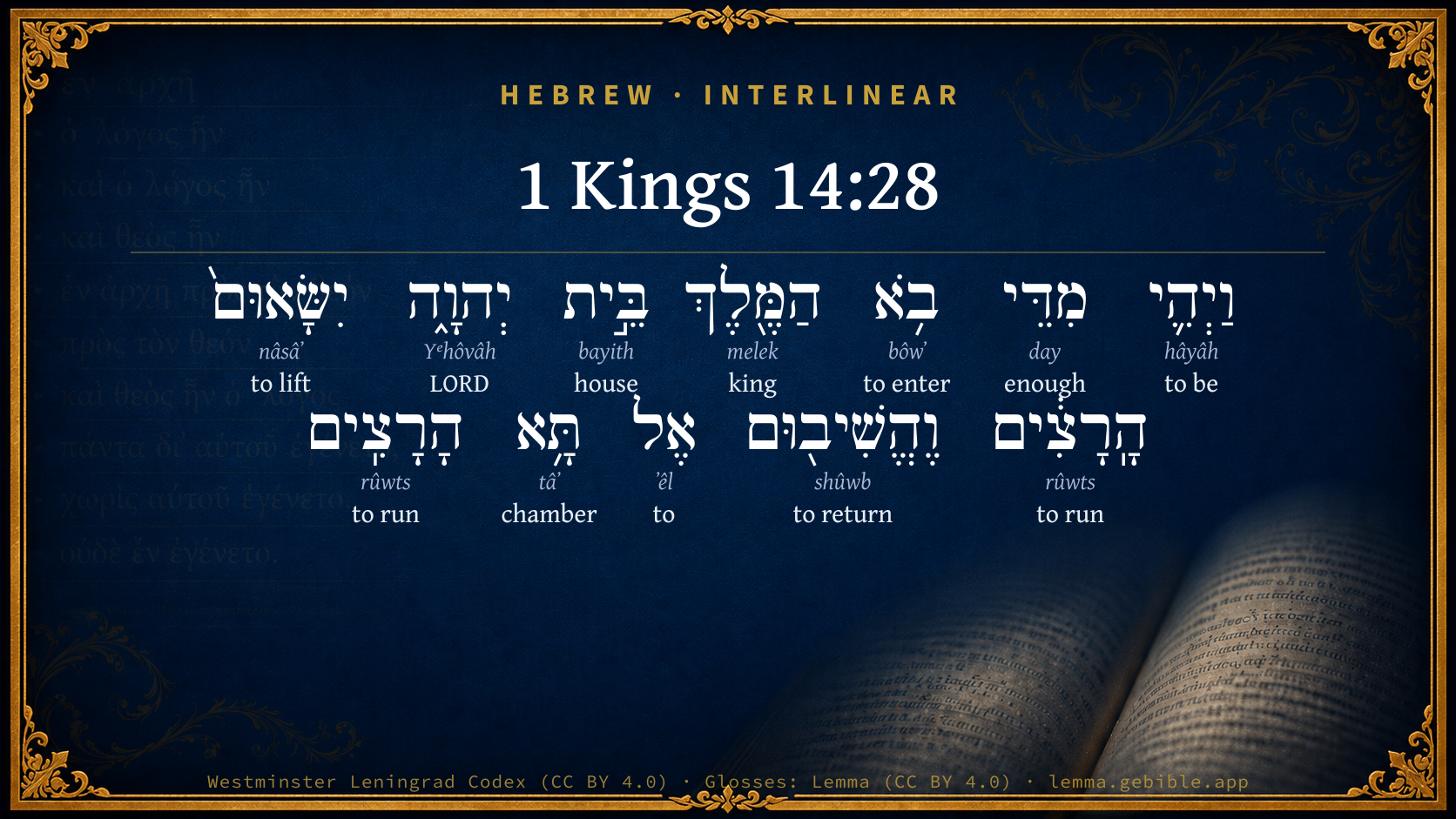
1 Kings 14:28

Hebrew (Westminster Leningrad Codex) 1 Kings 14:28 appears in the Hebrew Old Testament. The text above is from the Westminster Leningrad Codex. Each word links to its Strong’s number, a concise gloss, and parsing drawn from the Open Scriptures Hebrew Bible morphology. Click any word for its full Brown-Driver-Briggs (BDB) entry.
Download image
Cite this verse

1 Kings 14:28 (World English Bible). Public Domain. Lemma interlinear Bible study tool, https://lemma.gebible.app/v/1-kings/14/28.

Show BibTeX & RIS
BibTeX
RIS
English Translation
It was so, that as often as the king went into the house of Yahweh, the guard bore them, and brought them back into the guard-chamber.
World English Bible · Public Domain
Highlights
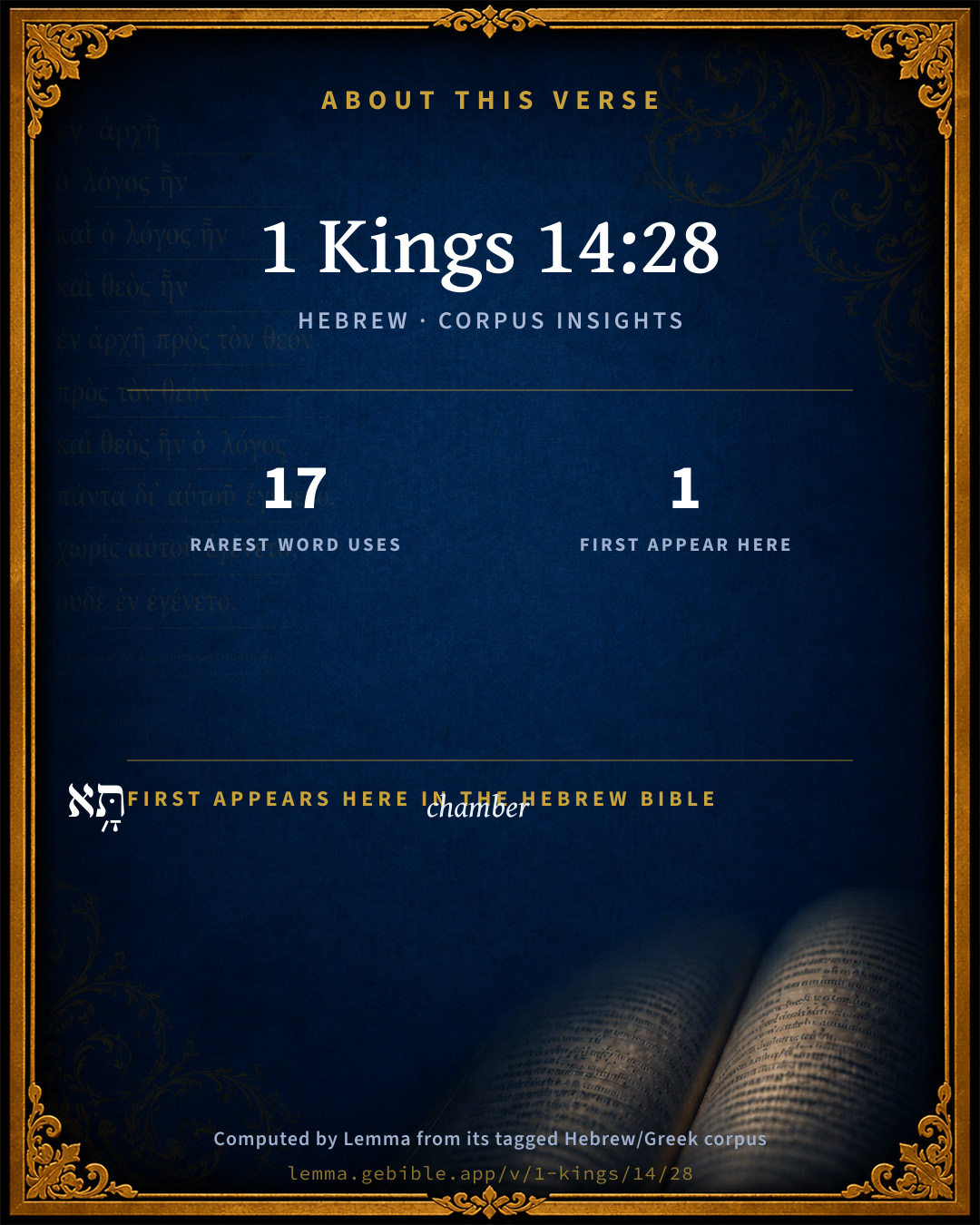
  • 1 first appearance in the Hebrew Bible
Full analysis ↓
Download a study sheet

One document with this verse’s original text, its word-by-word gloss line, the meaning frame, cross-references with their text, attributed commentary, and full source and license credits — printable, and it pastes into notes with its structure intact.

This verse Autodidact and up

Study sheet (.html) Plain text (.txt)

A passage Seminary Student

Up to 50 verses in one chapter. A passage sheet keeps up to 6 commentary sources and 12 cross-references per verse, in the order this page ranks them, and says so on the sheet whenever that leaves anything out. Ask for a single verse and you get the Autodidact verse sheet above.

Everything on this page stays free to read, with no account — the sheet is a download of what is already on screen, not access to it.

Want to remove ads? Support Godless Engineer
Compare translations 3

The same verse in 3 English versions, stacked beneath the original-language interlinear above. Click any original word for its lexicon entry.

Each is an independent rendering of the whole verse — the interlinear is not word-aligned to these translations.

Highlighted words mark where these versions differ — a whole-verse word diff, not a word-by-word alignment.

  • World English Bible Public Domain
    It was so, that as often as the king went into the house of Yahweh, the guard bore them, and brought them back into the guard-chamber.
  • King James Version Public Domain
    And it was so, when the king went into the house of the LORD, that the guard bare them, and brought them back into the guard chamber.
  • unfoldingWord Literal Text CC BY-SA 4.0
    And it happened that whenever the king entered the house of Yahweh, the runners bore them, and they brought them back to the chamber of the runners.

unfoldingWord Literal Text — © unfoldingWord, licensed CC BY-SA 4.0. Word-aligned USFM3 via Door43 (git.door43.org/unfoldingWord/en_ult).

Versions to compare (up to 4)

3 of 4 selected

Show all 18 translations

Every available English version of this verse, each an independent rendering of the whole verse.

  • World English Bible Public Domain
    It was so, that as often as the king went into the house of Yahweh, the guard bore them, and brought them back into the guard-chamber.
  • Berean Standard Bible Public Domain
    And whenever the king entered the house of the LORD, the guards would bear the shields, and later they would return them to the guardroom.
  • Majority Standard Bible Public Domain
    And whenever the king entered the house of the LORD, the guards would bear the shields, and later they would return them to the guardroom.
  • King James Version Public Domain
    And it was so, when the king went into the house of the LORD, that the guard bare them, and brought them back into the guard chamber.
  • American Standard Version (1901) Public Domain
    And it was so, that, as oft as the king went into the house of Jehovah, the guard bare them, and brought them back into the guard-chamber.
  • Revised Version (1885) Public Domain
    And it was so, that as oft as the king went into the house of the LORD, the guard bare them, and brought them back into the guard chamber.
  • Geneva Bible (1599) Public Domain
    And when the King went into the house of the Lord, the garde bare them, and brought them againe into the gard chamber.
  • Douay-Rheims (1899) Public Domain
    And when the king went into the house of the Lord, they whose office it was to go before him, carried them: and afterwards they brought them back to the armoury of the shieldbearers.
  • Young's Literal Translation Public Domain
    and it cometh to pass, from the going in of the king to the house of Jehovah, the runners bear them, and have brought them back unto the chamber of the runners.
  • Literal Standard Version CC BY-SA 4.0
    and it comes to pass, from the going in of the king to the house of YHWH, the runners carry them, and have brought them back to the chamber of the runners.
  • Unlocked Literal Bible CC BY-SA 4.0
    It happened that whenever the king entered the house of Yahweh, the guards would carry them; then they would bring them back into the guardhouse.
  • unfoldingWord Literal Text CC BY-SA 4.0
    And it happened that whenever the king entered the house of Yahweh, the runners bore them, and they brought them back to the chamber of the runners.
  • Darby Bible Public Domain
    And it was so, that as often as the king entered into the house of Jehovah, the couriers bore them, and brought them again into the chamber of the couriers.
  • World Messianic Bible Public Domain
    It was so, that as often as the king went into the LORD’s house, the guard bore them, and brought them back into the guard room.
  • Webster's Bible Public Domain
    And it was so, when the king went into the house of the LORD, that the guard bore them, and brought them back into the guard chamber.
  • Free Bible Version CC BY-SA 4.0
    Whenever the king went to the Lord's Temple, the guards would carry the shields. Afterwards they returned them to the guardroom.
  • Bible in Basic English Public Domain
    And whenever the king went into the house of the Lord, the armed men went with him taking the body-covers, and then took them back to their room.
  • JPS Tanakh (1917) Public Domain
    And it was so, that as oft as the king went into the house of the LORD, the guard bore them, and brought them back into the guard-chamber.

Literal Standard Version (2020), Covenant Press — licensed CC BY-SA 4.0. Text via the HelloAO Bible API (eBible.org). Unlocked Literal Bible (unfoldingWord) — licensed CC BY-SA 4.0. Text via the HelloAO Bible API (eBible.org). unfoldingWord Literal Text — © unfoldingWord, licensed CC BY-SA 4.0. Word-aligned USFM3 via Door43 (git.door43.org/unfoldingWord/en_ult). Free Bible Version, Dr. Jonathan Gallagher — licensed CC BY-SA 4.0. Text via the HelloAO Bible API (eBible.org).

Word by word

More ways to search: Search by grammar → Find every occurrence → Compare this word →

Practice this passage: Drill this verse → Learn its vocabulary →

תָּ֥א
tâʼ
H8372
“chamber of”
Noun, Common, Masculine, Singular, Construct
Part of Speech
Noun
Type
Common
Gender
Masculine
Number
Singular
State
Construct
Full BDB Definition

Origin: from (the base of) H8376

TWOT: 2484

chamber, guardroom
  1. וַיְהִ֛י hâyâh H1961 “and · to be” Conjunction + Verb, Qal, Sequential Imperfect, 3rd Person, Masculine, Singular
  2. מִדֵּי day H1767 “from · enough of” Preposition + Noun, Common, Masculine, Singular, Construct
  3. בֹ֥א bôwʼ H935 “to enter” Verb, Qal, Infinitive Construct
  4. הַמֶּ֖לֶךְ melek H4428 “the · king” Particle, Definite Article + Noun, Common, Masculine, Singular, Absolute
  5. בֵּ֣ית bayith H1004 “house of” Noun, Common, Masculine, Singular, Construct
  6. יְהוָ֑ה Yᵉhôvâh H3068 “LORD” Noun, Proper
  7. יִשָּׂאוּם֙ nâsâʼ H5375 “to lift · them” Verb, Qal, Imperfect, 3rd Person, Masculine, Plural + Suffix, Personal, 3rd Person, Masculine, Plural
  8. הָֽרָצִ֔ים rûwts H7323 “the · running” Particle, Definite Article + Verb, Qal, Participle Active, Masculine, Plural, Absolute
  9. וֶהֱשִׁיב֖וּם shûwb H7725 “and · to return · them” Conjunction + Verb, Hiphil, Perfect, 3rd Person, Common, Plural + Suffix, Personal, 3rd Person, Masculine, Plural
  10. אֶל ʼêl H413 “to” Preposition
  11. הָרָצִֽים rûwts H7323 “the · running” Particle, Definite Article + Verb, Qal, Participle Active, Masculine, Plural, Absolute

About this verse

These counts appear in no published source. They are computed here, from the morphology-tagged text and Lemma’s own curated glosses. What Lemma adds →

12
words
11
distinct lemmas
Historical
section

Notable vocabulary

The rarest word here is תָּ֥א chamber H8372 — appearing just 17 times in the whole Hebrew Bible.

First appearance in Scripture

This word makes its first canonical appearance in the Hebrew Bible here:

  • תָּ֥א chamber H8372

Shared distinctive vocabulary

תָּ֥א chamber H8372 occurs in 11 verses of the Hebrew Bible. Also found in:

Grammatical profile

  • 6 verbs
  • 5 nouns
  • 1 preposition

Verb forms

  • וַיְהִ֛י Qal · Sequential Imperfect
  • בֹ֥א Qal · Infinitive Construct
  • יִשָּׂאוּם֙ Qal · Imperfect
  • הָֽרָצִ֔ים Qal · Participle Active
  • וֶהֱשִׁיב֖וּם Hiphil · Perfect
  • הָרָצִֽים Qal · Participle Active

Repetition

A word recurs within this verse — often emphatic in Hebrew:

  • הָֽרָצִ֔ים to run H7323 ×2

Hebrew & Septuagint length

In English translation the verse runs 26 words from the Hebrew and 32 from the Septuagint (LXX English) — closely comparable.

A rough comparison of the two English renderings, which tokenize alike — not a word-level alignment.

Word counts can differ between the Hebrew and the Greek without any difference in meaning — e.g. the Hebrew direct-object marker אֵת has no separate Greek word, and Greek often adds the article ὁ.

Cross-references

1

Topical passages linked to 1 Kings 14:28 in the Treasury of Scripture Knowledge — connected by theme and wording, ordered by reader-vote popularity; previews shown in the World English Bible.

  • 2 Chronicles 12:11 It was so, that as often as the king entered into the house of Yahweh, the guard came and bore them, and brought them back into the guard-chamber.

Cross-references courtesy of OpenBible.info (CC BY 4.0).

Hebrew and Greek witnesses Masoretic Hebrew ↔ Greek Septuagint

The same verse in the two great witnesses to the Old Testament, shown verse-for-verse.

These are two independent witnesses, not word-aligned to each other, and the Septuagint is shown in lemma (dictionary) form.

Hebrew 1 Kings 14:28 Masoretic · Westminster Leningrad Codex

וַיְהִ֛י מִדֵּי בֹ֥א הַמֶּ֖לֶךְ בֵּ֣ית יְהוָ֑ה יִשָּׂאוּם֙ הָֽרָצִ֔ים וֶהֱשִׁיב֖וּם אֶל תָּ֥א הָרָצִֽים

It was so, that as often as the king went into the house of Yahweh, the guard bore them, and brought them back into the guard-chamber.

World English Bible · Public Domain

Greek LXX 1 Kings 14:28 Septuagint · lemma form
And it came to pass when the king went into the house of the Lord, that the body guard took them up, and fixed them in the chamber of the body guard.

LXX2012 (modern English Septuagint) · Public Domain

Hebrew: Westminster Leningrad Codex (CC BY 4.0). Greek: Septuagint (public domain); English from LXX2012 (modern English Septuagint) (Public Domain). How the Septuagint differs from the Hebrew →

Targum (Aramaic paraphrase)

1

The Targum is the ancient Jewish Aramaic paraphrase of the Hebrew Scriptures — an interpretive translation, not the Hebrew text itself. Onkelos (literal) and Pseudo-Jonathan (expansive) render the Torah, and Jonathan the Prophets. Coverage is partial: where no permissively-licensed English translation exists for a verse, only the Aramaic is shown. This is verse-level text, not a word-by-word alignment to the Hebrew.

  1. Targum Jonathan Prophets (Joshua–Malachi)
    וַהֲוָה בִּזְמַן דַעֲלֵיל מַלְכָּא לְבֵית מַקְדְשָׁא דַייָ נַסְבִין לְהוֹן רָהֲטַיָא וּמְתִיבִין לְהוֹן לְדוּבָא דְרָהֲטַיָא:

    (no public-domain English translation for this verse)

    Targum Jonathan — Aramaic: “Mikraot Gedolot” (public domain). English: “Sefaria Community Translation” (CC0 1.0 (public-domain dedication)); “London "Chaldee Paraphrase," 1871” (public domain). Text via Sefaria.

Commentary

Notes on 1 Kings 14:28 from classic Christian and Jewish commentators (each source and its license shown beneath its notes). The classic Christian expositions comment on the surrounding passage and are grouped to its opening verse, so a note may address several verses; the Jewish commentaries on the Tanakh (Rashi and others) are per-verse, so they appear only where the commentator wrote on this verse.

Lemma curates 59 commentaries, every one of them public domain or Creative Commons licensed, each selected and text-cleaned for this edition rather than reprinted as found. About our sources →

Trapp's Complete Commentary

John Trapp

1Ki 14:28 And it was [so], when the king went into the house of the LORD, that the guard bare them, and brought them back into the guard chamber.

Ver. 28. That the guard bare them.] Propter periculum insidiarum etiam in ipsa domo Domini metuendarum, to prevent danger.

John Trapp, A Commentary or Exposition upon All the Books of the Old and New Testament (1647–1656) — public domain. Text from a community e-Sword module.

Joseph Benson's Commentary

1Ki 14:28. When the king went to the house of the Lord — It appears from this, that he had not quite forsaken the worship or God; but still, at least occasionally, attended at the temple: or, if he had forsaken it, the chastisement he had received by the instrumentality of the king of Egypt had done him some good, and brought him back to that worship.

Joseph Benson's Commentary on the Old and New Testaments (1811–1818) — public domain. Text from a community e-Sword module.

Adam Clarke's Commentary

Verse 28. The guard bare them] The guard probably were just three hundred, answering to the number of the shields.

Adam Clarke's Commentary on the Bible (1810–1826) — public domain. Text from a community e-Sword/MySword module.

Ellicott's Commentary for English Readers

(28) When the king went.—Hence we see that Rehoboam still worshipped in the house of the Lord. If his idolatry were like that of his father, it would not have prevented this; but in 2Ch_12:6-8; 2Ch_12:12 it is implied that after the invasion he “humbled himself,” and returned to the Lord.

A Bible Commentary for English Readers, edited by Charles John Ellicott (1878–1897) — public domain. Text from a community e-Sword module.

The Cambridge Bible for Schools and Colleges

gen. ed. J. J. S. Perowne

28. And it was so, when] For ‘when’ the R.V. gives, as often as. The Hebrew word is not common. It occurs 1Sa_18:30; 2Ki_4:8; in the latter place the A.V. gives ‘as oft as,’ and in the former the R.V., has changed ‘after’ into ‘as often as,’ with a great improvement to the sense.

The Cambridge Bible for Schools and Colleges (gen. ed. J. J. S. Perowne; Cambridge University Press, 1878–1918) — public domain. Text from a community e-Sword module.

John Gill's Exposition

Now the rest of the acts of Rehoboam and all that he did,.... In the course of his reign, that was memorable:

are they not written in the book of the chronicles of the kings of Judah? who had annalists or historiographers to write for them, as the kings of Israel had, Kg1 14:19, in the writing of which, especially with respect to genealogies, Shemaiah the prophet, and Iddo the seer, were concerned, Ch2 12:15.

John Gill's Exposition of the Whole Bible (1746–1763) — public domain (CC PDM 1.0). Text via the HelloAO Bible API.

Albert Barnes' Notes on the Bible

It appears from this verse that Rehoboam, notwithstanding that he encouraged, and perhaps secretly practiced, idolatry (1Ki 14:22-24, compare 1Ki 15:3, 1Ki 15:12; 2Ch 12:1), maintained a public profession of faith in Yahweh, and attended in state the temple services. Compare the conduct of Solomon, 1Ki 9:25.

Albert Barnes' Notes on the Bible (1834–1885) — public domain. Text from a community e-Sword/MySword module.

Matthew Poole's English Annotations

When the king went into the house of the Lord; by which it seems the affliction had done him some good, and brought him back to the worship of God, which he had forsaken.

Matthew Poole's English Annotations on the Holy Bible (1683–1685) — public domain. Text from a community e-Sword/MySword module.

The Pulpit Commentary

And it was so, when the king went unto the house of the Lord, that the guards runners bare them Whatever idolatries Rehoboam tolerated or encouraged, it is clear that he maintained the temple worship with great pomp and circumstance. The state visits of the Sultan to the Mosque may perhaps be best compared with these processions. Ewald sees in this circumstance a proof of Rehoboam"s vanity. The brazen shields were "borne before him in solemn procession, as if everything were the same as before", and brought them back into the guard chamber Heb." chamber of the runners." Solomon"s golden shields were kept "in the house of the forest of Lebanon". (1Ki_10:17) These shields of Brass were of so little value that the guard chamber sufficed for their custody.

The Pulpit Commentary (1880–1919), ed. H.D.M. Spence-Jones & Joseph S. Exell — public domain. Text from a community e-Sword module.

John Wesley's Explanatory Notes

To the house, &c. - By which it seems the affliction had done him some good, and brought him back to the worship of God, which he had forsaken.

John Wesley, Explanatory Notes Upon the Whole Bible (1754–1765) — public domain. Text via the GEBible commentary corpus.

Rashi

Rabbi Shlomo Yitzchaki (Rashi)

The runners would carry them. Before him, in [his] honor, and afterwards, they would return them to the chamber where the runners were always stationed.

Rashi on the Tanakh — English translations: “The Judaica Press complete Tanach with Rashi, translated by A. J. Rosenberg” (CC BY 4.0); “Pentateuch with Rashi's commentary by M. Rosenbaum and A.M. Silbermann, 1929-1934” (public domain); “The Metsudah Tanach series, Lakewood, N.J” (CC BY 4.0); and “The Book of Joshua, Metsudah Publications, 1997” (CC BY 4.0). Text via Sefaria.

Lesson kit

Teaching starters — assembled from the data on this page, not authored interpretation. Every prompt links to the verse data it draws on. Edit before teaching.

1 Kings, in the Historical, opens this verse with 12 words (11 distinct Hebrew lemmas). Its most distinctive word is tâʼ (“chamber”). A historical commentator’s framing appears above. Read the whole chapter for the surrounding context.

Discussion questions

  1. How does “chamber” (tâʼ) shape what this verse is saying?
  2. The word “chamber” first appears here in Scripture. What is being introduced at this debut?
  3. 2 Chronicles 12:11 shares the word «chamber» with this verse. How do the two illuminate each other?
  4. “to run” occurs 2× in this one verse. What is the effect of the repetition?
  5. These translations render this verse differently. What is at stake in choosing one wording over another?
  6. The verb «וַיְהִ֛י» is Qal Sequential Imperfect. How does its form color the action?
  7. Reading how Trapp's Complete Commentary and Joseph Benson's Commentary read this verse, where do the two commentators agree and where do they part?

Things to notice

  • 1 word makes its first canonical appearance in Scripture here.
  • These translations choose different wording for 15 words in this verse.
  • “to run” occurs 2× in this single verse.
  • 11 distinct Hebrew lemmas span 12 words in this verse.

Reading settings

Reading text

Shown beneath each verse's original-language words.

Old Testament
Old Testament edition

Read the OT as the Masoretic Hebrew (MT) or the Greek Septuagint (LXX).

English shown for the Greek Septuagint (in the Hebrew ↔ Greek comparison).

Comparing translations? Open the Compare panel on any verse page to stack up to four side by side.