Nehemiah 4:17

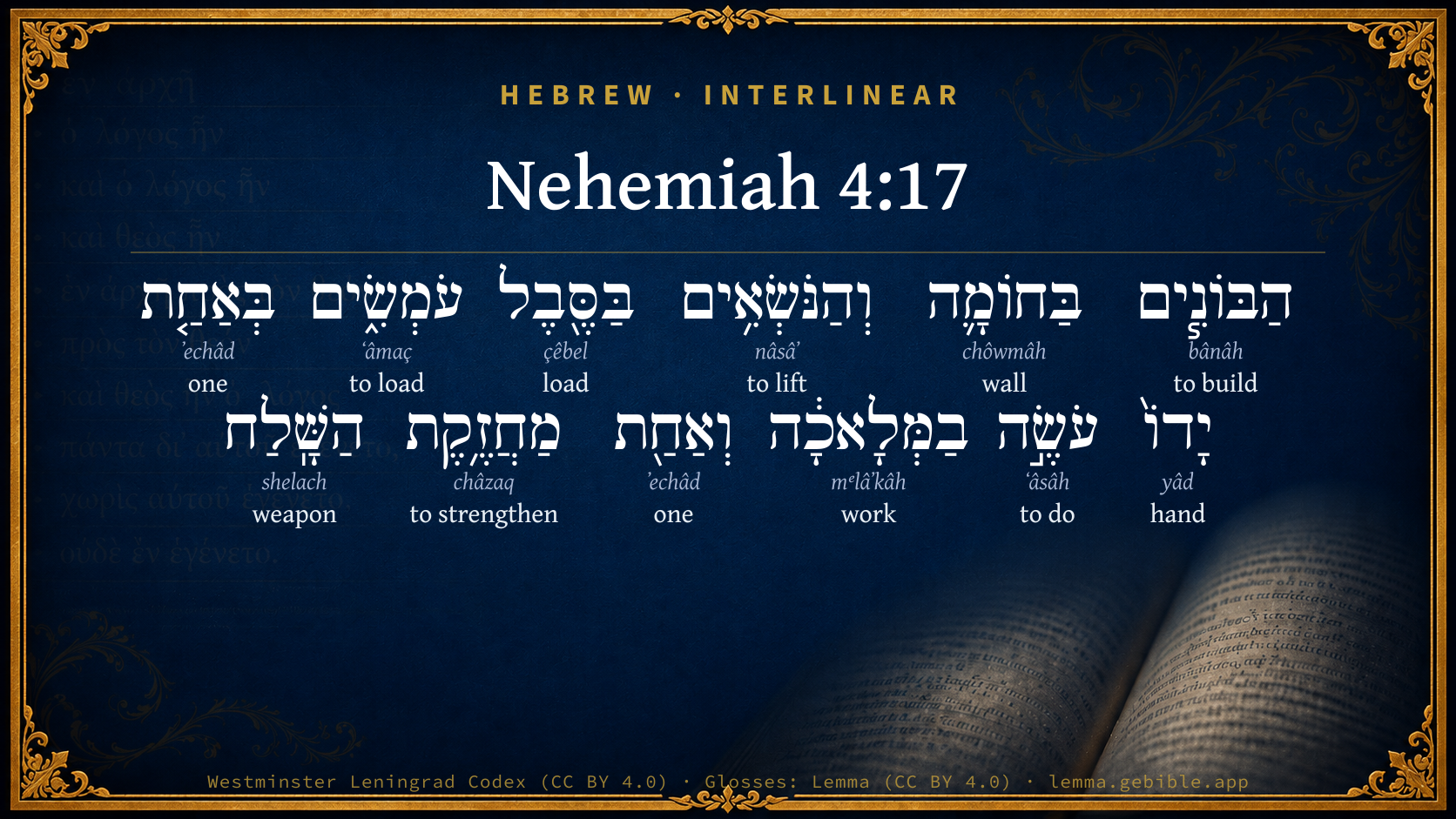
Hebrew (Westminster Leningrad Codex) Nehemiah 4:17 appears in the Hebrew Old Testament. The text above is from the Westminster Leningrad Codex. Each word links to its Strong’s number, a concise gloss, and parsing drawn from the Open Scriptures Hebrew Bible morphology. Click any word for its full Brown-Driver-Briggs (BDB) entry.
Download image
Cite this verse

Nehemiah 4:17 (World English Bible). Public Domain. Lemma interlinear Bible study tool, https://lemma.gebible.app/v/nehemiah/4/17.

Show BibTeX & RIS
BibTeX
RIS
English Translation
They all built the wall and those who bore burdens loaded themselves; everyone with one of his hands worked in the work, and with the other held his weapon;
World English Bible · Public Domain
Download a study sheet

One document with this verse’s original text, its word-by-word gloss line, the meaning frame, cross-references with their text, attributed commentary, and full source and license credits — printable, and it pastes into notes with its structure intact.

This verse Autodidact and up

Study sheet (.html) Plain text (.txt)

A passage Seminary Student

Up to 50 verses in one chapter. A passage sheet keeps up to 6 commentary sources and 12 cross-references per verse, in the order this page ranks them, and says so on the sheet whenever that leaves anything out. Ask for a single verse and you get the Autodidact verse sheet above.

Everything on this page stays free to read, with no account — the sheet is a download of what is already on screen, not access to it.

Want to remove ads? Support Godless Engineer
Compare translations 3

The same verse in 3 English versions, stacked beneath the original-language interlinear above. Click any original word for its lexicon entry.

Each is an independent rendering of the whole verse — the interlinear is not word-aligned to these translations.

Highlighted words mark where these versions differ — a whole-verse word diff, not a word-by-word alignment.

  • World English Bible Public Domain
    They all built the wall and those who bore burdens loaded themselves; everyone with one of his hands worked in the work, and with the other held his weapon;
  • King James Version Public Domain
    They which builded on the wall, and they that bare burdens, with those that laded, every one with one of his hands wrought in the work, and with the other hand held a weapon.
  • unfoldingWord Literal Text CC BY-SA 4.0
    Those who were building the wall, and those who were carrying burdens, the loaders, they were doing the work with one of his hands and one grasping weaponry.

unfoldingWord Literal Text — © unfoldingWord, licensed CC BY-SA 4.0. Word-aligned USFM3 via Door43 (git.door43.org/unfoldingWord/en_ult).

Versions to compare (up to 4)

3 of 4 selected

Show all 18 translations

Every available English version of this verse, each an independent rendering of the whole verse.

  • World English Bible Public Domain
    They all built the wall and those who bore burdens loaded themselves; everyone with one of his hands worked in the work, and with the other held his weapon;
  • Berean Standard Bible Public Domain
    who were rebuilding the wall. The laborers who carried materials worked with one hand and held a weapon with the other.
  • Majority Standard Bible Public Domain
    who were rebuilding the wall. The laborers who carried materials worked with one hand and held a weapon with the other.
  • King James Version Public Domain
    They which builded on the wall, and they that bare burdens, with those that laded, every one with one of his hands wrought in the work, and with the other hand held a weapon.
  • American Standard Version (1901) Public Domain
    They all builded the wall and they that bare burdens laded themselves; every one with one of his hands wrought in the work, and with the other held his weapon;
  • Revised Version (1885) Public Domain
    They that builded the wall and they that bare burdens laded themselves, every one with one of his hands wrought in the work, and with the other held his weapon;
  • Geneva Bible (1599) Public Domain
    They that buylded on the wall, and they that bare burdens, and they that laded, did the worke with one hand, and with the other helde the sworde.
  • Douay-Rheims (1899) Public Domain
    Of them that built on the wall and that carried burdens, and that laded: with one of his hands he did the work, and with the other he held a sword.
  • Young's Literal Translation Public Domain
    The builders on the wall, and the bearers of the burden, those lading, `each' with one of his hands is working in the business, and one is laying hold of the missile.
  • Literal Standard Version CC BY-SA 4.0
    The builders on the wall, and the bearers of the burden, those loading, [each] with one of his hands is working in the business, and one is laying hold of the missile.
  • Unlocked Literal Bible CC BY-SA 4.0
    The same workers who were building the wall and carrying loads were also guarding their positions. Everyone worked with one hand, and with the other hand he held his weapon.
  • unfoldingWord Literal Text CC BY-SA 4.0
    Those who were building the wall, and those who were carrying burdens, the loaders, they were doing the work with one of his hands and one grasping weaponry.
  • Darby Bible Public Domain
    They that built on the wall, and they that bore burdens, with those that loaded, wrought in the work with one hand, and with the other they held a weapon.
  • World Messianic Bible Public Domain
    Those who built the wall, and those who bore burdens loaded themselves; everyone with one of his hands did the work, and with the other held his weapon.
  • Webster's Bible Public Domain
    They who built on the wall, and they that bore burdens, with those that laded, every one with one of his hands wrought in the work, and with the other hand held a weapon.
  • Free Bible Version CC BY-SA 4.0
    who were building the wall. Those carrying materials worked with one hand, holding a weapon in the other.
  • Bible in Basic English Public Domain
    Those who were building the wall and those who were moving material did their part, everyone working with one hand, with his spear in the other;
  • JPS Tanakh (1917) Public Domain
    (4-11) They that builded the wall and they that bore burdens laded themselves, every one with one of his hands wrought in the work, and with the other held his weapon;

Literal Standard Version (2020), Covenant Press — licensed CC BY-SA 4.0. Text via the HelloAO Bible API (eBible.org). Unlocked Literal Bible (unfoldingWord) — licensed CC BY-SA 4.0. Text via the HelloAO Bible API (eBible.org). unfoldingWord Literal Text — © unfoldingWord, licensed CC BY-SA 4.0. Word-aligned USFM3 via Door43 (git.door43.org/unfoldingWord/en_ult). Free Bible Version, Dr. Jonathan Gallagher — licensed CC BY-SA 4.0. Text via the HelloAO Bible API (eBible.org).

Word by word

More ways to search: Search by grammar → Find every occurrence → Compare this word →

Practice this passage: Drill this verse → Learn its vocabulary →

בַּסֶּ֖בֶל
çêbel
H5447
“in/at the · load”
Preposition, Determined + Noun, Common, Masculine, Singular, Absolute
Part of Speech
Preposition + Noun
Type
Common
Gender
Masculine
Number
Singular
State
Absolute
Full BDB Definition

Origin: from H5445

TWOT: 1458a

load, burden
  1. הַבּוֹנִ֧ים bânâh H1129 “the · building” Particle, Definite Article + Verb, Qal, Participle Active, Masculine, Plural, Absolute
  2. בַּחוֹמָ֛ה chôwmâh H2346 “in/at the · wall” Preposition, Determined + Noun, Common, Feminine, Singular, Absolute
  3. וְהַנֹּשְׂאִ֥ים nâsâʼ H5375 “and · the · lifting” Conjunction + Particle, Definite Article + Verb, Qal, Participle Active, Masculine, Plural, Absolute
  4. עֹמְשִׂ֑ים ʻâmaç H6006 “loading” Verb, Qal, Participle Active, Masculine, Plural, Absolute
  5. בְּאַחַ֤ת ʼechâd H259 “in/at · one” Preposition + Adjective, Cardinal number, Feminine, Singular, Construct
  6. יָדוֹ֙ yâd H3027 “hand · his” Noun, Common, Both, Singular, Construct + Suffix, Personal, 3rd Person, Masculine, Singular
  7. עֹשֶׂ֣ה ʻâsâh H6213 “doing” Verb, Qal, Participle Active, Masculine, Singular, Absolute
  8. בַמְּלָאכָ֔ה mᵉlâʼkâh H4399 “in/at the · work” Preposition, Determined + Noun, Common, Feminine, Singular, Absolute
  9. וְאַחַ֖ת ʼechâd H259 “and · one” Conjunction + Adjective, Cardinal number, Feminine, Singular, Absolute
  10. מַחֲזֶ֥קֶת châzaq H2388 “strengthening” Verb, Hiphil, Participle Active, Feminine, Singular, Absolute
  11. הַשָּֽׁלַח shelach H7973 “the · weapon” Particle, Definite Article + Noun, Common, Masculine, Singular, Absolute

About this verse

These counts appear in no published source. They are computed here, from the morphology-tagged text and Lemma’s own curated glosses. What Lemma adds →

12
words
11
distinct lemmas
Historical
section

Notable vocabulary

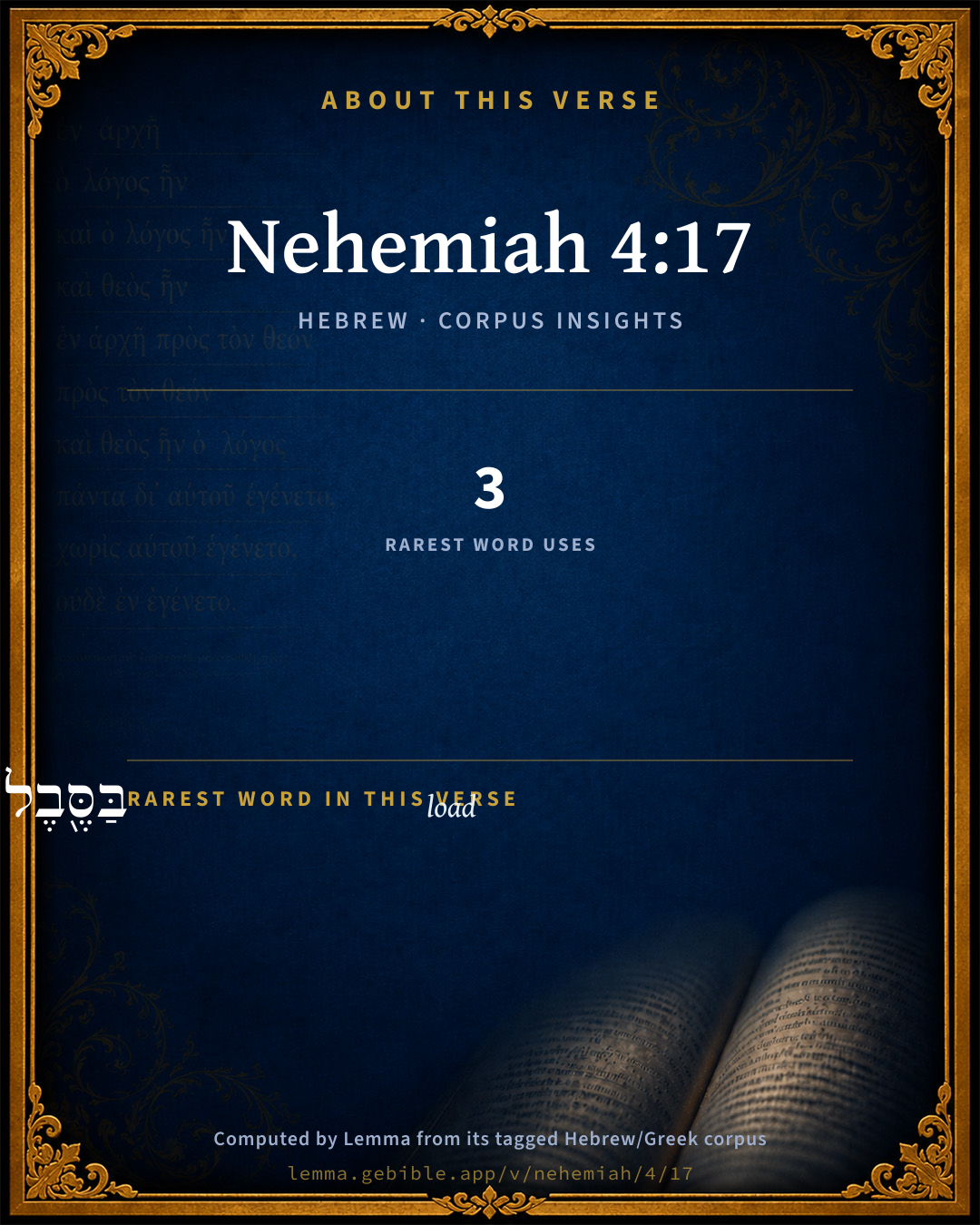
The rarest word here is בַּסֶּ֖בֶל load H5447 — appearing just 3 times in the whole Hebrew Bible.

Shared distinctive vocabulary

בַּסֶּ֖בֶל load H5447 occurs in 3 verses of the Hebrew Bible. Also found in:

Grammatical profile

  • 5 verbs
  • 5 nouns
  • 2 adjectives

Verb forms

  • הַבּוֹנִ֧ים Qal · Participle Active
  • וְהַנֹּשְׂאִ֥ים Qal · Participle Active
  • עֹמְשִׂ֑ים Qal · Participle Active
  • עֹשֶׂ֣ה Qal · Participle Active
  • מַחֲזֶ֥קֶת Hiphil · Participle Active

Repetition

A word recurs within this verse — often emphatic in Hebrew:

  • בְּאַחַ֤ת one H259 ×2

Cross-references

9

Topical passages linked to Nehemiah 4:17 in the Treasury of Scripture Knowledge — connected by theme and wording, ordered by reader-vote popularity; previews shown in the World English Bible.

  • 2 Corinthians 6:7 in the word of truth, in the power of God; by the armor of righteousness on the right hand and on the left,
  • 2 Timothy 2:3 You therefore must endure hardship, as a good soldier of Christ Jesus.
  • 2 Timothy 4:7 I have fought the good fight. I have finished the course. I have kept the faith.
  • 1 Corinthians 16:9 for a great and effective door has opened to me, and there are many adversaries.
  • 1 Corinthians 16:13 Watch! Stand firm in the faith! Be courageous! Be strong!
  • Ephesians 6:11–20 Put on the whole armor of God, that you may be able to stand against the wiles of the devil.
  • Philippians 1:28 and in nothing frightened by the adversaries, which is for them a proof of destruction, but to you of salvation, and that from God.
  • Daniel 9:25 Know therefore and discern, that from the going forth of the commandment to restore and to build Jerusalem to the Anointed One, the prince, shall be seven weeks, and sixty-two weeks: it shall be built again, with street and moat, even in troubled times.
  • 1 Corinthians 9:12 If others partake of this right over you, don't we yet more? Nevertheless we did not use this right, but we bear all things, that we may cause no hindrance to the Gospel of Christ.

Cross-references courtesy of OpenBible.info (CC BY 4.0).

Hebrew and Greek witnesses Masoretic Hebrew ↔ Greek Septuagint

The same verse in the two great witnesses to the Old Testament, shown verse-for-verse.

These are two independent witnesses, not word-aligned to each other, and the Septuagint is shown in lemma (dictionary) form.

Hebrew Nehemiah 4:17 Masoretic · Westminster Leningrad Codex

הַבּוֹנִ֧ים בַּחוֹמָ֛ה וְהַנֹּשְׂאִ֥ים בַּסֶּ֖בֶל עֹמְשִׂ֑ים בְּאַחַ֤ת יָדוֹ֙ עֹשֶׂ֣ה בַמְּלָאכָ֔ה וְאַחַ֖ת מַחֲזֶ֥קֶת הַשָּֽׁלַח

They all built the wall and those who bore burdens loaded themselves; everyone with one of his hands worked in the work, and with the other held his weapon;

World English Bible · Public Domain

Greek LXX Structure differs

The Septuagint has no separate book of Nehemiah. Its Greek text is the second half of Esdras B (2 Esdras), chapters 11–23; Ezra is the first half (1–10).

A verse-for-verse comparison isn’t shown here because the chapters and verses don’t line up. Switch to the LXX edition with the MT / LXX toggle above to read the Greek directly.

Hebrew: Westminster Leningrad Codex (CC BY 4.0). Greek: Septuagint (public domain); English from a public-domain English Septuagint. How the Septuagint differs from the Hebrew →

Commentary

Notes on Nehemiah 4:17 from classic Christian and Jewish commentators (each source and its license shown beneath its notes). The classic Christian expositions comment on the surrounding passage and are grouped to its opening verse, so a note may address several verses; the Jewish commentaries on the Tanakh (Rashi and others) are per-verse, so they appear only where the commentator wrote on this verse.

Lemma curates 59 commentaries, every one of them public domain or Creative Commons licensed, each selected and text-cleaned for this edition rather than reprinted as found. About our sources →

The Cambridge Bible for Schools and Colleges

gen. ed. J. J. S. Perowne

17. They which builded on the wall] R.V. They that builded the wall. The Hebrew preposition rendered ‘on’ in the A.V. occurs also e.g. in Neh_4:6, ‘So we built the wall,’ and merely expresses the object.

(a) These words are sometimes taken in conjunction with the conclusion of the previous verse (R.V. marg.), on account of the mention of them ‘that builded the wall’ in connexion with them ‘that bare burdens;’ whereas Neh_4:18 seems to speak of ‘the builders’ as a different class from them ‘that bare burdens.’

(b) Another explanation takes the first words of this verse as a nominative absolute, standing before the two Neh_4:17-18 which relate respectively to the two classes into which the wall builders would be distributed, i.e. ‘As for them that builded the wall, as well they that bare burdens, laded themselves &c. (18) as the builders’.

(c) The R.V. renders the words quite simply. It makes Neh_4:17 refer both to the builders and to the burden bearers, Neh_4:18 to the builders only. ‘They that builded on the wall’ are then further defined in Neh_4:17 as ‘they that bare burdens.’ ‘The builders’ in Neh_4:18, mentioned without further definition, must be limited to those occupied in the construction of the wall.

This makes very good sense. But the language is not without ambiguity, for which it is probable that the text is really accountable.

and they that bare burdens] See previous note. These words describe one class of workmen, distinguishing those who removed rubbish and carried material, stones, &c., from those occupied in the construction. If we take into account the enormous size of the stones used in the building of the ancient walls, and bear in mind the Assyrian representations of the moving of heavy weights by rollers, pulleys, mounds, &c., we may realize that the moving of the blocks and placing them in situ required a distinct class of workmen from those who removed the earth and the rubbish to prepare foundations, or constructed the mounds up which the stones could be drawn. This latter class is here indicated.

with those that laded] R.V. laded themselves. The word in the Hebrew is the predicate. It does not denote a third class of workmen.

every one … and with the other hand held a weapon] R.V. every one … and with the other held his weapon. This clause shows that the work men here mentioned had one hand free. They were probably employed in carrying baskets of rubbish over their backs or on their heads.

a weapon] The word here employed is not common. It denotes ‘a missile,’ and in this case was probably a light javelin.

The Cambridge Bible for Schools and Colleges (gen. ed. J. J. S. Perowne; Cambridge University Press, 1878–1918) — public domain. Text from a community e-Sword module.

Trapp's Complete Commentary

John Trapp

Neh 4:17 They which builded on the wall, and they that bare burdens, with those that laded, [every one] with one of his hands wrought in the work, and with the other [hand] held a weapon.

Ver. 17. They which builded on the wall] The master masons, and they that bare burdens, Bajuli, labourers and porters, who bear upon their shoulders as much as they can stand under, yet go singing oft under their burdens: the reason whereof Alexander Aphrodisaeus saith is this, that their minds being delighted with the sweetness of the music, the body may be the less sensible of the weight they carry. But these burden bearers had little mind to sing, their lives being in suspense. And yet, as worthy workmen, they went on with the wall.

Every one with one of his hands wrought, and in the other hand had a weapon] i.e., When they were busiest in building they had their weapons in a readiness to resist. What a goodly sight was this, saith one, to see every one so full of courage, that they feared not the enemy; and so willing to work, that they would not be weary. Let Christian men look into this notable example, and be ashamed of their slothfulness, &c.

John Trapp, A Commentary or Exposition upon All the Books of the Old and New Testament (1647–1656) — public domain. Text from a community e-Sword module.

The Biblical Illustrator

Joseph S. Exell

Neh_4:17-18

Every one with one of his hands wrought in the work, and with the other hand held a weapon,

The work and warfare of life

Life is work, and life is warfare; and these are ever commingled.

Our text is but an epitome and sample of that larger and longer work which fills the broad area of all human history.

I. This life is to men a scene of toil. In the sweat of thy face shalt thou eat bread is the universal and unchanging law of human life. Inaction is no blessing. The spirit of man stagnates and sickens under it, and it issues in a weariness which is worse than the fatigues of labour. Activity is needful to the true enjoyment of life. Adam was not inactive in paradise (Gen_2:15). Heaven is a rest, but not a rest of indolence. There His servants do serve Him. The true labour of life involves self-denial, apprehension, patience, fatigue, disappointment. Every man has a work that is specific and peculiar to him. The great Taskmaster never set two of His creatures the same task. Amid much general sameness, there is the strictest individuality. Lifes work is twofold.

1. The secular department. How great is the number of human avocations! And in each of these avocations what a number of workers! And each one has a task given him to do which is as distinct as himself, which no one can do but he, and which is defined by his circumstances, his relations and his endowments.

2. The spiritual department. The work of the soul and of eternity; the end of which is--to glorify God and enjoy Him for ever.

II. This life is also a scene of conflict. We have to fight--

1. Against ourselves. As internal wars are ever fiercest and most painful, so the battle-ground of a Christians own heart is that on which he is called to wage the severest fight and win the hardest victory. We have to overcome our sluggishness, our unbelief, our sensuality, our concupiscence, the heavy clog of sense, and the fierce impulse of corruption.

2. Against men. This enemy is called the world. And by it we mean that vast mass of maxims, opinions, beliefs, pursuits, ways, habits, opposed to the mind and service of God, which characterise human society.

3. Against spirits. The devil and his angels, numerous, powerful, malignant (Eph_6:12). (R. A. Hallam, D. D.)

Construction and contention

We have here illustrated two principles--

I. construction. Each of us is put into the world to be a builder, and himself is the building. Each separate disciple is a habitation of God, through the Spirit. If your faith, your work, your prayers, your watchfulness shall ever succeed in edifying you into anything like a completed Christian, your character will be an edifice where Gods glory will be more distinctly manifest than it is over any altar, where His praise will resound more acceptably than from the grandest organ, and where His truth is more effectually preached than from the most eloquent pulpit of any cathedral in the world.

1. Because character is a building it is not therefore to be understood that there is no need in the Christian life for an instant change, or conversion. That comes before the building can be begun to any purpose, or on any right plan. All must be sound at the base. If any man should try to build on a false foundation his work would come to nought. No outside clamps would hold it up. Except ye be converted, ye cannot enter into the kingdom of heaven.

2. We must not take the impression that the formation of Christian character consists in putting pieces of moral propriety together--a patchwork of merits without any all-controlling Divine principle. In all buildings there must be one design, an organising principle held clearly in the builders mind. In the structure of character this organising principle is the in working life of Christ. It is the will of God. The spiritual laws are just as necessary, in order to success in a righteous life, as the mechanical laws in order to architectural success. The first of those laws is that God is the centre and object of all religious affections; the second, that Jesus is the way to the Father. Hence--self-renunciation--yielding the heart--submission to the Heavenly Will is the inmost necessity of a Christian character. To the question how we shall build character fair and strong, the answer is--Believe on the Lord Jesus Christ. Into every particle of life must run this secret power of the Holy Christ--like the builders invisible design spreading through all the beams and braces and apartments of the house, or else it will be no habitation of the Spirit. Christian character means a righteous will, a purpose consecrated to God, and acting in all well-doing for man. You may grow in character by doing, thinking, and feeling more vigorously for God and your brother-man. Construction, then, is the multiplying of that inward spiritual energy out of which right outward deeds will be sure to come. It is replenishing the stock of life in the heart. It is making conscience quick, watchful, unbending. It is cultivating loyalty to the voice of God in the soul. It is the increase of humility, sincerity, temperance, integrity, patience, sweetness of temper, submission, benevolence. Additions to these, by whatever means, by Bible and prayer, and sacrament and labour, by the study of them in the lives of heroic saints, are the positive building of character.

II. contention. In the positive process of achieving good, hindrances are met. It has been said, There is nothing real or useful that is not a seat of war. Take construction without resistance.

If I ignore the fact of sin and forget temptations and simply go on cultivating good, as if there were no opposite, presently I shall find these sins are making assaults on me from behind: my work will be undermined, my pious pains spoilt; I shall be no true builder. On the other hand, take resistance without construction. This will produce a hard, censorious, belligerent type of piety. The sword will crowd out the gentle arts of peace. It makes soldiers against Satan, but not tillers of the soil of God. We become clever disputants, but not good, trusting, patient, loving, holy men and women. Looking out so sharply for the Ammonites and Ashdodites the walls do not go up. We want the watchful eye of the old anchorite, without his austerity. We want the practical activity of the modern reformer without his blindness to the personal foes in his own heart. We want one hand for service, one for battle; when this is understood Christs Church will be filled with consistent believers and fearless soldiers. (Bp. Huntington.)

The sword and the trowel

The stirring incident suggests lessons to the workers in Gods cause to-day.

I. The Church of God has still a great work to do for the salvation of the world. The walls of many a Jerusalem are down and need building up. Injustice, oppression, and wrong are found in many places.

II. How is the Church to accomplish all this work? Consider the people named in the text.

1. They had a wise and skilful leader. It is said that Alexander the Great was strolling among the tents of his soldiers on the eve of some great battle. Hearing some of his men engaged in conversation in one of the tents, he stopped to listen. The men were losing courage and heart, and said so. As they deplored their insufficiency for the task of the morrow, he slipped up to the door of the tent, and swinging back the canvas, said, Remember that Alexander is with you. Nehemiah told the people of a greater than Alexander. In all aggressive movements there must be aggressive leaders.

2. All the people were willing to help. The danger in these days is to leave the work to a few, to recognised leaders and officers. This is always foolish; in the Church of God it is fatal.

3. Each one had a work and did it. God has a piece of work for each one of us to do. Some have to stand in the front; others have to stand in the rear. Some work in the blaze of day, and others work out of sight. I sometimes admire the bridges which cross the Thames. As I have sailed under them, I have thought about the divers who had to work below the surface of the water to lay the foundation of some of the strong work which carries the weight of the whole. The work these divers did out of sight was all-important. If they had done it badly the whole would have suffered in consequence. It may be so with our work.

4. They did the work in dependence upon God. They did their secular work in a religious spirit. (C. Leach, D. D.)

The work of a Christian

This is well set forth by the occupations of a builder and a soldier.

1. There are heaps of rubbish to be removed. There must be a true repentance, a confessing and forsaking of sin.

2. Foundations deep and strong must be laid. Christ the one Foundation.

3. The wall must be carried up, little by little, etc. There must be a growing up into Christ, an advance in grace day by day.

4. This must be done according to the settled plan, by rule and square. Our rule is the written Word.

5. The Christian has to carry on his work in troublous times. He must stand bravely at his post, like a sentinel on watch. He must stand where his Captain has placed him. Obedience to Christ is the glory of the Christian soldier. We must believe where we cannot see, and trust where we cannot trace. The end will justify all His dealings with us and by us. In the Peninsular War, the captain of a division was placed by Wellington at a point remote from the field where s battle was about to be fought. He was expressly ordered to remain there, and on no account to quit his post. When the battle was raging fiercely the captain could no longer endure the inaction of his position, and so left it and joined in the fight. The enemy were driven from the field, and fled in the very direction that Wellington had anticipated, and where the captain with his men had been posted. The general felt confident that their flight would be cut off; but great was his anger when he found that his orders had been disobeyed, and the post vacated. It is said that he never again employed the captain in any important affair, and that the latter died of a broken heart through the loss of his reputation as a soldier. (J. M. Randall.)

The Biblical Illustrator, edited by Joseph S. Exell (c. 1880s–1900s) — public domain. Text from a community e-Sword module.

Joseph Benson's Commentary

Neh 4:17. Every one with one of his hands wrought in the work, and with the other held a weapon — That is, they were well prepared either to build or fight; for the expression is figurative, it not being possible for them to work, if both hands had not been at liberty. Accordingly the next verse says, Every one had his sword girded by his side. Thus must we work out our salvation, with the weapons of our warfare in our hands. For in every duty we must expect opposition from our spiritual enemies.

Joseph Benson's Commentary on the Old and New Testaments (1811–1818) — public domain. Text from a community e-Sword module.

Adam Clarke's Commentary

Verse 17. With one of his hands wrought in the work, and with the other hand held a weapon.] That is, he had his arms at hand, and was as fully prepared to fight as to work. So OVID, Epist. xi., Canace Macario, ver. 1: -

Si qua tamen caecis errabunt scripta lituris,

Oblitus a dominae caede libellus erit:

Dextra tenet calamum; strictum tenet altera ferrum:

Et jacet in gremio charta soluta meo.

If streaming blood my fatal letter stain,

Imagine, ere you read, the writer slain.

One hand the sword, and one the pen employs,

And in my lap the ready paper lies. DRYDEN.

By this mode of speech Canace does not intimate to her brother Macarius, that she actually held the sword in one hand while she held the pen in the other, but that she had it ready to slay herself as soon as she had written the epistle.

Adam Clarke's Commentary on the Bible (1810–1826) — public domain. Text from a community e-Sword/MySword module.

Ellicott's Commentary for English Readers

(17) They which builded.—Divided into masons and their burden-bearers. The latter held in one hand a weapon; the former built with both hands, and had their weapons at their side.

A Bible Commentary for English Readers, edited by Charles John Ellicott (1878–1897) — public domain. Text from a community e-Sword module.

John Gill's Exposition

That laid the mortar and stones upon it, and timber where it was necessary:

and they that bore burdens; that carried the mortar, stones, and timber to the builders, and served them:

with those that laded; which prepared the above for them, and laid them on their shoulders:

everyone with one of his hands wrought in the work, and with the other hand held a weapon; which is not to be understood strictly and literally, for without both hands they could not well perform either of the above works; but proverbially, signifying that they were intent on both working and fighting, and were ready and prepared to do the latter, as well as the former, having weapons lying by them, or girt about them, as is explained in the following verse.

John Gill's Exposition of the Whole Bible (1746–1763) — public domain (CC PDM 1.0). Text via the HelloAO Bible API.

Haydock's Catholic Bible Commentary

Sword. Hebrew, "dart." (Calmet) --- The expression seems to be proverbial. So Ovid makes Canacea speak, "My right hand holds the pen, my left the sword;" (Haydock) while I write, I am on the point of killing myself. (Calmet) Dextra tenet calamum, strictum tenet altera ferrum. (Ep. Her.)

George Leo Haydock (1774–1849), Haydock's Catholic Family Bible and Commentary, 1859 edition — public domain. Excludes Psalms (Douay-Rheims chapter numbering differs from Protestant) and Deuterocanonical books (Catholic canon only).

Matthew Poole's English Annotations

This is not to be taken properly, for they could never have done their work with one hand; and the next verse tells us the sword was not in their hands, but by their sides: but figuratively; this being a proverbial speech, such as is frequent amongst the Latins, as when they say of a man pretending kindness with evil design, he carries bread in one hand, and a stone in another.

Matthew Poole's English Annotations on the Holy Bible (1683–1685) — public domain. Text from a community e-Sword/MySword module.

Whedon's Commentary on the Bible

Daniel D. Whedon

17. With one of his hands wrought… with the other hand held a weapon — This seems to be a figurative expression to denote the constant readiness of the builders to rush at once to battle in case of sudden attack. Every one had his weapons at hand, ready for use at a moment’s warning. The word for weapon שׁלחmeans properly a missile — some-thing that can be hurled or thrown.

Daniel D. Whedon (gen. ed.), Commentary on the Old and New Testaments (1874–1909) — public domain. Text from a community e-Sword module.

The Pulpit Commentary

And they which bare burdens, with those that laded. Rather, both they which bare burdens, as they laded." The builders, or those engaged upon the work, are divided into two classes

(1) actual builders, and

(2) those who carried the materials.

Of these, the latter did their work with one hand, while in their other hand they held a weapon; the former needed both hands for their employment, but even these wore swords in theft girdles.

Vers. 17, 18. Building in readiness to fight.

"They which builded on the wall, etc. For the builders so builded." Regarding the work of building the wall of Jerusalem as an image of Christian edification, whether of the individual or of the Church, notice

I THE NEED WHICH CHRISTIANS HAVE or PREPARATION FOR COMBAT WHILE ENGAGED IN BUILDING.

1. In seeking each his own spiritual profit. Must be intent on improvement and growth, but at the same time ready to fight. For his spiritual foes are near, and may make their onset at any moment and from any direction.

2. In seeking to profit others. Instruction in the truth is of primary importance; but there must be preparedness to meet objections and reprove or warn against errors and sins. Applies peculiarly to Christian ministers. Their main work is to "edify;" but in doing so they must not only be ready for but actually do battle against iniquity and false teaching. Besides which, they, like Nehemiah and his retinue, must especially mount guard for the protection of the whole community against threatened assaults of unbelief, superstition, immorality, etc., and be ready, if necessary, to summon all to fight against them. (see Eze_3:17, seq. ; Eze_33:7, seq. )

II THEIR RELATION TO EACH OTHER.

1. They are mutually helpful. Fighting, or readiness for it, renders building possible. If infidelity or sin get the upper hand, "edification" ceases. Building aids fighting. Gives strength for it, supplies with strongest motives to it. He who is well "built up" in Christian faith and life has an experience of the preciousness of that which the enemy assails which will make him earnest and bold in contending for it. So with a Church established in all goodness, and richly enjoying the privileges of the gospel. In the end, however (as when the wall was finished), building may render preparation for fighting unnecessary. The Christian who has arrived at great maturity becomes unassailable by either serious error or temptation to sin. Growth in grace renders the disciple more and more like his Master, who could say, "The prince of this world cometh and hath nothing in me." After many a conflict, he settles down in quiet enjoyment of what he has won; his walls so strong, his gates so secure, that no enemy can enter, even if he do not cease the vain attempt. A Church, also, well built up at once in Christian life and character and in numbers, needs not take much heed of enemies without. Her life and works speak for her more powerfully than arguments.

2. Readiness for fighting may hinder or stop building. The attitude of mind favourable to the former is in no small degree unfavourable to the latter. Besides, when men are armed for conflict they may come to prefer it, and engage in it needlessly or excessively, to the neglect of edification. But no Church (or state) can live by fighting. This is partly true of direct battling with evil tendencies and habits in ourselves and others; let good be nourished and strengthened, and evil will decay. It is especially true of religious controversy. It is very apt to injure Christian life and character. The antagonistic spirit which it engenders is unfavourable to meekness and charity, and even justice and truthfulness. A Church must be militant and ever ready to fight; but a Church mainly militant will effect little good.

The lessons are

1. Be "ready, aye, ready" for battle. With the "whole armour of God" about you, and trained to the use of your weapons. But

2. Be mainly intent on building.

The Pulpit Commentary (1880–1919), ed. H.D.M. Spence-Jones & Joseph S. Exell — public domain. Text from a community e-Sword module.

John Wesley's Explanatory Notes

A Weapon - This is to be taken figuratively; being a proverbial speech, as when they say of a man pretending kindness, he carries bread in one hand, and a stone in another. Thus must we work out our salvation, with the weapons of our warfare in our hands. For in every duty we must expect opposition from our spiritual enemies.

John Wesley, Explanatory Notes Upon the Whole Bible (1754–1765) — public domain. Text via the GEBible commentary corpus.

unfoldingWord translationNotes

Door43 World Missions Community

Everyone worked with one hand, and with the other hand he held his weapon

This is an exaggeration. They did not always work with only one hand, but they always had their weapon with them so that they were prepared to protect themselves and those around them. (See: Hyperbole and Generalization)

translationWords

sword

works

trumpet

unfoldingWord translationNotes — © Distant Shores Media and the Door43 World Missions Community, licensed CC BY-SA 4.0. Source: git.door43.org/Door43/en_tn.

Rashi

Rabbi Shlomo Yitzchaki (Rashi)

we did not take off our clothes We were always zealous in guarding.

man took it even to the water This refers back to “not” above, like (I Sam. 2:3): “...let not arrogance come out of your mouth.” None of us would take off his clothes to lie down or to wash them with water, and this is a double expression, [repeating,] we did not undress.

took it off Heb. שִּׁלְחוֹ, taking off, like (Lev. 6: 4): “He shall then take off his garments,” which is translated by Targum as וְיִשְּׁלַח.

Rashi on the Tanakh — English translations: “The Judaica Press complete Tanach with Rashi, translated by A. J. Rosenberg” (CC BY 4.0); “Pentateuch with Rashi's commentary by M. Rosenbaum and A.M. Silbermann, 1929-1934” (public domain); “The Metsudah Tanach series, Lakewood, N.J” (CC BY 4.0); and “The Book of Joshua, Metsudah Publications, 1997” (CC BY 4.0). Text via Sefaria.

Lesson kit

Teaching starters — assembled from the data on this page, not authored interpretation. Every prompt links to the verse data it draws on. Edit before teaching.

Nehemiah, in the Historical, opens this verse with 12 words (11 distinct Hebrew lemmas). Its most distinctive word is çêbel (“load”). A historical commentator’s framing appears above. Read the whole chapter for the surrounding context.

Discussion questions

  1. The word çêbel carries the sense “load.” How does it shape the verse?
  2. How does 1 Kings 11:28, which shares the word «load», read alongside this verse?
  3. What does the repetition of “one” (2× in this one verse) do in this verse?
  4. The translations on this page render this verse differently — a whole-verse word diff, not a word-by-word alignment. What might account for the different wordings?
  5. «הַבּוֹנִ֧ים» is a Qal Participle Active verb. How does that grammatical form shape the action described?
  6. Compare how The Cambridge Bible for Schools and Colleges and Trapp's Complete Commentary read this verse. Where do they agree or differ?

Things to notice

Reading settings

Reading text

Shown beneath each verse's original-language words.

Old Testament
Old Testament edition

Read the OT as the Masoretic Hebrew (MT) or the Greek Septuagint (LXX).

English shown for the Greek Septuagint (in the Hebrew ↔ Greek comparison).

Comparing translations? Open the Compare panel on any verse page to stack up to four side by side.