
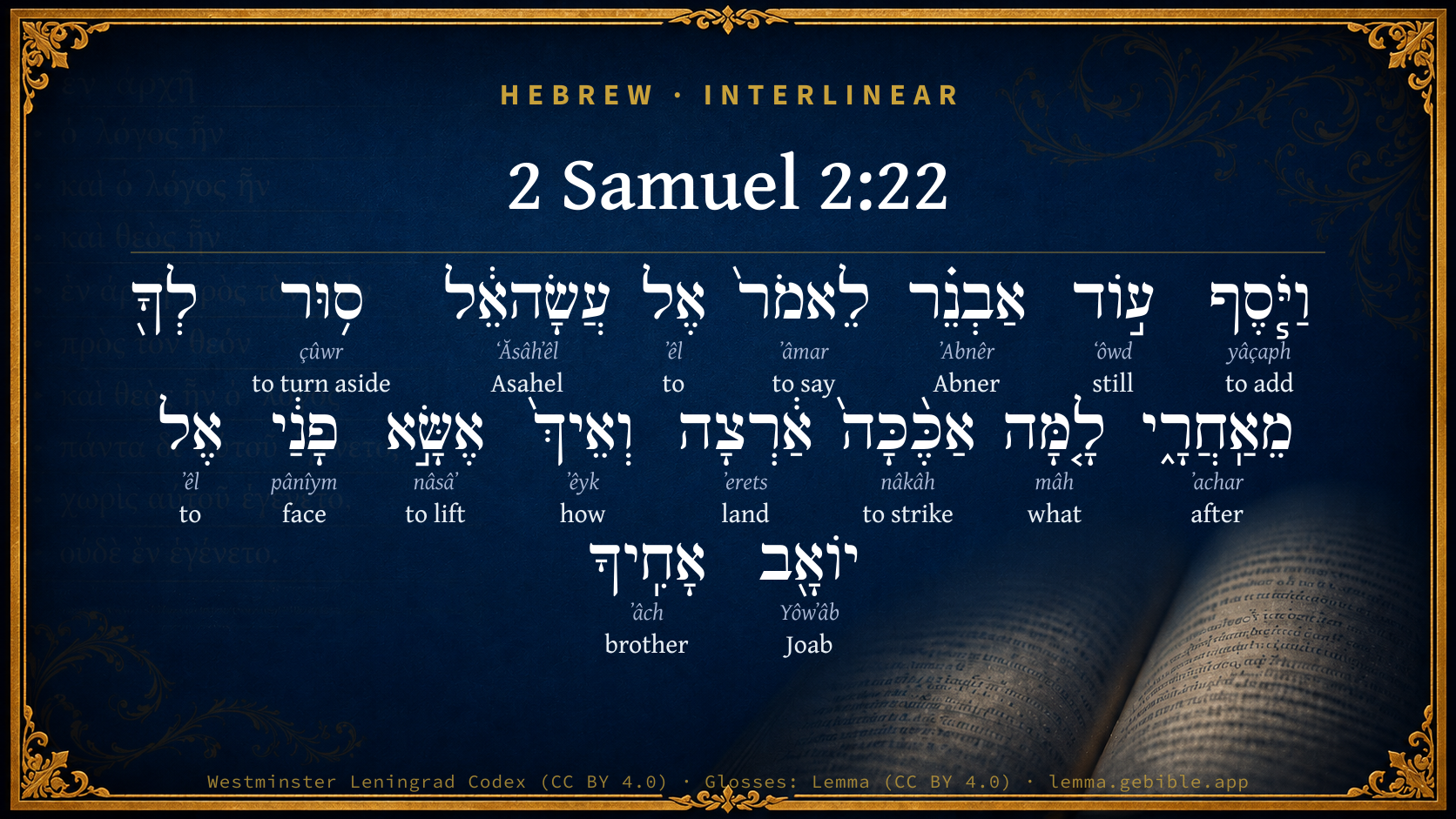
2 Samuel 2:22

Hebrew (Westminster Leningrad Codex) 2 Samuel 2:22 appears in the Hebrew Old Testament. The text above is from the Westminster Leningrad Codex. Each word links to its Strong’s number, a concise gloss, and parsing drawn from the Open Scriptures Hebrew Bible morphology. Click any word for its full Brown-Driver-Briggs (BDB) entry.
Download image
Cite this verse

2 Samuel 2:22 (World English Bible). Public Domain. Lemma interlinear Bible study tool, https://lemma.gebible.app/v/2-samuel/2/22.

Show BibTeX & RIS
BibTeX
RIS
English Translation
Abner said again to Asahel, Turn you aside from following me: why should I strike you to the ground? how then should I hold up my face to Joab your brother?
World English Bible · Public Domain
Download a study sheet

One document with this verse’s original text, its word-by-word gloss line, the meaning frame, cross-references with their text, attributed commentary, and full source and license credits — printable, and it pastes into notes with its structure intact.

This verse Autodidact and up

Study sheet (.html) Plain text (.txt)

A passage Seminary Student

Up to 50 verses in one chapter. A passage sheet keeps up to 6 commentary sources and 12 cross-references per verse, in the order this page ranks them, and says so on the sheet whenever that leaves anything out. Ask for a single verse and you get the Autodidact verse sheet above.

Everything on this page stays free to read, with no account — the sheet is a download of what is already on screen, not access to it.

Want to remove ads? Support Godless Engineer
Compare translations 3

The same verse in 3 English versions, stacked beneath the original-language interlinear above. Click any original word for its lexicon entry.

Each is an independent rendering of the whole verse — the interlinear is not word-aligned to these translations.

Highlighted words mark where these versions differ — a whole-verse word diff, not a word-by-word alignment.

  • World English Bible Public Domain
    Abner said again to Asahel, Turn you aside from following me: why should I strike you to the ground? how then should I hold up my face to Joab your brother?
  • King James Version Public Domain
    And Abner said again to Asahel, Turn thee aside from following me: wherefore should I smite thee to the ground? how then should I hold up my face to Joab thy brother?
  • unfoldingWord Literal Text CC BY-SA 4.0
    And Abner continued still, saying to Asahel, “Turn aside for yourself from behind me. Why should I strike you to the ground? Then how would I lift my face to Joab your brother?”

unfoldingWord Literal Text — © unfoldingWord, licensed CC BY-SA 4.0. Word-aligned USFM3 via Door43 (git.door43.org/unfoldingWord/en_ult).

Versions to compare (up to 4)

3 of 4 selected

Show all 18 translations

Every available English version of this verse, each an independent rendering of the whole verse.

  • World English Bible Public Domain
    Abner said again to Asahel, Turn you aside from following me: why should I strike you to the ground? how then should I hold up my face to Joab your brother?
  • Berean Standard Bible Public Domain
    Once again, Abner warned Asahel, “Stop chasing me. Why should I strike you to the ground? How could I show my face to your brother Joab?”
  • Majority Standard Bible Public Domain
    Once again, Abner warned Asahel, “Stop chasing me. Why should I strike you to the ground? How could I show my face to your brother Joab?”
  • King James Version Public Domain
    And Abner said again to Asahel, Turn thee aside from following me: wherefore should I smite thee to the ground? how then should I hold up my face to Joab thy brother?
  • American Standard Version (1901) Public Domain
    And Abner said again to Asahel, Turn thee aside from following me: wherefore should I smite thee to the ground? how then should I hold up my face to Joab thy brother?
  • Revised Version (1885) Public Domain
    And Abner said again to Asahel, Turn thee aside from following me: wherefore should I smite thee to the ground? how then should I hold up my face to Joab thy brother?
  • Geneva Bible (1599) Public Domain
    And Abner saide to Asahel, Depart from me: wherefore shoulde I smite thee to the grounde? howe then shoulde I be able to holde vp my face to Ioab thy brother?
  • Douay-Rheims (1899) Public Domain
    And again Abner said to Asael: Go off, and do not follow me, lest I be obliged to stab thee to the ground, and I shall not be able to hold up my face to Joab thy brother.
  • Young's Literal Translation Public Domain
    And Abner addeth again, saying unto Asahel, `Turn thee aside from after me, why do I smite thee to the earth? and how do I lift up my face unto Joab thy brother?'
  • Literal Standard Version CC BY-SA 4.0
    And Abner adds again, saying to Asahel, “Turn aside from after me, why do I strike you to the earth? And how do I lift up my face to your brother Joab?”
  • Unlocked Literal Bible CC BY-SA 4.0
    So Abner said again to Asahel, “Stop pursuing me. Why should I strike you to the ground? How then could I hold up my face to Joab, your brother?”
  • unfoldingWord Literal Text CC BY-SA 4.0
    And Abner continued still, saying to Asahel, “Turn aside for yourself from behind me. Why should I strike you to the ground? Then how would I lift my face to Joab your brother?”
  • Darby Bible Public Domain
    And Abner said again to Asahel, Turn thee aside from following me: why should I smite thee to the ground? how then should I hold up my face to Joab thy brother?
  • World Messianic Bible Public Domain
    Abner said again to Asahel, “Turn away from following me. Why should I strike you to the ground? How then could I look Joab your brother in the face?”
  • Webster's Bible Public Domain
    And Abner said again to Asahel, Turn thee aside from following me: Why should I smite thee to the ground? how then should I hold up my face to Joab thy brother?
  • Free Bible Version CC BY-SA 4.0
    Abner warned Asahel again. “Stop chasing me!” he shouted. “Why do you want me to kill you? How could I ever face your brother Joab?”
  • Bible in Basic English Public Domain
    Then again Abner said to Asahel, Go to one side, do not keep on coming after me: why will you make me put an end to you? for then I will be shamed before your brother Joab.
  • JPS Tanakh (1917) Public Domain
    And Abner said again to Asahel: 'Turn thee aside from following me; wherefore should I smite thee to the ground? how then should I hold up my face to Joab thy brother?'

Literal Standard Version (2020), Covenant Press — licensed CC BY-SA 4.0. Text via the HelloAO Bible API (eBible.org). Unlocked Literal Bible (unfoldingWord) — licensed CC BY-SA 4.0. Text via the HelloAO Bible API (eBible.org). unfoldingWord Literal Text — © unfoldingWord, licensed CC BY-SA 4.0. Word-aligned USFM3 via Door43 (git.door43.org/unfoldingWord/en_ult). Free Bible Version, Dr. Jonathan Gallagher — licensed CC BY-SA 4.0. Text via the HelloAO Bible API (eBible.org).

Word by word

More ways to search: Search by grammar → Find every occurrence → Compare this word →

Practice this passage: Drill this verse → Learn its vocabulary →

עֲשָׂהאֵ֔ל
ʻĂsâhʼêl
H6214
“Asahel”
Noun, Proper
Part of Speech
Noun
Type
Proper
Full BDB Definition

Origin: from H6213 and H410

TWOT: None

Asahel = "God-made" - nephew of David, son of David's sister Zeruiah, and brother of Joab and Abishai; swift of foot he was killed by Abner when he pursued him in battle and caught him - a Levite in the reign of king Jehoshaphat of Judah who went through the kingdom giving instruction in the law - a Levite in the reign of king Hezekiah of Judah in charge of the tithes and dedicated things in the temple - a priest, father of Jonathan, in the time of Ezra
  1. וַיֹּ֧סֶף yâçaph H3254 “and · to add” Conjunction + Verb, Hiphil, Sequential Imperfect, 3rd Person, Masculine, Singular
  2. ע֣וֹד ʻôwd H5750 “still” Adverb
  3. אַבְנֵ֗ר ʼAbnêr H74 “Abner” Noun, Proper
  4. לֵאמֹר֙ ʼâmar H559 “to say” Preposition + Verb, Qal, Infinitive Construct
  5. אֶל ʼêl H413 “to” Preposition
  6. ס֥וּר çûwr H5493 “turn aside” Verb, Qal, Imperative, 2nd Person, Masculine, Singular
  7. מֵאַֽחֲרָ֑י ʼachar H310 “from · after · me” Preposition + Preposition + Suffix, Personal, 1st Person, Common, Singular
  8. לָ֤מָּה mâh H4100 “to/for · what” Preposition + Particle, Interrogative
  9. אַכֶּ֨כָּה֙ nâkâh H5221 “to strike · you” Verb, Hiphil, Imperfect, 1st Person, Common, Singular + Suffix, Personal, 2nd Person, Masculine, Singular
  10. אַ֔רְצָה ʼerets H776 “land · toward” Noun, Common, Both, Singular, Absolute + Suffix, Demonstrative
  11. וְאֵיךְ֙ ʼêyk H349 “and · how” Conjunction + Particle, Interrogative
  12. אֶשָּׂ֣א nâsâʼ H5375 “to lift” Verb, Qal, Imperfect, 1st Person, Common, Singular
  13. פָנַ֔י pânîym H6440 “face(s) · my” Noun, Common, Both, Plural, Construct + Suffix, Personal, 1st Person, Common, Singular
  14. אֶל ʼêl H413 “to” Preposition
  15. יוֹאָ֖ב Yôwʼâb H3097 “Joab” Noun, Proper
  16. אָחִֽיךָ ʼâch H251 “brother · your” Noun, Common, Masculine, Singular, Construct + Suffix, Personal, 2nd Person, Masculine, Singular

About this verse

These counts appear in no published source. They are computed here, from the morphology-tagged text and Lemma’s own curated glosses. What Lemma adds →

18
words
16
distinct lemmas
Historical
section

Notable vocabulary

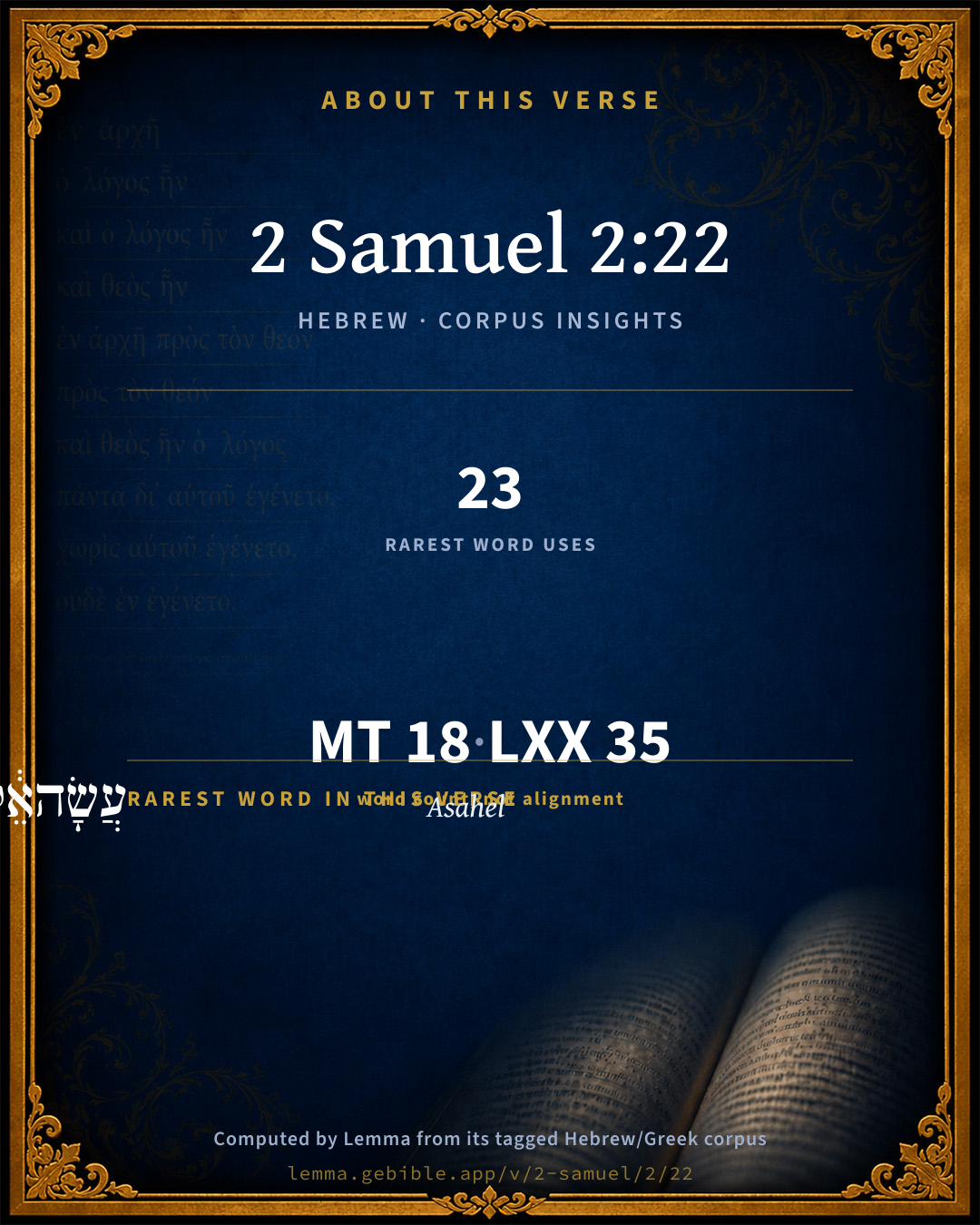
The rarest word here is עֲשָׂהאֵ֔ל Asahel H6214 — appearing just 23 times in the whole Hebrew Bible.

Shared distinctive vocabulary

עֲשָׂהאֵ֔ל Asahel H6214 occurs in 17 verses of the Hebrew Bible. Also found in:

Grammatical profile

  • 5 verbs
  • 6 nouns
  • 4 prepositions
  • 1 adverb
  • 2 particles

Verb forms

  • וַיֹּ֧סֶף Hiphil · Sequential Imperfect
  • לֵאמֹר֙ Qal · Infinitive Construct
  • ס֥וּר Qal · Imperative
  • אַכֶּ֨כָּה֙ Hiphil · Imperfect
  • אֶשָּׂ֣א Qal · Imperfect

Repetition

A word recurs within this verse — often emphatic in Hebrew:

  • אֶל to H413 ×2

Hebrew & Septuagint length

In English translation the verse runs 31 words from the Hebrew and 28 from the Septuagint (LXX English) — closely comparable.

A rough comparison of the two English renderings, which tokenize alike — not a word-level alignment.

Word counts can differ between the Hebrew and the Greek without any difference in meaning — e.g. the Hebrew direct-object marker אֵת has no separate Greek word, and Greek often adds the article ὁ.

In the original languages it is 18 Hebrew tokens and 35 Greek tokens — but the two are counted differently (Hebrew bundles its prefixes and suffixes into one token; the Greek is in lemma form), so that isn’t a like-for-like length.

Cross-references

4

Topical passages linked to 2 Samuel 2:22 in the Treasury of Scripture Knowledge — connected by theme and wording, ordered by reader-vote popularity; previews shown in the World English Bible.

  • 2 Samuel 3:27 When Abner was returned to Hebron, Joab took him aside into the midst of the gate to speak with him quietly, and struck him there in the body, so that he died, for the blood of Asahel his brother.
  • 2 Kings 14:10–12 You have indeed struck Edom, and your heart has lifted you up: glory of it, and abide at home; for why should you meddle to [your] hurt, that you should fall, even you, and Judah with you?
  • Proverbs 29:1 He who is often rebuked and stiffens his neck Will be destroyed suddenly, with no remedy.
  • Ecclesiastes 6:10 Whatever has been, its name was given long ago; and it is known what man is; neither can he contend with him who is mightier than he.

Cross-references courtesy of OpenBible.info (CC BY 4.0).

Hebrew and Greek witnesses Masoretic Hebrew ↔ Greek Septuagint

The same verse in the two great witnesses to the Old Testament, shown verse-for-verse.

These are two independent witnesses, not word-aligned to each other, and the Septuagint is shown in lemma (dictionary) form.

Hebrew 2 Samuel 2:22 Masoretic · Westminster Leningrad Codex

וַיֹּ֧סֶף ע֣וֹד אַבְנֵ֗ר לֵאמֹר֙ אֶל עֲשָׂהאֵ֔ל ס֥וּר לְךָ֖ מֵאַֽחֲרָ֑י לָ֤מָּה אַכֶּ֨כָּה֙ אַ֔רְצָה וְאֵיךְ֙ אֶשָּׂ֣א פָנַ֔י אֶל יוֹאָ֖ב אָחִֽיךָ

Abner said again to Asahel, Turn you aside from following me: why should I strike you to the ground? how then should I hold up my face to Joab your brother?

World English Bible · Public Domain

Greek LXX 2 Samuel 2:22 Septuagint · lemma form

καί προςτίθημι ἔτι αβεννηρ λέγω ὁ ασαηλ ἀποἵστημι ἀπό ἐγώ ἵνα μή πατάσσω σύ εἰς ὁ γῆ καί πῶς αἴρω ὁ πρόσωπον ἐγώ πρός ιωαβ καί ποῦ εἰμί οὗτος ἐπιστρέφω πρός ιωαβ ὁ ἀδελφός σύ

And Abenner said yet again to Asael, Stand aloof from me, lest I strike you to the ground? and how should I lift up my face to Joab?

LXX2012 (modern English Septuagint) · Public Domain

Hebrew: Westminster Leningrad Codex (CC BY 4.0). Greek: Septuagint (public domain); English from LXX2012 (modern English Septuagint) (Public Domain). How the Septuagint differs from the Hebrew →

Targum (Aramaic paraphrase)

1

The Targum is the ancient Jewish Aramaic paraphrase of the Hebrew Scriptures — an interpretive translation, not the Hebrew text itself. Onkelos (literal) and Pseudo-Jonathan (expansive) render the Torah, and Jonathan the Prophets. Coverage is partial: where no permissively-licensed English translation exists for a verse, only the Aramaic is shown. This is verse-level text, not a word-by-word alignment to the Hebrew.

  1. Targum Jonathan Prophets (Joshua–Malachi)
    וְאוֹסִיף עוֹד אַבְנֵר לְמֵימָר לַעֲשָׂהאֵל זוּר לָךְ מִבַּתְרַי לָמָה אֶקְטְלִינָךְ וְאֶרְמִינָךְ לְאַרְעָא וְאֵיכְדִין אֶזְקוֹף אַפֵּי וְאֵיחָמֵי לְיוֹאָב אָחוּךְ:

    (no public-domain English translation for this verse)

    Targum Jonathan — Aramaic: “Mikraot Gedolot” (public domain). English: “Sefaria Community Translation” (CC0 1.0 (public-domain dedication)); “London "Chaldee Paraphrase," 1871” (public domain). Text via Sefaria.

Commentary

Notes on 2 Samuel 2:22 from classic Christian and Jewish commentators (each source and its license shown beneath its notes). The classic Christian expositions comment on the surrounding passage and are grouped to its opening verse, so a note may address several verses; the Jewish commentaries on the Tanakh (Rashi and others) are per-verse, so they appear only where the commentator wrote on this verse.

Lemma curates 59 commentaries, every one of them public domain or Creative Commons licensed, each selected and text-cleaned for this edition rather than reprinted as found. About our sources →

Trapp's Complete Commentary

John Trapp

2Sa 2:22 And Abner said again to Asahel, Turn thee aside from following me: wherefore should I smite thee to the ground? how then should I hold up my face to Joab thy brother?

Ver. 22. Wherefore should I smite thee to the ground?] As I shall be forced to do, if thou desist not. If a man must kill or be killed, (1.) He must flee; (2.) Defend himself by all means possible, dissuading the party, as here, and otherwise as he may. That tenet of Navarrus is most false, that a man may lawfully kill another, for the avoiding of a box on the ear, and to recover his honour. And so is that of Soto, A man may kill another in his own defence, because it is a shame to flee from an adversary. These are your Popish casuists.

John Trapp, A Commentary or Exposition upon All the Books of the Old and New Testament (1647–1656) — public domain. Text from a community e-Sword module.

Geneva Bible (1599)

Geneva Bible translators

Why dost thou provoke me to kill thee?

Geneva Bible (1599) marginal notes — public domain. Text via Bolls.life.

The Cambridge Bible for Schools and Colleges

gen. ed. J. J. S. Perowne

22. Turn thee aside] Asahel was probably a mere stripling, and no match for Abner, who, wishing to avoid a feud with Joab and an obstacle to making favourable terms with David on the fall of Saul’s house, again exhorted Asahel to abandon the pursuit.

hold up my face to Joab] Meet him with the steady gaze which is the index of a clear conscience, the opposite of the downcast look which betokens shame and guilt. Cp. Job_11:15.

The Cambridge Bible for Schools and Colleges (gen. ed. J. J. S. Perowne; Cambridge University Press, 1878–1918) — public domain. Text from a community e-Sword module.

John Gill's Exposition

And Abner said again to Asahel,.... Being loath to dispatch him:

turn thee aside from following me, wherefore should I smite thee to the ground? which was giving him fair warning, and letting him know what he must expect, if he did not desist from his pursuit:

how then should I hold up my face to Joab thy brother? the general of David's army, a stout valiant commander, a man of spirit and resentment, whom Abner knew full well, and that should he slay his brother, he would never be friendly with him, or look pleasantly on him; he would never forgive him, but seek ways and means to avenge his blood on him and by this it seems as if Abner was conscious to himself that he was in a wrong cause, that the kingdom was of right David's, and would be his, and he must be obliged to make peace with him; when he should stand in need of Joab as his friend, which he could not expect, if he slew his brother, nor to live in favour and friendship with him hereafter.

John Gill's Exposition of the Whole Bible (1746–1763) — public domain (CC PDM 1.0). Text via the HelloAO Bible API.

Haydock's Catholic Bible Commentary

Brother. It seems they were great friends, though they had espoused different parties. (Calmet)

George Leo Haydock (1774–1849), Haydock's Catholic Family Bible and Commentary, 1859 edition — public domain. Excludes Psalms (Douay-Rheims chapter numbering differs from Protestant) and Deuterocanonical books (Catholic canon only).

Matthew Poole's English Annotations

He was loth to enrage Joab too much against him, because his guilty conscience told him that his cause was bad, and herefore he presaged ill success, and that he might need such a friend as Joab to make his peace with David.

Matthew Poole's English Annotations on the Holy Bible (1683–1685) — public domain. Text from a community e-Sword/MySword module.

Whedon's Commentary on the Bible

Daniel D. Whedon

22. Wherefore should I smite thee to the ground — Abner knew that his youthful pursuer was no match for him in strategy or war, and he did not wish to kill him because of the personal enmity that would thus arise between himself and Joab. See note on 2Sa_3:39.

Daniel D. Whedon (gen. ed.), Commentary on the Old and New Testaments (1874–1909) — public domain. Text from a community e-Sword module.

unfoldingWord translationNotes

Door43 World Missions Community

Why should I strike you to the ground?

This rhetorical question is used to warn Asahel of the danger he faced. "Strike to the ground" is a polite way of saying "to kill." AT: "I do not wish to kill you" (See: Rhetorical Question and Euphemism)

How then could I hold up my face to Joab, your brother?

This rhetorical question emphasizes that Abner does not want to fight and kill Asahel because it would destroy Abner's relationship with Joab. Here "hold up my face to Joab" is an idiom that means that he would be too ashamed to look at Joab. AT: "I would be too ashamed to look at your brother, Joab" (See: Rhetorical Question and Idiom)

turn aside

This means to "halt" or "stop chasing."

the blunt end of his spear

This refers to the handle, which is not sharp or designed to pierce anything. It can be implied that Abner was only trying to stop Asahel from following him, and did not intend to kill him. (See: Assumed Knowledge and Implicit Information)

translationWords

face

body

spear

die

unfoldingWord translationNotes — © Distant Shores Media and the Door43 World Missions Community, licensed CC BY-SA 4.0. Source: git.door43.org/Door43/en_tn.

Lesson kit

Teaching starters — assembled from the data on this page, not authored interpretation. Every prompt links to the verse data it draws on. Edit before teaching.

2 Samuel, in the Historical, opens this verse with 18 words (16 distinct Hebrew lemmas). Its most distinctive word is ʻĂsâhʼêl (“Asahel”). A historical commentator’s framing appears above. Read the whole chapter for the surrounding context.

Discussion questions

  1. The word ʻĂsâhʼêl carries the sense “Asahel.” How does it shape the verse?
  2. How does 2 Samuel 2:18, which shares the word «Asahel», read alongside this verse?
  3. What does the repetition of “to” (2× in this one verse) do in this verse?
  4. These translations render this verse differently. What is at stake in choosing one wording over another?
  5. «וַיֹּ֧סֶף» is a Hiphil Sequential Imperfect verb. How does that grammatical form shape the action described?
  6. Compare how Trapp's Complete Commentary and Geneva Bible (1599) read this verse. Where do they agree or differ?

Things to notice

Reading settings

Reading text

Shown beneath each verse's original-language words.

Old Testament
Old Testament edition

Read the OT as the Masoretic Hebrew (MT) or the Greek Septuagint (LXX).

English shown for the Greek Septuagint (in the Hebrew ↔ Greek comparison).

Comparing translations? Open the Compare panel on any verse page to stack up to four side by side.