

2 Chronicles 9:21

Hebrew (Westminster Leningrad Codex) 2 Chronicles 9:21 appears in the Hebrew Old Testament. The text above is from the Westminster Leningrad Codex. Each word links to its Strong’s number, a concise gloss, and parsing drawn from the Open Scriptures Hebrew Bible morphology. Click any word for its full Brown-Driver-Briggs (BDB) entry.
Download image
Cite this verse

2 Chronicles 9:21 (World English Bible). Public Domain. Lemma interlinear Bible study tool, https://lemma.gebible.app/v/2-chronicles/9/21.

Show BibTeX & RIS
BibTeX
RIS
English Translation
For the king had ships that went to Tarshish with the servants of Huram; once every three years came the ships of Tarshish, bringing gold, and silver, ivory, and apes, and peacocks.
World English Bible · Public Domain
Download a study sheet

One document with this verse’s original text, its word-by-word gloss line, the meaning frame, cross-references with their text, attributed commentary, and full source and license credits — printable, and it pastes into notes with its structure intact.

This verse Autodidact and up

Study sheet (.html) Plain text (.txt)

A passage Seminary Student

Up to 50 verses in one chapter. A passage sheet keeps up to 6 commentary sources and 12 cross-references per verse, in the order this page ranks them, and says so on the sheet whenever that leaves anything out. Ask for a single verse and you get the Autodidact verse sheet above.

Everything on this page stays free to read, with no account — the sheet is a download of what is already on screen, not access to it.

Want to remove ads? Support Godless Engineer
Compare translations 3

The same verse in 3 English versions, stacked beneath the original-language interlinear above. Click any original word for its lexicon entry.

Each is an independent rendering of the whole verse — the interlinear is not word-aligned to these translations.

Highlighted words mark where these versions differ — a whole-verse word diff, not a word-by-word alignment.

  • World English Bible Public Domain
    For the king had ships that went to Tarshish with the servants of Huram; once every three years came the ships of Tarshish, bringing gold, and silver, ivory, and apes, and peacocks.
  • King James Version Public Domain
    For the king's ships went to Tarshish with the servants of Huram: every three years once came the ships of Tarshish bringing gold, and silver, ivory, and apes, and peacocks.
  • unfoldingWord Literal Text CC BY-SA 4.0
    For the ships belonging to the king went to Tarshish with the servants of Huram. Once every three years the ships of Tarshish would come carrying gold and silver, ivories, and apes and baboons.

unfoldingWord Literal Text — © unfoldingWord, licensed CC BY-SA 4.0. Word-aligned USFM3 via Door43 (git.door43.org/unfoldingWord/en_ult).

Versions to compare (up to 4)

3 of 4 selected

Show all 18 translations

Every available English version of this verse, each an independent rendering of the whole verse.

  • World English Bible Public Domain
    For the king had ships that went to Tarshish with the servants of Huram; once every three years came the ships of Tarshish, bringing gold, and silver, ivory, and apes, and peacocks.
  • Berean Standard Bible Public Domain
    For the king had the ships of Tarshish that went with Hiram’s servants, and once every three years the ships of Tarshish would arrive bearing gold, silver, ivory, apes, and peacocks.
  • Majority Standard Bible Public Domain
    For the king had the ships of Tarshish that went with Hiram’s servants, and once every three years the ships of Tarshish would arrive bearing gold, silver, ivory, apes, and peacocks.
  • King James Version Public Domain
    For the king's ships went to Tarshish with the servants of Huram: every three years once came the ships of Tarshish bringing gold, and silver, ivory, and apes, and peacocks.
  • American Standard Version (1901) Public Domain
    For the king had ships that went to Tarshish with the servants of Huram; once every three years came the ships of Tarshish, bringing gold, and silver, ivory, and apes, and peacocks.
  • Revised Version (1885) Public Domain
    For the king had ships that went to Tarshish with the servants of Huram: once every three years came the ships of Tarshish, bringing gold, and silver, ivory, and apes, and peacocks.
  • Geneva Bible (1599) Public Domain
    For the Kings ships went to Tarshish with the seruants of Huram, euery three yeere once came the ships of Tarshish, and brought golde, and siluer, yuorie, and apes, and peacockes.
  • Douay-Rheims (1899) Public Domain
    For the king's ships went to Tharsis with the servants of Hiram, once in three years: and they brought thence gold and silver, and ivory, and apes, and peacocks.
  • Young's Literal Translation Public Domain
    for ships of the king are going to Tarshish, with servants of Huram: once in three years come do the ships of Tarshish bearing gold, and silver, ivory, apes, and peacocks.
  • Literal Standard Version CC BY-SA 4.0
    for ships of the king are going to Tarshish with servants of Huram: once in three years the ships of Tarshish come carrying gold, and silver, ivory, apes, and peacocks [[or monkeys]].
  • Unlocked Literal Bible CC BY-SA 4.0
    The king had at sea a fleet of oceangoing ships, along with the fleet of Hiram. Once every three years the fleet brought gold, silver, and ivory, as well as apes and baboons.
  • unfoldingWord Literal Text CC BY-SA 4.0
    For the ships belonging to the king went to Tarshish with the servants of Huram. Once every three years the ships of Tarshish would come carrying gold and silver, ivories, and apes and baboons.
  • Darby Bible Public Domain
    For the king's ships went to Tarshish with the servants of Huram: once in three years came the ships of Tarshish, bringing gold and silver, ivory, and apes, and peacocks.
  • World Messianic Bible Public Domain
    For the king had ships that went to Tarshish with Huram’s servants. Once every three years, the ships of Tarshish came bringing gold, silver, ivory, apes, and peacocks.
  • Webster's Bible Public Domain
    For the king's ships went to Tarshish with the servants of Huram: once every three years came the ships of Tarshish bringing gold, and silver, ivory, and apes, and peacocks.
  • Free Bible Version CC BY-SA 4.0
    The king had a fleet of ships from Tarshish crewed by Hiram's sailors. Once every three years the ships of Tarshish would arrive with a cargo of gold, silver, ivory, apes, and peacocks.
  • Bible in Basic English Public Domain
    For the king had Tarshish-ships sailing with the servants of Huram: once every three years the Tarshish-ships came back with gold and silver, ivory and monkeys and peacocks.
  • JPS Tanakh (1917) Public Domain
    For the king had ships that went to Tarshish with the servants of Huram; once every three years came the ships of Tarshish, bringing gold, and silver, ivory, and apes, and peacocks.

Literal Standard Version (2020), Covenant Press — licensed CC BY-SA 4.0. Text via the HelloAO Bible API (eBible.org). Unlocked Literal Bible (unfoldingWord) — licensed CC BY-SA 4.0. Text via the HelloAO Bible API (eBible.org). unfoldingWord Literal Text — © unfoldingWord, licensed CC BY-SA 4.0. Word-aligned USFM3 via Door43 (git.door43.org/unfoldingWord/en_ult). Free Bible Version, Dr. Jonathan Gallagher — licensed CC BY-SA 4.0. Text via the HelloAO Bible API (eBible.org).

Word by word

More ways to search: Search by grammar → Find every occurrence → Compare this word →

Practice this passage: Drill this verse → Learn its vocabulary →

שֶׁנְהַבִּ֥ים
shenhabbîym
H8143
“ivory”
Noun, Common, Masculine, Plural, Absolute
Part of Speech
Noun
Type
Common
Gender
Masculine
Number
Plural
State
Absolute
Full BDB Definition

Origin: from H8127 and the pl. apparently of a foreign word

TWOT: 2422c

ivory
  1. כִּֽי kîy H3588 “that” Conjunction
  2. אֳנִיּ֤וֹת ʼŏnîyâh H591 “ships” Noun, Common, Feminine, Plural, Absolute
  3. לַמֶּ֨לֶךְ֙ melek H4428 “to/for the · king” Preposition, Determined + Noun, Common, Masculine, Singular, Absolute
  4. הֹלְכ֣וֹת hâlak H1980 “walking” Verb, Qal, Participle Active, Feminine, Plural, Absolute
  5. תַּרְשִׁ֔ישׁ Tarshîysh H8659 “Tarshish” Noun, Proper
  6. עִ֖ם ʻim H5973 “with” Preposition
  7. עַבְדֵ֣י ʻebed H5650 “servants of” Noun, Common, Masculine, Plural, Construct
  8. חוּרָ֑ם Chûwrâm H2361 “Huram” Noun, Proper
  9. אַחַת֩ ʼechâd H259 “one” Adjective, Cardinal number, Feminine, Singular, Absolute
  10. לְשָׁל֨וֹשׁ shâlôwsh H7969 “to/for · three” Preposition + Adjective, Cardinal number, Feminine, Singular, Absolute
  11. שָׁנִ֜ים shâneh H8141 “years” Noun, Common, Feminine, Plural, Absolute
  12. תָּב֣וֹאנָה bôwʼ H935 “to enter” Verb, Qal, Imperfect, 3rd Person, Feminine, Plural
  13. אֳנִיּ֣וֹת ʼŏnîyâh H591 “ships of” Noun, Common, Feminine, Plural, Construct
  14. תַּרְשִׁ֗ישׁ Tarshîysh H8659 “Tarshish” Noun, Proper
  15. נֹֽשְׂאוֹת֙ nâsâʼ H5375 “lifting” Verb, Qal, Participle Active, Feminine, Plural, Absolute
  16. זָהָ֣ב zâhâb H2091 “gold” Noun, Common, Masculine, Singular, Absolute
  17. וָכֶ֔סֶף keçeph H3701 “and · silver” Conjunction + Noun, Common, Masculine, Singular, Absolute
  18. וְקוֹפִ֖ים qôwph H6971 “and · apes” Conjunction + Noun, Common, Masculine, Plural, Absolute
  19. וְתוּכִּיִּֽים tukkîy H8500 “and · peacocks” Conjunction + Noun, Common, Masculine, Plural, Absolute

About this verse

These counts appear in no published source. They are computed here, from the morphology-tagged text and Lemma’s own curated glosses. What Lemma adds →

20
words
18
distinct lemmas
Historical
section

Notable vocabulary

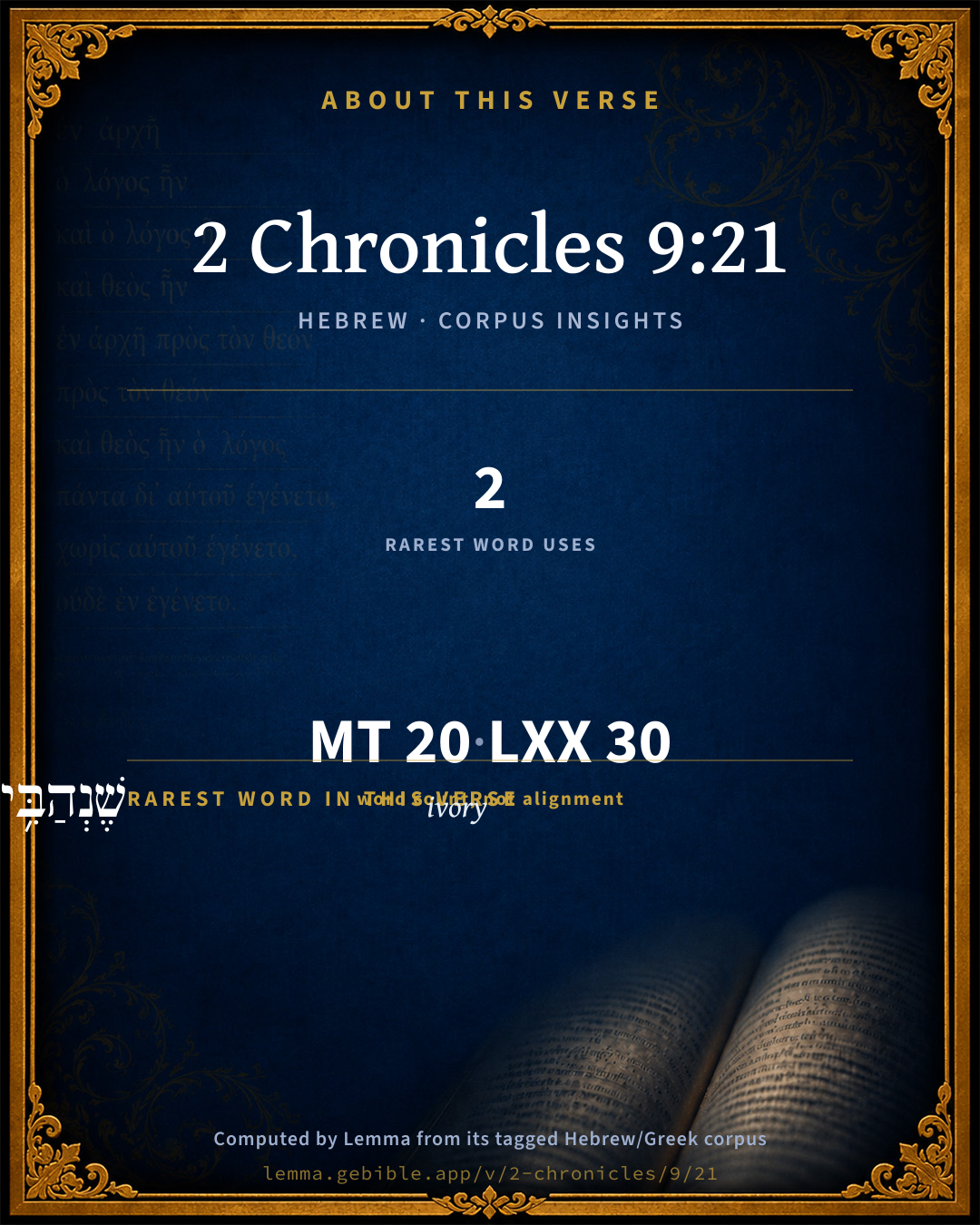
The rarest word here is שֶׁנְהַבִּ֥ים ivory H8143 — appearing just 2 times in the whole Hebrew Bible.

Shared distinctive vocabulary

שֶׁנְהַבִּ֥ים ivory H8143 occurs in 2 verses of the Hebrew Bible. Also found in:

Grammatical profile

  • 3 verbs
  • 13 nouns
  • 2 adjectives
  • 1 preposition
  • 1 conjunction

Verb forms

  • הֹלְכ֣וֹת Qal · Participle Active
  • תָּב֣וֹאנָה Qal · Imperfect
  • נֹֽשְׂאוֹת֙ Qal · Participle Active

Repetition

Words recur within this verse — often emphatic in Hebrew:

  • אֳנִיּ֤וֹת ship H591 ×2
  • תַּרְשִׁ֔ישׁ Tarshish H8659 ×2

Hebrew & Septuagint length

In English translation the verse runs 32 words from the Hebrew and 34 from the Septuagint (LXX English) — closely comparable.

A rough comparison of the two English renderings, which tokenize alike — not a word-level alignment.

Word counts can differ between the Hebrew and the Greek without any difference in meaning — e.g. the Hebrew direct-object marker אֵת has no separate Greek word, and Greek often adds the article ὁ.

In the original languages it is 20 Hebrew tokens and 30 Greek tokens — but the two are counted differently (Hebrew bundles its prefixes and suffixes into one token; the Greek is in lemma form), so that isn’t a like-for-like length.

Cross-references

4

Topical passages linked to 2 Chronicles 9:21 in the Treasury of Scripture Knowledge — connected by theme and wording, ordered by reader-vote popularity; previews shown in the World English Bible.

  • 1 Kings 10:22 For the king had at sea a navy of Tarshish with the navy of Hiram: once every three years came the navy of Tarshish, bringing gold, and silver, ivory, and apes, and peacocks.
  • 1 Kings 22:48 Jehoshaphat made ships of Tarshish to go to Ophir for gold: but they didn't go; for the ships were broken at Ezion Geber.
  • 2 Chronicles 20:36–37 and he joined himself with him to make ships to go to Tarshish; and they made the ships in Ezion Geber.
  • Job 39:13 "The wings of the ostrich wave proudly; But are they the feathers and plumage of love?

Cross-references courtesy of OpenBible.info (CC BY 4.0).

Hebrew and Greek witnesses Masoretic Hebrew ↔ Greek Septuagint

The same verse in the two great witnesses to the Old Testament, shown verse-for-verse.

These are two independent witnesses, not word-aligned to each other, and the Septuagint is shown in lemma (dictionary) form.

Hebrew 2 Chronicles 9:21 Masoretic · Westminster Leningrad Codex

כִּֽי אֳנִיּ֤וֹת לַמֶּ֨לֶךְ֙ הֹלְכ֣וֹת תַּרְשִׁ֔ישׁ עִ֖ם עַבְדֵ֣י חוּרָ֑ם אַחַת֩ לְשָׁל֨וֹשׁ שָׁנִ֜ים תָּב֣וֹאנָה אֳנִיּ֣וֹת תַּרְשִׁ֗ישׁ נֹֽשְׂאוֹת֙ זָהָ֣ב וָכֶ֔סֶף שֶׁנְהַבִּ֥ים וְקוֹפִ֖ים וְתוּכִּיִּֽים

For the king had ships that went to Tarshish with the servants of Huram; once every three years came the ships of Tarshish, bringing gold, and silver, ivory, and apes, and peacocks.

World English Bible · Public Domain

Greek LXX 2 Chronicles 9:21 Septuagint · lemma form

ὅτι ναῦς ὁ βασιλεύς πορεύομαι εἰς θαρσις μετά ὁ παῖς χιραμ ἅπαξ διά τρεῖς ἔτος ἄρχω πλοῖον ἐκ θαρσις ὁ βασιλεύς γέμω χρυσίον καί ἀργύριον καί ὀδούς ἐλεφάντινος καί πίθηκος

For a ship went for the king to Tharsis with the servants of Chiram: once every three years came vessels from Tharsis to the king, laden with gold, and silver, and ivory, and apes.

LXX2012 (modern English Septuagint) · Public Domain

Hebrew: Westminster Leningrad Codex (CC BY 4.0). Greek: Septuagint (public domain); English from LXX2012 (modern English Septuagint) (Public Domain). How the Septuagint differs from the Hebrew →

Commentary

Notes on 2 Chronicles 9:21 from classic Christian and Jewish commentators (each source and its license shown beneath its notes). The classic Christian expositions comment on the surrounding passage and are grouped to its opening verse, so a note may address several verses; the Jewish commentaries on the Tanakh (Rashi and others) are per-verse, so they appear only where the commentator wrote on this verse.

Lemma curates 59 commentaries, every one of them public domain or Creative Commons licensed, each selected and text-cleaned for this edition rather than reprinted as found. About our sources →

The Biblical Illustrator

Joseph S. Exell

2Ch_9:21

And apes, and peacocks.

Apes and peacocks

(to children):--We learn from this passage--

I. That a rich man can get, as far as worldly goods are concerned, almost what he likes in this world.

II. What even wise men will do, when they have more money than they know how to use. Such was Solomons position; apes and peacocks were costly, and so he had a special desire to have s goodly number about him. (D. Davies.)

Apes

I. The ape is something like us, and yet he is very much unlike us.

1. He cannot speak.

2. He cannot learn.

3. He has no foresight or forethought. It is wonderful how deceptive appearances can be.

II. The ape is only a caricature of a man, and does not imitate him in his better movements or habits; so you generally find that if a child or man apes another, he apes him only in his failings. I saw a boy the other day, who could not have been more than eleven, vigorously puffing the end of a cigar that he had picked up somewhere. He evidently thought he looked like a man, but I need not tell you how disgusted I felt, and wished that he could imitate the man in a more manly way. He stupidly aped a gentleman whose failing was that he smoked at all. Learn to be natural. Let the one desire of your life be to be true. Never put on a false look or try to live under false pretences. (D. Davies.)

Peacocks

The peacock has a beautiful tail, and in this respect no bird can match him. But the more you know about him the less you think of his tail. He can only screech hideously when he tries to sing. He is also a very gluttonous and a very selfish and destructive character. The beautiful bird has nothing to commend it except its beautiful feathers. Its characteristic failing is vanity.

I. I want you to remember that there are some people in the world like that peacock. Everything depends upon their dress, or their outward appearance. But if you get to know their disposition and their conduct, you will very often cease to be charmed with their dress.

II. I want you to guard yourselves against attaching too much importance to appearances. God does not. Learn that the truest ornament is a meek and gentle spirit, which in the sight of God is of great price. (D. Davies.)

The Biblical Illustrator, edited by Joseph S. Exell (c. 1880s–1900s) — public domain. Text from a community e-Sword module.

Tyndale Open Study Notes

Tyndale Open Resources

9:21 Solomon’s fleet of trading ships of Tarshish was used to transport cargo. The peculiar shape of these strong ships allowed them to sail long distances in the open sea. • and peacocks: The meaning of the Hebrew word is uncertain. Solomon was so great that he imported fine goods and exotic animals from the farthest reaches of the known world.

Tyndale Open Study Notes — © Tyndale Open Resources, licensed CC BY-SA 4.0. Text via the HelloAO Bible API.

Geneva Bible (1599)

Geneva Bible translators

Which country of the best writers is thought to be Cilicia, read 1 Kings 10:22.

Geneva Bible (1599) marginal notes — public domain. Text via Bolls.life.

Jamieson, Fausset & Brown

Robert Jamieson, A. R. Fausset & David Brown

the king's ships went to Tarshish--rather, "the king's ships of Tarshish went" with the servants of Huram.

ships of Tarshish--that is, in burden and construction like the large vessels built for or used at Tarshish [CALMET, Fragments].

Jamieson, Fausset & Brown — Commentary Critical and Explanatory on the Whole Bible (1871) — public domain (CC PDM 1.0). Text via the HelloAO Bible API.

Adam Clarke's Commentary

Verse 21. The king's ships went to Tarshish] "Went to Africa." - Targum.

Adam Clarke's Commentary on the Bible (1810–1826) — public domain. Text from a community e-Sword/MySword module.

Ellicott's Commentary for English Readers

(21) For the king’s ships went to Tarshish.—1Ki_10:22, “For the king had a Tarshish fleet on the sea, with the fleet of Hiram.” It is generally assumed that the words of the chronicler are an erroneous paraphrase of the expression, “Tarshish fleet,” i.e., a fleet of ships fitted for long voyages. (Comp. Isa_2:16.) The identity of the present fleet with that mentioned above in 2Ch_9:10 is not evident. Solomon may have had a fleet in the Mediterranean (“the sea” of 1Ki_10:22) trading westward, as well as in the Red Sea, trading south and east. Some have identified Tarshish with Cape Tarsis in the Persian Gulf. (See Note on 2Ch_20:36.)

A Bible Commentary for English Readers, edited by Charles John Ellicott (1878–1897) — public domain. Text from a community e-Sword module.

The Cambridge Bible for Schools and Colleges

gen. ed. J. J. S. Perowne

21. For the king’s ships went to Tarshish] R.V. For the king had ships that went to Tarshish. Here the Chronicler misunderstands the parallel passage (1Ki_10:22, “For the king had at sea a navy of Tarshish”). “Navy (or ‘ships’) of Tarshish” is a phrase meaning large ships fit for long voyages; cp. Psa_48:7. The merchandise mentioned in this verse doubtless came from the East and not from Tarshish (= Tartessus in Spain).

every three years once] R.V. once every three years.

apes] These animals were much sought after; they appear e.g. pictured in relief on the Black Obelisk (in the British Museum) among the tribute received by Shalmaneser II. of Assyria.

The Cambridge Bible for Schools and Colleges (gen. ed. J. J. S. Perowne; Cambridge University Press, 1878–1918) — public domain. Text from a community e-Sword module.

Haydock's Catholic Bible Commentary

Tharsis. Any distant place was so called. (Tirinus)

George Leo Haydock (1774–1849), Haydock's Catholic Family Bible and Commentary, 1859 edition — public domain. Excludes Psalms (Douay-Rheims chapter numbering differs from Protestant) and Deuterocanonical books (Catholic canon only).

The Pulpit Commentary

To Tarshish. The parallel has, in both clauses of its verse, (1Ki_10:22) "ships of Tarshish." The order of the words in the former clause of our present verse, that compels us to read, "going to Tarshish," certifies the correct meaning. The word "Tarshish" (the subsequent Tartessus) covered a district in South Spain, as well as named a town and river, and stretched opposite the coast of Africa. Both coasts were beneath Phoenician rule, and a voyage to Tarshish would most naturally mean calling at many a port, and many an African port, from one and another of which all the imports here spoken of would be obtainable. The meaning of the Hebrew root of Tarshish is "to subjugate." The town lay between the two mouths of the river Baetis, now Guadal-quiver. Gesenius thinks that the writer of Chronicles says, in ignorance, "to Tarshish." and that the ships went to Ophir! These passages do not say that the voyage, whatever it was, took three years; much less that that length of time was necessary. Whether voyages were in Solomon"s time made from the Red Sea, circumnavigating Africa, into the Mediterranean, is not certain. If they were such voyages, taken at a sauntering pace, with calls at many ports and easygoing delays, they may easily have consumed as long a space of time as three years! The theory that Tarshish was Tarsus in Cilicia is easily and conclusively negatived. The names in Hebrew of "ivory, apes, and peacocks" have been said to be of Indian origin. This is far from proved, and, as regards the first two, may be said to be sufficiently disproved. But if it all were so, still the fact that the Hebrew names were of an Indian language derivation would go very short way to prove that the Hebrew people got the things represented by them direct, or at all, from India.

Ivory; Hebrew, The Authorized Version rendering "ivory" occurs ten times in the Old Testament, having for its original the Hebrew (1Ki_10:18 1Ki_22:39; 2Ch_9:17; Psa_45:8; Son_5:14; Son_7:4; Eze_27:6, Eze_27:15; Amo_3:15 Amo_6:4)

In all these cases, two of them being in closest juxtaposition with the present and its parallel occasion, the word speaks of ivory that is being used, i.e. as though it were manufactured material or ready for manufacture. But in our passage and its parallel, where the different word given above is found, it is manifest that it speaks of the material, so to say, in the rough, as just "tooth or tusk of ;" but, further, what the is is not yet ascertained. It is not a word known in the Hebrew vocabulary. Gesenius finds the Sanscrit ibhas, which signifies an "elephant;" Canon Rawlinsen finds in some Assyrian inscriptions a word habba, used of both elephant and camel, but probably having for its generic signification "a great animal;" Keil (on the parallel) finds a Coptic word, eboy, the Latin elephas, to which he prefixes the Hebrew article h. The Targum Jonathan shows at once lypiDAve. Gesenius, in his "Thesaurus," calls also timely attention towhw Eze_27:15, where we read, "They brought thee a present, horns of ivory and ebony" (Hebrew, Chethiv, Keri, w ve twOnrq). But no use of "ebony" happens to be mentioned in the connection of our present passages or subject. Thus it will be seen that no little ingenuity has been employed to hunt down this little word, though as yet not quite successfully. More may be seen in Smith"s "Dictionary of the Bible," 1:906. Apes; Hebrew, Conder ("Handbook to the Bible," 2nd edit., p. 390) says, "This word is identical with the name of the monkey in Tamil. " Keil connects it with the Sanscrit kapi, but does not believe, with Gesenius, that the animal came from India, but Ethiopia. In a valuable note in the" Speaker"s Commentary" we read, "It is found" (not stated where) "that the word was an Egyptian word, signifying a kind of monkey, in use in the time of Thothmes II, i.e. about the time of the Israelites" exodus." (For Herodotus"s testimony respecting ivory and apes in North Africa, see his "Hist.," 4:91.) Peacocks; Hebrew, Conder ("Handbook to the Bible," p. 393") says a Tamil word, tokei, means "peacock." Keil proposes to consider it one of the later Romans" luxurious delicacies, aves Numidicae, from Tuoca, a town in Mauretania or Numi-alia. Some translate it "guinea-fowl," and some "parrots." The peacock did not belong to Africa, yet still it may have been purchaseable at some port there.

Vers. 21-31.

Grandeur without godliness.

These words and those that precede them are as suggestive by reason of what is absent from them as by that which is contained in them. They are significant of

I GRANDEUR WITHOUT GODLINESS. The historian is drawing his records of the reign of Solomon to a close; and, in taking his view (or his review) of it, he has much to say of the splendours of his throne and of his surroundings; of the multitude of his horses and chariots, with their stalls and stables; of his store of gold and silver; of his apes and peacocks; of his ships and his cedars; but he says nothing of his service of Jehovah; nothing of the gratitude he showed to God for the very bountiful blessings he had bestowed upon him, and the high estate to which he had raised him, and the special gifts of mind with which he had endowed him. Hem there is a painful absence, a silence that speaks only too forcibly. When Solomon came to review his own life and to examine his own career in the light of early influence and special privilege, he must have felt constrained to be silent, or, if he spoke at all, to use the language of confession. There had been much grandeur but little godliness in his reign. And what had been the proved value of it?

1. The delight it had ministered to him had been of a less noble and lesselevating kind, if not actually ignoble and injurious.

2. It bad led his mind away from sources of joy which would have been farworthier in themselves and far more beneficial in their influence.

3. It had raised a standard of excellency before the eyes of his subjectswhich can have had no enlarging and elevating effect upon their minds.

4. It must have awakened the cupidity of surrounding sovereigns and theenvy of many among his subjects.

5. It must have been in painful, not to say guilty, contrast with muchpoverty in many hundreds of Hebrew homes.

6. It entailed a heavy penalty on the people in the shape of burdensometaxes. Grandeur without godliness is a serious sin and a profound mistake. It is as guilty as it is foolish. And so we find the man who "passed all the kings of the earth" in wealth and in a certain order of wisdom (ver. 22), going down into fault and failure because he lost that "fear of God" which he ought to have understood was "the beginning of wisdom." Unfaithfulness to the principles he learned in youth sent him down into his grave "prematurely old," his kingdom weakened, his character corrupted, his reputation bearing upon its face a dark and ineffaceable stain. How unspeakably preferable is

II SIMPLICITY AND SACRED SERVICE. Rather than have grandeur without godliness, who would not live in obscurity with a name that does not travel beyond his "native hills," in a home unfamiliar with ivory and gold, living on homeliest fare and dressed in plainest raiment, with the love of the heavenly Father in the heart, the sense of his abiding favour in the soul, Christ"s happy and holy service for the heritage of the life, and his nearer presence the promise of the future? Before honour is humility, before grandeur is godliness, before gold and silver is a noble and a useful life. C.

The Pulpit Commentary (1880–1919), ed. H.D.M. Spence-Jones & Joseph S. Exell — public domain. Text from a community e-Sword module.

Rashi

Rabbi Shlomo Yitzchaki (Rashi)

ivory the tusks of elephants and the elephants themselves.

and apes In German, meerkats, long- tailed monkeys.

and peacocks - Heb. וְתוּכִּיִּים.

Rashi on the Tanakh — English translations: “The Judaica Press complete Tanach with Rashi, translated by A. J. Rosenberg” (CC BY 4.0); “Pentateuch with Rashi's commentary by M. Rosenbaum and A.M. Silbermann, 1929-1934” (public domain); “The Metsudah Tanach series, Lakewood, N.J” (CC BY 4.0); and “The Book of Joshua, Metsudah Publications, 1997” (CC BY 4.0). Text via Sefaria.

Lesson kit

Teaching starters — assembled from the data on this page, not authored interpretation. Every prompt links to the verse data it draws on. Edit before teaching.

2 Chronicles, in the Historical, opens this verse with 20 words (18 distinct Hebrew lemmas). Its most distinctive word is shenhabbîym (“ivory”). A historical commentator’s framing appears above. Read the whole chapter for the surrounding context.

Discussion questions

  1. What does “ivory” (shenhabbîym) contribute to the verse as a whole?
  2. 1 Kings 10:22 shares the word «ivory» with this verse. How do the two illuminate each other?
  3. “ship” occurs 2× in this one verse. What is the effect of the repetition?
  4. These translations render this verse differently. What is at stake in choosing one wording over another?
  5. The verb «הֹלְכ֣וֹת» is Qal Participle Active. How does its form color the action?
  6. Reading how The Biblical Illustrator and Tyndale Open Study Notes read this verse, where do the two commentators agree and where do they part?

Things to notice

Reading settings

Reading text

Shown beneath each verse's original-language words.

Old Testament
Old Testament edition

Read the OT as the Masoretic Hebrew (MT) or the Greek Septuagint (LXX).

English shown for the Greek Septuagint (in the Hebrew ↔ Greek comparison).

Comparing translations? Open the Compare panel on any verse page to stack up to four side by side.