Genesis 13:6

Hebrew (Westminster Leningrad Codex) Genesis 13:6 appears in the Hebrew Old Testament. The text above is from the Westminster Leningrad Codex. Each word links to its Strong’s number, a concise gloss, and parsing drawn from the Open Scriptures Hebrew Bible morphology. Click any word for its full Brown-Driver-Briggs (BDB) entry.
Download image
Cite this verse

Genesis 13:6 (World English Bible). Public Domain. Lemma interlinear Bible study tool, https://lemma.gebible.app/v/genesis/13/6.

Show BibTeX & RIS
BibTeX
RIS
English Translation
The land was not able to bear them, that they might live together: for their substance was great, so that they could not live together.
World English Bible · Public Domain
Highlights
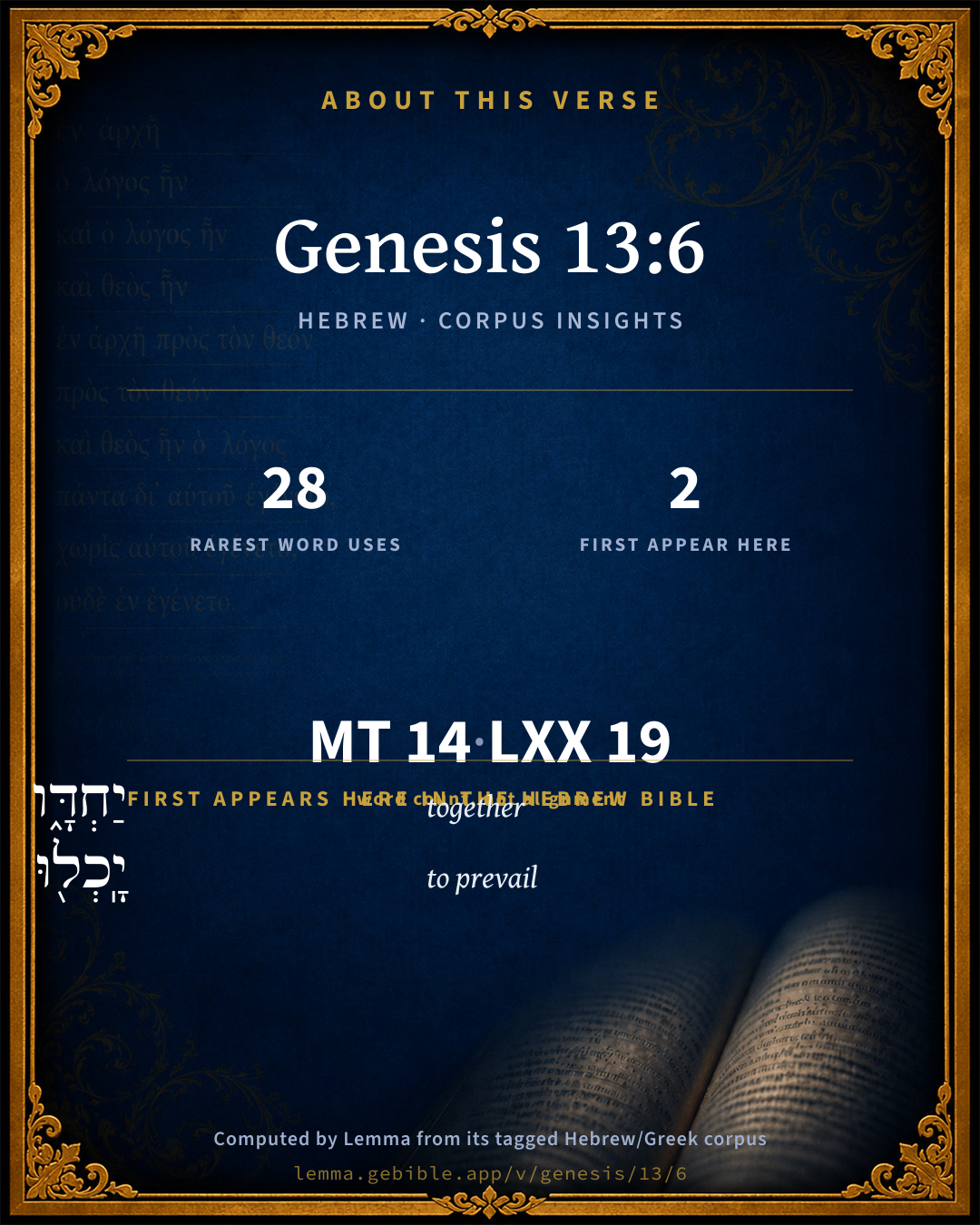
  • 2 first appearances in the Hebrew Bible
Full analysis ↓
Download a study sheet

One document with this verse’s original text, its word-by-word gloss line, the meaning frame, cross-references with their text, attributed commentary, and full source and license credits — printable, and it pastes into notes with its structure intact.

This verse Autodidact and up

Study sheet (.html) Plain text (.txt)

A passage Seminary Student

Up to 50 verses in one chapter. A passage sheet keeps up to 6 commentary sources and 12 cross-references per verse, in the order this page ranks them, and says so on the sheet whenever that leaves anything out. Ask for a single verse and you get the Autodidact verse sheet above.

Everything on this page stays free to read, with no account — the sheet is a download of what is already on screen, not access to it.

Want to remove ads? Support Godless Engineer
Compare translations 3

The same verse in 3 English versions, stacked beneath the original-language interlinear above. Click any original word for its lexicon entry.

Each is an independent rendering of the whole verse — the interlinear is not word-aligned to these translations.

Highlighted words mark where these versions differ — a whole-verse word diff, not a word-by-word alignment.

  • World English Bible Public Domain
    The land was not able to bear them, that they might live together: for their substance was great, so that they could not live together.
  • King James Version Public Domain
    And the land was not able to bear them, that they might dwell together: for their substance was great, so that they could not dwell together.
  • unfoldingWord Literal Text CC BY-SA 4.0
    But the land could not support them while they stayed together, because their possessions were great, so that they were not able to stay together.

unfoldingWord Literal Text — © unfoldingWord, licensed CC BY-SA 4.0. Word-aligned USFM3 via Door43 (git.door43.org/unfoldingWord/en_ult).

Versions to compare (up to 4)

3 of 4 selected

Show all 18 translations

Every available English version of this verse, each an independent rendering of the whole verse.

  • World English Bible Public Domain
    The land was not able to bear them, that they might live together: for their substance was great, so that they could not live together.
  • Berean Standard Bible Public Domain
    But the land was unable to support both of them while they stayed together, for they had so many possessions that they were unable to coexist.
  • Majority Standard Bible Public Domain
    But the land was unable to support both of them while they stayed together, for they had so many possessions that they were unable to coexist.
  • King James Version Public Domain
    And the land was not able to bear them, that they might dwell together: for their substance was great, so that they could not dwell together.
  • American Standard Version (1901) Public Domain
    And the land was not able to bear them, that they might dwell together: for their substance was great, so that they could not dwell together.
  • Revised Version (1885) Public Domain
    And the land was not able to bear them, that they might dwell together: for their substance was great, so that they could not dwell together.
  • Geneva Bible (1599) Public Domain
    So that the land coulde not beare them, that they might dwell together: for their substance was great, so that they coulde not dwell together.
  • Douay-Rheims (1899) Public Domain
    Neither was the land able to bear them, that they might dwell together: for their substance was great, and they could not dwell together.
  • Young's Literal Translation Public Domain
    and the land hath not suffered them to dwell together, for their substance hath been much, and they have not been able to dwell together;
  • Literal Standard Version CC BY-SA 4.0
    and the land has not permitted them to dwell together, for their substance has been much, and they have not been able to dwell together;
  • Unlocked Literal Bible CC BY-SA 4.0
    The land was not able to support them both living close together, because their possessions were very many, so that they could not stay together.
  • unfoldingWord Literal Text CC BY-SA 4.0
    But the land could not support them while they stayed together, because their possessions were great, so that they were not able to stay together.
  • Darby Bible Public Domain
    And the land could not support them, that they might dwell together, for their property was great; and they could not dwell together.
  • World Messianic Bible Public Domain
    The land was not able to bear them, that they might live together; for their possessions were so great that they couldn’t live together.
  • Webster's Bible Public Domain
    And the land was not able to bear them, that they might dwell together: for their substance was great, so that they could not dwell together.
  • Free Bible Version CC BY-SA 4.0
    so much so that the available land couldn't support both of them—they had so much livestock they couldn't stay together anymore.
  • Bible in Basic English Public Domain
    So that the land was not wide enough for the two of them: their property was so great that there was not room for them together.
  • JPS Tanakh (1917) Public Domain
    And the land was not able to bear them, that they might dwell together; for their substance was great, so that they could not dwell together.

Literal Standard Version (2020), Covenant Press — licensed CC BY-SA 4.0. Text via the HelloAO Bible API (eBible.org). Unlocked Literal Bible (unfoldingWord) — licensed CC BY-SA 4.0. Text via the HelloAO Bible API (eBible.org). unfoldingWord Literal Text — © unfoldingWord, licensed CC BY-SA 4.0. Word-aligned USFM3 via Door43 (git.door43.org/unfoldingWord/en_ult). Free Bible Version, Dr. Jonathan Gallagher — licensed CC BY-SA 4.0. Text via the HelloAO Bible API (eBible.org).

Word by word

More ways to search: Search by grammar → Find every occurrence → Compare this word →

Practice this passage: Drill this verse → Learn its vocabulary →

רְכוּשָׁם֙
rᵉkûwsh
H7399
“property · their”
Noun, Common, Masculine, Singular, Construct + Suffix, Personal, 3rd Person, Masculine, Plural
Part of Speech
Noun
Type
Common
Gender
Masculine
Number
Singular
State
Construct
Full BDB Definition

Origin: from pass part of H7408

TWOT: 2167b

property, goods, possessions - property, goods - general term for all movable goods - of livestock - of stores, utensils, etc
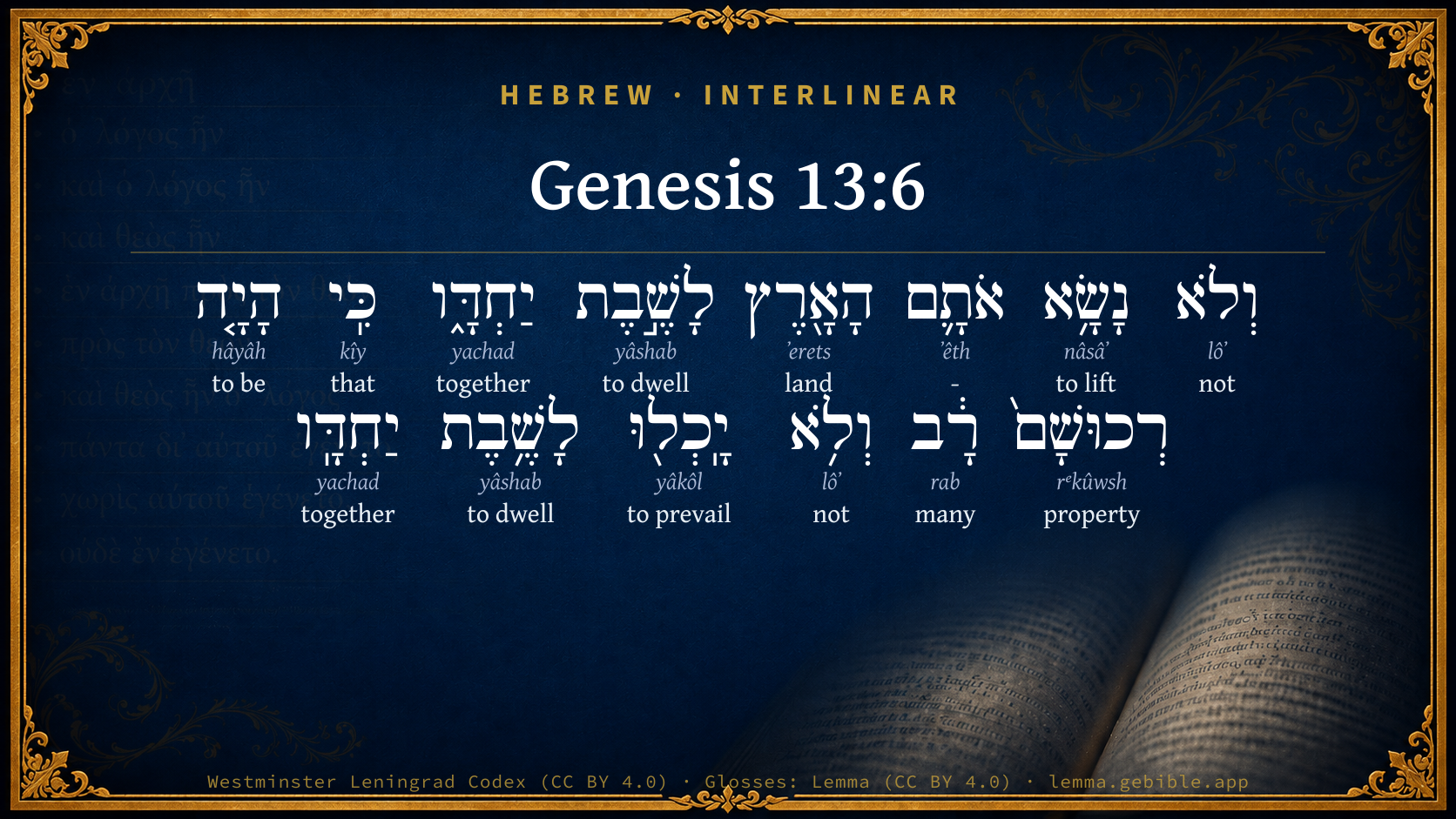
  1. וְלֹא lôʼ H3808 “and · not” Conjunction + Particle, Negative
  2. נָשָׂ֥א nâsâʼ H5375 “to lift” Verb, Qal, Perfect, 3rd Person, Masculine, Singular
  3. אֹתָ֛ם ʼêth H853 “- · them” Particle, Direct Object + Suffix, Personal, 3rd Person, Masculine, Plural
  4. הָאָ֖רֶץ ʼerets H776 “the · land” Particle, Definite Article + Noun, Common, Both, Singular, Absolute
  5. לָשֶׁ֣בֶת yâshab H3427 “to dwell” Preposition + Verb, Qal, Infinitive Construct
  6. יַחְדָּ֑ו yachad H3162 “together” Adverb
  7. כִּֽי kîy H3588 “that” Conjunction
  8. הָיָ֤ה hâyâh H1961 “to be” Verb, Qal, Perfect, 3rd Person, Masculine, Singular
  9. רָ֔ב rab H7227 “many” Adjective, Adjective, Masculine, Singular, Absolute
  10. וְלֹ֥א lôʼ H3808 “and · not” Conjunction + Particle, Negative
  11. יָֽכְל֖וּ yâkôl H3201 “to prevail” Verb, Qal, Perfect, 3rd Person, Common, Plural
  12. לָשֶׁ֥בֶת yâshab H3427 “to dwell” Preposition + Verb, Qal, Infinitive Construct
  13. יַחְדָּֽו yachad H3162 “together” Adverb

About this verse

These counts appear in no published source. They are computed here, from the morphology-tagged text and Lemma’s own curated glosses. What Lemma adds →

14
words
11
distinct lemmas
Pentateuch
section

First appearance in Scripture

These words make their first canonical appearance in the Hebrew Bible here:

  • יַחְדָּ֑ו together H3162
  • יָֽכְל֖וּ to prevail H3201

Shared distinctive vocabulary

רְכוּשָׁם֙ property H7399 occurs in 27 verses of the Hebrew Bible. Also found in:

Grammatical profile

  • 5 verbs
  • 2 nouns
  • 1 adjective
  • 1 conjunction
  • 2 adverbs
  • 3 particles

Verb forms

  • נָשָׂ֥א Qal · Perfect
  • לָשֶׁ֣בֶת Qal · Infinitive Construct
  • הָיָ֤ה Qal · Perfect
  • יָֽכְל֖וּ Qal · Perfect
  • לָשֶׁ֥בֶת Qal · Infinitive Construct

Repetition

Words recur within this verse — often emphatic in Hebrew:

  • לָשֶׁ֣בֶת to dwell H3427 ×2
  • יַחְדָּ֑ו together H3162 ×2
  • וְלֹא not H3808 ×2

Hebrew & Septuagint length

In English translation the verse runs 25 words from the Hebrew and 29 from the Septuagint (LXX English) — closely comparable.

A rough comparison of the two English renderings, which tokenize alike — not a word-level alignment.

Word counts can differ between the Hebrew and the Greek without any difference in meaning — e.g. the Hebrew direct-object marker אֵת has no separate Greek word, and Greek often adds the article ὁ.

In the original languages it is 14 Hebrew tokens and 19 Greek tokens — but the two are counted differently (Hebrew bundles its prefixes and suffixes into one token; the Greek is in lemma form), so that isn’t a like-for-like length.

Cross-references

4

Topical passages linked to Genesis 13:6 in the Treasury of Scripture Knowledge — connected by theme and wording, ordered by reader-vote popularity; previews shown in the World English Bible.

  • Genesis 36:6–7 Esau took his wives, his sons, his daughters, and all the members of his household, with his cattle, all his animals, and all his possessions, which he had gathered in the land of Canaan, and went into a land away from his brother Jacob.
  • Ecclesiastes 5:10–11 He who loves silver shall not be satisfied with silver; nor he who loves abundance, with increase: this also is vanity.
  • Luke 12:17–18 He reasoned within himself, saying, 'What will I do, because I don't have room to store my crops?'
  • 1 Timothy 6:9 But those who are determined to be rich fall into a temptation and a snare and many foolish and harmful lusts, such as drown men in ruin and destruction.

Cross-references courtesy of OpenBible.info (CC BY 4.0).

Hebrew and Greek witnesses Masoretic Hebrew ↔ Greek Septuagint

The same verse in the two great witnesses to the Old Testament, shown verse-for-verse.

These are two independent witnesses, not word-aligned to each other, and the Septuagint is shown in lemma (dictionary) form.

Hebrew Genesis 13:6 Masoretic · Westminster Leningrad Codex

וְלֹא נָשָׂ֥א אֹתָ֛ם הָאָ֖רֶץ לָשֶׁ֣בֶת יַחְדָּ֑ו כִּֽי הָיָ֤ה רְכוּשָׁם֙ רָ֔ב וְלֹ֥א יָֽכְל֖וּ לָשֶׁ֥בֶת יַחְדָּֽו

The land was not able to bear them, that they might live together: for their substance was great, so that they could not live together.

World English Bible · Public Domain

Greek LXX Genesis 13:6 Septuagint · lemma form

καί οὐ χωρέω αὐτός ὁ γῆ καταοἰκέω ἅμα ὅτι εἰμί ὁ ὑποἄρχω αὐτός πολύς καί οὐ δύναμαι καταοἰκέω ἅμα

And the land was not large enough for them to live together, because their possessions were great; and the land was not large enough for them to live together.

LXX2012 (modern English Septuagint) · Public Domain

Hebrew: Westminster Leningrad Codex (CC BY 4.0). Greek: Septuagint (public domain); English from LXX2012 (modern English Septuagint) (Public Domain). How the Septuagint differs from the Hebrew →

Targum (Aramaic paraphrase)

2

The Targum is the ancient Jewish Aramaic paraphrase of the Hebrew Scriptures — an interpretive translation, not the Hebrew text itself. Onkelos (literal) and Pseudo-Jonathan (expansive) render the Torah, and Jonathan the Prophets. Coverage is partial: where no permissively-licensed English translation exists for a verse, only the Aramaic is shown. This is verse-level text, not a word-by-word alignment to the Hebrew.

  1. Targum Onkelos Torah (Genesis–Deuteronomy)
    וְלָא סוֹבָרַת יָתְהוֹן אַרְעָא לְמִיתַב כַּחֲדָא אֲרֵי הֲוָה קִנְיָנְהוֹן סַגִּי וְלָא יְכִילוּ לְמִיתַּב כַּחֲדָא

    And the land could not support them, that they might dwell together.

    Targum Onkelos — Aramaic: “Onkelos Genesis” (public domain); “Onkelos Exodus” (public domain); “Onkelos Leviticus” (public domain); “Onkelos Numbers” (public domain); “Onkelos Deuteronomy” (public domain). English: “Sefaria Community Translation” (CC0 1.0 (public-domain dedication)); “J.W. Etheridge. The Targums of Onkelos and Jonathan Ben Uzziel on the Pentateuch. London: Longmans, Green, 1862” (public domain). Text via Sefaria.

  2. Targum Pseudo-Jonathan Torah (Genesis–Deuteronomy)
    וְלָא סוֹבָרַת יַתְהוֹם אַרְעָא לְמֵיתַב כַּחֲדָא אֲרוּם הֲוָה קִנְיָנֵהוֹן סַגִי וְלָא יָכִילוּ לְמֵיתַב כַּחֲדָא

    And the land could not sustain them to dwell together, because their possessions were great, and they were not able to dwell together.

    Targum Pseudo-Jonathan — Aramaic: “Targum Jonathan on Genesis” (public domain); “Targum Jonathan on Exodus” (public domain); “Targum Jonathan on Leviticus” (public domain); “Targum Jonathan on Numbers” (public domain); “Targum Jonathan on Deuteronomy” (public domain). English: “The Targum of Jonathan ben Uzziel, trans. J. W. Etheridge, London, 1862” (public domain). Text via Sefaria.

Commentary

Notes on Genesis 13:6 from classic Christian and Jewish commentators (each source and its license shown beneath its notes). The classic Christian expositions comment on the surrounding passage and are grouped to its opening verse, so a note may address several verses; the Jewish commentaries on the Tanakh (Rashi and others) are per-verse, so they appear only where the commentator wrote on this verse.

Lemma curates 59 commentaries, every one of them public domain or Creative Commons licensed, each selected and text-cleaned for this edition rather than reprinted as found. About our sources →

Trapp's Complete Commentary

John Trapp

Gen 13:6 And the land was not able to bear them, that they might dwell together: for their substance was great, so that they could not dwell together.

Ver. 6. And the land was not able to bear them.] This was sour sauce to their sweet meat, lest they should surfeit of their abundance. All earthly comforts are dissweetened with crosses, and there are thorns in all the world’s roses. It is seldom seen that God allows any, though never so dear to himself, a perfect contentment. Something they must have to complain of, that shall give an unsavoury verdure to their sweetest morsels, that they may long after heaven. It could not but be a great cut to this good couple, to be now at length sundered, and deprived of mutual society.

John Trapp, A Commentary or Exposition upon All the Books of the Old and New Testament (1647–1656) — public domain. Text from a community e-Sword module.

Joseph Benson's Commentary

Gen 13:6. The land was not able to bear them — The Canaanites and other former inhabitants of the country undoubtedly occupied the best of the land, and what remained was not sufficient to supply their flocks and herds with pasturage.

Joseph Benson's Commentary on the Old and New Testaments (1811–1818) — public domain. Text from a community e-Sword module.

Geneva Bible (1599)

Geneva Bible translators

This incommodity came by their riches, which brake friendship and as it were the bound of nature.

Geneva Bible (1599) marginal notes — public domain. Text via Bolls.life.

Adam Clarke's Commentary

Verse 6. Their substance was great] As their families increased, it was necessary their flocks should increase also, as from those flocks they derived their clothing, food, and drink. Many also were offered in sacrifice to God.

They could not dwell together]

1. Because their flocks were great.

2. Because the Canaanites and the Perizzites had already occupied a considerable part of the land.

3. Because there appears to have been envy between the herdmen of Abram and Lot.

To prevent disputes among them, that might have ultimately disturbed the peace of the two families, it was necessary that a separation should take place.

Adam Clarke's Commentary on the Bible (1810–1826) — public domain. Text from a community e-Sword/MySword module.

The Cambridge Bible for Schools and Colleges

gen. ed. J. J. S. Perowne

6. And the land, &c.] The account, according to P, of the reason for Lot’s separation. The flocks and herds of the two chieftains when combined were so numerous, that there was not pasturage enough to feed them. Cf. a similar reason, in P’s narrative, for the separation of Jacob and Esau, Gen_36:7. The word “substance” is characteristic of P. Cf. Gen_12:5.

The Cambridge Bible for Schools and Colleges (gen. ed. J. J. S. Perowne; Cambridge University Press, 1878–1918) — public domain. Text from a community e-Sword module.

John Gill's Exposition

And the land was not able to bear them, that they might dwell together,.... That part of the country where Abram and Lot were could not afford them room enough for their several tents; or however could not furnish them with sufficient pasturage for their flocks and herds, they were so numerous; at least could not do it so as to be contiguous to each other, that there was a necessity of one of them going further off:

for their substance was great, so that they could not dwell together; we have before an account of the substance of each of them, how great it was; and here now is noted an inconvenience which arises from a large increase of riches, that relations and friends are obliged to part, and cannot dwell together; what one would think would make them more comfortable together, is the cause and occasion of their separation.

John Gill's Exposition of the Whole Bible (1746–1763) — public domain (CC PDM 1.0). Text via the HelloAO Bible API.

Haydock's Catholic Bible Commentary

To bear or feed their flocks, as well as those of the Chanaanites. (Calmet)

George Leo Haydock (1774–1849), Haydock's Catholic Family Bible and Commentary, 1859 edition — public domain. Excludes Psalms (Douay-Rheims chapter numbering differs from Protestant) and Deuterocanonical books (Catholic canon only).

Whedon's Commentary on the Bible

Daniel D. Whedon

6. Land was not able to bear them — Having been impoverished by the recent great famine, and being already occupied, as the next verse states, by other dwellers, they were cramped for pasturage for their immense flocks and herds.

Daniel D. Whedon (gen. ed.), Commentary on the Old and New Testaments (1874–1909) — public domain. Text from a community e-Sword module.

John Wesley's Explanatory Notes

The land was not able to bear them - The place was too strait for them, and they had not room for their flocks.

John Wesley, Explanatory Notes Upon the Whole Bible (1754–1765) — public domain. Text via the GEBible commentary corpus.

Rashi

Rabbi Shlomo Yitzchaki (Rashi)

ולא נשא אתם AND THE LAND WAS NOT ABLE TO BEAR THEM — It could not provide sufficient pasture for their cattle. The phrase is elliptical and a word must be supplied, for instance: the pasturage (מרעה) of the land was not able to bear them — for this reason the word נשא (masculine) is used (to agree in gender with מרעה; the suggestion is that נשא cannot have הארץ as subject since that noun is feminine).

Rashi on the Tanakh — English translations: “The Judaica Press complete Tanach with Rashi, translated by A. J. Rosenberg” (CC BY 4.0); “Pentateuch with Rashi's commentary by M. Rosenbaum and A.M. Silbermann, 1929-1934” (public domain); “The Metsudah Tanach series, Lakewood, N.J” (CC BY 4.0); and “The Book of Joshua, Metsudah Publications, 1997” (CC BY 4.0). Text via Sefaria.

Radak

Rabbi David Kimhi (Radak)

ולא נשא אותם הארץ, in this instance the noun ארץ is treated as a masculine noun, as it is also in Isaiah 9,18 נעתם ארץ, “the earth was shaken.”

לשבת יחדו, for there was not enough grazing land to support their herds as well as those of the other inhabitants of the land. כי היה, for the possessions of Avram and Lot together was too great. As a result, a quarrel broke out among the respective shepherds. Each group of shepherds wanted to use the same meadows on which to graze their flocks.

Radak on the Tanakh — English translations: “Sefaria Community Translation” (CC0 1.0 (public-domain dedication)); “Eliyahu Munk, HaChut Hameshulash” (CC BY 4.0); “Rabbi Mike Feuer, Jerusalem Anthology” (CC BY 4.0); and “R. David Kimhi on the first book of Psalms, Translated by R.G. Finch, London, 1919” (public domain). Text via Sefaria.

Lesson kit

Teaching starters — assembled from the data on this page, not authored interpretation. Every prompt links to the verse data it draws on. Edit before teaching.

Genesis, in the Pentateuch, opens this verse with 14 words (11 distinct Hebrew lemmas). Its most distinctive word is rᵉkûwsh (“property”). A historical commentator’s framing appears above. Read the whole chapter for the surrounding context.

Discussion questions

  1. The word rᵉkûwsh carries the sense “property.” How does it shape the verse?
  2. 2 words here appear for the first time in Scripture. What is being introduced at this debut?
  3. Genesis 12:5 shares the word «property» with this verse. How do the two illuminate each other?
  4. “to dwell” occurs 2× in this one verse. What is the effect of the repetition?
  5. These translations render this verse differently; the difference is in the English rendering, not the original. What questions does that raise?
  6. The verb «נָשָׂ֥א» is Qal Perfect. How does its form color the action?
  7. Reading how Trapp's Complete Commentary and Joseph Benson's Commentary read this verse, where do the two commentators agree and where do they part?

Things to notice

Reading settings

Reading text

Shown beneath each verse's original-language words.

Old Testament
Old Testament edition

Read the OT as the Masoretic Hebrew (MT) or the Greek Septuagint (LXX).

English shown for the Greek Septuagint (in the Hebrew ↔ Greek comparison).

Comparing translations? Open the Compare panel on any verse page to stack up to four side by side.