
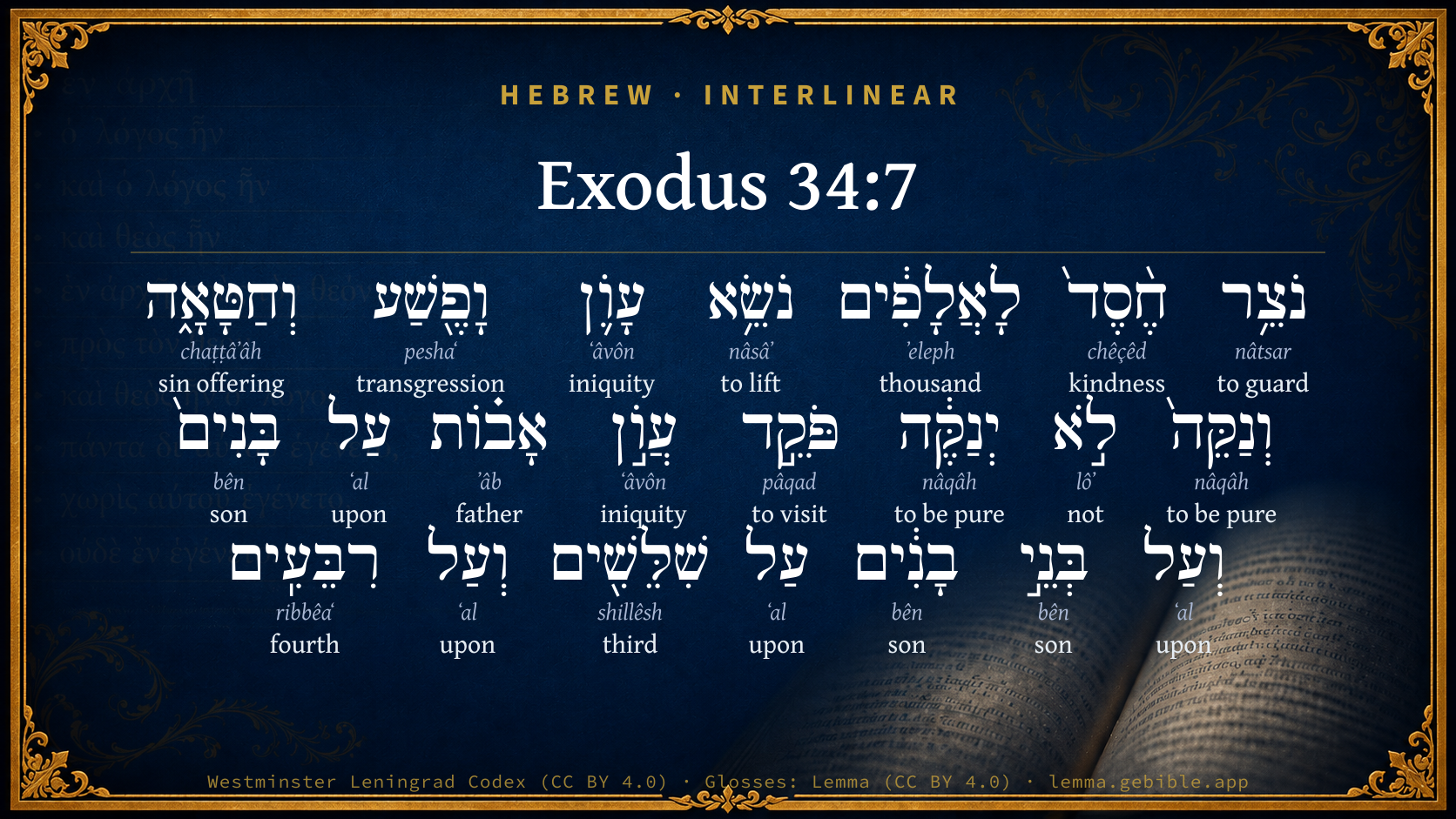
Exodus 34:7

Hebrew (Westminster Leningrad Codex) Exodus 34:7 appears in the Hebrew Old Testament. The text above is from the Westminster Leningrad Codex. Each word links to its Strong’s number, a concise gloss, and parsing drawn from the Open Scriptures Hebrew Bible morphology. Click any word for its full Brown-Driver-Briggs (BDB) entry.
Download image
Cite this verse

Exodus 34:7 (World English Bible). Public Domain. Lemma interlinear Bible study tool, https://lemma.gebible.app/v/exodus/34/7.

Show BibTeX & RIS
BibTeX
RIS
English Translation
keeping loving kindness for thousands, forgiving iniquity and disobedience and sin; and that will by no means clear the guilty, visiting the iniquity of the fathers on the children, and on the children's children, on the third and on the fourth generation."
World English Bible · Public Domain
Highlights
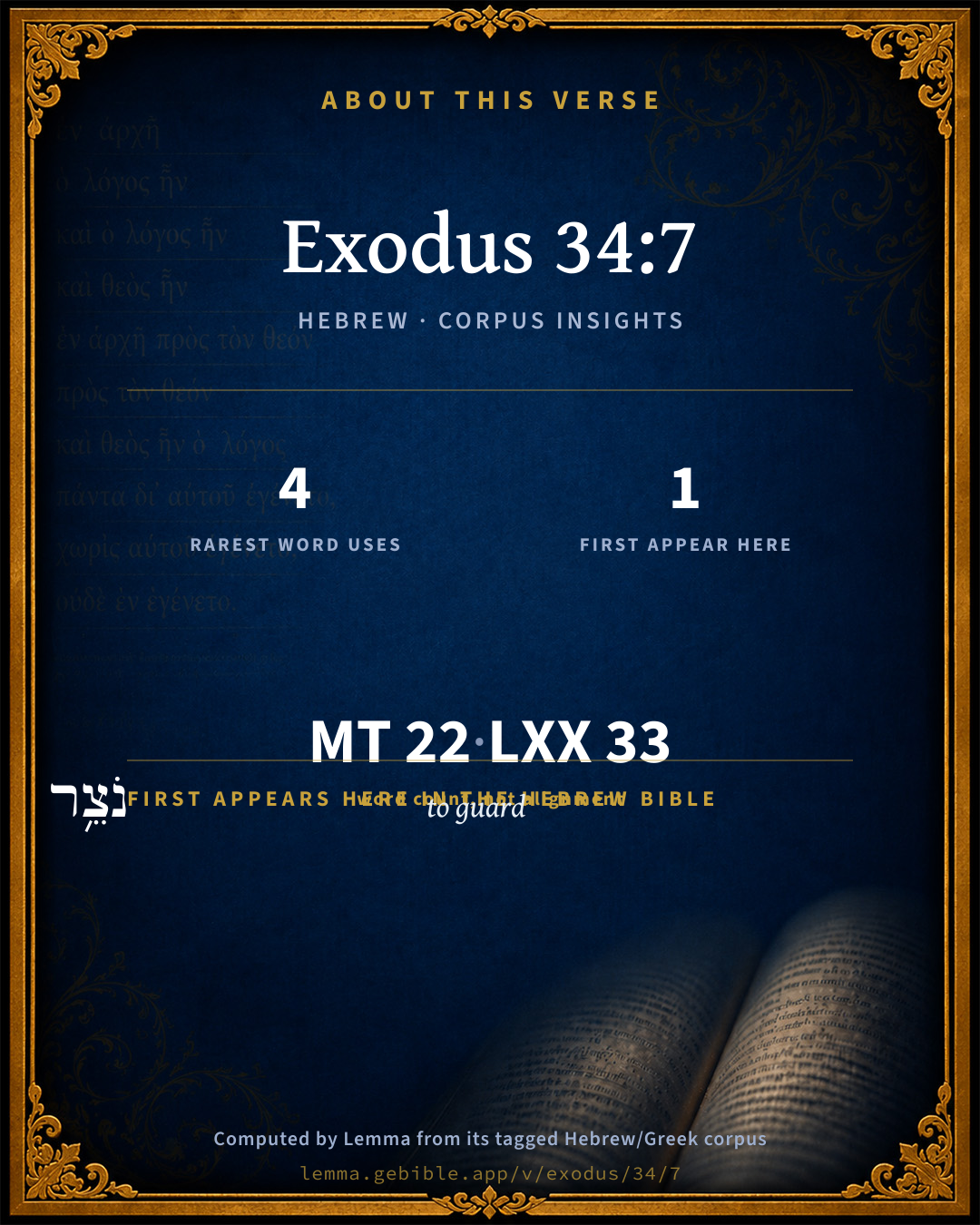
  • 1 first appearance in the Hebrew Bible
Full analysis ↓
Download a study sheet

One document with this verse’s original text, its word-by-word gloss line, the meaning frame, cross-references with their text, attributed commentary, and full source and license credits — printable, and it pastes into notes with its structure intact.

This verse Autodidact and up

Study sheet (.html) Plain text (.txt)

A passage Seminary Student

Up to 50 verses in one chapter. A passage sheet keeps up to 6 commentary sources and 12 cross-references per verse, in the order this page ranks them, and says so on the sheet whenever that leaves anything out. Ask for a single verse and you get the Autodidact verse sheet above.

Everything on this page stays free to read, with no account — the sheet is a download of what is already on screen, not access to it.

Want to remove ads? Support Godless Engineer
Compare translations 3

The same verse in 3 English versions, stacked beneath the original-language interlinear above. Click any original word for its lexicon entry.

Each is an independent rendering of the whole verse — the interlinear is not word-aligned to these translations.

Highlighted words mark where these versions differ — a whole-verse word diff, not a word-by-word alignment.

  • World English Bible Public Domain
    keeping loving kindness for thousands, forgiving iniquity and disobedience and sin; and that will by no means clear the guilty, visiting the iniquity of the fathers on the children, and on the children's children, on the third and on the fourth generation."
  • King James Version Public Domain
    Keeping mercy for thousands, forgiving iniquity and transgression and sin, and that will by no means clear the guilty; visiting the iniquity of the fathers upon the children, and upon the children's children, unto the third and to the fourth generation.
  • unfoldingWord Literal Text CC BY-SA 4.0
    keeping covenant faithfulness to thousands, forgiving iniquity, transgression, and sin. But he will surely not acquit, visiting the iniquity of the fathers on the sons and on the sons of the sons, on the third and on the fourth.”

unfoldingWord Literal Text — © unfoldingWord, licensed CC BY-SA 4.0. Word-aligned USFM3 via Door43 (git.door43.org/unfoldingWord/en_ult).

Versions to compare (up to 4)

3 of 4 selected

Show all 18 translations

Every available English version of this verse, each an independent rendering of the whole verse.

  • World English Bible Public Domain
    keeping loving kindness for thousands, forgiving iniquity and disobedience and sin; and that will by no means clear the guilty, visiting the iniquity of the fathers on the children, and on the children's children, on the third and on the fourth generation."
  • Berean Standard Bible Public Domain
    maintaining loving devotion to a thousand generations, forgiving iniquity, transgression, and sin. Yet He will by no means leave the guilty unpunished; He will visit the iniquity of the fathers on their children and grandchildren to the third and fourth generations.”
  • Majority Standard Bible Public Domain
    maintaining loving devotion to a thousand generations, forgiving iniquity, transgression, and sin. Yet He will by no means leave the guilty unpunished; He will visit the iniquity of the fathers on their children and grandchildren to the third and fourth generations.”
  • King James Version Public Domain
    Keeping mercy for thousands, forgiving iniquity and transgression and sin, and that will by no means clear the guilty; visiting the iniquity of the fathers upon the children, and upon the children's children, unto the third and to the fourth generation.
  • American Standard Version (1901) Public Domain
    keeping lovingkindness for thousands, forgiving iniquity and transgression and sin; and that will by no means clear `the guilty', visiting the iniquity of the fathers upon the children, and upon the children's children, upon the third and upon the fourth generation.
  • Revised Version (1885) Public Domain
    keeping mercy for thousands, forgiving iniquity and transgression and sin: and that will by no means clear the guilty; visiting the iniquity of the fathers upon the children, and upon the children’s children, upon the third and upon the fourth generation.
  • Geneva Bible (1599) Public Domain
    Reseruing mercy for thousands, forgiuing iniquitie, and transgression and sinne, and not making the wicked innocent, visiting the iniquitie of the fathers vpon ye children, and vpon childrens children, vnto the third and fourth generation.
  • Douay-Rheims (1899) Public Domain
    Who keepest mercy unto thousands: who takest away iniquity, and wickedness, and sin, and no man of himself is innocent before thee. Who renderest the iniquity of the fathers to the children, and to the grandchildren, unto the third and fourth generation.
  • Young's Literal Translation Public Domain
    keeping kindness for thousands, taking away iniquity, and transgression, and sin, and not entirely acquitting, charging iniquity of fathers on children, and on children's children, on a third `generation', and on a fourth.'
  • Literal Standard Version CC BY-SA 4.0
    keeping kindness for thousands, taking away iniquity, and transgression, and sin, and not entirely acquitting, charging iniquity of fathers on sons and on sons’ sons, on a third and on a fourth [generation].”
  • Unlocked Literal Bible CC BY-SA 4.0
    keeping covenant faithfulness for thousands of generations, forgiving iniquities, transgressions, and sins. But he will by no means clear the guilty. He will bring the punishment for the fathers' sin on their children and on their children's children, as far as the third and fourth generations.”
  • unfoldingWord Literal Text CC BY-SA 4.0
    keeping covenant faithfulness to thousands, forgiving iniquity, transgression, and sin. But he will surely not acquit, visiting the iniquity of the fathers on the sons and on the sons of the sons, on the third and on the fourth.”
  • Darby Bible Public Domain
    keeping mercy unto thousands, forgiving iniquity and transgression and sin, but by no means clearing [the guilty]; visiting the iniquity of the fathers upon the children, and upon the children's children, upon the third and upon the fourth [generation].
  • World Messianic Bible Public Domain
    keeping loving kindness for thousands, forgiving iniquity and disobedience and sin; and who will by no means clear the guilty, visiting the iniquity of the fathers on the children, and on the children’s children, on the third and on the fourth generation.”
  • Webster's Bible Public Domain
    Keeping mercy for thousands, forgiving iniquity and transgression and sin, and that will by no means clear the guilty; visiting the iniquity of the fathers upon the children, and upon the children's children, to the third and to the fourth generation.
  • Free Bible Version CC BY-SA 4.0
    I go on showing my trustworthy love to thousands, forgiving guilt, rebellion, and sin. But I will definitely not clear the wicked—the impact of sin will affect not only the parents, but also their children and grandchildren, up until the third and fourth generation.”
  • Bible in Basic English Public Domain
    Having mercy on thousands, overlooking evil and wrongdoing and sin; he will not let wrongdoers go free, but will send punishment on children for the sins of their fathers, and on their children's children to the third and fourth generation.
  • JPS Tanakh (1917) Public Domain
    keeping mercy unto the thousandth generation, forgiving iniquity and transgression and sin; and that will by no means clear the guilty; visiting the iniquity of the fathers upon the children, and upon the children's children, unto the third and unto the fourth generation.'

Literal Standard Version (2020), Covenant Press — licensed CC BY-SA 4.0. Text via the HelloAO Bible API (eBible.org). Unlocked Literal Bible (unfoldingWord) — licensed CC BY-SA 4.0. Text via the HelloAO Bible API (eBible.org). unfoldingWord Literal Text — © unfoldingWord, licensed CC BY-SA 4.0. Word-aligned USFM3 via Door43 (git.door43.org/unfoldingWord/en_ult). Free Bible Version, Dr. Jonathan Gallagher — licensed CC BY-SA 4.0. Text via the HelloAO Bible API (eBible.org).

Word by word

More ways to search: Search by grammar → Find every occurrence → Compare this word →

Practice this passage: Drill this verse → Learn its vocabulary →

רִבֵּעִֽים
ribbêaʻ
H7256
“fourth generation”
Noun, Common, Masculine, Plural, Absolute
Part of Speech
Noun
Type
Common
Gender
Masculine
Number
Plural
State
Absolute
Full BDB Definition

Origin: from H7251

TWOT: 2107d

pertaining to the fourth
  1. נֹצֵ֥ר nâtsar H5341 “guarding” Verb, Qal, Participle Active, Masculine, Singular, Absolute
  2. חֶ֨סֶד֙ chêçêd H2617 “kindness” Noun, Common, Masculine, Singular, Absolute
  3. לָאֲלָפִ֔ים ʼeleph H505 “to/for the · thousand” Preposition, Determined + Adjective, Cardinal number, Both, Plural, Absolute
  4. נֹשֵׂ֥א nâsâʼ H5375 “lifting” Verb, Qal, Participle Active, Masculine, Singular, Absolute
  5. עָוֺ֛ן ʻâvôn H5771 “iniquity” Noun, Common, Both, Singular, Absolute
  6. וָפֶ֖שַׁע peshaʻ H6588 “and · transgression” Conjunction + Noun, Common, Masculine, Singular, Absolute
  7. וְחַטָּאָ֑ה chaṭṭâʼâh H2403 “and · sin offering” Conjunction + Noun, Common, Feminine, Singular, Absolute
  8. וְנַקֵּה֙ nâqâh H5352 “and · to be pure” Conjunction + Verb, Piel, Infinitive Absolute
  9. לֹ֣א lôʼ H3808 “not” Particle, Negative
  10. יְנַקֶּ֔ה nâqâh H5352 “to be pure” Verb, Piel, Imperfect, 3rd Person, Masculine, Singular
  11. פֹּקֵ֣ד pâqad H6485 “visiting” Verb, Qal, Participle Active, Masculine, Singular, Absolute
  12. עֲוֺ֣ן ʻâvôn H5771 “iniquity of” Noun, Common, Both, Singular, Construct
  13. אָב֗וֹת ʼâb H1 “fathers” Noun, Common, Masculine, Plural, Absolute
  14. עַל ʻal H5921 “upon” Preposition
  15. בָּנִים֙ bên H1121 “sons” Noun, Common, Masculine, Plural, Absolute
  16. וְעַל ʻal H5921 “and · upon” Conjunction + Preposition
  17. בְּנֵ֣י bên H1121 “sons of” Noun, Common, Masculine, Plural, Construct
  18. בָנִ֔ים bên H1121 “sons” Noun, Common, Masculine, Plural, Absolute
  19. עַל ʻal H5921 “upon” Preposition
  20. שִׁלֵּשִׁ֖ים shillêsh H8029 “third generation” Noun, Common, Masculine, Plural, Absolute
  21. וְעַל ʻal H5921 “and · upon” Conjunction + Preposition

About this verse

These counts appear in no published source. They are computed here, from the morphology-tagged text and Lemma’s own curated glosses. What Lemma adds →

22
words
15
distinct lemmas
Pentateuch
section

Notable vocabulary

The rarest word here is רִבֵּעִֽים fourth H7256 — appearing just 4 times in the whole Hebrew Bible.

First appearance in Scripture

This word makes its first canonical appearance in the Hebrew Bible here:

  • נֹצֵ֥ר to guard H5341

Shared distinctive vocabulary

רִבֵּעִֽים fourth H7256 occurs in 4 verses of the Hebrew Bible. Also found in:

Grammatical profile

  • 5 verbs
  • 11 nouns
  • 1 adjective
  • 4 prepositions
  • 1 particle

Verb forms

  • נֹצֵ֥ר Qal · Participle Active
  • נֹשֵׂ֥א Qal · Participle Active
  • וְנַקֵּה֙ Piel · Infinitive Absolute
  • יְנַקֶּ֔ה Piel · Imperfect
  • פֹּקֵ֣ד Qal · Participle Active

Repetition

Words recur within this verse — often emphatic in Hebrew:

  • עַל upon H5921 ×4
  • בָּנִים֙ son H1121 ×3
  • עָוֺ֛ן iniquity H5771 ×2
  • וְנַקֵּה֙ to be pure H5352 ×2

Hebrew & Septuagint length

In English translation the verse runs 42 words from the Hebrew and 41 from the Septuagint (LXX English) — closely comparable.

A rough comparison of the two English renderings, which tokenize alike — not a word-level alignment.

Word counts can differ between the Hebrew and the Greek without any difference in meaning — e.g. the Hebrew direct-object marker אֵת has no separate Greek word, and Greek often adds the article ὁ.

In the original languages it is 22 Hebrew tokens and 33 Greek tokens — but the two are counted differently (Hebrew bundles its prefixes and suffixes into one token; the Greek is in lemma form), so that isn’t a like-for-like length.

Cross-references

33

Topical passages linked to Exodus 34:7 in the Treasury of Scripture Knowledge — connected by theme and wording, ordered by reader-vote popularity; previews shown in the World English Bible.

  • Exodus 20:5–6 you shall not bow yourself down to them, nor serve them, for I, Yahweh your God, am a jealous God, visiting the iniquity of the fathers on the children, on the third and on the fourth generation of those who hate me,
  • Psalms 103:3 Who forgives all your sins; Who heals all your diseases;
  • Deuteronomy 5:9–10 you shall not bow down yourself to them, nor serve them; for I, Yahweh, your God, am a jealous God, visiting the iniquity of the fathers on the children, and on the third and on the fourth generation of those who hate me;
  • Ephesians 1:7 in whom we have our redemption through his blood, the forgiveness of our trespasses, according to the riches of his grace,
  • 1 John 1:9 If we confess our sins, he is faithful and righteous to forgive us the sins, and to cleanse us from all unrighteousness.
  • Numbers 14:18–23 Yahweh is slow to anger, and abundant in loving kindness, forgiving iniquity and disobedience; and that will by no means clear [the guilty], visiting the iniquity of the fathers on the children, on the third and on the fourth generation.
  • Nahum 1:2–3 Yahweh is a jealous God and avenges. Yahweh avenges and is full of wrath. Yahweh takes vengeance on his adversaries, and he maintains wrath against his enemies.
  • Jeremiah 32:18 who show loving kindness to thousands, and recompense the iniquity of the fathers into the bosom of their children after them; the great, the mighty God, Yahweh of Hosts is his name;
  • Psalms 130:4 But there is forgiveness with you, Therefore you are feared.
  • Job 10:14 If I sin, then you mark me. You will not acquit me from my iniquity.
  • Daniel 9:9 To the Lord our God belong mercies and forgiveness; for we have rebelled against him;
  • Romans 3:19–26 Now we know that whatever things the law says, it speaks to those who are under the law, that every mouth may be closed, and all the world may be brought under the judgment of God.
  • Romans 4:7–8 "Blessed are they whose iniquities are forgiven, Whose sins are covered.
  • Ephesians 4:32 And be kind to one another, tenderhearted, forgiving each other, just as God also in Christ forgave you.
  • Exodus 23:7 "Keep far from a false charge, and don't kill the innocent and righteous: for I will not justify the wicked.
  • Psalms 86:15 But you, Lord, are a merciful and gracious God, Slow to anger, and abundant in loving kindness and truth.
  • Hebrews 12:29 for our God is a consuming fire.
  • Nehemiah 1:5 and said, I beg you, Yahweh, the God of heaven, the great and awesome God, who keeps covenant and loving kindness with those who love him and keep his commandments:
  • Nehemiah 9:32 Now therefore, our God, the great, the mighty, and the awesome God, who keep covenant and loving kindness, don't let all the travail seem little before you, that has come on us, on our kings, on our princes, and on our priests, and on our prophets, and on our fathers, and on all your people, since the time of the kings of Assyria to this day.
  • Daniel 9:4 I prayed to Yahweh my God, and made confession, and said, Oh, Lord, the great and dreadful God, who keeps covenant and loving kindness with those who love him and keep his commandments,
  • Micah 7:18 Who is a God like you, who pardons iniquity, And passes over the disobedience of the remnant of his heritage? He doesn't retain his anger forever, Because he delights in loving kindness.
  • Nahum 1:6 Who can stand before his indignation? Who can endure the fierceness of his anger? His wrath is poured out like fire, and the rocks are broken apart by him.
  • Romans 9:22–23 What if God, willing to show his wrath, and to make his power known, endured with much patience vessels of wrath made for destruction,
  • Acts 5:31 God exalted him with his right hand to be a Prince and a Savior, to give repentance to Israel, and remission of sins.
  • Acts 13:38 Be it known to you therefore, brothers, that through this man is proclaimed to you remission of sins,
  • Romans 2:4–9 Or do you despise the riches of his goodness, forbearance, and patience, not knowing that the goodness of God leads you to repentance?
  • Joshua 24:19 Joshua said to the people, You can't serve Yahweh; for he is a holy God; he is a jealous God; he will not forgive your disobedience nor your sins.
  • Exodus 23:21 Pay attention to him, and listen to his voice. Don't provoke him, for he will not pardon your disobedience, for my name is in him.
  • Deuteronomy 32:35 Vengeance is mine, and recompense, At the time when their foot shall slide: For the day of their calamity is at hand, The things that are to come on them shall make haste.
  • Psalms 9:16–17 Yahweh has made himself known. He has executed judgment. The wicked is snared by the work of his own hands. Meditation. Selah.
  • Psalms 11:5–6 Yahweh examines the righteous, But the wicked and him who loves violence his soul hates.
  • Micah 6:11 Shall I be pure with dishonest scales, And with a bag of deceitful weights?
  • Revelation 20:15 If anyone was not found written in the book of life, he was cast into the lake of fire.

Cross-references courtesy of OpenBible.info (CC BY 4.0).

Hebrew and Greek witnesses Masoretic Hebrew ↔ Greek Septuagint

The same verse in the two great witnesses to the Old Testament, shown verse-for-verse.

These are two independent witnesses, not word-aligned to each other, and the Septuagint is shown in lemma (dictionary) form.

Hebrew Exodus 34:7 Masoretic · Westminster Leningrad Codex

נֹצֵ֥ר חֶ֨סֶד֙ לָאֲלָפִ֔ים נֹשֵׂ֥א עָוֺ֛ן וָפֶ֖שַׁע וְחַטָּאָ֑ה וְנַקֵּה֙ לֹ֣א יְנַקֶּ֔ה פֹּקֵ֣ד עֲוֺ֣ן אָב֗וֹת עַל בָּנִים֙ וְעַל בְּנֵ֣י בָנִ֔ים עַל שִׁלֵּשִׁ֖ים וְעַל רִבֵּעִֽים

keeping loving kindness for thousands, forgiving iniquity and disobedience and sin; and that will by no means clear the guilty, visiting the iniquity of the fathers on the children, and on the children's children, on the third and on the fourth generation."

World English Bible · Public Domain

Greek LXX Exodus 34:7 Septuagint · lemma form

καί δικαιοσύνη διατηρέω καί ποιέω ἔλεος εἰς χιλιάς ἀποαἱρέω ἀνομία καί ἀδικία καί ἁμαρτία καί οὐ καθαρίζω ὁ ἔνοχος ἐπιἄγω ἀνομία πατήρ ἐπί τέκνον καί ἐπί τέκνον τέκνον ἐπί τρίτος καί τέταρτος γενεά

and keeping justice and mercy for thousands, taking away iniquity, and unrighteousness, and sins; and he will not clear the guilty; bringing the iniquity of the fathers upon the children, and to the children's children, to the third and fourth generation.

LXX2012 (modern English Septuagint) · Public Domain

On this verse, Adam Clarke's Commentary discusses the Septuagint’s reading. Read the note in Commentary ↓

Hebrew: Westminster Leningrad Codex (CC BY 4.0). Greek: Septuagint (public domain); English from LXX2012 (modern English Septuagint) (Public Domain). How the Septuagint differs from the Hebrew →

Targum (Aramaic paraphrase)

2

The Targum is the ancient Jewish Aramaic paraphrase of the Hebrew Scriptures — an interpretive translation, not the Hebrew text itself. Onkelos (literal) and Pseudo-Jonathan (expansive) render the Torah, and Jonathan the Prophets. Coverage is partial: where no permissively-licensed English translation exists for a verse, only the Aramaic is shown. This is verse-level text, not a word-by-word alignment to the Hebrew.

  1. Targum Onkelos Torah (Genesis–Deuteronomy)
    נָטַר טִיבוּ לְאַלְפֵי דָרִין שָׁבֵק לַעֲוָיָן וְלִמְרוֹד וּלְחוֹבִין סָלַח לִדְתַיְבִין לְאוֹרַיְתֵהּ וְלִדְלָא תַיְבִין לָא מְזַכֵּי מַסְעַר חוֹבֵי אֲבָהָן עַל בְּנִין וְעַל בְּנֵי בְנִין מְרָדִין עַל דַר תְּלִיתָי וְעַל דַר רְבִיעָי:

    (no public-domain English translation for this verse)

    Targum Onkelos — Aramaic: “Onkelos Genesis” (public domain); “Onkelos Exodus” (public domain); “Onkelos Leviticus” (public domain); “Onkelos Numbers” (public domain); “Onkelos Deuteronomy” (public domain). English: “Sefaria Community Translation” (CC0 1.0 (public-domain dedication)); “J.W. Etheridge. The Targums of Onkelos and Jonathan Ben Uzziel on the Pentateuch. London: Longmans, Green, 1862” (public domain). Text via Sefaria.

  2. Targum Pseudo-Jonathan Torah (Genesis–Deuteronomy)
    נְטִיר חֶסֶד וְטִיבוּ לְאַלְפֵי דָרִין שָׁרֵי וְשָׁבִיק עַל חוֹבִין וּמַעֲבַר עַל מְרוֹדִין וּמְכַפֵּר עַל חַטָּאִין סְלַח לִדְתַיְיבִין לְאוֹרַיְיתָא וְלִדְלָא תַיְיבִין לָא מְזַכֵּי בְּיוֹם דִּינָא רַבָּא מַסְעַר חוֹבֵי אַבְהָן עַל בְּנִין מְרוֹדִין עַל דַּר תְּלִיתָאֵי וְעַל דַּר רְבִיעָאֵי

    keeping mercy and bounty for thousands of generations, absolving and remitting guilt, passing by rebellions, and covering sins; pardoning them who convert unto the law, but holding not guiltless in the great day of judgment those who will not convert; visiting the sins of fathers upon rebellious children upon the third and upon the fourth generation.

    Targum Pseudo-Jonathan — Aramaic: “Targum Jonathan on Genesis” (public domain); “Targum Jonathan on Exodus” (public domain); “Targum Jonathan on Leviticus” (public domain); “Targum Jonathan on Numbers” (public domain); “Targum Jonathan on Deuteronomy” (public domain). English: “The Targum of Jonathan ben Uzziel, trans. J. W. Etheridge, London, 1862” (public domain). Text via Sefaria.

Commentary

Notes on Exodus 34:7 from classic Christian and Jewish commentators (each source and its license shown beneath its notes). The classic Christian expositions comment on the surrounding passage and are grouped to its opening verse, so a note may address several verses; the Jewish commentaries on the Tanakh (Rashi and others) are per-verse, so they appear only where the commentator wrote on this verse.

Lemma curates 59 commentaries, every one of them public domain or Creative Commons licensed, each selected and text-cleaned for this edition rather than reprinted as found. About our sources →

Trapp's Complete Commentary

John Trapp

Exo 34:7 Keeping mercy for thousands, forgiving iniquity and transgression and sin, and that will by no means clear [the guilty]; visiting the iniquity of the fathers upon the children, and upon the children’s children, unto the third and to the fourth [generation].

Ver. 7. Forgiving iniquity and transgression and sin,] i.e., All sorts of sin. It is natural to him as here. None like him for this. {Mic 7:18} It is the comfort of saints, that they have to do with a forgiving God, {Neh 9:31} that can multiply pardons, as they multiply sins. {Isa 55:7}

Keeping mercy for thousands.] The Hebrew word here rendered Keeping, is written with a greater letter {a} than ordinary, to note the extraordinary greatness of God’s promise to his people and their posterity. {Psa 25:10} {Hebrew Text Note} God is here said to keep mercy, to forgive sins of all sorts: as if his mercy were kept on purpose for pardoning poor sinners.

Clear the guilty.] This last letter in God’s name must still be remembered. So must all the rest: since there is enough in this sweetest text to answer all our objections. It is said of Leonard Lessius, that, a little before his death, he finished his treatise concerning the fifty names or attributes of God: and that he oft affirmed, that he found more spiritual light and delight in that last little work of his - at such time as he was grievously tortured with the stone, whereof also he died - than in all his large Commentaries upon Thomas Aquinas’s Sums.

{a} Nun rabbath Masor.

John Trapp, A Commentary or Exposition upon All the Books of the Old and New Testament (1647–1656) — public domain. Text from a community e-Sword module.

MacLaren's Expositions of Holy Scripture

Alexander MacLaren

Exodus

SIN AND FORGIVENESS

Exo 34:7.

The former chapter tells us of the majesty of the divine revelation as it was made to Moses on ‘the mount of God.’ Let us notice that, whatever was the visible pomp of the external Theophany to the senses, the true revelation lay in the proclamation of the ‘Name’; the revelation to the conscience and the heart; and such a revelation had never before fallen on mortal ears. It is remarkable that the very system which was emphatically one of law and retribution should have been thus heralded by a word which is perfectly ‘evangelical’ in its whole tone. That fact should have prevented many errors as to the relation of Judaism and Christianity. The very centre of the former was ‘God is love,’ ‘merciful and gracious,’ and if there follows the difficult addition ‘visiting the iniquities,’ etc., the New Testament adds its ‘Amen’ to that. True, the harmony of the two and the great revelation of the means of forgiveness lay far beyond the horizon of Moses and his people, but none the less was it the message of Judaism that ‘there is forgiveness with Thee that Thou mayest be feared.’ The law spoke of retribution, justice, duty, and sin, but side by side with the law was another institution, the sacrificial worship, which proclaimed that God was full of love, and that the sinner was welcomed to His side. And it is the root of many errors to transfer New Testament language about the law to the whole Old Testament system. But, passing away from this, I wish to look at two points in these words.

I. The characteristics of human sins.

II. The divine treatment of them.

I. The characteristics of human sins.

Observe the threefold form of expression-iniquity and transgression and sin.

It seems natural that in the divine proclamation of His own holy character, the sinful nature of men should be characterised with all the fervid energy of such words; for the accumulation even of synonyms would serve a moral purpose, expressive at once of the divine displeasure against sin, and of the free full pardon for it in all its possible forms. But the words are very far from all meaning the same thing. They all designate the same actions, but from different points of view, and with reference to different phases and qualities of sin.

Now these three expressions are inadequately represented by the English translation.

‘Iniquity’ literally means ‘twisting,’ or ‘something twisted,’ and is thus the opposite of ‘righteousness,’ or rather of what is ‘straight.’ It is thus like our own ‘right’ and ‘wrong,’ or like the Latin ‘in-iquity’ {by which it is happily enough rendered in our version}. So looking at this word and the thoughts which connect themselves with it, we come to this:-

{1} All sin of every sort is deviation from a standard to which we ought to be conformed.

Note the graphic force of the word as giving the straight line to which our conduct ought to run parallel, and the contrast between it and the wavering curves into which our lives meander, like the lines in a child’s copy-book, or a rude attempt at drawing a circle at one sweep of the pencil. Herbert speaks of

‘The crooked wandering ways in which we live.’

There is a path which is ‘right’ and one which is ‘wrong,’ whether we believe so or not.

There are hedges and limitations for us all. This law extends to the ordering of all things, whether great or small. If a line be absolutely straight, and we are running another parallel to it, the smallest possible wavering is fatal to our copy. And the smallest deflection, if produced, will run out into an ever-widening distance from the straight line.

There is nothing which it is more difficult to get into men’s belief than the sinfulness of little sins; nothing more difficult to cure ourselves of than the habit of considering quantity rather than quality in moral questions. What a solemn thought it is, that of a great absolute law of right rising serene above us, embracing everything! And this is the first idea that is here in our text-a grave and deep one.

But the second of these expressions for sin literally means ‘apostasy,’ ‘rebellion,’ not ‘transgression,’ and this word brings in a more solemn thought yet, viz.:-

{2} Every sin is apostasy from or rebellion against God.

The former word dealt only with abstract thought of a ‘law,’ this with a ‘Lawgiver.’

Our obligations are not merely to a law, but to Him who enacted it. So it becomes plain that the very centre of all sin is the shaking off of obedience to God. Living to ‘self’ is the inmost essence of every act of evil, and may be as virulently active in the smallest trifle as in the most awful crime.

How infinitely deeper and darker this makes sin to be!

When one thinks of our obligations and of our dependence, of God’s love and care, what an ‘evil and a bitter thing’ every sin becomes!

Urge this terrible contrast of a loving Father and a disobedient child.

This idea brings out the ingratitude of all sin.

But the third word here used literally means ‘missing an aim,’ and so we come to

{3} Every sin misses the goal at which we should aim. There may be a double idea here-that of failing in the great purpose of our being, which is already partially included in the first of these three expressions, or that of missing the aim which we proposed to ourselves in the act. All sin is a failure.

By it we fall short of the loftiest purpose. Whatever we gain we lose more.

Every life which has sin in it is a ‘failure.’ You may be prosperous, brilliant, successful, but you are ‘a failure.’

For consider what human life might be: full of God and full of joy. Consider what the ‘fruits’ of sin are. ‘Apples of Sodom.’ How sin leads to sorrow. This is an inevitable law. Sin fails to secure what it sought for. All ‘wrong’ is a mistake, a blunder. ‘Thou fool!’

So this word suggests the futility of sin considered in its consequences. ‘These be thy gods, O Israel!’ ‘The end of these things is death.’

II. The divine treatment of sins.

‘Forgiving,’ and yet not suffering them to go unpunished.

{1} God forgives, and yet He does not leave sin unpunished, for He will ‘by no means clear the guilty.’

The one word refers to His love, His heart; the other to the retributions which are inseparable from the very course of nature.

Forgiveness is the flow of God’s love to all, and the welcoming back to His favour of all who come. Forgiveness likewise includes the escape from the extreme and uttermost consequences of sin in this life and in the next, the sense of God’s displeasure here, and the final separation from Him, which is eternal death. Forgiveness is not inconsistent with retribution. There must needs be retribution, from-

{a} The very constitution of our nature.

Conscience, our spiritual nature, our habits all demand it.

{b} The constitution of the world.

In it all things work under God, but only for ‘good’ to them who love God. To all others, sooner or later, the Nemesis comes. ‘Ye shall eat of the fruit of your doings.’

{2} God forgives, and therefore He does not leave sin unpunished. It is divine mercy that strikes. The end of His chastisement is to separate us from our sins.

{3} Divine forgiveness and retributive justice both centre in the revelation of the Cross.

To us this message comes. It was the hidden heart of the Mosaic system. It was the revelation of Sinai. To Israel it was ‘proclaimed’ in thunder and darkness, and the way of forgiveness and the harmony of righteousness and mercy were veiled. To us it is proclaimed from Calvary. There in full light the Lord passes before us and proclaims, ‘I am the Lord, the Lord God merciful and gracious.’ ‘Ye are come . . .unto Jesus.’ ‘See that ye refuse not Him that speaketh.’ ‘This is my Beloved Son, hear Him !’

Alexander MacLaren, Expositions of Holy Scripture (1904–1910) — public domain. Text from a community e-Sword module.

Tyndale Open Study Notes

Tyndale Open Resources

34:7 God’s unfailing love and his generous desire to forgive are not weakness or indecisiveness, nor are they reason to sin. Sin will have its effects, because God created a world of cause and effect. The murderer may repent, be forgiven, and lead a new life, but the effects of previous choices will continue to play out. We should not sin just because we know that God will forgive (see study note on 20:5-6). • a thousand generations: See Deut 7:9-11. • I lay the sins of the parents: Our sins affect future generations of descendants, but God restricts the natural effect of those sins to three or four generations. See also Exod 20:5-6.

Tyndale Open Study Notes — © Tyndale Open Resources, licensed CC BY-SA 4.0. Text via the HelloAO Bible API.

Geneva Bible (1599)

Geneva Bible translators

Hebrew, not making innocent.

Geneva Bible (1599) marginal notes — public domain. Text via Bolls.life.

Adam Clarke's Commentary

Verse 7. That will by no means clear the guilty] This last clause is rather difficult; literally translated it signifies, in clearing he will not clear. But the Samaritan, reading לו lo, to him, instead of the negative lo, not, renders the clause thus: With whom the innocent shall be innocent; i.e., an innocent or holy person shall never be treated as if he were a transgressor, by this just and holy God. The Arabic version has it, He justifies and is not justified; and the Septuagint is nearly as our English text, και ου καθαριει τον ενοχον, and he doth not purify the guilty. The Alexandrian copy of the Septuagint, edited by Dr. Grabe, has και τον ενοχον καθαρισμῳ ου καθαριει, and the guilty he will not cleanse with a purification-offering. The Coptic is to the same purpose. The Vulgate is a paraphrase: nullusque apud te per se innocens est, "and no person is innocent by or of himself before thee." This gives a sound theologic sense, stating a great truth, That no man can make an atonement for his own sins, or purify his own heart; and that all have sinned and come short of the glory of God.

Adam Clarke's Commentary on the Bible (1810–1826) — public domain. Text from a community e-Sword/MySword module.

The Cambridge Bible for Schools and Colleges

gen. ed. J. J. S. Perowne

7. keeping mercy, &c.] hence, with ‘doing’ for ‘keeping,’ Exo_20:6.

forgiving iniquity, &c.] Cf. Mic_7:18.

will by no means clear the guilty] so Num_14:18, Nah_1:3 a, Jer_30:11 = Jer_46:28 (EVV., here, ‘will in no wise leave unpunished’). The verb is the one rendered hold guiltless in Exo_20:7 : see the note there.

visiting the iniquity, &c.] See on Exo_20:5.

The Cambridge Bible for Schools and Colleges (gen. ed. J. J. S. Perowne; Cambridge University Press, 1878–1918) — public domain. Text from a community e-Sword module.

John Gill's Exposition

Keeping mercy for thousands,.... In his own heart, in his purposes and decrees, in his counsels and covenant, in his Son, with whom he keeps it for ever, and for all in him, Psa 89:28 and they are many who are ordained to eternal life, for whom Christ gave his life a ransom, and for whom his blood was shed for the remission of their sins; and whom he justifies by his knowledge, and at last brings to glory as the great Captain of their salvation; these are even a number which no man can number. All the Targums render it to a thousand generations; and Jarchi interprets of two thousand generations. The first letter in the word, rendered "keeping", is longer than is usual, in the Hebrew text; which, according to the Jews (h), denotes the largeness of the grace of God, its great extent and long continuance:

forgiving iniquity, and transgression, and sin; the word used signifies a lifting it up, and taking it away: thus Jehovah has taken it from the sinner, and put it on his Son, who has borne it, and made satisfaction for it; and in so doing has taken it quite away, so as to be seen no more; and, through the application of his blood to the conscience of a sinner, it is taken away from thence, and removed as far as the east is from the west; from whence it appears, that it is in Christ, and for his sake, that God forgives sin, even through his blood, righteousness, sacrifice, and satisfaction; and this forgiveness is of all sin, of all sorts of sin, original or actual, greater or lesser, public or private, open or secret, of omission or commission, of heart, lip, and life. The Jews sometimes distinguish these three words; "iniquity", they say, signifies sins through pride and presumption; "transgression" intends rebellions against God; and "sin", what is committed through error and mistake (i); and much to this sense is Jarchi's interpretation of these words; they no doubt include all manner of sin, which God for Christ's sake forgives:

and will by no means clear the guilty; without a full and proper satisfaction to justice; which is provided in Christ, whom God has set forth to be the propitiation for sin, to declare his righteousness, that he might appear to be just, while he justifies and pardons those that believe in Jesus; otherwise all the world are guilty before God, and none would be cleared; but those for whom satisfaction is made, and a righteousness wrought out, they are cleared, acquitted, and discharged, and they only: or "though he will by no means let it go unpunished" (k); that is, sin, expressed by the several words preceding; and so to this purpose is this phrase translated in Jer 30:11 and the meaning is, that though God pardons sin, all manner of sin, and so displays his grace and mercy, yet he takes care of the honour of his justice, and never suffers any sin to go unpunished, either on the sinner, or on the surety. Pardon of sin always proceeds upon the redemption that is through the blood of Christ, and is a branch of it, see Rom 3:24. Some understand these words as relating not to the justice, but to the mercy and goodness of God; and render the words, either "in extirpating he will not extirpate", as Maimonides (l); and as Jonathan translates the same phrase in Jer 30:11 "in destroying I will not destroy"; and so De Dieu here, "in emptying he will not empty", or destroy; and this sense is thought to be most agreeable to the prayer of Moses, and the promise of God, that his goodness and glory should pass before him, to which the other sense seems contrary; but the justice of God is as much his glory, and in it lies his goodness, as well as his grace and mercy; besides, the following words cannot be thought to be so expressive of the grace, and mercy, and goodness of God, but of his punitive justice, and so the objection would still remain:

visiting the iniquity of the fathers upon the children, and upon the childrens' children, unto the third and to the fourth generation; See Gill on Exo 20:5.

(h) Vid. Buxtorf. Tiberiad. c. 14. p. 38. (i) Maimon. & Bartenora in Misn. Yoma, c. 4. sect. 2. (k) "et impunita minime dimittens", Tigurine version; "et non exercens impunitatem", Coccei Lexic. in voce (l) Moreh Nevochim, par. 1. c. 54.

John Gill's Exposition of the Whole Bible (1746–1763) — public domain (CC PDM 1.0). Text via the HelloAO Bible API.

Haydock's Catholic Bible Commentary

Keepest. So the Targum of Jerusalem reads. Hebrew and Septuagint have, "keepeth." --- No man, &c. All have sinned, Romans iii. 23. Hebrew, "who will not clear the guilty," which is followed by the Chaldean and Septuagint. God is a just judge, who will assuredly punish the impenitent. Yet even in justice, he will remember mercy, and will stop at the third and fourth generation, (Calmet) when the influence of the progenitors’ example can have but small influence upon their descendants. If, however, they prove guilty, they must expect chastisement, Exodus xx. 5.

George Leo Haydock (1774–1849), Haydock's Catholic Family Bible and Commentary, 1859 edition — public domain. Excludes Psalms (Douay-Rheims chapter numbering differs from Protestant) and Deuterocanonical books (Catholic canon only).

Matthew Poole's English Annotations

For thousands; the Chaldee and some others render it, for a thousand generations.

Iniquity, and transgression, and sin; sins of all sorts and sizes, secret or open, infirmities or presumptions, against God or men, as the heap of various words here put together signifies.

That will by no means clear the guilty: this is commonly esteemed a title of justice or vengeance, which is here added by way of correction lest men should mistake or abuse God’s mercy. God is most gracious indeed, but so as he is also just, and will not pity nor spare impudent and impenitent transgressors, but will severely punish them. And the Jewish doctors hereupon observe, that the mercy of God doth far exceed his justice; here being, as they number them, thirteen attributes of mercy, and but one of justice. But this translation and interpretation is rejected by some late learned interpreters, who make this an attribute of God’s goodness or clemency, and render the words thus, In destroying he will not utterly destroy, though visiting, &c.: q.d. He is so gracious, that though he will severely punish the iniquity of the fathers, and especially their idolatry, upon themselves, and upon their children, &c., as he hath said, Exo 20:5, yet in judgment he will remember mercy, and will not utterly destroy his people for their sins. There are many things which favour this interpretation.

1. This suits most with Moses’s solicitude and prayer for the people of Israel, which was that God would not utterly destroy them, as he threatened to do.

2. This sense best agrees with God’s promise, Exo 33:19, I will make all my goodness pass before thee; which general promise is particularly explained and performed in these two verses.

3. This place doth not speak of God’s disposition and carriage towards his enemies, against whom he proceeds with great severity, and commands the Israelites to do so in the verses here following; but towards his people, whose cause Moses is all along pleading with God. See Exo 32:11-13,31,32; 33:13,15; Exo 34:9.

4. The Hebrew verb here used frequently signifies to make empty or desolate, to empty men of their goods, or places of men. See Isa 3:26; Amo 4:6. So here, he will not utterly empty or destroy: though he will leave the marks of his vengeance for this sin upon thy people, even to their third and fourth generation; or, if it may be, further; yet he will not utterly root them out, which is the great thing thou fearest and labourest to prevent. And this very phrase, here used, we have in Jer 30:11, and repeated Jer 46:28, where, though interpreters generally render it, I will not leave thee altogether unpunished, which may make a good sense, yet it seems much better to be rendered, I will not utterly destroy thee,

(1.) Because hereby these words exactly answer to the foregoing clause, yet will I not make a full end of thee, and so the same thing is elegantly repeated in other words, which is very frequent in Scripture.

(2.) Because here is an opposition between the severity God useth to other people, and the kindness he useth to his own people, which is manifest in the former member of the verse, and therefore most probable and agreeable in this.

5. This is much confirmed from Num 14:18, where Moses, pleading with God for the pardon of his people’s sin, useth this very phrase and argument, as taken out of God’s mouth, which in this sense is very proper and prevalent, Thou hast said, that even when thou dost visit iniquity, &c., thou wilt not utterly destroy them. And God answers him, Exo 34:20, I have pardoned according to thy word, i.e. so as not utterly to destroy them. But truly as I live, &c., Exo 34:21-23, i.e. But I will severely punish them. But if this had been the meaning, Lord, thou hast said thou wilt by no means clear the guilty, as we render it, it was a most improper argument, and put a sword into the Lord’s hand to slay them even by virtue of this consideration.

Matthew Poole's English Annotations on the Holy Bible (1683–1685) — public domain. Text from a community e-Sword/MySword module.

Rashi

Rabbi Shlomo Yitzchaki (Rashi)

נצר חסד means God keeps (stores up) the mercy which a person does in His presence,

לאלפים TO THOUSANDS — to two thousand generations (the plural, “generations”, and “two” is the least that this can imply; cf. Rashi on Exodus 20:6).

עונות — These are sins committed presumptuously (with premeditation). פשעים — These are sins committed rebelliously.

ונקה לא ינקה AND WHO WILL BY NO MEANS CLEAR THE GUILTY — According to its plain sense this means that He is not altogether indulgent to sin (He does not entirely remit the punishment), but little by little exacts punishment from, him (the sinner). Our Rabbis, however, have explained: ונקה, And he clears — He clears those who repent, לא ינקה, He does not clear — but does not clear those who will not repent (Yoma 86a).

פקד עון אבות על בנים VISITING THE INIQUITY OF THE FATHERS UPON THE CHILDREN — when they retain in their hands (follow the example of) the evil doings of their ancestors. This must be the meaning because in another verse of a similar character it has already been stated: of them that hate Me (cf. Exodus 20:5: Visiting the iniquity of fathers upon the children, upon the third and fourth generation of them that hate Me (Berakhot 7a; Sanhedrin 27b).

ועל רבעים means AND UPON THE FOURTH GENERATION — It follows, therefore, that the measure of good (reward) is greater than the measure of punishment in the proportion of one to five hundred, for in respect to the measure of good it says: “Keeping mercy for thousands” (two thousands at least) (cf. Rashi above: Tosefta Sotah 4:1; see also Rashi on Exodus 20:5).

Rashi on the Tanakh — English translations: “The Judaica Press complete Tanach with Rashi, translated by A. J. Rosenberg” (CC BY 4.0); “Pentateuch with Rashi's commentary by M. Rosenbaum and A.M. Silbermann, 1929-1934” (public domain); “The Metsudah Tanach series, Lakewood, N.J” (CC BY 4.0); and “The Book of Joshua, Metsudah Publications, 1997” (CC BY 4.0). Text via Sefaria.

Lesson kit

Teaching starters — assembled from the data on this page, not authored interpretation. Every prompt links to the verse data it draws on. Edit before teaching.

Exodus, in the Pentateuch, opens this verse with 22 words (15 distinct Hebrew lemmas). Its most distinctive word is ribbêaʻ (“fourth”). A historical commentator’s framing appears above. Read the whole chapter for the surrounding context.

Discussion questions

  1. What does “fourth” (ribbêaʻ) contribute to the verse as a whole?
  2. The word “to guard” first appears here in Scripture. What is being introduced at this debut?
  3. Exodus 20:5 shares the word «fourth» with this verse. How do the two illuminate each other?
  4. “upon” occurs 4× in this one verse. What is the effect of the repetition?
  5. These translations render this verse differently. What is at stake in choosing one wording over another?
  6. The verb «נֹצֵ֥ר» is Qal Participle Active. How does its form color the action?
  7. Reading how Trapp's Complete Commentary and MacLaren's Expositions of Holy Scripture read this verse, where do the two commentators agree and where do they part?

Things to notice

Reading settings

Reading text

Shown beneath each verse's original-language words.

Old Testament
Old Testament edition

Read the OT as the Masoretic Hebrew (MT) or the Greek Septuagint (LXX).

English shown for the Greek Septuagint (in the Hebrew ↔ Greek comparison).

Comparing translations? Open the Compare panel on any verse page to stack up to four side by side.