Exodus 12:34

Hebrew (Westminster Leningrad Codex) Exodus 12:34 appears in the Hebrew Old Testament. The text above is from the Westminster Leningrad Codex. Each word links to its Strong’s number, a concise gloss, and parsing drawn from the Open Scriptures Hebrew Bible morphology. Click any word for its full Brown-Driver-Briggs (BDB) entry.
Download image
Cite this verse

Exodus 12:34 (World English Bible). Public Domain. Lemma interlinear Bible study tool, https://lemma.gebible.app/v/exodus/12/34.

Show BibTeX & RIS
BibTeX
RIS
English Translation
The people took their dough before it was leavened, their kneading-troughs being bound up in their clothes on their shoulders.
World English Bible · Public Domain
Highlights
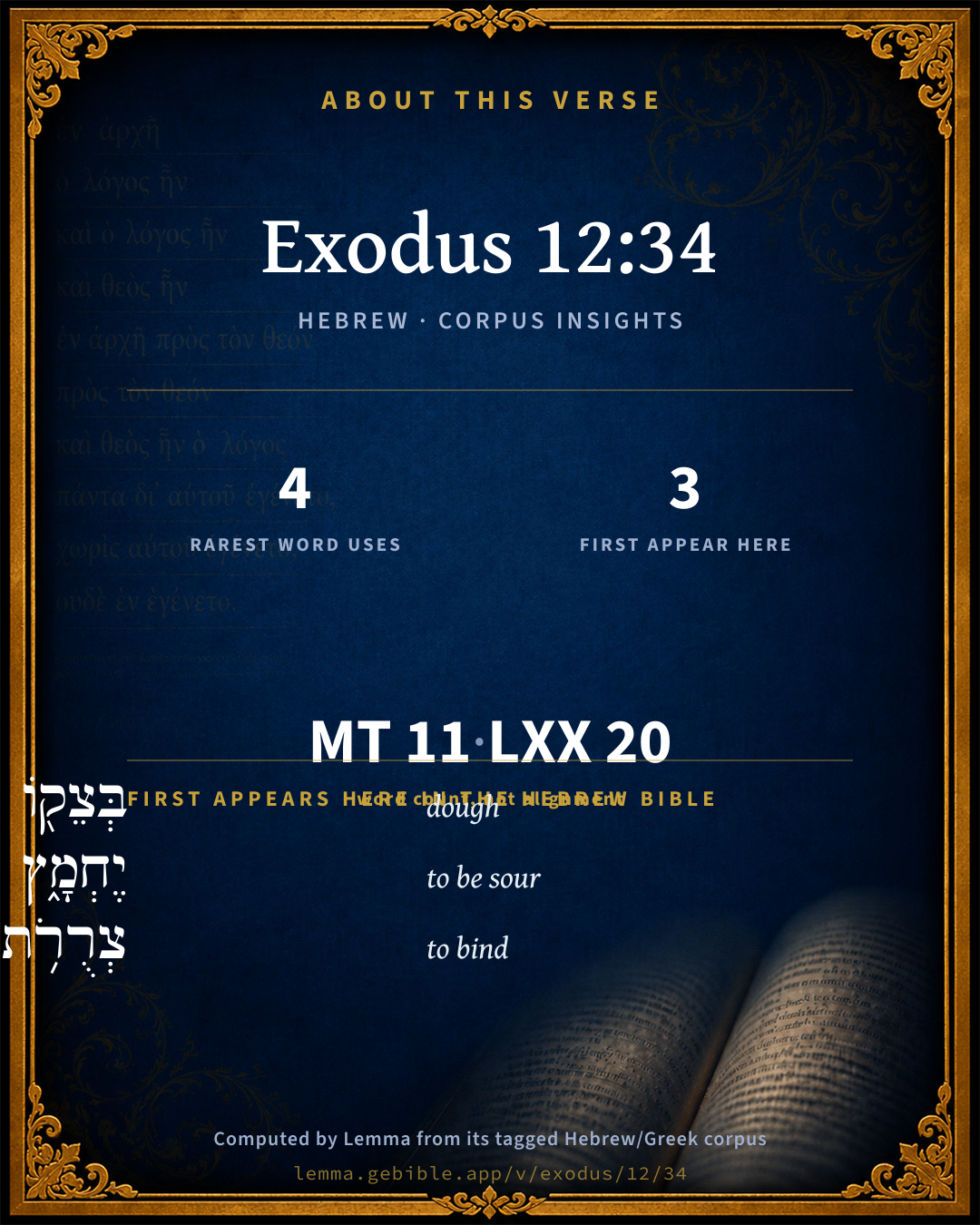
  • 3 first appearances in the Hebrew Bible
Full analysis ↓
Download a study sheet

One document with this verse’s original text, its word-by-word gloss line, the meaning frame, cross-references with their text, attributed commentary, and full source and license credits — printable, and it pastes into notes with its structure intact.

This verse Autodidact and up

Study sheet (.html) Plain text (.txt)

A passage Seminary Student

Up to 50 verses in one chapter. A passage sheet keeps up to 6 commentary sources and 12 cross-references per verse, in the order this page ranks them, and says so on the sheet whenever that leaves anything out. Ask for a single verse and you get the Autodidact verse sheet above.

Everything on this page stays free to read, with no account — the sheet is a download of what is already on screen, not access to it.

Want to remove ads? Support Godless Engineer
Compare translations 3

The same verse in 3 English versions, stacked beneath the original-language interlinear above. Click any original word for its lexicon entry.

Each is an independent rendering of the whole verse — the interlinear is not word-aligned to these translations.

Highlighted words mark where these versions differ — a whole-verse word diff, not a word-by-word alignment.

  • World English Bible Public Domain
    The people took their dough before it was leavened, their kneading-troughs being bound up in their clothes on their shoulders.
  • King James Version Public Domain
    And the people took their dough before it was leavened, their kneadingtroughs being bound up in their clothes upon their shoulders.
  • unfoldingWord Literal Text CC BY-SA 4.0
    And the people carried his dough before it developed leaven. Their kneading bowls were wrapped in their clothes on their shoulders.

unfoldingWord Literal Text — © unfoldingWord, licensed CC BY-SA 4.0. Word-aligned USFM3 via Door43 (git.door43.org/unfoldingWord/en_ult).

Versions to compare (up to 4)

3 of 4 selected

Show all 18 translations

Every available English version of this verse, each an independent rendering of the whole verse.

  • World English Bible Public Domain
    The people took their dough before it was leavened, their kneading-troughs being bound up in their clothes on their shoulders.
  • Berean Standard Bible Public Domain
    So the people took their dough before it was leavened, carrying it on their shoulders in kneading bowls wrapped in clothing.
  • Majority Standard Bible Public Domain
    So the people took their dough before it was leavened, carrying it on their shoulders in kneading bowls wrapped in clothing.
  • King James Version Public Domain
    And the people took their dough before it was leavened, their kneadingtroughs being bound up in their clothes upon their shoulders.
  • American Standard Version (1901) Public Domain
    And the people took their dough before it was leavened, their kneading-troughs being bound up in their clothes upon their shoulders.
  • Revised Version (1885) Public Domain
    And the people took their dough before it was leavened, their kneadingtroughs being bound up in their clothes upon their shoulders.
  • Geneva Bible (1599) Public Domain
    Therfore the people tooke their dough before it was leauened, euen their dough bound in clothes vpon their shoulders.
  • Douay-Rheims (1899) Public Domain
    The people therefore took dough before it was leavened: and tying it in their cloaks, put it on their shoulders.
  • Young's Literal Translation Public Domain
    and the people taketh up its dough before it is fermented, their kneading-troughs `are' bound up in their garments on their shoulder.
  • Literal Standard Version CC BY-SA 4.0
    and the people take up their dough before it is fermented, their kneading-troughs [are] bound up in their garments on their shoulder.
  • Unlocked Literal Bible CC BY-SA 4.0
    So the people took their dough without adding any yeast. Their kneading bowls were already tied up in their clothes and on their shoulders.
  • unfoldingWord Literal Text CC BY-SA 4.0
    And the people carried his dough before it developed leaven. Their kneading bowls were wrapped in their clothes on their shoulders.
  • Darby Bible Public Domain
    And the people took their dough before it was leavened; their kneading-troughs bound up in their clothes upon their shoulders.
  • World Messianic Bible Public Domain
    The people took their dough before it was leavened, their kneading troughs being bound up in their clothes on their shoulders.
  • Webster's Bible Public Domain
    And the people took their dough before it was leavened, their kneading troughs being bound up in their clothes upon their shoulders.
  • Free Bible Version CC BY-SA 4.0
    So the Israelites picked up their dough before it had risen, and carried it on their shoulders in kneading bowls wrapped in clothing.
  • Bible in Basic English Public Domain
    And the people took their bread-paste before it was leavened, putting their basins in their clothing on their backs.
  • JPS Tanakh (1917) Public Domain
    And the people took their dough before it was leavened, their kneading-troughs being bound up in their clothes upon their shoulders.

Literal Standard Version (2020), Covenant Press — licensed CC BY-SA 4.0. Text via the HelloAO Bible API (eBible.org). Unlocked Literal Bible (unfoldingWord) — licensed CC BY-SA 4.0. Text via the HelloAO Bible API (eBible.org). unfoldingWord Literal Text — © unfoldingWord, licensed CC BY-SA 4.0. Word-aligned USFM3 via Door43 (git.door43.org/unfoldingWord/en_ult). Free Bible Version, Dr. Jonathan Gallagher — licensed CC BY-SA 4.0. Text via the HelloAO Bible API (eBible.org).

Word by word

More ways to search: Search by grammar → Find every occurrence → Compare this word →

Practice this passage: Drill this verse → Learn its vocabulary →

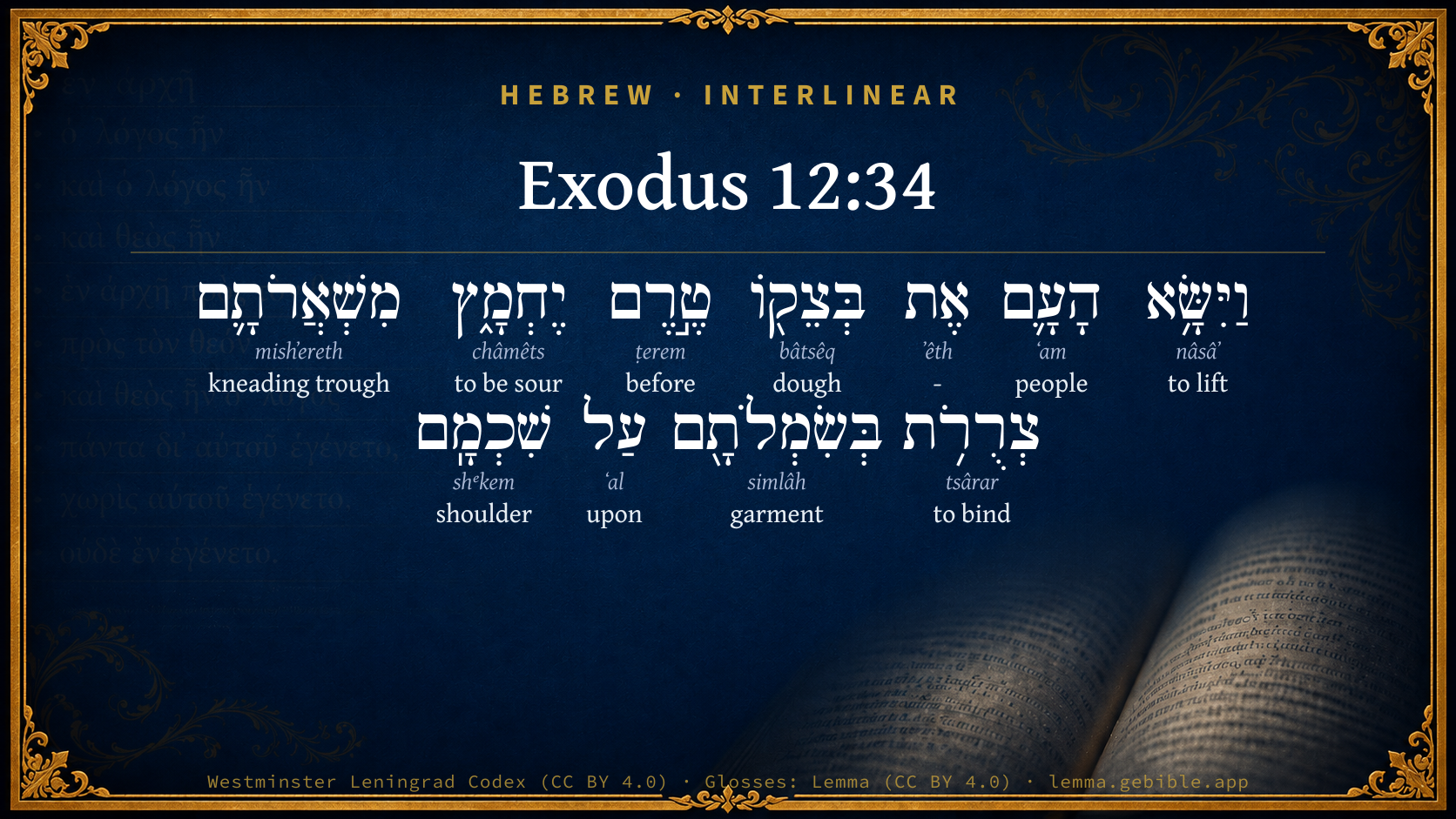
מִשְׁאֲרֹתָ֛ם
mishʼereth
H4863
“kneading troughs · their”
Noun, Common, Feminine, Plural, Construct + Suffix, Personal, 3rd Person, Masculine, Plural
Part of Speech
Noun
Type
Common
Gender
Feminine
Number
Plural
State
Construct
Full BDB Definition

Origin: from H7604 in the original sense of swelling

TWOT: 1252

kneading trough or bowl
  1. וַיִּשָּׂ֥א nâsâʼ H5375 “and · to lift” Conjunction + Verb, Qal, Sequential Imperfect, 3rd Person, Masculine, Singular
  2. הָעָ֛ם ʻam H5971 “the · people” Particle, Definite Article + Noun, Common, Masculine, Singular, Absolute
  3. אֶת ʼêth H853 “-” Particle, Direct Object
  4. בְּצֵק֖וֹ bâtsêq H1217 “dough · his” Noun, Common, Masculine, Singular, Construct + Suffix, Personal, 3rd Person, Masculine, Singular
  5. טֶ֣רֶם ṭerem H2962 “before” Adverb
  6. יֶחְמָ֑ץ châmêts H2556 “to be sour” Verb, Qal, Imperfect, 3rd Person, Masculine, Singular
  7. צְרֻרֹ֥ת tsârar H6887 “bound” Verb, Qal, Participle Passive, Feminine, Plural, Absolute
  8. בְּשִׂמְלֹתָ֖ם simlâh H8071 “in/at · garments · their” Preposition + Noun, Common, Feminine, Plural, Construct + Suffix, Personal, 3rd Person, Masculine, Plural
  9. עַל ʻal H5921 “upon” Preposition
  10. שִׁכְמָֽם shᵉkem H7926 “shoulder · their” Noun, Common, Masculine, Singular, Construct + Suffix, Personal, 3rd Person, Masculine, Plural

About this verse

These counts appear in no published source. They are computed here, from the morphology-tagged text and Lemma’s own curated glosses. What Lemma adds →

11
words
11
distinct lemmas
Pentateuch
section

Notable vocabulary

The rarest word here is מִשְׁאֲרֹתָ֛ם kneading trough H4863 — appearing just 4 times in the whole Hebrew Bible.

First appearance in Scripture

These words make their first canonical appearance in the Hebrew Bible here:

  • בְּצֵק֖וֹ dough H1217
  • יֶחְמָ֑ץ to be sour H2556
  • צְרֻרֹ֥ת to bind H6887

Shared distinctive vocabulary

מִשְׁאֲרֹתָ֛ם kneading trough H4863 occurs in 4 verses of the Hebrew Bible. Also found in:

Grammatical profile

  • 3 verbs
  • 5 nouns
  • 1 preposition
  • 1 adverb
  • 1 particle

Verb forms

  • וַיִּשָּׂ֥א Qal · Sequential Imperfect
  • יֶחְמָ֑ץ Qal · Imperfect
  • צְרֻרֹ֥ת Qal · Participle Passive

Hebrew & Septuagint length

In English translation the verse runs 20 words from the Hebrew and 22 from the Septuagint (LXX English) — closely comparable.

A rough comparison of the two English renderings, which tokenize alike — not a word-level alignment.

Word counts can differ between the Hebrew and the Greek without any difference in meaning — e.g. the Hebrew direct-object marker אֵת has no separate Greek word, and Greek often adds the article ὁ.

In the original languages it is 11 Hebrew tokens and 20 Greek tokens — but the two are counted differently (Hebrew bundles its prefixes and suffixes into one token; the Greek is in lemma form), so that isn’t a like-for-like length.

Cross-references

1

Topical passages linked to Exodus 12:34 in the Treasury of Scripture Knowledge — connected by theme and wording, ordered by reader-vote popularity; previews shown in the World English Bible.

  • Exodus 8:3 and the river shall swarm with frogs, which shall go up and come into your house, and into your bedchamber, and on your bed, and into the house of your servants, and on your people, and into your ovens, and into your kneading-troughs:

Cross-references courtesy of OpenBible.info (CC BY 4.0).

Hebrew and Greek witnesses Masoretic Hebrew ↔ Greek Septuagint

The same verse in the two great witnesses to the Old Testament, shown verse-for-verse.

These are two independent witnesses, not word-aligned to each other, and the Septuagint is shown in lemma (dictionary) form.

Hebrew Exodus 12:34 Masoretic · Westminster Leningrad Codex

וַיִּשָּׂ֥א הָעָ֛ם אֶת בְּצֵק֖וֹ טֶ֣רֶם יֶחְמָ֑ץ מִשְׁאֲרֹתָ֛ם צְרֻרֹ֥ת בְּשִׂמְלֹתָ֖ם עַל שִׁכְמָֽם

The people took their dough before it was leavened, their kneading-troughs being bound up in their clothes on their shoulders.

World English Bible · Public Domain

Greek LXX Exodus 12:34 Septuagint · lemma form

ἀναλαμβάνω δέ ὁ λαός ὁ σταῖς πρό ὁ ζύμομαι ὁ φύραμα αὐτός ἐνδέω ἐν ὁ ἱμάτιον αὐτός ἐπί ὁ ὦμος

And the people took their dough before their meal was leavened, bound up as it was in their garments, on their shoulders.

LXX2012 (modern English Septuagint) · Public Domain

Hebrew: Westminster Leningrad Codex (CC BY 4.0). Greek: Septuagint (public domain); English from LXX2012 (modern English Septuagint) (Public Domain). How the Septuagint differs from the Hebrew →

Targum (Aramaic paraphrase)

2

The Targum is the ancient Jewish Aramaic paraphrase of the Hebrew Scriptures — an interpretive translation, not the Hebrew text itself. Onkelos (literal) and Pseudo-Jonathan (expansive) render the Torah, and Jonathan the Prophets. Coverage is partial: where no permissively-licensed English translation exists for a verse, only the Aramaic is shown. This is verse-level text, not a word-by-word alignment to the Hebrew.

  1. Targum Onkelos Torah (Genesis–Deuteronomy)
    וּנְטַל עַמָא יָת לַיְשֵׁיהוֹן עַד לָא חֲמָע מוֹתַר אַצְוָתְהוֹן צְרִיר בִּלְבָשֵׁהוֹן עַל כַּתְפֵּיהוֹן:

    (no public-domain English translation for this verse)

    Targum Onkelos — Aramaic: “Onkelos Genesis” (public domain); “Onkelos Exodus” (public domain); “Onkelos Leviticus” (public domain); “Onkelos Numbers” (public domain); “Onkelos Deuteronomy” (public domain). English: “Sefaria Community Translation” (CC0 1.0 (public-domain dedication)); “J.W. Etheridge. The Targums of Onkelos and Jonathan Ben Uzziel on the Pentateuch. London: Longmans, Green, 1862” (public domain). Text via Sefaria.

  2. Targum Pseudo-Jonathan Torah (Genesis–Deuteronomy)
    וּנְטַל עַמָּא יַת לֵישֵׁיהוֹן עֲלוֹי רֵישֵׁיהוֹן עַד דְּלָא אַחְמָע וּמִן דְּמִשְׁתַּיֵּיר לְהוֹן מִן פַּטִּירֵי וּמְרִירִי סוֹבָרוּ צְרִיר בִּלְבוּשֵׁיהוֹן עַל כַּתְפֵיהוֹן

    And the people carried their dough upon their heads, being unleavened, and what remained to them of the paschal cakes and bitter things they carried, bound up with their raiment, upon their shoulders.

    Targum Pseudo-Jonathan — Aramaic: “Targum Jonathan on Genesis” (public domain); “Targum Jonathan on Exodus” (public domain); “Targum Jonathan on Leviticus” (public domain); “Targum Jonathan on Numbers” (public domain); “Targum Jonathan on Deuteronomy” (public domain). English: “The Targum of Jonathan ben Uzziel, trans. J. W. Etheridge, London, 1862” (public domain). Text via Sefaria.

Commentary

Notes on Exodus 12:34 from classic Christian and Jewish commentators (each source and its license shown beneath its notes). The classic Christian expositions comment on the surrounding passage and are grouped to its opening verse, so a note may address several verses; the Jewish commentaries on the Tanakh (Rashi and others) are per-verse, so they appear only where the commentator wrote on this verse.

Lemma curates 59 commentaries, every one of them public domain or Creative Commons licensed, each selected and text-cleaned for this edition rather than reprinted as found. About our sources →

Trapp's Complete Commentary

John Trapp

Exo 12:34 And the people took their dough before it was leavened, their kneadingtroughs being bound up in their clothes upon their shoulders.

Ver. 34. Took their dough, &c., upon their shoulders.] Not upon their camels, which, saith Aben Erza, were laden with the precious things borrowed of the Egyptians. Rab. Solomon saith, it was to show their cheerfulness in obeying the command of God. See a better reason afterwards, in Exo 12:39.

John Trapp, A Commentary or Exposition upon All the Books of the Old and New Testament (1647–1656) — public domain. Text from a community e-Sword module.

Joseph Benson's Commentary

Exo 12:34. The people took their dough — Perhaps the Hebrew word here used had better be rendered flour, as it is 2Sa 13:8; for if they had time to make it into paste, it seems they would also have had time to leaven it. Their kneading-troughs — The word thus rendered is translated store, Deu 28:5; Deu 28:17. And as kneading-troughs are not things which travellers are wont to carry with them, it seems more natural to understand it of their flour, grain, or dough.

Joseph Benson's Commentary on the Old and New Testaments (1811–1818) — public domain. Text from a community e-Sword module.

Jamieson, Fausset & Brown

Robert Jamieson, A. R. Fausset & David Brown

people took . . . their kneading-troughs--Having lived so long in Egypt, they must have been in the habit of using the utensils common in that country. The Egyptian kneading-trough was a bowl of wicker or rush work, and it admitted of being hastily wrapped up with the dough in it and slung over the shoulder in their hykes or loose upper garments.

Jamieson, Fausset & Brown — Commentary Critical and Explanatory on the Whole Bible (1871) — public domain (CC PDM 1.0). Text via the HelloAO Bible API.

Adam Clarke's Commentary

Verse 34. The people took their dough before it was leavened, c.] There was no time now to make any regular preparation for their departure, such was the universal hurry and confusion. The Israelites could carry but little of their household utensils with them but some, such as they kneaded their bread and kept their meal in, they were obliged to carry with them. The kneading troughs of the Arabs are comparatively small wooden bowls, which, after kneading their bread in, serve them as dishes out of which they eat their victuals. And as to these being bound up in their clothes, no more may be intended than their wrapping them up in their long, loose garments, or in what is still used among the Arabs, and called hykes, which is a long kind of blanket, something resembling a highland plaid, in which they often carry their provision, wrap themselves by day, and sleep at night. Dr. Shaw has been particular in his description of this almost entire wardrobe of an Arab. He says they are of different sizes and of different qualities, but generally about six yards in length, and five or six feet broad. He supposes that what we call Ruth's veil, Ru 3:15, was a hyke, and that the same is to be understood of the clothes of the Israelites mentioned in this verse. See his Travels, p. 224, 4to edition.

Adam Clarke's Commentary on the Bible (1810–1826) — public domain. Text from a community e-Sword/MySword module.

Ellicott's Commentary for English Readers

(34) Kneadingtroughs.—Light, portable wooden bowls, such as are now used by the Arabs.

A Bible Commentary for English Readers, edited by Charles John Ellicott (1878–1897) — public domain. Text from a community e-Sword module.

The Cambridge Bible for Schools and Colleges

gen. ed. J. J. S. Perowne

34. The people had not time to leaven their dough, but took it with them before it was leavened. The notice, taken in conjunction with the one in v. 39, is evidently intended as an explanation of the origin of the Maẓẓoth-feast: cf. Deu_16:3; and p. 91, above.

their kneading-bowls,] See on Exo_8:3.

in their clothes] rather, in their mantles. The simlâh was the large square outer garment, made of woollen cloth, which served as a covering by night (ch. Exo_22:26 f.), and was also often used for carrying things in (Jdg_8:25, Rth_3:15). See Dress 3 b in DB. (i. 625).

The Cambridge Bible for Schools and Colleges (gen. ed. J. J. S. Perowne; Cambridge University Press, 1878–1918) — public domain. Text from a community e-Sword module.

John Gill's Exposition

And the Lord gave the people favour in the sight of the Egyptians,.... Their minds were disposed towards them, and their hearts were inclined to grant their request, and did grant it:

so they lent unto them: such things as they required; or "they gave unto them" (b); made presents of them freely to them; and so Josephus says (c), that they honoured them with gifts:

and they spoiled the Egyptians; stripped them of their substance and riches, of their most valuable things; in doing which they were in no wise criminal, since they did it by the direction and authority of God, who has a right to dispose of all the things in the world; and to take of them from one, and give to another, as he pleases; nor was any injustice done to the Egyptians, who owed all this, and perhaps abundantly more, to the Israelites, for the labour and service they had served them in for many years; besides, they were the avowed enemies of Israel, and the Lord had now put himself at the head of the armies of Israel, and was contending with them, and they with him, who should overcome; and this was doing no other than what, acceding to the law of nations, is lawful to be done in time of war; to spoil, plunder, and distress an enemy, in whatsoever way it can be done. And thus the promise made to Abraham, that his posterity should come out with great substance, was fulfilled, Gen 15:14. This circumstance is taken notice of by some Heathen writers, as Artapanus (d); who says they borrowed many cups of the Egyptians, and not a little raiment, besides a great quantity of other treasure and riches; and so Ezekiel the tragedian (e) speaks of a vast deal of gold and silver, raiment, and other things, the Israelitish women had of the Egyptians at their departure, and who relates the history of Moses and the above plagues very agreeably to the sacred writings.

(b) "ut petita darent", Tigurine version, "ut dederint", Junius & Tremellius, Piscator, Ainsworth, Cartwright. (c) Antiqu. l. 2. c. 14. sect. 6. (d) Apud Euseb. Praepar. Evangel. l. 9. c. 27. p. 436. (e) Apud Euseb. ib. c. 29. p. 443.

John Gill's Exposition of the Whole Bible (1746–1763) — public domain (CC PDM 1.0). Text via the HelloAO Bible API.

Albert Barnes' Notes on the Bible

Kneadingtroughs - (Compare the margin and Deu 28:5). The troughs were probably small wooden bowls in which the cakes when baked were preserved for use. The Hebrews used their outer garment, or mantle, in the same way as the Bedouins at present, who make a bag of the voluminous folds of their burnous. See Rth 3:15; 2Ki 4:39.

Albert Barnes' Notes on the Bible (1834–1885) — public domain. Text from a community e-Sword/MySword module.

Haydock's Catholic Bible Commentary

Leavened; which dough afterwards made unleavened ember-cakes. Hebrew, "and misharoth (a word which the Vulgate does not translate) provisions" of flour, &c., ver. 39. (Josephus, [Antiquities?] ii. 6.) --- This flour might be tied up in their cloaks, as they were only square pieces of cloth, Ruth iii. 15. (Calmet)

George Leo Haydock (1774–1849), Haydock's Catholic Family Bible and Commentary, 1859 edition — public domain. Excludes Psalms (Douay-Rheims chapter numbering differs from Protestant) and Deuterocanonical books (Catholic canon only).

Matthew Poole's English Annotations

Their kneading-troughs; or, as others rightly render it, their dough lumps, or food, or lumps of paste unleavened.

Matthew Poole's English Annotations on the Holy Bible (1683–1685) — public domain. Text from a community e-Sword/MySword module.

Whedon's Commentary on the Bible

Daniel D. Whedon

34. Their kneading troughs being bound up in their clothes — The kneading troughs of the Egyptians were of wood, (see illustration under chap. 8:3,) and so, perhaps, were those of the Israelites; but more probably they were mere leather bags, such as are now used by the Bedouins. By “clothes” is here meant the simlah, a square, shawl-like outer garment, like a Scotch plaid, used to wrap up small movables. From this and the thirty-ninth verse it will be seen that the unleavened bread had an historical as well as a symbolical meaning. There was not the usual time for dough to rise, even had it been leavened.

Daniel D. Whedon (gen. ed.), Commentary on the Old and New Testaments (1874–1909) — public domain. Text from a community e-Sword module.

The Pulpit Commentary

The people took their dough. They probably regarded dough as more convenient for a journey than flour, and so made their flour into dough before starting; but they had no time to add leaven. Their kneading-troughs. This rendering is correct, both here and in the two other places where the word occurs. (Exo_8:3, and Deu_28:5) Kneading-troughs would be a necessity in the desert, and, if like those of the modern Arabs, which are merely small wooden bowls, would be light and portable. The dough and kneading-troughs, with perhaps other necessaries, were carried, as the Arabs still carry many small objects, bound up in their clothes (i.e. , in the beged or ample shawl) upon their shoulders.

The Pulpit Commentary (1880–1919), ed. H.D.M. Spence-Jones & Joseph S. Exell — public domain. Text from a community e-Sword module.

John Wesley's Explanatory Notes

Their kneading-troughs - Or rather, their lumps of paste unleavened.

John Wesley, Explanatory Notes Upon the Whole Bible (1754–1765) — public domain. Text via the GEBible commentary corpus.

unfoldingWord translationNotes

Door43 World Missions Community

Their kneading bowls were already tied up in their clothes and on their shoulders

This can be stated in active form. AT: "They had already tied up their kneading bowls in their clothes and on their shoulders" (See: Active or Passive)

translationWords

yeast

Israel

Egypt

silver

gold

unfoldingWord translationNotes — © Distant Shores Media and the Door43 World Missions Community, licensed CC BY-SA 4.0. Source: git.door43.org/Door43/en_tn.

Rashi

Rabbi Shlomo Yitzchaki (Rashi)

טרם יחמץ BEFORE IT WAS LEAVENED — The Egyptians would not allow them to stay long enough for the dough to become leavened.

משארתם (from the root שאר “to be left over”) denotes the leavings (what was left) of the unleavened bread and bitter herbs (Mekhilta).

על שכמם UPON THEIR SHOULDER — Although they took many cattle with them yet they bore this upon their shoulders because the commands of God were so dear unto them (Mekhilta).

Rashi on the Tanakh — English translations: “The Judaica Press complete Tanach with Rashi, translated by A. J. Rosenberg” (CC BY 4.0); “Pentateuch with Rashi's commentary by M. Rosenbaum and A.M. Silbermann, 1929-1934” (public domain); “The Metsudah Tanach series, Lakewood, N.J” (CC BY 4.0); and “The Book of Joshua, Metsudah Publications, 1997” (CC BY 4.0). Text via Sefaria.

Lesson kit

Teaching starters — assembled from the data on this page, not authored interpretation. Every prompt links to the verse data it draws on. Edit before teaching.

Exodus, in the Pentateuch, opens this verse with 11 words (11 distinct Hebrew lemmas). Its most distinctive word is mishʼereth (“kneading trough”). A historical commentator’s framing appears above. Read the whole chapter for the surrounding context.

Discussion questions

  1. The word mishʼereth carries the sense “kneading trough.” How does it shape the verse?
  2. 3 words here appear for the first time in Scripture. What is being introduced at this debut?
  3. Exodus 8:3 shares the word «kneading trough» with this verse. How do the two illuminate each other?
  4. The translations on this page render this verse differently — a whole-verse word diff, not a word-by-word alignment. What might account for the different wordings?
  5. The verb «וַיִּשָּׂ֥א» is Qal Sequential Imperfect. How does its form color the action?
  6. Reading how Trapp's Complete Commentary and Joseph Benson's Commentary read this verse, where do the two commentators agree and where do they part?

Things to notice

Reading settings

Reading text

Shown beneath each verse's original-language words.

Old Testament
Old Testament edition

Read the OT as the Masoretic Hebrew (MT) or the Greek Septuagint (LXX).

English shown for the Greek Septuagint (in the Hebrew ↔ Greek comparison).

Comparing translations? Open the Compare panel on any verse page to stack up to four side by side.