
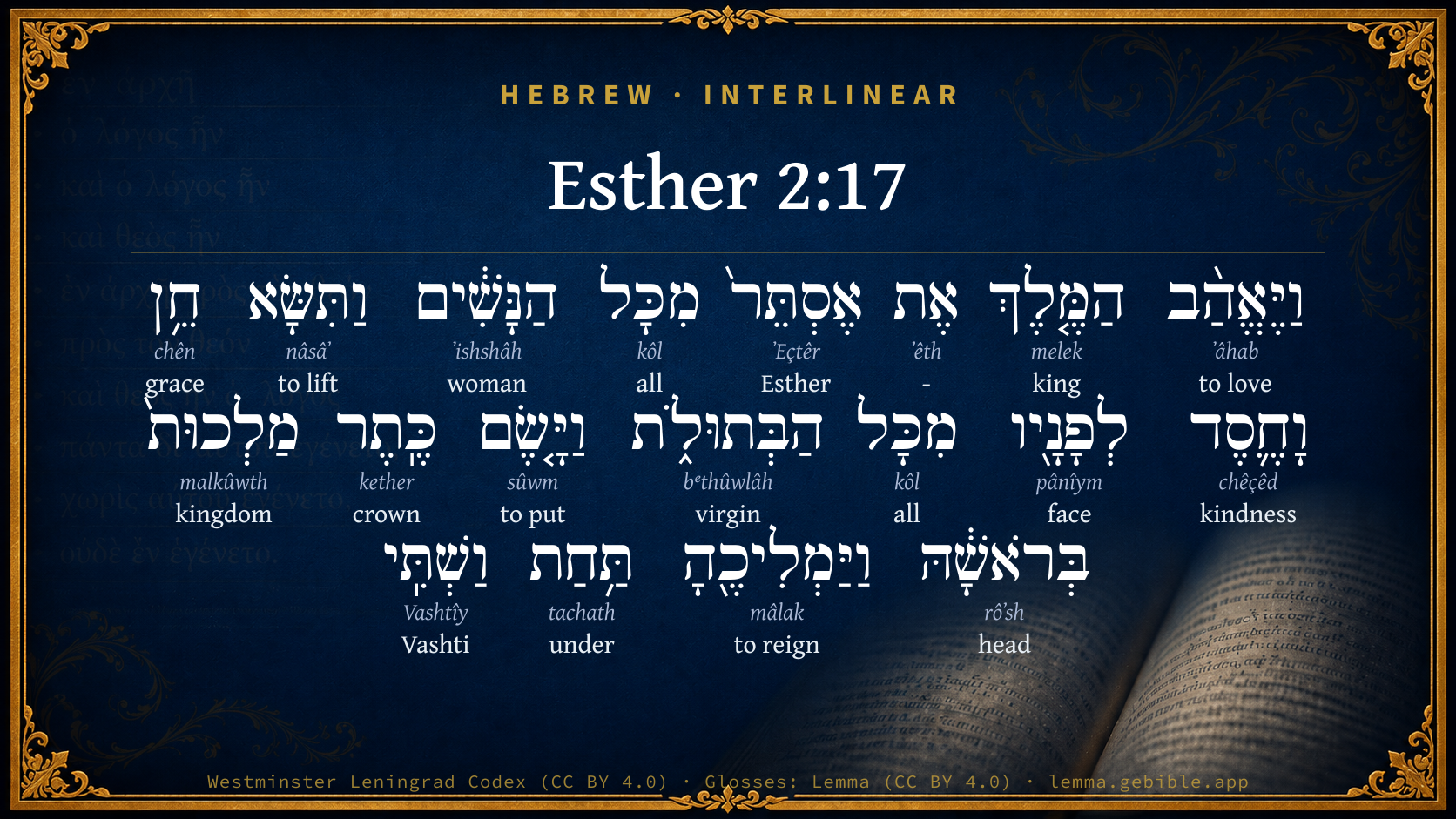
Esther 2:17

Hebrew (Westminster Leningrad Codex) Esther 2:17 appears in the Hebrew Old Testament. The text above is from the Westminster Leningrad Codex. Each word links to its Strong’s number, a concise gloss, and parsing drawn from the Open Scriptures Hebrew Bible morphology. Click any word for its full Brown-Driver-Briggs (BDB) entry.
Download image
Cite this verse

Esther 2:17 (World English Bible). Public Domain. Lemma interlinear Bible study tool, https://lemma.gebible.app/v/esther/2/17.

Show BibTeX & RIS
BibTeX
RIS
English Translation
The king loved Esther above all the women, and she obtained favor and kindness in his sight more than all the virgins; so that he set the royal crown on her head, and made her queen instead of Vashti.
World English Bible · Public Domain
Download a study sheet

One document with this verse’s original text, its word-by-word gloss line, the meaning frame, cross-references with their text, attributed commentary, and full source and license credits — printable, and it pastes into notes with its structure intact.

This verse Autodidact and up

Study sheet (.html) Plain text (.txt)

A passage Seminary Student

Up to 50 verses in one chapter. A passage sheet keeps up to 6 commentary sources and 12 cross-references per verse, in the order this page ranks them, and says so on the sheet whenever that leaves anything out. Ask for a single verse and you get the Autodidact verse sheet above.

Everything on this page stays free to read, with no account — the sheet is a download of what is already on screen, not access to it.

Want to remove ads? Support Godless Engineer
Compare translations 3

The same verse in 3 English versions, stacked beneath the original-language interlinear above. Click any original word for its lexicon entry.

Each is an independent rendering of the whole verse — the interlinear is not word-aligned to these translations.

Highlighted words mark where these versions differ — a whole-verse word diff, not a word-by-word alignment.

  • World English Bible Public Domain
    The king loved Esther above all the women, and she obtained favor and kindness in his sight more than all the virgins; so that he set the royal crown on her head, and made her queen instead of Vashti.
  • King James Version Public Domain
    And the king loved Esther above all the women, and she obtained grace and favour in his sight more than all the virgins; so that he set the royal crown upon her head, and made her queen instead of Vashti.
  • unfoldingWord Literal Text CC BY-SA 4.0
    And the king loved Esther more than all the women and she lifted favor and kindness before his face more than all the virgins. And he set a crown of royalty on her head, and he made her queen instead of Vashti.

unfoldingWord Literal Text — © unfoldingWord, licensed CC BY-SA 4.0. Word-aligned USFM3 via Door43 (git.door43.org/unfoldingWord/en_ult).

Versions to compare (up to 4)

3 of 4 selected

Show all 18 translations

Every available English version of this verse, each an independent rendering of the whole verse.

  • World English Bible Public Domain
    The king loved Esther above all the women, and she obtained favor and kindness in his sight more than all the virgins; so that he set the royal crown on her head, and made her queen instead of Vashti.
  • Berean Standard Bible Public Domain
    And the king loved Esther more than all the other women, and she found grace and favor in his sight more than all of the other virgins. So he placed the royal crown upon her head and made her queen in place of Vashti.
  • Majority Standard Bible Public Domain
    And the king loved Esther more than all the other women, and she found grace and favor in his sight more than all of the other virgins. So he placed the royal crown upon her head and made her queen in place of Vashti.
  • King James Version Public Domain
    And the king loved Esther above all the women, and she obtained grace and favour in his sight more than all the virgins; so that he set the royal crown upon her head, and made her queen instead of Vashti.
  • American Standard Version (1901) Public Domain
    And the king loved Esther above all the women, and she obtained favor and kindness in his sight more than all the virgins; so that he set the royal crown upon her head, and made her queen instead of Vashti.
  • Revised Version (1885) Public Domain
    And the king loved Esther above all the women, and she obtained grace and favour in his sight more than all the virgins; so that he set the royal crown upon her head, and made her queen instead of Vashti.
  • Geneva Bible (1599) Public Domain
    And the King loued Ester aboue all the women, and shee founde grace and fauour in his sight more then all the virgins: so that he set the crowne of the kingdome vpon her head, and made her Queene instead of Vashti.
  • Douay-Rheims (1899) Public Domain
    And the king loved her more than all the women, and she had favour and kindness before him above all the women, and he set the royal crown on her head, and made her queen instead of Vasthi.
  • Young's Literal Translation Public Domain
    and the king loveth Esther above all the women, and she receiveth grace and kindness before him above all the virgins, and he setteth a royal crown on her head, and causeth her to reign instead of Vashti,
  • Literal Standard Version CC BY-SA 4.0
    and the king loves Esther above all the women, and she receives grace and kindness before him above all the virgins, and he sets a royal crown on her head, and causes her to reign instead of Vashti,
  • Unlocked Literal Bible CC BY-SA 4.0
    The king loved Esther more than all the other women and she received acceptance and favor before him, more than all the other virgins. So he set the royal crown on her head and made her queen instead of Vashti.
  • unfoldingWord Literal Text CC BY-SA 4.0
    And the king loved Esther more than all the women and she lifted favor and kindness before his face more than all the virgins. And he set a crown of royalty on her head, and he made her queen instead of Vashti.
  • Darby Bible Public Domain
    And the king loved Esther above all the women, and she obtained grace and favour in his sight more than all the virgins, and he set the royal crown upon her head, and made her queen instead of Vashti.
  • World Messianic Bible Public Domain
    The king loved Esther more than all the women, and she obtained favor and kindness in his sight more than all the virgins; so that he set the royal crown on her head, and made her queen instead of Vashti.
  • Webster's Bible Public Domain
    And the king loved Esther above all the women, and she obtained grace and favor in his sight more than all the virgins; so that he set the royal crown upon her head, and made her queen instead of Vashti.
  • Free Bible Version CC BY-SA 4.0
    The king loved Esther more than all the other women. He treated her more favorably and with greater kindness than all of the other virgins. So he placed the royal crown on her head and made her queen instead of Vashti.
  • Bible in Basic English Public Domain
    And Esther was more pleasing to the king than all the women, and to his eyes she was fairer and more full of grace than all the other virgins: so he put his crown on her head and made her queen in place of Vashti.
  • JPS Tanakh (1917) Public Domain
    And the king loved Esther above all the women, and she obtained grace and favour in his sight more than all the virgins; so that he set the royal crown upon her head, and made her queen instead of Vashti.

Literal Standard Version (2020), Covenant Press — licensed CC BY-SA 4.0. Text via the HelloAO Bible API (eBible.org). Unlocked Literal Bible (unfoldingWord) — licensed CC BY-SA 4.0. Text via the HelloAO Bible API (eBible.org). unfoldingWord Literal Text — © unfoldingWord, licensed CC BY-SA 4.0. Word-aligned USFM3 via Door43 (git.door43.org/unfoldingWord/en_ult). Free Bible Version, Dr. Jonathan Gallagher — licensed CC BY-SA 4.0. Text via the HelloAO Bible API (eBible.org).

Word by word

More ways to search: Search by grammar → Find every occurrence → Compare this word →

Practice this passage: Drill this verse → Learn its vocabulary →

כֶּֽתֶר
kether
H3804
“crown of”
Noun, Common, Masculine, Singular, Construct
Part of Speech
Noun
Type
Common
Gender
Masculine
Number
Singular
State
Construct
Full BDB Definition

Origin: from H3803

TWOT: 1060a

crown
  1. וַיֶּאֱהַ֨ב ʼâhab H157 “and · to love” Conjunction + Verb, Qal, Sequential Imperfect, 3rd Person, Masculine, Singular
  2. הַמֶּ֤לֶךְ melek H4428 “the · king” Particle, Definite Article + Noun, Common, Masculine, Singular, Absolute
  3. אֶת ʼêth H853 “-” Particle, Direct Object
  4. אֶסְתֵּר֙ ʼEçtêr H635 “Esther” Noun, Proper
  5. מִכָּל kôl H3605 “from · all of” Preposition + Noun, Common, Masculine, Singular, Construct
  6. הַנָּשִׁ֔ים ʼishshâh H802 “the · women” Particle, Definite Article + Noun, Common, Feminine, Plural, Absolute
  7. וַתִּשָּׂא nâsâʼ H5375 “and · to lift” Conjunction + Verb, Qal, Sequential Imperfect, 3rd Person, Feminine, Singular
  8. חֵ֥ן chên H2580 “grace” Noun, Common, Masculine, Singular, Absolute
  9. וָחֶ֛סֶד chêçêd H2617 “and · kindness” Conjunction + Noun, Common, Masculine, Singular, Absolute
  10. לְפָנָ֖יו pânîym H6440 “to/for · face(s) · his” Preposition + Noun, Common, Both, Plural, Construct + Suffix, Personal, 3rd Person, Masculine, Singular
  11. מִכָּל kôl H3605 “from · all of” Preposition + Noun, Common, Masculine, Singular, Construct
  12. הַבְּתוּלֹ֑ת bᵉthûwlâh H1330 “the · virgins” Particle, Definite Article + Noun, Common, Feminine, Plural, Absolute
  13. וַיָּ֤שֶׂם sûwm H7760 “and · to put” Conjunction + Verb, Qal, Sequential Imperfect, 3rd Person, Masculine, Singular
  14. מַלְכוּת֙ malkûwth H4438 “kingdom” Noun, Common, Feminine, Singular, Absolute
  15. בְּרֹאשָׁ֔הּ rôʼsh H7218 “in/at · head · her” Preposition + Noun, Common, Masculine, Singular, Construct + Suffix, Personal, 3rd Person, Feminine, Singular
  16. וַיַּמְלִיכֶ֖הָ mâlak H4427 “and · to reign · her” Conjunction + Verb, Hiphil, Sequential Imperfect, 3rd Person, Masculine, Singular + Suffix, Personal, 3rd Person, Feminine, Singular
  17. תַּ֥חַת tachath H8478 “under” Preposition
  18. וַשְׁתִּֽי Vashtîy H2060 “Vashti” Noun, Proper

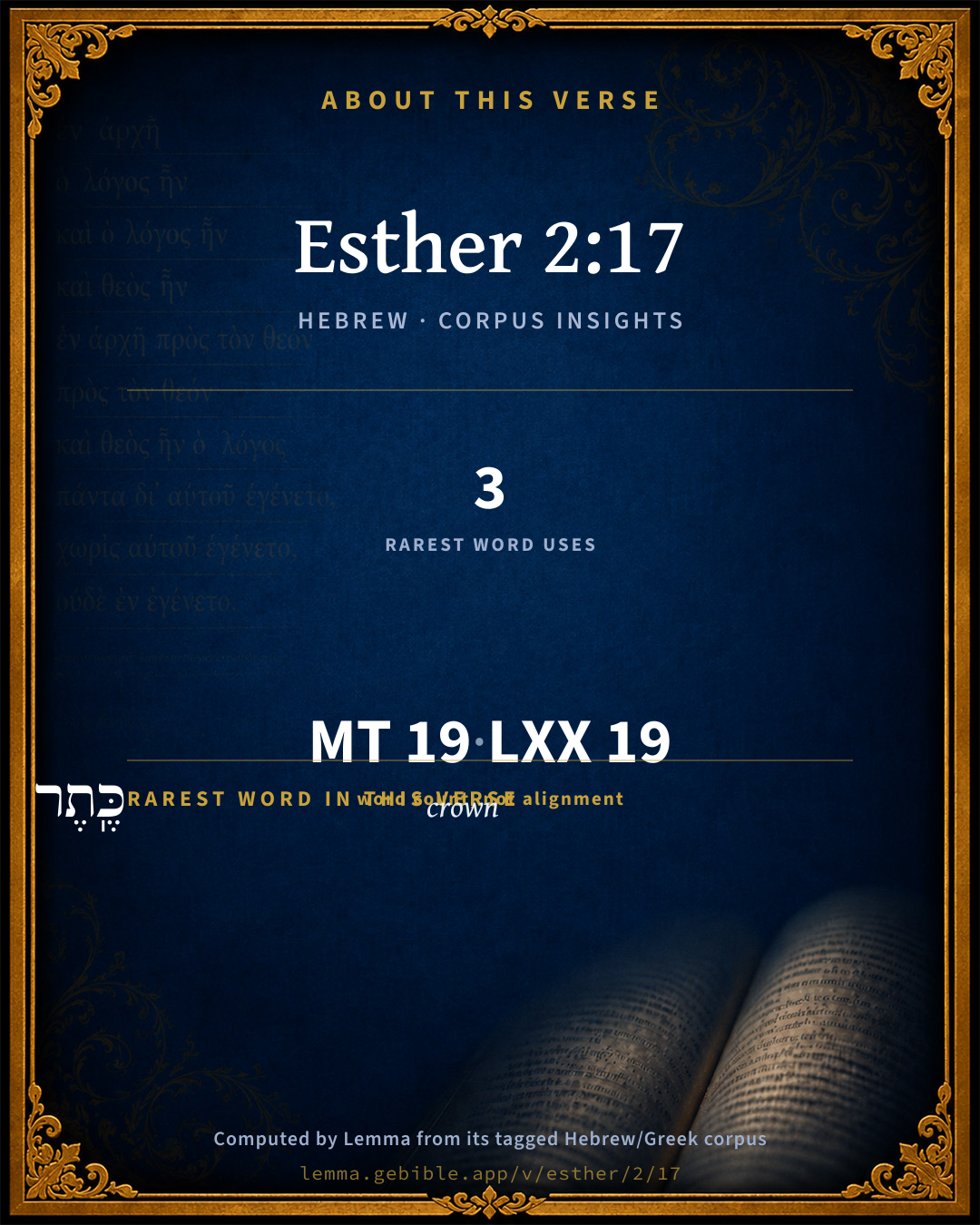
About this verse

These counts appear in no published source. They are computed here, from the morphology-tagged text and Lemma’s own curated glosses. What Lemma adds →

19
words
18
distinct lemmas
Historical
section

Notable vocabulary

The rarest word here is כֶּֽתֶר crown H3804 — appearing just 3 times in the whole Hebrew Bible.

Shared distinctive vocabulary

כֶּֽתֶר crown H3804 occurs in 3 verses of the Hebrew Bible. Also found in:

Grammatical profile

  • 4 verbs
  • 13 nouns
  • 1 preposition
  • 1 particle

Verb forms

  • וַיֶּאֱהַ֨ב Qal · Sequential Imperfect
  • וַתִּשָּׂא Qal · Sequential Imperfect
  • וַיָּ֤שֶׂם Qal · Sequential Imperfect
  • וַיַּמְלִיכֶ֖הָ Hiphil · Sequential Imperfect

Repetition

A word recurs within this verse — often emphatic in Hebrew:

  • מִכָּל all H3605 ×2

Hebrew & Septuagint length

In English translation the verse runs 39 words from the Hebrew and 22 from the Septuagint (LXX English) — the Septuagint runs noticeably shorter here. See the side-by-side →

A rough comparison of the two English renderings, which tokenize alike — not a word-level alignment.

Word counts can differ between the Hebrew and the Greek without any difference in meaning — e.g. the Hebrew direct-object marker אֵת has no separate Greek word, and Greek often adds the article ὁ.

In the original languages it is 19 Hebrew tokens and 19 Greek tokens — but the two are counted differently (Hebrew bundles its prefixes and suffixes into one token; the Greek is in lemma form), so that isn’t a like-for-like length.

Cross-references

7

Topical passages linked to Esther 2:17 in the Treasury of Scripture Knowledge — connected by theme and wording, ordered by reader-vote popularity; previews shown in the World English Bible.

  • Psalms 113:7–8 He raises up the poor out of the dust. Lifts up the needy from the ash heap;
  • Ezekiel 17:24 All the trees of the field shall know that I, Yahweh, have brought down the high tree, have exalted the low tree, have dried up the green tree, and have made the dry tree to flourish; I, Yahweh, have spoken and have done it.
  • Luke 1:48–52 For he has looked at the humble state of his handmaid. For behold, from now on, all generations will call me blessed.
  • 1 Samuel 2:8 He raises up the poor out of the dust, He lifts up the needy from the dunghill, To make them sit with princes, Inherit the throne of glory: For the pillars of the earth are Yahweh's, He has set the world on them.
  • Psalms 75:6–7 For neither from the east, nor from the west, Nor yet from the south, comes exaltation.
  • Esther 1:11 to bring Vashti the queen before the king with the crown royal, to show the peoples and the princes her beauty; for she was beautiful to look on.
  • Esther 4:14 For if you altogether hold your peace at this time, then will relief and deliverance arise to the Jews from another place, but you and your father's house will perish: and who knows whether you haven't come to the kingdom for such a time as this?

Cross-references courtesy of OpenBible.info (CC BY 4.0).

Hebrew and Greek witnesses Masoretic Hebrew ↔ Greek Septuagint

The same verse in the two great witnesses to the Old Testament, shown verse-for-verse.

Here the Septuagint runs noticeably shorter than the Hebrew — LXX2012 (modern English Septuagint) 22 words vs World English Bible 39. A rough length comparison of the two English translations, not a word-level alignment — read both below.

These are two independent witnesses, not word-aligned to each other, and the Septuagint is shown in lemma (dictionary) form.

Hebrew Esther 2:17 Masoretic · Westminster Leningrad Codex

וַיֶּאֱהַ֨ב הַמֶּ֤לֶךְ אֶת אֶסְתֵּר֙ מִכָּל הַנָּשִׁ֔ים וַתִּשָּׂא חֵ֥ן וָחֶ֛סֶד לְפָנָ֖יו מִכָּל הַבְּתוּלֹ֑ת וַיָּ֤שֶׂם כֶּֽתֶר מַלְכוּת֙ בְּרֹאשָׁ֔הּ וַיַּמְלִיכֶ֖הָ תַּ֥חַת וַשְׁתִּֽי

The king loved Esther above all the women, and she obtained favor and kindness in his sight more than all the virgins; so that he set the royal crown on her head, and made her queen instead of Vashti.

World English Bible · Public Domain

Greek LXX Esther 2:17 Septuagint · lemma form

καί ἐράω ὁ βασιλεύς εσθηρ καί εὑρίσκω χάρις παρά πᾶς ὁ παρθένος καί ἐπιτίθημι αὐτός ὁ διάδημα ὁ γυναικεῖος

And the king loved Esther, and she found favor beyond all the other virgins: and he put on her the queen's crown.

LXX2012 (modern English Septuagint) · Public Domain

Hebrew: Westminster Leningrad Codex (CC BY 4.0). Greek: Septuagint (public domain); English from LXX2012 (modern English Septuagint) (Public Domain). How the Septuagint differs from the Hebrew →

Commentary

Notes on Esther 2:17 from classic Christian and Jewish commentators (each source and its license shown beneath its notes). The classic Christian expositions comment on the surrounding passage and are grouped to its opening verse, so a note may address several verses; the Jewish commentaries on the Tanakh (Rashi and others) are per-verse, so they appear only where the commentator wrote on this verse.

Lemma curates 59 commentaries, every one of them public domain or Creative Commons licensed, each selected and text-cleaned for this edition rather than reprinted as found. About our sources →

Trapp's Complete Commentary

John Trapp

Est 2:17 And the king loved Esther above all the women, and she obtained grace and favour in his sight more than all the virgins; so that he set the royal crown upon her head, and made her queen instead of Vashti.

Ver. 17. And the king loved Esther] This was the Lord’s own work, who regarded the low estate of his handmaid, Luk 1:48, and framed the king’s heart to affect her. Let all such maids as desire loving husbands, and all such wives as would have their husbands loyal and loving to them, get God’s favour, and adorn themselves with humility and modesty, as Esther did. Let Christian husbands also learn (for shame) of this barbarian, to love their wives above all women, with a conjugal, chaste, and fast affection: not lusting and hankering after strange flesh. It is remarkable, that after Solomon had said, "Rejoice in the wife of thy youth, … be thou ravished always with her love; ravished with a strange woman, and embrace the bosom of a stranger?" Pro 5:19-20.

She obtained grace and favour in his sight] Surely as meat pleaseth better in a clean dish, so virtue in comely persons is more amiable, saith Hugo. Beauty of itself is a greater commendation, saith Aristotle, than all letters testimonial.

So that he set the royal crown upon her head] For queens also had their crowns, and did shine with the beams of their husbands; saying, as once those Roman ladies, Ubi tu Caius, ibi ego Caia, Wheresoever thou art king I also am queen. Severus here saith, that the king clothed Esther with a purple robe, to show that he shared the kingdom with her, but the text holdeth forth no such matter; indeed, he made her queen instead of Vashti, he made also a great wedding feast, and gave a release to the provinces, and gifts to his grandees, as it followeth.

John Trapp, A Commentary or Exposition upon All the Books of the Old and New Testament (1647–1656) — public domain. Text from a community e-Sword module.

The Biblical Illustrator

Joseph S. Exell

Est_2:17-20

So that he set the royal crown upon her head.

The elevation of woman

Gloss it as you may, this is not pleasant reading, and yet not unprofitable, having much to say to us, and especially to women, of what we owe to Christianity for the elevation of woman. Telling of a despot and sensualist, and how he claimed his countrys fairest beauty for his insatiate pleasure. But it is purely told us. It can be read without dulling the conscience or staining the imagination. What nation of antiquity looked not upon woman as a decorated toy or an abject drudge? There was one exception. Among the Jews her position was relatively high as compared with that assigned to her in adjacent nations. She had larger liberty than even now is allowed her in Oriental countries, with greater variety and importance of employments. She headed, like Miriam, the bands of women who celebrated, with triumphant song, the overthrow of enemies. She led armies, like Deborah, and was, like her, a prophetess and a judge. In the free grace of an unconfined maidenhood she went out to meet her father with timbrels and dances. Her hymns were included in sacred records, as was the song of Samuels mother. She was consulted, like Huldah, by high-priest and king. And while the effect of polygamy was disastrous, so far as that obtained before the captivity, and while it was obvious that the husband, not the wife, was the acknowledged head of the household, in independence of whom the wife could enter on no engagements, the dowry was given for the wife, not with her. The modern harem was unknown, the matron walked abroad unveiled, her husbands house was esteemed her rest, she had a large authority in the family, and the grace and force of her character and mind were honoured, cultured, and allowed opportunity. (R. S. Storrs.)

Esthers advancement

from low estate to share the throne of Persia reminds us of what God does for His people in raising them from the miry clay to sit with Christ upon His throne. (A. B. Davidson, D. D.)

The Biblical Illustrator, edited by Joseph S. Exell (c. 1880s–1900s) — public domain. Text from a community e-Sword module.

Tyndale Open Study Notes

Tyndale Open Resources

2:17 he set the royal crown on her head: Now Esther had access to the king’s heart as his favored wife. She was now in a place where God could use her to impact the thoughts and actions of the king.

Tyndale Open Study Notes — © Tyndale Open Resources, licensed CC BY-SA 4.0. Text via the HelloAO Bible API.

Jamieson, Fausset & Brown

Robert Jamieson, A. R. Fausset & David Brown

the king loved Esther above all the women--The choice fell on Esther, who found favor in the eyes of Ahasuerus. He elevated her to the dignity of chief wife, or queen. The other competitors had apartments assigned them in the royal harem, and were retained in the rank of secondary wives, of whom Oriental princes have a great number.

he set the royal crown upon her head--This consisted only of a purple ribbon, streaked with white, bound round the forehead. The nuptials were celebrated by a magnificent entertainment, and, in honor of the auspicious occasion, "he made a release to the provinces, and gave gifts, according to the state of the king." The dotation of Persian queens consisted in consigning to them the revenue of certain cities, in various parts of the kingdom, for defraying their personal and domestic expenditure. Some of these imposts the king remitted or lessened at this time.

Jamieson, Fausset & Brown — Commentary Critical and Explanatory on the Whole Bible (1871) — public domain (CC PDM 1.0). Text via the HelloAO Bible API.

Adam Clarke's Commentary

Verse 17. Set the royal crown upon her head] Made her what is now called in the East the SULTANA, the queen. She was the mistress of all the rest of the wives, all of whom were obliged to pay her the most profound respect.

Adam Clarke's Commentary on the Bible (1810–1826) — public domain. Text from a community e-Sword/MySword module.

The Cambridge Bible for Schools and Colleges

gen. ed. J. J. S. Perowne

17. the royal crown] See on Est_1:11.

The Cambridge Bible for Schools and Colleges (gen. ed. J. J. S. Perowne; Cambridge University Press, 1878–1918) — public domain. Text from a community e-Sword module.

John Gill's Exposition

And the king loved Esther above all the women,.... The virgins he made his concubines, as next explained; though Jarchi interprets it of married women, for such he supposes were gathered and brought to him, as well as virgins:

and she obtained grace and favour in his sight more than all the virgins; who had been purified, and in their turns brought to him:

so that he set the royal crown upon her head, and made her queen instead of Vashti; declared her queen, and gave her all the ensigns of royalty: so it was usual with the eastern kings to put a crown or diadem on the heads of their wives at the time of marriage, and declare them queens (s).

(s) Vid. Paschalium de Coronis, l. 10. c. 8. p. 689.

John Gill's Exposition of the Whole Bible (1746–1763) — public domain (CC PDM 1.0). Text via the HelloAO Bible API.

Haydock's Catholic Bible Commentary

Crown. Literally, "diadem," (Haydock) which was a bandage "of purple, striped with white," by which the queen was distinguished from the other wives. (Calmet) --- The king wore "a four-square cidaris," with a similar ornament. (Alex. Genial. i. 27.) --- Only one queen was chosen from all the wives, and she was "adored" by the rest. (Dion. Athen. iii. l.) --- Though God had forbidden marriages with infidels, (Calmet) at least with those of Chanaan, (Haydock) a dispensation might be granted, (Exodus xxxiv.; Tirinus; 2 Kings iii.; Worthington) for a greater good. Esther was not puffed up with her exaltation, and refrained from all forbidden meats, chap. xiv. 15. (Calmet) --- If she be the Artystona of Herotous, (vii. 69.; Haydock) as it is most probable, (Tirinus) her two sons, Arsames and Gobryas, had a command in the famous expedition of Xerxes. (Usher, the year of the world 3524.) (Calmet)

George Leo Haydock (1774–1849), Haydock's Catholic Family Bible and Commentary, 1859 edition — public domain. Excludes Psalms (Douay-Rheims chapter numbering differs from Protestant) and Deuterocanonical books (Catholic canon only).

Whedon's Commentary on the Bible

Daniel D. Whedon

17. Set the royal crown upon her head — To show his delight in honouring her, and to distinguish her as his favourite mistress. Compare Est_1:9; Est_1:11, notes.

Daniel D. Whedon (gen. ed.), Commentary on the Old and New Testaments (1874–1909) — public domain. Text from a community e-Sword module.

The Pulpit Commentary

Above all the women. i.e. above all his former secondary wives, as well as above all the virgins." The royal crown. See the comment Est_1:11.

Esther made queen.

History records many strange vicissitudes of fortune. The beggar is raised from the dunghill to the palace; the wealthy is brought to poverty; those once flattered and caressed are forgotten or despised. In Scripture history the Arab sheik becomes the father of nations; the boy sold into bondage becomes the prime minister of the greatest of states; the deserted babe becomes the mighty leader of a people; the shepherd lad becomes the renowned king of Israel. And Esther, the poor orphan, adopted by the despised Mordecai, becomes the successor to Vashti, and the queen of Ahasuerus, king of Persia.

I We have in Esther"s exaltation AN INSTANCE OF THE UNCERTAINTY AND MUTABILITY OF HUMAN LIFE. Here how true it is that "nothing continueth in one stay!" As the ancients figuratively expressed it, "Fortune is ever turning her wheel." We know that the hand of a wise and overruling Providence is manifest to the eye of faith in all the changes which occur in human life. We should learn not to think too much of circumstances, but to seek in every state to be content, and to be ready to profit spiritually by all events, and to turn every position in which we are placed into an opportunity for serving and glorifying God.

II Elevation to a high position is AN EFFECTIVE TEST OF CHARACTER. There are some weak and worthless natures which cannot endure when put thus to the proof. Such persons when raised to a lofty station forget, despise, or disown former friends. Other and nobler natures are benefited by promotion. Such persons retain kindly recollection of former associates, carry with them into new positions the ancient sympathies, even enlarged and refined, and, above all, retain the sweet grace of humility. Esther forgot not the friend of her youth, forgot not the people from whom she had received her knowledge of the true God. And she demeaned herself with the exquisite grace of lowliness when exalted to a throne.

III Exaltation may bring with it OPPORTUNITIES OF ENLARGED USEFULNESS. Every station in life affords scope for serving our fellowmen. But a station of eminence and authority has pre-eminent advantages of this kind. Noble natures value rank chiefly for this reason, that it imparts facilities to public services. To Esther there came one great and signal opportunity of serving her kindred and nation, an opportunity for which she was indebted to her position as consort of the king of Persia. And she did not neglect to avail herself of the opportunity thus placed within her reach.

IV Elevation to power may LEAD TO THE ENJOYMENT OF WIDESPREAD GRATITUDE AND AFFECTION. Esther used her position in such a way that she has been held by the nation she rescued from ruin in lasting and grateful remembrance. Those who employ power for selfaggrandisement will, by just minds, be contemned; but all who toil "not for their own, but for their people"s good," will have their record in the grateful hearts alike of contemporaries and of posterity.

HOMILIES BY P.C. BARKER Ver. 17.

An unexpected coronation.

set the royal crown on her head." This crown was a crowning-event. It was the signal event of a long and hitherto obscurely-connected series; it was the one effect of a series of causes and effects. Up to this point there was no one of all the foregoing to compare with it for significance. It will be well to pause awhile in the presence of this coronation scene. There have indeed been occasions of coronation which have attracted little notice or interest. There have been some supremely sad, although perhaps they have not seemed so to the eye, and at the time. But this coronation scene may be found able to yield much more for thought and profit than most.

For undoubtedly it has aspects, some unhappy in their surroundings, others most happy in their substance, which strikingly difference it from very many others.

1. It was not a crown won by effort, either noble or ignoble. It was not oneof those crowns which had been lifted to the brow, amid the enthusiastic plaudits of multitudes, as the result of athlete"s training, poet"s inspiration, or the force of genius. The statesman"s anxious toil, the philanthropist"s oft self-sacrificing ministry of mercy, the warrior"s sword these had not carved the way to a throne. It was not an occasion of coronation of this sort. In fact, nothing that had been specially done, and nothing that had been specially suffered, showed the way to it no keen strain of effort, no severe tension of patience. Neither these things, nor anything failing more within feminine range, and answering to them, heralded the gift of this crown.

2. It was not a crown conferred amid surroundings of the most augustkind, or associations at all elevating.

3. It was not a crown given by hands pure, honest, or merciful.

4. It certainly was not a crown of imperishable material, of ancestralrenown, or that could be reckoned upon to sit easy, or remain long on the head that now was to wear it.

But amid much to detract from it, there are some things to be remembered highly to the advantage of this crown.

1. The crown was one that was not sought with ambitious self-seeking.

2. It was one that did not come of mere hereditary succession.

1. It was one very rare indeed in this respect to the attainment ofwhich moral qualities did undoubtedly largely contribute. It was the more remarkable because those moral qualities had to make their way, and assert their influence, in the most unfavourable atmosphere, and the most unlikely circumstances. Had Esther ingratiated herself? But it was not the result of wiliness. Had she ingratiated herself? But it was not among the like-minded and the pure of heart. Had she ingratiated herself? It was actually, considering her distinguishing qualities, with the worst kind of character of all for her to go near the official character. Yet bribery had not done it, meretricious ways had not done it, insincerity had not done it, immorality had not done it. The force of simplicity, of contentment, of modesty, of refusal of superfluous ornament positively these things had done it l It is evident that she was a pattern of goodness, after a sort not so commonly recognisable, with those who surrounded her, and with such as they, but which, streaming gently forth, made its radiance seen, felt, admired by some of the most unlikely. Esther"s docile obedience to her guardian while she lived under his roof, her continued obedience to him after she had left it, her fidelity to the faith and hope of her people, her uncomplaining acceptance of a position decidedly humiliating to one of her race, in consideration of the captive adversity of her people, and still more of those objects which her cousin apparently, but which God really, would work for them by her these things all bear witness to the deep heart of goodness that dwelt in her. Yet, granting all this, was it not a strange thing that she should so make her way, and "walk the queen," that they were all ready to designate her such, and that he, with whom the choice and decision lay, at once did so? Many a desirable crown has been won by methods most undesirable. This was an undesirable crown, won by methods full of real honour and grace.

2. It was a crown which God designed for the head which it now reached.This is the best thing of all to be said about it. But for this, it would have nothing really to favour it; with this, it may claim all the rest as well. The providence of God raised the crown, after first raising the head of the humble and meek to receive it. His providence had other ends in view, great and good and kind, for his people. And by the vicarious humiliation of this maiden he wrought great miracles and wonders. For her the outer ornament of such a crown, in alliance with such circumstances, could have had small attractions indeed. But viewed in this other aspect, the crown had in the highest sense the qualities of the "unfading," the "imperishable." And for the patient head that now wore it, it was the earnest of another of immortal "honour and glory. B.

The Pulpit Commentary (1880–1919), ed. H.D.M. Spence-Jones & Joseph S. Exell — public domain. Text from a community e-Sword module.

unfoldingWord translationNotes

Door43 World Missions Community

The king loved

This is the romantic use of the word "love."

received acceptance and favor before him

These idioms mean the same thing and emphasize how much the Esther pleased the king. AT: "greatly pleased him" (See: Idiom and Doublet)

set the royal crown on her head

The king did this to show that he was making her his queen. (See: Symbolic Action)

"Esther's feast,"

It may be helpful to state that this is the name of the feast. AT: "he called it, 'Esther's feast,'" (See: Assumed Knowledge and Implicit Information)

he granted relief from taxation to the provinces

"he collected fewer taxes from the provinces than he had been collecting"

provinces

A province is a large area into which some countries are divided for the purposes of government. See how you translated this in Esther 1:1.

royal generosity

"generosity that only a king can give"

translationWords

king

love

Esther

favor

virgin

Vashti

feast

servant

tax

unfoldingWord translationNotes — © Distant Shores Media and the Door43 World Missions Community, licensed CC BY-SA 4.0. Source: git.door43.org/Door43/en_tn.

Rashi

Rabbi Shlomo Yitzchaki (Rashi)

more than all the women Those he had lived with, for he had also gathered all the women he had lived with.

Rashi on the Tanakh — English translations: “The Judaica Press complete Tanach with Rashi, translated by A. J. Rosenberg” (CC BY 4.0); “Pentateuch with Rashi's commentary by M. Rosenbaum and A.M. Silbermann, 1929-1934” (public domain); “The Metsudah Tanach series, Lakewood, N.J” (CC BY 4.0); and “The Book of Joshua, Metsudah Publications, 1997” (CC BY 4.0). Text via Sefaria.

Lesson kit

Teaching starters — assembled from the data on this page, not authored interpretation. Every prompt links to the verse data it draws on. Edit before teaching.

Esther, in the Historical, opens this verse with 19 words (18 distinct Hebrew lemmas). Its most distinctive word is kether (“crown”). The Greek Septuagint runs shorter here. A historical commentator’s framing appears above. Read the whole chapter for the surrounding context.

Discussion questions

  1. The word kether carries the sense “crown.” How does it shape the verse?
  2. How does Esther 1:11, which shares the word «crown», read alongside this verse?
  3. What does the repetition of “all” (2× in this one verse) do in this verse?
  4. The Septuagint runs shorter here than the Hebrew. What might account for the difference?
  5. The translations on this page render this verse differently — a whole-verse word diff, not a word-by-word alignment. What might account for the different wordings?
  6. «וַיֶּאֱהַ֨ב» is a Qal Sequential Imperfect verb. How does that grammatical form shape the action described?
  7. Compare how Trapp's Complete Commentary and The Biblical Illustrator read this verse. Where do they agree or differ?

Things to notice

Reading settings

Reading text

Shown beneath each verse's original-language words.

Old Testament
Old Testament edition

Read the OT as the Masoretic Hebrew (MT) or the Greek Septuagint (LXX).

English shown for the Greek Septuagint (in the Hebrew ↔ Greek comparison).

Comparing translations? Open the Compare panel on any verse page to stack up to four side by side.