
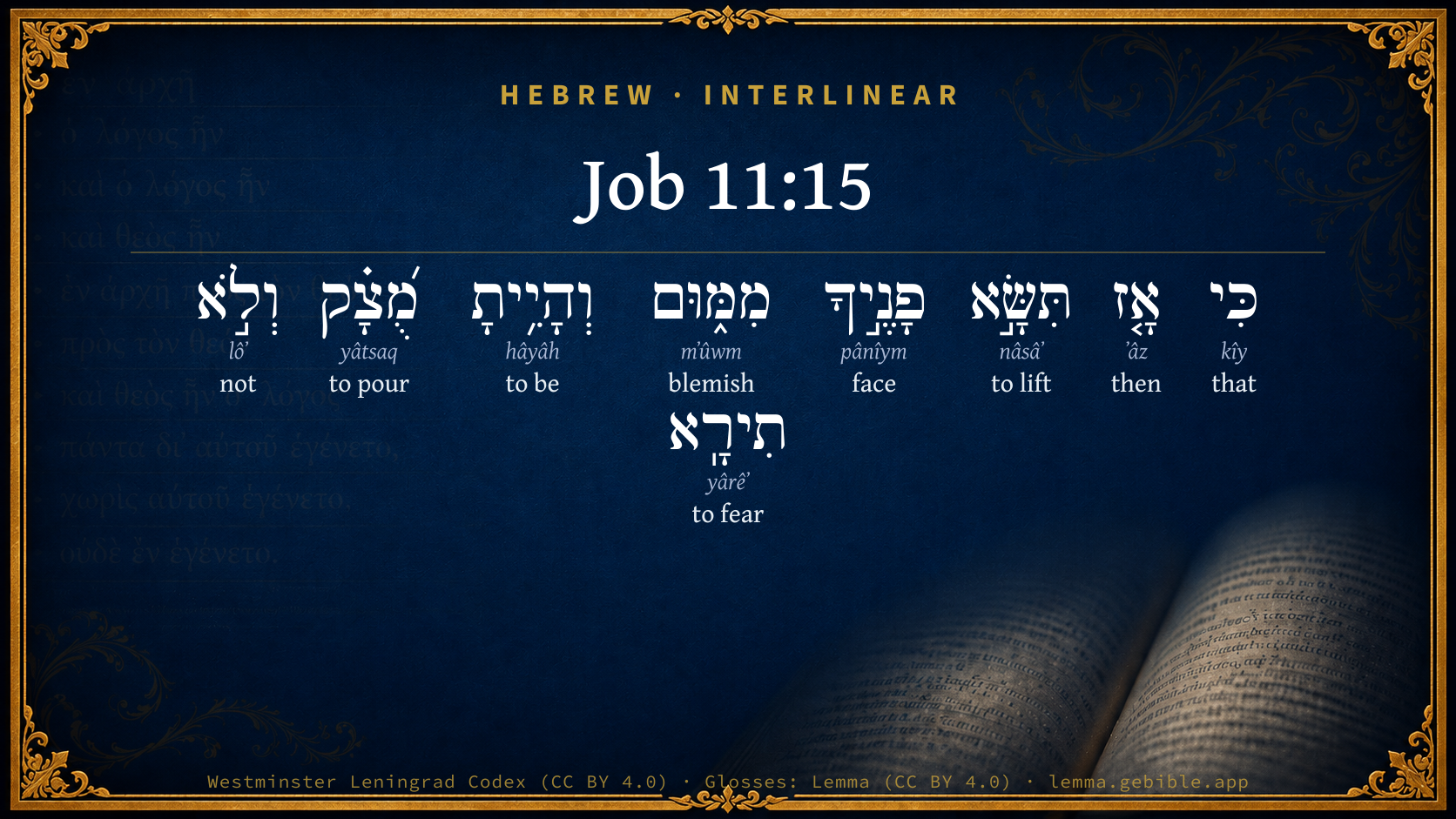
Job 11:15

Hebrew (Westminster Leningrad Codex) Job 11:15 appears in the Hebrew Old Testament. The text above is from the Westminster Leningrad Codex. Each word links to its Strong’s number, a concise gloss, and parsing drawn from the Open Scriptures Hebrew Bible morphology. Click any word for its full Brown-Driver-Briggs (BDB) entry.
Download image
Cite this verse

Job 11:15 (World English Bible). Public Domain. Lemma interlinear Bible study tool, https://lemma.gebible.app/v/job/11/15.

Show BibTeX & RIS
BibTeX
RIS
English Translation
Surely then shall you lift up your face without spot; Yes, you shall be steadfast, and shall not fear:
World English Bible · Public Domain
Download a study sheet

One document with this verse’s original text, its word-by-word gloss line, the meaning frame, cross-references with their text, attributed commentary, and full source and license credits — printable, and it pastes into notes with its structure intact.

This verse Autodidact and up

Study sheet (.html) Plain text (.txt)

A passage Seminary Student

Up to 50 verses in one chapter. A passage sheet keeps up to 6 commentary sources and 12 cross-references per verse, in the order this page ranks them, and says so on the sheet whenever that leaves anything out. Ask for a single verse and you get the Autodidact verse sheet above.

Everything on this page stays free to read, with no account — the sheet is a download of what is already on screen, not access to it.

Want to remove ads? Support Godless Engineer
Compare translations 3

The same verse in 3 English versions, stacked beneath the original-language interlinear above. Click any original word for its lexicon entry.

Each is an independent rendering of the whole verse — the interlinear is not word-aligned to these translations.

Highlighted words mark where these versions differ — a whole-verse word diff, not a word-by-word alignment.

  • World English Bible Public Domain
    Surely then shall you lift up your face without spot; Yes, you shall be steadfast, and shall not fear:
  • King James Version Public Domain
    For then shalt thou lift up thy face without spot; yea, thou shalt be stedfast, and shalt not fear:
  • unfoldingWord Literal Text CC BY-SA 4.0
    for then you will lift your face without blemish, and you will be established and you will not fear;

unfoldingWord Literal Text — © unfoldingWord, licensed CC BY-SA 4.0. Word-aligned USFM3 via Door43 (git.door43.org/unfoldingWord/en_ult).

Versions to compare (up to 4)

3 of 4 selected

Show all 18 translations

Every available English version of this verse, each an independent rendering of the whole verse.

  • World English Bible Public Domain
    Surely then shall you lift up your face without spot; Yes, you shall be steadfast, and shall not fear:
  • Berean Standard Bible Public Domain
    then indeed you will lift up your face without shame; you will stand firm and unafraid.
  • Majority Standard Bible Public Domain
    then indeed you will lift up your face without blemish; you will stand firm and unafraid.
  • King James Version Public Domain
    For then shalt thou lift up thy face without spot; yea, thou shalt be stedfast, and shalt not fear:
  • American Standard Version (1901) Public Domain
    Surely then shalt thou lift up thy face without spot; Yea, thou shalt be stedfast, and shalt not fear:
  • Revised Version (1885) Public Domain
    Surely then shalt thou lift up thy face without spot; yea, thou shalt be stedfast, and shalt not fear:
  • Geneva Bible (1599) Public Domain
    The truely shalt thou lift vp thy face without spot, and shalt be stable, and shalt not feare.
  • Douay-Rheims (1899) Public Domain
    Then mayst thou lift up thy face without spot, and thou shalt be steadfast, and shalt not fear.
  • Young's Literal Translation Public Domain
    For then thou liftest up thy face from blemish, And thou hast been firm, and fearest not.
  • Literal Standard Version CC BY-SA 4.0
    For then you lift up your face from blemish, || And you have been firm, and do not fear.
  • Unlocked Literal Bible CC BY-SA 4.0
    Then you would certainly lift up your face without a sign of shame; indeed, you would be steadfast and would not fear.
  • unfoldingWord Literal Text CC BY-SA 4.0
    for then you will lift your face without blemish, and you will be established and you will not fear;
  • Darby Bible Public Domain
    Surely then shalt thou lift up thy face without spot, and thou shalt be stedfast and shalt not fear:
  • World Messianic Bible Public Domain
    Surely then you will lift up your face without spot. Yes, you will be steadfast, and will not fear,
  • Webster's Bible Public Domain
    For then shalt thou lift up thy face without spot; yes, thou shalt be steadfast, and shalt not fear:
  • Free Bible Version CC BY-SA 4.0
    then you would be able to hold your head high in innocence, you will be firm and unafraid.
  • Bible in Basic English Public Domain
    Then truly your face will be lifted up, with no mark of sin, and you will be fixed in your place without fear:
  • JPS Tanakh (1917) Public Domain
    Surely then shalt thou lift up thy face without spot; yea, thou shalt be stedfast, and shalt not fear;

Literal Standard Version (2020), Covenant Press — licensed CC BY-SA 4.0. Text via the HelloAO Bible API (eBible.org). Unlocked Literal Bible (unfoldingWord) — licensed CC BY-SA 4.0. Text via the HelloAO Bible API (eBible.org). unfoldingWord Literal Text — © unfoldingWord, licensed CC BY-SA 4.0. Word-aligned USFM3 via Door43 (git.door43.org/unfoldingWord/en_ult). Free Bible Version, Dr. Jonathan Gallagher — licensed CC BY-SA 4.0. Text via the HelloAO Bible API (eBible.org).

Word by word

More ways to search: Search by grammar → Find every occurrence → Compare this word →

Practice this passage: Drill this verse → Learn its vocabulary →

About this verse

These counts appear in no published source. They are computed here, from the morphology-tagged text and Lemma’s own curated glosses. What Lemma adds →

9
words
9
distinct lemmas
Wisdom
section

Notable vocabulary

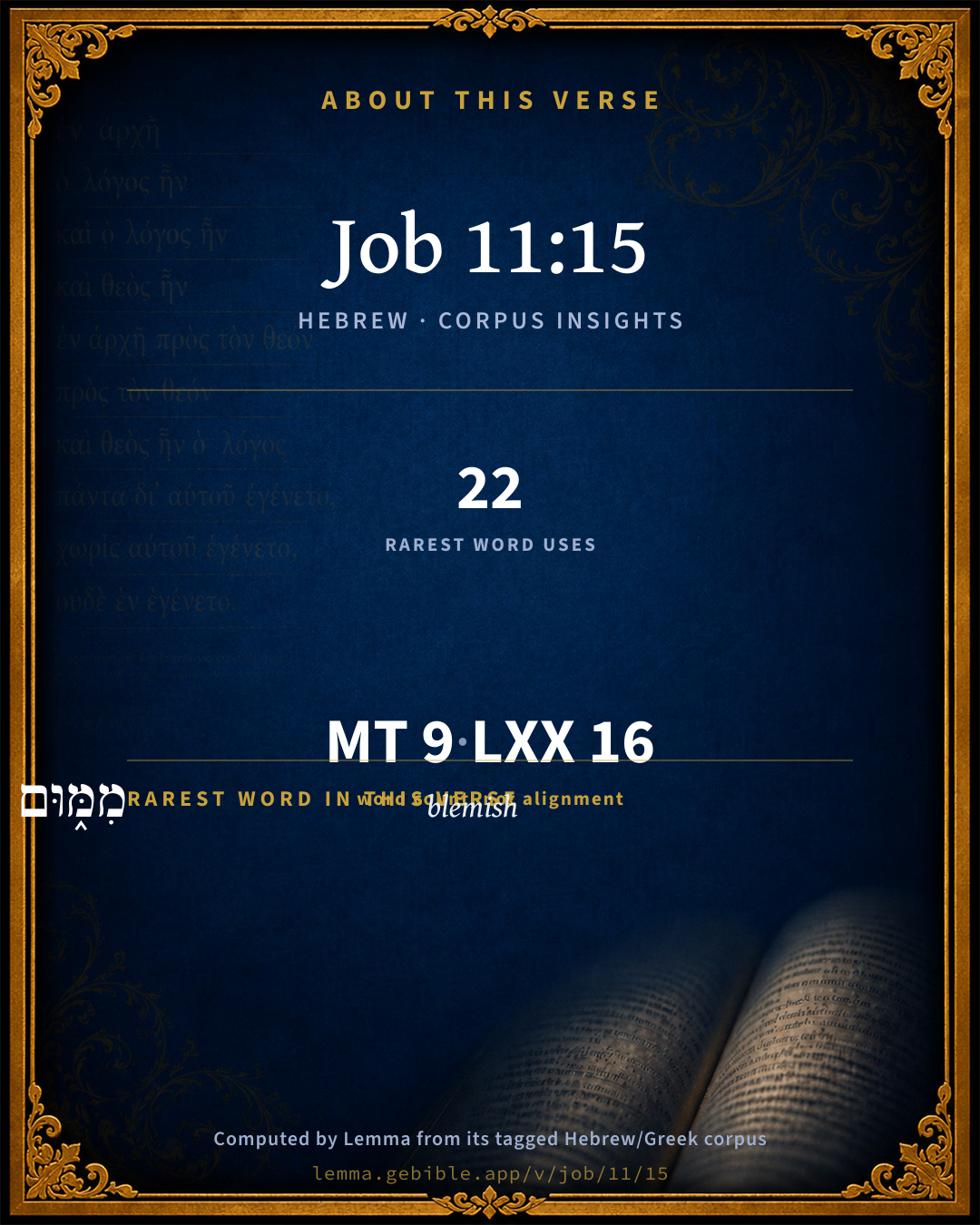
The rarest word here is מִמּ֑וּם blemish H3971 — appearing just 22 times in the whole Hebrew Bible.

Shared distinctive vocabulary

מִמּ֑וּם blemish H3971 occurs in 19 verses of the Hebrew Bible. Also found in:

Grammatical profile

  • 4 verbs
  • 2 nouns
  • 1 conjunction
  • 1 adverb
  • 1 particle

Verb forms

  • תִּשָּׂ֣א Qal · Imperfect
  • וְהָיִ֥יתָ Qal · Sequential Perfect
  • מֻ֝צָ֗ק Hophal · Participle Passive
  • תִירָֽא Qal · Imperfect

Hebrew & Septuagint length

In English translation the verse runs 19 words from the Hebrew and 21 from the Septuagint (LXX English) — closely comparable.

A rough comparison of the two English renderings, which tokenize alike — not a word-level alignment.

Word counts can differ between the Hebrew and the Greek without any difference in meaning — e.g. the Hebrew direct-object marker אֵת has no separate Greek word, and Greek often adds the article ὁ.

In the original languages it is 9 Hebrew tokens and 16 Greek tokens — but the two are counted differently (Hebrew bundles its prefixes and suffixes into one token; the Greek is in lemma form), so that isn’t a like-for-like length.

Cross-references

13

Topical passages linked to Job 11:15 in the Treasury of Scripture Knowledge — connected by theme and wording, ordered by reader-vote popularity; previews shown in the World English Bible.

  • Job 22:26 For then shall you delight yourself in the Almighty, And shall lift up your face to God.
  • 1 John 2:28 Now, little children, remain in him, that when he appears, we may have boldness, and not be ashamed before him at his coming.
  • 1 John 3:19–22 And by this we know that we are of the truth, and persuade our hearts before him,
  • 1 Timothy 2:8 I desire therefore that the men in every place pray, lifting up holy hands without wrath and doubting.
  • Genesis 4:5–6 but he didn't respect Cain and his offering. Cain was very angry, and the expression on his face fell.
  • Job 10:15 If I am wicked, woe to me. If I am righteous, I still shall not lift up my head, Being filled with disgrace, And conscious of my affliction.
  • Psalms 27:1 Yahweh is my light and my salvation. Whom shall I fear? Yahweh is the strength of my life. Of whom shall I be afraid?
  • Psalms 46:1 God is our refuge and strength, A very present help in trouble.
  • Psalms 112:6–8 For he will never be shaken. The righteous will be remembered forever.
  • Psalms 119:6–7 Then I wouldn't be disappointed, When I consider all of your commandments.
  • Proverbs 14:26 In the fear of Yahweh is a secure fortress, And he will be a refuge for his children.
  • Proverbs 28:1 The wicked flee when no one pursues; But the righteous are as bold as a lion.
  • 2 Corinthians 1:12 For our boasting is this: the testimony of our conscience, that in holiness and sincerity of God, not in fleshly wisdom but in the grace of God we behaved ourselves in the world, and more abundantly toward you.

Cross-references courtesy of OpenBible.info (CC BY 4.0).

Hebrew and Greek witnesses Masoretic Hebrew ↔ Greek Septuagint

The same verse in the two great witnesses to the Old Testament, shown verse-for-verse.

These are two independent witnesses, not word-aligned to each other, and the Septuagint is shown in lemma (dictionary) form.

Hebrew Job 11:15 Masoretic · Westminster Leningrad Codex

כִּי אָ֤ז תִּשָּׂ֣א פָנֶ֣יךָ מִמּ֑וּם וְהָיִ֥יתָ מֻ֝צָ֗ק וְלֹ֣א תִירָֽא

Surely then shall you lift up your face without spot; Yes, you shall be steadfast, and shall not fear:

World English Bible · Public Domain

Greek LXX Job 11:15 Septuagint · lemma form

οὕτως γάρ ἀναλάμπω σύ ὁ πρόσωπον ὥσπερ ὕδωρ καθαρός ἐκδύω δέ ῥύπος καί οὐ μή φοβέω

For thus shall your countenance shine again, as pure water; and you shall dive yourself of uncleanness, and shall not fear.

LXX2012 (modern English Septuagint) · Public Domain

On this verse, Haydock's Catholic Bible Commentary discusses the Septuagint’s reading. Read the note in Commentary ↓

Hebrew: Westminster Leningrad Codex (CC BY 4.0). Greek: Septuagint (public domain); English from LXX2012 (modern English Septuagint) (Public Domain). How the Septuagint differs from the Hebrew →

Commentary

Notes on Job 11:15 from classic Christian and Jewish commentators (each source and its license shown beneath its notes). The classic Christian expositions comment on the surrounding passage and are grouped to its opening verse, so a note may address several verses; the Jewish commentaries on the Tanakh (Rashi and others) are per-verse, so they appear only where the commentator wrote on this verse.

Lemma curates 59 commentaries, every one of them public domain or Creative Commons licensed, each selected and text-cleaned for this edition rather than reprinted as found. About our sources →

Trapp's Complete Commentary

John Trapp

Job 11:15 For then shalt thou lift up thy face without spot; yea, thou shalt be stedfast, and shalt not fear:

Ver. 15. For then shall thou lift up thy face without spot, &c.] Repentance must be performed in faith, or else it will prove to be poenitentia Iscariotica, a Judas like repentance. Lord (said that dying saint), cast me down as low as hell in repentance, and lift me up by faith into the highest heavens in confidence of thy salvation. Zophar, that he may move Job kindly and rightly to repent, promiseth him thereupon malorum ademptionem, bonorum adeptionem, freedom from evil and fruition of good. And, first, "Thou shalt lift up thy face without spot," i.e. Thou shalt be full of comfort and of confidence, not casting down thy countenance, as guilty Cain, but looking up boldly and cheerfully, as St Stephen did, Act 7:55-56, they saw his face as it had been the face of an angel.

Ibat ovans animis et spe sua damna levabat.

Yea, thou shall be stedfast] Or durable and compact as a molten pillar. Thy heart shall be established with grace, thy mind with peace, thine outward estate with a lasting felicity.

And shalt not fear] sc. The loss of those enjoyments. To be freed from the fear of evil is better than to be freed from evil; and a great part of the saints’ portion both on earth and in heaven lies in their deliverance from fear, Luk 1:74 Psa 112:7 Zep 3:13 Isa 17:2. Repent, and thou shall fear no more a revolution of any thy troubles.

John Trapp, A Commentary or Exposition upon All the Books of the Old and New Testament (1647–1656) — public domain. Text from a community e-Sword module.

Joseph Benson's Commentary

Job 11:15. For then shalt thou lift up thy face — With cheerfulness and holy boldness. Without spot — Having a clear and unspotted conscience. Yea, thou shalt be steadfast — Shalt have a strong and comfortable assurance of God’s favour, and shalt be settled, without any fear of losing thy happiness.

Joseph Benson's Commentary on the Old and New Testaments (1811–1818) — public domain. Text from a community e-Sword module.

Geneva Bible (1599)

Geneva Bible translators

He declareth what quietness of conscience and success in all things such shall have, which turn to God by true repentance.

Geneva Bible (1599) marginal notes — public domain. Text via Bolls.life.

Jamieson, Fausset & Brown

Robert Jamieson, A. R. Fausset & David Brown

Zophar refers to Job's own words (Job 10:15), "yet will I not lift up my head," even though righteous. Zophar declares, if Job will follow his advice, he may "lift up his face."

spot-- (Deu 32:5).

steadfast--literally, "run fast together," like metals which become firm and hard by fusion. The sinner on the contrary is wavering.

Jamieson, Fausset & Brown — Commentary Critical and Explanatory on the Whole Bible (1871) — public domain (CC PDM 1.0). Text via the HelloAO Bible API.

The Cambridge Bible for Schools and Colleges

gen. ed. J. J. S. Perowne

15. for then shalt thou] Or, surely then shalt thou, ch. Job_8:6.

lift up thy face without spot] The word lift up is selected to meet Job’s complaint that he must not lift up his head, ch. Job_10:15; and the words “without spot” meet his words “filled with shame.” Then he shall lift up his face in conscious innocence and disfigured with no signs of God’s anger on account of his guilt.

be steadfast, and shalt not fear] Said in reference to Job’s fluctuating feelings and condition as he describes them, ch. Job_9:27-28.

The Cambridge Bible for Schools and Colleges (gen. ed. J. J. S. Perowne; Cambridge University Press, 1878–1918) — public domain. Text from a community e-Sword module.

John Gill's Exposition

For then shall thou lift up thy face without spot,.... Either before men, being in all good conscience, walking in all the commandments and ordinances of the Lord, blameless, exercising a conscience void of offence towards God and men; and so be able to say as Samuel did, "whose ass have I taken?" &c. Sa1 12:3; or rather before God, as in Job 21:26; using an holy boldness and an humble confidence with him at the throne of grace, in the view of the blood, righteousness, and sacrifice of his living Redeemer he had knowledge of, as every true believer may; who, though he is not without spot in himself, yet, being washed in the blood of Christ, and clothed in his righteousness, he is all fair, and without spot or wrinkle, or any such thing; and may stand before the throne without fault, and appear before God, and in his sight, unblamable and irreprovable:

yea, thou shalt be steadfast: firm and solid, rooted and grounded in the love of God; having a firm persuasion of interest in it, and that nothing shall separate from it; being built on the foundation of Christ, and established in the exercise of faith on him; the affections being steady towards him, and fixedly set on divine and heavenly things; continuing steadfast in the doctrines of grace, and not carried about with strange doctrines, or every wind of doctrine; as well as constant and immovable in the work of the Lord, always employed in his service, and doing his will, from which nothing can move; not reproach, affliction, and persecution; and to be thus steady and fixed is a great privilege:

and shalt not fear; evil tidings of evil times; of wars and rumours of wars, famine, pestilence, earthquakes, and other judgments; of changes and revolutions in kingdoms and states, or of what is coming upon the world, according to promise and prophecy, the heart being fixed and well established, trusting in the Lord; nor be afraid of evil men or devils, or any enemies whatever, nor of death, the king of terrors, that being one of the believer's blessings, and a friend of his; nor of hell and damnation, or the second death, or wrath to come; from all which the saints are secure.

John Gill's Exposition of the Whole Bible (1746–1763) — public domain (CC PDM 1.0). Text via the HelloAO Bible API.

Albert Barnes' Notes on the Bible

For then shalt thou lift up thy face without spot - That is, thy face shall be bright, clear, and cheerful. Thus, we speak of a bright and happy countenance. Zophar undoubtedly designs to show what his appearance would be, contrasted with what it then was. Now his countenance was dejected and sad. It was disfigured by tears, and terror, and long continued anguish. But if he would put away iniquity, and return to God, his face would be cheerful again, and he would be a happy man.

Yea, thou shalt be steadfast, and shalt not fear - The word rendered “steadfast” (מצק mutsaq) is from יצק yâtsaq, to pour, to pour out, and is applied to liquids, or to metals which are fused and poured into a mould, and which then become hard. Hence, it is used in the sense of firm, solid, intrepid. “Gesenius.” Schultens supposes that the reference here is to metallic mirrors, made by casting, and then polished, and that the idea is, that his face would shine like such a mirror. But it may be doubted whether this interpretation is not too refined. The other and more common explanation well suits the sense, and should probably be retained.

Albert Barnes' Notes on the Bible (1834–1885) — public domain. Text from a community e-Sword/MySword module.

Haydock's Catholic Bible Commentary

Without. Septuagint, "as clean water, thou shalt pass away corruption, and shalt not fear."

George Leo Haydock (1774–1849), Haydock's Catholic Family Bible and Commentary, 1859 edition — public domain. Excludes Psalms (Douay-Rheims chapter numbering differs from Protestant) and Deuterocanonical books (Catholic canon only).

Matthew Poole's English Annotations

Then shalt thou lift up thy face; which notes cheerfulness, and holy boldness and confidence; as a dejected countenance notes grief and shame. See Gen 4:5,6; 2Sa 2:22; Job 22:26; Luk 21:28.

Without spot; or, being without spot; so it is only an ellipsis of the verb substantive, which is most frequent. And this fitly follows as the ground of his confidence, because he should in this case have a clear and unspotted conscience, and a sense of his own innocency. Or, without blemish, as the word properly signifies, i.e. without any sense of guilt, or any shame consequent upon it, either from God or men. The ground of the expression is this, that when men’s faces are spotted with dirt, they are ashamed to show them. And Job was charged by his friends as having many spots upon him, yea, such as were not the spots of God’s children.

Stedfast; or, firm, or fixed; either,

1. As to his outward condition, which should be constantly prosperous. Or rather,

2. As to his mind, which should have strong and comfortable assurance of God’s favour, and of his own safety and happiness. For this steadfastness is opposed unto that fear which is incident to wicked men; who, even when they are free from actual miseries, yet ofttimes are tormented with the dread of them.

Matthew Poole's English Annotations on the Holy Bible (1683–1685) — public domain. Text from a community e-Sword/MySword module.

Whedon's Commentary on the Bible

Daniel D. Whedon

15. Lift up thy face — He refers to Job’s remark, (Job_10:15,) “I will not lift up my head.”

Without spot — ממום. The Septuagint gives the sentence: “For thus shall thy countenance shine again as pure water.” In the Arabic the word is applied to fever spots and marks of cutaneous disease. There is, apparently, a cruel allusion to the effects of Job’s disease upon his countenance.

Steadfast — The word in the original is used of metal that has been melted and consolidated.

Daniel D. Whedon (gen. ed.), Commentary on the Old and New Testaments (1874–1909) — public domain. Text from a community e-Sword module.

The Pulpit Commentary

For then; rather, surely then (see the Revised Version). Shalt thou lift up thy face without spot. At present, Zophar implies, he could not do so. The stain of many sins was on him (vers. 6, 11, 14). Yea, thou shalt be steadfast; literally, molten perhaps "pure as refined metal", (see Isa_1:25) perhaps "bright as a metallic mass." And shalt not fear. "Shalt be freed," i.e. ," from all the fears that disturb thee now". (see Job_3:26 Job_6:4 Job_7:14 Job_9:28, etc.)

The Pulpit Commentary (1880–1919), ed. H.D.M. Spence-Jones & Joseph S. Exell — public domain. Text from a community e-Sword module.

John Wesley's Explanatory Notes

Lift up - Which denotes chearfulness, and holy boldness. Without spot - Having a clear and unspotted conscience. Steadfast - Shall have a strong and comfortable assurance of God's favour.

John Wesley, Explanatory Notes Upon the Whole Bible (1754–1765) — public domain. Text via the GEBible commentary corpus.

unfoldingWord translationNotes

Door43 World Missions Community

lift up your face without a sign of shame

"Lifting up your face" represents the attitude of a person who is confident and brave. (See: Metonymy and Idiom)

you would remember it only like waters that have flowed away

Zophar is comparing misery with water that flows downstream and it is gone. AT: "You would remember it, but the misery will be gone, like waters that have flowed away" (See: Simile)

Your life would ... like the morning.

Zophar repeats the same idea for emphasis. (See: Parallelism)

Your life would be brighter than the noonday

Brightness represents being prosperous and happy. AT: "Your life would be prosperous and happy like the noonday" (See: Metaphor)

though there were darkness

Darkness represents troubles and sadness. AT: "Though there were dark troubles and sadness" (See: Hypothetical Situations)

it would become like the morning

The morning represents light, which represents prosperity and happiness. AT: "it would be prosperous and happy like the morning" (See: Metaphor)

translationWords

face

sign

shame

fear

life

darkness

unfoldingWord translationNotes — © Distant Shores Media and the Door43 World Missions Community, licensed CC BY-SA 4.0. Source: git.door43.org/Door43/en_tn.

Rashi

Rabbi Shlomo Yitzchaki (Rashi)

For then you would be sure that you could lift your face unblemished, for you would cause yourself to lift your face without any blemish. Because of this...

and you shall be strong Heb. מצק, strong, like (I Sam. 2:8), “the pillars of (מצקי) the earth,”

Rashi on the Tanakh — English translations: “The Judaica Press complete Tanach with Rashi, translated by A. J. Rosenberg” (CC BY 4.0); “Pentateuch with Rashi's commentary by M. Rosenbaum and A.M. Silbermann, 1929-1934” (public domain); “The Metsudah Tanach series, Lakewood, N.J” (CC BY 4.0); and “The Book of Joshua, Metsudah Publications, 1997” (CC BY 4.0). Text via Sefaria.

Lesson kit

Teaching starters — assembled from the data on this page, not authored interpretation. Every prompt links to the verse data it draws on. Edit before teaching.

Job, in the Wisdom, opens this verse with 9 words (9 distinct Hebrew lemmas). Its most distinctive word is mʼûwm (“blemish”). A historical commentator’s framing appears above. Read the whole chapter for the surrounding context.

Discussion questions

  1. The word mʼûwm carries the sense “blemish.” How does it shape the verse?
  2. How does Leviticus 21:17, which shares the word «blemish», read alongside this verse?
  3. These translations render this verse differently. What is at stake in choosing one wording over another?
  4. «תִּשָּׂ֣א» is a Qal Imperfect verb. How does that grammatical form shape the action described?
  5. Compare how Trapp's Complete Commentary and Joseph Benson's Commentary read this verse. Where do they agree or differ?

Things to notice

Reading settings

Reading text

Shown beneath each verse's original-language words.

Old Testament
Old Testament edition

Read the OT as the Masoretic Hebrew (MT) or the Greek Septuagint (LXX).

English shown for the Greek Septuagint (in the Hebrew ↔ Greek comparison).

Comparing translations? Open the Compare panel on any verse page to stack up to four side by side.