
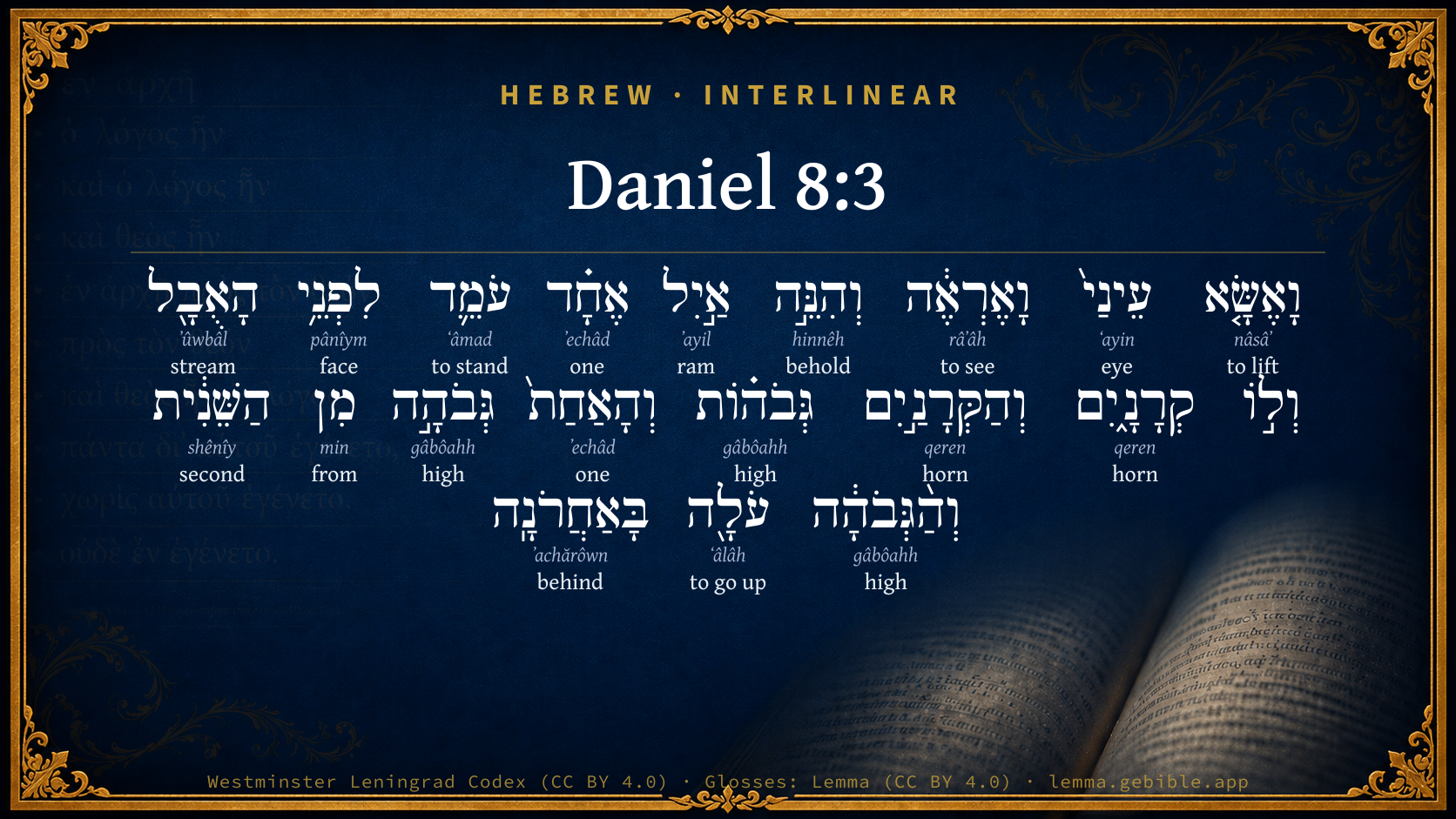
Daniel 8:3

Hebrew (Westminster Leningrad Codex) Daniel 8:3 appears in the Hebrew Old Testament. The text above is from the Westminster Leningrad Codex. Each word links to its Strong’s number, a concise gloss, and parsing drawn from the Open Scriptures Hebrew Bible morphology. Click any word for its full Brown-Driver-Briggs (BDB) entry.
Download image
Cite this verse

Daniel 8:3 (World English Bible). Public Domain. Lemma interlinear Bible study tool, https://lemma.gebible.app/v/daniel/8/3.

Show BibTeX & RIS
BibTeX
RIS
English Translation
Then I lifted up my eyes, and saw, and, behold, there stood before the river a ram which had two horns: and the two horns were high; but one was higher than the other, and the higher came up last.
World English Bible · Public Domain
Download a study sheet

One document with this verse’s original text, its word-by-word gloss line, the meaning frame, cross-references with their text, attributed commentary, and full source and license credits — printable, and it pastes into notes with its structure intact.

This verse Autodidact and up

Study sheet (.html) Plain text (.txt)

A passage Seminary Student

Up to 50 verses in one chapter. A passage sheet keeps up to 6 commentary sources and 12 cross-references per verse, in the order this page ranks them, and says so on the sheet whenever that leaves anything out. Ask for a single verse and you get the Autodidact verse sheet above.

Everything on this page stays free to read, with no account — the sheet is a download of what is already on screen, not access to it.

Want to remove ads? Support Godless Engineer
Compare translations 3

The same verse in 3 English versions, stacked beneath the original-language interlinear above. Click any original word for its lexicon entry.

Each is an independent rendering of the whole verse — the interlinear is not word-aligned to these translations.

Highlighted words mark where these versions differ — a whole-verse word diff, not a word-by-word alignment.

  • World English Bible Public Domain
    Then I lifted up my eyes, and saw, and, behold, there stood before the river a ram which had two horns: and the two horns were high; but one was higher than the other, and the higher came up last.
  • King James Version Public Domain
    Then I lifted up mine eyes, and saw, and, behold, there stood before the river a ram which had two horns: and the two horns were high; but one was higher than the other, and the higher came up last.
  • unfoldingWord Literal Text CC BY-SA 4.0
    Then I lifted my eyes and looked, and behold, a ram standing beside the canal. It had two horns and both horns were high, but one was higher than the other, and the higher one came up last.

unfoldingWord Literal Text — © unfoldingWord, licensed CC BY-SA 4.0. Word-aligned USFM3 via Door43 (git.door43.org/unfoldingWord/en_ult).

Versions to compare (up to 4)

3 of 4 selected

Show all 18 translations

Every available English version of this verse, each an independent rendering of the whole verse.

  • World English Bible Public Domain
    Then I lifted up my eyes, and saw, and, behold, there stood before the river a ram which had two horns: and the two horns were high; but one was higher than the other, and the higher came up last.
  • Berean Standard Bible Public Domain
    Then I lifted up my eyes and saw a ram with two horns standing beside the canal. The horns were long, but one was longer than the other, and the longer one grew up later.
  • Majority Standard Bible Public Domain
    Then I lifted up my eyes and saw a ram with two horns standing beside the canal. The horns were long, but one was longer than the other, and the longer one grew up later.
  • King James Version Public Domain
    Then I lifted up mine eyes, and saw, and, behold, there stood before the river a ram which had two horns: and the two horns were high; but one was higher than the other, and the higher came up last.
  • American Standard Version (1901) Public Domain
    Then I lifted up mine eyes, and saw, and, behold, there stood before the river a ram which had two horns: and the two horns were high; but one was higher than the other, and the higher came up last.
  • Revised Version (1885) Public Domain
    Then I lifted up mine eyes, and saw, and, behold, there stood before the river a ram which had two horns: and the two horns were high; but one was higher than the other, and the higher came up last.
  • Geneva Bible (1599) Public Domain
    Then I looked vp and sawe, and beholde, there stoode before the riuer a ramme, which had two hornes: and these two hornes were hie: but one was hier then another, and the hyest came vp last.
  • Douay-Rheims (1899) Public Domain
    And I lifted up my eyes, and saw: and behold a ram stood before the water, having two high horns, and one higher than the other, and growing up. Afterward
  • Young's Literal Translation Public Domain
    And I lift up mine eyes, and look, and lo, a certain ram is standing before the stream, and it hath two horns, and the two horns `are' high; and the one `is' higher than the other, and the high one is coming up last.
  • Literal Standard Version CC BY-SA 4.0
    And I lift up my eyes, and look, and behold, a certain ram is standing before the stream, and it has two horns, and the two horns [are] high; and one [is] higher than the other, and the high one is coming up last.
  • Unlocked Literal Bible CC BY-SA 4.0
    I looked up and saw before me a ram with two horns, standing beside the canal. One horn was longer than the other, but the longer one grew more slowly than the shorter and was passed up in length by it.
  • unfoldingWord Literal Text CC BY-SA 4.0
    Then I lifted my eyes and looked, and behold, a ram standing beside the canal. It had two horns and both horns were high, but one was higher than the other, and the higher one came up last.
  • Darby Bible Public Domain
    And I lifted up mine eyes and saw, and behold, there stood before the river a ram which had two horns; and the two horns were high; and one was higher than the other, and the higher came up last.
  • World Messianic Bible Public Domain
    Then I lifted up my eyes and saw, and behold, a ram which had two horns stood before the river. The two horns were high, but one was higher than the other, and the higher came up last.
  • Webster's Bible Public Domain
    Then I lifted up my eyes, and saw, and behold, there stood before the river a ram which had two horns: and the two horns were high; but one was higher than the other, and the higher came up last.
  • Free Bible Version CC BY-SA 4.0
    I looked around and saw a ram standing beside the river. It had two long horns, one longer than the other, even though the longer one had grown last.
  • Bible in Basic English Public Domain
    And lifting up my eyes, I saw, there before the stream, a male sheep with two horns: and the two horns were high, but one was higher than the other, the higher one coming up last.
  • JPS Tanakh (1917) Public Domain
    And I lifted up mine eyes, and saw, and, behold, there stood before the stream a ram which had two horns; and the two horns were high; but one was higher than the other, and the higher came up last.

Literal Standard Version (2020), Covenant Press — licensed CC BY-SA 4.0. Text via the HelloAO Bible API (eBible.org). Unlocked Literal Bible (unfoldingWord) — licensed CC BY-SA 4.0. Text via the HelloAO Bible API (eBible.org). unfoldingWord Literal Text — © unfoldingWord, licensed CC BY-SA 4.0. Word-aligned USFM3 via Door43 (git.door43.org/unfoldingWord/en_ult). Free Bible Version, Dr. Jonathan Gallagher — licensed CC BY-SA 4.0. Text via the HelloAO Bible API (eBible.org).

Word by word

More ways to search: Search by grammar → Find every occurrence → Compare this word →

Practice this passage: Drill this verse → Learn its vocabulary →

הָאֻבָ֖ל
ʼûwbâl
H180
“the · stream”
Particle, Definite Article + Noun, Common, Masculine, Singular, Absolute
Part of Speech
Particle + Noun
Type
Common
Gender
Masculine
Number
Singular
State
Absolute
Full BDB Definition

Origin: from H2986 (in the sense of H2988 )

TWOT: 835g

stream, river
  1. וָאֶשָּׂ֤א nâsâʼ H5375 “and · to lift” Conjunction + Verb, Qal, Sequential Imperfect, 1st Person, Common, Singular
  2. עֵינַי֙ ʻayin H5869 “eyes · my” Noun, Common, Both, Dual, Construct + Suffix, Personal, 1st Person, Common, Singular
  3. וָאֶרְאֶ֔ה râʼâh H7200 “and · to see” Conjunction + Verb, Qal, Sequential Imperfect, 1st Person, Common, Singular
  4. וְהִנֵּ֣ה hinnêh H2009 “and · behold” Conjunction + Particle, Demonstrative
  5. אַ֣יִל ʼayil H352 “ram” Noun, Common, Masculine, Singular, Absolute
  6. אֶחָ֗ד ʼechâd H259 “one” Adjective, Cardinal number, Masculine, Singular, Absolute
  7. עֹמֵ֛ד ʻâmad H5975 “standing” Verb, Qal, Participle Active, Masculine, Singular, Absolute
  8. לִפְנֵ֥י pânîym H6440 “to/for · face(s) of” Preposition + Noun, Common, Both, Plural, Construct
  9. קְרָנָ֑יִם qeren H7161 “horns” Noun, Common, Both, Dual, Absolute
  10. וְהַקְּרָנַ֣יִם qeren H7161 “and · the · horns” Conjunction + Particle, Definite Article + Noun, Common, Both, Dual, Absolute
  11. גְּבֹה֗וֹת gâbôahh H1364 “high” Adjective, Adjective, Feminine, Plural, Absolute
  12. וְהָאַחַת֙ ʼechâd H259 “and · the · one” Conjunction + Particle, Definite Article + Adjective, Cardinal number, Feminine, Singular, Absolute
  13. גְּבֹהָ֣ה gâbôahh H1364 “high” Adjective, Adjective, Feminine, Singular, Absolute
  14. מִן min H4480 “from” Preposition
  15. הַשֵּׁנִ֔ית shênîy H8145 “the · second” Particle, Definite Article + Adjective, Ordinal number, Feminine, Singular, Absolute
  16. וְהַ֨גְּבֹהָ֔ה gâbôahh H1364 “and · the · high” Conjunction + Particle, Definite Article + Adjective, Adjective, Feminine, Singular, Absolute
  17. עֹלָ֖ה ʻâlâh H5927 “going up” Verb, Qal, Participle Active, Feminine, Singular, Absolute
  18. בָּאַחֲרֹנָֽה ʼachărôwn H314 “in/at the · behind” Preposition, Determined + Adjective, Adjective, Feminine, Singular, Absolute

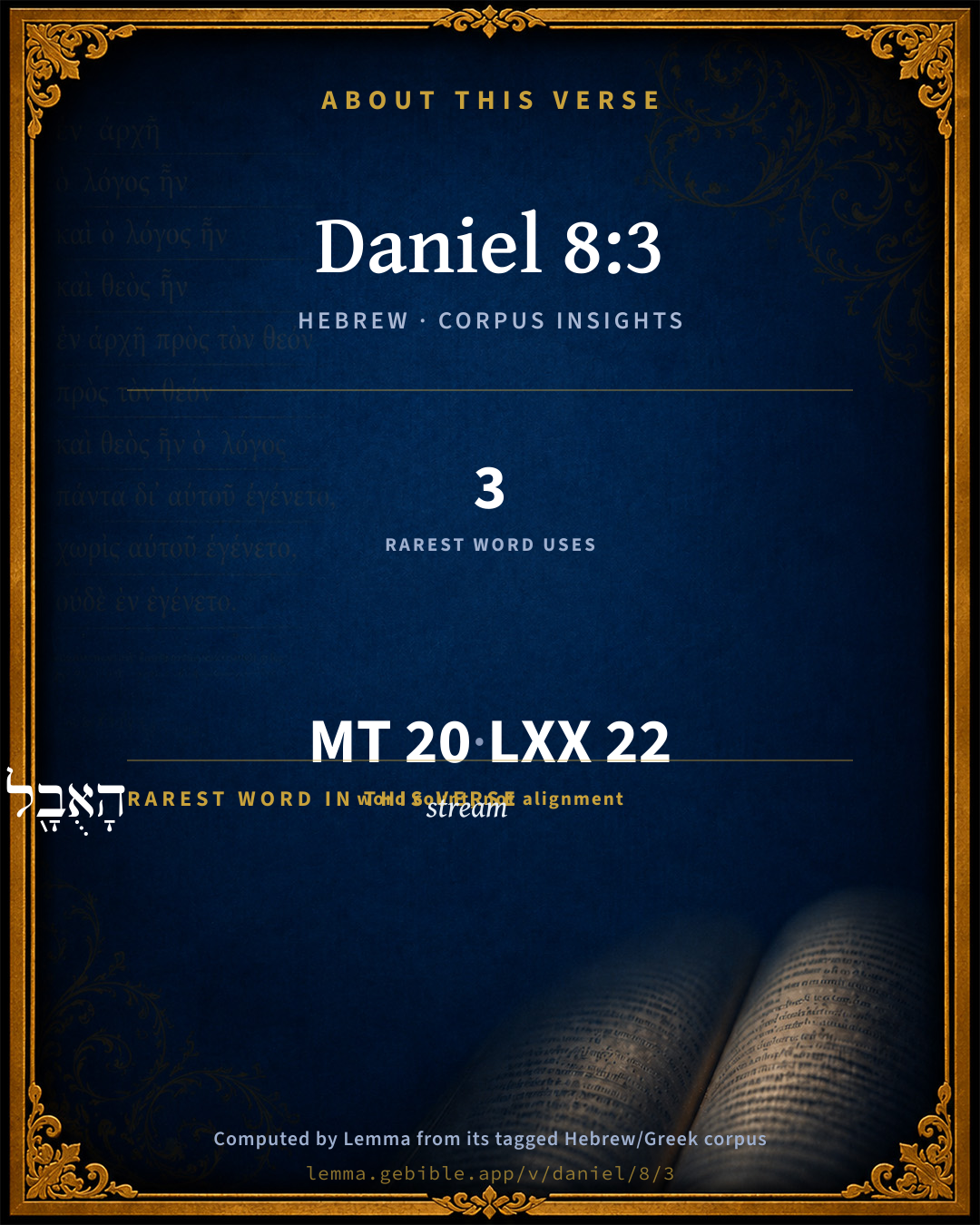
About this verse

These counts appear in no published source. They are computed here, from the morphology-tagged text and Lemma’s own curated glosses. What Lemma adds →

20
words
15
distinct lemmas
Prophets
section

Notable vocabulary

The rarest word here is הָאֻבָ֖ל stream H180 — appearing just 3 times in the whole Hebrew Bible.

Shared distinctive vocabulary

הָאֻבָ֖ל stream H180 occurs in 3 verses of the Hebrew Bible. Also found in:

Grammatical profile

  • 4 verbs
  • 6 nouns
  • 7 adjectives
  • 2 prepositions
  • 1 particle

Verb forms

  • וָאֶשָּׂ֤א Qal · Sequential Imperfect
  • וָאֶרְאֶ֔ה Qal · Sequential Imperfect
  • עֹמֵ֛ד Qal · Participle Active
  • עֹלָ֖ה Qal · Participle Active

Repetition

Words recur within this verse — often emphatic in Hebrew:

  • גְּבֹה֗וֹת high H1364 ×3
  • אֶחָ֗ד one H259 ×2
  • קְרָנָ֑יִם horn H7161 ×2

Hebrew & Septuagint length

In English translation the verse runs 40 words from the Hebrew and 37 from the Septuagint (LXX English) — closely comparable.

A rough comparison of the two English renderings, which tokenize alike — not a word-level alignment.

Word counts can differ between the Hebrew and the Greek without any difference in meaning — e.g. the Hebrew direct-object marker אֵת has no separate Greek word, and Greek often adds the article ὁ.

In the original languages it is 20 Hebrew tokens and 22 Greek tokens — but the two are counted differently (Hebrew bundles its prefixes and suffixes into one token; the Greek is in lemma form), so that isn’t a like-for-like length.

Cross-references

22

Topical passages linked to Daniel 8:3 in the Treasury of Scripture Knowledge — connected by theme and wording, ordered by reader-vote popularity; previews shown in the World English Bible.

  • Daniel 8:20 The ram which you saw, that had the two horns, they are the kings of Media and Persia.
  • Daniel 10:5 I lifted up my eyes, and looked, and, behold, a man clothed in linen, whose loins were girded with pure gold of Uphaz:
  • Numbers 24:2 Balaam lifted up his eyes, and he saw Israel dwelling according to their tribes; and the Spirit of God came on him.
  • Joshua 5:13 It happened, when Joshua was by Jericho, that he lifted up his eyes and looked, and, behold, there stood a man over against him with his sword drawn in his hand: and Joshua went to him, and said to him, Are you for us, or for our adversaries?
  • 1 Chronicles 21:16 David lifted up his eyes, and saw the angel of Yahweh standing between earth and the sky, having a drawn sword in his hand stretched out over Jerusalem. Then David and the elders, clothed in sackcloth, fell on their faces.
  • Ezra 1:2 Thus says Cyrus king of Persia, All the kingdoms of the earth has Yahweh, the God of heaven, given me; and he has charged me to build him a house in Jerusalem, which is in Judah.
  • Ezra 4:5 and hired counselors against them, to frustrate their purpose, all the days of Cyrus king of Persia, even until the reign of Darius king of Persia.
  • Esther 1:3 in the third year of his reign, he made a feast to all his princes and his servants; the power of Persia and Media, the nobles and princes of the provinces, being before him;
  • Isaiah 13:17 Behold, I will stir up the Medes against them, who shall not regard silver, and as for gold, they shall not delight in it.
  • Isaiah 21:2 A grievous vision is declared to me; the treacherous man deals treacherously, and the destroyer destroys. Go up, Elam; besiege, Media; all the sighing of it have I made to cease.
  • Isaiah 44:28 Who says of Cyrus, [He is] my shepherd, and shall perform all my pleasure, even saying of Jerusalem, She shall be built; and of the temple, Your foundation shall be laid.
  • Jeremiah 51:11 Make sharp the arrows; hold firm the shields: Yahweh has stirred up the spirit of the kings of the Medes; because his purpose is against Babylon, to destroy it: for it is the vengeance of Yahweh, the vengeance of his temple.
  • Daniel 2:39 After you shall arise another kingdom inferior to you; and another third kingdom of brass, which shall bear rule over all the earth.
  • Daniel 5:31 Darius the Mede received the kingdom, being about sixty-two years old.
  • Daniel 6:28 So this Daniel prospered in the reign of Darius, and in the reign of Cyrus the Persian.
  • Daniel 7:5 Behold, another animal, a second, like a bear; and it was raised up on one side, and three ribs were in its mouth between its teeth: and they said thus to it, Arise, devour much flesh.
  • Zechariah 1:18 I lifted up my eyes, and saw, and, behold, four horns.
  • Zechariah 2:1 I lifted up my eyes, and saw, and, behold, a man with a measuring line in his hand.
  • Zechariah 5:1 Then again I lifted up my eyes, and saw, and, behold, a flying scroll.
  • Zechariah 5:5 Then the angel who talked with me came forward, and said to me, "Lift up now your eyes, and see what is this that is appearing."
  • Zechariah 5:9 Then lifted I up my eyes, and saw, and, behold, there were two women, and the wind was in their wings. Now they had wings like the wings of a stork, and they lifted up the ephah basket between earth and the sky.
  • Zechariah 6:1 Again I lifted up my eyes, and saw, and, behold, four chariots came out from between two mountains; and the mountains were mountains of brass.

Cross-references courtesy of OpenBible.info (CC BY 4.0).

Hebrew and Greek witnesses Masoretic Hebrew ↔ Greek Septuagint

The same verse in the two great witnesses to the Old Testament, shown verse-for-verse.

These are two independent witnesses, not word-aligned to each other, and the Septuagint is shown in lemma (dictionary) form.

Hebrew Daniel 8:3 Masoretic · Westminster Leningrad Codex

וָאֶשָּׂ֤א עֵינַי֙ וָאֶרְאֶ֔ה וְהִנֵּ֣ה אַ֣יִל אֶחָ֗ד עֹמֵ֛ד לִפְנֵ֥י הָאֻבָ֖ל וְל֣וֹ קְרָנָ֑יִם וְהַקְּרָנַ֣יִם גְּבֹה֗וֹת וְהָאַחַת֙ גְּבֹהָ֣ה מִן הַשֵּׁנִ֔ית וְהַ֨גְּבֹהָ֔ה עֹלָ֖ה בָּאַחֲרֹנָֽה

Then I lifted up my eyes, and saw, and, behold, there stood before the river a ram which had two horns: and the two horns were high; but one was higher than the other, and the higher came up last.

World English Bible · Public Domain

Greek LXX Daniel 8:3 Septuagint · lemma form

ἀναβλέπω ὁράω κριός εἷς μέγας ἵστημι ἀπέναντι ὁ πύλη καί ἔχω κέρας καί ὁ εἷς ὑψηλός ὁ ἕτερος καί ὁ ὑψηλός ἀναβαίνω

And I lifted up my eyes, and saw, and, behold, a ram standing in front of the Ubal; and he had high horns; and one was higher than the other, and the high one came up last.

LXX2012 (modern English Septuagint) · Public Domain

On this verse, The Pulpit Commentary discusses the Septuagint’s reading. Read the note in Commentary ↓

Hebrew: Westminster Leningrad Codex (CC BY 4.0). Greek: Septuagint (public domain); English from LXX2012 (modern English Septuagint) (Public Domain). How the Septuagint differs from the Hebrew →

Commentary

Notes on Daniel 8:3 from classic Christian and Jewish commentators (each source and its license shown beneath its notes). The classic Christian expositions comment on the surrounding passage and are grouped to its opening verse, so a note may address several verses; the Jewish commentaries on the Tanakh (Rashi and others) are per-verse, so they appear only where the commentator wrote on this verse.

Lemma curates 59 commentaries, every one of them public domain or Creative Commons licensed, each selected and text-cleaned for this edition rather than reprinted as found. About our sources →

Trapp's Complete Commentary

John Trapp

Dan 8:3 Then I lifted up mine eyes, and saw, and, behold, there stood before the river a ram which had [two] horns: and the [two] horns [were] high; but one [was] higher than the other, and the higher came up last.

Ver. 3. There stood before the river a ram.] With a golden fleece and full of flesh. This was the Persian monarch; who is also said to stand, because of his slow motion and sluggish disposition; and "before the river," because the Persians ruled over many nations, signified by waters. {Rev 17:1} A ram stalketh stately before the flock as a captain; but they are only sheep which he leadeth. Let a dog but lay his nose over the hedge, and away they run all: so did the sheepish cowardly Persians before Alexander.

Which had two horns.] These were the states of Medea and Persia.

But one was higher than the other,] i.e., The Persians at length became higher than the Medes, and overtopped them.

And the higher came up last.] Cyrus after Darius, uniting both nations into one monarchy.

John Trapp, A Commentary or Exposition upon All the Books of the Old and New Testament (1647–1656) — public domain. Text from a community e-Sword module.

Joseph Benson's Commentary

Dan 8:3. I saw, and behold, a ram with two horns — In the former vision there appeared four beasts, because there four empires were represented; but in this two only, because here we have a representation of what was transacted chiefly within two empires. The first of the four empires, that is, the Babylonian, is wholly omitted here; for its fate was sufficiently known, and it was now drawing very near to a conclusion. The second empire in the former vision is the first in this; and what is there compared to a bear, is here prefigured by a ram. This ram had two horns; and, according to the explication of the angel Gabriel, Dan 8:20, it was the empire of the Medes and Persians. The source of this figure of horns for kingdoms, must be derived from the hieroglyphics of Egypt, from which most of the metaphors and figures in the oriental languages were originally derived; and in these languages the same word signifies a horn, a crown, power, and splendour, whence a horn was an ensign of royalty among the Phenicians; and the Hebrew word קרן, keren, signifying a horn, is several times by the Chaldeans rendered מלכותא, malchutha, or a kingdom; and horns are frequently used for kings and kingdoms in the Old Testament. This empire, therefore, which was formed by the conjunction of the Medes and Persians, was not unfitly represented by a ram with two horns. Cyrus, the founder of this empire, was the son of Cambyses, king of Persia, and, by his mother Mandane, was grandson of Astyages, king of Media; and afterward marrying the daughter and only child of his uncle Cyaxares, king of Media, he succeeded to both crowns, and united the kingdoms of Media and Persia. It was a coalition of two very formidable powers, and therefore it is said that the two horns were high; but one, it is added, was higher than the other, and the higher came up last. The kingdom of Media was the more ancient of the two, and more famous in history. Persia was of little note or account till the time of Cyrus; but under him the Persians gained and maintained the ascendant. But a question remains, why that empire, which was before likened to a bear for its cruelty, should now be represented by a ram? Now the Hebrew word for a ram, which is איל, ail, and עילם, eelam, which is the Hebrew word for Persia, both sprang from the same root; and both implying something of strength, the one is not improperly made the type of the other. The propriety of it appears further from hence, that it was usual for the king of Persia to wear a ram’s head made of gold, and set with precious stones, instead of a diadem. We may add, that a ram’s head with horns, one higher and the other lower, was the royal ensign of the Persians, and is still to be seen on the pillars of Persepolis: see Bishop Newton.

Joseph Benson's Commentary on the Old and New Testaments (1811–1818) — public domain. Text from a community e-Sword module.

Tyndale Open Study Notes

Tyndale Open Resources

8:3-4 Two long horns implies that there were two major nations in this kingdom represented by a ram (see 8:20-21). • God allowed the nation to do as it pleased; God was still in control (cp. Isa 45:1-4).

Tyndale Open Study Notes — © Tyndale Open Resources, licensed CC BY-SA 4.0. Text via the HelloAO Bible API.

Geneva Bible (1599)

Geneva Bible translators

Meaning, Cyrus, which after grew greater in power than Darius his uncle and father-in-law.

Which represented the kingdom of the Persians and Medes, which were joined together.

Geneva Bible (1599) marginal notes — public domain. Text via Bolls.life.

Jamieson, Fausset & Brown

Robert Jamieson, A. R. Fausset & David Brown

two horns--The "two" ought not to be in italics, as if it were not in the original; for it is expressed by the Hebrew dual. "Horn" in the East is the symbol of power and royalty.

one . . . higher than . . . other . . . the higher came up last--Persia, which was of little note till Cyrus' time, became then ascendant over Media, the more ancient kingdom. Darius was sixty-two years old (Dan 5:31) when he began to reign; during his short reign of two years, being a weak king (Dan 6:1-3), the government was almost entirely in Cyrus' hands. Hence HERODOTUS does not mention Darius; but XENOPHON does under the name of Cyaxares II. The "ram" here corresponds to the "bear" (Dan 7:5), symbolizing clumsy firmness. The king of Persia wore a jewelled ram's head of gold instead of a diadem, such as are seen on the pillars at Persepolis. Also the Hebrew for "ram" springs from the same root as "Elam," or Persia [NEWTON]. The "one horn higher than the other" answers to the bear "raising itself on one side" (compare Note, see on Dan 7:5).

Jamieson, Fausset & Brown — Commentary Critical and Explanatory on the Whole Bible (1871) — public domain (CC PDM 1.0). Text via the HelloAO Bible API.

Adam Clarke's Commentary

Verse 3. A ram which had two horns] In the former vision there were four beasts, pointing out four empires; in this we have but two, as only two empires are concerned here, viz., the Grecian and the Persian. The Babylonish empire is not mentioned; its fate was before decided, and it was now at its close.

By the ram, the empire of the Medes and Persians was pointed out, as explained by the angel Gabriel, Da 8:20; and particularly Cyrus, who was the founder of that empire. Cyrus was the son of Cambyses, king of Persia; and grandson of Astyages, king of Media, by his daughter Mandane, who had been given in marriage to Cambyses. Cyrus marrying Roxana, the daughter and only child of his uncle Cyaxares, called in Scripture Ahasuerus, succeeded to both crowns, and thus united Media and Persia. A ram was the symbol of the Persians; and a ram's head with two horns, one higher than the other, appears as such in different parts of the ruins of Persepolis. See the plates of these ruins in the supplement to the seventh volume of the ancient part of the Universal History.

This ram had two horns; that is, two kingdoms, viz., Media and Persia; but one was higher than the other; and the higher came up last. Media, signified by the shorter horn, was the more ancient of the two kingdoms. Persia, the higher horn, had come up but lately, and was of little historic or political consequence till the time of Cyrus; but in the reigns of this prince and his immediate successors, Persia attained a political consequence greatly superior to that possessed at any time by the kingdom of Media; therefore, it is said to have been the higher, and to have come up last.

Adam Clarke's Commentary on the Bible (1810–1826) — public domain. Text from a community e-Sword/MySword module.

John Calvin's Commentaries

He next subjoins, And behold a ram, stood at the bank of the river, and it had horns He now compares the empire of Persia and Media to a ram. It ought not to seem absurd that God proposed to his servant various similitude’s, because his duty was to teach a rude people in various ways; and[ we know this vision to have been presented before the Prophet, not for his private instruction only, but for the common advantage of the whole people. I do not think we need scrupulously inquire why the Persian kings are called rams. I know of no valid reason, unless perhaps to institute a comparison between them and Alexander of Macedon and his successors. If so, when God, under the image of a ram, exhibits to his Prophet the Persian Empire, he does not illustrate its nature absolutely, but only by comparison with that of Alexander. ‘We are well aware of the opposition between these two empires. The Persian monarchy is called “a ram,” with reference to the Macedonian, which, as we shall afterwards see, bears the name of “he-goat” with respect to its antagonism. And we may gather the best reason for this comparison in the humble origin of the kings of Persia. With great propriety, then, Cyrus, the first ruler of this empire, is here depicted for us under the form or image of a ram. His “horn” produced a concussion through the whole earth, when no one expected anything to spring from a region by no means abounding in anything noble. And as to Alexander, he is called a “he-goat,” with respect to the “ram,” as being far more nimble, and yet more obscure in his origin. For what was Macedon but a mere corner of Greece? But I do not propose to run the parallel between these points; it is sufficient that God wishes to show to his Prophet and to the whole Church, how among the Persians, unknown as they were, and despised by their neighbors, a king should arise to consume the Median power, as we shall soon see, and also to overthrow the Babylonian monarchy. Behold, therefore, says he, a ram stood before the river, or at the bank of the river, since Cyrus subdued both the Medes and his grandfather, as historians inform us. Cyrus then rushed forth from his own mountains and stood at the bank of the river He also says, He had two horns. Here the Prophet puts two horns for two empires, and not by any means for two persons. For although Cyrus married the daughter of Cyaxares his uncle, yet we know the Persian empire to have lasted a long time, and to have supplied historians with a long catalogue of kings. As Cyrus had so many successors, by the two horns God doubtless showed his Prophet those two empires of the Medes and Persians united under one sovereignty. Therefore, when the ram appeared to the Prophet, it represented both kingdoms under one emblem.

The context confirms this by saying, The two horns were lofty, one higher than the other, and this was raised backwards The two horns were lofty; for, though the Persian territory was not rich, and the people rustic and living in woods, spending an austere life and despising all luxuries, yet the nation was always warlike. Wherefore the Prophet says this horn was higher than the other, meaning, than the empire of the Medes. Now Cyrus surpassed his father-in-law Darius in fame, authority, and rank, and still he always permitted Darius to enjoy the royal majesty to the end of his life. As he was an old man, Cyrus might easily concede to him the highest one without any loss to himself. With respect then to the following period, Cyrus was clearly pre-eminent, as he was certainly superior to Darius, whom Xenophon calls Cyaxares. For this reason, then, this horn was higher. But meanwhile the Prophet shews how gradually Cyrus was raised on high. The horn rose backwards; that is, “afterwards” — meaning, although the horn of the Median kingdom was more illustrious and conspicuous, yet the horn which rose afterwards obscured the brightness and glory of the former one. This agrees with the narratives of profane history: for every reader of those narratives will find nothing recorded by Daniel which was not fulfilled by the event. Let us go on: —

John Calvin's Commentaries (1540-1563) — public domain. Text from the Calvin Translation Society English edition (1840s-50s) via the Christian Classics Ethereal Library (ccel.org). Calvin's coverage is partial (roughly two-thirds of the Bible); uncommented books and verses are honest gaps, never fabricated. The 19th-century editor's footnotes and remarks are omitted so the notes are faithfully Calvin's own voice.

Ellicott's Commentary for English Readers

(3) A ram—i.e., a single ram. The ram was standing before the river, or eastward of it, and represented the Medo-Persian empire (Dan_8:20). The two horns, like the two breasts and arms of the image, or the two sides of the bear, symbolise the twofold character of this empire. The higher horn denotes the Persians, the dominant race. For other instances of rams and goats representing nations, comp. Isa_14:9; Jer_1:8; Zec_10:3.

A Bible Commentary for English Readers, edited by Charles John Ellicott (1878–1897) — public domain. Text from a community e-Sword module.

The Cambridge Bible for Schools and Colleges

gen. ed. J. J. S. Perowne

3. And I lifted up my eyes] in the vision: cf. Dan_10:5; Gen_31:10; Zec_1:18; Zec_2:1; Zec_5:1; Zec_5:9; Zec_6:1.

a ram standing before the stream, and it had two horns; and the two horns were high, &c.] The ram is an emblem of power and dominion: cf. Eze_39:18. The symbolism of the figure is explained in Dan_8:20 : the ram, as a whole, represents the combined power of the Medes and Persians; but the strength of the animal lying in its horns, these are taken as representing more particularly the two powers separately, that of Persia, as being the stronger, and arising after that of Media, being represented by the higher horn, which came up last. On the distinction between the two empires, see the notes on Dan_2:39 and Dan_5:31.

The Cambridge Bible for Schools and Colleges (gen. ed. J. J. S. Perowne; Cambridge University Press, 1878–1918) — public domain. Text from a community e-Sword module.

John Gill's Exposition

Then I lifted up mine eyes,.... To see what was to be seen in this place, where he in the vision was brought; he lifted up the eyes of his understanding, being enlightened by the vision of prophecy, and the eyes of his body, to which objects of corporeal things formed in the fancy were represented:

and saw, and, behold; he saw something wonderful in a visionary way, and which struck his mind, and raised his attention:

there stood before the river; the river Ulai, near Shushan, the palace, the seat of the kings of Persia, to the east:

a ram, which had two horns; a symbol of the kingdom of the Medes and Persians, signified by the two horns, Dan 8:20, an emblem of power and dominion, and sometimes used to signify kings and kingdoms; see Dan 7:24 and these as united in one monarchy, under one monarch, Cyrus, and continued in his successors unto the times of Alexander; and therefore called "a ram", or "one ram" (m), as in the original; and which in sound has some likeness to Elam or Persia: and this kingdom or monarchy may be signified by it, partly because of its strength and power, and partly because of its riches, as some think, as well as because it is a fighting creature; and it may be chiefly because this monarchy was mild, and kind, and gentle to the Jewish nation: and it is very remarkable, that, according to Ammianus Marcellinus (n), the ram was the royal ensign of the Persians; whose kings used to wear for a diadem something made of gold, in the shape of a ram's head, set with little stones:

and the two horns were high; grew straight up on high, and so were different from the usual horns of a ram, which are crooked; denoting the great power, authority, wealth, and riches, these two kingdoms rose up unto:

but one was higher than the other, and the higher came up last; I think the words might be rendered better, "and the first was higher than the second, but it ascended, or grew up, higher at last" (o); the kingdom of the Medes was the first kingdom, and it was at first superior to the kingdom of Persia; but afterwards the kingdom of Persia became greater than that, under Cyrus and his successors: and Sir John Chardin says (p), that rams' heads, with horns one higher than another, are still to be seen in the ruins of Persepolis.

(m) "aries unus", V. L. Pagninus, Montanus, &c. (n) Hist. l. 19. (o) . (p) Travels, vol. 3.

John Gill's Exposition of the Whole Bible (1746–1763) — public domain (CC PDM 1.0). Text via the HelloAO Bible API.

Albert Barnes' Notes on the Bible

Then I lifted up mine eyes and saw - And saw in vision, or there seemed to be before me.

There stood before the river - On the bank of the river.

A ram which had two horns - There can be no error in explaining the design of this symbol, for in Dan 8:20 it is expressly said that it denoted the two kings of Media and Persia. The united power of the kingdom was denoted by the ram itself; the fact that there were two powers or kingdoms combined, by the two horns of the ram.

And the two horns were high - Both indicating great power.

But one was higher than the other, and the higher came up last - The higher horn springing up last denotes Persia, that became the more mighty power of the two, so that the name Media became finally almost dropped, and the united kingdom was known in Grecian history as the Persian The Median or Assyrian power was the older, but the Persian became the most mighty.

Albert Barnes' Notes on the Bible (1834–1885) — public domain. Text from a community e-Sword/MySword module.

Haydock's Catholic Bible Commentary

A ram. The empire of the Medes and Persians. (Challoner) (Worthington) --- Cyrus, the founder, was allied to both. --- Higher, denoting the Persians; or Hystaspes, and his posterity, the second branch of the royal family, which reigned to the end: whereas Cambyses was the only one of the race of Cyrus who succeeded to the throne. Others think that he alludes to Codomannus, whom Alexander certainly attacked. --- Afterward is not in Hebrew. St. Jerome supposed that another ram was designated, but it is the same.

George Leo Haydock (1774–1849), Haydock's Catholic Family Bible and Commentary, 1859 edition — public domain. Excludes Psalms (Douay-Rheims chapter numbering differs from Protestant) and Deuterocanonical books (Catholic canon only).

Matthew Poole's English Annotations

Which had two horns; by which is meant the kingdom of the Medes and Persians, as it is in Dan 8:20, where it is so interpreted. Before he was called a

bear, and here a

ram, both noting the same thing, though by different expressions. A ram because he is a fighting creature, pushing.

The two horns were high, i.e. they were very powerful.

One was higher than the other, i.e. the Median, that it came up last; but afterward the Persian was much superior in magnificence and fame, which was verified in Cyrus; who had an incredible heap, even fifty millions of talents. See Curtius and Strabo.

Matthew Poole's English Annotations on the Holy Bible (1683–1685) — public domain. Text from a community e-Sword/MySword module.

Whedon's Commentary on the Bible

Daniel D. Whedon

3. Even Dr. Terry says of the ram that “it represented the Medo-Persian empire.” This indeed can hardly be denied in the face of the direct statement of Dan_8:20. But since this two-horned ram corresponds exactly to the bear of Dan_7:5, this alone would seem to settle the contention that the second empire was not Median but Medo-Persian. Dr. Terry supposes that the two horns represent the dynasties of Cyrus and Darius Hystaspes. Yet, according to his own theory, neither of these was a Median king, but both were kings of a later Persian empire; the second, or Median empire, having existed merely in the imagination of the writer of this book, being represented only by “Darius the Mede” (vi, 31). It does not appear consistent to acknowledge a Medo-Persian empire here and to deny it a place in the list of successive empires described in chaps. ii and 7. Bryan is more consistent with his own position when he declares that the ram here represents the two distinct empires of the Medes and Persians, the higher horn representing the Persian and the lower one the Median empire. But certainly it is contrary to all the laws of symbolism to represent two distinct empires as merely the two horns of one animal. In that case, what would the animal itself symbolize? It is the animal, not the horn, which symbolizes the empire. The empire is a unit as the animal is one. But this one empire is distinctly declared in Dan_8:20 to be that of the Medes and Persians. The two horns of power growing out of this one beast almost certainly, therefore, represent these dual potencies; the higher and younger of the two representing the Persian, and the other the Median branches of the one empire. This explanation agrees with Daniel’s own statement, and has the additional advantage over the opposing view of being consistent with the facts of history. (See notes Dan_2:39-41.) As a ram naturally has two horns this feature would not have had symbolic importance if the fact had not been brought into prominence by the writer himself.

Daniel D. Whedon (gen. ed.), Commentary on the Old and New Testaments (1874–1909) — public domain. Text from a community e-Sword module.

The Pulpit Commentary

Then I lifted up mine eyes, and saw, and, behold, there stood before the river a ram which had two horns; and the two horns were high; but one was higher than the other, and the higher came up last. The rendering of the LXX does not differ essentially from the Massoretic Version, save in the last clause, which is rendered, "and the higher ascended (ajnebaine)." As in the former verse, oobal is translated "gate." Certainly, as before remarked, before a river" is an awkward combination; before" or over against a gate" is intelligible. "Eastward," which liphnee also means, will not suit the geographical circumstances, as Shushan itself stood on the east bank of the river Eulaeus, or Shapur. If, further, oobal means a "marsh," as Jerome renders it, then "eastward" would not suit. for the existing marsh is to the south-west of Shushan. Theodotion is in closer agreement with the Massoretic text, but does not translate (oobal, he merely transliterates it. The Peshitta is in strict agreement with the text of the Massoretes. Jerome, as we just said. in this verse renders oobal by paludem. Daniel in his vision seems looking from the walls of the citadel of Shushan, most likely even now the capital of the triumphant young conqueror. The progress of the arms of Cyrus would no doubt be viewed with apprehension by the court of Babylon. Daniel"s thoughts would be naturally filled with the new factor in the polities of the Euphrates valley. Hence it was not unnatural that the thoughts of the (lay should colour the visions of the night. The choice of the animal the ram to represent the Medo-Persian monarchy is by some supposed to be illustrated by the figures of goats and rams on Persian cylinders. If it has any special meaning, it probably is that the monarchy had sprung up among a pastoral people. It is maintained by Professor Bevan, that this figure of a ram with two horns proves that there were two successive empires a Median and a Persian. If Mr. Bevan would use his ingenuity, and show us any way by which the actual facts of the history and constitution of the Medo-Persian Empire could be represented in a symbol that would not be liable to his misinterpretation, it would be an advantage. The empire, we know, was built up by two races the race which last came into prominence became the predominant. Here in the symbol before us the unity of the empire is exhibited by the animal being one, and the two races are indicated by the two horns. The duality of the symbol ought to be noted.

Vers. 3-8, 20-22.

Two world-empires.

ram which thou sawest," etc. (vers. 20, 21). The only way in which the substance of the vision can be legitimately treated seems to us the expository. But be it remembered that the exposition of a chapter like this is really an explication of the gradual unfolding of a part of the history of the kingdom of God antecedent to the Incarnation. We set up here simply directing-posts to mark the way. Note particularly the partial character of this vision it is not now of the four world-empires and of the everlasting kingdom, but only of two Persia, Greece and the development of Greece. And mark, the symbols are authoritatively interpreted (vers. 21, 22). Here we have a key wherewith to unlock the secrets of the rest of the book.

I PERSIA. In the symbol we have:

Its unity. "A ram.

Its duality "Two horns." Media and Persia.

Its inequality. One horn the higher; and came up last.

The direction of its aggression. (Ver. 4.) Babylon; Lydia; Egypt.

Its temporary irresistibility. (Ver. 4.)

Complete overthrow. (Ver. 7.) Compare throughout with the bear of ch. 7.

II GREECE. Here should be opened out:

1. The fitness of the goat as a symbol; e.g. Greece abounded in goats; several municipalities adopted it as a symbol, and struck its image on their coins, etc. See detailed Expositions.

2. Its ubiquity. "On the face of the whole earth.

3. Celerity. "Touched not the ground.

4. The concentration of its genius. "A notable horn." Alexander (ver. 21).

1. Its victory.

1. The conflict was within the Persian lines. "Close unto the ram.

2. The attack made with the concentrated wrath of Greece. "Moved with choler." The provocation was the successive Persian invasions.

3. Complete.

1. Its subsequent growth.

2. Sudden break-down.

III GREECE DIVINED.

1. Into four. Greece; Asia Minor; Syria; Egypt.

2. At the zenith of power; i.e. under Alexander (ver. 8).

3. With instant collapse. (Ver. 22.) "Not in his power. R.

The Pulpit Commentary (1880–1919), ed. H.D.M. Spence-Jones & Joseph S. Exell — public domain. Text from a community e-Sword module.

John Wesley's Explanatory Notes

Two horns - The kingdom of Media and Persia. And the higher - The kingdom of Persia which rose last, in Cyrus, became more eminent than that of the Medes.

John Wesley, Explanatory Notes Upon the Whole Bible (1754–1765) — public domain. Text via the GEBible commentary corpus.

Scofield Reference Notes

C. I. Scofield

ram

(See Scofield "Dan 8:20").

The Scofield Reference Bible (1917 edition), notes by C. I. Scofield — public domain. Text from a community e-Sword module.

unfoldingWord translationNotes

Door43 World Missions Community

a ram with two horns

It is normal for rams to have two horns. These horns, however, have symbolic meaning. (See: Symbolic Language)

but the longer ... passed up in length by it

"but the longer one grew more slowly than the shorter one, and the shorter one grew to be even longer than it"

I saw the ram charging

"I saw the ram rushing" or "I saw the ram running very quickly"

to rescue anyone out of his hand

Rams do not have hands. Here "hand" refers to the ram's power. AT: "to rescue anyone from him" or "to rescue anyone from his power" (See: Metonymy)

translationWords

ewe

hand

unfoldingWord translationNotes — © Distant Shores Media and the Door43 World Missions Community, licensed CC BY-SA 4.0. Source: git.door43.org/Door43/en_tn.

Rashi

Rabbi Shlomo Yitzchaki (Rashi)

and it had horns symbolizing the kingdom of Persia and Media.

and one was higher than the other symbolizing the kingdom of Persia, which was greater than the kingdom of Media, for the kingdom of Media existed for only one year, as it says (9:1): “In the first year of Darius the son of Ahasuerus of the seed of Media,” and we learned in Seder Olam (ch. 28): “We do not find any year ascribed to Media in the Holy Writ but this one only.”

and the higher one sprouted last This symbolizes that the kingdom of Media will precede the kingdom of Persia.

Rashi on the Tanakh — English translations: “The Judaica Press complete Tanach with Rashi, translated by A. J. Rosenberg” (CC BY 4.0); “Pentateuch with Rashi's commentary by M. Rosenbaum and A.M. Silbermann, 1929-1934” (public domain); “The Metsudah Tanach series, Lakewood, N.J” (CC BY 4.0); and “The Book of Joshua, Metsudah Publications, 1997” (CC BY 4.0). Text via Sefaria.

Lesson kit

Teaching starters — assembled from the data on this page, not authored interpretation. Every prompt links to the verse data it draws on. Edit before teaching.

Daniel, in the Prophets, opens this verse with 20 words (15 distinct Hebrew lemmas). Its most distinctive word is ʼûwbâl (“stream”). A historical commentator’s framing appears above. Read the whole chapter for the surrounding context.

Discussion questions

  1. The word ʼûwbâl carries the sense “stream.” How does it shape the verse?
  2. Daniel 8:2 shares the word «stream» with this verse. How do the two illuminate each other?
  3. “high” occurs 3× in this one verse. What is the effect of the repetition?
  4. The translations on this page render this verse differently — a whole-verse word diff, not a word-by-word alignment. What might account for the different wordings?
  5. The verb «וָאֶשָּׂ֤א» is Qal Sequential Imperfect. How does its form color the action?
  6. Reading how Trapp's Complete Commentary and Joseph Benson's Commentary read this verse, where do the two commentators agree and where do they part?

Things to notice

Reading settings

Reading text

Shown beneath each verse's original-language words.

Old Testament
Old Testament edition

Read the OT as the Masoretic Hebrew (MT) or the Greek Septuagint (LXX).

English shown for the Greek Septuagint (in the Hebrew ↔ Greek comparison).

Comparing translations? Open the Compare panel on any verse page to stack up to four side by side.