
Psalms 10:12

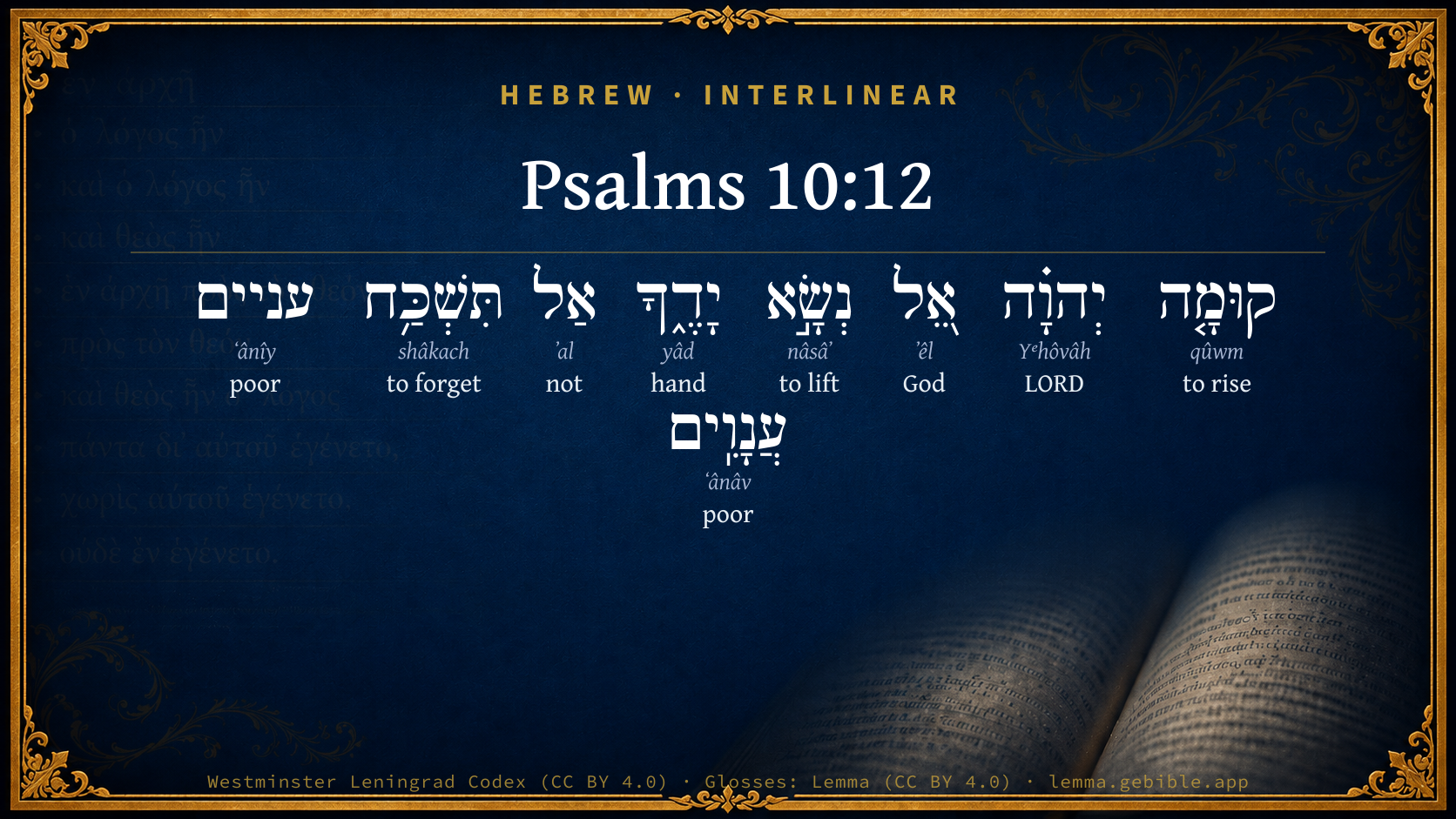
Hebrew (Westminster Leningrad Codex) Psalms 10:12 appears in the Hebrew Old Testament. The text above is from the Westminster Leningrad Codex. Each word links to its Strong’s number, a concise gloss, and parsing drawn from the Open Scriptures Hebrew Bible morphology. Click any word for its full Brown-Driver-Briggs (BDB) entry.
Download image
Cite this verse

Psalms 10:12 (World English Bible). Public Domain. Lemma interlinear Bible study tool, https://lemma.gebible.app/v/psalms/10/12.

Show BibTeX & RIS
BibTeX
RIS
English Translation
Arise, Yahweh! God, lift up your hand! Don't forget the helpless.
World English Bible · Public Domain
Download a study sheet

One document with this verse’s original text, its word-by-word gloss line, the meaning frame, cross-references with their text, attributed commentary, and full source and license credits — printable, and it pastes into notes with its structure intact.

This verse Autodidact and up

Study sheet (.html) Plain text (.txt)

A passage Seminary Student

Up to 50 verses in one chapter. A passage sheet keeps up to 6 commentary sources and 12 cross-references per verse, in the order this page ranks them, and says so on the sheet whenever that leaves anything out. Ask for a single verse and you get the Autodidact verse sheet above.

Everything on this page stays free to read, with no account — the sheet is a download of what is already on screen, not access to it.

Want to remove ads? Support Godless Engineer
Compare translations 3

The same verse in 3 English versions, stacked beneath the original-language interlinear above. Click any original word for its lexicon entry.

Each is an independent rendering of the whole verse — the interlinear is not word-aligned to these translations.

Highlighted words mark where these versions differ — a whole-verse word diff, not a word-by-word alignment.

  • World English Bible Public Domain
    Arise, Yahweh! God, lift up your hand! Don't forget the helpless.
  • King James Version Public Domain
    Arise, O LORD; O God, lift up thine hand: forget not the humble.
  • unfoldingWord Literal Text CC BY-SA 4.0
    Arise, Yahweh! God, lift up your hand! Do not forget the afflicted ones.

unfoldingWord Literal Text — © unfoldingWord, licensed CC BY-SA 4.0. Word-aligned USFM3 via Door43 (git.door43.org/unfoldingWord/en_ult).

Versions to compare (up to 4)

3 of 4 selected

Show all 17 translations

Every available English version of this verse, each an independent rendering of the whole verse.

  • World English Bible Public Domain
    Arise, Yahweh! God, lift up your hand! Don't forget the helpless.
  • Berean Standard Bible Public Domain
    Arise, O LORD! Lift up Your hand, O God! Do not forget the helpless.
  • Majority Standard Bible Public Domain
    Arise, O LORD! Lift up Your hand, O God! Do not forget the helpless.
  • King James Version Public Domain
    Arise, O LORD; O God, lift up thine hand: forget not the humble.
  • American Standard Version (1901) Public Domain
    Arise, O Jehovah; O God, lift up thy hand: Forget not the poor.
  • Revised Version (1885) Public Domain
    Arise, O LORD; O God, lift up thine hand: forget not the poor.
  • Geneva Bible (1599) Public Domain
    Arise, O Lord God: lift vp thine hande: forget not the poore.
  • Young's Literal Translation Public Domain
    Arise, O Jehovah! O God, lift up Thy hand! Forget not the humble.
  • Literal Standard Version CC BY-SA 4.0
    Arise, O YHWH! O God, lift up Your hand! Do not forget the humble.
  • Unlocked Literal Bible CC BY-SA 4.0
    Arise, Yahweh! Lift up your hand, God! Do not forget the oppressed.
  • unfoldingWord Literal Text CC BY-SA 4.0
    Arise, Yahweh! God, lift up your hand! Do not forget the afflicted ones.
  • Darby Bible Public Domain
    Arise, Jehovah; O ùGod, lift up thy hand: forget not the afflicted.
  • World Messianic Bible Public Domain
    Arise, LORD! God, lift up your hand! Don’t forget the helpless.
  • Webster's Bible Public Domain
    Arise, O LORD; O God, lift up thy hand: forget not the humble.
  • Free Bible Version CC BY-SA 4.0
    Take a stand, Lord! Raise your hand to strike! Don't forget those who can't defend themselves.
  • Bible in Basic English Public Domain
    Up! O Lord; let your hand be lifted: give thought to the poor.
  • JPS Tanakh (1917) Public Domain
    Arise, O LORD; O God, lift up Thy hand; forget not the humble.

Literal Standard Version (2020), Covenant Press — licensed CC BY-SA 4.0. Text via the HelloAO Bible API (eBible.org). Unlocked Literal Bible (unfoldingWord) — licensed CC BY-SA 4.0. Text via the HelloAO Bible API (eBible.org). unfoldingWord Literal Text — © unfoldingWord, licensed CC BY-SA 4.0. Word-aligned USFM3 via Door43 (git.door43.org/unfoldingWord/en_ult). Free Bible Version, Dr. Jonathan Gallagher — licensed CC BY-SA 4.0. Text via the HelloAO Bible API (eBible.org).

Word by word

More ways to search: Search by grammar → Find every occurrence → Compare this word →

Practice this passage: Drill this verse → Learn its vocabulary →

About this verse

These counts appear in no published source. They are computed here, from the morphology-tagged text and Lemma’s own curated glosses. What Lemma adds →

9
words
9
distinct lemmas
Wisdom
section

Shared distinctive vocabulary

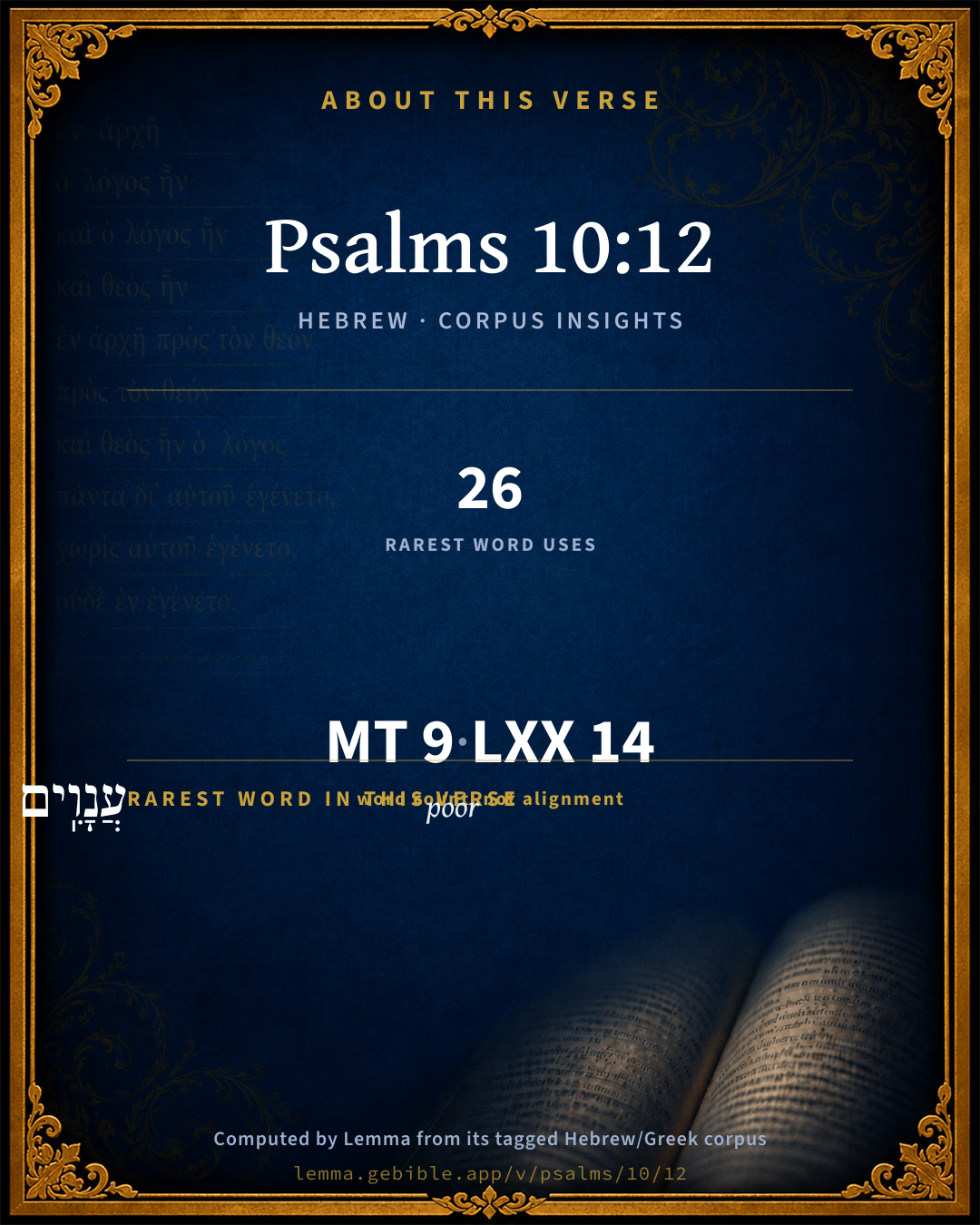
עֲנָוִֽים poor H6035 occurs in 24 verses of the Hebrew Bible. Also found in:

Grammatical profile

  • 3 verbs
  • 3 nouns
  • 2 adjectives
  • 1 particle

Verb forms

  • קוּמָ֤ה Qal · Imperative
  • נְשָׂ֣א Qal · Imperative
  • תִּשְׁכַּ֥ח Qal · Jussive

Hebrew & Septuagint length

In English translation the verse runs 11 words from the Hebrew and 18 from the Septuagint (LXX English) — closely comparable.

A rough comparison of the two English renderings, which tokenize alike — not a word-level alignment.

Word counts can differ between the Hebrew and the Greek without any difference in meaning — e.g. the Hebrew direct-object marker אֵת has no separate Greek word, and Greek often adds the article ὁ.

In the original languages it is 9 Hebrew tokens and 14 Greek tokens — but the two are counted differently (Hebrew bundles its prefixes and suffixes into one token; the Greek is in lemma form), so that isn’t a like-for-like length.

Cross-references

11

Topical passages linked to Psalms 10:12 in the Treasury of Scripture Knowledge — connected by theme and wording, ordered by reader-vote popularity; previews shown in the World English Bible.

  • Micah 5:9 Let your hand be lifted up above your adversaries, And let all of your enemies be cut off.
  • Psalms 9:12 For he who avenges blood remembers them. He doesn't forget the cry of the afflicted.
  • Psalms 94:2 Rise up, you judge of the earth. Pay back the proud what they deserve.
  • Psalms 17:7 Show your marvelous loving kindness, You who save those who take refuge by your right hand from their enemies.
  • Isaiah 33:10 Now will I arise, says Yahweh; now will I lift up myself; now will I be exalted.
  • Psalms 3:7 Arise, Yahweh! Save me, my God! For you have struck all of my enemies on the cheek bone. You have broken the teeth of the wicked.
  • Psalms 7:6 Arise, Yahweh, in your anger. Lift up yourself against the rage of my adversaries. Awake for me. You have commanded judgment.
  • Psalms 9:19 Arise, Yahweh! Don't let man prevail. Let the nations be judged in your sight.
  • Psalms 77:9 Has God forgotten to be gracious? Has he, in anger, withheld his compassion?" Selah.
  • Isaiah 26:11 Yahweh, your hand is lifted up, yet they don't see: but they shall see [your] zeal for the people, and be disappointed; yes, fire shall devour your adversaries.
  • Psalms 13:1 How long, Yahweh? Will you forget me forever? How long will you hide your face from me?

Cross-references courtesy of OpenBible.info (CC BY 4.0).

Hebrew and Greek witnesses Masoretic Hebrew ↔ Greek Septuagint

The same verse in the two great witnesses to the Old Testament, shown verse-for-verse.

You’re reading Greek Psalm 9 (Hebrew Psalm 10). The Septuagint counts the superscription, so verse numbers can differ from the Hebrew — chapter-level alignment, not verse-by-verse. Numbering follows Rahlfs.

These are two independent witnesses, not word-aligned to each other, and the Septuagint is shown in lemma (dictionary) form.

Hebrew Psalms 10:12 Masoretic · Westminster Leningrad Codex

קוּמָ֤ה יְהוָ֗ה אֵ֭ל נְשָׂ֣א יָדֶ֑ךָ אַל תִּשְׁכַּ֥ח עניים עֲנָוִֽים

Arise, Yahweh! God, lift up your hand! Don't forget the helpless.

World English Bible · Public Domain

Greek LXX Greek Psalm 9:12 Septuagint · lemma form

ψάλλω ὁ κύριος ὁ καταοἰκέω ἐν σιων ἀναἀγγέλλω ἐν ὁ ἔθνος ὁ ἐπιτήδευμα αὐτός

For he remembered them, in making inquisition for blood: he has not forgotten the supplication of the poor.

LXX2012 (modern English Septuagint) · Public Domain

Hebrew: Westminster Leningrad Codex (CC BY 4.0). Greek: Septuagint (public domain); English from LXX2012 (modern English Septuagint) (Public Domain). How the Septuagint differs from the Hebrew →

Commentary

Notes on Psalms 10:12 from classic Christian and Jewish commentators (each source and its license shown beneath its notes). The classic Christian expositions comment on the surrounding passage and are grouped to its opening verse, so a note may address several verses; the Jewish commentaries on the Tanakh (Rashi and others) are per-verse, so they appear only where the commentator wrote on this verse.

Lemma curates 59 commentaries, every one of them public domain or Creative Commons licensed, each selected and text-cleaned for this edition rather than reprinted as found. About our sources →

Matthew Henry's Commentary

David here, upon the foregoing representation of the inhumanity and impiety of the oppressors, grounds an address to God, wherein observe,

I. What he prays for. 1. That God would himself appear (Psa 10:12): "Arise, O Lord! O God! lift up thy hand, manifest thy presence and providence in the affairs of this lower world. Arise, O Lord! to the confusion of those who say that thou hidest thy face. Manifest thy power, exert it for the maintaining of thy own cause, lift up thy hand to give a fatal blow to these oppressors; let thy everlasting arm be made bare." 2. That he would appear for his people: "Forget not the humble, the afflicted, that are poor, that are made poorer, and are poor in spirit. Their oppressors, in their presumption, say that thou hast forgotten them; and they, in their despair, are ready to say the same. Lord, make it to appear that they are both mistaken." 3. That he would appear against their persecutors, Psa 10:15. (1.) That he would disable them from doing any mischief: Break thou the arm of the wicked, take away his power, that the hypocrite reign not, lest the people be ensnared, Job 34:30. We read of oppressors whose dominion was taken away, but their lives were prolonged (Dan 7:12), that they might have time to repent. (2.) That he would deal with them for the mischief they had done: "Seek out his wickedness; let that be all brought to light which he thought should for ever lie undiscovered; let that be all brought to account which he thought should for ever go unpunished; bring it out till thou find none, that is, till none of his evil deeds remain unreckoned for, none of his evil designs undefeated, and none of his partisans undestroyed."

II. What he pleads for the encouraging of his own faith in these petitions.

1. He pleads the great affronts which these proud oppressors put upon God himself: "Lord, it is thy own cause that we beg thou wouldst appear in; the enemies have made it so, and therefore it is not for thy glory to let them go unpunished" (Psa 10:13): Wherefore do the wicked contemn God? He does so; for he says, "Thou wilt not require it; thou wilt never call us to an account for what we do," than which they could not put a greater indignity upon the righteous God. The psalmist here speaks with astonishment, (1.) At the wickedness of the wicked: "Why do they speak so impiously, why so absurdly?" It is a great trouble to good men to think what contempt is cast upon the holy God by the sin of sinners, upon his precepts, his promises, his threatenings, his favours, his judgments; all are despised and made light of. Wherefore do the wicked thus contemn God? It is because they do not know him. (2.) At the patience and forbearance of God towards them: "Why are they suffered thus to contemn God? Why does he not immediately vindicate himself and take vengeance on them?" It is because the day of reckoning is yet to come, when the measure of their iniquity is full.

2. He pleads the notice God took of the impiety and iniquity of these oppressors (Psa 10:14): "Do the persecutors encourage themselves with a groundless fancy that thou wilt never see it? Let the persecuted encourage themselves with a well-grounded faith, not only that thou hast seen it, but that thou doest behold it, even all the mischief that is done by the hands, and all the spite and malice that lurk in the hearts, of these oppressors; it is all known to thee, and observed by thee; nay, not only thou hast seen it and dost behold it, but thou wilt requite it, wilt recompense it into their bosoms, by thy just and avenging hand."

3. He pleads the dependence which the oppressed had upon him: "The poor commits himself unto thee, each of them does so, I among the rest. They rely on thee as their patron and protector, they refer themselves to thee as their Judge, in whose determination they acquiesce and at whose disposal they are willing to be. They leave themselves with thee" ( so some read it), "not prescribing, but subscribing, to thy wisdom and will. They thus give thee honour as much as their oppressors dishonour thee. They are thy willing subjects, and put themselves under thy protection; therefore protect them."

4. He pleads the relation in which God is pleased to stand to us, (1.) As a great God. He is King for ever and ever, Psa 10:16. And it is the office of a king to administer justice for the restraint and terror of evil-doers and the protection and praise of those that do well. To whom should the injured subjects appeal but to the sovereign? Help, my Lord, O King! Avenge me of my adversary. "Lord, let all that pay homage and tribute to thee as their King have the benefit of thy government and find thee their refuge. Thou art an everlasting King, which no earthly prince is, and therefore canst and wilt, by an eternal judgment, dispense rewards and punishments in an everlasting state, when time shall be no more; and to that judgment the poor refer themselves." (2.) As a good God. He is the helper of the fatherless (Psa 10:14), of those who have no one else to help them and have many to injure them. He has appointed kings to defend the poor and fatherless (Psa 82:3), and therefore much more will he do so himself; for he has taken it among the titles of his honour to be a Father to the fatherless (Psa 68:5), a helper of the helpless.

5. He pleads the experience which God's church and people had had of God's readiness to appear for them. (1.) He had dispersed and extirpated their enemies (Psa 10:16): "The heathen have perished out of his land; the remainders of the Canaanites, the seven devoted nations, which have long been as thorns in the eyes and goads in the sides of Israel, are now, at length, utterly rooted out; and this is an encouragement to us to hope that God will, in like manner, break the arm of the oppressive Israelites, who were, in some respects, worse than heathens." (2.) He had heard and answered their prayers (Psa 10:17): "Lord, thou hast many a time heard the desire of the humble, and never saidst to a distressed suppliant, Seek in vain. Why may not we hope for the continuance and repetition of the wonders, the favours, which our father told us of?"

6. He pleads their expectations from God pursuant to their experience of him: "Thou hast heard, therefore thou will cause thy ear to hear, as, Psa 6:9. Thou art the same, and thy power, and promise, and relation to thy people are the same, and the work and workings of grace are the same in them; why therefore may we not hope that he who has been will still be, will ever be, a God hearing prayers?" But observe, (1.) In what method God hears prayer. He first prepares the heart of his people and then gives them an answer of peace; nor may we expect his gracious answer, but in this way; so that God's working upon us is the best earnest of his working for us. He prepares the heart for prayer by kindling holy desires, and strengthening our most holy faith, fixing the thoughts and raising the affections, and then he graciously accepts the prayer; he prepares the heart for the mercy itself that is wanting and prayed for, makes us fit to receive it and use it well, and then gives it in to us. The preparation of the heart is from the Lord, and we must seek unto him for it (Pro 16:1) and take that as a leading favour. (2.) What he will do in answer to prayer, Psa 10:18. [1.] He will plead the cause of the persecuted, will judge the fatherless and oppressed, will judge for them, clear up their innocency, restore their comforts, and recompense them for all the loss and damage they have sustained. [2.] He will put an end to the fury of the persecutors. Hitherto they shall come, but no further; here shall the proud waves of their malice be stayed; an effectual course shall be taken that the man of the earth may no more oppress. See how light the psalmist now makes of the power of that proud persecutor whom he had been describing in this psalm, and how slightly he speaks of him now that he had been considering God's sovereignty. First, He is but a man of the earth, a man out of the earth (so the word is), sprung out of the earth, and therefore mean, and weak, and hastening to the earth again. Why then should we be afraid of the fury of the oppressor when he is but man that shall die, a son of man that shall be as grass? Isa 51:12. He that protects us is the Lord of heaven; he that persecutes us is but a man of the earth. Secondly, God has him in a chain, and can easily restrain the remainder of his wrath, so that he cannot do what he would. When God speaks the word Satan shall by his instruments no more deceive (Rev 20:3), no more oppress.

In singing these verses we must commit religion's just but injured cause to God, as those that are heartily concerned for its honour and interests, believing that he will, in due time, plead it with jealousy.

Matthew Henry's Commentary on the Whole Bible (1708–1710) — public domain (CC PDM 1.0). Text via the HelloAO Bible API.

Trapp's Complete Commentary

John Trapp

Psa 10:12 Arise, O LORD; O God, lift up thine hand: forget not the humble.

Ver. 12. Arise, O Lord] Surge, age, summe Pater, said Mantuan to the pope, stirring him up against the Turks; may we better say to the Almighty God, against his people’s enemies,

O God, lift up thine hand Lift it up on high, that it may fall down the more heavily. In the first verse of this psalm the prophet complained that God stood afar off, and hid himself in time of trouble, Here he is entreated to arise, to come near, to put forth his hand for his people’s help, &c.

John Trapp, A Commentary or Exposition upon All the Books of the Old and New Testament (1647–1656) — public domain. Text from a community e-Sword module.

Joseph Benson's Commentary

Psa 10:12-13. Lift up thy hand — To rescue the poor, and to smite their oppressors; forget not the humble — Show, by thy appearing for their vindication, that thou dost remember and regard them. Wherefore doth the wicked contemn God? — Why dost thou, by giving them impunity, suffer and occasion them to despise thee?

Joseph Benson's Commentary on the Old and New Testaments (1811–1818) — public domain. Text from a community e-Sword module.

Tyndale Open Study Notes

Tyndale Open Resources

10:12-15 With confidence that the wicked will be held responsible for their deeds and that the Lord will care for the helpless, the psalmist prays intensely for rescue from evil.

Tyndale Open Study Notes — © Tyndale Open Resources, licensed CC BY-SA 4.0. Text via the HelloAO Bible API.

Geneva Bible (1599)

Geneva Bible translators

He calleth to God for help, because wickedness is so far overgrown, that God must now help or never.

Geneva Bible (1599) marginal notes — public domain. Text via Bolls.life.

Jamieson, Fausset & Brown

Robert Jamieson, A. R. Fausset & David Brown

(Compare Psa 9:19; Psa 3:7).

the humble--(Compare Psa 10:17, and Margin.)

lift up thine hand--exert thy power.

Jamieson, Fausset & Brown — Commentary Critical and Explanatory on the Whole Bible (1871) — public domain (CC PDM 1.0). Text via the HelloAO Bible API.

Adam Clarke's Commentary

Verse 12. Arise, O Lord] Hear their reproaches see their guile, consider thy oppressed people. "Lift up thine hand," threaten them, that they may desist and repent. If they repent not let them be punished.

Adam Clarke's Commentary on the Bible (1810–1826) — public domain. Text from a community e-Sword/MySword module.

John Calvin's Commentaries

12. Arise, O Jehovah. It is a disease under which men in general labor, to imagine, according to the judgment of the flesh, that when God does not execute his judgments, he is sitting idle, or lying at ease. There is, however, a great difference with respect to this between the faithful and the wicked. The latter cherish the false opinion which is dictated by the weakness of the flesh, and in order to soothe and flatter themselves in their vices, they indulge in slumbering, and render their conscience stupid, “Et prenent plaisir kassop et rendre leur conscience stupide, afin de se flatter en leurs vices.” — Fr.

“Retournans d’eux mesmes a bien considerer ce qui enest a la verite.” — Fr.

John Calvin's Commentaries (1540-1563) — public domain. Text from the Calvin Translation Society English edition (1840s-50s) via the Christian Classics Ethereal Library (ccel.org). Calvin's coverage is partial (roughly two-thirds of the Bible); uncommented books and verses are honest gaps, never fabricated. The 19th-century editor's footnotes and remarks are omitted so the notes are faithfully Calvin's own voice.

Ellicott's Commentary for English Readers

(12) Here the acrostic arrangement is resumed with koph.

A Bible Commentary for English Readers, edited by Charles John Ellicott (1878–1897) — public domain. Text from a community e-Sword module.

The Cambridge Bible for Schools and Colleges

gen. ed. J. J. S. Perowne

12. Arise] The usual summons to action. Cp. Psa_3:7, Psa_7:6 (notes); Psa_9:19.

O God] El, as in Psa_10:11.

lift up thine hand] The attitude of action. Cp. similar phrases in Psa_138:7; Exo_7:5; Mic_5:9; and contrast Psa_74:11.

forget not the humble] Disprove the calumny of the wicked (Psa_10:11). The Qrç ‘anavîm, ‘humble’ or ‘meek,’ is preferable to the Kthîbh ‘aniyyîm, ‘afflicted’ or ‘poor.’ The spirit in which sufferings have been borne is urged as a plea. Cp. Psa_10:17.

12, 13. Stanza of Qôph.

12–18. An urgent plea that Jehovah will vindicate His own character by action, grounded upon a confident assurance of the present reality of His government. The alphabetical arrangement is here resumed.

The Cambridge Bible for Schools and Colleges (gen. ed. J. J. S. Perowne; Cambridge University Press, 1878–1918) — public domain. Text from a community e-Sword module.

John Gill's Exposition

Arise, O Lord,.... See Psa 3:7;

O God, lift up thine hand; either on the behalf of his people, to help and deliver them; his hand may be said to be let down when their enemies prevail, and to be lifted up or exalted when it does valiantly, and works salvation for them; so when Moses's hands were let down Amalek prevailed, and when his hands were lifted up Israel prevailed, Exo 17:11; or against their enemies, to strike them, to inflict punishment upon them, as God's hand is said to be stretched out against the Egyptians, and to lie upon them, when he sent his plagues among them, Exo 7:4; and a dreadful thing it is to fall both into and under the hand of the living God, and to feel the weight of the lighting down of his arm with indignation. The Targum understands it as a gesture of swearing; see Gen 14:22; and paraphrases it, "confirm the oath of thine hand"; either sworn in wrath against his enemies, or in love to his people; either of which is sure and certain, and according to the immutable counsel of his will;

forget not the humble; the followers of the meek and lowly Jesus, the Lamb of God, by which character the saints are distinguished from the antichristian party, Rev 14:4; these are such who are made so by the Spirit of God, who in conversion brings down the pride and haughtiness of man, that Christ and his grace may be alone exalted; these have the meanest thoughts of themselves, and the best of others; their motto is,

"less than the least of all saints, and the chief of sinners;''

they envy not the gifts and graces of others, and ascribe all they have and are to the free grace of God; they are not easily provoked, they patiently bear injuries, and quietly submit to the adverse dispensations of Providence: the word in the original text is read "humble", but written "afflicted": both characters generally meet together in the people of God; See Gill on Psa 9:12; this prayer for the humble is a prayer of faith; for though the humble may seem to be forgotten by God, they are not, they are precious in his sight; he dwells among them, he gives more grace unto them, he comforts them when disconsolate, he feeds them when they are hungry, he teaches and guides them when they want direction, he lifts them up when they are cast down, and beautifies them with salvation.

John Gill's Exposition of the Whole Bible (1746–1763) — public domain (CC PDM 1.0). Text via the HelloAO Bible API.

Albert Barnes' Notes on the Bible

Arise, O Lord - See the note at Psa 3:7. This commences the second part of the psalm, in which the author calls on God to remember those who were oppressed and wronged by the wicked. By suffering the wicked thus to carry on their plans, God seemed to be indifferent to human affairs, and the psalmist, therefore, invokes him to interpose, and to rescue the afflicted from their grasp.

O God, lift up thine hand - As one does when he is about to strike, or to exert his power. The prayer is, that God would interfere to put down the wicked.

Forget not the humble - Margin, “afflicted.” The margin expresses the true sense. The idea is not that God would remember “humble” persons in the sense in which that word is now commonly used, but that he would remember those who were down-trodden, crushed, and afflicted. This is in accordance with the marginal reading in the Hebrew Bibles, which is now usually regarded as the more correct reading.

Albert Barnes' Notes on the Bible (1834–1885) — public domain. Text from a community e-Sword/MySword module.

Matthew Poole's English Annotations

Lift up thine hand, to rescue the poor, and to smite their oppressors with a hand stretched out and lifted up, that the blow maybe the greater: compare Exo 7:5; Isa 5:25; 9:12, &c.

Forget not the humble; show by thy appearance for their vindication that thou dost remember and regard them.

Matthew Poole's English Annotations on the Holy Bible (1683–1685) — public domain. Text from a community e-Sword/MySword module.

Whedon's Commentary on the Bible

Daniel D. Whedon

12. Arise, O Lord—Against the blasphemous unbelief and wickedness already described, the psalmist calls upon Jehovah, the Almighty, to show his power and justice in defence of his own law and covenant promise.

Lift up thy hand—An allusion, probably, to the custom of oriental masters in giving their orders to servants by the motion of the hand. Thus Baron de Tott: “The muzar aga, (or high priest,) coming into the hall, and approaching the pasha, whispered something in his ear, and we observed that all the answer he received from him was a slight horizontal motion with his hand, after which the vizier, instantly resuming an agreeable smile, continued the conversation. We then left the hall of audience and came to the foot of the great staircase, where we remounted our horses. Here nine heads, cut off and placed in a row on the outside of the first gate, completely explained the sign which the vizier had made use of in our presence.” See note on Psa_123:2

Daniel D. Whedon (gen. ed.), Commentary on the Old and New Testaments (1874–1909) — public domain. Text from a community e-Sword module.

The Pulpit Commentary

Arise, O Lord. (comp. Psa_9:19) At this point the psalmist passes from description to invocation. From ver. 2 to the end of ver. 11 he has described the conduct, the temper, and the very inmost thoughts of the wicked. Now he addresses himself to God he summons God to arise to vengeance. As Hengetenberg says, "Here the second part begins prayer, springing out of the lamentation which has preceded;" prayer and invocation, beginning here, and terminating at the close of ver. 15. O God, lift up thine hand; i.e. to strike, to take vengeance on the wicked. Forget not the humble; or, the afflicted. Do not justify the hidden thought of the wicked (ver. 11), that thou forgettest show that thou rememberest at once the sufferings of the afflicted, and the guilt of their oppressors.

The Pulpit Commentary (1880–1919), ed. H.D.M. Spence-Jones & Joseph S. Exell — public domain. Text from a community e-Sword module.

Keil & Delitzsch

C. F. Keil & F. Delitzsch

The six strophes, in which the consecutive letters from מ to צ are wanting, are completed, and now the acrostic strophes begin again with ק. In contrast to those who have no God, or only a lifeless idol, the psalmist calls upon his God, the living God, to destroy the appearance that He is not an omniscient Being, by arising to action. We have more than one name of God used here; אל is a vocative just as in Psa 16:1; Psa 83:2; Psa 139:17, Psa 139:23. He is to lift up His hand in order to help and to punish (נשׂא יד, whence comes the imperat. נשׂא = שׂא, cf. נסה Psa 4:7, like שׁלח יד Psa 138:7 and נטה יד Exo 7:5 elsewhere). Forget not is equivalent to: fulfil the לא שׁכח of Psa 9:13, put to shame the שׁכח אל of the ungodly, Psa 10:11! Our translation follows the Kerמ ענוים. That which is complained of in Psa 10:3, Psa 10:4 is put in the form of a question to God in Psa 10:13 : wherefore (על־מה, instead of which we find על־מה in Num 22:32; Jer 9:11, because the following words begin with letters of a different class) does it come to pass, i.e., is it permitted to come to pass? On the perf. in this interrogative clause vid., Psa 11:3. מדּוּע inquires the cause, למּה the aim, and על־מה the motive, or in general the reason: on what ground, since God's holiness can suffer no injury to His honour? On לא תדרשׁ with כּי, the oratio directa instead of obliqua, vid., on Ps 9:21.

Keil & Delitzsch — Biblical Commentary on the Old Testament (1861–1891) — public domain (CC PDM 1.0). Text via the HelloAO Bible API. (Old Testament only.)

J. A. Alexander on Psalms

Joseph Addison Alexander

12. Arise, Jehovah! Almighty (God), raise thy hand! Forget not sufferers (or the wretched)! The impious incredulity, expressed in the preceding verse, is now made the ground of an importunate petition. God is besought to do away with the appearance of inaction and indifference. See above, on Psa 7:7 (6). Raise thy hand, exert thy power. The second name by which God is addressed (lxe) is one expressive of omnipotence, and may be correctly rendered by our phrase, Almighty God. As the name Jehovah appeals to his covenant relation to his people, as a reason for granting their requests, so this invokes his power as necessary to their deliverance and the vindication of his own honour from the imputation of forgetfulness cast upon him by his enemies. This imputation he is entreated, in the last clause, to wipe off by shewing that he does remember. Forget not is, in this connection, tantamount to saying, shew that thou dost not forget. Here, as in Psa 9:13 (12), the margin of the Hebrew Bible reads (Myvinf) meek or humble, while the text has (Myynf) suffering or afflicted. The Kethib, or textual reading, is regarded by the highest critical authorities as the more ancient, and therefore, except in some rare cases, entitled to the preference.

Joseph Addison Alexander, The Psalms Translated and Explained (1850) — public domain. Text from a community e-Sword module.

Kretzmann's Popular Commentary

Paul E. Kretzmann

David Makes a Plea for Speedy Deliverance

v. 12. Arise, O Lord, David’s usual powerful and importunate appeal to Jehovah, the true God; O God, lift up Thine hand, namely, for the purpose of punishing the wicked; forget not the humble, forsaking them, giving them up to the cruelty of the wicked.

v. 13. Wherefore doth the wicked contemn God? How is it possible that God should permit such a blasphemous challenge of His government? He hath said in his heart, Thou wilt not require it, not call the wicked to account for his every misdeed.

v. 14. Thou hast seen it, this being set against the false security of the wicked; for Thou beholdest mischief and spite, all the grief which the ungodly lays upon the righteous, to requite it with Thy hand, with the full punishment which it deserves. The poor committeth himself unto Thee, trusting in God’s righteous judgment; Thou art the Helper of the fatherless, those without natural protectors to defend them.

v. 15. Break Thou the arm of the wicked, definitely putting a stop to his wicked acts, and the evil man; seek out his wickedness till Thou find none, the result being such a reverent awe of God that all meanness would be removed and disappear without leaving a trace.

v. 16. The Lord is King forever and ever, He is not dethroned despite all the attacks of the enemies; the heathen are perished out of His land, cut off entirely, annihilated, no remnant remaining. This being the poet’s assurance, he adds his last plea.

v. 17. Lord, Thou hast heard the desire of the humble, their longing for help; Thou wilt prepare their heart, establishing it by firm confidence in Him; Thou wilt cause Thine ear to hear, to attend closely to their cry,

v. 18. to judge the fatherless and the oppressed, executing judgment upon their oppressors, that the man of the earth, the haughty wicked adversary, may no more oppress, by terrifying the believers. That is the consolation of the children of God at all times, that He will finally vindicate His might and execute judgment upon all enemies of His people.

Paul E. Kretzmann, Popular Commentary of the Bible (1921–1924) — public domain. Text from a community e-Sword module.

Radak

Rabbi David Kimhi (Radak)

Arise, O Lord; O God, lift up Thy hand: – Because the wicked says that Thou dost not see, do Thou arise and lift up Thy hand against him.

Forget not the meek: – even as the wicked has said, God has forgotten. The Kethib is עניים (poor); the Keri ענוים (meek).

Radak on the Tanakh — English translations: “Sefaria Community Translation” (CC0 1.0 (public-domain dedication)); “Eliyahu Munk, HaChut Hameshulash” (CC BY 4.0); “Rabbi Mike Feuer, Jerusalem Anthology” (CC BY 4.0); and “R. David Kimhi on the first book of Psalms, Translated by R.G. Finch, London, 1919” (public domain). Text via Sefaria.

Lesson kit

Teaching starters — assembled from the data on this page, not authored interpretation. Every prompt links to the verse data it draws on. Edit before teaching.

Psalms, in the Wisdom, opens this verse with 9 words (9 distinct Hebrew lemmas). Its most distinctive word is ʻânâv (“poor”). A historical commentator’s framing appears above. Read the whole chapter for the surrounding context.

Discussion questions

  1. The word ʻânâv carries the sense “poor.” How does it shape the verse?
  2. Numbers 12:3 shares the word «poor» with this verse. How do the two illuminate each other?
  3. These translations render this verse differently; the difference is in the English rendering, not the original. What questions does that raise?
  4. The verb «קוּמָ֤ה» is Qal Imperative. How does its form color the action?
  5. Reading how Matthew Henry's Commentary and Trapp's Complete Commentary read this verse, where do the two commentators agree and where do they part?

Things to notice

Reading settings

Reading text

Shown beneath each verse's original-language words.

Old Testament
Old Testament edition

Read the OT as the Masoretic Hebrew (MT) or the Greek Septuagint (LXX).

English shown for the Greek Septuagint (in the Hebrew ↔ Greek comparison).

Comparing translations? Open the Compare panel on any verse page to stack up to four side by side.