Zechariah 5:7

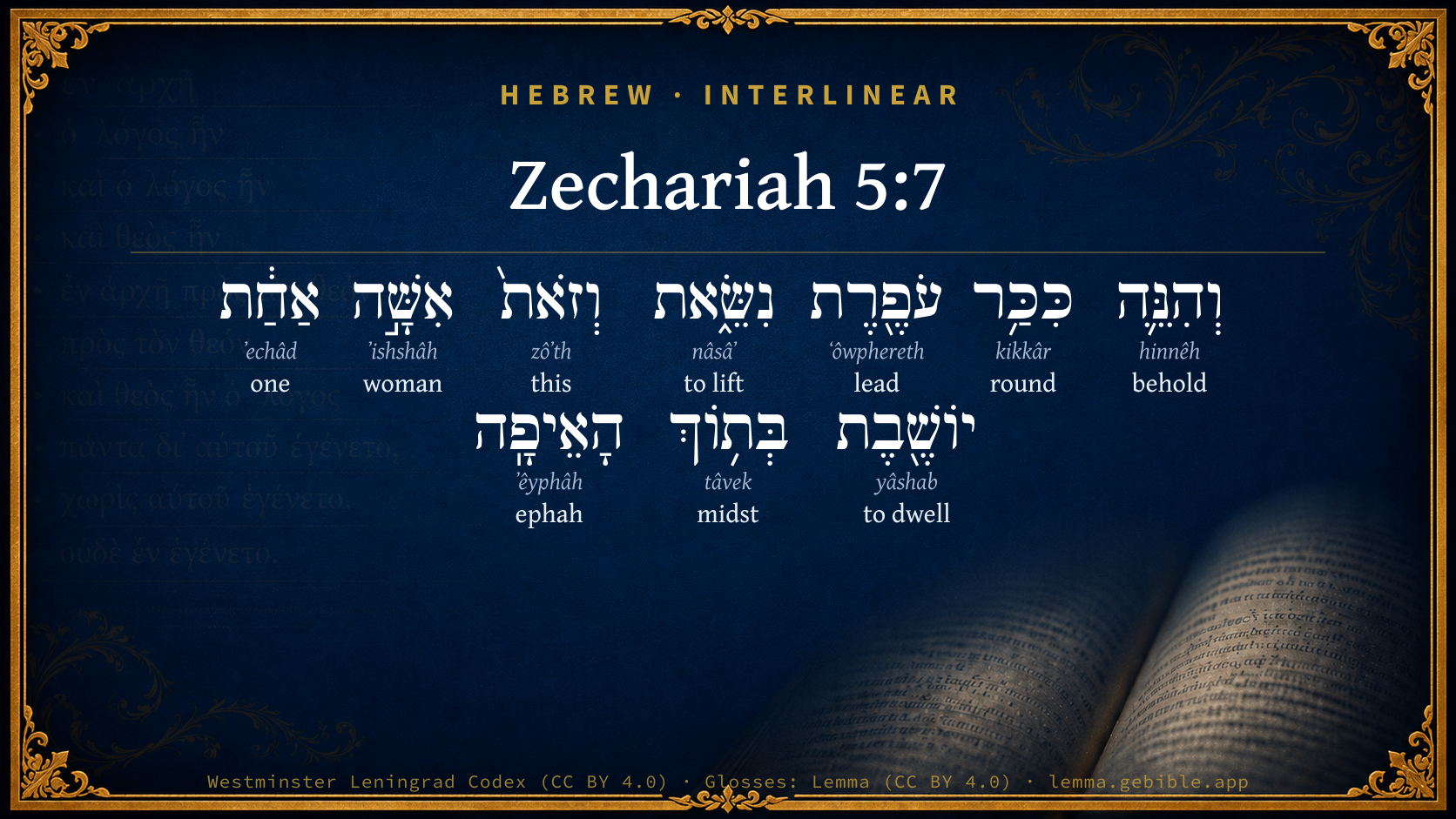
Hebrew (Westminster Leningrad Codex) Zechariah 5:7 appears in the Hebrew Old Testament. The text above is from the Westminster Leningrad Codex. Each word links to its Strong’s number, a concise gloss, and parsing drawn from the Open Scriptures Hebrew Bible morphology. Click any word for its full Brown-Driver-Briggs (BDB) entry.
Download image
Cite this verse

Zechariah 5:7 (World English Bible). Public Domain. Lemma interlinear Bible study tool, https://lemma.gebible.app/v/zechariah/5/7.

Show BibTeX & RIS
BibTeX
RIS
English Translation
(and, behold, a talent of lead was lifted up); and this is a woman sitting in the midst of the ephah basket."
World English Bible · Public Domain
Download a study sheet

One document with this verse’s original text, its word-by-word gloss line, the meaning frame, cross-references with their text, attributed commentary, and full source and license credits — printable, and it pastes into notes with its structure intact.

This verse Autodidact and up

Study sheet (.html) Plain text (.txt)

A passage Seminary Student

Up to 50 verses in one chapter. A passage sheet keeps up to 6 commentary sources and 12 cross-references per verse, in the order this page ranks them, and says so on the sheet whenever that leaves anything out. Ask for a single verse and you get the Autodidact verse sheet above.

Everything on this page stays free to read, with no account — the sheet is a download of what is already on screen, not access to it.

Want to remove ads? Support Godless Engineer
Compare translations 3

The same verse in 3 English versions, stacked beneath the original-language interlinear above. Click any original word for its lexicon entry.

Each is an independent rendering of the whole verse — the interlinear is not word-aligned to these translations.

Highlighted words mark where these versions differ — a whole-verse word diff, not a word-by-word alignment.

  • World English Bible Public Domain
    (and, behold, a talent of lead was lifted up); and this is a woman sitting in the midst of the ephah basket."
  • King James Version Public Domain
    And, behold, there was lifted up a talent of lead: and this is a woman that sitteth in the midst of the ephah.
  • unfoldingWord Literal Text CC BY-SA 4.0
    And behold, a disk of lead was being lifted up, and this one woman sitting in the midst of the ephah.

unfoldingWord Literal Text — © unfoldingWord, licensed CC BY-SA 4.0. Word-aligned USFM3 via Door43 (git.door43.org/unfoldingWord/en_ult).

Versions to compare (up to 4)

3 of 4 selected

Show all 18 translations

Every available English version of this verse, each an independent rendering of the whole verse.

  • World English Bible Public Domain
    (and, behold, a talent of lead was lifted up); and this is a woman sitting in the midst of the ephah basket."
  • Berean Standard Bible Public Domain
    And behold, the cover of lead was raised, and there was a woman sitting inside the basket.
  • Majority Standard Bible Public Domain
    And behold, the cover of lead was raised, and there was a woman sitting inside the basket.
  • King James Version Public Domain
    And, behold, there was lifted up a talent of lead: and this is a woman that sitteth in the midst of the ephah.
  • American Standard Version (1901) Public Domain
    (and, behold, there was lifted up a talent of lead); and this is a woman sitting in the midst of the ephah.
  • Revised Version (1885) Public Domain
    (and behold, there was lifted up a talent of lead:) and this is a woman sitting in the midst of the ephah.
  • Geneva Bible (1599) Public Domain
    And beholde, there was lift vp a talent of lead: and this is a woman that sitteth in the middes of the Ephah.
  • Douay-Rheims (1899) Public Domain
    And behold a talent of lead was carried, and behold a woman sitting in the midst of the vessel.
  • Young's Literal Translation Public Domain
    And lo, a cake of lead lifted up; and this `is' a woman sitting in the midst of the ephah.'
  • Literal Standard Version CC BY-SA 4.0
    And behold, a disc of lead lifted up; and this [is] a woman sitting in the midst of the ephah.”
  • Unlocked Literal Bible CC BY-SA 4.0
    Then a lead covering was lifted off the basket and there was a woman under it sitting in it!
  • unfoldingWord Literal Text CC BY-SA 4.0
    And behold, a disk of lead was being lifted up, and this one woman sitting in the midst of the ephah.
  • Darby Bible Public Domain
    And behold, there was lifted up a round plate of lead; and this is a woman that sitteth in the midst of the ephah.
  • World Messianic Bible Public Domain
    and behold, a lead cover weighing one talent was lifted up—and there was a woman sitting in the middle of the efah basket.”
  • Webster's Bible Public Domain
    And behold, there was lifted up a talent of lead: and this is a woman that sitteth in the midst of the ephah.
  • Free Bible Version CC BY-SA 4.0
    Then the lead lid was lifted from the barrel and there was a woman sitting inside.
  • Bible in Basic English Public Domain
    And I saw a round cover of lead lifted up; and a woman was seated in the middle of the ephah.
  • JPS Tanakh (1917) Public Domain
    and, behold, there was lifted up a round piece of lead — and this is a woman sitting in the midst of the measure.'

Literal Standard Version (2020), Covenant Press — licensed CC BY-SA 4.0. Text via the HelloAO Bible API (eBible.org). Unlocked Literal Bible (unfoldingWord) — licensed CC BY-SA 4.0. Text via the HelloAO Bible API (eBible.org). unfoldingWord Literal Text — © unfoldingWord, licensed CC BY-SA 4.0. Word-aligned USFM3 via Door43 (git.door43.org/unfoldingWord/en_ult). Free Bible Version, Dr. Jonathan Gallagher — licensed CC BY-SA 4.0. Text via the HelloAO Bible API (eBible.org).

Word by word

More ways to search: Search by grammar → Find every occurrence → Compare this word →

Practice this passage: Drill this verse → Learn its vocabulary →

About this verse

These counts appear in no published source. They are computed here, from the morphology-tagged text and Lemma’s own curated glosses. What Lemma adds →

10
words
10
distinct lemmas
Prophets
section

Notable vocabulary

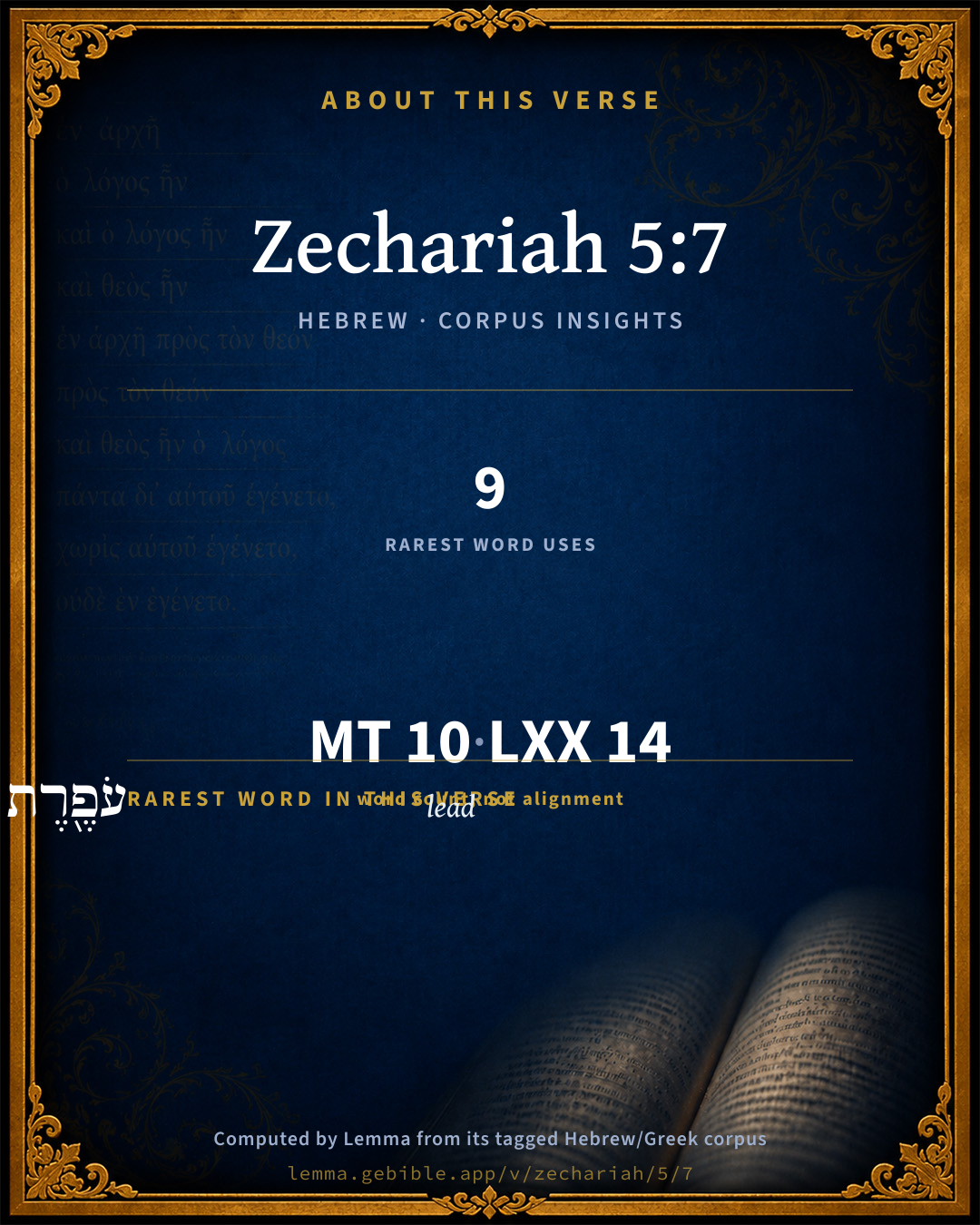
The rarest word here is עֹפֶ֖רֶת lead H5777 — appearing just 9 times in the whole Hebrew Bible.

Shared distinctive vocabulary

עֹפֶ֖רֶת lead H5777 occurs in 9 verses of the Hebrew Bible. Also found in:

Grammatical profile

  • 2 verbs
  • 5 nouns
  • 1 adjective
  • 1 pronoun
  • 1 particle

Verb forms

  • נִשֵּׂ֑את Niphal · Participle Passive
  • יוֹשֶׁ֖בֶת Qal · Participle Active

Hebrew & Septuagint length

In English translation the verse runs 22 words from the Hebrew and 19 from the Septuagint (LXX English) — closely comparable.

A rough comparison of the two English renderings, which tokenize alike — not a word-level alignment.

Word counts can differ between the Hebrew and the Greek without any difference in meaning — e.g. the Hebrew direct-object marker אֵת has no separate Greek word, and Greek often adds the article ὁ.

In the original languages it is 10 Hebrew tokens and 14 Greek tokens — but the two are counted differently (Hebrew bundles its prefixes and suffixes into one token; the Greek is in lemma form), so that isn’t a like-for-like length.

Cross-references

8

Topical passages linked to Zechariah 5:7 in the Treasury of Scripture Knowledge — connected by theme and wording, ordered by reader-vote popularity; previews shown in the World English Bible.

  • Revelation 17:1–18 One of the seven angels who had the seven bowls came and spoke with me, saying, "Come here. I will show you the judgment of the great prostitute who sits on many waters,
  • Ezekiel 23:1–49 The word of Yahweh came again to me, saying,
  • Jeremiah 3:1–2 They say, If a man put away his wife, and she go from him, and become another man's, will he return to her again? Won't that land be greatly polluted? But you have played the prostitute with many lovers; yet return again to me, says Yahweh.
  • Isaiah 13:1 The burden of Babylon, which Isaiah the son of Amoz did see.
  • Isaiah 15:1 The burden of Moab. For in a night Ar of Moab is laid waste, [and] brought to nothing; for in a night Kir of Moab is laid waste, [and] brought to nothing.
  • Isaiah 22:11 you made also a reservoir between the two walls for the water of the old pool. But you didn't look to him who had done this, neither did you have respect for him who purposed it long ago.
  • Ezekiel 16:1–63 Again the word of Yahweh came to me, saying,
  • Hosea 1:1–3 The word of Yahweh that came to Hosea the son of Beeri, in the days of Uzziah, Jotham, Ahaz, and Hezekiah, kings of Judah, and in the days of Jeroboam the son of Joash, king of Israel.

Cross-references courtesy of OpenBible.info (CC BY 4.0).

Hebrew and Greek witnesses Masoretic Hebrew ↔ Greek Septuagint

The same verse in the two great witnesses to the Old Testament, shown verse-for-verse.

These are two independent witnesses, not word-aligned to each other, and the Septuagint is shown in lemma (dictionary) form.

Hebrew Zechariah 5:7 Masoretic · Westminster Leningrad Codex

וְהִנֵּ֛ה כִּכַּ֥ר עֹפֶ֖רֶת נִשֵּׂ֑את וְזֹאת֙ אִשָּׁ֣ה אַחַ֔ת יוֹשֶׁ֖בֶת בְּת֥וֹךְ הָאֵיפָֽה

(and, behold, a talent of lead was lifted up); and this is a woman sitting in the midst of the ephah basket."

World English Bible · Public Domain

Greek LXX Zechariah 5:7 Septuagint · lemma form

καί ἰδού τάλαντον μολιβός ἐκαἴρω καί ἰδού εἷς γυνή κάθημαι ἐν μέσος ὁ μέτρον

And behold a talent of lead lifted up: and behold a woman sat in the midst of the measure.

LXX2012 (modern English Septuagint) · Public Domain

Hebrew: Westminster Leningrad Codex (CC BY 4.0). Greek: Septuagint (public domain); English from LXX2012 (modern English Septuagint) (Public Domain). How the Septuagint differs from the Hebrew →

Targum (Aramaic paraphrase)

1

The Targum is the ancient Jewish Aramaic paraphrase of the Hebrew Scriptures — an interpretive translation, not the Hebrew text itself. Onkelos (literal) and Pseudo-Jonathan (expansive) render the Torah, and Jonathan the Prophets. Coverage is partial: where no permissively-licensed English translation exists for a verse, only the Aramaic is shown. This is verse-level text, not a word-by-word alignment to the Hebrew.

  1. Targum Jonathan Prophets (Joshua–Malachi)
    וְהָא עַמְמַיָא קַלִילִין מַגְלַן יַתְהוֹן בְּקַלִילוּ וְאָתוֹ עַמְמִין אוֹחֲרָנִין וִיתִיבוּ בְּאַתְרַיְהוֹן עַל דַהֲווֹ נָסְבִין וְיָהֲבִין בִּמְכִילְתָּא דְשִׁקְרָא:

    (no public-domain English translation for this verse)

    Targum Jonathan — Aramaic: “Mikraot Gedolot” (public domain). English: “Sefaria Community Translation” (CC0 1.0 (public-domain dedication)); “London "Chaldee Paraphrase," 1871” (public domain). Text via Sefaria.

Commentary

Notes on Zechariah 5:7 from classic Christian and Jewish commentators (each source and its license shown beneath its notes). The classic Christian expositions comment on the surrounding passage and are grouped to its opening verse, so a note may address several verses; the Jewish commentaries on the Tanakh (Rashi and others) are per-verse, so they appear only where the commentator wrote on this verse.

Lemma curates 59 commentaries, every one of them public domain or Creative Commons licensed, each selected and text-cleaned for this edition rather than reprinted as found. About our sources →

The Cambridge Bible for Schools and Colleges

gen. ed. J. J. S. Perowne

7. a talent of lead] Rather, a circle of lead, i.e. a thick circular plate or lamina of lead, which formed the lid or cover of the ephah, Zec_5:8; round piece, R. V. margin. This the prophet saw in the act of being “lifted up” from the mouth of the ephah, in order to give him a view of its contents.

and this] which now comes into view as the lid is raised. To indicate the raising of the cover just at this moment, the R. V. prints the first part of Zec_5:7 within brackets.

The Cambridge Bible for Schools and Colleges (gen. ed. J. J. S. Perowne; Cambridge University Press, 1878–1918) — public domain. Text from a community e-Sword module.

Trapp's Complete Commentary

John Trapp

Zec 5:7 And, behold, there was lifted up a talent of lead: and this [is] a woman that sitteth in the midst of the ephah.

Ver. 7. And, behold, there was lifted up a talent of lead] A lump of lead, the weightiest metal; noting the immoveable and immutable decree of God for the punishment of the wicked. Say to the wicked, tell him so from me, it shall go ill with him, Isa 3:11; iniquity shall be his ruin. This lump of lead is first lifted up, and then let down upon the ephah as an adequate covering; and betokeneth the grievousness and long continuance of the Jews’ punishment and banishment for their parricide, or rather deicide, in crucifying the Lord of glory. A day of grace they had, but they knew it not; therefore is wrath come upon them to the utmost, or, until the end, or finally, so as it shall never be removed; so some interpret it (εις τελος, 1Th 2:16).

And this is a woman that sitteth in the midst of the ephah] In medio modii: and so she went forth or moved forward with an open face, and upper parts appearing, as not ashamed; the show of her countenance witnessed against her, she declared her sin as Sodom, Isa 3:9, and as Lot’s daughters, who savoured too much of Sodom when, glorying in their shame, they called their incestuous brats Moab, that is, the begotten of my father, and Benammi, which sounds to the same sense. This woman is also said to sit, as resolved of her course. Confer Psa 1:1; Psa 50:20 : the Jews are still a stubborn and refractory people. Antiquum obtinent: "Oh that the salvation of Israel were come out of Zion!" &c., Psa 14:7. Deus nos dignabitur clarissima visione cum reducet Zion, saith Jachiades, one of their Rabbis. I add, Fiat, Fiat. Do it, do it.

John Trapp, A Commentary or Exposition upon All the Books of the Old and New Testament (1647–1656) — public domain. Text from a community e-Sword module.

Whedon's Commentary on the Bible

Daniel D. Whedon

7. While the interpreter was still speaking, the cover was lifted from the top of the ephah.

A talent of lead — Literally, a circle; margin, “a round piece” (of lead). The ephah is pictured as round. Now the prophet beholds the contents.

And this is a woman that sitteth in the midst of the ephah — If the first part of Zec_5:7 is taken as a parenthetical clause (so R.V.), these words are a continuation of Zec_5:6, dependent on “He said moreover.” If Zec_5:7 is taken by itself as describing the sight which met the prophet’s eyes, a better rendering would be, “And, behold! a round piece of lead was lifted up; and (behold) this! one (lone) woman sitting in the midst of the ephah”; one woman is in apposition to this (G.-K., 136d, note). It says not “a woman,” but “one woman”; the numeral is used to indicate that nothing else was in the ephah.

Daniel D. Whedon (gen. ed.), Commentary on the Old and New Testaments (1874–1909) — public domain. Text from a community e-Sword module.

Tyndale Open Study Notes

Tyndale Open Resources

5:7-8 The evil woman in a basket represents a seductive and dangerous force that is difficult to contain. The sin of idolatry had previously provoked God’s judgment (2 Kgs 17:16-18; 2 Chr 36:14).

5:7 The heavy lead cover (literally a talent [seventy-five pounds] of lead) is not a natural cover for an ephah basket, but shows that extraordinary measures were needed to seal the basket’s unholy contents.

Tyndale Open Study Notes — © Tyndale Open Resources, licensed CC BY-SA 4.0. Text via the HelloAO Bible API.

Geneva Bible (1599)

Geneva Bible translators

To cover the measure.

Which representeth iniquity, as in the next verse.

Geneva Bible (1599) marginal notes — public domain. Text via Bolls.life.

Jamieson, Fausset & Brown

Robert Jamieson, A. R. Fausset & David Brown

lifted up--The cover is lifted off the ephah to let the prophet see the female personification of "wickedness" within, about to be removed from Judea. The cover being "of lead," implies that the "woman" cannot escape from the ponderous load which presses her down.

talent--literally, "a round piece": hence a talent, a weight of one hundred twenty-five pounds troy.

woman--for comparison of "wickedness" to a woman, Pro 2:16; Pro 5:3-4. In personifying abstract terms, the feminine is used, as the idea of giving birth to life is associated with woman.

Jamieson, Fausset & Brown — Commentary Critical and Explanatory on the Whole Bible (1871) — public domain (CC PDM 1.0). Text via the HelloAO Bible API.

John Calvin's Commentaries

Now the Prophet says that wickedness, when first seen, was in mid air, and in a measure; but at the same time he calls the measure the eye of the ungodly, for though wickedness extends itself to all parts, yet God confines it within a hidden measure; and this he designates by eyes, whereby he seems to allude to a former prophecy, which we have explained. For he had said that there were seven eyes in the stone of the high priest, because God would carry on by his providence the building of the temple. So also he says, that God’s eyes are upon all the ungodly, according to what is said in the book of Psalms —

“The eyes of the Lord are over the wicked, to destroy their memory from the earth.” (Psalm 34:17.)

And this mode of speaking often occurs in Scripture. The meaning then is, that though wickedness spreads and extends through the whole earth, it is yet in a measure; but this measure is not always closed up. However this may be, still God knows how to regulate all things, so that impiety shall not exceed its limits. And this is most true, whatever view may be taken; for when enemies harass the church, though they may be carried along in the air, that is, though God may not immediately restrain their wrongs, they yet sit in a measure, and are ruled by the eyes of God, so that they cannot move a finger, except so far as they are permitted. Let us in a word know, that in a state of things wholly disordered, God watches, and his eyes are vigilant, in order to put an end to injuries. The same also may be said when God gives up to a reprobate mind those who deserve such a punishment; for though he cast them away, and Satan takes possession of them, yet this remains true — that they sit in a measure. They are not indeed shut in; but we ought not, as I have said, to suppose that God is indifferent in heaven, or that sins prevail in the world, as though he did not see them; for his connivance is not blindness. The eyes of God then mark and observe whatever sins are done in the world.

John Calvin's Commentaries (1540-1563) — public domain. Text from the Calvin Translation Society English edition (1840s-50s) via the Christian Classics Ethereal Library (ccel.org). Calvin's coverage is partial (roughly two-thirds of the Bible); uncommented books and verses are honest gaps, never fabricated. The 19th-century editor's footnotes and remarks are omitted so the notes are faithfully Calvin's own voice.

Ellicott's Commentary for English Readers

(7, 8) Talent.—Better, disc. The construction of these verses is rather difficult. They should be taken as the words of the angel-interpreter, and be rendered: And behold (i.e., and you may see) a leaden disc being lifted up, and this [which you now see on the removal of the disc] is a woman sitting in the ephah; this, continued he, is wickedness. Observe the climax: first, representatives of the two classes of sinners are spoken of; then they are heaped into an undistinguishable mass, and afterwards they are spoken of as one woman, who impersonates wickedness.

Cast it.—Better, her, the woman.

A Bible Commentary for English Readers, edited by Charles John Ellicott (1878–1897) — public domain. Text from a community e-Sword module.

John Gill's Exposition

And, behold, there was lifted up a talent of lead,.... By the angel; since he is afterwards said to cast it upon the mouth of the "ephah". A cicar, or talent of silver, with the Jews, was equal to three thousand shekels, as may be gathered from Exo 38:24 and weighed a hundred and twenty five pounds (a); or, as others, a hundred and twenty (b), and, according to the more exact account of Dr. Arbuthnot, a hundred and thirteen pounds, ten ounces, one pennyweight, and ten and two seventh grains of our Troy weight. A Babylonish talent, according to Aelianus (c), weighed seventy two Attic pounds; and an Attic mina, or pound, weighed a hundred drachmas; so that it was of the weight of seven thousand two hundred such drachmas. An Alexandrian talent was equal to twelve thousand Attic drachmas; and these the same with a hundred and twenty five Roman libras or pounds; which talent is supposed to be the same with that of Moses. The Roman talent contained seventy two Italic minas, which were the same with the Roman libras (d). But since the Hebrew word "cicar" signifies anything plain, and what is extended like a cake, as Arias Montanus observes (e), it may here intend a plate of lead, which was laid over the mouth of the "ephah", as a lid unto it; though indeed it is afterwards called , "a stone of lead", and so seems to design a weight.

And this is a woman that sitteth in the midst of the ephah; who, in Zac 5:8, is called "wickedness"; and here represented by a "woman", because, say some, the woman was first in the transgression; or rather because sin is flattering and deceitful, and draws into the commission of it, and so to ruin: and this woman, wickedness, intends wicked men; all the wicked among the Jews, and even all the wicked of the world; who sit in the "ephah", very active and busy in filling up the measure of their sins, and where they sit with great pleasure and delight; very openly and visibly declare their sin, as Sodom, and hide it not; in a very proud and haughty manner, with great boldness and impudence, and in great security, without any concern about a future state, promising themselves impunity here and hereafter. This woman is a very lively emblem of the whore of Rome, sitting as a queen upon many waters; ruling over kings and princes; living deliciously, and in great ease and pleasure filling up the measure of her sins. Kimchi interprets this woman of the ten tribes, who wickedly departed from God, and were as one kingdom.

(a) Epiphanius de Mensuris & Ponderibus. (b) Hebraei apud Buxtorf. Lex. Heb. in rad. (c) Var. Hist. l. 1. c. 22. (d) See Prideaux's Preface to Connexion, &c. vol. 1. p. 18, 19, &c. (e) Ephron, sive de Siclo, prope finem.

John Gill's Exposition of the Whole Bible (1746–1763) — public domain (CC PDM 1.0). Text via the HelloAO Bible API.

Albert Barnes' Notes on the Bible

And behold there was lifted up a talent of lead - the heaviest Hebrew weight, elsewhere of gold or silver; the golden talent weighing, 1,300,000 grains; the silver, 660,000; here, being lead, it is obviously an undefined mass, though circular , corresponding to the Ephah. The Ephah too was the largest Hebrew measure, whose compass cannot now, with certainty, be ascertained . Both probably were, in the vision, ideal. Theodoret: “Holy Scripture calleth the punishment of sin, lead, as being by nature heavy. This the divine David teacheth us, “mine iniquities are gone over my head: as an heavy burden, they are too heavy for me” Psa 38:4. The divine Zechariah seeth sin under the image of a woman; for most evils are engendered by luxury. But he seeth the punishment, like most heavy lead, lying upon the mouth of iniquity, according to a Psalm, “all iniquity shall stop her mouth” Psa 107:42. Ambr. in Ps. 35. n. 9. Opp. i. 769: “Iniquity, as with a talent of lead, weighs down the conscience.”

This is a woman - Literally, “one woman,” all sin being concentrated and personified in one, as he goes on to speak of her as the, personified, wickedness. The sitting may represent her abiding tranquil condition in her sins, according to the climax in Psa 1:1-6, “and hath not sat in the seat of the scornful” Psa 1:1; and, “thou sittest and speakest against thy brother” Psa 50:20; (Lap.), “not standing as by the way, but sitting, as if of set purpose, of custom and habit.” “Whoso hath peace in sins is not far from lying down in them, so that, oppressed by a spirit of slumber, he neither sees light, nor feels any blow, but is kept down by the leaden talent of his obduracy.”

Albert Barnes' Notes on the Bible (1834–1885) — public domain. Text from a community e-Sword/MySword module.

Haydock's Catholic Bible Commentary

Talent, or weight, (Haydock) called a stone, ver. 8. --- Vessel, like the idol Canopus.

George Leo Haydock (1774–1849), Haydock's Catholic Family Bible and Commentary, 1859 edition — public domain. Excludes Psalms (Douay-Rheims chapter numbering differs from Protestant) and Deuterocanonical books (Catholic canon only).

Matthew Poole's English Annotations

Here is another part of this vision.

There was lifted up, either lifted up from out of the ephah, or brought thither to cover it,

a talent of lead; a large piece of lead of a talent weight, large as the mouth of the ephah.

This is a woman; a woman, the third in the vision or emblem.

That sitteth, secure, shameless, and resolved of her way in increasing in sin.

Matthew Poole's English Annotations on the Holy Bible (1683–1685) — public domain. Text from a community e-Sword/MySword module.

The Pulpit Commentary

There was lifted up a talent of lead. As the prophet gazed, the leaden cover of the ephah was raised, so that the contents became visible. The word rendered "talent" (kikkar) denotes a circle. It is used in Gen_13:10, Gen_13:12, for the tract of country of which the Jordan was the centre, and in 1Sa_2:36 for a round loaf. Here it means a disc or circular plate which formed the cover of the round shaped ephah. In the next verse it is called, "the weight of lead." And this is a woman that sitteth in the midst of the ephah; and there was a woman sitting, etc. When the leaden lid was raised one woman (mulier una, gunh mia ) was seen in the measure. She is called "one," as uniting and concentrating in her person all sinners and all sins.

The Pulpit Commentary (1880–1919), ed. H.D.M. Spence-Jones & Joseph S. Exell — public domain. Text from a community e-Sword module.

John Wesley's Explanatory Notes

And behold - Here is another part of this vision. Lifted up - Brought thither to cover it. A talent - A piece of lead of a talent weight, as large as the mouth of the ephah. A woman - A woman, the third in the vision. Perhaps this vision was purposely obscure, least a plain denunciation of the second overthrow of the state and temple, might discourage them from going forward in the present restoration of them.

John Wesley, Explanatory Notes Upon the Whole Bible (1754–1765) — public domain. Text via the GEBible commentary corpus.

Rashi

Rabbi Shlomo Yitzchaki (Rashi)

And behold! A talent of lead was being lifted I saw that a weight [made] of a talent of lead was being lifted off the earth into the air, and I saw further that this one woman was sitting in the midst of the ephah.

Rashi on the Tanakh — English translations: “The Judaica Press complete Tanach with Rashi, translated by A. J. Rosenberg” (CC BY 4.0); “Pentateuch with Rashi's commentary by M. Rosenbaum and A.M. Silbermann, 1929-1934” (public domain); “The Metsudah Tanach series, Lakewood, N.J” (CC BY 4.0); and “The Book of Joshua, Metsudah Publications, 1997” (CC BY 4.0). Text via Sefaria.

Lesson kit

Teaching starters — assembled from the data on this page, not authored interpretation. Every prompt links to the verse data it draws on. Edit before teaching.

Zechariah, in the Prophets, opens this verse with 10 words (10 distinct Hebrew lemmas). Its most distinctive word is ʻôwphereth (“lead”). A historical commentator’s framing appears above. Read the whole chapter for the surrounding context.

Discussion questions

  1. The word ʻôwphereth carries the sense “lead.” How does it shape the verse?
  2. How does Exodus 15:10, which shares the word «lead», read alongside this verse?
  3. The translations on this page render this verse differently — a whole-verse word diff, not a word-by-word alignment. What might account for the different wordings?
  4. «נִשֵּׂ֑את» is a Niphal Participle Passive verb. How does that grammatical form shape the action described?
  5. Compare how The Cambridge Bible for Schools and Colleges and Trapp's Complete Commentary read this verse. Where do they agree or differ?

Things to notice

Reading settings

Reading text

Shown beneath each verse's original-language words.

Old Testament
Old Testament edition

Read the OT as the Masoretic Hebrew (MT) or the Greek Septuagint (LXX).

English shown for the Greek Septuagint (in the Hebrew ↔ Greek comparison).

Comparing translations? Open the Compare panel on any verse page to stack up to four side by side.