
2 Samuel 8:2

Hebrew (Westminster Leningrad Codex) 2 Samuel 8:2 appears in the Hebrew Old Testament. The text above is from the Westminster Leningrad Codex. Each word links to its Strong’s number, a concise gloss, and parsing drawn from the Open Scriptures Hebrew Bible morphology. Click any word for its full Brown-Driver-Briggs (BDB) entry.
Download image
Cite this verse

2 Samuel 8:2 (World English Bible). Public Domain. Lemma interlinear Bible study tool, https://lemma.gebible.app/v/2-samuel/8/2.

Show BibTeX & RIS
BibTeX
RIS
English Translation
He struck Moab, and measured them with the line, making them to lie down on the ground; and he measured two lines to put to death, and one full line to keep alive. The Moabites became servants to David, and brought tribute.
World English Bible · Public Domain
Download a study sheet

One document with this verse’s original text, its word-by-word gloss line, the meaning frame, cross-references with their text, attributed commentary, and full source and license credits — printable, and it pastes into notes with its structure intact.

This verse Autodidact and up

Study sheet (.html) Plain text (.txt)

A passage Seminary Student

Up to 50 verses in one chapter. A passage sheet keeps up to 6 commentary sources and 12 cross-references per verse, in the order this page ranks them, and says so on the sheet whenever that leaves anything out. Ask for a single verse and you get the Autodidact verse sheet above.

Everything on this page stays free to read, with no account — the sheet is a download of what is already on screen, not access to it.

Want to remove ads? Support Godless Engineer
Compare translations 3

The same verse in 3 English versions, stacked beneath the original-language interlinear above. Click any original word for its lexicon entry.

Each is an independent rendering of the whole verse — the interlinear is not word-aligned to these translations.

Highlighted words mark where these versions differ — a whole-verse word diff, not a word-by-word alignment.

  • World English Bible Public Domain
    He struck Moab, and measured them with the line, making them to lie down on the ground; and he measured two lines to put to death, and one full line to keep alive. The Moabites became servants to David, and brought tribute.
  • King James Version Public Domain
    And he smote Moab, and measured them with a line, casting them down to the ground; even with two lines measured he to put to death, and with one full line to keep alive. And so the Moabites became David's servants, and brought gifts.
  • unfoldingWord Literal Text CC BY-SA 4.0
    And he struck Moab, and he measured them with a rope, making them lie on the ground. And he measured two ropes to kill and the fullness of the rope to let live. And Moab became servants to David, lifters of tribute.

unfoldingWord Literal Text — © unfoldingWord, licensed CC BY-SA 4.0. Word-aligned USFM3 via Door43 (git.door43.org/unfoldingWord/en_ult).

Versions to compare (up to 4)

3 of 4 selected

Show all 18 translations

Every available English version of this verse, each an independent rendering of the whole verse.

  • World English Bible Public Domain
    He struck Moab, and measured them with the line, making them to lie down on the ground; and he measured two lines to put to death, and one full line to keep alive. The Moabites became servants to David, and brought tribute.
  • Berean Standard Bible Public Domain
    David also defeated the Moabites, made them lie down on the ground, and measured them off with a cord. He measured off with two lengths those to be put to death, and with one length those to be spared. So the Moabites became subject to David and brought him tribute.
  • Majority Standard Bible Public Domain
    David also defeated the Moabites, made them lie down on the ground, and measured them off with a cord. He measured off with two lengths those to be put to death, and with one length those to be spared. So the Moabites became subject to David and brought him tribute.
  • King James Version Public Domain
    And he smote Moab, and measured them with a line, casting them down to the ground; even with two lines measured he to put to death, and with one full line to keep alive. And so the Moabites became David's servants, and brought gifts.
  • American Standard Version (1901) Public Domain
    And he smote Moab, and measured them with the line, making them to lie down on the ground; and he measured two lines to put to death, and one full line to keep alive. And the Moabites became servants to David, and brought tribute.
  • Revised Version (1885) Public Domain
    And he smote Moab, and measured them with the line, making them to lie down on the ground; and he measured two lines to put to death, and one full fine to keep alive. And the Moabites became servants to David, and brought presents.
  • Geneva Bible (1599) Public Domain
    And hee smote Moab, and measured them with a corde, and cast them downe to the ground: he measured them with two cordes to put them to death, and with one full corde to keepe them aliue: so became the Moabites Dauids seruants, and brought giftes.
  • Douay-Rheims (1899) Public Domain
    And he defeated Moab, and measured them with a line, casting them down to the earth: and he measured with two lines, one to put to death, and one to save alive: and Moab was made to serve David under tribute.
  • Young's Literal Translation Public Domain
    And he smiteth Moab, and measureth them with a line, causing them to lie down on the earth, and he measureth two lines to put to death, and the fulness of the line to keep alive, and the Moabites are to David for servants, bearers of a present.
  • Literal Standard Version CC BY-SA 4.0
    And he strikes Moab, and measures them with a line, causing them to lie down on the earth, and he measures two lines to put to death, and the fullness of the line to keep alive, and the Moabites are for servants to David, bearers of a present.
  • Unlocked Literal Bible CC BY-SA 4.0
    Then he defeated Moab and measured their men with a line by making them lie down on the ground. He measured off two lines to put to death, and one full line to keep alive. So the Moabites became servants to David and began to pay him tribute.
  • unfoldingWord Literal Text CC BY-SA 4.0
    And he struck Moab, and he measured them with a rope, making them lie on the ground. And he measured two ropes to kill and the fullness of the rope to let live. And Moab became servants to David, lifters of tribute.
  • Darby Bible Public Domain
    And he smote the Moabites, and measured them with a line, making them lie down on the ground; and he measured two lines to put to death, and one full line to keep alive. And the Moabites became David's servants, [and] brought gifts.
  • World Messianic Bible Public Domain
    He defeated Moab, and measured them with the line, making them to lie down on the ground; and he measured two lines to put to death, and one full line to keep alive. The Moabites became servants to David, and brought tribute.
  • Webster's Bible Public Domain
    And he smote Moab, and measured them with a line, casting them down to the ground; even with two lines he measured to put to death, and with one full line to keep alive. And so the Moabites became David's servants, and brought gifts.
  • Free Bible Version CC BY-SA 4.0
    David also defeated the Moabites. He made them lie down on the ground, and he measured them with a length of cord. He measured two lengths for those to be killed, and one cord length for those to be allowed to live. So he made them subject to him and required them to pay taxes.
  • Bible in Basic English Public Domain
    And he overcame the Moabites, and he had them measured with a line when they were stretched out on the earth; marking out two lines for death and one full line for life. So the Moabites became servants to David and gave him offerings.
  • JPS Tanakh (1917) Public Domain
    And he smote Moab, and measured them with the line, making them to lie down on the ground; and he measured two lines to put to death, and one full line to keep alive. And the Moabites became servants to David, and brought presents.

Literal Standard Version (2020), Covenant Press — licensed CC BY-SA 4.0. Text via the HelloAO Bible API (eBible.org). Unlocked Literal Bible (unfoldingWord) — licensed CC BY-SA 4.0. Text via the HelloAO Bible API (eBible.org). unfoldingWord Literal Text — © unfoldingWord, licensed CC BY-SA 4.0. Word-aligned USFM3 via Door43 (git.door43.org/unfoldingWord/en_ult). Free Bible Version, Dr. Jonathan Gallagher — licensed CC BY-SA 4.0. Text via the HelloAO Bible API (eBible.org).

Word by word

More ways to search: Search by grammar → Find every occurrence → Compare this word →

Practice this passage: Drill this verse → Learn its vocabulary →

וּמְלֹ֥א
mᵉlôʼ
H4393
“and · fulness of”
Conjunction + Noun, Common, Masculine, Singular, Construct
Part of Speech
Conjunction + Noun
Type
Common
Gender
Masculine
Number
Singular
State
Construct
Full BDB Definition

Origin: from H4390

TWOT: 1195b

fulness, that which fills - fulness, handful - mass, multitude - fulness, that which fills, entire contents - full length, full line
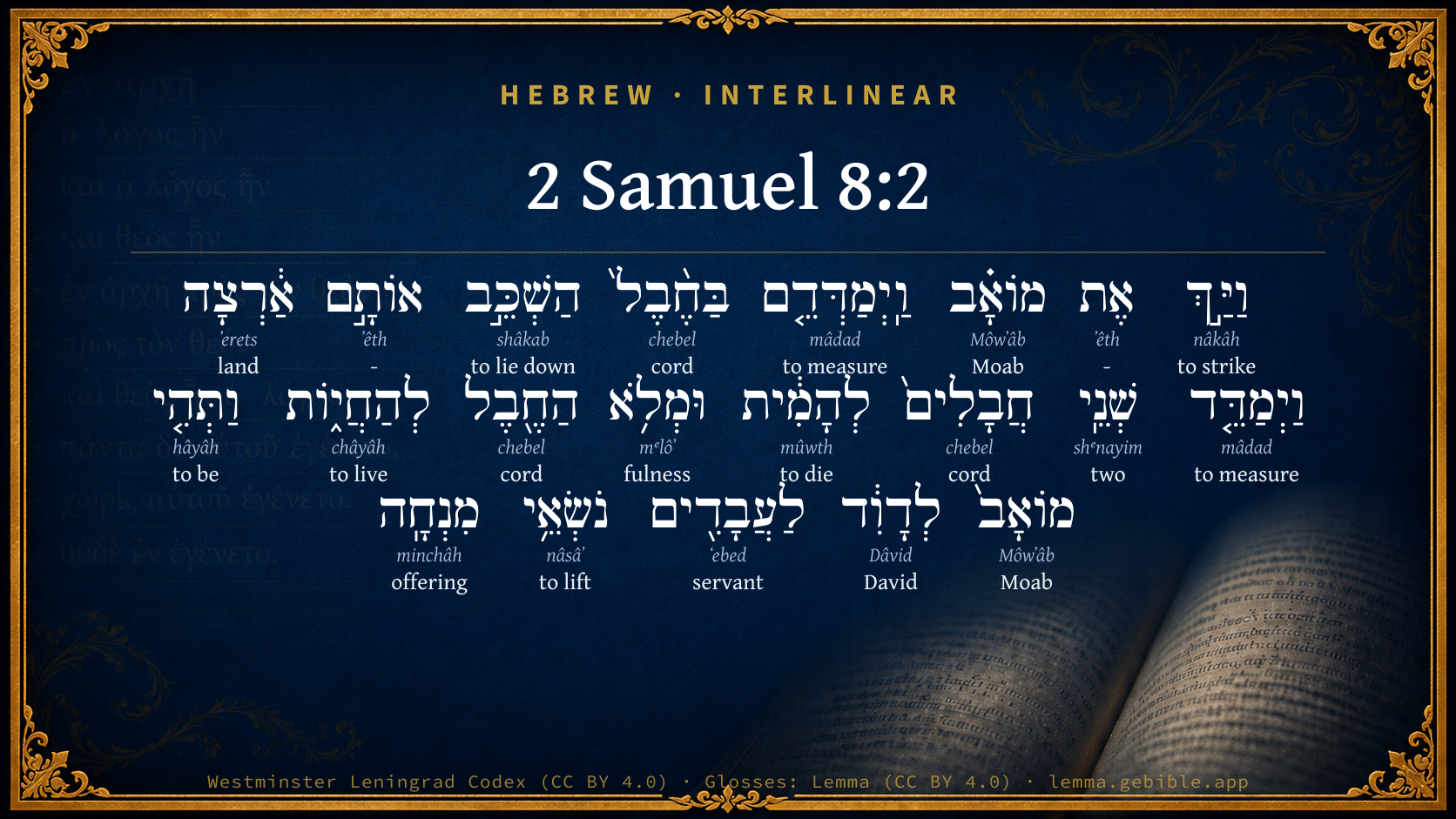
  1. וַיַּ֣ךְ nâkâh H5221 “and · to strike” Conjunction + Verb, Hiphil, Sequential Imperfect, 3rd Person, Masculine, Singular
  2. אֶת ʼêth H853 “-” Particle, Direct Object
  3. מוֹאָ֗ב Môwʼâb H4124 “Moab” Noun, Proper
  4. וַֽיְמַדְּדֵ֤ם mâdad H4058 “and · to measure · them” Conjunction + Verb, Piel, Sequential Imperfect, 3rd Person, Masculine, Singular + Suffix, Personal, 3rd Person, Masculine, Plural
  5. בַּחֶ֨בֶל֙ chebel H2256 “in/at the · cord” Preposition, Determined + Noun, Common, Both, Singular, Absolute
  6. הַשְׁכֵּ֣ב shâkab H7901 “to lie down” Verb, Hiphil, Infinitive Absolute
  7. אוֹתָ֣ם ʼêth H853 “- · them” Particle, Direct Object + Suffix, Personal, 3rd Person, Masculine, Plural
  8. אַ֔רְצָה ʼerets H776 “land · toward” Noun, Common, Both, Singular, Absolute + Suffix, Demonstrative
  9. וַיְמַדֵּ֤ד mâdad H4058 “and · to measure” Conjunction + Verb, Piel, Sequential Imperfect, 3rd Person, Masculine, Singular
  10. שְׁנֵֽי shᵉnayim H8147 “two” Adjective, Cardinal number, Masculine, Dual, Construct
  11. חֲבָלִים֙ chebel H2256 “cords” Noun, Common, Both, Plural, Absolute
  12. לְהָמִ֔ית mûwth H4191 “to die” Preposition + Verb, Hiphil, Infinitive Construct
  13. הַחֶ֖בֶל chebel H2256 “the · cord” Particle, Definite Article + Noun, Common, Both, Singular, Absolute
  14. לְהַחֲי֑וֹת châyâh H2421 “to live” Preposition + Verb, Hiphil, Infinitive Construct
  15. וַתְּהִ֤י hâyâh H1961 “and · to be” Conjunction + Verb, Qal, Sequential Imperfect, 3rd Person, Feminine, Singular
  16. מוֹאָב֙ Môwʼâb H4124 “Moab” Noun, Proper
  17. לְדָוִ֔ד Dâvid H1732 “to/for · David” Preposition + Noun, Proper
  18. לַעֲבָדִ֖ים ʻebed H5650 “to/for · servants” Preposition + Noun, Common, Masculine, Plural, Absolute
  19. נֹשְׂאֵ֥י nâsâʼ H5375 “lifting” Verb, Qal, Participle Active, Masculine, Plural, Construct
  20. מִנְחָֽה minchâh H4503 “offering” Noun, Common, Feminine, Singular, Absolute

About this verse

These counts appear in no published source. They are computed here, from the morphology-tagged text and Lemma’s own curated glosses. What Lemma adds →

21
words
16
distinct lemmas
Historical
section

Shared distinctive vocabulary

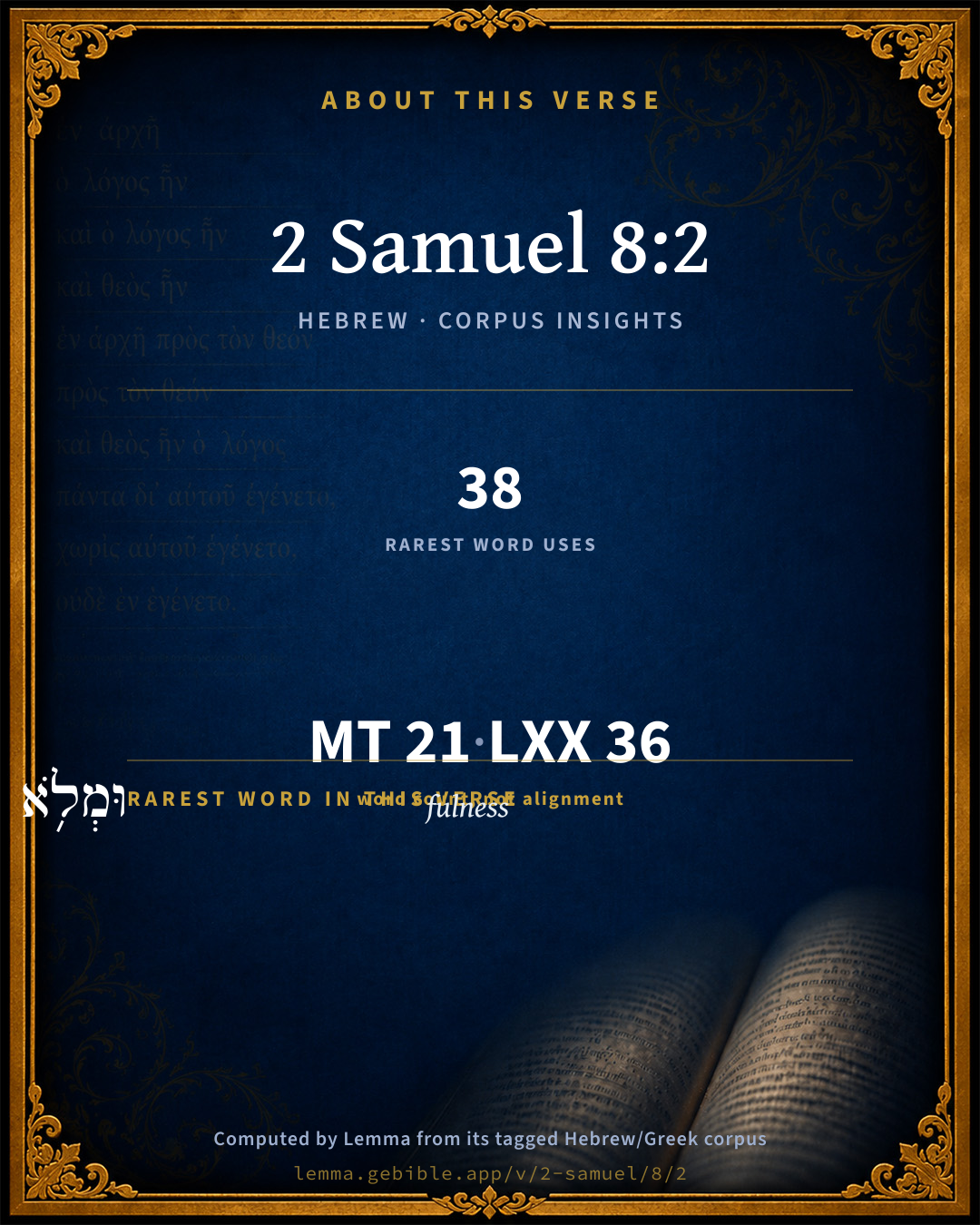
וּמְלֹ֥א fulness H4393 occurs in 36 verses of the Hebrew Bible. Also found in:

Grammatical profile

  • 8 verbs
  • 10 nouns
  • 1 adjective
  • 2 particles

Verb forms

  • וַיַּ֣ךְ Hiphil · Sequential Imperfect
  • וַֽיְמַדְּדֵ֤ם Piel · Sequential Imperfect
  • הַשְׁכֵּ֣ב Hiphil · Infinitive Absolute
  • וַיְמַדֵּ֤ד Piel · Sequential Imperfect
  • לְהָמִ֔ית Hiphil · Infinitive Construct
  • לְהַחֲי֑וֹת Hiphil · Infinitive Construct
  • וַתְּהִ֤י Qal · Sequential Imperfect
  • נֹשְׂאֵ֥י Qal · Participle Active

Repetition

Words recur within this verse — often emphatic in Hebrew:

  • בַּחֶ֨בֶל֙ cord H2256 ×3
  • מוֹאָ֗ב Moab H4124 ×2
  • וַֽיְמַדְּדֵ֤ם to measure H4058 ×2

Hebrew & Septuagint length

In English translation the verse runs 42 words from the Hebrew and 38 from the Septuagint (LXX English) — closely comparable.

A rough comparison of the two English renderings, which tokenize alike — not a word-level alignment.

Word counts can differ between the Hebrew and the Greek without any difference in meaning — e.g. the Hebrew direct-object marker אֵת has no separate Greek word, and Greek often adds the article ὁ.

In the original languages it is 21 Hebrew tokens and 36 Greek tokens — but the two are counted differently (Hebrew bundles its prefixes and suffixes into one token; the Greek is in lemma form), so that isn’t a like-for-like length.

Cross-references

17

Topical passages linked to 2 Samuel 8:2 in the Treasury of Scripture Knowledge — connected by theme and wording, ordered by reader-vote popularity; previews shown in the World English Bible.

  • Numbers 24:17 I see him, but not now; I see him, but not near: There shall come forth a star out of Jacob, A scepter shall rise out of Israel, Shall strike through the corners of Moab, Break down all the sons of tumult.
  • 1 Samuel 10:27 But certain worthless fellows said, How shall this man save us? They despised him, and brought him no present. But he held his peace.
  • 2 Samuel 8:6 Then David put garrisons in Syria of Damascus; and the Syrians became servants to David, and brought tribute. Yahweh gave victory to David wherever he went.
  • Psalms 60:8 Moab is my wash basin. I will throw my shoe on Edom. I shout in triumph over Philistia."
  • Judges 3:29–30 They struck of Moab at that time about ten thousand men, every lusty man, and every man of valor; and there escaped not a man.
  • 1 Samuel 14:47 Now when Saul had taken the kingdom over Israel, he fought against all his enemies on every side, against Moab, and against the children of Ammon, and against Edom, and against the kings of Zobah, and against the Philistines: and wherever he turned himself, he put [them] to the worse.
  • 2 Samuel 8:12–14 of Syria, and of Moab, and of the children of Ammon, and of the Philistines, and of Amalek, and of the spoil of Hadadezer, son of Rehob, king of Zobah.
  • 2 Samuel 12:31 He brought forth the people who were therein, and put them under saws, and under harrows of iron, and under axes of iron, and made them pass through the brick kiln: and thus did he to all the cities of the children of Ammon. David and all the people returned to Jerusalem.
  • 2 Kings 1:1 Moab rebelled against Israel after the death of Ahab.
  • 2 Kings 3:4–27 Now Mesha king of Moab was a sheep-master; and he rendered to the king of Israel the wool of one hundred thousand lambs, and of one hundred thousand rams.
  • 2 Kings 17:3 Against him came up Shalmaneser king of Assyria; and Hoshea became his servant, and brought him tribute.
  • 1 Chronicles 18:2 He struck Moab; and the Moabites became servants to David, and brought tribute.
  • 2 Chronicles 26:8 The Ammonites gave tribute to Uzziah: and his name spread abroad even to the entrance of Egypt; for he grew exceeding strong.
  • Psalms 72:10–11 The kings of Tarshish and of the isles will bring tribute. The kings of Sheba and Seba shall offer gifts.
  • Psalms 108:9 Moab is my wash pot. I will toss my sandal on Edom. I will shout over Philistia."
  • Isaiah 36:16 Don't listen to Hezekiah: for thus says the king of Assyria, Make your peace with me, and come out to me; and eat you everyone of his vine, and everyone of his fig tree, and drink you everyone the waters of his own cistern;
  • Psalms 83:6 The tents of Edom and the Ishmaelites; Moab, and the Hagrites;

Cross-references courtesy of OpenBible.info (CC BY 4.0).

Hebrew and Greek witnesses Masoretic Hebrew ↔ Greek Septuagint

The same verse in the two great witnesses to the Old Testament, shown verse-for-verse.

These are two independent witnesses, not word-aligned to each other, and the Septuagint is shown in lemma (dictionary) form.

Hebrew 2 Samuel 8:2 Masoretic · Westminster Leningrad Codex

וַיַּ֣ךְ אֶת מוֹאָ֗ב וַֽיְמַדְּדֵ֤ם בַּחֶ֨בֶל֙ הַשְׁכֵּ֣ב אוֹתָ֣ם אַ֔רְצָה וַיְמַדֵּ֤ד שְׁנֵֽי חֲבָלִים֙ לְהָמִ֔ית וּמְלֹ֥א הַחֶ֖בֶל לְהַחֲי֑וֹת וַתְּהִ֤י מוֹאָב֙ לְדָוִ֔ד לַעֲבָדִ֖ים נֹשְׂאֵ֥י מִנְחָֽה

He struck Moab, and measured them with the line, making them to lie down on the ground; and he measured two lines to put to death, and one full line to keep alive. The Moabites became servants to David, and brought tribute.

World English Bible · Public Domain

Greek LXX 2 Samuel 8:2 Septuagint · lemma form

καί πατάσσω δαυίδ ὁ μωαβ καί διαμετρέω αὐτός ἐν σχοινίον κοιμίζω αὐτός ἐπί ὁ γῆ καί γίγνομαι ὁ δύο σχοίνισμα ὁ θανατόω καί ὁ δύο σχοίνισμα ζωγρέω καί γίγνομαι μωαβ ὁ δαυίδ εἰς δοῦλος φέρω ξένιον

And David struck Moab, and measured them out with lines, having laid them down on the ground: and there were two lines for slaying, and two lines he kept alive: and Moab became servants to David, yielding tribute.

LXX2012 (modern English Septuagint) · Public Domain

On this verse, Jamieson, Fausset & Brown discusses the Septuagint’s reading. Read the note in Commentary ↓

Hebrew: Westminster Leningrad Codex (CC BY 4.0). Greek: Septuagint (public domain); English from LXX2012 (modern English Septuagint) (Public Domain). How the Septuagint differs from the Hebrew →

Targum (Aramaic paraphrase)

1

The Targum is the ancient Jewish Aramaic paraphrase of the Hebrew Scriptures — an interpretive translation, not the Hebrew text itself. Onkelos (literal) and Pseudo-Jonathan (expansive) render the Torah, and Jonathan the Prophets. Coverage is partial: where no permissively-licensed English translation exists for a verse, only the Aramaic is shown. This is verse-level text, not a word-by-word alignment to the Hebrew.

  1. Targum Jonathan Prophets (Joshua–Malachi)
    וּמְחָא יַת מוֹאֲבָאֵי וּמְשַׁח לְהוֹן בְּעַדְבָא רָמֵי יַתְהוֹן לְאַרְעָא וּמְשַׁח תְּרֵין חַבְלִין לְמִקְטַל וּמְלֵי חַבְלָא לַאֲחָאָה וַהֲווֹ מוֹאָבָא לְדָוִד לְעַבְדִין נַטְלֵי פְרָס:

    (no public-domain English translation for this verse)

    Targum Jonathan — Aramaic: “Mikraot Gedolot” (public domain). English: “Sefaria Community Translation” (CC0 1.0 (public-domain dedication)); “London "Chaldee Paraphrase," 1871” (public domain). Text via Sefaria.

Commentary

Notes on 2 Samuel 8:2 from classic Christian and Jewish commentators (each source and its license shown beneath its notes). The classic Christian expositions comment on the surrounding passage and are grouped to its opening verse, so a note may address several verses; the Jewish commentaries on the Tanakh (Rashi and others) are per-verse, so they appear only where the commentator wrote on this verse.

Lemma curates 59 commentaries, every one of them public domain or Creative Commons licensed, each selected and text-cleaned for this edition rather than reprinted as found. About our sources →

Trapp's Complete Commentary

John Trapp

2Sa 8:2 And he smote Moab, and measured them with a line, casting them down to the ground; even with two lines measured he to put to death, and with one full line to keep alive. And [so] the Moabites became David’s servants, [and] brought gifts.

Ver. 2. And he smote Moab, and measured them with a line.] He used this great severity against them, say the Rabbis, because they had treacherously slain his father and mother, whom he had left with them. {1Sa 22:3-4} Howsoever, the Moabites were ever bitter enemies to the Israelites. See Num 22:3. {See Trapp on "Num 22:3"}

And measured them with a line.] As a carpenter marketh out with a line {Isa 44:13} what he meaneth to hew off. Compare Isa 34:11.

And with one full line to keep alive.] See a like mixture of severity and mercy in Zec 13:8-9. So Christ will at the last day shed and sever the sheep from the goats. {Mat 25:32-33}

And so the Moabites became David’s servants.] Even his wash pots, {Psa 60:8} and that prophecy was in part fulfilled, Num 24:17.

John Trapp, A Commentary or Exposition upon All the Books of the Old and New Testament (1647–1656) — public domain. Text from a community e-Sword module.

Joseph Benson's Commentary

2Sa 8:2. He smote Moab — For although the king of Moab, out of hatred to Saul, gave protection to David’s parents, 1Sa 22:3-4; yet the Moabites were perpetual and sworn enemies to the Israelites, who therefore were forbidden to admit them into the congregation of the Lord. God indeed commanded the Israelites, in their march to Canaan, to spare the Moabites for the sake of their progenitor Lot, but afterward they became such fierce enemies to him and his people, that he was provoked to treat them in a different manner. Now was fulfilled the prophecy of Balaam, Num 24:17-18. “A sceptre shall rise out of Israel, and shall smite the corners,” or princes, “of Moab.” See the note on that passage. And measured them with a line — That is, having conquered the country, he took an exact survey, and made an estimate of it, distributing the towns and people into three parts. Casting them down to the ground — Destroying the fortified cities and strong holds of the whole land, and levelling them with the ground, as far as he thought necessary to humble them and secure himself. With two lines measured he to put to death, and with one full line to keep alive — This passage, it must be acknowledged, is extremely obscure. But the most probable sense of it seems to be, that upon the taking and demolishing of those forts and strong holds, which made an obstinate resistance, he discriminated between those who were hardy and determined in refusing all offers of mercy, made upon their submission, and those who were unwillingly withheld by their rulers and commanders from accepting the mercy offered them; preserving the latter alive, and putting the others to death. “Agreeable to this sense,” says Dr. Delaney, “the Hebrew text may, and I think ought, to be understood thus: With two lines measured he, namely, one to put to death those obstinate few who rejected all offers of mercy; and with one full line (in the original, one line of plenitude) to keep alive; that is, to save all those who would have submitted and accepted proffered mercy, had they been suffered. David was a prophet, and thoroughly versed in the Scriptures; and when he had there learned that a king was to arise out of Jacob who should one day smite and subdue Moab, it was not hard for him to discern, in the spirit of prophecy, that he himself was that king, especially after the message delivered to him by Nathan, from the word of the Lord. And there is no doubt but he executed the sentence denounced against Moab, in the prophecy of Baalam, in that sense in which the Spirit of God denounced it, which I apprehend to be that now explained. But, supposing David destroyed two-thirds of the Moabites on this occasion, and saved only one- third, (for so some understand the text,) the severity of this chastisement was no greater than that which God himself denounces against his own people for their sins, Zec 13:8. And why might not the sins of the Moabites deserve this chastisement now, as those of the Jews did at the time referred to in this prophecy? The greatest sins the Jews ever committed against God were those corruptions which they copied from their neighbour nations, the most abominable of all which were practised by the very nation we are now speaking of; and therefore there is good reason to believe that they now deserved the same severity of vengeance from the justice of God, which he afterward inflicted upon his own people.” And so the Moabites became David’s servants — Were made subject to him; and brought gifts — Or paid a constant tribute, which they continued to do all his days, and in the reign of Solomon. And after the kingdom was divided, it was paid to the kings of Israel, till after the death of Ahab, when they refused to pay it, 2Ki 3:4-5.

Joseph Benson's Commentary on the Old and New Testaments (1811–1818) — public domain. Text from a community e-Sword module.

Tyndale Open Study Notes

Tyndale Open Resources

8:2 Moab was on the east side of the Dead Sea. Earlier, the people of Moab had provided David’s parents with refuge during Saul’s reign (1 Sam 22:3-4); David’s great-grandmother, Ruth, was from Moab. For whatever reason, no such fraternal relationship existed any longer. • two groups to be executed for every one group to be spared: This is the only time in 2 Samuel that David executed captives taken in battle (see Num 21:29; 24:17; Deut 2:9).

Tyndale Open Study Notes — © Tyndale Open Resources, licensed CC BY-SA 4.0. Text via the HelloAO Bible API.

Geneva Bible (1599)

Geneva Bible translators

He slew two parts as it pleased him, and reserved the third.

Geneva Bible (1599) marginal notes — public domain. Text via Bolls.life.

Jamieson, Fausset & Brown

Robert Jamieson, A. R. Fausset & David Brown

he smote Moab, and measured them with a line--This refers to a well-known practice of Eastern kings, to command their prisoners of war, particularly those who, notorious for the atrocity of their crimes or distinguished by the indomitable spirit of their resistance, had greatly incensed the victors, to lie down on the ground. Then a certain portion of them, which was determined by lot, but most commonly by a measuring-line, were put to death. Our version makes him put two-thirds to death, and spare one-third. The Septuagint and Vulgate make one-half. This war usage was not, perhaps, usually practised by the people of God; but Jewish writers assert that the cause of this particular severity against this people was their having massacred David's parents and family, whom he had, during his exile, committed to the king of Moab.

Jamieson, Fausset & Brown — Commentary Critical and Explanatory on the Whole Bible (1871) — public domain (CC PDM 1.0). Text via the HelloAO Bible API.

Adam Clarke's Commentary

Verse 2. And measured them with a line - even with two lines] It has been generally conjectured that David, after he had conquered Moab, consigned two-thirds of the inhabitants to the sword; but I think the text will bear a meaning much more reputable to that king. The first clause of the verse seems to determine the sense; he measured them with a line, casting them down to the ground-to put to death, and with one line to keep alive. Death seems here to be referred to the cities by way of metaphor; and, from this view of the subject we may conclude that two-thirds of the cities, that is, the strong places of Moab, were erased; and not having strong places to trust to, the text adds, So the Moabites became David's servants, and brought gifts, i.e., were obliged to pay tribute. The word line may mean the same here as our rod, i.e., the instrument by which land is measured. There are various opinions on this verse, with which I shall not trouble the reader. Much may be seen in Calmet and Dodd.

Adam Clarke's Commentary on the Bible (1810–1826) — public domain. Text from a community e-Sword/MySword module.

Ellicott's Commentary for English Readers

(2) He smote Moab.—David’s former friendly relations with Moab (probably connected with his own descent from Ruth), are mentioned in 1Sa_22:3-4. The cause of his entire change of bearing towards them is not certainly known, but according to Jewish tradition the Moabites had proved false to their trust, and had put to death David’s father and mother. This is not unlikely, as his parents are never mentioned again after they were left in Moab. Others think that the Moabites had been guilty of some treachery towards David in his war with the Syrians and Ammonites. The two suppositions are quite consistent, and both may have been true. Many writers see in this conquest at least a partial fulfilment of the prophecy in Num_24:17.

With two lines.—This expression with the “one full line” of the next clause is equivalent to saying that David measured off the bodies of his prostrate enemies with a line divided into three equal parts. When they had been made to lie down upon the ground, side by side, the line was stretched over them. Such as were found under the two first parts of it were put to death, those under the third part were spared, thus two-thirds of all the Moabite men perished. There is no mention of this in 1Ch_18:2.

Brought gifts.—A frequent euphemism for paid tribute. (Comp. 2Sa_8:6.)

A Bible Commentary for English Readers, edited by Charles John Ellicott (1878–1897) — public domain. Text from a community e-Sword module.

The Cambridge Bible for Schools and Colleges

gen. ed. J. J. S. Perowne

2. casting them down to the ground] Making them lie down on the ground. The Moabite prisoners, doubtless only the fighting men, were ordered to lie down upon the ground in rows, which were measured with a measuring line. Two thirds of them were executed, and only the remaining third spared. Why David inflicted such terrible vengeance on a nation which had once received him and given his parents an asylum (1Sa_22:3-4) can only be conjectured. A Jewish tradition relates that the king of Moab betrayed his trust and murdered David’s parents. Possibly the Moabites may have been guilty of some special act of treachery in one of David’s wars with their neighbours the Ammonites or Edomites. The exploit recorded in ch. 2Sa_23:20 was perhaps performed in this war. By this victory Balaam’s prophecy was fulfilled (Num_24:17).

brought gifts] Paid tribute to David. Cp. 2Sa_8:6; 1Ki_4:21. At the division of the kingdom, Moab seems to have fallen to Israel, for we find Mesha, the king of Moab, paying a heavy tribute to Ahab, and at his death making a vigorous effort to throw off the Israelite yoke (2Ki_3:4 ff.).

The Cambridge Bible for Schools and Colleges (gen. ed. J. J. S. Perowne; Cambridge University Press, 1878–1918) — public domain. Text from a community e-Sword module.

John Gill's Exposition

And he smote Moab,.... He next went against that, and invaded it, the people of it being always troublesome and distressing to the children of Israel; and though the king of it had shown some favour to David, yet it was when he considered him as an enemy to Saul, and Saul to him; but things having taken a different turn, his and his people's enmity against David and his people appeared; wherefore he went and fought them, and made them his subjects, whereby was fulfilled the prophecy of Balaam, Num 24:17; as it referred to David:

and measured them with a line: either their country and fields, to distribute among his people, or rather the soldiers he took prisoners; which, as Procopius Gazaeus says, were so numerous that they could not be told, and therefore they were ordered to lie prostrate on the ground, and they were measured with a line, as it follows:

casting them down to the ground; or ordering them to lie down; though some understand this of casting down their cities, towers, and strong holds, and levelling them with the ground:

even with two lines measured he; with one, so it may be supplied, as the Vulgate Latin:

to put to death, and with one full line, to keep alive; that is, in measuring them with his lines, he divided them into two parts, one he put to death, and the other, the full line, which contained the most, he saved alive; though it seems according to our version, and so most understand it, that David slew two thirds, and saved one, and so Josephus (e). This must be understood of the army of the Moabites that fell into his hands, so Josephus, who persisted and refused to submit, not of all the inhabitants of the land. The Jews say (f), that the reason of this severe treatment of them was because they slew the father, and mother and brethren of David, whom he left to the care and custody of the king of Moab, when he fled from Saul, see Sa1 22:3; since after that they are heard no more of; though it should rather be imputed to their enmity against the people of Israel. The phrase of "meting out the valley of Succoth" seems to be an allusion to this fact, Psa 60:6, the psalm being written on occasion of the victories here related:

and so the Moabites became David's servants; the inhabitants of the land who were left in it, perhaps that part of the soldiers preserved alive were brought home captives:

and brought gifts; paid a yearly tribute to King David, as they afterwards did to Solomon and to Rehoboam, until the revolt of the ten tribes, and then they paid it unto the kings of Israel, to the times of Ahab, see Kg2 3:4, though these gifts may be distinct from, and besides the tribute paid, which is supposed in their being servants, see Ch2 17:11. Thus the Arabians (g) carried gifts to the king of Persia besides tribute.

(e) Antiqu. l. 7. c. 5. sect. 1. (f) Bemidbar Rabba, l. 14. fol. 212. 1. (g) Herodot. Thalia, sive, l. 3. c. 97.

John Gill's Exposition of the Whole Bible (1746–1763) — public domain (CC PDM 1.0). Text via the HelloAO Bible API.

Albert Barnes' Notes on the Bible

David took great numbers of the Moabites prisoners of war, and made them lie down on the ground, and then divided them by a measuring line into three parts, putting two-thirds to death, and saving alive one-third. The cause of the war with the Moabites, who had been very friendly with David 1Sa 22:3-4, and of this severe treatment, is not known. But it seems likely, from the tone of Psa 60:1-12 that David had met with some temporary reverse in his Syrian wars, and that the Moabites and Edomites had treacherously taken advantage of it, and perhaps tried to cut off his retreat.

Albert Barnes' Notes on the Bible (1834–1885) — public domain. Text from a community e-Sword/MySword module.

Haydock's Catholic Bible Commentary

Earth, like criminals condemned to die. (Theodoret) --- Some of them he chose to spare, and made tributary, having levelled the strong places with the ground. (Denis the Carthusian) --- Septuagint intimate that half were destroyed. (Calmet) --- But the Hebrew rather implies that the greatest part was saved, "a full cord to save alive;" (Menochius) unless there were three lots, and only one of them, larger indeed than the rest, spared. (Haydock) --- Death, or slavery, were the portion of all who were taken in war. (Grotius, Jur. iii. 4, 20.) --- Lex nulla capto parcit aut pœnam impendit. (Seneca) --- Tribute. Hebrew, "brought gifts," which is a softer term. The Moabites were thus punished for former and, probably, for some recent offences. (Haydock)

George Leo Haydock (1774–1849), Haydock's Catholic Family Bible and Commentary, 1859 edition — public domain. Excludes Psalms (Douay-Rheims chapter numbering differs from Protestant) and Deuterocanonical books (Catholic canon only).

Matthew Poole's English Annotations

He smote Moab; for although the king of Moab, out of hatred to Saul, pretended some kindness to David, and gave protection to his parents, 1Sa 22:3,4; yet the Moabites were perpetual and sworn enemies to the Israelites, who therefore were forbidden to admit them into the congregation of the Lord, and to seek their peace and prosperity, Deu 23:6. And though God commanded them in their march to Canaan to spare the Moabites, Deu 2:9,19, yet afterwards they proved unthankful, and insolent, and fierce enemies to God and his people, Num 22:2; 24:17,18; Jdg 3:14, &c.; 1Sa 14:47, &c., and thereby provoked God to alter his course and carriage towards them.

With a line, i. e. as with line, the particle as being oft understood, as Psa 11:1; 22:6; 45:1. The sense is, having conquered the land, he made an estimate of it, and, as it follows, distributed the towns and people into three parts.

Casting them down to the ground, i. e. overthrowing their towns, and utterly destroying their people in, manner following.

With two lines measured he to put to death; which severity was necessary for his own and his people’s security, because they were numerous and potent, and bordering upon Canaan, and very vexatious and mischievous to the Israelites. And now that prophecy, Num 24:7, was accomplished.

Matthew Poole's English Annotations on the Holy Bible (1683–1685) — public domain. Text from a community e-Sword/MySword module.

Whedon's Commentary on the Bible

Daniel D. Whedon

2. Smote Moab — The occasion and details of this war are unknown, though some Jewish writers have conjectured that it was undertaken to retaliate the death or ill-usage of David’s parents. See note on 1Sa_22:4. The fearful slaughter to which David put the Moabites shows that they had wantonly provoked his wrath, and that of Israel. The incident related of Benaiah in 2Sa_23:20, and 1Ch_11:22, probably occurred at this time.

Measured them with a line — A barbarous but convenient method of numbering the captives, and in accordance with the customs and spirit of that age.

Casting them down to the ground — Rather, causing them to lie down. They were made to lie down in a row so as to be more conveniently measured with the line.

Two lines… to put to death… one full line to keep alive — That is, two thirds were marked off for death, and one full third to be kept alive. “That they might not suffer by the roughness of this mode of marking them out, the line was so drawn as palpably to make the proportion marked off to be spared much the largest of the three thirds, which is doubtless the meaning of the full line to keep alive.” — Kitto.

Brought gifts — Paid tribute.

Daniel D. Whedon (gen. ed.), Commentary on the Old and New Testaments (1874–1909) — public domain. Text from a community e-Sword module.

The Pulpit Commentary

He smote Moab. In the previous history we find David and Moab on such friendly terms that he entrusted his father and mother into their king"s keeping. (1Sa_22:3, 1Sa_22:4) Now he not only subjugates them, but puts two-thirds or, according to the ancient versions, half of the captured combatants to death. Compared with the custom of the Romans, and with the attempt to destroy all the males in Edom, this was mild treatment; for we find Caesar in his Gallic wars putting all his prisoners to death, and using for their execution the mere phrase, "he counted them in the number of enemies," as if the killing of enemies was a matter of course. The customs of the Israelites in war were not so cruel, and this treatment of the Moabites seems to be mentioned as showing that they received exceptionally severe treatment. The justification of this is found by Jewish commentators, on the authority of the Midrash, in the supposed fact that the King of Moab had put David"s father and mother to death. But as Philippson adds, even so it was an instance of the extreme barbarity of ancient warfare. Casting them down to the ground; Hebrew, making them to lie down on the ground; and so the Revised Version. It is plain that those who were made to lie on the ground were combatants who had been made prisoners, and the Hebrew seems to mean that, while they were thus prostrate, they were measured off into three divisions, whereof two were put to the sword, and one permitted to live. All the versions, however, understand that only half were put to death, making the sense to be that he measured them with two cords, one to kill, and one full cord one, that is, of larger size, to save alive. We get no help from 1Ch_18:2, where this treatment of the Moabites is omitted. It is probable that it was in this war that Benaiah slew "two lion-like men of Moab", (1Ch_11:22) who were its champions and perhaps members of the royal house. They brought gifts means that they paid an annual tribute; but the phrase shows that, though now they were David"s servants, that is, subjects, yet that they were left in possession of their independence, and that their internal affairs were managed by native authorities.

The Pulpit Commentary (1880–1919), ed. H.D.M. Spence-Jones & Joseph S. Exell — public domain. Text from a community e-Sword module.

John Wesley's Explanatory Notes

Moab - For although the king of Moab, out of hatred to Saul, gave protection to his parents, 1 Sam. xxii, 3, 4, yet the Moabites were perpetual and sworn enemies to the Israelites, who therefore were forbidden to admit them into the congregation of the Lord. And though God commanded them in their march to Canaan, to spare the Moabites, yet afterwards they proved fierce enemies to God and his people, and thereby provoked God to alter his carriage towards them. Measured them - That is, having conquered the land, he made an estimate of it, and distributed the towns and people into three parts. Casting down - Overthrowing their towns, and utterly destroying their people in manner following. And now that prophecy, Num. xxiv, 17, was accomplished.

John Wesley, Explanatory Notes Upon the Whole Bible (1754–1765) — public domain. Text via the GEBible commentary corpus.

Keil & Delitzsch

C. F. Keil & F. Delitzsch

Subjugation of Moab. - "He smote Moab (i.e., the Moabites), and measured them with the line, making them lie down upon the ground, and measured two lines (i.e., two parts) to put to death, and one line full to keep alive." Nothing further is known about either the occasion or the history of this war, with the exception of the cursory notice in Ch1 11:22, that Benaiah, one of David's heroes, smote two sons of the king of Moab, which no doubt took place in the same war. In the earliest period of his flight from Saul, David had met with a hospitable reception from the king of Moab, and had even taken his parents to him for safety (Sa1 22:3-4). But the Moabites must have very grievously oppressed the Israelites afterwards, that David should have inflicted a severer punishment upon them after their defeat, than upon any other of the nations that he conquered, with the exception of the Ammonites (Sa2 12:31), upon whom he took vengeance for having most shamefully insulted his ambassadors (Sa2 10:2.). The punishment inflicted, however, was of course restricted to the fighting men who had been taken prisoners by the Israelites. They were ordered to lie down in a row upon the earth; and then the row was measured for the purpose of putting two-thirds to death, and leaving one-third alive. The Moabites were then made "servants" to David (i.e., they became his subjects), "bringing gifts" (i.e., paying tribute).

Keil & Delitzsch — Biblical Commentary on the Old Testament (1861–1891) — public domain (CC PDM 1.0). Text via the HelloAO Bible API. (Old Testament only.)

unfoldingWord translationNotes

Door43 World Missions Community

Then he defeated

Here "he" refers to David who represents his soldiers. AT: "Then they defeated" (See: Synecdoche)

measured their men with a line ... He measured off two lines to put to death, and one full line to keep alive

Here the "line" is a "rope." David had the soldiers lie down on the ground to be measured and sorted into three groups. The men in two groups were killed, and in the third, they were allowed to live.

translationWords

Moab

die

life

servant

tribute

unfoldingWord translationNotes — © Distant Shores Media and the Door43 World Missions Community, licensed CC BY-SA 4.0. Source: git.door43.org/Door43/en_tn.

Rashi

Rabbi Shlomo Yitzchaki (Rashi)

Those measured with two ropes were killed. [This vengeance was] because they killed his father, his mother and his brothers as it is said, "He led them before the king of Moav." (Shmuel I, 22:4) We do not find that they ever left from there.

Rashi on the Tanakh — English translations: “The Judaica Press complete Tanach with Rashi, translated by A. J. Rosenberg” (CC BY 4.0); “Pentateuch with Rashi's commentary by M. Rosenbaum and A.M. Silbermann, 1929-1934” (public domain); “The Metsudah Tanach series, Lakewood, N.J” (CC BY 4.0); and “The Book of Joshua, Metsudah Publications, 1997” (CC BY 4.0). Text via Sefaria.

Lesson kit

Teaching starters — assembled from the data on this page, not authored interpretation. Every prompt links to the verse data it draws on. Edit before teaching.

2 Samuel, in the Historical, opens this verse with 21 words (16 distinct Hebrew lemmas). Its most distinctive word is mᵉlôʼ (“fulness”). A historical commentator’s framing appears above. Read the whole chapter for the surrounding context.

Discussion questions

  1. What does “fulness” (mᵉlôʼ) contribute to the verse as a whole?
  2. How does Genesis 48:19, which shares the word «fulness», read alongside this verse?
  3. What does the repetition of “cord” (3× in this one verse) do in this verse?
  4. These translations render this verse differently; the difference is in the English rendering, not the original. What questions does that raise?
  5. «וַיַּ֣ךְ» is a Hiphil Sequential Imperfect verb. How does that grammatical form shape the action described?
  6. Compare how Trapp's Complete Commentary and Joseph Benson's Commentary read this verse. Where do they agree or differ?

Things to notice

Reading settings

Reading text

Shown beneath each verse's original-language words.

Old Testament
Old Testament edition

Read the OT as the Masoretic Hebrew (MT) or the Greek Septuagint (LXX).

English shown for the Greek Septuagint (in the Hebrew ↔ Greek comparison).

Comparing translations? Open the Compare panel on any verse page to stack up to four side by side.