
2 Kings 19:4

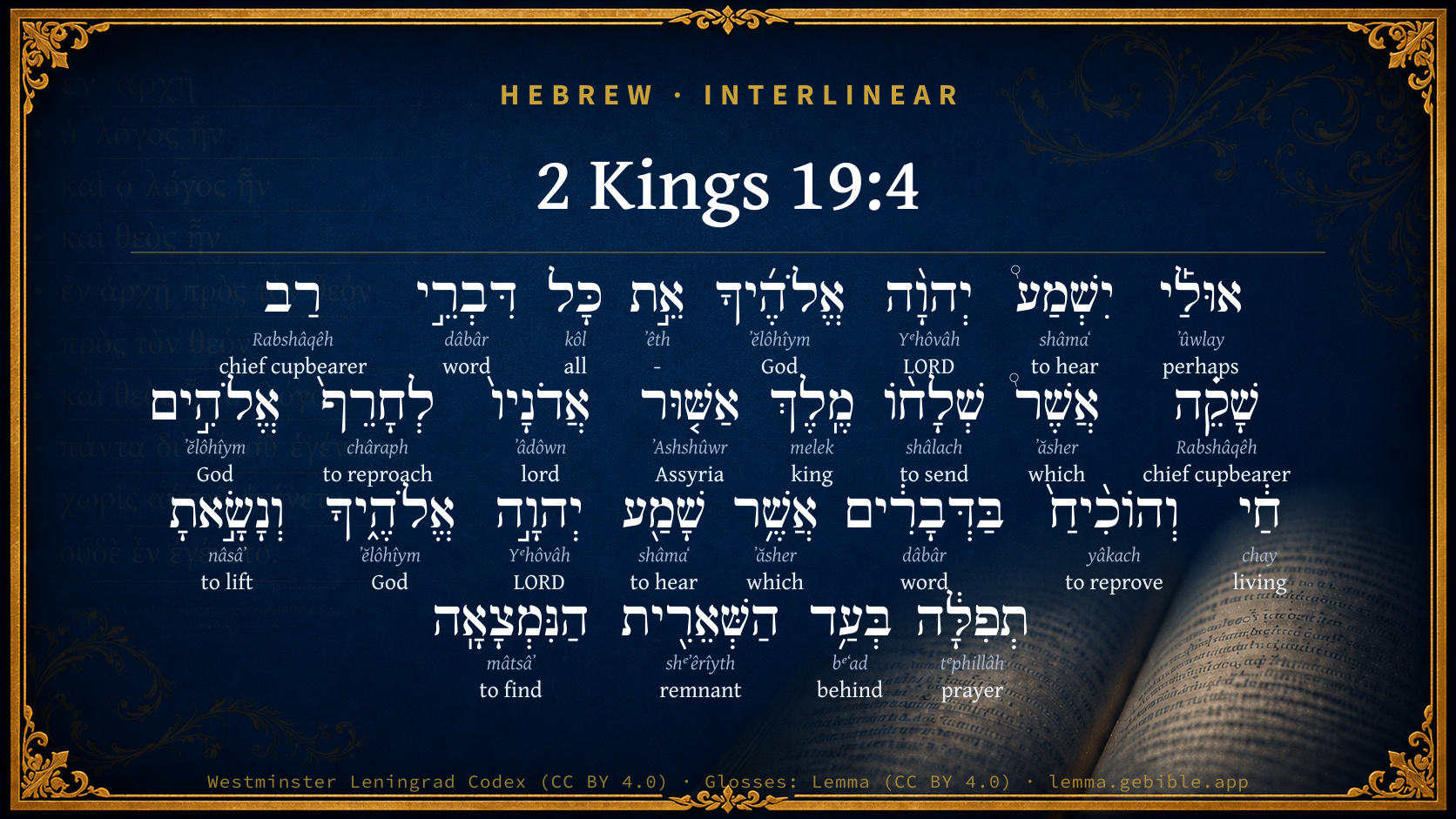
Hebrew (Westminster Leningrad Codex) 2 Kings 19:4 appears in the Hebrew Old Testament. The text above is from the Westminster Leningrad Codex. Each word links to its Strong’s number, a concise gloss, and parsing drawn from the Open Scriptures Hebrew Bible morphology. Click any word for its full Brown-Driver-Briggs (BDB) entry.
Download image
Cite this verse

2 Kings 19:4 (World English Bible). Public Domain. Lemma interlinear Bible study tool, https://lemma.gebible.app/v/2-kings/19/4.

Show BibTeX & RIS
BibTeX
RIS
English Translation
It may be Yahweh your God will hear all the words of Rabshakeh, whom the king of Assyria his master has sent to defy the living God, and will rebuke the words which Yahweh your God has heard. Therefore lift up your prayer for the remnant that is left.
World English Bible · Public Domain
Download a study sheet

One document with this verse’s original text, its word-by-word gloss line, the meaning frame, cross-references with their text, attributed commentary, and full source and license credits — printable, and it pastes into notes with its structure intact.

This verse Autodidact and up

Study sheet (.html) Plain text (.txt)

A passage Seminary Student

Up to 50 verses in one chapter. A passage sheet keeps up to 6 commentary sources and 12 cross-references per verse, in the order this page ranks them, and says so on the sheet whenever that leaves anything out. Ask for a single verse and you get the Autodidact verse sheet above.

Everything on this page stays free to read, with no account — the sheet is a download of what is already on screen, not access to it.

Want to remove ads? Support Godless Engineer
Compare translations 3

The same verse in 3 English versions, stacked beneath the original-language interlinear above. Click any original word for its lexicon entry.

Each is an independent rendering of the whole verse — the interlinear is not word-aligned to these translations.

Highlighted words mark where these versions differ — a whole-verse word diff, not a word-by-word alignment.

  • World English Bible Public Domain
    It may be Yahweh your God will hear all the words of Rabshakeh, whom the king of Assyria his master has sent to defy the living God, and will rebuke the words which Yahweh your God has heard. Therefore lift up your prayer for the remnant that is left.
  • King James Version Public Domain
    It may be the LORD thy God will hear all the words of Rabshakeh, whom the king of Assyria his master hath sent to reproach the living God; and will reprove the words which the LORD thy God hath heard: wherefore lift up thy prayer for the remnant that are left.
  • unfoldingWord Literal Text CC BY-SA 4.0
    Perhaps Yahweh your God will have heard all of the words of the Rabshakeh, him whom the king of Assyria, his master, sent to taunt the living God, and he will chastise the words that Yahweh your God has heard. And may you lift up a prayer on behalf of the remnant found.’”

unfoldingWord Literal Text — © unfoldingWord, licensed CC BY-SA 4.0. Word-aligned USFM3 via Door43 (git.door43.org/unfoldingWord/en_ult).

Versions to compare (up to 4)

3 of 4 selected

Show all 18 translations

Every available English version of this verse, each an independent rendering of the whole verse.

  • World English Bible Public Domain
    It may be Yahweh your God will hear all the words of Rabshakeh, whom the king of Assyria his master has sent to defy the living God, and will rebuke the words which Yahweh your God has heard. Therefore lift up your prayer for the remnant that is left.
  • Berean Standard Bible Public Domain
    Perhaps the LORD your God will hear all the words of the Rabshakeh, whom his master the king of Assyria has sent to defy the living God, and He will rebuke him for the words that the LORD your God has heard. Therefore lift up a prayer for the remnant that still survives.”
  • Majority Standard Bible Public Domain
    Perhaps the LORD your God will hear all the words of the Rabshakeh, whom his master the king of Assyria has sent to defy the living God, and He will rebuke him for the words that the LORD your God has heard. Therefore lift up a prayer for the remnant that still survives.”
  • King James Version Public Domain
    It may be the LORD thy God will hear all the words of Rabshakeh, whom the king of Assyria his master hath sent to reproach the living God; and will reprove the words which the LORD thy God hath heard: wherefore lift up thy prayer for the remnant that are left.
  • American Standard Version (1901) Public Domain
    It may be Jehovah thy God will hear all the words of Rabshakeh, whom the king of Assyria his master hath sent to defy the living God, and will rebuke the words which Jehovah thy God hath heard: wherefore lift up thy prayer for the remnant that is left.
  • Revised Version (1885) Public Domain
    It may be the LORD thy God will hear all the words of Rabshakeh, whom the king of Assyria his master hath sent to reproach the living God, and will rebuke the words which the LORD thy God hath heard: wherefore lift up thy prayer for the remnant that is left.
  • Geneva Bible (1599) Public Domain
    If so be the Lord thy God hath heard all the wordes of Rabshakeh, whome the King of Asshur his master hath sent to raile on the liuing God, and to reproch him with wordes which the Lord thy God hath heard, then lift thou vp thy prayer for the remnant that are left.
  • Douay-Rheims (1899) Public Domain
    It may be the Lord thy God will hear all the words of Rabsaces, whom the king of the Assyrians his master hath sent to reproach the living God, and to reprove with words, which the Lord thy God hath heard: and do thou offer prayer for the remnants that are found.
  • Young's Literal Translation Public Domain
    `It may be Jehovah thy God doth hear all the words of the chief of the butlers with which the king of Asshur his lord hath sent him to reproach the living God, and hath decided concerning the words that Jehovah thy God hath heard, and thou hast lifted up prayer for the remnant that is found.'
  • Literal Standard Version CC BY-SA 4.0
    It may be your God YHWH hears all the words of the chief of the butlers with which the king of Asshur his lord has sent him to reproach the living God, and has decided concerning the words that your God YHWH has heard, and you have lifted up prayer for the remnant that is found.”
  • Unlocked Literal Bible CC BY-SA 4.0
    It may be that Yahweh your God will hear all the words of the chief commander, whom the king of Assyria his master has sent to defy the living God, and will rebuke the words which Yahweh your God has heard. Now lift up your prayer for the remnant that is still here.'”
  • unfoldingWord Literal Text CC BY-SA 4.0
    Perhaps Yahweh your God will have heard all of the words of the Rabshakeh, him whom the king of Assyria, his master, sent to taunt the living God, and he will chastise the words that Yahweh your God has heard. And may you lift up a prayer on behalf of the remnant found.’”
  • Darby Bible Public Domain
    It may be Jehovah thy God will hear all the words of Rab-shakeh, whom the king of Assyria his master has sent to reproach the living God; and will rebuke the words which Jehovah thy God has heard. Therefore lift up a prayer for the remnant that is left.
  • World Messianic Bible Public Domain
    It may be the LORD your God will hear all the words of Rabshakeh, whom the king of Assyria his master has sent to defy the living God, and will rebuke the words which the LORD your God has heard. Therefore lift up your prayer for the remnant that is left.’”
  • Webster's Bible Public Domain
    It may be the LORD thy God will hear all the words of Rab-shakeh, whom the king of Assyria his master hath sent to reproach the living God; and will reprove the words which the LORD thy God hath heard: wherefore lift up thy prayer for the remnant that are left.
  • Free Bible Version CC BY-SA 4.0
    Maybe the Lord your God, hearing the message the army commander delivered on behalf of his master, the king of Assyria—a message sent to insult the living God—will punish him for his words. Please say a prayer for the remnant of us who still survive.”
  • Bible in Basic English Public Domain
    It may be that the Lord your God will give ear to the words of the Rab-shakeh, whom the king of Assyria, his master, sent to say evil things against the living God, and will make his words come to nothing: so then make your prayer for the rest of the people.
  • JPS Tanakh (1917) Public Domain
    It may be the LORD thy God will hear all the words of Rab-shakeh, whom the king of Assyria his master hath sent to taunt the living God, and will rebuke the words which the LORD thy God hath heard; wherefore make prayer for the remnant that is left.'

Literal Standard Version (2020), Covenant Press — licensed CC BY-SA 4.0. Text via the HelloAO Bible API (eBible.org). Unlocked Literal Bible (unfoldingWord) — licensed CC BY-SA 4.0. Text via the HelloAO Bible API (eBible.org). unfoldingWord Literal Text — © unfoldingWord, licensed CC BY-SA 4.0. Word-aligned USFM3 via Door43 (git.door43.org/unfoldingWord/en_ult). Free Bible Version, Dr. Jonathan Gallagher — licensed CC BY-SA 4.0. Text via the HelloAO Bible API (eBible.org).

Word by word

More ways to search: Search by grammar → Find every occurrence → Compare this word →

Practice this passage: Drill this verse → Learn its vocabulary →

רַב
Rabshâqêh
H7262
“chief cupbearer”
Noun, Proper
Part of Speech
Noun
Type
Proper
Full BDB Definition

Origin: from H7227 and H8248

TWOT: None

chief cupbearer, chief of the officers? - Rabshakeh
  1. אוּלַ֡י ʼûwlay H194 “perhaps” Adverb
  2. יִשְׁמַע֩ shâmaʻ H8085 “to hear” Verb, Qal, Imperfect, 3rd Person, Masculine, Singular
  3. יְהוָ֨ה Yᵉhôvâh H3068 “LORD” Noun, Proper
  4. אֱלֹהֶ֜יךָ ʼĕlôhîym H430 “God(s) · your” Noun, Common, Masculine, Plural, Construct + Suffix, Personal, 2nd Person, Masculine, Singular
  5. אֵ֣ת ʼêth H853 “-” Particle, Direct Object
  6. כָּל kôl H3605 “all of” Noun, Common, Masculine, Singular, Construct
  7. דִּבְרֵ֣י dâbâr H1697 “words of” Noun, Common, Masculine, Plural, Construct
  8. שָׁקֵ֗ה Rabshâqêh H7262 “chief cupbearer” Noun, Proper
  9. אֲשֶׁר֩ ʼăsher H834 “which” Particle, Relative
  10. שְׁלָח֨וֹ shâlach H7971 “to send · him” Verb, Qal, Perfect, 3rd Person, Masculine, Singular + Suffix, Personal, 3rd Person, Masculine, Singular
  11. מֶֽלֶךְ melek H4428 “king of” Noun, Common, Masculine, Singular, Construct
  12. אַשּׁ֤וּר ʼAshshûwr H804 “Assyria” Noun, Proper
  13. אֲדֹנָיו֙ ʼâdôwn H113 “lords · his” Noun, Common, Masculine, Plural, Construct + Suffix, Personal, 3rd Person, Masculine, Singular
  14. לְחָרֵף֙ châraph H2778 “to reproach” Preposition + Verb, Piel, Infinitive Construct
  15. אֱלֹהִ֣ים ʼĕlôhîym H430 “God(s)” Noun, Common, Masculine, Plural, Absolute
  16. חַ֔י chay H2416 “living” Adjective, Adjective, Masculine, Singular, Absolute
  17. וְהוֹכִ֨יחַ֙ yâkach H3198 “and · to reprove” Conjunction + Verb, Hiphil, Sequential Perfect, 3rd Person, Masculine, Singular
  18. בַּדְּבָרִ֔ים dâbâr H1697 “in/at the · words” Preposition, Determined + Noun, Common, Masculine, Plural, Absolute
  19. אֲשֶׁ֥ר ʼăsher H834 “which” Particle, Relative
  20. שָׁמַ֖ע shâmaʻ H8085 “to hear” Verb, Qal, Perfect, 3rd Person, Masculine, Singular
  21. יְהוָ֣ה Yᵉhôvâh H3068 “LORD” Noun, Proper
  22. אֱלֹהֶ֑יךָ ʼĕlôhîym H430 “God(s) · your” Noun, Common, Masculine, Plural, Construct + Suffix, Personal, 2nd Person, Masculine, Singular
  23. וְנָשָׂ֣אתָ nâsâʼ H5375 “and · to lift” Conjunction + Verb, Qal, Sequential Perfect, 2nd Person, Masculine, Singular
  24. תְפִלָּ֔ה tᵉphillâh H8605 “prayer” Noun, Common, Feminine, Singular, Absolute
  25. בְּעַ֥ד bᵉʻad H1157 “behind” Preposition
  26. הַשְּׁאֵרִ֖ית shᵉʼêrîyth H7611 “the · remnant” Particle, Definite Article + Noun, Common, Feminine, Singular, Absolute
  27. הַנִּמְצָאָֽה mâtsâʼ H4672 “the · finding” Particle, Definite Article + Verb, Niphal, Participle Active, Feminine, Singular, Absolute

About this verse

These counts appear in no published source. They are computed here, from the morphology-tagged text and Lemma’s own curated glosses. What Lemma adds →

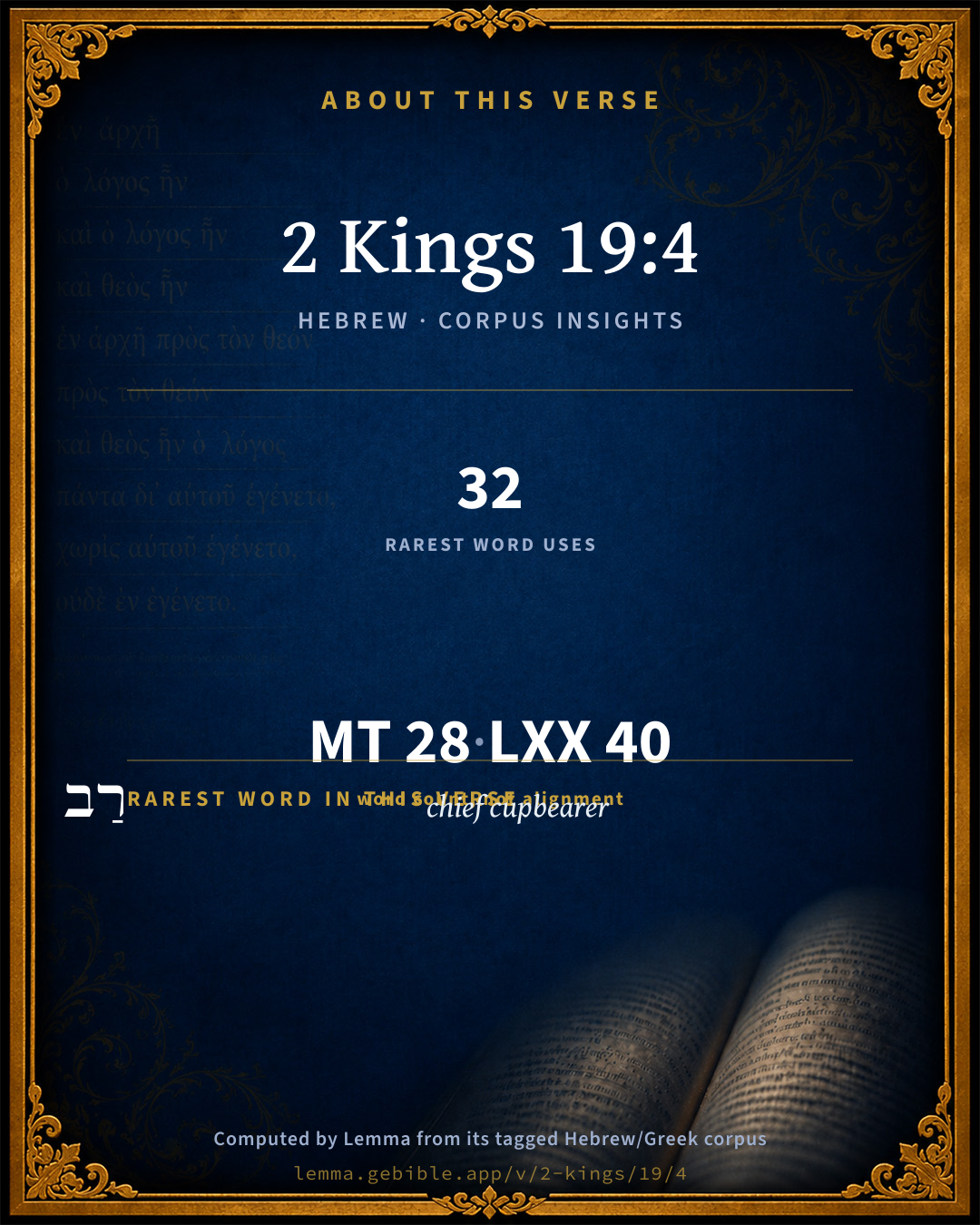
28
words
21
distinct lemmas
Historical
section

Shared distinctive vocabulary

רַב chief cupbearer H7262 occurs in 16 verses of the Hebrew Bible. Also found in:

Grammatical profile

  • 7 verbs
  • 15 nouns
  • 1 adjective
  • 1 preposition
  • 1 adverb
  • 3 particles

Verb forms

  • יִשְׁמַע֩ Qal · Imperfect
  • שְׁלָח֨וֹ Qal · Perfect
  • לְחָרֵף֙ Piel · Infinitive Construct
  • וְהוֹכִ֨יחַ֙ Hiphil · Sequential Perfect
  • שָׁמַ֖ע Qal · Perfect
  • וְנָשָׂ֣אתָ Qal · Sequential Perfect
  • הַנִּמְצָאָֽה Niphal · Participle Active

Repetition

Words recur within this verse — often emphatic in Hebrew:

  • אֱלֹהֶ֜יךָ God H430 ×3
  • יִשְׁמַע֩ to hear H8085 ×2
  • יְהוָ֨ה LORD H3068 ×2
  • דִּבְרֵ֣י word H1697 ×2
  • רַב chief cupbearer H7262 ×2
  • אֲשֶׁר֩ which H834 ×2

Hebrew & Septuagint length

In English translation the verse runs 49 words from the Hebrew and 52 from the Septuagint (LXX English) — closely comparable.

A rough comparison of the two English renderings, which tokenize alike — not a word-level alignment.

Word counts can differ between the Hebrew and the Greek without any difference in meaning — e.g. the Hebrew direct-object marker אֵת has no separate Greek word, and Greek often adds the article ὁ.

In the original languages it is 28 Hebrew tokens and 40 Greek tokens — but the two are counted differently (Hebrew bundles its prefixes and suffixes into one token; the Greek is in lemma form), so that isn’t a like-for-like length.

Cross-references

22

Topical passages linked to 2 Kings 19:4 in the Treasury of Scripture Knowledge — connected by theme and wording, ordered by reader-vote popularity; previews shown in the World English Bible.

  • 2 Samuel 16:12 It may be that Yahweh will look on the wrong done to me, and that Yahweh will requite me good for [his] cursing of me this day.
  • Joshua 14:12 Now therefore give me this hill-country, of which Yahweh spoke in that day; for you heard in that day how the Anakim were there, and cities great and fortified: it may be that Yahweh will be with me, and I shall drive them out, as Yahweh spoke.
  • Ezekiel 36:37 Thus says the Lord Yahweh: For this, moreover, will I be inquired of by the house of Israel, to do it for them: I will increase them with men like a flock.
  • Romans 9:27 Isaiah cries concerning Israel, "If the number of the children of Israel are as the sand of the sea, It is the remnant who will be saved;
  • James 5:16–17 Confess your offenses to one another, and pray one for another, that you may be healed. The effective, earnest prayer of a righteous man is powerfully effective.
  • Genesis 22:14 Abraham called the name of that place Yahweh-Jireh. As it is said to this day, "In Yahweh's mountain it will be provided.
  • Deuteronomy 32:36 For Yahweh will judge his people, Repent himself for his servants; When he sees that [their] power is gone, There is none [remaining], shut up or left at large.
  • 1 Samuel 14:6 Jonathan said to the young man who bore his armor, Come, and let us go over to the garrison of these uncircumcised: it may be that Yahweh will work for us; for there is no restraint to Yahweh to save by many or by few.
  • 1 Samuel 17:45 Then said David to the Philistine, You come to me with a sword, and with a spear, and with a javelin: but I come to you in the name of Yahweh of hosts, the God of the armies of Israel, whom you have defied.
  • 2 Kings 17:5–6 Then the king of Assyria came up throughout all the land, and went up to Samaria, and besieged it three years.
  • 2 Kings 18:13 Now in the fourteenth year of king Hezekiah did Sennacherib king of Assyria come up against all the fortified cities of Judah, and took them.
  • 2 Kings 18:17–35 The king of Assyria sent Tartan and Rabsaris and Rabshakeh from Lachish to king Hezekiah with a great army to Jerusalem. They went up and came to Jerusalem. When they were come up, they came and stood by the conduit of the upper pool, which is in the highway of the fuller's field.
  • 2 Kings 19:22 Whom have you defied and blasphemed? and against whom have you exalted your voice and lifted up your eyes on high? [even] against the Holy One of Israel.
  • 2 Chronicles 28:5–6 Therefore Yahweh his God delivered him into the hand of the king of Syria; and they struck him, and carried away of his a great multitude of captives, and brought them to Damascus. He was also delivered into the hand of the king of Israel, who struck him with a great slaughter.
  • 2 Chronicles 32:20 Hezekiah the king, and Isaiah the prophet the son of Amoz, prayed because of this, and cried to heaven.
  • Psalms 50:15 Call on me in the day of trouble. I will deliver you, and you will honor me."
  • Psalms 50:21 You have done these things, and I kept silent. You thought that the "I AM" was just like you. I will rebuke you, and accuse you in front of your eyes.
  • Psalms 74:18 Remember this, that the enemy has mocked you, Yahweh. Foolish people have blasphemed your name.
  • Isaiah 1:9 Unless Yahweh of hosts had left to us a very small remnant, We would have been as Sodom; We would have been like Gomorrah.
  • Isaiah 8:7–8 now therefore, behold, the Lord brings up on them the waters of the River, strong and many, [even] the king of Assyria and all his glory: and it shall come up over all its channels, and go over all its banks;
  • Isaiah 10:6 I will send him against a profane nation, and against the people of my wrath will I give him a charge, to take the spoil, and to take the prey, and to tread them down like the mire of the streets.
  • Jeremiah 33:3 Call to me, and I will answer you, and will show you great things, and difficult, which you don't know.

Cross-references courtesy of OpenBible.info (CC BY 4.0).

Hebrew and Greek witnesses Masoretic Hebrew ↔ Greek Septuagint

The same verse in the two great witnesses to the Old Testament, shown verse-for-verse.

These are two independent witnesses, not word-aligned to each other, and the Septuagint is shown in lemma (dictionary) form.

Hebrew 2 Kings 19:4 Masoretic · Westminster Leningrad Codex

אוּלַ֡י יִשְׁמַע֩ יְהוָ֨ה אֱלֹהֶ֜יךָ אֵ֣ת כָּל דִּבְרֵ֣י רַב שָׁקֵ֗ה אֲשֶׁר֩ שְׁלָח֨וֹ מֶֽלֶךְ אַשּׁ֤וּר אֲדֹנָיו֙ לְחָרֵף֙ אֱלֹהִ֣ים חַ֔י וְהוֹכִ֨יחַ֙ בַּדְּבָרִ֔ים אֲשֶׁ֥ר שָׁמַ֖ע יְהוָ֣ה אֱלֹהֶ֑יךָ וְנָשָׂ֣אתָ תְפִלָּ֔ה בְּעַ֥ד הַשְּׁאֵרִ֖ית הַנִּמְצָאָֽה

It may be Yahweh your God will hear all the words of Rabshakeh, whom the king of Assyria his master has sent to defy the living God, and will rebuke the words which Yahweh your God has heard. Therefore lift up your prayer for the remnant that is left.

World English Bible · Public Domain

Greek LXX 2 Kings 19:4 Septuagint · lemma form

εἰ πῶς εἰςἀκούω κύριος ὁ θεός σύ πᾶς ὁ λόγος ραψακης ὅς ἀποστέλλω αὐτός βασιλεύς ἀσσύριος ὁ κύριος αὐτός ὀνειδίζω θεός ζάω καί βλασφημέω ἐν λόγος ὅς ἀκούω κύριος ὁ θεός σύ καί λαμβάνω προσευχή περί ὁ λεῖμμα ὁ εὑρίσκω

Peradventure the Lord your God will hear all the words of Rapsakes, whom the king of Assyria his master has sent to reproach the living God and to revile him with the words which the Lord your God has heard: and you shall offer your prayer for the remnant that is found.

LXX2012 (modern English Septuagint) · Public Domain

On this verse, Ellicott's Commentary for English Readers discusses the Septuagint’s reading. Read the note in Commentary ↓

Hebrew: Westminster Leningrad Codex (CC BY 4.0). Greek: Septuagint (public domain); English from LXX2012 (modern English Septuagint) (Public Domain). How the Septuagint differs from the Hebrew →

Targum (Aramaic paraphrase)

1

The Targum is the ancient Jewish Aramaic paraphrase of the Hebrew Scriptures — an interpretive translation, not the Hebrew text itself. Onkelos (literal) and Pseudo-Jonathan (expansive) render the Torah, and Jonathan the Prophets. Coverage is partial: where no permissively-licensed English translation exists for a verse, only the Aramaic is shown. This is verse-level text, not a word-by-word alignment to the Hebrew.

  1. Targum Jonathan Prophets (Joshua–Malachi)
    מָאִים שְׁמִיעַ קֳדָם יְיָ אֱלָהָךְ יַת כָּל פִּתְגָמֵי רַבְשָׁקֵה דִשְׁלִחֵיהּ מַלְכָּא דְאַתּוּר רִבּוֹנֵי לְחַסָדָא עַמָא דַייָ קַיָמָא וְיַעֲבֵּיד פּוּרְעֲנוּתָא עַל כָּל פִּתְגָמַיָא דְשָׁמְעִין קֳדָמוֹהִי יְיָ אֱלָהָךְ וְתִתְחַנֵן בִּצְלוֹ עַל שְׁאָרָא הָדֵין דְאִשְׁתְּאָר:

    (no public-domain English translation for this verse)

    Targum Jonathan — Aramaic: “Mikraot Gedolot” (public domain). English: “Sefaria Community Translation” (CC0 1.0 (public-domain dedication)); “London "Chaldee Paraphrase," 1871” (public domain). Text via Sefaria.

Commentary

Notes on 2 Kings 19:4 from classic Christian and Jewish commentators (each source and its license shown beneath its notes). The classic Christian expositions comment on the surrounding passage and are grouped to its opening verse, so a note may address several verses; the Jewish commentaries on the Tanakh (Rashi and others) are per-verse, so they appear only where the commentator wrote on this verse.

Lemma curates 59 commentaries, every one of them public domain or Creative Commons licensed, each selected and text-cleaned for this edition rather than reprinted as found. About our sources →

Trapp's Complete Commentary

John Trapp

2Ki 19:4 It may be the LORD thy God will hear all the words of Rabshakeh, whom the king of Assyria his master hath sent to reproach the living God; and will reprove the words which the LORD thy God hath heard: wherefore lift up [thy] prayer for the remnant that are left.

Ver. 4. It may be.] We nothing doubt of it, but are well assured he will, for he is a jealous God, and thou canst do much with him. Be pleased to improve thine interest for us in this exigence.

Wherefore lift up thy prayer.] Pray to thine utmost; strive and strain, tug hard, and bestir thee all that may be. Prayer is a laborious exercise: and as a man that would be good at lifting must set his sides and shoulders to work, he must also often use himself to lifting; so here. This gets a dexterity, a handiness to the work.

John Trapp, A Commentary or Exposition upon All the Books of the Old and New Testament (1647–1656) — public domain. Text from a community e-Sword module.

Joseph Benson's Commentary

2Ki 19:4. It may be, &c. — He speaks doubtfully, because he knew not whether God would not deliver them all up into the hands of the Assyrians, as he knew he and his people deserved. That the Lord thy God — To whom thou art dear and precious, and who will regard thy petitions: will hear all the words of Rab-shakeh — Will show by his actions that he hath heard them with just indignation. Hezekiah does not say our God, because God seemed to have forsaken and rejected them; and they, by their sins, had forfeited all their interest in him. And will reprove the words — Or rather, will reprove him for the words, as the Syriac, Arabic, and Chaldee render it. Wherefore lift up thy prayer for the remnant — For Judah, which is but a remnant, now the ten tribes are gone: for Jerusalem, which is but a remnant, now the defenced cities of Judah are taken.

Joseph Benson's Commentary on the Old and New Testaments (1811–1818) — public domain. Text from a community e-Sword module.

Tyndale Open Study Notes

Tyndale Open Resources

19:4 Hezekiah was not denying his own relationship to the Lord by referring to him as your God; rather, he was acknowledging God’s special call upon Isaiah.

Tyndale Open Study Notes — © Tyndale Open Resources, licensed CC BY-SA 4.0. Text via the HelloAO Bible API.

Geneva Bible (1599)

Geneva Bible translators

Meaning, for Jerusalem which only remained of all the cities of Judah.

Geneva Bible (1599) marginal notes — public domain. Text via Bolls.life.

Jamieson, Fausset & Brown

Robert Jamieson, A. R. Fausset & David Brown

the living God--"The living God" is a most significant expression taken in connection with the senseless deities that Rab-shakeh boasted were unable to resist his master's victorious arms.

Jamieson, Fausset & Brown — Commentary Critical and Explanatory on the Whole Bible (1871) — public domain (CC PDM 1.0). Text via the HelloAO Bible API.

Adam Clarke's Commentary

Verse 4. The remnant that are left] That is, the Jews; the ten tribes having been already carried away captive by the kings of Assyria.

Adam Clarke's Commentary on the Bible (1810–1826) — public domain. Text from a community e-Sword/MySword module.

Ellicott's Commentary for English Readers

(4) It may be.—The old commentator Clericus well remarks: “Non est dubitantis sed sperantis.”

And will reprove the words.—See Note on 2Ki_19:3. The LXX. and Vulg. read, “and to rebuke with the words which the Lord,” &c, but the Syriac and Targum agree with the Authorised Version as regards the construction.

Lift up.—Heavenwards (2Ch_32:2). Or we might compare the phrase “to lift up the voice” (Gen_27:38), and render, “to utter” (Num_23:7.)

Thy prayer.—A prayer.

The remnant that are left.—The existing (or, present) remnant. Sennacherib had captured most of the strong cities of Judah, and “the daughter of Zion was left as a hut in a vineyard” (Isa_1:8). (Comp. Note on 2Ch_32:1.)

A Bible Commentary for English Readers, edited by Charles John Ellicott (1878–1897) — public domain. Text from a community e-Sword module.

The Cambridge Bible for Schools and Colleges

gen. ed. J. J. S. Perowne

4. It may be] The Hebrew word introduces expressions of uncertainty but yet of hope. Cf. Num_23:3 where Balaam says to Balak, ‘Peradventure the Lord will come and meet me’; and Jos_14:12 where Caleb entreats for the possession of Hebron, in hope to drive out the Anakim, ‘If so be the Lord will be with me, then I shall be able to drive them out’. Hezekiah is sending to the only source of hope.

and will reprove R.V. [rebuke] the words] The verb is cognate with the noun rendered ‘rebuke’ in the previous verse. The ground on which Hezekiah pleads that God should interpose is not that he and his people have deserved such mercy, but that in what they suffer God’s name and honour are blasphemed.

wherefore lift up thy prayer for the remnant that are [R.V. is] left] The cities round about had been for the most part reduced by Sennacherib’s army. The feeble remnant is Jerusalem and its people. For these Hezekiah entreats Isaiah to intercede. The king knew from the experience of his father’s reign how Isaiah had been chosen by God as His messenger. His prayer therefore he thinks will be of much efficacy. As to send to a mighty king by one who has near access to him is the surest way of making a want known, and obtaining relief.

The Cambridge Bible for Schools and Colleges (gen. ed. J. J. S. Perowne; Cambridge University Press, 1878–1918) — public domain. Text from a community e-Sword module.

Albert Barnes' Notes on the Bible

Will hear - i. e., “will show that he has heard - will notice and punish.”

The living God - See 1Sa 17:26 note.

And will reprove the words - Rather, “will reprove him for the words.”

The remnant - i. e., for the kingdom of Judah, the only remnant of God’s people that was now left, after Galilee and Gilead and Samaria had all been carried away captive.

Albert Barnes' Notes on the Bible (1834–1885) — public domain. Text from a community e-Sword/MySword module.

Haydock's Catholic Bible Commentary

It may. Literally, "if perhaps the Lord hear." (Haydock) --- Found. After such devastation has been made in the country, particularly by carrying away the ten tribes, (Calmet) Ezechias recommends the kingdom to the prayers of the prophet; as we are exhorted to have recourse to the intercession of the saints. (Haydock)

George Leo Haydock (1774–1849), Haydock's Catholic Family Bible and Commentary, 1859 edition — public domain. Excludes Psalms (Douay-Rheims chapter numbering differs from Protestant) and Deuterocanonical books (Catholic canon only).

Matthew Poole's English Annotations

It may be; he speaks doubtfully, because he knew not whether God would not deliver them all up into the Assyrian’s hand, as he and his people deserved. But sometimes this is not a word of doubt, but of good hope; as Num 22:33; Jos 14:12.

The Lord thy God, to whom thou art dear and precious. He saith not our God, because he seemed to have forsaken and rejected them; and they by their designs had forfeited all their interest in him.

Will hear, i.e. will show by his actions that he hath heard them with just indignation.

Will reprove the words, or rather, will reprove him (an ellipsis of the pronoun, which is frequent in the Hebrew tongue) for the words, as the Syria, and Arabic, and Chaldee render it.

Lift up thy prayer for the remnant: this he mentions as an argument to stir up Isaiah to pray, and to move God’s compassion towards them; that they were but a small remnant, either of God’s people, of whom ten tribes were now lost; or of the kingdom of Judah, which had been greatly wasted and depopulated in the days of Ahaz, and now lately by this Assyrian, 2Ki 19:13.

Matthew Poole's English Annotations on the Holy Bible (1683–1685) — public domain. Text from a community e-Sword/MySword module.

Whedon's Commentary on the Bible

Daniel D. Whedon

4. The remnant that are left — Jerusalem and its besieged inhabitants. The word rendered left is better rendered found. The thought is, the remnant that are still to be found, those still in existence.

4.

Yet again take root — Literally, add root; that is, strike out new roots, and thereby take firmer hold downward into the soil.

Bear fruit upward — Not only striking its roots deep in the earth, but its upspringing boughs yielding bountiful harvests. The general sense of this verse is, that Judah shall survive and vigorously flourish.

Daniel D. Whedon (gen. ed.), Commentary on the Old and New Testaments (1874–1909) — public domain. Text from a community e-Sword module.

The Pulpit Commentary

It may be the Lord thy God still "thy God," at any rate, if he will not condescend to be called ours, since we have so grievously offended him by our many sins and backslidingswill hear all the words of Rabshakeh. "The words of Rabshakeh"; (Isa_37:4) but theexpression here used is more emphatic. Hezekiah hoped that God would "hear" Rabshakeh"s words, would note them, and punish them. Whom the King of Assyria his master hath sent to reproach the living God (For the "reproaches" intended, see 2Ki_18:30-35. For the expression, "the living God," yj see Deu_5:26; Jos_3:10; 1Sa_17:26; Psa_42:2 Psa_84:2; Hos_1:10, etc.) A contrast is intended between the "living" God, and the dead idols whom Rabshakeh has placed on a par with him. And will reprove the words which the Lord thy God hath heard. The "words of Rabshakeh," his contemptuous words concerning Jehovah (2Ki_18:33-35) and his lying words (2Ki_18:25) constituted the new feature in the situation, and, while a ground for "distress," were also a ground for hope: would not God in some signal way vindicate his own honor, and "reprove" them? Wherefore lift up thy prayer for the remnant that are left. Sennacherib, in his former expedition, wherein he took forty-six of the Judaean cities, besides killing vast numbers, had, as he himself tells us ("Eponym Canon," p. 134), carried off into captivity 200, 150 persons. He had also curtailed Hezekiah"s dominions, detaching from them various cities with their territories, and attaching them to Ashdod, Gaza, and Ekron (ibid., p. 135). Thus it was only a "remnant" of the Jewish people that was left in the land. (Isa_1:7-9)

The Pulpit Commentary (1880–1919), ed. H.D.M. Spence-Jones & Joseph S. Exell — public domain. Text from a community e-Sword module.

John Wesley's Explanatory Notes

For the remnant - For Judah, which is but a remnant, now the ten tribes are gone: for Jerusalem, which is but a remnant, now the defensed cities of Judah are taken.

John Wesley, Explanatory Notes Upon the Whole Bible (1754–1765) — public domain. Text via the GEBible commentary corpus.

Keil & Delitzsch

C. F. Keil & F. Delitzsch

Perhaps Jehovah thy God will hear the blasphemies of the living God on the part of Rabshakeh. ישׁמע: hear, equivalent to observes, take notice of, and in this case punish. חי אלהים: the living God, in contrast to the gods of the heathen, who are only lifeless idols (cf. Sa1 17:26, Sa1 17:36). והוכיח is not to be taken in connection with לחרף, as if it stood for להוכיח, "and to scold with words" (Luth., Ges., etc.), but is a perf. rel. or a progressive perfect (Ewald, 234, a.), and the continuation of ישׁמע: "and will chastise (punish, sc. him) for the words which He has heard." תף ונשׂאת "therefore lift up prayer (to heaven) for the (still) existing remnant, sc. of the people of God;" nearly all Judah having come into the power of Sennacherib since the carrying away of the ten tribes.

Keil & Delitzsch — Biblical Commentary on the Old Testament (1861–1891) — public domain (CC PDM 1.0). Text via the HelloAO Bible API. (Old Testament only.)

Rashi

Rabbi Shlomo Yitzchaki (Rashi)

And he brought proof with the words. Aprover, in O.F., He showed evidence to [support] his statement, [namely,] that he prospered wherever he went.

Rashi on the Tanakh — English translations: “The Judaica Press complete Tanach with Rashi, translated by A. J. Rosenberg” (CC BY 4.0); “Pentateuch with Rashi's commentary by M. Rosenbaum and A.M. Silbermann, 1929-1934” (public domain); “The Metsudah Tanach series, Lakewood, N.J” (CC BY 4.0); and “The Book of Joshua, Metsudah Publications, 1997” (CC BY 4.0). Text via Sefaria.

Lesson kit

Teaching starters — assembled from the data on this page, not authored interpretation. Every prompt links to the verse data it draws on. Edit before teaching.

2 Kings, in the Historical, opens this verse with 28 words (21 distinct Hebrew lemmas). Its most distinctive word is Rabshâqêh (“chief cupbearer”). A historical commentator’s framing appears above. Read the whole chapter for the surrounding context.

Discussion questions

  1. How does “chief cupbearer” (Rabshâqêh) shape what this verse is saying?
  2. 2 Kings 18:17 shares the word «chief cupbearer» with this verse. How do the two illuminate each other?
  3. “God” occurs 3× in this one verse. What is the effect of the repetition?
  4. These translations render this verse differently. What is at stake in choosing one wording over another?
  5. The verb «יִשְׁמַע֩» is Qal Imperfect. How does its form color the action?
  6. Reading how Trapp's Complete Commentary and Joseph Benson's Commentary read this verse, where do the two commentators agree and where do they part?

Things to notice

Reading settings

Reading text

Shown beneath each verse's original-language words.

Old Testament
Old Testament edition

Read the OT as the Masoretic Hebrew (MT) or the Greek Septuagint (LXX).

English shown for the Greek Septuagint (in the Hebrew ↔ Greek comparison).

Comparing translations? Open the Compare panel on any verse page to stack up to four side by side.