
Isaiah 42:11

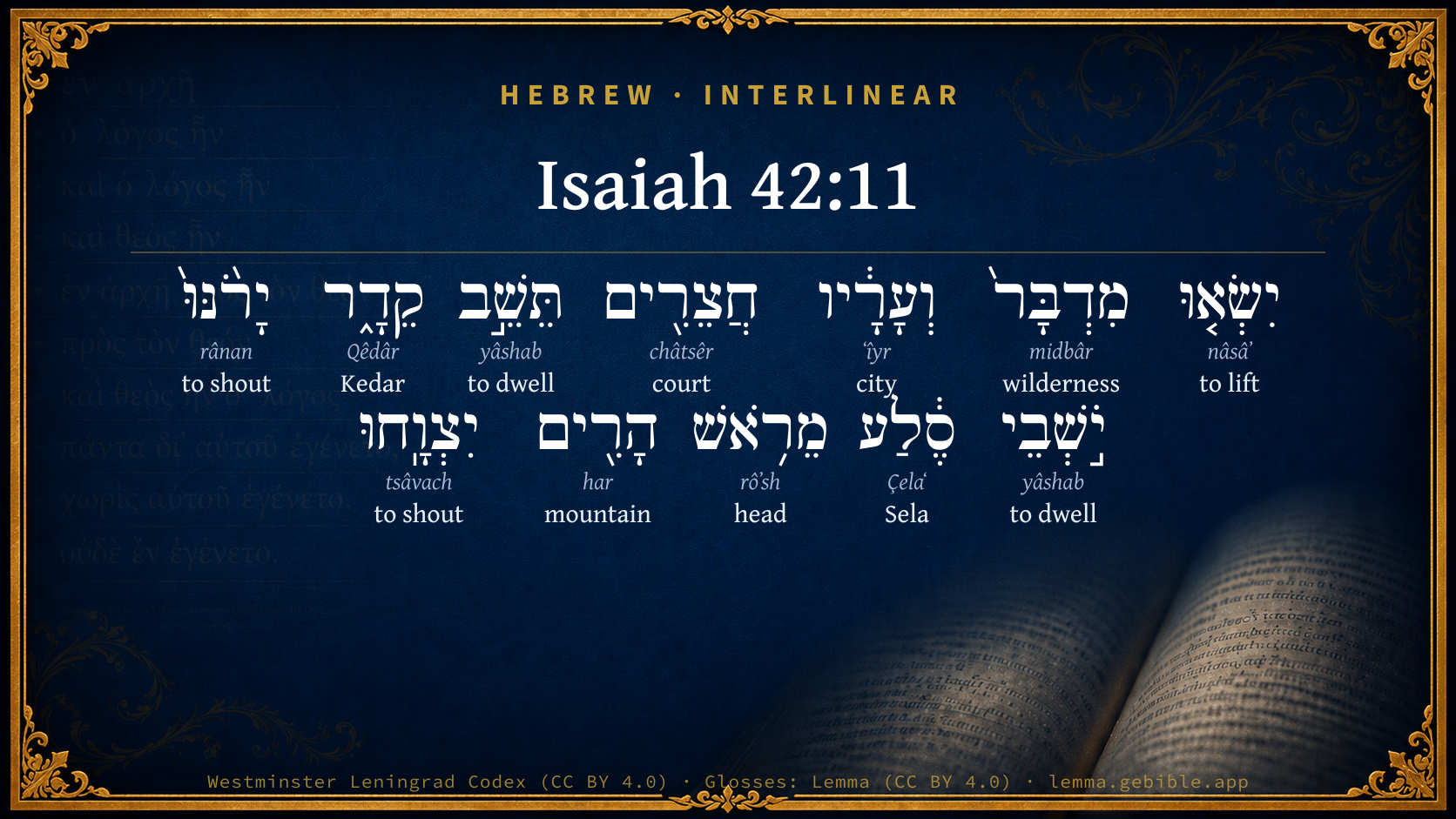
Hebrew (Westminster Leningrad Codex) Isaiah 42:11 appears in the Hebrew Old Testament. The text above is from the Westminster Leningrad Codex. Each word links to its Strong’s number, a concise gloss, and parsing drawn from the Open Scriptures Hebrew Bible morphology. Click any word for its full Brown-Driver-Briggs (BDB) entry.
Download image
Cite this verse

Isaiah 42:11 (World English Bible). Public Domain. Lemma interlinear Bible study tool, https://lemma.gebible.app/v/isaiah/42/11.

Show BibTeX & RIS
BibTeX
RIS
English Translation
Let the wilderness and the cities of it lift up [their voice], the villages that Kedar does inhabit; let the inhabitants of Sela sing, let them shout from the top of the mountains.
World English Bible · Public Domain
Highlights
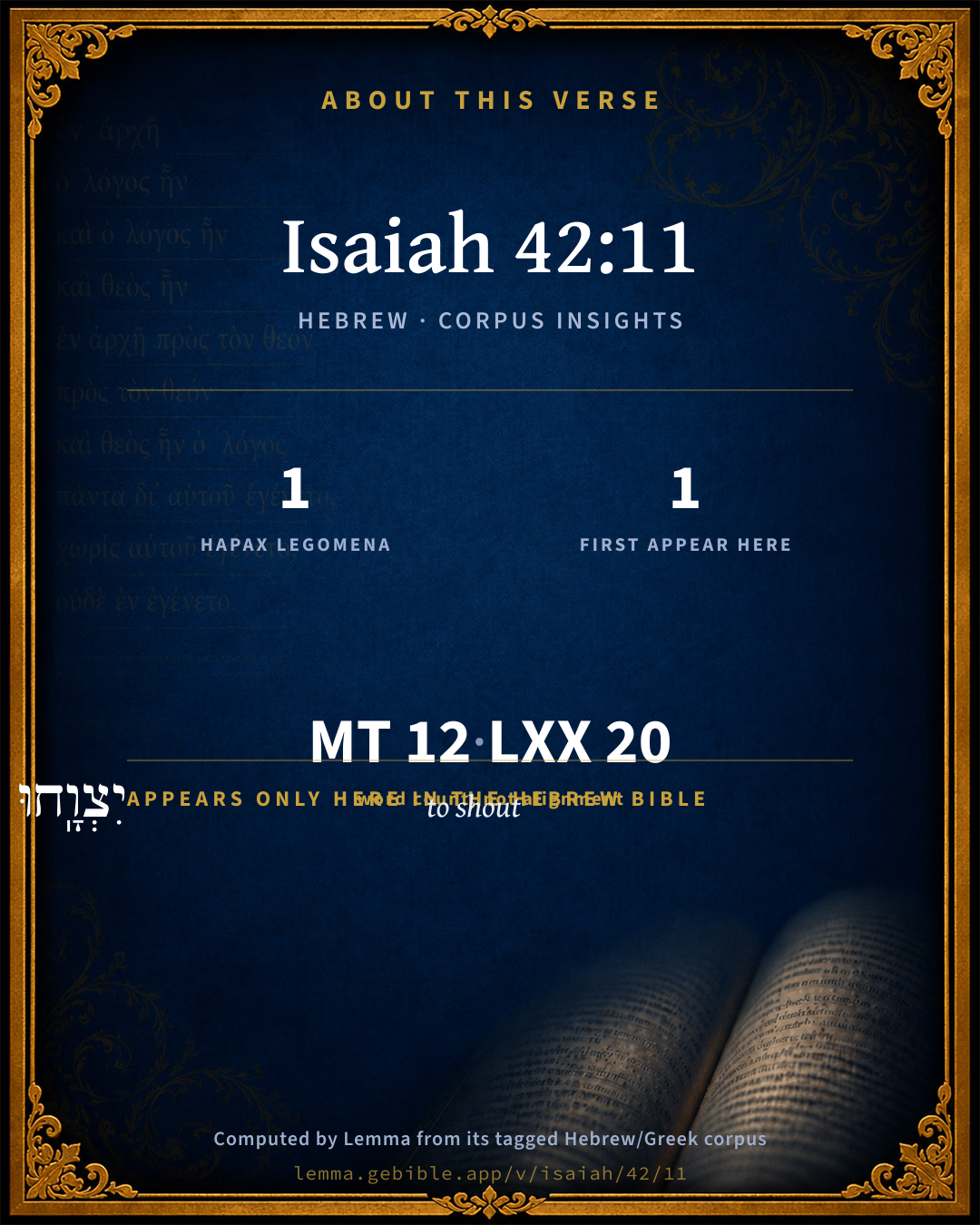
  • 1 hapax legomenon — only here in the Hebrew Bible
  • 1 first appearance in the Hebrew Bible
Full analysis ↓
Download a study sheet

One document with this verse’s original text, its word-by-word gloss line, the meaning frame, cross-references with their text, attributed commentary, and full source and license credits — printable, and it pastes into notes with its structure intact.

This verse Autodidact and up

Study sheet (.html) Plain text (.txt)

A passage Seminary Student

Up to 50 verses in one chapter. A passage sheet keeps up to 6 commentary sources and 12 cross-references per verse, in the order this page ranks them, and says so on the sheet whenever that leaves anything out. Ask for a single verse and you get the Autodidact verse sheet above.

Everything on this page stays free to read, with no account — the sheet is a download of what is already on screen, not access to it.

Want to remove ads? Support Godless Engineer
Compare translations 3

The same verse in 3 English versions, stacked beneath the original-language interlinear above. Click any original word for its lexicon entry.

Each is an independent rendering of the whole verse — the interlinear is not word-aligned to these translations.

Highlighted words mark where these versions differ — a whole-verse word diff, not a word-by-word alignment.

  • World English Bible Public Domain
    Let the wilderness and the cities of it lift up [their voice], the villages that Kedar does inhabit; let the inhabitants of Sela sing, let them shout from the top of the mountains.
  • King James Version Public Domain
    Let the wilderness and the cities thereof lift up their voice, the villages that Kedar doth inhabit: let the inhabitants of the rock sing, let them shout from the top of the mountains.
  • unfoldingWord Literal Text CC BY-SA 4.0
    Let the wilderness and its cities lift up, the villages Kedar inhabits. Let the dwellers of Sela sing joyfully; let them shout from the head of the mountains.

unfoldingWord Literal Text — © unfoldingWord, licensed CC BY-SA 4.0. Word-aligned USFM3 via Door43 (git.door43.org/unfoldingWord/en_ult).

Versions to compare (up to 4)

3 of 4 selected

Show all 18 translations

Every available English version of this verse, each an independent rendering of the whole verse.

  • World English Bible Public Domain
    Let the wilderness and the cities of it lift up [their voice], the villages that Kedar does inhabit; let the inhabitants of Sela sing, let them shout from the top of the mountains.
  • Berean Standard Bible Public Domain
    Let the desert and its cities raise their voices; let the villages of Kedar cry aloud. Let the people of Sela sing for joy; let them cry out from the mountaintops.
  • Majority Standard Bible Public Domain
    Let the desert and its cities raise their voices; let the villages of Kedar cry aloud. Let the people of Sela sing for joy; let them cry out from the mountaintops.
  • King James Version Public Domain
    Let the wilderness and the cities thereof lift up their voice, the villages that Kedar doth inhabit: let the inhabitants of the rock sing, let them shout from the top of the mountains.
  • American Standard Version (1901) Public Domain
    Let the wilderness and the cities thereof lift up `their voice', the villages that Kedar doth inhabit; let the inhabitants of Sela sing, let them shout from the top of the mountains.
  • Revised Version (1885) Public Domain
    Let the wilderness and the cities thereof lift up their voice, the villages that Kedar doth inhabit; let the inhabitants of Sela sing, let them shout from the top of the mountains.
  • Geneva Bible (1599) Public Domain
    Let the wildernesse and the cities thereof lift vp their voyce, the townes that Kedar doeth inhabite: let the inhabitants of the rocks sing: let them shoute from the toppe of the mountaines.
  • Douay-Rheims (1899) Public Domain
    Let the desert and the cities thereof be exalted: Cedar shall dwell in houses: ye inhabitants of Petra, give praise, they shall cry from the top of the mountains.
  • Young's Literal Translation Public Domain
    The wilderness and its cities do lift up `the voice', The villages Kedar doth inhabit, Sing do the inhabitants of Sela, From the top of mountains they cry.
  • Literal Standard Version CC BY-SA 4.0
    The wilderness and its cities lift up [their voice], || Kedar inhabits the villages, || The inhabitants of Sela sing, || They cry from the top of mountains.
  • Unlocked Literal Bible CC BY-SA 4.0
    Let the desert and the cities cry out, the villages where Kedar lives, shout for joy! Let the inhabitants of Sela sing; let them shout from the mountaintops.
  • unfoldingWord Literal Text CC BY-SA 4.0
    Let the wilderness and its cities lift up, the villages Kedar inhabits. Let the dwellers of Sela sing joyfully; let them shout from the head of the mountains.
  • Darby Bible Public Domain
    Let the wilderness and the cities thereof lift up [their voice], the villages that Kedar doth inhabit; let the inhabitants of the rock sing, let them shout from the top of the mountains:
  • World Messianic Bible Public Domain
    Let the wilderness and its cities raise their voices, with the villages that Kedar inhabits. Let the inhabitants of Sela sing. Let them shout from the top of the mountains!
  • Webster's Bible Public Domain
    Let the wilderness and its cities lift up their voice, the villages that Kedar doth inhabit: let the inhabitants of the rock sing, let them shout from the top of the mountains.
  • Free Bible Version CC BY-SA 4.0
    Let the people in the desert and its towns shout; let the people of the villages of Kedar cry out loud. Let the people of Sela sing for joy; let them shout from the mountain-tops.
  • Bible in Basic English Public Domain
    Let the waste land and its flocks be glad, the tent-circles of Kedar; let the people of the rock give a glad cry, from the top of the mountains let them make a sound of joy.
  • JPS Tanakh (1917) Public Domain
    Let the wilderness and the cities thereof lift up their voice, the villages that Kedar doth inhabit; let the inhabitants of Sela exult, let them shout from the top of the mountains.

Literal Standard Version (2020), Covenant Press — licensed CC BY-SA 4.0. Text via the HelloAO Bible API (eBible.org). Unlocked Literal Bible (unfoldingWord) — licensed CC BY-SA 4.0. Text via the HelloAO Bible API (eBible.org). unfoldingWord Literal Text — © unfoldingWord, licensed CC BY-SA 4.0. Word-aligned USFM3 via Door43 (git.door43.org/unfoldingWord/en_ult). Free Bible Version, Dr. Jonathan Gallagher — licensed CC BY-SA 4.0. Text via the HelloAO Bible API (eBible.org).

Word by word

More ways to search: Search by grammar → Find every occurrence → Compare this word →

Practice this passage: Drill this verse → Learn its vocabulary →

יִצְוָֽחוּ
tsâvach
H6681
“to shout”
Verb, Qal, Imperfect, 3rd Person, Masculine, Plural
Part of Speech
Verb
Stem
Qal
Form
Imperfect
Person
3rd Person
Gender
Masculine
Number
Plural
Full BDB Definition

Origin: a primitive root

TWOT: 1888

(Qal) to shout, cry aloud, cry out
  1. יִשְׂא֤וּ nâsâʼ H5375 “to lift” Verb, Qal, Imperfect, 3rd Person, Masculine, Plural
  2. מִדְבָּר֙ midbâr H4057 “wilderness” Noun, Common, Masculine, Singular, Absolute
  3. וְעָרָ֔יו ʻîyr H5892 “and · cities · his” Conjunction + Noun, Common, Feminine, Plural, Construct + Suffix, Personal, 3rd Person, Masculine, Singular
  4. חֲצֵרִ֖ים châtsêr H2691 “courts” Noun, Common, Both, Plural, Absolute
  5. תֵּשֵׁ֣ב yâshab H3427 “to dwell” Verb, Qal, Imperfect, 3rd Person, Feminine, Singular
  6. קֵדָ֑ר Qêdâr H6938 “Kedar” Noun, Proper
  7. יָרֹ֨נּוּ֙ rânan H7442 “to shout” Verb, Qal, Imperfect, 3rd Person, Masculine, Plural
  8. יֹ֣שְׁבֵי yâshab H3427 “dwelling” Verb, Qal, Participle Active, Masculine, Plural, Construct
  9. סֶ֔לַע Çelaʻ H5554 “Sela” Noun, Proper
  10. מֵרֹ֥אשׁ rôʼsh H7218 “from · head of” Preposition + Noun, Common, Masculine, Singular, Construct
  11. הָרִ֖ים har H2022 “mountains” Noun, Common, Masculine, Plural, Absolute

About this verse

These counts appear in no published source. They are computed here, from the morphology-tagged text and Lemma’s own curated glosses. What Lemma adds →

12
words
11
distinct lemmas
Prophets
section

Notable vocabulary

1 hapax legomenon — a word that appears only here in the entire Hebrew Bible:

  • יִצְוָֽחוּ to shout H6681

First appearance in Scripture

This word makes its first canonical appearance in the Hebrew Bible here:

  • יִצְוָֽחוּ to shout H6681

Shared distinctive vocabulary

סֶ֔לַע Sela H5554 occurs in 3 verses of the Hebrew Bible. Also found in:

Grammatical profile

  • 5 verbs
  • 7 nouns

Verb forms

  • יִשְׂא֤וּ Qal · Imperfect
  • תֵּשֵׁ֣ב Qal · Imperfect
  • יָרֹ֨נּוּ֙ Qal · Imperfect
  • יֹ֣שְׁבֵי Qal · Participle Active
  • יִצְוָֽחוּ Qal · Imperfect

Repetition

A word recurs within this verse — often emphatic in Hebrew:

  • תֵּשֵׁ֣ב to dwell H3427 ×2

Hebrew & Septuagint length

In English translation the verse runs 33 words from the Hebrew and 30 from the Septuagint (LXX English) — closely comparable.

A rough comparison of the two English renderings, which tokenize alike — not a word-level alignment.

Word counts can differ between the Hebrew and the Greek without any difference in meaning — e.g. the Hebrew direct-object marker אֵת has no separate Greek word, and Greek often adds the article ὁ.

In the original languages it is 12 Hebrew tokens and 20 Greek tokens — but the two are counted differently (Hebrew bundles its prefixes and suffixes into one token; the Greek is in lemma form), so that isn’t a like-for-like length.

Cross-references

18

Topical passages linked to Isaiah 42:11 in the Treasury of Scripture Knowledge — connected by theme and wording, ordered by reader-vote popularity; previews shown in the World English Bible.

  • Isaiah 32:16 Then justice shall dwell in the wilderness; and righteousness shall abide in the fruitful field.
  • Isaiah 60:7 All the flocks of Kedar shall be gathered together to you, the rams of Nebaioth shall minister to you; they shall come up with acceptance on my altar; and I will glorify the house of my glory.
  • Psalms 72:8–10 He shall have dominion also from sea to sea, From the River to the ends of the earth.
  • Isaiah 41:18–19 I will open rivers on the bare heights, and springs in the midst of the valleys; I will make the wilderness a pool of water, and the dry land springs of water.
  • Genesis 25:23 Yahweh said to her, Two nations are in your womb, Two peoples will be separated from your body. The one people will be stronger than the other people. The elder will serve the younger.
  • Psalms 120:5 Woe is me, that I live in Meshech, That I dwell among the tents of Kedar!
  • Isaiah 16:1 Send you the lambs for the ruler of the land from Selah to the wilderness, to the mountain of the daughter of Zion.
  • Isaiah 21:16 For thus has the Lord said to me, Within a year, according to the years of a hireling, all the glory of Kedar shall fail;
  • Isaiah 35:6 Then shall the lame man leap as a hart, and the tongue of the mute shall sing; for in the wilderness shall waters break out, and streams in the desert.
  • Isaiah 52:7 How beautiful on the mountains are the feet of him who brings good news, who publishes peace, who brings good news of good, who publishes salvation, who says to Zion, Your God reigns!
  • Nahum 1:15 Behold, on the mountains the feet of him who brings good news, who publishes peace! Keep your feasts, Judah! Perform your vows, for the wicked one will no more pass through you. He is utterly cut off.
  • Isaiah 35:1 The wilderness and the dry land shall be glad; and the desert shall rejoice, and blossom as the rose.
  • Isaiah 43:19 Behold, I will do a new thing; now shall it spring forth; shall you not know it? I will even make a way in the wilderness, and rivers in the desert.
  • Jeremiah 21:13 Behold, I am against you, O inhabitant of the valley, [and] of the rock of the plain, says Yahweh; you that say, Who shall come down against us? or who shall enter into our habitations?
  • Jeremiah 48:28 You inhabitants of Moab, leave the cities, and dwell in the rock; and be like the dove that makes her nest over the mouth of the abyss.
  • Jeremiah 49:16 As for your terror, the pride of your heart has deceived you, O you who dwell in the clefts of the rock, who hold the height of the hill: though you should make your nest as high as the eagle, I will bring you down from there, says Yahweh.
  • Isaiah 40:3 The voice of one who cries, Prepare you in the wilderness the way of Yahweh; make level in the desert a highway for our God.
  • Obadiah 1:3 The pride of your heart has deceived you, you who dwell in the clefts of the rock, whose habitation is high, who says in his heart, 'Who will bring me down to the ground?'

Cross-references courtesy of OpenBible.info (CC BY 4.0).

Hebrew and Greek witnesses Masoretic Hebrew ↔ Greek Septuagint

The same verse in the two great witnesses to the Old Testament, shown verse-for-verse.

These are two independent witnesses, not word-aligned to each other, and the Septuagint is shown in lemma (dictionary) form.

Hebrew Isaiah 42:11 Masoretic · Westminster Leningrad Codex

יִשְׂא֤וּ מִדְבָּר֙ וְעָרָ֔יו חֲצֵרִ֖ים תֵּשֵׁ֣ב קֵדָ֑ר יָרֹ֨נּוּ֙ יֹ֣שְׁבֵי סֶ֔לַע מֵרֹ֥אשׁ הָרִ֖ים יִצְוָֽחוּ

Let the wilderness and the cities of it lift up [their voice], the villages that Kedar does inhabit; let the inhabitants of Sela sing, let them shout from the top of the mountains.

World English Bible · Public Domain

Greek LXX Isaiah 42:11 Septuagint · lemma form

εὐφραίνω ἔρημος καί ὁ κώμη αὐτός ἔπαυλις καί ὁ καταοἰκέω κηδαρ εὐφραίνω ὁ καταοἰκέω πέτρα ἀπό ἄκρος ὁ ὄρος βοάω

Rejoice, you wilderness, and the villages thereof, the hamlets, and the dwellers in Kedar: the inhabitants of the rock shall rejoice, they shall shout from the top of the mountains.

LXX2012 (modern English Septuagint) · Public Domain

Hebrew: Westminster Leningrad Codex (CC BY 4.0). Greek: Septuagint (public domain); English from LXX2012 (modern English Septuagint) (Public Domain). How the Septuagint differs from the Hebrew →

Targum (Aramaic paraphrase)

1

The Targum is the ancient Jewish Aramaic paraphrase of the Hebrew Scriptures — an interpretive translation, not the Hebrew text itself. Onkelos (literal) and Pseudo-Jonathan (expansive) render the Torah, and Jonathan the Prophets. Coverage is partial: where no permissively-licensed English translation exists for a verse, only the Aramaic is shown. This is verse-level text, not a word-by-word alignment to the Hebrew.

  1. Targum Jonathan Prophets (Joshua–Malachi)
    יְשַׁבַּח מַדְבְּרָא וְקִרְוִין דְיַתְבִין בֵּיהּ פְּצִיחִין יָתְבִין מִדְבַּר עַרְבָאִי יְשַׁבְּחוּן מֵיתַיָא כַּד יִפְקוּן מִבָּתֵּי עַלְמֵיהוֹן מְרֵישֵׁי טוּרַיָא יְרִימוּן קָלְהוֹן:

    Let the wilderness praise Him, and the cities that are in it, & the villages which inhabit the wilderness of the Arabians; let the dead praise Him, when they go forth from their long abodes; from the tops of the mountains let them lift up their voice.

    Targum Jonathan — Aramaic: “Mikraot Gedolot” (public domain). English: “Sefaria Community Translation” (CC0 1.0 (public-domain dedication)); “London "Chaldee Paraphrase," 1871” (public domain). Text via Sefaria.

Commentary

Notes on Isaiah 42:11 from classic Christian and Jewish commentators (each source and its license shown beneath its notes). The classic Christian expositions comment on the surrounding passage and are grouped to its opening verse, so a note may address several verses; the Jewish commentaries on the Tanakh (Rashi and others) are per-verse, so they appear only where the commentator wrote on this verse.

Lemma curates 59 commentaries, every one of them public domain or Creative Commons licensed, each selected and text-cleaned for this edition rather than reprinted as found. About our sources →

Trapp's Complete Commentary

John Trapp

Isa 42:11 Let the wilderness and the cities thereof lift up [their voice], the villages [that] Kedar doth inhabit: let the inhabitants of the rock sing, let them shout from the top of the mountains.

Ver. 11. Let the wilderness.] Ye that dwell eastward. It was called the wilderness, because but thinly inhabited.

The villages that Kedar doth inhabit.] The most fierce and savage people, cicurated and civilised by the gospel preached among them, as it is with us at this day, whose ancestors were most barbarous and brutish, as Cicero {a} testifieth.

Let the inhabitants of the rock.] Or, Of Petra, the chief city of Arabia Petraea.

{a} De Nat. Deor.

John Trapp, A Commentary or Exposition upon All the Books of the Old and New Testament (1647–1656) — public domain. Text from a community e-Sword module.

The Biblical Illustrator

Joseph S. Exell

Isa_42:11

Let the inhabitants of the Rock sing

Christ the Christians Rock

I.

SHOW IN WHAT RESPECT CHRIST MAY BE COMPARED TO A ROCK.

1. Christ is a Rock, in regard of His omnipotent power.

2. Christ is a Rock, in regard of that ineffable glory to which He is now exalted. Rocks may lie low and deep in the ground, but rise with artless grandeur and inimitable beauty, and their lofty heads divide the clouds.

3. Jesus Christ is a Rock in regard of His faithfulness, and the unchangeable nature of His perfections. Those storms and tempests which spread desolation, and bury whole islands and countries in ruins, remove not the rocks out of their place. But Jesus is firmer than they.

4. Christ is a Rock, in regard of His majesty and beauty.

II. SHOW HOW GOOD MEN MAY BE CALLED INHABITANTS OF THE ROCK

1. Because that is their dwelling-place.

2. They are inhabitants of the Rock, as that is the place of their nativity. All the inhabitants of this Rock are born in the image of the Son of God; a new and peculiar race.

3. They may be called inhabitants of the Rock, as they are a people who dwell on high. Their souls and all their nobler powers soar above the mean pursuits of this world.

4. They may be called inhabitants of the Rock, as they are to abide there for ever.

5. They are inhabitants of the Rock, as all their supplies come from Christ. From this doctrine we may learns

(1) The infinite wisdom of God in laying our help upon Christ.

(2) That the figurative expression of Christ, trader the notion of a rock, magnifieth the power of God on which our faith may rest.

(3) The wickedness and folly of all who oppose the Son of God.

(4) The folly and wickedness of those who build their hopes of eternal life upon any other foundation than Christ, the Rock.

(5) The great duty of all who hear the Gospels joyful sound, to fly to Christ, the Rock. (J. Johnston.)

Christ the Christians song

I. WHAT KIND OF A SONG IT IS WHICH THE SAINTS ARE CALLED TO SING. It is a song on redeeming love.

1. A new song. It proceeds from a new heart, which is animated with new mercies.

2. A spiritual song. It is unmingled with carnal joy, or that of the hypocrite, which is short and unfruitful of solid comfort. It is from above, and animates all the powers of the soul. It will never become obsolete, but afford endless pleasure to the redeemed.

3. A song of distinction. Every heart is not formed for such exalted praise. The feeble powers of nature, unassisted by Divine grace, cannot learn this new song.

4. A song of victory. The saints of God are clothed in white, an authentic emblem of their faith and victory.

5. A song upon a sacrifice.

6. An everlasting song. Not the joy of the hypocrite, soon kindled, and soon extinguished; the powers of the soul are enlarged, and rendered fit for those endless raptures of joy and praise.

II. THE SUBJECT-MATTER OF THIS SONG.

1. Jesus Christ our Lord manifested in human nature.

2. The manifestation of Divine judgments. When the Judge of all the earth came down, and delivered His ancient Israel from Egyptian bondage, He routed Pharaoh and His hosts, by such signal judgments as spread His fame far and wide: His name was great, and His praise glorious through the whole earth. Moses and Israel sang, The Lord hath triumphed gloriously, the horse and his rider hath He thrown into the sea. When Rome, as ancient Babylon, fell to rise no more, the heavenly Church is brought in as a chorus, to praise God for His righteous judgments and faithfulness. This excellent hymn of praise, sung by the united voices of saints and angels, strongly represents to all Christians, and every Church on earth, what grateful sense they ought to have of the Divine faithfulness in their protection, and of His righteous judgments in punishing the persecutors of truth and religion.

3. The infinite worthiness of Christ the Lamb of God.

4. The believers union to the Divine Redeemer.

5. Communion with all the persons of Deity. That sincere believers in Christ enjoy such a communion, is most obvious from the sacred Scriptures. (J. Johnston.)

Safety in the rock

The hare, that trusteth to the swiftness of her legs, is at length overtaken and torn to pieces; when the coney, that flieth to the holes in the rocks, doth easily avoid the dogs that pursue her. (J. Trapp.)

The Biblical Illustrator, edited by Joseph S. Exell (c. 1880s–1900s) — public domain. Text from a community e-Sword module.

Geneva Bible (1599)

Geneva Bible translators

Meaning, the Arabians, under whom he comprehendeth all the people of the East.

Geneva Bible (1599) marginal notes — public domain. Text via Bolls.life.

Jamieson, Fausset & Brown

Robert Jamieson, A. R. Fausset & David Brown

cities--in a region not wholly waste, but mainly so, with an oasis here and there.

Kedar--in Arabia-Deserta (Isa 21:16; Gen 25:13). The Kedarenians led a nomadic, wandering life. So Kedar is here put in general for that class of men.

rock--Sela, that is, Petra, the metropolis of Idumea and the Nabathoean Ishmaelites. Or it may refer in general to those in Arabia-Petræa, who had their dwellings cut out of the rock.

the mountains--namely, of Paran, south of Sinai, in Arabic Petræa [VITRINGA].

Jamieson, Fausset & Brown — Commentary Critical and Explanatory on the Whole Bible (1871) — public domain (CC PDM 1.0). Text via the HelloAO Bible API.

Adam Clarke's Commentary

Verse 11. Let the wilderness] The most uncultivated countries, and the most rude and uncivilized people, shall confess and celebrate with thanksgiving the blessing of the knowledge of God graciously imparted to them. By the desert is meant Arabia Deserta; by the rocky country, Arabia Petraea; by the mountains, probably those celebrated ones, Paran, Horeb, Sinai, in the same country; to which also belonged Kedar, a clan of Arabians, dwelling for the most part in tents; but there were others of them who inhabited or frequented cities and villages, as may be collected from this place of the prophet. Pietro della Valle, speaking of the people of Arabia Deserta, says: "There is a sort of Arabs of that country called Maedi, who with their herds, of buffaloes for the most part, sometimes live in the deserts, and sometimes in cities; from whence they have their name, which signifies wandering, going from place to place. They have no professed houses; nor are they properly Bedaui, or Beduui, that is, Deserticoli, who are the most noble among them, and never abide within walls, but always go wandering through the open country with their black tents; nor are they properly called Hhadesi, as they call those who dwell in cities, and lands with fixed houses. These by the latter are esteemed ignoble and base; but both are considered as of low condition." Viaggi, Parte III. lett. ii.

The villages that Kedar doth inhabit] The Arabs, according to the Targum.

The inhabitants of the rock] They who dwell on fortified places. The Vulgate has habitatores Petraeae, "the inhabitants of Arabia Petraea." Those who make the rock Jesus Christ, the inhabitants of the rock, true believers in him; the singing, rejoicing for the salvation they have received; abuse and disgrace the passage and the pulpit. I have heard a clergyman, a magistrate, a justice of the quorum, spend an hour in showing from these words,

1. That they meant Jesus Christ, and none other.

2. That he might be fully compared to a rock, as the foundation on which his Church was built, and on which all true believers rested for their salvation.

3. A rock, because of his strength and might in destroying his enemies, and supporting his friends.

4. A refreshing rock, like that in the wilderness; and that rock was Christ.

5. A perspective rock, from which true believers could discover their heavenly inheritance: "When my heart is overwhelmed, lead me to the rock that is higher than I," c. Now all this is true in itself but false in respect to the words on which it was professedly built, for they have no such meaning.

Adam Clarke's Commentary on the Bible (1810–1826) — public domain. Text from a community e-Sword/MySword module.

The Cambridge Bible for Schools and Colleges

gen. ed. J. J. S. Perowne

11. the wilderness and the cities thereof] The “cities,” like the “villages” of the next line, are those in the oases, occupied by the settled Arabs; the former are probably the great centres of the caravan trade, like Tadmor and Petra. Kedar (see on ch. Isa_21:16) is sometimes referred to as a tribe of nomadic, tent-dwelling Arabs (Psa_120:5; Son_1:5; Jer_49:28 f.); here they are villagers, what the modern Arabs call ḥaḍarîya (connected with the word ḥâc̨çr, used here) as opposed to the wabarîya or nomads (Delitzsch). In Jer_2:10 Kedar stands, as here, in opposition to the Mediterranean countries.

the inhabitants of the rock] (i.e. “the rock-dwellers”). R.V. has “the inhabitants of Sela,” which would probably be Petra. It is difficult to say which translation is preferable. It should be mentioned that the identification of Sela, in any O.T. passage, with Petra is resisted by many scholars (see on ch. Isa_16:1).

sing] Rather, exult,—a different word at any rate from that used in Isa_42:10.

The Cambridge Bible for Schools and Colleges (gen. ed. J. J. S. Perowne; Cambridge University Press, 1878–1918) — public domain. Text from a community e-Sword module.

John Gill's Exposition

Let the wilderness and the cities thereof lift up their voice,.... The eastern part of the world, Arabia Deserta, and the inhabitants of the cities which were in it:

the villages that Kedar doth inhabit; or the "courts" (t), or tents, the Kedarenes inhabited, who were Arabians, and dwelt in tents, which they pitched here and there, for the convenience of their flocks; and so the Targum,

"the Arabians that inhabit the wilderness shall praise:''

let the inhabitants of the rock sing: or of Petra, which Jerom says was a city of Palestine. It was the metropolis of Arabia Petraea, which whole country may be here meant, and the inhabitants of it, who had reason to sing for joy, when the Gospel was preached unto them; as it was by the Apostle Paul in Arabia, Gal 1:17,

let them shout from the top of the mountains; the wild, savage, and barbarous people that dwell there, but now become civilized, as well as evangelized, by the Gospel; or the messengers and ministers of the word, whose feet on those mountains were beautiful, bringing the good tidings of peace and salvation by Christ. The Targum interprets this of the resurrection of the dead,

"the dead, when they shall go out of the house of their world, from the tops of the mountains shall lift up their voice (u).''

(t) "atria", Montanus; "tentoria", Grotius. (u) Ben Melech interprets the rocks and mountains of towers built on rocks and mountains, where men dwelt.

John Gill's Exposition of the Whole Bible (1746–1763) — public domain (CC PDM 1.0). Text via the HelloAO Bible API.

Albert Barnes' Notes on the Bible

Let the wilderness - (See the note at Isa 35:1). The word here denotes the most uncultivated countries, intimating that even the most rude and barbarous people would have occasion to rejoin, and would be interested in the mercy of God.

And the cities thereof - To us there seems to be something incongruous in speaking of the ‘cities’ in a ‘wilderness.’ But we are to remember that the Hebrews gave the name wilderness or desert to those regions that were mostly uncultivated, or sparsely inhabited. They were places that were chiefly devoted to pasturage, and not cultivated by the plow, or regions of vast plains of sand and far-extended barrenness, with here and there an oasis on which a city might be built. Josephus, speaking of the desert or wilderness lying between Jerusalem and Jericho enumerates several villages or towns in it, showing that though it was mainly a waste, yet that it was not wholly without towns or inhabitants. We are to remember also that large towns or cities for commercial purposes, or thorough fares, were often built in the few fertile or advantageous places which were found in the midst of desert wastes. Thus we are told of Solomon 2Ch 8:4, that ‘he built Tadmor in the wilderness;’ and we know that Palmyra, and Bozrah, and Sela, were large cities that were built in the midst of regions that were generally to be regarded as deserts, or wastes.

The villages that Kedar doth inhabit - Where the inhabitants of Kedar dwell. Kedar was a son of Ishmael Gen 25:13, the father of the Kedarenians or Cedrei, mentioned by Pliny (Nat. Hist. v. 2), who dwell in the vicinity of the Nabathaeans in Arabia Deserta. They often changed their place, though it would seem that they usually dwelt in the neighborhood of Petra, or Sela. The name Kedar is often given to Arabia Deserta, and the word may in some instances denote Arabia in general. The inhabitants of those countries usually dwell in tents, and lead a nomadic and wandering life.

Let the inhabitants of the rock sing - It is uncertain whether the word ‘rock’ here (Hebrew, סלע sela‛, Greek Πέτραν Petran, ‘Petra’ or ‘rock’) is to be regarded as a proper name, or to denote in a general sense those who dwell in the rocky part of Arabia. Sela, or Petra, was the name of the celebrated city that was the capital of Idumea (see the notes at Isa 16:1); and the connection here would rather lead us to suppose that this city was intended here, and that the inhabitants of the capital were called upon to join with the dwellers in the surrounding cities and villages in celebrating the goodness of God. But it may denote in general those who inhabited the desolate and stony region of Arabia Petrea, or whose home was among the cliffs of the rocks. If so, it is a call upon Arabia in general to rejoice in the mercy of God, and to give glory to him for providing a plan of redemption - an intimation that to the descendants of Ishmael the blessings of the gospel would be extended.

Let them shout from the top of the mountains - They who had taken refuge there, or who had made their permanent abode there. Vitringa supposes that the mountains of Paran are meant, which are situated on the north of Mount Sinai. The idea in the verse is, that all the dwellers in Arabia would celebrate the goodness of God, and join in praising him for his mercy in giving a deliverer. They were yet to partake of the benefits of his coming, and to have occasion of joy at his advent. It is possible that Cowper may have had this passage in his eye in the following description of the final and universal prevalence of the gospel:

The dwellers in the vales and on the rocks,

Shout to each other, sad the mountain-tops,

From distant mountains catch the flying joy:

Till nation after nation taught the strain,

Earth rolls the rapturous hosannas round.

Task.

Albert Barnes' Notes on the Bible (1834–1885) — public domain. Text from a community e-Sword/MySword module.

Haydock's Catholic Bible Commentary

Cedar, or the Jews in exile in the desert Arabia, Psalm cxix. 5. (Calmet) --- The people dwell in tents. (Roger. ii. 5.) --- Petra. A city that gives name to Arabia Petræa. (Challoner)

George Leo Haydock (1774–1849), Haydock's Catholic Family Bible and Commentary, 1859 edition — public domain. Excludes Psalms (Douay-Rheims chapter numbering differs from Protestant) and Deuterocanonical books (Catholic canon only).

Matthew Poole's English Annotations

The wilderness; those parts of the world which are now like a wilderness; not literally, for he speaks of their cities in the next clause, but spiritually, desolate and forsaken of God, dry and destitute of the waters of God’s grace, and barren of all good fruits.

Kedar; the Arabians; which were a heathenish and barbarous people, and well known to the Jews, and are synecdochically put for all nations in the same circumstances.

Let the inhabitants of the rock sing, let them shout from the top of the mountains: having mentioned cities and villages, he now adds those who dwell upon rocks and mountains, which are commonly more savage and ignorant than others, and therefore harder to be taught and reformed.

Matthew Poole's English Annotations on the Holy Bible (1683–1685) — public domain. Text from a community e-Sword/MySword module.

The Pulpit Commentary

The wilderness and the cities thereof. The desert had its cities, built on some more or less fertile oases, where at any rate water was procurable. Instances of such cities are Tudmor, Petra, Kadesh. (Num_20:1) Its villages were probably collections of tents, which were moved from time to time, since the Beni-Kedar were nomads. (Psa_120:5) The call is upon both the stationary and the wandering inhabitants of the Syro-Arabian desert to join in the song of praise. The inhabitants of the rock; rather, the iahabitants of Sela, or Petra, the rock-city, which was the capital of Idumaea, or Edom (see the comment on Isa_16:1). It is assumed that the return of the Israelites to their land ought to be a subject of rejoicing to all their neighbours.

The Pulpit Commentary (1880–1919), ed. H.D.M. Spence-Jones & Joseph S. Exell — public domain. Text from a community e-Sword module.

John Wesley's Explanatory Notes

The wilderness - Those parts of the world which are now desolate and forsaken of God, and barren of all good fruits. Kedar - The Arabians: who were an Heathen and barbarous people, and are put for all nations. Mountains - Who are commonly more savage and ignorant than others.

John Wesley, Explanatory Notes Upon the Whole Bible (1754–1765) — public domain. Text via the GEBible commentary corpus.

J. A. Alexander on Isaiah

Joseph Addison Alexander

“The desert and its towns shall raise (the voice), the enclosures (or encampments, in which) Kedar dwells; the dwellers in the Rock shall shout, front the top of mountains shall they cry aloud.” This is a direct continuation of the previous description, in which the whole world is represented as exulting in the promised change. The reference of this verse to the course of the returning exiles through the intervening desert is forbidden by the mention of the sea and its fullness, the isles and the ends of the earth, in the preceding and following verses. If these are not all parts of the same great picture, it is impossible to frame one. If they are, it is absurd to take the first and last parts in their widest sense as an extravagant hyperbole, and that which is between them in its strictest sense as a literal description. The only consistent supposition is that sea, islands, deserts, mountains, towns, and camps, are put together as poetical ingredients of the general conception, that the earth in all its parts shall have occasion to rejoice. The mention of cities as existing in the wilderness appears less strange in the original than in a modern version, because both the leading words have a greater latitude of meaning than their usual equivalents, the first denoting properly a pasture-ground, and being applicable therefore to any uncultivated region whether uninhabited or not, the other answering to town in its widest English sense inclusive of both villages and cities. The translation villages is too restricted, since the Hebrew word is applicable also to collections of tents or nomadic encampments, which appears to be the prominent idea here. Kedar was the second son of Ishmael (Gen 25:13). Here, as in Isa 21:16, the name is put for his descendants, or by a natural metonymy for the Arabians in general. The rabbinical name for the Arabic language is the tongue of Kedar.

Joseph Addison Alexander, The Prophecies of Isaiah (1846–1847; New York: Scribner, 1870–1878) — public domain. Text from a community e-Sword module.

Rashi

Rabbi Shlomo Yitzchaki (Rashi)

The desert and its cities shall raise [their voice] their voice in song.

Kedar shall be inhabited with villages (Connected to “The desert...shall raise.” The desert of Kedar, where they now dwell in tents, shall raise their voice and sing. It is like: And the villages with which Kedar is settled.) The desert of Kedar, where they now dwell in tents, will be permanent cities and villages.

rock dwellers The dead who will be resurrected. So did Jonathan render this.

from the mountain peaks they shall shout From the mountain peaks they shall raise their voices [from Jonathan].

Rashi on the Tanakh — English translations: “The Judaica Press complete Tanach with Rashi, translated by A. J. Rosenberg” (CC BY 4.0); “Pentateuch with Rashi's commentary by M. Rosenbaum and A.M. Silbermann, 1929-1934” (public domain); “The Metsudah Tanach series, Lakewood, N.J” (CC BY 4.0); and “The Book of Joshua, Metsudah Publications, 1997” (CC BY 4.0). Text via Sefaria.

Ibn Ezra

Rabbi Abraham ibn Ezra

The plain and the cities thereof shall lift up their voice, etc.

Every plain and the cities thereof, all villages which are inhabited by Kedar, etc.; the tribe of Kedar always lived in the plain. The inhabitants of the rock, the nations that live in the rocks.

ירנו Shall shout. Comp. הרנה the cry (1 Kings 22:36).

יצוהו Shall lift up their voice. It is used both in a good and a bad sense. Comp. צוחה crying (24:11).

Ibn Ezra on the Tanakh — English translations: “Sefaria Community Translation” (CC0 1.0 (public-domain dedication)); “Yalkut, Sifsei Chachomim Chumash, Metsudah Publications, 2009” (CC BY 4.0); and “Commentary of Ibn Ezra on Isaiah - trans. by M. Friedlander, 1873” (public domain). Text via Sefaria.

Lesson kit

Teaching starters — assembled from the data on this page, not authored interpretation. Every prompt links to the verse data it draws on. Edit before teaching.

Isaiah, in the Prophets, opens this verse with 12 words (11 distinct Hebrew lemmas). Its most distinctive word is tsâvach (“to shout”). A historical commentator’s framing appears above. Read the whole chapter for the surrounding context.

Discussion questions

  1. How does “to shout” (tsâvach) shape what this verse is saying?
  2. 1 word here appears nowhere else in the Hebrew Bible. Why might the author reach for such rare wording?
  3. This is the first place “to shout” appears in Scripture (first appears here). What does its debut here establish?
  4. How does 2 Kings 14:7, which shares the word «Sela», read alongside this verse?
  5. What does the repetition of “to dwell” (2× in this one verse) do in this verse?
  6. These translations render this verse differently. What is at stake in choosing one wording over another?
  7. «יִשְׂא֤וּ» is a Qal Imperfect verb. How does that grammatical form shape the action described?
  8. Compare how Trapp's Complete Commentary and The Biblical Illustrator read this verse. Where do they agree or differ?

Things to notice

  • 1 word in this verse appears nowhere else in the Hebrew Bible.
  • 1 word makes its first canonical appearance in Scripture here.
  • This verse counts 12 Hebrew ↔ 20 Greek words.
  • These translations choose different wording for 12 words in this verse.
  • “to dwell” occurs 2× in this single verse.

Reading settings

Reading text

Shown beneath each verse's original-language words.

Old Testament
Old Testament edition

Read the OT as the Masoretic Hebrew (MT) or the Greek Septuagint (LXX).

English shown for the Greek Septuagint (in the Hebrew ↔ Greek comparison).

Comparing translations? Open the Compare panel on any verse page to stack up to four side by side.