
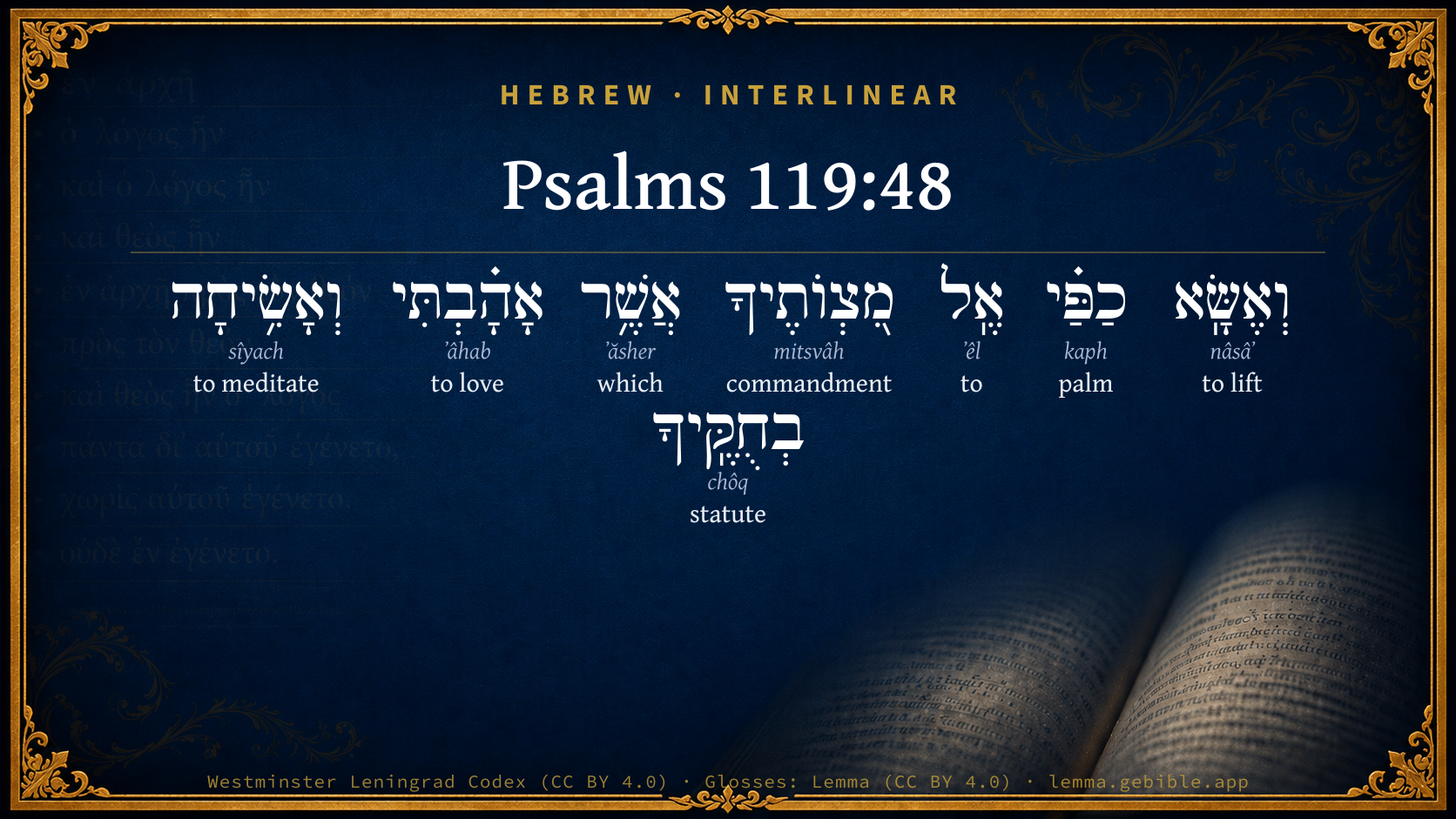
Psalms 119:48

Hebrew (Westminster Leningrad Codex) Psalms 119:48 appears in the Hebrew Old Testament. The text above is from the Westminster Leningrad Codex. Each word links to its Strong’s number, a concise gloss, and parsing drawn from the Open Scriptures Hebrew Bible morphology. Click any word for its full Brown-Driver-Briggs (BDB) entry.
Download image
Cite this verse

Psalms 119:48 (World English Bible). Public Domain. Lemma interlinear Bible study tool, https://lemma.gebible.app/v/psalms/119/48.

Show BibTeX & RIS
BibTeX
RIS
English Translation
I reach out my hands for your commandments, which I love. I will meditate on your statutes.
World English Bible · Public Domain
Download a study sheet

One document with this verse’s original text, its word-by-word gloss line, the meaning frame, cross-references with their text, attributed commentary, and full source and license credits — printable, and it pastes into notes with its structure intact.

This verse Autodidact and up

Study sheet (.html) Plain text (.txt)

A passage Seminary Student

Up to 50 verses in one chapter. A passage sheet keeps up to 6 commentary sources and 12 cross-references per verse, in the order this page ranks them, and says so on the sheet whenever that leaves anything out. Ask for a single verse and you get the Autodidact verse sheet above.

Everything on this page stays free to read, with no account — the sheet is a download of what is already on screen, not access to it.

Want to remove ads? Support Godless Engineer
Compare translations 3

The same verse in 3 English versions, stacked beneath the original-language interlinear above. Click any original word for its lexicon entry.

Each is an independent rendering of the whole verse — the interlinear is not word-aligned to these translations.

Highlighted words mark where these versions differ — a whole-verse word diff, not a word-by-word alignment.

  • World English Bible Public Domain
    I reach out my hands for your commandments, which I love. I will meditate on your statutes.
  • King James Version Public Domain
    My hands also will I lift up unto thy commandments, which I have loved; and I will meditate in thy statutes.
  • unfoldingWord Literal Text CC BY-SA 4.0
    And I will lift up my palms to your commandments, which I love, and I will meditate on your statutes. ZAYIN

unfoldingWord Literal Text — © unfoldingWord, licensed CC BY-SA 4.0. Word-aligned USFM3 via Door43 (git.door43.org/unfoldingWord/en_ult).

Versions to compare (up to 4)

3 of 4 selected

Show all 17 translations

Every available English version of this verse, each an independent rendering of the whole verse.

  • World English Bible Public Domain
    I reach out my hands for your commandments, which I love. I will meditate on your statutes.
  • Berean Standard Bible Public Domain
    I lift up my hands to Your commandments, which I love, and I meditate on Your statutes.
  • Majority Standard Bible Public Domain
    I lift up my hands to Your commandments, which I love, and I meditate on Your statutes.
  • King James Version Public Domain
    My hands also will I lift up unto thy commandments, which I have loved; and I will meditate in thy statutes.
  • American Standard Version (1901) Public Domain
    I will lift up my hands also unto thy commandments, which I have loved; And I will meditate on thy statutes.
  • Revised Version (1885) Public Domain
    I will lift up my hands also unto thy commandments, which I have loved; and I will meditate in thy statutes.
  • Geneva Bible (1599) Public Domain
    Mine handes also will I lift vp vnto thy commandements, which I haue loued, and I will meditate in thy statutes.
  • Young's Literal Translation Public Domain
    And I lift up my hands unto Thy commands, That I have loved, And I do meditate on Thy statutes!
  • Literal Standard Version CC BY-SA 4.0
    And I lift up my hands to Your commands, || That I have loved, || And I meditate on Your statutes!
  • Unlocked Literal Bible CC BY-SA 4.0
    I will lift up my hands to your commandments, which I love; I will meditate on your statutes.
  • unfoldingWord Literal Text CC BY-SA 4.0
    And I will lift up my palms to your commandments, which I love, and I will meditate on your statutes. ZAYIN
  • Darby Bible Public Domain
    And I will lift up my hands unto thy commandments, which I have loved, and I will meditate in thy statutes.
  • World Messianic Bible Public Domain
    I reach out my hands for your commandments, which I love. I will meditate on your statutes. ZAYIN
  • Webster's Bible Public Domain
    My hands also will I lift to thy commandments, which I have loved; and I will meditate in thy statutes.
  • Free Bible Version CC BY-SA 4.0
    I lift up my hands in prayer, honoring your commandments. I will think deeply about all you say. Zayin
  • Bible in Basic English Public Domain
    And so that my hands may be stretched out to you; and I will give thought to your rules.
  • JPS Tanakh (1917) Public Domain
    I will lift up my hands also unto Thy commandments, which I have loved; and I will meditate in Thy statutes.

Literal Standard Version (2020), Covenant Press — licensed CC BY-SA 4.0. Text via the HelloAO Bible API (eBible.org). Unlocked Literal Bible (unfoldingWord) — licensed CC BY-SA 4.0. Text via the HelloAO Bible API (eBible.org). unfoldingWord Literal Text — © unfoldingWord, licensed CC BY-SA 4.0. Word-aligned USFM3 via Door43 (git.door43.org/unfoldingWord/en_ult). Free Bible Version, Dr. Jonathan Gallagher — licensed CC BY-SA 4.0. Text via the HelloAO Bible API (eBible.org).

Word by word

More ways to search: Search by grammar → Find every occurrence → Compare this word →

Practice this passage: Drill this verse → Learn its vocabulary →

וְאָשִׂ֥יחָה
sîyach
H7878
“and · to meditate”
Conjunction + Verb, Qal, Cohortative, 1st Person, Common, Singular
Part of Speech
Conjunction + Verb
Stem
Qal
Form
Cohortative
Person
1st Person
Gender
Common
Number
Singular
Full BDB Definition

Origin: a primitive root

TWOT: 2255

to put forth, mediate, muse, commune, speak, complain, ponder, sing - (Qal) - to complain - to muse, meditate upon, study, ponder - to talk, sing, speak - (Polel) to meditate, consider, put forth thoughts
  1. וְאֶשָּֽׂא nâsâʼ H5375 “and · to lift” Conjunction + Verb, Qal, Imperfect, 1st Person, Common, Singular
  2. כַפַּ֗י kaph H3709 “palms · my” Noun, Common, Feminine, Dual, Construct + Suffix, Personal, 1st Person, Common, Singular
  3. אֶֽל ʼêl H413 “to” Preposition
  4. מִ֭צְוֺתֶיךָ mitsvâh H4687 “commandments · your” Noun, Common, Feminine, Plural, Construct + Suffix, Personal, 2nd Person, Masculine, Singular
  5. אֲשֶׁ֥ר ʼăsher H834 “which” Particle, Relative
  6. אָהָ֗בְתִּי ʼâhab H157 “to love” Verb, Qal, Perfect, 1st Person, Common, Singular
  7. בְחֻקֶּֽיךָ chôq H2706 “in/at · statutes · your” Preposition + Noun, Common, Masculine, Plural, Construct + Suffix, Personal, 2nd Person, Masculine, Singular

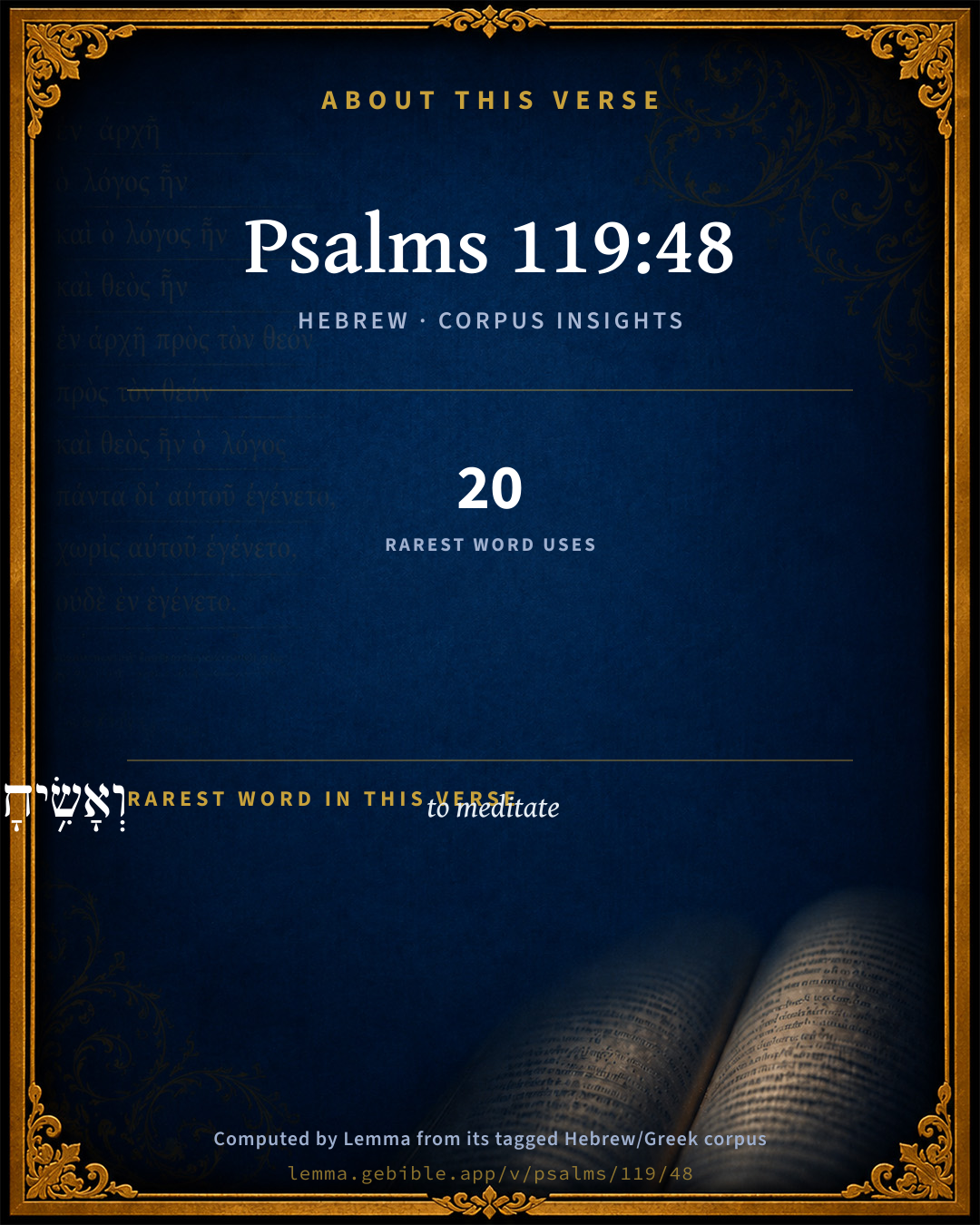
About this verse

These counts appear in no published source. They are computed here, from the morphology-tagged text and Lemma’s own curated glosses. What Lemma adds →

8
words
8
distinct lemmas
Wisdom
section

Notable vocabulary

The rarest word here is וְאָשִׂ֥יחָה to meditate H7878 — appearing just 20 times in the whole Hebrew Bible.

Shared distinctive vocabulary

וְאָשִׂ֥יחָה to meditate H7878 occurs in 20 verses of the Hebrew Bible. Also found in:

Grammatical profile

  • 3 verbs
  • 3 nouns
  • 1 preposition
  • 1 particle

Verb forms

  • וְאֶשָּֽׂא Qal · Imperfect
  • אָהָ֗בְתִּי Qal · Perfect
  • וְאָשִׂ֥יחָה Qal · Cohortative

Hebrew & Septuagint length

In English translation the verse runs 17 words from the Hebrew and 18 from the Septuagint (LXX English) — closely comparable.

A rough comparison of the two English renderings, which tokenize alike — not a word-level alignment.

Word counts can differ between the Hebrew and the Greek without any difference in meaning — e.g. the Hebrew direct-object marker אֵת has no separate Greek word, and Greek often adds the article ὁ.

Cross-references

7

Topical passages linked to Psalms 119:48 in the Treasury of Scripture Knowledge — connected by theme and wording, ordered by reader-vote popularity; previews shown in the World English Bible.

  • Psalms 119:15 I will meditate on your precepts, And consider your ways.
  • Psalms 1:2 But his delight is in Yahweh's law; On his law he meditates day and night.
  • Matthew 7:21 Not everyone who says to me, 'Lord, Lord,' will enter into the Kingdom of Heaven; but he who does the will of my Father who is in heaven.
  • John 15:14 You are my friends, if you do whatever I command you.
  • John 13:17 If you know these things, blessed are you if you do them.
  • Ezekiel 44:12 Because they ministered to them before their idols, and became a stumbling block of iniquity to the house of Israel; therefore have I lifted up my hand against them, says the Lord Yahweh, and they shall bear their iniquity.
  • James 1:22–25 But be doers of the word, and not only hearers, deluding your own selves.

Cross-references courtesy of OpenBible.info (CC BY 4.0).

Hebrew and Greek witnesses Masoretic Hebrew ↔ Greek Septuagint

The same verse in the two great witnesses to the Old Testament, shown verse-for-verse.

You’re reading Greek Psalm 118 (Hebrew Psalm 119). The Septuagint counts the superscription, so verse numbers can differ from the Hebrew — chapter-level alignment, not verse-by-verse. Numbering follows Rahlfs.

These are two independent witnesses, not word-aligned to each other, and the Septuagint is shown in lemma (dictionary) form.

Hebrew Psalms 119:48 Masoretic · Westminster Leningrad Codex

וְאֶשָּֽׂא כַפַּ֗י אֶֽל מִ֭צְוֺתֶיךָ אֲשֶׁ֥ר אָהָ֗בְתִּי וְאָשִׂ֥יחָה בְחֻקֶּֽיךָ

I reach out my hands for your commandments, which I love. I will meditate on your statutes.

World English Bible · Public Domain

Greek LXX Greek Psalm 118:48 Septuagint · lemma form

καί αἴρω ὁ χείρ ἐγώ πρός ὁ ἐντολή σύ ὅς ἀγαπάω καί ἀδολεσχέω ἐν ὁ δικαίωμα σύ

And I lifted up my hands to your commandments which I loved; and I meditated in your ordinances.

LXX2012 (modern English Septuagint) · Public Domain

Hebrew: Westminster Leningrad Codex (CC BY 4.0). Greek: Septuagint (public domain); English from LXX2012 (modern English Septuagint) (Public Domain). How the Septuagint differs from the Hebrew →

Commentary

Notes on Psalms 119:48 from classic Christian and Jewish commentators (each source and its license shown beneath its notes). The classic Christian expositions comment on the surrounding passage and are grouped to its opening verse, so a note may address several verses; the Jewish commentaries on the Tanakh (Rashi and others) are per-verse, so they appear only where the commentator wrote on this verse.

Lemma curates 59 commentaries, every one of them public domain or Creative Commons licensed, each selected and text-cleaned for this edition rather than reprinted as found. About our sources →

Trapp's Complete Commentary

John Trapp

Psa 119:48 My hands also will I lift up unto thy commandments, which I have loved; and I will meditate in thy statutes.

Ver. 48. My hands also will I lift up, &c.] Removing all rubs, and pulling thy word to me with both hands earnestly, with my whole man, with my whole might; Utraque manu capessim, επεκτεινομενος, straining the body, and stretching out the hands to do mine utmost at it, while others put it from them with a force, and so judge themselves unworthy of everlasting life, Act 13:46.

John Trapp, A Commentary or Exposition upon All the Books of the Old and New Testament (1647–1656) — public domain. Text from a community e-Sword module.

The Treasury of David

Charles H. Spurgeon

Ver. 48. My hands also will I lift up unto thy commandments, which I have loved. He will stretch out towards perfection as far as he can, hoping to reach it one day; when his hands hang down he will cheer himself out of languor by the prospect of glorifying God by obedience; and he will give solemn sign of his hearty assent and consent to all that his God commands. The phrase "lift up my hands" is very full of meaning, and doubtless the sweet singer meant all that we can see in it, and a great deal more. Again he declares his love; for a true heart loves to express itself; it is a kind of fire which must send forth its flames. It was natural that he should reach out towards a law which he delighted in, even as a child holds out its hands to receive a gift which it longs for. When such a lovely object as holiness is set before us, we are bound to rise towards it with our whole nature, and till that is fully accomplished we should at least lift up our hands in prayer towards it. Where holy hands and holy hearts go, the whole man will one day follow.

And I will meditate in thy statutes. He can never have enough of meditation upon the mind of God. Loving subjects wish to be familiar with their sovereign's statutes, for they are anxious that they may not offend through ignorance. Prayer with lifted hands, and meditation with upward glancing eyes will in happy union work out the best inward results. The prayer of Ps 119:41 is already fulfilled in the man who is thus struggling upward and studying deeply. The whole of this verse is in the future, and may be viewed not only as a determination of David's mind, but as a result which he knew would follow from the Lord's sending him his mercies and his salvation. When mercy comes down, our hands will be lifted up; when God in favour thinks upon us, we are sure to think of him. Happy is he who stands with hands uplifted both to receive the blessing and to obey the precept; he shall not wait upon the Lord in vain.

Ver. 48. My hands also will I lift up unto thy commandments, etc. The duty that David promises God here, is the service of his actions, that he will lift up his hands to the practice of God's commandments. The kingdom of God is not in word, but in power; we are the disciples of that Master, who first began to do and then to teach. But now the world is full of mutilated Christians; either they want an ear and cannot hear God's word, or a tongue and cannot speak of it; or if they have both, they want hands and cannot practise it. William Cowper.

Ver. 48. My hands also will I lift up. To lift up the hands is taken variously, and it signifies:

1. To pray: as in Ps 28:2 La 2:19 Hab 3:10.

2. To bless others: as Le 9:22 Ps 134:2.

3. To swear: as Ge 14:22 Ex 6:8.

4. To set about some important matter: as Ge 41:44; "without thee shall no man lift up his hand; "i.e. shall attempt anything, or shall accomplish; Ps 10:12, "lift up thine hand, "viz., effectively, to bring help: Heb 12:12, "lift up the hands, "etc.; i.e. strongly stimulate Christians.

Perhaps all these may be accommodated to the present passage; for it is possible to be either,

1. Prayer for Divine grace for the doing of the precepts: or,

2. Blessing, i.e. praise of God because of them, and the advantages which have thence accrued to us: which the Syriac translator approves, who adds, "and I will glory in thy faithfulness:" or,

3. Vow, or oath of constant obedience, etc.: or,

4. Active and earnest undertaking of them; which, also, appears to be here chiefly meant. Henry Hammond in Synopsis Poli.

Ver. 48. My hands also will I lift up unto thy commandments; vowing obedience to them: Ge 14:22. William Kay.

Ver. 48. My hands also will I lift up. I will present every victim and sacrifice which the law requires. I will make prayer and supplication before thee, lifting up holy hands without wrath and doubting. Adam Clarke.

Ver. 48. My hands also will I lift up. Aben Ezra explains, (and perhaps rightly,)that the metaphor, in this place, is taken from the action of those who receive any one whom they are glad or proud to see. Daniel Cresswell, 1776-1844.

Ver. 48. I will lift up my hands in admiration of thy precepts, "And meditate on thy statutes." W. Green, in "A New Translation of the Psalms, "1762.

Ver. 48. To lift up the hand is a gesture importing readiness, and special intention in doing a thing. My hands (saith David) also will I lift up unto thy commandments; as a man that is willing to do a thing and addresses himself to the doing of it, lifts up his hand; so a godly man is described as lifting up his hand to fulfil the commands of God. Joseph Caryl.

Ver. 48. Thy commandments. By commandments he understandeth the word of God, yet it is more powerful than so; it is not, I have loved thy word;but, I have loved that part of thy word that is thy "commandments, "the mandatory part. There are some parts of the will and word of God that even ungodly men will be content to love. There is the promissory part; all men gather and catch at the promises, and show love to these. The reason is clear; there is pleasure, and profit, and gain, and advantage in the promises; but a pious soul doth not only look to the promises, but to the commands. Piety looks on Christ as a Lawgiver, as well as a Saviour, and not only on him as a Mediator, but as a Lord and Master;it doth not only live by faith, but it liveth by rule;it makes indeed the promises the stay and staff of a Christian's life, but it makes the commandments of God the level. A pious heart knows that some command is implied in the qualification and condition of every promise; it knows that as for the fulfilling of the promises, it belongs to God; but the fulfilling of the commands belongs to us. Therefore it looks so, upon the enjoying of that which is promised that it will first do that which is commanded. There is no hope of attaining comfort in the promise but in keeping of the precept; therefore he pitches the emphasis, "I have loved thy word, "that is true, and all thy word, and this part, the mandatory part: "I have loved thy commandments."

Observe the number, "thy commandments"; it is plural, that is, all thy commandments without exception; otherwise even ungodly men will be content to love some commandments, if they may choose them for themselves. Richard Holdsworth (1590-1649), in "The Valley of Vision."

Ver. 48. Which I love, or have loved, as in Ps 119:47, the terms of which are studiously repeated with a fine rhetorical effect, which is further heightened by the and at the beginning, throwing both verses, as it were, into one sentence. As if he had said: I will derive my happiness from thy commandments, which I love and have loved, and to these commandments, which I love and have loved, I will lift up my hands and heart together. Joseph Addison Alexander.

Ver. 48. I will meditate. It is in holy meditation on the word of God that all the graces of the Spirit are manifested. What is the principle of faith but the reliance of the soul upon the promises of the word? What is the sensation of godly fear but the soul trembling before the threatenings of God? What is the object of hope but the apprehended glory of God? What is the excitement of desire or love but longing, endearing contemplations of the Saviour, and of his unspeakable blessings? So that we can scarcely conceive of the influences of grace separated from spiritual meditation in the word. Charles Bridges.

Ver. 48. The Syriac has an addition to Ps 119:48, which I am surprised has not been noticed. The addition is, "and I will glory in thy faithfulness." Dathe in a note says, THE SEVENTY seem to have read some such addition, although not exactly the same. Edward Thomas Gibson, 1819-1880.

Ver. 48.

1. Love renewing its activity.

2. Love refreshing itself with spiritual food.

Ver. 48.

1. Scripture in the hand for reading. Often in the hand.

2. In the mind for meditation: "I will meditate, "etc.

3. In the heart for love: "Which I have loved." G.R.

Ver. 48. Religion engaged the whole manhood of David: hands, heart, head.

1. The uplifted hands.

(a) Taking an oath of allegiance to God's word.

Ge 14:22 Eze 20:28. To receive its doctrines, obey its

precepts, regard its warnings, uphold its honour.

(b) Imploring a blessing upon God's word. Ge 48:14;

Le 9:22 Lu 24:50. That its light might spread:

"Fly abroad, thou mighty gospel; "that its influence may become

universal.

2. The loyal heart.

(a) This accounts for uplifted hands. He had loved the word

himself. Religion is inward first, then outward. We must

love it before we are anxious to spread it.

(b) But what accounts for the loyal heart? The word had

brought him salvation, yielded him sustenance, afforded him

guidance. We love the world for its joyous effects upon

ourselves.

3. The studious mind.

(a) Devout meditation the best employment.

(b) The Word of God affords a grand field for it.

(c) To meditate in it learn to love it: "have loved, ""will

meditate." H.W.

Ver. 48.

1. God's commandments loved. We love the law when we love the Lawgiver. We love his will only when our hearts are reconciled and renewed. Hence the need of spiritual renewal.

2. God's commandments the subject of prayer:"My hands also will I lift up." Perowne says, "The expression denotes the act of prayer." We may pray for a fuller knowledge, a deeper experience, a readier and more perfect obedience.

3. A theme for meditation. Amidst the hurry of outward activities we must not forget the need of quiet meditation. H.W.

Psalms 119:49*

This octrain deals with the comfort of the word. It begins by seeking the main consolation, namely, the Lord's fulfilment of his promise, and then it shows how the word sustains us under affliction, and makes us so impervious to ridicule that we are moved by the harsh conduct of the wicked rather to horror of their sin than to any submission to their temptations. We are then shown how the Scripture furnishes songs for pilgrims, and memories for night watchers; and the psalm concludes by the general statement that the whole of this happiness and comfort arises out of keeping the statutes of the Lord.

Charles H. Spurgeon's The Treasury of David (1869–1885) — public domain. Psalms only. Text from a community e-Sword/MySword module.

J. A. Alexander on Psalms

Joseph Addison Alexander

48. (Psa 119:48) And I will raise my hands to thy commandments which I love, and I will muse of thy statutes. The raising of the hands is a symbol of the raising of the heart or the affections to some elevated object. See above, on Psa 28:2. Which I love, or have loved, as in Psa 119:47, the terms of which are studiously repeated with a fine rhetorical effect, which is further heightened by the and at the beginning, throwing both verses, as it were, into one sentence. As if he had said, I will derive my happiness from thy commandments, which I love and have loved, and to these commandments, which I love and have loved, I will lift up my hands and heart together. For the meaning of the last clause, see above, on Psa 119:27. The connective force of the conjunction and must not be urged in this verse, as it was needed to supply the initial vau, a letter with which scarcely any Hebrew words begin.

Joseph Addison Alexander, The Psalms Translated and Explained (1850) — public domain. Text from a community e-Sword module.

Adam Clarke's Commentary

Verse 48. My hands also will I lift up] I will present every victim and sacrifice which the law requires. I will make prayer and supplication before thee, lifting up holy hands without wrath and doubting.

ANALYSIS OF LETTER VAU. - Sixth Division

The psalmist prays for mercy, and promises to show his thankfulness two ways: -

I. By a bold confession of God's law.

II. By holy obedience to it.

The whole section consists of two petitions and six promises.

I. I. First petition. "Let thy mercies come also unto me - even thy salvation." He joins these two, mercy and salvation, as cause and effect; for God's mercy can alone bring salvation.

This being granted, he vows to be thankful and courageous.

1. He vows to confess God's law, and answer any adversary who may say, "It is vain for him to hope in the Lord," by showing that God has fulfilled his word.

2. That he will put his trust in God; because he is omnipotent and merciful.

II. The second petition is, "Take not the word of truth utterly out of my mouth." For which he gives a reason: "I have hoped in thy judgments."

1. "Take not thy word," in which I boast and glory before my adversaries.

2. "Take not the word out of my mouth," so that I dare not speak nor openly profess it.

3. "Take it not away utterly." If for my unfaithfulness thou shouldst shut my mouth for a time, restore thy favour to me, that I may again make confession unto salvation.

4. For which he gives this reason: "I have hoped," c. I trust in thy fidelity and justice, that thou wilt accomplish, in promises and threatenings, whatsoever thou hast engaged to perform.

II. Now he shows his thankfulness by determining to make confession of God's mercy in a holy life serving God.

1. With a free heart: "I will walk at liberty;" sin shall have no dominion over me.

2. With a loosened tongue: "I will speak of thy testimonies also before kings." It is a difficult thing to speak to great men concerning their salvation; it requires great boldness, and equal humility. Rudeness, under the guise of zeal, spoils every good.

3. With hearty affection: "I will delight myself." He who can delight in his duty has made considerable progress in piety.

4. With corresponding practice: "My hands will I lift up." My life shall declare that I have not received the grace of God in vain.

5. With a considerate mind: "I will meditate in thy statutes." My understanding shall frequently examine them, approve of them, and turn them over to a heart full of fervent affection.

6. This was a work to which he was accustomed: "I have loved thy commandments and statutes." Love feels no loads, and habit is a second nature.

Adam Clarke's Commentary on the Bible (1810–1826) — public domain. Text from a community e-Sword/MySword module.

Ellicott's Commentary for English Readers

(48) My hands.—See Psa_28:2. The expression here is elliptical: “I will lift my hands in prayer for power to observe Thy commands.”

A Bible Commentary for English Readers, edited by Charles John Ellicott (1878–1897) — public domain. Text from a community e-Sword module.

The Cambridge Bible for Schools and Colleges

gen. ed. J. J. S. Perowne

48. And I will lift up my hands unto thy commandments] The attitude of prayer, significant of an uplifted heart (Psa_28:2), and here of reverence and devotion.

which I have loved] The clause overweights the verse, and has probably been accidentally repeated from Psa_119:47.

The Cambridge Bible for Schools and Colleges (gen. ed. J. J. S. Perowne; Cambridge University Press, 1878–1918) — public domain. Text from a community e-Sword module.

John Gill's Exposition

This is my comfort in my affliction,.... David had his afflictions, and so has every good man; none are without; it is the will and pleasure of God that so it should be; and many are their afflictions, inward and outward: the word of God is often their comfort under them, the written word, heard or read; and especially a word of promise, powerfully applied: this is putting underneath everlasting arms, and making their bed in sickness. This either respects what goes before, concerning the word of promise hoped in, or what follows:

for thy word hath quickened me; not only had been the means of quickening him when dead in am, as it often is the means of quickening dead sinners, being the savour of life unto life; but of reviving his drooping spirits, when in affliction and distress; and of quickening the graces of the Spirit of God in him, and him to the exercise of them, when they seemed ready to die; and to the fervent and diligent discharge of duty, when listless and backward to it.

John Gill's Exposition of the Whole Bible (1746–1763) — public domain (CC PDM 1.0). Text via the HelloAO Bible API.

Albert Barnes' Notes on the Bible

My hands also will I lift up unto thy commandments ... - As an expression of delight or rejoicing, as people lift up their hands with their voice when they give expression to joy. It denotes a high statue of joy, such as leads to an outward expression; not merely that which exists in calm contemplation, but where the heart is full, and when it finds outward expression.

And I will meditate in thy statutes - See the notes at Psa 1:2. I will indicate my joy - my happiness - in thy commandments in every way possible; by outward expressions, and by deep and calm contemplation when I am alone; in my daily employments, in solitude, in the night-watches. This is indicative always of true religion.

Albert Barnes' Notes on the Bible (1834–1885) — public domain. Text from a community e-Sword/MySword module.

Matthew Poole's English Annotations

Lift up; to lay hold upon them, to receive and embrace thy precepts and promises by faith and love, and cheerfully and vigorously to put them in practice; for as the hanging down of the hands is a gesture of sloth and listlessness, as 2Ch 15:7, and elsewhere; so the lifting up of the hands is the posture of a man entering upon action, as Gen 41:44; 2Sa 20:21.

I will meditate in thy statutes; my deepest thoughts, as well as my hands, shall be exercised in them.

Matthew Poole's English Annotations on the Holy Bible (1683–1685) — public domain. Text from a community e-Sword/MySword module.

The Pulpit Commentary

My hands also will I lift up unto thy commandments, which I have loved. In a sort of qualified worship. (comp. Gen_14:22 Psa_28:2 Psa_134:2 Psa_141:2 Lam_3:41) And I will meditate in thy statutes. Almost a repetition of ver. 15a.

The Pulpit Commentary (1880–1919), ed. H.D.M. Spence-Jones & Joseph S. Exell — public domain. Text from a community e-Sword module.

John Wesley's Explanatory Notes

Lift up - To receive and embrace thy precepts and promises.

John Wesley, Explanatory Notes Upon the Whole Bible (1754–1765) — public domain. Text via the GEBible commentary corpus.

Lesson kit

Teaching starters — assembled from the data on this page, not authored interpretation. Every prompt links to the verse data it draws on. Edit before teaching.

Psalms, in the Wisdom, opens this verse with 8 words (8 distinct Hebrew lemmas). Its most distinctive word is sîyach (“to meditate”). A historical commentator’s framing appears above. Read the whole chapter for the surrounding context.

Discussion questions

  1. The word sîyach carries the sense “to meditate.” How does it shape the verse?
  2. How does Judges 5:10, which shares the word «to meditate», read alongside this verse?
  3. These translations render this verse differently. What is at stake in choosing one wording over another?
  4. «וְאֶשָּֽׂא» is a Qal Imperfect verb. How does that grammatical form shape the action described?
  5. Compare how Trapp's Complete Commentary and The Treasury of David read this verse. Where do they agree or differ?

Things to notice

Reading settings

Reading text

Shown beneath each verse's original-language words.

Old Testament
Old Testament edition

Read the OT as the Masoretic Hebrew (MT) or the Greek Septuagint (LXX).

English shown for the Greek Septuagint (in the Hebrew ↔ Greek comparison).

Comparing translations? Open the Compare panel on any verse page to stack up to four side by side.