
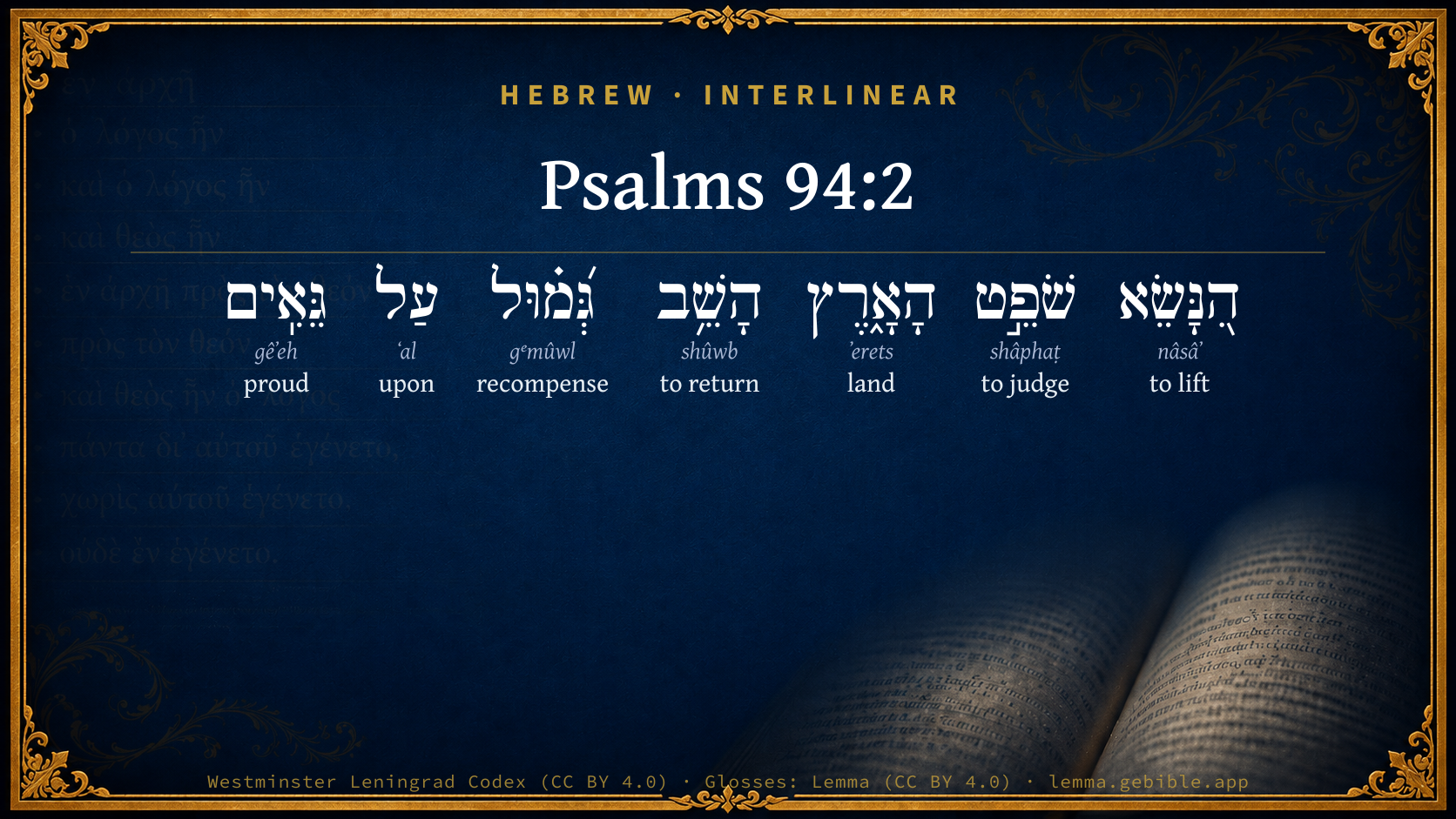
Psalms 94:2

Hebrew (Westminster Leningrad Codex) Psalms 94:2 appears in the Hebrew Old Testament. The text above is from the Westminster Leningrad Codex. Each word links to its Strong’s number, a concise gloss, and parsing drawn from the Open Scriptures Hebrew Bible morphology. Click any word for its full Brown-Driver-Briggs (BDB) entry.
Download image
Cite this verse

Psalms 94:2 (World English Bible). Public Domain. Lemma interlinear Bible study tool, https://lemma.gebible.app/v/psalms/94/2.

Show BibTeX & RIS
BibTeX
RIS
English Translation
Rise up, you judge of the earth. Pay back the proud what they deserve.
World English Bible · Public Domain
Download a study sheet

One document with this verse’s original text, its word-by-word gloss line, the meaning frame, cross-references with their text, attributed commentary, and full source and license credits — printable, and it pastes into notes with its structure intact.

This verse Autodidact and up

Study sheet (.html) Plain text (.txt)

A passage Seminary Student

Up to 50 verses in one chapter. A passage sheet keeps up to 6 commentary sources and 12 cross-references per verse, in the order this page ranks them, and says so on the sheet whenever that leaves anything out. Ask for a single verse and you get the Autodidact verse sheet above.

Everything on this page stays free to read, with no account — the sheet is a download of what is already on screen, not access to it.

Want to remove ads? Support Godless Engineer
Compare translations 3

The same verse in 3 English versions, stacked beneath the original-language interlinear above. Click any original word for its lexicon entry.

Each is an independent rendering of the whole verse — the interlinear is not word-aligned to these translations.

Highlighted words mark where these versions differ — a whole-verse word diff, not a word-by-word alignment.

  • World English Bible Public Domain
    Rise up, you judge of the earth. Pay back the proud what they deserve.
  • King James Version Public Domain
    Lift up thyself, thou judge of the earth: render a reward to the proud.
  • unfoldingWord Literal Text CC BY-SA 4.0
    Rise up, judge of the earth, return recompense upon the proud.

unfoldingWord Literal Text — © unfoldingWord, licensed CC BY-SA 4.0. Word-aligned USFM3 via Door43 (git.door43.org/unfoldingWord/en_ult).

Versions to compare (up to 4)

3 of 4 selected

Show all 18 translations

Every available English version of this verse, each an independent rendering of the whole verse.

  • World English Bible Public Domain
    Rise up, you judge of the earth. Pay back the proud what they deserve.
  • Berean Standard Bible Public Domain
    Rise up, O Judge of the earth; render a reward to the proud.
  • Majority Standard Bible Public Domain
    Rise up, O Judge of the earth; render a reward to the proud.
  • King James Version Public Domain
    Lift up thyself, thou judge of the earth: render a reward to the proud.
  • American Standard Version (1901) Public Domain
    Lift up thyself, thou judge of the earth: Render to the proud `their' desert.
  • Revised Version (1885) Public Domain
    Lift up thyself, thou judge of the earth: render to the proud their desert.
  • Geneva Bible (1599) Public Domain
    Exalt thy selfe, O Iudge of the worlde, and render a reward to the proude.
  • Douay-Rheims (1899) Public Domain
    Lift up thyself, thou that judgest the earth: render a reward to the proud.
  • Young's Literal Translation Public Domain
    Be lifted up, O Judge of the earth, Send back a recompence on the proud.
  • Literal Standard Version CC BY-SA 4.0
    Be lifted up, judging the earth, || Send back a repayment on the proud.
  • Unlocked Literal Bible CC BY-SA 4.0
    Rise up, judge of the earth, give to the proud what they deserve.
  • unfoldingWord Literal Text CC BY-SA 4.0
    Rise up, judge of the earth, return recompense upon the proud.
  • Darby Bible Public Domain
    Lift up thyself, thou judge of the earth, render the reward to the proud.
  • World Messianic Bible Public Domain
    Rise up, you judge of the earth. Pay back the proud what they deserve.
  • Webster's Bible Public Domain
    Lift up thyself, thou judge of the earth: render a reward to the proud.
  • Free Bible Version CC BY-SA 4.0
    Stand up, judge of the earth, and pay back those who are proud what they deserve.
  • Bible in Basic English Public Domain
    Be lifted up, O judge of the earth; let their reward come to the men of pride.
  • JPS Tanakh (1917) Public Domain
    Lift up Thyself, Thou Judge of the earth; render to the proud their recompense.

Literal Standard Version (2020), Covenant Press — licensed CC BY-SA 4.0. Text via the HelloAO Bible API (eBible.org). Unlocked Literal Bible (unfoldingWord) — licensed CC BY-SA 4.0. Text via the HelloAO Bible API (eBible.org). unfoldingWord Literal Text — © unfoldingWord, licensed CC BY-SA 4.0. Word-aligned USFM3 via Door43 (git.door43.org/unfoldingWord/en_ult). Free Bible Version, Dr. Jonathan Gallagher — licensed CC BY-SA 4.0. Text via the HelloAO Bible API (eBible.org).

Word by word

More ways to search: Search by grammar → Find every occurrence → Compare this word →

Practice this passage: Drill this verse → Learn its vocabulary →

About this verse

These counts appear in no published source. They are computed here, from the morphology-tagged text and Lemma’s own curated glosses. What Lemma adds →

7
words
7
distinct lemmas
Wisdom
section

Notable vocabulary

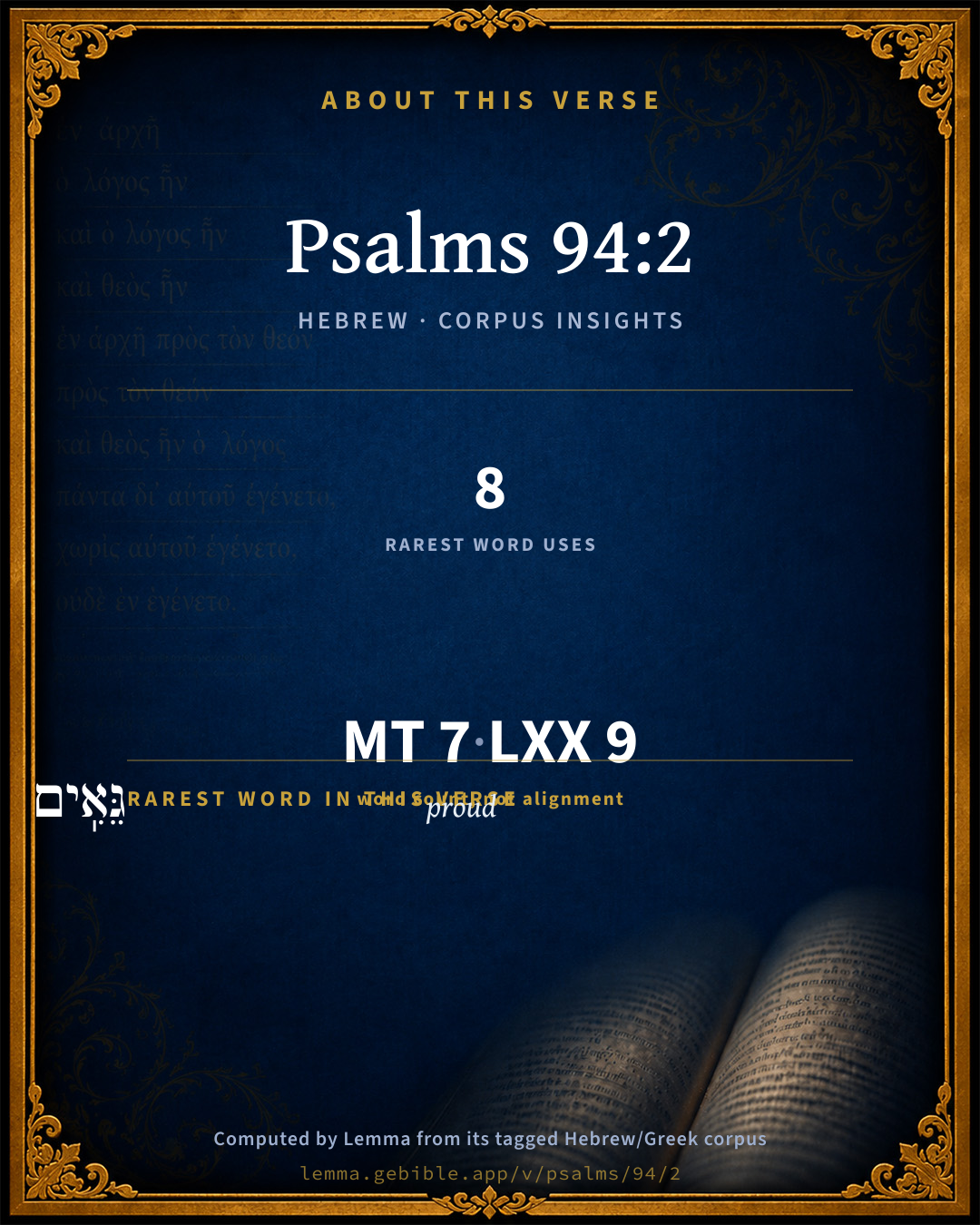
The rarest word here is גֵּאִֽים proud H1343 — appearing just 8 times in the whole Hebrew Bible.

Shared distinctive vocabulary

גֵּאִֽים proud H1343 occurs in 8 verses of the Hebrew Bible. Also found in:

Grammatical profile

  • 3 verbs
  • 2 nouns
  • 1 adjective
  • 1 preposition

Verb forms

  • הִ֭נָּשֵׂא Niphal · Imperative
  • שֹׁפֵ֣ט Qal · Participle Active
  • הָשֵׁ֥ב Hiphil · Imperative

Hebrew & Septuagint length

In English translation the verse runs 14 words from the Hebrew and 14 from the Septuagint (LXX English) — the same length.

A rough comparison of the two English renderings, which tokenize alike — not a word-level alignment.

Word counts can differ between the Hebrew and the Greek without any difference in meaning — e.g. the Hebrew direct-object marker אֵת has no separate Greek word, and Greek often adds the article ὁ.

In the original languages it is 7 Hebrew tokens and 9 Greek tokens — but the two are counted differently (Hebrew bundles its prefixes and suffixes into one token; the Greek is in lemma form), so that isn’t a like-for-like length.

Cross-references

21

Topical passages linked to Psalms 94:2 in the Treasury of Scripture Knowledge — connected by theme and wording, ordered by reader-vote popularity; previews shown in the World English Bible.

  • Psalms 7:6 Arise, Yahweh, in your anger. Lift up yourself against the rage of my adversaries. Awake for me. You have commanded judgment.
  • Psalms 31:23 Oh love Yahweh, all you his saints! Yahweh preserves the faithful, And pays back him who deals proudly in full.
  • 2 Corinthians 5:10 For we must all be revealed before the judgment seat of Christ; that each one may receive the things in the body, according to what he has done, whether good or bad.
  • Genesis 18:25 Be it far from you to do things like that, to kill the righteous with the wicked, that so the righteous should be as the wicked. May that be far from you. Shouldn't the Judge of all the earth do right?"
  • Micah 5:9 Let your hand be lifted up above your adversaries, And let all of your enemies be cut off.
  • John 5:22–23 For the Father judges no one, but he has given all judgment to the Son,
  • 1 Peter 5:5 Likewise, you younger ones, be subject to the elder. Yes, all of you gird yourselves with humility, to subject yourselves to one another; for "God resists the proud, but gives grace to the humble."
  • Job 40:11–12 Pour forth the fury of your anger. Look on everyone who is proud, and bring him low.
  • Psalms 50:6 The heavens shall declare his righteousness, For God himself is judge. Selah.
  • Psalms 68:1 Let God arise! Let his enemies be scattered! Let them who hate him also flee before him.
  • Psalms 74:22 Arise, God! Plead your own cause. Remember how the foolish man mocks you all day.
  • Isaiah 2:11–12 The lofty looks of man will be brought low, The haughtiness of men will be bowed down, And Yahweh alone will be exalted in that day.
  • Isaiah 2:17 The loftiness of man shall be bowed down, And the haughtiness of men shall be brought low; And Yahweh alone shall be exalted in that day.
  • Isaiah 10:12 Therefore it shall happen that, when the Lord has performed his whole work on Mount Zion and on Jerusalem, I will punish the fruit of the stout heart of the king of Assyria, and the glory of his high looks.
  • Isaiah 37:23 Whom have you defied and blasphemed? and against whom have you exalted your voice and lifted up your eyes on high? [even] against the Holy One of Israel.
  • Isaiah 37:29 Because of your raging against me, and because your arrogance is come up into my ears, therefore will I put my hook in your nose, and my bridle in your lips, and I will turn you back by the way by which you came.
  • Isaiah 37:36–38 The angel of Yahweh went forth, and struck in the camp of the Assyrians one hundred and eighty-five thousand; and when men arose early in the morning, behold, these were all dead bodies.
  • Jeremiah 50:31–32 Behold, I am against you, you proud one, says the Lord, Yahweh of Hosts; for your day is come, the time that I will visit you.
  • Daniel 4:37 Now I, Nebuchadnezzar, praise and extol and honor the King of heaven; for all his works are truth, and his ways justice; and those who walk in pride he is able to abase.
  • Daniel 5:22–24 You his son, Belshazzar, have not humbled your heart, though you knew all this,
  • Revelation 18:6–8 Return to her just as she returned, and repay her double as she did, and according to her works. In the cup which she mixed, mix to her double.

Cross-references courtesy of OpenBible.info (CC BY 4.0).

Hebrew and Greek witnesses Masoretic Hebrew ↔ Greek Septuagint

The same verse in the two great witnesses to the Old Testament, shown verse-for-verse.

You’re reading Greek Psalm 93 (Hebrew Psalm 94). The Septuagint counts the superscription, so verse numbers can differ from the Hebrew — chapter-level alignment, not verse-by-verse. Numbering follows Rahlfs.

These are two independent witnesses, not word-aligned to each other, and the Septuagint is shown in lemma (dictionary) form.

Hebrew Psalms 94:2 Masoretic · Westminster Leningrad Codex

הִ֭נָּשֵׂא שֹׁפֵ֣ט הָאָ֑רֶץ הָשֵׁ֥ב גְּ֝מ֗וּל עַל גֵּאִֽים

Rise up, you judge of the earth. Pay back the proud what they deserve.

World English Bible · Public Domain

Greek LXX Greek Psalm 93:2 Septuagint · lemma form

ὑψόω ὁ κρίνω ὁ γῆ ἀποδίδωμι ἀνταπόδοσις ὁ ὑπερήφανος

Be you exalted, you that judge the earth: render a reward to the proud.

LXX2012 (modern English Septuagint) · Public Domain

Hebrew: Westminster Leningrad Codex (CC BY 4.0). Greek: Septuagint (public domain); English from LXX2012 (modern English Septuagint) (Public Domain). How the Septuagint differs from the Hebrew →

Commentary

Notes on Psalms 94:2 from classic Christian and Jewish commentators (each source and its license shown beneath its notes). The classic Christian expositions comment on the surrounding passage and are grouped to its opening verse, so a note may address several verses; the Jewish commentaries on the Tanakh (Rashi and others) are per-verse, so they appear only where the commentator wrote on this verse.

Lemma curates 59 commentaries, every one of them public domain or Creative Commons licensed, each selected and text-cleaned for this edition rather than reprinted as found. About our sources →

Trapp's Complete Commentary

John Trapp

Psa 94:2 Lift up thyself, thou judge of the earth: render a reward to the proud.

Ver. 2. Lift up thyself, thou judge of the earth] Judges, as they ascend the tribunal, so when to pass sentence they usually stand up. See Isa 33:10. And hereunto the psalmist alludeth.

John Trapp, A Commentary or Exposition upon All the Books of the Old and New Testament (1647–1656) — public domain. Text from a community e-Sword module.

J. A. Alexander on Psalms

Joseph Addison Alexander

2. (Psa 94:2) Raise thyself, Judge of the Earth, return a recompence upon the proud. The first verb is equivalent in meaning to the more familiar term, arise, i.e. arouse thyself from inactivity, address thyself to action. See above, on Psa 3:7. The specific sense, which some interpreters assume, "Ascend the judgment-seat," is not expressed by this verb, but suggested by the context. The word translated recompence strictly means the treatment of one person by another, to return which is to retaliate or recompense it. See above, on Psa 7:4, and compare Psa 79:12. The use of the particle upon implies the inequality of the parties or the superiority of the avenger, from whom the recompence, as it were, comes down upon the guilty.

Joseph Addison Alexander, The Psalms Translated and Explained (1850) — public domain. Text from a community e-Sword module.

Tyndale Open Study Notes

Tyndale Open Resources

94:2 Just as the Lord’s enemies rise up against him and his people (3:7; 93:3), he must arise and make retribution against the enemy (see 79:12; Isa 65:6).

Tyndale Open Study Notes — © Tyndale Open Resources, licensed CC BY-SA 4.0. Text via the HelloAO Bible API.

Adam Clarke's Commentary

Verse 2. Lift up thyself] Exert thy power.

Render a reward to the proud.] To the Babylonians, who oppress and insult us.

Adam Clarke's Commentary on the Bible (1810–1826) — public domain. Text from a community e-Sword/MySword module.

Ellicott's Commentary for English Readers

(2) Lift up thyself—i.e., either be exalted, or rise to give sentence.

A Bible Commentary for English Readers, edited by Charles John Ellicott (1878–1897) — public domain. Text from a community e-Sword module.

The Cambridge Bible for Schools and Colleges

gen. ed. J. J. S. Perowne

2. Lift up thyself] Shew Thyself to be the supremely exalted Ruler. Cp. Isa_6:1; Isa_33:10; Psa_7:6.

judge of the earth] Cp. Gen_18:25; Psa_58:11; Psa_82:8. The universal Judge is needed to call the subordinate ‘judges of the earth’ to account.

render a reward to the proud] R.V. Render to the proud (their) desert; assimilating the rendering to that of Psa_28:4. Cp. Lam_3:64.

The Cambridge Bible for Schools and Colleges (gen. ed. J. J. S. Perowne; Cambridge University Press, 1878–1918) — public domain. Text from a community e-Sword module.

John Gill's Exposition

Lift up thyself, thou, O Judge of the earth,.... A title very proper to Christ, and which is given him by Abraham, Gen 18:25, who then appeared to him in an human form, and with whom he was conversing; he judges his own people on earth, all judgment being committed to him by the Father; he judges and chastises them, that they may not be condemned with the world; he judges and distinguishes between them and the world; he protects and defends them, he pleads their cause, and avenges them on their enemies: and for this purpose he is requested to "lift up" himself; being in the apprehension of his people as one laid down and asleep, quite negligent and careless of them; and therefore they desire that he would awake and arise, and exert his power, and show himself higher than their enemies; that he would mount his throne, and execute justice and judgment on the wicked, agreeably to his character and office:

render a reward to the proud; an evil reward, as the Targum; to proud persecutors of the church, who through their pride persecute the poor saints; and to render tribulation to them is but just with the Lord; to antichrist, that exalts himself above all that is called God, and to all his haughty and ambitious dependents and followers, cardinals, bishops, priests, &c.

John Gill's Exposition of the Whole Bible (1746–1763) — public domain (CC PDM 1.0). Text via the HelloAO Bible API.

Albert Barnes' Notes on the Bible

Lift up thyself - Be exalted or lifted up so as to be manifest in thy true character. The idea is that God was, as it were, sitting at his ease, or as if he were indifferent to what was occurring in the world. See the notes at Psa 3:7.

Thou Judge of the earth - Ruler of the world; to whom it pertains to exercise judgment over all classes of people, and in all circumstances. The meaning here is, that as he was the Ruler of the whole earth, this matter came without doubt under his jurisdiction. It was a case for his interposition.

Render a reward to the proud - A just recompence to the people who are confident in their own strength, and who are manifesting their pride in depriving others of their rights.

Albert Barnes' Notes on the Bible (1834–1885) — public domain. Text from a community e-Sword/MySword module.

Matthew Poole's English Annotations

Lift up thyself; either,

1. Ascend thy tribunal to pronounce the sentence. Or,

2. Arise from thy seat, and bestir thyself to punish thy proud enemies, as it here follows.

Matthew Poole's English Annotations on the Holy Bible (1683–1685) — public domain. Text from a community e-Sword/MySword module.

The Treasury of David

Charles H. Spurgeon

Ver. 2. Lift up thyself, thou judge of the earth. Ascend thy judgment seat and be acknowledged as the ruler of men: and, moreover, raise thyself as men do who are about to strike with all their might; for the abounding sin of mankind requires a heavy blow from thy hand.

Render a reward to the proud, give them measure for measure, a fair retaliation, blow for blow. The proud look down upon the gracious poor and strike them from above, as a giant might hurl down blows upon his adversary; after the same manner, O Lord, lift up thyself, and "return a recompense upon the proud, "and let them know that thou art far more above them than they can be above the meanest of their fellow men. The psalmist thus invokes the retribution of justice in plain speech, and his request is precisely that which patient innocence puts up in silence, when her looks of anguish appeal to heaven.

Ver. 2. The peculiar provocation of the sin of pride and its kindred vices. Its influence on the proud, on their follow men, and upon God himself.

Psalms 94:3*

Charles H. Spurgeon's The Treasury of David (1869–1885) — public domain. Psalms only. Text from a community e-Sword/MySword module.

Whedon's Commentary on the Bible

Daniel D. Whedon

2. Reward to the proud—Recompense upon the arrogant. The upon specifies the visitation of personal desert. God will avenge his elect and requite innocent blood. See Deu_32:35

Daniel D. Whedon (gen. ed.), Commentary on the Old and New Testaments (1874–1909) — public domain. Text from a community e-Sword module.

The Pulpit Commentary

Lift up thyself. (comp. Psa_7:6 Isa_33:10) "Rouse thyself," that is, "from thy state of inaction come and visit the earth as Judge. Thou Judge of the earth. (comp. Gen_18:25 Psa_58:11) Render a reward to the proud; rather, render a recompense as the same phrase is translated in Lam_3:64.

"The Judge of all the earth.

The older Scriptures constantly set God forth as the actual, living Judge, concerned now in his Divine magistracy, deciding causes, vindicating the oppressed, punishing the wrong doer. The idea of some one single judgment day, in the far future, when all earth complications are to be put straight, and all earth evils are to be rectified, does not appear to have been in the minds of Old Testament saints. It may be that the New Testament figure of the "judgment seat of Christ" has unduly limited the Christian idea of the present and ever-continuous judging of God. It may be that this present judging needs to be set more clearly before the Christian mind. Our notion of the Judge is of one who, at a fixed time, holds a grand assize; and this notion helps to shape our figure of a single final judgment. But the Israelite thought of judging, magistracy, as the most important continuous function of his king, which every faithful king would exercise daily, sitting in the gate to hear and decide all causes that might be presented, and so coming into constant judicial relation to the life of the people. Shifting God"s judgment on to a future great assize should not be allowed to loosen our Christian sense of God"s present rule as involving a present magistracy, and present punishments and rewards. Read life aright, and the signs of a present Divine magistracy will abundantly appear.

I GOD THE JUDGE IS DISTINGUISHING IN DIFFICULT CASES. Illustrate from the nisi prius courts. Constantly in life we find ourselves bewildered. We do not know what to think, or what to do, or where to go. We are in danger of being carried away by the merely attractive. If we will but wait, God will surely decide for us, and make the right for us quite unquestionable.

II GOD THE JUDGE IS RECOGNIZING AND REWARDING THE RIGHTEOUS. We never have any doubt of this until we become impatient, and want the recognition at once. Because the Judge is also the Sanctifier, he may delay the reward which he decides to be due. But he is keen to notice everything that is good.

III GOD THE JUDGE IS THE PUNISHER OF ALL THE WICKED. We need never be deceived by the apparent prosperity of the unjust. It is part of their judgment. It is making them top-heavy in preparation for some irremediable fall. R.T.

The Pulpit Commentary (1880–1919), ed. H.D.M. Spence-Jones & Joseph S. Exell — public domain. Text from a community e-Sword module.

Lesson kit

Teaching starters — assembled from the data on this page, not authored interpretation. Every prompt links to the verse data it draws on. Edit before teaching.

Psalms, in the Wisdom, opens this verse with 7 words (7 distinct Hebrew lemmas). Its most distinctive word is gêʼeh (“proud”). A historical commentator’s framing appears above. Read the whole chapter for the surrounding context.

Discussion questions

  1. How does “proud” (gêʼeh) shape what this verse is saying?
  2. How does Job 40:11, which shares the word «proud», read alongside this verse?
  3. These translations render this verse differently. What is at stake in choosing one wording over another?
  4. «הִ֭נָּשֵׂא» is a Niphal Imperative verb. How does that grammatical form shape the action described?
  5. Compare how Trapp's Complete Commentary and J. A. Alexander on Psalms read this verse. Where do they agree or differ?

Things to notice

Reading settings

Reading text

Shown beneath each verse's original-language words.

Old Testament
Old Testament edition

Read the OT as the Masoretic Hebrew (MT) or the Greek Septuagint (LXX).

English shown for the Greek Septuagint (in the Hebrew ↔ Greek comparison).

Comparing translations? Open the Compare panel on any verse page to stack up to four side by side.