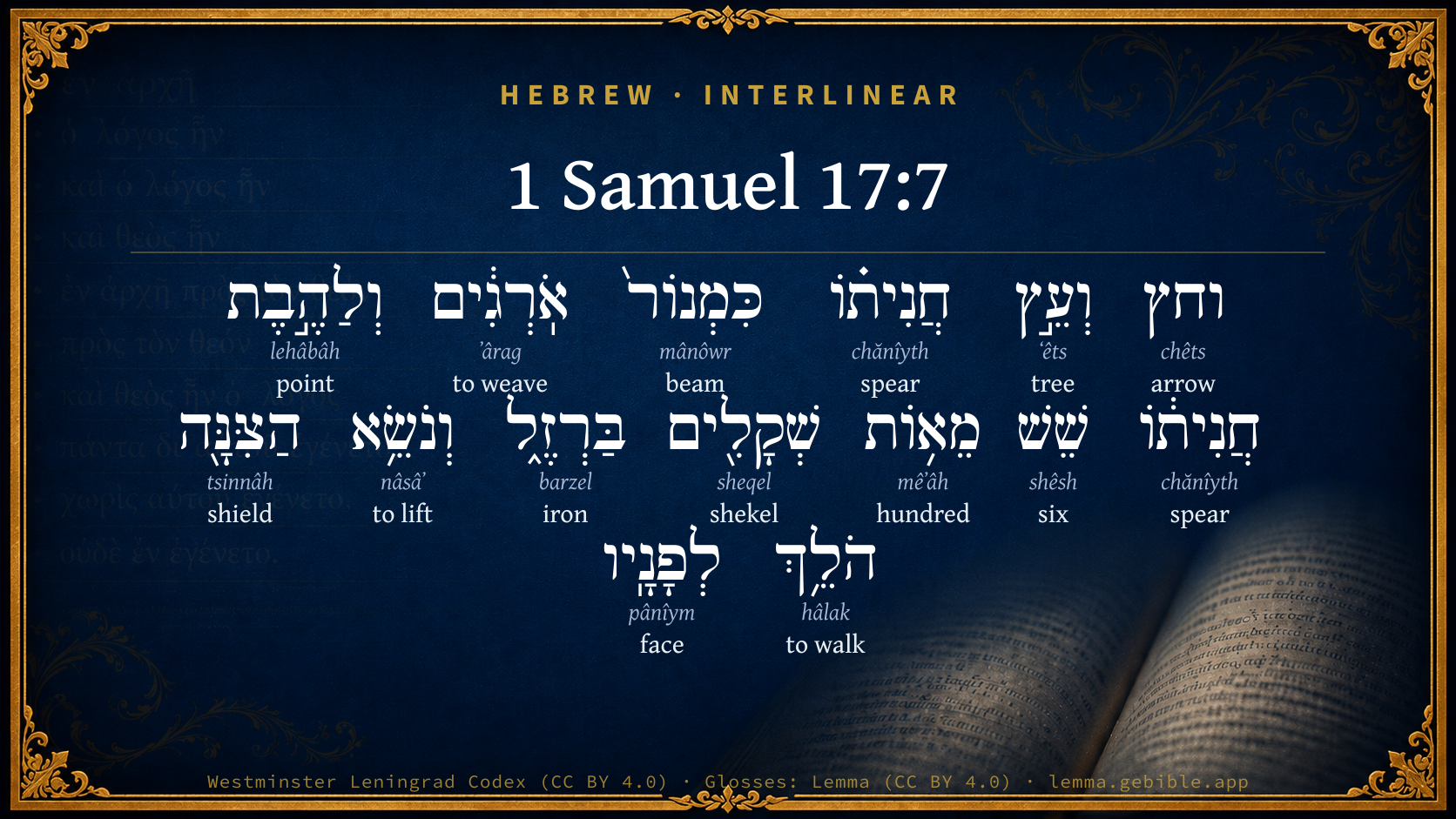
1 Samuel 17:7

Hebrew (Westminster Leningrad Codex) 1 Samuel 17:7 appears in the Hebrew Old Testament. The text above is from the Westminster Leningrad Codex. Each word links to its Strong’s number, a concise gloss, and parsing drawn from the Open Scriptures Hebrew Bible morphology. Click any word for its full Brown-Driver-Briggs (BDB) entry.
Download image
Cite this verse

1 Samuel 17:7 (World English Bible). Public Domain. Lemma interlinear Bible study tool, https://lemma.gebible.app/v/1-samuel/17/7.

Show BibTeX & RIS
BibTeX
RIS
English Translation
The staff of his spear was like a weaver's beam; and his spear's head [weighed] six hundred shekels of iron: and his shield-bearer went before him.
World English Bible · Public Domain
Highlights
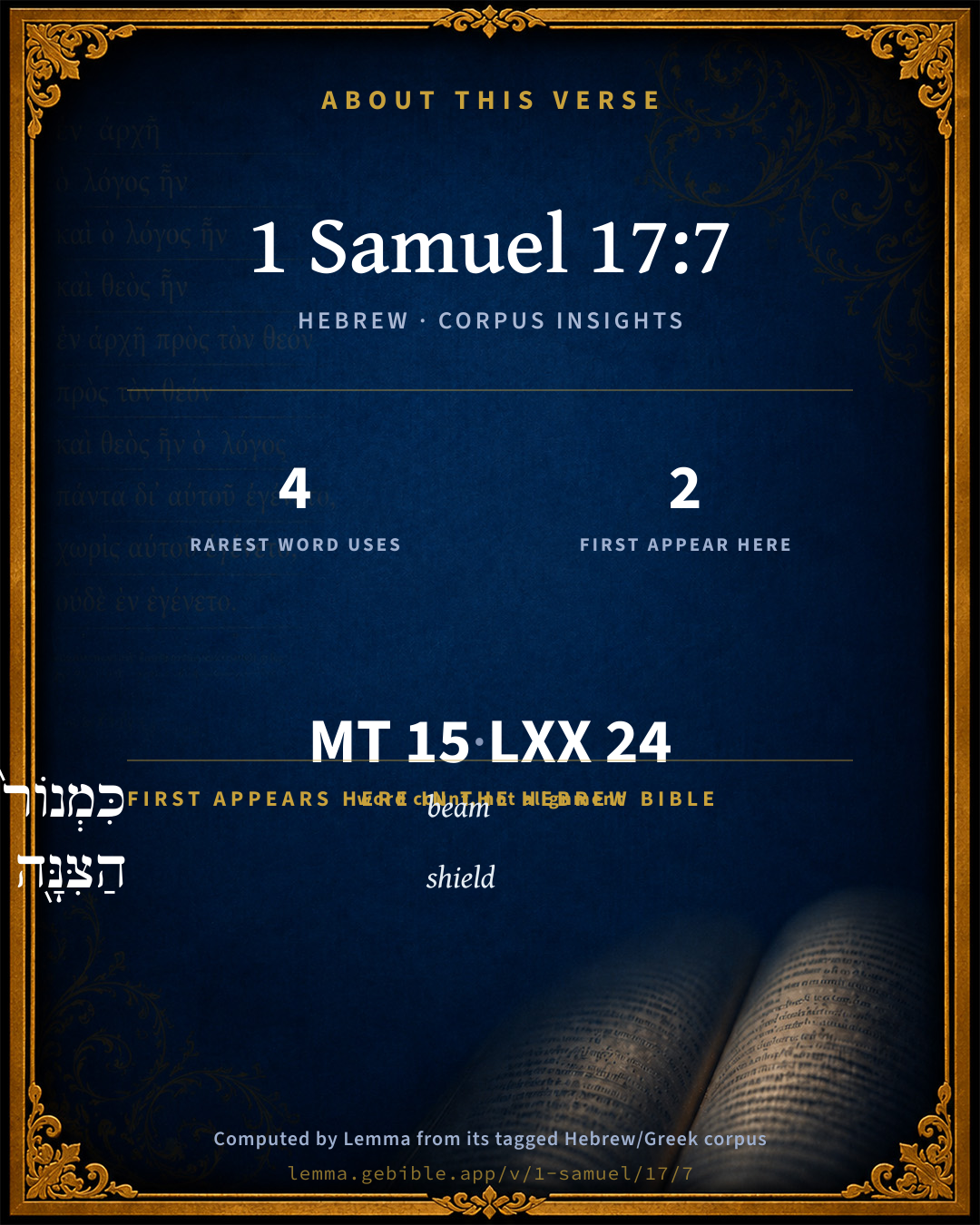
  • 2 first appearances in the Hebrew Bible
Full analysis ↓
Download a study sheet

One document with this verse’s original text, its word-by-word gloss line, the meaning frame, cross-references with their text, attributed commentary, and full source and license credits — printable, and it pastes into notes with its structure intact.

This verse Autodidact and up

Study sheet (.html) Plain text (.txt)

A passage Seminary Student

Up to 50 verses in one chapter. A passage sheet keeps up to 6 commentary sources and 12 cross-references per verse, in the order this page ranks them, and says so on the sheet whenever that leaves anything out. Ask for a single verse and you get the Autodidact verse sheet above.

Everything on this page stays free to read, with no account — the sheet is a download of what is already on screen, not access to it.

Want to remove ads? Support Godless Engineer
Compare translations 3

The same verse in 3 English versions, stacked beneath the original-language interlinear above. Click any original word for its lexicon entry.

Each is an independent rendering of the whole verse — the interlinear is not word-aligned to these translations.

Highlighted words mark where these versions differ — a whole-verse word diff, not a word-by-word alignment.

  • World English Bible Public Domain
    The staff of his spear was like a weaver's beam; and his spear's head [weighed] six hundred shekels of iron: and his shield-bearer went before him.
  • King James Version Public Domain
    And the staff of his spear was like a weaver's beam; and his spear's head weighed six hundred shekels of iron: and one bearing a shield went before him.
  • unfoldingWord Literal Text CC BY-SA 4.0
    And the wood of his spear like a beam of weavers, and the flame of his spear 600 iron shekels. And the carrier of his shield was going to his face.

unfoldingWord Literal Text — © unfoldingWord, licensed CC BY-SA 4.0. Word-aligned USFM3 via Door43 (git.door43.org/unfoldingWord/en_ult).

Versions to compare (up to 4)

3 of 4 selected

Show all 18 translations

Every available English version of this verse, each an independent rendering of the whole verse.

  • World English Bible Public Domain
    The staff of his spear was like a weaver's beam; and his spear's head [weighed] six hundred shekels of iron: and his shield-bearer went before him.
  • Berean Standard Bible Public Domain
    The shaft of his spear was like a weaver’s beam, and its iron point weighed six hundred shekels. In addition, his shield bearer went before him.
  • Majority Standard Bible Public Domain
    The shaft of his spear was like a weaver’s beam, and its iron point weighed six hundred shekels. In addition, his shield bearer went before him.
  • King James Version Public Domain
    And the staff of his spear was like a weaver's beam; and his spear's head weighed six hundred shekels of iron: and one bearing a shield went before him.
  • American Standard Version (1901) Public Domain
    And the staff of his spear was like a weaver's beam; and his spear's head `weighed' six hundred shekels of iron: and his shield-bearer went before him.
  • Revised Version (1885) Public Domain
    And the staff of his spear was like a weaver’s beam; and his spear’s head weighed six hundred shekels of iron: and his shield-bearer went before him.
  • Geneva Bible (1599) Public Domain
    And the shaft of his speare was like a weauers beame: and his speare head weyed sixe hundreth shekels of yron: and one bearing a shielde went before him.
  • Douay-Rheims (1899) Public Domain
    And the staff of his spear was like a weaver's beam, and the head of his spear weighed six hundred sicles of iron: and his armourbearer went before him.
  • Young's Literal Translation Public Domain
    and the wood of his spear `is' like a beam of weavers', and the flame of his spear `is' six hundred shekels of iron, and the bearer of the buckler is going before him.
  • Literal Standard Version CC BY-SA 4.0
    and the wood of his spear [is] like a weavers’ beam, and the flame of his spear [is] six hundred shekels of iron, and the bearer of the buckler is going before him.
  • Unlocked Literal Bible CC BY-SA 4.0
    The staff of his spear was large, with a loop of cord for throwing it like the cord on a weaver's beam. His spear's head weighed six hundred shekels of iron. His shield bearer went before him.
  • unfoldingWord Literal Text CC BY-SA 4.0
    And the wood of his spear like a beam of weavers, and the flame of his spear 600 iron shekels. And the carrier of his shield was going to his face.
  • Darby Bible Public Domain
    And the shaft of his spear was like a weaver's beam; and his spear's head weighed six hundred shekels of iron; and the shield-bearer went before him.
  • World Messianic Bible Public Domain
    The staff of his spear was like a weaver’s beam; and his spear’s head weighed six hundred shekels of iron. His shield bearer went before him.
  • Webster's Bible Public Domain
    And the staff of his spear was like a weaver's beam; and his spear's head weighed six hundred shekels of iron: and one bearing a shield went before him.
  • Free Bible Version CC BY-SA 4.0
    The shaft of his spear was as thick as weaver's beam, with an iron tip that weighed six hundred shekels. His shield-bearer walked ahead of him carrying his shield.
  • Bible in Basic English Public Domain
    The stem of his spear was as long as a cloth-worker's rod, and its head was made of six hundred shekels' weight of iron: and one went before him with his body-cover.
  • JPS Tanakh (1917) Public Domain
    And the shaft of his spear was like a weaver's beam; and his spear's head weighed six hundred shekels of iron; and his shield-bearer went before him.

Literal Standard Version (2020), Covenant Press — licensed CC BY-SA 4.0. Text via the HelloAO Bible API (eBible.org). Unlocked Literal Bible (unfoldingWord) — licensed CC BY-SA 4.0. Text via the HelloAO Bible API (eBible.org). unfoldingWord Literal Text — © unfoldingWord, licensed CC BY-SA 4.0. Word-aligned USFM3 via Door43 (git.door43.org/unfoldingWord/en_ult). Free Bible Version, Dr. Jonathan Gallagher — licensed CC BY-SA 4.0. Text via the HelloAO Bible API (eBible.org).

Word by word

More ways to search: Search by grammar → Find every occurrence → Compare this word →

Practice this passage: Drill this verse → Learn its vocabulary →

כִּמְנוֹר֙
mânôwr
H4500
“like/as · beam of”
Preposition + Noun, Common, Masculine, Singular, Construct
Part of Speech
Preposition + Noun
Type
Common
Gender
Masculine
Number
Singular
State
Construct
Full BDB Definition

Origin: from H5214

TWOT: 1361a

beam - beam (carrying the heddles in a loom)
  1. וחץ chêts H2671 “and · arrow of” Conjunction + Noun, Common, Masculine, Singular, Construct
  2. וְעֵ֣ץ ʻêts H6086 “and · tree of” Conjunction + Noun, Common, Masculine, Singular, Construct
  3. חֲנִית֗וֹ chănîyth H2595 “spear · his” Noun, Common, Feminine, Singular, Construct + Suffix, Personal, 3rd Person, Masculine, Singular
  4. אֹֽרְגִ֔ים ʼârag H707 “weaving” Verb, Qal, Participle Active, Masculine, Plural, Absolute
  5. וְלַהֶ֣בֶת lehâbâh H3852 “and · point of” Conjunction + Noun, Common, Feminine, Singular, Construct
  6. חֲנִית֔וֹ chănîyth H2595 “spear · his” Noun, Common, Feminine, Singular, Construct + Suffix, Personal, 3rd Person, Masculine, Singular
  7. שֵׁשׁ shêsh H8337 “six” Adjective, Cardinal number, Feminine, Singular, Absolute
  8. מֵא֥וֹת mêʼâh H3967 “hundred” Adjective, Cardinal number, Both, Plural, Absolute
  9. שְׁקָלִ֖ים sheqel H8255 “shekels” Noun, Common, Masculine, Plural, Absolute
  10. בַּרְזֶ֑ל barzel H1270 “iron” Noun, Common, Masculine, Singular, Absolute
  11. וְנֹשֵׂ֥א nâsâʼ H5375 “and · lifting” Conjunction + Verb, Qal, Participle Active, Masculine, Singular, Construct
  12. הַצִּנָּ֖ה tsinnâh H6793 “the · shield” Particle, Definite Article + Noun, Common, Feminine, Singular, Absolute
  13. הֹלֵ֥ךְ hâlak H1980 “walking” Verb, Qal, Participle Active, Masculine, Singular, Absolute
  14. לְפָנָֽיו pânîym H6440 “to/for · face(s) · his” Preposition + Noun, Common, Both, Plural, Construct + Suffix, Personal, 3rd Person, Masculine, Singular

About this verse

These counts appear in no published source. They are computed here, from the morphology-tagged text and Lemma’s own curated glosses. What Lemma adds →

15
words
14
distinct lemmas
Historical
section

Notable vocabulary

The rarest word here is כִּמְנוֹר֙ beam H4500 — appearing just 4 times in the whole Hebrew Bible.

First appearance in Scripture

These words make their first canonical appearance in the Hebrew Bible here:

  • כִּמְנוֹר֙ beam H4500
  • הַצִּנָּ֖ה shield H6793

Shared distinctive vocabulary

כִּמְנוֹר֙ beam H4500 occurs in 4 verses of the Hebrew Bible. Also found in:

Grammatical profile

  • 3 verbs
  • 10 nouns
  • 2 adjectives

Verb forms

  • אֹֽרְגִ֔ים Qal · Participle Active
  • וְנֹשֵׂ֥א Qal · Participle Active
  • הֹלֵ֥ךְ Qal · Participle Active

Repetition

A word recurs within this verse — often emphatic in Hebrew:

  • חֲנִית֗וֹ spear H2595 ×2

Hebrew & Septuagint length

In English translation the verse runs 26 words from the Hebrew and 29 from the Septuagint (LXX English) — closely comparable.

A rough comparison of the two English renderings, which tokenize alike — not a word-level alignment.

Word counts can differ between the Hebrew and the Greek without any difference in meaning — e.g. the Hebrew direct-object marker אֵת has no separate Greek word, and Greek often adds the article ὁ.

In the original languages it is 15 Hebrew tokens and 24 Greek tokens — but the two are counted differently (Hebrew bundles its prefixes and suffixes into one token; the Greek is in lemma form), so that isn’t a like-for-like length.

Cross-references

4

Topical passages linked to 1 Samuel 17:7 in the Treasury of Scripture Knowledge — connected by theme and wording, ordered by reader-vote popularity; previews shown in the World English Bible.

  • 2 Samuel 21:19 There was again war with the Philistines at Gob; and Elhanan the son of Jaareoregim the Bethlehemite killed Goliath the Gittite's brother, the staff of whose spear was like a weaver's beam.
  • 1 Samuel 17:41 The Philistine came on and drew near to David; and the man who bore the shield went before him.
  • 1 Chronicles 11:23 He killed an Egyptian, a man of great stature, five cubits high; and in the Egyptian's hand was a spear like a weaver's beam; and he went down to him with a staff, and plucked the spear out of the Egyptian's hand, and killed him with his own spear.
  • 1 Chronicles 20:5 There was again war with the Philistines; and Elhanan the son of Jair killed Lahmi the brother of Goliath the Gittite, the staff of whose spear was like a weaver's beam.

Cross-references courtesy of OpenBible.info (CC BY 4.0).

Hebrew and Greek witnesses Masoretic Hebrew ↔ Greek Septuagint

The same verse in the two great witnesses to the Old Testament, shown verse-for-verse.

These are two independent witnesses, not word-aligned to each other, and the Septuagint is shown in lemma (dictionary) form.

Hebrew 1 Samuel 17:7 Masoretic · Westminster Leningrad Codex

וחץ וְעֵ֣ץ חֲנִית֗וֹ כִּמְנוֹר֙ אֹֽרְגִ֔ים וְלַהֶ֣בֶת חֲנִית֔וֹ שֵׁשׁ מֵא֥וֹת שְׁקָלִ֖ים בַּרְזֶ֑ל וְנֹשֵׂ֥א הַצִּנָּ֖ה הֹלֵ֥ךְ לְפָנָֽיו

The staff of his spear was like a weaver's beam; and his spear's head [weighed] six hundred shekels of iron: and his shield-bearer went before him.

World English Bible · Public Domain

Greek LXX 1 Samuel 17:7 Septuagint · lemma form

καί ὁ κοντός ὁ δόρυ αὐτός ὡσεί μέσακλον ὑφαίνω καί ὁ λόγχη αὐτός ἑξακόσιοι σίκλος σίδηρος καί ὁ αἴρω ὁ ὅπλον αὐτός προπορεύομαι αὐτός

And the staff of his spear was like a weaver's beam, and the spear's head was formed of six hundred shekels of iron; and his armor-bearer went before him.

LXX2012 (modern English Septuagint) · Public Domain

Hebrew: Westminster Leningrad Codex (CC BY 4.0). Greek: Septuagint (public domain); English from LXX2012 (modern English Septuagint) (Public Domain). How the Septuagint differs from the Hebrew →

Targum (Aramaic paraphrase)

1

The Targum is the ancient Jewish Aramaic paraphrase of the Hebrew Scriptures — an interpretive translation, not the Hebrew text itself. Onkelos (literal) and Pseudo-Jonathan (expansive) render the Torah, and Jonathan the Prophets. Coverage is partial: where no permissively-licensed English translation exists for a verse, only the Aramaic is shown. This is verse-level text, not a word-by-word alignment to the Hebrew.

  1. Targum Jonathan Prophets (Joshua–Malachi)
    וְאָעָא דְמוּרְנִיתֵיהּ כְּאַכְסָן דְגַרְדָאִין וְשִׁנָנָא דְמוּרְנִיתֵיהּ מַתְקַל שִׁית מְאָה תִקְלֵי פַרְזְלָא וְנָטַל תְּרֵיסָא אָזֵיל קֳדָמוֹהִי:

    (no public-domain English translation for this verse)

    Targum Jonathan — Aramaic: “Mikraot Gedolot” (public domain). English: “Sefaria Community Translation” (CC0 1.0 (public-domain dedication)); “London "Chaldee Paraphrase," 1871” (public domain). Text via Sefaria.

Commentary

Notes on 1 Samuel 17:7 from classic Christian and Jewish commentators (each source and its license shown beneath its notes). The classic Christian expositions comment on the surrounding passage and are grouped to its opening verse, so a note may address several verses; the Jewish commentaries on the Tanakh (Rashi and others) are per-verse, so they appear only where the commentator wrote on this verse.

Lemma curates 59 commentaries, every one of them public domain or Creative Commons licensed, each selected and text-cleaned for this edition rather than reprinted as found. About our sources →

Trapp's Complete Commentary

John Trapp

1Sa 17:7 And the staff of his spear [was] like a weaver’s beam; and his spear’s head [weighed] six hundred shekels of iron: and one bearing a shield went before him.

Ver. 7. And one bearing a shield.] For state’s sake. He came into the field like thunder and lightning, but went out like a snuff.

John Trapp, A Commentary or Exposition upon All the Books of the Old and New Testament (1647–1656) — public domain. Text from a community e-Sword module.

The Biblical Illustrator

Joseph S. Exell

1Sa_17:7

One bearing a shield went before him.

The shield bearer of Goliath

I. That it is a grievous mistake for men to arm themselves as in triple mail against good influences. Goliath had a helmet of brass upon his head, and he was armed with a coat of mail, etc., and one bearing a shield went, before him. How many in spiritual matters surround their minds as it were wish a covering of obstinacy and indifference, so as to keep out from their understandings the knowledge of the truth, and case their hearts in an impregnable corselet of selfishness, so as to prevent the entrance of faith. In a different manner from this ought the humble believer, not inflated with ideas of his own righteousness, much less with any notion of bidding defiance of the armies of the living God, arm him for the battle of life.

II. That it is as futile as it is sinful to attempt to oppose the will of God. The shield of the shield bearer would not stop the stone sent from the sling of David. It is, assuredly, a presumption beyond description for the finite to imagine that he can understand, much less oppose, the Infinite. As well might the fly upon the wheel attempt to correct or to oppose the action of the machinery. If a counsel or a work be of God, ye cannot overthrow it, lest haply ye be found even to fight against God.

III. That worldly friendship, based on a companionship in sin, is weak in the hour of trial. When Goliath comes forth to tread vaingloriously before the armies of Israel, we read that this man bearing a shield went before him. He had attended the gigantic champion in the hour of triumph, does he remain faithful to him in the hour of misfortune? Does he attempt to strike a blow on behalf of his fallen master? Does he strive to prevent David from dishonouring that masters body, by cutting off the giants head with the giants own sword? We read of nothing of the kind; no effort to aid or to protect his master is recorded of him. Doubtless he fled, as the other Philistines fled, when the great champion fell. So, the friendship of the world is not only enmity against God, but is not lasting to be relied on. It is a mistake to state that there is honour amongst thieves; it is a delusion to think that there is loyalty to each other amongst sinners. The pursuit of unlawful pleasures is essentially a selfish pursuit; and the so-called friendships that are formed in it are evanescent and ephemeral. When such intimacies are found by any of the contracting parties to be no longer pleasant or profitable, the bond of self-interest that was their only connecting link is speedily broken, and the so-called friendship dissolved or ignored. Well is it, indeed, if it can be ended without bitterness and tears and blood. False friendship is like the gaudy but scentless sunflower, that will bloom only in the sunshine of prosperity. (R. Young, M. A.)

The Biblical Illustrator, edited by Joseph S. Exell (c. 1880s–1900s) — public domain. Text from a community e-Sword module.

Jamieson, Fausset & Brown

Robert Jamieson, A. R. Fausset & David Brown

staff of his spear--rather under five feet long, and capable of being used as a javelin (Sa1 19:10). It had an iron head.

one bearing a shield--In consequence of their great size and weight, the Oriental warrior had a trusty and skilful friend, whose office it was to bear the large shield behind which he avoided the missile weapons of the enemy. He was covered, cap-a-pie, with defensive armor, while he had only two offensive weapons--a sword by his side and a spear in his hand.

Jamieson, Fausset & Brown — Commentary Critical and Explanatory on the Whole Bible (1871) — public domain (CC PDM 1.0). Text via the HelloAO Bible API.

Adam Clarke's Commentary

Verse 7. The staff on his spear was like a weaver's beam] Either like that on which the warp is rolled, or that on which the cloth is rolled. We know not how thick this was, because there were several sorts of looms, and the sizes of the beams very dissimilar. Our woollen, linen, cotton, and silk looms are all different in the size of their beams; and I have seen several that I should not suppose too thick, though they might be too short, for Goliath's spear.

His spear's head weighed six hundred shekels of iron] That is, his spear's head was of iron, and it weighed six hundred shekels; this, according to the former computation, would amount to eighteen pounds twelve ounces.

And one bearing a shield] הצנה hatstsinnah, from צן tsan, pointed or penetrating, if it do not mean some kind of a lance, must mean a shield, with what is called the umbo, a sharp protuberance, in the middle, with which they could as effectually annoy their enemies as defend themselves. Many of the old Highland targets were made with a projecting dagger in the centre. Taking the proportions of things unknown to those known, the armour of Goliath is supposed to have weighed not less than two hundred and seventy-two pounds thirteen ounces! Plutarch informs us that the ordinary weight of a soldier's panoply, or complete armour, was one talent, or sixty pounds; and that one Alcimus, in the army of Demetrius, was considered as a prodigy, because his panoply weighed two talents, or one hundred and twenty pounds.

Adam Clarke's Commentary on the Bible (1810–1826) — public domain. Text from a community e-Sword/MySword module.

The Cambridge Bible for Schools and Colleges

gen. ed. J. J. S. Perowne

7. the staff of his spear, &c.] The shaft of Goliath’s spear, short, but extraordinarily stout and heavy, is compared to the “beam” to which the web is fastened in a loom (cp. 2Sa_21:19). The iron spear head weighed nearly nineteen pounds avoirdupois.

one bearing a shield] A large shield to protect the whole body. Comp. Layard’s Nineveh II. 346, “The archers, whether on foot or in chariots, were accompanied by shield-bearers, whose office it was to protect them from the shafts of the enemy. The king was always attended in his wars by this officer; and even in peace, one of his eunuchs usually carried a circular shield for his use. This shield-bearer was probably a person of high rank as in Egypt.” Ajax protects Teucer with his shield while he is shooting (Hom. Il. VIII. 266–272).

The Cambridge Bible for Schools and Colleges (gen. ed. J. J. S. Perowne; Cambridge University Press, 1878–1918) — public domain. Text from a community e-Sword module.

John Gill's Exposition

And the staff of his spear was like a weaver's beam,.... The wooden part of it, held in the hand; this for thickness was like the beam in the weaver's loom, about which the warp, or else the web, is rolled; and it is conjectured that, in proportion to the stature of Goliath, his spear must be twenty six feet long, since Hector's in Homer (m) was eleven cubits, or sixteen feet and a half:

and his spear's head weighed six hundred shekels of iron; the iron part of the spear, the point of it, which has its name in Hebrew from a flame of fire, because when brandished it looks shining and flaming; and being the weight of six hundred shekels, amounted to eighteen pounds and three quarters of avoirdupois weight, and the whole spear is supposed to weigh thirty seven pounds and a half; and the whole of this man's armour is thought to weigh two hundred and seventy two pounds, thirteen ounces (n); which was a prodigious weight for a man to carry, and go into battle with; and one may well wonder how he could be able with such a weight about him to move and lay about in an engagement; though this is nothing in comparison of the weight some men have carried. Pliny (o) tells us that he saw one Athanatus come into the theatre clothed with a leaden breastplate of five hundred pounds weight, and shod with buskins of the same weight:

and one bearing a shield went before him; which when engaged in battle he held in his own hand, and his sword in the other; the former was reckoned at thirty pounds, and the latter at four pounds, one ounce; though one would think he had no occasion for a shield, being so well covered with armour all over; so that the carrying of it before him might be only a matter of form and state. His spear is the only piece of armour that was of iron, all the rest were of brass; and Hesiod (p), writing of the brazen age, says, their arms and their houses were all of brass, for then there was no iron; and so Lucretius (q) affirms that the use of brass was before iron; but both are mentioned together; see Gill on Gen 4:22, hence Mars is called (r).

(m) Iliad. 18. (n) Hostius, ut supra. (o) Nat. Hist. l. 7. c. 20. (p) Opera & Dies, l. 1. ver. 147, 148. (q) "De rerum natura". l. 5. & "prior aeris erat", &c. (r) Homer. Iliad. 5. ver. 704, 859, 864. Pindar. Olymp. Ode 10.

John Gill's Exposition of the Whole Bible (1746–1763) — public domain (CC PDM 1.0). Text via the HelloAO Bible API.

Albert Barnes' Notes on the Bible

Spear’s-head - literally, “the flame of his spear,” the metal part which flashed like a flame.

Six hundred shekels - i. e., between seventeen and eighteen pounds avoirdupois.

Albert Barnes' Notes on the Bible (1834–1885) — public domain. Text from a community e-Sword/MySword module.

Haydock's Catholic Bible Commentary

Beam, which was of a very different construction from ours. Hostius concludes, that all the armour of Goliath must have weighed 272 pounds and 13 ounces, including the buckler and spear which his armour-bearer carried before him. Plutarch allows a talent, or 60 pounds, for the usual weight of a soldier’s armour. Alcimus was remarked in the army of Demetrius, for having double that weight. --- Bearer. Hebrew, "one bearing a shield," or whose office it was to carry it, or any other part of the armour, when required. It would appear singular that the giant should have two bucklers, though David seems to specify two sorts, Psalm xxxiv. 2. This attendant might carry a large one, which would cover most part of the body, and was of service when a person had not to remove far from his place of battle. The buckler of Ajax was like a tower, and consisted of seven hides, covered with a plate of brass. (Homer, Iliad Greek: Z) (Calmet)

George Leo Haydock (1774–1849), Haydock's Catholic Family Bible and Commentary, 1859 edition — public domain. Excludes Psalms (Douay-Rheims chapter numbering differs from Protestant) and Deuterocanonical books (Catholic canon only).

Matthew Poole's English Annotations

A weaver’s beam, on which the weavers fasten their web. It was like this for thickness; and for length, that he omits, as easy to be collected by proportion to the rest. And though the whole weight of Goliath’s armour may seem prodigious, yet it is not so much by far as one Athanatus did manage; of whom Pliny relates, that he saw him come into the theatre with arms weighing 12,000 ounces.

Matthew Poole's English Annotations on the Holy Bible (1683–1685) — public domain. Text from a community e-Sword/MySword module.

Whedon's Commentary on the Bible

Daniel D. Whedon

7. The staff of his spear — So the Keri, and the parallel passages in 2Sa_21:19; 1Ch_20:5. But the Kethib here reads, חצ חניתו, arrow of his spear, that is, the arrow-head, or iron point, of his javelin. The Keri is to be preferred.

Like a weaver’s beam — Like the large cylinder of wood on which the weaver winds his warp before weaving, or that on which the cloth is rolled as it is woven. Perhaps the reference is to the upright standards of the loom. See cut of ancient loom at Jdg_16:13. Six hundred shekels — About eighteen pounds.

Daniel D. Whedon (gen. ed.), Commentary on the Old and New Testaments (1874–1909) — public domain. Text from a community e-Sword module.

John Wesley's Explanatory Notes

Beam - On which the weavers fasten their web. It was like this for thickness. And though the whole weight of Goliath's armour may seem prodigious; yet it is not so much by far as one Athanatus did manage: of whom Pliny relates, That he saw him come into the theatre with arms weighing twelve thousand ounces. A shield - Probably for state: for he that was clad in brass, little needed a shield.

John Wesley, Explanatory Notes Upon the Whole Bible (1754–1765) — public domain. Text via the GEBible commentary corpus.

Rashi

Rabbi Shlomo Yitzchaki (Rashi)

Like a weaver's beam. Targum Yonoson renders, 'like a weaver's beam', ensouble in O.F.

Six hundred shekel. All shekels mentioned in the Nevi'im, are 'maneh.'

Rashi on the Tanakh — English translations: “The Judaica Press complete Tanach with Rashi, translated by A. J. Rosenberg” (CC BY 4.0); “Pentateuch with Rashi's commentary by M. Rosenbaum and A.M. Silbermann, 1929-1934” (public domain); “The Metsudah Tanach series, Lakewood, N.J” (CC BY 4.0); and “The Book of Joshua, Metsudah Publications, 1997” (CC BY 4.0). Text via Sefaria.

Lesson kit

Teaching starters — assembled from the data on this page, not authored interpretation. Every prompt links to the verse data it draws on. Edit before teaching.

1 Samuel, in the Historical, opens this verse with 15 words (14 distinct Hebrew lemmas). Its most distinctive word is mânôwr (“beam”). A historical commentator’s framing appears above. Read the whole chapter for the surrounding context.

Discussion questions

  1. How does “beam” (mânôwr) shape what this verse is saying?
  2. 2 words make their first appearance in Scripture here. What does this debut establish?
  3. How does 2 Samuel 21:19, which shares the word «beam», read alongside this verse?
  4. What does the repetition of “spear” (2× in this one verse) do in this verse?
  5. These translations render this verse differently. What is at stake in choosing one wording over another?
  6. «אֹֽרְגִ֔ים» is a Qal Participle Active verb. How does that grammatical form shape the action described?
  7. Compare how Trapp's Complete Commentary and The Biblical Illustrator read this verse. Where do they agree or differ?

Things to notice

Reading settings

Reading text

Shown beneath each verse's original-language words.

Old Testament
Old Testament edition

Read the OT as the Masoretic Hebrew (MT) or the Greek Septuagint (LXX).

English shown for the Greek Septuagint (in the Hebrew ↔ Greek comparison).

Comparing translations? Open the Compare panel on any verse page to stack up to four side by side.