
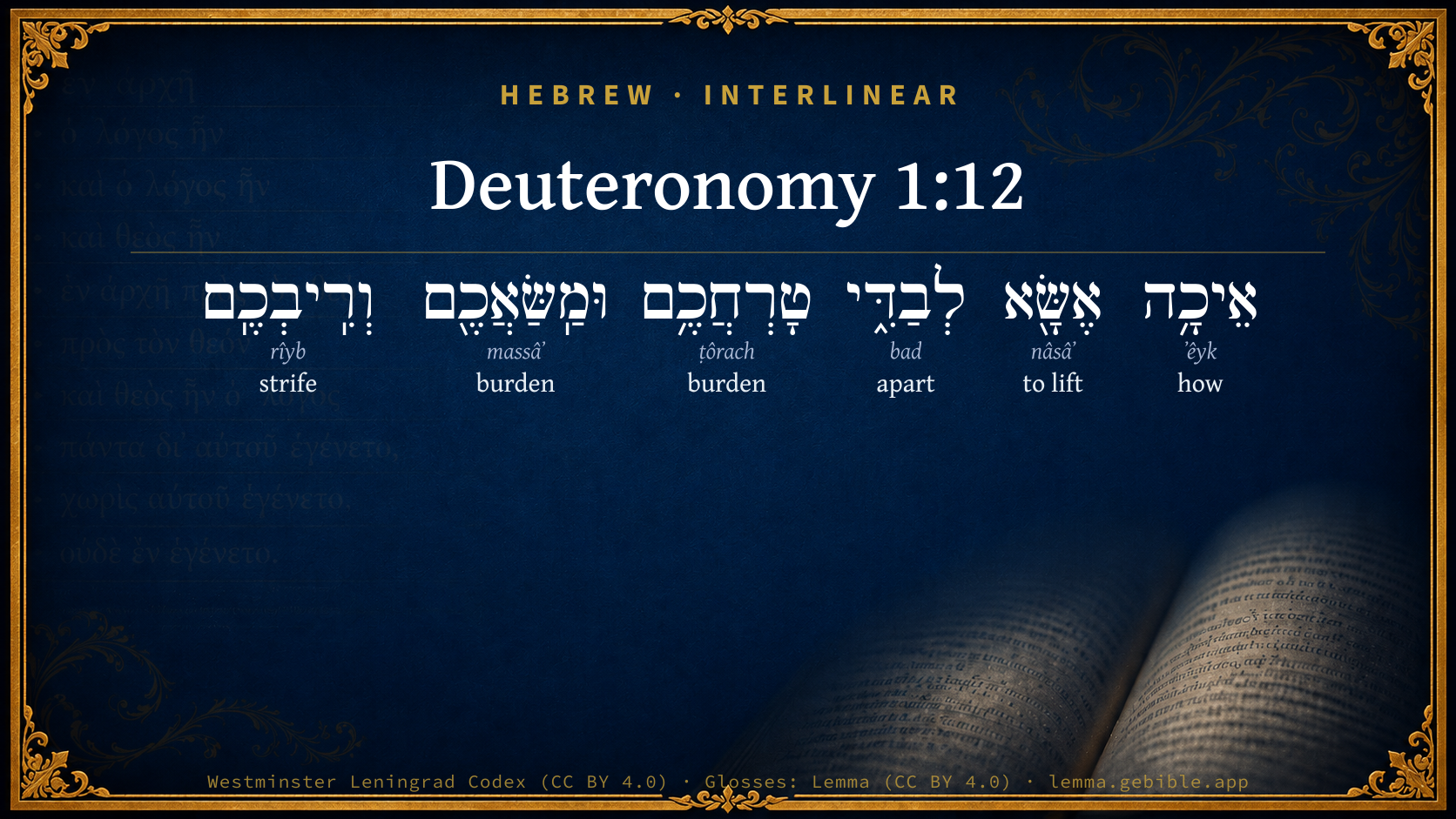
Deuteronomy 1:12

Hebrew (Westminster Leningrad Codex) Deuteronomy 1:12 appears in the Hebrew Old Testament. The text above is from the Westminster Leningrad Codex. Each word links to its Strong’s number, a concise gloss, and parsing drawn from the Open Scriptures Hebrew Bible morphology. Click any word for its full Brown-Driver-Briggs (BDB) entry.
Download image
Cite this verse

Deuteronomy 1:12 (World English Bible). Public Domain. Lemma interlinear Bible study tool, https://lemma.gebible.app/v/deuteronomy/1/12.

Show BibTeX & RIS
BibTeX
RIS
English Translation
How can I myself alone bear your encumbrance, and your burden, and your strife?
World English Bible · Public Domain
Highlights
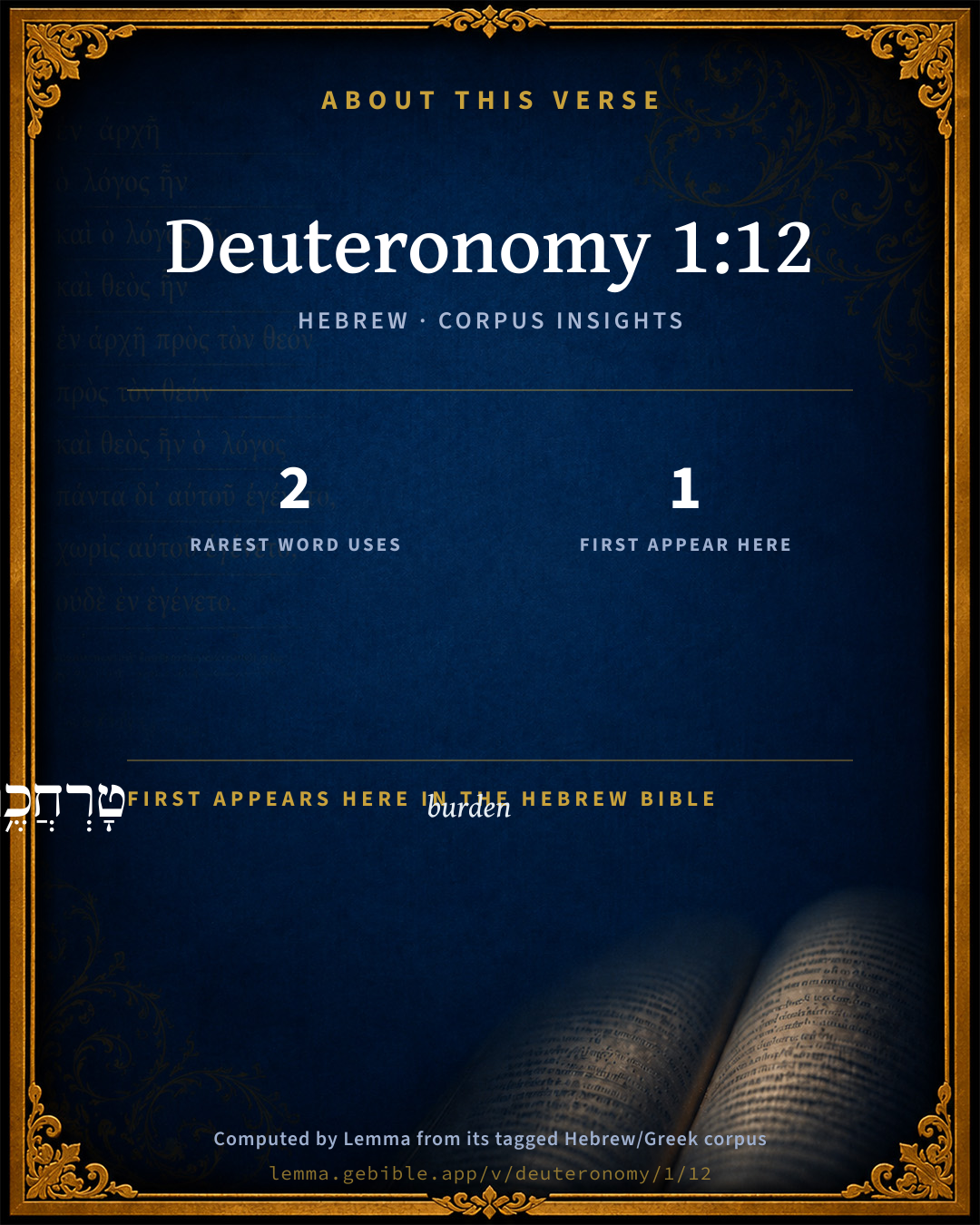
  • 1 first appearance in the Hebrew Bible
Full analysis ↓
Download a study sheet

One document with this verse’s original text, its word-by-word gloss line, the meaning frame, cross-references with their text, attributed commentary, and full source and license credits — printable, and it pastes into notes with its structure intact.

This verse Autodidact and up

Study sheet (.html) Plain text (.txt)

A passage Seminary Student

Up to 50 verses in one chapter. A passage sheet keeps up to 6 commentary sources and 12 cross-references per verse, in the order this page ranks them, and says so on the sheet whenever that leaves anything out. Ask for a single verse and you get the Autodidact verse sheet above.

Everything on this page stays free to read, with no account — the sheet is a download of what is already on screen, not access to it.

Want to remove ads? Support Godless Engineer
Compare translations 3

The same verse in 3 English versions, stacked beneath the original-language interlinear above. Click any original word for its lexicon entry.

Each is an independent rendering of the whole verse — the interlinear is not word-aligned to these translations.

Highlighted words mark where these versions differ — a whole-verse word diff, not a word-by-word alignment.

  • World English Bible Public Domain
    How can I myself alone bear your encumbrance, and your burden, and your strife?
  • King James Version Public Domain
    How can I myself alone bear your cumbrance, and your burden, and your strife?
  • unfoldingWord Literal Text CC BY-SA 4.0
    How will I carry by myself your loads and your burdens and your disputes?

unfoldingWord Literal Text — © unfoldingWord, licensed CC BY-SA 4.0. Word-aligned USFM3 via Door43 (git.door43.org/unfoldingWord/en_ult).

Versions to compare (up to 4)

3 of 4 selected

Show all 18 translations

Every available English version of this verse, each an independent rendering of the whole verse.

  • World English Bible Public Domain
    How can I myself alone bear your encumbrance, and your burden, and your strife?
  • Berean Standard Bible Public Domain
    But how can I bear your troubles, burdens, and disputes all by myself?
  • Majority Standard Bible Public Domain
    But how can I bear your troubles, burdens, and disputes all by myself?
  • King James Version Public Domain
    How can I myself alone bear your cumbrance, and your burden, and your strife?
  • American Standard Version (1901) Public Domain
    How can I myself alone bear your cumbrance, and your burden, and your strife?
  • Revised Version (1885) Public Domain
    How can I myself alone bear your cumbrance, and your burden, and your strife?
  • Geneva Bible (1599) Public Domain
    Howe can I alone beare your combrance and your charge, and your strife?
  • Douay-Rheims (1899) Public Domain
    I alone am not able to bear you: for the Lord your God hath multiplied you, and you are this day as the stars of heaven, for multitude.
  • Young's Literal Translation Public Domain
    `How do I bear by myself your pressure, and your burden, and your strife?
  • Literal Standard Version CC BY-SA 4.0
    How do I bear your pressure, and your burden, and your strife by myself?
  • Unlocked Literal Bible CC BY-SA 4.0
    But how can I myself alone carry your loads, your burdens, and your disputes?
  • unfoldingWord Literal Text CC BY-SA 4.0
    How will I carry by myself your loads and your burdens and your disputes?
  • Darby Bible Public Domain
    How can I myself alone sustain your wear, and your burden, and your strife?
  • World Messianic Bible Public Domain
    How can I myself alone bear your problems, your burdens, and your strife?
  • Webster's Bible Public Domain
    How can I alone bear your encumbrance, and your burden, and your strife?
  • Free Bible Version CC BY-SA 4.0
    But how can I take on all your troubles, burdens, and arguments just by myself?
  • Bible in Basic English Public Domain
    How is it possible for me by myself to be responsible for you, and undertake the weight of all your troubles and your arguments?
  • JPS Tanakh (1917) Public Domain
    How can I myself alone bear your cumbrance, and your burden, and your strife?

Literal Standard Version (2020), Covenant Press — licensed CC BY-SA 4.0. Text via the HelloAO Bible API (eBible.org). Unlocked Literal Bible (unfoldingWord) — licensed CC BY-SA 4.0. Text via the HelloAO Bible API (eBible.org). unfoldingWord Literal Text — © unfoldingWord, licensed CC BY-SA 4.0. Word-aligned USFM3 via Door43 (git.door43.org/unfoldingWord/en_ult). Free Bible Version, Dr. Jonathan Gallagher — licensed CC BY-SA 4.0. Text via the HelloAO Bible API (eBible.org).

Word by word

More ways to search: Search by grammar → Find every occurrence → Compare this word →

Practice this passage: Drill this verse → Learn its vocabulary →

About this verse

These counts appear in no published source. They are computed here, from the morphology-tagged text and Lemma’s own curated glosses. What Lemma adds →

6
words
6
distinct lemmas
Pentateuch
section

Notable vocabulary

The rarest word here is טָרְחֲכֶ֥ם burden H2960 — appearing just 2 times in the whole Hebrew Bible.

First appearance in Scripture

This word makes its first canonical appearance in the Hebrew Bible here:

  • טָרְחֲכֶ֥ם burden H2960

Shared distinctive vocabulary

טָרְחֲכֶ֥ם burden H2960 occurs in 2 verses of the Hebrew Bible. Also found in:

Grammatical profile

  • 1 verb
  • 4 nouns
  • 1 particle

Verb forms

  • אֶשָּׂ֖א Qal · Imperfect

Hebrew & Septuagint length

In English translation the verse runs 14 words from the Hebrew and 16 from the Septuagint (LXX English) — closely comparable.

A rough comparison of the two English renderings, which tokenize alike — not a word-level alignment.

Word counts can differ between the Hebrew and the Greek without any difference in meaning — e.g. the Hebrew direct-object marker אֵת has no separate Greek word, and Greek often adds the article ὁ.

Cross-references

7

Topical passages linked to Deuteronomy 1:12 in the Treasury of Scripture Knowledge — connected by theme and wording, ordered by reader-vote popularity; previews shown in the World English Bible.

  • 2 Corinthians 3:5 not that we are sufficient of ourselves, to account anything as from ourselves; but our sufficiency is from God;
  • Numbers 11:11–15 Moses said to Yahweh, Why have you dealt ill with your servant? and why haven't I found favor in your sight, that you lay the burden of all this people on me?
  • Deuteronomy 1:9 I spoke to you at that time, saying, I am not able to bear you myself alone:
  • 1 Kings 3:7–9 Now, Yahweh my God, you have made your servant king instead of David my father: and I am but a little child; I don't know how to go out or come in.
  • Psalms 89:19 Then you spoke in vision to your saints, And said, "I have bestowed strength on the warrior. I have exalted a young man from the people.
  • 2 Corinthians 2:16 to the one a stench from death to death; to the other a sweet aroma from life to life. Who is sufficient for these things?
  • Exodus 18:13–16 It happened on the next day, that Moses sat to judge the people, and the people stood around Moses from the morning to the evening.

Cross-references courtesy of OpenBible.info (CC BY 4.0).

Hebrew and Greek witnesses Masoretic Hebrew ↔ Greek Septuagint

The same verse in the two great witnesses to the Old Testament, shown verse-for-verse.

These are two independent witnesses, not word-aligned to each other, and the Septuagint is shown in lemma (dictionary) form.

Hebrew Deuteronomy 1:12 Masoretic · Westminster Leningrad Codex

אֵיכָ֥ה אֶשָּׂ֖א לְבַדִּ֑י טָרְחֲכֶ֥ם וּמַֽשַּׂאֲכֶ֖ם וְרִֽיבְכֶֽם

How can I myself alone bear your encumbrance, and your burden, and your strife?

World English Bible · Public Domain

Greek LXX Deuteronomy 1:12 Septuagint · lemma form

πῶς δύναμαι μόνος φέρω ὁ κόπος σύ καί ὁ ὑπόστασις σύ καί ὁ ἀντιλογία σύ

How shall I alone be able to bear your labor, and your burden, and your gainsayings?

LXX2012 (modern English Septuagint) · Public Domain

Hebrew: Westminster Leningrad Codex (CC BY 4.0). Greek: Septuagint (public domain); English from LXX2012 (modern English Septuagint) (Public Domain). How the Septuagint differs from the Hebrew →

Targum (Aramaic paraphrase)

2

The Targum is the ancient Jewish Aramaic paraphrase of the Hebrew Scriptures — an interpretive translation, not the Hebrew text itself. Onkelos (literal) and Pseudo-Jonathan (expansive) render the Torah, and Jonathan the Prophets. Coverage is partial: where no permissively-licensed English translation exists for a verse, only the Aramaic is shown. This is verse-level text, not a word-by-word alignment to the Hebrew.

  1. Targum Onkelos Torah (Genesis–Deuteronomy)
    אֶכְדֵין אֵסוֹבַר בִּלְחוֹדִי טָרְחֲכוֹן וְעִסְקֵיכוֹן וְדִינְכוֹן

    (no public-domain English translation for this verse)

    Targum Onkelos — Aramaic: “Onkelos Genesis” (public domain); “Onkelos Exodus” (public domain); “Onkelos Leviticus” (public domain); “Onkelos Numbers” (public domain); “Onkelos Deuteronomy” (public domain). English: “Sefaria Community Translation” (CC0 1.0 (public-domain dedication)); “J.W. Etheridge. The Targums of Onkelos and Jonathan Ben Uzziel on the Pentateuch. London: Longmans, Green, 1862” (public domain). Text via Sefaria.

  2. Targum Pseudo-Jonathan Torah (Genesis–Deuteronomy)
    הֵיךְ אֲנָא יָכִיל בִּלְחוֹדִי לְמִסְבּוֹל טַרְחוֹת אַפְקַרְסוּתְכוֹן וּדְמִחַשְׁלִין עֲלֵי בִישְׁתָּא וּמִילֵי דִיגַנְבוּן דְּמַפְקִין סִלְעָא לְאַפּוֹקֵי תְּרֵי

    But how can I alone sustain the labour, your sensuality, your evil thoughts, your words of strife, your offering one shekel for two?

    Targum Pseudo-Jonathan — Aramaic: “Targum Jonathan on Genesis” (public domain); “Targum Jonathan on Exodus” (public domain); “Targum Jonathan on Leviticus” (public domain); “Targum Jonathan on Numbers” (public domain); “Targum Jonathan on Deuteronomy” (public domain). English: “The Targum of Jonathan ben Uzziel, trans. J. W. Etheridge, London, 1862” (public domain). Text via Sefaria.

Commentary

Notes on Deuteronomy 1:12 from classic Christian and Jewish commentators (each source and its license shown beneath its notes). The classic Christian expositions comment on the surrounding passage and are grouped to its opening verse, so a note may address several verses; the Jewish commentaries on the Tanakh (Rashi and others) are per-verse, so they appear only where the commentator wrote on this verse.

Lemma curates 59 commentaries, every one of them public domain or Creative Commons licensed, each selected and text-cleaned for this edition rather than reprinted as found. About our sources →

Trapp's Complete Commentary

John Trapp

Deu 1:12 How can I myself alone bear your cumbrance, and your burden, and your strife?

Ver. 12. Hear your cumbrance.] A prince’s temples are not so compassed with a crown, as his mind besieged with cares; nor is he so lifted up with the splendour of his train, as cast down with the multitude of his fears. {See Trapp on "Deu 1:9"} St Paul also had the "cumber {a} of the churches." {2Co 11:28} All care cumbered and mustered together, and that with anxiety; with the same solicitude that a man hath about his own most important business.

{a} επισυστασις, μεριμνα

John Trapp, A Commentary or Exposition upon All the Books of the Old and New Testament (1647–1656) — public domain. Text from a community e-Sword module.

Joseph Benson's Commentary

Deu 1:12-13. How can I alone bear your burden? — The trouble of ruling and managing so perverse a people. Your strife — Your contentions among yourselves, for the determination whereof the elders were appointed. Take ye wise men and understanding — Persons of knowledge, wisdom, and experience. Known among your tribes — Hebrew, to your tribes; men had in reputation for ability and integrity; for to such they would more readily submit.

Joseph Benson's Commentary on the Old and New Testaments (1811–1818) — public domain. Text from a community e-Sword module.

Geneva Bible (1599)

Geneva Bible translators

Signifying how great a burden it is, to govern the people.

Geneva Bible (1599) marginal notes — public domain. Text via Bolls.life.

Ellicott's Commentary for English Readers

(12) Your cumbrance.—The original word is found only here and in Isa_1:14 : “They are a trouble unto me, I am weary to bear them.”

Deu_1:13-15 recall very exactly what is said in Exodus 18

A Bible Commentary for English Readers, edited by Charles John Ellicott (1878–1897) — public domain. Text from a community e-Sword module.

The Cambridge Bible for Schools and Colleges

gen. ed. J. J. S. Perowne

12. How] This emphatic Heb. form is found in the Pent. only here, Deu_7:17, Deu_12:30, Deu_18:21, (Deu_32:30).

can I myself alone bear] See on Deu_1:9.

your cumbrance, and your burden, and your strife] Better the weight, the burden, and the strife of you. Weight cp. Isa_1:14, they are a weight upon me, I am weary of bearing. Is the use of the word here an echo of Isaiah? The Heb. ṭoraḥ is not found elsewhere in the O. T. Burden or carriage, cp. J, Num_11:11, the burden of all this people upon me, and 17. Strife; the Heb. rîb is used in JE of quarrels about wells and other physical struggles; but also of law-disputes, and of Israel’s contentiousness with Moses and God (E, Exo_17:2; Exo_17:7; J, Num_20:3; P, Num_20:13; and in the Song, Deu_33:8). In D four times for law-pleas. Here it is either the people’s litigiousness among themselves or their frequent contentions with Moses and God.

The Cambridge Bible for Schools and Colleges (gen. ed. J. J. S. Perowne; Cambridge University Press, 1878–1918) — public domain. Text from a community e-Sword module.

John Gill's Exposition

How can I myself alone bear your cumbrance, and your burden, and your strife? His meaning is, that he could not hear and try all their causes, and determine all their law suits, and decide the strifes and controversies which arose between them; it was too heavy for him, and brought too much trouble and incumbrance upon him.

How can I myself alone bear your cumbrance, and your burden, and your strife? His meaning is, that he could not hear and try all their causes, and determine all their law suits, and decide the strifes and controversies which arose between them; it was too heavy for him, and brought too much trouble and incumbrance upon him.

Deuteronomy 1:13

deu 1:13

deu 1:13

deu 1:13Take ye wise men, and understanding, and known among your tribes,.... Not only whose persons were well known, but their characters and qualifications, for their probity and integrity, for their wisdom and prudence in the management of affairs, for their skill and knowledge in things divine and human, civil and religious, and for their capacity in judging and determining matters in difference; see Exo 18:21.

and I will make them rulers over you; the people were allowed to choose their own officers, whom they were to bring to Moses, and present before him, to be invested with their office. A like method was taken in the choice and constitution of deacons in the Christian church, when the secular affairs of it lay too heavy upon the apostles, Act 6:3.

John Gill's Exposition of the Whole Bible (1746–1763) — public domain (CC PDM 1.0). Text via the HelloAO Bible API.

Matthew Poole's English Annotations

Your burden; the trouble of ruling and managing so perverse a people.

Your strife; either your quarrellings with God; or rather your contentions among yourselves, for the determination whereof the elders were appointed.

Matthew Poole's English Annotations on the Holy Bible (1683–1685) — public domain. Text from a community e-Sword/MySword module.

The Pulpit Commentary

Moses appeals to the good sense of the people themselves: How can I myself alone bear your cumbrance, and your burden, and your strife? Cumbrance: this is a just rendering of the Hebrew word jr mo, from jrf which, though it occurs only in the Hiphil in Hebrew, in the sense of to cast down, (Job_17:11) probably was in use also in the Kal, in the sense of to lay upon, to encumber, which is the meaning of the cognate Arabic followed by. Burden (aV; from acn to lift up, to carry, to bear), something lifted up and carried, a load or burden. Strife: (byri) here, not mere contention, but litigation, suit-at-law. Some understand all these three, of troubles and burdens laid upon Moses, by his being called upon to compose differences, and adjust competing claims among the people. But other burdens besides these came upon him as the leader of the nation; and it seems best, therefore, to understand the first two of troubles and burdens generally.

The Pulpit Commentary (1880–1919), ed. H.D.M. Spence-Jones & Joseph S. Exell — public domain. Text from a community e-Sword module.

John Wesley's Explanatory Notes

Your burden - The trouble of ruling and managing so perverse a people. Your strife - Your contentions among yourselves, for the determnination whereof the elders were appointed.

John Wesley, Explanatory Notes Upon the Whole Bible (1754–1765) — public domain. Text via the GEBible commentary corpus.

unfoldingWord translationNotes

Door43 World Missions Community

General Information:

Moses continues speaking to the people of Israel.

But how can I myself alone carry your loads, your burdens, and your disputes?

Moses uses a question to emphasize that he cannot solve all of their problems by himself. This rhetorical question can be translated as a statement. AT: "I cannot carry your loads, your burdens, and your disputes by myself." (See: Rhetorical Question)

carry your loads, your burdens

Moses speaks as if the people's problems and complaints that he needed to take care of were heavy physical objects that he had been carrying. AT: "take care of your problems, your complaints" (See: Metaphor)

your disputes

"your arguments" or "your disagreements"

men of good repute from each tribe

"men from each tribe whom the people of Israel respect"

translationWords

burden

wise

understand

tribe

head

unfoldingWord translationNotes — © Distant Shores Media and the Door43 World Missions Community, licensed CC BY-SA 4.0. Source: git.door43.org/Door43/en_tn.

Rashi

Rabbi Shlomo Yitzchaki (Rashi)

איכה אשא לבדי HOW CAN I MYSELF ALONE BEAR [YOUR CUMBRANCE, etc.]? — If I were to say, "I will do so in order to receive a reward for it", I may not do so. This is what I have already said to you: not of myself do I tell you that I am not able to bear you, but by the bidding of the Holy One, blessed be He (see Rashi v. 9).

טרחכם YOUR CUMBRANCE — Moses' use of this word regarding them teaches us that the Israelites were troublesome: if one of them perceived that his opponent in a law suit was about to be victor in the case he would say: I have witnesses to bring, further proof to adduce, I will add judges to you who are sitting (Sifrei Devarim 12:1).

ומשאכם YOUR BURDEN — this teaches that they were Epicorsim (that they treated the judges with scant respect): if Moses went forth early from his tent they said, “Why does the son of Amram leave so early? Perhaps he is not at ease at home?" If he left late, they said, “What do you think? He is sitting and devising evil schemes against you, and is plotting against you" (Sifrei Devarim 12:2).

וריבכם AND YOUR STRIFE — this teaches that they were always contentious (Sifrei Devarim 12:3).

Rashi on the Tanakh — English translations: “The Judaica Press complete Tanach with Rashi, translated by A. J. Rosenberg” (CC BY 4.0); “Pentateuch with Rashi's commentary by M. Rosenbaum and A.M. Silbermann, 1929-1934” (public domain); “The Metsudah Tanach series, Lakewood, N.J” (CC BY 4.0); and “The Book of Joshua, Metsudah Publications, 1997” (CC BY 4.0). Text via Sefaria.

Ramban (Nachmanides)

Rabbi Moshe ben Nachman (Ramban / Nachmanides)

HOW CAN I MYSELF ALONE BEAR ‘TORCHACHEM’ (YOUR TROUBLE) ‘UMASA’ACHEM’ (AND YOUR BURDEN), V’RIVCHEM (AND YOUR STRIFE)? According to the simple meaning of Scripture, Moses our teacher alluded to them the three things which he told Jethro that he was doing for the people, as I have explained there. He now mentioned them to Israel by implication. He said torchachem corresponding to and I make known to them the statutes of G-d and His laws, Verse 16. for it was a difficult “task” to teach those who had come forth from Egypt, the statutes and the laws of G-d, their meanings, interpretations, and secrets. He said masa’achem corresponding to the people come unto me to inquire of G-d, a reference to prayer, for he used to pray on their behalf. The word masa’achem is related to the expression: ‘v’nasatha t’filah’ (and thou lift up prayer); nor ‘tisa’ (lift up) entreaty or prayer in their behalf. [He stated] ‘v’rivchem’ (and your strife) which is to be understood in its plain sense — matters of judgments [because judges must rule when there is strife among people]. Moses continued to state: Get you men who are wise, and understanding, and known among your tribes — referring only to [the qualities of] judges. But he said unqualifiedly, and I will make them heads over you by way of humility. Now Rashi quotes from the Sifre: 12. “‘Torchachem’ (Your trouble). This teaches that they were troublesome. If one perceived that his opponent was winning a litigation, he would say ‘I have witnesses to bring; I have evidence to present; I [exercise my right to] add judges to you [thereby increasing the size of the court].’” But I do not know [the validity of] this law that one of the litigants should have the right to add judges above [the usual number of] three in cases concerning monetary matters, and surely he has no such right after presenting his case before them and perceiving that his opponent was winning the case! For, had he voluntarily accepted upon himself a relative or an unqualified person as a judge, he could indeed retract prior to the rendering of the final judgment, but from those qualified to judge he cannot retract [his acceptance]! Perhaps we can deduce from here the principle that a man can say, “I choose two judges and you choose two other ones, and they [i.e., the four judges] will choose one more, be divisible evenly;” it must have an odd number of judges to assure that, in the event of a split, there would not be a tie vote (ibid., 2a). and let the suit be decided by five or more judges,” just as the Rabbis have said: 2:13). “A suit decided by five [judges] is not comparable to one decided by ten [judges].” Although three judges [have the power to] compel parties to come before them for judgment when one refuses to be bound by their decision, yet if one [of the litigants] desires to choose additional judges, he may do so, because it is similar to [the case of] one [of the litigants] who says, “Let us go to the main meeting place of the scholars [to bring our suit before them on the assumption that superior scholars are better qualified to judge],” in which case we accede to him, provided it does not entail [undue] hardship, for in such a case we have been commanded, Justice, justice, shalt thou pursue, [which the Sifre interpreted]: “Go to a reliable court,” and an increase in the number constitutes “a reliable court.” 144; Sanhedrin 32b. Now in the wilderness, wise men were available to them and the litigants could say, “Let us go before the officers of the thousands.”

Ramban (Nachmanides) on the Tanakh — English translation: “Commentary on the Torah by Ramban (Nachmanides). Translated and annotated by Charles B. Chavel. New York, Shilo Pub. House, 1971-1976” (CC BY 4.0). Text via Sefaria.

Lesson kit

Teaching starters — assembled from the data on this page, not authored interpretation. Every prompt links to the verse data it draws on. Edit before teaching.

Deuteronomy, in the Pentateuch, opens this verse with 6 words (6 distinct Hebrew lemmas). Its most distinctive word is ṭôrach (“burden”). A historical commentator’s framing appears above. Read the whole chapter for the surrounding context.

Discussion questions

  1. The word ṭôrach carries the sense “burden.” How does it shape the verse?
  2. This is the first place “burden” appears in Scripture (first appears here). What does its debut here establish?
  3. How does Isaiah 1:14, which shares the word «burden», read alongside this verse?
  4. These translations render this verse differently. What is at stake in choosing one wording over another?
  5. «אֶשָּׂ֖א» is a Qal Imperfect verb. How does that grammatical form shape the action described?
  6. Compare how Trapp's Complete Commentary and Joseph Benson's Commentary read this verse. Where do they agree or differ?

Things to notice

Reading settings

Reading text

Shown beneath each verse's original-language words.

Old Testament
Old Testament edition

Read the OT as the Masoretic Hebrew (MT) or the Greek Septuagint (LXX).

English shown for the Greek Septuagint (in the Hebrew ↔ Greek comparison).

Comparing translations? Open the Compare panel on any verse page to stack up to four side by side.