
Job 13:14

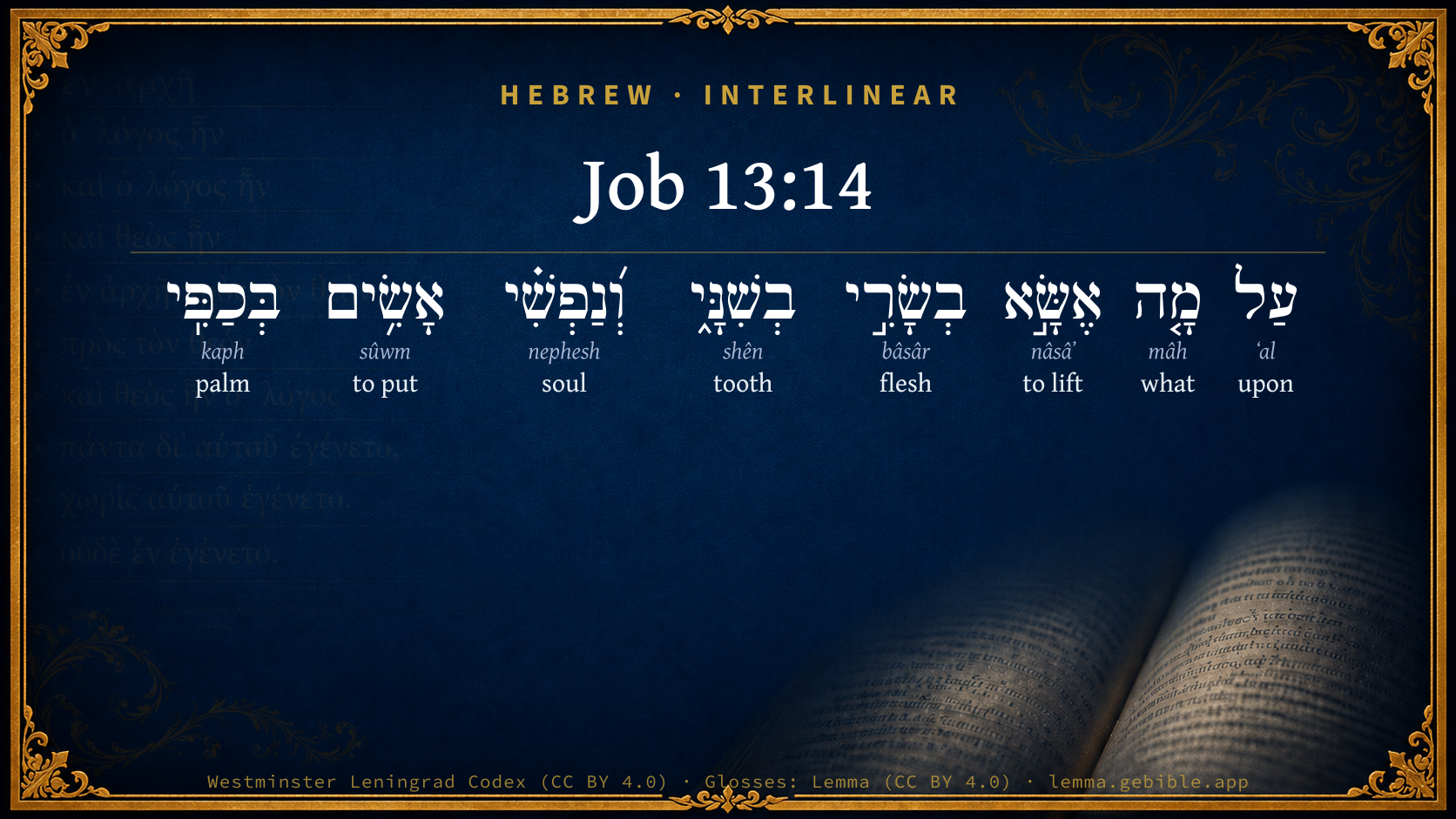
Hebrew (Westminster Leningrad Codex) Job 13:14 appears in the Hebrew Old Testament. The text above is from the Westminster Leningrad Codex. Each word links to its Strong’s number, a concise gloss, and parsing drawn from the Open Scriptures Hebrew Bible morphology. Click any word for its full Brown-Driver-Briggs (BDB) entry.
Download image
Cite this verse

Job 13:14 (World English Bible). Public Domain. Lemma interlinear Bible study tool, https://lemma.gebible.app/v/job/13/14.

Show BibTeX & RIS
BibTeX
RIS
English Translation
Why should I take my flesh in my teeth, And put my life in my hand?
World English Bible · Public Domain
Download a study sheet

One document with this verse’s original text, its word-by-word gloss line, the meaning frame, cross-references with their text, attributed commentary, and full source and license credits — printable, and it pastes into notes with its structure intact.

This verse Autodidact and up

Study sheet (.html) Plain text (.txt)

A passage Seminary Student

Up to 50 verses in one chapter. A passage sheet keeps up to 6 commentary sources and 12 cross-references per verse, in the order this page ranks them, and says so on the sheet whenever that leaves anything out. Ask for a single verse and you get the Autodidact verse sheet above.

Everything on this page stays free to read, with no account — the sheet is a download of what is already on screen, not access to it.

Want to remove ads? Support Godless Engineer
Compare translations 3

The same verse in 3 English versions, stacked beneath the original-language interlinear above. Click any original word for its lexicon entry.

Each is an independent rendering of the whole verse — the interlinear is not word-aligned to these translations.

Highlighted words mark where these versions differ — a whole-verse word diff, not a word-by-word alignment.

  • World English Bible Public Domain
    Why should I take my flesh in my teeth, And put my life in my hand?
  • King James Version Public Domain
    Wherefore do I take my flesh in my teeth, and put my life in mine hand?
  • unfoldingWord Literal Text CC BY-SA 4.0
    Why do I take my flesh in my teeth and put my life in my hands?

unfoldingWord Literal Text — © unfoldingWord, licensed CC BY-SA 4.0. Word-aligned USFM3 via Door43 (git.door43.org/unfoldingWord/en_ult).

Versions to compare (up to 4)

3 of 4 selected

Show all 18 translations

Every available English version of this verse, each an independent rendering of the whole verse.

  • World English Bible Public Domain
    Why should I take my flesh in my teeth, And put my life in my hand?
  • Berean Standard Bible Public Domain
    Why do I put myself at risk and take my life in my own hands?
  • Majority Standard Bible Public Domain
    Why do I put myself at risk and take my life in my own hands?
  • King James Version Public Domain
    Wherefore do I take my flesh in my teeth, and put my life in mine hand?
  • American Standard Version (1901) Public Domain
    Wherefore should I take my flesh in my teeth, And put my life in my hand?
  • Revised Version (1885) Public Domain
    Wherefore should I take my flesh in my teeth, and put my life in mine hand?
  • Geneva Bible (1599) Public Domain
    Wherefore doe I take my flesh in my teeth, and put my soule in mine hande?
  • Douay-Rheims (1899) Public Domain
    Why do I tear my flesh with my teeth, and carry my soul in my hands?
  • Young's Literal Translation Public Domain
    Wherefore do I take my flesh in my teeth? And my soul put in my hand?
  • Literal Standard Version CC BY-SA 4.0
    Why do I take my flesh in my teeth? And my soul put in my hand?
  • Unlocked Literal Bible CC BY-SA 4.0
    I will take my own flesh in my teeth; I will take my life in my hands.
  • unfoldingWord Literal Text CC BY-SA 4.0
    Why do I take my flesh in my teeth and put my life in my hands?
  • Darby Bible Public Domain
    Wherefore should I take my flesh in my teeth, and put my life in my hand?
  • World Messianic Bible Public Domain
    Why should I take my flesh in my teeth, and put my life in my hand?
  • Webster's Bible Public Domain
    Why do I take my flesh in my teeth, and put my life in my hand?
  • Free Bible Version CC BY-SA 4.0
    I take responsibility for myself; I am ready to risk my life.
  • Bible in Basic English Public Domain
    I will take my flesh in my teeth, and put my life in my hand.
  • JPS Tanakh (1917) Public Domain
    Wherefore? I will take my flesh in my teeth, and put my life in my hand.

Literal Standard Version (2020), Covenant Press — licensed CC BY-SA 4.0. Text via the HelloAO Bible API (eBible.org). Unlocked Literal Bible (unfoldingWord) — licensed CC BY-SA 4.0. Text via the HelloAO Bible API (eBible.org). unfoldingWord Literal Text — © unfoldingWord, licensed CC BY-SA 4.0. Word-aligned USFM3 via Door43 (git.door43.org/unfoldingWord/en_ult). Free Bible Version, Dr. Jonathan Gallagher — licensed CC BY-SA 4.0. Text via the HelloAO Bible API (eBible.org).

Word by word

More ways to search: Search by grammar → Find every occurrence → Compare this word →

Practice this passage: Drill this verse → Learn its vocabulary →

בְשִׁנָּ֑י
shên
H8127
“in/at · teeth · my”
Preposition + Noun, Common, Both, Dual, Construct + Suffix, Personal, 1st Person, Common, Singular
Part of Speech
Preposition + Noun
Type
Common
Gender
Both
Number
Dual
State
Construct
Full BDB Definition

Origin: from H8150

TWOT: 2422a

tooth, ivory - tooth - of man, lex talionis, beast - tooth, tine (of fork) - ivory - as material - of commerce - sharp pointed rock
  1. עַל ʻal H5921 “upon” Preposition
  2. מָ֤ה mâh H4100 “what” Particle, Interrogative
  3. אֶשָּׂ֣א nâsâʼ H5375 “to lift” Verb, Qal, Imperfect, 1st Person, Common, Singular
  4. בְשָׂרִ֣י bâsâr H1320 “flesh · my” Noun, Common, Masculine, Singular, Construct + Suffix, Personal, 1st Person, Common, Singular
  5. וְ֝נַפְשִׁ֗י nephesh H5315 “and · soul · my” Conjunction + Noun, Common, Both, Singular, Construct + Suffix, Personal, 1st Person, Common, Singular
  6. אָשִׂ֥ים sûwm H7760 “to put” Verb, Qal, Imperfect, 1st Person, Common, Singular
  7. בְּכַפִּֽי kaph H3709 “in/at · palm · my” Preposition + Noun, Common, Feminine, Singular, Construct + Suffix, Personal, 1st Person, Common, Singular

About this verse

These counts appear in no published source. They are computed here, from the morphology-tagged text and Lemma’s own curated glosses. What Lemma adds →

8
words
8
distinct lemmas
Wisdom
section

Shared distinctive vocabulary

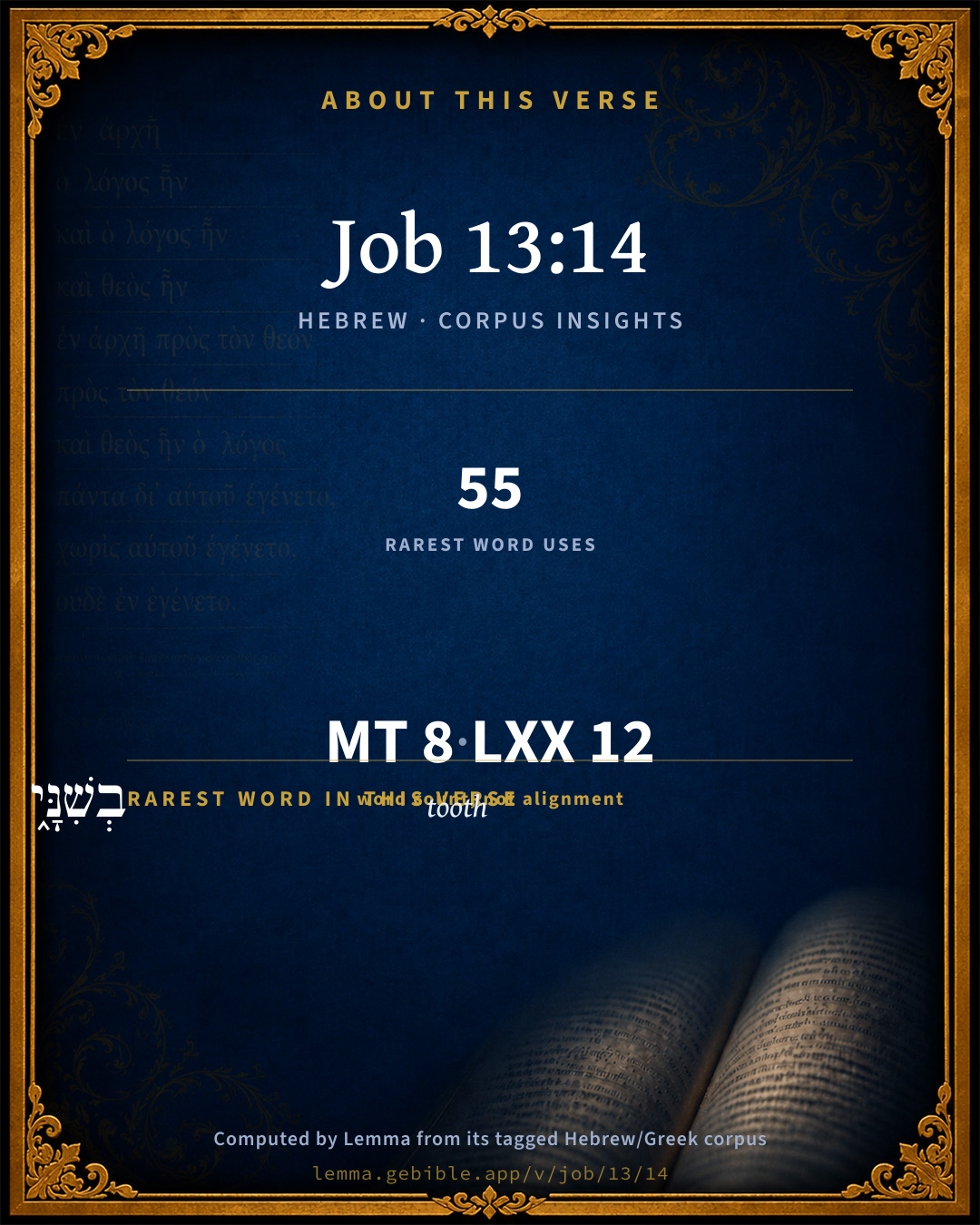
בְשִׁנָּ֑י tooth H8127 occurs in 48 verses of the Hebrew Bible. Also found in:

Grammatical profile

  • 2 verbs
  • 4 nouns
  • 1 preposition
  • 1 particle

Verb forms

  • אֶשָּׂ֣א Qal · Imperfect
  • אָשִׂ֥ים Qal · Imperfect

Hebrew & Septuagint length

In English translation the verse runs 16 words from the Hebrew and 16 from the Septuagint (LXX English) — the same length.

A rough comparison of the two English renderings, which tokenize alike — not a word-level alignment.

Word counts can differ between the Hebrew and the Greek without any difference in meaning — e.g. the Hebrew direct-object marker אֵת has no separate Greek word, and Greek often adds the article ὁ.

In the original languages it is 8 Hebrew tokens and 12 Greek tokens — but the two are counted differently (Hebrew bundles its prefixes and suffixes into one token; the Greek is in lemma form), so that isn’t a like-for-like length.

Cross-references

8

Topical passages linked to Job 13:14 in the Treasury of Scripture Knowledge — connected by theme and wording, ordered by reader-vote popularity; previews shown in the World English Bible.

  • Judges 12:3 When I saw that you didn't save me, I put my life in my hand, and passed over against the children of Ammon, and Yahweh delivered them into my hand: why then are you come up to me this day, to fight against me?
  • Psalms 119:109 My soul is continually in my hand, Yet I won't forget your law.
  • 1 Samuel 19:5 for he put his life in his hand, and struck the Philistine, and Yahweh worked a great victory for all Israel: you saw it, and did rejoice; why then will you sin against innocent blood, to kill David without a cause?
  • 1 Samuel 28:21 The woman came to Saul, and saw that he was sore troubled, and said to him, Behold, your handmaid has listened to your voice, and I have put my life in my hand, and have listened to your words which you spoke to me.
  • Job 18:4 You who tear yourself in your anger, Shall the earth be forsaken for you? Or shall the rock be removed out of its place?
  • Ecclesiastes 4:5 The fool folds his hands together and ruins himself.
  • Isaiah 9:20 One shall snatch on the right hand, and be hungry; and he shall eat on the left hand, and they shall not be satisfied: they shall eat every man the flesh of his own arm:
  • Isaiah 49:26 I will feed those who oppress you with their own flesh; and they shall be drunken with their own blood, as with sweet wine: and all flesh shall know that I, Yahweh, am your Savior, and your Redeemer, the Mighty One of Jacob.

Cross-references courtesy of OpenBible.info (CC BY 4.0).

Hebrew and Greek witnesses Masoretic Hebrew ↔ Greek Septuagint

The same verse in the two great witnesses to the Old Testament, shown verse-for-verse.

These are two independent witnesses, not word-aligned to each other, and the Septuagint is shown in lemma (dictionary) form.

Hebrew Job 13:14 Masoretic · Westminster Leningrad Codex

עַל מָ֤ה אֶשָּׂ֣א בְשָׂרִ֣י בְשִׁנָּ֑י וְ֝נַפְשִׁ֗י אָשִׂ֥ים בְּכַפִּֽי

Why should I take my flesh in my teeth, And put my life in my hand?

World English Bible · Public Domain

Greek LXX Job 13:14 Septuagint · lemma form

ἀναλαμβάνω ὁ σάρξ ἐγώ ὁ ὀδούς ψυχή δέ ἐγώ τίθημι ἐν χείρ

while I may take my flesh in my teeth, and put my life in my hand.

LXX2012 (modern English Septuagint) · Public Domain

On this verse, Albert Barnes' Notes on the Bible discusses the Septuagint’s reading. Read the note in Commentary ↓

Hebrew: Westminster Leningrad Codex (CC BY 4.0). Greek: Septuagint (public domain); English from LXX2012 (modern English Septuagint) (Public Domain). How the Septuagint differs from the Hebrew →

Commentary

Notes on Job 13:14 from classic Christian and Jewish commentators (each source and its license shown beneath its notes). The classic Christian expositions comment on the surrounding passage and are grouped to its opening verse, so a note may address several verses; the Jewish commentaries on the Tanakh (Rashi and others) are per-verse, so they appear only where the commentator wrote on this verse.

Lemma curates 59 commentaries, every one of them public domain or Creative Commons licensed, each selected and text-cleaned for this edition rather than reprinted as found. About our sources →

The Cambridge Bible for Schools and Colleges

gen. ed. J. J. S. Perowne

14. Wherefore do I take] Or, should I take. This and the following verse are surrounded with difficulties. The meaning of the second clause of Job_13:14 is well ascertained from usage, it is: to expose one’s life to jeopardy, Jdg_12:3, 1Sa_19:5; 1Sa_28:21, Psa_119:109. The meaning of the first clause is doubtful, as the expression does not occur again. It is held by many that the figure is borrowed from the action of a wild beast, which seizes its prey in its teeth and carries it off to a place of security; in which case the meaning would be, Why should I seek anxiously to preserve my life? If this be assumed to be the meaning the interrogation must end with the first clause, Why should I take my flesh in my teeth? nay, I will put my life in mine hand. This is not quite satisfactory. Hence an endeavour is made by many to extract a sense from the second clause different from that sanctioned by usage, a sense indeed to appearance the opposite of it, and corresponding to the first clause. It is assumed that the phrase properly means to commit one’s life to his hand to carry it through, to fight one’s way through; in other words, to make strenuous efforts to save one’s life. This is rather a hazardous mode of dealing with language the meaning of which is established by usage. The obscurity of the first clause makes it impossible to be certain of the construction of the verse.

The Cambridge Bible for Schools and Colleges (gen. ed. J. J. S. Perowne; Cambridge University Press, 1878–1918) — public domain. Text from a community e-Sword module.

Trapp's Complete Commentary

John Trapp

Job 13:14 Wherefore do I take my flesh in my teeth, and put my life in mine hand?

Ver. 14. Wherefore do I take my flesh in my teeth?] q.d. Do ye think, O my friends, that I am in a fit of spiritual frenzy, and so far out of my wits, that tearing, as it were, my flesh with mine own hands, I mean to sue any cruelty towards myself, and willingly to betray mine own life? (Vatab.) Non sum ira crudelis, ut totus perdi velim, I am not yet so cruel to myself (whatever you may gather by my complaints and outcries) as utterly to cast away my confidence and all care of my life and soul. See 1Sa 19:5. To despair in part and for a time may befall a godly man. See Mr Perkins’s discourse of Spiritual Desertion, where he remembereth that Luther lay (after his conversion) three days in desperation. And the like is recorded of Mr Robert Bolton. Aliqui suspicantur Iobum respondentem, &c. (Pineda). But of any good man that destroyed himself we read not. David’s life was in his hand continually (and he in daily danger of losing it), yet have I not forgotten thy law, saith he, Psa 119:109, which flatly forbiddeth all the degrees of suicide, as the worst sort. That Satan tempted Job to this sin some do probably collect from this text. A man is to expect, if he live but his days, saith a reverend casuist, {A theologian (or other person) who studies and resolves cases of conscience or doubtful questions regarding duty and conduct} to be urged to all sins, to the breach of every branch of the ten commandments, and to be put to it in respect of every article of our creed.

John Trapp, A Commentary or Exposition upon All the Books of the Old and New Testament (1647–1656) — public domain. Text from a community e-Sword module.

Albert Barnes' Notes on the Bible

Wherefore do I take my flesh in my teeth - The meaning of the proverbial expressions in this verse is not very clear. They indicate a state of great danger; but the exact sense of the proverbs it has been difficult to ascertain. Some have supposed that the phrase “to take the flesh in the teeth,” is significant of a state of famine, where a man dying from this cause would cease upon his own flesh and devour it; others, that it refers to the contentions of voracious animals, struggling for a piece of flesh; others, that it refers to the fact that what is borne in the teeth is liable to be dropped, and that Job regarded his life as in such a perilous condition. Schultens regards it as denoting that bold courage in which a man exposes his life to imminent peril. He supposes that it is to be taken in connection with the previous verse, as intimating that he would go forward and speak at any rate, whatever might be the result.

He translates it, “Whatever may be the event, I will take my flesh in my teeth, and my life in my hand.” In this interpretation Rosenmuller concurs. Noyes renders it, “I will count it nothing to bear my flesh in my teeth.” Good, “Let what may - I will carry my flesh in my teeth; ‘ and supposes that the phrase is equivalent to saying, that he would incur any risk or danger. The proverb he supposes is taken from the contest which so frequently takes place between dogs and other carnivorous quadrupeds, when one of them is carrying a bone or piece of flesh in his mouth, which becomes a source of dispute and a prize to be fought for. The Vulgate renders it, “Quare lacero carnes meus dentibus meis.” The Septuagint, “Taking my flesh in my teeth, I will put my life in my hand.” It seems to me, that the language is to be taken in connection with the previous verse, and is not to be regarded as an interrogatory, but as a declaration. “Let come upon me anything - whatever it may be - מה mâh - Job 13:13 on account of that, or in reference to that - על־מה ‛al-mâh - Job 13:14, I will take my life in my hand, braving any and every danger.”

It is a firm and determined purpose that he would express his sentiments, no matter what might occur - even if it involved the peril of his life. The word “flesh” I take to be synonymous with life, or with his best interests; and the figure is probably taken from the fact that animals thus carry their prey or spoil in their teeth. Of course, this would be a poor protection. It would be liable to be seized by others. It might even tempt and provoke others to seize it: and would lead to conflict and perils. So Job felt that the course he was pursuing would lead him into danger, but he was determined to pursue it, let come what might.

And put my life in mine hand - This is a proverbial expression, meaning the same as, I will expose myself to danger. Anything of value taken in the hand is liable to be rudely snatched away. It is like taking a casket of jewels, or a purse of gold, in the hand, which may at any moment be seized by robbers. The phrase is not uncommon in the Scriptures to denote exposure to great peril; compare Psa 119:109, “My soul is continually in my hand;” 1Sa 19:5, “For he did put his life in his hand, and slew the Philistine;” Jdg 12:3, “I put my life in my hands, and passed over against the children of Ammon.” A similar expression occurs in the Greek Classics denoting exposure to imminent danger - ἐν τῇ χειρὶ τὴν ψυχὴν ἔχει en tē cheiri tēn psuchēn echei - “he has his life in his hand;” see Rosenmuller on Psa 119:109. The Arabs have a somewhat similar proverb, as quoted by Schultens, “His flesh is upon a butcher’s block.”

Albert Barnes' Notes on the Bible (1834–1885) — public domain. Text from a community e-Sword/MySword module.

Joseph Benson's Commentary

Job 13:14. Wherefore do I take my flesh in my teeth, &c. — The sense, according to some commentators, is, Why do I torment myself? Why do I grieve so immoderately, like those persons who, in their afflictions, rend their garments, and are ready to tear their very flesh? But Bishop Patrick’s paraphrase seems to accord better with the context, namely, “I am so conscious to myself of my innocence, that I must still wonder why I suffer such enraging miseries, and am exposed to so many dangers.” Henry speaks to nearly the same purpose: “Why do I suffer such agonies? I cannot but wonder that God should lay so much upon me, when he knows I am not a wicked man. He was ready, not only to rend his clothes, but even to tear his flesh, through the greatness of his affliction; and saw himself at the brink of death, and his life in his hand; yet his friends could not charge him with any enormous crime, nor could he himself discover any; no marvel then he was in such confusion.” The phrase of having his life in his hand, denotes a condition extremely dangerous. Thus Jephthah tells the Ephraimites, I put my life in my hands and passed over against the children of Ammon, Jdg 12:3. That is, I exposed my life to the greatest danger. Thus Jonathan speaks of David: He put his life in his hand, and slew the Philistine, 1Sa 19:5. The words, says Poole, may imply “a reason of his ardent desire of liberty of speech, because he could hold his tongue no longer, but must needs tear himself to pieces, if he had not some vent for his grief.” In which sense the LXX. seem to have understood him.

Joseph Benson's Commentary on the Old and New Testaments (1811–1818) — public domain. Text from a community e-Sword module.

Geneva Bible (1599)

Geneva Bible translators

Is not this a manifest sign of mine affliction, and that I do not complain without cause, seeing that I am thus tormented as though I should tear mine own flesh, and put my life in danger?

Geneva Bible (1599) marginal notes — public domain. Text via Bolls.life.

Jamieson, Fausset & Brown

Robert Jamieson, A. R. Fausset & David Brown

A proverb for, "Why should I anxiously desire to save my life?" [EICHORN]. The image in the first clause is that of a wild beast, which in order to preserve his prey, carries it in his teeth. That in the second refers to men who hold in the hand what they want to keep secure.

Jamieson, Fausset & Brown — Commentary Critical and Explanatory on the Whole Bible (1871) — public domain (CC PDM 1.0). Text via the HelloAO Bible API.

Adam Clarke's Commentary

Verse 14. Wherefore do I take my flesh in my teeth] A proverbial expression. I risk every thing on the justice of my cause. I put my life in my hand, 1Sa 28:21. I run all hazards; I am fearless of the consequences.

Adam Clarke's Commentary on the Bible (1810–1826) — public domain. Text from a community e-Sword/MySword module.

Ellicott's Commentary for English Readers

(14) Wherefore do I take my flesh in my teeth.—This is probably the meaning of this verse, which, however, should not be read interrogatively: “At all risks, come what come may, I will take my flesh in my teeth, and put my life in my hand.”

A Bible Commentary for English Readers, edited by Charles John Ellicott (1878–1897) — public domain. Text from a community e-Sword module.

John Gill's Exposition

Wherefore do I take my flesh in my teeth,.... Or bite my lips, to keep in my words, and refrain from speaking? I will not do it:

and put my life in my hand? or, expose it to danger by a forced silence; when I am ready to burst, and must if I do not speak; I will not thus endanger my life; it is unreasonable I should, I will speak my mind freely and fully, that I may be refreshed; so Sephorno interprets it of Job's putting his hand to his mouth, that he might be silent; and of putting a forcible restraint upon himself, that he might not declare what was upon his mind; see Job 13:19; but others, as Bar Tzemach, take the sense to be, what is the sin I have committed, that such sore afflictions are laid upon me; that through the pain and distress I am in, I am ready to tear off my flesh with my teeth, and my life is in the utmost danger? and some think he was under a temptation to tear his own flesh, and destroy himself; and therefore argues why he should be thus hardly dealt with, as to be exposed to such a temptation, and thrown in such despair, which yet he laboured against; but rather the meaning is, in connection with the preceding verse, let whatsoever will come upon me, "at all events, I will take my flesh in my teeth, and I will put my life in my hand" (l); I will expose myself to the greatest dangers which is the sense of the last phrase in Jdg 12:3; come life, come death, I will not fear; I am determined to speak out my mind let what will be the consequence; and with this bold and heroic spirit agrees what follows.

(l) "Super quocunque eventu", Schultens.

John Gill's Exposition of the Whole Bible (1746–1763) — public domain (CC PDM 1.0). Text via the HelloAO Bible API.

Haydock's Catholic Bible Commentary

Why you seem to ask do I thus eagerly desire to die, (Haydock) as if I wear tearing my own flesh, and exposing my soul to danger, (Worthington) like a madman? (Tirinus) --- Is it not better for me to address myself to God, that he would hasten my departure, than thus to tear my flesh with my teeth? (Calmet) --- Some have supposed that Job really did so in extreme anguish, (Ven. Bede) the leprosy occasioning such an insupportable irritation. (Haydock) --- But the expression insinuates an interior anguish or despair; (Isaias xlix. 26.) in which sense Pythagoras enjoins, "no to eat the heart." --- Hands, in imminent danger of death, Psalm cxviii. 109. --- St. Gregory explains it in a moral sense: "It is to manifest the intention of the heart by the actions." (Haydock)

George Leo Haydock (1774–1849), Haydock's Catholic Family Bible and Commentary, 1859 edition — public domain. Excludes Psalms (Douay-Rheims chapter numbering differs from Protestant) and Deuterocanonical books (Catholic canon only).

Matthew Poole's English Annotations

According to this translation the sense seems to be this, If you speak truth, and God punisheth none but wicked men, why doth he bring me (whom he knows to be no hypocrite, as you slander me) to that extremity of pain and misery, that I am almost constrained to tear and eat my own flesh, (which is mentioned as the character of men in great anguish, Isa 9:20; 49:26) and am ready to lay violent hands upon myself? Is it so great a crime to complain in this case, or at least to inquire into the cause of this unwonted severity? But this sense seems not well to suit either with the foregoing or following verses, but to come in abruptly. Others therefore render the words thus,

Why should I take my flesh in my teeth, & c.? And so this may be either,

1. A reason of his ardent desire of liberty of speech, because he could hold his tongue no longer, but must needs tear himself to pieces, if he had not some vent for his grief. So this agrees well both with Job 13:13, where he desired this freedom; and with Job 13:19, where the same sense is expressed in plainer words. Or,

2. An antidote against despair. I perceive, O my friends, by your discourses, that you intend to drive me to utter despair, if I do not turn to God in another manner than yet I have done; which if it were true, I should certainly tear my flesh, and violently take away my own life; but I see no reason why I should give way to any such despair or desperate actions? And this also hath a good dependence upon the foregoing words, let come on me what will; (q.d. But I have no reason to fear such consequences as you suggest, nor to despair of a merciful audience and relief from God;) and a good connexion with those which follow, Job 13:15, where he declares his hope and confidence in God. The phrase of having one’s life in his hand notes a condition extremely dangerous, and almost desperate, as Jdg 12:3; 1Sa 19:5; 28:21; Psa 119:109.

Matthew Poole's English Annotations on the Holy Bible (1683–1685) — public domain. Text from a community e-Sword/MySword module.

Whedon's Commentary on the Bible

Daniel D. Whedon

Second section — JOB RESOLVES TO APPEAR BEFORE GOD WITH HIS APPEAL, EVEN AT THE RISK OF HIS LIFE, Job_13:13-22. (Compare Exo_33:20; Jdg_13:22.)

First strophe — His extreme fear of God on the one hand, and his deep-rooted consciousness of innocence on the other, involve him in a painful oscillation of mind ere he reaches the full decision to cite God to judgement, Job_13:13-16

14. Take my flesh in my teeth — The second member of this verse helps to determine the meaning of the first. The “taking of one’s life in one’s hand” means its voluntary exposure to great danger, (Jdg_12:3; 1Sa_19:5, etc.) “To take one’s flesh in his teeth” is probably a similar proverb for an imminent risk knowingly incurred; perhaps kindred to that cited by Schultens from the Arabic, “His flesh is on the butcher’s block.” Munster observes, “He who exposes his life to perils does not spare himself; thus he does not spare himself who bites his own flesh with his teeth.”

Daniel D. Whedon (gen. ed.), Commentary on the Old and New Testaments (1874–1909) — public domain. Text from a community e-Sword module.

The Pulpit Commentary

Vers. 14-28. The appeal is now to God; but Job prefaces it by excusing his boldness (vers. 14-19).

Wherefore do I take my flesh in my teeth! An obscure phrase, to be explained by the parallel in the second member of the verse. The general meaning is, "Why do I jeopardize everything my body, taking it as it were between my teeth; and my soul, taking it as it were in my hand?" Neither idea will bear minute analysis; but the latter, at any rate, was known to the Greeks (Athen., "Deipnosoph.," p. 569), and is common in English. And put my life in my hand. (comp. Jud_1:12:3 1Sa_19:5 1Sa_28:21 Psa_119:109)

The Pulpit Commentary (1880–1919), ed. H.D.M. Spence-Jones & Joseph S. Exell — public domain. Text from a community e-Sword module.

John Wesley's Explanatory Notes

Wherefore - And this may be a reason of his desire of liberty of speech, because he could hold his tongue no longer, but must needs tear himself to pieces, if he had not some vent for his grief. The phrase having his life in his hand, denotes a condition extremely dangerous.

John Wesley, Explanatory Notes Upon the Whole Bible (1754–1765) — public domain. Text via the GEBible commentary corpus.

Rashi

Rabbi Shlomo Yitzchaki (Rashi)

my flesh up into my teeth to afflict myself and force myself to silence?

and take my life into my hand to bring my life close to death with the agonies of silence.

Rashi on the Tanakh — English translations: “The Judaica Press complete Tanach with Rashi, translated by A. J. Rosenberg” (CC BY 4.0); “Pentateuch with Rashi's commentary by M. Rosenbaum and A.M. Silbermann, 1929-1934” (public domain); “The Metsudah Tanach series, Lakewood, N.J” (CC BY 4.0); and “The Book of Joshua, Metsudah Publications, 1997” (CC BY 4.0). Text via Sefaria.

Lesson kit

Teaching starters — assembled from the data on this page, not authored interpretation. Every prompt links to the verse data it draws on. Edit before teaching.

Job, in the Wisdom, opens this verse with 8 words (8 distinct Hebrew lemmas). Its most distinctive word is shên (“tooth”). A historical commentator’s framing appears above. Read the whole chapter for the surrounding context.

Discussion questions

  1. How does “tooth” (shên) shape what this verse is saying?
  2. Genesis 49:12 shares the word «tooth» with this verse. How do the two illuminate each other?
  3. These translations render this verse differently. What is at stake in choosing one wording over another?
  4. The verb «אֶשָּׂ֣א» is Qal Imperfect. How does its form color the action?
  5. Reading how The Cambridge Bible for Schools and Colleges and Trapp's Complete Commentary read this verse, where do the two commentators agree and where do they part?

Things to notice

Reading settings

Reading text

Shown beneath each verse's original-language words.

Old Testament
Old Testament edition

Read the OT as the Masoretic Hebrew (MT) or the Greek Septuagint (LXX).

English shown for the Greek Septuagint (in the Hebrew ↔ Greek comparison).

Comparing translations? Open the Compare panel on any verse page to stack up to four side by side.