
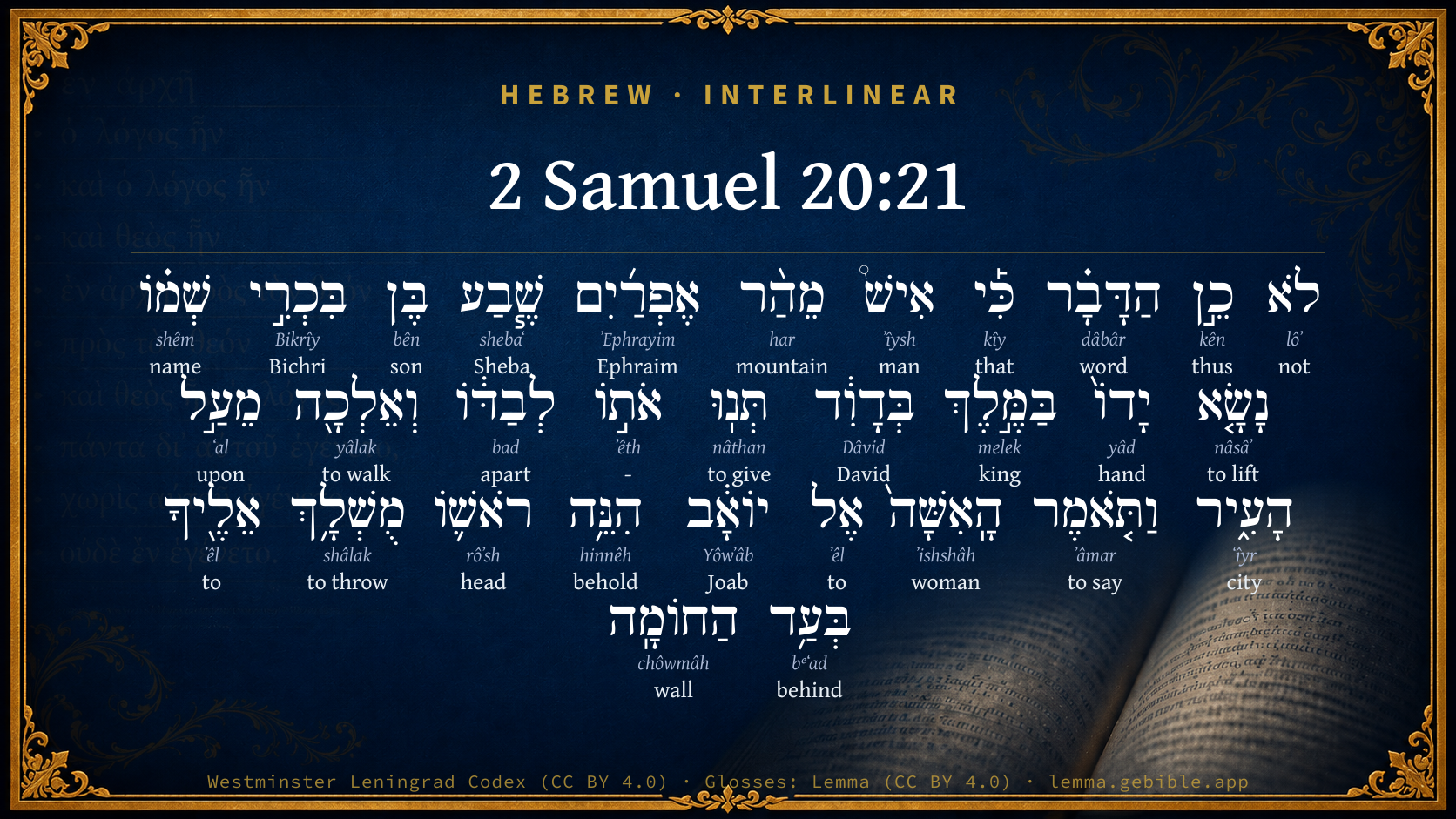
2 Samuel 20:21

Hebrew (Westminster Leningrad Codex) 2 Samuel 20:21 appears in the Hebrew Old Testament. The text above is from the Westminster Leningrad Codex. Each word links to its Strong’s number, a concise gloss, and parsing drawn from the Open Scriptures Hebrew Bible morphology. Click any word for its full Brown-Driver-Briggs (BDB) entry.
Download image
Cite this verse

2 Samuel 20:21 (World English Bible). Public Domain. Lemma interlinear Bible study tool, https://lemma.gebible.app/v/2-samuel/20/21.

Show BibTeX & RIS
BibTeX
RIS
English Translation
The matter is not so: but a man of the hill-country of Ephraim, Sheba the son of Bichri by name, has lifted up his hand against the king, even against David; deliver him only, and I will depart from the city. The woman said to Joab, Behold, his head shall be thrown to you over the wall.
World English Bible · Public Domain
Download a study sheet

One document with this verse’s original text, its word-by-word gloss line, the meaning frame, cross-references with their text, attributed commentary, and full source and license credits — printable, and it pastes into notes with its structure intact.

This verse Autodidact and up

Study sheet (.html) Plain text (.txt)

A passage Seminary Student

Up to 50 verses in one chapter. A passage sheet keeps up to 6 commentary sources and 12 cross-references per verse, in the order this page ranks them, and says so on the sheet whenever that leaves anything out. Ask for a single verse and you get the Autodidact verse sheet above.

Everything on this page stays free to read, with no account — the sheet is a download of what is already on screen, not access to it.

Want to remove ads? Support Godless Engineer
Compare translations 3

The same verse in 3 English versions, stacked beneath the original-language interlinear above. Click any original word for its lexicon entry.

Each is an independent rendering of the whole verse — the interlinear is not word-aligned to these translations.

Highlighted words mark where these versions differ — a whole-verse word diff, not a word-by-word alignment.

  • World English Bible Public Domain
    The matter is not so: but a man of the hill-country of Ephraim, Sheba the son of Bichri by name, has lifted up his hand against the king, even against David; deliver him only, and I will depart from the city. The woman said to Joab, Behold, his head shall be thrown to you over the wall.
  • King James Version Public Domain
    The matter is not so: but a man of mount Ephraim, Sheba the son of Bichri by name, hath lifted up his hand against the king, even against David: deliver him only, and I will depart from the city. And the woman said unto Joab, Behold, his head shall be thrown to thee over the wall.
  • unfoldingWord Literal Text CC BY-SA 4.0
    The matter not thus, but a man from the hill country of Ephraim—Sheba, the son of Bichri, is his name—has lifted his hand against the king, against David. Give him alone, and let me go from the city.” And the woman said to Joab, “Behold, his head will be thrown to you over the wall.”

unfoldingWord Literal Text — © unfoldingWord, licensed CC BY-SA 4.0. Word-aligned USFM3 via Door43 (git.door43.org/unfoldingWord/en_ult).

Versions to compare (up to 4)

3 of 4 selected

Show all 18 translations

Every available English version of this verse, each an independent rendering of the whole verse.

  • World English Bible Public Domain
    The matter is not so: but a man of the hill-country of Ephraim, Sheba the son of Bichri by name, has lifted up his hand against the king, even against David; deliver him only, and I will depart from the city. The woman said to Joab, Behold, his head shall be thrown to you over the wall.
  • Berean Standard Bible Public Domain
    That is not the case. But a man named Sheba son of Bichri, from the hill country of Ephraim, has lifted up his hand against the king, against David. Deliver him alone, and I will depart from the city.” “Look,” the woman replied, “his head will be thrown to you over the wall.”
  • Majority Standard Bible Public Domain
    That is not the case. But a man named Sheba son of Bichri, from the hill country of Ephraim, has lifted up his hand against the king, against David. Deliver him alone, and I will depart from the city.” “Look,” the woman replied, “his head will be thrown to you over the wall.”
  • King James Version Public Domain
    The matter is not so: but a man of mount Ephraim, Sheba the son of Bichri by name, hath lifted up his hand against the king, even against David: deliver him only, and I will depart from the city. And the woman said unto Joab, Behold, his head shall be thrown to thee over the wall.
  • American Standard Version (1901) Public Domain
    The matter is not so: but a man of the hill-country of Ephraim, Sheba the son of Bichri by name, hath lifted up his hand against the king, even against David; deliver him only, and I will depart from the city. And the woman said unto Joab, Behold, his head shall be thrown to thee over the wall.
  • Revised Version (1885) Public Domain
    The matter is not so: but a man of the hill country of Ephraim, Sheba the son of Bichri by name, hath lifted up his hand against the king, even against David: deliver him only, and I will depart from the city. And the woman said unto Joab, Behold, his head shall be thrown to thee over the wall.
  • Geneva Bible (1599) Public Domain
    The matter is not so, but a man of mout Ephraim (Sheba ye sonne of Bichri by name) hath lift vp his had against ye King, euen against Dauid: deliuer vs him onely, and I will depart from the citie. And the woman saide vnto Ioab, Beholde, his head shalbe throwen to thee ouer the wall.
  • Douay-Rheims (1899) Public Domain
    The matter is not so, but a man of mount Ephraim, Seba the son of Bochri by name, hath lifted up his hand against king David: deliver him only, and we will depart from the city. And the woman said to Joab: Behold his head shall be thrown to thee from the wall.
  • Young's Literal Translation Public Domain
    The matter `is' not so; for a man of the hill-country of Ephraim -- Sheba son of Bichri his name -- hath lifted up his hand against the king, against David; give ye up him by himself, and I go away from the city.' And the woman saith unto Joab, `Lo, his head is cast unto thee over the wall.'
  • Literal Standard Version CC BY-SA 4.0
    The matter [is] not so; for a man of the hill-country of Ephraim—Sheba son of Bichri [is] his name—has lifted up his hand against the king, against David; give him up by himself, and I go away from the city.” And the woman says to Joab, “Behold, his head is cast to you over the wall.”
  • Unlocked Literal Bible CC BY-SA 4.0
    That is not true. But a man from the hill country of Ephraim, named Sheba son of Bikri, has lifted up his hand against the king, against David. Give up him alone, and I will withdraw from the city.” The woman said to Joab, “His head will be thrown to you over the wall.”
  • unfoldingWord Literal Text CC BY-SA 4.0
    The matter not thus, but a man from the hill country of Ephraim—Sheba, the son of Bichri, is his name—has lifted his hand against the king, against David. Give him alone, and let me go from the city.” And the woman said to Joab, “Behold, his head will be thrown to you over the wall.”
  • Darby Bible Public Domain
    The matter is not so; but a man of mount Ephraim, Sheba the son of Bichri by name, has lifted up his hand against the king, against David: give up him only, and I will depart from the city. And the woman said to Joab, Behold, his head shall be thrown to thee over the wall.
  • World Messianic Bible Public Domain
    The matter is not so. But a man of the hill country of Ephraim, Sheba the son of Bichri by name, has lifted up his hand against the king, even against David. Just deliver him, and I will depart from the city.” The woman said to Joab, “Behold, his head will be thrown to you over the wall.”
  • Webster's Bible Public Domain
    The matter is not so: but a man of mount Ephraim, Sheba the son of Bichri by name, hath lifted up his hand against the king, even against David: deliver him only, and I will depart from the city. And the woman said to Joab, Behold, his head shall be thrown to thee over the wall.
  • Free Bible Version CC BY-SA 4.0
    That's not the intention. But a man called Sheba, son of Bichri, from the hill country of Ephraim, has rebelled against the king, against David. Just hand over this one man and I will withdraw from the town.” “Fine,” the woman replied, “his head will be thrown over the wall to you.”
  • Bible in Basic English Public Domain
    Not so: but a man of the hill-country of Ephraim, Sheba, son of Bichri, by name, has taken up arms against the king, against David: give up this man only, and I will go away from the town. And the woman said to Joab, His head will be dropped over the wall to you.
  • JPS Tanakh (1917) Public Domain
    The matter is not so; but a man of the hill-country of Ephraim, Sheba the son of Bichri by name, hath lifted up his hand against the king, even against David; deliver him only, and I will depart from the city.' And the woman said unto Joab: 'Behold, his head shall be thrown to thee over the wall.'

Literal Standard Version (2020), Covenant Press — licensed CC BY-SA 4.0. Text via the HelloAO Bible API (eBible.org). Unlocked Literal Bible (unfoldingWord) — licensed CC BY-SA 4.0. Text via the HelloAO Bible API (eBible.org). unfoldingWord Literal Text — © unfoldingWord, licensed CC BY-SA 4.0. Word-aligned USFM3 via Door43 (git.door43.org/unfoldingWord/en_ult). Free Bible Version, Dr. Jonathan Gallagher — licensed CC BY-SA 4.0. Text via the HelloAO Bible API (eBible.org).

Word by word

More ways to search: Search by grammar → Find every occurrence → Compare this word →

Practice this passage: Drill this verse → Learn its vocabulary →

בִּכְרִ֣י
Bikrîy
H1075
“Bichri”
Noun, Proper
Part of Speech
Noun
Type
Proper
Full BDB Definition

Origin: from H1069

TWOT: None

Bichri = "youthful" - a Benjamite, father of Sheba - (BDB) the Bichrites
  1. לֹא lôʼ H3808 “not” Particle, Negative
  2. כֵ֣ן kên H3651 “thus” Adverb
  3. הַדָּבָ֗ר dâbâr H1697 “the · word” Particle, Definite Article + Noun, Common, Masculine, Singular, Absolute
  4. כִּ֡י kîy H3588 “that” Conjunction
  5. אִישׁ֩ ʼîysh H376 “man” Noun, Common, Masculine, Singular, Absolute
  6. מֵהַ֨ר har H2022 “from · mountain of” Preposition + Noun, Common, Masculine, Singular, Construct
  7. אֶפְרַ֜יִם ʼEphrayim H669 “Ephraim” Noun, Proper
  8. שֶׁ֧בַע shebaʻ H7652 “Sheba” Adjective, Cardinal number, Feminine, Singular, Absolute
  9. בֶּן bên H1121 “son of” Noun, Common, Masculine, Singular, Construct
  10. שְׁמ֗וֹ shêm H8034 “name · his” Noun, Common, Masculine, Singular, Construct + Suffix, Personal, 3rd Person, Masculine, Singular
  11. נָשָׂ֤א nâsâʼ H5375 “to lift” Verb, Qal, Perfect, 3rd Person, Masculine, Singular
  12. יָדוֹ֙ yâd H3027 “hand · his” Noun, Common, Both, Singular, Construct + Suffix, Personal, 3rd Person, Masculine, Singular
  13. בַּמֶּ֣לֶךְ melek H4428 “in/at the · king” Preposition, Determined + Noun, Common, Masculine, Singular, Absolute
  14. בְּדָוִ֔ד Dâvid H1732 “in/at · David” Preposition + Noun, Proper
  15. תְּנֽוּ nâthan H5414 “give” Verb, Qal, Imperative, 2nd Person, Masculine, Plural
  16. אֹת֣וֹ ʼêth H853 “- · him” Particle, Direct Object + Suffix, Personal, 3rd Person, Masculine, Singular
  17. לְבַדּ֔וֹ bad H905 “to/for · apart · his” Preposition + Noun, Common, Masculine, Singular, Construct + Suffix, Personal, 3rd Person, Masculine, Singular
  18. וְאֵלְכָ֖ה yâlak H3212 “and · to walk” Conjunction + Verb, Qal, Cohortative, 1st Person, Common, Singular
  19. מֵעַ֣ל ʻal H5921 “from · upon” Preposition + Preposition
  20. הָעִ֑יר ʻîyr H5892 “the · city” Particle, Definite Article + Noun, Common, Feminine, Singular, Absolute
  21. וַתֹּ֤אמֶר ʼâmar H559 “and · to say” Conjunction + Verb, Qal, Sequential Imperfect, 3rd Person, Feminine, Singular
  22. הָֽאִשָּׁה֙ ʼishshâh H802 “the · woman” Particle, Definite Article + Noun, Common, Feminine, Singular, Absolute
  23. אֶל ʼêl H413 “to” Preposition
  24. יוֹאָ֔ב Yôwʼâb H3097 “Joab” Noun, Proper
  25. הִנֵּ֥ה hinnêh H2009 “behold” Particle, Demonstrative
  26. רֹאשׁ֛וֹ rôʼsh H7218 “head · his” Noun, Common, Masculine, Singular, Construct + Suffix, Personal, 3rd Person, Masculine, Singular
  27. מֻשְׁלָ֥ךְ shâlak H7993 “thrown” Verb, Hophal, Participle Passive, Masculine, Singular, Absolute
  28. אֵלֶ֖יךָ ʼêl H413 “to · you” Preposition + Suffix, Personal, 2nd Person, Masculine, Singular
  29. בְּעַ֥ד bᵉʻad H1157 “behind” Preposition
  30. הַחוֹמָֽה chôwmâh H2346 “the · wall” Particle, Definite Article + Noun, Common, Feminine, Singular, Absolute

About this verse

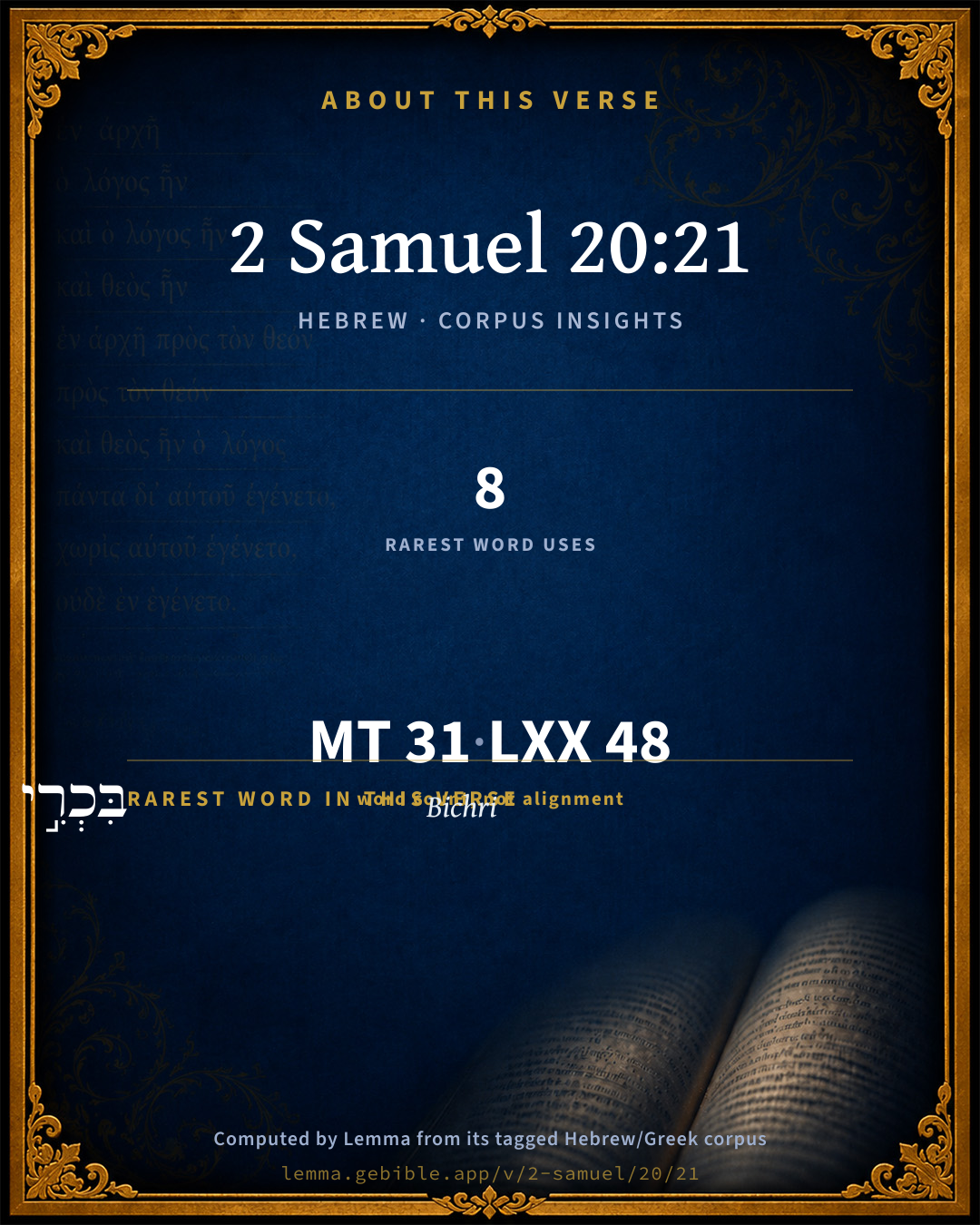
These counts appear in no published source. They are computed here, from the morphology-tagged text and Lemma’s own curated glosses. What Lemma adds →

31
words
30
distinct lemmas
Historical
section

Notable vocabulary

The rarest word here is בִּכְרִ֣י Bichri H1075 — appearing just 8 times in the whole Hebrew Bible.

Shared distinctive vocabulary

בִּכְרִ֣י Bichri H1075 occurs in 8 verses of the Hebrew Bible. Also found in:

Grammatical profile

  • 5 verbs
  • 16 nouns
  • 1 adjective
  • 4 prepositions
  • 1 conjunction
  • 1 adverb
  • 3 particles

Verb forms

  • נָשָׂ֤א Qal · Perfect
  • תְּנֽוּ Qal · Imperative
  • וְאֵלְכָ֖ה Qal · Cohortative
  • וַתֹּ֤אמֶר Qal · Sequential Imperfect
  • מֻשְׁלָ֥ךְ Hophal · Participle Passive

Repetition

A word recurs within this verse — often emphatic in Hebrew:

  • אֶל to H413 ×2

Hebrew & Septuagint length

In English translation the verse runs 57 words from the Hebrew and 55 from the Septuagint (LXX English) — closely comparable.

A rough comparison of the two English renderings, which tokenize alike — not a word-level alignment.

Word counts can differ between the Hebrew and the Greek without any difference in meaning — e.g. the Hebrew direct-object marker אֵת has no separate Greek word, and Greek often adds the article ὁ.

In the original languages it is 31 Hebrew tokens and 48 Greek tokens — but the two are counted differently (Hebrew bundles its prefixes and suffixes into one token; the Greek is in lemma form), so that isn’t a like-for-like length.

Cross-references

13

Topical passages linked to 2 Samuel 20:21 in the Treasury of Scripture Knowledge — connected by theme and wording, ordered by reader-vote popularity; previews shown in the World English Bible.

  • Joshua 24:33 Eleazar the son of Aaron died; and they buried him in the hill of Phinehas his son, which was given him in the hill-country of Ephraim.
  • Judges 2:9 They buried him in the border of his inheritance in Timnath Heres, in the hill country of Ephraim, on the north of the mountain of Gaash.
  • Judges 7:24 Gideon sent messengers throughout all the hill-country of Ephraim, saying, Come down against Midian, and take before them the waters, as far as Beth Barah, even the Jordan. So all the men of Ephraim were gathered together, and took the waters as far as Beth Barah, even the Jordan.
  • Judges 18:4–8 He said to them, Thus and thus has Micah dealt with me, and he has hired me, and I am become his priest.
  • 1 Samuel 24:6 He said to his men, Yahweh forbid that I should do this thing to my lord, Yahweh's anointed, to put forth my hand against him, seeing he is Yahweh's anointed.
  • 1 Samuel 26:9 David said to Abishai, Don't destroy him; for who can put forth his hand against Yahweh's anointed, and be guiltless?
  • 2 Samuel 17:2–3 and I will come on him while he is weary and weak-handed, and will make him afraid; and all the people who are with him shall flee; and I will strike the king only;
  • 2 Samuel 20:1 There happened to be there a base fellow, whose name was Sheba, the son of Bichri, a Benjamite: and he blew the trumpet, and said, We have no portion in David, neither have we inheritance in the son of Jesse: every man to his tents, Israel.
  • 2 Samuel 23:18 Abishai, the brother of Joab, the son of Zeruiah, was chief of the three. He lifted up his spear against three hundred and killed them, and had a name among the three.
  • 2 Kings 5:22 He said, All is well. My master has sent me, saying, Behold, even now there are come to me from the hill-country of Ephraim two young men of the sons of the prophets; please give them a talent of silver, and two changes of clothing.
  • 2 Kings 10:7 It happened, when the letter came to them, that they took the king's sons, and killed them, even seventy persons, and put their heads in baskets, and sent them to him to Jezreel.
  • Jeremiah 4:15 For a voice declares from Dan, and publishes evil from the hills of Ephraim:
  • Jeremiah 50:19 I will bring Israel again to his pasture, and he shall feed on Carmel and Bashan, and his soul shall be satisfied on the hills of Ephraim and in Gilead.

Cross-references courtesy of OpenBible.info (CC BY 4.0).

Hebrew and Greek witnesses Masoretic Hebrew ↔ Greek Septuagint

The same verse in the two great witnesses to the Old Testament, shown verse-for-verse.

These are two independent witnesses, not word-aligned to each other, and the Septuagint is shown in lemma (dictionary) form.

Hebrew 2 Samuel 20:21 Masoretic · Westminster Leningrad Codex

לֹא כֵ֣ן הַדָּבָ֗ר כִּ֡י אִישׁ֩ מֵהַ֨ר אֶפְרַ֜יִם שֶׁ֧בַע בֶּן בִּכְרִ֣י שְׁמ֗וֹ נָשָׂ֤א יָדוֹ֙ בַּמֶּ֣לֶךְ בְּדָוִ֔ד תְּנֽוּ אֹת֣וֹ לְבַדּ֔וֹ וְאֵלְכָ֖ה מֵעַ֣ל הָעִ֑יר וַתֹּ֤אמֶר הָֽאִשָּׁה֙ אֶל יוֹאָ֔ב הִנֵּ֥ה רֹאשׁ֛וֹ מֻשְׁלָ֥ךְ אֵלֶ֖יךָ בְּעַ֥ד הַחוֹמָֽה

The matter is not so: but a man of the hill-country of Ephraim, Sheba the son of Bichri by name, has lifted up his hand against the king, even against David; deliver him only, and I will depart from the city. The woman said to Joab, Behold, his head shall be thrown to you over the wall.

World English Bible · Public Domain

Greek LXX 2 Samuel 20:21 Septuagint · lemma form

οὐ οὗτος ὁ λόγος ὅτι ἀνήρ ἐκ ὄρος ἐφράιμ σαβεε υἱός βοχορι ὄνομα αὐτός καί ἐπιαἴρω ὁ χείρ αὐτός ἐπί ὁ βασιλεύς δαυίδ δίδωμι αὐτός ἐγώ μόνος καί ἀποἔρχομαι ἀπάνωθεν ὁ πόλις καί εἶπον ὁ γυνή πρός ιωαβ ἰδού ὁ κεφαλή αὐτός ῥίπτω πρός σύ διά ὁ τεῖχος

Is not the case thus, that a man of mount Ephraim, Sabee, son of Bochori by name, has even lifted up his hand against king David? Give him only to me, and I will depart from the city. And the woman said to Joab, Behold, his head shall be thrown to you over the wall.

LXX2012 (modern English Septuagint) · Public Domain

Hebrew: Westminster Leningrad Codex (CC BY 4.0). Greek: Septuagint (public domain); English from LXX2012 (modern English Septuagint) (Public Domain). How the Septuagint differs from the Hebrew →

Targum (Aramaic paraphrase)

1

The Targum is the ancient Jewish Aramaic paraphrase of the Hebrew Scriptures — an interpretive translation, not the Hebrew text itself. Onkelos (literal) and Pseudo-Jonathan (expansive) render the Torah, and Jonathan the Prophets. Coverage is partial: where no permissively-licensed English translation exists for a verse, only the Aramaic is shown. This is verse-level text, not a word-by-word alignment to the Hebrew.

  1. Targum Jonathan Prophets (Joshua–Malachi)
    לָא כֵן פִתְגָמָא אֲרֵי גַבְרָא מִטוּרָא דְבֵית אֶפְרַיִם שֶׁבַע בַּר בִּכְרִי שְׁמֵיהּ אֲרִים יְדֵיהּ בְּמַלְכָּא בְּדָוִד הָבוּ יָתֵיהּ בִּלְחוֹדֵיהּ וְאֵיהַךְ מֵעַל קַרְתָּא וַאֲמַרַת אִתְּתָא לְיוֹאָב הָא רֵישֵׁיהּ מִיתְרְמֵי לָךְ מִן שׁוּרָא:

    (no public-domain English translation for this verse)

    Targum Jonathan — Aramaic: “Mikraot Gedolot” (public domain). English: “Sefaria Community Translation” (CC0 1.0 (public-domain dedication)); “London "Chaldee Paraphrase," 1871” (public domain). Text via Sefaria.

Commentary

Notes on 2 Samuel 20:21 from classic Christian and Jewish commentators (each source and its license shown beneath its notes). The classic Christian expositions comment on the surrounding passage and are grouped to its opening verse, so a note may address several verses; the Jewish commentaries on the Tanakh (Rashi and others) are per-verse, so they appear only where the commentator wrote on this verse.

Lemma curates 59 commentaries, every one of them public domain or Creative Commons licensed, each selected and text-cleaned for this edition rather than reprinted as found. About our sources →

Trapp's Complete Commentary

John Trapp

2Sa 20:21 The matter [is] not so: but a man of mount Ephraim, Sheba the son of Bichri by name, hath lifted up his hand against the king, [even] against David: deliver him only, and I will depart from the city. And the woman said unto Joab, Behold, his head shall be thrown to thee over the wall.

Ver. 21. Deliver him only, and I will depart from the city.] Spiritually the case is ours, saith a right reverend writer. {a} Every man’s breast is as a city enclosed. Every sin is a traitor that lurketh within those walls. God calleth to us for Sheba’s head, neither hath he any quarrel to us for our person, but for our sin. If we love the head of our traitor above the life of our soul, we shall justly perish in the vengeance. We cannot be more willing to part with our sins, than our merciful God is to withdraw his judgments.

{a} Bp. Hall, Contempl.

John Trapp, A Commentary or Exposition upon All the Books of the Old and New Testament (1647–1656) — public domain. Text from a community e-Sword module.

Joseph Benson's Commentary

2Sa 20:21. A man of mount Ephraim — He is said before, 2Sa 20:1, to be of the tribe of Benjamin. Either, therefore, he lived in mount Ephraim, or a place in Benjamin is here called so, probably because it was upon the borders of Ephraim, or for some notable action or event of the Ephraimites in that place. His head shall be thrown to thee — Which she undertook, because she knew the present temper of the citizens and soldiers too. And it is not unlikely that this woman might be a governess in that city. For, though this office was commonly performed by men, yet women were sometimes employed in the government; as we see in Deborah, who judged Israel, Jdg 4:4.

Joseph Benson's Commentary on the Old and New Testaments (1811–1818) — public domain. Text from a community e-Sword module.

Geneva Bible (1599)

Geneva Bible translators

Hearing his fault told him, he gave place to reason, and required only him that was author of the treason.

Geneva Bible (1599) marginal notes — public domain. Text via Bolls.life.

Adam Clarke's Commentary

Verse 21. His head shall be thrown to thee] Thus it appears she had great sway in the counsels of the city; and that the punishment of a state rebel was then, what it is now in this kingdom, beheading.

Adam Clarke's Commentary on the Bible (1810–1826) — public domain. Text from a community e-Sword/MySword module.

Ellicott's Commentary for English Readers

(21) Mount Ephraim.—The range of hills so called because much of it lay in the tribe of Ephraim, although extending south into Benjamin.

A Bible Commentary for English Readers, edited by Charles John Ellicott (1878–1897) — public domain. Text from a community e-Sword module.

The Cambridge Bible for Schools and Colleges

gen. ed. J. J. S. Perowne

21. a man of mount Ephraim] The name “mount Ephraim,” applied to the central mountainous district of Palestine, was extended southwards so as to include part of the territory of Benjamin. See note on 1Sa_1:1.

The Cambridge Bible for Schools and Colleges (gen. ed. J. J. S. Perowne; Cambridge University Press, 1878–1918) — public domain. Text from a community e-Sword module.

John Gill's Exposition

The matter is not so,.... I am not come with the army against this city with any ill will to it, and with an intention to destroy it: the case is this:

but a man of Mount Ephraim, Sheba the son of Bichri by name; for though he was by birth a Benjaminite, his dwelling was in Mount Ephraim in that tribe; unless there was a place of this name in the tribe of Benjamin, so called from any memorable event there, as the wood of Ephraim, Sa2 18:6. This same man, says Joab:

hath lifted up his hand against the king, even against David; is in rebellion against the king, even so great and good a king as David; he has lifted up his hand, and blown a trumpet to draw off men from David, and after himself; he has committed acts of hostility and treason; he has drawn his sword, and raised an insurrection and rebellion in the nation:

deliver him only, and I will depart from the city: he did not desire any of his followers to be delivered up, only himself, knowing the rebellion would cease upon the delivery of him; and being unwilling that the blood of any Israelite should be shed, whom he had unawares drawn into this rebellion, and who he knew would return to their own cities upon this:

and the woman said unto Joab, behold, his head shall be thrown to thee over the wall; she knew the fright the inhabitants of the city were in, and how disposed they were to do anything to save their city; she knew what influence she had among them, and how weak Sheba's party was, and therefore could assure Joab that this should be done.

John Gill's Exposition of the Whole Bible (1746–1763) — public domain (CC PDM 1.0). Text via the HelloAO Bible API.

Matthew Poole's English Annotations

A man of Mount Ephraim.

Quest. How can this be so when he is called a Benjamite, 2Sa 20:1?

Answ. Either he was a Benjamite by birth, but dwelt in the tribe of Ephraim, as many did upon several occasions dwell out of their own tribes; or Mount Ephraim was a place in Benjamin, which might be so called, either because it was upon the borders of Ephraim, and looked towards it; or from some notable action or event of the Ephraimites in that place. Compare 1Sa 18:6. Hath lift up his hand, i.e. taken up arms, or raised rebellion. His head shall be thrown, to thee over the wall; which she undertook, because she knew the present temper and great fears of the citizens, and soldiers too; and that considering their evident and extreme danger, they were generally desirous of peace, from which they were restrained only by Sheba’s authority and interest; and therefore did not doubt by God’s blessing upon her wise counsel to effect it, as indeed she did. And it is not unlikely that this woman might be a governess in that city for though this office was commonly performed by men, yet were not the women wholly excluded, but sometimes employed in the government; as we see in Deborah, who judged Israel, Jdg 4:4; and queen Athaliah, 2Ki 11.

Matthew Poole's English Annotations on the Holy Bible (1683–1685) — public domain. Text from a community e-Sword/MySword module.

Whedon's Commentary on the Bible

Daniel D. Whedon

21. Mount Ephraim — Which extended into the territory of Benjamin. See note on Jdg_17:1.

Daniel D. Whedon (gen. ed.), Commentary on the Old and New Testaments (1874–1909) — public domain. Text from a community e-Sword module.

The Pulpit Commentary

The matter is not so. It seems from this verse that the citizens did not quite understand why Joab attacked them. Sheba had thrown himself into the city. and Joab, in hot pursuit, finding the gate closed a measure of ordinary precaution upon the approach of a body of men at once blockaded the town, and began to cast up the mount. At all events, they were ready to come to terms now, and would probably have given up Sheba at first, if Joab had demanded his surrender. A man of Mount Ephraim. Sheba was a Benjamite, but the hills of Ephraim extended into the territory of Benjamin, and retained their name. (see 1Sa_1:1) Over the wall; Hebrew, through the wall, being the word rendered "at" a window in Gen_26:8. It probably means through one of the apertures made for the archers.

The Pulpit Commentary (1880–1919), ed. H.D.M. Spence-Jones & Joseph S. Exell — public domain. Text from a community e-Sword module.

John Wesley's Explanatory Notes

Ephraim - Probably mount Ephraim was a place in Benjamin so called, either because it was upon the borders of Ephraim or for some notable action or event of the Ephraimites in that place. His head - Which she undertook, because she knew the present temper of the citizens, and soldiers too. And it is not unlikely, that this woman might be a governness in that city. For though this office was commonly performed by men; yet women were sometimes employed in the government: as we see in Deborah, who judged Israel, Judg. iv, 4.

John Wesley, Explanatory Notes Upon the Whole Bible (1754–1765) — public domain. Text via the GEBible commentary corpus.

Rashi

Rabbi Shlomo Yitzchaki (Rashi)

Lifted his hand against the king, Dovid. Against the king even if it were not Dovid he is punishable by death. Alternatively if it were against Dovid [who is a scholar] even if he was not the king, he [Shevah] is punishable by death. All the much more so [now that he has rebelled] against the king, against Dovid. This is how this verse is expounded upon in the Midrash Koheles.

Rashi on the Tanakh — English translations: “The Judaica Press complete Tanach with Rashi, translated by A. J. Rosenberg” (CC BY 4.0); “Pentateuch with Rashi's commentary by M. Rosenbaum and A.M. Silbermann, 1929-1934” (public domain); “The Metsudah Tanach series, Lakewood, N.J” (CC BY 4.0); and “The Book of Joshua, Metsudah Publications, 1997” (CC BY 4.0). Text via Sefaria.

Lesson kit

Teaching starters — assembled from the data on this page, not authored interpretation. Every prompt links to the verse data it draws on. Edit before teaching.

2 Samuel, in the Historical, opens this verse with 31 words (30 distinct Hebrew lemmas). Its most distinctive word is Bikrîy (“Bichri”). A historical commentator’s framing appears above. Read the whole chapter for the surrounding context.

Discussion questions

  1. What does “Bichri” (Bikrîy) contribute to the verse as a whole?
  2. 2 Samuel 20:1 shares the word «Bichri» with this verse. How do the two illuminate each other?
  3. “to” occurs 2× in this one verse. What is the effect of the repetition?
  4. These translations render this verse differently; the difference is in the English rendering, not the original. What questions does that raise?
  5. The verb «נָשָׂ֤א» is Qal Perfect. How does its form color the action?
  6. Reading how Trapp's Complete Commentary and Joseph Benson's Commentary read this verse, where do the two commentators agree and where do they part?

Things to notice

Reading settings

Reading text

Shown beneath each verse's original-language words.

Old Testament
Old Testament edition

Read the OT as the Masoretic Hebrew (MT) or the Greek Septuagint (LXX).

English shown for the Greek Septuagint (in the Hebrew ↔ Greek comparison).

Comparing translations? Open the Compare panel on any verse page to stack up to four side by side.