
Job 42:8

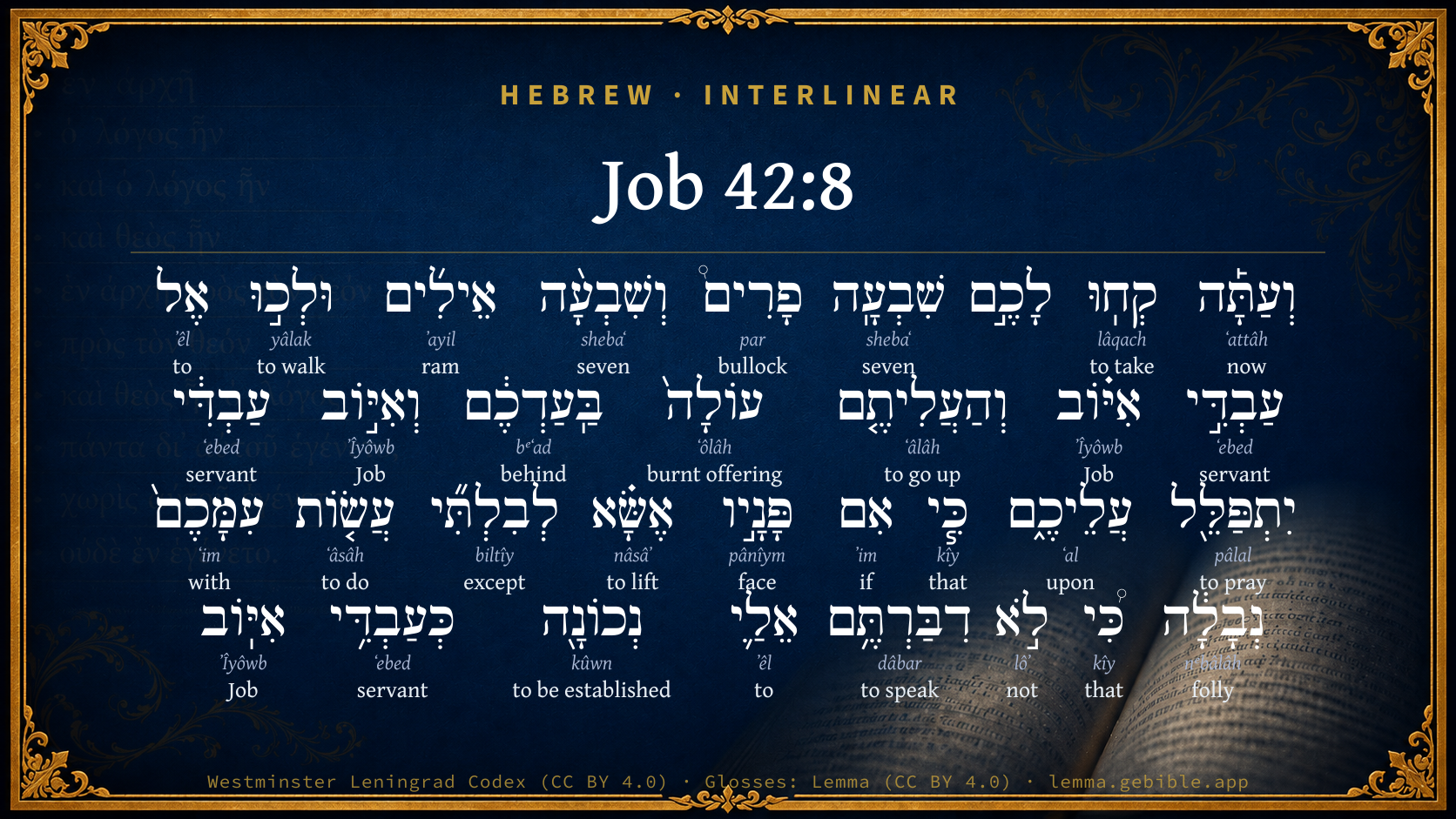
Hebrew (Westminster Leningrad Codex) Job 42:8 appears in the Hebrew Old Testament. The text above is from the Westminster Leningrad Codex. Each word links to its Strong’s number, a concise gloss, and parsing drawn from the Open Scriptures Hebrew Bible morphology. Click any word for its full Brown-Driver-Briggs (BDB) entry.
Download image
Cite this verse

Job 42:8 (World English Bible). Public Domain. Lemma interlinear Bible study tool, https://lemma.gebible.app/v/job/42/8.

Show BibTeX & RIS
BibTeX
RIS
English Translation
Now therefore, take to yourselves seven bulls and seven rams, and go to my servant Job, and offer up for yourselves a burnt offering; and my servant Job shall pray for you, for I will accept him, that I not deal with you according to your folly. For you have not spoken of me the thing that is right, as my servant Job has."
World English Bible · Public Domain
Download a study sheet

One document with this verse’s original text, its word-by-word gloss line, the meaning frame, cross-references with their text, attributed commentary, and full source and license credits — printable, and it pastes into notes with its structure intact.

This verse Autodidact and up

Study sheet (.html) Plain text (.txt)

A passage Seminary Student

Up to 50 verses in one chapter. A passage sheet keeps up to 6 commentary sources and 12 cross-references per verse, in the order this page ranks them, and says so on the sheet whenever that leaves anything out. Ask for a single verse and you get the Autodidact verse sheet above.

Everything on this page stays free to read, with no account — the sheet is a download of what is already on screen, not access to it.

Want to remove ads? Support Godless Engineer
Compare translations 3

The same verse in 3 English versions, stacked beneath the original-language interlinear above. Click any original word for its lexicon entry.

Each is an independent rendering of the whole verse — the interlinear is not word-aligned to these translations.

Highlighted words mark where these versions differ — a whole-verse word diff, not a word-by-word alignment.

  • World English Bible Public Domain
    Now therefore, take to yourselves seven bulls and seven rams, and go to my servant Job, and offer up for yourselves a burnt offering; and my servant Job shall pray for you, for I will accept him, that I not deal with you according to your folly. For you have not spoken of me the thing that is right, as my servant Job has."
  • King James Version Public Domain
    Therefore take unto you now seven bullocks and seven rams, and go to my servant Job, and offer up for yourselves a burnt offering; and my servant Job shall pray for you: for him will I accept: lest I deal with you after your folly, in that ye have not spoken of me the thing which is right, like my servant Job.
  • unfoldingWord Literal Text CC BY-SA 4.0
    So now take for yourselves seven bulls and seven rams and go to my servant Job and offer a burnt offering for yourselves. And Job my servant will pray for you; I will surely lift his face, lest I deal with you folly. For you have not said what is right about me like my servant Job.”

unfoldingWord Literal Text — © unfoldingWord, licensed CC BY-SA 4.0. Word-aligned USFM3 via Door43 (git.door43.org/unfoldingWord/en_ult).

Versions to compare (up to 4)

3 of 4 selected

Show all 18 translations

Every available English version of this verse, each an independent rendering of the whole verse.

  • World English Bible Public Domain
    Now therefore, take to yourselves seven bulls and seven rams, and go to my servant Job, and offer up for yourselves a burnt offering; and my servant Job shall pray for you, for I will accept him, that I not deal with you according to your folly. For you have not spoken of me the thing that is right, as my servant Job has."
  • Berean Standard Bible Public Domain
    So now, take seven bulls and seven rams, go to My servant Job, and sacrifice a burnt offering for yourselves. Then My servant Job will pray for you, for I will accept his prayer and not deal with you according to your folly. For you have not spoken accurately about Me, as My servant Job has.”
  • Majority Standard Bible Public Domain
    So now, take seven bulls and seven rams, go to My servant Job, and sacrifice a burnt offering for yourselves. Then My servant Job will pray for you, for I will accept his prayer and not deal with you according to your folly. For you have not spoken accurately about Me, as My servant Job has.”
  • King James Version Public Domain
    Therefore take unto you now seven bullocks and seven rams, and go to my servant Job, and offer up for yourselves a burnt offering; and my servant Job shall pray for you: for him will I accept: lest I deal with you after your folly, in that ye have not spoken of me the thing which is right, like my servant Job.
  • American Standard Version (1901) Public Domain
    Now therefore, take unto you seven bullocks and seven rams, and go to my servant Job, and offer up for yourselves a burnt-offering; and my servant Job shall pray for you; for him will I accept, that I deal not with you after your folly; for ye have not spoken of me the thing that is right, as my servant Job hath.
  • Revised Version (1885) Public Domain
    Now therefore, take unto you seven bullocks and seven rams, and go to my servant Job, and offer up for yourselves a burnt offering; and my servant Job shall pray for you; for him will I accept, that I deal not with you after your folly; for ye have not spoken of me the thing that is right, as my servant Job hath.
  • Geneva Bible (1599) Public Domain
    Therefore take vnto you nowe seuen bullockes, and seuen rammes, and go to my seruant Iob, and offer vp for your selues a burnt offring, and my seruant Iob shall pray for you: for I wil accept him, least I should put you to shame, because ye haue not spoken of me the thing, which is right, like my seruant Iob.
  • Douay-Rheims (1899) Public Domain
    Take unto you therefore seven oxen, and seven rams, and go to my servant Job, and offer for yourselves a holocaust: and my servant Job shall pray for you: his face I will accept, that folly be not imputed to you: for you have not spoken right things before me, as my servant Job hath.
  • Young's Literal Translation Public Domain
    And now, take to you seven bullocks and seven rams, and go ye unto My servant Job, and ye have caused a burnt-offering to ascend for you; and Job My servant doth pray for you, for surely his face I accept, so as not to do with you folly, because ye have not spoken concerning Me rightly, like My servant Job.
  • Literal Standard Version CC BY-SA 4.0
    And now, take seven bullocks and seven rams for yourselves, and go to My servant Job, and you have caused a burnt-offering to ascend for yourselves; and Job My servant prays for you, for surely I accept his face, so as not to do folly with you, because you have not spoken correctly concerning Me, like My servant Job.”
  • Unlocked Literal Bible CC BY-SA 4.0
    Now therefore, take for yourselves seven bulls and seven rams, go to my servant Job, and offer up for yourselves a burnt offering. My servant Job will pray for you, and I will accept his prayer, so that I may not deal with you after your folly. You have not said what is right about me, as my servant Job has done.”
  • unfoldingWord Literal Text CC BY-SA 4.0
    So now take for yourselves seven bulls and seven rams and go to my servant Job and offer a burnt offering for yourselves. And Job my servant will pray for you; I will surely lift his face, lest I deal with you folly. For you have not said what is right about me like my servant Job.”
  • Darby Bible Public Domain
    And now, take for yourselves seven bullocks and seven rams, and go to my servant Job, and offer up for yourselves a burnt-offering; and my servant Job shall pray for you, for him will I accept: lest I deal with you [after your] folly, for ye have not spoken of me rightly, like my servant Job.
  • World Messianic Bible Public Domain
    Now therefore, take to yourselves seven bulls and seven rams, and go to my servant Job, and offer up for yourselves a burnt offering; and my servant Job shall pray for you, for I will accept him, that I not deal with you according to your folly. For you have not spoken of me the thing that is right, as my servant Job has.”
  • Webster's Bible Public Domain
    Therefore take to you now seven bullocks and seven rams, and go to my servant Job, and offer for yourselves a burnt-offering; and my servant Job shall pray for you: for him will I accept: lest I deal with you after your folly, in that ye have not spoken of me the thing which is right, like my servant Job.
  • Free Bible Version CC BY-SA 4.0
    So take seven bulls and seven rams and go to my servant Job, and you shall offer a burnt offering for yourselves. My servant Job will pray on your behalf and I will accept his prayer and not deal with you according to your foolishness, because you have not told the truth about me, as my servant Job did.”
  • Bible in Basic English Public Domain
    And now, take seven oxen and seven sheep, and go to my servant Job, and give a burned offering for yourselves, and my servant Job will make prayer for you, that I may not send punishment on you; because you have not said what is right about me, as my servant Job has.
  • JPS Tanakh (1917) Public Domain
    Now therefore, take unto you seven bullocks and seven rams, and go to My servant Job, and offer up for yourselves a burnt-offering; and My servant Job shall pray for you; for him will I accept, that I do not unto you aught unseemly; for ye have not spoken of Me the thing that is right, as my servant Job hath.'

Literal Standard Version (2020), Covenant Press — licensed CC BY-SA 4.0. Text via the HelloAO Bible API (eBible.org). Unlocked Literal Bible (unfoldingWord) — licensed CC BY-SA 4.0. Text via the HelloAO Bible API (eBible.org). unfoldingWord Literal Text — © unfoldingWord, licensed CC BY-SA 4.0. Word-aligned USFM3 via Door43 (git.door43.org/unfoldingWord/en_ult). Free Bible Version, Dr. Jonathan Gallagher — licensed CC BY-SA 4.0. Text via the HelloAO Bible API (eBible.org).

Word by word

More ways to search: Search by grammar → Find every occurrence → Compare this word →

Practice this passage: Drill this verse → Learn its vocabulary →

נְבָלָ֔ה
nᵉbâlâh
H5039
“folly”
Noun, Common, Feminine, Singular, Absolute
Part of Speech
Noun
Type
Common
Gender
Feminine
Number
Singular
State
Absolute
Full BDB Definition

Origin: from H5036

TWOT: 1285b

senselessness, folly - disgraceful folly - of immorality, profane actions - disgrace, contumely disgrace
  1. וְעַתָּ֡ה ʻattâh H6258 “and · now” Conjunction + Adverb
  2. קְחֽוּ lâqach H3947 “take” Verb, Qal, Imperative, 2nd Person, Masculine, Plural
  3. שִׁבְעָֽה shebaʻ H7651 “seven” Adjective, Cardinal number, Masculine, Singular, Absolute
  4. פָרִים֩ par H6499 “bullocks” Noun, Common, Masculine, Plural, Absolute
  5. וְשִׁבְעָ֨ה shebaʻ H7651 “and · seven” Conjunction + Adjective, Cardinal number, Masculine, Singular, Absolute
  6. אֵילִ֜ים ʼayil H352 “rams” Noun, Common, Masculine, Plural, Absolute
  7. וּלְכ֣וּ yâlak H3212 “and · walk” Conjunction + Verb, Qal, Imperative, 2nd Person, Masculine, Plural
  8. אֶל ʼêl H413 “to” Preposition
  9. עַבְדִּ֣י ʻebed H5650 “servant · my” Noun, Common, Masculine, Singular, Construct + Suffix, Personal, 1st Person, Common, Singular
  10. אִיּ֗וֹב ʼÎyôwb H347 “Job” Noun, Proper
  11. וְהַעֲלִיתֶ֤ם ʻâlâh H5927 “and · to go up” Conjunction + Verb, Hiphil, Sequential Perfect, 2nd Person, Masculine, Plural
  12. עוֹלָה֙ ʻôlâh H5930 “burnt offering” Noun, Common, Feminine, Singular, Absolute
  13. בַּֽעַדְכֶ֔ם bᵉʻad H1157 “behind · you” Preposition + Suffix, Personal, 2nd Person, Masculine, Plural
  14. וְאִיּ֣וֹב ʼÎyôwb H347 “and · Job” Conjunction + Noun, Proper
  15. עַבְדִּ֔י ʻebed H5650 “servant · my” Noun, Common, Masculine, Singular, Construct + Suffix, Personal, 1st Person, Common, Singular
  16. יִתְפַּלֵּ֖ל pâlal H6419 “to pray” Verb, Hithpael, Imperfect, 3rd Person, Masculine, Singular
  17. עֲלֵיכֶ֑ם ʻal H5921 “upon · you” Preposition + Suffix, Personal, 2nd Person, Masculine, Plural
  18. כִּ֧י kîy H3588 “that” Conjunction
  19. אִם ʼim H518 “if” Conjunction
  20. פָּנָ֣יו pânîym H6440 “face(s) · his” Noun, Common, Both, Plural, Construct + Suffix, Personal, 3rd Person, Masculine, Singular
  21. אֶשָּׂ֗א nâsâʼ H5375 “to lift” Verb, Qal, Imperfect, 1st Person, Common, Singular
  22. לְבִלְתִּ֞י biltîy H1115 “to/for · except” Preposition + Conjunction
  23. עֲשׂ֤וֹת ʻâsâh H6213 “to do” Verb, Qal, Infinitive Construct
  24. עִמָּכֶם֙ ʻim H5973 “with · you” Preposition + Suffix, Personal, 2nd Person, Masculine, Plural
  25. כִּ֠י kîy H3588 “that” Conjunction
  26. לֹ֣א lôʼ H3808 “not” Particle, Negative
  27. דִבַּרְתֶּ֥ם dâbar H1696 “to speak” Verb, Piel, Perfect, 2nd Person, Masculine, Plural
  28. אֵלַ֛י ʼêl H413 “to · me” Preposition + Suffix, Personal, 1st Person, Common, Singular
  29. נְכוֹנָ֖ה kûwn H3559 “being established” Verb, Niphal, Participle Active, Feminine, Singular, Absolute
  30. כְּעַבְדִּ֥י ʻebed H5650 “like/as · servant · my” Preposition + Noun, Common, Masculine, Singular, Construct + Suffix, Personal, 1st Person, Common, Singular
  31. אִיּֽוֹב ʼÎyôwb H347 “Job” Noun, Proper

About this verse

These counts appear in no published source. They are computed here, from the morphology-tagged text and Lemma’s own curated glosses. What Lemma adds →

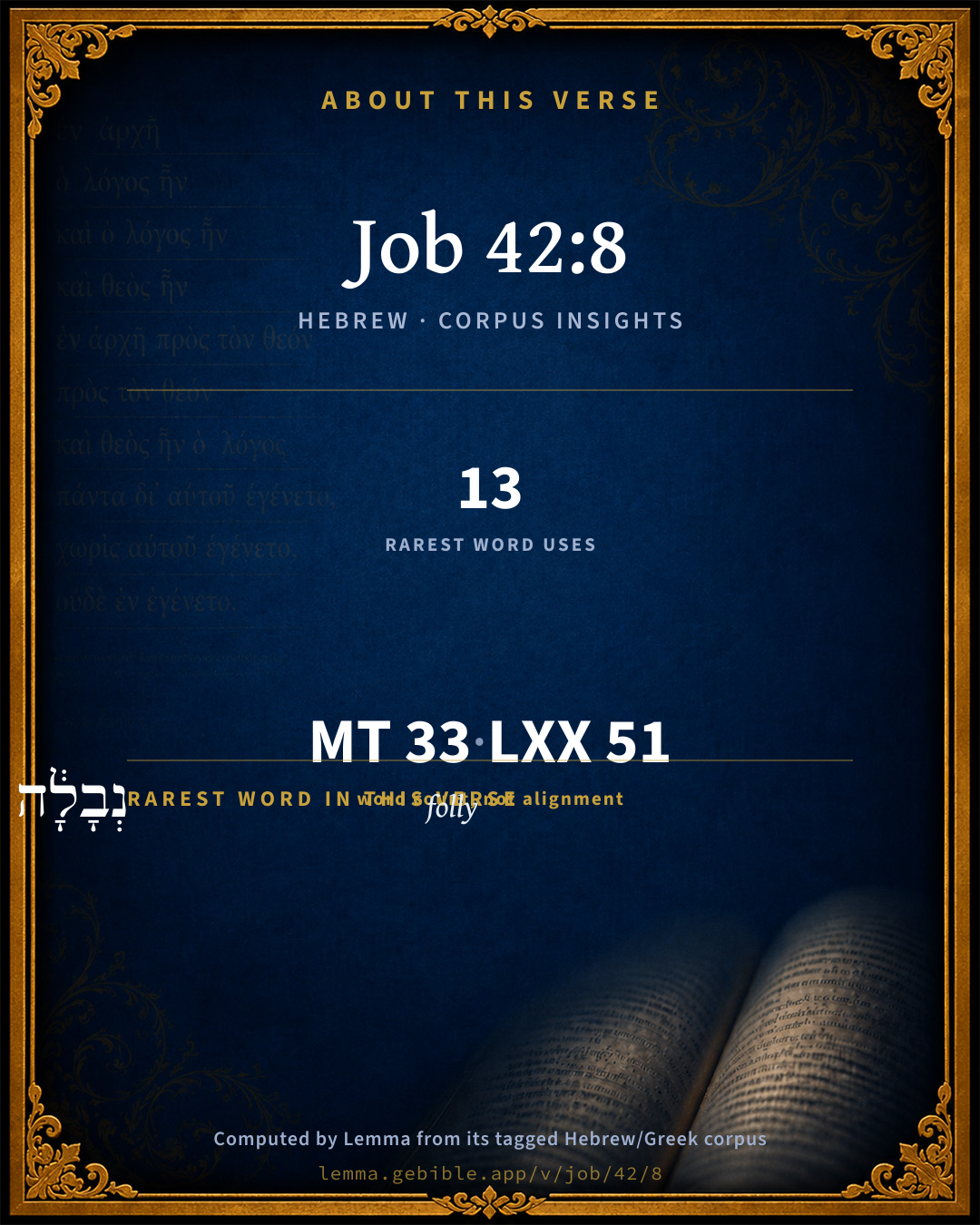
33
words
25
distinct lemmas
Wisdom
section

Notable vocabulary

The rarest word here is נְבָלָ֔ה folly H5039 — appearing just 13 times in the whole Hebrew Bible.

Shared distinctive vocabulary

נְבָלָ֔ה folly H5039 occurs in 13 verses of the Hebrew Bible. Also found in:

Grammatical profile

  • 8 verbs
  • 11 nouns
  • 2 adjectives
  • 6 prepositions
  • 4 conjunctions
  • 1 adverb
  • 1 particle

Verb forms

  • קְחֽוּ Qal · Imperative
  • וּלְכ֣וּ Qal · Imperative
  • וְהַעֲלִיתֶ֤ם Hiphil · Sequential Perfect
  • יִתְפַּלֵּ֖ל Hithpael · Imperfect
  • אֶשָּׂ֗א Qal · Imperfect
  • עֲשׂ֤וֹת Qal · Infinitive Construct
  • דִבַּרְתֶּ֥ם Piel · Perfect
  • נְכוֹנָ֖ה Niphal · Participle Active

Repetition

Words recur within this verse — often emphatic in Hebrew:

  • עַבְדִּ֣י servant H5650 ×3
  • אִיּ֗וֹב Job H347 ×3
  • שִׁבְעָֽה seven H7651 ×2
  • אֶל to H413 ×2
  • כִּ֧י that H3588 ×2

Hebrew & Septuagint length

In English translation the verse runs 64 words from the Hebrew and 57 from the Septuagint (LXX English) — closely comparable.

A rough comparison of the two English renderings, which tokenize alike — not a word-level alignment.

Word counts can differ between the Hebrew and the Greek without any difference in meaning — e.g. the Hebrew direct-object marker אֵת has no separate Greek word, and Greek often adds the article ὁ.

In the original languages it is 33 Hebrew tokens and 51 Greek tokens — but the two are counted differently (Hebrew bundles its prefixes and suffixes into one token; the Greek is in lemma form), so that isn’t a like-for-like length.

Cross-references

30

Topical passages linked to Job 42:8 in the Treasury of Scripture Knowledge — connected by theme and wording, ordered by reader-vote popularity; previews shown in the World English Bible.

  • Numbers 23:1 Balaam said to Balak, Build me here seven altars, and prepare me here seven bulls and seven rams.
  • James 5:16 Confess your offenses to one another, and pray one for another, that you may be healed. The effective, earnest prayer of a righteous man is powerfully effective.
  • Genesis 20:17 Abraham prayed to God. God healed Abimelech, and his wife, and his maid-servants, and they bore children.
  • 1 Chronicles 15:26 It happened, when God helped the Levites who bore the ark of the covenant of Yahweh, that they sacrificed seven bulls and seven rams.
  • Job 22:30 He will even deliver him who is not innocent; Yes, he shall be delivered through the cleanness of your hands."
  • Psalms 103:10 He has not dealt with us according to our sins, Nor repaid us for our iniquities.
  • Ezekiel 14:14 though these three men, Noah, Daniel, and Job, were in it, they should deliver but their own souls by their righteousness, says the Lord Yahweh.
  • Numbers 23:29 Balaam said to Balak, Build me here seven altars, and prepare me here seven bulls and seven rams.
  • 2 Chronicles 29:21 They brought seven bulls, and seven rams, and seven lambs, and seven male goats, for a sin-offering for the kingdom and for the sanctuary and for Judah. He commanded the priests the sons of Aaron to offer them on the altar of Yahweh.
  • Job 42:9 So Eliphaz the Temanite and Bildad the Shuhite and Zophar the Naamathite went, and did what Yahweh commanded them, and Yahweh accepted Job.
  • Matthew 3:17 Behold, a voice out of the heavens said, "This is my beloved Son, with whom I am well pleased."
  • James 5:14 Is any among you sick? Let him call for the elders of the assembly, and let them pray over him, anointing him with oil in the name of the Lord,
  • Exodus 18:12 Jethro, Moses' father-in-law, took a burnt offering and sacrifices for God. Aaron came with all of the elders of Israel, to eat bread with Moses' father-in-law before God.
  • Numbers 23:14 He took him into the field of Zophim, to the top of Pisgah, and built seven altars, and offered up a bull and a ram on every altar.
  • 1 Samuel 25:35 So David received of her hand that which she had brought him: and he said to her, Go up in peace to your house; behold, I have listened to your voice, and have accepted your person.
  • Job 1:5 It was so, when the days of their feasting had run their course, that Job sent and sanctified them, and rose up early in the morning, and offered burnt offerings according to the number of them all. For Job said, "It may be that my sons have sinned, and renounced God in their hearts." Thus did Job continually.
  • Ezekiel 45:23 The seven days of the feast he shall prepare a burnt offering to Yahweh, seven bulls and seven rams without blemish daily the seven days; and a male goat daily for a sin-offering.
  • 1 John 5:6 This is he who came by water and blood, Jesus Christ; not with the water only, but with the water and the blood. It is the Spirit who testifies, because the Spirit is the truth.
  • 1 John 5:16 If anyone sees his brother sinning a sin not leading to death, he shall ask, and God will give him life for those who sin not leading to death. There is a sin leading to death. I don't say that he should make a request concerning this.
  • Revelation 3:9 Behold, I give of the synagogue of Satan, of those who say they are Jews, and they are not, but lie. Behold, I will make them to come and worship before your feet, and to know that I have loved you.
  • Isaiah 60:14 The sons of those who afflicted you shall come bending to you; and all those who despised you shall bow themselves down at the soles of your feet; and they shall call you The city of Yahweh, The Zion of the Holy One of Israel.
  • Jeremiah 14:11 Yahweh said to me, Don't pray for this people for [their] good.
  • Jeremiah 15:1 Then said Yahweh to me, Though Moses and Samuel stood before me, yet my mind would not be toward this people: cast them out of my sight, and let them go forth.
  • 2 Timothy 4:14 Alexander, the coppersmith, did much evil to me. The Lord will repay him according to his works,
  • Hebrews 10:4 For it is impossible that the blood of bulls and goats should take away sins.
  • Hebrews 10:10–14 by which will we have been sanctified through the offering of the body of Jesus Christ once for all.
  • Malachi 1:8–9 When you offer the blind for sacrifice, isn't that evil? And when you offer the lame and sick, isn't that evil? Present it now to your governor! Will he be pleased with you? Or will he accept your person?" says Yahweh of Hosts.
  • Matthew 5:23–24 "If therefore you are offering your gift at the altar, and there remember that your brother has anything against you,
  • Ephesians 1:6 to the praise of the glory of his grace, by which he freely bestowed favor on us in the Beloved,
  • Hebrews 7:25 Therefore he is also able to save to the uttermost those who draw near to God through him, seeing he ever lives to make intercession for them.

Cross-references courtesy of OpenBible.info (CC BY 4.0).

Hebrew and Greek witnesses Masoretic Hebrew ↔ Greek Septuagint

The same verse in the two great witnesses to the Old Testament, shown verse-for-verse.

These are two independent witnesses, not word-aligned to each other, and the Septuagint is shown in lemma (dictionary) form.

Hebrew Job 42:8 Masoretic · Westminster Leningrad Codex

וְעַתָּ֡ה קְחֽוּ לָכֶ֣ם שִׁבְעָֽה פָרִים֩ וְשִׁבְעָ֨ה אֵילִ֜ים וּלְכ֣וּ אֶל עַבְדִּ֣י אִיּ֗וֹב וְהַעֲלִיתֶ֤ם עוֹלָה֙ בַּֽעַדְכֶ֔ם וְאִיּ֣וֹב עַבְדִּ֔י יִתְפַּלֵּ֖ל עֲלֵיכֶ֑ם כִּ֧י אִם פָּנָ֣יו אֶשָּׂ֗א לְבִלְתִּ֞י עֲשׂ֤וֹת עִמָּכֶם֙ נְבָלָ֔ה כִּ֠י לֹ֣א דִבַּרְתֶּ֥ם אֵלַ֛י נְכוֹנָ֖ה כְּעַבְדִּ֥י אִיּֽוֹב

Now therefore, take to yourselves seven bulls and seven rams, and go to my servant Job, and offer up for yourselves a burnt offering; and my servant Job shall pray for you, for I will accept him, that I not deal with you according to your folly. For you have not spoken of me the thing that is right, as my servant Job has."

World English Bible · Public Domain

Greek LXX Job 42:8 Septuagint · lemma form

νῦν δέ λαμβάνω ἑπτά μόσχος καί ἑπτά κριός καί πορεύομαι πρός ὁ θεράπων ἐγώ ιωβ καί ποιέω κάρπωσις περί σύ ιωβ δέ ὁ θεράπων ἐγώ εὔχομαι περί σύ ὅτι εἰ μή πρόσωπον αὐτός λαμβάνω εἰ μή γάρ διά αὐτός ἀποὀλλύω ἄν σύ οὐ γάρ λαλέω ἀληθής κατά ὁ θεράπων ἐγώ ιωβ

Now then take seven bullocks, and seven rams, and go to my servant Job, and he shall offer a burnt offering for you. And my servant Job shall pray for you, for I will only accept him: for but his sake, I would have destroyed you, for you⌃ have not spoken the truth against my servant Job.

LXX2012 (modern English Septuagint) · Public Domain

On this verse, Haydock's Catholic Bible Commentary discusses the Septuagint’s reading. Read the note in Commentary ↓

Hebrew: Westminster Leningrad Codex (CC BY 4.0). Greek: Septuagint (public domain); English from LXX2012 (modern English Septuagint) (Public Domain). How the Septuagint differs from the Hebrew →

Commentary

Notes on Job 42:8 from classic Christian and Jewish commentators (each source and its license shown beneath its notes). The classic Christian expositions comment on the surrounding passage and are grouped to its opening verse, so a note may address several verses; the Jewish commentaries on the Tanakh (Rashi and others) are per-verse, so they appear only where the commentator wrote on this verse.

Lemma curates 59 commentaries, every one of them public domain or Creative Commons licensed, each selected and text-cleaned for this edition rather than reprinted as found. About our sources →

Trapp's Complete Commentary

John Trapp

Job 42:8 Therefore take unto you now seven bullocks and seven rams, and go to my servant Job, and offer up for yourselves a burnt offering; and my servant Job shall pray for you: for him will I accept: lest I deal with you [after your] folly, in that ye have not spoken of me [the thing which is] right, like my servant Job.

Ver. 8. Therefore take unto you now seven bullocks] God reproveth not his for any other end, but that he may reduce them, and be reconciled unto them. The Sun of righteousness loveth not to set in a cloud.

Deiecit ut relevet; premit ut solaria praestet.

Enecat, ut possit vivificare Deus.

Seven bullocks and seven rams] A great sacrifice, whether we look to the greatness of the cattle, or the number (especially if each of them were to bring seven of each sort, as some understand it), to show the greatness of their sin, in not speaking right things of God and Job, though of a good intention, and with a very fair pretence. Seven of each they were to bring, which is noted for a number of perfection; and this pointed them of old (for the ceremonial law was their gospel) to the complete perfect sacrifice of Jesus Christ, the Lamb slain from the beginning of the world, every way sufficient to expiate their sins, and to save them from the wrath to come. It is assured them, also, that God was through Christ perfectly satisfied and pacified toward his faithful people.

And go to my servant Job] Who was to do the honourable office of a priest for them (as before the law Abraham did, and Melchisedek and others), and is thrice in this verse called God’s servant, for honour’s sake; to the end that his friends might the more respect him, whom before they had vilipended (critised), and be reconciled unto him, whom before they had wronged.

And offer up for yourselves a burnt offering] Holocaustabitis holocaustum, a whole burnt offering. Where we must not imagine that God took delight in the smell or rather stench of the burnt beasts, hides and all, but in the faith of those that offered them, who also were hereby reminded of their sins (for which they had deserved to be burnt in hell) and of their duties, to mortify their earthly members, and to present their bodies a living sacrifice, holy, acceptable unto God, Rom 12:1.

And my servant Job shall pray for you] Which, as he could do very well, Eze 14:14, so he should now do, to show his hearty reconciliation; but should have little availed for them had not they repented, and believed, and prayed for themselves. For the just shall live by his faith; and it is a great vanity in some great Papists, who presume to live loosely and basely, because they have hired some hedge priest to say a certain number of prayers for them daily.

For him will I accept] sc. Through the office and person of my Son, which herein he resembleth. The high priest’s office was, 1. To expiate the sins of the people. 2. To intercede and make request for them. Christ is the High Priest of the New Testament; in whom the Father is well pleased, and through whom he will deny nothing to his humble suppliants, for themselves or others.

Lest I deal with you after your folly] Heb. Lest I work foolishness with you; that is (saith Beza), lest I so behave myself toward you as your foolishness doth deserve. Or, lest I so handle you, that you may think me no wiser than I should be since you have seemed so to roughly hew Job out of zeal to me. Thus to the froward God seemeth to deal frowardly, Psa 18:27. Tremellius rendereth it not folly, but heinous offence; others, disgrace, flagitium, ignominia.

In that ye have not spoken, &c.] And if for hard words and ill language good men may suffer, what shall become of such as, both with virulent tongues and violent hands, set against such as fear God?

John Trapp, A Commentary or Exposition upon All the Books of the Old and New Testament (1647–1656) — public domain. Text from a community e-Sword module.

Joseph Benson's Commentary

Job 42:8. Therefore take now seven bullocks, &c. — To make an atonement for what you have said amiss. It seems they were each of them to bring seven bullocks and seven rams, which were to be wholly offered up to God as a burnt-offering; for before, the law of Moses, all sacrifices, even those of atonement, appear to have been wholly burned, and therefore were called burnt-offerings. They thought, doubtless, that they had spoken wonderfully well, and had done a righteous act in pleading God’s cause; but they are told quite the contrary, that God was displeased with them, required a sacrifice from them, and threatened, if they did not bring it, he would deal with them according to their folly. Many times is God angry at that in us which we ourselves are ready to be proud of; and sees much amiss in that which we think was well done. And go to my servant Job — Whom, though you condemned him as a hypocrite, I own for my faithful servant. And offer up a burnt-offering — By the hand of Job, whom I hereby constitute your priest, to pray and sacrifice for you. Lest I deal with you after your folly — Lest my just judgment take hold of you for your false and foolish speeches.

Joseph Benson's Commentary on the Old and New Testaments (1811–1818) — public domain. Text from a community e-Sword module.

Tyndale Open Study Notes

Tyndale Open Resources

42:8-9 The Lord made Job the mediator that Job had hoped to find for himself (9:33; 16:19-21; 19:25) and that Elihu desired to be (32:1–37:24). • go to my servant Job: God wanted Job’s friends to be reconciled with Job before they presented their offerings (Matt 5:23-24). • My servant Job will pray for you; he had also prayed for his children (1:5; cp. Jas 5:16; 1 Jn 5:16). • When the Lord accepted Job’s prayer, it ironically fulfilled Eliphaz’s promise (Job 22:26-30).

Tyndale Open Study Notes — © Tyndale Open Resources, licensed CC BY-SA 4.0. Text via the HelloAO Bible API.

Geneva Bible (1599)

Geneva Bible translators

When you have reconciled yourselves to him for the faults that you have committed against him, he shall pray for you, and I will hear him.

Geneva Bible (1599) marginal notes — public domain. Text via Bolls.life.

Jamieson, Fausset & Brown

Robert Jamieson, A. R. Fausset & David Brown

seven--(See Introduction). The number offered by the Gentile prophet (Num 23:1). Job plainly lived before the legal priesthood, &c. The patriarchs acted as priests for their families; and sometimes as praying mediators (Gen 20:17), thus foreshadowing the true Mediator (Ti1 2:5), but sacrifice accompanies and is the groundwork on which the mediation rests.

him--rather, "His person [face] only" (see on Job 22:30). The "person," must be first accepted, before God can accept his offering and work (Gen 4:4); that can be only through Jesus Christ.

folly--impiety (Job 1:22; Job 2:10).

Jamieson, Fausset & Brown — Commentary Critical and Explanatory on the Whole Bible (1871) — public domain (CC PDM 1.0). Text via the HelloAO Bible API.

Adam Clarke's Commentary

Verse 8. Take-seven bullocks and seven rams] From this it appears that Job was considered a priest, not only in his own family but also for others. For his children he offered burnt-offerings, Job 1:5; and now he is to make the same kind of offerings, accompanied with intercession, in behalf of his three friends. This is a full proof of the innocence and integrity of Job: a more decided one could not be given, that the accusations of his friends, and their bitter speeches, were as untrue as they were malevolent. God thus clears his character, and confounds their devices.

Adam Clarke's Commentary on the Bible (1810–1826) — public domain. Text from a community e-Sword/MySword module.

Ellicott's Commentary for English Readers

(8) Therefore take unto you now seven bullocks and seven rams.—It is remarkable that the sacrifices prescribed for Job’s friends were similar to those which Balaam prescribed for Balak (Num_23:2-29). This is probably one indication out of many that the age of Job was that of Moses, or before it. “My servant Job shall pray for you.” This, strange to say, was the very promise with which Eliphaz himself had closed his third and last speech. His words therefore received a striking fulfilment in the case of himself and his friends. The intercession of Job seems to show us that his character is a typical one, representing to us the character of Christ as the sufferer and the mediator on behalf of man; and as in Job there is no trace of acquaintance with the Divine covenant, the book shows us a sort of anticipation of the Gospel to the Gentile world, that the mercies of God are not limited, as some have thought, to the chosen race, but that the principles of God’s action are the same universally. He deals with men upon a principle of mediation: whether the mediator be Moses, as the mediator of the first covenant; or Job, who was the accepted mediator for his friends beyond the pale of the covenant; or whether the mediator be Jesus Christ, as the one Mediator between God and man.

A Bible Commentary for English Readers, edited by Charles John Ellicott (1878–1897) — public domain. Text from a community e-Sword module.

John Gill's Exposition

So Eliphaz the Temanite, and Bildad the Shuhite, and Zophar the Naamathite, went,.... Having taken the above creatures for sacrifice, as directed, they went to Job with them;

and did according as the Lord commanded them; offered them by Job for a burnt offering, and desired him to pray for them. This they did, both as to matter and manner, as the Lord ordered them; and they did it immediately, without consulting flesh and blood, the pride and other passions of their hearts; and they all united in it, and served the Lord with one consent, which showed them to be good men;

the Lord also accepted Job; the sacrifice he offered; perhaps by sending fire from heaven, which consumed the burnt offering: or "the face of Job"; he heard his prayer for his friends, and granted his request for them: or "the person of Job", as Mr. Broughton renders it; Job in this was a type of Christ also, who is always heard in his intercession and mediation for his people. God has respect to his person, which always acceptable to him, and in whom he is well pleased; and he has respect to his offering and sacrifice, which is of a sweet smelling savour to him. And the persons of his people are accepted in him the Beloved, and all their services and sacrifices of prayer and praise, Mat 3:17. The Targum is,

"they did as the Word of the Lord spake unto them, and the Word of the Lord accepted the face of Job.''

John Gill's Exposition of the Whole Bible (1746–1763) — public domain (CC PDM 1.0). Text via the HelloAO Bible API.

Albert Barnes' Notes on the Bible

Therefore take unto you - Or, FOR yourselves.

Seven bullocks and seven rams - The number “seven” was a common number in offering animals for sacrifice; see Lev 23:18; Num 29:32. It was not a number, however, confined at all to Jewish sacrifices, for we find that Balaam gave the direction to Balak, king of Moab, to prepare just this number for sacrifice. “And Balaam said unto Balak, Build me here seven altars, and prepare me here seven oxen and seven rams;” Num 23:1, Num 23:29. The number “seven” was early regarded as a perfect number, and it was probably with reference to this that that number of victims was selected, with an intention of offering a sacrifice that would be complete or perfect.

And go to my servant Job - An acknowledgment of his superiority. It is probably to be understood, also, that Job would act as the officiating priest in offering up the sacrifice. It is observable that no allusion is made in this book to the priestly office, and the conclusion is obvious that the scene is laid before the institution of that office among the Jews; compare the notes at Job 1:5.

And offer up for yourselves - That is, by the aid of Job. They were to make the offering, though Job was evidently to be the officiating priest.

A burnt-offering - Notes, Job 1:5.

And my servant Job shall pray for you - In connection with the offering, or as the officiating priest. This is a beautiful instance of the nature and propriety of intercession for others. Job was a holy man; his prayers would be acceptable to God, and his friends were permitted to avail themselves of his powerful intercession in their behalf. It is also an instance showing the nature of the patriarchal worship. It did not consist merely in offering sacrifices. Prayer was to be connected with sacrifices, nor is there any evidence that bloody offerings were regarded as available in securing acceptance with God, except in connection with fervent prayer. It is also an instance showing the nature of the patriarchal “piety.” It was “presumed” that Job would be ready to do this, and would not hesitate thus to pray for his “friends.” Yet it could not be forgotten how much they had wounded his feelings; how severe had been their reproaches; nor how confidently they had maintained that he was an eminently bad man. But it was presumed now that Job would be ready to forgive all this; to welcome his friends to a participation in the same act of worship with him, and to pray for them that their sins might be forgiven. Such is religion, alike in the patriarchal age and under the gospel, prompting us to be ready to forgive those who have pained or injured us, and making us ready to pray that God would pardon and bless them.

For him will I accept - Margin, “his face,” or “person.” So the Hebrew. So in Gen 19:21 (“margin,”) compare Deu 28:50. The word “face” is thus used to denote the “person,” or man. The meaning is, that Job was so holy and upright that God would regard his prayers.

Lest I deal with you after your folly - As their folly had deserved. There is particular reference here to the sentiments which they had advanced respecting the divine character and government.

Albert Barnes' Notes on the Bible (1834–1885) — public domain. Text from a community e-Sword/MySword module.

Haydock's Catholic Bible Commentary

Offer. Septuagint, "Thou shalt make an oblation, Greek: karpoma, for you." (Haydock) --- Yet holocausts seem to have been the only species of sacrifice before Moses. The number seven, has always been in a manner sacred; (Calmet) being doubled, it shews the greatness of the offence. (St. Gregory) (Worthington) --- Job was to present these victims to God, (Calmet) as the priest and mediator, (Du Hamel) of whom God approved. He officiated for his family, (Calmet) and was the most honourable person there. (Haydock) --- It seems Job was not present when God gave this injunction; perhaps some time after their debates. (Calmet) --- Pray. Behold the efficacy of the prayers of the saints, even while upon earth. How much greater will it be, when their charity is greater and unfailing! (Haydock) --- The many sacrifices would not have sufficed, if Job had not joined his prayer, as St. Chrysostom (or 5 con. Judœos) observes. His mediation did not derogate from God’s mercy, under the law of nature; not does that of other men injure Christ’s under the law of grace, 2 Corinthians i. 11. We have here also a proof that both sacrifice and the devotion of the offerer, have their distinct effects; opus operatum, and opus operantis, as the schoolmen speak. Thus Job was honourably acquitted, while his friends were justly rebuked. Eliu needed no express condemnation; as what God says to one, must be applied to another in the same circumstances, chap. xxxiii. 14. Protestants are therefore inexcusable, who preach a doctrine not only condemned in their fellows, Luther, &c., but long before in ancient heretics: as the justification by faith alone was in the apostles’ time, the rejection of the ceremonies of baptism, of confirmation and penance, in the Novatians, &c. See St. Cyprian iv. ep. 2. (Worthington) --- Face. Septuagint, "For I would not accept his face, and if it were not on his account, I had surely destroyed you. For you have not said to me any thing good (Roman Septuagint, true,) against (or concerning, Greek: kata,) my servant Job." They acted both against charity and truth. (Haydock) --- Before. Protestants, "of me the thing which is right." The words underlined were not so in the earlier edition by Barker, printer to James I, (1613) where some of the margin translations are also omitted, ver. 14, &c. The matter is of no farther consequence, than to shew that alterations have taken place since the days of James I, who Bible is supposed to be the standard of the English Church. The marginal version is also frequently neglected altogether, (the year of our Lord 1706) though the authors seem to have looked upon it as equally probable with that in the text. (Pref.) (Haydock)

George Leo Haydock (1774–1849), Haydock's Catholic Family Bible and Commentary, 1859 edition — public domain. Excludes Psalms (Douay-Rheims chapter numbering differs from Protestant) and Deuterocanonical books (Catholic canon only).

Matthew Poole's English Annotations

Go to my servant Job; whom though you have censured and condemned as a hypocrite, I own for my faithful servant, human infirmity excepted.

Offer up by the hand of Job, whom I do hereby constitute your priest, to pray and sacrifice for you.

Him will I accept, to wit, on your behalf, as well as on his own.

Lest I deal with you after your folly; lest my wrath and just judgment take hold of you for your false and foolish speeches.

Matthew Poole's English Annotations on the Holy Bible (1683–1685) — public domain. Text from a community e-Sword/MySword module.

Whedon's Commentary on the Bible

Daniel D. Whedon

8. A burnt offering — This differs from the burnt offering required by the Mosaic ritual. That it should be the same in kind and number with that offered by Balaam, a Gentile prophet, (Num_23:1-2,) and that there should be the twofold recognition of the sacred and complete number seven, points to an ante-Mosaical, if not patriarchal, period for the life of Job. The profound solemnity thus given to the sacrifice about to be offered, and the mortifying announcement that “the friends” should find forgiveness through the intercession and priesthood of the leprous Job, must have made them painfully alive to the folly of their conduct. According to Grotius, in loc., the Hebrews think that the holocaust was the only form of sacrifice prevailing to the time of Moses. See Job_1:5.

My servant Job shall pray for you — The intercessory prayer which Job is directed to offer also suggests a pre-Mosaical economy as that under which he lived. Gen_20:7; Gen_20:17. The Mosaic law prescribes grandly significant rites and ceremonies, but without specific directions for prayer. See, however, Lev_16:21; Deu_26:10-13.

For him will I accept — Literally, only his face will I lift up; that is, regard favourably. The expression takes its rise from the favour granted by an Oriental prince to a suppliant, who is graciously bidden to rise from his prostration, and thus lift up his face. Compare Job_13:8; Job_32:21; Gen_19:21. This profound principle of the divine economy — the power of the good to intercede for the sinful — had been already portrayed by Eliphaz with great beauty, (Job_22:29-30,) and in patriarchal times was announced by God himself to the Egyptian king, Abimelech. Gen_20:7. Compare Gen_18:32; Gen_26:24; Exo_32:7-14; Deu_9:7-29. In a world where the life of each is made to depend upon the kind offices and interposition of another, as is the case throughout the infantile period of human existence, the patriarchal usage of intercession by one being for another is one which fully comports with the demands of our reason. The whole scheme of society is subsequently so arranged as to make the services of others indispensable to each — a principle so universally true that no one attains to the higher bliss of life without the co-operation of others. His own richest temporal blessings God, for the most part, bestows through the medium of others; and by making human beings the channels for the outflow of divine beneficence, so arranges that they themselves shall be benefited and ennobled. All beneficence, human or divine, then, fails to fulfil its mission unless it brings with it manifold blessings — even as rays of light, whose end may be to give life and sustenance to the unpretending plant, scatter blessings along their entire path. The culminating hour of prayer, when Job gains the highest victory over himself by praying for the three friends, and more especially for the genteel and venerable leader Eliphaz, who most deeply maligned him, becomes the culmination of his distress and the turning point of his “captivity.” See Job_42:10.

Lest I deal with you after your folly — Literally, that I may not do with your folly, which Hitzig supposes to be spoken after the manner of men, and to refer to possible precipitate action on the part of God. The views of Delitzsch and Dillmann, which Hitzig calls “wooden,” are to be preferred. They take folly by synecdoche for “the punishment of folly,” in like manner as השׂאת or עין, sin, is used for the penalty of sin — the former of whom reads, in accordance with our Authorized Version, that I recompense not unto you your folly.

Daniel D. Whedon (gen. ed.), Commentary on the Old and New Testaments (1874–1909) — public domain. Text from a community e-Sword module.

The Pulpit Commentary

Therefore take unto you now seven bullocks and seven rams. (On the early and widespread prevalence of the rite of sacrifice, see the comment upon Job_1:5) (On the preference, for sacrificial purposes, of the number seven, see Lev_23:18 Num_23:1, Num_23:14, 29 28:11, 19, 27 29:2, 8, 36 1Ch_15:26 2Ch_29:21 Ezr_8:35 Eze_45:23, etc.) It is noticeable that "seven bullocks and seven rams" was exactly the offering of the Moabite king Balak, and his prophet Balaam, contemporary with Moses. And go to my servant Job. Humble yourselves before the man whom you have striven to abase and bring low. Go to him make application to him, that he will be pleased to come to your aid, joining and assisting in the offering which I require at your hands. And offer up for yourselves a burnt offering. Do as Job had done for his sins, (Job_1:5) "offer a burnt offering;" and then my servant Job shall pray for you. Present at your sacrifice, and sharing in it, he shall assume the highest priestly function, and intercede on your behalf. For him will I accept; literally, his face, or his person, will I accept. It is implied that, apart from Job, the three "comforters" would not have been listened to, much less have obtained pardon. Lest I deal with you after your folly, in that ye have not spoken of me the thing which is right, like my servant Job (see the comment on the preceding verse).

The Pulpit Commentary (1880–1919), ed. H.D.M. Spence-Jones & Joseph S. Exell — public domain. Text from a community e-Sword module.

John Wesley's Explanatory Notes

My servant - Whom though you condemned as an hypocrite, I own for my faithful servant. Offer - By the hand of Job, whom I hereby constitute your priest to pray and sacrifice for you. Lest I deal - Lest my just judgment take hold of you for your false and foolish speeches.

John Wesley, Explanatory Notes Upon the Whole Bible (1754–1765) — public domain. Text via the GEBible commentary corpus.

Rashi

Rabbi Shlomo Yitzchaki (Rashi)

and offer up a burnt offering for yourselves So that you placate and appease Me, provided that My servant Job pray for you that I forgive your sins, and no longer remember your transgressions.

for I will favor him Heb. כי אם, because I will favor him to accept his prayer (thus the word אִם is used for “that”), and likewise (Gen. 24:19), “until (עד אם) they have finished drinking”; (Ex. 21:30), “in which case (אם) an atonement is placed on him,” and many others.

for...not Because...not.

Rashi on the Tanakh — English translations: “The Judaica Press complete Tanach with Rashi, translated by A. J. Rosenberg” (CC BY 4.0); “Pentateuch with Rashi's commentary by M. Rosenbaum and A.M. Silbermann, 1929-1934” (public domain); “The Metsudah Tanach series, Lakewood, N.J” (CC BY 4.0); and “The Book of Joshua, Metsudah Publications, 1997” (CC BY 4.0). Text via Sefaria.

Lesson kit

Teaching starters — assembled from the data on this page, not authored interpretation. Every prompt links to the verse data it draws on. Edit before teaching.

Job, in the Wisdom, opens this verse with 33 words (25 distinct Hebrew lemmas). Its most distinctive word is nᵉbâlâh (“folly”). A historical commentator’s framing appears above. Read the whole chapter for the surrounding context.

Discussion questions

  1. What does “folly” (nᵉbâlâh) contribute to the verse as a whole?
  2. How does Genesis 34:7, which shares the word «folly», read alongside this verse?
  3. What does the repetition of “servant” (3× in this one verse) do in this verse?
  4. The translations on this page render this verse differently — a whole-verse word diff, not a word-by-word alignment. What might account for the different wordings?
  5. «קְחֽוּ» is a Qal Imperative verb. How does that grammatical form shape the action described?
  6. Compare how Trapp's Complete Commentary and Joseph Benson's Commentary read this verse. Where do they agree or differ?

Things to notice

Reading settings

Reading text

Shown beneath each verse's original-language words.

Old Testament
Old Testament edition

Read the OT as the Masoretic Hebrew (MT) or the Greek Septuagint (LXX).

English shown for the Greek Septuagint (in the Hebrew ↔ Greek comparison).

Comparing translations? Open the Compare panel on any verse page to stack up to four side by side.