
2 Samuel 8:6

Hebrew (Westminster Leningrad Codex) 2 Samuel 8:6 appears in the Hebrew Old Testament. The text above is from the Westminster Leningrad Codex. Each word links to its Strong’s number, a concise gloss, and parsing drawn from the Open Scriptures Hebrew Bible morphology. Click any word for its full Brown-Driver-Briggs (BDB) entry.
Download image
Cite this verse

2 Samuel 8:6 (World English Bible). Public Domain. Lemma interlinear Bible study tool, https://lemma.gebible.app/v/2-samuel/8/6.

Show BibTeX & RIS
BibTeX
RIS
English Translation
Then David put garrisons in Syria of Damascus; and the Syrians became servants to David, and brought tribute. Yahweh gave victory to David wherever he went.
World English Bible · Public Domain
Download a study sheet

One document with this verse’s original text, its word-by-word gloss line, the meaning frame, cross-references with their text, attributed commentary, and full source and license credits — printable, and it pastes into notes with its structure intact.

This verse Autodidact and up

Study sheet (.html) Plain text (.txt)

A passage Seminary Student

Up to 50 verses in one chapter. A passage sheet keeps up to 6 commentary sources and 12 cross-references per verse, in the order this page ranks them, and says so on the sheet whenever that leaves anything out. Ask for a single verse and you get the Autodidact verse sheet above.

Everything on this page stays free to read, with no account — the sheet is a download of what is already on screen, not access to it.

Want to remove ads? Support Godless Engineer
Compare translations 3

The same verse in 3 English versions, stacked beneath the original-language interlinear above. Click any original word for its lexicon entry.

Each is an independent rendering of the whole verse — the interlinear is not word-aligned to these translations.

Highlighted words mark where these versions differ — a whole-verse word diff, not a word-by-word alignment.

  • World English Bible Public Domain
    Then David put garrisons in Syria of Damascus; and the Syrians became servants to David, and brought tribute. Yahweh gave victory to David wherever he went.
  • King James Version Public Domain
    Then David put garrisons in Syria of Damascus: and the Syrians became servants to David, and brought gifts. And the LORD preserved David whithersoever he went.
  • unfoldingWord Literal Text CC BY-SA 4.0
    And David put garrisons in Aram of Damascus, and Aram became servants to David, lifters of tribute. And Yahweh saved David in every where he went.

unfoldingWord Literal Text — © unfoldingWord, licensed CC BY-SA 4.0. Word-aligned USFM3 via Door43 (git.door43.org/unfoldingWord/en_ult).

Versions to compare (up to 4)

3 of 4 selected

Show all 18 translations

Every available English version of this verse, each an independent rendering of the whole verse.

  • World English Bible Public Domain
    Then David put garrisons in Syria of Damascus; and the Syrians became servants to David, and brought tribute. Yahweh gave victory to David wherever he went.
  • Berean Standard Bible Public Domain
    Then he placed garrisons in Aram of Damascus, and the Arameans became subject to David and brought him tribute. So the LORD made David victorious wherever he went.
  • Majority Standard Bible Public Domain
    Then he placed garrisons in Aram of Damascus, and the Arameans became subject to David and brought him tribute. So the LORD made David victorious wherever he went.
  • King James Version Public Domain
    Then David put garrisons in Syria of Damascus: and the Syrians became servants to David, and brought gifts. And the LORD preserved David whithersoever he went.
  • American Standard Version (1901) Public Domain
    Then David put garrisons in Syria of Damascus; and the Syrians became servants to David, and brought tribute. And Jehovah gave victory to David whithersoever he went.
  • Revised Version (1885) Public Domain
    Then David put garrisons in Syria of Damascus: and the Syrians became servants to David, and brought presents. And the LORD gave victory to David whithersoever he went.
  • Geneva Bible (1599) Public Domain
    And Dauid put a garison in Aram of Damesek: and the Aramites became seruants to Dauid, and brought gifts. And the Lord saued Dauid wheresoeuer he went.
  • Douay-Rheims (1899) Public Domain
    And David put garrisons in Syria of Damascus: and Syria served David under tribute: and the Lord preserved David in all his enterprises, whithersoever he went.
  • Young's Literal Translation Public Domain
    and David putteth garrisons in Aram of Damascus, and Aram is to David for a servant, bearing a present; and Jehovah saveth David whithersoever he hath gone;
  • Literal Standard Version CC BY-SA 4.0
    and David puts garrisons in Aram of Damascus, and Aram is for a servant to David, carrying a present; and YHWH saves David wherever he has gone;
  • Unlocked Literal Bible CC BY-SA 4.0
    Then David put garrisons in Aram of Damascus, and the Arameans became servants to him and brought him tribute. Yahweh gave victory to David wherever he went.
  • unfoldingWord Literal Text CC BY-SA 4.0
    And David put garrisons in Aram of Damascus, and Aram became servants to David, lifters of tribute. And Yahweh saved David in every where he went.
  • Darby Bible Public Domain
    And David put garrisons in Syria of Damascus; and the Syrians became servants to David, [and] brought gifts. And Jehovah preserved David whithersoever he went.
  • World Messianic Bible Public Domain
    Then David put garrisons in Syria of Damascus; and the Syrians became servants to David, and brought tribute. The LORD gave victory to David wherever he went.
  • Webster's Bible Public Domain
    Then David put garrisons in Syria of Damascus: and the Syrians became servants to David, and brought gifts. And the LORD preserved David whithersoever he went.
  • Free Bible Version CC BY-SA 4.0
    He placed garrisons in the Aramean kingdom with its capital in Damascus, and made the Arameans subject to him and required them to pay taxes. The Lord gave David victories wherever he went.
  • Bible in Basic English Public Domain
    And David put armed forces in Aram of Damascus: and the Aramaeans became servants to David and gave him offerings. And the Lord made David overcome wherever he went.
  • JPS Tanakh (1917) Public Domain
    Then David put garrisons in Aram of Damascus; and the Arameans became servants to David, and brought presents. And the LORD gave victory to David whithersoever he went.

Literal Standard Version (2020), Covenant Press — licensed CC BY-SA 4.0. Text via the HelloAO Bible API (eBible.org). Unlocked Literal Bible (unfoldingWord) — licensed CC BY-SA 4.0. Text via the HelloAO Bible API (eBible.org). unfoldingWord Literal Text — © unfoldingWord, licensed CC BY-SA 4.0. Word-aligned USFM3 via Door43 (git.door43.org/unfoldingWord/en_ult). Free Bible Version, Dr. Jonathan Gallagher — licensed CC BY-SA 4.0. Text via the HelloAO Bible API (eBible.org).

Word by word

More ways to search: Search by grammar → Find every occurrence → Compare this word →

Practice this passage: Drill this verse → Learn its vocabulary →

נְצִבִים֙
nᵉtsîyb
H5333
“garrisons”
Noun, Common, Masculine, Plural, Absolute
Part of Speech
Noun
Type
Common
Gender
Masculine
Number
Plural
State
Absolute
Full BDB Definition

Origin: from H5324

TWOT: 1398b

set over, something placed, pillar, prefect, garrison, post - pillar - prefect, deputy
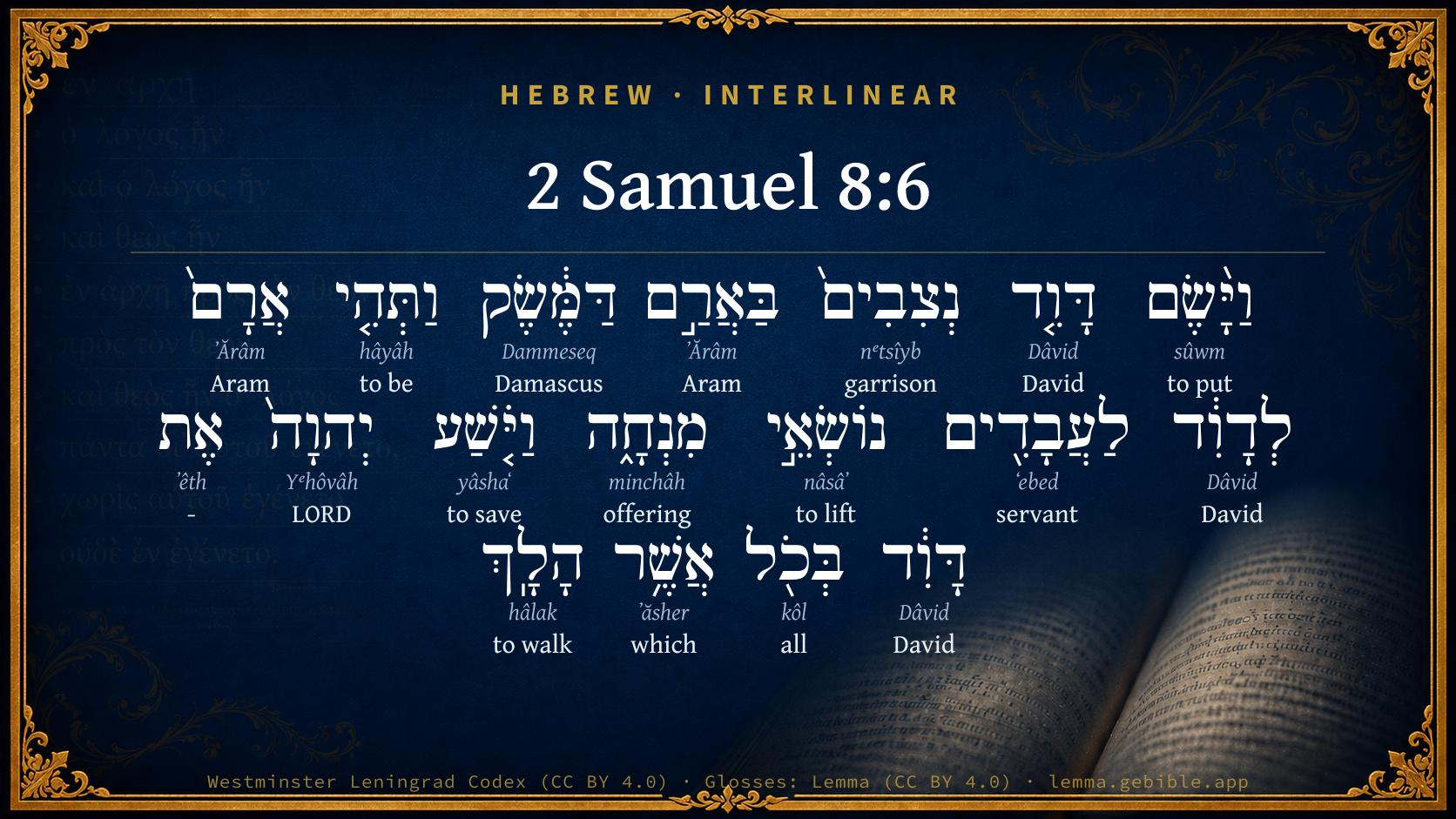
  1. וַיָּ֨שֶׂם sûwm H7760 “and · to put” Conjunction + Verb, Qal, Sequential Imperfect, 3rd Person, Masculine, Singular
  2. דָּוִ֤ד Dâvid H1732 “David” Noun, Proper
  3. בַּאֲרַ֣ם ʼĂrâm H758 “in/at · Aram” Preposition + Noun, Proper
  4. דַּמֶּ֔שֶׂק Dammeseq H1834 “Damascus” Noun, Proper
  5. וַתְּהִ֤י hâyâh H1961 “and · to be” Conjunction + Verb, Qal, Sequential Imperfect, 3rd Person, Feminine, Singular
  6. אֲרָם֙ ʼĂrâm H758 “Aram” Noun, Proper
  7. לְדָוִ֔ד Dâvid H1732 “to/for · David” Preposition + Noun, Proper
  8. לַעֲבָדִ֖ים ʻebed H5650 “to/for · servants” Preposition + Noun, Common, Masculine, Plural, Absolute
  9. נוֹשְׂאֵ֣י nâsâʼ H5375 “lifting” Verb, Qal, Participle Active, Masculine, Plural, Construct
  10. מִנְחָ֑ה minchâh H4503 “offering” Noun, Common, Feminine, Singular, Absolute
  11. וַיֹּ֤שַׁע yâshaʻ H3467 “and · to save” Conjunction + Verb, Hiphil, Sequential Imperfect, 3rd Person, Masculine, Singular
  12. יְהוָה֙ Yᵉhôvâh H3068 “LORD” Noun, Proper
  13. אֶת ʼêth H853 “-” Particle, Direct Object
  14. דָּוִ֔ד Dâvid H1732 “David” Noun, Proper
  15. בְּכֹ֖ל kôl H3605 “in/at · all” Preposition + Noun, Common, Masculine, Singular, Absolute
  16. אֲשֶׁ֥ר ʼăsher H834 “which” Particle, Relative
  17. הָלָֽךְ hâlak H1980 “to walk” Verb, Qal, Perfect, 3rd Person, Masculine, Singular

About this verse

These counts appear in no published source. They are computed here, from the morphology-tagged text and Lemma’s own curated glosses. What Lemma adds →

18
words
15
distinct lemmas
Historical
section

Notable vocabulary

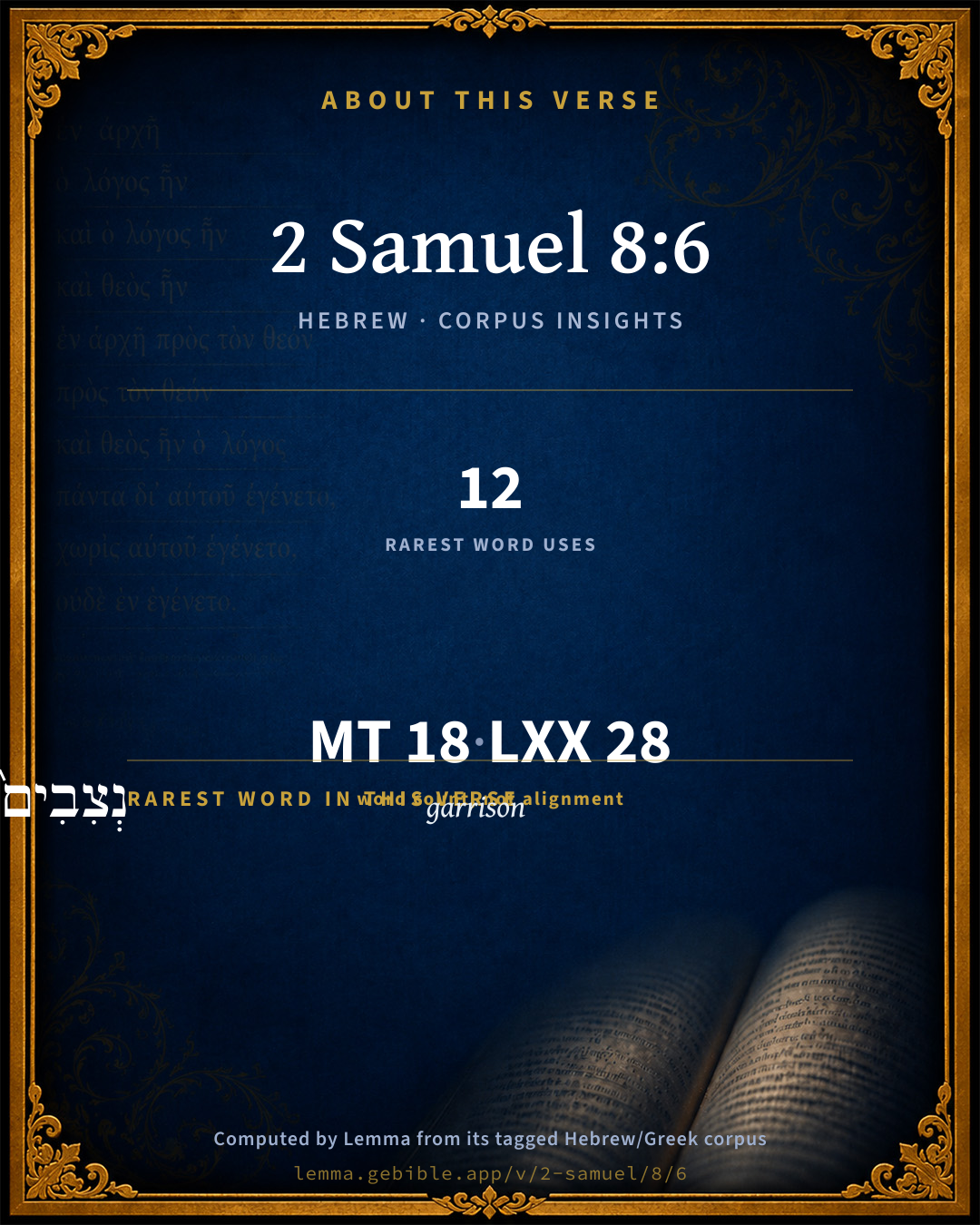
The rarest word here is נְצִבִים֙ garrison H5333 — appearing just 12 times in the whole Hebrew Bible.

Shared distinctive vocabulary

נְצִבִים֙ garrison H5333 occurs in 11 verses of the Hebrew Bible. Also found in:

Grammatical profile

  • 5 verbs
  • 11 nouns
  • 2 particles

Verb forms

  • וַיָּ֨שֶׂם Qal · Sequential Imperfect
  • וַתְּהִ֤י Qal · Sequential Imperfect
  • נוֹשְׂאֵ֣י Qal · Participle Active
  • וַיֹּ֤שַׁע Hiphil · Sequential Imperfect
  • הָלָֽךְ Qal · Perfect

Repetition

Words recur within this verse — often emphatic in Hebrew:

  • דָּוִ֤ד David H1732 ×3
  • בַּאֲרַ֣ם Aram H758 ×2

Hebrew & Septuagint length

In English translation the verse runs 26 words from the Hebrew and 26 from the Septuagint (LXX English) — the same length.

A rough comparison of the two English renderings, which tokenize alike — not a word-level alignment.

Word counts can differ between the Hebrew and the Greek without any difference in meaning — e.g. the Hebrew direct-object marker אֵת has no separate Greek word, and Greek often adds the article ὁ.

In the original languages it is 18 Hebrew tokens and 28 Greek tokens — but the two are counted differently (Hebrew bundles its prefixes and suffixes into one token; the Greek is in lemma form), so that isn’t a like-for-like length.

Cross-references

17

Topical passages linked to 2 Samuel 8:6 in the Treasury of Scripture Knowledge — connected by theme and wording, ordered by reader-vote popularity; previews shown in the World English Bible.

  • 2 Samuel 8:14 He put garrisons in Edom; throughout all Edom put he garrisons, and all the Edomites became servants to David. Yahweh gave victory to David wherever he went.
  • 2 Samuel 7:9 and I have been with you wherever you went, and have cut off all your enemies from before you; and I will make you a great name, like the name of the great ones who are in the earth.
  • 2 Chronicles 17:2 He placed forces in all the fortified cities of Judah, and set garrisons in the land of Judah, and in the cities of Ephraim, which Asa his father had taken.
  • Psalms 18:34–46 He teaches my hands to war; So that my arms bend a bow of bronze.
  • Psalms 140:7 Yahweh, the Lord, the strength of my salvation, You have covered my head in the day of battle.
  • Psalms 144:1–2 Blessed be Yahweh, my rock, Who teaches my hands to war, And my fingers to battle:
  • 1 Samuel 13:3 Jonathan struck the garrison of the Philistines that was in Geba: and the Philistines heard of it. Saul blew the trumpet throughout all the land, saying, Let the Hebrews hear.
  • 1 Samuel 14:1 Now it fell on a day, that Jonathan the son of Saul said to the young man who bore his armor, Come, and let us go over to the Philistines' garrison, that is on yonder side. But he didn't tell his father.
  • 1 Samuel 14:6 Jonathan said to the young man who bore his armor, Come, and let us go over to the garrison of these uncircumcised: it may be that Yahweh will work for us; for there is no restraint to Yahweh to save by many or by few.
  • 1 Samuel 14:15 There was a trembling in the camp, in the field, and among all the people; the garrison, and the spoilers, they also trembled; and the earth quaked: so there was an exceeding great trembling.
  • 2 Samuel 3:18 now then do it; for Yahweh has spoken of David, saying, By the hand of my servant David I will save my people Israel out of the hand of the Philistines, and out of the hand of all their enemies.
  • 2 Samuel 8:2 He struck Moab, and measured them with the line, making them to lie down on the ground; and he measured two lines to put to death, and one full line to keep alive. The Moabites became servants to David, and brought tribute.
  • 2 Samuel 23:14 David was then in the stronghold; and the garrison of the Philistines was then in Bethlehem.
  • 1 Chronicles 18:13 He put garrisons in Edom; and all the Edomites became servants to David. Yahweh gave victory to David wherever he went.
  • Psalms 5:11–12 But let all those who take refuge in you rejoice, Let them always shout for joy, because you defend them. Let them also who love your name be joyful in you.
  • Psalms 121:7–8 Yahweh will keep you from all evil. He will keep your soul.
  • Proverbs 21:31 The horse is prepared for the day of battle; But victory is with Yahweh.

Cross-references courtesy of OpenBible.info (CC BY 4.0).

Hebrew and Greek witnesses Masoretic Hebrew ↔ Greek Septuagint

The same verse in the two great witnesses to the Old Testament, shown verse-for-verse.

These are two independent witnesses, not word-aligned to each other, and the Septuagint is shown in lemma (dictionary) form.

Hebrew 2 Samuel 8:6 Masoretic · Westminster Leningrad Codex

וַיָּ֨שֶׂם דָּוִ֤ד נְצִבִים֙ בַּאֲרַ֣ם דַּמֶּ֔שֶׂק וַתְּהִ֤י אֲרָם֙ לְדָוִ֔ד לַעֲבָדִ֖ים נוֹשְׂאֵ֣י מִנְחָ֑ה וַיֹּ֤שַׁע יְהוָה֙ אֶת דָּוִ֔ד בְּכֹ֖ל אֲשֶׁ֥ר הָלָֽךְ

Then David put garrisons in Syria of Damascus; and the Syrians became servants to David, and brought tribute. Yahweh gave victory to David wherever he went.

World English Bible · Public Domain

Greek LXX 2 Samuel 8:6 Septuagint · lemma form

καί τίθημι δαυίδ φρουρά ἐν συρία ὁ κατά δαμασκός καί γίγνομαι ὁ σύρος ὁ δαυίδ εἰς δοῦλος φέρω ξένιον καί σώζω κύριος ὁ δαυίδ ἐν πᾶς ὅς πορεύομαι

And David placed a garrison in Syria near Damascus, and the Syrians became servants and tributaries to David: and the Lord preserved David wherever he went.

LXX2012 (modern English Septuagint) · Public Domain

Hebrew: Westminster Leningrad Codex (CC BY 4.0). Greek: Septuagint (public domain); English from LXX2012 (modern English Septuagint) (Public Domain). How the Septuagint differs from the Hebrew →

Targum (Aramaic paraphrase)

1

The Targum is the ancient Jewish Aramaic paraphrase of the Hebrew Scriptures — an interpretive translation, not the Hebrew text itself. Onkelos (literal) and Pseudo-Jonathan (expansive) render the Torah, and Jonathan the Prophets. Coverage is partial: where no permissively-licensed English translation exists for a verse, only the Aramaic is shown. This is verse-level text, not a word-by-word alignment to the Hebrew.

  1. Targum Jonathan Prophets (Joshua–Malachi)
    וּמַנֵי דָוִד אִסְטַרְטִיגִין בַּאֲרַם דַמֶשֶׂק וַהֲווֹ אֱנַשׁ אֲרָם לְדָוִד לְעַבְדִין נַטְלֵי פְרָס וּפְרַק יְיָ יַת דָוִד בְּכָל אֲתַר דִי הֲלִיךְ:

    (no public-domain English translation for this verse)

    Targum Jonathan — Aramaic: “Mikraot Gedolot” (public domain). English: “Sefaria Community Translation” (CC0 1.0 (public-domain dedication)); “London "Chaldee Paraphrase," 1871” (public domain). Text via Sefaria.

Commentary

Notes on 2 Samuel 8:6 from classic Christian and Jewish commentators (each source and its license shown beneath its notes). The classic Christian expositions comment on the surrounding passage and are grouped to its opening verse, so a note may address several verses; the Jewish commentaries on the Tanakh (Rashi and others) are per-verse, so they appear only where the commentator wrote on this verse.

Lemma curates 59 commentaries, every one of them public domain or Creative Commons licensed, each selected and text-cleaned for this edition rather than reprinted as found. About our sources →

Trapp's Complete Commentary

John Trapp

2Sa 8:6 Then David put garrisons in Syria of Damascus: and the Syrians became servants to David, [and] brought gifts. And the LORD preserved David whithersoever he went.

Ver. 6. Then David put garrisons in Syria of Damascus.] Which lay north of Judea, as the Moabites did east, the Philistines west, and the Edomites {2Sa 8:14} south. Thus he laid about him lustily; beating his enemies on all sides; himself the chief actor; for as Virgil hath it -

“ Urget praesentia Turni. ”

John Trapp, A Commentary or Exposition upon All the Books of the Old and New Testament (1647–1656) — public domain. Text from a community e-Sword module.

The Biblical Illustrator

Joseph S. Exell

2Sa_8:6-14

And David put garrisons in Syria of Damascus.

The garrison of the graces

He that buildeth a ship doth not make his work of such a sort that it may avoid all waves and billows, that is impossible; but he so builds it that it may be tight and staunch, and able to endure all weathers. Even so the very frame and construction of the spiritual life were formed with a view to trials. Jerusalem was walled because enemies were expected; David built towers and armouries because he looked for war; and what mean the graces of faith and patience unless affliction is to be reckoned on? Our glorious Leader would never have armed and armoured all his followers if there had not been allotted to them a wrestling with principalities and powers. See how Paul, in the same chapter in which he tells us of the panoply of God, reminds us of the adversaries whom we shall surely encounter. Has the Lord made thee to be strong in faith and brave in heart? Then be not surprised if thy stout ship is sent to traverse stormy seas. God doth not throw away strength by putting it where it will never be needed. Storms will surely come where grace is given to bear them, and through these storms grace will develop into glory (C. H. Spurgeon.)

The Lord preserved David whithersoever he went.--

God over man

I. The employment in which David was engaged.

(1) In the service of God, in which he was engaged

(2) with a single eye to Gods glory

(3) with all his heart,

(4) and under the Divine direction.

II. The care which David experienced.

(1) Special, as to his person, circumstances, etc.

(2) Complete, in going out, returning, etc.

(3) Constant, by day and by night, in youth, manhood, age, health, sickness, etc.

Application. Who will this day consecrate his service unto the Lord? Those who do so will find it

(1) delightful,

(2) honourable,

(3) easy,

(4) profitable. (Pulpit Analyst.)

The Biblical Illustrator, edited by Joseph S. Exell (c. 1880s–1900s) — public domain. Text from a community e-Sword module.

Tyndale Open Study Notes

Tyndale Open Resources

8:6 David established army garrisons in Aram but not in Moab (8:2), which suggests that Aram was a more formidable force and that David needed a military presence there to maintain control. • the Lord made David victorious: Cp. 8:14. God was the real source of David’s growth and power.

Tyndale Open Study Notes — © Tyndale Open Resources, licensed CC BY-SA 4.0. Text via the HelloAO Bible API.

Geneva Bible (1599)

Geneva Bible translators

In that part of Syria, where Damascus was.

They paid yearly tribute.

Geneva Bible (1599) marginal notes — public domain. Text via Bolls.life.

Adam Clarke's Commentary

Verse 6. Brought gifts] Paid tribute.

Adam Clarke's Commentary on the Bible (1810–1826) — public domain. Text from a community e-Sword/MySword module.

Ellicott's Commentary for English Readers

(6) Garrisons.—The primary meaning of this word in the original is something placed, and then placed over. Hence it comes to have the different derived meanings of officer in 1Ki_4:5; 1Ki_4:19; 2Ch_8:10, and garrison (1Sa_10:5; 1Sa_13:3), which is probably its meaning here.

A Bible Commentary for English Readers, edited by Charles John Ellicott (1878–1897) — public domain. Text from a community e-Sword module.

The Cambridge Bible for Schools and Colleges

gen. ed. J. J. S. Perowne

6. garrisons] Military posts to secure the country. Some render the word officers for the collection of the tribute, but the E. V. is probably right. Cp. note on 1Sa_10:5.

brought gifts] See note on 2Sa_8:2.

preserved] Or saved, as in ch. 2Sa_3:18, 2Sa_22:3-4.

The Cambridge Bible for Schools and Colleges (gen. ed. J. J. S. Perowne; Cambridge University Press, 1878–1918) — public domain. Text from a community e-Sword module.

John Gill's Exposition

Then David put garrisons in Syria of Damascus,.... Which was Coele-Syria, and lay between Libanus and Antilibanus, the chief city of which was Damascus; which Curtius (q) calls Damascus of Syria, being the head of it, Isa 7:8; in the principal places of which he put garrisons of soldiers to keep the country in subjection to him; or he put commanders or governors, as the Targum, in the, chief cities, and so Ben Gersom and R. Isaiah interpret it:

and the Syrians became servants to David, and brought gifts; or paid him tribute by way of homage, acknowledging themselves his subjects:

and the Lord preserved David whithersoever he went; he covered his head in the day of battle, and saved him from the hurtful sword.

(q) Hist. l. 3. c. 8.

John Gill's Exposition of the Whole Bible (1746–1763) — public domain (CC PDM 1.0). Text via the HelloAO Bible API.

Albert Barnes' Notes on the Bible

Garrisons - The word is used for officers in 1Ki 4:5, 1Ki 4:19, and some think that that is its meaning here. Perhaps, however, it is best to take it with the King James Version in the same sense as in 1Sa 10:5; 1Sa 13:3.

Brought gifts - Rather, “tribute” (and in 2Sa 8:2); meaning they became subject and tributary.

Albert Barnes' Notes on the Bible (1834–1885) — public domain. Text from a community e-Sword/MySword module.

Matthew Poole's English Annotations

Brought gifts, to purchase their peace, and acknowledge their subjection to him.

Matthew Poole's English Annotations on the Holy Bible (1683–1685) — public domain. Text from a community e-Sword/MySword module.

Whedon's Commentary on the Bible

Daniel D. Whedon

6. Garrisons — Large military forces. David wisely took measures to preserve order and maintain his authority over the subjugated provinces.

Daniel D. Whedon (gen. ed.), Commentary on the Old and New Testaments (1874–1909) — public domain. Text from a community e-Sword module.

The Pulpit Commentary

Garrisons. This is the word used in 1Sa_10:5 1Sa_13:3. The Arameans were left free to manage their internal affairs themselves, but they had to pay tribute (see on ver. 2); and to prevent the assembling of troops to contest David"s authority and shake off his yoke, garrisons were stationed in such places as commanded the country. The Philistines had done the same in Israel when they were masters there.

HOMILIES BY G. WOOD Ver. 6.

Divine preservation.

The Revised Version translates, "The Lord gave victory to David;" but in the margin, "saved David," which is equivalent to the translation in the Authorized Version, and is the more literal meaning of the original, from which there is no necessity to depart. In the Psalms, in which David praises God for his help against his enemies, he speaks as much of the protection he experienced as of the victories he won. His preservation in so many perils of war was worthy of special mention. The record is one that might be made in an account of the lives of most of us; in some respects, of all.

I THE PRESERVATION EXPERIENCED.

1. Physical. That of bodily life and health and of the senses. Protection in perils by land or water. Preservation from serious illnesses, or deliverance from them. The uniformity of good health and wholeness of limbs is a greater blessing than restoration from sickness or repair of fractures, although it does not usually excite so much notice or call forth so much gratitude.

2. Mental. That of the soundness of the mind, of perception, memory, reason. It might be salutary for each of us to pay one visit to a lunatic asylum. Such impressions of the value of our reason may be obtained there as can be obtained nowhere else.

3. Moral and spiritual. That of faith and a good conscience, of principles and habits of religion and virtue. Protection from specially powerful temptations which, yielded to, would have been our ruin.

4. Of reputation. From slander or misunderstanding. A good name is conducive, not only to our comfort, but to our success in life, and to our usefulness. To some, owing to peculiar circumstances, its continuance is marvellous.

5. Prolonged. In many cases for very many years, in which dangers numerous, various, repeated, and imminent, have been met with. The greater the perils and the longer the period, so much the more noteworthy the preservation.

II TO WHOM IT IS TO BE ASCRIBED. "The Lord." David owed much to faithful friends and brave soldiers, who regarded his life as their special care, and defended it at the peril of their own; (see 2Sa_21:15-17) but the historian ascribes all to God; and David, when he reviews his life, or any part of it, does the same. In like manner, as we look back, we may remember many who have in various ways ministered to our preservation, and towards whom we rightly cherish gratitude; but these, and all else that has contributed to our well being, we rightly ascribe to God. (comp. 2Ti_3:11 2Ti_4:16, 2Ti_4:17)

III THE EMOTIONS IT SHOULD AWAKEN.

1. Gratitude. Expressed in praise and renewed self-dedication.

My life, which thou hast made thy care, Lord, I devote to thee.

Also in zealous endeavours to preserve others from evil, especially the young and inexperienced (see Ps 116 Ps 117)

2. Confidence and hope. As to future physical and mental preservation, so far as seems good to the infinite wisdom and goodness; but especially as to the moral and spiritual (see Ps 91 and Ps 121; 2Co_1:9, 2Co_1:10; 2Ti_4:18)

We"ll praise him for all that is past, And trust him for all that"s to come.

G.W.

The Pulpit Commentary (1880–1919), ed. H.D.M. Spence-Jones & Joseph S. Exell — public domain. Text from a community e-Sword module.

Lesson kit

Teaching starters — assembled from the data on this page, not authored interpretation. Every prompt links to the verse data it draws on. Edit before teaching.

2 Samuel, in the Historical, opens this verse with 18 words (15 distinct Hebrew lemmas). Its most distinctive word is nᵉtsîyb (“garrison”). A historical commentator’s framing appears above. Read the whole chapter for the surrounding context.

Discussion questions

  1. The word nᵉtsîyb carries the sense “garrison.” How does it shape the verse?
  2. How does Genesis 19:26, which shares the word «garrison», read alongside this verse?
  3. What does the repetition of “David” (3× in this one verse) do in this verse?
  4. These translations render this verse differently; the difference is in the English rendering, not the original. What questions does that raise?
  5. «וַיָּ֨שֶׂם» is a Qal Sequential Imperfect verb. How does that grammatical form shape the action described?
  6. Compare how Trapp's Complete Commentary and The Biblical Illustrator read this verse. Where do they agree or differ?

Things to notice

Reading settings

Reading text

Shown beneath each verse's original-language words.

Old Testament
Old Testament edition

Read the OT as the Masoretic Hebrew (MT) or the Greek Septuagint (LXX).

English shown for the Greek Septuagint (in the Hebrew ↔ Greek comparison).

Comparing translations? Open the Compare panel on any verse page to stack up to four side by side.