2 Kings 4:20

Hebrew (Westminster Leningrad Codex) 2 Kings 4:20 appears in the Hebrew Old Testament. The text above is from the Westminster Leningrad Codex. Each word links to its Strong’s number, a concise gloss, and parsing drawn from the Open Scriptures Hebrew Bible morphology. Click any word for its full Brown-Driver-Briggs (BDB) entry.
Download image
Cite this verse

2 Kings 4:20 (World English Bible). Public Domain. Lemma interlinear Bible study tool, https://lemma.gebible.app/v/2-kings/4/20.

Show BibTeX & RIS
BibTeX
RIS
English Translation
When he had taken him, and brought him to his mother, he sat on her knees until noon, and then died.
World English Bible · Public Domain
Download a study sheet

One document with this verse’s original text, its word-by-word gloss line, the meaning frame, cross-references with their text, attributed commentary, and full source and license credits — printable, and it pastes into notes with its structure intact.

This verse Autodidact and up

Study sheet (.html) Plain text (.txt)

A passage Seminary Student

Up to 50 verses in one chapter. A passage sheet keeps up to 6 commentary sources and 12 cross-references per verse, in the order this page ranks them, and says so on the sheet whenever that leaves anything out. Ask for a single verse and you get the Autodidact verse sheet above.

Everything on this page stays free to read, with no account — the sheet is a download of what is already on screen, not access to it.

Want to remove ads? Support Godless Engineer
Compare translations 3

The same verse in 3 English versions, stacked beneath the original-language interlinear above. Click any original word for its lexicon entry.

Each is an independent rendering of the whole verse — the interlinear is not word-aligned to these translations.

Highlighted words mark where these versions differ — a whole-verse word diff, not a word-by-word alignment.

  • World English Bible Public Domain
    When he had taken him, and brought him to his mother, he sat on her knees until noon, and then died.
  • King James Version Public Domain
    And when he had taken him, and brought him to his mother, he sat on her knees till noon, and then died.
  • unfoldingWord Literal Text CC BY-SA 4.0
    And he picked him up and brought him to his mother. And he sat on her knees until noon, then he died.

unfoldingWord Literal Text — © unfoldingWord, licensed CC BY-SA 4.0. Word-aligned USFM3 via Door43 (git.door43.org/unfoldingWord/en_ult).

Versions to compare (up to 4)

3 of 4 selected

Show all 18 translations

Every available English version of this verse, each an independent rendering of the whole verse.

  • World English Bible Public Domain
    When he had taken him, and brought him to his mother, he sat on her knees until noon, and then died.
  • Berean Standard Bible Public Domain
    After the servant had picked him up and carried him to his mother, the boy sat on her lap until noon, and then he died.
  • Majority Standard Bible Public Domain
    After the servant had picked him up and carried him to his mother, the boy sat on her lap until noon, and then he died.
  • King James Version Public Domain
    And when he had taken him, and brought him to his mother, he sat on her knees till noon, and then died.
  • American Standard Version (1901) Public Domain
    And when he had taken him, and brought him to his mother, he sat on her knees till noon, and then died.
  • Revised Version (1885) Public Domain
    And when he had taken him, and brought him to his mother, he sat on her knees till noon, and then died.
  • Geneva Bible (1599) Public Domain
    And hee tooke him and brought him to his mother, and hee sate on her knees till noone, and dyed.
  • Douay-Rheims (1899) Public Domain
    And when he had taken him, and brought him to his mother, she set him on her knees until noon, and then he died.
  • Young's Literal Translation Public Domain
    and he beareth him, and bringeth him in unto his mother, and he sitteth on her knees till the noon, and dieth.
  • Literal Standard Version CC BY-SA 4.0
    and he carries him, and brings him to his mother, and he sits on her knees until the noon, and dies.
  • Unlocked Literal Bible CC BY-SA 4.0
    When the servant had picked him up and brought the boy to his mother, the child sat on her knees until noon and then died.
  • unfoldingWord Literal Text CC BY-SA 4.0
    And he picked him up and brought him to his mother. And he sat on her knees until noon, then he died.
  • Darby Bible Public Domain
    And he carried him, and brought him to his mother; and he sat on her knees till noon, and died.
  • World Messianic Bible Public Domain
    When he had taken him and brought him to his mother, he sat on her knees until noon, and then died.
  • Webster's Bible Public Domain
    And when he had taken him, and brought him to his mother, he sat on her knees till noon, and then died.
  • Free Bible Version CC BY-SA 4.0
    The servant picked him up and took him back to his mother. The boy sat on her lap until noon, and then he died.
  • Bible in Basic English Public Domain
    And he took him in to his mother, and she took him on her knees and kept him there till the middle of the day, when his life went from him.
  • JPS Tanakh (1917) Public Domain
    And when he had taken him, and brought him to his mother, he sat on her knees till noon, and then died.

Literal Standard Version (2020), Covenant Press — licensed CC BY-SA 4.0. Text via the HelloAO Bible API (eBible.org). Unlocked Literal Bible (unfoldingWord) — licensed CC BY-SA 4.0. Text via the HelloAO Bible API (eBible.org). unfoldingWord Literal Text — © unfoldingWord, licensed CC BY-SA 4.0. Word-aligned USFM3 via Door43 (git.door43.org/unfoldingWord/en_ult). Free Bible Version, Dr. Jonathan Gallagher — licensed CC BY-SA 4.0. Text via the HelloAO Bible API (eBible.org).

Word by word

More ways to search: Search by grammar → Find every occurrence → Compare this word →

Practice this passage: Drill this verse → Learn its vocabulary →

הַֽצָּהֳרַ֖יִם
tsôhar
H6672
“the · noon”
Particle, Definite Article + Noun, Common, Masculine, Plural, Absolute
Part of Speech
Particle + Noun
Type
Common
Gender
Masculine
Number
Plural
State
Absolute
Full BDB Definition

Origin: from H6671

TWOT: 1883a , 1883b

noon, midday (noun masculine) - noon (as specific time of day) - noon (in simile as bright of happiness, blessing) - roof (noun feminine) - meaning dubious
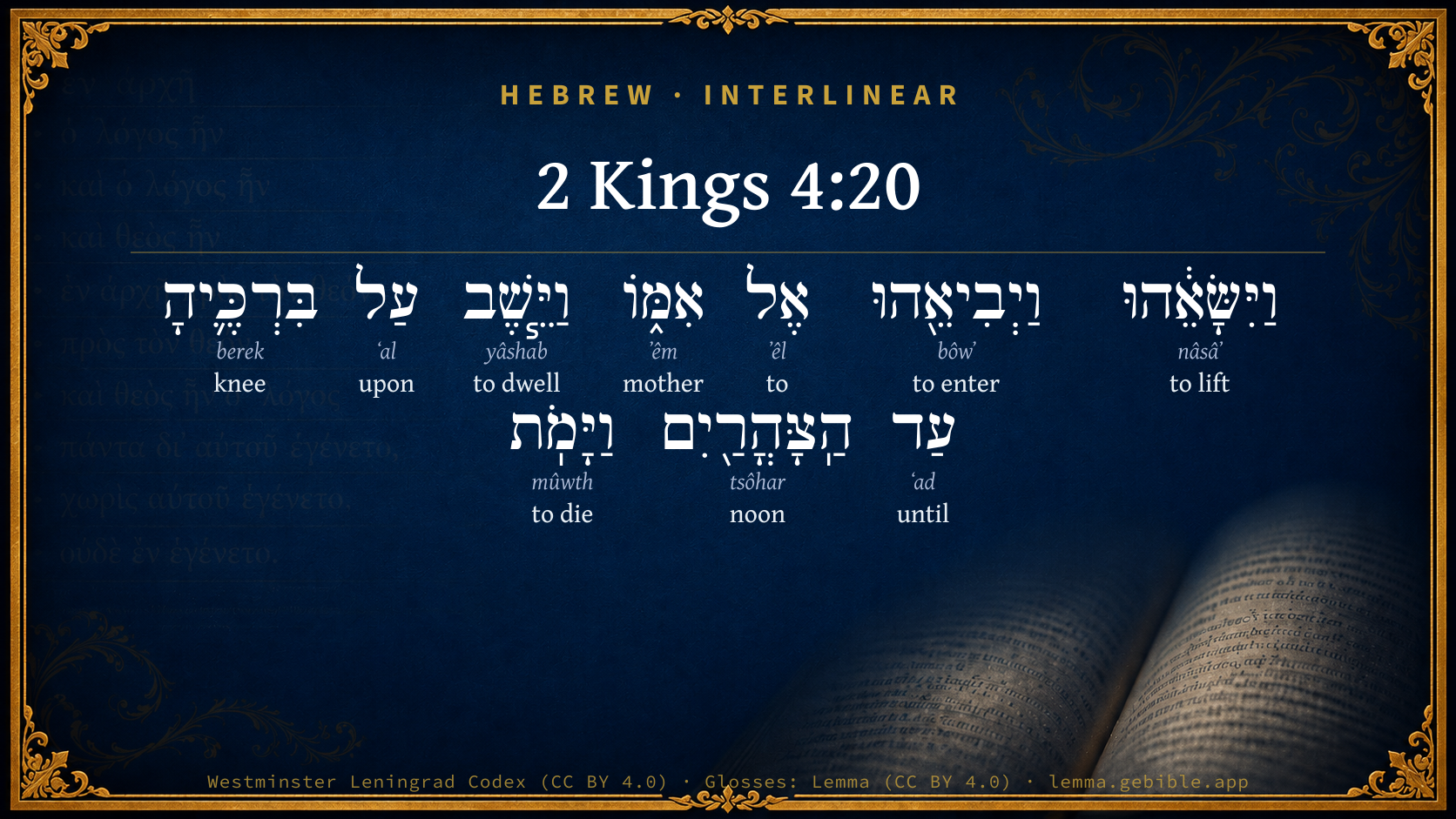
  1. וַיִּשָּׂאֵ֔הוּ nâsâʼ H5375 “and · to lift · him” Conjunction + Verb, Qal, Sequential Imperfect, 3rd Person, Masculine, Singular + Suffix, Personal, 3rd Person, Masculine, Singular
  2. וַיְבִיאֵ֖הוּ bôwʼ H935 “and · to enter · him” Conjunction + Verb, Hiphil, Sequential Imperfect, 3rd Person, Masculine, Singular + Suffix, Personal, 3rd Person, Masculine, Singular
  3. אֶל ʼêl H413 “to” Preposition
  4. אִמּ֑וֹ ʼêm H517 “mother · his” Noun, Common, Feminine, Singular, Construct + Suffix, Personal, 3rd Person, Masculine, Singular
  5. וַיֵּ֧שֶׁב yâshab H3427 “and · to dwell” Conjunction + Verb, Qal, Sequential Imperfect, 3rd Person, Masculine, Singular
  6. עַל ʻal H5921 “upon” Preposition
  7. בִּרְכֶּ֛יהָ berek H1290 “knees · her” Noun, Common, Feminine, Dual, Construct + Suffix, Personal, 3rd Person, Feminine, Singular
  8. עַד ʻad H5704 “until” Preposition
  9. וַיָּמֹֽת mûwth H4191 “and · to die” Conjunction + Verb, Qal, Sequential Imperfect, 3rd Person, Masculine, Singular

About this verse

These counts appear in no published source. They are computed here, from the morphology-tagged text and Lemma’s own curated glosses. What Lemma adds →

10
words
10
distinct lemmas
Historical
section

Notable vocabulary

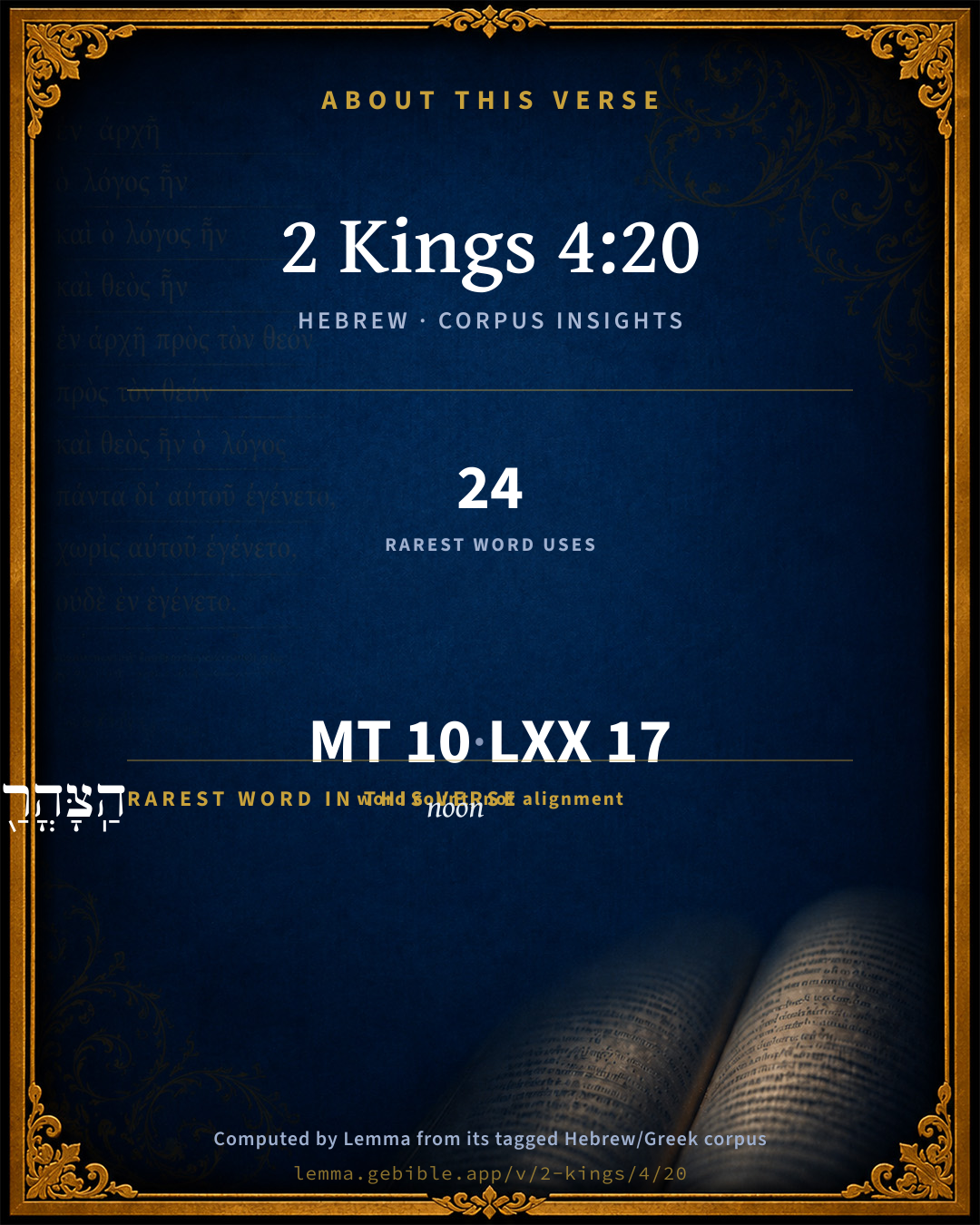
The rarest word here is הַֽצָּהֳרַ֖יִם noon H6672 — appearing just 24 times in the whole Hebrew Bible.

Shared distinctive vocabulary

הַֽצָּהֳרַ֖יִם noon H6672 occurs in 24 verses of the Hebrew Bible. Also found in:

Grammatical profile

  • 4 verbs
  • 3 nouns
  • 3 prepositions

Verb forms

  • וַיִּשָּׂאֵ֔הוּ Qal · Sequential Imperfect
  • וַיְבִיאֵ֖הוּ Hiphil · Sequential Imperfect
  • וַיֵּ֧שֶׁב Qal · Sequential Imperfect
  • וַיָּמֹֽת Qal · Sequential Imperfect

Hebrew & Septuagint length

In English translation the verse runs 21 words from the Hebrew and 17 from the Septuagint (LXX English) — closely comparable.

A rough comparison of the two English renderings, which tokenize alike — not a word-level alignment.

Word counts can differ between the Hebrew and the Greek without any difference in meaning — e.g. the Hebrew direct-object marker אֵת has no separate Greek word, and Greek often adds the article ὁ.

In the original languages it is 10 Hebrew tokens and 17 Greek tokens — but the two are counted differently (Hebrew bundles its prefixes and suffixes into one token; the Greek is in lemma form), so that isn’t a like-for-like length.

Cross-references

12

Topical passages linked to 2 Kings 4:20 in the Treasury of Scripture Knowledge — connected by theme and wording, ordered by reader-vote popularity; previews shown in the World English Bible.

  • Luke 7:12 Now when he drew near to the gate of the city, behold, one who was dead was carried out, the only son of his mother, and she was a widow. Many people of the city were with her.
  • John 11:3 The sisters therefore sent to him, saying, "Lord, behold, he for whom you have great affection is sick."
  • John 11:5 Now Jesus loved Martha, and her sister, and Lazarus.
  • John 11:14 So Jesus said to them plainly then, "Lazarus is dead.
  • Genesis 22:2 He said, "Now take your son, your only son, whom you love, even Isaac, and go into the land of Moriah. Offer him there for a burnt offering on one of the mountains which I will tell you of."
  • Genesis 37:3 Now Israel loved Joseph more than all his children, because he was the son of his old age, and he made him a coat of many colors.
  • Genesis 37:5 Joseph dreamed a dream, and he told it to his brothers, and they hated him all the more.
  • 1 Kings 17:17 It happened after these things, that the son of the woman, the mistress of the house, fell sick; and his sickness was so sore, that there was no breath left in him.
  • Isaiah 49:15 Can a woman forget her sucking child, that she should not have compassion on the son of her womb? yes, these may forget, yet I will not forget you.
  • Isaiah 66:13 As one whom his mother comforts, so will I comfort you; and you shall be comforted in Jerusalem.
  • Ezekiel 24:16–18 Son of man, behold, I take away from you the desire of your eyes with a stroke: yet you shall neither mourn nor weep, neither shall your tears run down.
  • Luke 2:35 Yes, a sword will pierce through your own soul, that the thoughts of many hearts may be revealed."

Cross-references courtesy of OpenBible.info (CC BY 4.0).

Hebrew and Greek witnesses Masoretic Hebrew ↔ Greek Septuagint

The same verse in the two great witnesses to the Old Testament, shown verse-for-verse.

These are two independent witnesses, not word-aligned to each other, and the Septuagint is shown in lemma (dictionary) form.

Hebrew 2 Kings 4:20 Masoretic · Westminster Leningrad Codex

וַיִּשָּׂאֵ֔הוּ וַיְבִיאֵ֖הוּ אֶל אִמּ֑וֹ וַיֵּ֧שֶׁב עַל בִּרְכֶּ֛יהָ עַד הַֽצָּהֳרַ֖יִם וַיָּמֹֽת

When he had taken him, and brought him to his mother, he sat on her knees until noon, and then died.

World English Bible · Public Domain

Greek LXX 2 Kings 4:20 Septuagint · lemma form

καί αἴρω αὐτός πρός ὁ μήτηρ αὐτός καί κοιμάω ἐπί ὁ γόνυ αὐτός ἕως μεσημβρία καί ἀποθνήσκω

And he carried him to his mother, and he lay upon her knees till noon, and died.

LXX2012 (modern English Septuagint) · Public Domain

Hebrew: Westminster Leningrad Codex (CC BY 4.0). Greek: Septuagint (public domain); English from LXX2012 (modern English Septuagint) (Public Domain). How the Septuagint differs from the Hebrew →

Targum (Aramaic paraphrase)

1

The Targum is the ancient Jewish Aramaic paraphrase of the Hebrew Scriptures — an interpretive translation, not the Hebrew text itself. Onkelos (literal) and Pseudo-Jonathan (expansive) render the Torah, and Jonathan the Prophets. Coverage is partial: where no permissively-licensed English translation exists for a verse, only the Aramaic is shown. This is verse-level text, not a word-by-word alignment to the Hebrew.

  1. Targum Jonathan Prophets (Joshua–Malachi)
    וְנַסְבֵיהּ וְאוֹבִילֵיהּ לְאִמֵיהּ וִיתֵיב עַל בִּרְכָּהָא עַד עִדַן טִהֲרָא וּמִית:

    (no public-domain English translation for this verse)

    Targum Jonathan — Aramaic: “Mikraot Gedolot” (public domain). English: “Sefaria Community Translation” (CC0 1.0 (public-domain dedication)); “London "Chaldee Paraphrase," 1871” (public domain). Text via Sefaria.

Commentary

Notes on 2 Kings 4:20 from classic Christian and Jewish commentators (each source and its license shown beneath its notes). The classic Christian expositions comment on the surrounding passage and are grouped to its opening verse, so a note may address several verses; the Jewish commentaries on the Tanakh (Rashi and others) are per-verse, so they appear only where the commentator wrote on this verse.

Lemma curates 59 commentaries, every one of them public domain or Creative Commons licensed, each selected and text-cleaned for this edition rather than reprinted as found. About our sources →

The Biblical Illustrator

Joseph S. Exell

2Ki_4:20

He sat on her knees till noon, and then died.

Death in early life

I. Let us inquire what proportion of mankind die before they arrive to years of maturity.

II. What purposes God may design to answer by the early death of children. Though there is no reason to doubt whether God has some wise and good purpose to promote by cutting short the lives of so many of mankind; yet it is not to be supposed that we can discover all the reasons which influence the kind Parent of the universe in bereaving fathers and mothers of their young and lovely children. But some of His purposes in such dispensations of Providence are plain and obvious.

1. He may intend, by taking away so many at an early age, to make this appear as a dying world. Though He has told us in His Word that it is appointed unto all men once to die, and that dust they are and unto dust they must return, yet these declarations generally fail of making mankind realise their frail and mortal state. The eye affects the heart, and the bare sight of death makes a deeper impression on the minds of the living, than any human or even Divine declarations concerning it. The frequency of death seems necessary to keep up a lively sense of it in the minds of dying creatures. A very dying time we know is always very alarming to the living. And by so many deaths of the young, God makes it appear to all, that they live in a dying world and are dying creatures. The frequent instances of mortality, not only from year to year, but from month to month, and from week to week, make it appear that death is continually carrying mankind to their long home, and causing mourners to go about the streets. If it be necessary, then, that the world should appear as a dying world, what wiser course could God take to produce this solemn and instructive appearance, than to cut off such a large proportion of mankind in their earliest days?

2. God may design, by the great mortality of children, to teach mankind His sovereign right to take away any temporal favours He has bestowed upon them. They are very apt to consider their children as their own property, and their own most precious property. They value them more than all their other earthly enjoyments, and claim a higher right to them. They possess many things which they do not consider as their own. They dwell in houses, and cultivate lands which are not their own. They borrow many comforts and conveniences from one another; but their children they hold by a stronger claim, and practically deny human or Divine right to take them away. But they ought to consider, that God has given them these desirable objects and precious blessings, and therefore that He has an original and sovereign right to do what He will with His own. This is a matter of so much importance, that God may, with propriety, take the most effectual method to display His sovereignty. And we can hardly conceive of any more effectual way to make mankind see, and feel, and acknowledge His sovereignty, than His stripping them of those blessings which they are most apt to claim, most apt to prize, and most reluctant to part with. By going into their families, and tearing from them the objects which lie nearest to their hearts, He gives them the most sensible and affecting evidence, that He has a right to dispose of them and of all they have. The loss of children was the heaviest of Jobs afflictions, and most effectually bowed his heart in cordial submission to Divine sovereignty. The Lord gave, and the Lord hath taken away; blessed be the name of the Lord.

3. God may design, by the death of some little children, to take them away from the evil to come, and give them cause to adore His sovereign goodness in early and safely conducting them to His heavenly kingdom. We are told that God sometimes takes away the godly from the evil to come; and why may He not do the same by some who die in infancy and childhood?

4. God may design, by the death of little children, to moderate the affections of their parents towards them. They are extremely prone to love their children too much. Jacob was too fond of Joseph and Benjamin. David was too fond of Absalom. Aaron and Eli were too fond of their sons. And parents in general are too fond of their children. And sometimes they are partial in their affections, and dote upon some son or daughter, who has the more promising appearance or talents. Now, God knows the feelings of parents better than they do themselves, and there is reason to think that He often takes away some of their darlings, to teach them to moderate their affections towards them that survive.

5. God may intend, by the death of children, to prevent parents from being too much engaged to provide for them in this life. Their great fondness for them often creates a worldly spirit, and an anxiety to lay up for them rich and large possessions. They are ready to think that they cannot do too much for them. They give themselves no rest, but employ their time and exhaust their strength and expose their own lives, for the sake of putting their children into the most easy and flourishing situations.

6. God may bereave parents of some of their children, on purpose to teach them to do their duty to the rest. So long as parents have high expectations of their childrens living, they are apt to neglect to prepare them for dying; but when God takes away one or more of their children, by an early death, then they can hardly fail to realise that they are all mortal, and may be called out of time into eternity before they are prepared for the solemn and interesting event; which makes them feel, that it is of more importance to prepare their children for dying than for living.

7. God may bereave pious parents of their young and tender offspring, in order to try and purify their hearts. This seems to have been the primary purpose of God, in taking away for a time the child of the Shunammites. Every circumstance was directly suited to try the hearts of those professed friends of God. They were not fond of the world. They were amiable and exemplary persons, and much engaged in religion, and warmly attached to its friends. But it is probable that they idolised their only child. Accordingly, God meant to take away their idol, try their sincerity, and recall their supreme affections to Himself.

8. Another reason why God sometimes bereaves parents of their little children, is because He intends to make their bereavement the means of their own conversion. Such sensible and severe strokes of Providence have led thoughtless, careless, and prayerless parents to attend to the things of their everlasting peace.

III. Improvement.

1. If so great a proportion of mankind die in childhood and youth, as has been stated, then all adult persons have great reason of gratitude for the preservation of life.

2. If God so often takes away infants and little children by death, then those parents have peculiar reason for gratitude to God, who have never suffered a single breach in their young and rising families.

3. If God so often and so early takes away children from their parents, then it is of very serious importance that parents should be truly religions.

4. If God may answer many wise and benevolent purposes by the death of little children, then those who are lamenting the sudden and surprising death of their lovely and only child, ought to be cordially submissive to the bereaving and afflictive hand of God.

5. This subject calls upon all to inquire whether the bereavements and afflictions they have experienced have been instructive and beneficial to them. (N. Emmons, D. D.)

Influence of a childs death upon his mother

Princess Alice had just returned from her Italian trip, into which she had thrown herself with true enjoyment, and was still resting after the fatigue of the long journey. The two little princes had been playing by her sofa; Prince Ernest ran into the next room followed by the Princess, and in her brief absence Prince Fritz fell out of the window upon the stone pavement below. One moment in the most vivid radiant life and health, the next he lay senseless and crushed. He died a few hours later in his mothers arms. In her agony she sounded, as it were for the first time, the depths of scepticism. She searched in vain through the various systems of philosophy, but found no foothold. She did not speak of the transformation that was going on within; but slowly, silently, and surely faith returned to her, never again ¢o falter. The whole edifice of philosophical conclusions which I had built up for myself, I find to have no foundation whatever--nothing of it is left--it has crumbled away like dust. What should we be, what would become of us if we had no faith--if we did not believe that there is a God who rules the world and each single one of us? (Miss Gladstone in Contemporary Review.)

The Shunammites son

I. The dead child. Beautiful: innocent, and pure.

1. His death was sudden. Although sufficiently grown to have passed the usual dangers of the infant age, he is not old enough to go out to the field to the reapers.

2. In the death of this child there is one of the hardest providences to understand.

II. The believing mother. In reality she is the central figure in this story.

1. She manifested her faith by her determination. She tells no one of her plans, but prepares to go to find the prophet, and bring him to the chamber where the child has been placed.

2. She showed her faith again in not making known her errand until she met the prophet himself. She must pour her complaint into the ears of Gods representative.

3. Her faith came out still stronger in her refusing to leave the prophet unless he would return with her. Gehazi had been sent with the prophets staff, but this, to her mind, was not sufficient. Her intuition seemed to tell her that it would not restore the child, and Elisha must return with her.

III. The restored son.

1. He stretched himself upon the child. He put his mouth upon his mouth, and his eyes upon his eyes, and his hands upon his hands; and he stretched himself upon the child; and the flesh of the child waxed warm.

2. This effort was a manifestation of the earnestness of the prophet. Elijah did the same. In both cases there was such an earnest longing for the accomplishment of the purpose that they would willingly give their own lives to restore the dead. (G. S. Butters.)

The Biblical Illustrator, edited by Joseph S. Exell (c. 1880s–1900s) — public domain. Text from a community e-Sword module.

Ellicott's Commentary for English Readers

(20) Taken.—Carried.

Brought him.—Brought him in—i.e., in-doors.

Till noon.—We gather from this that the boy was hurt in the forenoon.

A Bible Commentary for English Readers, edited by Charles John Ellicott (1878–1897) — public domain. Text from a community e-Sword module.

The Cambridge Bible for Schools and Colleges

gen. ed. J. J. S. Perowne

20. he sat on her knees till noon] The attack was in the early part of the day, when the oblique rays of the sun appear to be most dangerous. The mother’s affection shews itself in her unbroken attention.

The Cambridge Bible for Schools and Colleges (gen. ed. J. J. S. Perowne; Cambridge University Press, 1878–1918) — public domain. Text from a community e-Sword module.

John Gill's Exposition

And when he had taken him, and brought him to his mother,.... The lad led him home, and delivered him to his mother:

he sat on her knees till noon, and then died; out of her great affection, she took him on her knees, and laid his head in her bosom to sooth the pain, and in this posture he continued until the middle of the day, and then expired; by which it appears it was in the morning when he went into the field, and when the sun was pretty high, and beat strongly on him; which, it may be, produced a fever, and which issued in his death.

John Gill's Exposition of the Whole Bible (1746–1763) — public domain (CC PDM 1.0). Text via the HelloAO Bible API.

The Pulpit Commentary

And when he had taken him, and brought him to his mother, he sat on her knees till noon. It was in the morning, therefore, that the child received his sunstroke an unusual, but not an unknown, occurrence. In the East the sun often becomes intensely hot by ten o"clock.

And then died. There is no ambiguity here, no room for doubt; the child not only became insensible, but died. The historian could not possibly have expressed himself more plainly.

The Pulpit Commentary (1880–1919), ed. H.D.M. Spence-Jones & Joseph S. Exell — public domain. Text from a community e-Sword module.

Lesson kit

Teaching starters — assembled from the data on this page, not authored interpretation. Every prompt links to the verse data it draws on. Edit before teaching.

2 Kings, in the Historical, opens this verse with 10 words (10 distinct Hebrew lemmas). Its most distinctive word is tsôhar (“noon”). A historical commentator’s framing appears above. Read the whole chapter for the surrounding context.

Discussion questions

  1. The word tsôhar carries the sense “noon.” How does it shape the verse?
  2. Genesis 6:16 shares the word «noon» with this verse. How do the two illuminate each other?
  3. These translations render this verse differently. What is at stake in choosing one wording over another?
  4. The verb «וַיִּשָּׂאֵ֔הוּ» is Qal Sequential Imperfect. How does its form color the action?
  5. Reading how The Biblical Illustrator and Ellicott's Commentary for English Readers read this verse, where do the two commentators agree and where do they part?

Things to notice

Reading settings

Reading text

Shown beneath each verse's original-language words.

Old Testament
Old Testament edition

Read the OT as the Masoretic Hebrew (MT) or the Greek Septuagint (LXX).

English shown for the Greek Septuagint (in the Hebrew ↔ Greek comparison).

Comparing translations? Open the Compare panel on any verse page to stack up to four side by side.