1 Chronicles 16:29

Hebrew (Westminster Leningrad Codex) 1 Chronicles 16:29 appears in the Hebrew Old Testament. The text above is from the Westminster Leningrad Codex. Each word links to its Strong’s number, a concise gloss, and parsing drawn from the Open Scriptures Hebrew Bible morphology. Click any word for its full Brown-Driver-Briggs (BDB) entry.
Download image
Cite this verse

1 Chronicles 16:29 (World English Bible). Public Domain. Lemma interlinear Bible study tool, https://lemma.gebible.app/v/1-chronicles/16/29.

Show BibTeX & RIS
BibTeX
RIS
English Translation
Ascribe to Yahweh the glory due to his name: Bring an offering, and come before him: Worship Yahweh in holy array.
World English Bible · Public Domain
Highlights
  • 1 first appearance in the Hebrew Bible
Full analysis ↓
Download a study sheet

One document with this verse’s original text, its word-by-word gloss line, the meaning frame, cross-references with their text, attributed commentary, and full source and license credits — printable, and it pastes into notes with its structure intact.

This verse Autodidact and up

Study sheet (.html) Plain text (.txt)

A passage Seminary Student

Up to 50 verses in one chapter. A passage sheet keeps up to 6 commentary sources and 12 cross-references per verse, in the order this page ranks them, and says so on the sheet whenever that leaves anything out. Ask for a single verse and you get the Autodidact verse sheet above.

Everything on this page stays free to read, with no account — the sheet is a download of what is already on screen, not access to it.

Want to remove ads? Support Godless Engineer
Compare translations 3

The same verse in 3 English versions, stacked beneath the original-language interlinear above. Click any original word for its lexicon entry.

Each is an independent rendering of the whole verse — the interlinear is not word-aligned to these translations.

Highlighted words mark where these versions differ — a whole-verse word diff, not a word-by-word alignment.

  • World English Bible Public Domain
    Ascribe to Yahweh the glory due to his name: Bring an offering, and come before him: Worship Yahweh in holy array.
  • King James Version Public Domain
    Give unto the LORD the glory due unto his name: bring an offering, and come before him: worship the LORD in the beauty of holiness.
  • unfoldingWord Literal Text CC BY-SA 4.0
    Ascribe to Yahweh the glory of his name; bring an offering and come to his face; worship Yahweh in the splendor of holiness.

unfoldingWord Literal Text — © unfoldingWord, licensed CC BY-SA 4.0. Word-aligned USFM3 via Door43 (git.door43.org/unfoldingWord/en_ult).

Versions to compare (up to 4)

3 of 4 selected

Show all 18 translations

Every available English version of this verse, each an independent rendering of the whole verse.

  • World English Bible Public Domain
    Ascribe to Yahweh the glory due to his name: Bring an offering, and come before him: Worship Yahweh in holy array.
  • Berean Standard Bible Public Domain
    Ascribe to the LORD the glory due His name; bring an offering and come before Him. Worship the LORD in the splendor of His holiness;
  • Majority Standard Bible Public Domain
    Ascribe to the LORD the glory due His name; bring an offering and come before Him. Worship the LORD in the splendor of His holiness;
  • King James Version Public Domain
    Give unto the LORD the glory due unto his name: bring an offering, and come before him: worship the LORD in the beauty of holiness.
  • American Standard Version (1901) Public Domain
    Ascribe unto Jehovah the glory due unto his name: Bring an offering, and come before him: Worship Jehovah in holy array.
  • Revised Version (1885) Public Domain
    Give unto the LORD the glory due unto his name: bring an offering, and come before him: worship the LORD in the beauty of holiness.
  • Geneva Bible (1599) Public Domain
    Giue vnto the Lord ye glory of his Name: bring an offring and come before him, and worship the Lord in the glorious Sanctuarie.
  • Douay-Rheims (1899) Public Domain
    Give to the Lord glory to his name, bring up sacrifice, and come ye in his sight: and adore the Lord in holy becomingness.
  • Young's Literal Translation Public Domain
    Ascribe to Jehovah the honour of His name, Lift up a present, and come before Him. Bow yourselves to Jehovah, In the beauty of holiness.
  • Literal Standard Version CC BY-SA 4.0
    Ascribe to YHWH the glory of His Name, || Lift up a present, and come before Him. Bow yourselves to YHWH, || In the beauty of holiness.
  • Unlocked Literal Bible CC BY-SA 4.0
    Ascribe to Yahweh the glory his name deserves. Bring an offering and come before him. Bow down to Yahweh in the splendor of holiness.
  • unfoldingWord Literal Text CC BY-SA 4.0
    Ascribe to Yahweh the glory of his name; bring an offering and come to his face; worship Yahweh in the splendor of holiness.
  • Darby Bible Public Domain
    Give unto Jehovah the glory of his name! Bring an oblation, and come before him: Worship Jehovah in holy splendour.
  • World Messianic Bible Public Domain
    Ascribe to the LORD the glory due to his name. Bring an offering, and come before him. Worship the LORD in holy array.
  • Webster's Bible Public Domain
    Give to the LORD the glory due to his name: bring an offering, and come before him: worship the LORD in the beauty of holiness.
  • Free Bible Version CC BY-SA 4.0
    Give the Lord the glory he deserves; bring an offering and come before him. Worship the Lord in his magnificent holiness.
  • Bible in Basic English Public Domain
    Give to the Lord the glory of his name; take with you an offering and come before him; give worship to the Lord in holy robes.
  • JPS Tanakh (1917) Public Domain
    Ascribe unto the LORD the glory due unto His name; bring an offering, and come before Him; worship the LORD in the beauty of holiness.

Literal Standard Version (2020), Covenant Press — licensed CC BY-SA 4.0. Text via the HelloAO Bible API (eBible.org). Unlocked Literal Bible (unfoldingWord) — licensed CC BY-SA 4.0. Text via the HelloAO Bible API (eBible.org). unfoldingWord Literal Text — © unfoldingWord, licensed CC BY-SA 4.0. Word-aligned USFM3 via Door43 (git.door43.org/unfoldingWord/en_ult). Free Bible Version, Dr. Jonathan Gallagher — licensed CC BY-SA 4.0. Text via the HelloAO Bible API (eBible.org).

Word by word

More ways to search: Search by grammar → Find every occurrence → Compare this word →

Practice this passage: Drill this verse → Learn its vocabulary →

בְּהַדְרַת
hădârâh
H1927
“in/at · adornment of”
Preposition + Noun, Common, Feminine, Singular, Construct
Part of Speech
Preposition + Noun
Type
Common
Gender
Feminine
Number
Singular
State
Construct
Full BDB Definition

Origin: from H1926

TWOT: 477c

adornment, glory - holy adornment (of public worship) - glory (of the king)
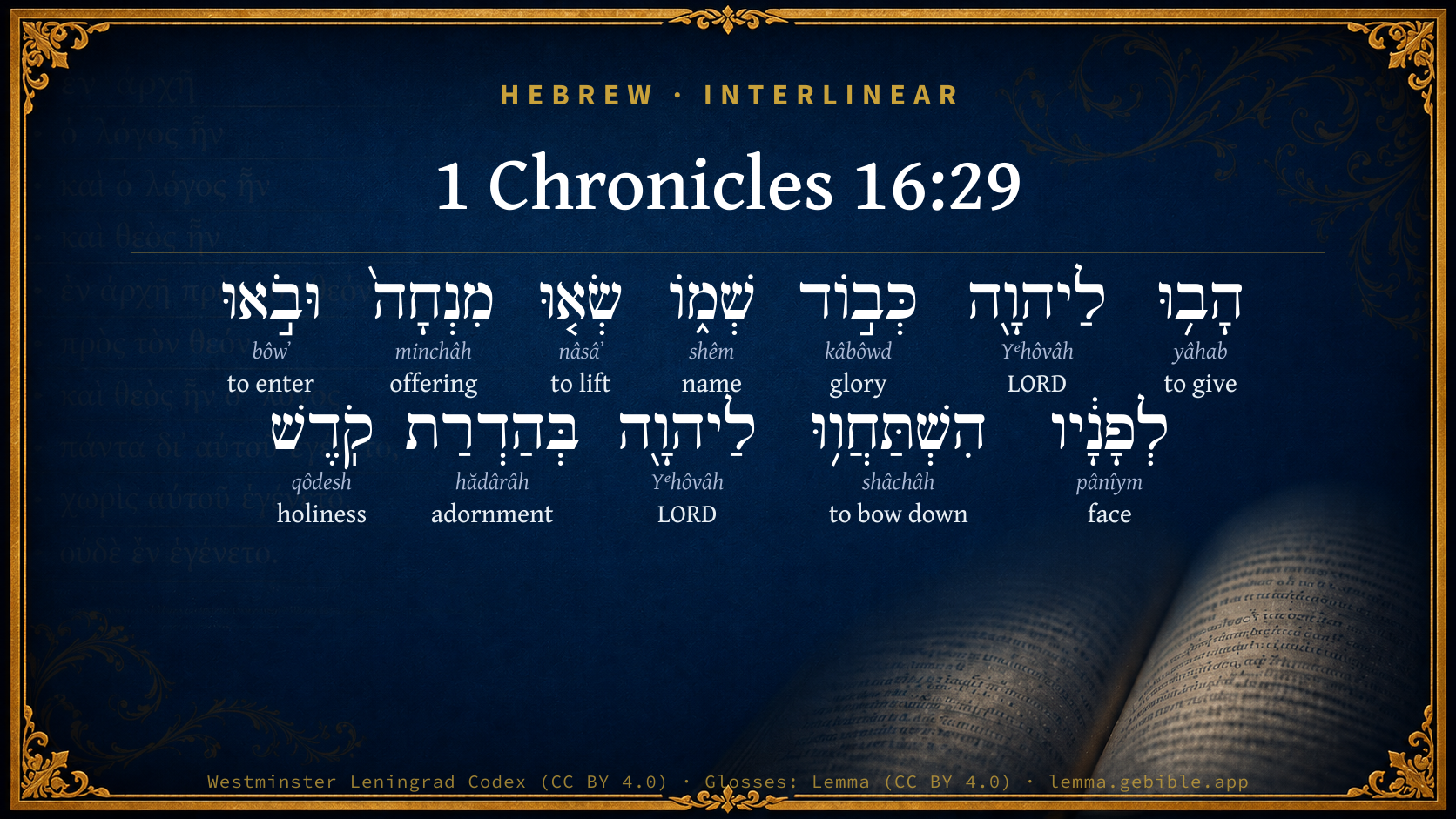
  1. הָב֥וּ yâhab H3051 “give” Verb, Qal, Imperative, 2nd Person, Masculine, Plural
  2. לַיהוָ֖ה Yᵉhôvâh H3068 “to/for · LORD” Preposition + Noun, Proper
  3. כְּב֣וֹד kâbôwd H3519 “glory of” Noun, Common, Both, Singular, Construct
  4. שְׁמ֑וֹ shêm H8034 “name · his” Noun, Common, Masculine, Singular, Construct + Suffix, Personal, 3rd Person, Masculine, Singular
  5. שְׂא֤וּ nâsâʼ H5375 “lift” Verb, Qal, Imperative, 2nd Person, Masculine, Plural
  6. מִנְחָה֙ minchâh H4503 “offering” Noun, Common, Feminine, Singular, Absolute
  7. וּבֹ֣אוּ bôwʼ H935 “and · enter” Conjunction + Verb, Qal, Imperative, 2nd Person, Masculine, Plural
  8. לְפָנָ֔יו pânîym H6440 “to/for · face(s) · his” Preposition + Noun, Common, Both, Plural, Construct + Suffix, Personal, 3rd Person, Masculine, Singular
  9. הִשְׁתַּחֲו֥וּ shâchâh H7812 “bow down” Verb, Hishtaphel, Imperative, 2nd Person, Masculine, Plural
  10. לַיהוָ֖ה Yᵉhôvâh H3068 “to/for · LORD” Preposition + Noun, Proper
  11. קֹֽדֶשׁ qôdesh H6944 “holiness” Noun, Common, Masculine, Singular, Absolute

About this verse

These counts appear in no published source. They are computed here, from the morphology-tagged text and Lemma’s own curated glosses. What Lemma adds →

12
words
11
distinct lemmas
Historical
section

Notable vocabulary

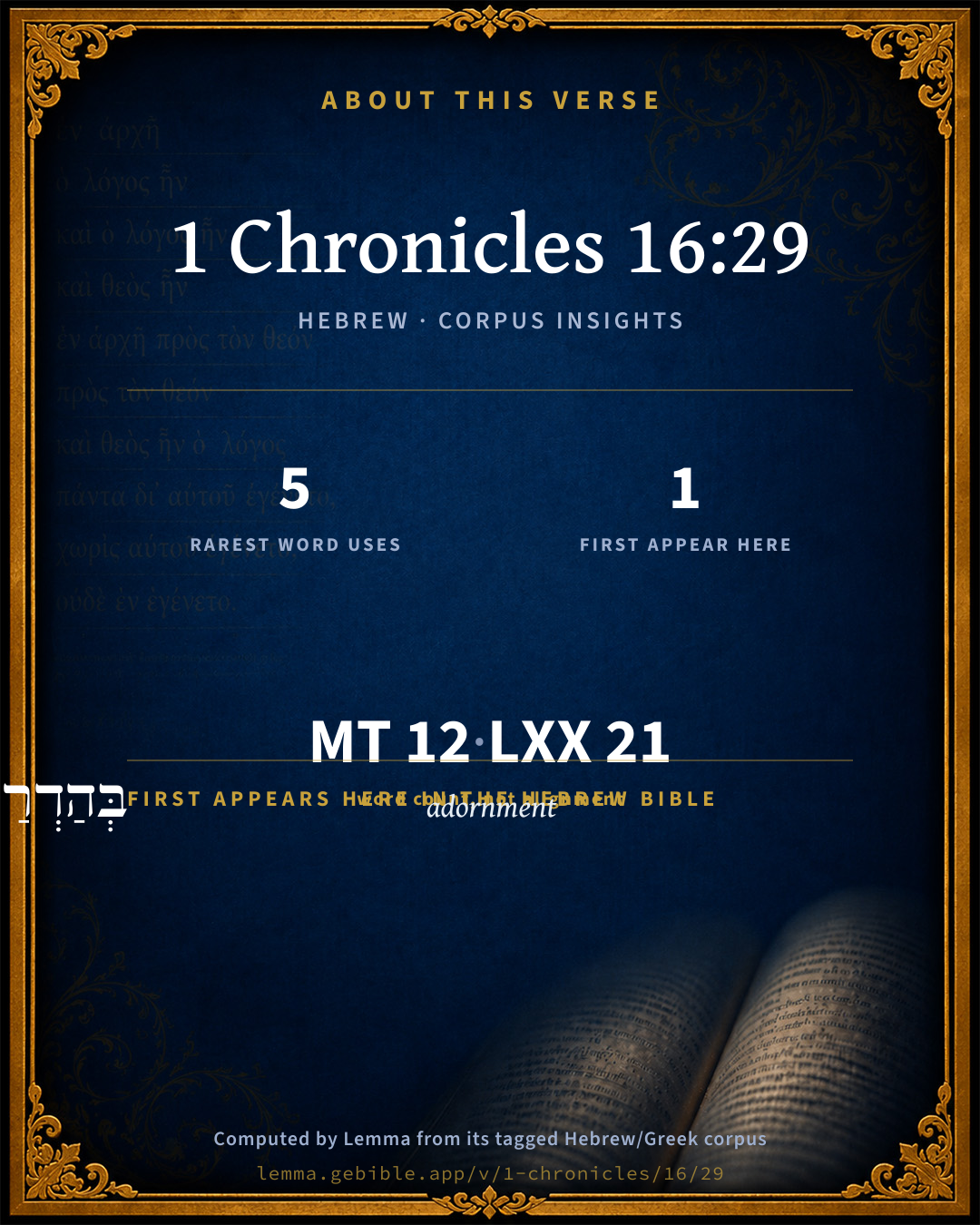
The rarest word here is בְּהַדְרַת adornment H1927 — appearing just 5 times in the whole Hebrew Bible.

First appearance in Scripture

This word makes its first canonical appearance in the Hebrew Bible here:

  • בְּהַדְרַת adornment H1927

Shared distinctive vocabulary

בְּהַדְרַת adornment H1927 occurs in 5 verses of the Hebrew Bible. Also found in:

Grammatical profile

  • 4 verbs
  • 8 nouns

Verb forms

  • הָב֥וּ Qal · Imperative
  • שְׂא֤וּ Qal · Imperative
  • וּבֹ֣אוּ Qal · Imperative
  • הִשְׁתַּחֲו֥וּ Hishtaphel · Imperative

Repetition

A word recurs within this verse — often emphatic in Hebrew:

  • לַיהוָ֖ה LORD H3068 ×2

Hebrew & Septuagint length

In English translation the verse runs 21 words from the Hebrew and 25 from the Septuagint (LXX English) — closely comparable.

A rough comparison of the two English renderings, which tokenize alike — not a word-level alignment.

Word counts can differ between the Hebrew and the Greek without any difference in meaning — e.g. the Hebrew direct-object marker אֵת has no separate Greek word, and Greek often adds the article ὁ.

In the original languages it is 12 Hebrew tokens and 21 Greek tokens — but the two are counted differently (Hebrew bundles its prefixes and suffixes into one token; the Greek is in lemma form), so that isn’t a like-for-like length.

Cross-references

22

Topical passages linked to 1 Chronicles 16:29 in the Treasury of Scripture Knowledge — connected by theme and wording, ordered by reader-vote popularity; previews shown in the World English Bible.

  • Psalms 100:4 Enter into his gates with thanksgiving, Into his courts with praise. Give thanks to him, and bless his name.
  • Psalms 96:9 Worship Yahweh in holy array. Tremble before him, all the earth.
  • Isaiah 6:3 One called to another, and said, "Holy, holy, holy, is Yahweh of Hosts! The whole earth is full of his glory!"
  • Psalms 96:6 Honor and majesty are before him. Strength and beauty are in his sanctuary.
  • Psalms 108:3–5 I will give thanks to you, Yahweh, among the nations. I will sing praises to you among the peoples.
  • Psalms 95:2 Let's come before his presence with thanksgiving. Let's extol him with songs!
  • Psalms 29:2 Ascribe to Yahweh the glory due to his name. Worship Yahweh in holy array.
  • Psalms 72:15 They shall live, and to him shall be given of the gold of Sheba. Men shall pray for him continually. They shall bless him all day long.
  • Psalms 89:5–8 The heavens will praise your wonders, Yahweh; Your faithfulness also in the assembly of the holy ones.
  • Revelation 4:9–11 When the living creatures give glory, honor, and thanks to him who sits on the throne, to him who lives forever and ever,
  • 2 Chronicles 20:21 When he had taken counsel with the people, he appointed those who should sing to Yahweh, and give praise in holy array, as they went out before the army, and say, Give thanks to Yahweh; for his loving kindness endures forever.
  • Psalms 110:3 Your people offer themselves willingly in the day of your power, in holy array. Out of the womb of the morning, you have the dew of your youth.
  • Psalms 148:13–14 Let them praise the name of Yahweh, For his name alone is exalted. His glory is above the earth and the heavens.
  • Revelation 7:12 saying, "Amen! Blessing, glory, wisdom, thanksgiving, honor, power, and might, be to our God forever and ever! Amen."
  • Psalms 50:2 Out of Zion, the perfection of beauty, God shines forth.
  • Psalms 72:10 The kings of Tarshish and of the isles will bring tribute. The kings of Sheba and Seba shall offer gifts.
  • Ezekiel 24:25 You, son of man, shall it not be in the day when I take from them their strength, the joy of their glory, the desire of their eyes, and that whereupon they set their heart, their sons and their daughters,
  • Revelation 5:12–14 saying with a loud voice, "Worthy is the Lamb who has been killed to receive the power, wealth, wisdom, strength, honor, glory, and blessing!"
  • 1 Kings 8:41–43 Moreover concerning the foreigner, who is not of your people Israel, when he shall come out of a far country for your name's sake
  • Isaiah 60:6–7 The multitude of camels shall cover you, the dromedaries of Midian and Ephah; all they from Sheba shall come; they shall bring gold and frankincense, and shall proclaim the praises of Yahweh.
  • Ezekiel 7:20 As for the beauty of his ornament, he set it in majesty; but they made the images of their abominations [and] their detestable things therein: therefore have I made it to them as an unclean thing.
  • Psalms 68:30–31 Rebuke the wild animal of the reeds, The multitude of the bulls, with the calves of the peoples. Being humbled, may it bring bars of silver. Scatter the nations that delight in war.

Cross-references courtesy of OpenBible.info (CC BY 4.0).

Hebrew and Greek witnesses Masoretic Hebrew ↔ Greek Septuagint

The same verse in the two great witnesses to the Old Testament, shown verse-for-verse.

These are two independent witnesses, not word-aligned to each other, and the Septuagint is shown in lemma (dictionary) form.

Hebrew 1 Chronicles 16:29 Masoretic · Westminster Leningrad Codex

הָב֥וּ לַיהוָ֖ה כְּב֣וֹד שְׁמ֑וֹ שְׂא֤וּ מִנְחָה֙ וּבֹ֣אוּ לְפָנָ֔יו הִשְׁתַּחֲו֥וּ לַיהוָ֖ה בְּהַדְרַת קֹֽדֶשׁ

Ascribe to Yahweh the glory due to his name: Bring an offering, and come before him: Worship Yahweh in holy array.

World English Bible · Public Domain

Greek LXX 1 Chronicles 16:29 Septuagint · lemma form

δίδωμι ὁ κύριος δόξα ὄνομα αὐτός λαμβάνω δῶρον καί φέρω κατά πρόσωπον αὐτός καί προςκυνέω ὁ κύριος ἐν αὐλή ἅγιος αὐτός

Give to the Lord the glory belonging to his name: take gifts and offer them before him; and worship the Lord in his holy courts.

LXX2012 (modern English Septuagint) · Public Domain

On this verse, The Pulpit Commentary discusses the Septuagint’s reading. Read the note in Commentary ↓

Hebrew: Westminster Leningrad Codex (CC BY 4.0). Greek: Septuagint (public domain); English from LXX2012 (modern English Septuagint) (Public Domain). How the Septuagint differs from the Hebrew →

Commentary

Notes on 1 Chronicles 16:29 from classic Christian and Jewish commentators (each source and its license shown beneath its notes). The classic Christian expositions comment on the surrounding passage and are grouped to its opening verse, so a note may address several verses; the Jewish commentaries on the Tanakh (Rashi and others) are per-verse, so they appear only where the commentator wrote on this verse.

Lemma curates 59 commentaries, every one of them public domain or Creative Commons licensed, each selected and text-cleaned for this edition rather than reprinted as found. About our sources →

The Biblical Illustrator

Joseph S. Exell

1Ch_16:27; 1Ch_16:29

Glory and honour are in His presence.

The beautiful place

Apply this to the sanctuary.

I. Beautified by Gods presence.

II. Beautified by attractive services.

1. Cheerful song.

2. Freewill offerings.

3. Spiritual fervour.

III. Beautified by loyal attendants.

1. Regular in attendance.

2. Mindful of its interests.

3. Obedient to its rules. (J. Wolfendale.)

Religious worship

I. It is due to God.

1. It is right.

2. It is acceptable. Though not enriching, yet well pleasing to Him. Whosoever offereth praise glorifieth Me.

II. It befits our moral nature.

1. It meets our aspirations.

2. It satisfies our wants.

3. It dignifies our character.

It detaches from earth and sin, gives beauty to contemplate, strength to imitate, and fear to humble and guide. It is good for me to draw near to God. (J. Wolfendale.)

Strength and gladness are in His place.

Abiding strength and gladness

We all need enthusiasm and vigour in our work. It is, however, a rare thing to find these as an abiding, continuous experience. Youth, of course, has freshness and freedom. Its ardent hopefulness covers everything, just as we find when, looking at distant objects through a lens not perfectly achromatic, we see them fringed with prismatic tints--a rainbow brilliancy which does not belong to the objects themselves. There are objects in life that lose their illusive and enchanting brightness when viewed in the sober inspection of maturer age. Health, too, has its influence in imparting enthusiasm. On a bright and bracing day we walk the street with resounding foot. The sunlit skies and the crisp air help to quicken and enliven our spirits. Contact with a friend we love warms our soul with new emotion, and pours the elixir of life into languid veins. A great thought, or the perusal of a delightful book, may stir our intellect to fresh activity. A new key to the mystery of life is given us by momentary contact with an illuminated mind. But society is complex. Cares are multiplied and minute in this our hurrying and exacting life. By no voluntary act of ours can we maintain this tension, any more than we can stretch a wire a hundred yards without a sag. With added years and with narrowing friendships we see less of pleasure ahead to anticipate. We come to feel the need of something to alleviate the weariness of life. Can we as Christian disciples find in our religion that ennobling and enlivening element which was found in the Hebrew? If not, ours is narrower and more limited than the Hebrew. Yes, we do not find strength and gladness here. We do not find a transient glow, an occasional enthusiasm, but an abiding joy, as we come under the power of the religion of Christ? Do you ask, How this is to be maintained?

I. We find it in the entire relief from solitude as to the future which the grace of Christ imparts.

II. We realise this abiding strength and gladness as we remember that we are working out Gods will concerning us in all that is done or borne by us.

III. We are educated by what we do. The thought of developed character and of virtues daily nourished within us is calculated to give abiding joyousness and strength to life.

IV. Life eternal is thus linked to this. A light supernal cheers and lifts up our spirits as the swing of the sea lifts and carries forward the waves till they flood every inlet and beach along the winding shore. We are released from apprehension as to the future. We see all things working together for our good, around us and within us. We do not rightly estimate the believers privilege. We go moaning and whining, instead of walking on the high places. We go with weights, and not with wings, over the bleak and barren paths of life. But if character have this abiding strength and gladness, freshness and exuberance; if each of us have this shekinah of glory within the soul, we shall show to men of the world that we have what they have not. We have more than a knowledge of the truth in its verbal exactness. We have Christ in us the hope of glory. We have an enthusiasm more continuous than the ardour of youth or the glow of health, or the inspiration of genius. This abiding power is what the world wants. Its fruits, seen in character, ennoble society and link earth with heaven. They make earth bright and vocal. Culture, art, science, mechanical skill cannot work this transformation. Wealth is powerless. (Richard S. Storrs, D. D.)

The Biblical Illustrator, edited by Joseph S. Exell (c. 1880s–1900s) — public domain. Text from a community e-Sword module.

The Cambridge Bible for Schools and Colleges

gen. ed. J. J. S. Perowne

29. before him] Psa_96:8, into his courts.

worship the Lord in the beauty of holiness] Render, worship the LORD for the majesty of [his] holiness. God’s beauty (majesty) is His holiness. To translate (as R.V. mg.) in holy array, attributing the beauty of holiness to the worshipper is no doubt wrong; cp. 2Ch_20:21.

The Cambridge Bible for Schools and Colleges (gen. ed. J. J. S. Perowne; Cambridge University Press, 1878–1918) — public domain. Text from a community e-Sword module.

Haydock's Catholic Bible Commentary

CHAPTER XVI.

Sacrifice, of flour and wine. --- Beauty. Hebrew, "in the beauty of his sanctuary." Psalms, Come into his courts: adore ye the Lord in his holy court.

George Leo Haydock (1774–1849), Haydock's Catholic Family Bible and Commentary, 1859 edition — public domain. Excludes Psalms (Douay-Rheims chapter numbering differs from Protestant) and Deuterocanonical books (Catholic canon only).

The Pulpit Commentary

The right, the acceptable, and the beautiful thing.

Why should we worship God? "Wherewithal shall we come before the Lord?" How shall we honour and please him? These are three questions to which our text will suggest replies. We are reminded

I THAT TO REVERENCE GOD IS THE ONE RIGHT THING FOR US TO DO. There are many things which it is well, proper, right, for us to do; things which make for the well-being of others; things which contribute to our own ennoblement and self-respect. But the thing which, above all others, it is right for us to do is to revere and honour God, to "give unto the Lord the glory due to his Name. " That which is due to our kindred and friends, that which is due to ourselves, this is as nothing compared with the reverence, obedience, and submission which are due to him from whom we come, without whose creative energy we had not been, without whose sustaining power we should cease to be, in whom we live, and move, and have our being," to whom we owe everything we are and have. To serve God is to secure ourselves against the worst evils; it is to avail ourselves of our highest privilege; it is also, and foremost of all, to discharge our deepest obligation; it is to render that which is due indeed.

II THAT TO BRING TO GOD OUR CONTRIBUTION MAY BE AN ACCEPTABLE THING TO Do. "Bring an offering, and come before him." It is true that he "needeth nothing" at our hand; that "if he were hungry he would not tell us;" that "every beast of the forest is his, and the cattle upon a thousand hills". (Ps 1) It is also true that there were conditions under which God was "pleased with the sacrifices of righteousness, with burnt offering and whole burnt offering". (Psa_51:19) And it is also true that the Divine Lord who sits over against the treasury is pleased with the two mites which the widow gives of her poverty. We may "bring an offering" now that may be very large and "munificent" in the sight of men, which shall be very lightly esteemed, or even weigh nothing or less than nothing, in the sight of the holy and the pure One. But then we may "bring an offering" that may be very small in man"s reckoning, which, laid by the hand of love on the altar, shall weigh much in the balances of heaven.

III THAT TO WORSHIP GOD MAY BE A BEAUTIFUL THING TO DO. "Worship the Lord in the beauty of holiness." That which is called Divine worship may be an altogether unbeautiful thing in his sight. That which is rendered carelessly, slovenly, thoughtlessly, stiffly, heartlessly, or hypocritically, is utterly unbeautiful before him. But there is worship of another kind. We render our service in the beauty of holiness when:

1. From a pure desire to give to God our best, we worship him mosttastefully. When, thus prompted and with this aim in view, we erect for his worship the costly and beautiful building, we sing his praise with perfected harmony, we read his word and preach his truth with cultured carefulness.

2. We bring to his worship the most excellent and requisite graces humility, faith, docility, gratitude, adoration, generosity, consecration of spirit. Then, when clothed upon with these beautiful garments of the soul, do we most truly "worship the Lord in the beauty of holiness. C.

Sincerity and fervour in worship shown by gifts.

In accordance with the Mosaic regulations, and as a fitting expression of pious feeling, the people were enjoined to bring an offering, and come before him." By an offering" here we are to understand a gift rather than a sacrifice. (see Mal_2:8-10) From the very earliest beginnings of the human race it was distinctly apprehended whether by following the instincts with which God endowed man, or by special Divine revelations, we cannot say that a man can and may give himself to God by and through the presentation to God of something that he has. This is the underlying principle of all tithes, offerings, and sacrifices. Nothing presented to God can be acceptable unless it carries with it the person presenting, seeing that what he cares for is mans love and trust and service. Illustrate from the case of Cain and Abel, each bringing a thank offering from that in which God had blessed him. Show how the principle gained development in the Mosaic system; the regular devotement of property being enjoined, and gifts being required in connection with all sanctuary attendances. Show that the principle has our lords commendation, and passed over into the early Church, forming one of the first impulses of awakened Christian feeling (see Barnabas), and being specially commended to the attention of the Churches by the apostles (Act_2:45; Gal_2:10; 1Co_16:1, 1Co_16:2) It may be enforced

I THAT CHRISTIAN FEELING STILL IMPELS GIFTS. The sense of indebtedness and of thankfulness always wants this mode of expression.

II THAT CHRISTIAN FEELING STILL SEEKS RIGHT SPHERES FOR GIFTS. These are found in every age in connection with Divine worship. And as Christ is not now with us in the body, we find spheres for gifts in helping and blessing others for his sake.

III THAT CHRISTIAN FEELING STILL SEEKS TO SERVE GOD BY ITS GIFTS. Letting them be

(1) signs to him, and

(2) inspiring examples to our fellow-men.

Press the duty of seeking right ideas concerning the trust of money, and the due apportionment of it so that God may be glorified in its use. R.T.

The claims of God to the worship and homage of his creatures.

What I have to demonstrate is:

1. That God is entitled to the homage of his creatures, and claims it asproper and right.

2. That these claims are made upon us, his intelligent creatures. It will therefore be necessary to show that we are capable of knowing God to all the extent necessary to excite in our minds the feelings of awe, reverence, and admiration, since these are essential to homage and worship. Also to prove that such claims are not only reasonable, but founded in justice and right.

3. That the worship and homage required is such that it not only does notdegrade, but elevates the man that pays it; that it is not the hard requirement of despotism, but the righteous claim of infinite excellence; not the service of flattery and servility, but the free-will offering of a discerning and admiring mind (J. Robinson). R.T.

The clothing of true worshippers.

The expression "in the beauty of holiness" is rendered in the Septuagint Version, "in his sanctuary;" and by the Syriac Version, "with reverence and thanksgiving? A similar expression is found in 2Ch_20:21, "That should praise the beauty of holiness;" this is translated by Bertheau, "in holy attire;" and by Malvenda, "Praise the Lord with the same costume, and dignity, and magnificence, as in the temple." The term "beauty of holiness" may be regarded as including inward devotion, and also with outward reverence. Jennings and Lowe, in their note on Psa_96:9, translate, "in holy vestments;" and they quote a passage in Ecc_1:11, where it is said that Simon the high priest "put on the robe of honour, and made the garment of the sanctuary honourable." For man external forms of worship are necessary, but in his relations to them there is a constant peril of formality, and so a constant need for a watchful and careful culture of the spiritual life and feeling which alone can make forms acceptable. Illustrate the danger of formality by the Jewish wearing of the tallith, etc., and by exaggerated rabbinical regulations. Note with what constant anxiety our Lord taught that they who "worship the Father must worship him in spirit and in truth." Holiness, as here used, has no precise equivalent. It includes "sincerity," and also "reverence," but it should be thought of as embracing whole-heartedness "and "devout earnestness" and "spiritual preparedness." The term may be suggestively compared with the "integrity" of David and the "perfect" of the New Testament. The worship-clothing which is expressed in the term "beauty of holiness" may be treated as including

(1) humility;

(2) reverence;

(3) sincerity;

(4) earnestness;

(5) preparedness;

(6) and openness to receive.

In the Christian Church is a "kingdom of priests," a "holy priesthood," then we should be devoutly anxious to secure the priestly clothing for our high and noble spiritual worship. R.T.

The Pulpit Commentary (1880–1919), ed. H.D.M. Spence-Jones & Joseph S. Exell — public domain. Text from a community e-Sword module.

Rashi

Rabbi Shlomo Yitzchaki (Rashi)

Ascribe to the Lord the glory of His name His name is אֲדֹנָי, and He is the Lord (אָדוֹן) of all. That is the meaning of “Ascribe to the Lord the glory of His name,” because like His name, so is His praise.

bow down to the Lord in the beauty of holiness for so we said, “There is beauty and majesty before Him.”

Rashi on the Tanakh — English translations: “The Judaica Press complete Tanach with Rashi, translated by A. J. Rosenberg” (CC BY 4.0); “Pentateuch with Rashi's commentary by M. Rosenbaum and A.M. Silbermann, 1929-1934” (public domain); “The Metsudah Tanach series, Lakewood, N.J” (CC BY 4.0); and “The Book of Joshua, Metsudah Publications, 1997” (CC BY 4.0). Text via Sefaria.

Lesson kit

Teaching starters — assembled from the data on this page, not authored interpretation. Every prompt links to the verse data it draws on. Edit before teaching.

1 Chronicles, in the Historical, opens this verse with 12 words (11 distinct Hebrew lemmas). Its most distinctive word is hădârâh (“adornment”). A historical commentator’s framing appears above. Read the whole chapter for the surrounding context.

Discussion questions

  1. How does “adornment” (hădârâh) shape what this verse is saying?
  2. This is the first place “adornment” appears in Scripture (first appears here). What does its debut here establish?
  3. How does 2 Chronicles 20:21, which shares the word «adornment», read alongside this verse?
  4. What does the repetition of “LORD” (2× in this one verse) do in this verse?
  5. These translations render this verse differently; the difference is in the English rendering, not the original. What questions does that raise?
  6. «הָב֥וּ» is a Qal Imperative verb. How does that grammatical form shape the action described?
  7. Compare how The Biblical Illustrator and The Cambridge Bible for Schools and Colleges read this verse. Where do they agree or differ?

Things to notice

Reading settings

Reading text

Shown beneath each verse's original-language words.

Old Testament
Old Testament edition

Read the OT as the Masoretic Hebrew (MT) or the Greek Septuagint (LXX).

English shown for the Greek Septuagint (in the Hebrew ↔ Greek comparison).

Comparing translations? Open the Compare panel on any verse page to stack up to four side by side.